𝗙𝗨𝗟𝗟 𝗦𝗧𝗢𝗥𝗬:“HE ALWAYS COMES BACK… WHY NOT THIS TIME?” K-9 Max Refused to Eat, Sleep, or Leave the Hospital Doors After His Partner Collapsed—He Waited All Night Until 7:15 AM, When the Elevator Opened and His Reaction Broke Everyone’s Heart…
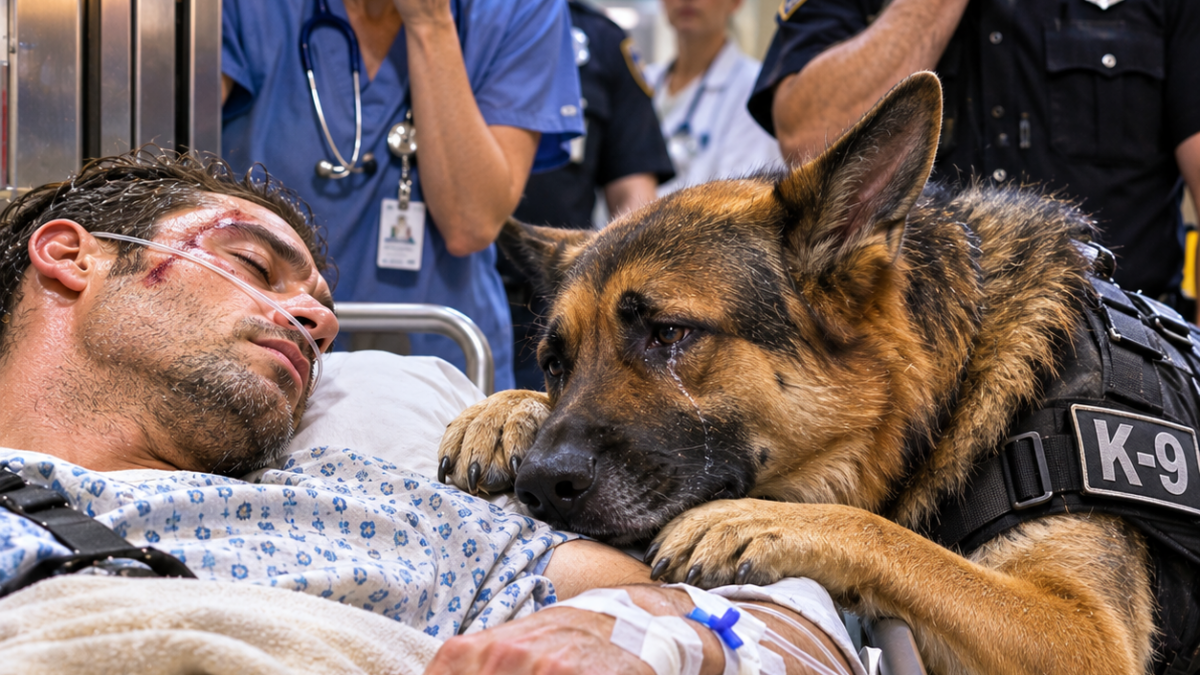
𝗙𝗨𝗟𝗟 𝗦𝗧𝗢𝗥𝗬 𝗜𝗦 𝗜𝗡 𝗧𝗛𝗘 𝗙𝗜𝗥𝗦𝗧 𝗖𝗢𝗠𝗠𝗘𝗡𝗧


I put one hand against his shoulder.
“He didn’t leave you.”
Max gave a small sound.
Almost a question.
My phone rang.
Hospital administration.
Jake had stabilized.
He was awake.
Weak.
Very weak.
But conscious.
And when the nurse asked whether he knew where he was, Jake whispered one word.
Not my name.
Not the captain.
Not a family member.
“Max.”
I closed my eyes.
Then looked at the dog beside me.
“You idiot.”
Max turned toward me.
My voice broke.
“He’s asking for you.”
The hospital administrator had spoken with Dr. Anderson.
Jake could tolerate a brief wheelchair trip to the lobby if his vitals remained stable.
No excitement.
No physical contact.
No dog inside.
Five minutes.
Maybe less.
It was risky enough that the medical team debated it.
Then Dr. Anderson reportedly said:
“If seeing that dog gives him something to fight toward, we can give them five minutes.”
At 7:15, I stood outside with Max.
He had stopped pacing.
That worried me more than the pacing.
He simply watched the glass.
Inside, far down the corridor, an elevator bell rang.
The doors opened.
A nurse emerged pushing a wheelchair.
Jake sat in it.
Pale.
Hospital gown hanging loosely around his shoulders.
IV line taped to his arm.
His face looked smaller.
Older.
For the first time since I had known him, Sergeant Jake Sullivan looked fragile.
Max could not see him yet.
But his nose lifted.
Once.
Again.
His breathing changed.
His ears rose.
And then every muscle in that exhausted dog went absolutely still.
FULL STORY CONTINUATION
I loosened my grip on the leash.
“Max?”
He did not move.
His nose worked rapidly.
He took in the air coming through every opening in the doors.
The nurse pushed Jake farther into the lobby.
Still too far away for Max to see clearly.
Then the wheelchair turned slightly.
Jake lifted his head.
The glass doors separated them by maybe fifteen feet.
Max saw him.
His entire body froze.
I had watched him locate hidden suspects.
I had seen him catch scent during searches.
I had seen him lock onto danger before any officer around him understood why.
Nothing looked like this.
His mouth closed.
His front paw remained suspended slightly above the pavement.
His ears stayed forward.
He stared.
Not at the wheelchair.
Not the nurse.
Jake.
Just Jake.
For several seconds, nobody moved.
Then Max’s tail moved once.
Slowly.
A single sweep.
Jake saw it.
The corner of his mouth lifted.
Max’s tail moved again.
Then faster.
Within seconds, it was hitting both sides of his body so hard that his hips began moving with it.
Still he did not bark.
That was what broke me.
This dog who had spent the entire night searching for his partner did not explode when he found him.
He seemed afraid to disturb the moment.
Jake lifted one hand.
The movement was slow.
Painfully slow.
I could see effort in his face.
He raised his arm toward the glass.
Pressed his palm against it.
Max immediately stepped forward.
One step.
Two.
Three.
He reached the door.
Sniffed.
His nose touched the glass.
Jake whispered something.
We could barely hear it.
“Hey, buddy.”
Max’s ears twitched.
Jake smiled.
“Yeah.”
His voice cracked.
“I know.”
Max lifted his right paw.
For one second, it hovered.
Then he placed it against the glass.
Directly opposite Jake’s palm.
I heard the nurse inhale.
The woman at reception covered her mouth.
A man waiting near the elevators turned away and wiped his face.
I forgot I was holding a leash.
Forgot I was in uniform.
Forgot there were people watching.
Hand.
Paw.
Glass between them.
Less than half an inch.
Five years of patrols reduced to that distance.
Jake leaned forward.
“Good boy.”
Max tilted his head.
That old familiar movement.
Jake had seen it thousands of times.
Training fields.
Living room.
Patrol car.
Station.
Now hospital glass.
Jake laughed.
Barely.
It sounded painful.
Max’s tail hit the door.
Thump.
Thump.
Thump.
Then he began licking the glass where Jake’s hand rested.
Again.
Again.
Again.
Jake closed his eyes.
A tear moved down his cheek.
I had known him nearly a decade.
I had seen him after shootings.
Seen him after funerals.
Seen him stand beside officers’ families and speak when nobody else could.
Jake did not cry easily.
That morning he did not even try to hide it.
“Thought I left you, huh?”
Max licked the glass.
Jake swallowed.
“I’m sorry.”
The words nearly disappeared.
“I’m sorry, buddy.”
I looked down.
That was the moment I had to stop watching for several seconds.
Because Jake was apologizing for almost dying.
To his dog.
Later, he told me he remembered almost nothing from the night before.
Fragments.
Kitchen light.
Chest pressure.
Floor.
Voices.
Hospital ceiling.
Then darkness.
But he remembered waking up.
He remembered panic before memory fully returned.
Something was missing.
Someone.
He couldn’t immediately say what.
Then he understood.
Max.
He asked the nurse.
“Dog?”
She thought he was confused.
“What?”
“Max.”
He tried again.
“My dog.”
Then he passed back into sleep.
When he woke the second time, Max was still the first question.
That was why the doctor eventually agreed to the lobby reunion.
Not because anybody believed the dog was medicine.
Jake needed actual medicine.
Skilled doctors.
Monitoring.
Rest.
Treatment.
But people in hospitals understand something charts cannot always display.
Patients need reasons to care about tomorrow.
Jake’s reason had four legs and was waiting outside.
They remained at the glass for nearly three minutes.
Dr. Anderson had approved five.
I think everyone would have stolen ten if Jake’s condition allowed it.
Max finally sat.
His paw dropped.
But his eyes never left Jake.
Jake kept his hand against the glass.
“Listen to me.”
Max watched.
“I’m coming home.”
His tail moved.
“You hear me?”
Max gave one tiny whine.
“Soon.”
Jake swallowed.
“I promise.”
Something about the word promise made my chest ache.
Because none of us could actually promise.
Jake’s condition was stable.
That did not mean simple.
Recovery could go wrong.
Complications existed.
Doctors were optimistic enough to move him.
Not reckless enough to guarantee anything.
But Max did not need probabilities.
He needed Jake.
And Jake needed to say the thing.
“I’m coming home.”
Max pressed his nose to the glass.
Jake whispered:
“You wait for me.”
Max sat straighter.
The same command he had heard thousands of times.
Stay.
Wait.
Jake tried to smile.
“That’s my boy.”
Dr. Anderson approached.
He did not look eager to end the moment.
But medicine wins eventually.
“Sergeant.”
Jake glanced at him.
“We need to head back.”
“One minute.”
“You said that a minute ago.”
Jake looked back at Max.
“Thirty seconds.”
The doctor sighed.
“Thirty.”
Jake leaned closer toward the glass.
His hand remained there.
Max’s paw rose again.
Same place.
Then Jake whispered:
“I love you, buddy.”
Nobody in that lobby pretended not to hear.
Max’s tail moved once.
Slowly.
Then the nurse touched the wheelchair handles.
Jake lowered his hand.
Max stood immediately.
“Stay.”
The word came weakly.
Max stopped.
His body trembled.
But he stayed.
The wheelchair turned.
Jake looked back.
“Good boy.”
Ten feet.
Twenty.
Max watched.
Jake lifted his hand once more.
Max’s tail moved.
The wheelchair reached the corridor.
Then disappeared.
Max remained standing for several seconds.
I braced for another frantic search.
Another night of pacing.
Instead, he exhaled.
Turned once.
Lowered himself directly in front of the glass doors.
Placed his head on his paws.
And closed his eyes.
No whining.
No pacing.
No searching.
Just sleep.
For the first time since Jake collapsed.
I crouched beside him.
The dog’s breathing slowed almost instantly.
I rested one hand between his ears.
“He’s coming back.”
Max slept.
I stayed there for almost twenty minutes.
I could have moved him.
Didn’t.
Hospital visitors stepped around us.
A nurse came outside with a bowl of water.
I thanked her.
Max did not wake.
Eventually, his body seemed to release everything he had been holding since the night before.
His paws twitched in sleep.
His jaw relaxed.
I looked through the glass.
Thought about what had changed.
Jake was still inside.
Still sick.
Still physically absent.
But Max knew.
There is a difference between absence and loss.
Before the glass, Max had no way to know which one this was.
Now he had an answer.
Jake existed.
Jake had looked at him.
Spoken.
Promised.
That was enough for a dog to finally rest.
When we returned to the station, I placed food in front of Max.
He looked at it.
Then at me.
“Don’t start.”
He sniffed.
I waited.
Then he ate.
Slowly at first.
Then normally.
Sergeant Morales passed the doorway.
Stopped.
“He’s eating?”
“Yes.”
Morales leaned against the frame.
“Good.”
He walked away.
Five seconds later he came back.
“All of it?”
I smiled.
“Pretend you’re not emotionally invested.”
“I am professionally monitoring department property.”
Max looked at him.
Morales scratched his head.
“Good boy.”
Then left before anybody else saw.
That afternoon, I visited Jake.
He was awake.
Machines still surrounded him.
His color had improved slightly.
He looked at me the second I walked in.
“Max?”
“He ate.”
Jake’s eyes closed.
His whole body seemed to relax.
“He slept?”
“Almost immediately after you left.”
A small smile.
“Good.”
“Which means you are now required to do the same.”
Jake opened one eye.
“You always this annoying?”
“Yes.”
“Max likes me better.”
“He has questionable judgment.”
Jake looked toward the window.
After a minute, he said:
“Was he bad?”
I knew what he meant.
“How bad?”
“Last night.”
I hesitated.
Jake saw the answer before I spoke.
“He wouldn’t eat.”
Jake’s jaw tightened.
“Wouldn’t sleep.”
He looked away.
“Kept looking for you.”
Jake swallowed.
“I should’ve—”
“Stop.”
He looked at me.
“What?”
“You are not apologizing for a medical emergency.”
His eyes filled.
“He thought I left him.”
“You didn’t.”
“He didn’t know that.”
“No.”
Silence.
I continued.
“Now he does.”
Jake nodded.
A tear slipped down the side of his face into his hair.
He did not wipe it.
Jake Sullivan had always been difficult to separate from his identity as a police officer.
He had joined young.
Stayed.
Promoted.
Eventually became sergeant.
His marriage had ended years earlier, not because he didn’t care about his wife, but because the job had gradually taken everything he kept promising he would give back later.
No children.
His parents were gone.
His younger brother lived across the country.
Jake had friends.
Plenty.
But his house belonged to him and Max.
That mattered after the hospital.
When doctors asked who could stay with him during recovery, Jake listed me.
Then Morales.
Then, after a pause:
“Max.”
The nurse smiled.
“He can’t monitor your medication.”
Jake answered:
“You haven’t seen him work.”
Five years earlier, Max had been a difficult young K-9.
Smart.
Driven.
Suspicious.
Strong enough to drag an inexperienced handler across a training field.
He was initially assigned to another officer.
That lasted one week.
During training, Max repeatedly broke focus to look toward Jake.
Jake wasn’t even participating.
He was assisting an instructor.
At the end of one session, Jake walked across the field.
Max sat immediately.
No command.
Just sat.
The instructor laughed.
“Looks like somebody requested reassignment.”
Jake said:
“I don’t need a dog.”
Max stared at him.
Jake stared back.
Three months later, they were certified partners.
The department never let him forget it.
“Max picked you.”
Jake always answered:
“I had no say.”
We all knew that became one of the proudest things in his life.
Their routine became almost absurdly precise.
5:30 a.m.
Jake woke.
Max already waiting.
Coffee.
Breakfast.
Equipment check.
Short walk.
Patrol car.
Station.
Training.
Shift.
Home.
Dinner.
Max slept at the foot of Jake’s bed.
When Jake had nightmares after difficult calls, Max sometimes climbed closer.
When Max hurt a paw during training, Jake slept on the floor beside him for two nights.
Nobody knew that except me.
Until now.
That was the relationship missing from the hospital room.
Five years of ordinary days.
The kind you do not appreciate because you believe there will always be another.
For the next week, I brought Max to the hospital entrance every morning.
Usually for ten minutes.
No promises Jake would appear.
Max did not seem to need another reunion.
He simply sat.
Watched.
Sometimes sniffed the air.
Then came home with me.
He ate.
Slept.
Waited.
The panic was gone.
One nurse began calling him “the lobby sergeant.”
A maintenance worker brought him water.
Ms. Clark, the hospital administrator, stopped several times to talk.
On the third morning, she asked:
“Do you think he knows Jake is getting better?”
“I think he knows Jake exists.”
She smiled sadly.
“Maybe that’s enough.”
Jake’s recovery was not a straight line.
That part rarely makes the emotional stories people tell later.
There were good days.
Then bad.
One morning he stood for a few seconds.
The next afternoon, dizziness kept him in bed.
Medication changes.
Tests.
Physical therapy.
Fear.
He hated weakness.
Hated asking for help.
The first time a nurse had to steady him walking to the bathroom, he refused visitors the rest of the day.
I came anyway.
He glared.
“I said no visitors.”
“I can’t read.”
“Go away.”
“No.”
I sat.
Jake stared at the ceiling.
After a minute:
“Max okay?”
“Yes.”
Silence.
Then:
“I hate this.”
“I know.”
“I can barely walk.”
“You nearly died.”
“There it is again.”
“What?”
“That phrase.”
“Because you keep behaving like you missed a workout.”
Jake looked toward the window.
His eyes suddenly filled.
“What if I can’t work again?”
I had no answer.
He continued.
“What happens to Max?”
That was the real question.
Not career.
Max.
If Jake could not return to active K-9 duty, what happened to the dog who had built his entire life around him?
“We’ll figure it out.”
“That’s not an answer.”
“No.”
Jake looked at me.
“You promise he doesn’t get handed to somebody else?”
I took a breath.
“That is above my pay grade.”
“Ramirez.”
“I’ll fight for him.”
Jake nodded.
“Good.”
Then whispered:
“He’s mine.”
I smiled faintly.
“Pretty sure he thinks you’re his.”
Discharge day came one week after the collapse.
Seven days.
To Max, probably a lifetime.
I knew the approximate time.
Jake did too.
The station did not organize a big display.
We discussed it.
Rejected it.
Jake hated being the center of sentimental attention.
Max would be enough.
At 9:50 a.m., I parked outside the hospital.
Max knew something was different.
His tail moved continuously.
He sniffed the entrance.
Then me.
Then the entrance again.
“Calm down.”
He sat.
Immediately.
I laughed.
“Show-off.”
At 10:08, the doors opened.
Not Jake.
Max stood.
A family exited.
He sat again.
Doors opened.
Nurse.
Sat.
Again.
Wheelchair.
Wrong patient.
Max lowered his ears.
I touched his neck.
“He’s coming.”
Then the doors opened one more time.
Jake.
No gown.
Gray sweatpants.
Department sweatshirt.
Still pale.
Still thin.
But outside.
Max stood.
Jake saw him.
Stopped the wheelchair with one hand.
His face broke into a smile.
“Hey.”
Max took one step.
I loosened the leash.
“Easy.”
Another step.
Then another.
He did not run.
That was the part that destroyed everyone watching.
He could have.
He wanted to.
His entire body shook with excitement.
But Max approached as carefully as if Jake were made of glass.
Maybe he smelled illness.
Maybe he read Jake’s movements.
Maybe five years taught him more than we understood.
He reached the wheelchair.
Sat.
Looked up.
Jake’s mouth trembled.
“Hi, buddy.”
Max leaned forward.
Placed his head gently across Jake’s knees.
Jake folded over him.
Both hands entered Max’s fur.
No glass.
No barrier.
Nothing.
Jake pressed his forehead against the top of Max’s head.
“I told you.”
His voice broke.
Max’s tail moved slowly.
“I told you I was coming back.”
Jake began crying.
Not silently this time.
His shoulders shook.
Max did not move.
He simply stayed there.
Head across Jake’s lap.
Exactly where he belonged.
The nurse pushing the wheelchair turned away.
Dr. Anderson stood behind the doors.
Arms folded.
Eyes wet.
Ms. Clark held a hand over her mouth.
Two officers from our department stood near me.
Neither spoke.
There are moments where words become disrespectful.
This was one.
Eventually, Jake lifted his head.
Max sniffed his face.
Then his chest.
Then his hands.
Jake laughed through tears.
“Inspection?”
Max sniffed the wheelchair.
The IV tape mark still visible on Jake’s arm.
The bag of medication.
Then Jake again.
“He thinks you’re counterfeit,” I said.
Jake smiled.
“Smart dog.”
Max’s nose pressed against Jake’s fingers.
Jake whispered:
“Still me.”
Max licked his hand.
Getting Jake into the SUV took longer than he wanted.
He insisted he could stand.
He could.
Barely.
I held one arm.
A nurse held the other.
Jake hated it.
Max watched everything.
The second Jake was seated, Max climbed carefully into the back.
No command.
He turned once.
Lay down.
Pressed his entire side against Jake’s leg.
Jake rested a hand on him.
The drive home was almost silent.
At a stoplight, I looked in the mirror.
Jake’s eyes were closed.
Max’s head rested near his hip.
For the first time since the call, both of them looked peaceful.
At home, Max went insane in the most controlled way possible.
He ran three feet into the house.
Turned.
Back to Jake.
Forward again.
Bedroom.
Back.
Kitchen.
Back.
Living room.
Back.
Every room needed to be inspected.
Jake laughed until he ran out of breath.
“Okay.”
Max returned.
“Everything’s still here.”
Max wagged.
Jake lowered into his recliner.
That effort exhausted him.
I watched his face lose color.
“You done?”
“For now.”
“Good.”
Max immediately lay against his feet.
Jake looked down.
Then whispered:
“Home.”
I pretended not to hear.
That first night frightened Jake.
He never told me until months later.
During the day, being home felt like victory.
At night, the kitchen looked too much like the place where he collapsed.
Every sensation became suspicious.
Heart beating faster.
Chest tight?
Normal?
Danger?
He sat on the edge of his bed at 1:40 a.m.
Too scared to sleep.
Max woke.
Walked over.
Sat in front of him.
Jake put one hand on his neck.
Max stayed.
At 2:13, Jake called me.
“Are you awake?”
“No.”
“Funny.”
“What’s wrong?”
Silence.
“Jake?”
“I’m scared to sleep.”
That sentence frightened me more than anything else.
Jake Sullivan admitting fear was like a building admitting it could fall.
“Any chest pain?”
“No.”
“Breathing okay?”
“Yes.”
“Call the doctor if—”
“I know.”
Silence.
Then:
“I keep thinking if I fall asleep…”
He couldn’t finish.
Max moved near him.
I heard his collar.
“Where’s Max?”
“Here.”
“Put your hand on him.”
“What?”
“Do it.”
“Why?”
“I’m improvising.”
Jake sighed.
Then:
“Okay.”
“Feel him breathing?”
“Yes.”
“Slow?”
“Yes.”
“Match it.”
“You’re an idiot.”
“Breathe.”
Silence.
Several minutes.
Then Jake said quietly:
“He keeps leaning against me.”
“Good.”
“Like he knows.”
“Maybe he does.”
We stayed on the phone until Jake’s voice slowed.
Eventually:
“I think I can sleep.”
“Then sleep.”
“Ramirez?”
“What?”
“Thanks.”
I hung up.
The next morning, I received a text.
4 hours. Max stayed beside me.
I stared at it longer than necessary.
Recovery gave Jake bad days.
People prefer stories where survival instantly creates gratitude.
Sometimes it creates anger.
Jake became furious at his own body.
He snapped at me.
At doctors.
At himself.
One afternoon, he tried walking farther than his rehabilitation plan allowed.
Max followed.
Halfway back, Jake had to sit on a bench.
Sweat on his face.
Hands shaking.
I had followed at a distance because I didn’t trust him.
I approached.
“You’re an idiot.”
“Go away.”
“No.”
“I’m fine.”
“You’re gray.”
“I’m naturally handsome.”
Max sat directly against Jake’s leg.
Jake looked down.
His anger disappeared.
“I hate this.”
I sat beside him.
“I know.”
“I used to run after suspects.”
“You will run again or you won’t.”
He glared.
“That’s motivational.”
“I’m not your motivational speaker.”
His eyes filled.
“What if this is me now?”
I looked at Max.
Then Jake.
“This is you now.”
His face hardened.
I continued.
“Tomorrow may be different.”
That seemed to help.
Not hope.
Honesty.
Max adjusted to Jake’s limitations faster than Jake did.
No pulling.
No racing through doors.
No jumping onto him.
When Jake stood, Max watched.
When Jake sat too quickly, Max got up.
If Jake coughed, Max’s ears lifted.
Once, Jake fell asleep in the recliner.
His head rolled sideways.
Max stood.
Sniffed Jake’s face.
Pushed his nose against Jake’s hand.
Jake woke.
“What?”
Max stared.
Jake looked at me.
“You saw that?”
“Yes.”
“He was checking me.”
“Looks like it.”
Jake placed one hand against Max’s head.
“I’m okay.”
Max lay down.
Jake’s eyes filled.
At the six-week follow-up, Jake asked Dr. Anderson directly:
“Can I go back?”
“To what?”
“Work.”
Anderson looked at him.
“Eventually, maybe.”
Jake’s jaw tightened.
“What does maybe mean?”
“It means your heart doesn’t care that you have a badge.”
I nearly laughed.
Jake did not.
The doctor continued.
“You are progressing well.”
“Good.”
“That does not mean rushing.”
Jake looked toward the door where Max waited with me.
“What about K-9 duty?”
“We’ll decide later.”
Jake’s face fell.
The doctor noticed.
“Sergeant.”
“What?”
“You nearly lost your life.”
Jake looked away.
Anderson’s voice softened.
“Getting it back is not a punishment.”
That line stayed with him.
Around the same time, Jake began asking me uncomfortable questions.
“If I die—”
“No.”
“Ramirez.”
“No.”
“Stop being a child.”
“You first.”
Jake glared.
Then continued.
“If something happens to me, Max goes to you.”
I stopped joking.
“He has departmental status.”
“Captain said we can document preferences.”
“Okay.”
“He knows you.”
“Yes.”
“He trusts you.”
“Not like you.”
Jake looked down.
“No one like me.”
The sadness in that sentence nearly broke me.
I said:
“You’re not going anywhere.”
Jake smiled faintly.
“That promise again.”
I understood.
The hospital glass.
Soon.
Coming home.
Promises are dangerous after medical emergencies.
So I changed it.
“Then while you’re here, do the paperwork.”
Jake nodded.
“Fair.”
We did.
Two months after the collapse, Jake returned to the station for a visit.
Not work.
Just visit.
He wore jeans.
Max came with him.
The second we entered, people pretended not to make a big deal.
They failed.
Someone clapped.
Then everyone.
Jake stopped.
“Oh, for God’s sake.”
Max barked.
The room erupted.
Morales yelled:
“Speech!”
Jake raised one finger.
We all laughed.
Then he walked toward his old desk.
Max beside him.
Same pace.
Same place.
Jake sat.
Max lowered himself beneath the desk.
Exactly as before.
The room became quiet.
Jake looked down.
Touched the dog’s head.
Then quickly looked away.
I knew why.
Normal can hurt when you thought you lost it.
Three months after the cardiac event, Jake received clearance for a phased return.
Administrative duty first.
Then limited training.
Then short patrol if testing remained stable.
No heroics.
No arguments.
Jake agreed to everything.
Mostly because the alternative was staying home.
The morning he put on the uniform again, I was at his house.
He pulled on duty pants.
Max stood.
Jake reached for his shirt.
Max began pacing.
Boots.
Max barked.
Jake froze.
The dog ran to the front door.
Jake’s face crumpled.
I pretended to check my phone.
“You okay?”
“No.”
He laughed.
“I forgot what that looked like.”
Max stared at him.
Jake crouched carefully.
“We’re going back.”
Max’s tail exploded.
Jake rested his forehead against Max’s.
“We’re going back, buddy.”
Their first real patrol was intentionally boring.
Daytime.
Four hours.
No major calls.
Traffic assist.
Welfare check.
Paperwork.
Lunch.
Jake loved every second.
Max looked like somebody had restored gravity.
Everything fit again.
At the end of shift, Jake opened the cruiser door.
Max jumped inside.
Jake stood there.
Hand on the frame.
I was walking past.
“You okay?”
He nodded.
Then smiled.
“I’m really here.”
That was the first time I believed he had emotionally survived too.
People began telling the story.
At first around the department.
Then outside.
Someone had photographed the glass-door moment from the lobby.
Jake’s palm.
Max’s paw.
Two silhouettes.
The image spread.
Jake hated attention.
“He looks better than I do.”
“He has better hair.”
“True.”
K-9 units from other departments sent messages.
Patients sent notes.
Families wrote about dogs waiting outside surgeries.
Jake read more of them than he admitted.
One letter came from a twelve-year-old girl whose father was in cancer treatment.
She wrote:
My dog waits outside Dad’s bedroom every time he comes home from chemo. I think dogs know when people are fighting to stay.
Jake stared at that sentence for a long time.
Then folded the letter carefully.
He kept it.
Hospital Administrator Clark later invited Jake and Max back.
A small staff event.
Jake resisted.
Then agreed.
When Max reached the hospital entrance, he stopped.
The lobby had not changed yet.
Same doors.
Same glass.
He walked to almost the exact spot where he had waited.
Then looked at Jake.
Jake stood beside him.
Same side.
That mattered.
Ms. Clark approached.
“Max.”
The dog greeted her.
She smiled.
Then looked at Jake.
“You look much better.”
“I feel much better.”
She hesitated.
“Can I ask you something?”
“Sure.”
“What did that first reunion mean to you?”
Jake stared through the glass.
For a while, he didn’t answer.
Then:
“When I woke up in ICU, everything was about what happened.”
She waited.
“Heart.”
“Blood pressure.”
“Medication.”
“Risk.”
He looked down at Max.
“Then I saw him.”
Jake swallowed.
“And I remembered what still existed outside the hospital.”
Ms. Clark’s eyes filled.
“Home?”
Jake nodded.
“Home.”
He touched Max’s neck.
“He gave me somewhere to go.”
That phrase became important.
Some people survive and then struggle with the question:
For what?
Jake didn’t.
Max answered before the question finished.
Home.
Walks.
Patrol.
Food at 5:30.
A dog who would stare at the door until he returned.
Recovery wasn’t abstract.
It had a face.
At the police academy, new K-9 handlers eventually heard the story.
One recruit asked Jake:
“Does a dog really understand that kind of separation?”
Jake smiled.
“I don’t know what Max understood medically.”
The recruit waited.
“He understood I was gone.”
Another recruit asked:
“And seeing you fixed it?”
Jake shook his head.
“No.”
He looked toward Max.
“It gave him information.”
“What information?”
“I was alive.”
Simple.
True.
Jake continued.
“And he gave me information too.”
“What?”
Jake smiled.
“Someone was waiting.”
Their partnership deepened after the hospital.
Not because everything became sentimental.
They still worked.
Training remained strict.
Commands remained commands.
Max was still a professional working dog.
But something subtle changed.
Jake became less careless with time.
Before, he would take overtime without thinking.
After, he went home when he could.
He stopped treating every free day like a chance to catch up on paperwork.
He walked Max longer.
Sat on the porch.
Sometimes did nothing.
I once teased him.
“You’re becoming emotionally healthy.”
“Take that back.”
A year later, Jake’s cardiology follow-up was stable.
Not perfect.
Stable.
He obeyed medication.
Mostly obeyed diet.
Complained about both.
Dr. Anderson looked at him.
“You’re doing well.”
Jake nodded.
The doctor pointed toward Max outside.
“Still your personal trainer?”
“Yes.”
“Keep him.”
Jake smiled.
“Wasn’t planning otherwise.”
Time kept moving.
That is the part every emotional reunion story eventually confronts.
Jake recovered.
Max aged.
At first, slowly.
Then noticeably.
Gray appeared around his muzzle.
Long shifts tired him.
His hips stiffened after cold mornings.
A veterinarian eventually said the words Jake had been avoiding.
“Retirement.”
Jake went silent.
Max still wanted to work.
Dogs do not understand career transitions.
They understand routines.
The department chose to retire Max before pain turned service into suffering.
Jake agreed.
Then cried in the parking lot afterward.
He thought no one saw.
I did.
I kept walking.
Some grief deserves privacy.
Max’s final shift was treated like a celebration.
Photographs.
Treats.
A ceremonial collar he hated.
Officers kneeling beside him.
Jake smiling too broadly.
At the end, he removed Max’s working harness.
Held it.
For years, the harness meant:
We go together.
Now it meant:
You stay.
The next morning, Jake dressed for work.
Max walked to the door.
Jake stopped.
“Buddy.”
Max wagged.
Jake crouched.
“You’re staying home today.”
Max tilted his head.
Jake’s voice broke.
“No work.”
Max looked toward the cruiser.
Then back.
Jake sat on the floor.
I happened to be there.
He stayed beside Max for almost fifteen minutes.
No words.
Eventually, Jake left.
Max watched from the window.
That reminded me of the hospital.
Except this time, Jake was healthy.
And he would come back.
Max knew that now.
That mattered.
Retirement turned Max into an ordinary dog.
Or as ordinary as a retired K-9 can become.
Sunlight.
Couch naps.
Slow walks.
Stealing food.
Children petting him at department events.
Jake complained that Max had “lost discipline.”
Then gave him pieces of steak under the table.
“You’re the problem,” I said.
“He earned it.”
As Max grew older, the hospital photograph changed meaning.
At first, it represented survival.
Then loyalty.
Later, time.
Jake kept it framed in his house.
One night, I noticed it facedown.
“Why?”
Jake shrugged.
I waited.
Finally:
“He looked young.”
I looked toward Max asleep nearby.
Gray muzzle.
Slow breathing.
I understood.
Photographs eventually become evidence of how quickly life moved.
Jake whispered:
“I wish dogs got thirty years.”
I had no answer.
Nobody does.
One winter evening years after the hospital, Jake called me.
“Can you come over?”
His voice told me everything was wrong before he explained.
“What happened?”
“Max can’t stand.”
I grabbed my keys.
The veterinarian met us.
Max was old.
His hips had deteriorated.
That night was frightening.
But treatment helped.
He went home.
Not forever.
For more time.
That was enough.
Jake placed blankets beside his bed.
Slept on the floor with Max.
At midnight, I stood in the doorway preparing to leave.
Max’s head rested across Jake’s thigh.
Same place as discharge day.
Jake looked down.
Then at me.
“We saved each other.”
This time, I did not joke.
“Yes.”
Max stayed long enough for more mornings.
That detail matters.
Stories often rush toward endings because endings feel important.
But love is mostly the ordinary days before them.
Jake making coffee.
Max asleep.
A slow walk to the corner.
Medication hidden inside food.
A dog choosing the warmest patch of sunlight.
Jake reading on the porch.
Max shifting closer.
Nothing dramatic.
Everything.
When people tell the hospital story now, they exaggerate.
They say Max waited three days without eating.
No.
One terrible night.
That was enough.
They say Jake was clinically dead for ten minutes.
I never heard that from Jake or his doctors.
They say Max broke through hospital doors.
He did not.
The truth needs no embellishment.
A man nearly died.
His dog had no idea where he went.
The dog searched all night.
Refused food.
Could not sleep.
Waited outside a hospital.
Then saw the man through glass.
Placed one paw against his hand.
And finally lay down.
That is already extraordinary.
Years later, Jake spoke at the academy.
A recruit asked:
“Sergeant, did Max save your life?”
Jake thought carefully.
“The doctors saved my life.”
The room became quiet.
“Nurses.”
“Medication.”
“Rehab.”
“People who knew what they were doing.”
Then he looked down at Max.
“But he reminded me why I wanted the life they were saving.”
Nobody spoke.
That sentence became the version I remember.
The medical team gave Jake more years.
Max gave those years a shape.
Morning.
Home.
Work.
Companionship.
Purpose.
Jake once told me:
“When you’re lying in ICU, people talk about recovery like it’s a destination.”
I asked:
“What is it?”
He scratched Max’s ears.
“A reason to get up tomorrow.”
Eventually, the hospital remodeled its entrance.
The glass doors were replaced.
The lobby changed.
The spot where Max waited disappeared.
When Jake learned that, he laughed.
“Good.”
“Good?”
“Yeah.”
“Why?”
He looked at Max.
“We don’t need the glass anymore.”
I had not expected that answer.
It stayed with me.
Max eventually became too old to attend department events.
Jake stopped taking him.
Not because Max disliked them.
Because Jake did not want strangers crowding him.
They spent more time at home.
The world narrowed.
Porch.
Yard.
Kitchen.
Bedroom.
Short sidewalk.
But Max never seemed to mind.
His world had always been Jake.
A smaller radius did not mean a smaller life if the center remained.
One evening, I sat with Jake while Max slept.
The dog’s breathing was slow.
Jake watched every breath.
“That hospital night…”
I looked at him.
“What about it?”
“I thought Max was the one waiting.”
“He was.”
Jake smiled.
“So was I.”
I frowned.
He continued.
“When I woke up, I didn’t know what came next.”
He looked down.
“I was waiting to know whether my life was still mine.”
“And?”
“Then I saw him.”
Jake’s eyes filled.
“I thought:
There it is.”
I said nothing.
“Something that still knows me.”
He touched Max’s head.
“Not Sergeant Sullivan.”
“Not patient.”
“Not cardiac case.”
“Just Jake.”
His voice broke.
“His person.”
That was the truth beneath everything.
Max had no interest in titles.
Ranks.
Medical diagnoses.
Heroic reputations.
He did not care whether Jake could run a mile.
Lead a shift.
Wear a uniform.
He wanted Jake.
That was all.
Sometimes being loved that simply is terrifying.
Because it removes every excuse to believe you are valuable only when useful.
Jake had spent decades proving his worth through work.
Max valued him asleep on a couch.
Sick.
Weak.
Retired.
Old.
Alive.
Years after the original hospital reunion, a young officer asked me what the most important lesson from K-9 work was.
I almost gave him a technical answer.
Instead, I said:
“Be someone worth waiting for.”
He laughed.
I didn’t.
Because I meant it.
Max waited because Jake had returned every other time.
Trust is built on repetition.
Day after day.
Door after door.
Come back.
Come back.
Come back.
Until the one night you don’t.
Then the creature who loves you has five years of evidence saying this absence should end too.
Max waited because Jake had taught him the world worked that way.
And Jake fought his way home because Max was still there expecting the promise to remain true.
The photograph of the paw against the palm remains my favorite photograph from my entire career.
Not because it is dramatic.
Because of what happened after it.
Max slept.
That is the part the photograph cannot show.
The dog who had refused rest finally closed his eyes.
Why?
Because he had seen Jake.
That single sight gave him permission to stop searching.
There is something heartbreaking about that.
And beautiful.
One night at Jake’s house, years later, Max woke suddenly.
He looked toward Jake’s chair.
Jake was there.
Reading.
Max stared.
Jake noticed.
“What?”
Max’s tail moved.
Jake smiled.
“Still here.”
Max put his head back down.
I watched.
Same conversation.
Different room.
No glass.
No emergency.
Just reassurance.
Still here.
I think that is what most love asks eventually.
Not grand promises.
Not heroism.
Just:
Are you still here?
Yes.
On the morning of the hospital reunion, Jake told Max:
“I’m coming home.”
He meant in a week.
Maybe he meant longer.
Maybe neither of them knew.
Years later, every time Jake opened his front door after shift, Max stood there.
Every time, the promise was fulfilled again.
Home.
When Max grew too weak to stand quickly, he still lifted his head at the sound of Jake’s key.
When his hearing faded, he recognized vibration.
When his eyesight softened, scent remained.
When even scent seemed weaker, somehow he still knew.
Jake.
His person.
One afternoon, Max struggled to move from the living room to the porch.
Jake started to help.
Max resisted.
Still proud.
Still Max.
He eventually made it.
Collapsed onto his favorite spot.
Jake sat beside him.
Sunlight crossed the porch.
I sat on the steps.
Nobody spoke.
Max rested his head against Jake’s leg.
Jake looked down.
“Remember the hospital?”
I smiled.
“He probably doesn’t.”
Jake stroked him.
“I do.”
A pause.
“I thought that was the worst night of my life.”
He looked toward the yard.
“Now I’d take it again.”
I understood.
Because at the end of that night, Jake and Max were still at the beginning of more years together.
Painful memories become precious when they contain people you would give anything to have young again.
Max’s life did not need a dramatic final scene in this story.
The original story is about waiting.
About returning.
About a bond tested by one terrifying separation and strengthened afterward.
So I will leave him where Jake always remembered him best.
At Jake’s feet.
Head on his knees.
Eyes closing because the person he trusted was there.
Safe.
At the station, the story remains.
The dog who waited.
The dog who would not eat.
The dog who refused to sleep.
The dog who sat outside a hospital until he saw his partner alive.
Rookies hear it.
Some think it is sentimental.
Then they work long enough with an animal.
Eventually, they understand.
Jake’s answer never changes when someone asks what the bond meant.
“We saved each other.”
People often think he means dangerous calls.
Max protecting Jake.
Jake protecting Max.
That happened.
But I know he means the hospital.
Jake gave Max a home.
Max gave Jake a reason to return to it.
Simple.
If I could return to that morning at 7:15, I would pay attention to one detail I almost missed.
Not the paw.
Not Jake crying.
Not the people stopping.
Max’s eyes.
Before he saw Jake, they looked exhausted.
Lost.
Then Jake appeared.
The fear vanished.
Not slowly.
Instantly.
The dog did not need to understand the illness.
He did not need to know Jake’s prognosis.
He needed to know one thing.
You are still in this world.
Jake needed the same answer.
He looked through that glass at the dog who had waited all night.
And Max’s existence told him:
So are you.
The doors eventually opened.
A week later, Jake came through them.
Max approached slowly.
Placed his head on Jake’s lap.
Jake buried both hands in his fur.
Nothing between them.
That was the moment the story reached its highest point.
Not because the hospital battle was over.
Recovery remained.
Fear remained.
Work remained.
But separation ended.
The promise became physical.
Warm fur.
Human hands.
No glass.
Months later, Jake stood in uniform again.
Max beside him.
Someone at the station joked:
“Thought we got rid of you.”
Jake looked at Max.
“No chance.”
Everyone laughed.
But I heard the deeper truth.
No chance.
Not after waiting like that.
The bond between Jake Sullivan and Max was not magical.
It was built.
Five years.
Thousands of repetitions.
Food.
Training.
Commands.
Car rides.
Danger.
Sleep.
Home.
Trust.
One terrifying night did not create it.
That night revealed what five years had already made.
When people ask whether dogs love the way humans do, I do not argue science with them.
I tell them what I saw.
A working K-9 whose partner disappeared.
Food untouched.
No sleep.
Hours at the door.
Then the man appeared behind glass.
The dog put his paw against the man’s hand.
Five minutes later, the man disappeared again.
And the dog lay down.
Why?
Because whatever word you prefer—bond, attachment, conditioning, loyalty, love—the result was the same.
He had found his person.
That was enough.
Years later, I still remember the sound Max’s tail made against the glass.
Thump.
Thump.
Thump.
Jake’s weak smile.
His hand trembling slightly.
“Good boy.”
The paw lifting.
Touching the same place.
I remember thinking that people spend entire lives trying to explain loyalty.
And there it was.
No explanation necessary.
The most painful part was not the hospital.
It was the empty night before it.
Max checking rooms.
The food untouched.
The door.
Every passing car.
That is where the love showed itself first.
Not in reunion.
In absence.
You learn what someone means to you when the routine that contains them suddenly breaks.
Max’s world had a Jake-shaped hole.
Nothing else fit.
The most beautiful part was not the glass either.
It was after.
Max finally sleeping.
Because love is not only excitement when someone returns.
Sometimes love is the relief of being allowed to rest because you finally know the person you were afraid of losing still exists.
And the most important part came one week later.
No glass.
Jake’s knees.
Max’s head.
“I told you I’d come back.”
That sentence became the promise underneath every year they had afterward.
I have seen many things in police work that I wish I could forget.
That morning is one I hope I never do.
Because whenever the job makes the world look cruel, I remember a dog outside a hospital.
I remember a sick man inside.
I remember a wall of glass.
And I remember both of them finding each other through it.
Five years together taught Max that Jake always came back.
One terrible night made him doubt it.
One hospital window restored the truth.
One week later, the doors opened.
And Jake kept his promise.
If Max could have spoken that morning, I think he would have said only one thing.
Not:
Why did you leave?
Not:
Where were you?
Not even:
I missed you.
Just:
There you are.
And if Jake had answered in the language beneath words, I think his reply would have been just as simple.
I came back.
That is the whole story.
Not a miracle.
Not magic.
A man almost lost.
A dog who waited.
Doctors who saved a life.
A hospital willing to give two partners five minutes through a glass door.
A promise.
A return.
And years afterward, one old K-9 still lying at the feet of the man he once refused to stop searching for.
Jake had given Max a home five years earlier.
But on the darkest night of Jake Sullivan’s life, Max gave that word back to him.
Home.
A place beyond the ICU.
Beyond the monitors.
Beyond fear.
A place where somebody was waiting.
And perhaps that is why Jake always smiled when people called Max loyal.
Because he knew the truth was larger than that.
Max had not simply waited for him.
He had reminded Jake that surviving meant returning to someone who still believed he would.
And on that morning at 7:15, with one paw pressed against one trembling hand through a cold sheet of glass, they made the promise without ever needing to say it clearly.
You don’t leave me.
I won’t.
And for every day they were given afterward—
they kept it.








