𝗙𝗨𝗟𝗟 𝗦𝗧𝗢𝗥𝗬:“GIVE THE SHARKS MY REGARDS, BILLIONAIRE!” My Sister Pushed Me Off My $150 Million Yacht While Our Parents Watched — They Thought They Had Inherited $5.6 Billion, But They Had Missed One Terrifying Detail
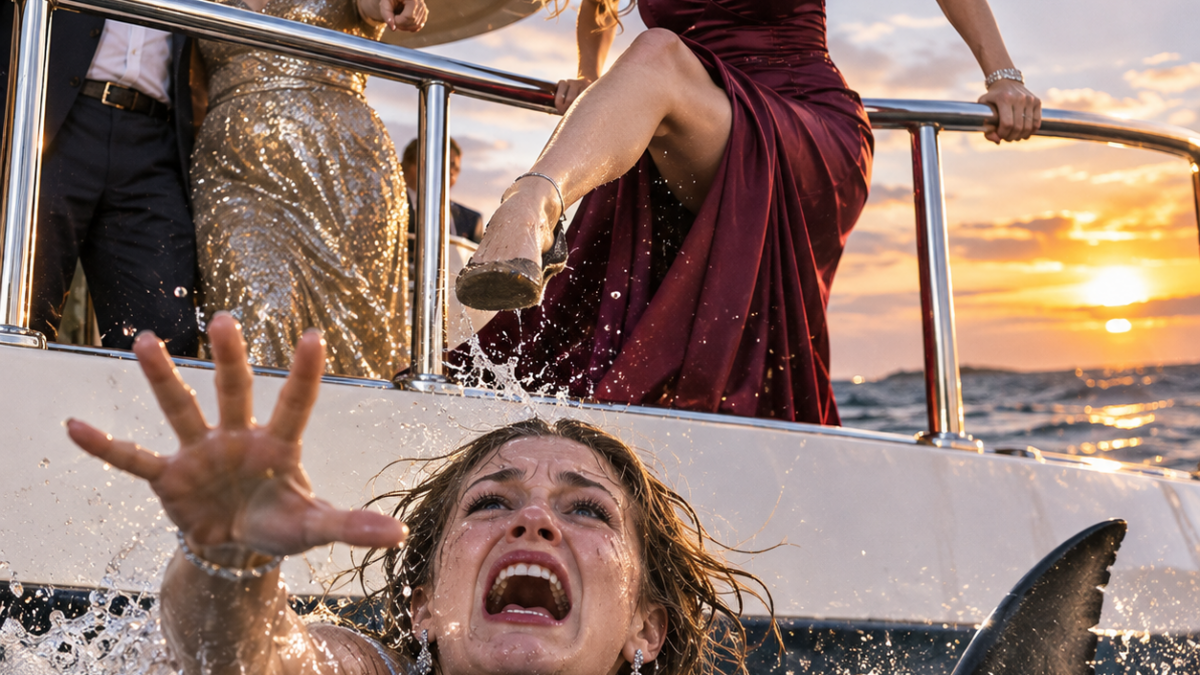
“Elias, darling,” my mother said, touching my arm with fingers covered in diamonds, “you really ought to think more seriously about your health.”
I turned toward her.
“My health?”
“You work too much. You never rest. Your father and I worry.”
Across the table, Chloe leaned forward.
“Actually, we were just discussing your estate planning.”
I watched her carefully.
“My estate planning?”
She smiled.
“You know, wills, beneficiaries, trusts. The usual things responsible billionaires take care of.”
My father chuckled.
“Your sister has a point. A man with your wealth should make certain his family is protected.”
I looked at the three people sitting before me.
For years, I’d tried to convince myself that their obsession with my money was simply their clumsy way of showing concern.
But I’d learned to recognize the difference between people who worried about losing me and people who worried about losing access to my bank accounts.
“Everything is taken care of,” I replied.
Chloe’s eyes brightened.
“Really?”
“Every asset. Every company. Every contingency.”
My father raised his glass.
“That’s my boy.”
I didn’t raise mine.
Instead, I walked toward the aft railing and stared into the water.
Behind me, their voices dropped.
I heard Chloe whisper something.
My mother gave a quiet laugh.
Then Dad said, “Just make sure there aren’t any complications.”
My pulse quickened.
I knew they were discussing me.
More precisely, I knew they were discussing how much easier their lives would become if I disappeared.
Still, some foolish part of me hoped I was wrong.
I wanted my mother to ask me whether I was happy.
I wanted my father to stop measuring my worth in dollars.
I wanted my sister to remember the years when we were children, before jealousy and entitlement consumed everything between us.
Instead, I heard footsteps approaching.
“Elias,” Chloe said sweetly, “there’s one more thing.”
I started turning.
Two hands struck my back.
My stomach slammed against the railing, and suddenly there was nothing beneath my feet.
I heard my sister’s laughter.
I saw my parents smiling.
Then the ocean rushed toward me.
The impact stole every breath from my body.
Cold water swallowed me, dragging me beneath the surface as the yacht’s enormous hull moved away overhead.
I kicked upward, but my muscles were already tightening from shock.
My lungs burned.
The light above me grew smaller.
For one terrifying moment, I wondered whether I had prepared for everything except the possibility that my family would actually go through with it.
Then something vibrated beneath me.
A deep mechanical hum passed through the water.
And far below, two green lights suddenly appeared in the darkness.
FULL STORY CONTINUATION
At first, I thought the lights belonged to something alive.
They moved together through the darkness, growing brighter as they approached. A low vibration trembled through the water, followed by a narrow beam of light that illuminated the bubbles rising around me.
Then I recognized the shape beneath the lights.
A titanium-gray submersible.
Mine.
The compact tactical extraction vessel was part of the Axiom’s security system, designed for underwater inspections, emergency recovery, and operations that required discretion.
I had insisted it remain operational during our voyage.
My security chief had thought I was being excessively cautious.
Now I was grateful she’d listened.
I tried to swim toward the approaching vessel, but my arms barely responded. My chest felt as though it were collapsing inward. Every instinct screamed at me to breathe, even though I knew doing so underwater would be catastrophic.
A diver emerged from the submersible’s exterior compartment.
He moved quickly, securing me with a recovery harness while another crew member guided us toward the vessel’s access chamber.
I remember the pressure of someone’s hand against my shoulder.
I remember being pulled through the hatch.
And I remember the astonishing relief of air entering my lungs.
Then I started coughing so violently that I couldn’t speak.
“Elias! Can you hear me?”
A woman was kneeling beside me.
Captain Mara Voss.
She was forty-one, a former naval officer who had spent the past five years overseeing my personal security.
Her dark hair was secured tightly behind her head, and her expression was controlled, though her eyes betrayed how frightened she was.
“Elias, look at me.”
I tried.
“Can you breathe?”
I nodded weakly.
“Good. Don’t try to stand.”
A medic fitted an oxygen mask over my face while another checked my pulse and examined the bruising across my ribs.
Mara pressed a headset against her ear.
“Recovery confirmed. Subject conscious. Proceed to rendezvous.”
The submersible’s engines changed pitch.
I lay against the narrow medical berth, shaking uncontrollably.
For several minutes, all I could hear was the machinery and the rush of air through the mask.
Then I managed to speak.
“They did it.”
Mara leaned closer.
“What?”
“My family.”
She went still.
“Chloe pushed me.”
Her jaw tightened.
“And your parents?”
I stared at the metal ceiling.
“They watched.”
Mara didn’t say anything.
“They smiled,” I whispered.
Her expression changed.
In five years, I had seen her respond to attempted break-ins, serious threats, and a security incident involving a disgruntled former employee.
I had never seen her look so furious.
“I’m sorry, Elias.”
I shook my head.
“No.”
I swallowed against the burning pain in my throat.
“You warned me.”
She looked away.
Three weeks earlier, Mara had come to my office carrying a report concerning unusual communications between my sister and people who had been asking questions about the Axiom’s safety procedures.
At the time, the evidence was troubling but incomplete.
Chloe had asked about emergency response times, the location of life-saving equipment, and which crew members were responsible for monitoring the aft deck.
She had also shown a sudden interest in how deaths at sea were investigated.
I wanted to believe she was simply curious.
Mara did not.
She had recommended canceling the family voyage.
I refused.
Not because I wanted to die.
Not because I believed I was invincible.
Because I couldn’t quite accept that people who had known me since birth might actually intend to kill me.
I agreed to additional precautions, including underwater recovery support, discreet surveillance, and emergency communication protocols.
But a part of me still believed the trip would end with an ugly conversation rather than a murder attempt.
Now I understood how dangerous that hope had been.
“Did you record it?” I asked.
Mara nodded.
“We have the deck camera footage. Several security personnel witnessed the incident. The bridge team logged what happened.”
“And the captain?”
“The yacht’s captain is cooperating. The appropriate maritime authorities have been notified through our legal team.”
I closed my eyes.
“Do they know I’m alive?”
“The authorities do. Your family doesn’t.”
I looked at her.
Mara hesitated.
“Your attorney recommended keeping your status confidential from the suspects until investigators determine the safest way to proceed.”
I thought of Chloe laughing.
My parents smiling.
The yacht sailing away without attempting to rescue me.
“Good,” I said.
Mara studied my face.
“Elias, I need you to understand something. We have evidence, but you came dangerously close to dying. This wasn’t a successful experiment. It was an attempted murder.”
I turned toward her.
“I know.”
“Then promise me you won’t take another unnecessary risk.”
I thought about the look on my mother’s face.
The woman who used to tuck me into bed had watched me fall into the ocean as though I were nothing more than a problem being solved.
“I promise,” I whispered.
But even as I said it, I knew something inside me had changed forever.
The medical examination took place aboard a support vessel operating several miles from the Axiom.
By then, the ocean had turned black.
A storm was forming on the horizon, and the support ship rolled gently beneath us.
I had bruised ribs, strained muscles, and early symptoms of cold-water exposure, but the medical team found no immediate injury that required emergency surgery.
I was fortunate.
Painfully, impossibly fortunate.
At one point, the doctor told me that another few minutes in the water could have changed everything.
I lay on the examination bed and stared at the ceiling.
Another few minutes.
That was all that had separated my life from my sister’s plan.
I had spent years calculating financial risk down to fractions of a percentage.
I understood investment exposure, cybersecurity vulnerabilities, corporate acquisitions, and the mathematical consequences of decisions affecting billions of dollars.
Yet I had nearly died because I couldn’t bring myself to believe my family was capable of murder.
Mara returned carrying a tablet.
“There’s something you need to see.”
I sat up carefully.
She pulled a chair beside the bed.
On the screen was footage from one of the Axiom’s concealed exterior cameras.
The image showed the aft deck.
I was standing near the railing.
Chloe approached.
Even without sound, I recognized the impatient movement of her shoulders.
Then she shoved me.
I watched myself disappear over the railing.
My stomach twisted.
“Stop.”
Mara immediately paused the recording.
I pressed my hand against my chest.
For a moment, the room seemed to tilt.
“I thought I was ready.”
“You don’t have to watch it now.”
I looked away.
“I just wanted to know whether it really happened the way I remembered.”
Mara’s voice softened.
“It did.”
I took a trembling breath.
“And my parents?”
She hesitated.
“Elias.”
“Please.”
She resumed the footage.
After I disappeared, Chloe leaned over the railing.
My father walked forward.
My mother joined him.
For several seconds, all three looked down into the ocean.
Nobody reached for a life ring.
Nobody shouted for help.
Nobody ran toward the bridge.
Then my father placed his arm around my mother’s waist.
And she smiled.
I turned my face away.
“Turn it off.”
Mara did.
I sat silently for a long time.
Then I asked, “Did anyone try to make them help?”
“Two crew members moved toward the rescue equipment. Your father ordered them to stay back and claimed you’d jumped voluntarily.”
I looked at her.
“What?”
“Security personnel intervened. The crew began the prescribed emergency response, but your family attempted to interfere.”
My pulse quickened.
“They told everyone I jumped?”
“Yes.”
“Why would I jump?”
Mara’s expression hardened.
“They weren’t thinking about whether the story made sense. They were thinking about whether they could make someone believe it.”
I stared at the blank screen.
For years, my parents had rewritten every argument we ever had.
If Dad insulted me, I had misunderstood.
If Mom humiliated me, I was too sensitive.
If Chloe stole something, I was selfish for refusing to share.
Now they were trying to rewrite the last moments of my life.
Only this time, there were cameras.
And witnesses.
And I was still alive.
I had never wanted to believe that my family loved my money more than they loved me.
The first time I made a million dollars, I bought my parents a house.
Not the mansion I owned in Washington.
A comfortable home in Connecticut, near the friends they’d known for decades.
My father complained that the neighborhood wasn’t prestigious enough.
My mother asked why I hadn’t bought something with a larger garden.
Chloe wanted to know why she hadn’t received a property of equal value.
I told myself they were simply overwhelmed.
The first time my company reached a valuation above one billion dollars, I paid off my parents’ debts.
There were more than I realized.
My father had made disastrous investments.
My mother had taken out loans to maintain appearances.
Chloe had accumulated credit card balances that would have frightened most working professionals.
I cleared the legitimate obligations and put financial advisers in place.
Six months later, they were spending recklessly again.
When I asked why, my father looked offended.
“Are you seriously going to lecture me about money?”
I remember standing in his study.
“Dad, I’m trying to help.”
“You’re trying to humiliate me.”
“I just paid off your debts.”
“And now you think you own me?”
I had been twenty-seven.
Still young enough to believe that if I explained myself carefully, eventually he would understand.
I didn’t recognize the pattern.
He wanted my money without accepting my boundaries.
Mom wanted my generosity without acknowledging my sacrifices.
Chloe wanted my lifestyle without doing the work that had created it.
Whenever I said no, I became the cruel one.
Whenever I gave them something, it became evidence that I could afford to give them more.
By the time I bought the Axiom, the demands had become relentless.
Chloe wanted access to my private aircraft.
Dad wanted a seat on my company’s board.
Mom insisted that I purchase a vacation estate in France so the family could entertain guests.
I refused the board seat.
I declined to buy the French property.
I set clear limits on the plane.
My father called me ungrateful.
Chloe called me controlling.
Mom cried and asked what she’d done to deserve such a selfish son.
I believed setting boundaries might eventually improve our relationship.
Instead, my family began searching for ways around them.
The first warning came six months before the yacht party.
My estate attorney, Daniel Mercer, requested a private meeting.
Daniel had represented me since my company was small enough to operate from a rented office above a hardware store.
He wasn’t impressed by wealth.
He’d known me when I paid him in installments and worried about making payroll.
That was one reason I trusted him.
He arrived carrying a thin folder.
“Elias, I need to ask you something unusual.”
I leaned back in my chair.
“Go ahead.”
“Have you recently authorized your father to speak on your behalf about your estate?”
I frowned.
“No.”
“Your sister?”
“No.”
He placed the folder on my desk.
“We’ve received inquiries from third parties who appear to believe your family has some authority over your succession planning.”
I stared at him.
“What kind of inquiries?”
“Beneficiary designations. Trust structures. Potential changes in ownership following your death.”
I laughed.
It was instinctive.
Not because the situation was funny.
Because the alternative was too disturbing to consider.
“Daniel, I’m thirty-two.”
“I know.”
“I’m healthy.”
“I know that too.”
“Then why would anyone be asking about my death?”
Daniel folded his hands.
“That’s what concerns me.”
I looked down at the papers.
Some inquiries came through financial intermediaries.
Others originated with attorneys I had never retained.
One communication mentioned Chloe by name.
Another referenced my father’s supposed role in managing family assets.
I felt a cold sensation move through my chest.
“What do you recommend?”
“Review everything. Tighten the authorization procedures. And stop discussing your estate with anyone who doesn’t have a legitimate reason to know.”
I nodded.
Then I asked the question I was afraid to ask.
“Do you think my family is trying to steal from me?”
Daniel looked at me.
“I think someone is behaving as though your death would create an opportunity.”
I didn’t sleep that night.
The next warning was more difficult to dismiss.
Mara brought me a report about the Axiom.
My family had been asking crew members questions about voyage routes, emergency procedures, and the availability of small boats.
Chloe had requested access to restricted areas twice.
Dad had asked whether the yacht’s security cameras could be disabled during private gatherings.
Mom had repeatedly complained that the crew was too visible and should remain out of sight during family events.
Individually, each request could have been explained.
Together, they formed a pattern.
I asked Mara what she thought.
She didn’t hesitate.
“I think they’re testing the security arrangements.”
“Why?”
“I don’t know yet.”
I looked toward the window.
The Seattle skyline was disappearing into evening fog.
“Maybe they’re just embarrassed about being watched.”
“Then why ask about rescue equipment?”
I didn’t answer.
Mara leaned forward.
“Elias, I know they’re your family. But my job is to protect you, not to protect your feelings about them.”
I looked at her.
“Do you think they’re dangerous?”
She paused.
“I think they’ve become comfortable imagining a world where you’re not in charge of your own money.”
That sentence stayed with me.
A world where I wasn’t in charge.
My father had spent years trying to gain control of my companies.
Chloe had pressured me to change beneficiary arrangements.
Mom had repeatedly reminded me that family wealth should remain in the family.
Now they were asking about emergency procedures aboard a yacht.
I wanted to cancel the voyage.
I almost did.
Instead, I decided that if they insisted on having a private family gathering, I would make certain nothing happened beyond the reach of my security team.
I ordered the submarine placed on emergency standby.
I instructed Mara to assign trained personnel to the crew.
I authorized continuous recording in permitted areas.
And I told Daniel to make certain my estate plan could not be manipulated by anyone claiming authority they did not possess.
I was trying to protect myself.
I was not trying to trap anyone.
That distinction became important later.
Because when Chloe pushed me, I was genuinely surprised.
A terrible suspicion had become reality.
And nothing about being prepared made the betrayal hurt less.
By the time the support vessel reached its rendezvous point, Daniel had joined us by secure video call.
He looked exhausted.
“Elias.”
“I’m alive.”
“I can see that.”
He removed his glasses and rubbed his forehead.
“Mara told me what happened.”
I nodded.
He was silent for a moment.
Then he said, “I am very glad you’re breathing.”
Something in his voice nearly broke me.
He sounded more relieved than my own parents had ever sounded about anything.
“What’s happening on the yacht?” I asked.
“The captain has documented the incident. Evidence has been preserved. The relevant authorities have been contacted.”
“And my family?”
“They believe you were lost at sea.”
I looked toward Mara.
Daniel continued.
“They’ve been told there is an investigation. They’ve also been advised that they cannot assume control over your property.”
“Did they listen?”
His expression turned grim.
“Not particularly.”
I let out a hollow laugh.
Of course they hadn’t.
“Chloe has already contacted people concerning your estate.”
“How long ago?”
“Within hours of the incident.”
I stared at him.
“She didn’t even wait until morning?”
“No.”
I looked down at my bruised hands.
I had barely been pulled out of the ocean.
My sister was already trying to claim my money.
Daniel spoke again.
“Elias, your family cannot legally inherit anything simply because they assume you’re dead. Your estate arrangements are more complicated than that, and a declaration of death is not something a judge ordinarily issues after forty-eight hours.”
“I know.”
“But they appear to believe the process can be accelerated through influence.”
I thought of my father.
He had spent his entire life treating rules as inconveniences that applied to other people.
Daniel continued.
“We should cooperate fully with the investigation. I also recommend that you remain somewhere secure until law enforcement has completed the next steps.”
I nodded.
“What about the house?”
“The Washington property?”
“Yes.”
Daniel hesitated.
“Your father has contacted the estate manager. He says the family needs access to collect personal items.”
I stared at the screen.
“They’re moving in.”
“That’s what they appear to be attempting.”
A strange calm settled over me.
My father wasn’t waiting for confirmation.
My mother wasn’t grieving.
Chloe wasn’t searching for my body.
They were trying to occupy my home.
I looked at Mara.
“Can we monitor the property?”
She nodded.
“The existing security system is operational.”
I turned back to Daniel.
“I want the authorities informed of everything. I want every relevant recording preserved.”
“Absolutely.”
“And I want my family prevented from accessing the companies or moving assets.”
“Those protections are already in place.”
I closed my eyes.
Then I said, “I want to go home.”
Forty-eight hours after my sister pushed me into the Mediterranean, rain battered the windows of my mansion in the Pacific Northwest.
The house stood among tall evergreens on a cliff overlooking a gray, restless stretch of water.
I had designed it to be private.
Not merely luxurious.
Private.
I spent so much of my life surrounded by employees, investors, lawyers, reporters, and people who wanted something from me that I treasured the ability to close my front door and disappear.
The mansion had a modern stone exterior, large reinforced windows, an underground security center, and a central automation system my company had helped develop.
There were no cameras in bedrooms or bathrooms.
But the shared areas, including my study, had security coverage.
My family knew that.
They had complained about it repeatedly.
Dad called it paranoia.
Chloe called it creepy.
Mom said it made the house feel like a government facility.
None of them seemed concerned about the cameras when they believed I was dead.
I entered through the private underground access with Mara and two security officers.
Daniel was already there.
He had a tablet in one hand and a folder in the other.
“Welcome home,” he said.
I looked at the screens covering one wall of the security room.
“Are they here?”
He nodded.
“They arrived about an hour ago.”
I stepped closer.
On the central monitor was my study.
My father’s feet were resting on my desk.
He had opened a bottle of rare scotch from my private collection.
A cigar hung from his mouth.
Ash fell onto an antique Persian rug.
I watched him reach for the framed photograph that sat beside my computer.
It showed me at twenty-four, standing outside the first office I’d ever rented.
I was smiling beside three exhausted employees.
We had just signed our first major commercial contract.
Dad picked up the photograph.
Looked at it.
Then placed it face down.
Something inside my chest tightened.
On another screen, Mom stood beside the display cabinet near my desk.
She had found a pair of my grandmother’s mother-of-pearl cufflinks.
They were among the few objects I owned that had genuine sentimental value.
My grandmother had given them to me before she died.
She’d told me to wear them whenever I needed to remember where I came from.
Mom examined them, then fastened them onto her own blouse.
As though taking them were perfectly natural.
On the third monitor, Chloe sat on my leather sofa with a laptop.
She was speaking through a Bluetooth headset.
Her voice came through the security speakers.
“I don’t care what the company charter says. Elias is gone.”
I stared at her.
She paced toward the windows.
“We need the lawyers moving before his executives decide they can freeze us out.”
A pause.
Then she snapped, “Don’t tell me how long death declarations usually take. That’s why we’re paying people.”
Daniel’s expression darkened.
He began recording the communication through the appropriate evidence system.
On the screen, Chloe ended the call.
Then she turned toward our parents.
“The board is being difficult.”
Dad waved his cigar.
“They’ll come around.”
“Not if they think they can control the estate.”
Mom lifted her chin.
“Then remind them whose family built Elias into what he was.”
I stared at her.
My mother had never written a line of code.
My father had refused to invest in my company because he thought the idea was ridiculous.
Chloe had laughed when I moved into a garage to save money.
Yet here they were.
Speaking as though the company were theirs.
Chloe dropped onto the sofa.
“The maritime police accepted the tragic accident story. There’s nothing connecting us to the fall.”
Mara stood beside me, listening.
Dad chuckled.
“Of course there isn’t.”
I felt my fists tightening.
Mom adjusted my grandmother’s cufflinks.
“He was always so careless when he got distracted.”
I stared at her.
Then Chloe said the words that ended whatever hope I had left.
“I pushed him hard enough. There’s no way he survived.”
Silence filled the security room.
Daniel slowly looked at me.
I couldn’t speak.
On the monitor, Dad raised his glass.
“To Elias.”
Mom smiled.
Chloe laughed.
And my father added, “He finally did something useful for this family.”
I had imagined that hearing them discuss my death might make me furious.
Instead, for a moment, I felt nothing.
It was as though my mind had stopped trying to understand.
My father was drinking my scotch.
My mother was wearing my grandmother’s cufflinks.
My sister was discussing how hard she had pushed me.
They weren’t frightened.
They weren’t grieving.
They weren’t even pretending to miss me now that they believed nobody was listening.
They were celebrating.
Mara switched the audio to a lower volume.
“Elias?”
I didn’t answer.
Daniel stepped closer.
“We have what we need to support the investigation.”
I looked at the screen.
Chloe had begun typing again.
“I want them to hear me,” I said.
Daniel studied my face.
“Elias, we need to handle this carefully.”
“I know.”
“No threats. No violence. Nothing that could compromise the case.”
“I understand.”
Mara folded her arms.
“The officers are ready. They can enter whenever we authorize it.”
I looked at her.
“Not yet.”
She frowned.
“Why?”
“Because I want them to look me in the eye.”
Daniel sighed.
“Elias.”
“They watched me fall.”
My voice sounded strange.
“They watched me sink.”
I turned toward him.
“They’ve spent two days dividing everything I built. I want them to have to explain that while I’m standing in front of them.”
Daniel considered me for a moment.
Then he nodded slowly.
“As long as law enforcement controls the arrest and everyone remains safe.”
“I don’t intend to touch them.”
Mara exchanged a look with him.
Then she activated the house’s security protocol for the study.
The automated doors could close and restrict ordinary access while retaining emergency release functions.
The room’s environmental controls could be adjusted remotely.
The lighting and display system were connected to the central network.
I had designed the room for secure conferences.
Now my family had unknowingly turned it into a stage.
I took a slow breath.
“Let’s begin.”
Upstairs, the jazz music changed.
The smooth saxophone melody slowed, warped through the speakers, and abruptly stopped.
Chloe looked up.
“What happened?”
Dad frowned.
“Probably one of Elias’s ridiculous gadgets.”
Mom looked around.
“I never liked this house.”
Mara reduced the room temperature.
Cold air began moving through the vents.
Mom pulled her cashmere shawl tighter.
“Richard, it’s freezing.”
Dad walked toward the thermostat.
“Whoever installed this system should be fired.”
Chloe looked toward the doors.
“Can we just leave? This is irritating.”
The heavy oak doors closed automatically.
The security bolts engaged.
Their ordinary access was temporarily restricted, although the emergency release remained available.
Chloe grabbed the handle.
It didn’t open.
She pulled harder.
“Dad?”
Richard turned.
“What?”
“The door.”
“What about it?”
“It’s locked.”
Dad rolled his eyes.
“Don’t be dramatic.”
He crossed the room and tried the handle himself.
Then he tried again.
His expression changed.
“That’s strange.”
Mom stood.
“Richard, open it.”
“I’m trying.”
Chloe moved toward the wall control panel.
The screen displayed a security message.
OWNER AUTHORIZATION REQUIRED.
She stared at it.
“That’s impossible.”
I watched from the security center.
Mara glanced at me.
“We should keep this brief.”
I nodded.
“Ten seconds.”
The overhead lights dimmed.
Mom gasped.
“Richard!”
The room fell into darkness.
Chloe began shouting.
“Someone call security!”
Dad slammed his palm against the wall.
“Open this damned door!”
Then the massive display screen illuminated.
A live feed of the study appeared.
The image showed the three of them standing beneath the blue light.
Confused.
Angry.
Afraid.
Chloe stared at the screen.
“What the hell is this?”
Her eyes moved across the picture.
Then stopped.
The camera angle showed the far corner of the study.
A high-backed armchair stood in the shadows.
A man was sitting in it.
Chloe turned slowly.
Mom followed her gaze.
Dad stood motionless.
I had entered the room through the private access corridor while the lights were dimmed, accompanied discreetly by my security detail.
I sat in the chair, wearing a midnight-blue suit.
My hair was neatly combed.
My shoes were polished.
I looked nothing like the man they’d watched disappear beneath the Mediterranean two nights earlier.
A small spotlight came on above me.
I turned the chair.
And smiled.
“Hello, family.”
Chloe screamed.
Mom staggered backward.
Dad dropped his cigar.
It landed on the Persian rug, burning a small hole into the silk.
Nobody moved to pick it up.
Chloe pointed at me.
“No.”
I stood slowly.
“No?”
She shook her head.
“No, no, no.”
I looked at her.
“Something wrong, Chloe?”
Her face had gone white.
“You’re dead.”
I raised an eyebrow.
“Am I?”
“We saw you!”
“Yes,” I replied. “You did.”
Mom made a strangled sound.
“Elias?”
I turned toward her.
“Hello, Mother.”
Her hands flew to her mouth.
Dad gripped the edge of my desk.
“How?”
I looked at him.
“That’s your first question?”
He said nothing.
I took one step forward.
“Not ‘Are you hurt?’ Not ‘Thank God you’re alive?’”
My voice remained quiet.
“Just how?”
Chloe backed against the sofa.
“This can’t be happening.”
I looked directly into her eyes.
“Those were almost my exact words when you shoved me off my own yacht.”
She began shaking.
“Elias, I—”
I raised one hand.
“Don’t.”
The room fell silent.
For thirty-two years, I had looked at these people hoping to find something that resembled love.
Now I was looking at three strangers who shared my blood.
“You wanted my fortune,” I said.
Dad swallowed.
“Son, let’s talk about this.”
I looked at him.
“Don’t call me that.”
His mouth opened.
Then closed.
I stepped closer to the center of the room.
“You thought I would disappear without a trace. You thought you could write me out of my own life and divide everything I built.”
Chloe began crying.
Mom clutched her shawl.
Dad stared at the floor.
I reached into my jacket and removed a small black remote.
“You forgot something.”
Nobody spoke.
“You forgot who owned the yacht.”
I looked at Chloe.
“You forgot who controlled its security systems.”
Then I turned toward Dad.
“And you forgot that money can’t buy your way out of every consequence.”
I held up the remote.
“You wanted my inheritance, Chloe?”
She shook her head frantically.
“Please, Elias—”
I looked at my parents.
“I have a little surprise for both of you, too.”
Then I pressed the silver button.
The enormous screen behind me flickered.
For a moment, the only light in the room came from the blue glow of the display.
Then the first recording began.
Chloe appeared on the aft deck of the Axiom, her blonde hair moving in the Mediterranean wind. She stood several feet behind me, looking over her shoulder before moving toward the railing.
My father leaned forward.
“What is this?”
I didn’t answer.
On the screen, Chloe took three quick steps.
Her hands struck my back.
I disappeared over the railing.
My mother’s voice came through the speakers.
“Oh, my goodness.”
For a fraction of a second, it almost sounded like genuine surprise.
Then Chloe laughed.
“Give the sharks my regards, billionaire!”
The recording continued.
My father walked toward the railing.
Mom followed.
They looked into the water.
Neither called for help.
Neither reached for a flotation device.
Then Dad said something I hadn’t heard while I was falling.
“It’s finally done.”
My mother answered, “Thank God.”
I felt the room tilt beneath me.
I had already seen parts of the footage.
But hearing those words was different.
Thank God.
My mother had thanked God because she believed I was dead.
Chloe covered her mouth.
“Turn it off.”
I looked at her.
“Why?”
She began shaking her head.
“Please.”
“It’s your own voice.”
Dad stepped forward.
“Elias, you don’t understand what happened.”
I stared at him.
“Then explain it.”
He opened his mouth.
Nothing came out.
The recording continued.
My father could be heard instructing crew members not to launch a rescue boat.
Chloe claimed I had jumped.
Mom told another crew member that I’d been depressed and behaving strangely.
I watched the three of them listen to their own lies.
My father’s face grew red.
My mother began crying.
Chloe crouched beside the sofa, her hands pressed against her ears.
“Stop it!”
I turned off the video.
The sudden silence was almost unbearable.
For a long moment, nobody moved.
Then I said, “That’s what happened.”
Dad looked at me.
“Elias—”
“No.”
I took another step.
“You don’t get to tell me I misunderstood.”
My voice trembled for the first time.
“You don’t get to say you were joking.”
I looked at Chloe.
“And you don’t get to pretend it was an accident.”
She was crying harder now.
“I’m sorry.”
I stared at her.
Two words.
The words I’d wanted to hear from my family for years.
Now that they had finally arrived, they sounded empty.
“Are you sorry you pushed me?” I asked.
She nodded frantically.
“Or are you sorry I’m standing here?”
Her mouth opened.
She couldn’t answer.
That told me everything.
Dad straightened his jacket.
The movement was familiar.
Whenever he felt cornered, he adjusted his clothes, lifted his chin, and tried to reclaim control of the conversation.
I had seen him do it at family dinners.
During arguments about money.
When business associates challenged him.
When I refused to provide another loan.
He looked around the room, clearly searching for someone he could intimidate.
“Elias, this has gone far enough.”
I almost laughed.
“Has it?”
“You’ve made your point.”
“My point?”
He gestured toward the screen.
“This little production. The security system. The theatrics.”
I stared at him.
“You tried to murder me.”
His expression hardened.
“Your sister made a terrible mistake.”
Chloe looked up.
“Dad!”
He ignored her.
“People make mistakes, Elias.”
I felt something cold settle in my chest.
“When I was nine,” I said quietly, “I broke a window playing baseball.”
Dad blinked.
“What?”
“You made me work every weekend for three months to pay for it.”
He looked confused.
“You said actions had consequences.”
I stepped closer.
“When I was fifteen, Chloe wrecked your car.”
My sister stopped crying for a moment.
“You told the insurance company someone hit it in a parking lot.”
Dad’s jaw tightened.
“When I was twenty, I borrowed money to keep my company alive. You told me that if I failed, I shouldn’t come crawling home.”
I paused.
“But when I succeeded, you called it the family business.”
“Elias—”
“Now Chloe pushed me into the ocean, and you’re calling it a mistake.”
He looked away.
I lowered my voice.
“What would you call it if someone had done that to her?”
He said nothing.
I waited.
Then I answered for him.
“You would call it attempted murder.”
Mom began sobbing.
“Stop speaking to your father that way!”
I turned toward her.
The old instinct to apologize flickered for an instant.
It surprised me.
Even after everything, some part of me was still the child who became frightened when my mother raised her voice.
Then I remembered her smile above the railing.
“Mother,” I said, “you watched your son disappear into the ocean.”
She covered her face.
“You don’t understand what it was like!”
I stared at her.
“What?”
“All those years,” she cried. “All those people asking why you never took care of your family properly.”
I felt my stomach turn.
“I bought you a house.”
“That wasn’t the point!”
“I paid your debts.”
“You made us feel like charity cases!”
I stared at her.
“You asked me for the money.”
She shook her head.
“You always had to remind everyone that you were successful!”
I took a slow breath.
“I never wanted to embarrass you.”
“Well, you did!”
Her voice echoed through the room.
“You bought yachts and planes and houses while your own father had to ask permission to spend money!”
I looked at Dad.
Then back at her.
“He had to ask permission to spend my money.”
She went silent.
I continued.
“Do you know what I wanted from you?”
Her eyes filled.
“I wanted you to visit me without asking for something.”
I swallowed.
“I wanted you to call because you missed me.”
My voice cracked.
“I wanted you to be proud of me without calculating how much my success might be worth to you.”
For a moment, Mom looked genuinely shaken.
I almost hoped she might finally understand.
Then she whispered, “You could have made everything easier if you’d just been more generous.”
And the hope disappeared.
Chloe slowly stood.
Her mascara had run beneath her eyes.
She looked younger than her thirty years.
For a moment, I remembered the little girl who used to follow me around our childhood home, asking me to help with puzzles and homework.
I remembered teaching her to swim.
I remembered staying awake with her during thunderstorms because she was frightened of lightning.
I had loved that girl.
I didn’t know when she had become this woman.
“Elias,” she whispered.
I turned.
“Please.”
“What?”
She looked toward our parents.
Then back at me.
“I wasn’t supposed to be the one who did it.”
The room went still.
Dad’s head snapped toward her.
“Chloe.”
She flinched.
I stared at her.
“What did you say?”
She began crying.
“Nothing.”
I stepped closer, keeping several feet between us.
“Chloe, look at me.”
She shook her head.
“Please don’t make me.”
“You pushed me.”
She covered her mouth.
“And now you’re telling me you weren’t supposed to be the one?”
Dad moved forward.
“That’s enough.”
Mara’s voice came through the discreet earpiece I was wearing.
“Elias, security is ready. Don’t engage if they approach.”
I remained where I was.
“Who was supposed to do it, Chloe?”
She looked at Dad.
He stared at her with open fury.
“Keep your mouth shut.”
My chest tightened.
Mom began pleading.
“Richard, please.”
I looked from one face to another.
The truth was taking shape in front of me.
Not another mysterious conspiracy.
Not some stranger they had hired.
Something uglier.
They had discussed getting rid of me.
They had planned to create an opportunity.
And in the moment, Chloe had acted.
My father stepped toward her.
“She’s hysterical. She doesn’t know what she’s saying.”
I looked at him.
“Then let her speak.”
He turned toward me.
“You’re going to believe your sister after what she did?”
I almost smiled.
“That’s an interesting argument, Dad.”
Chloe began shaking.
“I thought you were going to make it look like an accident,” she whispered.
Mom made a small sound.
I felt my throat tighten.
Dad shouted, “Chloe!”
She backed away.
“You said he would never give us anything while he was alive!”
The words hung in the room.
Nobody moved.
She looked at me.
“I didn’t want to be the one.”
I stared at her.
“But you did it anyway.”
She began sobbing.
I felt no triumph.
Only exhaustion.
My family had spent years competing for the right to control my money.
They had finally become willing to destroy one another to avoid responsibility.
And I knew that if I remained in the room much longer, I might say things I would spend years regretting.
I stepped back.
“That’s enough.”
I pressed another button on the remote.
The screen changed.
A sequence of documents appeared.
My estate plan.
The corporate succession agreements.
The trust arrangements.
The board resolutions establishing who could act if I became incapacitated.
Chloe stared at them.
“What is that?”
I looked at her.
“The part you forgot to read.”
Dad narrowed his eyes.
“What’s the meaning of this?”
I walked toward the screen.
“You spent months trying to find out how my assets would be distributed if I died.”
I turned toward them.
“But none of you understood what you were asking.”
Chloe looked confused.
“You don’t inherit a corporation simply because your brother dies,” I explained. “You don’t gain control of a board by announcing that someone is missing.”
Dad’s expression tightened.
“And nobody can make a $5.6 billion fortune appear in your bank account with a phone call to a friendly attorney.”
Chloe took a step toward the screen.
“But the trust—”
“The trust doesn’t name you as a beneficiary.”
She froze.
I looked at Mom.
“It doesn’t name you either.”
Then Dad.
“And it certainly doesn’t put you in control of my companies.”
My father stared at me.
“That’s impossible.”
I shook my head.
“No. It’s documented.”
I had spent years building an estate plan that protected employees, investors, charitable commitments, and the continuity of the businesses I’d created.
My ownership interests were governed by legal structures that could not simply be handed to relatives who had no role in the companies.
There were independent fiduciaries.
Written succession provisions.
Controls designed to prevent opportunistic interference.
Daniel had insisted on those safeguards long before I suspected my family might become dangerous.
I looked toward Chloe.
“Even if you’d succeeded, you wouldn’t have gotten what you wanted.”
She began shaking her head.
“No.”
“Yes.”
“No, that’s not possible!”
I watched her.
“You tried to kill me for money you were never going to receive.”
She stumbled backward.
Dad looked at the screen with growing disbelief.
Mom sank into a chair.
I paused.
“There’s something else.”
The display changed again.
This time, it showed records of the inquiries made to my attorneys and financial advisers.
The unauthorized requests.
The attempts to obtain confidential information.
The communications in which my father misrepresented his authority.
There were also public financial records and documents lawfully obtained by my legal team relating to earlier dealings my father had concealed from us.
I wasn’t claiming that every questionable transaction was criminal.
That was for investigators and courts to determine.
But the records were enough to show that my father had been telling one story in public and living a very different one in private.
He had burned through inherited wealth.
Borrowed against assets.
Promised repayment he couldn’t readily provide.
And counted on my continued financial support to keep his reputation intact.
I turned toward him.
“You said you’d built a legacy.”
He stared at me.
“What?”
“You spent my entire childhood telling me that the Whitmore name represented discipline, responsibility, and financial excellence.”
My voice hardened.
“But you gambled away the money Grandpa left you.”
Dad’s jaw tightened.
“You know nothing about those investments.”
“I know you asked me to cover the losses.”
“That doesn’t mean—”
“I know you told your friends you were managing my companies.”
His eyes flashed.
“I was advising you!”
“You were demanding control.”
I pointed toward the screen.
“And I know you tried to convince other people that you had authority over assets you didn’t own.”
For the first time, my father looked genuinely frightened.
Not because he had tried to kill me.
Because I was exposing the image he’d spent his life protecting.
Mom looked toward the documents.
“Richard?”
He ignored her.
“Richard, what are those debts?”
“Eleanor, not now.”
She stood.
“You told me everything was handled!”
He turned angrily.
“I said not now!”
Chloe moved toward them.
“Wait. Are you telling me there’s no money?”
I looked at her.
“There was money. You spent much of what you were given.”
She shook her head.
“But Dad said—”
Dad slammed his hand onto the desk.
“Everyone stop talking!”
The sound made Mom flinch.
For a fraction of a second, I remembered being twelve years old.
Standing in our dining room while Dad shouted because I’d received a B in algebra.
Mom telling me not to upset him.
Chloe watching from the stairs.
The memory passed.
I was no longer twelve.
And he no longer had the power to make me disappear by raising his voice.
“Sit down, Richard,” I said.
He stared at me.
“What did you call me?”
“Richard.”
His face reddened.
“I’m your father.”
I looked at him.
“You should have remembered that before you watched me fall.”
He opened his mouth.
Then looked away.
I pressed the remote one final time.
A message appeared on the screen.
EVIDENCE PRESERVATION CONFIRMED.
A second line followed.
AUTHORIZED INVESTIGATORS NOTIFIED.
Chloe stared at the words.
“What does that mean?”
I turned toward her.
“It means the recordings are preserved.”
She looked at Dad.
“And it means the information relevant to what happened on the yacht has been provided to law enforcement.”
Mom made a frightened sound.
“Elias, please.”
I looked at her.
“For once, Mother, this isn’t something we can settle by telling people to keep quiet.”
Dad moved toward the door.
“Open it.”
I looked at Mara, who had entered through the private corridor with two security officers.
She nodded.
The security restriction was released.
The doors opened.
Beyond them stood uniformed officers accompanied by investigators who had coordinated with Daniel and the relevant maritime authorities.
Dad stopped.
Chloe began crying again.
Mom clutched the stolen cufflinks.
For several seconds, all three stared at the officers.
Then Dad turned toward me.
“You called the police on your own family?”
I looked at him.
“No.”
He frowned.
“You tried to kill your own son.”
The next few minutes felt strangely ordinary.
There was no dramatic struggle.
No desperate chase through the mansion.
No secret passage or helicopter escape.
The officers identified themselves, explained the reason for their presence, and began separating my family for questioning.
The investigation involved several jurisdictions because the original attack had occurred at sea, while additional conduct and evidence were connected to the United States.
The officers at my home were acting as part of that coordinated process.
I watched Chloe look toward the front door.
Then toward the security officers.
She seemed to be searching for a way to convince someone that this was another misunderstanding.
“Elias,” she whispered.
I looked at her.
“Please tell them.”
“Tell them what?”
“That I didn’t mean it.”
I stared at her.
“You pushed me over a railing in open water.”
She began shaking.
“I wasn’t thinking.”
“You laughed.”
Her face crumpled.
“You told me to give the sharks your regards.”
She covered her mouth.
I felt my chest tighten.
“Chloe, you didn’t even try to save me.”
She looked down.
For once, she had nothing to say.
Mom approached me before an officer gently asked her to remain where she was.
“Elias, darling—”
I stepped back.
She froze.
It was a small movement.
But I saw how deeply it offended her.
For thirty-two years, my mother had assumed she could touch my arm, kiss my cheek, or cry on my shoulder whenever she wanted something.
Now I didn’t want her anywhere near me.
“Please,” she whispered.
I stared at her.
“Do you remember what you said when I fell?”
Her eyes filled.
“Elias—”
“You thanked God.”
She looked away.
“I was frightened.”
“You smiled.”
She began crying.
“I didn’t know what to do!”
I thought of the footage.
Of her standing beside Dad.
Of her adjusting her shawl while I disappeared beneath the waves.
I swallowed.
“Someone who didn’t know what to do would have called for help.”
She opened her mouth.
Then closed it.
I stepped away.
I had spent my entire life hoping my mother would choose me when it mattered.
She finally had.
And she had chosen my money.
My father was the last to leave the study.
He stood near the door with an officer beside him.
His shoulders had lost their usual rigid confidence.
For the first time, his expensive suit looked like clothing rather than armor.
“Elias.”
I turned.
His voice was lower.
Almost gentle.
“Son, we need to talk.”
I said nothing.
“Whatever you think happened, I can explain.”
I stared at him.
“You’ve had thirty-two years to explain yourself.”
He swallowed.
“Don’t do this.”
I felt anger rise in my chest.
“Don’t do what?”
“Destroy this family.”
The words struck me harder than I expected.
I looked toward the broken cigar on the rug.
The overturned photograph.
My mother’s abandoned glass.
Chloe’s laptop lying near the sofa.
Then I looked back at him.
“You destroyed this family when you decided my life was worth less than my bank account.”
His face tightened.
“You don’t understand the pressure I’ve been under.”
I shook my head.
“I know you’ve had financial problems.”
“You have no idea.”
“Then you should have told me.”
He laughed bitterly.
“So you could lecture me?”
“So I could decide whether I wanted to help.”
He stared at me.
“And that’s your problem, Elias. You always wanted to be the one deciding.”
I felt something settle into place.
There it was.
The truth beneath every argument.
My father didn’t resent me because I was cruel.
He resented me because I had become an adult he couldn’t control.
I looked at him.
“Yes,” I said. “I wanted to decide what happened to the life I built.”
His mouth tightened.
“And I’m still deciding.”
He was escorted out.
I watched him disappear into the hallway.
Then the house fell quiet.
I remained standing in the study after everyone had gone.
Mara approached.
“Elias?”
I didn’t answer.
She looked at the screen.
“I can shut everything down.”
I nodded.
The monitors went dark.
The room returned to its ordinary lighting.
Outside, rain struck the windows.
I stood in the center of the floor, staring at the place where my father had been sitting.
Two days earlier, I’d been in the ocean.
Now I was back inside my home.
Alive.
Safe.
My family had been taken away for questioning.
The evidence was preserved.
The investigation was moving forward.
By any practical measure, the immediate danger was over.
But I didn’t feel victorious.
I felt empty.
Mara watched me carefully.
“Are you all right?”
I tried to answer.
Nothing came out.
Then my knees gave way.
She caught me before I hit the floor.
“Elias!”
I gripped her sleeve.
For the first time since the submersible pulled me from the ocean, I began shaking uncontrollably.
I couldn’t stop.
The room seemed too large.
The air too cold.
The sound of rain became the roar of water rushing past my ears.
I could see Chloe’s face above the railing.
I could hear her laugh.
I could see Mom smiling.
I struggled to breathe.
Mara knelt beside me.
“Elias, you’re home.”
I shook my head.
“Look at me.”
I tried.
“You’re not in the water. You’re safe.”
She spoke slowly, helping me focus on the room and steady my breathing.
Daniel appeared in the doorway.
He stopped when he saw me.
Then he quietly sat on the floor nearby.
Neither of them told me to be strong.
Neither reminded me that I was a billionaire.
Neither said I should be grateful for surviving.
They simply stayed.
And eventually, I began to cry.
Not because I had lost my fortune.
Not because my family had exposed themselves.
Because I had spent thirty-two years believing that somewhere beneath their greed, my parents still loved me.
Now I had seen what they did when they believed I was no longer useful.
There was no way to forget that.
The next morning, I asked the staff to remove the damaged rug.
It was an expensive antique.
My father had burned it with his cigar.
A few years earlier, I would have been furious.
Now I barely cared.
I asked someone to clean the study and return my grandmother’s cufflinks to their case.
Then I went into the kitchen.
For the first time in months, I made my own breakfast.
Two eggs.
Toast.
Black coffee.
I sat beside the window and watched the rain.
Nobody asked me for money.
Nobody complained about the house.
Nobody suggested that I was selfish because I wanted to spend a quiet morning alone.
It should have felt peaceful.
Instead, every sound made me flinch.
When the refrigerator compressor started, my chest tightened.
When someone closed a door down the hallway, I turned sharply.
When I walked past the living-room windows, I caught myself checking the reflections.
I had built a house designed to make me feel secure.
Now I couldn’t relax inside it.
Daniel came by around ten.
He found me sitting at the kitchen island.
“Have you eaten?”
I nodded toward the empty plate.
He sat opposite me.
“We need to discuss the next steps.”
I took a slow breath.
“Go ahead.”
He opened his folder.
“The attempted killing aboard the yacht is being investigated by the authorities with jurisdiction over the vessel and the incident. The evidence collected in the United States will be handled through formal cooperation.”
I nodded.
“Your family has legal representation. There will be hearings and decisions about custody and charges. The process won’t be immediate.”
“I understand.”
“We’re also reviewing possible financial misconduct and attempts to interfere with the lawful administration of your estate.”
I looked down at my coffee.
“What about the companies?”
“Secure.”
“The board?”
“Informed of the threat. No unauthorized transfer has occurred.”
I nodded.
Daniel closed the folder.
Then he looked at me.
“Elias, that’s the business side.”
I raised my eyes.
“What?”
“Who’s taking care of you?”
I almost laughed.
“I have an entire medical team.”
“That’s not what I asked.”
I stared at him.
He leaned forward.
“You nearly died. Your family tried to kill you. You spent two days preparing to confront them.”
I looked away.
“You don’t have to turn the next forty-eight hours into another project.”
I was quiet.
Daniel continued.
“I’ve known you for more than a decade. When you’re frightened, you work harder. When you’re hurt, you become more organized. When something goes wrong, you try to solve it.”
I swallowed.
“But this isn’t a software problem.”
I looked toward the windows.
“I don’t know what to do.”
Daniel’s expression softened.
“Then start by allowing yourself not to know.”
The first psychologist I met with asked me a question I didn’t expect.
“What did you feel when your sister pushed you?”
I stared at her.
“Fear.”
She nodded.
“Anything else?”
I thought about it.
“Surprise.”
“Why surprise?”
“Because I knew something might happen.”
She waited.
“I knew my family was becoming dangerous. I had security precautions. I had reports. I had warnings.”
I looked down.
“But I still didn’t believe she would actually do it.”
The psychologist, Dr. Hannah Reed, sat quietly.
“Why do you think that was?”
I considered the question.
“Because she’s my sister.”
Hannah nodded.
“And what does that mean to you?”
I almost answered automatically.
Family.
Loyalty.
Love.
Protection.
But the words felt hollow.
“I thought there were limits,” I said.
“Limits to what?”
“To how much someone could hurt you if they loved you.”
My voice cracked.
“I thought they could be greedy. Selfish. Cruel.”
I swallowed.
“But I didn’t think they could stand there and watch me die.”
Hannah gave me time.
Then she said, “Sometimes recognizing that the people who raised us are capable of serious harm changes our understanding of our entire history.”
I looked at her.
“It feels like everything was a lie.”
“Does it?”
I nodded.
“All the birthdays. The family vacations. The photographs.”
I rubbed my eyes.
“I keep wondering whether any of it was real.”
Hannah leaned forward slightly.
“You don’t have to decide that today.”
I stared at her.
She continued.
“Your family may have shown genuine affection at some moments and behaved terribly at others. You don’t have to erase every memory to acknowledge what they did.”
I looked away.
“But you also don’t have to excuse the violence because some memories were good.”
That sentence stayed with me.
I had spent years using occasional kindness as evidence that the cruelty wasn’t as bad as it seemed.
Mom remembered my birthday once.
Dad praised me at a graduation ceremony.
Chloe hugged me after a difficult breakup.
I held onto those moments because I wanted them to mean something larger.
But love couldn’t be measured only by the pleasant moments.
It also had to be measured by what people were willing to do when they didn’t get what they wanted.
And my family had answered that question.
Over the following weeks, the investigation exposed the extent of their financial desperation.
The evidence didn’t reveal a hidden international criminal empire or some elaborate organization waiting in the shadows.
The truth was much more ordinary.
My father had spent beyond his means for decades.
He had inherited money from his father, then from an uncle, then from a family trust that eventually distributed its remaining assets.
Three separate opportunities to build something lasting.
Three opportunities he had squandered.
He invested recklessly in businesses he didn’t understand.
He borrowed against properties to maintain a lifestyle he couldn’t afford.
He financed expensive purchases because he couldn’t tolerate appearing less successful than his friends.
Whenever a venture failed, he blamed someone else.
Whenever an investment succeeded, he claimed personal genius.
My mother’s spending had followed the same pattern.
Designer jewelry.
Luxury vacations.
Private clubs.
Charity events designed more to impress than to help.
She had built an identity around appearing wealthy.
And the appearance had become more important than the reality.
Chloe learned from both of them.
She had never held a stable job for very long.
She moved from one expensive apartment to another, treating every inconvenience as evidence that she deserved better.
When her money ran low, she called me.
When I asked about a budget, she accused me of controlling her.
When I offered help finding work, she called me insulting.
Now I understood that all three had reached the same conclusion.
If I wouldn’t give them unrestricted access to my money while I was alive, they would try to take it when I was gone.
It was horrifying.
Not because the plan was particularly sophisticated.
Because it was so simple.
They had looked at their own son and brother and decided the only obstacle between them and wealth was his continued existence.
Daniel arranged an independent review of the financial documents.
Investigators examined the communications concerning my estate and the purported influence Chloe had claimed over a judge named Harrison.
Her boast about promised campaign contributions became part of a separate inquiry.
I didn’t assume that every name she dropped represented a corrupt person.
My sister had always exaggerated her connections.
But the authorities were entitled to determine whether anyone had actually attempted an improper payment or promised influence.
The legal review also identified false representations my father had made concerning his authority over my property.
Some had been made to creditors.
Others had been made to business contacts.
Those records created serious problems for him independent of the yacht attack.
For years, he had relied on people believing he was connected to my companies in a way he was not.
He used my surname.
My reputation.
My success.
And his status as my father.
Now the documents were being examined without his ability to intimidate everyone involved.
The consequences were immediate.
Lenders began demanding accurate information.
Business associates distanced themselves.
People who had once accepted his claims without question started asking for proof.
His image as a wealthy patriarch began collapsing.
I didn’t need to invent a financial catastrophe.
He had created one himself.
The investigation simply removed the curtain.
Chloe’s situation was more direct.
The camera footage showed her pushing me.
The witnesses confirmed that she acted deliberately.
The evidence also established what happened afterward.
She laughed.
She made the comment about sharks.
She did not attempt to summon help.
She participated in the false explanation that I’d fallen accidentally.
Her later statements inside my study added to the evidence regarding her intentions.
I didn’t need to speculate about what she wanted.
She had said it.
Repeatedly.
She wanted my fortune.
And she believed my death was the easiest way to obtain it.
The legal process would still require proof of each charge under the applicable law.
But the recordings left little room for the innocent explanation she wanted everyone to accept.
My parents’ roles required a more careful examination.
Neither had physically pushed me.
But the witnesses, communications, and subsequent statements raised serious questions about their knowledge, participation, and attempts to interfere with the rescue and investigation.
The prosecutors handled those questions separately.
I wanted everyone held responsible for what they had actually done.
I didn’t want the case weakened by exaggeration.
The truth was enough.
A month after I returned home, I received the first letter from my mother.
It came through Daniel’s office.
He called before forwarding it.
“Elias, are you sure you want to read this?”
I looked out the window.
“Yes.”
He hesitated.
“It may not be what you’re hoping for.”
I almost laughed.
“I don’t think I’m hoping for anything anymore.”
The letter arrived that afternoon.
My mother’s handwriting was elegant and carefully spaced.
I’d seen it on birthday cards, holiday notes, and handwritten invitations all my life.
For a moment, I felt a rush of childhood memories.
Then I began reading.
My dearest Elias,
I hope you understand that this situation has become terribly difficult for everyone involved.
I paused.
Everyone involved.
Not I’m grateful you’re alive.
Not I’m sorry we failed to protect you.
Not I can’t imagine how frightened you must have been.
The letter continued.
She wrote about the humiliation of being questioned.
The stress on my father.
Chloe’s emotional distress.
The damage to our family’s reputation.
She said reporters had been contacting old acquaintances.
She complained about legal expenses.
Then came the sentence that told me she hadn’t changed.
I know you were upset by what happened on the yacht, but you must understand that your father and sister were under extraordinary pressure.
I read it twice.
Upset.
She described my attempted murder as though I’d been offended by a rude comment.
I kept reading.
Mom asked me to stop cooperating with investigators.
She suggested that I could make the entire matter disappear if I explained that the family had been arguing and emotions had gotten out of control.
She said I should remember everything she’d sacrificed for me.
Then she ended with a warning.
If you continue down this path, you may destroy the family you still have.
I folded the letter.
For several minutes, I sat in silence.
Then I called Daniel.
“Please preserve this with the other communications.”
“Of course.”
“And tell her attorney that I won’t respond personally.”
He paused.
“Are you sure?”
I looked toward the garden.
“Yes.”
For the first time in my life, my mother had written me a letter I didn’t feel obligated to answer.
Chloe’s letter came two weeks later.
It was shorter.
And angrier.
She accused me of humiliating her.
She claimed I had manipulated the situation by placing security cameras throughout the yacht.
She wrote that I had always known she was emotionally unstable around money and that I should have protected her from herself.
I stared at that sentence for a long time.
She was blaming me for failing to prevent her from attempting to kill me.
Then she wrote:
You knew I wanted a better life. You could have given it to me.
I put the letter down.
My sister had confused wanting a better life with wanting someone else’s.
A better life required choices.
Effort.
Responsibility.
Sometimes sacrifice.
Chloe wanted the reward without the work.
And when she couldn’t get it, she had decided to remove the person who stood between her and the lifestyle she imagined.
I didn’t reply.
I gave the letter to Daniel.
And I went back to therapy.
The hardest part of surviving wasn’t the pain in my ribs.
It wasn’t the nightmares.
It wasn’t even the knowledge that my own family had planned to profit from my death.
It was learning how to live without the approval I’d spent my entire childhood chasing.
I had built a company worth billions.
I’d negotiated deals with powerful executives.
I’d survived financial crises that nearly destroyed everything I owned.
Yet a single disapproving look from my father could still make me feel like a frightened teenager.
Hannah helped me understand why.
During one session, she asked me to describe my earliest memory of wanting my father’s approval.
I thought about it.
Then I remembered a school science fair.
I was eleven.
I’d spent weeks building a small automated irrigation system from discarded electronics and plastic tubing.
It wasn’t particularly impressive by professional standards, but I had designed it myself.
When my project won first place, I ran home carrying the ribbon.
Dad was sitting in the living room.
“Look!”
He glanced at the ribbon.
“What is that?”
“I won.”
He took a sip of his drink.
“That’s nice.”
I waited.
He looked back at the television.
“Chloe needs help with her piano recital. Go ask your mother what time we’re leaving.”
I remember standing there.
Holding the ribbon.
Waiting for him to look up again.
He never did.
Hannah listened quietly.
“What did you decide that meant?”
I looked down.
“That I hadn’t done enough.”
“And what did you do next?”
I laughed bitterly.
“I tried to do more.”
I entered competitions.
I studied harder.
I taught myself programming.
I earned scholarships.
I started businesses.
I became successful.
And somewhere along the way, the little boy holding that ribbon became a man worth $5.6 billion.
But the original question never changed.
Dad, are you proud of me yet?
I covered my face.
Hannah waited until I could speak.
Then she said, “You built an extraordinary life, Elias. But the approval you were seeking was never something you could guarantee by achieving more.”
I looked at her.
“Because he didn’t want me to succeed?”
“Because his capacity to give you what you needed was not under your control.”
That distinction mattered.
My success was mine.
My father’s response to it was his.
And I had spent too long treating his failures as evidence that I needed to become someone better.
As the criminal proceedings approached, my lawyers warned me that the trial would be emotionally difficult.
I would have to describe the fall.
I would have to identify Chloe.
I would have to explain the months of pressure leading up to the attack.
I might be questioned about my security preparations, my financial arrangements, and my relationship with my family.
The defense would have an opportunity to challenge the prosecution’s evidence.
I understood that.
I believed in the legal process.
But understanding it intellectually didn’t make it easy.
One evening, Mara found me in the underground security center.
I was watching the yacht footage again.
She stood in the doorway.
“Elias.”
I paused the recording.
She walked closer.
“How many times have you watched that?”
I shrugged.
“I don’t know.”
She looked at the screen.
Chloe stood behind me, frozen a fraction of a second before the shove.
Mara turned off the monitor.
I looked at her.
“I’m trying to remember everything.”
“You remember what happened.”
“I keep thinking there might be something I missed.”
She pulled up a chair.
“Something that would explain it?”
I nodded.
For a while, we sat in silence.
Then Mara said, “There may never be an explanation that makes this feel reasonable.”
I stared at the dark screen.
“I know.”
“Your job isn’t to understand how someone could choose to hurt you that way.”
I looked at her.
“Then what is my job?”
“To survive what happened without allowing it to become the only thing you know about yourself.”
I thought about that for a long time.
Then I stood.
“Let’s get out of here.”
She nodded.
We walked upstairs.
And I didn’t turn the screen back on.
The company became one of the things that helped me recover.
Not because work could erase trauma.
It couldn’t.
But because I had built something that mattered beyond my family’s greed.
The new neural-network venture was still scheduled to launch.
Hundreds of employees were counting on decisions that couldn’t be postponed indefinitely.
There were research teams, engineers, and project managers who had spent years developing technology they believed could improve how complex systems operated.
I had been so consumed by the investigation that I’d almost forgotten the world was continuing beyond it.
One morning, I visited the company’s main office.
I arrived without announcing myself to the wider staff.
My longtime operations director, Jonah, met me near the entrance.
He’d worked with me since the company’s early days.
Back when we shared a broken coffee machine and couldn’t afford to replace an overheating server.
He looked at me for a moment.
Then pulled me into a hug.
“Don’t ever scare us like that again.”
I laughed.
“I’ll do my best.”
He stepped back.
His eyes were wet.
“We thought we’d lost you.”
I swallowed.
“I know.”
He looked toward the office.
“People have been asking when you’re coming back.”
I nodded.
“I’m here.”
Jonah smiled.
“Then come see what we’ve been building.”
We walked through the engineering floor.
Employees stopped to greet me.
Some shook my hand.
Some hugged me.
Others simply smiled and said they were glad I was safe.
Nobody asked about my inheritance.
Nobody wanted to know whether I was changing my will.
Nobody cared what had happened to the cufflinks in my study.
They cared that I was alive.
And for the first time in months, I began to feel something other than grief.
I felt connected to a future.
The criminal proceedings began after months of investigation and preparation.
The authorities responsible for the yacht incident had assembled the evidence.
The prosecution’s case included security recordings, witness statements, communications before the voyage, and evidence concerning the false explanation my family had offered after I disappeared.
The defense argued that Chloe hadn’t intended to kill me.
They suggested the shove had been an impulsive act during a family argument.
They claimed my father and mother had been confused by what happened.
They questioned whether certain statements had been made seriously.
But the prosecution had something the defense couldn’t easily explain away.
The footage.
And my survival.
The trial took place in the jurisdiction handling the maritime crime, with evidence from the United States formally incorporated into the case.
I traveled with Mara, Daniel, and my legal representatives.
The night before my testimony, I couldn’t sleep.
I stood beside the hotel window, looking down at the lights of the city.
The Mediterranean was not far away.
For a moment, I could smell the salt.
Feel the wind.
Hear Chloe’s laughter.
My hands began trembling.
I sat down.
Then I called Hannah.
She answered after the first ring.
“Elias?”
“I’m scared.”
There was no judgment in her voice.
“Of testifying?”
I looked toward the dark window.
“Of seeing them.”
She waited.
“I haven’t been in the same room with them since the mansion.”
“That’s understandable.”
“What if Dad looks at me the way he used to?”
“What do you think will happen?”
I swallowed.
“I might feel twelve years old again.”
Hannah’s voice softened.
“You might.”
I closed my eyes.
“But feeling twelve doesn’t mean you are twelve.”
I opened them.
“Your father may still know how to frighten you. That doesn’t mean he still has authority over your choices.”
I took a slow breath.
She continued.
“You don’t have to be fearless tomorrow. You only have to tell the truth.”
I looked toward the lights.
For most of my life, the truth had been something my parents punished.
Tomorrow, it would be something I was legally permitted to say.
When I entered the courtroom, Chloe was already seated beside her attorney.
She looked different.
Her hair was tied back.
She wore a plain dark jacket.
There were no extravagant diamonds.
No designer handbag.
No expression of amused superiority.
She looked tired.
Older.
For a moment, I remembered the little girl who used to climb into my bed during thunderstorms.
Then she looked up.
Our eyes met.
Her face crumpled.
I turned away.
My father sat several seats away, facing his own legal proceedings and the consequences of his alleged involvement.
He looked furious.
Mom sat with her attorney, clutching a tissue.
When she saw me, she started crying.
I felt the familiar pull.
The urge to comfort her.
To apologize.
To assure her everything would be okay.
Then I remembered the ocean.
I sat down without speaking.
My testimony began with the voyage.
I explained why I had invited my family aboard the Axiom.
I described the growing concerns about their behavior.
I acknowledged that my security team had advised additional precautions.
Then the prosecutor asked what happened on the aft deck.
I took a breath.
“I was standing near the railing.”
“Who approached you?”
“My sister.”
“What did she do?”
“She pushed me.”
“Can you describe the force?”
I swallowed.
“Both hands against my back. Hard enough to send me over the railing.”
“What happened next?”
“I fell into the water.”
I paused.
“I remember looking up.”
The courtroom seemed to grow quieter.
“What did you see?”
I stared at the prosecutor.
“Chloe was laughing.”
My throat tightened.
“My parents were standing behind her.”
“What were they doing?”
I looked down.
“Smiling.”
The prosecutor gave me a moment.
Then asked, “Did anyone in your family attempt to rescue you?”
“No.”
“Did anyone call for help?”
“Not my family.”
I swallowed.
“My sister shouted something before I hit the water.”
“What did she say?”
I closed my eyes.
I could hear it perfectly.
Every word.
“Give the sharks my regards, billionaire.”
When I opened my eyes, the courtroom was silent.
The prosecutor thanked me.
Then the defense began its questions.
Chloe’s attorney asked whether she had always been physically aggressive toward me.
“No,” I replied.
“Had your relationship become strained because of financial disagreements?”
“Yes.”
“Had you refused to provide your sister with money?”
“Yes.”
“Would you agree that your family believed you had treated them unfairly?”
I considered the question.
“They said that.”
“Then you knew your sister was upset?”
“Yes.”
“Isn’t it possible she acted impulsively without intending serious harm?”
I looked at him.
“She pushed me off a moving yacht into open water.”
He paused.
“I understand what happened, Mr. Whitmore.”
“Then you understand why I can’t tell you what was in her mind beyond what she said and did.”
The attorney moved on.
He asked about the submarine.
My emergency planning.
The security cameras.
The medical arrangements.
At one point, he suggested that my precautions indicated I had expected a confrontation.
I answered truthfully.
“Yes. My security chief had concerns.”
“So you anticipated danger?”
“I anticipated the possibility.”
“Yet you invited your family aboard anyway?”
“Yes.”
“Why?”
I looked toward Chloe.
Then back at the attorney.
“Because they were my family.”
I swallowed.
“And I wanted to believe they wouldn’t do it.”
The attorney paused.
I continued.
“Having security precautions didn’t give anyone permission to kill me.”
The courtroom was quiet.
I looked straight ahead.
“I prepared for the possibility that I might need help. I never agreed to be thrown into the ocean.”
The footage was presented later that day.
I didn’t watch every second.
I had already seen enough.
But I heard the recording.
My own voice.
Chloe’s footsteps.
The impact.
The splash.
Then her laughter.
My father’s words.
My mother’s response.
The prosecution also presented evidence concerning their actions after the fall.
The false explanation.
The efforts to influence the crew.
The communications about claiming my estate.
And the statements recorded inside my Washington study.
Those recordings were examined carefully because their context mattered.
There was no need to rely on a single dramatic confession.
The larger body of evidence told a consistent story.
Chloe had deliberately pushed me.
My parents had encouraged the circumstances that led to the attack and had failed to act as innocent witnesses would have acted afterward.
The family had attempted to conceal what happened and pursue financial benefits based on my presumed death.
Their precise criminal responsibilities were determined individually.
That mattered to me.
I didn’t want a spectacle.
I wanted the facts.
The most painful testimony came from a crew member named Thomas.
He had been working near the aft deck when I went overboard.
He described hearing the splash.
Then seeing Chloe lean across the railing.
He had moved toward the emergency equipment.
My father told him not to interfere.
“He said Mr. Whitmore had jumped,” Thomas explained.
The prosecutor asked what he did.
“I tried to reach the life ring.”
“And then?”
“He told me I’d lose my job if I didn’t obey.”
I felt anger rise in my chest.
My father had used my wealth to threaten an employee who was trying to save my life.
The prosecutor continued.
“Did you believe Mr. Whitmore had intentionally jumped?”
Thomas shook his head.
“No.”
“Why not?”
“Because I saw what happened.”
He paused.
“And because nobody who jumps voluntarily reacts the way he did.”
My throat tightened.
Thomas looked toward me.
“I heard him shout when he fell.”
I closed my eyes.
I didn’t remember shouting.
I remembered the wind.
The water.
The terror.
Thomas continued.
“We were trained to respond to a person overboard. I wanted to do my job.”
His voice shook.
“I thought he was going to die.”
I lowered my head.
For the rest of my life, I would remember that a crew member had risked his position to help me while my own father tried to stop him.
The defense presented its arguments.
Chloe expressed remorse.
My mother insisted she had been in shock.
My father claimed he had misunderstood the severity of the situation.
But their earlier statements contradicted those explanations.
The recorded laughter.
The smiles.
The instructions given to the crew.
The communications about inheritance.
The celebration inside my study.
Each piece mattered.
Eventually, the court reached its decisions.
Chloe was convicted of the serious attempted killing offense established by the evidence.
My father’s role in the planning and interference with rescue efforts resulted in criminal accountability under the applicable findings.
My mother also faced consequences for the conduct prosecutors proved, including her participation in the attempted concealment.
The sentences reflected their differing actions and legal responsibilities.
Chloe received a substantial prison term.
My father also faced significant punishment.
My mother’s sentence was different, but she did not escape accountability.
When the rulings were announced, I remained seated.
I didn’t smile.
I didn’t raise my arms.
I didn’t feel the triumphant rush I’d imagined.
I simply closed my eyes.
And breathed.
After the verdict, the court permitted me to address the impact of what had happened.
I stood slowly.
My hands were trembling.
My family sat before me.
For once, none of them interrupted.
I looked at the judge.
Then I began.
“I spent most of my life believing that if I worked hard enough, my family would be proud of me.”
My voice was steady.
“When I was a child, I wanted my father’s approval. When I grew older, I wanted my mother’s affection. And when I became successful, I wanted my sister to feel happy for me.”
I paused.
“I thought money might finally give me the ability to help everyone.”
I looked toward my father.
“I paid debts. I bought property. I offered opportunities. I tried to provide security.”
My chest tightened.
“But every time I gave them something, they expected more.”
I looked toward Chloe.
“Eventually, they decided that the only way to get everything was to remove me.”
She lowered her head.
I continued.
“I remember the moment I fell.”
The room was silent.
“I remember the cold water.”
I swallowed.
“I remember looking up and seeing the three people who should have cared most about my life.”
My voice broke.
“They were smiling.”
I paused until I could breathe.
“For a long time, I thought their actions meant there was something wrong with me.”
I looked down at my hands.
“I wondered whether I had become arrogant. Whether I’d failed them. Whether I should have given more.”
I raised my head.
“But I understand now that no amount of money could have purchased the kind of love I wanted from them.”
My father looked away.
I continued.
“I cannot give back what happened. I cannot make them into different people. And I cannot erase the fear I carry.”
I took a breath.
“But I can refuse to let their choices define the rest of my life.”
I looked directly at the judge.
“I am grateful to the people who saved me. I am grateful to the witnesses who told the truth. And I am grateful that the law recognizes that wealth and family relationships do not place anyone above accountability.”
Then I looked at my parents and sister.
“I loved you.”
My throat tightened.
“I really did.”
None of them moved.
“But I am finished proving that love by allowing you to hurt me.”
I folded my statement.
And sat down.
The financial consequences unfolded over the following year.
My father’s creditors pursued legitimate claims.
Investigations into his business representations continued.
The appearance of wealth he had spent decades cultivating could no longer be supported by access to my money.
His reputation collapsed.
Some acquaintances who had once praised him disappeared.
The clubs where he had enjoyed attention no longer welcomed the same version of him.
Business contacts became cautious.
The family image he’d spent so much money maintaining was gone.
Mom lost the social position she had considered essential to her identity.
Chloe’s dream of becoming a billionaire heiress ended with a criminal conviction rather than an inheritance.
But I didn’t spend my days following their misfortunes.
I received necessary updates from Daniel.
I cooperated when investigators required information.
And then I returned my attention to my own life.
The $5.6 billion fortune remained under the structures I’d established.
The company continued operating.
The neural-network venture launched after a delay caused by the crisis.
It wasn’t the spectacular public celebration I had originally imagined.
But it was successful.
And when I stood before the employees who had built it with me, I realized how wrong my family had been about what wealth meant.
My money wasn’t simply a pile of assets waiting to be divided.
It represented years of effort.
Thousands of jobs.
Research.
Risk.
Relationships.
And the chance to create something useful.
My family had seen only the number.
They had never cared about the people or the work behind it.
I made several changes to my life after the trial.
Some were practical.
The security systems remained strong, but I no longer wanted to feel as though I lived inside a fortress.
I reduced unnecessary surveillance in spaces where it wasn’t needed.
I redesigned parts of the house so they felt warmer.
I stopped working eighteen-hour days.
I began taking actual vacations.
I reconnected with friends I’d neglected while building the company.
And I spent more time doing things that had no financial return.
Reading.
Cooking.
Walking.
Sitting beside the water without checking my phone.
I also expanded my charitable commitments.
Not as a dramatic punishment directed at my family.
Not to prove that I was better than them.
But because the experience had changed the way I thought about responsibility.
I supported maritime rescue training and emergency response programs.
I contributed to organizations helping people recover from family violence.
I funded educational opportunities for young people who had talent but lacked financial support.
Daniel helped ensure the commitments were structured responsibly.
I didn’t announce every donation.
I didn’t need the publicity.
For the first time, giving money felt like an expression of my values rather than an attempt to purchase someone’s affection.
Mara remained my security chief.
But our relationship changed.
She had been the person who warned me.
The person who insisted on the submersible being ready.
The person whose team pulled me from the water.
And the person who sat beside me when I collapsed in my own study.
One afternoon, we stood on the rear terrace overlooking the Washington coastline.
The sky was clear.
Sunlight moved over the water.
I looked toward her.
“I owe you my life.”
She shook her head.
“You don’t owe me anything.”
“I do.”
She smiled.
“Then keep living it.”
I looked at her.
She continued.
“That’s the best way to make the rescue worthwhile.”
I thought about that.
For months, I’d been so focused on what my family had tried to take that I’d sometimes forgotten what remained.
A life.
A future.
People who cared about me.
Work I loved.
The ability to choose what came next.
I turned toward the ocean.
“I’m trying.”
Mara nodded.
“I know.”
A year after the trial, I received one final letter from Chloe.
Daniel asked whether I wanted it forwarded.
I considered refusing.
Then I told him to send it.
I sat alone in the study when it arrived.
The room had changed.
The damaged Persian rug was gone.
The old desk had been refinished.
My grandmother’s cufflinks were back inside their case.
The photograph from my first office stood upright again.
I opened the envelope.
Chloe’s handwriting was smaller than I remembered.
She wrote that prison had given her time to think.
She admitted that she’d been jealous of me for years.
She wrote about how our parents encouraged her to see my success as something unfairly withheld from her.
She said she’d confused being loved with being given whatever she wanted.
Then she acknowledged what she had done.
I pushed you because I wanted your money more than I cared whether you lived.
I stopped reading.
My chest tightened.
It was the first time she’d stated the truth without attaching an excuse.
I continued.
She wrote that she understood I might never forgive her.
She said she didn’t expect another chance.
Then she ended:
I don’t know whether you’ll ever believe me, but I’m glad you survived.
I sat with the letter for a long time.
I didn’t know whether her remorse would last.
I didn’t know whether she truly understood the damage she’d caused.
I didn’t know whether the words were sincere or simply another attempt to reach me.
And I realized I didn’t have to decide.
I could acknowledge the letter without reopening the relationship.
I placed it in a folder.
Then I walked outside.
I never answered.
My parents also tried to contact me through attorneys and family acquaintances.
My father continued to frame the case as a misunderstanding amplified by my wealth.
Mom occasionally expressed regret, but her statements usually returned to the hardship she’d experienced.
I stopped expecting them to become different people.
That didn’t mean I hated them.
Hatred would have required keeping them at the center of my life.
I no longer wanted that.
I wanted peace.
And peace required accepting that some relationships could not be repaired merely because the people involved shared DNA.
I could remember the good moments without denying the violence.
I could wish them no further harm without inviting them back into my home.
I could move forward without obtaining their approval.
Those lessons took time.
But they changed my life more profoundly than any business deal ever had.
On the second anniversary of the yacht attack, I returned to the Mediterranean.
I didn’t take the Axiom.
Not at first.
I traveled with a small group of people I trusted.
Mara came.
Daniel came for part of the trip.
Jonah joined us for a few days.
We stayed near the coast, where the water was clear and the evenings were warm.
I had avoided swimming since the attack.
Even looking at deep water sometimes made my chest tighten.
Hannah and I had discussed the trip for months.
I wasn’t going to prove anything by forcing myself into the ocean.
I simply wanted to see whether I could enjoy being near it again.
One morning, I walked down to a quiet beach.
Mara followed at a distance.
I stood at the edge of the water.
Small waves washed over the sand.
The Mediterranean looked nothing like it had that evening aboard the Axiom.
It was bright.
Blue.
Peaceful.
I removed my shoes.
Then stepped into the shallow water.
My heart began pounding.
For a moment, I could hear Chloe’s laughter.
I closed my eyes.
The memory passed.
I opened them.
The sun was shining.
The beach was quiet.
Mara stood nearby.
I took another step.
Then stopped.
That was enough.
I didn’t need to swim into deep water.
I didn’t need to defeat my fear in a single dramatic moment.
I had already survived.
Now I was learning how to live.
That evening, we sat outside a small restaurant overlooking the harbor.
Jonah was telling a ridiculous story about the company’s early days.
Apparently, he’d once convinced a potential investor that our broken office heater was part of a sophisticated climate-control experiment.
Daniel laughed so hard he nearly spilled his drink.
Mara shook her head.
“You people should never have been allowed to run a technology company.”
Jonah raised his glass.
“And yet here we are.”
I laughed.
A real laugh.
Not the bitter sound I’d made when discussing my family.
Not the exhausted laugh that came when I was trying to keep from crying.
Just laughter.
For a moment, I looked around the table.
These people had no claim to my money.
They weren’t related to me.
They hadn’t known me as a baby.
They didn’t appear in my childhood photographs.
But they had shown up when I needed them.
They had protected me.
Helped me.
Told me uncomfortable truths.
Stayed when I was frightened.
And celebrated when I began finding happiness again.
I thought about how desperately I’d tried to earn my family’s approval.
Then I looked at the people sitting around me.
I had spent years assuming blood was what made a family.
Now I understood that loyalty was something people demonstrated through their choices.
Several months later, I finally returned to the Axiom.
The yacht had undergone maintenance and changes to its safety systems after the investigation.
The original crew members involved in the rescue had received recognition and support.
The emergency procedures had been reviewed.
I stood on the aft deck beside Mara.
The railing had been inspected and modified.
The wind moved gently across the water.
I looked toward the place where Chloe had pushed me.
For a moment, my stomach tightened.
Mara noticed.
“Want to go inside?”
I shook my head.
“Not yet.”
We stood silently.
Then I walked closer to the railing.
Not all the way.
Just close enough to look at the water.
The horizon stretched endlessly ahead.
I remembered the terror of falling.
The sudden loss of air.
The cold water.
The darkness.
Then the green lights.
The submersible.
The hands pulling me to safety.
I remembered believing that I might never see another sunrise.
And I remembered the faces of the people who had wanted that outcome.
I gripped the railing.
For years, I had imagined my family’s greed as a problem I might eventually solve.
Maybe more money would make them happy.
Maybe greater success would make them proud.
Maybe a larger house, another vacation, or a generous trust would finally give them the security they claimed to need.
But greed had never been the real problem.
The problem was that they believed my life belonged to them.
My father believed being my parent entitled him to control what I’d built.
My mother believed her sacrifices entitled her to unlimited reward.
Chloe believed being my sister entitled her to whatever I possessed.
And when I refused to surrender that control, they decided to take it by force.
I looked toward the dark blue water.
They had been wrong about something fundamental.
My life had never belonged to them.
I reached into my pocket and removed a small photograph.
It was taken when I was twenty-four, standing outside my first office.
Three employees stood beside me.
We looked exhausted.
Our clothes were wrinkled.
The building behind us was ugly.
But we were smiling.
We had almost no money.
No luxury cars.
No private aircraft.
No yacht.
Yet I remembered feeling happier that day than I had during many of the years that followed.
We had built something.
Together.
I looked at the picture.
Then back at the ocean.
For the first time, I understood that the boy in that photograph had already possessed most of what mattered.
Purpose.
Friendship.
Hope.
And the freedom to decide what kind of man he wanted to become.
The money came later.
It had changed my circumstances.
It had given me extraordinary opportunities.
But it had never been capable of creating love in people who valued me only for what I could provide.
I slipped the photograph back into my pocket.
Mara stepped beside me.
“Ready?”
I nodded.
“Yes.”
We walked toward the bridge.
The Axiom continued through the Mediterranean, its engines humming steadily beneath our feet.
The water shimmered beneath the afternoon sun.
And for the first time since the attack, I wasn’t looking over my shoulder.
People still ask me whether I consider what happened a victory.
It’s a strange question.
My sister tried to kill me.
My parents watched.
My family attempted to steal a fortune they had never earned.
The legal proceedings exposed their actions.
Their reputations collapsed.
Their freedom and financial security were damaged by the consequences of their own choices.
If you look at the story only through the lens of money and punishment, it might sound like a victory.
But that’s not how I remember it.
I remember waking in the middle of the night, convinced I was drowning.
I remember sitting on the floor of my study, unable to stop shaking.
I remember reading my mother’s letter and realizing she cared more about her reputation than my survival.
I remember looking at photographs from childhood and wondering which smiles had been genuine.
Those experiences aren’t erased by a verdict.
They remain part of me.
But they no longer define everything I am.
I have learned that strength doesn’t mean never being frightened.
Sometimes strength means asking for help.
Sometimes it means admitting that someone you love is dangerous.
Sometimes it means walking away from people who insist that your suffering is the price of belonging.
And sometimes it means allowing yourself to be happy even when the people who hurt you refuse to apologize.
The last time I stood on the aft deck of the Axiom, I watched the sun descend toward the horizon.
The sky turned violet and orange.
Almost exactly the same colors as the evening my family tried to kill me.
I thought about how much had changed.
My father no longer controlled my emotions with a single angry word.
My mother no longer determined whether I felt worthy of affection.
Chloe no longer had access to my life, my money, or my future.
The fortune was secure.
The companies were thriving.
The people who had protected me were still part of my life.
But the most important change wasn’t visible on a balance sheet.
I no longer believed I had to earn the right to be loved.
I had spent thirty-two years trying to become someone my parents would be proud to call their son.
In the end, I learned that I could be proud of the man I’d become without waiting for their permission.
I rested my hands against the railing.
Below me, the Mediterranean stretched into the distance.
The same ocean that had almost become my grave now reflected the last golden light of the afternoon.
For a moment, I closed my eyes.
I could still hear Chloe’s voice.
Give the sharks my regards, billionaire.
Then the memory faded.
I opened my eyes and looked toward the bridge.
Mara was waiting.
The crew was preparing dinner.
Somewhere behind me, Jonah was laughing at something Daniel had said.
Life was continuing.
My life.
And I intended to live every moment of it.
I took one last look at the sea before turning away.
My family had believed that pushing me into the ocean would give them everything.
Instead, their actions exposed the truth, destroyed the control they had spent years trying to obtain, and left them facing consequences they had never imagined.
They had mistaken my desire to be loved for weakness.
They had mistaken my generosity for surrender.
And they had mistaken my silence for ignorance.
But the greatest mistake they made wasn’t forgetting about the yacht’s cameras, the submarine, or the estate plan that protected my fortune.
It was believing that my worth could be measured by the $5.6 billion they wanted to take.
Because when I finally stopped trying to buy my family’s love, I discovered something they had never understood.
I hadn’t survived to protect my fortune from them. I had survived to reclaim the life I should never have allowed them to control.
And as I walked away from the railing, with the people who had truly stood beside me waiting just ahead, I knew I had finally received something far more valuable than revenge.
I was free.








