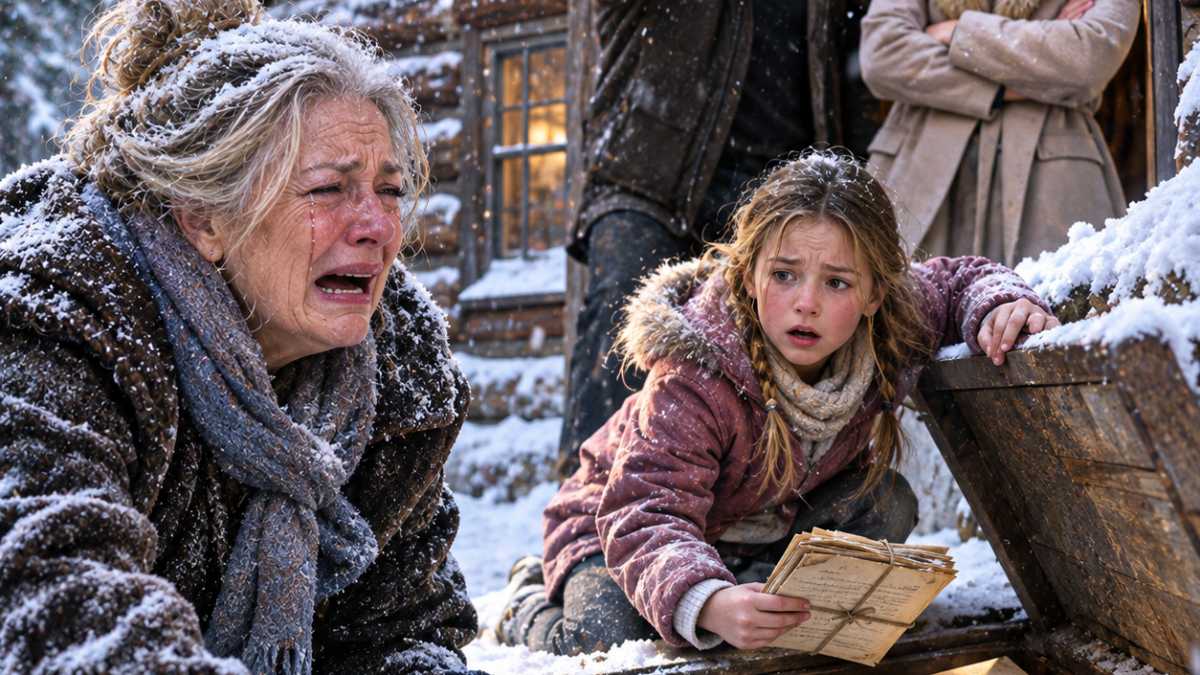
𝗙𝗨𝗟𝗟 𝗦𝗧𝗢𝗥𝗬:“GET OUT, YOU WORTHLESS OLD WOMAN! DAD LEFT YOU NOTHING!” My Son and His Wife Threw Me Into the Snow Hours After His Funeral—But a Little Girl Found the Secret My Husband Had Hidden Beneath the Cabin…
FULL ENDING
“Beautiful, isn’t it?”
I couldn’t answer.
She touched the diamond.
“Richard always said it needed someone who could carry it properly.”
My fingers curled around the damp tissue in my lap.
“He promised that necklace to me.”
Chloe tilted her head.
“Oh, Eleanor.”
She gave a soft laugh.
“Richard mentioned your neck was getting a little too fragile for something this heavy.”
Across the table, my son Connor smiled.
Not a broad smile.
Just the smallest movement of his mouth.
But I saw it.
And something inside me went cold.
Three days earlier, I had stood beside my husband’s grave while snow collected on the black sleeves of my coat.
Three days earlier, Connor had held my elbow and told me he would take care of everything.
Three days earlier, I’d believed him.
Now Robert Sterling, an attorney whose hourly rate probably exceeded what most people earned in a week, was explaining why forty years of marriage entitled me to nothing.
“The estate documents designate Connor Hathaway as the principal beneficiary,” he said.
I stared at him.
“The company?”
“Transferred under the controlling estate arrangements.”
“The bank accounts?”
“Subject to the same provisions.”
“The house in Maple Ridge?”
“Connor has possession and claims ownership under the estate documents.”
I felt dizzy.
“That house is my home.”
Sterling adjusted his glasses.
“Mrs. Hathaway, I understand this is emotional.”
My son sighed.
“Mom, please don’t make this harder.”
I turned toward him.
“Connor, your father would never have done this.”
His expression hardened.
“Dad knew you couldn’t manage the estate.”
I stared.
He continued.
“He wanted you taken care of, but he also wanted the family business protected.”
“Taken care of?”
My voice broke.
“You locked me out of my house while I was at his funeral.”
Chloe crossed her legs.
“We couldn’t leave the property unsecured.”
“You put my clothes in the snow.”
She rolled her eyes.
“Those bags were covered.”
“They were soaked.”
“Eleanor,” Sterling interrupted, “the only real property specifically designated for you in these documents is the Beacon Falls cabin.”
The room went silent.
Beacon Falls.
I hadn’t heard the name spoken aloud in years.
It was an old, isolated place Richard had purchased long before the company became successful.
A narrow wooden cabin surrounded by trees, reached by a mountain road that could become nearly impassable during winter storms.
The roof leaked.
The windows rattled.
The floorboards creaked.
Richard had spoken about repairing it someday.
But life kept getting in the way.
I looked at Connor.
“That’s where you expect me to live?”
He shrugged.
“It’s property. Be grateful.”
Chloe smiled.
“Honestly, Eleanor, it’s probably more your speed.”
Then she leaned forward.
“That’s where you belong.”
I looked at the son I’d raised.
The little boy whose fever I’d monitored through sleepless nights.
The teenager I’d comforted after heartbreak.
The young man whose first apartment Richard and I had helped furnish.
And I waited for him to defend me.
He looked away.
That hurt more than the diamond.
More than the house.
More than the money.
I had spent forty years building a family.
And now that my husband was gone, the people I’d loved most were treating me as an inconvenience to be removed.
Sterling pushed a document toward me.
“Please acknowledge receipt.”
I stared at the page.
My hands trembled.
I signed the receipt under pressure, believing for that moment that I had no practical choice.
I didn’t know that acknowledgment was not the same as surrendering my legal rights.
I didn’t know that the purported will had never been properly tested against the original documents.
And I certainly didn’t know that Richard had already prepared for the possibility that our son would betray me.
All I knew was that I had nowhere else to go.
Then I drove to Beacon Falls.
And found a warning painted across the cabin door in dripping red letters.
PAY UP OR BURN.
PART2
I sat in my car for almost twenty minutes.
The engine was still running.
Snow gathered along the edges of the windshield.
The words on the door looked wet enough that I could imagine the paint dripping while I watched.
PAY UP OR BURN.
I stared at them.
Then at the cabin.
Then at the narrow forest road behind me.
For a moment, I wanted to turn around.
But where would I go?
Connor had changed the locks on the Maple Ridge house.
My bank accounts were caught in the confusion surrounding Richard’s estate.
My purse held a little cash, one credit card that still worked, and the keys to a cabin I’d never expected to call home.
There was no welcoming porch.
No light shining from the windows.
No husband waiting inside to take my coat and ask whether I’d remembered to eat.
There was only a sagging roof, a broken front step, and a message that made my blood run cold.
I finally shut off the engine.
The silence felt enormous.
I stepped into the snow.
My boots sank several inches.
The wind pushed against my coat.
And I walked toward the door of the place my son had decided was all I deserved.
Inside, the cabin smelled of damp timber and dust.
The living room was barely large enough for a couch, a stove, and an old wooden table.
The kitchen had faded yellow cabinets.
The bedroom contained a narrow bed frame and a dresser with one missing handle.
The bathroom pipes had been drained for winter, and I knew I would have to check what still worked before using anything.
I stood in the middle of the room.
Then I saw Richard’s old wool jacket hanging from a hook.
I touched the sleeve.
It was stiff with age.
But I remembered him wearing it.
He’d put it on the first time he brought me here.
“Not much to look at,” he’d joked.
Then he’d stood beside me on the porch and pointed toward the trees.
“But listen.”
I’d listened.
To the wind.
The birds.
The creek somewhere beyond the ridge.
He’d smiled.
“See? Some things are worth keeping because they’re quiet.”
I held the jacket against my face.
And finally, I cried.
Not the restrained tears I’d shed in Sterling’s conference room.
Not the silent tears I’d hidden from Connor at the cemetery.
I cried until my chest hurt.
Because I missed my husband.
Because I couldn’t understand what had happened to my son.
And because the man who had promised to protect me for the rest of his life was gone.
Or so I believed.
The first night was worse than the conference room.
At least in Boston, there had been heat.
Bright lights.
Other people.
A table I could lean against when my legs threatened to collapse.
At the cabin, there was only the wind moving through the branches and the sound of something tapping against the kitchen window.
I found dry firewood stacked under a canvas sheet on the porch. After checking the stove and chimney as carefully as I could, I managed to build a small fire.
The flames illuminated the room in uneven orange patches.
I sat in Richard’s old chair and wrapped a blanket around myself.
His shotgun lay across a folded coat nearby, unloaded and secured as soon as I realized how frightened I was becoming. I wanted protection, but I knew panic and exhaustion were a terrible combination.
Every sound made me turn my head.
A branch striking the roof.
Snow sliding from the porch railing.
The old refrigerator clicking despite the electricity being disconnected.
I hadn’t eaten since morning.
My coffee had gone cold hours earlier.
But I couldn’t bring myself to move.
On the drive here, I’d stopped at a grocery store and bought bread, soup, batteries, bottled water, and a few other necessities.
I had enough to survive several days.
Nothing more.
I looked at my wedding ring.
Forty years.
It seemed impossible that forty years could be reduced to a widow sitting in an abandoned cabin, frightened of whoever had written a threat on her door.
I turned the ring slowly.
“Richard,” I whispered, “what happened to us?”
The fire answered with a small crack.
I closed my eyes.
And remembered the last time he’d held my hand.
Richard hadn’t died suddenly.
His final months had been difficult.
At first, we believed the fatigue was temporary.
Then came the appointments.
The tests.
The consultations that turned our lives into a series of medical calendars and carefully measured hope.
Eventually, he became too weak to work.
Connor began spending more time at the company.
He told me he was taking pressure off his father.
I was grateful.
I wanted to believe our son was becoming the kind of man Richard had tried to raise.
But during those last months, I’d noticed changes.
Connor became impatient whenever I asked about company matters.
Chloe began visiting with a stack of papers and speaking to Richard in a voice she’d never used before.
Sweet.
Exaggerated.
Almost childish.
“Daddy Richard, we just need one little signature.”
I remembered standing in the doorway of his bedroom one afternoon.
Connor was leaning over the bed.
Richard looked exhausted.
Chloe held a folder.
“What are you doing?” I’d asked.
Connor straightened immediately.
“Business.”
“Your father needs rest.”
He rolled his eyes.
“Mom, not everything revolves around his medication schedule.”
Richard had lifted one trembling hand.
“Eleanor.”
I went to him.
He gripped my fingers.
Then looked toward Connor.
“Take those papers away.”
My son had smiled tightly.
“Dad, we already discussed—”
“Not today.”
Richard’s voice had been weak.
But the command was unmistakable.
Connor’s expression darkened.
Chloe quickly closed the folder.
“Of course, Richard. We don’t want to upset you.”
They left.
That evening, Richard asked me to sit beside him.
His eyes were clearer than they’d been all day.
“Eleanor,” he whispered, “promise me something.”
I stroked his hand.
“Anything.”
“Don’t sign papers just because Connor tells you to.”
I frowned.
“Why would I?”
He looked toward the bedroom door.
“Promise.”
I nodded.
“I promise.”
Then he said something I hadn’t understood.
“Beacon Falls. The gift.”
I leaned closer.
“What gift?”
His fingers tightened.
“Remember.”
I thought he was confused.
The doctors had warned me that fatigue, illness, and medication could sometimes affect his clarity.
I kissed his forehead.
“Rest, darling.”
His eyes filled.
“Eleanor, please.”
I held him until he fell asleep.
Then, when he whispered the words again several days later, I blamed the medication.
Beacon Falls. The gift.
Now, sitting inside the cabin, I remembered them.
And wondered whether he’d been trying to tell me something all along.
The threatening message on the door wasn’t the only strange thing about Beacon Falls.
Two mornings later, I found a folded notice wedged beneath the windshield wiper of my car.
There was no name.
No official letterhead.
Only a typed message demanding payment on a five-hundred-thousand-dollar debt.
The notice claimed that the Beacon Falls property had been pledged as security and that failure to pay would result in immediate consequences.
My hands shook as I read it.
I knew very little about gambling debts.
But I knew Richard.
He had been cautious with money.
He’d hated speculation.
He’d never approved of Connor’s trips to private gaming clubs or the acquaintances he called his business partners.
I also knew a debt wasn’t automatically attached to land because someone wrote it on a piece of paper.
Still, the threat frightened me.
It wasn’t only about money.
Someone knew where I lived.
Someone had come to the cabin while I was sleeping.
I photographed the notice and the painted door.
Then I called the local police.
An officer came that afternoon, documented the threatening language, and advised me to report any suspicious visitors immediately.
He couldn’t promise who had placed the notice there.
He couldn’t tell me whether the debt claim was legitimate.
But he gave me an incident number and urged me not to meet anyone who came demanding payment.
“Mrs. Hathaway, if somebody threatens you, call us,” he said.
I nodded.
“What if they come back?”
“Stay somewhere safe if you can. Don’t try to confront them.”
I looked around the cabin.
Somewhere safe.
I almost laughed.
My son had sent me here because he knew I had nowhere else.
And now a stranger was telling me to leave the only roof I had.
For the next two weeks, I lived between fear and exhaustion.
I slept badly.
I kept the curtains closed at night.
I checked the doors twice before bed.
And every time tires crunched along the distant forest road, I held my breath.
Occasionally a vehicle continued past toward another property.
Sometimes it was a maintenance truck.
Once it was a snowplow.
But I couldn’t stop imagining Connor sending someone to force me out.
I tried calling him twice.
He didn’t answer.
Chloe replied instead.
Connor is very busy managing the estate. Please stop creating drama.
I stared at the message.
Then typed:
Someone is threatening me over a debt attached to the cabin. What do you know about it?
Her answer arrived several minutes later.
That’s why you need to stop being difficult and handle your responsibilities.
I read it three times.
Then saved the conversation.
I didn’t yet understand what it meant.
But I knew the answer didn’t sound like surprise.
And that frightened me more than the notice.
The storm arrived on the fifteenth night.
By evening, the sky had turned the color of dirty steel.
Snow began striking the windows.
The wind rose through the trees with a sound like an enormous animal breathing.
A weather report on my battery radio warned of a historic nor’easter.
Travel was dangerous.
Visibility had fallen.
Road crews were struggling to keep routes open.
I fed another log into the stove and pulled my blanket closer.
Then, sometime after dark, I heard pounding.
Three heavy blows against the front door.
I froze.
For one terrifying moment, I was certain the people who’d written the threat had returned.
Another knock.
Then a man’s voice shouted over the wind.
“PLEASE! IS SOMEBODY INSIDE?”
I stared at the door.
The voice came again.
“WE HAVE A CHILD! PLEASE HELP US!”
Everything inside me changed.
I moved toward the window.
Through the snow, I could barely make out three shapes.
A man.
A woman.
And a little girl wrapped in a coat much too thin for the weather.
The child was leaning against the woman.
Her head hung forward.
I opened the door.
The wind nearly tore it from my hand.
The man looked at me with an expression of pure desperation.
“Please,” he said. “Our car went off the road. We couldn’t get it started.”
The woman was crying.
“Our daughter is freezing.”
I looked at the little girl.
Her lips had a frightening bluish tint.
Her eyelashes were coated in snow.
And when she tried to speak, her voice came out as a faint whisper.
“Mommy…”
I stepped aside immediately.
“Get her inside. Now.”
The little girl couldn’t stop shaking.
Her mother carried her toward the stove while the man struggled to close the door against the wind.
Snow blew across the floorboards.
I pushed the door shut and secured the latch.
Then I turned back.
The woman was kneeling on the rug, holding her daughter close.
“Her name is Sofia,” she said. “Please, she was walking with us, and then she couldn’t anymore.”
I crouched beside them.
Sofia couldn’t have been more than seven.
Her cheeks were pale.
Her clothes were damp.
She looked at me through half-closed eyes.
I had no medical training beyond the first-aid courses Richard and I had taken years earlier, but I knew this wasn’t something to treat casually.
I asked the parents to move her away from the direct heat and began helping them replace wet outer layers with dry blankets.
The man introduced himself as Mateo.
His wife was Elena.
They had been driving toward relatives when the storm became too severe to continue.
Their car slid off the road.
They tried calling for help, but the signal kept failing.
Then they saw a faint glow through the trees.
My cabin.
They’d followed it.
And now Sofia was lying beneath Richard’s old wool blanket, barely able to keep her eyes open.
I reached for my phone.
The signal was weak, but I managed to connect with emergency services long enough to explain what had happened and ask for medical help.
The dispatcher asked about Sofia’s breathing, alertness, and exposure to the cold.
I followed the instructions carefully.
She warned us not to try to warm Sofia too quickly or rub her frozen skin.
Rescue personnel were being sent, though the roads might delay their arrival.
When the call ended, I knelt near Sofia again.
“Hello, sweetheart.”
Her eyes moved toward me.
“My name is Eleanor.”
She blinked slowly.
“Are you going to be okay?” Elena whispered.
I looked at the child’s mother.
I wanted to promise.
More than anything, I wanted to tell her that the storm couldn’t hurt her daughter anymore.
But I wasn’t going to give a frightened parent false certainty.
“We’ve called for help,” I said. “We’re going to keep her sheltered and follow what the dispatcher told us.”
Elena nodded.
Tears ran down her face.
Mateo took her hand.
I watched them hold each other.
And something broke inside me.
They were frightened.
Exhausted.
Possibly injured themselves.
But their first concern was Sofia.
Every word.
Every movement.
Everything they did centered on keeping their child safe.
I remembered Connor at the lawyer’s office.
The way he’d stared at the table while Chloe mocked me.
Then I looked at Mateo and Elena.
Two strangers who had nearly lost everything in the snow.
And still, their love for their daughter filled the room.
Sofia gradually became more responsive as we waited for medical assistance.
She looked toward the stove.
Then toward the window.
Then up at me.
“Is this your house?”
Her voice was thin.
I smiled gently.
“For now.”
She studied my face.
“It’s old.”
Despite everything, I laughed.
“Yes, sweetheart. It’s very old.”
Her father smiled faintly.
It was the first expression other than fear I’d seen on his face.
Sofia looked toward the ceiling.
“Does it always make those noises?”
I followed her gaze.
The cabin creaked every time the wind struck.
“Only when the weather gets dramatic.”
She considered that.
Then whispered, “It sounds like Grandpa’s house.”
Elena kissed her forehead.
“You need to rest, mi amor.”
Sofia settled beneath the blanket.
I stayed nearby.
Mateo kept checking the road through the window, hoping to see emergency lights.
At one point, he turned toward me.
“Mrs. Hathaway…”
“Eleanor.”
He nodded.
“Eleanor. Thank you.”
I shook my head.
“There’s nothing to thank me for.”
He looked toward his daughter.
“You opened the door.”
I swallowed.
“Of course I did.”
He stared at me.
For a moment, his eyes filled.
“We knocked at another building farther down the road. Nobody answered.”
I looked toward Sofia.
She was resting against Elena.
Mateo continued.
“We didn’t know whether we’d find shelter.”
His voice broke.
“Another half hour out there…”
He stopped.
I reached for his hand.
“You’re here now.”
He gripped my fingers.
And for the first time since Richard died, the warmth in the room didn’t come only from the stove.
The emergency crew arrived after a difficult journey through the storm.
They assessed Sofia, then examined Elena and Mateo for possible exposure and injuries.
The little girl needed further medical evaluation, and the responders arranged her transport when the route was safe enough.
Elena looked at me as they prepared to leave.
“Will you be all right here?”
I stared at her.
She had just come close to losing her daughter.
And she was worried about me.
“I’ll manage.”
Mateo frowned.
“You’re alone?”
I nodded.
Elena looked around the cabin.
The cracked plaster.
The damaged window frames.
The water stains.
The old stove struggling against the cold.
Then she looked toward the threatening words visible through the front-door window.
Her expression changed.
“Eleanor, what happened here?”
I hesitated.
It was none of their business.
They were strangers.
People I had met only hours earlier.
But for some reason, I couldn’t bear to tell another lie.
“My husband died,” I said quietly.
Elena’s face softened.
“I’m so sorry.”
“My son took possession of our home and most of the estate. This cabin is all I was told I had left.”
Mateo stared.
“Your son?”
I nodded.
“I haven’t even been able to make sense of the paperwork.”
Elena looked toward Sofia, who was being cared for by the responders.
Then back at me.
“You shouldn’t have to stay here alone.”
I looked down.
“Sometimes we don’t get to choose.”
Mateo said something softly in Spanish to his wife.
She answered with a nod.
Then he turned toward me.
“Eleanor, when the storm is over, we’ll come back and check on you.”
I tried to smile.
“You don’t need to do that.”
He shook his head.
“You opened the door for our daughter.”
His voice thickened.
“We don’t forget things like that.”
I watched them leave with the emergency crew.
Then I closed the door.
The cabin fell quiet again.
But not quite the same quiet as before.
For a few hours, there had been people here.
A mother.
A father.
A little girl.
And I’d remembered what it felt like to care for someone without being afraid that my love would be used against me.
Mateo and Elena returned the following afternoon once Sofia had received medical care and was well enough to accompany them.
The storm had weakened, but the roads were still difficult.
They arrived with bags of groceries, warm clothing, and a small portable charger.
I stood in the doorway, astonished.
“You shouldn’t have come back so soon.”
Elena smiled.
“We said we would.”
Sofia stepped forward, bundled in a proper winter coat.
“Hi, Señora Eleanor.”
I crouched.
“Hello, sweetheart. You’re looking much better.”
She smiled shyly.
“Mom says I was very cold.”
“You certainly were.”
She looked toward the stove.
“Is your house still talking?”
I laughed.
“The floorboards still complain.”
Mateo carried the groceries inside.
He’d spent the morning trying to arrange repairs to their vehicle, which remained off the road. They had been staying temporarily with relatives.
But those arrangements were crowded.
The family was struggling financially.
Mateo’s hours at work had been reduced.
Elena had recently lost a position when the small business employing her closed.
They had no stable housing they could afford while they worked through the disruption.
And Sofia had been frightened by the thought of sleeping somewhere unfamiliar again.
I listened as they spoke.
Then looked around the cabin.
Four walls.
A roof that needed repairs.
A stove.
A kitchen.
A bed.
And land my son considered worthless enough to use as a punishment.
I thought of Richard.
Of the first time he’d brought me here.
Of his laughter when we discovered a squirrel had made a nest in the chimney.
And of how he’d always said the value of a home had very little to do with its price.
I looked at Mateo.
“Do you know how to repair houses?”
He smiled faintly.
“I used to work in construction.”
I glanced toward the ceiling.
“Then perhaps we can help each other.”
Elena frowned.
“What do you mean?”
I took a breath.
“I want you to have this cabin.”
They stared.
Mateo set down his grocery bag.
“Eleanor…”
I raised a hand.
“I know I can’t simply hand you a key and make a legal transfer. There are documents to sort out, and someone has made threats about the property.”
I looked toward the door.
“But I want to give it to you when I can do that properly.”
Elena’s eyes filled.
“We couldn’t possibly—”
“I don’t want you to pay me.”
I swallowed.
“I want Sofia to have a safe place to come home to.”
Mateo looked around the room.
His face changed.
“Why would you do that for strangers?”
I thought about Connor.
The expensive attorney.
The diamond around Chloe’s neck.
The cold conference room where I’d been told I deserved nothing.
Then I looked at the family standing in front of me.
“Because you needed somewhere to go.”
My voice trembled.
“And I know what that feels like.”
Elena covered her mouth.
Sofia looked from one adult to another.
Then she walked toward me and wrapped both arms around my waist.
“Thank you, Grandma Eleanor.”
I froze.
The words went straight through me.
Grandma.
I hadn’t heard a child call me that in years.
I rested one trembling hand on her hair.
And cried.
That evening, after we agreed they could stay with me temporarily while the property and safety issues were investigated, Mateo began checking the cabin for urgent repairs.
He didn’t want Sofia sleeping near a broken window.
He found loose weather stripping and a gap where cold air entered around the kitchen wall.
I helped him locate Richard’s old toolbox.
Elena cleaned the little bedroom and arranged fresh blankets.
Sofia sat near the stove, drawing pictures with colored pencils Elena had brought.
For the first time since Richard’s funeral, the cabin sounded like a home.
Then, just before midnight, Sofia lifted her head.
“Señora Eleanor?”
I looked up.
“Yes, sweetheart?”
She pointed toward the center of the living room.
“Why is the floor talking?”
Mateo paused with a screwdriver in his hand.
Elena smiled.
“The house is creaking, Sofia.”
The little girl shook her head.
“No, Mommy.”
She pointed again.
“There’s a man under there.”
A chill moved across my shoulders.
I looked at the floor.
At first, I heard only the storm.
Then a faint crackling sound.
Almost like a badly tuned radio.
Mateo crouched.
“Where, Sofia?”
She walked toward a wide pine plank near Richard’s old chair.
“Here.”
We listened.
Static.
A pause.
Then a weak, distorted voice.
“Beacon Falls…”
My heart stopped.
Another burst of static.
“The gift…”
I stumbled backward.
Because I knew that voice.
Even beneath the interference.
Even weakened by the tiny speaker and the noise of the wind.
I had heard it say good morning for forty years.
I had heard it laugh.
Argue.
Sing badly while cooking breakfast.
Whisper that he loved me.
And now it was coming from beneath the floorboards.
“Richard?” I whispered.
The voice repeated.
“Beacon Falls…”
A pause.
“The gift…”
Mateo looked at me.
“Eleanor?”
I couldn’t answer.
I sank into the chair.
And began shaking.
Because my husband had whispered those exact words before he died.
And for the first time, I understood he’d been trying to lead me somewhere.
Mateo examined the floorboards without touching them.
The static continued.
A soft crackle.
Then silence.
Then Richard’s voice again.
“Beacon Falls. The gift.”
The transmission was so faint that we could barely hear it unless the room was quiet.
I knelt beside Mateo.
“This is impossible.”
He looked toward me.
“You recognize the voice?”
I nodded.
Tears blurred my vision.
“My husband.”
Elena stepped closer.
“Eleanor…”
“He died three weeks ago.”
The room went still.
Sofia moved toward her mother.
Elena gently drew the little girl away from the center of the floor.
Mateo studied the wood.
“There’s something underneath.”
I followed his gaze.
One of the pine boards had a narrow seam running along its edge.
At first glance, it looked no different from the others.
But there were small dark marks near the corners.
Marks made by an old tool.
I remembered Richard working on the cabin years earlier.
He’d been determined to repair the floor himself.
He was a successful businessman who could have hired a dozen contractors, but he insisted that fixing a house with his own hands made it feel more like home.
I’d laughed at him.
“You own a company worth millions, Richard Hathaway. Why are you crawling around under old floorboards?”
He’d grinned.
“Because down here, nobody asks me about quarterly earnings.”
I looked at the seam.
Then whispered, “He built this.”
Mateo turned.
“Are you sure?”
I nodded.
“I remember him working on the floor.”
Mateo reached for his tools.
“Would you like me to see whether it opens?”
My heart pounded.
I looked toward the spot where the voice had emerged.
Then toward Sofia.
She was holding her mother’s hand.
Her eyes were enormous.
I took a breath.
“Yes.”
Mateo worked carefully along the edge of the plank.
He didn’t tear up the whole floor.
He loosened the section around what appeared to be a concealed hatch.
Then, with a small movement of the pry bar, the wood lifted.
Cold air rose from below.
A dark rectangular cavity appeared beneath the boards.
Inside it sat a heavy steel box.
Beside the box was a small battery-powered audio device connected to a compact speaker.
It was set to play a short message at intervals, as though Richard had wanted someone to notice it in the quiet hours of the night.
I stared.
“Dear God.”
Mateo looked toward me.
“Should we stop?”
I swallowed.
“No.”
My voice shook.
“Please.”
He carefully lifted the box onto the floor.
It was heavy.
Much heavier than I expected.
A combination lock secured the front.
The metal was cold enough to sting my fingers.
On the lid, someone had scratched two words.
FOR ELEANOR.
I covered my mouth.
My husband had left this.
Not accidentally.
Not as a forgotten object.
He’d hidden it beneath the cabin floor.
And he’d used his own voice to guide me toward it.
The combination was our wedding anniversary.
June 14.
I entered the numbers with trembling fingers.
At first, nothing happened.
I tried again.
The lock clicked.
I stared.
Mateo leaned closer.
Elena whispered, “Eleanor?”
I opened the lid.
Inside were stacks of manila envelopes.
Several USB drives.
A leather-bound document.
A red folder.
And a letter sealed inside an envelope bearing my name in Richard’s unmistakable handwriting.
I picked it up.
My hands were shaking so badly that I almost tore the paper.
For forty years, I’d known the shape of those letters.
The long curve of his E.
The slightly uneven line of his handwriting when he was tired.
The way he always pressed harder on the final stroke of my name.
I opened the envelope.
The first words nearly stopped my heart.
My dearest Eleanor,
I closed my eyes.
For a moment, I could hear him.
Not the distorted recording beneath the floor.
The real Richard.
The man who used to stand behind me while I cooked and kiss the side of my neck.
The man who kept a little notebook of our anniversaries because he was terrified of forgetting a date that mattered to me.
The man who always left a lamp on when I came home late.
I forced myself to keep reading.
If you are holding this letter, then something I feared may already have happened. I pray I was wrong about Connor. I pray he chose honesty when I could no longer protect the people and things I love. But I have seen enough to prepare for the possibility that he did not.
My breath caught.
I read the next paragraph.
Eleanor, the will Robert Sterling may present to you is not the estate plan I authorized. Arthur Vance holds the executed documents and the records needed to establish my actual wishes. Do not sign away your rights simply because someone tells you that you have none.
I began crying.
Richard had known.
He’d known something was wrong.
And he’d been trying to warn me.
The letter continued.
Before you contact Arthur, review the material marked for you. The red folder contains the records that led me to suspect Connor was using family assets and documents without authorization. The recordings and electronic files may help explain what happened, but the originals and independent records must be examined by appropriate professionals.
I swallowed.
Then reached the sentence that broke me completely.
I did not leave you poor, my love. I spent forty years building a life with you. I would never willingly give it away without your knowledge. If someone tells you otherwise, please remember that you knew me better than anyone.
I pressed the letter against my chest.
For a moment, I couldn’t breathe.
Then I heard Elena whisper, “Oh, Eleanor.”
I looked toward her.
She was crying too.
I tried to speak.
Only one word came out.
“Richard.”
The first USB drive was labeled PRIVATE—ELEANOR.
Beneath the documents lay a small, inexpensive laptop with a charged battery pack secured in a protective case.
Richard had thought of everything.
Or at least, he’d tried.
I couldn’t imagine him lying ill in our house while secretly arranging this hiding place.
Who had helped him?
When had he come here?
Had he known how little time he had left?
The questions crowded my mind.
But the letter was clear.
I needed to understand the evidence before contacting Arthur Vance.
Mateo carefully connected the laptop and drive.
I sat beside him at the wooden table.
Elena kept Sofia occupied with her drawings, though the little girl watched us with worried eyes.
The computer started.
A folder appeared.
Inside were scanned financial documents, correspondence, and several audio files.
One file carried a date from Richard’s final months.
Mateo looked at me.
“Do you want me to play it?”
I stared at the screen.
Then nodded.
“Yes.”
The speakers crackled.
For a moment, there was only background noise.
Then I heard Connor.
My son.
The baby I’d carried home from the hospital thirty-eight years earlier.
The little boy who used to run through our kitchen in dinosaur pajamas.
The teenager Richard taught to drive.
His voice came through the speaker, casual and cold.
“She thinks she’s grieving, Chloe, but she won’t even survive the winter out there.”
I went numb.
Elena looked sharply toward me.
Connor continued.
“Once she’s stuck at Beacon Falls, she’ll have no money to fight.”
Then Chloe laughed.
That laugh.
I’d heard it in Sterling’s conference room.
I’d heard it when she touched the Hathaway diamond.
Now it sounded almost unbearable.
“Sterling assured us the paper trail would look clean,” she said. “The replacement will gives her the cabin, and once those people start coming after the debt, she’ll fold.”
I gripped the edge of the table.
Connor answered.
“The half-million-dollar problem won’t be ours anymore if we can make the property carry it.”
Chloe gave a satisfied little laugh.
“Either she gives up the land or she breaks under the pressure.”
The room went silent.
I stared at the computer.
My son wasn’t merely indifferent to my suffering.
He’d anticipated it.
Planned around it.
Expected fear to do what he couldn’t accomplish openly.
I felt physically ill.
Then another audio file began.
And Richard’s voice filled the room.
Clearer.
Steadier.
The voice of a man determined to leave one final message.
“Eleanor, if you’re hearing this, Connor may have walked directly into the trap he built for himself.”
I covered my mouth.
Richard continued.
“The documents Robert Sterling presented will not withstand proper examination if Arthur’s originals and the records in this box are preserved. Do not confront Connor alone. Do not surrender the cabin. And before you do anything else, open the red folder.”
I looked toward the steel box.
There it was.
A thick red folder resting beneath the envelopes.
My husband’s voice continued.
“Everything you need to understand why I was afraid is inside.”
The recording ended.
For several seconds, nobody moved.
Then Sofia spoke softly from beside the stove.
“Grandma Eleanor?”
I turned.
Her little face was worried.
“Why are you crying?”
I looked at the letter in my hands.
Then at the folder.
And said the only thing I knew to be true.
“Because, sweetheart, my husband remembered me.”
The red folder was thicker than it looked.
I opened it on the kitchen table while Mateo and Elena sat beside me.
Sofia had fallen asleep near the stove, wrapped in the warmest blanket we could find.
The storm was beginning to weaken.
Snow still tapped against the windows, but the violent gusts had become less frequent.
The little cabin felt strangely quiet.
A few hours earlier, I’d believed everything inside it was old, damaged, and nearly worthless.
Now its floor had given up a secret that could change the rest of my life.
The first page in the red folder was a letter from Richard’s longtime attorney.
Arthur Vance.
I’d known Arthur for more than twenty years.
He’d helped Richard with business acquisitions, estate planning, and documents neither of us particularly enjoyed discussing.
He was a careful man.
Not especially warm.
But honest.
Richard used to say that Arthur was the only lawyer he’d ever met who occasionally advised him not to spend money on legal fees.
I remembered laughing whenever he said it.
Now I wished Arthur were sitting beside me.
I read the letter.
It confirmed that Richard had executed a comprehensive estate plan well before his final illness, including a will and trust arrangements designed to protect me.
It referred to original documents maintained in Arthur’s custody.
The letter also identified changes Richard had considered but never completed.
I turned the page.
There were copies of signature pages.
Dates.
Witness information.
Correspondence about the estate.
And a memorandum Richard had written shortly after discovering irregularities in company transactions.
My heart began pounding.
I read one sentence twice.
I have not authorized Connor Hathaway or Robert Sterling to replace, revoke, or alter the estate documents held by Arthur Vance.
I looked toward the conference-room papers Sterling had placed in front of me.
The purported will.
The one that left everything to Connor.
The one I had accepted because an expensive attorney spoke as though the matter had already been settled.
I remembered Sterling’s calm expression.
Your late husband left the entire estate to your son.
My hands began shaking.
“He lied to me.”
Mateo leaned forward.
“What?”
“Sterling.”
I looked toward the red folder.
“He told me Richard had changed everything.”
Elena touched my arm.
“What does this mean?”
I swallowed.
“I think the document they showed me wasn’t the real will.”
Mateo stared.
“Can they do that?”
“They can try,” I whispered.
Then I looked at the next page.
And felt the room shift beneath me.
The next section contained financial records.
Not ordinary household statements.
Company ledgers.
Bank correspondence.
Internal transaction summaries.
A sequence of electronic approvals associated with Connor’s access to Hathaway business accounts.
Richard had highlighted several transfers in red.
Large amounts of money had moved through accounts connected to business entities I’d never heard of.
Some transactions were described as consulting fees.
Others as advance payments.
Several had no supporting invoices in the copies Richard preserved.
Beside one transfer, he’d written:
Connor approved this while telling me the vendor was an ordinary logistics supplier. Accountant unable to verify services.
Another page referred to a private lender and gambling-related obligations.
I stared at the balance.
Five hundred thousand dollars.
The same amount demanded in the notice outside the cabin.
My breath caught.
I turned another page.
There was a draft security agreement naming the Beacon Falls property.
Someone had attempted to use the cabin as collateral.
But the authorization records raised immediate questions.
The signature attributed to Richard didn’t match the way he normally signed.
The dates fell during his final hospitalization.
And the property records Richard had obtained did not clearly establish a properly authorized lien.
I looked toward Mateo.
“They were trying to put Connor’s debt on the cabin.”
He frowned.
“Can they just do that?”
I shook my head slowly.
“I don’t think so.”
I looked at the documents again.
“Someone may have tried to create paperwork that made it appear Richard had agreed.”
The implications were overwhelming.
Connor had taken business money.
Or at least, Richard believed he had.
He’d become entangled in dangerous financial obligations.
He’d sought to use family assets to cover them.
Then, after Richard died, he’d pushed me out of the estate and left me in a cabin surrounded by threats.
I could almost hear Chloe’s voice from the recording.
She’ll fold.
I pressed my hands against my temples.
My son had known I was grieving.
He’d known I was frightened.
And instead of protecting me, he’d tried to make those things useful.
At the bottom of the red folder was a second letter.
This one was addressed to me in Richard’s handwriting.
I opened it carefully.
My Eleanor,
I hope with all my heart that you never need the contents of this folder.
I began reviewing Connor’s activities after discovering transactions I could not reconcile with the company’s legitimate business. When I confronted him, he became angry and insisted that everything was under control. I wanted to believe him.
I stopped reading.
My throat tightened.
Of course Richard had wanted to believe him.
Connor was our son.
We’d watched him grow.
We’d held his hand crossing streets.
Cheered for him at school performances.
Sat beside him through illnesses and disappointments.
No parent begins by expecting betrayal.
I continued.
I eventually learned that Connor had been making promises involving property and funds he was not authorized to control. When I refused to approve them, he accused me of withholding what he considered his inheritance.
My eyes filled.
Eleanor, I failed to tell you sooner because I hoped I could correct the situation without destroying our family. That was my mistake. You should have known what I knew.
I covered my mouth.
Richard continued.
Arthur has the true executed documents. The bulk of the estate provisions protect you, including your interest in the family home and the assets we built together. Connor has no authority to rewrite those provisions merely because I am ill or have died.
I swallowed.
The material here may not all be usable in court in the form I’ve preserved it. Arthur will know what can be authenticated and what independent records must be obtained. Let the proper professionals handle it. Do not put yourself in danger to confront Connor.
Then came the line that made me cry so hard I had to put the letter down.
I’m sorry I couldn’t give you another forty years. But I tried to give you enough truth that no one could take away the life we built.
I pressed the paper against my heart.
For a moment, I was no longer in the cabin.
I was standing beside Richard in our first tiny apartment.
He was twenty-six.
I was twenty-four.
We owned a secondhand couch, a scratched dining table, and a car that sometimes refused to start.
He’d wrapped his arms around me in the kitchen and said, “One day, I’ll build you a beautiful home.”
I’d laughed.
“I already have one.”
He’d looked around.
“This?”
I’d kissed him.
“Anywhere you’re waiting for me.”
Now, decades later, I understood that he’d been trying to protect more than a mansion.
He’d been trying to protect our home from the people who believed everything inside it could be taken.
I wanted to call Connor.
The impulse came so suddenly that I reached for my phone before realizing what I was doing.
I wanted to hear his voice.
To demand an explanation.
To ask how he’d become the kind of man who could listen to his mother’s grief and see an opportunity.
But then I remembered Richard’s warning.
Do not confront Connor alone.
I lowered the phone.
Mateo watched me.
“What are you thinking?”
I stared at the red folder.
“I want to ask my son why he did this.”
Elena’s expression softened.
“I know.”
“I want him to tell me it’s a mistake.”
My voice cracked.
“That someone forged his voice. That he didn’t mean what he said.”
I looked at the computer.
The screen had gone dark.
“But I heard him.”
Mateo was quiet.
I continued.
“And Chloe.”
I swallowed.
“They talked about leaving me here as though they were discussing getting rid of old furniture.”
Elena reached across the table and took my hand.
“You don’t need to decide what to say to him tonight.”
I looked at her.
She smiled sadly.
“You have something important to do first.”
I glanced toward Sofia.
The little girl was sleeping peacefully.
“What?”
“Keep yourself safe.”
I looked around the cabin.
The damaged windows.
The threatening words outside.
The steel box.
The documents.
Then I nodded.
Elena was right.
Before I could reclaim anything, I had to stay alive and preserve what Richard had left.
The following morning, I called Arthur Vance.
I had to try several times before the weak signal connected.
When he answered, his familiar voice made me cry immediately.
“Vance and Merritt. Arthur speaking.”
“Arthur?”
There was a pause.
“Eleanor?”
I swallowed.
“Yes.”
“My God. Eleanor, I’ve been trying to reach you.”
I froze.
“What?”
“Where are you?”
“Beacon Falls.”
His voice sharpened.
“The cabin?”
“Yes.”
“Are you safe?”
I looked toward the red folder.
“I don’t know.”
Arthur became very quiet.
Then he said, “Tell me exactly what’s happened.”
I told him everything.
Sterling’s conference room.
The supposed will.
The locked house.
Chloe wearing the Hathaway diamond.
Connor telling me I deserved nothing.
The cabin.
The threatening notices.
And finally, the steel box beneath the floor.
Arthur didn’t interrupt.
When I finished, his voice was thick with emotion.
“Richard told me he’d prepared a duplicate evidence package.”
I closed my eyes.
“You knew?”
“I knew he was worried. I knew he had gathered records. I didn’t know where he’d hidden the copies.”
I swallowed.
“Why didn’t you stop them?”
He exhaled.
“Eleanor, I’ve been attempting to reach you since I learned of Richard’s death. I contacted the estate representatives, but Sterling’s office asserted that your husband had executed later documents and that the family was managing the matter.”
He paused.
“I was told you weren’t available to speak.”
My mouth fell open.
“They said that?”
“Yes.”
I stared at the wall.
Connor had controlled more than the house.
He’d tried to control who could reach me.
Arthur continued.
“I did not accept their claims without review. I’ve been seeking the documents they rely on and preparing to challenge any improper filing. But I needed to speak with you.”
My voice broke.
“Arthur, they told me everything was gone.”
His answer came immediately.
“Eleanor, that is not something they had authority to declare as a final legal fact at a conference table.”
I covered my mouth.
He continued.
“Richard’s original executed will and trust records are here. We need to compare them with whatever Sterling has presented, review the estate proceedings, and secure the relevant assets.”
I looked at the red folder.
“Can you help me?”
Arthur’s voice softened.
“Your husband was my friend for thirty years.”
For a moment, he couldn’t speak.
Then he said, “And you’re not going through this alone.”
I began sobbing.
It was the first time since Richard’s funeral that someone who knew him well had said the words I’d desperately needed to hear.
You’re not alone.
Arthur waited until I could breathe again.
Then he asked, “Are the documents secure?”
I looked toward Mateo.
He nodded reassuringly.
“Yes.”
“Good. Keep the originals intact. Don’t circulate the recordings or confront Connor. We’ll arrange safe custody, obtain the relevant records through proper channels, and address those threats immediately.”
I wiped my face.
“Arthur?”
“Yes?”
“Richard knew, didn’t he?”
Arthur was silent.
Then he said, “He knew enough to be frightened.”
I looked toward the wedding photograph on my phone.
“And he still tried to protect me.”
Arthur’s voice broke.
“Yes, Eleanor.”
He paused.
“He never stopped.”
The roads didn’t fully reopen for another day.
During that time, I barely slept.
But I wasn’t alone.
Mateo helped repair the worst gaps around the windows while Elena prepared meals from the groceries they’d brought.
Sofia treated the cabin as though it were an enormous adventure.
She made a little house for her dolls beneath the table.
Drew pictures of snowflakes.
And asked me approximately forty questions about Richard.
“Was he nice?”
I smiled.
“Very.”
“Did he like cookies?”
“More than was good for him.”
She giggled.
“Did he have a beard?”
“Only when he forgot to shave.”
“Did he love you?”
The question stopped me.
I looked at the little girl.
Her eyes were serious.
I swallowed.
“Yes, sweetheart.”
She tilted her head.
“How much?”
I thought about forty years.
The difficult days.
The beautiful days.
The arguments we’d had over bills when we were young.
The laughter.
The holidays.
The way Richard always reached for my hand when we crossed a street, even when we were old enough that neither of us needed help.
I smiled through tears.
“More than I can tell you.”
Sofia considered that.
Then said, “I think he still does.”
I stared at her.
She pointed toward the floor.
“Because he left you a message.”
I couldn’t speak.
Elena looked at me from the stove.
Her eyes were wet.
I opened my arms.
Sofia came toward me.
I hugged her gently.
And for a moment, the world felt less cruel.
When the roads were passable, Arthur arranged for us to meet in a secure office rather than at the cabin.
He also coordinated with local authorities regarding the threats I’d received.
The original documents from the steel box were transferred into appropriate custody for review, with the condition and location of the materials documented.
The physical device beneath the floor was preserved.
The red folder.
The USB drives.
The handwritten letters.
Everything.
I was afraid someone would tell me the evidence was worthless.
That Richard had been confused.
That Connor’s attorney was too powerful.
That the truth didn’t matter because too much money had already changed hands.
But Arthur didn’t promise an instant victory.
He told me what he could establish.
And what still required proof.
The existence of Richard’s earlier executed estate plan was clear.
The authenticity and legal effect of the later documents presented by Sterling were disputed.
The company transactions needed independent examination.
The claimed debt attached to the cabin required a title search and an analysis of any recorded security instruments.
And the threatening messages had to be treated as a safety issue, not merely a financial argument.
Arthur introduced me to an estate-litigation attorney and a forensic accountant.
For the first time, someone was examining the documents without assuming Connor spoke for the family.
I sat at the conference table, listening.
Then asked the question that had terrified me since the funeral.
“Can they take my home before all this is settled?”
The attorney answered carefully.
“We’re seeking appropriate orders to protect the property and prevent improper transfers while the dispute is reviewed.”
I swallowed.
“And the accounts?”
“We’ll identify what is held in the estate, what is held in trust, what belongs to you independently, and what has been transferred. We’ll pursue access and preservation through the proper process.”
I looked at Arthur.
For a moment, I thought about the first conference room.
Sterling sliding a paper toward me.
Connor staring at the table.
Chloe smiling behind the Hathaway diamond.
I’d been treated as a widow who should be grateful for scraps.
Now people were asking what I knew.
Reviewing records.
Explaining options.
And treating me as someone whose rights mattered.
I began crying.
Arthur reached across the table.
“Eleanor?”
I wiped my cheeks.
“I’m sorry.”
He shook his head.
“No apology necessary.”
I took a breath.
“It’s just that nobody asked me what I wanted.”
The room grew quiet.
Then the estate attorney leaned forward.
“Mrs. Hathaway, what would you like us to protect first?”
I looked down at the wedding ring on my hand.
Then answered.
“My husband’s wishes.”
I swallowed.
“And my home.”
The investigation did not take three days.
It took months.
That was the part Connor hadn’t anticipated.
He’d built his plan around speed.
Get me out of the mansion.
Control the accounts.
Present the purported will as a completed fact.
Make me feel helpless before I could obtain independent advice.
Then rely on embarrassment, grief, and fear to keep me from asking questions.
But once the original records were produced, the picture became much more complicated.
Arthur’s firm had retained the executed estate documents and the records surrounding their preparation.
Witnesses could confirm the earlier signing process.
Trust and property documents identified interests Richard intended to preserve for me.
The purported later will raised questions about how and when it had been created.
Its supporting paperwork relied on representations that investigators could compare with medical records, financial records, and evidence from the relevant period.
The accountant found transactions that did not match legitimate business purposes.
Records from the company showed Connor had exercised authority beyond what Richard had approved.
Several transfers required further explanation.
And the draft instrument relating to the Beacon Falls cabin was not evidence that Connor’s private gambling obligation had somehow become my lawful debt.
That mattered.
A person couldn’t simply assign someone else’s property to settle his own losses without a valid legal basis.
The threatening notices had made the claim sound inevitable.
But once the actual title and financial records were reviewed, the apparent security arrangement was challenged.
Additional questions arose about whether signatures and supporting statements had been falsified.
The recordings Richard left were preserved for lawyers and investigators to assess, not treated as magic evidence that would automatically win a case.
Their lawfulness and possible admissibility required review.
But they led the professionals examining the matter toward documents, communications, and financial trails that could be independently tested.
And those records told a story Connor hadn’t expected anyone to reconstruct.
Chloe called me one afternoon.
I was staying in a small furnished apartment arranged while the dispute proceeded.
Mateo and Elena had returned to the cabin with permission after the immediate safety concerns were assessed, and they were helping maintain it while we worked toward a permanent arrangement.
Sofia had resumed school.
She called me every Sunday.
Sometimes she wanted to show me a drawing.
Sometimes she asked whether Richard had liked strawberries.
And sometimes she simply said, “Grandma Eleanor, when are you coming to visit?”
Every time, my heart softened.
Then Chloe’s name appeared on my phone.
For a moment, I thought about ignoring it.
Instead, I answered.
“Hello.”
Her voice was sharp.
“Eleanor, have you lost your mind?”
I closed my eyes.
“Good afternoon, Chloe.”
“Do you understand what you’re doing to this family?”
I looked toward the window.
“What am I doing?”
“You’ve hired people to investigate Connor.”
“I’ve retained counsel to review Richard’s estate.”
“It’s the same thing!”
I said nothing.
She took a breath.
“Connor is under enormous pressure.”
I looked down at my hand.
“I’m sorry to hear that.”
“You don’t sound sorry.”
“Chloe, I spent two weeks in a cabin with a threat painted on the door.”
Silence.
I continued.
“I asked you about the debt, and you told me to handle my responsibilities.”
She gave an irritated sigh.
“You’re exaggerating.”
I felt my stomach tighten.
Then I remembered Arthur’s advice.
I didn’t have to argue.
I didn’t have to persuade her.
I didn’t have to accept the role she’d assigned me.
“Please direct any questions about the estate to my attorney.”
“Eleanor—”
“I won’t discuss the legal matter with you privately.”
Her voice hardened.
“Connor says you’ve been manipulated by people who want your money.”
I thought about Mateo and Elena.
The little girl I’d found trembling in the snow.
Their groceries.
Their kindness.
The way Mateo helped repair windows in a cabin he didn’t own.
Then I looked at the photographs on my table.
Sofia laughing.
Richard smiling beside me on our anniversary.
I took a breath.
“The people helping me now didn’t ask me for anything.”
Chloe made a disgusted sound.
“Oh, please.”
I continued.
“They asked whether I was safe.”
Then I ended the call.
For the first time since Richard’s death, Chloe’s anger felt like exactly what it was.
Her anger.
Not an instruction.
Not a debt I owed.
Not something I had to spend the rest of the day trying to repair.
My son didn’t call for several weeks.
Then, one gray afternoon, he sent a message.
Mom, we need to talk. Please.
I stared at the screen.
A thousand memories rushed back.
Connor at five, asleep in Richard’s arms.
Connor at ten, proudly showing me a school certificate.
Connor at seventeen, slamming a door after an argument.
Connor on his wedding day, smiling at Chloe as though no one else existed.
And Connor in Sterling’s office, telling me it was time to stand on my own two feet.
I could still hear his voice.
Dad felt you’d been taken care of long enough.
My fingers trembled.
I wanted to answer.
I wanted my boy back.
Not the man who’d helped remove me from my home.
The boy who used to crawl into my lap during thunderstorms and ask whether we could stay like that until the lightning stopped.
I opened the message.
Then closed it.
Instead of replying privately, I forwarded it to Arthur.
He called a few minutes later.
“Eleanor, you don’t need to meet him alone.”
I swallowed.
“I know.”
“If there’s a legitimate reason to discuss the estate, we can arrange an appropriate setting.”
I looked toward the photograph of Connor as a child.
“Arthur?”
“Yes?”
“Can you lose a son without him dying?”
Arthur was silent for a long moment.
Then his voice softened.
“I think sometimes you can lose the person you believed someone was.”
I began crying.
He waited.
Then added, “That doesn’t mean you have to stop loving him. It means you may have to stop trusting him.”
I looked at Richard’s wedding ring, which I wore on a chain beside my own.
For forty years, I’d believed the hardest thing I’d ever have to do was bury my husband.
Now I was discovering another kind of grief.
The grief of looking at your own child and realizing he knew you were hurting.
And chose to make it worse.
I agreed to meet Connor in Arthur’s office.
Not in our family home.
Not in a restaurant where he could accuse me of making a scene.
And not alone.
The meeting took place on a cold Tuesday afternoon, nearly four months after Richard’s funeral.
Connor arrived wearing a navy suit.
He’d always looked so much like his father when he dressed that way.
The same dark hair.
The same broad shoulders.
The same habit of adjusting his cuffs before sitting down.
But Richard used to smile when he saw me.
Connor barely looked at my face.
He sat across the table.
“Hi, Mom.”
I folded my hands.
“Hello, Connor.”
For a moment, he studied the attorneys.
Then he sighed.
“Do we really need all these people?”
Arthur remained calm.
“Given the pending disputes, this is the appropriate setting.”
Connor looked toward me.
“I can’t believe it’s come to this.”
My heart tightened.
Neither could I.
But for very different reasons.
He leaned forward.
“Mom, you know I love you.”
I stared at him.
The words hurt.
Not because I didn’t want to hear them.
Because I wanted desperately to believe them.
“I’ve loved you since the day you were born,” I answered.
His expression softened.
“Then why are you doing this?”
I felt the old instinct to explain myself.
To comfort him.
To make the conversation easier.
Instead, I asked, “Did you know about the threatening message on the cabin door?”
Connor’s face changed.
He looked toward his attorney.
“Mom—”
“Did you?”
He rubbed his hands together.
“I knew there were financial issues.”
I nodded slowly.
“Were they your financial issues?”
His jaw tightened.
“It’s complicated.”
I thought of the letter.
The half-million-dollar demand.
The old house in Maple Ridge.
Chloe wearing my necklace.
Then I said, “Your father knew about the transactions.”
Connor went still.
I watched his face.
“He left records.”
My son’s eyes moved toward Arthur.
Then back to me.
“What records?”
Arthur answered carefully.
“Records relevant to the estate and financial proceedings. The appropriate material has been provided through the applicable channels.”
Connor swallowed.
For a moment, he looked frightened.
Then he turned toward me.
“Mom, Dad was sick.”
I stared.
“He was confused.”
I felt my chest tighten.
“Was he confused when he asked you to take papers out of his bedroom?”
Connor froze.
I continued.
“I was there.”
His face reddened.
“Mom—”
“He told you no.”
My voice trembled.
“And you kept insisting.”
Connor looked down.
For several seconds, nobody spoke.
Then he said quietly, “I was trying to save the company.”
I stared at him.
“By taking money without permission?”
He shook his head.
“It wasn’t supposed to happen like this.”
I felt tears gather.
“What was supposed to happen?”
He stared at the table.
I waited.
Then he whispered, “I thought I could make it back.”
My heart sank.
He continued.
“The losses. The debts. Everything.”
I closed my eyes.
So much of the evidence had pointed toward this.
A man who’d borrowed.
Gambled.
Used business money.
Made promises he couldn’t keep.
Then decided the problem could be solved by taking whatever remained.
But there was still one thing I couldn’t understand.
I looked at him.
“Why did you send me to the cabin?”
He didn’t answer.
I waited.
“Connor.”
His voice was barely audible.
“Because you would’ve asked questions.”
The room became very quiet.
My chest tightened.
I whispered, “So you knew.”
He looked up.
“Mom—”
“You knew I was grieving.”
His eyes filled.
“Yes.”
“You knew I had no access to our home.”
He looked down.
“Yes.”
“You knew there were people demanding money connected to the cabin.”
He swallowed.
“I knew there was a problem.”
I felt something inside me break.
“And you let me go there anyway.”
He stared at me.
For a long moment, I couldn’t speak.
Then I asked the question that mattered more than the company, the diamond, or the money.
“Were you hoping I wouldn’t survive?”
Connor’s face crumpled.
“No!”
His voice shook.
“No, Mom. Never.”
I looked at him.
“Then what were you hoping?”
He covered his face.
Silence stretched between us.
Finally, he whispered, “That you’d be too scared to fight.”
I stared.
For a moment, I thought I might be sick.
He’d wanted me frightened.
Not necessarily dead.
But helpless.
Terrified enough to accept what he’d done.
And somehow, he believed that distinction made him less cruel.
I looked toward Arthur.
Then back at my son.
“I spent your whole life trying to make sure you never had to feel abandoned.”
My voice broke.
“And when your father died, you made abandonment your first gift to me.”
Connor began crying.
I watched the tears roll down his face.
And for the first time, I didn’t reach across the table to wipe them away.
The meeting ended without reconciliation.
Connor said he was sorry.
Several times.
He admitted he’d made terrible decisions.
He told me Chloe had encouraged him to move quickly.
He said Robert Sterling had assured them the documents could be handled.
But whenever he began explaining, the same thing happened.
His apologies turned into justifications.
The debt had frightened him.
The company had been under pressure.
Richard had been too strict.
Chloe expected a certain lifestyle.
He’d believed the estate would eventually belong to him anyway.
I listened.
Then realized he was still describing my life as something he had been entitled to use.
Arthur advised that the unresolved issues would continue through the appropriate legal process.
Connor’s attorney agreed that further discussion should occur through counsel.
Before leaving, my son stopped at the doorway.
“Mom.”
I looked up.
“Are you ever going to forgive me?”
The question struck like a physical blow.
I stared at him.
I wanted to say yes.
I wanted to tell him he could still come home for Sunday dinner.
That I would make his favorite meal.
That one day we’d sit together and laugh about some old memory of Richard.
But those hopes belonged to the past.
And I couldn’t rebuild a relationship on promises neither of us was ready to keep.
“I don’t know,” I whispered.
His face crumpled.
I continued.
“I still love you.”
He looked up.
“But I don’t trust you.”
Tears slid down my cheeks.
“And I won’t pretend I do just because you’re my son.”
Connor stood motionless.
Then he nodded once.
And walked away.
I watched the door close.
For a moment, I couldn’t move.
Then Arthur gently placed a glass of water beside me.
I looked at him.
“Did I do the right thing?”
His expression softened.
“You told him the truth.”
I stared toward the empty chair.
Then whispered, “Why does it hurt so much?”
Arthur didn’t offer an easy answer.
He simply sat beside me until I could breathe again.
The proceedings eventually exposed the full financial damage.
Not in one dramatic hearing.
Not through one recording played while everyone gasped.
But through months of records, examinations, testimony, and legal challenges.
The court reviewed the competing estate documents.
The purported later will was challenged on grounds including authenticity and the circumstances of its preparation.
Evidence surrounding the signatures and execution of that document raised serious concerns.
The original estate plan held by Arthur’s firm was supported by its execution records and other evidence.
Ultimately, the fraudulent document Connor and Sterling had relied upon was rejected.
The estate was administered under Richard’s valid arrangements.
The home in Maple Ridge and the assets Richard had intended to protect for me were no longer treated as Connor’s personal property.
The business interests were addressed according to the legitimate estate and trust documents.
The disputed transactions were subjected to further examination.
Some transfers were reversed or recovered.
Others became the subject of claims seeking repayment.
And the parties involved faced the consequences of their own conduct through civil proceedings and, where the evidence warranted, referrals for criminal investigation.
Robert Sterling’s role was scrutinized.
His conduct was referred to the appropriate professional authorities.
The matter was too serious to be dismissed as a misunderstanding over a grieving widow’s inheritance.
But I didn’t spend every day thinking about how much punishment Connor, Chloe, or Sterling might receive.
I spent those months learning how to live again.
The Hathaway diamond was recovered as part of the disputed estate-property process.
When Arthur called to tell me, I sat in silence.
For months, I’d imagined seeing it again.
The necklace Richard’s mother had worn.
The one Richard promised me.
The diamond Chloe had displayed with such deliberate cruelty.
Arthur asked whether I wanted it returned to me directly once the necessary arrangements were complete.
I said yes.
When I finally held it, I expected to feel triumphant.
Instead, I cried.
The stone was cold in my palm.
Its brilliance hadn’t changed.
The platinum setting still held the same tiny marks I’d noticed years earlier.
But the necklace no longer felt like a symbol of wealth.
It felt like a reminder of Richard’s mother.
Of our wedding.
Of anniversaries and ordinary evenings.
And of the family I’d believed would protect those memories when he was gone.
I opened the velvet case.
Placed the necklace inside.
Then set it beside Richard’s photograph.
I didn’t put it on.
Not that day.
Some things needed time before they could be worn without pain.
Returning to Maple Ridge was harder than I’d imagined.
The first time I entered after the necessary property arrangements were resolved, the house smelled faintly of furniture polish and expensive flowers.
The grand staircase rose before me.
Sunlight fell through the tall windows.
The marble floors gleamed.
Everything looked beautiful.
And almost nothing felt familiar.
Chloe had changed the curtains.
Several photographs of Richard and me had disappeared from the hallway.
My favorite chair had been moved.
A painting my mother gave me had been taken down.
The kitchen shelves had been rearranged.
It was as though Connor and Chloe had tried to erase my presence before my husband’s grave was even filled.
I walked into the living room.
The fireplace stood cold.
Richard’s chair remained near the window.
I touched the leather armrest.
Then sat down.
For forty years, that chair had belonged to him.
He’d read the newspaper there.
Held conference calls.
Fallen asleep while watching documentaries.
And laughed when I accused him of pretending to listen to my stories.
Now it was empty.
The house was mine to occupy according to the restored arrangements.
But I couldn’t make it feel like home simply because a court had recognized my rights.
I sat there for a long time.
Then whispered, “I got it back, Richard.”
My voice broke.
“I got our home back.”
The silence that followed was almost unbearable.
Because the one person I wanted to tell wasn’t there to hear it.
That evening, Sofia called.
I was still sitting in Richard’s chair when my phone rang.
“Grandma Eleanor!”
Her voice filled the empty room.
I smiled through tears.
“Hello, sweetheart.”
“Guess what?”
“What?”
“Daddy fixed the kitchen window!”
I laughed.
“Did he?”
“Yes! And Mommy says the room isn’t freezing anymore.”
“That’s wonderful.”
Sofia paused.
“Are you sad?”
I looked around the mansion.
The expensive furniture.
The enormous windows.
The rooms I’d spent decades decorating.
And the absence that filled every corner.
“A little.”
She was quiet.
Then said, “You should come here.”
My throat tightened.
“To Beacon Falls?”
“Yes.”
I smiled faintly.
“Why?”
“Because we miss you.”
I closed my eyes.
For a moment, I couldn’t speak.
Then Sofia added, “And Daddy says I can help bake cookies.”
I laughed through tears.
“Well, that sounds like a very good reason.”
She giggled.
“Come tomorrow!”
I looked toward Richard’s empty chair.
Then toward the photograph of him on the mantel.
And suddenly, I knew where I wanted to be.
Not because Maple Ridge didn’t belong to me.
It did.
But because home was beginning to mean something different.
Something Richard had always understood.
A home wasn’t a prize awarded to the person with the strongest legal argument.
It was the place where someone wanted you to walk through the door.
I looked toward the phone.
“Save me a cookie, Sofia.”
She laughed.
“I’ll save you two!”
And for the first time that day, I smiled without forcing myself.
By the following autumn, the case had reached a more definite conclusion.
Investigators had followed the financial records, interviewed people involved in preparing the disputed documents, and examined the transactions Connor had approved.
The evidence supported charges arising from the fraudulent use of estate and business documents and the diversion of funds.
Connor eventually accepted responsibility through the criminal process and was ordered to make restitution in connection with the losses attributed to his conduct.
Chloe’s participation in the estate deception carried its own legal and financial consequences.
Sterling’s conduct resulted in professional disciplinary action after the relevant review established that he’d participated in presenting documents he had reason to know were improper.
The threats at Beacon Falls were investigated separately. The claimed lien did not survive legal examination, and the purported gambling debt was not recognized as an obligation that I had personally agreed to assume.
I didn’t attend every hearing.
I read the records.
Spoke with my lawyers.
Answered questions when required.
And allowed the proper authorities to do their work.
There were days I felt relief.
There were days I felt grief.
And there were mornings when I woke remembering Connor as a little boy and wondered how we’d arrived at a place where the word restitution appeared in documents beside his name.
I hadn’t wanted my son punished for the sake of punishment.
I had wanted him to stop hurting people.
I’d wanted him to tell the truth.
I’d wanted him to recognize that what he’d done to his father, to the company, and to me was not a clever way of escaping debt.
It was betrayal.
Whether he’d carry that understanding into the rest of his life was something I couldn’t control.
But the legal resolution meant I no longer had to surrender my security to give him the chance to change.
The final title work on Beacon Falls took longer than I expected.
Arthur made certain the property’s ownership was clear and that the questionable debt-related instruments had been properly addressed.
Only then did I begin the process of transferring the cabin to Mateo and Elena.
I wanted the gift to be genuine.
Not a handshake that could be disputed later.
Not a promise that left them vulnerable to someone else’s claim.
A lawful conveyance.
A recorded deed.
A home they could live in without worrying that another person would appear and insist they had no right to be there.
Arthur asked whether I was certain.
We sat in his office with the draft documents between us.
“Eleanor,” he said gently, “you understand the property has value beyond the cabin itself.”
I nodded.
“Yes.”
“You could sell it.”
“I know.”
“You could retain it for your own use.”
“I know that too.”
He studied me.
“Then why give it away?”
I looked toward the photograph on my phone.
Mateo standing beside a repaired window.
Elena holding a tray of bread.
Sofia smiling in front of the woodstove.
I swallowed.
“Because Richard didn’t save me so I could spend the rest of my life guarding everything from everyone.”
Arthur was quiet.
I continued.
“Connor treated love like a transaction. He gave nothing without expecting control in return.”
I touched the photograph.
“Mateo and Elena didn’t know whether I had a dollar to my name when they helped me.”
My voice trembled.
“They were grateful for shelter, and they gave me kindness when I needed it most.”
Arthur nodded slowly.
I looked at him.
“I don’t want to give them the cabin because they owe me.”
I paused.
“I want to give it to them because they don’t.”
For a moment, Arthur’s eyes grew wet.
Then he closed the folder.
“Very well.”
He smiled.
“Let’s do it properly.”
The day the transfer was completed, I invited Mateo and Elena to meet me at the cabin.
Sofia came along, carrying a small drawing she’d made at school.
The weather was clear.
Sunshine fell across the snow remaining beneath the trees.
Mateo had repaired the damaged door.
The threatening red words were gone.
The windows had been fixed.
The roof had received the work it needed.
Inside, Elena had hung curtains and placed a small vase of flowers on the table.
There were books on a shelf.
Children’s shoes beside the door.
A little row of colored pencils near the stove.
It looked nothing like the broken cabin Connor had sent me to.
And yet, I recognized it more deeply than ever.
It had become a home.
We gathered around the wooden table where I’d first opened Richard’s letter.
Arthur had explained the documents in advance, and the necessary transfer formalities had been completed.
Now I placed a copy of the recorded deed in front of Mateo and Elena.
Mateo stared.
“Eleanor…”
I smiled.
“It’s yours.”
He looked down at the paper.
Then at me.
“Really?”
I nodded.
“No secret debt. No hidden claim that you’re supposed to accept without understanding. Arthur helped make certain the title was addressed properly.”
Elena covered her mouth.
Tears filled her eyes.
I continued.
“You’ll have normal responsibilities as property owners. Taxes, maintenance, everything that comes with owning a home.”
Mateo nodded rapidly.
“We understand.”
I smiled.
“But it belongs to you.”
For a moment, nobody spoke.
Then Elena began crying.
Not quietly.
She covered her face and sobbed.
Mateo wrapped his arms around her.
I felt my own eyes fill.
“I don’t know what to say,” he whispered.
I looked toward Sofia.
She was staring at the document with a confused expression.
“Mommy?”
Elena wiped her cheeks.
“Yes, sweetheart?”
“Does this mean we get to stay?”
Her mother dropped to her knees.
“Yes, mi amor.”
Sofia’s eyes widened.
“Forever?”
Elena hugged her.
“As long as we take care of our home.”
The little girl looked at me.
Then ran forward.
She wrapped her arms around my waist so tightly that I nearly lost my balance.
“Grandma Eleanor!”
I laughed through tears.
“Yes, sweetheart?”
“You gave us a house!”
I stroked her hair.
“No.”
She looked up, confused.
I smiled.
“I gave you a cabin.”
She giggled.
Then I looked toward Mateo and Elena.
“You made it a home.”
Afterward, we sat beside the stove.
Elena brought out the cookies Sofia had helped bake.
Mateo made coffee.
Sunlight fell across the newly repaired floor.
I looked toward the spot where we’d found the steel box.
The hidden hatch was still there, carefully restored and secured after the evidence had been collected.
The little audio device had long since been switched off and preserved with the other materials.
Richard’s voice no longer rose from beneath the floorboards.
For a moment, I missed it so fiercely that my chest ached.
Sofia noticed me looking.
“Grandma?”
I turned.
“Yes?”
“Are you thinking about Grandpa Richard?”
I swallowed.
“Yes.”
She took my hand.
Then asked, “Do you think he would like our house?”
I looked around.
The fresh paint.
The curtains.
The flowers.
The little drawings taped beside the kitchen doorway.
Then I remembered Richard standing on this same floor years earlier, holding a hammer and laughing because he’d installed a board backward.
I smiled through tears.
“He would love it.”
Sofia nodded solemnly.
“Because it’s happy now.”
I felt my throat tighten.
“Yes.”
I pulled her close.
“Because it’s happy now.”
Later that afternoon, I stepped onto the porch.
The sky was pale blue.
Snow lay beneath the trees, but the air was beginning to soften with the promise of spring.
Behind me, I could hear Sofia laughing.
Mateo was telling Elena a story.
The stove crackled.
Someone dropped a spoon.
And all at once, I remembered my first night at Beacon Falls.
The red threat on the door.
The cold.
The terrible silence.
The feeling that I was standing at the end of my life with nothing left to hold.
I looked toward the forest.
Then whispered, “You knew, Richard.”
I wasn’t speaking about the hidden documents.
Not only those.
He had known the cabin mattered.
That even a small, forgotten place could become a refuge.
That the home he’d purchased when we were young still had something to give.
He had preserved the truth here.
And because I opened the door during a storm, that truth had reached me through the kindness of strangers.
A little girl had heard his voice.
Her father had found the box.
Her mother had held my hand while I listened to the evidence of my son’s betrayal.
And together, we’d discovered that the inheritance I’d been told was worthless contained the one thing I needed most.
A way forward.
A year after Richard’s death, I returned to Maple Ridge on the anniversary of our wedding.
The mansion was quiet.
I’d made changes since reclaiming it.
Not expensive changes.
Not the kind Connor and Chloe would have noticed.
I’d moved Richard’s favorite chair back beside the window.
Rehung the photographs that had been taken down.
Returned my mother’s painting to its place above the piano.
And filled the kitchen with the ordinary things that made me feel comfortable.
A chipped mug.
Fresh flowers.
The cookbook Richard had given me when we first married.
The house was still large.
Still beautiful.
Still filled with memories.
But I’d stopped trying to preserve it exactly as it had been.
Richard wasn’t coming back.
There was no way to restore the life we’d had before his illness.
All I could do was honor it while allowing myself to continue living.
That afternoon, I opened the velvet case containing the Hathaway diamond.
For months, I’d been unable to look at it without seeing Chloe’s cruel smile.
Now I held the necklace beneath the sunlight.
I remembered Richard fastening it around my neck on our anniversary.
The way he’d fumbled with the clasp.
The way I’d laughed because he insisted he could do it without his reading glasses.
I smiled.
Then I put it on.
Not because I wanted to look wealthy.
Not because I wanted to prove anything to Connor or Chloe.
Because Richard had wanted me to have it.
And after everything, I was finally able to accept that his wishes had not disappeared simply because someone else tried to replace them.
I stood before the mirror.
My hair was whiter than it had been a year earlier.
There were deeper lines around my eyes.
Grief had changed my face.
But the woman looking back at me no longer seemed helpless.
I touched the necklace.
Then whispered, “Happy anniversary, Richard.”
Connor wrote to me later that year.
It was a long letter.
There were no demands for money.
No complaints about unfair treatment.
No suggestion that Chloe had forced him to do everything.
He acknowledged decisions he’d made and the harm he’d caused.
He wrote that he’d begun trying to understand how he could have treated the people who loved him as obstacles to his own desires.
I read the letter slowly.
Then put it away.
I wasn’t ready to restore our relationship.
Perhaps someday I would be.
Perhaps we’d eventually sit across a table and speak honestly without attorneys, accusations, or excuses.
But I no longer believed forgiveness meant returning to a situation where the same person could hurt me again without consequences.
I could love Connor.
I could hope he changed.
And I could still require him to respect the boundaries I’d put in place.
That was a painful lesson to learn at my age.
But it was one I needed.
On Christmas Eve, Mateo and Elena invited me to Beacon Falls.
Snow covered the forest road.
The cabin’s windows glowed warmly through the trees.
There was a wreath on the repaired front door.
Not a warning.
Not a threat.
A wreath made of evergreen branches and red ribbon.
Sofia had insisted on choosing it herself.
When I stepped onto the porch, the door swung open.
“GRANDMA ELEANOR!”
A small golden blur of excitement rushed toward me.
I barely had time to set down my bag before Sofia wrapped her arms around my waist.
I laughed.
“Careful, sweetheart!”
She looked up.
“We made cookies!”
“So I’ve heard.”
“And Daddy fixed the shelf!”
“Wonderful.”
“And Mommy made your favorite soup!”
I looked past her.
Elena stood in the doorway.
Mateo was beside her.
Both were smiling.
“Welcome home, Eleanor,” Elena said.
My eyes filled.
Home.
The word struck me with extraordinary gentleness.
I stepped inside.
The cabin smelled of soup, cinnamon, and burning wood.
A little Christmas tree stood near the window.
Paper ornaments hung from its branches.
On the mantel rested a framed photograph of Richard.
I’d given it to them several months earlier.
Sofia had placed a small handmade star beside it.
I looked at the photograph.
Richard was smiling.
The same warm, slightly crooked smile I’d loved for forty years.
For a moment, the room blurred.
Mateo noticed.
“Eleanor?”
I shook my head.
“I’m fine.”
But Elena stepped closer.
She didn’t ask me to stop crying.
Didn’t tell me to be strong.
She simply put her arm around my shoulders.
And let me stand there.
After dinner, Sofia climbed into the chair beside mine.
She held a folded piece of paper.
“Grandma?”
“Yes, sweetheart?”
“I made something.”
She handed it to me.
I opened it carefully.
It was a drawing.
The cabin stood in the middle of the page.
Snow covered the roof.
Smoke rose from the chimney.
There were four figures standing in front.
Mateo.
Elena.
Sofia.
And me.
Above them, she’d drawn a fifth figure with a bright yellow circle around him.
I stared.
“Who’s that?”
Sofia pointed.
“Grandpa Richard.”
My throat tightened.
She smiled.
“He’s watching over the house.”
I looked down at the drawing.
The little figures were holding hands.
The cabin windows glowed yellow.
And above them all, Richard smiled from the sky.
I began crying.
Sofia’s expression changed.
“Did I make you sad?”
I pulled her close.
“No, sweetheart.”
I kissed her hair.
“You made me very happy.”
She rested her head against my shoulder.
Then whispered, “Mommy says you saved us.”
I looked toward Elena.
Her eyes were wet.
Sofia continued.
“But I think we saved you too.”
I closed my eyes.
For a moment, I couldn’t breathe.
Then I hugged her tighter.
“Yes, sweetheart.”
My voice broke.
“Yes, you did.”
That night, after Sofia went to bed, I sat beside the woodstove.
Mateo and Elena cleaned the kitchen.
The fire crackled softly.
Outside, the snow continued falling.
I looked toward the floor where we’d discovered Richard’s hidden box.
It was strange to think that everything had begun with a little girl hearing a voice beneath the boards.
A child who’d nearly frozen during a storm.
A child whose parents had knocked on the door of a frightened widow because they had nowhere else to go.
They hadn’t known I was wealthy.
They hadn’t known I was involved in an inheritance dispute.
They hadn’t known Richard had hidden documents beneath the cabin.
They’d simply needed shelter.
And I’d opened the door.
In return, they’d given me something no attorney could restore.
The feeling of being loved without conditions.
Richard’s real will had helped me reclaim the life we’d built.
The financial records had exposed Connor’s deception.
The legal proceedings had established the truth.
But none of those things could have placed warmth back inside my heart.
That had come from ordinary people.
A father who repaired broken windows.
A mother who made soup.
And a little girl who called me Grandma without once asking what I could give her.
Before going to bed, I stepped onto the porch.
The snow had stopped.
The forest was silent.
A thousand stars seemed scattered above the trees.
I pulled my coat tighter and looked toward the road where Mateo’s family had first appeared through the blizzard.
I could still see Sofia as she’d been that night.
Shivering.
Exhausted.
Her lips blue from the cold.
I remembered opening the door.
Bringing them inside.
And feeling, for the first time since Richard died, that there was something more important than my own suffering.
A life needed help.
And I was still capable of helping.
I looked up at the stars.
“Richard,” I whispered, “I thought you’d left me with nothing.”
My eyes filled.
“Then I found your letter.”
I swallowed.
“I found the truth.”
The wind moved softly through the branches.
“And I found them.”
Behind me, I heard Sofia laugh in her sleep.
The sound drifted through the cabin.
Small.
Warm.
Beautiful.
I smiled through tears.
“You always said a house wasn’t worth much if nobody felt welcome inside it.”
I looked toward the glowing windows.
“You were right.”
My son took my mansion.
He took control of our money.
He tried to use false documents to erase forty years of marriage.
His wife wore my promised inheritance and laughed while I stood grieving.
They sent me to a rotting cabin and expected fear to finish what their cruelty had begun.
But they hadn’t counted on Richard’s determination to protect the truth.
They hadn’t counted on the records hidden beneath the floor.
And they certainly hadn’t counted on a little girl with frozen hands and curious ears who would hear the faint voice they never knew was there.
I thought the greatest gift my husband left me was the evidence that restored my inheritance.
But when I opened that cabin door to a desperate family, I discovered something worth even more.
A reason to live beyond my grief.
A family that chose me without being required to.
And the knowledge that even after losing the person I loved most, my heart still had room for others.
I went inside.
Elena had left a cup of warm tea beside my chair.
Mateo was adding a final log to the fire.
Sofia’s drawing rested on the mantel beside Richard’s photograph.
And for the first time in more than a year, I didn’t feel like a widow who’d been left behind.
I felt like a woman who still had a life to live.
I touched Richard’s photograph.
Then whispered, “Thank you for the gift, my love.”
Outside, the snow began falling again.
But inside the little cabin, nobody was cold.
Nobody was unwanted.
And nobody had to beg for a place to belong.
The son who inherited everything tried to leave me with nothing. The strangers who had almost nothing gave me back the one thing money could never buy—a home filled with love.








