𝗙𝗨𝗟𝗟 𝗦𝗧𝗢𝗥𝗬:“GET OUT, YOU USELESS SERVANT! THIS TABLE IS FOR REAL FAMILY!” My Mother-in-Law Screamed as She Pulled My Chair Away at Christmas — Then My Husband Heard What Happened and Dialled a Number His Family Feared
𝗙𝗨𝗟𝗟 𝗦𝗧𝗢𝗥𝗬
I said nothing.
Sylvia looked me up and down with an expression I’d learned to recognize.
Disgust disguised as superiority.
“Honestly, David could have married anyone. A judge’s daughter. A senator’s niece. Someone with a respectable family and a proper upbringing.”
Her lips curled.
“But he brought home you.”
I lowered my eyes.
For three years, Sylvia had believed I was a poor, defenseless woman with no influential relatives.
She called me an orphan.
She spoke about my background as though poverty and loneliness were contagious diseases.
I never corrected her.
Because the truth was something I had guarded fiercely.
My father wasn’t an ordinary man.
He was the Chief Justice of our state’s Supreme Court.
His name was known throughout the legal profession. His decisions were studied in law schools, his opinions discussed by attorneys, and his presence commanded respect in courtrooms across the state.
But I had spent years trying to build a life outside that shadow.
I had wanted a husband who loved Anna, not the daughter of Chief Justice Thomas Whitaker.
So I kept my family history private.
I never imagined my silence would convince the Millers that they could treat me like property.
At seven that morning, I was bending painfully to lift another roasting pan when my husband, David, walked into the kitchen.
He was wearing a perfectly tailored charcoal suit and adjusting his silk tie.
“David,” I whispered, “please help me.”
He didn’t look up.
“With what?”
“I’ve been standing for hours. Your mother wants everything perfect, and I keep getting these terrible pains in my back.”
His expression hardened.
“Anna, not today.”
“I’m not trying to cause trouble. I just need to rest.”
He glanced at his watch.
“The senior partners are arriving in an hour. Do you understand what that means for my career?”
I stared at him.
“Our baby—”
“Our baby is fine,” he interrupted. “Stop using the pregnancy as an excuse.”
The words made me feel smaller than I thought possible.
He stepped closer.
“Tonight is important. My mother is hosting people who can make me a partner. I need you to look pleasant, behave properly, and not embarrass me.”
I felt our baby move beneath my palm.
For a moment, I wanted to scream.
I wanted to tell him that the woman he was treating like a servant was the daughter of a man whose legal opinions he quoted at dinner parties.
But I didn’t.
I was still desperately clinging to the belief that my husband might eventually become the man I’d married.
David turned toward the door.
“And Anna?”
I looked up.
“Don’t sit at the dining table unless Mother tells you to.”
Then he walked away.
I stood there, stunned.
My stomach tightened.
I pressed both hands against it and whispered to my unborn child, “Just get through today with me, sweetheart.”
I didn’t know that by the time Christmas dinner was served, I would be lying on that cold marble floor, terrified for my baby’s life.
Or that the man who had just ordered me to remain silent would be the one to call my father.
FULL STORY CONTINUATION
By eight o’clock, the first guests were arriving.
I heard car doors closing in the circular driveway, followed by the low murmur of voices in the entrance hall. Sylvia’s entire manner changed the moment strangers stepped through her front door.
The woman who had been snapping orders at me less than ten minutes earlier was suddenly laughing warmly.
“Richard! What a pleasure to have you here!”
I recognized the name immediately.
Richard Bennett was one of the senior partners at David’s law firm. My husband had spent the past six months talking about him almost daily.
Richard was influential, wealthy, and notoriously difficult to impress. David believed that if he could win Richard’s confidence, his promotion to equity partner would be all but guaranteed.
Christmas at the Miller Estate wasn’t simply a family holiday.
It was a carefully staged opportunity to display the wealth and sophistication David believed he deserved.
And my role, apparently, was to make that display possible without allowing anyone to notice me.
The caterers arrived shortly afterward.
There were only three of them, hired primarily to serve drinks, arrange the formal presentation, and help with the final dinner service. Sylvia had insisted that I prepare the main meal myself.
“Homemade food creates the right impression,” she told me earlier that week.
At the time, I’d almost been flattered.
Now I understood that she wanted the appearance of a devoted, capable household without having to acknowledge the woman doing the work.
One of the catering employees, a woman named Marisol, noticed me leaning against the kitchen counter.
“Ma’am, are you alright?”
I straightened quickly.
“Yes. Just tired.”
Her gaze dropped to my stomach.
“How far along are you?”
“Twenty-nine weeks.”
Her eyebrows rose.
“And you’ve been cooking all morning?”
I gave a small smile.
“Something like that.”
She looked at the trays covering the countertops.
“Please sit down. We can finish some of this.”
Before I could answer, Sylvia swept through the swinging door.
“Marisol, why are you standing around chatting? The guests need coffee.”
Marisol glanced at me.
“I was just checking on Mrs. Miller.”
Sylvia’s expression chilled.
“Anna is perfectly capable of managing the kitchen. You’re being paid to serve my guests.”
Marisol’s face tightened.
“Of course, Mrs. Miller.”
She gave me one last concerned look before leaving.
I watched the door close.
For a moment, I wanted to follow her.
I wanted to put on my coat, climb into my car, and drive until the enormous stone gates of the Miller Estate disappeared behind me.
But where would I go?
That was the question I’d asked myself too many times.
I had money of my own, although David controlled most of our household spending. I had a modest savings account he’d never bothered to ask about and professional skills I could return to after the baby came.
I wasn’t financially helpless.
But emotionally, I had allowed myself to become trapped.
When I married David, I believed we were building something permanent.
I had wanted a home where our child would grow up hearing laughter rather than arguments, affection rather than threats.
I wanted the ordinary family life I’d never truly experienced.
My mother had died when I was thirteen.
She was the person who made our house feel warm.
She baked bread on winter mornings, sang while folding laundry, and never allowed my father’s demanding career to make our family feel unimportant.
When she died, the warmth disappeared.
My father was already a prominent appellate judge. He loved me, but grief made him retreat into work.
He attended meetings, wrote opinions, and spent long evenings behind a closed study door.
He provided everything I needed except the thing I wanted most.
His presence.
Eventually, I went to live with my mother’s sister, Aunt June.
She lived in a modest town several hours from the capital, where nobody cared about judges or political connections.
I took my mother’s family name when I became an adult.
I earned my own degree.
I found my own work.
And I promised myself that one day, someone would love me without knowing who my father was.
When I met David, I thought I’d found that person.
He was charming in a quiet, confident way. He remembered small details about conversations. He walked me home after our first date because it had started raining, and he gave me his jacket even though he was shivering.
He asked about my childhood.
I told him my mother had died and that my aunt had raised me.
I said my relationship with my father was complicated.
David never asked much more.
He seemed satisfied with the assumption that my family had little money and even less influence.
At first, I appreciated that.
He didn’t treat me as someone important.
He treated me as Anna.
But after we married, his attitude slowly shifted.
He began correcting the way I spoke around his colleagues.
He criticized my clothing.
He laughed when I admitted I preferred quiet evenings at home to expensive social events.
And every time Sylvia made a cruel remark about my background, David told me not to take it personally.
“That’s just Mother,” he would say.
For three years, I’d accepted that explanation.
I had convinced myself that keeping the peace was proof of maturity.
Now, standing in the kitchen at twenty-nine weeks pregnant, I was beginning to wonder whether I’d simply mistaken silence for strength.
A wave of pain moved across my lower back.
I gripped the counter.
I had felt the baby move normally earlier that morning, but the pressure frightened me.
I checked the clock.
Nine fifteen.
I had been working for more than five hours.
I filled a glass with water and sat on a small stool near the pantry.
It was the first time I’d taken my weight off my feet all morning.
I had barely swallowed two mouthfuls when Sylvia appeared.
“What are you doing?”
I closed my eyes.
“Drinking water.”
“Why are you sitting?”
“My back hurts.”
She looked toward the dining room.
“The guests are expecting breakfast pastries.”
“Marisol said she could help.”
Sylvia laughed sharply.
“I’m not paying professionals to do work you should have finished.”
I stared at her.
“I’m seven months pregnant.”
“And?”
The single word stunned me.
She folded her arms.
“Do you think having a baby makes you special? I carried David while managing this entire household.”
I looked around the enormous kitchen.
There were two refrigerators, a wine cooler, an industrial dishwasher, and more appliances than most restaurants.
Sylvia had a housekeeper three days a week and gardeners who arrived every Friday.
She rarely cooked.
I knew better than to mention that.
“I just need ten minutes,” I said.
She stepped closer.
“Anna, you’ve always had a tendency to exaggerate discomfort. It’s a very unattractive habit.”
I felt tears gathering.
“Please.”
Her eyes hardened.
“Get up.”
I stood.
Not because I agreed with her.
Because I was exhausted, frightened, and still trying to avoid the confrontation that had been building for years.
Sylvia looked satisfied.
“That’s better.”
Then she walked away.
I stood motionless for several seconds.
Finally, I reached into my pocket and touched my phone.
My father’s number was still saved there.
It had been nearly four months since we’d spoken.
Our last conversation had been brief.
He asked about the pregnancy.
I told him everything was fine.
He asked whether David was taking good care of me.
I said yes.
That lie came back to me now with a force that made my face burn.
My father had asked.
I had simply been too ashamed to tell him the truth.
I took my phone out.
For a moment, my thumb hovered over his name.
Then I locked the screen and put it away.
I told myself I could endure one more day.
I wish I had understood then that enduring mistreatment wasn’t the same as protecting my family.
And that asking for help wasn’t an admission of failure.
By noon, the estate was crowded with guests.
David’s colleagues moved through the reception rooms, admiring the decorations and complimenting Sylvia’s taste.
I caught glimpses of them whenever I carried another tray through the hallway.
The women wore elegant dresses and expensive jewelry. The men stood in small groups discussing investments, legal cases, and holiday travel plans.
Everyone looked comfortable.
Everyone looked relaxed.
Except me.
My dress had become damp with perspiration beneath my apron. My feet were swollen inside my shoes, and my lower back ached constantly.
I hadn’t eaten anything substantial since before dawn.
Every time I reached for food, another task interrupted me.
Sylvia wanted the serving platters rearranged.
David wanted the coffee brought into the library.
One of the guests requested a different drink.
The place cards needed checking.
The appetizers needed replenishing.
It seemed that the entire household revolved around my willingness to keep moving.
Around two o’clock, I carried a tray of small sandwiches into the library.
David stood near the fireplace with Richard Bennett and another senior attorney, a woman named Evelyn Carter.
I had met Evelyn twice before.
She was reserved, observant, and known for her reputation as an exceptionally careful litigator.
David had once described her as the person at the firm whose approval mattered almost as much as Richard’s.
I placed the tray on a side table.
Evelyn looked at me.
“Anna, you look pale.”
I attempted a smile.
“It’s been a busy morning.”
She glanced at my stomach.
“Should you be carrying all of this?”
Before I could answer, David laughed.
“My wife insists on doing everything herself.”
I turned toward him.
The lie was effortless.
Evelyn’s expression didn’t change.
“Even so, perhaps she should rest.”
David put a hand on my shoulder.
To anyone watching, it probably looked affectionate.
But his fingers tightened just enough to warn me.
“Anna’s fine,” he said. “Aren’t you, darling?”
I looked at him.
There was something frightening about how easily he could perform tenderness in front of other people.
“Yes,” I whispered.
He smiled.
“See?”
Evelyn continued looking at me.
“If you need anything, please say so.”
“Thank you.”
I left the room before David could give me another instruction.
In the hallway, I stopped beside a window.
Snow had begun falling again.
The garden outside was white and silent.
I placed one hand over my stomach.
“Please be alright,” I whispered.
The baby moved.
A small, reassuring flutter.
I breathed out slowly.
Then I returned to the kitchen.
At four thirty, the ham came out of the oven.
Its glaze shone beneath the lights, deep gold and fragrant with honey, cloves, garlic, and brown sugar.
The vegetables were ready.
The potatoes were finished.
The stuffing was warm.
The table decorations had been arranged.
I had been working almost continuously for more than twelve hours.
My body felt as though it no longer belonged to me.
Marisol approached while I was transferring the ham onto its serving platter.
“Mrs. Miller, please let me do that.”
I shook my head.
“Sylvia wants me to finish.”
“Then I’ll tell her I helped.”
I looked at her.
She wasn’t smiling.
She seemed genuinely worried.
“You’re shaking,” she said.
I glanced at my hands.
She was right.
The carving knife trembled slightly between my fingers.
“I’m just tired.”
“Have you eaten?”
“Not much.”
Marisol put down the tray she was carrying.
“Sit.”
I almost laughed.
“You sound like my aunt.”
“Then your aunt must be sensible.”
She pulled out a chair near the kitchen island.
I sat.
For several minutes, she brought me water and a small plate of food.
I ate slowly.
The warmth of the meal made me realize how hungry I was.
Marisol crouched beside me.
“Do you have someone you can call?”
I stared at her.
“What do you mean?”
“Someone who can take you home.”
I looked toward the kitchen door.
“My husband is here.”
She hesitated.
“I know.”
Something about her expression made my throat tighten.
She had seen enough that day to understand what I was trying so hard not to admit.
I looked down at my plate.
“My father lives a few hours away.”
“Call him.”
I shook my head.
“It’s complicated.”
“Families usually are.”
She stood.
“But complicated doesn’t mean you should have to suffer alone.”
I watched her return to work.
Her words stayed with me.
I wished I’d had the courage to act on them immediately.
Instead, I sat for another few minutes, rested my hand on my belly, and told myself that dinner was almost ready.
Just one more meal.
Just one more evening.
Then I could go home, take a warm shower, and pretend Christmas had been everything it was supposed to be.
I had no idea how wrong I was.
At six fifteen, the guests began gathering in the dining room.
The Miller Estate’s formal dining room was enormous.
A polished mahogany table stretched beneath two crystal chandeliers. Silver candlesticks stood between arrangements of white roses and evergreen branches.
There were nearly twenty people present.
David’s senior partners.
Several colleagues and their spouses.
A few relatives.
Sylvia’s closest friends.
Everyone had a place.
I noticed that immediately.
Each setting had been carefully arranged with expensive china, polished silverware, and a handwritten name card.
I moved along the table, checking the arrangement.
Richard Bennett.
Evelyn Carter.
Sylvia Miller.
David Miller.
I reached the end.
There was no card for Anna Miller.
I checked again.
Nothing.
My heart began pounding.
Surely Sylvia hadn’t meant what she’d said that morning.
Surely she wouldn’t humiliate me in front of everyone after I’d spent the entire day preparing their dinner.
I returned to the kitchen.
Sylvia was inspecting the serving dishes.
“Everything is ready,” I said.
She glanced at the clock.
“Finally.”
I swallowed.
“Sylvia, I couldn’t find my place card.”
She didn’t look up.
“You don’t have one.”
I stared at her.
“What?”
“You heard me.”
“But where am I supposed to sit?”
She gave an impatient sigh.
“Anna, we’ve discussed this.”
I felt my stomach tighten.
“I thought you meant I should help serve before sitting down.”
Sylvia turned toward me.
“Oh, don’t be ridiculous.”
She gestured toward the kitchen counter.
“You can eat in here.”
I looked at the counter.
There were dirty dishes stacked beside the sink, empty food containers, and trays waiting to be washed.
“Alone?”
Sylvia smiled thinly.
“Of course. Someone needs to supervise the cleanup.”
I couldn’t speak.
She stepped closer.
“You should be grateful I’m allowing you to eat before everything is finished.”
I stared at her.
“I cooked this entire dinner.”
“And?”
“I’ve been standing since four this morning.”
Her expression hardened.
“Don’t start.”
“My back is hurting, and I’m exhausted.”
“Then perhaps you should have worked faster.”
I felt something inside me finally break.
Not loudly.
Not dramatically.
Just a quiet realization that I could no longer keep pleading for basic kindness.
I looked toward the dining room.
“I’m going to sit with my husband.”
Sylvia’s eyes widened.
“Excuse me?”
“I’m going to sit down and eat dinner.”
She laughed.
“You certainly are not.”
I moved past her.
My heart was pounding, and my legs felt weak.
But I kept walking.
The dining room was filled with conversation.
Nobody seemed to notice me at first.
I approached an empty chair near the end of the table.
One of the guests hadn’t arrived yet, and the place setting was still unused.
I reached for the chair.
Sylvia followed me.
“Anna.”
I ignored her.
I placed one hand on the backrest.
“Anna, don’t you dare.”
I looked across the table.
David was sitting beside Richard Bennett.
He saw me.
For a moment, our eyes met.
I silently begged him to say something.
Anything.
But he looked away.
I pulled the chair back.
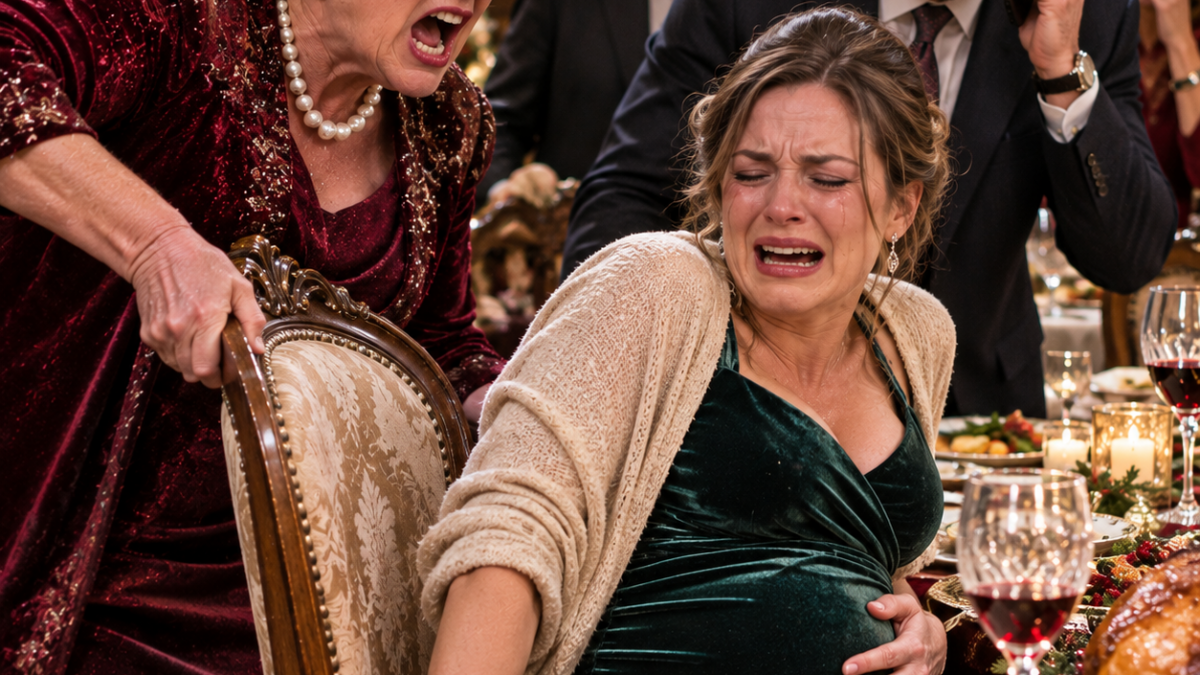
And then Sylvia spoke loudly enough for everyone to hear.
“GET OUT OF THAT CHAIR!”
The dining room fell silent.
I froze.
Sylvia walked toward me, her face twisted with anger.
“SERVANTS DON’T SIT AT THE FAMILY TABLE!”
A shocked murmur moved through the room.
I could feel every pair of eyes turning toward us.
My cheeks burned.
“Sylvia,” I whispered, “please.”
She grabbed the chair.
“I said get away from the table!”
I tightened my grip.
“I just need to sit down.”
“Not here!”
She jerked the chair backward.
I lost my balance.
For a terrifying instant, my feet seemed to slide out from beneath me.
I reached for the table, but my hand caught only the edge of the tablecloth.
My hip struck the corner of another chair.
Then I stumbled sideways and landed hard against the marble floor.
A sharp pain tore through my lower abdomen.
I gasped.
The entire room went still.
For several seconds, I couldn’t move.
Then another wave of pain gripped my stomach.
This one was different.
Deeper.
Frightening.
I pressed both hands against my belly.
“David,” I whispered.
He stood.
But he didn’t come toward me.
Sylvia stared down at me.
“Oh, for heaven’s sake, Anna. Stop being dramatic.”
I tried to sit up.
The pain worsened.
Something was terribly wrong.
I knew it with the certainty that comes before any explanation.
This was not ordinary back pain.
This was not simple exhaustion.
I was twenty-nine weeks pregnant.
And I was lying on the floor in agony.
“Please,” I whispered. “Call an ambulance.”
Nobody moved quickly enough.
Marisol appeared in the doorway.
She immediately dropped to her knees beside me.
“Don’t try to stand.”
I gripped her sleeve.
“My baby.”
Her face changed.
“Someone call 911!”
Sylvia stepped forward.
“Absolutely not. We are not having ambulances and police cars outside my house on Christmas.”
I stared at her in disbelief.
Another tightening pain moved across my abdomen.
I gasped.
Marisol looked toward David.
“Your wife needs medical help.”
David finally approached.
But instead of reaching for his own phone, he looked down at me with a furious expression.
“Anna, what are you doing?”
I couldn’t believe what I was hearing.
“What am I doing?”
His jaw tightened.
“You’ve embarrassed my mother in front of everyone.”
I stared at him.
“I fell.”
“You caused a scene.”
“She pulled the chair!”
“Lower your voice.”
I looked toward the guests.
Richard Bennett stood near the table.
Evelyn Carter had risen from her seat.
Several people were whispering.
I reached into my dress pocket.
My phone.
I still had my phone.
My fingers trembled so badly I could barely unlock it.
I was trying to open the emergency dialer when David bent down.
“What are you doing?”
“Calling for help.”
“Give me that.”
I pulled the phone closer.
“David, please.”
He grabbed my wrist.
Then he snatched the phone from my hand.
I stared at him.
“Give it back.”
“No.”
“David, I’m scared.”
“You’re causing a spectacle.”
“I need a hospital.”
He glanced toward the guests, then leaned close enough that only the people nearest us could hear.
“You think you can call the police and accuse my mother of something?”
I shook my head.
“I just need help.”
He gave a cold laugh.
“I’m a lawyer, Anna. Do you understand that?”
My stomach tightened again.
I bent forward, struggling to breathe.
He continued.
“You have no evidence. No connections. No one important standing behind you.”
I stared at the man I had married.
He was still holding my phone.
Still more concerned about his reputation than our unborn child.
Then he said the words that finally destroyed whatever remained of my love for him.
“You have no chance of winning against me.”
I stopped pleading.
I looked at his face.
And suddenly, beneath the terror and pain, I remembered something my father used to tell me when I was little.
The truth doesn’t become less true because powerful people refuse to hear it.
I drew a trembling breath.
“Then call my father.”
David blinked.
“What?”
“My father.”
He actually laughed.
“Your father?”
I nodded.
“Call him.”
David looked around the room.
Then he gave a smug smile.
“Fine. Let’s call your mysterious father and see what he has to say.”
He held up my phone.
“What’s his number?”
I recited it.
David entered the digits.
He pressed call.
Then he switched on the speaker, apparently eager to humiliate me in front of everyone.
The room was silent.
One ring.
Two.
Three.
Then a deep, familiar voice answered.
“Hello?”
My eyes filled instantly.
“Dad,” I whispered.
There was a pause.
“Anna?”
David smirked.
“Yes, sir. This is David Miller, Anna’s husband. I’m afraid your daughter is behaving rather badly at a family Christmas dinner.”
Another silence.
Then my father’s voice changed.
“Where is Anna?”
David laughed.
“She’s right here. She’s making quite a scene.”
“Put her on the phone.”
Something in his tone made David’s smile falter.
But he lowered the phone toward me.
I could barely speak.
“Daddy?”
His voice softened.
“Anna, sweetheart, what’s wrong?”
The word sweetheart broke something inside me.
I had spent years trying to prove I didn’t need him.
Now I was lying on the floor, terrified, and all I wanted was my father.
“I’m pregnant,” I sobbed. “I fell. My stomach hurts so badly, and David won’t let me call for help.”
The silence that followed was absolute.
Then my father spoke.
Calmly.
Clearly.
With a steadiness that cut through the room.
“Anna, listen carefully. Do not try to stand. Is anyone there helping you?”
“Marisol,” I whispered. “She’s here.”
“Good. Give the phone to her.”
David stiffened.
“Now, hold on—”
My father’s voice became cold.
“I asked for the person helping my daughter.”
David frowned.
“Who exactly am I speaking to?”
My father didn’t answer immediately.
Instead, he said, “Call an ambulance. Right now.”
David’s expression hardened.
“Sir, I’m an attorney, and I don’t appreciate being ordered around in my own home.”
I closed my eyes.
My father spoke again.
“Then perhaps you’ll recognize my name.”
David looked irritated.
“Go ahead.”
“Thomas Whitaker.”
The room seemed to stop breathing.
Richard Bennett turned sharply toward us.
Evelyn Carter’s face changed.
David stared at the phone.
My father continued.
“Chief Justice Thomas Whitaker.”
David’s smile vanished.
“And Anna,” my father said, his voice steady but unmistakably shaken, “is my daughter.”
For a moment, nobody moved.
Then David looked at me.
His expression had changed completely.
The arrogance was gone.
The confidence.
The smug certainty that I was powerless.
He stared at me as though he were seeing a stranger.
“You’re…”
He couldn’t finish.
I looked back at him through my tears.
“Yes, David.”
I pressed one hand over my stomach as another painful contraction began.
“The woman you’ve been treating like a servant is his daughter.”
But my father wasn’t interested in proving a point.
His voice came through the speaker again.
“Anna, are you still having pain?”
“Yes.”
“Is the baby moving?”
I tried to answer.
I couldn’t be certain.
The terror was overwhelming.
My father’s breathing changed.
Then he said firmly, “Someone tell me the address. I’m getting emergency services involved.”
Marisol spoke immediately.
She gave him the full address of the Miller Estate.
Evelyn Carter had already pulled out her own phone.
“I’m calling 911,” she said.
David turned toward her.
“Evelyn, there’s no need—”
She looked at him with an expression I had never seen on her face.
“David. Your wife is twenty-nine weeks pregnant and injured. Move away from her.”
He opened his mouth.
Nothing came out.
Evelyn placed the call.
Marisol stayed beside me, holding my hand.
And Sylvia, the woman who had spent the entire day calling me worthless, stood completely motionless beside the Christmas table.
Her guests were staring.
The senior partners were staring.
My husband was staring.
But for the first time in three years, I wasn’t watching their reactions.
I was listening to my father’s voice.
“Stay with me, Anna.”
I began crying harder.
“I’m scared, Daddy.”
“I know, sweetheart.”
“I’m scared for the baby.”
“I know.”
His voice trembled slightly.
Then he said, “Help is coming. You concentrate on breathing, and let the people there take care of you.”
I closed my eyes.
I had never heard my father sound so frightened.
Not during public arguments.
Not during difficult court decisions.
Not even when reporters gathered outside our home after controversial rulings.
But now, hearing his daughter struggle to breathe, the most powerful judge in our state sounded like any other terrified father.
“Please don’t hang up,” I whispered.
“I won’t.”
And he didn’t.
He stayed on the phone until the paramedics arrived.
The sound of the ambulance siren reached me through the walls of the Miller Estate.
At first, it was distant.
Then it grew louder, cutting through the quiet streets beyond the gates.
I had never been so grateful to hear anything in my life.
Marisol squeezed my hand.
“They’re here, Anna.”
I tried to nod.
Another contraction tightened across my stomach.
I cried out before I could stop myself.
Evelyn was still speaking with the emergency dispatcher.
She had remained near me, calmly answering questions while the other guests moved away from the table.
David stood several feet back, holding my phone.
He looked trapped.
For most of our marriage, he had always known what to say.
He could turn an argument into a debate, twist an apology into an accusation, and make me question whether something cruel had really happened the way I remembered.
But now there were witnesses.
There was a dispatcher on the line.
And there was an injured pregnant woman lying on the floor.
No clever argument could change those facts.
Two paramedics rushed through the dining room carrying medical equipment.
One knelt beside me.
“Hi, Anna. My name is Rachel. I’m a paramedic. Can you tell me how far along you are?”
“Twenty-nine weeks.”
“Okay. We’re going to take care of you.”
She spoke gently while her partner began checking my vital signs.
“Can you tell me what happened?”
I looked toward Sylvia.
She was standing beside the table with her arms rigid at her sides.
I was still afraid of her.
Even then.
Even after everything.
“I was trying to sit down,” I whispered. “My mother-in-law pulled the chair away. I fell.”
Rachel’s expression remained professional.
“Did you strike your abdomen?”
“I don’t know. I hit the chair, and then I fell.”
“Are you having pain right now?”
“Yes.”
“Any bleeding?”
I hesitated.
I had felt an uncomfortable dampness beneath my dress, but I hadn’t wanted to think about what it might mean.
Rachel checked carefully.
Her expression became more serious.
“We’re going to get you to the hospital.”
I began crying again.
“Is my baby going to die?”
She looked directly into my eyes.
“Anna, I can’t answer that here. What I can do is get you to a team that can assess both of you immediately.”
Her honesty frightened me.
But it also reassured me.
For the first time all day, someone was treating my condition as something real.
Not an inconvenience.
Not an embarrassment.
Not a performance.
I was a patient.
And my baby mattered.
David approached as they prepared to move me.
“I’m her husband. I’ll ride with her.”
Rachel looked at me.
“Anna, would you like him to come?”
I stared at David.
He was wearing the same beautiful charcoal suit he’d put on that morning.
His tie was perfectly straight.
His hair hadn’t moved.
He looked like a man who had just stepped out of a magazine advertisement for a successful attorney.
But I could still hear his voice.
You have no chance of winning against me.
I began shaking.
“No,” I whispered.
David stiffened.
“Anna, don’t be ridiculous.”
Rachel looked at him.
“Sir, please step back.”
“She’s my wife.”
“And she’s told us she doesn’t want you accompanying her.”
His face flushed.
“This is a private family matter.”
Evelyn spoke from behind him.
“David, stop.”
He turned.
“Stay out of this.”
Richard Bennett stepped forward.
“That’s enough.”
The room became silent again.
Richard was a broad-shouldered man in his late fifties with silver hair and the controlled manner of someone accustomed to making difficult decisions.
He had spent most of the day laughing with David.
Now his expression was unreadable.
“Let them do their jobs,” he said.
David looked from Richard to Evelyn.
For the first time, he seemed to understand that the people he had spent months trying to impress had witnessed something he couldn’t talk his way out of.
He stepped back.
As the paramedics transferred me onto the stretcher, I caught sight of Sylvia.
She was no longer standing proudly beside her perfect Christmas table.
Her hands were shaking.
Her face was pale.
And the expensive dinner I’d spent the entire day preparing sat untouched beneath the chandeliers.
I wondered whether she would finally understand what she’d done.
Then another contraction came.
I stopped wondering about Sylvia.
I had much more important things to worry about.
The ambulance doors closed behind me.
For the first time that day, I was away from the Millers.
I should have felt safe.
Instead, I felt terrified.
Rachel sat beside me, monitoring my condition and speaking into a radio.
Her partner drove.
The lights above me seemed painfully bright.
Every bump in the road made me tense.
I kept one hand on my stomach.
“Please,” I whispered. “Please, baby.”
Rachel leaned closer.
“Anna, try to breathe slowly.”
I tried.
She asked a few more questions.
Had I been having contractions before the fall?
Had my water broken?
Had I experienced bleeding earlier in the day?
I told her about the back pain, the long hours standing, and the tightening sensations I’d tried to ignore.
She listened without interrupting.
Then she asked whether I had experienced anything like this during the pregnancy before.
“No.”
“Okay.”
I watched her face, searching for reassurance.
She remained calm.
That helped.
But I couldn’t stop imagining what might be happening inside me.
I had spent twenty-nine weeks dreaming about my baby.
I’d painted the nursery a soft shade of green.
I’d bought tiny white socks, folded blankets, and spent hours choosing a crib.
I had imagined bringing my daughter home in the spring, when the trees were beginning to bloom.
I had imagined holding her against my chest and whispering that she was safe.
I hadn’t imagined lying in an ambulance on Christmas night, praying she would survive long enough for me to meet her.
My phone was gone.
David still had it.
I suddenly remembered my father.
“Can someone call my dad?”
Rachel nodded.
“Of course. Do you know his number?”
I recited it.
She made sure someone at the hospital would contact him as soon as possible.
Then she placed her hand lightly on my shoulder.
“Anna, right now I need you to focus on yourself and the baby.”
I nodded.
I closed my eyes.
And for the first time in three years, I allowed myself to stop worrying about David’s feelings.
The hospital was a blur of bright lights, hurried footsteps, and urgent voices.
A team was waiting when the ambulance arrived.
I was taken directly to labor and delivery.
A nurse helped remove my dress and gave me a hospital gown.
Another attached monitors.
A physician began asking questions about the fall, the pain, and my pregnancy.
I answered as best I could.
Then I heard something that made me cry with relief.
A heartbeat.
Fast.
Steady for that moment.
My baby’s heartbeat.
I turned toward the monitor.
“That’s her?”
The nurse nodded.
“That’s your baby.”
I covered my mouth.
For a few precious seconds, the terror loosened its grip.
She was alive.
My little girl was alive.
But the doctor wasn’t smiling.
She explained that the team was concerned about possible placental injury and premature labor. They needed to monitor my contractions, bleeding, and the baby’s heart rate closely.
I stared at her.
“Is she going to be alright?”
“We’re doing everything we can for both of you,” she answered.
I knew she was being careful.
I also knew that careful answers sometimes contained frightening truths.
They began treatment to help protect the baby if early delivery became unavoidable.
I was moved into a room where nurses could monitor me continuously.
Every few minutes, someone checked the screen.
Every change in the sound of the heartbeat made my own heart race.
I kept thinking about the moment Sylvia pulled the chair.
If I hadn’t tried to sit down, would this have happened?
If I’d rested earlier, would the pain have stopped?
If I’d called my father that morning, would I be safe at home instead of lying in a hospital bed?
I began blaming myself.
For the first time that night, the doctor sat beside me and spoke firmly.
“Anna, I need you to understand something. We can’t determine the cause of every complication from one event, but you did the right thing by seeking emergency care. Our priority now is keeping you and your baby safe.”
I looked at her.
“I should have left earlier.”
She paused.
Then she said, “You deserved to be safe long before you came to this hospital.”
I began crying.
Because she was right.
And because I had spent so long convincing myself otherwise.
My father arrived shortly before midnight.
I didn’t see him enter.
I was lying on my side, exhausted, while a nurse adjusted one of the monitors.
Then I heard a familiar voice.
“Anna?”
I turned.
He was standing in the doorway.
For a moment, I hardly recognized him.
Not because his appearance had changed.
But because I had never seen him look so frightened.
Chief Justice Thomas Whitaker was a tall man with silver hair, a serious face, and a posture that usually made every room seem smaller.
He had spent decades in courtrooms where attorneys rose when he entered.
Reporters described him as stern.
Colleagues called him disciplined.
But now he stood in a hospital doorway wearing an old wool coat over a wrinkled sweater, his eyes red and his hands trembling.
“Daddy.”
He crossed the room in three long steps.
I reached for him.
He held me carefully, avoiding the monitoring equipment.
And I began sobbing against his shoulder.
“I was so scared.”
“I know, sweetheart.”
“I thought I was going to lose her.”
His arms tightened around me.
“I’m here.”
I shook my head.
“I’m sorry.”
He pulled back slightly.
“For what?”
“For not telling you.”
His eyes filled.
“Anna, you don’t have anything to apologize for.”
“I lied.”
He shook his head.
“You told me you were happy.”
I couldn’t speak.
He gently brushed a strand of hair away from my face.
“I should have asked more questions.”
“You did ask.”
He looked at me.
“I just kept saying everything was fine.”
My father sat beside the bed.
For a moment, neither of us spoke.
Then he said something that broke my heart all over again.
“I spent years making sure other people’s children received fair treatment under the law. And I didn’t know my own daughter was afraid in her home.”
I shook my head.
“You couldn’t have known.”
He looked down.
“Perhaps not. But I wish you’d felt you could tell me.”
I stared at him.
The words touched a wound much older than my marriage.
“When Mom died,” I whispered, “I needed you.”
His face changed.
I had never spoken to him so directly about that time.
“I know.”
“You were always working.”
He closed his eyes.
“I know.”
“I thought you didn’t want to be around me because I reminded you of her.”
He looked devastated.
“Oh, Anna.”
I began crying again.
“I thought if I needed you too much, you’d leave me, too.”
He took my hand.
“Your mother was the love of my life,” he whispered. “When she died, I didn’t know how to keep living the way we’d lived before.”
I looked at him.
“So you went to work.”
“Yes.”
“And I went to Aunt June.”
His voice broke.
“Yes.”
I had spent years believing that my father had chosen his career over me.
Now I could see that grief had left us both lost.
That didn’t erase what happened.
But it explained some of the distance we’d never managed to cross.
“I failed you in ways I can’t undo,” he said. “I’m sorry.”
I squeezed his hand.
“I didn’t tell David who you were because I didn’t want another man loving me for your position.”
My father studied my face.
“I understand that.”
“I wanted a normal marriage.”
“Of course you did.”
“I wanted someone to love me because I was me.”
He leaned closer.
“Anna, you should never have to reveal who your father is to make someone treat you decently.”
I closed my eyes.
Those were the words I hadn’t known I needed.
He continued.
“If David had been worthy of you, it wouldn’t have mattered whether your father was a judge, a janitor, or a man who never had a dollar to his name.”
I looked at him through my tears.
“He wasn’t always like this.”
My father nodded.
“People rarely reveal every part of themselves at the beginning.”
“I kept thinking he would change.”
“I know.”
“He said he loved me.”
My father’s eyes filled.
“Love should never require you to be afraid.”
I looked down at my stomach.
The monitor continued recording my baby’s heartbeat.
I wanted to believe we were safe now.
Then the nurse entered.
Her expression was serious.
And I knew, before she spoke, that something had changed.
The next hour moved with terrifying speed.
The baby’s heart rate had begun showing concerning changes, and my contractions were becoming more frequent.
The medical team repeated their assessments.
The doctor came to my bedside.
“Anna, we’re increasingly concerned that your baby may not be tolerating what’s happening. We need to prepare for the possibility of delivering her tonight.”
My father stood beside me.
I stared at the doctor.
“Tonight?”
She nodded.
“But she’s too small.”
“I know this is frightening,” she said. “Our neonatal team is prepared to care for babies born this early. We’re going to explain each step, but we may need to move quickly.”
I looked at my father.
His face was pale.
“Daddy?”
He took my hand.
“I’m right here.”
I began shaking.
“I haven’t even finished her nursery.”
His eyes filled.
“I know, sweetheart.”
“I didn’t wash all her blankets.”
“You’ll have time to do that later.”
“I haven’t held her yet.”
My voice broke completely.
He bent closer.
“Then let’s concentrate on getting you both through tonight.”
The doctor explained that an emergency cesarean delivery might be the safest option if the baby’s condition continued to worsen.
I listened.
I asked questions.
I signed the necessary consent forms after the team explained the risks and urgency.
My father stayed beside me until the staff prepared to take me into the operating room.
Then he kissed my forehead.
“I love you, Anna.”
I stared at him.
For years, I’d wanted him to say those words more often.
Now they were the only thing keeping me from falling apart.
“I love you, Daddy.”
He squeezed my hand.
“I’ll be right here when you come back.”
I nodded.
Then the doors opened.
And I was taken away.
I remember the operating room in fragments.
Bright lights.
A nurse speaking gently near my head.
The sound of medical equipment.
Someone explaining what was happening.
A strange pressure.
The desperate need to hear my baby cry.
I kept asking whether she was alright.
The team reassured me that they were working carefully and quickly.
Then, finally, she was born.
My daughter.
Twenty-nine weeks.
So much earlier than I’d imagined.
I heard a small sound.
Not the loud, indignant cry I’d pictured in all my daydreams.
Just a brief, fragile cry that made tears rush into my eyes.
“Is that her?”
A voice answered.
“Yes, Anna. That’s your baby.”
I began sobbing.
“Is she okay?”
“She needs help breathing, and the neonatal team is caring for her.”
I tried to turn my head.
I wanted to see her.
I wanted to know what she looked like.
For a fleeting moment, someone brought her close enough for me to glimpse her tiny face.
She was impossibly small.
Her skin was pink and delicate.
Her eyes were closed.
Then the neonatal team took her away to the intensive care unit.
I watched them go.
Every instinct in my body screamed to follow.
But I couldn’t move.
I lay there listening to the medical team, trying to comprehend what had just happened.
My daughter had been born.
She was alive.
And I couldn’t hold her.
When I woke in recovery, my father was sitting beside me.
He stood immediately.
“Anna?”
I blinked.
My mouth was dry.
“Baby?”
He leaned closer.
“She’s in the neonatal intensive care unit.”
I struggled to lift my head.
“Is she alive?”
“Yes, sweetheart.”
I began crying.
“She’s alive?”
He nodded.
“She is.”
I covered my face.
For several seconds, I could do nothing but sob.
My father rested his hand over mine.
“The doctors say she’s receiving the care she needs. She’s very premature, and they can’t promise what the next few weeks will bring, but they’re watching her closely.”
I stared at him.
“Have you seen her?”
“Not yet.”
I swallowed.
“Can I see her?”
“As soon as the doctors say you’re ready.”
I closed my eyes.
I wanted to feel happy.
I’d become a mother.
My daughter was alive.
But joy was tangled with terror, exhaustion, and a grief I couldn’t fully explain.
I had imagined giving birth surrounded by love.
I had imagined David holding my hand.
I had imagined him kissing my forehead and telling me how proud he was.
Instead, my husband had watched his mother humiliate me, taken away my phone, and tried to prevent me from seeking help.
I turned toward my father.
“Where’s David?”
His expression changed.
“He came to the hospital.”
My body tensed.
“Is he here?”
“No. The hospital staff explained that you didn’t want him with you. He isn’t in this room.”
I stared at the ceiling.
“Was he angry?”
My father was quiet.
“Anna, you don’t need to manage David’s emotions tonight.”
I looked at him.
That sentence was so simple.
But it felt like permission to put down a weight I’d been carrying for years.
I began crying again.
“I don’t want him near me.”
My father took my hand.
“Then we’ll make sure the staff understand your wishes and help you explore the protections available.”
I nodded.
A nurse came in shortly afterward.
She asked whether I felt safe returning home.
I shook my head.
She asked whether I wanted to speak with a hospital social worker and a victim-support advocate.
I said yes.
She didn’t pressure me.
She didn’t tell me what decision to make about my marriage.
She simply explained that help was available and that I didn’t have to make every decision immediately.
I looked at my father.
For the first time since Christmas morning, I felt that the people around me were listening to what I wanted.
That alone was almost overwhelming.
The first time I saw my daughter in the neonatal intensive care unit, I couldn’t stop crying.
She lay inside an incubator surrounded by equipment.
Her tiny chest rose and fell with the assistance of respiratory support.
A soft knitted cap covered her head.
There were monitors above her bed, and the gentle sounds of the unit filled the room.
I stood beside her, still sore from surgery, with my father close enough to steady me.
She was so small.
Smaller than any baby I’d ever held.
I stared at her fingers.
Perfect little fingers.
Her tiny nose.
The curve of her cheek.
I reached toward the incubator, then stopped.
A nurse showed me how to place my hand gently against her without disturbing the equipment.
I touched my daughter for the first time.
“Hi, baby,” I whispered.
My voice broke.
“It’s Mommy.”
She moved slightly.
I bent closer.
“I’m sorry you had such a hard beginning.”
Tears slipped down my cheeks.
“I wanted to keep you safe.”
The nurse spoke gently.
“You’re here with her now, Anna.”
I nodded.
But the guilt was fierce.
I kept replaying every moment of Christmas Day.
Why hadn’t I refused to work?
Why hadn’t I walked away?
Why had I remained silent?
My father seemed to understand what I was thinking.
He stood beside me and said quietly, “Anna, the responsibility for what happened belongs to the people who chose to hurt you.”
I shook my head.
“I should have protected her.”
“You sought help when you knew something was wrong.”
I stared at my daughter.
“She shouldn’t be here this early.”
“I know.”
My father placed a hand on my shoulder.
“But she is here. And she’s getting help.”
I wiped my eyes.
I looked at her again.
“I’m going to call her Clara.”
My father turned toward me.
For a moment, he didn’t speak.
Clara had been my mother’s name.
I had considered several names during the pregnancy, but that one had always stayed with me.
My father swallowed.
“Clara?”
I nodded.
“Clara June.”
After my mother and the aunt who had helped raise me.
My father’s eyes filled.
“Your mother would have loved that.”
I smiled through my tears.
“I know.”
We stood together beside the incubator.
The daughter who had lost her mother too young.
The father who had never learned how to speak about his grief.
And the tiny granddaughter who had brought us back into the same room.
For the first time in years, I didn’t feel the need to hide who I was.
I was Anna.
I was Thomas Whitaker’s daughter.
I was Clara June’s mother.
And I was finally beginning to understand that those truths could exist together without any of them diminishing the others.
The first official questions about Christmas night came while I was still recovering.
A police officer visited the hospital after speaking with the medical staff and confirming that I was willing and medically able to give a statement.
A hospital advocate remained nearby.
My father offered to step out.
I asked him to stay.
The officer introduced herself as Detective Laura Hayes.
She spoke calmly and explained that she wanted to understand what happened at the Miller Estate.
I told her everything.
The early morning cooking.
Sylvia’s insults.
David’s refusal to let me rest.
The missing place setting.
The chair.
The fall.
The pain.
My attempt to call for help.
David taking my phone.
His threats.
I described the events slowly, stopping whenever I needed to.
Detective Hayes didn’t interrupt.
When I finished, she asked several questions.
“Did you give your husband permission to take your phone?”
“No.”
“Did you tell him you needed emergency assistance?”
“Yes.”
“Did he return the phone when you asked?”
“No.”
“Were there other people present?”
I nodded.
“Nearly twenty.”
She wrote that down.
“Do you remember any names?”
“Richard Bennett. Evelyn Carter. Marisol was one of the caterers.”
The detective nodded.
“We’ve already spoken with some people who were there.”
I looked at her.
“You have?”
“Yes.”
My stomach tightened.
“What did they say?”
She answered carefully.
“I can’t discuss everyone’s statement, but several witnesses have provided information about the incident.”
I looked down.
For years, David had convinced me that nobody would believe me.
Now there were people willing to describe what they had seen.
The detective asked whether David had threatened me before.
That question was harder.
I thought about the humiliating remarks.
The way he controlled conversations.
The threats that he could destroy my reputation if I ever left.
The way he’d sometimes taken my car keys during arguments, insisting I wasn’t calm enough to drive.
I had spent years telling myself those incidents weren’t serious.
After all, he hadn’t always been physically violent.
He could be generous.
He could be affectionate.
He could apologize beautifully when he wanted to.
But as I began describing our marriage, I heard the pattern in my own words.
David had repeatedly used fear, money, and his professional status to control me.
He told me nobody would believe me.
He said he knew judges.
He said he understood how the legal system worked and I didn’t.
He made me feel foolish for questioning him.
And whenever I tried to defend myself, he accused me of being unstable.
Detective Hayes listened.
Then she said, “Anna, what you’re describing may be relevant to our investigation. I appreciate you telling me.”
I swallowed.
“Is he going to be arrested?”
She didn’t promise anything.
She explained that investigators would review the evidence and work with prosecutors to determine what charges, if any, were supported.
I nodded.
I was learning that the legal process wasn’t like the courtroom dramas David enjoyed watching.
There wasn’t always an immediate dramatic arrest.
There wasn’t one powerful person who could simply declare someone guilty.
There were statements, records, evidence, procedures, and rights.
My father knew that better than anyone.
And he was determined not to interfere.
After the detective left, he sat beside my bed.
I looked at him.
“Are you going to do something?”
His expression softened.
“I’m going to help you get safe, Anna.”
“I mean about David.”
He took a breath.
“I’m your father. I can support you, help you find independent counsel, and make sure you have access to ordinary legal protections.”
I watched him.
“But I cannot use my judicial position to decide what happens to David.”
I nodded.
“I know.”
“And because this concerns my family, I won’t take part in any judicial proceeding involving this matter.”
I stared at him for a moment.
Then I whispered, “I don’t want you to break the law for me.”
He squeezed my hand.
“I know, sweetheart.”
“I just want him to stop hurting me.”
My father’s eyes filled.
“Then that’s where we begin.”
The weeks that followed were some of the longest of my life.
Clara remained in the neonatal intensive care unit.
Every morning, I woke with the same question.
Was my daughter still alright?
I learned to recognize the sounds of the monitors. I learned which numbers the nurses watched most closely and why they sometimes asked me to step back while they adjusted her equipment.
I learned that progress with a premature baby rarely happened in a straight line.
One day, Clara seemed stronger.
The next, she needed more help.
Some mornings, I felt hopeful.
Other mornings, I sat beside her incubator fighting the fear that I might lose her before I ever had the chance to bring her home.
The nurses taught me how to participate in her care.
At first, I was afraid to touch her.
She seemed so delicate.
But gradually, I began to understand that she needed me, even when I couldn’t hold her the way I’d imagined.
I spoke to her.
I read children’s stories softly beside her incubator.
I told her about the house where I grew up, the garden Aunt June loved, and the grandmother she’d been named after.
My father visited whenever he could.
Sometimes he sat silently beside me.
Sometimes he brought food because he knew I would forget to eat.
Once, he arrived carrying a small children’s book.
I recognized it immediately.
It was the same collection of bedtime stories my mother used to read to me.
The cover was faded.
The corners were worn.
I stared at it.
“Where did you find that?”
My father smiled sadly.
“I kept it.”
I took it carefully.
“You still have it?”
“Of course.”
I opened the cover.
Inside, in my mother’s handwriting, were three words.
For my Anna.
I began crying.
My father sat beside me.
“She used to say you’d grow up to be a wonderful mother.”
I looked through the nursery window at Clara.
“I don’t feel wonderful.”
He took my hand.
“Most good parents spend more time worrying about what they’ve done wrong than celebrating what they’ve done right.”
I looked at him.
He smiled faintly.
“I know I did.”
For a moment, we both remembered the distance between us.
Then he continued.
“But you don’t have to make the same mistakes I made.”
I looked toward Clara.
“I don’t want her growing up afraid to ask me for help.”
“Then make sure she knows your love isn’t conditional.”
I nodded.
“And make sure she knows that loving someone doesn’t mean accepting cruelty.”
I closed the book.
Those words stayed with me.
David began contacting me through messages shortly after I left the hospital.
At first, he apologized.
Anna, I never wanted any of this to happen.
Then he blamed Sylvia.
Mother shouldn’t have touched the chair.
Then he blamed the guests.
People misunderstood what they saw.
Then he blamed me.
You didn’t need to involve the police. We could have handled this privately.
Finally, he began talking about his career.
Do you understand what your father’s involvement is doing to me?
I stared at that message for a long time.
Even after our daughter had been born prematurely, David was still thinking about his professional reputation.
He seemed more frightened of losing his partnership than of what had happened to his wife and child.
I stopped replying directly.
With help from the hospital advocate, I contacted an attorney who specialized in family law and protective orders.
Her name was Rebecca Collins.
She was practical, direct, and completely unimpressed by David’s professional status.
During our first meeting, I told her I was worried because my husband understood the legal system better than I did.
Rebecca leaned back in her chair.
“Anna, your husband being a lawyer doesn’t mean he’s entitled to control you.”
I looked at her.
“He says he knows how to win.”
She nodded.
“I’m sure he does. But a courtroom is not a contest in which the person with the most confidence automatically wins.”
I almost smiled.
She continued.
“We’re going to document what’s happened, understand your options, and make decisions based on your safety and your daughter’s needs.”
I swallowed.
“Can he take Clara away from me?”
Rebecca’s expression remained calm.
“Custody decisions depend on the law and the evidence. I can’t promise you an outcome, but being a lawyer doesn’t give David special parental rights. The court will consider the child’s welfare and the circumstances involved.”
I nodded.
For years, David had spoken about the law as though it were a weapon he personally owned.
Rebecca spoke about it as a system.
Not perfect.
Not magical.
But something that existed beyond my husband’s control.
That distinction mattered more than I expected.
With her help, I began the process of legally separating from David and seeking protective arrangements.
I also began gathering my personal documents.
Bank statements.
Employment records.
Marriage records.
Medical information.
I learned that I had more independence than David had led me to believe.
My savings account was still mine.
My professional qualifications hadn’t disappeared.
My ability to make decisions hadn’t vanished because I’d married into a wealthy family.
I was frightened.
But I wasn’t helpless.
David’s career began unraveling in ways he hadn’t anticipated.
The first consequences came from his own law firm.
Richard Bennett and Evelyn Carter had witnessed enough of Christmas evening to become deeply concerned.
They had heard Sylvia insult me.
They had seen the aftermath of my fall.
And Evelyn had witnessed David interfere while I was trying to obtain emergency help.
Within days, the firm began reviewing what had occurred and assessing David’s conduct.
He was placed on leave while the firm evaluated the situation.
David was furious.
He sent a message through my attorney claiming that my father had pressured his employers.
But that wasn’t true.
My father had not called the firm.
He had not contacted Richard Bennett or Evelyn Carter.
He had not threatened anyone’s license.
He had not demanded that prosecutors file charges.
The people who had watched David’s behavior were perfectly capable of judging it for themselves.
At the Christmas dinner, David had wanted to impress the senior partners with his refinement, connections, and professional discipline.
Instead, they’d watched him refuse to protect his pregnant wife after she was injured and attempt to prevent her from making an emergency call.
No family influence was required to recognize how serious that was.
David’s promotion was taken off the table.
Then the firm ended his employment.
I learned about it through Rebecca.
She explained the situation carefully because she didn’t want me relying on rumors.
I listened without speaking.
For months, David had told me that everything depended on Christmas dinner.
He had warned me not to embarrass him.
He had ordered me to work through pain because the evening was supposedly the most important event of his professional life.
And in a way, he’d been right.
That Christmas changed his career.
But not because I revealed who my father was.
It changed because the men and women whose respect he wanted had finally seen how he behaved when he thought someone was powerless.
I didn’t celebrate.
I was still spending my days beside Clara’s incubator.
I was still struggling to recover from surgery.
I was still frightened about the future.
But I felt something I hadn’t experienced in years.
Relief.
David could no longer insist that his reputation made him untouchable.
His reputation had consequences.
And those consequences belonged to him.
Sylvia reacted differently.
She hired an attorney and insisted that the fall had been an accident.
She claimed I’d been emotional because of the pregnancy.
She said I’d misunderstood her instructions.
She suggested I’d deliberately created a scene because I resented her relationship with David.
When investigators asked about the chair, she maintained that she’d simply moved it out of the way.
I wasn’t surprised.
For three years, Sylvia had treated my feelings as evidence of weakness.
Now she was using the same argument to explain away what happened on Christmas.
But there were witnesses.
Marisol had been close enough to see the chair move.
Evelyn had seen the confrontation.
Other guests had heard Sylvia’s words.
And the emergency records documented what happened afterward.
Investigators also reviewed what David had done when I tried to call for help.
The case moved slowly.
Statements had to be reviewed.
Evidence had to be assessed.
Attorneys had to respond.
I didn’t follow every development.
Rebecca kept me informed of the important parts, and I focused on my daughter.
Eventually, charges were filed in connection with the assault and interference with emergency assistance.
Sylvia and David were entitled to defend themselves.
They were entitled to legal representation.
They were entitled to due process.
My father reminded me of that when I grew frustrated with how long everything was taking.
“I know you want it finished,” he said.
“I just want them to admit what they did.”
He nodded.
“I understand.”
“Why is it so difficult for them to tell the truth?”
He looked at me.
“Because sometimes people build their entire identity around believing they are incapable of wrongdoing.”
I thought about Sylvia standing beside her perfect Christmas table.
I thought about David laughing while holding my phone.
“Does the truth matter if they never admit it?”
My father took my hand.
“Yes,” he said. “But you don’t have to wait for their agreement before you begin rebuilding your life.”
I looked at him.
He continued.
“You know what happened. The people who witnessed it know what they saw. The legal process will determine the consequences it can support. Your recovery doesn’t have to depend on an apology.”
I sat quietly.
Then I nodded.
Because for the first time, I understood that waiting for Sylvia or David to become different people might keep me trapped long after I’d physically left them.
Clara spent weeks in the hospital.
There were difficult days.
One morning, her breathing became more labored, and the medical team had to adjust her support.
I sat beside her, feeling helpless.
Every alarm made my heart race.
Every time a nurse approached quickly, I feared the worst.
But slowly, Clara grew stronger.
She gained weight.
Her breathing improved.
The doctors began discussing the possibility of bringing her home when she was medically ready.
The first time I was allowed to hold her against my chest, I felt something in me begin to heal.
A nurse helped position her carefully.
Her tiny body rested against mine.
I could feel her warmth.
Her breathing.
The gentle pressure of her little hand against my skin.
I closed my eyes.
“Hello, Clara.”
She moved slightly.
I kissed the top of her head.
“I’ve been waiting for this.”
The nurse smiled.
I began crying.
Not because I was afraid.
Not entirely.
I cried because, after weeks of imagining the worst, I was finally holding my daughter.
I thought about the nursery.
The blankets.
The little white socks.
All the things I’d feared she would never need.
I whispered, “We’re going to go home, sweetheart.”
And for the first time, I truly believed it.
David requested permission to see Clara.
The request came through Rebecca.
I didn’t know how to feel.
He was her father.
That fact didn’t disappear because he’d hurt me.
But I was terrified of being anywhere near him.
Rebecca explained that any contact would need to follow the protective arrangements and medical guidance in place.
We discussed what would be safe, appropriate, and legally required.
I didn’t make the decision out of revenge.
I didn’t want to punish Clara for her father’s actions.
I wanted her protected.
Eventually, with the necessary arrangements in place, David was permitted to receive medical updates and participate in limited, supervised contact as approved.
I wasn’t present for those visits.
That was important to me.
I couldn’t begin healing while David continued using every interaction to pressure me.
He sent a letter through Rebecca.
It was several pages long.
For the first time, he acknowledged taking my phone.
He admitted that he had allowed Sylvia to treat me badly.
He said he had been obsessed with becoming a partner.
He claimed that he’d mistaken professional ambition for responsibility.
I read the letter slowly.
Some of the words sounded sincere.
Others sounded like the carefully crafted explanations David had always been good at producing.
Near the end, he wrote:
I know I destroyed your trust, but I hope someday you can forgive me.
I stared at that sentence.
For most of our marriage, forgiveness had been something David expected me to provide quickly.
He would hurt me.
Then apologize.
Then become irritated when I didn’t immediately behave as though everything were normal.
Now he was asking again.
But this time, I understood that forgiveness didn’t require reconciliation.
I could let go of hatred without returning to a harmful marriage.
I could recognize that David might regret his actions without trusting him with my safety.
And I could hope he became a better father without becoming his wife again.
I folded the letter.
I didn’t respond immediately.
A few days later, I asked Rebecca to convey a short message.
I appreciated his acknowledgment of what he’d done.
But I would not be returning to the marriage.
I wanted to proceed with the divorce.
That decision frightened me.
It also felt like the first fully independent choice I’d made in years.
By the time Clara was finally ready to leave the hospital, winter was beginning to loosen its grip.
I stood beside her crib while a nurse went through the discharge instructions.
There were follow-up appointments to schedule.
Specialist visits.
Feeding guidance.
Developmental monitoring.
More questions than I could count.
I listened carefully.
I wrote everything down.
I asked for clarification when I didn’t understand something.
Then I dressed Clara in the tiny outfit I’d brought for her.
It was pale yellow, with little embroidered flowers near the collar.
I’d purchased it months earlier, imagining the day I’d bring her home.
Back then, I had planned to return to the Miller Estate.
Now I was taking her somewhere else.
A small house my father had helped me find near the hospital, where I could live independently while arranging the next stage of my life.
He had offered to buy me something enormous.
I refused.
I didn’t want another estate.
I didn’t want marble floors or chandeliers.
I wanted somewhere I could breathe.
Somewhere the front door opened because I chose to open it.
Somewhere my daughter would never be told that she didn’t belong at the family table.
My father understood.
He helped me arrange the practical details, but he respected my decision to maintain control over my own finances and future.
The house was modest.
Two bedrooms.
A bright living room.
A small kitchen with white cabinets.
A fenced backyard where I hoped Clara would someday play.
It was perfect.
When I carried her through the front door for the first time, I stopped in the hallway.
My father stood behind me holding the diaper bag.
“Everything alright?”
I looked around.
Sunlight fell across the wooden floor.
A small Christmas ornament I’d kept from childhood hung beside the window, although the holiday had passed.
The nursery door stood open.
The house smelled faintly of fresh paint and lavender.
I looked down at Clara.
She was sleeping peacefully against my chest.
“Yes,” I whispered.
My father smiled.
“Good.”
I began crying.
He looked worried.
“Anna?”
I shook my head.
“I’m happy.”
He smiled sadly.
“Then cry as much as you need to.”
I laughed through my tears.
And I stepped inside.
For the first time since my marriage began falling apart, I didn’t feel like I was escaping something.
I felt like I was arriving somewhere.
Home.
The legal proceedings continued throughout the spring and summer.
I tried not to let them consume my life.
Clara needed me.
My recovery needed attention.
And I had begun rebuilding the ordinary routines David and Sylvia had spent years disrupting.
But there were still days when the past returned with frightening force.
A door closing too loudly could make me flinch.
A man’s angry voice in a grocery store could send my heart racing.
Sometimes, while washing dishes, I would suddenly remember standing in the Miller Estate kitchen with my hand on my pregnant belly, begging for ten minutes of rest.
The memories arrived without warning.
I began seeing a counselor who worked with survivors of domestic abuse.
At first, I was embarrassed.
I told her I should have known better.
I had a college education.
I had professional experience.
My father was one of the most respected legal figures in the state.
How could I have allowed someone to treat me that way?
She listened.
Then she asked, “Anna, if another woman told you her husband had threatened her, isolated her, and refused to help while she was injured, would you think she was foolish?”
“Of course not.”
“Would you ask why she hadn’t been strong enough to leave sooner?”
I shook my head.
“Then why do you believe those things about yourself?”
I couldn’t answer.
For years, David had made me believe that every problem in our marriage began with my reactions.
If he raised his voice, I had provoked him.
If Sylvia insulted me, I was too sensitive.
If I cried, I was unstable.
If I complained, I was ungrateful.
Gradually, I had started monitoring my own behavior more carefully than theirs.
I had become so afraid of causing conflict that I stopped recognizing when conflict was being forced upon me.
The counselor helped me understand how that happened.
She also helped me accept something I had resisted for months.
I didn’t need to become fearless overnight.
I only needed to keep making choices that protected my daughter and me.
Some days, that meant speaking with Rebecca.
Some days, it meant attending another medical appointment with Clara.
And some days, it meant sitting in my sunny little kitchen, drinking coffee without worrying that someone would burst through the door and demand to know why I wasn’t working.
Those peaceful mornings became precious to me.
The criminal cases eventually moved toward resolution.
Sylvia’s attorney argued that the chair incident had been a misunderstanding.
The prosecution relied on witness statements, the circumstances of the fall, and other evidence.
Marisol testified about what she had seen.
Evelyn Carter gave her account of the confrontation and the effort to obtain emergency help.
David’s conduct after I fell became a separate and serious part of the proceedings.
The medical evidence established the condition in which I arrived at the hospital, although the doctors could not say with absolute certainty that one specific action had caused Clara’s premature birth.
I appreciated that honesty.
I didn’t need anyone to exaggerate what had happened.
The truth was frightening enough.
My mother-in-law had deliberately pulled a chair while I was trying to sit.
I had fallen.
I had experienced a medical emergency.
And my husband had taken away my phone while I was asking for help.
Those were the facts.
They didn’t need decoration.
Eventually, Sylvia accepted responsibility through a negotiated plea to an assault-related charge.
She received a sentence involving probation and court-imposed conditions.
It wasn’t the dramatic punishment I’d imagined during my angriest moments.
There was no grand public humiliation.
No judge delivering a speech about the cruelty of wealthy families.
But Sylvia could no longer insist that nothing improper had happened.
There was an official record.
There was accountability.
And most importantly, I was no longer living under her roof.
David faced consequences of his own.
His interference with my attempt to seek emergency assistance, combined with the evidence of his threatening behavior, became the subject of criminal proceedings and a professional disciplinary review.
He ultimately accepted responsibility in the criminal matter.
His former law firm had already terminated his employment.
His anticipated partnership was gone.
The disciplinary authorities later imposed a suspension on his ability to practice law, following their own process and review of the evidence.
The man who had once warned me that his legal knowledge made him unbeatable now had to answer for his conduct before the very profession he’d used to intimidate me.
None of it happened because my father ordered it.
My father remained completely outside the decisions involving prosecution, professional discipline, and judicial proceedings.
He recused himself from any matter involving our family that might otherwise have reached his court.
He didn’t make secret calls.
He didn’t threaten judges.
He didn’t tell anyone to punish David.
The consequences came from the evidence, the witnesses, and David’s own actions.
One phone call had exposed the truth.
But it was David’s conduct that destroyed his career.
I saw him in person during one of the final proceedings connected with our separation.
He looked different.
Not unrecognizable.
Just smaller somehow.
The expensive suits were gone.
He wore a plain dark jacket and sat beside his attorney without the effortless confidence I’d once mistaken for strength.
When our eyes met, he looked away.
For years, I had been the one lowering my eyes.
Now I looked directly at him.
I felt no desire to embarrass him.
I didn’t want him frightened or humiliated.
I simply wanted to finish the legal process and return to my daughter.
At one point, David approached through his attorney and asked whether he could speak with me.
Rebecca looked at me.
“You don’t have to.”
I thought for a moment.
Then I shook my head.
“Not today.”
David remained where he was.
I turned toward the hallway.
And for the first time, declining a conversation with my husband didn’t make me feel guilty.
It made me feel free.
Our divorce became final after the necessary proceedings.
There were difficult negotiations involving finances, property, and Clara’s care.
I didn’t receive everything I initially hoped for.
Neither did David.
The arrangements were based on the applicable law and Clara’s welfare, not my father’s position.
David’s contact with Clara remained subject to the protective conditions and custody arrangements in place, with supervised parenting time as appropriate.
I intended to follow those arrangements.
I also intended to protect my daughter.
I hoped David would eventually understand that being a father required more than providing money or claiming authority.
It required patience.
Consistency.
Accountability.
And the ability to recognize someone else’s needs.
I couldn’t make him become that person.
But I could refuse to teach Clara that his mistakes were her responsibility.
Sylvia remained distant.
I didn’t seek contact with her.
I didn’t feel a need to revisit the estate or demand another apology.
There was nothing left for me in that enormous house.
No amount of expensive furniture could make it feel like a home.
And I was finished trying to earn a place in a family that had treated my dignity as something optional.
That autumn, I returned to part-time work.
I had spent years helping develop literacy programs and educational materials before stepping back during my pregnancy.
I had missed it more than I realized.
At first, I worried that I wouldn’t be able to balance everything.
Clara still had follow-up appointments.
Some nights, she slept poorly.
There were days when I was exhausted by noon.
But I made careful arrangements, accepted practical support from people I trusted, and slowly rebuilt my professional life.
I wasn’t earning an extraordinary salary.
I didn’t need to.
I had enough to maintain a modest home and provide for my daughter.
My father continued offering assistance.
Sometimes I accepted.
Sometimes I declined.
And unlike David, he never treated my independence as an insult.
One afternoon, while Clara slept in her crib, my father and I sat together at the kitchen table.
He was reviewing photographs I’d taken during her latest pediatric appointment.
“She looks so much like your mother,” he said.
I smiled.
“Do you think so?”
“The eyes.”
I leaned closer.
Clara had dark, curious eyes that seemed to study everything around her.
“She does have Mom’s eyes.”
My father nodded.
For a while, neither of us spoke.
Then I asked something I’d wondered about for months.
“Dad, were you angry when I changed my name?”
He looked surprised.
“Angry?”
“When I stopped using Whitaker.”
He shook his head.
“No.”
“Not even a little?”
He smiled sadly.
“I was hurt that you wanted so much distance between us. But I understood why.”
I looked down.
“I thought if I kept your name, people would always judge me by what you had accomplished.”
“And you wanted to accomplish something yourself.”
“Yes.”
He took my hand.
“Anna, I was proud of you long before you had a career or a family.”
My eyes filled.
“I didn’t know that.”
He looked pained.
“Then I should have told you more often.”
I squeezed his hand.
“We both have things we wish we’d done differently.”
He nodded.
“Yes.”
I looked toward Clara’s room.
“But we still have time.”
My father smiled.
“Yes, sweetheart. We do.”
The following Christmas, I decided to host dinner at my own house.
Nothing elaborate.
No chandeliers.
No imported china.
No senior partners.
No enormous guest list.
Just a small meal with the people who had helped me through the hardest year of my life.
My father came.
Aunt June traveled from her hometown.
Rebecca stopped by briefly with a thoughtful gift for Clara.
Marisol, who had become a dear friend, joined us for dinner.
She insisted on bringing dessert.
I laughed when she arrived carrying two pies.
“You’re supposed to be my guest.”
She smiled.
“And you’re supposed to let people help you.”
I shook my head.
“Fair enough.”
My father helped arrange the table.
Aunt June prepared the vegetables.
Marisol handled dessert.
And I cooked a modest Christmas ham.
Not thirty pounds.
Not something that required two days of exhausting preparation.
Just a small ham, enough for the people sitting around my table.
The kitchen smelled of cloves, honey, and brown sugar.
For a moment, the scent brought back memories of the Miller Estate.
I paused beside the oven.
My father noticed.
“Anna?”
I looked up.
“I’m alright.”
He studied my face.
“Are you sure?”
I nodded.
“Just remembering.”
He didn’t ask me to explain.
He simply moved closer and helped lift the roasting pan.
“Let me carry that.”
I smiled.
“Thank you.”
Together, we brought the ham to the dining table.
Clara sat safely in her high chair, watching us with wide eyes.
She had grown stronger.
Her doctors continued monitoring her development, and there were still appointments ahead, but she was home, gaining weight, and discovering the world around her.
She had recently learned to laugh.
It was my favorite sound.
Aunt June leaned toward her.
“Look at that beautiful girl!”
Clara squealed.
Everyone laughed.
I stood beside the table for a moment.
Then I counted the chairs.
One for my father.
One for Aunt June.
One for Marisol.
One for me.
And Clara in her high chair.
Everyone had a place.
Nobody needed to earn it.
Nobody was expected to stand in the kitchen.
Nobody had to cook for fourteen hours to prove they belonged.
I sat down.
My father raised his glass.
“To family,” he said.
Aunt June smiled.
“To second chances.”
Marisol looked at me.
“And to knowing when to ask for help.”
I laughed softly.
Then I looked at Clara.
She was reaching toward a small toy on her tray, completely unconcerned with the emotional significance of the evening.
I felt tears gather.
My father noticed.
“Anna?”
I smiled.
“I’m just happy.”
He reached across the table and squeezed my hand.
We began eating.
The ham was delicious.
The potatoes were slightly overcooked.
Aunt June complained that I’d made too much food.
Marisol told a ridiculous story about a wedding reception she’d worked earlier that year.
My father laughed so hard that he had to put down his fork.
And Clara began laughing simply because everyone else was laughing.
It was imperfect.
It was noisy.
It was warm.
It was everything I’d wanted Christmas to be.
Later that evening, after our guests had gone and Clara was asleep, I stood in my kitchen washing the last few dishes.
My father had offered to stay and help, but I’d sent him home with leftovers and a promise to visit the following weekend.
Outside, snow drifted gently past the windows.
I turned off the water and looked around.
The house was quiet.
A small Christmas tree glowed in the living room.
Clara’s toys rested beside the couch.
A photograph of my mother stood on the mantel.
Beside it was a newer picture of my father holding Clara for the first time.
I thought about how much had changed in one year.
The marriage I’d fought to preserve was over.
The estate I’d once believed would become my daughter’s childhood home was behind us.
The husband who had promised to protect me had become someone I needed protection from.
And the father I’d spent years trying not to need had become one of the people I trusted most.
I hadn’t planned any of it.
I certainly hadn’t wanted my daughter to begin her life in a hospital.
But I could no longer imagine returning to the woman I’d been that Christmas morning.
The woman who apologized for being tired.
The woman who accepted insults because she feared conflict.
The woman who believed that being loved meant being useful.
I wished I could go back to that freezing kitchen at five o’clock in the morning and tell her what I knew now.
That she didn’t have to endure another insult to prove she was a good wife.
That she didn’t have to hide her family to prove she was independent.
That she could ask for help without losing her dignity.
And that the people who loved her would never require her to suffer silently.
I turned toward Clara’s room.
The door stood slightly open.
I stepped inside.
She was sleeping peacefully, her tiny hand resting near her cheek.
I stood beside her crib and watched her breathe.
“Hi, sweetheart,” I whispered.
She stirred but didn’t wake.
I brushed my fingers gently across her blanket.
“One day, you’re going to grow up. You’ll meet people who are kind, and people who aren’t. You’ll make mistakes. You’ll fall in love. You’ll have your heart broken.”
My eyes filled.
“And I won’t be able to protect you from everything.”
I paused.
“But I promise you something.”
I leaned closer.
“You will never have to earn your place in this family.”
A tear slipped down my cheek.
“You will never have to make yourself small so someone else can feel important.”
I smiled at her sleeping face.
“And if anyone ever tells you that you don’t deserve a seat at their table, I hope you remember that you can always come home to mine.”
I kissed her forehead.
Then I turned off the bedside lamp.
I still remember the exact sound of David laughing when I told him to call my father.
I remember the confidence in his voice.
The certainty that I had nobody powerful enough to challenge him.
He believed that being a lawyer made him untouchable.
Sylvia believed that wealth gave her the right to decide who deserved respect.
They both believed my quietness meant weakness.
They were wrong.
But the most important lesson I learned wasn’t that my father was powerful enough to frighten them.
It was that I never should have needed a powerful father to deserve safety.
I didn’t become worthy of respect when David heard the Chief Justice’s name.
I was worthy of respect when I stood exhausted in that kitchen at five o’clock in the morning.
I was worthy of respect when I asked to rest.
I was worthy of respect when I reached for that chair.
And I was worthy of protection when I fell.
My father’s title didn’t create that worth.
It only exposed how little the Millers had ever understood it.
People sometimes imagine that the most satisfying part of my story was watching David’s face change when he realized who my father was.
I won’t pretend that moment meant nothing.
After years of being told I was powerless, seeing David lose his certainty was unforgettable.
But it wasn’t the moment that mattered most.
The moment that mattered most happened months later, in my own little house, when I sat down to Christmas dinner with my daughter surrounded by people who genuinely loved us.
Nobody ordered me to stand.
Nobody demanded that I serve before I ate.
Nobody reminded me that I came from the wrong family.
There was simply a chair waiting for me.
And a place at the table that had never been in question.
David thought one phone call would prove that I had no one to defend me. Instead, it exposed the cruelty he’d spent years hiding.
But my greatest victory wasn’t watching his legal career collapse. It was building a life where my daughter would never have to wonder whether she deserved to belong.








