𝗙𝗨𝗟𝗟 𝗦𝗧𝗢𝗥𝗬:“GET OUT, SARAH! YOU’RE WORTH NOTHING WITHOUT ME!” My CEO Husband Humiliated Me at Our Anniversary Gala—Then His 72-Year-Old Father Opened a Red Dossier That Made Him Go Pale…
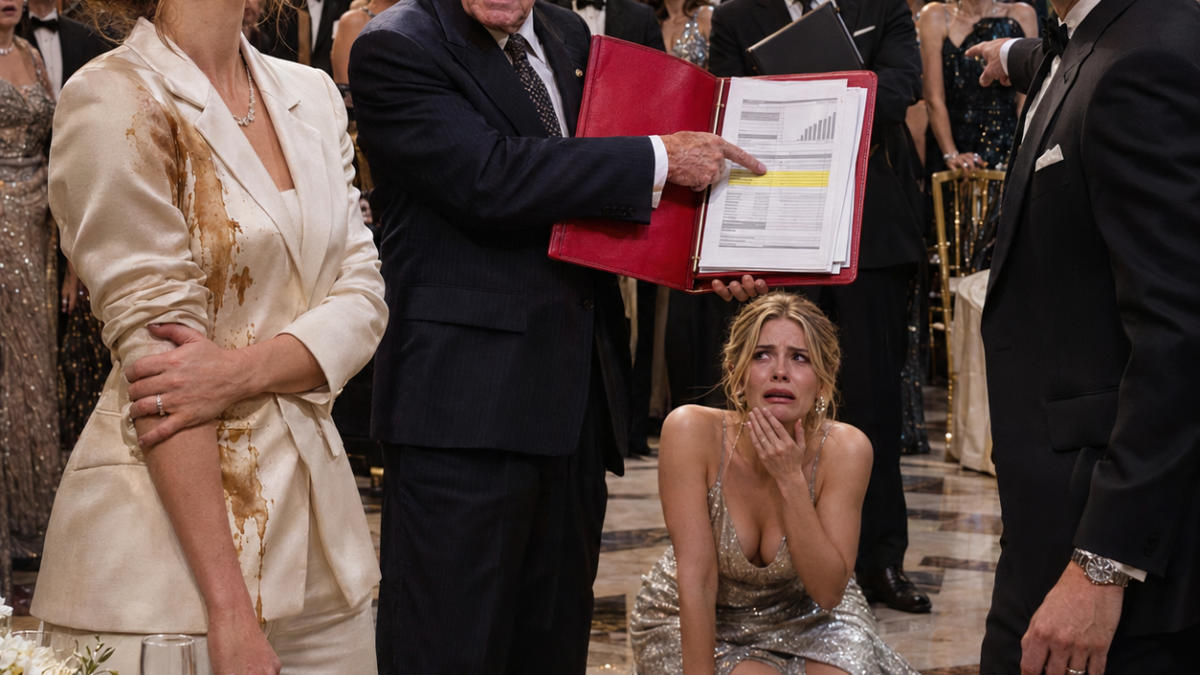
FULL ENDING
Her voice rose dramatically.
“I didn’t mean to!”
She covered her face.
“I tripped!”
I stared at her.
There wasn’t a mark on either of her hands.
Not a stain on her dress.
Not a single splash of coffee on the skin she’d supposedly put at risk while carrying the tray.
Meanwhile, my arm was throbbing beneath a sleeve soaked in scalding liquid.
I looked toward the nearest server.
“Please get the medical team.”
Then I heard footsteps.
Fast.
Determined.
Familiar.
Nathan.
My husband.
Nathan Vance, chief executive officer of Vanguard Technologies, was pushing through the crowd in his perfectly tailored midnight-blue tuxedo.
For one foolish instant, relief moved through me.
Despite everything that had changed between us over the previous few months, I thought he would see my arm.
I thought he’d ask if I was hurt.
Maybe take my hand.
Maybe call for help.
We were married, after all.
I was his wife.
His business partner.
The woman who had spent five years helping turn his father’s struggling company into something worth saving.
Nathan reached us.
His eyes moved over the scene.
The broken porcelain.
The spilled coffee.
Khloe kneeling on the marble.
Me standing with my injured arm held against my body.
Then he did something I will never forget.
He walked past me.
And crouched beside her.
“Khloe?”
His voice softened.
“Are you okay?”
I stared.
She looked up at him with tears shining in her eyes.
“Nathan, I ruined everything!”
He gently took her hands.
“Did you cut yourself?”
My mouth fell open.
He inspected her manicured fingers, turning them carefully beneath the chandelier light.
I looked down at my forearm.
The fabric was wet.
The skin beneath it burned.
I was shaking.
“Nathan.”
He didn’t look at me.
“Just a minute, Sarah.”
I felt something cold move through my chest.
“Nathan, she’s not injured. I am.”
He turned.
And the expression on his face wasn’t concern.
It was anger.
“Then why are you standing here making a scene?”
I stared at him.
“What?”
He rose, positioning himself protectively between Khloe and me.
“You could have stepped aside.”
For a moment, I genuinely thought I’d misheard.
“Excuse me?”
His jaw tightened.
“Don’t do this tonight.”
I looked at the crowd.
Two hundred people.
Investors.
Bankers.
Board members.
Industry executives.
People who knew me as Vanguard’s chief operating officer and co-founder.
People who’d watched me negotiate contracts, rebuild supply chains, and keep the company alive when banks refused to return Nathan’s calls.
Now they were watching my husband accuse me of deliberately getting burned.
I swallowed.
“She’s the one who spilled coffee on me.”
Nathan leaned closer.
His voice became a poisonous whisper.
“Sarah, your jealousy is becoming pathetic.”
Something inside me went still.
I stared at him.
And suddenly I realized the worst part of the evening wasn’t going to be the pain in my arm.
It was going to be discovering how little my husband cared that I was hurting.
PART2
FULL STORY CONTINUATION
“Jealousy?”
I repeated the word slowly.
Nathan’s eyes narrowed.
“Don’t pretend you don’t know what I’m talking about.”
Behind him, Khloe made a small sobbing sound.
“Nathan, please don’t fight because of me.”
I almost laughed.
Not because anything was funny.
Because the situation was so grotesque that my mind briefly refused to accept it.
A woman had poured dangerously hot coffee onto my arm.
My husband was shielding her.
And somehow, I had become the villain.
I looked down at my sleeve.
The ivory fabric had darkened to an ugly brown.
The heat continued biting into my skin.
I pulled away from Nathan and turned toward a member of the event staff.
“I need cool running water. And please call the medical team.”
The young man nodded immediately.
“Yes, ma’am.”
Nathan caught my attention before I could move.
“Sarah.”
I looked back.
His expression was thunderous.
“What now?”
He stepped closer.
“Stop issuing orders like this is your private kingdom.”
I felt my breathing change.
“I’m the chief operating officer.”
“And I’m the CEO.”
His voice rose.
Several people shifted uncomfortably.
Nathan looked around, apparently realizing how many people were listening.
Then he lowered his voice again.
“This is precisely the problem with you. Everything has to be about control.”
I stared at him.
“Control?”
“Yes.”
He gestured toward Khloe.
“You’ve been hostile toward her since the day she started.”
Khloe lowered her eyes.
I looked at her.
She’d been with Vanguard for eight weeks.
Eight weeks.
And in that short time, I’d watched her begin handling meetings she wasn’t authorized to attend, carrying documents she had no reason to possess, and referring to the executive suite as though it belonged to her.
When I’d raised concerns, Nathan had accused me of being insecure.
When I’d asked why his secretary suddenly had access to financial correspondence normally handled by my office, he’d told me to stop micromanaging.
And when I’d discovered that she’d been included in discussions concerning our largest prospective financing arrangement, he’d dismissed my questions entirely.
Now I was standing in a ballroom with a burned arm while she played the victim.
I looked Nathan straight in the eyes.
“I’m not discussing your secretary’s feelings while my skin is burning.”
His face tightened.
“Then leave.”
The word struck harder than I expected.
I blinked.
“What?”
“You heard me.”
He glanced toward the guests.
“This evening is about our three-hundred-million-dollar green energy partnership.”
His voice became harsh.
“And I will not let your ridiculous behavior destroy five years of work.”
I stared.
Five years.
My five years.
Five years of sixteen-hour days.
Five years of rebuilding investor confidence after Vanguard nearly collapsed.
Five years of negotiating with vendors who wouldn’t extend credit.
Five years of convincing employees to stay when they could have earned more elsewhere.
Five years of protecting a company Nathan had inherited the opportunity to lead.
And he was telling me to leave my own anniversary celebration.
I felt an unfamiliar calm settle over me.
Not forgiveness.
Not acceptance.
Something colder.
I took a slow breath.
“Tell me something, Nathan.”
He glared.
“What?”
“If I walk out of this ballroom tonight, who exactly do you think is going to finish the operating plan Sterling Capital requested?”
He hesitated.
I continued.
“The same operating plan your secretary couldn’t locate yesterday?”
Khloe’s head snapped up.
Nathan’s expression hardened.
“Don’t bring business into this.”
I looked down at my ruined blazer.
“You already did.”
Then I turned toward the medical staff approaching from the side of the ballroom.
And that was when I heard the voice.
Low.
Controlled.
Absolutely unmistakable.
“The person who should leave this room is not Sarah Vance.”
Every conversation stopped.
I turned.
Marcus Sterling was walking toward us.
And the expression on his face told me that the evening had just become far more serious than a spilled cup of coffee.
Marcus Sterling was not a man who made theatrical entrances.
He didn’t need to.
At sixty-one, he had spent more than three decades managing institutional investments. His firm, Sterling Capital, had financed infrastructure projects across the United States and Europe.
He was known for two things.
A remarkable ability to identify promising businesses.
And an even greater willingness to walk away when he no longer trusted the people running them.
For eleven months, he’d been evaluating Vanguard’s proposed green energy expansion.
Three hundred million dollars.
A financing arrangement that could have transformed our manufacturing capacity, opened new facilities, and created hundreds of jobs.
The agreement wasn’t fully closed yet.
There were final conditions, governance requirements, and compliance certifications still to satisfy.
But tonight had been designed as the celebration before the final documents were executed.
Nathan had told everyone the deal was practically guaranteed.
I’d spent months warning him that nothing was guaranteed until the financing conditions were satisfied.
He’d called me pessimistic.
Now Marcus was standing in front of him with an expression I’d never seen before.
“Mr. Sterling!”
Nathan’s transformation was immediate.
The contempt disappeared from his face.
His shoulders straightened.
A bright, artificial smile replaced his anger.
“I’m terribly sorry you had to witness this. Just a minor domestic misunderstanding.”
Marcus didn’t smile.
He looked directly at my arm.
“Mrs. Vance, have you received medical attention?”
I opened my mouth.
Nathan answered first.
“She’s fine.”
Marcus turned toward him.
“I asked your wife.”
The room went silent.
I felt Nathan stiffen beside me.
I looked at Marcus.
“Not yet. The medical team is here now.”
He nodded once.
“Please let them examine you.”
Then he looked toward the event coordinator.
“Can someone ensure Mrs. Vance receives proper care immediately?”
“Yes, Mr. Sterling.”
I began moving toward the adjoining service corridor with a member of the medical team.
But before I reached the doors, Nathan said, “Marcus, this is unnecessary.”
Marcus turned.
“What’s unnecessary?”
Nathan gestured toward Khloe, who was still standing close behind him.
“My secretary had a small accident. Sarah overreacted. Surely we don’t need to involve everyone.”
I stopped.
The medical professional beside me touched my uninjured arm gently.
“Mrs. Vance, we should treat that burn.”
“I know.”
But I couldn’t take my eyes off my husband.
Marcus studied Nathan for a long moment.
Then said, “Do you understand what I just witnessed?”
Nathan attempted a laugh.
“An unfortunate spill.”
“No.”
Marcus’s voice was quiet.
“I witnessed the chief executive of a company seeking three hundred million dollars in institutional financing publicly belittle an injured executive while refusing to exercise even the most basic judgment.”
Nathan’s smile vanished.
“Marcus—”
“And not just any executive.”
Marcus gestured toward me.
“Your chief operating officer. Your co-founder. The person whose operational certifications are part of our financing review.”
I swallowed.
He continued.
“When a company faces an unexpected problem, I watch how its leaders respond.”
Nathan opened his mouth.
Marcus raised one hand.
“I’ve watched you respond.”
The silence was absolute.
Then Marcus said the words that changed everything.
“Sterling Capital is withdrawing from the proposed financing arrangement.”
Nathan went pale.
For a moment, he looked almost confused.
“What?”
Marcus held his gaze.
“The three-hundred-million-dollar partnership is canceled. Our legal team will issue formal notice.”
A sharp intake of breath moved through the ballroom.
Nathan stepped forward.
“You can’t be serious.”
“I am.”
“Over coffee?”
Marcus’s expression grew colder.
“This isn’t about coffee.”
Nathan’s jaw tightened.
“You’re allowing a personal misunderstanding to jeopardize an international investment.”
Marcus looked at him.
“I am declining to entrust institutional capital to a management team whose chief executive has repeatedly ignored governance concerns.”
The word repeatedly caught my attention.
I looked at Marcus.
He continued.
“Tonight simply confirmed that my concerns were justified.”
Nathan’s face changed.
I recognized that expression.
It was the look he got when he realized a conversation contained information he hadn’t expected the other person to know.
“Marcus,” he said carefully, “let’s discuss this privately.”
“I believe we’ve already had enough private conversations.”
Nathan took another step.
“Three hundred million dollars doesn’t disappear because of one awkward incident.”
Marcus’s eyes hardened.
“It disappears when trust disappears.”
Then he looked toward me again.
“Mrs. Vance, please have that burn treated.”
I nodded.
“Thank you.”
He gave a small, respectful inclination of his head.
And turned toward the ballroom exit.
Nathan reached after him.
“Marcus!”
But the investor kept walking.
Behind him, two members of Sterling Capital’s legal and investment team followed without hesitation.
I watched Nathan’s face drain of color.
For five years, he’d wanted the world to see him as the visionary responsible for Vanguard’s success.
Now, in front of the industry’s most influential financiers, he had just watched the largest proposed partnership in our company’s history collapse.
And he still hadn’t asked whether I was all right.
“Sarah!”
I turned.
Nathan was staring at me.
His voice shook with fury.
“Do you understand what you’ve done?”
I felt something inside me break.
Not loudly.
Not dramatically.
Like a thread pulled too tightly for too long.
I looked straight at him.
“I’ve done?”
He pointed toward the doors Marcus had just walked through.
“You embarrassed the company!”
I stared.
“Nathan, your secretary burned my arm.”
“Stop saying it like she attacked you!”
Khloe stepped closer.
Her voice trembled.
“I’m sorry, Nathan. I never meant for any of this to happen.”
He immediately softened.
“I know.”
Then he turned back to me.
“Are you satisfied now?”
I looked from him to Khloe.
And for one moment, I saw my marriage with a clarity that frightened me.
This wasn’t the man who’d proposed to me five years earlier.
It wasn’t the man who’d sat beside me in our cramped first office eating takeout while we tried to save Vanguard.
It wasn’t the man who’d once told me he couldn’t imagine running the company without me.
That man might have been real once.
Or perhaps I’d spent years loving the version of him I hoped would eventually return.
But the man standing before me was treating my injury as an inconvenience because it interfered with his image.
I looked down at my arm.
The pain was worsening.
The medical professional beside me spoke firmly.
“Mrs. Vance needs treatment now.”
I nodded.
Then looked at Nathan.
“No.”
He frowned.
“No what?”
“I’m not satisfied.”
I held his gaze.
“And I don’t think you understand how much damage you’ve just done.”
He laughed bitterly.
“Oh, believe me, Sarah. I understand the damage.”
I shook my head.
“You don’t.”
Then I walked away.
The event medical team escorted me to a private treatment area.
They helped me cool the burn under running water, assessed the injured skin, and arranged further medical care.
I removed my jewelry and carefully dealt with the wet clothing as directed.
The pain was sharp enough to make me nauseated.
But what disturbed me most was how my hands trembled whenever I remembered Nathan kneeling beside Khloe.
Are you hurt?
He had asked her.
Not me.
I’d spent five years protecting that man from financial disaster, professional embarrassment, and his own increasingly reckless decisions.
And he hadn’t even asked whether I needed a doctor.
A nurse examined my arm.
“Mrs. Vance, we’re going to arrange a physician’s assessment.”
I nodded.
“Thank you.”
She looked toward my face.
“Are you feeling faint?”
“A little.”
“Let’s get you seated.”
I sat.
She spoke gently while continuing the necessary care.
I answered her questions mechanically.
Where had the coffee struck?
How long ago?
Was there numbness?
Had any other part of my body been burned?
But my mind kept returning to Marcus’s words.
Repeatedly ignored governance concerns.
What concerns?
Vanguard had undergone extensive due diligence over the preceding eleven months.
I’d personally supervised the operating disclosures.
We’d provided financial forecasts, manufacturing contracts, environmental assessments, staffing plans, and capital expenditure schedules.
I’d signed certifications covering my areas of responsibility.
But in recent weeks, Nathan had been increasingly secretive about the final funding documents.
At first, he’d told me it was because Sterling Capital wanted direct communication with the CEO.
Then he’d said my office was slowing the process down.
And eventually, he’d begun excluding me from meetings entirely.
Two weeks earlier, I’d asked for the latest project cash reconciliation.
Nathan had told me the accounting team was busy.
Three days later, when I asked again, Khloe replied on his behalf.
The CEO’s office is handling all financing-related matters. No further operational review is required at this stage.
I remembered staring at that email.
A secretary telling the COO that operational review was unnecessary.
I’d forwarded it to our controller with a request to confirm the project account balances.
The controller hadn’t responded.
The following day, Nathan had confronted me.
“Stop undermining my office.”
I’d asked why he was angry about a routine request.
He’d called me controlling.
Then he’d walked out.
At the time, I thought he was hiding a mistake.
Now I wondered whether he’d been hiding something much worse.
I was sitting with a cool dressing over my forearm when the door opened.
I expected another member of the medical staff.
Instead, I saw Arthur Vance.
My father-in-law.
Seventy-two years old.
Founder and chairman of Vanguard.
He stood in the doorway wearing a charcoal suit, his silver hair neatly combed and one hand resting on the carved walnut cane he’d carried since a hip injury several years earlier.
Arthur was not a sentimental man.
He’d built Vanguard from a small industrial engineering company into a respected supplier before poor market conditions and several disastrous contracts pushed it toward bankruptcy.
Nathan had always been proud of being his son.
But he’d spent years resenting the fact that Arthur still chaired the board.
Arthur looked at me.
Then at the medical dressing.
His expression tightened.
“Sarah.”
I tried to stand.
“Arthur.”
He shook his head.
“Stay seated.”
I obeyed.
He entered slowly.
For a moment, he didn’t speak.
Then he asked, “How badly are you hurt?”
My throat tightened.
It was such a simple question.
The question my husband had never asked.
I looked down.
“I’m being assessed. They think I’ll need further treatment, but I’m stable.”
Arthur nodded.
“Good.”
Then he pulled a chair closer.
“I’m sorry.”
I looked at him.
“For what?”
He leaned forward.
“For allowing Nathan to become a man who believes authority excuses cruelty.”
I stared.
Arthur’s jaw tightened.
“I saw what happened.”
My eyes filled.
“He blamed me.”
“I know.”
“He told me to leave.”
“I heard him.”
I swallowed.
Arthur looked toward the door.
Then back at me.
“Sarah, there’s something else you need to know.”
My stomach tightened.
“What?”
He hesitated.
Then said, “The coffee wasn’t the only reason Marcus walked away tonight.”
I stared at him.
Arthur lowered his voice.
“We have a financial problem.”
A chill moved through me.
“How serious?”
He looked directly at me.
“Thirty million dollars serious.”
For a moment, the room seemed to disappear.
“What do you mean, thirty million dollars?”
Arthur didn’t answer immediately.
He reached into his jacket and removed a thin folder.
Not the red dossier from the ballroom.
A smaller set of documents.
He placed it on the table beside me.
“We received an internal compliance alert concerning a transfer from Vanguard’s green energy project reserve.”
I stared.
“How much was transferred?”
“Thirty million.”
My mouth went dry.
“That account was restricted for project development expenses.”
“I know.”
“Every transfer above the delegated threshold requires documented approval.”
“I know that too.”
I looked at him.
“Whose approval?”
Arthur held my gaze.
“According to the electronic records, yours.”
For several seconds, I couldn’t speak.
Then I laughed.
A short, disbelieving sound.
“No.”
Arthur remained silent.
I leaned forward.
“No, Arthur. I never approved a thirty-million-dollar transfer.”
He nodded.
“I believe you.”
I stared at him.
The company had been built around a system of approvals because we couldn’t afford another financial disaster.
I’d helped design those controls.
I’d insisted that large project disbursements require independent verification.
And now someone was claiming I’d signed off on the very kind of transfer I’d spent years trying to prevent.
“Where did the money go?”
Arthur looked toward the door.
Then lowered his voice further.
“An account associated with an outside advisory entity.”
“What entity?”
He hesitated.
“Crescent Advisory Holdings.”
I’d never heard the name.
I frowned.
“Who are they?”
“That’s one of the questions we’re investigating.”
I stared at the documents.
Then looked back at Arthur.
“Did Nathan authorize it?”
Arthur’s expression hardened.
“The transfer originated through the CEO’s office.”
My breath caught.
“And the compliance team believes there may be irregularities in the supporting documents.”
I sat back.
The burn on my arm throbbed.
But I barely felt it.
Arthur continued.
“Marcus’s team had already raised concerns about gaps in the financing disclosures.”
I looked at him.
“He knew?”
“Not everything.”
Arthur paused.
“But he knew enough to begin questioning whether Vanguard’s controls were functioning as represented.”
I stared.
And suddenly Marcus’s words in the ballroom took on a different meaning.
Tonight simply confirmed that my concerns were justified.
I looked toward the door.
“Where’s Nathan?”
Arthur’s face became cold.
“In the ballroom.”
“With Khloe?”
He didn’t answer.
He didn’t need to.
I closed my eyes.
Thirty million dollars.
An unauthorized transfer.
A fabricated approval bearing my name.
And a secretary who’d spent eight weeks positioning herself between Nathan and every person responsible for protecting the company’s finances.
I opened my eyes.
“Arthur.”
He looked at me.
“I want every document.”
His expression softened slightly.
“Sarah, you’re injured.”
“I know.”
“You need to finish your medical assessment.”
“I will.”
I leaned forward.
“But whoever used my name to authorize thirty million dollars made one very serious mistake.”
Arthur waited.
I looked him directly in the eyes.
“They assumed I wouldn’t know how to trace it.”
Arthur sat quietly while I tried to process the number.
Thirty million dollars.
For most people, that amount was almost impossible to imagine.
To me, it represented something painfully concrete.
Equipment deposits.
Factory expansion.
Engineering contracts.
Site preparation.
Payroll commitments.
Environmental testing.
The money that would allow Vanguard to fulfill obligations we’d made in anticipation of the larger financing.
It wasn’t simply an entry on a balance sheet.
It was the difference between a company moving forward and a company suddenly facing a dangerous liquidity problem.
I looked at Arthur.
“When was the transfer?”
“Two business days ago.”
My stomach tightened.
Two days.
I’d been asking about the project accounts for almost two weeks.
Nathan had repeatedly blocked the review.
And while I was preparing tonight’s investor presentation, thirty million dollars had left the project reserve.
“Why wasn’t I notified?”
Arthur’s expression darkened.
“That’s one of the questions I intend to ask Nathan.”
I shook my head.
“Why wasn’t the controller notified?”
“He was. But the transfer instructions represented that the approvals had already been obtained.”
I stared.
“By whom?”
Arthur looked at the documents.
“The CEO’s office.”
I felt something cold settle inside me.
Of course.
The CEO’s office.
The same phrase Khloe had used in her emails.
The same phrase Nathan had repeated whenever I asked for the latest project reconciliation.
I glanced toward the door.
“Arthur, what happened after Marcus left?”
He studied me.
Then said, “I confronted Nathan.”
I looked up.
“Tonight?”
“In the ballroom.”
My pulse quickened.
Arthur continued.
“I was coming from the VIP corridor when I heard the end of Marcus’s announcement. Tyler and our compliance officer were with me.”
Tyler Bennett was Vanguard’s chief legal officer.
He was meticulous, cautious, and one of the few executives Nathan hadn’t managed to intimidate into silence.
I looked toward Arthur.
“What did you say?”
He lowered his eyes briefly.
“I asked Nathan to explain the transfer.”
My breath caught.
“In front of everyone?”
“Only enough to make clear that the board was taking the matter seriously. I wasn’t going to reveal confidential account details to two hundred guests.”
I nodded.
Arthur continued.
“He tried to blame you.”
I closed my eyes.
Of course he had.
“He called it an administrative misunderstanding.”
I gave a bitter laugh.
Arthur’s expression hardened.
“Then he suggested Marcus had engineered the entire confrontation to gain negotiating leverage.”
I stared at him.
“That’s absurd.”
“I told him so.”
Arthur paused.
“I ordered immediate preservation of the relevant financial records and instructed Tyler to initiate the emergency procedures available under our bylaws.”
I swallowed.
“And Nathan?”
“He reminded us he was CEO.”
I laughed once.
There was no humor in it.
Arthur looked toward the window.
“Apparently, my son has forgotten that being chief executive doesn’t make him the owner of every dollar in the company.”
He turned back toward me.
“Tyler has instructed the appropriate teams to suspend discretionary transactions initiated through the CEO’s office pending review, preserve the audit trails, and restrict Nathan’s ability to alter relevant records.”
I sat straighter.
“Can Nathan still access the approval system?”
“Not to change anything covered by the legal hold.”
I nodded slowly.
Arthur continued.
“There’s an emergency board meeting at eight tomorrow morning.”
My pulse quickened.
“Tomorrow?”
“Yes.”
“And Nathan?”
“He’s been notified.”
I looked toward the clock.
The gala wasn’t even over.
The largest financing arrangement in our history had collapsed.
A thirty-million-dollar transfer was under investigation.
My husband had publicly humiliated me.
And by eight the next morning, Vanguard’s board would be deciding whether Nathan could remain CEO.
Arthur rose carefully.
Then looked down at me.
“Sarah, I’m going to ask you something.”
I waited.
“Can you come to that meeting?”
I looked at the dressing on my arm.
Then at the documents beside me.
“Yes.”
He studied my face.
“You don’t have to ignore your medical needs to prove anything.”
“I won’t.”
I took a breath.
“But I built those controls, Arthur. If someone bypassed them using my name, I need to be present when the facts are examined.”
He nodded.
“That’s what I thought you’d say.”
Then he placed a hand gently on my shoulder.
“Get the treatment you need tonight.”
He paused.
“And Sarah?”
I looked up.
“Yes?”
“Don’t contact Nathan about the investigation.”
I frowned.
“Why?”
“Because I don’t want him learning anything about the evidence from you.”
I held his gaze.
For the first time that evening, I understood that Arthur wasn’t treating this as a family dispute.
He was treating it as a potential financial crime.
I nodded.
“Understood.”
The physician who examined my arm confirmed that the burn required medical treatment and follow-up.
The pain was significant, but there was no indication that I needed to remain hospitalized overnight.
I received appropriate wound care, instructions for monitoring the injury, and advice about protecting the affected skin while it healed.
A nurse helped me arrange the dressing.
Then she asked whether someone could drive me home.
I almost said Nathan.
The name rose automatically.
Five years of marriage had taught my mind to reach for him in ordinary moments.
Then I remembered his voice.
You could have stepped aside.
I looked down.
“No.”
The nurse waited.
“I’ll call someone.”
I phoned my friend Claire.
She answered on the second ring.
“Sarah?”
Her voice was immediate concern.
“What’s wrong?”
I closed my eyes.
“Can you pick me up?”
“Where are you?”
“At the hospital.”
Silence.
Then, “What happened?”
I swallowed.
“It’s a long story.”
“Are you safe?”
“Yes.”
“Then I’m coming.”
I felt my throat tighten.
“Thank you.”
Claire didn’t ask another question.
She simply said, “Send me the entrance.”
And ended the call.
Claire had known me since college.
She’d watched me fall in love with Nathan.
Attended our wedding.
Celebrated when Vanguard signed its first major recovery contract.
And spent the last year gently asking whether I was happy.
I always told her I was tired.
That was easier than answering honestly.
When she arrived, she took one look at my bandaged arm and stopped.
“Sarah.”
I tried to smile.
“Hi.”
She stared.
“What happened?”
I looked away.
“Coffee.”
Her eyes narrowed.
“Coffee?”
I nodded.
“At the gala.”
She glanced toward my ruined blazer, folded inside a hospital bag.
Then back at my arm.
“Who did this?”
I swallowed.
“Khloe.”
Claire’s expression changed.
“Nathan’s secretary?”
“Yes.”
She was quiet for a moment.
Then asked, “Where’s Nathan?”
I stared at the floor.
“Probably still at the hotel.”
Claire looked at me.
“Why isn’t he here?”
I opened my mouth.
Nothing came out.
For several seconds, I couldn’t speak.
Then the tears began.
Not delicate tears.
Not a dignified little moment of sadness.
I bent forward and cried so hard that Claire had to put her arm around my shoulders.
She didn’t tell me to calm down.
Didn’t ask me to explain immediately.
She simply held me.
When I could finally speak, I whispered, “He asked if she was hurt.”
Claire was silent.
I continued.
“Khloe spilled boiling-hot coffee on my arm, and Nathan ran over to check her hands.”
Claire’s whole body went rigid.
“What?”
I nodded.
“He told me I was embarrassing him.”
She stared.
“Sarah.”
“He said I should leave.”
Her face changed from disbelief to fury.
“Your husband told you to leave your own gala after you were burned?”
I looked down.
“Yes.”
Claire took a slow breath.
Then carefully picked up my bag.
“Come on.”
I glanced toward her.
“Where are we going?”
“My place.”
I hesitated.
“Claire—”
She looked directly at me.
“You are not spending tonight waiting for that man to come home and explain why his secretary’s feelings mattered more than your injury.”
I stared at her.
Then nodded.
For the first time in months, I didn’t feel guilty about letting someone take care of me.
At Claire’s apartment, she made tea and helped me settle on the couch.
I wasn’t hungry.
I was exhausted.
My arm hurt.
My head felt heavy.
And my phone kept vibrating.
Nathan.
Again.
And again.
Finally, I looked.
There were seven missed calls.
Four messages.
The first was sent shortly after Marcus walked out.
Sarah, where are you? We need to fix this before it gets worse.
The second arrived twenty minutes later.
You need to speak to Marcus. Tell him you misunderstood what happened.
The third made my stomach turn.
If you care about this company, you’ll stop being emotional and help me recover the deal.
I stared at the screen.
Then opened the fourth.
Dad has completely lost his mind. Don’t let him use you against me.
I read the messages twice.
Not once had Nathan asked whether my burn was serious.
Not once had he asked where I was receiving treatment.
Not once had he apologized.
I turned the phone toward Claire.
She read them.
Then looked up.
Her expression was frighteningly calm.
“Sarah.”
I swallowed.
“Yes?”
“Don’t answer him tonight.”
I nodded.
She handed the phone back.
Then sat beside me.
“Can I ask you something?”
I looked at her.
“Sure.”
“How long has he been treating you like this?”
I opened my mouth.
I wanted to say tonight was unusual.
I wanted to say Nathan had been stressed.
That the financing process was exhausting.
That he’d been under pressure from his father.
That the business had changed him temporarily.
But the words wouldn’t come.
Because I remembered too much.
The way he’d dismissed me during meetings.
The way he’d started referring to company decisions as his decisions.
The way he’d let Khloe interrupt me.
The way he’d accused me of being jealous whenever I questioned a professional boundary.
The way he’d treated my five years of work as something he’d generously allowed me to do.
I looked down.
“Longer than I wanted to admit.”
Claire didn’t speak.
I felt tears gathering again.
Then I whispered, “I don’t think he loves me anymore.”
Claire reached for my uninjured hand.
She didn’t tell me I was wrong.
She didn’t invent excuses for him.
She simply said, “Whatever he feels, Sarah, you deserve to be treated with basic respect.”
I looked toward my bandaged arm.
The pain returned in a sharp pulse.
I swallowed.
“I think I’m finally beginning to understand that.”
At 6:15 the next morning, I woke to a message from Tyler Bennett.
Emergency board meeting confirmed for 8:00 a.m. Your physician’s care instructions take priority. If you’re able to attend, legal will have the relevant documents available.
I read it.
Then sat up slowly.
My arm throbbed beneath the dressing.
I’d slept only a few hours.
But my mind was clear.
I needed to know what had happened to the money.
I needed to understand how my authorization had appeared on a transfer I’d never seen.
And I needed the board to understand that the financial controls we’d spent years building were not optional inconveniences.
Claire appeared in the doorway.
She was holding coffee.
“Morning.”
I looked up.
She saw my expression.
“The meeting?”
I nodded.
“Eight.”
She handed me a cup.
Then looked toward my arm.
“Are you sure you should go?”
“I’ve got my medical instructions. I’ll follow them.”
She studied me.
“And Nathan?”
I looked down.
“I don’t know what he’s going to do.”
Claire nodded.
Then said, “You know what I think?”
I raised my eyes.
“What?”
“I think you’ve spent so long protecting him from consequences that he genuinely believes there won’t be any.”
I was quiet.
Claire continued.
“And today might be the first morning of his life when he discovers that being your husband doesn’t give him the right to destroy everything you’ve built.”
I looked toward the window.
Sunlight was beginning to reach the buildings across the street.
I set down my cup.
Then stood.
“Can you help me with my jacket?”
Claire smiled sadly.
“Of course.”
I chose a dark navy suit.
Not because I wanted to look intimidating.
Because the jacket was loose enough to accommodate the dressing on my arm.
I pinned my hair back.
Put on simple earrings.
And left my wedding ring on the dresser.
For a moment, I stared at it.
A platinum band.
Small diamonds.
A symbol I’d once believed represented two people choosing to face every difficult thing together.
I remembered the day Nathan placed it on my finger.
He’d looked so happy.
So proud.
He’d promised we would always be partners.
At home.
At work.
In everything.
I stared at the ring.
Then remembered him kneeling beside Khloe while coffee burned through my clothing.
I turned away.
Claire noticed.
She didn’t comment.
Instead, she picked up my bag.
“Ready?”
I looked toward the door.
“Yes.”
And for the first time in five years, I walked into a Vanguard board meeting without wondering how to protect Nathan.
I was going there to protect the company.
Even if that meant protecting it from him.
The boardroom was on the thirty-fourth floor of Vanguard’s headquarters.
I’d spent countless hours there.
Some of the best days of my career had happened around that long walnut table.
We’d celebrated our first profitable quarter.
Approved the expansion of our engineering department.
Signed contracts that kept struggling factories open.
And made decisions that had given hundreds of employees a reason to believe Vanguard had a future.
That morning, the room felt entirely different.
Arthur sat at the head of the table.
Tyler was beside him.
Our chief compliance officer, Rebecca Shaw, had arranged several folders and a laptop in front of her.
Two independent directors sat to Arthur’s left.
Others attended through a secure video connection.
An outside forensic accounting specialist had been brought in to assist.
Everyone looked tired.
No one was smiling.
When I entered, Arthur stood.
“Sarah.”
I nodded.
“Good morning.”
His eyes moved toward my bandaged arm.
“How are you feeling?”
“I’m managing.”
He pulled out a chair near the end of the table.
“Sit wherever you’re comfortable.”
I took my usual seat.
It was across from Nathan’s.
His chair was empty.
I looked toward the clock.
7:56.
Four minutes until the meeting.
Rebecca approached.
“Sarah.”
I looked up.
Her expression was serious.
“Before we begin, I want you to know we’re treating the disputed authorization as a potential falsification.”
My pulse quickened.
“Have you confirmed it?”
“Not conclusively. But we have evidence that raises significant questions.”
I nodded.
“Then let’s look at it.”
She placed a folder in front of me.
I opened it.
The first page contained a transfer summary.
Thirty million dollars.
Date.
Time.
Originating account.
Beneficiary.
Crescent Advisory Holdings LLC.
My stomach tightened.
Then I saw a line farther down.
Approving Executive: Sarah Vance, Chief Operating Officer.
I stared.
There was an electronic signature block beneath it.
My name.
My title.
My supposed approval.
I turned the page.
And found a copy of the supporting authorization.
For several seconds, I couldn’t breathe.
Because it looked like a document I’d signed.
The font.
The spacing.
The format.
Even the small digital image of my signature.
But I’d never seen that agreement in my life.
I looked up.
“Rebecca.”
She turned.
“Yes?”
“This isn’t my approval.”
The room went quiet.
She nodded.
“That’s what we’re investigating.”
I looked down again.
The document referred to a strategic advisory mobilization fee.
Thirty million dollars.
Payable before the Sterling Capital financing closed.
I stared at the phrase.
Then began reading more carefully.
And something caught my attention.
The document claimed the payment was necessary to secure a foreign equipment supplier and preserve priority access to advanced manufacturing technology.
But the supplier wasn’t named.
There was no corresponding purchase agreement.
No verified equipment schedule.
No performance guarantee.
Just a vaguely described advisory service.
For thirty million dollars.
I looked toward Rebecca.
“Who approved this vendor?”
She opened her laptop.
“That’s another concern.”
My stomach tightened.
“What do you mean?”
“The vendor was created in the system through an expedited executive process.”
“By whom?”
Rebecca glanced toward the empty chair across from me.
“The CEO’s office.”
At exactly eight o’clock, Nathan entered.
He wasn’t wearing the tuxedo from the gala.
Instead, he wore a dark gray suit and an expression of forced confidence.
His eyes found mine immediately.
Then moved toward my bare left hand.
For a fraction of a second, something shifted in his face.
But he recovered quickly.
“Good morning.”
Nobody responded warmly.
He looked around.
“Are we really doing this?”
Arthur didn’t rise.
“Sit down, Nathan.”
Nathan gave a short laugh.
“Dad, this is absurd.”
Arthur’s voice hardened.
“Sit.”
My husband pulled out his chair.
Then looked directly at me.
“Sarah, I assume you’re here to explain the misunderstanding from last night.”
I stared at him.
He continued.
“Marcus clearly overreacted, and I expect you to help repair the damage.”
I looked down at my documents.
Then back at him.
“Nathan, I’m here because thirty million dollars left a restricted account using an approval I never gave.”
His face went still.
For a moment, nobody spoke.
Then he leaned back.
“That’s a separate issue.”
Rebecca raised her eyes.
“It’s the primary subject of this meeting.”
Nathan looked toward her.
“I’m aware of the agenda.”
Arthur folded his hands.
“Then you understand why we’re here.”
Nathan gave an irritated sigh.
“I authorized a strategic payment in connection with the green energy expansion.”
I stared.
“You authorized thirty million dollars?”
“Yes.”
“To a company nobody in operations has vetted?”
He turned toward me.
“Sarah, you weren’t involved in every financing discussion.”
I felt the familiar anger rise.
But I kept my voice steady.
“I was required to review this disbursement under our control procedures.”
He shrugged.
“Those procedures can be adjusted for time-sensitive transactions.”
I stared.
“Not by simply deciding they don’t apply.”
Nathan’s jaw tightened.
“Don’t lecture me on governance.”
Arthur spoke.
“Then perhaps Rebecca should.”
Rebecca connected her laptop to the screen.
A transaction timeline appeared.
The room became still.
She pointed toward the first entry.
“Crescent Advisory Holdings was added as a vendor eight weeks ago.”
My eyes narrowed.
Eight weeks.
The same period in which Khloe had joined Vanguard.
Rebecca continued.
“The vendor setup was initiated through a request originating from the CEO’s administrative office.”
Nathan shifted in his chair.
“Because the project was confidential.”
Rebecca nodded.
“Confidentiality does not eliminate vendor verification requirements.”
She moved to the next entry.
“The payment instruction was created two business days before the gala.”
A second record appeared.
“Approval was recorded under Mrs. Vance’s credentials.”
I sat straighter.
Nathan looked toward me.
“You signed it.”
I stared at him.
“No.”
He shrugged.
“Perhaps you’ve forgotten.”
The room went silent.
I leaned forward.
“Thirty million dollars isn’t something I forget.”
Nathan’s face hardened.
“Sarah—”
“No.”
I held his gaze.
“You can accuse me of jealousy, emotional instability, and embarrassing you in public. You can tell two hundred people that I deliberately made a scene while my arm was burning.”
My voice shook.
“But you are not going to sit across from me and tell me I authorized a payment I never reviewed.”
Nathan opened his mouth.
Arthur raised one hand.
“Let Rebecca finish.”
Rebecca displayed the electronic audit record.
“The approval metadata does not match Mrs. Vance’s ordinary signing workflow.”
Nathan frowned.
“What does that mean?”
“It means the document contains an image resembling her electronic signature, but we have not found a corresponding authenticated approval event from her account.”
I felt my stomach twist.
Rebecca continued.
“The file was assembled through a separate document process, and the approval image appears to have been inserted rather than generated through the company’s standard signing platform.”
I stared at the screen.
Someone had copied my signature.
And placed it on a thirty-million-dollar authorization.
Nathan leaned forward.
“That’s ridiculous.”
Rebecca didn’t react.
“We’re preserving the file history and obtaining an independent forensic review.”
Nathan looked toward Tyler.
“You’re letting her accuse me of fraud?”
Tyler’s expression remained calm.
“Nobody is making a final determination this morning.”
Arthur nodded.
“But we have enough information to justify immediate protective action.”
Nathan laughed bitterly.
“Based on a software discrepancy?”
Rebecca changed the slide.
“There’s more.”
The room went quiet again.
She displayed the vendor’s onboarding history.
“The contact email used for Crescent Advisory Holdings was entered by a user account associated with Ms. Davis.”
I stared.
Khloe.
Nathan’s expression changed.
Rebecca continued.
“The supporting correspondence also identifies Ms. Davis as the executive liaison for the payment.”
Nathan immediately said, “She was my secretary.”
Rebecca nodded.
“Yes.”
“She handled paperwork.”
“Yes.”
“So naturally her name would appear.”
Rebecca looked directly at him.
“Then perhaps you can explain why she was the primary contact for a thirty-million-dollar strategic advisory payment that was never submitted to the procurement or compliance teams for normal review.”
Nathan’s jaw tightened.
“Because I told her to handle it.”
The silence that followed was terrible.
He seemed to realize what he’d said a moment too late.
Arthur leaned forward.
“You told Khloe to handle it?”
Nathan looked toward his father.
“To coordinate the documentation.”
“Without procurement?”
“The transaction was time-sensitive.”
“Without the COO?”
“Sarah was slowing things down.”
I stared.
There it was.
In front of the entire board.
His explanation.
The reason my signature had allegedly been bypassed.
I asked too many questions.
I insisted on documentation.
I expected approvals to mean something.
And Nathan had decided I was an obstacle.
Arthur looked toward Tyler.
“Please ensure that statement is accurately reflected in the meeting record.”
Tyler nodded.
Nathan’s face turned red.
“Dad, you’re twisting my words.”
Arthur looked at him.
“No, Nathan.”
His voice was quiet.
“You’re finally saying them clearly.”
The forensic specialist, Daniel Price, spoke next.
He was careful not to claim the investigation was finished.
But the preliminary findings were serious.
The beneficiary account had been opened under a corporate structure that required further examination.
Some ownership records linked the entity to individuals associated with Khloe Davis.
The transfer instructions had passed through an unusual approval route.
And the supporting documents contained inconsistencies that ordinary controls should have detected.
I listened carefully.
Then asked the question that mattered most.
“Where is the money now?”
Daniel looked toward Rebecca.
She nodded for him to answer.
“Some of the funds remain traceable in accounts for which urgent legal preservation measures have been requested. We have not yet confirmed the disposition of the entire amount.”
My stomach tightened.
“How much is still potentially recoverable?”
“We don’t have a reliable final figure.”
I nodded slowly.
It wasn’t the answer I wanted.
But I appreciated that he wasn’t pretending the situation was already resolved.
Nathan leaned back.
“See? Nobody knows anything.”
Arthur turned toward him.
“We know thirty million dollars left a restricted project account under circumstances that require investigation.”
Nathan opened his mouth.
Arthur continued.
“We know the payment wasn’t subjected to the controls the company represented to its investors.”
He pointed toward the screen.
“And we know your office directed the transaction.”
Nathan’s jaw tightened.
“I’m the CEO.”
Arthur looked at him for a long moment.
Then said, “You’ve reminded us of that repeatedly.”
He paused.
“Now we’re going to discuss what it means.”
Tyler rose.
“Under the company’s governing documents, the board has authority to review executive conduct, suspend delegated powers, and remove officers when warranted.”
Nathan stared at him.
“You’re threatening me?”
“No.”
Tyler’s voice was even.
“I’m explaining the decisions before the board.”
Arthur looked toward the directors.
“We have two immediate responsibilities.”
He held up one finger.
“Preserve the evidence and protect company assets.”
Then another.
“Maintain the business while the investigation proceeds.”
Nathan looked around.
“You can’t run Vanguard without me.”
I felt something bitter move through my chest.
For years, he’d said variations of that sentence.
Whenever an employee questioned him.
Whenever a supplier challenged his assumptions.
Whenever the board wanted more detailed reporting.
You can’t do this without me.
I built this company.
I’m the reason we’re successful.
I looked at the other directors.
Then toward Arthur.
And I realized something.
Nathan had begun believing his title was the same as the company’s existence.
But Vanguard was larger than him.
It had engineers.
Manufacturing teams.
Accountants.
Project managers.
Designers.
Logistics specialists.
Employees who showed up every morning and did the work that actually kept the business running.
It had clients.
Contracts.
Factories.
And obligations to hundreds of families.
Nathan was the CEO.
But he wasn’t Vanguard.
Arthur leaned toward him.
“Son.”
Nathan looked up.
The room became still.
Arthur’s voice was quiet.
“I founded this company before you were old enough to understand what a balance sheet was.”
Nathan’s jaw tightened.
“I know.”
“I nearly lost it because I trusted the wrong people and ignored the wrong warnings.”
His expression changed.
“Dad—”
“And when Sarah helped rebuild it, I thought you’d learned what responsibility meant.”
I felt my throat tighten.
Arthur continued.
“Last night, I watched you publicly humiliate your injured wife to protect an employee.”
Nathan stared at the table.
“Today, I am listening to you defend an unauthorized transaction by reminding everyone that you are CEO.”
Arthur leaned forward.
His seventy-two-year-old face looked suddenly older.
“Being my son does not make you exempt from the rules.”
Nathan’s eyes lifted.
Arthur held his gaze.
“And being chief executive does not give you permission to treat the company as your personal bank account.”
The board moved into formal discussion.
Nathan objected repeatedly.
He demanded more time.
Accused Arthur of a personal vendetta.
Suggested Marcus Sterling had orchestrated the entire situation.
And insisted I’d turned the directors against him because I resented Khloe.
I listened until I couldn’t anymore.
Then I raised my hand.
Arthur nodded.
“Sarah.”
I looked around the table.
“I want to make one thing clear.”
Everyone turned toward me.
“My marriage is not on the agenda.”
Nathan scoffed.
I ignored him.
“Whether my husband has been faithful, whether he respects me, or whether he believes I embarrassed him last night are personal matters.”
I took a breath.
“But someone used my name to approve a thirty-million-dollar transfer.”
I looked toward Rebecca.
“Our company’s capital controls were bypassed.”
Then toward the independent directors.
“And our largest financing partner withdrew because he no longer trusts our governance.”
I paused.
“There are employees outside this room whose livelihoods depend on whether we act responsibly today.”
The room was silent.
I continued.
“Do not make this decision about Nathan and me.”
My voice steadied.
“Make it about Vanguard.”
Arthur nodded slowly.
“Thank you, Sarah.”
I looked down.
Then added one final sentence.
“And whatever happens, I want an independent investigation. Not one controlled by my office, Nathan’s office, or our family.”
Tyler nodded.
“That is the recommendation from legal as well.”
Arthur turned toward the directors.
“Then let’s proceed.”
The board voted to suspend Nathan’s executive authority immediately.
His access to company systems remained restricted to what was necessary for the investigation.
His ability to authorize payments was revoked.
His executive security credentials were deactivated.
An independent forensic review would continue under board oversight.
And the company would appoint temporary leadership while the board considered Nathan’s permanent removal.
The resolution passed.
Nathan sat completely still.
For the first time since I’d known him, he seemed unable to find a sentence that would change the outcome.
Arthur looked toward him.
“Your CEO access badge, Nathan.”
My husband stared.
“What?”
“Your badge.”
Nathan laughed bitterly.
“You’re serious.”
“Yes.”
He looked around the table.
No one intervened.
Slowly, he reached inside his jacket.
Removed the badge he’d worn with such pride.
And placed it on the walnut table.
The little plastic card made a soft clicking sound.
It was almost nothing.
But in the silent boardroom, I heard it clearly.
Arthur looked at Tyler.
“Please have security arrange his departure.”
Nathan turned toward me.
His eyes were full of rage.
“This is what you wanted?”
I stared at him.
“No.”
He laughed.
“Don’t lie.”
I looked at my bandaged arm.
Then at the financial documents.
“What I wanted was a husband who would help me when I was hurt.”
His expression changed.
I swallowed.
“And a CEO who understood the difference between leading a company and owning it.”
For a moment, nobody spoke.
Then Nathan stood.
His chair scraped against the floor.
He looked toward Arthur.
“You’re choosing her over your own son.”
Arthur’s face tightened.
“No.”
His voice was quiet.
“I’m choosing the responsibilities you forgot.”
Nathan stared at him.
Then walked toward the door.
He stopped beside my chair.
For one terrible second, I thought he might finally apologize.
Instead, he leaned closer.
“You’ll regret this.”
I looked up.
“Maybe I’ll regret how long I waited to see who you were.”
His jaw clenched.
Then he left.
And the boardroom door closed behind him.
Nathan’s departure didn’t feel like victory.
I had imagined, in the abstract, that watching someone who’d mistreated me lose his power might bring satisfaction.
But as the door closed behind him, all I felt was exhaustion.
My husband had just been suspended from the company we’d spent five years rebuilding.
Thirty million dollars remained under investigation.
Sterling Capital had withdrawn its proposed financing.
And the company still had employees who needed to be paid the following Friday.
I looked around the boardroom.
“Now what?”
Arthur turned toward me.
His expression was grim.
“Now we keep Vanguard operating.”
Rebecca nodded.
“We’re working with the banks and outside counsel to protect the remaining funds.”
Tyler added, “The forensic review will continue independently. We also need an immediate liquidity assessment and a controlled disclosure plan.”
I looked toward the screen.
The project account reconciliation was still displayed.
One number stood out.
Thirty million dollars.
I took a breath.
“Then we start with payroll, outstanding supplier obligations, and the projects already in production.”
Arthur nodded.
“The board needs an interim chief executive.”
I glanced toward him.
He held my gaze.
For a moment, I thought he might say my name.
Then he did.
“Sarah.”
My chest tightened.
“Arthur—”
“You know the operations.”
I swallowed.
“You understand the project commitments.”
I looked toward Rebecca.
“And you helped build the control framework we’ve just watched someone bypass.”
Arthur paused.
“Would you be willing to serve as interim CEO while the board completes its review?”
I stared.
It was the position Nathan had treated as the ultimate proof of his importance.
The position he’d used to silence me.
The position he’d believed nobody could take from him.
But all I could think about was the weight of responsibility it carried.
I looked around the room.
“If I accept, I want the appointment to be based on the company’s needs. Not because I’m your daughter-in-law.”
Arthur nodded.
“Agreed.”
“And I want an independent director overseeing the financial investigation.”
Tyler said, “Already proposed.”
“I also want the board to approve all material emergency expenditures until we know the full extent of the problem.”
Rebecca nodded.
“That would help protect the company.”
I looked toward the empty chair across from me.
Nathan’s chair.
For five years, I’d sat opposite him while we argued about budgets, contracts, suppliers, and expansion plans.
I’d believed we were building something together.
Now that chair looked like a warning.
I took a breath.
“All right.”
Arthur studied me.
“You accept?”
“Yes.”
I looked toward the directors.
“But I want it understood that my first priority is the employees and the company’s solvency. Not my title.”
The board proceeded with the necessary vote.
The interim appointment was approved.
Arthur thanked me.
I barely heard him.
Because the moment the resolution passed, I realized that my life had changed again.
The night before, I’d walked into a gala as the COO and Nathan Vance’s wife.
Now I was leaving an emergency board meeting as Vanguard’s interim CEO.
And I had no idea whether the company would survive long enough for the title to matter.
The first forty-eight hours were brutal.
We reviewed every major cash obligation.
Contacted lenders.
Identified which expansion expenditures could be postponed without disrupting existing customer commitments.
Spoke with key suppliers.
And established a stricter payment approval process while the financial investigation continued.
I personally met with the manufacturing leadership team.
Some already knew the proposed financing had collapsed.
Others had heard rumors about the gala.
A few had seen photographs circulating among industry contacts.
When I entered the conference room, everyone stopped talking.
I stood at the front.
My injured arm was still bandaged.
I hadn’t slept much.
And I knew I looked tired.
But the people in that room deserved more than another polished corporate speech.
I took a breath.
“I know you’re worried.”
Nobody spoke.
I continued.
“The Sterling Capital transaction is no longer proceeding under the arrangement we expected.”
Several people shifted.
“I know that affects our expansion plans.”
I looked around.
“And I know some of you are wondering whether your jobs are safe.”
A manufacturing director raised his hand.
“Sarah, are we going to miss payroll?”
I looked directly at him.
“Based on our current verified cash position, we have funding for the upcoming payroll. We’re conducting a detailed liquidity review for the weeks beyond that.”
He nodded slowly.
Another executive asked whether the new facility would be canceled.
I explained that we’d paused several expansion commitments while preserving our ongoing operations.
Then I said something Nathan would never have said.
“I don’t have all the answers yet.”
The room went quiet.
I continued.
“But I won’t give you promises that aren’t supported by the numbers.”
I looked at the faces around the table.
“Here’s what I can promise. You’ll receive accurate updates. We will identify problems as early as possible. And we will not hide material risks until it’s too late to respond.”
For a moment, nobody spoke.
Then the manufacturing director nodded.
“Okay.”
Another employee asked what they could do.
I looked around the room.
“Keep doing the work you’re responsible for. Report any pressure to bypass controls. And if something doesn’t add up, speak up.”
I paused.
“That’s how we’re going to protect the company.”
When the meeting ended, several people stayed behind.
One of our oldest operations managers approached me.
His name was George.
He’d been at Vanguard before Nathan became CEO.
He looked at my arm.
“Sarah.”
I smiled tiredly.
“George.”
He shook his head.
“You’ve had one hell of a week.”
I laughed weakly.
“It’s only Thursday.”
He smiled.
Then his expression softened.
“You know, when the company was almost bankrupt, you were the one who kept coming down to the factory.”
I looked at him.
He continued.
“Everybody else sent emails.”
I swallowed.
“You came and asked us what we needed to keep the lines running.”
My eyes filled.
George stepped closer.
“We haven’t forgotten that.”
For a moment, I couldn’t speak.
Then he said, “You take care of the numbers. We’ll take care of the work.”
I blinked back tears.
“Thank you.”
He nodded.
And walked away.
I stood in the empty conference room for a long time.
Because after everything Nathan had said about my leadership, one of the people whose work mattered most had just reminded me why I’d spent five years fighting for Vanguard.
On Friday afternoon, Tyler called me into his office.
Rebecca was there.
So was Daniel Price.
Their expressions told me the news wasn’t routine.
I sat down.
“What did you find?”
Tyler looked toward Daniel.
The forensic specialist opened his laptop.
“We’ve traced additional parts of the documentation chain.”
My pulse quickened.
He displayed a sequence of records.
The vendor setup.
The payment instructions.
The supposed authorization.
The supporting correspondence.
Then he opened a separate document.
“Mrs. Vance, do you recognize this?”
I stared.
It was an approval form I’d signed almost four months earlier.
A routine equipment deposit authorization for an established supplier.
I remembered it clearly.
“Yes.”
Daniel nodded.
“Your signature image on the disputed thirty-million-dollar approval is consistent with an image extracted from this earlier document.”
I felt sick.
He continued.
“We’re still completing authentication work, but the evidence strongly supports that the signature image was reused.”
I stared at the screen.
Someone had taken my legitimate approval.
Copied it.
And attached it to an entirely different transaction.
I looked toward Rebecca.
“Who assembled the file?”
She took a breath.
“The file history shows work performed through the CEO’s administrative workspace.”
My stomach tightened.
“And Khloe?”
Rebecca nodded.
“Her assigned account appears in the editing history.”
For several seconds, I said nothing.
Then I leaned back.
I remembered her standing in the ballroom.
Her hands covering her face.
Her voice trembling.
Sarah, I’m so sorry. I tripped.
I remembered Nathan rushing to her side.
And now I was looking at records indicating she’d participated in preparing a document that falsely represented my approval of a thirty-million-dollar transfer.
I felt a slow, cold anger rise.
“Did Nathan know?”
Daniel looked at me.
“We have evidence of communication between his office and Ms. Davis concerning the payment process. The investigation is examining what each person knew and directed.”
I nodded.
I didn’t need them to jump to conclusions.
I needed evidence strong enough to withstand scrutiny.
Tyler continued.
“There’s another development.”
I looked up.
“What?”
“Outside counsel has obtained information linking Crescent Advisory Holdings to individuals with financial relationships to Ms. Davis.”
I stared.
“What kind of relationships?”
“Beneficial ownership and related-party financial interests are being examined. The initial corporate records did not disclose them clearly.”
I looked toward the window.
Of course they hadn’t.
The entire transaction appeared designed to avoid the scrutiny that a properly declared related-party payment would have triggered.
I took a breath.
“And the money?”
Rebecca leaned forward.
“Banking institutions have responded to preservation requests. A substantial portion is still within accounts subject to the ongoing recovery process.”
“How much?”
Daniel shook his head gently.
“We’re not ready to give a final recovery number.”
I nodded.
“Then don’t.”
They looked at me.
I continued.
“I want accuracy. Not optimism.”
Tyler gave a small nod.
“Understood.”
That afternoon, Khloe’s employment was terminated following the company’s internal procedures, with the financial and compliance findings referred for independent investigation.
She was accompanied from the building by security.
I didn’t go to watch.
I had no interest in standing in the hallway while she cried.
There were too many questions still unanswered.
Too much money at stake.
Too many employees waiting to find out whether the company would survive.
But before she left, she sent me one message.
You think you won because Nathan chose me? You’re going to find out how quickly people forget the woman who does all the work.
I stared at the screen.
Then saved the message and forwarded it to Tyler.
I didn’t respond.
Not because I had nothing to say.
Because I’d finally learned that not every accusation deserves an argument.
And because the evidence was beginning to speak far more clearly than Khloe ever had.
The following Monday, the gala’s event management company provided preserved security footage through the appropriate legal process.
Tyler called me before lunch.
“Sarah, there’s something you should see.”
I went to the legal conference room.
Rebecca was already there.
Tyler had the recording open.
He looked at me.
“This involves the coffee incident.”
My stomach tightened.
For several days, I’d tried not to think about it.
My arm still hurt.
The dressing still needed care.
And every time I remembered Nathan blaming me, I felt the old humiliation return.
I sat down.
“Play it.”
The screen showed the ballroom.
The chandeliers.
The servers.
The crowd moving between tables.
Then me.
Standing near a display with several guests.
Khloe appeared at the edge of the frame carrying the silver tray.
I watched her approach.
At first, nothing seemed unusual.
She walked carefully.
The tray was level.
There was clear space around her.
Then, as she came beside me, her eyes moved toward my arm.
She changed her grip.
Her wrist rotated.
And the tray tipped sharply toward me.
No collision.
No visible stumble.
No one touching her.
I leaned forward.
“Pause.”
Tyler stopped the recording.
My hands were shaking.
I stared at the still image.
Khloe’s eyes were directed toward my sleeve.
The tray was already beginning to tilt.
I swallowed.
“Play it again.”
He did.
I watched the coffee spill.
The cup fall.
The tray drop.
Then Khloe sink to her knees.
I felt sick.
Rebecca spoke carefully.
“The footage raises serious concerns about whether the spill was accidental.”
I nodded.
I appreciated the precision.
A recording could show movement.
It couldn’t read someone’s thoughts.
But I knew what I’d seen that night.
And now the video supported the part of my account Nathan had treated as a lie.
I sat back.
Tears gathered in my eyes.
For several seconds, nobody spoke.
Then I whispered, “He said I made it happen.”
Tyler looked toward me.
I kept staring at the screen.
“He stood there while my arm was burning and said it was my fault.”
Rebecca’s expression softened.
“Sarah.”
I shook my head.
“He didn’t even ask if I was hurt.”
The tears came harder.
I looked down at the dressing.
Then toward the frozen image.
Khloe’s hand on the tray.
The coffee spilling.
Nathan still several feet away.
I swallowed.
“Please preserve the original footage and the event staff’s witness accounts.”
Tyler nodded.
“We are.”
“And include it with the incident records for the appropriate authorities.”
“Understood.”
I stood carefully.
Then looked back at the screen one last time.
For days, I’d carried the pain of being blamed.
Now I had evidence.
It didn’t erase the burn.
It didn’t undo the humiliation.
But it meant I no longer had to argue with someone who’d decided my suffering was inconvenient.
Nathan called that evening.
I almost ignored it.
Then I remembered that certain business matters still required controlled communication through counsel.
I declined the call and sent a short message directing him to contact Tyler regarding company matters.
He responded immediately.
I’m not calling about the company. I’m calling about us.
I stared.
For the first time since the gala, he’d used the word us.
I waited.
Another message appeared.
We need to talk. Five years of marriage deserve that much.
I felt my chest tighten.
Five years.
A long time.
Long enough to build a company.
Long enough to trust someone with your future.
Long enough to become accustomed to the sound of his footsteps in the hallway.
And long enough to overlook things you should have confronted much sooner.
I took a breath.
Then replied.
If you want to discuss our marriage, we can do it through our attorneys for now. I need space, and I will not discuss the investigation.
His answer appeared less than a minute later.
You’re really going to throw everything away over Khloe?
I stared at the message.
Then placed the phone on the table.
No.
I wasn’t throwing away five years because of Khloe.
I was facing the fact that Nathan had spent months dismissing my judgment, undermining my authority, and humiliating me whenever I questioned his decisions.
Khloe hadn’t created those choices for him.
Nathan had made them himself.
And whatever the investigation ultimately established about his financial conduct, the damage to our marriage was already real.
That night, I called a divorce attorney.
Seven weeks after the gala, the independent investigators delivered their first comprehensive report to the board.
By then, Nathan had stopped calling me directly.
His attorneys communicated with Vanguard’s legal team.
Khloe had retained counsel of her own.
The company’s banking partners were cooperating with the recovery effort.
And the financial records were beginning to reveal a pattern far more troubling than an isolated administrative mistake.
The report concluded that the thirty-million-dollar transfer had not followed Vanguard’s required authorization process.
My signature image had been reused without my approval.
The vendor had not passed normal due diligence.
Key records had been routed through the CEO’s office rather than the departments responsible for reviewing them.
And communications recovered during the investigation connected Nathan and Khloe to the preparation and execution of the payment.
The related-party financial interests surrounding Crescent Advisory Holdings were also documented.
I sat in the boardroom reading the findings.
For several minutes, nobody spoke.
Then Arthur asked, “Sarah?”
I looked up.
He was watching me.
“Are you all right?”
I looked at the report.
Thirty million dollars.
My name.
My copied signature.
The months of secrecy.
The warnings I’d raised and Nathan had dismissed.
I took a breath.
“I think I am.”
Arthur frowned slightly.
I continued.
“For weeks, I kept wondering whether I’d missed something obvious.”
My voice tightened.
“Whether I should have pushed harder when the cash reconciliation was delayed.”
Rebecca shook her head.
“Sarah, your repeated requests are documented. Those requests helped identify the gaps.”
I looked toward her.
She continued.
“You followed the review process. The problem was that others bypassed it.”
I swallowed.
For months, Nathan had made me feel that asking questions was a character flaw.
That insisting on documentation meant I didn’t trust him.
That refusing to approve something I hadn’t reviewed was evidence I wanted to control everything.
Now an independent investigation was showing exactly why those questions mattered.
I looked down at the report.
Then nodded.
“Let’s move forward.”
The board subsequently voted to remove Nathan permanently as chief executive.
The decision followed the investigation’s findings, the documented failures of governance, and the board’s assessment of his conduct.
Vanguard also pursued civil recovery measures and referred the relevant financial evidence to the appropriate authorities.
Those proceedings would take time.
There would be legal arguments.
Further document reviews.
Questions about responsibility.
And no guarantee that every dollar could be recovered.
But the company had stopped pretending the problem was an unfortunate misunderstanding.
It was being handled as the serious matter it was.
I attended the meeting when the final removal decision was recorded.
Nathan wasn’t there in person.
His attorneys represented his interests through the process.
And when the vote concluded, there was no applause.
No triumphant speech.
No celebration.
Arthur simply closed his folder.
Then sat very still.
I looked at him.
For the first time, I noticed how old he seemed.
Not physically weak.
Just tired.
A seventy-two-year-old father who had spent his life building a company and was now confronting the consequences of his own son’s actions.
I walked toward him.
“Arthur.”
He looked up.
His eyes were wet.
“I never imagined it would come to this.”
I swallowed.
“I know.”
He looked toward the empty chair where Nathan used to sit.
“He was my little boy once.”
His voice broke.
“I taught him to ride a bicycle.”
I stood quietly.
“I took him to the factory when he was twelve.”
He smiled sadly.
“He used to wear one of my hard hats. It was too big for him.”
His eyes filled.
“He told everybody he was going to run the company someday.”
I felt tears gathering.
Arthur looked down.
“I thought giving him that opportunity would mean something.”
I sat beside him.
“It did mean something.”
He shook his head.
“I should have seen what he was becoming.”
I looked at him.
“You couldn’t make his decisions for him.”
Arthur swallowed.
Then said, “No.”
He stared at the table.
“But I had a responsibility to respond when those decisions harmed other people.”
I nodded.
He looked toward me.
“I’m sorry I didn’t act sooner.”
I felt my chest tighten.
For years, Arthur had been a demanding chairman.
He was not a man who apologized easily.
Now he was looking at me not as his son’s wife, but as someone he’d failed to protect from a destructive situation.
I swallowed.
“Thank you.”
He reached for my uninjured hand.
“I still believe in this company, Sarah.”
I nodded.
“So do I.”
He held my gaze.
“Then let’s make it worthy of the people who kept it alive.”
Marcus Sterling never reinstated the canceled three-hundred-million-dollar partnership.
That was one of the hardest consequences of the entire disaster.
No last-minute phone call reversed his decision.
No emotional speech persuaded him to forget what he’d seen.
The proposed agreement had been withdrawn.
And the opportunities attached to that particular financing arrangement were gone.
At first, I hated accepting it.
Three hundred million dollars had represented years of planning.
New facilities.
Hundreds of potential jobs.
An expansion I’d worked toward almost every day for nearly two years.
Now those plans had to be rewritten.
Some projects were postponed.
Others were reduced in scope.
Several proposed capital expenditures were canceled entirely.
But as we rebuilt the financing plan, I began recognizing something Nathan had refused to admit.
Expansion wasn’t success if it rested on unreliable numbers.
A large financing announcement wasn’t worth celebrating if the company couldn’t demonstrate how its own money was being used.
And the appearance of growth meant nothing if the foundations underneath it were unstable.
So we started again.
We went back to our existing contracts.
Our cash flow.
Our actual production capacity.
Our customers’ realistic demand.
And our ability to finance growth responsibly.
It wasn’t glamorous.
It didn’t produce headlines.
But month by month, the company began stabilizing.
A substantial portion of the disputed thirty-million-dollar transfer was ultimately recovered through the banking and legal process.
The remaining amount became the subject of continuing recovery claims.
We disclosed what we were required to disclose.
Strengthened our controls.
And worked with lenders who were willing to evaluate the company under its new governance structure.
Six months after the gala, Vanguard secured a smaller, carefully staged financing package to support essential operations and a limited expansion.
It was nowhere near three hundred million dollars.
But it was funding we could justify.
Funding we could manage.
Funding we didn’t have to hide behind promises that everything would somehow work out.
And when the board approved it, I didn’t feel the wild excitement Nathan always seemed to crave.
I felt relief.
The kind that comes from knowing the numbers are real.
One afternoon, I received a call from Marcus.
I was sitting in my office reviewing a manufacturing schedule when his name appeared on the screen.
For a moment, I hesitated.
Then answered.
“Mr. Sterling.”
“Sarah.”
His voice was warm but professional.
“I hope I’m not interrupting.”
“Not at all.”
He asked about my arm.
The question caught me off guard.
The injury had healed significantly, although the skin remained sensitive and there was still a visible mark.
“It’s much better,” I told him.
“I’m glad.”
He paused.
“I’ve been following Vanguard’s progress.”
I looked toward the reports on my desk.
“We’re making improvements.”
“So I’ve heard.”
I waited.
Then he said, “I wanted to make something clear.”
My chest tightened.
“Of course.”
“Sterling Capital’s withdrawal was a decision about governance and risk. It wasn’t a judgment on your ability to run operations.”
I sat very still.
He continued.
“I respected your work throughout the diligence process.”
I swallowed.
“Thank you.”
“And I respect the way you’ve handled the company’s recovery.”
For a moment, I couldn’t speak.
Then I said, “I wish we’d met your expectations before the gala.”
Marcus was quiet.
Finally, he answered, “So do I.”
There was no offer to restore the three-hundred-million-dollar deal.
No promise of another investment.
Just an acknowledgment that the work I’d done had mattered.
He wished me well.
Then the call ended.
I looked at my phone for a long time.
And realized that, for the first time, I didn’t need Marcus Sterling to reverse his decision in order to believe I was capable of leading Vanguard.
The company would survive or fail on what we did next.
Not on whether one powerful investor chose to forgive Nathan.
My divorce took months.
There were attorneys.
Documents.
Financial disclosures.
Difficult conversations.
And evenings when I sat alone wondering how five years of marriage had become something I needed legal assistance to end.
Nathan tried more than once to convince me that we’d both made mistakes.
He said the pressure had been enormous.
That the financing had consumed his attention.
That I’d become too focused on control.
That Khloe had manipulated him.
That his father had never believed in him.
Some of those statements may have reflected things he genuinely felt.
But none changed what he’d done.
I could recognize that he had been under pressure without accepting his decision to humiliate me.
I could understand that he felt threatened by my questions without believing that justified bypassing controls.
And I could acknowledge that Khloe had played a role without pretending Nathan had no responsibility for his own conduct.
Eventually, the discussions became quieter.
There were fewer accusations.
More paperwork.
And then, one day, the marriage was legally over.
I remember leaving the attorney’s office afterward.
The sky was bright.
People were walking along the sidewalk.
Someone across the street was laughing into a phone.
A delivery truck pulled up beside a café.
Everything looked ordinary.
And I found myself standing still.
For five years, I’d imagined my future with Nathan.
Our work.
Our home.
The life we were going to build.
Now that future was gone.
I expected to feel only grief.
And some of it was there.
But beneath it was something I hadn’t felt in a very long time.
Peace.
I could go home without wondering whether he’d accuse me of undermining him.
I could ask a question without being called insecure.
I could disagree without being told I was embarrassing him.
And if something hurt, I no longer had to convince the person beside me that the pain was real.
I looked toward the sunlight.
Then took a breath.
And walked toward my car.
Nearly a year after the gala, Vanguard held another anniversary gathering.
Smaller.
Quieter.
No extravagant ballroom.
No towering floral arrangements.
No champagne fountains.
Just employees, board members, and families gathering in a renovated space near our main facility.
There were photographs on the walls.
Not of Nathan.
Not of Arthur.
Not even of me.
Photographs of the people who had kept the company operating.
Engineers standing beside completed equipment.
Manufacturing teams celebrating safety milestones.
Warehouse employees smiling after finishing a difficult shipment.
Project managers beside the first units produced under our revised expansion plan.
I walked slowly around the room, looking at them.
Then I stopped in front of an old photograph.
Five years earlier.
The factory floor.
A handful of employees.
Me standing beside a machine that barely worked.
Nathan was in the background.
Arthur stood near the edge.
Everyone looked exhausted.
But we were smiling.
I remembered that day.
We’d just secured enough work to keep the facility open for another quarter.
It hadn’t seemed like a great achievement to outsiders.
But to us, it meant the company had another chance.
I looked at the photograph for a long time.
Then heard footsteps beside me.
Arthur.
He carried his familiar walnut cane.
“Sarah.”
I smiled.
“Arthur.”
He followed my gaze.
“Hard to believe that was five years ago.”
I nodded.
“Feels like another lifetime.”
He studied the photograph.
Then looked toward the room full of employees.
“Do you regret staying?”
I thought about the question.
About the gala.
The coffee.
The pain.
Nathan kneeling beside Khloe.
Marcus walking away.
The red dossier.
The emergency board meeting.
And the months that followed.
I shook my head.
“No.”
Arthur looked at me.
“I regret what happened,” I said.
My voice softened.
“I regret that the company lost the financing. I regret the damage to the employees’ confidence. And I regret spending so long believing that keeping my marriage together meant tolerating things I shouldn’t have.”
I paused.
“But I don’t regret staying to help Vanguard recover.”
Arthur nodded slowly.
“Neither do I.”
Then he smiled.
“The board seems to agree.”
I looked at him.
“What do you mean?”
He raised an eyebrow.
“You haven’t checked your agenda for tomorrow?”
I frowned.
“Arthur.”
He laughed softly.
“Relax, Sarah. It’s not another emergency.”
Then he added, “The board intends to confirm your permanent appointment as CEO.”
I stared.
For a moment, I couldn’t speak.
Arthur’s expression softened.
“Your performance has earned their confidence.”
I looked around the room.
At George laughing with members of the production team.
At Rebecca speaking with an independent director.
At engineers whose projects we’d managed to preserve.
At employees who had stayed through the uncertainty because they believed the company could be better.
My throat tightened.
“Arthur, I—”
He held up one hand.
“Don’t thank me.”
I looked at him.
“Thank the people who trust you to do the work.”
Then he smiled.
“And keep earning it.”
Later that evening, I stepped outside.
The air was cool.
Music drifted faintly from the gathering behind me.
For a moment, I leaned against the terrace railing and looked toward the lights of the city.
I could still remember the previous year’s gala.
The chandeliers.
The silver tray.
The porcelain mug shattering against marble.
The sudden, unbearable heat against my skin.
And Nathan’s voice.
It’s your fault for making a scene.
I looked down at my forearm.
The burn had healed, leaving a faint scar.
It was small compared with what it had felt like in those first terrible moments.
But it was still there.
A reminder.
Not that I’d been weak.
Not that I’d been humiliated.
But that I’d survived a moment when someone else’s cruelty had made me question my own worth.
I ran my fingers gently over the healed skin.
Then I heard Claire behind me.
“There you are.”
I turned.
She stepped onto the terrace carrying two glasses of sparkling water.
“Thought you might need a break.”
I smiled.
“Thank you.”
She handed me one.
Then looked toward the city.
“Funny, isn’t it?”
I glanced at her.
“What?”
“How different things look a year later.”
I took a breath.
“Yeah.”
She smiled.
“Last year you were standing in a hospital wondering why your husband didn’t care that you’d been hurt.”
I looked down.
“And now?”
She turned toward me.
“Now you’re about to become CEO of the company he thought couldn’t function without him.”
I laughed softly.
But then I shook my head.
“That’s not the best part.”
Claire looked surprised.
“No?”
I thought about the months since the gala.
The people who’d supported me.
The work we’d done.
The difficult decisions.
The nights when I finally slept peacefully.
The freedom to make choices without wondering whether Nathan would punish me for them.
Then I smiled.
“The best part is that I don’t have to spend my life begging someone to recognize what I bring to the table.”
Claire’s eyes softened.
She raised her glass.
“To that.”
I touched mine against hers.
And for the first time, the celebration felt like it belonged to me too.
I sometimes think about the moment Marcus Sterling canceled the financing.
The way Nathan’s face changed.
The way the entire ballroom seemed to stop breathing.
The way Arthur appeared with that crimson dossier and demanded an explanation for the missing money.
At the time, I thought those were the moments that would define the rest of my life.
The lost deal.
The financial investigation.
The emergency meeting.
The removal of the CEO.
But I was wrong.
The moment that changed me most came earlier.
Before Marcus spoke.
Before Arthur opened the dossier.
Before anyone knew about the thirty million dollars.
It was the moment Nathan looked at my burned arm and decided Khloe’s embarrassment mattered more than my pain.
Because in that instant, the last illusion I’d been protecting finally disappeared.
I’d spent years believing that if I worked harder, stayed calmer, accomplished more, and made fewer demands, Nathan would remember the woman he’d married.
But respect doesn’t return because you make yourself smaller.
And love doesn’t become healthier because you keep absorbing someone else’s cruelty.
I didn’t need to destroy Nathan.
I didn’t need to humiliate Khloe.
I didn’t need to pretend the company hadn’t suffered serious damage.
I needed the truth.
And once the truth began coming out, I needed the courage to act on it.
The independent investigation continued through the proper legal channels.
Financial recovery efforts remained ongoing.
Nathan and Khloe were left to answer for their conduct through those processes.
I didn’t control the ultimate outcomes.
Nor did I need to.
My responsibility was to stop protecting the people who had misused their positions, preserve the evidence, and help rebuild what could still be saved.
The next morning, I entered the boardroom.
My usual seat was waiting.
The same walnut table.
The same windows overlooking the city.
The same room where Nathan had placed his CEO badge before walking out.
Arthur nodded toward the chair at the head of the table.
“Sarah.”
I looked at him.
He smiled faintly.
“That one’s yours now.”
I stood still for a moment.
Then walked toward it.
I didn’t feel triumphant.
I felt the weight of the job.
The employees.
The contracts.
The financial controls.
The responsibility to ask difficult questions even when people would rather I stayed quiet.
I sat down.
The board completed its vote.
My permanent appointment as chief executive was approved.
Arthur looked toward me.
“Congratulations, Sarah.”
I smiled.
“Thank you.”
He leaned forward.
“Any words before we move to the next agenda item?”
I looked around the table.
Then down at my healed forearm.
For a brief second, I remembered coffee soaking into ivory silk.
The humiliation.
The pain.
The accusation that I’d made a scene.
Then I looked at the people waiting for me to speak.
And I knew exactly what I wanted to say.
“Vanguard nearly lost everything because people with authority began believing that accountability was optional.”
The room was silent.
I continued.
“From this day forward, nobody’s title will matter more than the truth. Nobody’s personal relationships will place them above the rules. And nobody will be punished for asking a legitimate question about company money.”
I paused.
“That’s the company we’re going to build.”
Arthur nodded.
Rebecca smiled faintly.
And for the first time in a very long time, I felt completely certain that I was sitting in the right chair.
A year earlier, my husband had ordered me out of our own gala because I refused to apologize for being burned. Now I was leading the company he’d nearly destroyed—not because his father handed me power, but because the people who depended on Vanguard had finally seen who was willing to protect it.
The three-hundred-million-dollar deal was gone.
My marriage was over.
And the scar on my arm hadn’t disappeared.
But the woman Nathan had tried to silence was no longer standing in a ballroom wondering whether she deserved to be treated with dignity.
I knew the answer.
I’d known it all along.
I had simply spent too many years allowing someone else to tell me otherwise.
Nathan thought the worst thing that could happen that night was losing his $300 million deal. What he never understood was that the moment he chose to protect Khloe instead of his injured wife, he lost the one person who had spent five years protecting him from the consequences of his own decisions.








