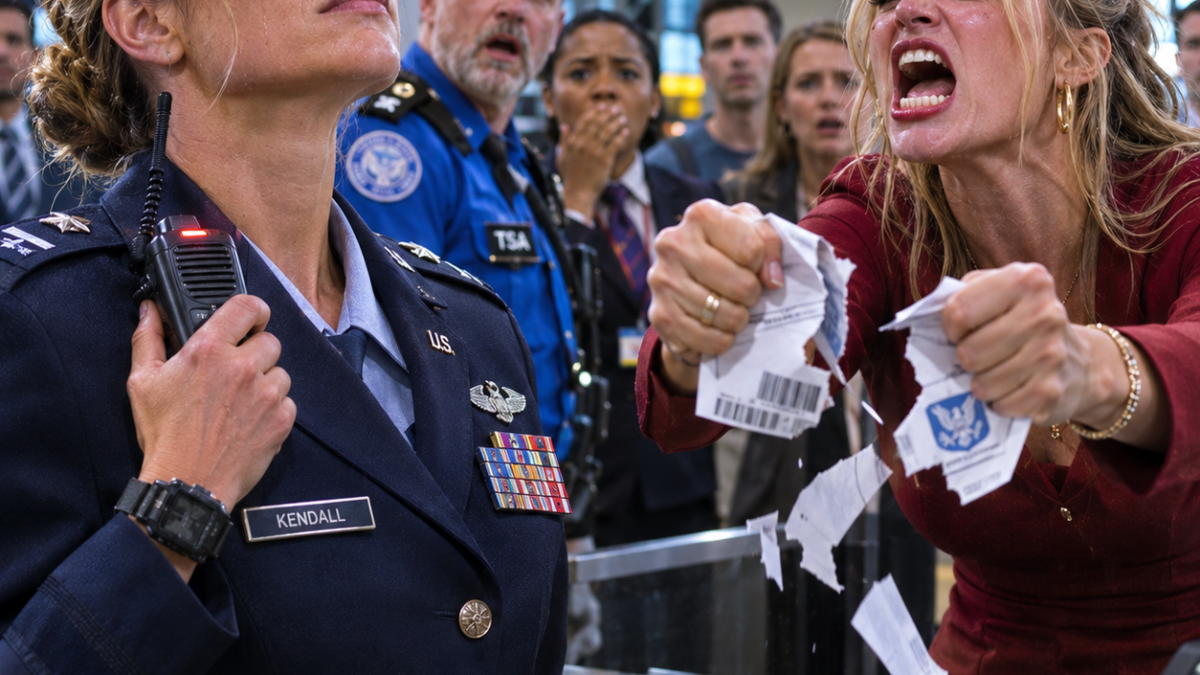
𝗙𝗨𝗟𝗟 𝗦𝗧𝗢𝗥𝗬:“GET OUT OF MY AIRPORT, MARISSA! I DON’T CARE HOW IMPORTANT YOU THINK YOU ARE IN THE MILITARY!” my younger sister screamed before snatching my federally authorized flight-access document from the security counter and ripping it into eight pieces while airport employees watched in horror —Then Air Force Command Called My Radio and She Realized Who I Really Was
𝗙𝗨𝗟𝗟 𝗦𝗧𝗢𝗥𝗬
“You may have authority over a handful of soldiers on some military base, Marissa, but don’t confuse that with having authority over me.”
I studied her.
“I’m not asking you to obey me as my sister.”
“Good.”
“I’m asking you to follow the access procedure your airport has already approved.”
She smiled.
“Then I’ll show you how much that approval means.”
Before I could respond, she grabbed the document from the counter.
The tearing sound was startlingly loud.
Miles recoiled.
Kendra ripped it again.
And again.
Until eight fragments lay between us.
She dropped them onto the metal surface and brushed her hands together.
“There.”
Her eyes gleamed.
“No valid paperwork. No inspection.”
For a moment, I said nothing.
I looked at the fragments.
Then at the electronic authorization still displayed on the monitor.
Finally, I asked, “Kendra, are you formally acknowledging that you’re deliberately blocking an authorized federal mission despite successful electronic verification?”
She gave an exaggerated sigh.
“Yes, Marissa. That’s exactly what I’m doing.”
I nodded.
Then carefully collected the fragments and placed them inside a clear pouch I carried with my mission materials.
She laughed again.
“Oh, please. Are you pretending to collect evidence?”
I sealed the pouch.
“I’m preserving the damaged document.”
“What an impressive little performance.”
I didn’t answer.
Because at that exact moment, three electronic beeps sounded from the military radio clipped to my belt.
Miles went completely still.
Kendra’s smile faltered.
A clear voice came through the speaker.
“Mobility Operations calling Falcon Three. Colonel Kendall, report your inspection status.”
The room fell silent.
Kendra stared at the radio.
Then at me.
For the first time that morning, I saw uncertainty replace arrogance.
She’d spent thirty-five years calling me her bossy older sister.
She’d never once bothered to understand the work I actually did.
I raised the radio.
Pressed the transmission switch.
And answered with the calm professionalism she’d spent her whole life mistaking for weakness.
“Falcon Three to Mobility Operations. Colonel Kendall reporting. Access to Runway 22 has been deliberately denied at Service Gate 4 after successful credential verification.”
Kendra’s mouth opened.
I continued.
“The denying official is Deputy Director of Operations Kendra Kendall Pierce.”
Her face turned white.
And the woman who’d just laughed while destroying my authorization suddenly realized that being my sister would not make her actions disappear from the official record.
PART2
“Falcon Three, confirm the credential validation occurred before access was denied.”
The voice over the radio remained steady.
Professional.
Unemotional.
Exactly what I needed.
“Affirmative,” I replied. “Security Officer Miles Benton completed electronic verification. The credential returned valid. Airport operations supervision then overrode the approved access procedure and destroyed the physical authorization.”
Miles gripped the edge of the counter.
Kendra took a step toward me.
“Marissa—”
I raised one finger.
Not as a threat.
Not as a command from a superior officer.
Simply a signal that she needed to stop interrupting an official transmission.
She stared at my hand.
For a moment, I thought she’d slap it away.
Instead, she froze.
The radio sounded again.
“Identify the supervising official who issued the denial.”
I looked directly at my sister.
“Deputy Director of Operations Kendra Kendall Pierce.”
Kendra’s jaw dropped.
I continued.
“She personally tore the physical authorization into multiple pieces after being informed that electronic validation had succeeded.”
Silence.
Then the response came.
“Copy, Falcon Three. Maintain your present safe location. Do not attempt to enter the movement area without coordinated airport clearance. We are contacting the designated airport authority and federal mission liaison.”
“Understood.”
“Aircraft schedule remains active. Inspection status is required before the planned arrival. Report further changes immediately.”
“Wilco.”
I released the switch.
The booth became unbearably quiet.
Miles looked from me to the radio.
Then toward Kendra.
My sister’s lips moved.
No words came out.
Finally, she whispered, “You reported me?”
I met her eyes.
“I reported the access obstruction.”
“You told the Air Force my name!”
“You were the official who denied access.”
Her face reddened.
“You’re my sister!”
I nodded.
“Yes.”
She pointed toward the radio.
“And you just embarrassed me in front of the entire military?”
“No, Kendra.”
My voice remained level.
“I reported facts through the operational channel responsible for the mission.”
She gave a brittle laugh.
“This is unbelievable.”
I looked toward the computer.
The authorization status still read valid.
The aircraft schedule was still active.
And Miles was standing beside us, looking as though his entire career might depend on remaining invisible.
Kendra took another step.
“This is a family matter.”
I shook my head.
“It stopped being a private argument when you interfered with an authorized inspection.”
She stared at me.
Then said the words that told me she still didn’t understand.
“You think you can ruin my career just because I insulted you?”
I looked down at the damaged document.
Then back at her.
“No.”
I paused.
“Your career isn’t the reason I came here.”
Outside the booth, a ground-service vehicle passed beyond the fence.
The clock continued moving.
An aircraft was still scheduled to arrive.
And the inspection I had been sent to perform remained unfinished.
I turned toward Miles.
“Officer Benton, please preserve the original validation record and the relevant access log under your airport’s procedures.”
He nodded quickly.
“Yes, Colonel.”
Kendra whirled toward him.
“Don’t you dare—”
I turned back to her.
“Kendra.”
She froze.
“This is your chance to stop making the situation worse.”
For the first time in our lives, my younger sister had nothing clever to say.
But I knew her well enough to understand that silence wouldn’t last.
And I was right.
“Turn that radio off,” Kendra hissed.
I looked at her.
“No.”
“This is my office.”
“And it’s part of an airport conducting a federally coordinated operation.”
She stepped closer to the counter.
“You’re doing this to punish me.”
I could hear how badly she wanted that to be true.
If she could make the incident about my hurt feelings, she could dismiss it as another argument between sisters.
She’d done that since childhood.
When she broke something that belonged to me, I was too sensitive.
When she lied to our parents, I was being dramatic.
When she humiliated me in front of strangers, I needed to develop a sense of humor.
The details changed.
The pattern never did.
But I was no longer a sixteen-year-old trying to persuade our mother that Kendra had taken money from my birthday envelope.
I was Colonel Marissa Kendall, responsible for an operational inspection with a documented purpose and a scheduled deadline.
And the distinction mattered.
“Kendra, the radio stays on,” I said. “I am required to remain available to mission operations.”
She folded her arms.
“Look at you. Acting like you’re in some war movie.”
I didn’t respond.
She turned toward Miles.
“Delete the verification.”
The young guard blinked.
“Ma’am?”
“You heard me.”
His face turned pale.
I felt my stomach tighten.
This was the moment the situation became more disturbing than the torn document.
Destroying my physical authorization had been deliberate.
But now she was instructing a junior employee to interfere with an electronic record.
I spoke before Miles could answer.
“Officer Benton, do not alter the record outside established procedures.”
Kendra wheeled toward me.
“Stop giving orders to my employee!”
I looked directly at her.
“I’m telling him not to erase an official access record.”
She laughed harshly.
“It’s a computer entry.”
“Then it should be easy to preserve.”
Miles stared at the keyboard.
Kendra pointed.
“Delete it.”
He swallowed.
“Deputy Director, I can’t.”
Her face changed.
“What did you say?”
He straightened slightly.
“The system records successful credential validation automatically. I don’t have authority to erase the audit log.”
Kendra stared at him.
For one brief moment, I saw the young man’s fear nearly overwhelm him.
Then he added, “And I wouldn’t be comfortable changing it improperly.”
My respect for him rose immediately.
He’d been trembling since the confrontation began.
He had every reason to worry about his supervisor’s reaction.
But he’d refused to falsify a record.
I looked toward him.
“Thank you for clarifying.”
He nodded without meeting my eyes.
Kendra’s expression grew vicious.
“You can turn in your badge at the end of your shift.”
Miles went white.
I felt anger surge through me.
But I kept my voice level.
“That statement should also be documented.”
Kendra stared.
“Oh, you cannot be serious.”
I looked toward the security camera mounted above the door.
“Very serious.”
Her gaze followed mine.
For the first time, she seemed to remember that the booth wasn’t a private room in our parents’ house.
There were cameras.
Access logs.
Electronic timestamps.
Employees.
And an active mission record.
Her confidence had depended on one assumption.
That everyone around her would be too frightened to contradict her.
Now that assumption was beginning to fail.
I had arrived at Redwood Valley Regional Airport at 8:12 that morning.
The scheduled arrival of the military transport aircraft wasn’t until later, but the inspection had to be completed before the aircraft was cleared to use the planned facilities.
There had been recent maintenance work near portions of the operational area.
Our team needed to verify several items associated with the coordinated airfield-use plan, including the condition of the designated route and the status of temporary operational restrictions.
Nothing about it was glamorous.
It involved checklists.
Coordination with airport personnel.
Communication with the appropriate control authorities.
And careful confirmation that the conditions matched the information supplied in advance.
A missing inspection result didn’t automatically make the entire airport unsafe.
But it did mean our mission personnel couldn’t simply assume that the conditions required for the planned operation had been confirmed.
The aircraft had alternatives.
The mission had contingency procedures.
That was the point of planning.
Still, an unnecessary interruption created work for everyone involved and could affect the flight’s schedule.
My assigned role was to conduct the inspection and report its status.
Not to win an argument.
Not to demonstrate my rank.
And certainly not to fight with my younger sister.
In fact, I hadn’t expected to see Kendra at all.
When I received the assignment, I knew she worked at Redwood Valley Regional.
I knew her title was Deputy Director of Operations.
But her work schedule was none of my business.
The airport’s official coordination had been handled through designated contacts.
I’d confirmed my arrival arrangements in advance.
My credentials had been processed through the approved system.
A security escort was scheduled.
There was no reason the inspection couldn’t proceed in the ordinary way.
Then Kendra appeared.
And within minutes, she transformed a routine verification into a public demonstration of her belief that she could punish me whenever she pleased.
I had been standing at Miles’s counter when she entered.
He’d just verified the electronic authorization.
“Everything checks out, Colonel Kendall,” he’d said.
I smiled.
“Thank you, Officer.”
He reached for the visitor-control log.
Then the booth door swung open.
“Marissa?”
I turned.
Kendra stood in the doorway in a tailored gray suit.
Her hair was pulled into a sleek bun.
A gold watch gleamed on her wrist.
Her airport badge hung from a retractable clip at her waist.
She looked surprised.
Then pleased.
But not pleased to see me.
Pleased to find me somewhere she believed she held more power.
“Well, well,” she said.
I sighed inwardly.
“Good morning, Kendra.”
She stepped inside.
“What are you doing here?”
“Working.”
Her eyebrows rose.
“Obviously. But why are you at my airport?”
“I’m here for a scheduled inspection.”
She laughed.
“Of course you are.”
Miles looked between us.
“Deputy Director Pierce, Colonel Kendall’s credentials have been verified. The inspection is on today’s access schedule.”
Kendra ignored him.
She looked at my uniformed credentials, the mission paperwork, and the radio at my waist.
Then she smiled.
“So you really are doing the whole military-authority routine today.”
I kept my expression neutral.
“I’m performing an assigned duty.”
She rolled her eyes.
“Marissa, I don’t care how impressive your title sounds on some base.”
Miles lowered his head.
I knew immediately where the conversation was going.
I’d seen that smile too many times.
Kendra hadn’t come to ask about the inspection.
She’d come to remind me that in her world, she was still the daughter who mattered most.
And I was still supposed to step aside.
When we were children, Kendra used to follow me through the house, taking whatever caught her attention.
My books.
My headphones.
The little silver bracelet our grandmother gave me when I turned thirteen.
If I objected, she cried.
Then our mother would appear and tell me I ought to know better than to upset my younger sister.
“Kendra’s sensitive, Marissa.”
Or:
“You’re older. Act like it.”
Or the sentence that followed me into adulthood:
“Just let her have this one thing.”
At first, the things were small.
A toy.
A seat in the car.
The larger slice of birthday cake.
Then they became more important.
Our parents paid for her expensive extracurricular activities while explaining that I’d have to work for mine.
They celebrated her every achievement.
If I earned a scholarship, they said I was fortunate.
If Kendra won a school award, they organized dinner.
By the time I left home, I’d learned that the quickest way to avoid a fight was to stop expecting fairness.
I entered the military because I wanted a life built on responsibilities I could understand.
A place where preparation mattered.
Where decisions had consequences.
Where rank came with obligations rather than permission to humiliate people.
I didn’t find a perfect world.
No institution is perfect.
But I found a career in which my work could be evaluated by people who weren’t related to me.
Over the years, I learned to lead.
To listen.
To accept criticism.
To correct mistakes.
And to keep my personal feelings separate from decisions affecting other people.
Kendra learned something different.
She learned that confidence could be mistaken for competence.
That an angry demand might work if the person hearing it was frightened enough.
And that our parents would often defend her before asking what had happened.
Our lives had taken separate paths.
But every family gathering brought us back to the old rules.
Kendra interrupted.
Mother excused her.
I remained quiet.
Until that morning at Service Gate 4, when she tried to apply those rules to an airport security procedure.
The booth telephone rang.
All three of us looked toward it.
Miles reached for the receiver.
“Service Gate 4, Benton speaking.”
He listened.
His eyes widened slightly.
“Yes, sir.”
Another pause.
“Yes, the colonel is here.”
Kendra stepped toward him.
“Who’s calling?”
Miles glanced at her.
“Airport Operations Director Vale.”
Her expression changed.
“Give me that.”
Miles hesitated.
Then handed over the receiver.
Kendra pressed it to her ear.
“Martin, I was just handling a minor authorization discrepancy.”
I looked toward the shredded document pouch.
Her voice became sweeter.
“No, there’s no reason to escalate anything. It’s a misunderstanding involving my sister.”
She listened.
Her smile faded.
Then she said, “I am the Deputy Director of Operations.”
Another pause.
Her jaw tightened.
“I understand the access schedule.”
She looked toward me.
Her eyes flashed.
Then she turned away.
“Yes. Fine.”
She ended the call.
For several seconds, she stared at the receiver.
Then she placed it back in its cradle.
“Martin Vale is coming here.”
I nodded.
“Good.”
She glared.
“Don’t act so pleased.”
I looked toward the gate.
“I’m pleased the appropriate airport authority is responding.”
She folded her arms.
“I’m still your supervisor’s contact for this site.”
I looked at her.
“You’re not my supervisor, Kendra.”
Her face hardened.
“And you’re not mine.”
“No,” I agreed.
“Which is precisely why we should both follow the established procedures.”
She opened her mouth.
Then closed it.
Behind her, Miles returned to his logbook.
His hands were still shaking.
But he was writing.
And I knew that would matter more than anything Kendra said next.
Martin Vale arrived with two other airport officials twelve minutes later.
I recognized him from the pre-inspection coordination call.
He was a tall man in his late fifties with silver-framed glasses and a face that suggested he had spent many years solving problems he hadn’t created.
Beside him walked the airport’s security manager, Teresa Grant.
A third person carried a tablet and a document folder.
Martin stepped inside the booth.
“Colonel Kendall.”
I nodded.
“Director Vale.”
He looked toward Kendra.
Then Miles.
Then the sealed pouch containing the torn authorization.
His expression tightened.
“I understand there’s been an incident.”
Kendra laughed nervously.
“Martin, this has been blown completely out of proportion.”
He didn’t look at her.
Instead, he addressed Miles.
“Officer Benton, please explain what happened from the beginning.”
The young guard swallowed.
Kendra stepped forward.
“Martin, I already told you—”
He turned.
“Kendra. I’m asking the officer who processed the credential.”
She froze.
The words were delivered quietly.
But their effect was unmistakable.
For perhaps the first time in her professional life, someone with authority over her was insisting on hearing from a junior employee rather than accepting her version.
Miles looked at me.
I gave him a small nod.
Not an instruction about what to say.
Only encouragement to speak for himself.
He took a breath.
“Colonel Kendall arrived for her scheduled inspection. I verified the authorization using the designated system. The result was valid.”
Martin nodded.
“Go on.”
“I was preparing the required access record when Deputy Director Pierce entered.”
Kendra stared at the floor.
Miles continued.
“She asked me to deny entry.”
“On what grounds?”
Miles hesitated.
“She said the colonel’s document wasn’t sufficient.”
Martin looked toward me.
I remained silent.
“Did the system indicate an access problem?” he asked.
“No, sir.”
“Did you identify a safety or security concern requiring an immediate hold?”
“No, sir.”
Martin’s expression hardened slightly.
“Then what happened?”
Miles swallowed.
“The deputy director took the physical authorization and tore it into pieces.”
Teresa Grant looked sharply toward Kendra.
Martin held out his hand.
“Colonel Kendall, may I see the damaged document?”
I passed him the pouch.
He examined it without opening the seal.
Eight fragments.
All accounted for.
The same document that had been intact less than an hour earlier.
Martin looked toward Kendra.
“Did you do this?”
She stared.
Then gave a strained laugh.
“It wasn’t as dramatic as it looks.”
He waited.
She crossed her arms.
“Yes, I tore it.”
Teresa exhaled quietly.
Martin asked, “Why?”
Kendra looked toward me.
“Because she’s my sister and she was being arrogant.”
The silence that followed was extraordinary.
Martin blinked once.
Then said, “That is not an airport-access criterion.”
Kendra’s face reddened.
“She came in acting like she owned the place.”
I spoke calmly.
“I presented the required documentation and waited for verification.”
Martin nodded.
“The electronic record supports that.”
Kendra glared at me.
He continued.
“What specific security concern justified denying access?”
She opened her mouth.
Then closed it.
For several seconds, she couldn’t find an answer.
Finally, she said, “I have discretion.”
Martin’s expression remained unchanged.
“Discretion must be exercised for operational reasons. Not personal grievances.”
She stared at him.
Then looked toward Teresa.
“Are you seriously taking her side?”
Teresa shook her head.
“We’re reviewing the procedure and the evidence.”
Kendra laughed bitterly.
“Of course.”
Martin turned toward Miles.
“Preserve the original records. Include the credential result, the gate log, the communications log, and any applicable camera footage under the airport’s retention procedures.”
“Yes, sir.”
Kendra’s eyes widened.
“Martin—”
He continued.
“Teresa, make sure the records are protected and coordinate the operational review.”
She nodded.
“Understood.”
Then Martin looked at me.
“Colonel, I apologize for the unnecessary interruption.”
I inclined my head.
“Thank you. My priority is completing the scheduled inspection safely.”
He nodded.
“We’ll work through the appropriate access arrangements.”
Kendra stared at him.
Then demanded, “What about me?”
For the first time, Martin’s expression softened.
Not with forgiveness.
With disappointment.
“Kendra, you’re going to step away from this operation while we review what happened.”
Her face lost color.
“What?”
“Effective immediately, you are not directing access decisions for this mission.”
She looked toward me.
I said nothing.
Martin continued.
“We’ll discuss your administrative status separately.”
And I watched my sister realize that no amount of shouting would turn those words into a family argument.
The radio sounded again.
“Mobility Operations to Falcon Three.”
I answered.
“Falcon Three, go ahead.”
“Request updated inspection-access status.”
I looked toward Martin.
He nodded for me to report accurately.
“Airport operations leadership is on scene. Access is being re-coordinated through the designated authority. Inspection has not yet commenced.”
“Copy. Continue to hold until the required ground permissions are confirmed. Mission control is reviewing schedule options.”
“Understood.”
I released the switch.
Martin turned toward Teresa.
“How quickly can we complete the coordination?”
She checked her tablet.
“The approved escort is available. We need to document the access-control exception, confirm the current airfield status, and obtain the appropriate clearance before the inspection team proceeds.”
Martin nodded.
“Do it.”
Kendra suddenly spoke.
“You cannot just let her go through!”
Everyone turned.
She gestured toward me.
“She doesn’t have the physical document anymore.”
I stared at her.
Martin closed his eyes briefly.
Then opened them.
“Kendra, you destroyed the document.”
Her cheeks flushed.
“That doesn’t change the fact that it’s gone.”
Teresa looked toward the terminal.
“Her credential remains electronically valid. We can follow the documented procedure for the damaged physical copy and make a new access determination through authorized channels.”
Kendra folded her arms.
“So now we’re just making exceptions for her?”
“No,” Martin answered.
“We’re following the rules that apply to this situation.”
He paused.
“Your decision to destroy a document does not automatically invalidate the authorization behind it.”
I looked down at the evidence pouch.
Those eight pieces had taken my sister less than ten seconds to produce.
She’d believed that was all the time required to erase my authority.
Now she stood in a room where every person understood something she’d never learned.
A document can be damaged.
A record can be preserved.
A decision can be reviewed.
And power exercised improperly can be challenged.
While the airport officials completed the necessary coordination, I moved to the side of the booth.
Miles approached quietly.
“Colonel?”
I turned.
“Yes?”
He looked exhausted.
“I wanted to apologize.”
I frowned.
“For what?”
“For not stopping her.”
I studied him.
“You followed the verification procedure.”
He looked down.
“But I let her take the document.”
I considered my response carefully.
He was young.
He’d been threatened by a supervisor.
And he was standing in the aftermath of an incident that could affect his job.
I wasn’t going to offer him false reassurance.
But I wasn’t going to make him responsible for Kendra’s decisions either.
“You should cooperate fully with the review,” I said. “Explain what happened accurately and preserve whatever records your procedures require.”
He nodded.
“I will.”
I continued.
“Your supervisor’s conduct is being examined. You don’t need to change your account to make anyone comfortable.”
His eyes filled.
“Thank you, ma’am.”
I glanced toward the gate.
“Are you all right?”
He hesitated.
Then whispered, “She said she’d fire me.”
I nodded.
“I heard.”
He swallowed.
“I’ve only been here seven months.”
I looked at him.
“That’s long enough to know how to verify a credential correctly.”
A faint smile appeared.
“Yes, ma’am.”
“And to know when something doesn’t belong in an access log.”
He nodded.
I lowered my voice.
“Keep doing your job properly, Officer Benton.”
His shoulders relaxed slightly.
“I’ll try.”
I smiled.
“That’s all anyone can reasonably ask.”
He stepped back toward his station.
And I thought about how close Kendra had come to making him the scapegoat for her own misconduct.
She hadn’t merely wanted to humiliate me.
She’d been willing to sacrifice a junior employee’s livelihood to preserve her pride.
That angered me more than the torn document.
Twenty minutes later, the appropriate airport personnel completed the steps needed to proceed.
My electronic authorization remained confirmed.
The damaged-document exception was recorded.
The designated airport escort was assigned.
And access to the operational area would occur only after the necessary local coordination and clearances.
No one waved me through because my radio had identified me as a colonel.
No one surrendered an airport gate to military authority.
The officials responsible for controlling access made a documented decision under the procedures governing their facility.
That was exactly how it should have worked in the first place.
Martin approached.
“Colonel Kendall, the escort is ready.”
I nodded.
“Thank you.”
He glanced toward the security manager.
“We’ll continue the administrative review while your inspection proceeds.”
“Understood.”
He hesitated.
“I’m sorry you had to deal with this.”
I looked toward Kendra.
She stood near the wall, her arms tightly folded.
Her eyes followed every movement.
I could see the humiliation burning inside her.
And the old part of me—the older sister who’d spent decades trying to prevent her from crying—wanted to say something that would make the situation less painful.
I recognized the instinct.
Then let it pass.
Martin was waiting.
I turned back.
“My primary concern is that the mission proceeds safely and the records remain accurate.”
He nodded.
“Agreed.”
I walked toward the door.
Kendra spoke behind me.
“Marissa.”
I stopped.
She took a step forward.
For a moment, I thought she might apologize.
Then she said, “You’re going to regret this.”
I looked back.
She was trembling with anger.
I studied her.
“Kendra, I didn’t make you take the document.”
Her expression tightened.
“I didn’t make you tear it.”
She looked away.
“And I didn’t make you threaten Miles.”
I paused.
“You made those decisions.”
Then I turned and left the booth.
Behind me, the door closed.
And the inspection that had been delayed by a family feud finally began.
The airfield looked ordinary from the service vehicle.
That might sound strange to someone who imagines every military mission surrounded by flashing lights and urgent commands.
But much of the work that keeps aircraft operating safely looks remarkably unremarkable from a distance.
Pavement.
Lighting.
Markings.
Communication.
Maintenance records.
People checking details that most travelers will never notice.
The airport escort, a senior operations specialist named Daniel Ruiz, drove while I reviewed the inspection materials.
He was a quiet man with a careful manner.
He didn’t ask about Kendra.
Didn’t mention the radio transmission.
Didn’t offer an opinion about the incident.
I appreciated that.
“Colonel,” he said as we approached the designated area, “we’ve received the latest field-status information.”
I nodded.
“Thank you.”
He explained the relevant operational conditions and the coordination already completed.
We stopped where authorized, followed the required movement-area procedures, and began reviewing the assigned inspection items.
I checked the information against the pre-arrival plan.
There had been temporary work near a portion of the designated aircraft movement route.
The repairs were substantially complete, but certain temporary arrangements still required confirmation.
One item didn’t match the information I’d received during the earlier coordination briefing.
I paused.
“Daniel, when was this marking arrangement updated?”
He checked his tablet.
“Yesterday afternoon.”
I looked at the record.
“The inspection packet I received doesn’t reflect that revision.”
He studied the entry.
Then frowned.
“Looks like the updated notice wasn’t included in your package.”
I nodded.
“Let’s verify the current condition and get the information corrected.”
We did.
There was no dramatic emergency.
No aircraft suddenly descending toward danger.
No frantic command to evacuate the runway.
The discrepancy was the kind of issue inspection procedures existed to identify before a scheduled operation.
We documented it.
Confirmed the actual condition.
Requested the appropriate update.
And continued the assessment.
As I worked, I thought about Kendra.
She had accused me of caring only about my ego.
Yet this was the actual purpose of my presence.
Not to look important.
Not to be admired.
To identify gaps between planning information and real-world conditions so the people responsible for the aircraft could make informed decisions.
It required cooperation between military and civilian personnel.
It required accurate records.
And it required everyone involved to respect procedures, even when those procedures felt inconvenient.
I thought of Miles.
He’d done his part correctly.
Kendra had punished him for it.
Then I returned my attention to the checklist.
Whatever happened to my sister, my responsibility remained the same.
Finish the work properly.
By the time we completed the field assessment, the scheduled aircraft arrival had required a revised coordination timeline.
Mobility Operations had been informed about the delay and was working through the available options.
The airport had corrected the documentation discrepancy.
The relevant operational information had been passed through the required channels.
And the mission could proceed under the updated plan once all necessary approvals were confirmed.
I gave my report.
“Falcon Three to Mobility Operations. Field inspection complete. Temporary-condition information has been verified and updated through airport operations. No unresolved inspection item remains within my assigned scope. Final operational approval remains with the designated authorities.”
The response came promptly.
“Roger, Falcon Three. Inspection status received. Thank you, Colonel.”
“Falcon Three, out.”
I lowered the radio.
For a moment, I simply stood beside the service vehicle.
Sunlight reflected from the distant hangars.
A ground crew moved equipment near a parked aircraft.
An airport operations vehicle passed along an authorized route.
The world hadn’t stopped because my sister had thrown a tantrum.
It had merely required additional people to do work that should never have been necessary.
Daniel approached.
“Everything squared away?”
I nodded.
“The inspection report is submitted.”
He smiled.
“Glad we could get it done.”
I looked toward the terminal buildings.
“So am I.”
He hesitated.
Then said, “For what it’s worth, Officer Benton is a good kid.”
I turned.
“You know him?”
“Worked a few shifts with him before he moved into access control.”
I nodded.
“He handled the verification correctly.”
Daniel’s expression softened.
“I heard.”
I looked toward the service road.
“He deserves a fair review of what happened.”
Daniel nodded.
“Agreed.”
For a while, we stood quietly.
Then he said, “I can’t imagine having family mixed up in something like this.”
I gave a tired smile.
“Neither could I.”
That wasn’t entirely true.
I’d spent years imagining what would happen if Kendra’s behavior followed me into my professional life.
I just hadn’t expected the answer to arrive at an airport security booth on New Year’s Eve.
When I returned to the operations building, Martin Vale was waiting.
His jacket was off.
His tie was loosened.
He looked like a man who’d already spent too many hours dealing with a problem that should never have occurred.
“Colonel Kendall.”
I nodded.
“Director.”
“Was the inspection completed?”
“Yes. The report has been transmitted.”
He exhaled.
“Good.”
I studied him.
“Is there anything further you need from me?”
He gestured toward a conference room.
“If you have a few minutes, we’d appreciate a factual statement for the airport’s incident review.”
I checked the time.
My mission responsibilities allowed for a brief statement before I returned to the scheduled reporting process.
“Of course.”
Inside the conference room sat Teresa Grant and a representative from the airport’s compliance office.
They explained the purpose of the statement.
I recounted the events in order.
Arrival.
Credential presentation.
Successful electronic verification.
Kendra’s arrival.
The verbal denial.
The destruction of the physical authorization.
The radio report.
Her instruction to Miles to erase the log.
Her threat concerning his employment.
I gave them the pouch containing the torn document for proper handling and obtained acknowledgment that it had been received.
I didn’t characterize Kendra as evil.
Didn’t describe her as unstable.
Didn’t speculate about why she’d chosen that morning to humiliate me.
When the compliance representative asked whether there had been prior personal conflict between us, I answered honestly.
“Yes. Kendra is my younger sister. Our relationship has been difficult for years.”
The woman nodded.
“Did you threaten her employment before she destroyed the document?”
“No.”
“Did you demand access based solely on your military rank?”
“No. I presented the scheduled authorization and waited for the airport’s access procedure.”
“Did you attempt to bypass the gate after being denied?”
“No.”
“Did you instruct Officer Benton to alter records?”
“No. I instructed him not to alter them improperly.”
The representative finished her notes.
Then asked, “Do you have a preferred disciplinary outcome?”
I looked at her.
“No.”
She seemed surprised.
I continued.
“My responsibility is to provide an accurate account. The airport should determine the appropriate administrative response under its policies, and other authorities can assess any matters within their jurisdiction.”
She nodded.
“Understood.”
I looked toward Martin.
“I would like the record to reflect that Officer Benton completed the credential verification correctly and did not initiate the denial.”
Martin nodded.
“We’re reviewing his involvement separately.”
I felt some tension leave my shoulders.
“Thank you.”
There was nothing else I needed to say.
Kendra was waiting outside the conference room.
I hadn’t expected that.
She stood near a row of windows, her arms wrapped around herself.
Her carefully arranged hair had begun to loosen.
Her lipstick looked faded.
And the self-assured smile she’d worn in the security booth was gone.
When she saw me, she straightened.
“Marissa.”
I stopped.
“What?”
She glanced toward the conference-room door.
“Can we talk?”
I considered saying no.
Then I looked at her face.
For all her cruelty, she was still my sister.
And I wanted to understand whether she had finally recognized what she’d done.
“Briefly.”
She moved closer.
Her voice dropped.
“They’re putting me on administrative leave.”
I nodded.
“That’s an employment decision.”
She stared.
“Martin says my access permissions are being restricted during the review.”
I said nothing.
“Do you know what that means?”
I looked at her.
“I understand it’s serious.”
Her face tightened.
“This is my career, Marissa.”
I felt the old familiar pressure.
The same pressure I’d felt when she cried over a broken toy as a child.
The same pressure our mother had applied when I received praise for something Kendra wanted to be hers.
She’s your little sister.
You’re older.
Be understanding.
I took a breath.
“Kendra, you destroyed an authorization during a live inspection.”
She looked away.
“I know.”
“You threatened a junior employee for following procedure.”
Her jaw tightened.
“I was angry.”
“That doesn’t make it acceptable.”
She looked back at me.
Tears had gathered in her eyes.
For one second, I hoped she’d apologize.
Then she said, “Can’t you tell them you misunderstood?”
I went still.
“What?”
She stepped closer.
“Just say we were arguing. Tell them I didn’t know it was official.”
I stared.
She continued rapidly.
“Say I thought it was a copy. Say I wasn’t aware the credential had been verified.”
My heart sank.
“Kendra.”
“Please.”
“You told me directly that you were interfering despite verification.”
Her eyes flashed.
“I didn’t know you were recording everything!”
I looked at her.
The words hung between us.
Then I said quietly, “You didn’t object because you believed it was wrong.”
Her expression changed.
“You object because there’s a record.”
She opened her mouth.
Nothing came out.
I studied her.
For years, she’d told our parents that I overreacted.
That I was too stern.
That I couldn’t take a joke.
Now, facing professional consequences, she wanted me to become the older sister who quietly absorbed the damage and made sure she escaped.
Again.
I shook my head.
“I won’t give a false statement.”
Her face crumpled.
“Marissa, please.”
“I’ll tell the truth. Nothing more.”
She stared at me.
Then whispered, “You’re really going to let them do this?”
I felt tears gather in my own eyes.
“Kendra, you still think I’m doing this to you.”
She looked away.
And I realized she hadn’t understood anything.
Not yet.
Kendra reached for my arm.
I stepped back.
“Please don’t.”
She froze.
For a moment, she looked more offended by the boundary than by anything I’d said.
Then she lowered her hand.
“You’ve changed.”
I almost laughed.
“No.”
I looked toward the conference room.
“I’ve stopped pretending your actions are harmless.”
She wiped her eyes angrily.
“Mom was right about you.”
I felt the familiar ache.
“Which part?”
“That you care more about rules than people.”
I stared at her.
For a moment, I pictured our childhood home.
The long dining table.
Our mother sitting at one end.
Kendra beside her, smiling as she explained why something she’d done was actually my fault.
I remembered the time she borrowed my car without asking when she was nineteen.
She returned it with damage along the passenger-side door.
When I asked what happened, she accused me of making her feel guilty about an accident.
Our mother insisted I should be grateful Kendra hadn’t been injured.
The repair bill became my responsibility.
I was twenty-four.
Home on leave.
Already beginning to understand that the professional world could hold me accountable for a missed deadline while my sister could damage my property and demand an apology for being questioned.
Now she was standing in an airport operations building using almost the same language.
I looked at her.
“Rules protect people too, Kendra.”
She scoffed.
“Oh, please.”
I continued.
“Miles followed a procedure designed to control access to a restricted area. You tried to punish him for it.”
Her expression tightened.
“The inspection affected an aircraft schedule. The coordination involved personnel who had responsibilities beyond this room.”
She looked away.
“And you destroyed a document because you wanted me to feel small.”
Her lips trembled.
I paused.
“Which person were you trying to protect?”
For once, she didn’t have an answer.
Then she whispered, “I didn’t think it would go this far.”
I nodded.
“I believe that.”
Her face lifted hopefully.
I continued.
“But not expecting consequences doesn’t mean the decision was harmless.”
She stared at me.
And I knew she’d heard only the first half.
We were still standing near the windows when her phone rang.
Kendra looked at the screen.
“Mom.”
I nearly closed my eyes.
Of course.
She answered immediately.
“Mom?”
I heard our mother’s voice, loud and urgent.
“Kendra, what is happening? You sounded hysterical.”
My sister turned away.
“Marissa reported me to the Air Force.”
There was a sharp pause.
Then our mother said something I couldn’t hear.
Kendra looked back at me.
“Yes, she’s here.”
Another pause.
Then she held out the phone.
“Mom wants to talk to you.”
I considered refusing.
But there was one thing I wanted to make clear before the family spent the next several weeks inventing a different story.
I accepted the phone.
“Hello, Mom.”
“Marissa Kendall, what have you done?”
I looked through the window toward the airfield.
“I completed my mission.”
“Don’t play games.”
I said nothing.
“Kendra says you’ve had her suspended from work.”
“The airport is reviewing an incident.”
“What incident?”
I took a breath.
“She destroyed an official document after my credentials had been verified and blocked an authorized inspection.”
Our mother gave a disgusted sigh.
“Oh, honestly. You two have always been competitive.”
I closed my eyes.
There it was.
Our entire childhood reduced to a misunderstanding between two girls.
“This wasn’t a competition.”
“Kendra said you came in ordering everyone around.”
“I followed the access process.”
“She’s the deputy director, Marissa. You should have respected her position.”
I looked toward the security building.
“Respecting her position doesn’t mean accepting misconduct.”
Our mother’s voice sharpened.
“She’s your little sister.”
I felt something inside me become very quiet.
Thirty years.
Thirty years of that sentence.
I looked at Kendra.
She was standing a few feet away, watching me.
Waiting for the old rules to take effect.
I spoke slowly.
“And I’m her older sister.”
Our mother paused.
“Yes?”
“Why has that always meant I have to accept whatever she does?”
Silence.
I continued.
“When she damaged my car, I paid for it. When she lied about me, you told me to let it go. When she insulted my career, you called it teasing.”
My voice trembled.
“Now she’s interfered with my work, threatened an employee, and asked me to lie about what happened.”
Our mother inhaled sharply.
“Marissa—”
“No.”
The word surprised even me.
I rarely interrupted her.
But I was finished allowing every conversation to become a trial in which Kendra’s feelings were the only evidence.
“I won’t alter an official report to protect her.”
Our mother went quiet.
Then she said, very coldly, “You are going to destroy this family over a piece of paper.”
I looked at the phone.
The same phrase Kendra had used.
A piece of paper.
Not a mission authorization.
Not a record.
Not something connected to responsibilities affecting people beyond our family.
Just an object small enough that they could dismiss what happened to it.
I took a breath.
“The paper isn’t the reason we’re here.”
Our mother didn’t answer.
“Kendra made a choice. The airport will review it.”
“Can’t you intervene?”
“I have no authority to control the airport’s employment decision.”
“Then ask whoever you need to ask.”
I closed my eyes.
She didn’t understand.
Or refused to.
It had never occurred to her that authority was supposed to be limited.
That using professional influence to protect a relative from an impartial review could itself be improper.
I spoke carefully.
“Mom, I will not use my position to interfere with an investigation.”
Her voice became icy.
“Then I suppose we know where your loyalties lie.”
I looked toward Kendra.
Her eyes were wet.
For a moment, I saw the little girl who used to hide behind our mother’s skirt when she’d done something wrong.
Then I answered.
“My loyalty is to telling the truth and doing my job properly.”
I handed the phone back.
Kendra stared at me.
“You made her cry.”
I looked at my sister.
For a moment, I almost apologized.
Then I remembered Miles Benton standing behind the counter while Kendra threatened his job.
And I said, “I didn’t call her.”
I left the operations building shortly afterward.
My vehicle was parked in the designated visitor area.
A cold wind swept across the lot, carrying the smell of rain.
It was New Year’s Eve.
I’d almost forgotten.
Most people were thinking about parties.
Family gatherings.
Midnight countdowns.
Champagne.
The promise that a new year might be kinder than the one before.
I had expected to finish the inspection, submit my report, and return to my assigned location in time for a quiet evening.
I hadn’t planned to spend the morning documenting my younger sister’s attempt to sabotage a federal mission.
I certainly hadn’t planned to make our mother furious before lunch.
As I reached my car, I heard footsteps behind me.
“Marissa!”
I turned.
Kendra was coming across the lot.
Her jacket hung open despite the cold.
Her heels struck the pavement unevenly.
Her face was blotched from crying.
I stopped.
“Kendra, I have to leave.”
“Please.”
Her voice was thin.
I looked toward the building.
“What’s happened?”
She stopped several feet away.
“Martin took my badge.”
I swallowed.
“He restricted your access?”
She nodded.
“They say I can’t return to my duties while the review is pending.”
I said nothing.
She took a shaky breath.
“They’re interviewing Miles.”
I nodded.
“That makes sense.”
Her expression collapsed.
“And Teresa says they have the camera footage.”
For a moment, the wind seemed to grow louder.
Kendra stared at me.
“Marissa, you don’t understand.”
I waited.
“This job is everything to me.”
I felt an old ache move through my chest.
I understood that feeling.
I’d spent years building my own career.
I’d worked holidays.
Missed birthdays.
Accepted assignments that demanded more than I sometimes knew how to give.
I knew what it meant to have professional responsibility become part of your identity.
But I also knew that caring deeply about your work didn’t excuse abusing your authority.
I looked at her.
“Then why did you put it at risk?”
Her face twisted.
“Because you walked in here acting so superior!”
I stared.
For a moment, I thought perhaps I’d misheard.
I took a breath.
“I walked in with a scheduled authorization.”
“You always do that!”
“Do what?”
“Act like you’re above everybody!”
I felt tears gather.
“Kendra, I didn’t even know you were working today.”
She shook her head.
“You make everyone feel small.”
I stared at her.
Then asked quietly, “Did I make Miles feel small?”
She blinked.
“What?”
“When he verified my credentials, did I humiliate him?”
“No, but—”
“Did I insult the airport director?”
“No.”
“Did I demand entry without verification?”
She looked away.
I continued.
“Did I use my rank to threaten your employment?”
She shook her head.
“No.”
I held her gaze.
“Then who did I make feel small?”
Her mouth trembled.
And suddenly, I understood.
It wasn’t that I had behaved arrogantly.
It was that my presence reminded her of something she didn’t know how to handle.
There were places in the world where our mother’s approval meant nothing.
Places where Kendra couldn’t make herself more important by telling me to be quiet.
Places where a verified authorization remained valid no matter how badly she wanted to destroy it.
And she’d mistaken that limit on her power for an attack.
Kendra looked toward the airport building.
Then back at me.
“Please,” she whispered.
Her voice broke.
“I can’t lose this job.”
I didn’t answer immediately.
She took a step closer.
“Marissa, please. Tell Martin we were joking.”
I shook my head.
“No.”
“Tell him I misunderstood.”
“You acknowledged what you were doing.”
“Tell them the paper wasn’t important.”
I looked at her.
“It was important enough that you deliberately destroyed it.”
Her eyes filled.
“Please.”
Then she did something I’d never seen her do.
Her knees buckled.
She dropped onto the pavement in front of me.
At first, I thought she’d slipped.
I moved instinctively toward her.
“Kendra—”
But she raised both hands.
“Please don’t let them fire me!”
I stopped.
She was kneeling in the cold parking lot, crying openly.
A few people near the entrance turned toward us.
My stomach tightened.
I didn’t want this.
I hadn’t wanted a public humiliation.
I hadn’t wanted my sister on her knees.
I wanted an inspection to proceed without interference.
I wanted Miles to keep his job if the facts supported it.
I wanted my mission report to be accurate.
And I wanted my sister to understand that the world was not a stage on which she could punish people for refusing to applaud her.
I crouched a few feet away.
“Kendra, stand up.”
She shook her head.
“Not until you promise.”
I looked at her.
“Promise what?”
“That you’ll make this go away.”
I felt tears sting my eyes.
I lowered my voice.
“I can’t.”
She began sobbing harder.
“You can. You’re a colonel. They listen to you.”
I shook my head.
“Kendra, that’s not how this works.”
“Please!”
I looked toward the building.
Two airport employees had stopped near the entrance.
I spoke gently but firmly.
“Get up. You don’t need to kneel to speak to me.”
She stared at me.
Then whispered, “Do you hate me that much?”
The question hurt.
Despite everything, it hurt.
I swallowed.
“No.”
Her expression changed.
A flicker of hope.
Then I continued.
“But I won’t lie for you.”
She lowered her head.
I took a breath.
“I can tell the truth about what happened. I can explain that you eventually stopped interfering. I can say whether you cooperated afterward.”
I paused.
“But I cannot erase the destruction of the document, the delay, or what you said to Miles.”
She cried quietly.
I watched her for a moment.
Then asked something I’d never dared ask as a child.
“Why is your fear of consequences supposed to matter more than what you did to someone else?”
She looked up.
Her face was wet.
I waited.
But she had no answer.
Finally, she allowed me to help her to her feet.
I stood beside her until she was steady.
Then I said, “Go inside. Speak to your employer. Tell the truth.”
She stared at me.
“And if they fire me?”
I swallowed.
“Then you’ll have to decide what you do next.”
She looked as though I’d slapped her.
I didn’t apologize.
Because for once, the answer was not mine to give.
I spent New Year’s Eve at a quiet desk with a cup of coffee and a stack of reports.
There was no celebration.
No champagne.
No crowded room full of people shouting at midnight.
I’d completed the inspection, submitted the required findings, and confirmed that my portion of the mission had been properly documented.
The planned aircraft operation proceeded under the revised coordination arrangements once the necessary authorities were satisfied.
The delay had been inconvenient.
It had required additional communication and adjustments.
But the aircraft and its personnel were handled through the operational processes designed for such circumstances.
That mattered to me far more than whether Kendra had finally stopped shouting.
Around ten that evening, my phone vibrated.
A message from my mother.
I hope you’re proud of yourself.
I stared at it.
Then set the phone facedown.
A few minutes later, another message appeared.
Your sister is spending New Year’s Eve crying because you couldn’t let a family disagreement go.
I read it.
Then opened my laptop and reviewed the final inspection checklist.
Every required item had been addressed.
The relevant discrepancy had been documented.
The operational status had been transmitted.
The records were complete.
I looked toward my phone.
For the first time, I didn’t feel obligated to explain myself.
My mother had already chosen the story she wanted to believe.
If I answered, she would turn every fact into an argument about loyalty.
If I stayed silent, she’d accuse me of cruelty.
Either way, I’d be expected to manage her emotions.
I picked up the phone.
Typed one sentence.
I will discuss this when we can talk about what actually happened, including Kendra’s treatment of Officer Benton.
Then I sent it.
No argument.
No detailed defense.
No apology for having done my job.
I put the phone away.
And finished my report.
At midnight, I heard distant fireworks.
I walked to the window.
Somewhere beyond the buildings, people were celebrating the start of a new year.
I watched the faint flashes against the winter sky.
Then I thought about my sister.
I wondered whether she was home.
Whether her husband had come to pick her up.
Whether she’d eaten.
Whether she was sitting with our mother, telling a story in which I’d arrived at the airport determined to destroy her career.
The questions came automatically.
I’d spent my entire life worrying about Kendra’s distress.
It was an old habit.
One I’d learned before I was old enough to understand what it cost.
I took a breath.
Then reminded myself that concern didn’t require dishonesty.
I could hope she was safe.
Hope she received fair treatment.
Hope she learned something from what happened.
And still refuse to protect her from the truth.
The distinction felt small.
But it was the most important thing I’d learned that day.
The formal reviews continued after the holiday.
I was asked to provide additional clarification about the incident.
I did.
The airport reviewed the gate’s electronic verification record, available video, staff statements, communications, and the damaged document.
My mission organization also reviewed the operational impact and maintained the appropriate record of the interruption.
There were separate questions involved.
Had the airport’s access process been followed?
Had a supervising official improperly overridden that process?
Had records been threatened or altered?
Had the incident affected the coordinated aircraft operation?
Had any employee been subjected to retaliation for carrying out assigned duties?
And were there matters requiring referral beyond the airport’s internal administrative process?
Those questions belonged to the relevant authorities.
I didn’t determine the answers.
I provided the facts I personally knew.
Kendra contacted me several times.
At first, her messages were angry.
You had no right to report me.
This is completely unfair.
Mom says you’re enjoying this.
Then they became pleading.
Please tell them I didn’t understand.
You know I would never intentionally hurt you.
Can’t we just settle this between us?
I read them.
Saved them where appropriate.
And answered only when necessary.
I wasn’t going to argue about evidence over text messages.
And I wasn’t going to offer a private version of events that contradicted what I’d formally reported.
One evening, she called.
I considered letting it go to voicemail.
Then I answered.
“Hello, Kendra.”
She was crying.
“Marissa.”
I waited.
“They’re reviewing whether I should keep my position.”
I nodded.
“I understand.”
“Do you?”
Her voice sharpened.
“I worked for years to get that job.”
“I know.”
“I went to school. Took extra shifts. Worked holidays. Did everything they asked.”
I listened.
“I finally got somewhere, and now it’s all falling apart.”
I looked toward the window.
“Kendra, you did work hard for your career.”
She went quiet.
I continued.
“That’s why I don’t understand why you thought it was worth risking over an argument with me.”
Her breath caught.
For once, she didn’t immediately accuse me of being arrogant.
After a long silence, she whispered, “I was jealous.”
I closed my eyes.
It was the first honest answer she’d given me since Service Gate 4.
“Of what?”
She gave a broken laugh.
“You.”
I sat down.
For a moment, I couldn’t speak.
She continued.
“Every time Mom talks about you, she says you think you’re better than us.”
I stared at the floor.
“And when I saw you at the airport, everyone was calling you Colonel.”
Her voice trembled.
“Miles was being so respectful. You were so calm. Like you didn’t even care whether I was standing there.”
I swallowed.
“So you tried to embarrass me?”
“I wanted to make you stop acting important.”
I looked toward the dark window.
“Kendra, I was there to work.”
“I know.”
Her voice was barely audible.
“I know that now.”
For a moment, I heard only her breathing.
Then I asked, “Do you understand what you did to Miles?”
She was quiet.
I waited.
Finally, she whispered, “I threatened his job.”
“Yes.”
“I shouldn’t have.”
I felt a small ache in my chest.
It wasn’t enough.
Not yet.
But it was the first sign that she might be looking beyond the humiliation she’d experienced herself.
I said, “He was doing his job properly.”
“I know.”
“And you tried to make him choose between following procedure and keeping his supervisor happy.”
She began crying again.
“I know.”
I looked at the clock.
For years, I’d waited for Kendra to admit she’d done something wrong without immediately telling me I was responsible.
Now she had.
And it didn’t feel like victory.
It felt sad.
Because the apology she’d withheld for so long had finally arrived only after other people began examining her decisions.
I took a breath.
“Tell that to the investigators.”
She swallowed.
“What?”
“Tell them the truth about Miles. Tell them he verified my credentials correctly. Tell them you told him to deny access and later threatened his employment.”
Her voice shook.
“That will make me look worse.”
I closed my eyes.
“Kendra.”
She didn’t answer.
“Taking responsibility isn’t a way to make yourself look better.”
There was a long silence.
Then she whispered, “I don’t know how to do that.”
For the first time in our lives, I believed her completely.
Miles Benton contacted me several weeks later.
He’d been permitted to provide a brief professional update after the relevant parts of the review concerning his own conduct had been completed.
His message was simple.
Colonel Kendall, I wanted to thank you for making sure my account was heard. The airport determined that I followed the credential-verification process correctly. My employment is secure, and I’ve returned to my regular assignment.
I read it twice.
Then smiled.
That was the update I’d been waiting for.
Not news about Kendra.
Not rumors about administrative meetings.
Not speculation about how much trouble someone might face.
The young guard who’d done his job properly was no longer afraid he’d lose it because he refused to erase a record.
I replied.
Officer Benton, I’m glad the review confirmed your actions. Continue following your training, documenting accurately, and asking questions when something seems wrong. I wish you success in your career.
A few minutes later, he answered.
Thank you, ma’am. Happy New Year.
I looked at the message.
Then thought about him standing behind that metal counter.
His trembling hands.
His pale face.
The moment he’d said he couldn’t delete the access log.
Courage doesn’t always look like someone charging into danger.
Sometimes it looks like a young employee telling an angry supervisor that a record cannot be altered simply because she wants it gone.
That kind of courage deserves protection too.
The airport’s administrative findings were completed later.
Kendra had been given the opportunity to respond to the allegations and the evidence.
The review established that she had personally destroyed the physical authorization, improperly interfered with the access process for personal reasons, attempted to have a verification record deleted, and threatened an employee who had followed the required procedure.
Her position involved substantial responsibility for airport operations.
The conduct was considered incompatible with those responsibilities.
Kendra’s employment was terminated.
The airport also implemented corrective measures concerning supervisory overrides, reporting, and protection of personnel who raised procedural concerns.
Any question of additional legal consequences was left to the authorities empowered to examine it.
I did not receive a dramatic telephone call announcing that federal agents had arrested my sister.
There was no courtroom scene in which I stood above her wearing a uniform while someone declared that she’d offended the United States Air Force.
Real accountability was less theatrical.
It involved statements.
Records.
Reviewers.
Policies.
Opportunities to respond.
And a written decision.
When I learned the outcome, I sat quietly for a long time.
I didn’t cheer.
Didn’t laugh.
Didn’t call our mother to say I’d won.
I thought about a woman who’d spent years building her career.
And the moment she’d decided making her older sister feel powerless mattered more than protecting that career.
I wished she’d chosen differently.
But wishing didn’t change what happened.
Our mother called that evening.
I almost didn’t answer.
Then I did.
“Marissa.”
Her voice sounded tired.
“Hello, Mom.”
“Kendra lost her job.”
“I heard.”
There was a pause.
“I suppose you’re satisfied.”
I looked toward the desk.
“No.”
She seemed surprised.
“What?”
“I’m not happy that Kendra lost her job.”
“Then why didn’t you stop it?”
I closed my eyes briefly.
“Because I didn’t have the right to change the facts.”
Our mother sighed.
“You could’ve shown compassion.”
I took a breath.
“Mom, compassion doesn’t require me to lie.”
She went quiet.
I continued.
“I can care about Kendra. I can hope she recovers from this. I can help her in ways that don’t compromise my responsibilities.”
I paused.
“But I can’t say she didn’t do something I watched her do.”
Our mother said nothing.
Then I asked, “Have you spoken to Miles?”
She sounded confused.
“Who?”
“The airport employee Kendra threatened.”
A pause.
“Marissa, why are you bringing him into this?”
I stared at the window.
“Because he was part of what happened.”
“He was just a guard.”
There it was.
The same old assumption.
That people mattered according to their position in the family or the organization.
That a younger employee’s career was less important than Kendra’s pride.
That my sister’s embarrassment outweighed someone else’s right to be treated fairly.
I took a breath.
“He was a person doing his job.”
Our mother was silent.
Then she said, “You’ve always been so rigid.”
I looked down.
For years, that word had hurt.
Rigid.
Cold.
Unforgiving.
It was what she called me when I refused to clean up Kendra’s mistakes.
Now I understood she was describing the boundary she couldn’t persuade me to move.
I answered quietly.
“If being fair to everyone feels rigid to you, then I don’t think we’re going to agree about this.”
She sighed.
“Fine.”
For a moment, I thought she’d hang up.
Then she said something unexpected.
“I suppose I never understood your job.”
I sat very still.
She continued.
“I thought it was mostly about giving orders.”
I looked toward my uniform jacket hanging nearby.
“No, Mom.”
My voice softened.
“It’s mostly about being responsible for what happens when you give them.”
There was a long silence.
Then she whispered, “I see.”
I didn’t know whether she truly did.
But for once, she hadn’t laughed at me.
And that was a beginning, even if it was a small one.
Three months after the incident, Kendra asked to meet me.
Not through our mother.
Not through an angry voicemail.
Not with a message demanding that I undo something.
She sent a short email.
Marissa, I know I don’t have the right to ask you for anything. But if you’re willing, I’d like to apologize in person. I won’t ask you to change any reports. I just want to talk.
I stared at the message for a long time.
Part of me didn’t want to answer.
I’d spent my childhood attending conversations where Kendra apologized for ten seconds before explaining why I’d made her behave badly.
I didn’t want another performance.
I didn’t want to leave a coffee shop feeling guilty for something she’d done.
But another part of me remembered the phone call.
I was jealous.
The admission had been raw.
Uncomfortable.
And different from the excuses I’d heard for years.
I thought about it overnight.
Then I agreed to meet her in a quiet public café.
Not because I owed her forgiveness.
Because I wanted to know whether she had finally begun to understand that our relationship couldn’t continue under the old rules.
Kendra was already there when I arrived.
She sat near the window with both hands wrapped around a coffee cup.
She looked different.
Not dramatically.
She hadn’t aged ten years in three months.
Her hair was still carefully styled.
Her clothes were neat.
But the restless confidence she’d always worn seemed quieter.
She stood when she saw me.
“Marissa.”
I nodded.
“Kendra.”
We sat.
For a moment, neither spoke.
Then she took a breath.
“I’ve practiced this about a hundred times.”
I said nothing.
She looked at her cup.
“I don’t know how to say it without sounding like I’m asking you to make me feel better.”
I waited.
She swallowed.
“What I did was wrong.”
My chest tightened.
She continued.
“You were at the airport to perform an inspection. Your authorization was valid. Miles did his job correctly.”
Her voice trembled.
“I knew all that.”
I looked at her.
She didn’t look away.
“I tore the document because I wanted to humiliate you.”
The words were quiet.
But they were clear.
No excuse.
No suggestion that I’d provoked her.
No claim that the incident had been a misunderstanding.
Just the truth.
Kendra took another breath.
“When you asked whether I was deliberately interfering, I said yes.”
I nodded.
“I remember.”
She looked down.
“I kept thinking about that afterward.”
I waited.
“I was so sure you were trying to make me feel small.”
Her eyes filled.
“But you weren’t.”
I watched her.
“You were just doing your job.”
I said nothing.
She continued.
“And then I tried to make Miles destroy the record. When he wouldn’t, I threatened him.”
Her voice broke.
“I could’ve ruined his career because I was afraid of losing face.”
I felt tears gather.
Kendra wiped her cheeks.
“I wrote him an apology.”
I looked up.
“He didn’t owe me a reply. I told him that. I just wanted him to know I understood he hadn’t done anything wrong.”
For a moment, I couldn’t speak.
Then I asked, “Did you tell the review panel the same thing?”
She nodded.
“Yes.”
I looked at her carefully.
“And?”
“It didn’t save my job.”
She gave a sad smile.
“But it was true.”
I felt something loosen in my chest.
Not forgiveness.
Not yet.
But something that resembled hope.
Kendra looked out the window.
“Do you know what hurt most?”
I waited.
“After they terminated me, I kept waiting for Mom to tell me how unfair everybody was.”
I almost smiled.
“She did tell you.”
Kendra nodded.
“Constantly.”
She looked back at me.
“And for a while, I believed her.”
I studied her.
“What changed?”
She took a breath.
“I watched the security footage during the review.”
My chest tightened.
She continued.
“I saw myself walk into that booth.”
Her voice grew smaller.
“I saw Miles trying to explain the verification.”
I remembered his shaking hands.
Kendra swallowed.
“And I saw how scared he looked when I threatened him.”
For a moment, she stared at the table.
“I didn’t recognize myself.”
I didn’t answer.
She continued.
“I kept thinking I was a confident person who knew how to take charge.”
Her eyes filled.
“But I looked like a bully.”
The word hung between us.
I didn’t disagree.
Kendra took a shaky breath.
“I’ve started working with someone to understand why I react like that when I feel embarrassed.”
I nodded.
“That’s a good step.”
She looked at me.
“I know it doesn’t fix anything.”
“No.”
Her face tightened, but she accepted the answer.
I continued.
“It doesn’t undo the delay. It doesn’t undo what happened to Miles. And it doesn’t bring back your job.”
She nodded.
“I know.”
I studied her.
“But it matters that you’re willing to look at it.”
For a moment, she seemed close to crying again.
Then she whispered, “I’m sorry, Marissa.”
I met her eyes.
She continued.
“Not because I got caught.”
Her voice trembled.
“Because I wanted to hurt you.”
I felt a tear slide down my cheek.
“I know.”
She looked down.
“And I spent years doing things like that.”
I swallowed.
“Yes.”
For a long moment, we sat quietly.
Then I said, “I appreciate the apology.”
She looked up.
I continued.
“But I need time. And if we’re going to have a relationship, it can’t work the way it used to.”
She nodded immediately.
“I understand.”
I looked at her.
“Mom doesn’t get to decide whether we’re speaking.”
“Okay.”
“You don’t get to use her to pressure me when I say no.”
“Okay.”
“And I won’t pretend you’re right to keep the peace.”
Kendra gave a sad, almost embarrassed smile.
“I don’t think I want that anymore.”
I studied her.
Then nodded.
“Good.”
It wasn’t a happy ending in which everything was suddenly repaired.
It was two adults sitting across a table, acknowledging damage that had taken years to create.
And for the first time in our lives, neither of us was asking our mother to decide who had won.
Several months later, I returned to Redwood Valley Regional Airport for another scheduled professional visit.
The assignment was routine.
The coordination was completed in advance.
The access requirements were documented.
And I arrived with the same understanding I’d had on New Year’s Eve.
My rank didn’t give me permission to bypass airport controls.
My authorization didn’t eliminate the need for local coordination.
And my responsibility was to complete the assigned work safely and accurately.
When I entered the security area, a familiar face looked up.
Miles Benton.
He smiled.
“Good morning, Colonel Kendall.”
I smiled back.
“Good morning, Officer Benton.”
He reached for the appropriate verification equipment.
“Here for the scheduled visit?”
“Yes.”
He checked the record.
Confirmed the information.
Completed the required procedure.
And looked up.
“Everything is in order, ma’am.”
I nodded.
“Thank you.”
For a moment, his eyes moved toward the corner of the booth where Kendra had stood months earlier.
Then he looked back at me.
“It’s a lot quieter around here.”
I gave a faint smile.
“I imagine it is.”
He hesitated.
Then said, “I wanted you to know something.”
I looked at him.
“Yes?”
“When all that happened, I thought I’d have to choose between doing my job and keeping it.”
My expression softened.
He continued.
“Afterward, the airport updated some of the reporting and escalation procedures. It made it easier for us to know who to contact if a supervisor’s instruction conflicts with the established process.”
I nodded.
“That’s important.”
He smiled.
“Yeah.”
For a moment, I thought about Kendra.
The torn paper.
Her laughter.
The way she’d ordered Miles to delete a record.
And how frightened he’d looked when he refused.
I turned toward him.
“I’m glad you stayed.”
His expression softened.
“Me too, Colonel.”
Then he checked the final required entry.
And the visit proceeded.
No shouting.
No humiliation.
No threats.
No one pretending that a personal grudge could invalidate a verified authorization.
Just people doing their jobs.
That was all I’d wanted the first time.
And somehow, seeing how ordinary it could be felt like the greatest relief of all.
I still have a copy of the incident documentation.
Not displayed on a wall.
Not framed beside my awards.
Not something I show people at dinner parties.
It rests in the records associated with that assignment, where it belongs.
I don’t keep it as a trophy.
I remember it because it taught me something about my family that I’d spent decades trying not to see.
My sister had always believed that destroying something I valued would make her stronger.
A childhood possession.
An opportunity.
My reputation.
And finally, a federal authorization.
But a person’s responsibilities don’t vanish because someone tears a document in half.
A successful credential verification doesn’t disappear because a supervisor dislikes the person being verified.
And the truth doesn’t become less true because telling it makes someone uncomfortable.
Kendra had believed I was powerless outside a military installation.
She thought my authority was a costume that could be stripped away by destroying a piece of paper.
But the radio transmission wasn’t the moment I became a colonel.
I’d earned that rank long before I entered the booth.
And the mission wasn’t important because people suddenly heard my title.
It was important because I had responsibilities to fulfill, and the people relying on the work deserved an accurate report.
That was the part my sister hadn’t understood.
Authority isn’t the ability to humiliate someone.
It’s the responsibility to make decisions within the limits of your role and answer for the consequences.
The memory that stays with me most isn’t Kendra dropping to her knees.
I didn’t enjoy seeing her that frightened.
I didn’t want her crying in a parking lot while strangers watched.
I didn’t want her to lose the career she’d spent years building.
But I also couldn’t let those feelings erase what happened.
If I’d lied to protect her, I would have betrayed the responsibilities entrusted to me.
I would have told Miles Benton that his professional integrity mattered less than my sister’s comfort.
I would have turned an official operational record into another family secret.
And I would have confirmed the belief that had harmed us both since childhood.
That Kendra could do whatever she wanted, because eventually someone else would make the consequences disappear.
This time, nobody did.
The airport reviewed the evidence.
My organization documented the operational impact.
Miles was treated fairly.
The inspection was completed.
The aircraft mission proceeded under the proper arrangements.
And Kendra had to begin learning how to live with decisions she could no longer blame on me.
I hope she continues that work.
I hope her apology becomes lasting change.
And I hope we eventually find a way to be sisters without turning every disagreement into a contest.
But I no longer believe my love for her requires me to take responsibility for choices that belong to her.
On New Year’s Eve, Kendra tore my authorization into eight pieces and smiled as though she’d finally defeated me.
She told me I had no authority over her.
And she was right about one thing.
I had no authority to control her personal choices.
I couldn’t force her to respect me.
Couldn’t make her follow the rules.
Couldn’t order her to apologize.
And couldn’t decide whether she would keep her job.
What I could do was tell the truth.
I could protect the accuracy of the mission record.
I could refuse to help her punish an innocent employee.
And I could carry out my assignment without turning my professional responsibilities into a weapon against my own family.
Three sharp beeps from my radio hadn’t magically transformed me into someone important.
They’d simply made it impossible for my sister to pretend the work I was doing didn’t exist.
Kendra thought ripping up my federal authorization would erase my authority. Instead, she created a record of her own actions that no one could tear apart.
And when she finally knelt in front of me, begging me to make the consequences disappear, I gave her the only answer that had ever been fair.
“I won’t decide your punishment, Kendra. But I won’t lie to save you from the truth.”
For the first time in our lives, she had to accept that answer.
And for the first time in mine, I walked away without apologizing for it.








