𝗙𝗨𝗟𝗟 𝗦𝗧𝗢𝗥𝗬:“GET OFF THIS ROAD, DANIEL! THE HOA HAS ALREADY SOLD 400 OF YOUR TREES, AND YOU DON’T HAVE THE AUTHORITY TO STOP US!” HOA Karen Sent Logging Trucks Into My Private Forest—She Never Expected Me to Uncover Who Was Getting Paid
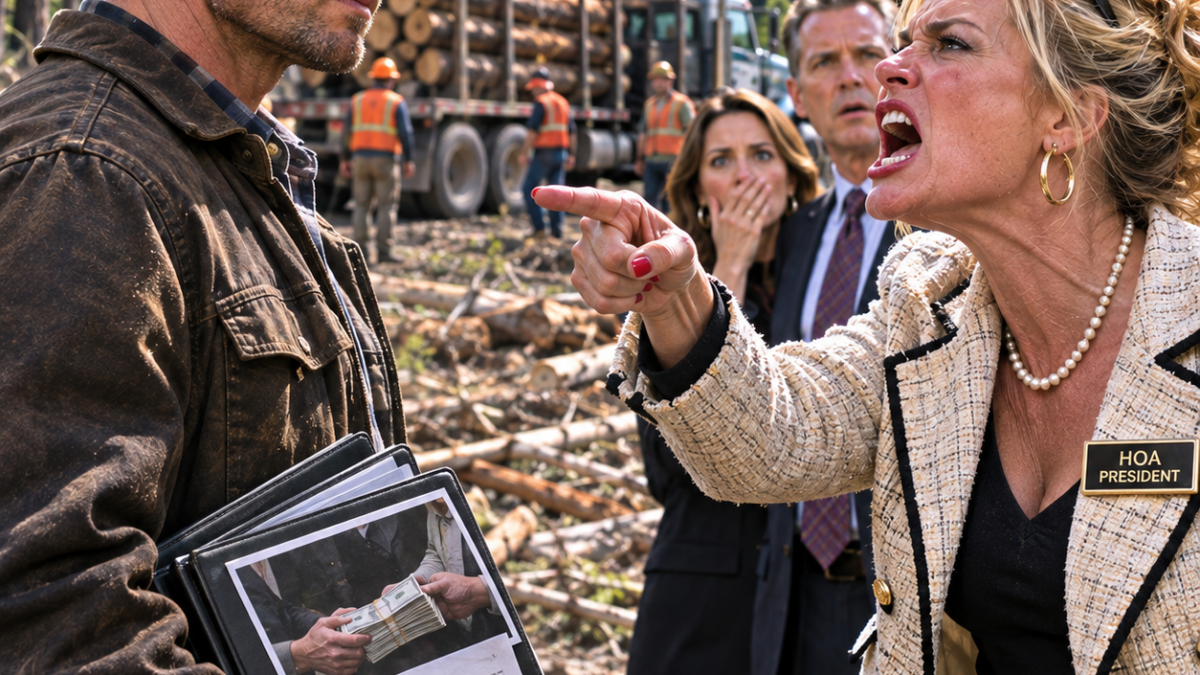
Her voice became sharp enough to carry across the clearing.
“You’re not going to sabotage a legally approved HOA project because you have some sentimental attachment to a few old trees.”
A few old trees.
I stared at her.
“Those oaks took eighty years to grow.”
She rolled her eyes.
“And they’ll grow again. Honestly, this is why people like you shouldn’t be allowed to interfere with community improvements.”
I felt my jaw tighten.
“My land is not part of your community.”
She lifted the document toward me.
“Then explain this.”
It bore the Stonebrook Ridge letterhead.
An official-looking stamp.
A map shaded along the eastern edge of my property.
And signatures supposedly approving the sale.
One belonged to Linda Foster, the HOA secretary.
Something immediately caught my attention.
The shaded strip didn’t follow my recorded boundary.
It reached hundreds of feet into my forest.
Right into the area Sam and I had surveyed for a completely separate, carefully controlled harvest.
I looked toward the loaded truck.
Then I noticed the painted markings on the bark.
Blue.
Not orange.
Sam marked our approved trees in orange and used numbered tags.
Someone had been deliberately marking a different collection of trees.
I looked at Karen.
“Who gave you this map?”
Her expression flickered.
“That’s association business.”
“Who signed the authorization?”
“The board.”
“Where are the recorded property rights?”
She stepped closer.
“You really don’t understand how powerful an HOA can be, do you?”
I folded the paper.
“I understand exactly what you think you can get away with.”
Her face reddened.
“If you stop this operation, I’ll make sure you’re sued for every penny of the delay.”
Behind her, the loader lifted another trunk.
I raised my phone and began photographing the equipment, the license plates, the stumps, and the logs.
Karen lunged toward me.
“PUT THAT PHONE DOWN!”
I didn’t move.
“I’m documenting what you’ve done.”
“You don’t have permission to photograph HOA records!”
I looked directly into her eyes.
“Karen, you’re standing in my forest, selling trees you don’t own.”
Then I called the sheriff.
And for the first time that morning, her smile disappeared.
PART2
Karen tried to grab the document from my hand.
I pulled it away.
“Give that back,” she snapped. “That belongs to Stonebrook Ridge.”
I looked at the photocopy.
“Then the association can explain why its name is on an authorization to cut timber from my property.”
Her jaw tightened.
“You’re making a very expensive mistake.”
I glanced toward the fresh stumps.
“No, Karen.”
I looked back at her.
“Someone already made one.”
The noise of the machinery continued behind us.
I turned toward the crew.
“Shut it down until the property rights are verified.”
The foreman approached.
He was a broad-shouldered man in a faded hard hat, carrying a clipboard covered with work orders.
“I’m Mike Dalton,” he said. “I’m supervising this operation.”
I nodded.
“Daniel Mercer. I own this land.”
Mike looked from me to Karen.
Then back again.
“Sir, we were given a signed authorization.”
“By whom?”
He hesitated.
“Our broker.”
“Did you verify the deed?”
His expression changed.
“We were told the association had management rights over the buffer.”
I pointed toward the nearest stump.
“That tree was nowhere near an HOA-owned parcel.”
Karen folded her arms.
“Don’t let him intimidate you, Mike.”
He ignored her.
“Mr. Mercer, if there’s a genuine ownership dispute, we can pause.”
“There isn’t a dispute,” I said. “There’s a deed, a recorded survey, and an unauthorized crew cutting my hardwood.”
Karen scoffed.
“You can’t simply declare yourself right.”
I stared at her.
“I don’t need to declare it. I can prove it.”
Mike reached for his radio.
“Everybody hold position. Saws off.”
Karen whirled toward him.
“WHAT ARE YOU DOING?”
Mike kept his voice controlled.
“Pausing the operation until this gets sorted out.”
“The HOA approved this!”
“Then somebody can show me the recorded authority.”
For a moment, Karen looked genuinely stunned.
I don’t think she had ever considered the possibility that a contractor might refuse an order she shouted loudly enough.
She stepped toward Mike.
“I will have your company removed from every Stonebrook Ridge project.”
Mike looked at her.
“Ma’am, I’m not putting my crew in the middle of a property dispute with law enforcement coming.”
Karen’s face went crimson.
I almost smiled.
But then I looked toward the timber.
The damage was already done.
And nothing about Mike’s decision could put those trees back into the ground.
The deputy arrived approximately twenty minutes later.
His name was Deputy Harris, a calm, methodical man who seemed unimpressed by Karen’s expensive clothes, the branded folder, or the way she kept saying “association authority” as though it were a magical phrase.
He separated us and began taking statements.
Karen spoke first.
Naturally.
She described the area as a disputed community buffer.
She claimed the HOA had maintained an access corridor for years.
She said the timber sale was part of a fire-safety improvement program.
And she insisted the contractors had relied on documents approved by the board.
I listened.
Every sentence sounded rehearsed.
When Deputy Harris turned toward me, I gave him the facts.
I owned 180 acres.
The eastern boundary was recorded.
Stonebrook Ridge had no authority to harvest my timber.
And the cutting area lay inside my property.
“Do you have the survey?” he asked.
“My forester’s bringing it.”
Karen laughed.
“His personal forester?”
I turned toward her.
“Sam Price. Licensed professional. He’s maintained our forestry records for years.”
Deputy Harris raised a hand.
“Ma’am, I’ll speak to you again if I have questions.”
Karen pressed her lips together.
Sam arrived ten minutes later.
His truck was covered in dust, and he was carrying the thick binder we used for our forest management records.
He got out, looked toward the logging trucks, and stopped.
“Jesus, Daniel.”
I nodded.
“I know.”
He walked past me toward the cut area.
When he saw the stumps, his face changed.
Sam wasn’t an emotional man.
He didn’t raise his voice often.
He was happiest among trees, walking through the woods with a measuring tape, a GPS unit, and a notebook full of observations.
But I’d never seen him look as angry as he did that morning.
He crouched beside a fresh oak stump.
Ran his hand across the exposed wood.
Then looked toward me.
“This wasn’t marked for harvest.”
I shook my head.
“Blue paint.”
He nodded grimly.
“Our approved timber is orange.”
Then he stood.
“Whoever did this had no idea what they were destroying.”
Sam spread the recorded survey over the hood of my truck.
Deputy Harris stood beside him.
Mike approached from the other side.
Karen remained a few feet away, watching with her arms folded.
Sam pointed toward the eastern boundary.
“Here’s the recorded line.”
He followed it with his finger.
“It runs along the old stone drainage ditch, then turns north near the marked white oak.”
Deputy Harris leaned closer.
“And the cut trees?”
Sam pointed toward another section.
“Here. Well inside Mr. Mercer’s property.”
Karen stepped forward.
“That’s an outdated interpretation.”
Sam slowly looked up.
“Excuse me?”
“The HOA has maintained the corridor for years.”
Sam turned toward her.
“Maintaining a corridor doesn’t give an association ownership of the trees beside it.”
Karen’s eyes narrowed.
“You’re not an attorney.”
“No,” Sam replied.
“I’m the person who has mapped this forest for years.”
He pointed toward the survey again.
“And your document doesn’t follow the recorded property line.”
Deputy Harris looked at the two maps side by side.
The difference was obvious.
Karen’s shaded strip pushed deep into my land.
The recorded survey didn’t.
The deputy turned toward Mike.
“Has your company completed any additional verification?”
Mike shook his head.
“We relied on the work order and the seller’s authorization.”
The deputy nodded.
“Then the cutting stops until the property rights and authorization are verified.”
Karen stepped forward.
“You can’t do that!”
Deputy Harris remained calm.
“I’m documenting the complaint. There won’t be any additional cutting under this disputed authorization while the matter is being reviewed.”
Karen stared at him.
Then at Sam.
Then at me.
“You’re all going to regret this.”
I looked toward the machinery.
The engines were shutting down.
One by one, the chainsaws fell silent.
For the first time that morning, I could hear the wind moving through the trees.
I should have felt relieved.
Instead, I stared at the fresh stumps.
And wondered how much of my family’s forest Karen had already sold.
That evening, I received a call from Curtis Hale.
Curtis had been operating in the county for thirty years.
He knew timber.
He knew contracts.
And until that day, I’d considered him a careful businessman.
Months earlier, Sam and I had worked with him on a legitimate selective harvest.
Four hundred mature oak and maple trees.
Each identified.
Each recorded.
Each chosen according to the management plan.
The harvest would be spread across designated compartments, preserving young growth and protecting the creek buffers.
Curtis had walked the forest with us.
He’d inspected the access road.
He’d reviewed the contract.
Everything had been carefully arranged.
So when his name appeared on my phone, I expected him to be furious about the unauthorized crew.
He was.
But not for the reason I expected.
“Daniel,” he said, “what the hell is going on with the eastern corridor?”
I sat down.
“Karen Whitmore sent a crew onto my land.”
He was quiet.
Then he said, “I think we’ve got a serious problem.”
My stomach tightened.
“What kind of problem?”
“I’ve got paperwork in front of me saying the HOA controls harvesting rights along that boundary.”
I closed my eyes.
“Curtis, the HOA doesn’t own those trees.”
He exhaled sharply.
“That’s what I’m trying to understand.”
“Who sent the paperwork?”
“A company called Ridgeway Land Services.”
I frowned.
“I’ve never heard of them.”
“They claimed the HOA had authority over the corridor.”
I felt a cold sensation spread through my chest.
“Curtis.”
“Yeah?”
“How much money changed hands?”
Silence.
Then he answered.
“Seventy-two thousand dollars.”
I sat completely still.
“What?”
“A seventy-two-thousand-dollar advance.”
My mouth went dry.
“For what?”
“To secure the timber rights and reserve the crews.”
I stared at the wall.
“Four hundred trees?”
“Yes.”
I closed my eyes.
Karen hadn’t simply hired a few workers to clear an access road.
She’d arranged a timber sale.
A real financial transaction.
With money already transferred.
And she’d done it using trees that belonged to me.
“Curtis,” I said slowly, “I never authorized that sale.”
He didn’t answer.
I continued.
“You walked my forest. You know my harvest plan. You know which trees Sam marked.”
“I know.”
“Then why the hell did you pay a company claiming to sell timber from that boundary without calling me?”
He exhaled.
“Because they represented it as a separate corridor-rights transaction. I thought the association had an existing agreement.”
I shook my head.
“You should have verified it.”
“I know.”
There was no defensiveness in his voice now.
Only the realization that he’d made an expensive mistake.
I looked toward the window.
Outside, the woods were dark.
“Curtis, stop everything connected to Ridgeway.”
“Already done.”
“Preserve every email.”
“I will.”
“Every work order. Every payment record. Every authorization.”
“Daniel—”
“And send me copies of all of it.”
He was quiet.
Then he said, “You have my word.”
I closed my eyes.
“Good.”
When the call ended, I sat in silence.
Seventy-two thousand dollars.
Four hundred trees.
A forged-looking HOA document.
And a woman who had spent the morning threatening to sue me for stopping the destruction.
I realized then that Karen hadn’t merely crossed a property line.
She’d created an entire paper trail to make stealing from me look legal.
And somewhere along that trail was the answer to why.
I barely slept that night.
Every time I closed my eyes, I saw those oak trunks stacked on the trailers.
The pale wood.
The torn bark.
The blue paint.
I thought about the trees my grandfather had walked beneath long before I was born.
I thought about the years Sam and I had spent developing a sustainable management plan.
And I thought about how easily a woman with a folder and an arrogant smile had convinced strangers to destroy something she didn’t own.
Just after sunrise, Sam arrived.
I was standing outside my truck with a thermos of coffee.
He stepped out carrying his tablet and a fresh notebook.
“Ready?”
I nodded.
“Let’s see what she did.”
We walked the eastern compartment.
The silence was difficult.
Yesterday, the area had been filled with machinery.
Now the equipment stood motionless behind the temporary work boundary.
But the destruction was everywhere.
Deep tire tracks cut through wet ground.
Broken branches hung from damaged saplings.
Chunks of bark littered the road.
And the stumps appeared one after another.
Sam stopped at the first one.
He recorded its location.
Measured the diameter.
Identified the species.
Then photographed it from several angles.
We continued.
Ten stumps.
Twenty.
Thirty.
By the time we reached forty, I felt physically ill.
Sam remained methodical.
It was one of the things I admired about him.
When something mattered, he didn’t become careless simply because he was angry.
He made certain the evidence could survive scrutiny.
At the sixty-third stump, he stopped.
Beyond it, the standing trees continued up the slope.
He checked the map.
Then looked at me.
“Sixty-three.”
I stared at him.
“Sixty-three trees?”
“That’s the count in this cut area.”
I looked toward the damaged slope.
Some of those trees had been mature oaks.
Others were maples.
Several had stood for generations.
And the cutting hadn’t followed any recognizable forestry plan.
“Karen said she sold four hundred.”
Sam nodded.
“Fortunately, they hadn’t cut that many.”
I let out a shaky breath.
Then looked toward the broken saplings crushed beneath a fallen trunk.
“But the damage isn’t limited to the stumps.”
“No.”
Sam pointed toward the ground.
“Look at those ruts. They’ll need repair. And this young growth was damaged when the loader dragged those logs out.”
He crouched beside a small broken tree.
“This wasn’t scheduled for harvest.”
I watched him touch the splintered trunk.
“Can it recover?”
He shook his head.
“Not this one.”
I looked away.
Sam stood.
“We need a complete assessment. Timber value by species, grade, and market conditions. Damage to the remaining trees. Soil disturbance. Access-road repairs. Restoration needs.”
I nodded.
“Whatever it takes.”
He looked at me.
“Daniel, I know you’re angry.”
I laughed bitterly.
“Angry?”
My voice cracked.
“Sam, someone came onto my land, cut down sixty-three trees, damaged the younger forest, and tried to sell hundreds more.”
He was quiet.
I looked toward the stumps.
“And she smiled while she did it.”
Sam stepped closer.
“Then don’t give her another advantage by doing something reckless.”
I turned toward him.
He held up the tablet.
“Let the evidence speak.”
I swallowed.
Then nodded.
He was right.
Karen wanted a shouting match.
She wanted me furious enough to say something she could use against me.
She wanted the argument to become about my behavior instead of what she’d done.
I wasn’t going to give her that.
That afternoon, I called Rachel Boone.
Rachel was a property attorney who had helped me resolve an easement issue several years earlier.
She was smart, direct, and almost impossible to intimidate.
When I explained the situation, she let me speak without interruption.
I told her about the logging trucks.
The HOA authorization.
The false-looking map.
Linda Foster’s supposed signature.
The sixty-three stumps.
And Curtis Hale’s seventy-two-thousand-dollar advance to Ridgeway Land Services.
When I finished, Rachel was silent for a moment.
Then she asked, “Have you threatened Karen?”
I frowned.
“What?”
“Have you threatened her personally?”
“No.”
“Have you posted anything about her online?”
“No.”
“Have you allowed anyone to remove the timber?”
“No.”
“Good.”
I leaned back.
“Rachel, she stole my trees.”
“Then we’re going to treat this as a serious property and financial matter, not a neighborhood argument.”
My jaw tightened.
“She’s calling it a buffer dispute.”
“Of course she is.”
Rachel’s voice sharpened.
“That’s exactly why I don’t want you getting into a public shouting contest.”
I looked toward the window.
“She thinks she can get away with anything.”
“Maybe she’s gotten used to people backing down.”
Rachel paused.
“But contracts, surveys, financial records, and authentic signatures don’t change because somebody raises her voice.”
I let out a slow breath.
“What do we do?”
“We preserve everything.”
She began giving me instructions.
Certified copies of the deed.
The recorded survey.
The forest management plan.
The legitimate harvesting contract.
The photographs Sam had taken.
The sheriff’s report.
The documents Curtis received.
Every message from Karen or the HOA.
Every invoice connected to the unauthorized work.
“We’ll send preservation notices,” Rachel said. “And we’ll request the original HOA records rather than relying on photocopies.”
I rubbed my forehead.
“What about the seventy-two thousand?”
“We follow the money through lawful discovery and the investigation.”
I stared at the desk.
“Can we stop her from moving it?”
“We can ask for appropriate relief if the evidence and circumstances support it. But we need to know where it went before we make claims.”
I nodded.
Rachel paused.
“One more thing, Daniel.”
“Yeah?”
“If Karen contacts you, don’t get pulled into another argument.”
I almost laughed.
“That might be difficult.”
“I know.”
Her voice softened slightly.
“But right now, she thinks the person who sounds most confident will win.”
I looked at the photograph of the logging truck on my phone.
Rachel continued.
“Let’s show her what happens when someone asks for proof.”
The first preservation letters went out the next day.
Rachel sent them to Stonebrook Ridge.
Ridgeway Land Services.
Curtis’s company.
And the logging contractor.
The letters instructed the recipients to preserve records relevant to the timber transaction and unauthorized cutting.
Contracts.
Emails.
Messages.
Invoices.
Financial documents.
Work orders.
Maps.
Board minutes.
And any other materials connected to the supposed authority to harvest my trees.
Karen responded almost immediately.
Not through a lawyer.
Not through the HOA’s official process.
She called me.
I let it go to voicemail.
Then she called again.
And again.
On the fourth attempt, she left a message.
“Daniel, this has become completely ridiculous. The board made a legitimate decision, and your attorney is trying to intimidate everyone involved. If you would stop acting like a spoiled child and come to the clubhouse, we could settle this like adults.”
I listened twice.
Then forwarded the recording to Rachel.
She replied with a short message.
Preserve it. Do not respond.
I looked at the screen.
For a moment, I felt the familiar urge to defend myself.
To call Karen and explain, one more time, that the land belonged to me.
To remind her that she had no authority to cut my trees.
Then I stopped.
I’d spent years dealing with people who believed persistence could eventually become permission.
Karen was one of them.
She had asked me to trim the trees along my access lane because she didn’t like how enclosed the entrance looked.
I’d refused.
She’d asked me to move my gate because she wanted a cleaner view toward the development.
I’d refused again.
Each time, she smiled.
Each time, she talked about community standards.
Each time, she acted as though my answer was merely a temporary inconvenience.
Now I was beginning to understand that Karen hadn’t accepted my boundaries.
She’d simply found another way to cross them.
Two days later, Curtis sent the file.
I opened the documents in Rachel’s office.
Sam joined us, carrying his forestry records.
The conference table quickly disappeared beneath maps, printed emails, contracts, and spreadsheets.
Rachel placed the Ridgeway agreement in front of me.
“Start here.”
I read the heading.
TIMBER ACQUISITION AGREEMENT
The seller was Ridgeway Land Services.
The property description referred to standing hardwood within the Stonebrook Ridge Community Management Boundary.
The agreement listed four hundred trees.
I stared at it.
“That’s the same number as our legitimate harvest.”
Sam nodded.
“I noticed.”
Rachel turned another page.
A map showed the supposed community corridor.
It was the same inaccurate shaded strip Karen had waved in my face.
The agreement claimed the HOA possessed rights through a historic access arrangement.
But the actual recorded document proving those rights wasn’t attached.
I looked at Rachel.
“Where’s the easement?”
“Exactly.”
She slid another page toward me.
“There’s a reference to it. No recording information. No copy. No legal opinion confirming it exists.”
Sam shook his head.
“A professional timber buyer should have asked for that.”
I looked toward Curtis, who had joined us by phone.
“Why didn’t you?”
His answer came after a pause.
“I should have.”
I stared at the speakerphone.
He continued.
“The seller represented it as an HOA-controlled corridor separate from your managed harvest. Karen said the association had already received legal confirmation.”
Rachel looked at the document.
“Did she give you that legal opinion?”
“No.”
“Did she give you the recorded agreement?”
“She sent a summary.”
Rachel raised an eyebrow.
“A summary prepared by whom?”
“Ridgeway.”
Rachel leaned back.
“Not title evidence.”
Curtis sighed.
“I understand that now.”
I felt anger rising.
“Curtis, those trees were worth more than a line on someone’s sales pitch.”
“I know, Daniel.”
His voice sounded exhausted.
“I know.”
Rachel held up one hand.
“Let’s focus on the records.”
She turned to the next page.
The seventy-two-thousand-dollar advance had been transferred to an account designated by Ridgeway Land Services.
I stared at the payment confirmation.
“Who owns Ridgeway?”
Rachel’s expression changed.
“That’s what we’re investigating.”
The public business records were the first real crack in Karen’s story.
Ridgeway Land Services had been formed only seven months earlier.
Seven months.
Yet Karen’s paperwork described it as though it had been managing land and timber transactions for years.
The mailing address wasn’t a forestry office.
It was a private mailbox at a shipping store.
The listed manager was a man named Eric Whitcomb.
Neither Sam nor I recognized the name.
Curtis couldn’t explain how he fit into Stonebrook Ridge.
Rachel studied the filing.
“Interesting.”
I looked at her.
“What?”
“The contact information.”
She pointed toward a telephone number.
“This number matches one Karen used on an older HOA vendor form.”
I stared at it.
“You’re saying she’s connected to Ridgeway?”
“I’m saying the records provide a reason to investigate that connection.”
I leaned forward.
“Could she own the company?”
“Possibly. But we aren’t going to guess.”
Rachel looked at me.
“We document what can be established.”
I nodded.
Then she turned to another file.
“There’s also a consulting company called Whitmore Community Strategies.”
I frowned.
“Whitmore?”
“Karen’s company.”
I stared at her.
“What does it do?”
Rachel glanced at the available invoices.
“Apparently, it provides community planning and strategy services.”
“Apparently?”
“The descriptions are vague. We’re going to need supporting records.”
I looked toward Sam.
He was staring at the documents.
Then he looked at me.
“Daniel, this wasn’t about clearing a firebreak.”
I shook my head.
“No.”
My voice grew quiet.
“It was about getting paid.”
Rachel initially found the consulting company’s connection through HOA vendor records and the documents available from the timber transaction.
Later, as investigators obtained authorized financial records, the picture became much clearer.
The seventy-two-thousand-dollar advance hadn’t simply remained in Ridgeway’s account.
Portions had been moved to other accounts.
One connected to a vendor with no documented services.
Another to Whitmore Community Strategies.
And a smaller payment eventually reached a personal credit balance linked to Karen.
The details emerged gradually.
But even the early evidence was alarming.
I remember sitting across from Rachel when she first explained what had been confirmed.
“You need to understand something,” she said.
I looked at her.
“We’re still reviewing the transaction. The financial connections are significant, but we don’t want to claim more than the evidence proves.”
I nodded.
She continued.
“However, this no longer looks like an ordinary mistake about a property boundary.”
I stared at the copied authorization.
The shaded map.
The supposed board approval.
The letterhead.
Everything had been assembled to look official.
Every piece was designed to make someone believe Karen had authority.
And when the money moved, it hadn’t gone to me.
Or to Sam.
Or to the people responsible for the actual forest management plan.
It had gone through a company I had never heard of.
I looked toward Rachel.
“She knew.”
Rachel paused.
“We need evidence of what she knew and when.”
I leaned back.
Then I remembered something.
“The gate.”
Rachel frowned.
“What?”
“Karen asked me to move my gate months ago.”
“So?”
“She stood near that same boundary.”
I could picture her cream-colored jacket.
Her expensive sunglasses.
The way she pointed toward the trees and spoke as though my forest were an ugly landscaping problem she was entitled to correct.
“She knew the ditch marked the line,” I said. “I explained it to her.”
Rachel leaned forward.
“Did anyone witness that conversation?”
“Sam was nearby for part of it.”
She made a note.
“Tell me exactly what happened.”
I took a breath.
And began remembering a morning I hadn’t thought important at the time.
Karen had arrived at my gate on a clear spring day, months before the logging trucks appeared.
I’d been inspecting the eastern access road.
Sam was checking some boundary markers nearby.
Karen pulled up in a white SUV, stepped out wearing expensive sunglasses, and approached without greeting me.
“Daniel, we need to talk about this entrance.”
I looked toward the gate.
“What’s wrong with it?”
“It looks industrial.”
I blinked.
“It’s a forestry access gate.”
“Exactly.”
She folded her arms.
“Stonebrook Ridge is an upscale community. We have standards.”
I looked past her toward the development.
Large homes.
Neatly maintained lawns.
A landscaped stone entrance.
Then I looked back at my gate.
“And?”
“The association would like you to move it farther back.”
I laughed.
“Why?”
“Because the current location creates an unattractive visual barrier.”
I stared at her.
“Karen, it’s on my land.”
She smiled.
“That’s a narrow interpretation.”
I remember feeling irritated.
Not alarmed.
Just tired of the way she spoke.
“The property line runs along the drainage ditch,” I said, pointing toward the trees.
She looked in that direction.
“The HOA uses that corridor.”
“Using a route doesn’t make you the owner.”
She lifted her chin.
“We’ve been maintaining portions of the area.”
I shook my head.
“Then you need to stop entering beyond any lawful access rights.”
Her smile disappeared.
“Daniel, you’re being difficult.”
I turned toward the gate.
“No. I’m being clear.”
She stepped closer.
“We’ll have to revisit this formally.”
I shrugged.
“Bring a recorded document showing what rights you claim.”
She said nothing.
Then returned to her SUV.
At the time, I’d assumed it was just another attempt to pressure me into changing something she didn’t like.
Now I understood why that conversation mattered.
She had stood near the boundary.
She had been shown where my land began.
And months later, she presented a map that moved that line hundreds of feet into my forest.
I couldn’t prove the entire scheme from that conversation alone.
But it gave Rachel another piece to investigate.
And Karen’s claim that she simply misunderstood the boundary was beginning to sound less believable with every document we found.
Stonebrook Ridge began sending letters.
The first described the situation as an unfortunate confusion regarding shared corridor use.
The second said the association had acted in good faith.
The third invited me to a special board meeting to resolve the matter constructively.
I read that phrase aloud in Rachel’s office.
“Resolve the matter constructively.”
She laughed once.
Without humor.
“They want you to discuss a timber sale as though it’s a disagreement over driveway maintenance.”
I set the letter down.
“Should I go?”
Rachel thought for a moment.
“Yes.”
I stared at her.
“Really?”
“With conditions.”
She began outlining them.
We would request the meeting materials in advance.
We would arrange for a proper record of the proceedings.
We would present the ownership evidence without making unsupported accusations.
And we would make clear that any discussion at the meeting did not replace the ongoing investigation or potential legal claims.
I nodded.
“Fine.”
Rachel looked at me.
“One more thing.”
“What?”
“Karen may try to provoke you.”
I smiled bitterly.
“She’s been doing that for years.”
“Then let her.”
Rachel leaned forward.
“Your strongest argument isn’t that she’s unpleasant.”
I looked at her.
“It’s that she didn’t have the right to sell your property.”
I nodded.
“And we can prove it.”
The meeting packet arrived the afternoon before the scheduled gathering.
Rachel called me immediately.
“Daniel, come to my office.”
Something in her voice made me stop what I was doing.
“What’s wrong?”
“I want you to see something.”
I drove straight there.
When I entered, she was standing beside the conference table.
A document lay in front of her.
Stonebrook Ridge letterhead.
A formal resolution.
A date nearly three weeks before the unauthorized cutting began.
And five board members’ names listed beneath a claim of unanimous approval.
I read the title.
RESOLUTION AUTHORIZING LIMITED FOREST MANAGEMENT ACTIVITY WITHIN THE EASTERN COMMUNITY BUFFER
My stomach tightened.
“There it is.”
Rachel nodded.
“Supposedly.”
I looked at her.
“What do you mean?”
She handed me another set of papers.
“The actual minutes from that board meeting.”
I read them.
Landscaping.
Road maintenance.
Entrance signage.
Routine vendor discussions.
Nothing about timber sales.
Nothing about four hundred trees.
Nothing about Ridgeway Land Services.
Nothing about selling hardwood from my property.
I looked up.
“There’s no vote.”
Rachel shook her head.
“No.”
I looked back at the resolution.
“But this says unanimous.”
“Yes.”
“Five board members.”
“Yes.”
I stared at her.
“Then what the hell is it?”
Rachel’s eyes narrowed.
“That’s what Karen is going to have to explain.”
The most damaging part of the meeting packet wasn’t what it said.
It was what the original records said it didn’t contain.
Rachel laid the two documents side by side.
On the left was the supposed board resolution.
On the right were the actual meeting minutes.
Same date.
Same association.
Completely different account of what had happened.
I stared at the paper.
“Karen couldn’t have made this without knowing the board never voted.”
Rachel leaned back.
“We need to determine who prepared it. But yes, the discrepancy is serious.”
I pointed toward Linda Foster’s name.
“What about Linda?”
“I’m arranging to speak with her.”
I remembered the secretary.
Linda was sixty-three, quiet, and meticulous.
She wasn’t the kind of person who enjoyed confrontation.
At the few community meetings I’d attended, she usually sat near the end of the table taking notes while Karen dominated every conversation.
I’d never seen Linda publicly challenge the HOA president.
But I’d also never seen her pretend to know something she didn’t.
Rachel called her later that day.
I wasn’t present for the entire conversation.
But the result was enough to change the course of everything.
Linda agreed to meet.
And she brought documents Karen had apparently never expected anyone outside the board to read.
Linda arrived at Rachel’s office looking frightened.
She carried a canvas bag filled with folders and an envelope containing printed emails.
Her hands shook slightly as she sat down.
Rachel offered her water.
Linda thanked her.
Then looked toward me.
“Mr. Mercer, I’m very sorry about your trees.”
I studied her face.
“Did you approve the sale?”
She looked horrified.
“No.”
“Did you sign the authorization Karen showed the contractor?”
“No.”
“Did the board vote to sell timber from my property?”
She shook her head.
“Absolutely not.”
I felt my stomach tighten.
Linda looked toward Rachel.
“I’ve been trying to get answers for months.”
Rachel leaned forward.
“Tell us.”
Linda opened her bag.
“Karen began presenting unusual vendor payments earlier this year.”
“What kind?” Rachel asked.
“Planning services. Community strategy. Special consulting projects.”
I looked at her.
“Whitmore Community Strategies?”
Linda nodded.
“Yes.”
Rachel made a note.
Linda continued.
“The invoices were vague. Sometimes there were no hours listed. Sometimes no clear description of the work.”
“Did you ask questions?”
“Repeatedly.”
Her voice grew stronger.
“I asked for contracts. Deliverables. Meeting minutes authorizing the expenses.”
I leaned forward.
“And Karen?”
Linda looked down.
“She said I was obstructing progress.”
I almost laughed.
It was exactly what Karen had told me.
Linda continued.
“She said the board had already discussed the strategic direction and that the details were administrative.”
Rachel frowned.
“Did the board approve the specific payments?”
“Not all of them. At least, I never found records showing that it had.”
She reached into the envelope.
Then removed an email dated two days before the logging trucks entered my forest.
I leaned forward.
Linda placed it on the table.
Her message to Karen was direct.
I cannot approve a sale of trees on land we do not own. Please provide the recorded agreement and legal opinion before any contract is signed.
I read it twice.
My heart began pounding.
“She knew.”
Rachel looked toward me.
“Daniel—”
“She was told.”
Linda nodded slowly.
“Yes.”
I looked at her.
“And what did she say?”
Linda removed another page.
Karen’s reply was printed beneath the original message.
The board has already authorized the operational decision. Please do not delay the project with unnecessary objections.
I stared at those words.
They were so familiar.
So arrogant.
So perfectly Karen.
No explanation.
No recorded agreement.
No proof.
Just a declaration that the decision had already been made and anyone asking questions was causing trouble.
I leaned back.
“She didn’t even answer you.”
Linda shook her head.
“No.”
“Did you sign anything after that?”
“Absolutely not.”
Rachel turned toward her.
“Would you be willing to provide a sworn statement?”
Linda’s face grew pale.
For a moment, she looked frightened again.
Then she straightened her back.
“Yes.”
I studied her.
“Are you sure?”
She looked at me.
“I should have insisted on a full review sooner.”
I shook my head.
“You asked for proof.”
She looked down.
“You refused to approve the sale.”
Her eyes filled.
“I did.”
I leaned forward.
“Then you did something Karen didn’t expect.”
Linda looked up.
“You told her no.”
For the first time since entering the office, she smiled faintly.
And I realized Karen’s entire scheme depended on people like Linda feeling too intimidated to keep asking questions.
That was about to end.
The special board meeting took place on a rainy Thursday evening.
The Stonebrook Ridge clubhouse was filled before the scheduled start.
Residents crowded into folding chairs.
Some stood along the walls.
Others gathered near the back holding copies of the association’s recent letters.
I recognized a few faces.
People who had waved at me while walking near the forest entrance.
People who had complained about Karen’s strict interpretation of neighborhood rules.
People who had apparently been told that the timber sale was an ordinary safety project.
Now they wanted answers.
Karen sat at the front table.
Her hair was perfectly arranged.
Her jacket was expensive.
Her expression was composed.
Beside her sat two board members and an attorney hired by the association.
She looked as though she expected to control the room the same way she’d controlled the logging crew.
When Rachel and I entered, Karen’s eyes narrowed.
She leaned toward the person beside her and whispered something.
I couldn’t hear it.
But I saw the familiar smile.
The one she used whenever she believed someone was about to embarrass himself.
Rachel touched my arm.
“Remember what we discussed.”
I nodded.
“Facts.”
“Exactly.”
We took our seats.
Sam sat nearby with the forestry records.
Linda was a few chairs away.
She looked nervous.
But when I caught her eye, she gave a small nod.
The meeting began.
Karen stood.
“Good evening, everyone.”
Her voice was smooth.
“I appreciate the community coming together to address a very unfortunate misunderstanding.”
I felt my jaw tighten.
Misunderstanding.
Sixty-three stumps.
Seventy-two thousand dollars.
A document carrying a signature the supposed signer denied making.
And Karen wanted to call it a misunderstanding.
She continued.
“The association has always acted in the best interests of Stonebrook Ridge. Our intention was to improve the eastern corridor, reduce fire risks, and ensure that the surrounding landscape is properly maintained.”
Someone near the back muttered, “By selling trees?”
Karen ignored the comment.
“Unfortunately, an outside landowner has chosen to challenge a project that was undertaken in good faith.”
I stared at her.
Outside landowner.
That was what she called me.
As though my family-owned forest were an inconvenience that had appeared beside her subdivision without permission.
Karen continued.
“We hope tonight’s conversation will correct the misinformation and allow us to move forward peacefully.”
Rachel leaned toward me.
“Let her finish.”
I nodded.
Karen spoke for another five minutes.
She described administrative confusion.
Different interpretations of the community buffer.
Contractor errors.
Historic access practices.
What she didn’t mention was the seventy-two-thousand-dollar payment.
Or the fact that no recorded agreement had been produced.
Or Linda’s refusal to sign.
Or the discrepancy between the supposed resolution and the actual minutes.
When she finally sat down, the chair recognized us.
Rachel stood.
“Thank you.”
She placed the certified deed on the table.
Then the survey.
Then the property map.
Then the photographs.
The room grew quiet.
“Before anyone discusses whether a project was desirable,” Rachel said, “we need to establish whether the HOA possessed the authority to perform it.”
She turned toward me.
“Daniel.”
I stood.
And for the first time, Karen looked uncertain.
I didn’t shout.
That was the hardest part.
Every part of me wanted to point at Karen and tell the room exactly what I thought of her.
But Rachel had been right.
Anger wasn’t proof.
So I began with the deed.
“This is the recorded ownership document for my 180-acre property.”
I placed it where the board could see.
“This is the certified survey showing the eastern boundary.”
Then I laid Karen’s shaded map beside it.
The difference was obvious.
The HOA map reached deep into my land.
The recorded survey did not.
A man in the second row raised his hand.
“Why does the HOA map show land outside the boundary?”
Karen immediately leaned toward her microphone.
“It was prepared for operational purposes.”
I looked at her.
“Operational purposes don’t change property ownership.”
A few residents murmured.
Karen’s expression tightened.
I continued.
“My forester and I had a legitimate selective harvest planned for four hundred marked trees.”
I held up the original forestry map.
“Those trees were inventoried, tagged, and selected under a management plan.”
Sam stepped forward.
He explained our system.
Orange paint.
Numbered tags.
Protected buffers.
Planned harvest cycles.
The difference between carefully selecting mature trees and cutting indiscriminately through young growth.
Then he displayed the photographs.
The first showed a fresh stump.
The second showed a felled oak beside a blue paint mark.
The third showed damaged saplings beneath a fallen trunk.
The fourth showed deep loader tracks cutting through wet ground.
Sam looked toward the residents.
“Those sixty-three stumps were not part of the approved cutting plan for that location.”
The room fell silent.
He continued.
“Some of these trees had stood for approximately eighty years. The damage includes more than the commercial timber removed. Younger trees were destroyed or injured, and the access track requires restoration.”
A woman near the back whispered, “My God.”
I looked toward Karen.
She sat motionless.
Then she leaned toward her attorney.
I couldn’t hear what she said.
But I saw her face.
For the first time, the woman who’d threatened to ruin me financially was realizing that the people she’d claimed to represent were looking at the damage instead of listening to her excuses.
Rachel turned toward Linda.
“Mrs. Foster, would you explain your role as secretary?”
Linda stood slowly.
Her hands were trembling.
She held several pages.
I could see how difficult it was for her.
Karen stared at her.
“Linda,” she said sharply, “I don’t think this is necessary.”
Rachel looked toward the meeting chair.
“Mrs. Foster has information directly relevant to the purported authorization.”
The chair nodded.
“Let her speak.”
Karen pressed her lips together.
Linda took a breath.
“My name is Linda Foster. I’ve served as secretary of Stonebrook Ridge for several years.”
She looked toward the papers.
“I did not sign the timber-sale authorization.”
A wave of murmurs moved through the room.
Karen leaned forward.
“Linda, you’re confused about the administrative process.”
Linda stopped reading.
Then looked directly at her.
“No, Karen.”
The room went quiet.
I had never heard Linda speak to her that way.
Linda continued.
“I know what I signed.”
Karen’s face hardened.
“And I know what I refused to sign.”
A resident near the front leaned forward.
Linda held up the email.
“Two days before the logging trucks arrived, I told Karen I could not approve a sale of trees from land the association did not own.”
Karen opened her mouth.
Linda kept speaking.
“I requested a recorded agreement and a legal opinion.”
She looked toward the front table.
“Neither was provided.”
A murmur moved across the room.
Linda continued.
“Karen replied that the board had already authorized the operational decision.”
She held up the actual meeting minutes.
“But no such vote appears in our records.”
Karen stood abruptly.
“THIS IS A COMPLETE MISREPRESENTATION!”
Linda didn’t sit down.
For a moment, the two women stared at each other.
Then Linda said something I’ll never forget.
“You told me not to delay the project with unnecessary objections.”
Karen’s jaw tightened.
Linda’s voice trembled.
“I asked you for proof because I knew the land wasn’t ours.”
Silence.
“And you never showed me any proof.”
Karen looked toward her attorney.
For once, the attorney didn’t rush to defend her.
Linda lowered the paper.
“Because there was no agreement to show.”
The room erupted.
Several residents began talking at once.
Someone demanded to see the original resolution.
Another asked why the contractor hadn’t verified the property line.
A third wanted to know whether association money had been used.
The meeting chair called for order.
Karen remained standing.
Her face was pale beneath her makeup.
I watched her grip the edge of the table.
And I realized something.
Karen had spent years making people feel small when they asked questions.
Now an entire room was asking questions she couldn’t silence.
Rachel waited until the room settled.
Then she introduced the seventy-two-thousand-dollar advance.
Karen’s head snapped toward her.
“This is an ongoing matter,” Rachel said carefully. “We’re not asking the residents to draw conclusions beyond what the documented records support.”
She placed the payment information on the table.
“But a timber buyer transferred seventy-two thousand dollars to Ridgeway Land Services in connection with the disputed sale.”
A man near the back stood.
“Who is Ridgeway?”
Rachel looked toward him.
“That’s an important question.”
She explained the company’s recent formation and the lack of documentation showing that Stonebrook Ridge had formally engaged it through the normal vendor process.
Then she identified the recorded connection between Ridgeway’s contact information and an older HOA vendor form associated with Karen.
Karen stood again.
“This is character assassination!”
Rachel remained calm.
“The records speak for themselves.”
“You’re making allegations without understanding the association’s finances!”
Rachel turned toward her.
“Then the association should authorize an independent review.”
Karen went silent.
Alan Brooks, a retired accountant serving on the board, leaned toward his microphone.
“Karen.”
She looked at him.
“Did the full board vote to authorize a timber sale?”
She lifted her chin.
“The board approved the management direction.”
Alan frowned.
“That isn’t what I asked.”
Karen folded her arms.
He continued.
“Did we vote to sell four hundred trees from property outside our recorded boundary?”
She hesitated.
“Operational details were delegated.”
Another board member, Ellen, opened the meeting minutes.
“There’s no vote here.”
Karen looked toward her.
Ellen continued.
“No timber contract. No authorization to sell private timber. No approval of Ridgeway as a vendor.”
She raised her eyes.
“Why was the payment made to a company we never hired?”
For a moment, Karen simply stared.
Then she said, “These administrative matters are more complex than you understand.”
I almost laughed.
There it was again.
The arrogance.
The assumption that everyone questioning her was too foolish to comprehend her authority.
Alan leaned forward.
“Karen, I’ve been an accountant for thirty-four years.”
A few residents began laughing nervously.
He continued.
“I understand the difference between an approved payment and an unauthorized one.”
Karen’s face reddened.
“You’re undermining the board.”
“No,” Alan replied.
“I’m asking where the money went.”
The room fell silent.
And for the first time, Karen looked truly frightened.
The HOA’s attorney finally spoke.
He had remained quiet through much of the discussion.
Now he leaned toward the microphone.
“Given the documents presented and the questions concerning authorization, I recommend that the association make no further substantive representations about the disputed timber transaction until an independent review has been completed.”
Karen turned sharply toward him.
“What?”
He didn’t look at her.
“The association needs to verify the records and its legal position.”
Karen’s expression changed from shock to anger.
“I am the president.”
The attorney nodded.
“Yes.”
“Then I expect you to support the board’s decision.”
He remained calm.
“My responsibility is to advise the association.”
A whisper moved across the room.
He continued.
“And the association must act based on verified authority and accurate records.”
Karen looked toward the residents.
Several were staring directly at her.
No smiles.
No polite nods.
No willingness to accept vague explanations.
She pushed back her chair.
“This entire meeting has been manipulated by people with personal agendas.”
A resident stood.
“Then show us the contract!”
Another called out, “Where’s the board vote?”
Someone near the back shouted, “Why was the money sent to Ridgeway?”
Karen lifted both hands.
“This is a politically motivated attack!”
I looked at her.
Then toward the photographs of my forest.
Sixty-three stumps.
Broken young trees.
A ruined access track.
I stood.
The room quieted slightly.
“Karen,” I said.
She glared at me.
“This isn’t about politics.”
I pointed toward the survey.
“The land is mine.”
Then toward the meeting minutes.
“The board never authorized the sale.”
Then toward Linda.
“She never signed the document.”
I took a breath.
“And until someone can show a recorded right to sell those trees, everything else is an excuse.”
Karen stared at me.
I continued.
“You stood in my forest and told me I was too late.”
Her expression hardened.
“You told me the deal was done.”
I paused.
“You told the workers to keep cutting even after I challenged your authority.”
The room was silent.
I looked directly at her.
“Now I’m asking you the same question I asked that morning.”
She said nothing.
“Who gave you the right?”
For the first time since I’d known her, Karen Whitmore had no answer.
The meeting ended without any resolution supporting Karen.
The board agreed to arrange an independent review.
Several members demanded preservation of records.
Residents insisted on seeing actual contracts, not summaries.
And the association’s attorney advised against further action on my land.
Karen refused to step aside voluntarily.
She called the questions unfair.
She accused the board of betrayal.
She claimed outside interests were attempting to undermine neighborhood safety.
But as people began leaving the clubhouse, nobody seemed interested in following her.
Outside, rain tapped against the pavement.
Linda caught up with me near my truck.
“Daniel.”
I turned.
She stood beneath a small umbrella, holding her folders against her chest.
“I’m sorry.”
I frowned.
“For what?”
She looked down.
“I knew something wasn’t right with those consulting invoices.”
I waited.
“I kept asking questions, but Karen always made me feel like I was holding everybody back.”
I sighed.
“That’s what she does.”
Linda looked toward the clubhouse.
“I should have pushed harder.”
I stepped closer.
“Linda, you asked for the records.”
She nodded.
“You refused to approve the sale.”
Her eyes filled.
“You preserved the email.”
I looked directly at her.
“That matters.”
She swallowed.
“But the trees…”
I glanced toward the dark road leading back to my property.
“I know.”
For a moment, neither of us spoke.
Then I said, “Karen counted on everyone being too embarrassed to keep asking questions.”
Linda nodded slowly.
I looked toward the clubhouse.
“Tonight, people finally stopped being embarrassed.”
She gave a sad smile.
Then whispered, “I hope it’s enough.”
I looked toward the rain.
“So do I.”
But the investigation was only beginning.
Karen didn’t disappear quietly.
If anything, she became louder.
Three days after the meeting, Stonebrook Ridge residents received a newsletter accusing outside landowners of obstructing necessary fire-prevention work.
It referred to the controversy as a misunderstanding created by people unfamiliar with the association’s historical responsibilities.
It complained about delays.
It mentioned possible financial harm to the community.
And it implied that I was refusing to cooperate with reasonable safety measures.
What it didn’t mention was the seventy-two-thousand-dollar advance.
Or Ridgeway Land Services.
Or Linda’s disputed signature.
Or the lack of a board vote.
I read the newsletter standing in Rachel’s office.
Then I set it down.
“She’s still doing it.”
Rachel nodded.
“She wants to control the story before the records are fully reviewed.”
I looked at her.
“Should we respond?”
“Yes,” she said. “But through accurate information and the appropriate legal channels.”
She opened another file.
“The association’s independent review is moving forward. We shouldn’t turn this into a public argument when investigators are already examining the underlying transaction.”
I nodded.
But I was frustrated.
Every day that passed, I could still see the damage from my kitchen window.
The trucks were gone.
The saws were silent.
But the stumps remained.
And Karen was still telling people she’d acted to protect their neighborhood.
The investigation took longer than I wanted.
Weeks passed while records were collected and compared.
Curtis provided his files.
Mike Dalton and the logging crew explained the work order they’d received.
Linda supplied her original emails and the association’s authentic meeting records.
Investigators examined the disputed authorization and compared the signature against verified examples.
The association preserved emails, invoices, and other materials relevant to the transaction.
Rachel kept me updated, but she was careful about what she said.
“Daniel, don’t mistake a quiet week for a week when nothing’s happening.”
I tried to remember that.
Sometimes I succeeded.
Other times, I walked the eastern compartment and felt the anger rise all over again.
There was one stump in particular that bothered me.
An enormous oak near the old drainage ditch.
Its diameter was large enough that I couldn’t reach around it with both arms.
I remembered resting against that tree during summer walks.
I remembered the shade it cast.
The small plants growing beneath it.
The way its branches reached over the access road.
Now its trunk was gone.
The stump had begun drying around the edges.
I stood beside it one morning and looked toward the sunlight falling where the canopy used to be.
Sam found me there.
“You okay?”
I shook my head.
“Not really.”
He stood beside me.
For a while, neither of us spoke.
Then he said, “We’ll restore what we can.”
I looked at him.
“Not this.”
Sam followed my gaze.
“No.”
The honesty hurt.
He continued.
“We can protect the surviving growth. Repair the soil and access road. Replant where it makes ecological sense.”
I nodded.
“But the trees that were already mature…”
He looked down.
“Those take time you and I won’t get back.”
I stared toward the hill.
That was the part Karen had never understood.
To her, a tree was worth whatever someone would pay to cut it down.
To me, it also represented time.
Care.
Habitat.
A responsibility passed from one generation to another.
And no court judgment could replace eighty years of growth.
The independent HOA review produced results Karen couldn’t explain away.
There was no recorded easement giving Stonebrook Ridge the right to sell timber from my land.
Ridgeway had not gone through the normal vendor approval process.
The supposed timber-sale resolution contradicted the actual board minutes.
And several payments to Whitmore Community Strategies lacked adequate supporting documentation.
The board suspended Karen’s financial access and signing authority while the matter was investigated.
Karen called it a betrayal.
Residents called it overdue.
I learned about the decision from Rachel.
“She’s lost control of the association’s accounts,” she told me.
I sat down.
“Finally.”
Rachel’s expression remained serious.
“It’s important, but it doesn’t resolve everything.”
“I know.”
“The ownership dispute, the damaged forest, and the financial investigation all need to be addressed through their appropriate processes.”
I nodded.
Then I asked, “Has she admitted anything?”
Rachel shook her head.
“Not that I’m aware of.”
I laughed bitterly.
“Of course not.”
She looked at me.
“Daniel, don’t expect an apology.”
I stared at the wall.
“I don’t.”
And I meant it.
I’d stopped caring whether Karen would ever say she was sorry.
I wanted an accurate record.
Accountability.
Compensation for proven losses.
And the assurance that she couldn’t simply walk into somebody else’s property and sell it because she’d decided the neighborhood would benefit.
The most revealing evidence came from an unexpected place.
An investigator contacted Rachel about a photograph recovered during the review.
She arranged for me to see it through the proper process.
When the image appeared on the screen, I leaned forward.
There was Karen.
Months before the logging trucks arrived.
Standing near the eastern boundary.
Wearing sunglasses.
Holding a folded map.
Pointing toward the same stretch of forest where the unauthorized cutting later began.
I stared at the photograph.
“I remember that day.”
Rachel looked at me.
“The gate conversation?”
I nodded.
“Yes.”
The investigator explained that the image did not prove the entire scheme by itself.
But it was relevant to Karen’s claim that she hadn’t understood where the property boundary lay.
I looked at the screen again.
Karen had been standing beside the actual surveyed boundary.
She’d been shown where my land began.
Yet the later sale map depicted a different line.
Rachel leaned toward me.
“That’s why we document everything.”
I swallowed.
For months, Karen had been claiming confusion.
Mistaken interpretations.
Historic use.
Administrative misunderstandings.
But now there was a photograph showing her examining the same location she’d later insisted was unclear.
The image didn’t answer every question.
It didn’t need to.
It was another piece of the sequence.
And the sequence was becoming difficult to dispute.
The financial evidence continued to develop.
Authorized records showed that the seventy-two-thousand-dollar payment had reached Ridgeway and then been distributed.
Part of it went to a vendor for which investigators could find no corresponding services.
Part went to Whitmore Community Strategies.
A smaller portion went toward a personal credit balance associated with Karen.
The investigation also examined communications between Karen, Ridgeway, and the buyer.
Curtis explained that Karen had repeatedly urged him to treat the transaction as a straightforward association-approved deal.
She’d discouraged further county inquiries by saying the necessary legal verification had already been completed.
When he requested the historical access agreement, she’d supplied a one-page summary rather than the recorded document itself.
During one conversation, Curtis admitted to me that he still couldn’t believe he’d accepted it.
We were standing near the gate.
The same gate Karen had tried to make me move.
Curtis looked toward the damaged slope.
“I should have called you.”
I nodded.
“Yes.”
He rubbed his forehead.
“I knew you had a legitimate harvesting plan. I knew Sam was involved. I should have verified every claimed right before paying Ridgeway.”
I studied him.
“Why didn’t you?”
He looked ashamed.
“I trusted paperwork that looked official and a person who insisted the board had approved everything.”
I glanced toward the trees.
“That’s how she operated.”
Curtis nodded.
“She made hesitation sound unreasonable.”
I looked back at him.
“But those were my trees.”
“I know.”
His voice broke slightly.
“I can’t undo what happened, Daniel.”
I swallowed.
“No.”
He took a breath.
“But I’ll cooperate with every legitimate investigation and process needed to establish what happened.”
I nodded.
“That’s what I expect.”
Curtis looked toward the forest.
Then said quietly, “I’m sorry.”
For a moment, I thought about the first logging truck.
The loaded trailer.
Karen smiling beside it.
The sawdust drifting across my access road.
I wanted to remain angry at everyone involved forever.
But Curtis was cooperating.
And the evidence was leading toward the person who had created the false authority.
So I nodded.
“Let’s make sure nothing like it happens again.”
When the case reached court, Karen pleaded not guilty.
She maintained that she’d believed Stonebrook Ridge held historical rights over the disputed corridor.
She characterized Ridgeway as a temporary administrative vendor.
She insisted the paperwork problems were unintentional.
And she continued claiming that her actions had been motivated by neighborhood safety.
I sat behind Rachel during the proceedings.
Sam was nearby.
Linda sat several rows away.
Curtis and Mike were present when required to testify.
I hadn’t expected the courtroom to affect me as deeply as it did.
I’d imagined feeling triumphant.
I’d imagined watching Karen finally face the consequences of her choices.
But when I entered the courtroom and saw the photographs of my forest prepared as evidence, my stomach tightened.
Those trees were gone.
The courtroom couldn’t bring them back.
Nothing about the proceedings changed that.
What mattered was whether the truth could be established clearly enough to survive Karen’s excuses.
The prosecution presented the sequence carefully.
The ownership records.
The original survey.
The legitimate forestry management plan.
The unauthorized cutting.
The false-looking association map.
The supposed board resolution.
The authentic minutes showing no such vote.
The recent formation of Ridgeway Land Services.
The communications with the buyer.
The seventy-two-thousand-dollar advance.
And the movement of funds through accounts connected to the transaction.
Linda testified that she had never signed the authorization.
Her voice trembled when she first sat in the witness chair.
But she answered every question.
“Did you approve the sale?”
“No.”
“Did you sign the document presented to the contractor?”
“No.”
“Did the board vote to sell timber from Mr. Mercer’s property?”
“Not at any meeting I attended or recorded.”
Then the prosecution displayed her email.
The one sent two days before the trucks arrived.
I cannot approve a sale of trees on land we do not own. Please provide the recorded agreement and legal opinion before any contract is signed.
Linda looked toward the screen.
“Yes. That’s my email.”
The prosecutor asked about Karen’s response.
Linda swallowed.
“She told me the board had already authorized the decision.”
“Had it?”
“No.”
I looked toward Karen.
She sat beside her attorney.
For once, her expression was difficult to read.
She wasn’t smiling.
She wasn’t rolling her eyes.
She was staring at the screen.
And I wondered whether she’d ever imagined that the email she’d dismissed as an unnecessary objection would eventually be shown to a jury.
Ellen testified about the board minutes.
Alan explained the financial approval procedures.
Curtis described the payment and the communications with Ridgeway.
Mike explained how his crew had received the work order and why he stopped cutting when I produced a credible ownership challenge.
Sam explained the forest boundaries and the damage.
When he displayed the photographs of the sixty-three stumps, I lowered my eyes.
I’d seen those images countless times.
But watching them appear in a courtroom felt different.
They weren’t just reminders of what I’d lost.
They were evidence.
The trees had been cut.
The unauthorized work had happened.
And the map used to justify it didn’t match the recorded line.
No amount of shouting could change those facts.
Karen took the stand.
I wasn’t surprised.
She’d spent years believing she could talk her way out of almost anything.
She spoke confidently about association responsibilities.
Fire safety.
Community improvements.
Historic access.
The need for decisive leadership.
Then the questions became more specific.
Could she identify the recorded agreement giving Stonebrook Ridge the right to sell my timber?
She couldn’t.
Could she identify an actual board vote authorizing the transaction?
She referred to general management discussions.
Could she explain why the supposed resolution contradicted the authentic minutes?
She said there had been administrative confusion.
Could she explain why Ridgeway had been used without normal approval?
She called it an operational necessity.
Then the prosecutor asked about Linda’s signature.
Karen hesitated.
“I believed the secretary had approved the paperwork.”
The prosecutor displayed Linda’s refusal email.
The courtroom went quiet.
The prosecutor asked, “You received this before the logging trucks arrived?”
Karen looked at the screen.
“Yes.”
“And the secretary expressly told you she could not approve a sale of trees on land the association didn’t own?”
Karen shifted.
“She had concerns about the process.”
The prosecutor continued.
“She asked for a recorded agreement and a legal opinion.”
Karen nodded reluctantly.
“Yes.”
“Did you provide them?”
Silence.
“Ms. Whitmore?”
“No.”
The prosecutor displayed Karen’s response.
The board has already authorized the operational decision. Please do not delay the project with unnecessary objections.
I watched Karen stare at her own words.
For a moment, I remembered her standing beside the lead logging truck.
Smiling.
Telling me I was too late.
Threatening to make me pay if I stopped the work.
Then I looked at the jury.
They were studying the documents.
Not Karen’s jacket.
Not her title.
Not her confidence.
The documents.
And I knew that was what she’d feared from the beginning.
The jury found Karen guilty on the principal fraud charges.
When the verdict was read, I didn’t cheer.
I didn’t smile.
I sat very still.
Rachel reached over and touched my arm.
I looked toward her.
She nodded slightly.
Across the courtroom, Karen’s expression had changed.
The woman who once treated everybody else’s objections as stupidity seemed unable to process that her version of the story had finally failed.
At sentencing, the judge imposed thirty months in prison, a forty-thousand-dollar fine, and restitution for the proven timber losses and eligible restoration costs.
The association wasn’t simply ordered to pay Karen’s personal fine.
The financial responsibilities connected to the wider dispute remained subject to the applicable legal processes.
I listened carefully.
Thirty months.
Forty thousand dollars.
Restitution.
Words I’d once imagined hearing with satisfaction.
But when they finally came, all I could think about was the forest.
Those sixty-three stumps.
The young trees crushed under machinery.
The road torn apart.
And the years it would take the land to recover.
Karen had lost her freedom.
But I’d lost something no one could replace quickly.
After the hearing, Rachel found me standing near the courthouse steps.
“Daniel?”
I looked at her.
“It’s over?”
She took a breath.
“This stage has reached its outcome. There are still practical matters to complete.”
I nodded.
She studied me.
“You don’t look relieved.”
I glanced toward the parking lot.
“I am.”
Then I looked back at her.
“But I keep thinking about those trees.”
Rachel’s expression softened.
“I know.”
I swallowed.
“Money can’t make them grow back.”
“No,” she said.
“It can’t.”
For a while, we stood in silence.
Then she added, “But the record now establishes that Karen had no right to sell them.”
I looked toward the courthouse.
“And the people she tried to blame were heard.”
Rachel nodded.
“Yes.”
I took a slow breath.
I realized then that justice didn’t always feel like victory.
Sometimes it felt like finally being allowed to stop defending a truth that should never have been questioned.
Stonebrook Ridge changed after Karen’s conviction.
Not overnight.
And not without arguments.
The association removed her from office and continued reviewing its financial records.
Other payments lacking proper approval were identified for further examination.
Residents who had once accepted Karen’s confident explanations began asking for actual documents.
Invoices.
Contracts.
Recorded votes.
Legal authority.
The board adopted stronger financial controls.
Vendor payments required clearer documentation.
Contracts could no longer be handled entirely by one officer.
And any proposed work affecting land outside the association’s ownership required verified legal rights and the property owner’s written permission.
Linda stayed on as secretary through the transition.
I spoke with her after one of the new board’s meetings.
She looked tired.
But lighter somehow.
“Daniel,” she said, “we’ve changed the approval procedures.”
I nodded.
“Good.”
“No single person can prepare a contract, approve it, control the records, and arrange the payment anymore.”
I looked toward the clubhouse.
“That’s how it should have been.”
Linda smiled sadly.
“I wish we’d done it sooner.”
I thought about Karen.
How easily she’d turned questions into accusations.
How she’d made careful people feel unreasonable.
How she’d treated every request for proof as an insult to her authority.
Then I looked at Linda.
“You’re doing it now.”
She nodded.
“I suppose we are.”
I reached out and shook her hand.
“Thank you for telling the truth.”
Her eyes filled.
“For a while, I was afraid nobody would listen.”
I looked toward the clubhouse.
“They did.”
She smiled.
And for the first time since the logging trucks appeared, I felt that something beyond my forest had begun to heal.
The restoration work took patience.
Sam and I didn’t rush.
We waited until the necessary documentation was complete and the damaged area could be worked on without compromising the remaining evidence.
Then he brought in a qualified crew.
They removed dangerous debris.
Repaired the badly rutted access track.
Protected surviving saplings.
Addressed the disturbed soil.
And replanted appropriate native trees where the restoration plan called for them.
I walked beside Sam one morning as the crew worked.
The ground was still scarred.
The stumps were still there.
But small changes had begun.
A repaired section of road.
A protected patch of young growth.
New saplings in carefully selected locations.
Sam stopped beside a planting area.
“Look.”
I followed his gaze.
A young oak stood in the soft soil.
Its trunk was thin enough that I could wrap one hand around it.
I stared at it.
“This won’t be mature for decades.”
“No.”
Sam looked toward the surrounding forest.
“But that’s how managed forests work, Daniel.”
I nodded.
“You make decisions for trees you’ll never see fully grown.”
His words stayed with me.
My family had done that before I was born.
They’d protected trees that became the shade I walked beneath.
They’d made choices whose benefits they might never personally enjoy.
And now it was my turn.
Karen had treated those woods as a quick financial opportunity.
I was going to treat their restoration as a responsibility.
We couldn’t undo what she’d done.
But we could make certain the damage wasn’t the final chapter.
Curtis Hale returned after the legal issues were sufficiently resolved.
This time, he came through my gate under the legitimate contract Sam and I had approved.
There were no questionable maps.
No invented community-management boundary.
No secret seller.
No paperwork claiming an HOA could dispose of timber it didn’t own.
Every tree selected for harvest was part of the approved plan.
Every load would be checked.
Every boundary respected.
Curtis met me near the gate before work began.
He looked toward the forest.
“Daniel.”
I nodded.
“Curtis.”
For a moment, neither of us spoke.
Then he said, “I’ve reviewed the markings with Sam.”
“Good.”
“Every compartment. Every numbered tree. Every protected buffer.”
I looked at him.
“And?”
“No cutting outside the approved areas.”
I nodded.
He shifted his weight.
“I should have verified the documents before paying Ridgeway.”
I didn’t answer immediately.
He continued.
“I know saying that now doesn’t change what happened.”
“No,” I said.
“It doesn’t.”
He looked toward the gate.
“But I intend to do this one right.”
I studied him.
Then nodded.
“That’s all I’m asking.”
I stepped closer.
“Cut what’s marked.”
He nodded.
“Leave what isn’t.”
Curtis held out his hand.
I shook it.
And this time, when the logging trucks entered my forest, they came with my permission.
The first load leaving under the legitimate harvest plan was a strange sight.
I stood near the entrance as the truck rolled slowly down the access road.
Its trailer carried selected hardwood from the designated compartments.
Sam had checked the load.
The records matched.
The work had followed the management plan.
Everything was exactly as it should have been.
Yet when I heard the diesel engine approaching, my chest tightened.
I was back on that first morning.
Karen standing beside the lead truck.
Her cream-colored jacket.
Her smug smile.
The way she’d told me I was too late.
I gripped the gatepost.
Then the truck came into view.
Curtis slowed.
The driver nodded toward me.
I looked at the marked logs.
Orange paint.
Numbered tags.
The proper records.
I took a breath.
Then stepped aside.
The truck passed through the gate.
And for the first time since the unauthorized cutting, the sound of a logging engine didn’t feel like someone stealing from me.
It felt like a decision I had actually made.
My land.
My contract.
My forestry plan.
My permission.
Nothing more complicated than that.
People occasionally asked whether I felt I’d won.
I never knew how to answer.
If winning meant proving Karen had no authority over my property, then yes.
If it meant exposing the false paperwork, the unauthorized transaction, and the financial connections she’d tried to hide, then yes.
If it meant seeing her held accountable through the legal process, then yes.
But when I walked among the old stumps, I didn’t feel like a winner.
I felt the absence of the trees.
The missing shade.
The empty spaces where branches had once reached over the path.
Those things mattered.
No restitution payment could restore a mature oak in a single season.
No conviction could undo the moment a chainsaw severed a trunk that had taken decades to grow.
Still, the truth mattered.
The property line hadn’t moved.
The HOA hadn’t owned the timber.
The board hadn’t voted to sell it.
Linda hadn’t signed the authorization.
And Karen’s insistence that everyone should trust her authority hadn’t survived an examination of the records.
That was what I carried forward.
Not the satisfaction of seeing someone punished.
The knowledge that I hadn’t allowed a powerful, arrogant person to turn a lie into an accepted fact.
That autumn, I walked the eastern compartment alone.
The air was cool.
Leaves drifted slowly through the trees.
Sunlight filtered through the remaining canopy.
The damaged area still looked different from the rest of the forest, but new growth had begun appearing along the restored sections.
I stopped near the old drainage ditch.
The boundary marker stood exactly where it always had.
A little weathered.
A little stained.
But unmistakable.
I placed one hand against it.
Then looked toward the gate.
Karen had once demanded that I move it.
She’d complained that the trees made the entrance look too enclosed.
She’d called my property an obstacle to community improvements.
And when I refused to surrender control, she’d tried to sell four hundred trees from a forest that never belonged to her.
In the end, the gate hadn’t moved.
The recorded boundary hadn’t moved.
And the land was still mine.
I continued walking until I reached the first of the large stumps.
Its exposed surface had darkened with weather.
Tiny plants were growing near its edge.
I stood there for a long time.
Then I noticed a young oak a short distance away.
Not one of the newly planted trees.
A survivor.
A little tree that had been standing beneath the older canopy when the logging crew came through.
Somehow, it hadn’t been crushed.
Its leaves were turning gold in the autumn sunlight.
I crouched beside it.
The trunk was slender.
The branches were small.
But it was growing.
I smiled.
“Hang in there.”
Then I stood and looked across the forest.
For decades, my family had cared for this land.
I had spent years learning to manage it responsibly.
Karen had believed a few signatures, a shaded map, and an arrogant threat would be enough to take control.
She’d been wrong.
Not because I was louder.
Not because I had more influence.
But because I had records she couldn’t erase.
A deed.
A survey.
A documented management plan.
An honest forester.
A secretary who refused to lie.
And people willing to examine the evidence instead of accepting whatever the HOA president told them.
A few days later, I found a folded copy of Stonebrook Ridge’s new property-access policy in my mailbox.
I read it at the kitchen table.
The association would not authorize work on private property without the owner’s written permission and verified legal authority.
I stared at the sentence.
Then laughed softly.
It was such a simple rule.
The kind of rule most decent people never needed explained.
But someone had nearly destroyed an entire section of my forest because she believed it didn’t apply to her.
I folded the paper and placed it in my records.
Then I went outside.
The late-afternoon sun was moving behind the trees.
The air smelled of fallen leaves and damp soil.
Somewhere in the distance, a truck traveled along the public road.
I listened for a moment.
Then smiled.
Karen had stood beside a loaded logging truck and told me the HOA had already sold four hundred of my trees.
She’d believed that once the trucks were moving, nobody would stop them.
She’d believed my objections were meaningless.
And she’d believed the documents she’d created would prevent anyone from asking where the money had gone.
But the trucks did stop.
The records were checked.
The false authority fell apart.
And eventually, the logging trucks returned.
Not under Karen’s orders. Not under a fake HOA map. Not with seventy-two thousand dollars disappearing through a company I had never authorized.
They returned under my contract, on my road, cutting only the trees Sam and I had selected.
I looked toward the eastern boundary one last time.
The forest was quieter than it had been before.
Some of its oldest trees were gone.
Their absence would remain for years.
But the standing forest was still there.
The young growth was recovering.
The gate was where it belonged.
And the boundary Karen had tried to erase remained exactly where my family had always known it to be.
Karen thought the power to sign a document gave her the right to take whatever she wanted. What she never understood was that a signature means nothing when the authority behind it is a lie.








