𝗙𝗨𝗟𝗟 𝗦𝗧𝗢𝗥𝗬:“GET BRUNO AWAY FROM THAT PATROL CAR—HE HASN’T EATEN IN THREE DAYS!” one of my officers pleaded as I found our police K-9 lying against the rear tire, his exhausted eyes fixed on the door where Sergeant Ethan Parker had climbed in beside him for five years.
𝗙𝗨𝗟𝗟 𝗦𝗧𝗢𝗥𝗬
Now I wished I’d understood how literally Bruno seemed to take those words.
Three days earlier, Ethan had been seriously injured during a patrol incident.
By the time emergency responders transported him to the hospital, he had sustained significant injuries requiring surgery.
His leg was broken.
Several ribs were fractured.
And nobody could tell me immediately how long his recovery would take.
Bruno had been separated from him amid the emergency.
Afterward, we brought the dog back to the station.
I expected him to be distressed.
I expected pacing, whining, searching.
What I didn’t expect was that he would plant himself beside Ethan’s patrol car and refuse to leave.
An officer brought him food.
Bruno ignored it.
Someone offered his favorite treats.
He turned away.
We tried encouraging him toward a quiet rest area.
He returned to the car.
Every time a vehicle entered the station lot, he lifted his head.
Every time footsteps approached, his ears rose.
And every time the person getting out wasn’t Ethan, his head slowly lowered again.
By the third morning, I couldn’t stand watching it.
I knelt beside him.
“Bruno.”
He didn’t look at me.
I stroked his shoulder.
“Come on, buddy. You need to eat something.”
His eyes remained on the patrol car.
I placed a hand against the vehicle door.
“Ethan isn’t here.”
Bruno stood suddenly.
His ears shot forward.
For one terrible second, I saw hope flash across his face.
He sniffed the handle.
Then the window.
Then the place where Ethan usually stood.
But there was no familiar voice.
No hand reaching for his collar.
No quiet command telling him it was time to go home.
Bruno stepped backward.
Made a low, broken whine.
And lowered himself beside the tire again.
I felt my throat tighten.
“God, buddy.”
He closed his eyes.
“I’m trying.”
I walked into my office, picked up the telephone, and called the hospital.
I spoke with the staff caring for Ethan.
Then, when it was appropriate, I spoke briefly with Ethan himself.
His voice was weak.
But the first thing he asked wasn’t about his patrol car.
It wasn’t about his paperwork.
It wasn’t even about the station.
“Captain…”
I leaned closer to the phone.
“I’m here, son.”
A pause.
Then he whispered, “How’s Bruno?”
I closed my eyes.
For several seconds, I couldn’t answer.
Because I suddenly understood that somewhere in that hospital, a wounded officer was worrying about his dog with the same desperation that had kept the dog beside an empty patrol car for three days.
PART2
“Captain?”
Ethan’s voice came through the phone again.
“Is he okay?”
I gripped the receiver.
“He’s safe.”
There was a pause.
“Is he eating?”
I looked through my office window toward the parking area.
Bruno was still lying beside the rear door of the patrol car.
I could see the untouched bowl nearby.
“Not much,” I admitted.
Ethan went quiet.
Then I heard him take a strained breath.
“He thinks I left him.”
The words hit me harder than I expected.
“No, Ethan. He knows you wouldn’t abandon him.”
“You don’t understand.”
His voice trembled.
I sat down.
“Then tell me.”
For a moment, he said nothing.
When he finally spoke, his voice was barely above a whisper.
“Every shift, I come back for him.”
I closed my eyes.
“Every single time.”
He paused to breathe.
“If I leave him with somebody for training, I come back. If I go inside a building, I come back. If somebody else handles him, I always come back.”
I stared toward the lot.
Bruno had lifted his head at the sound of another vehicle arriving.
Ethan continued.
“He doesn’t know why I haven’t come back this time.”
My throat tightened.
“Son, you’re recovering from surgery.”
“I know.”
“You need to take care of yourself.”
“I am.”
His voice cracked.
“But please, Captain…”
I leaned forward.
“What?”
“Don’t let him think I forgot him.”
I couldn’t answer.
Not immediately.
Because for the first time in my career, I had a seriously injured officer lying in a hospital bed and a police dog waiting beside an empty car, and both of them seemed more worried about the other than themselves.
“I won’t,” I promised.
Ethan exhaled.
“Thank you.”
I looked toward the window again.
Bruno was watching the station entrance.
Waiting.
Always waiting.
Then I said, “I’m going to see what we can arrange.”
The first person I spoke with after hanging up was the officer responsible for Bruno’s immediate care.
He’d been trying everything he could.
Fresh water.
Appropriate food.
A quiet resting space.
Gentle exercise.
Familiar blankets.
Time away from the patrol car.
Nothing seemed to hold Bruno’s attention for long.
The dog would accept enough handling to be kept safe and monitored, but whenever he had the opportunity, he returned to the same place.
Ethan’s vehicle.
The officer stood beside me in the parking lot.
“I’ve never seen him like this, Captain.”
I nodded.
“Neither have I.”
He looked down at Bruno.
“He won’t play.”
I crouched.
“Hey, buddy.”
Bruno opened his eyes.
The officer continued.
“He’ll get up if we really need him to, but then he just wants to come back here.”
I looked toward the door.
“You’ve spoken with the veterinarian?”
“Yes. We’re keeping a close eye on him.”
I nodded.
We weren’t going to allow an animal to suffer without care simply because the situation made people emotional.
Bruno needed attention, hydration, and monitoring.
But the problem didn’t appear to be that he’d forgotten how to eat.
He was distressed by the disappearance of the person who defined his daily routine.
The officer lowered his voice.
“He keeps watching the driveway.”
I looked at Bruno.
“I know.”
“Like he expects Ethan’s car to pull in.”
I swallowed.
“Except he’s already beside Ethan’s car.”
The officer stared at the vehicle.
Then shook his head.
“He doesn’t understand.”
I knelt and rubbed Bruno’s shoulder.
The dog barely moved.
For five years, that vehicle had meant work, safety, routine, and partnership.
It carried Ethan’s scent.
His equipment.
The familiar places where he stored Bruno’s gear.
And every memory of leaving together and coming back together.
I couldn’t explain a hospital stay to a dog.
I couldn’t tell him that surgery took time.
Or that fractured ribs made breathing painful.
Or that Ethan’s leg needed weeks of healing before he could walk normally.
All I could do was watch Bruno wait for a person who wasn’t there.
And hope I could find a way to show him that Ethan hadn’t disappeared forever.
I’ve known Ethan Parker for most of his career as a K-9 officer.
He’s one of those men who never made a performance out of doing his job well.
He wasn’t the loudest officer in the room.
He didn’t tell exaggerated stories about dangerous calls.
He didn’t need an audience to prove he was brave.
He simply showed up.
Prepared his equipment.
Checked his vehicle.
Cared for his dog.
And worked.
The kind of officer you trusted because he treated his responsibilities seriously, not because he talked about them constantly.
I still remembered the first time I saw him with Bruno.
The dog had been younger then.
Alert.
Energetic.
Eager to work.
Ethan was learning to read every movement of his new partner.
They weren’t perfect together at first.
No team is.
They had to build communication.
Understand each other’s signals.
Learn when to move and when to wait.
Develop the quiet confidence that comes only from repeated training and experience.
But even then, there was something different about the way Ethan treated Bruno.
He didn’t talk about him as equipment.
He didn’t treat him like a tool he could put away at the end of a shift.
He treated him as a living partner.
A creature whose safety mattered as much as his own.
When the other officers went inside after long shifts, Ethan often stayed with Bruno for a little while.
Sometimes they sat beside the patrol car.
Sometimes Ethan checked his paws.
Sometimes he brushed his coat or offered water.
And sometimes, after a difficult day, he simply rested a hand on Bruno’s head.
I once asked him why he stayed outside so long.
Ethan smiled.
“He had the same shift I did.”
I laughed.
“Fair point.”
He looked down at Bruno.
“He deserves a little time to come down from it too.”
Bruno lifted his head.
Ethan scratched behind his ear.
“Don’t you, buddy?”
The dog’s tail moved.
I remember watching them and thinking Ethan understood something that couldn’t be taught from a manual.
Trust wasn’t simply a command answered correctly.
It was built in thousands of ordinary moments.
And now, five years later, those moments were the reason Bruno refused to leave an empty patrol car.
The hospital call came later that morning.
A physician named Dr. Keller had learned about Bruno’s condition through the staff caring for Ethan.
She wanted to speak with me about whether a carefully arranged visit might be possible.
I answered immediately.
“Captain Harris.”
“Captain, this is Dr. Keller.”
I straightened.
“How’s Ethan?”
“He’s recovering. There are still serious injuries to manage, and he’ll need rehabilitation.”
I nodded, though she couldn’t see me.
“Understood.”
She paused.
“I’ve been told his K-9 partner is struggling.”
I looked toward my window.
Bruno was still in the lot.
“Yes, ma’am.”
“Can you describe what’s happening?”
I took a breath.
“He’s been waiting beside Ethan’s patrol car for three days.”
She was quiet.
“He’s barely touched his food. He’s constantly checking the driveway and the vehicle. Our officers are supervising him and getting veterinary guidance.”
I swallowed.
“He’s never been like this.”
Dr. Keller listened.
Then asked, “Does Ethan usually live and work with the dog?”
“Yes. They’ve been partners for five years.”
“And Ethan wants to see him?”
“Very much.”
Another pause.
Then she said, “I think we may be able to arrange a controlled visit.”
I sat straighter.
“At the hospital?”
“Yes. We’d need the appropriate approvals, and we’d have to consider Ethan’s mobility, infection-control procedures, and everyone’s safety.”
“Of course.”
“We can prepare a suitable area and make sure the visit doesn’t interfere with his care.”
I looked toward the dog.
For the first time in three days, I felt a possibility open in front of me.
“Doctor…”
“Yes?”
“Do you think it might help?”
Her voice softened.
“I can’t promise how the dog will respond.”
I nodded.
“But seeing a familiar partner might be meaningful for both of them.”
I looked at Bruno.
His head was still resting beside the car door.
Then I said, “Let’s try.”
I went outside after the arrangement was confirmed.
The weather was clear.
Sunlight fell across the patrol vehicles.
Somebody was washing a department SUV near the far end of the lot.
Officers moved in and out of the station.
Ordinary work continued.
It always does.
Even when someone is hurt.
Even when people are frightened.
Even when a dog has spent three days waiting for a man who hasn’t returned.
I walked toward Bruno.
He lifted his head.
“Hey, big guy.”
His ears moved.
I crouched beside him.
“I’ve got news.”
He looked toward me.
I smiled sadly.
“You’re going to see Ethan.”
Of course, I didn’t expect him to understand the sentence.
But I said it anyway.
“Your partner’s waiting.”
Bruno stood.
Not excitedly.
Not yet.
He sniffed my hand.
Then looked toward the car.
I took the leash.
“Come on.”
For a moment, he resisted.
He glanced toward the familiar door.
The place he’d guarded for three days.
Then he looked at me again.
I spoke gently.
“Trust me, buddy.”
He hesitated.
And finally followed.
I don’t know whether he recognized something different in my voice.
Maybe he was simply tired enough to comply.
Maybe he trusted the familiar routine of walking beside an officer.
But as we approached the vehicle arranged for the trip, he seemed more alert than he had in days.
He climbed in with assistance.
Settled in the rear.
Then lifted his head.
I looked at him through the open door.
“Let’s go find your boy.”
I closed the door gently.
And for the first time in three days, Bruno left Ethan’s patrol car behind.
The drive to the hospital took less than half an hour.
It felt much longer.
Bruno sat in the rear of the vehicle, but he couldn’t settle.
He shifted from one side to the other.
Lifted his head.
Sniffed toward the windows.
Then lowered his muzzle as if trying to find something familiar.
Every few minutes, I checked him in the mirror.
“Easy, Bruno.”
His ears moved.
“Almost there.”
He looked toward me.
Then back toward the road.
I’d spent three days watching him behave as though the world had stopped at the patrol car.
Now he was alert.
Not relaxed.
Not happy.
But awake in a way I hadn’t seen since Ethan’s injury.
I remembered the phone conversation.
Don’t let him think I forgot him.
I tightened my grip on the steering wheel.
Ethan had sounded exhausted.
He’d undergone surgery.
He was in pain.
He faced a long recovery.
And still, the thought of Bruno waiting without him had been enough to bring emotion into his voice.
I wondered what I would tell him if the reunion went badly.
What if Bruno didn’t recognize him immediately?
Ethan looked different after his injuries.
There were bandages.
Bruising.
Medical equipment.
The unfamiliar smells of the hospital.
What if the dog became frightened?
What if seeing Ethan in a wheelchair made Bruno more distressed?
I pushed those thoughts away.
The doctor had arranged the visit carefully.
We weren’t going to force the dog into a situation he couldn’t handle.
And Ethan would have medical staff nearby.
But my heart still pounded as the hospital came into view.
I pulled into the designated area.
Turned off the engine.
Then sat for a moment.
In the mirror, Bruno was standing.
His ears were pointed forward.
His nose was moving rapidly.
I turned toward him.
“Well, buddy.”
He stared past me.
“We’re here.”
I opened the rear door.
Bruno stepped out.
Normally, when he arrived at a new location, he followed his handler’s cues and assessed the surroundings.
He was trained for discipline.
He understood commands.
He knew how to work around strangers.
But that morning, he seemed unusually focused on something beyond the parking area.
He lifted his head.
Sniffed.
Then turned toward the building.
His entire posture changed.
The leash remained secure in my hand.
I didn’t let him rush into the hospital.
I simply gave him a moment.
“Easy.”
He sniffed again.
I wondered whether he recognized the scent of Ethan’s belongings that had been carried through the entrance.
Or something familiar on the people moving in and out.
I couldn’t know.
A hospital contains thousands of overlapping smells.
Cleaning products.
Medication.
Food.
Clothing.
Equipment.
Visitors.
But Bruno was searching.
That much was obvious.
He kept orienting toward the doors.
I placed a hand against his neck.
“Come on, big guy.”
He moved beside me.
Quickly.
Eagerly.
With a determination that made it difficult to remember the dog who’d been lying motionless beside the patrol car that morning.
A staff member met us near the entrance.
“Captain Harris?”
“Yes.”
“We’re ready for you.”
I nodded.
She glanced down at Bruno.
“Hello there.”
He barely noticed her.
His attention was fixed on the doors.
“Dr. Keller has arranged for Sergeant Parker to meet you in a suitable area,” she explained. “We’ll guide you through.”
“Thank you.”
She smiled.
Then opened the way inside.
Bruno stepped forward.
And we entered the hospital.
The bright lights seemed to make him pause.
His paws clicked against the tile.
He looked left.
Then right.
His ears rotated toward unfamiliar sounds.
A cart rolled somewhere down the corridor.
A telephone rang.
Footsteps echoed.
The automatic doors closed behind us.
For a moment, Bruno stood completely still.
I felt the leash tighten slightly.
I bent toward him.
“It’s okay.”
He looked up.
I stroked his shoulder.
“We’re not working a call.”
He sniffed the air again.
Then started forward.
Slowly at first.
Then with greater determination.
I followed the staff member while keeping him close.
The hospital hallway stretched ahead of us.
White walls.
Bright overhead lighting.
Several nurses moving between rooms.
A visitor sitting beside a window.
Bruno’s nose was working constantly.
Then he stopped.
His head rose.
His ears pointed forward.
And he made a low sound.
Not a growl.
Not a warning.
A soft, searching whine.
I looked down.
“What is it, buddy?”
He pulled gently toward the corridor ahead.
I held him.
“Easy.”
He looked up at me.
Then back toward the hall.
The staff member glanced toward us.
“He seems very interested.”
I swallowed.
“That’s one way to put it.”
Bruno whined again.
Then gave a short bark.
It wasn’t the powerful bark I’d heard during training.
It sounded almost uncertain.
As though he were calling into the hallway and waiting for someone to answer.
I felt my throat tighten.
“Bruno.”
He stared ahead.
Then barked once more.
A nurse stopped near the doorway.
Another person turned.
I murmured an apology and settled him with a familiar cue.
But I wasn’t angry at him.
How could I be?
For three days, he’d waited for a voice that never came.
And now, somewhere inside that building, the man he loved was waiting to see him.
I stroked his neck.
“Almost there.”
His tail moved once.
Then stopped.
And suddenly, a door opened at the far end of the corridor.
At first, I saw only the nurse.
She stepped through the doorway, guiding a wheelchair.
Then I saw the person sitting in it.
A man wearing hospital clothing.
His face pale.
His hands bandaged.
His posture guarded because movement still hurt.
There were deep shadows beneath his eyes.
For a second, he barely looked like the strong officer who’d climbed into his patrol car beside me countless times.
Then he lifted his head.
And I recognized him.
Ethan.
He looked toward the dog.
His expression changed.
Bruno froze.
Every muscle in his body seemed to go still at once.
His ears pointed straight ahead.
His nose stopped moving.
For one impossible moment, the dog who’d spent three days searching for his partner stood motionless in the middle of a hospital hallway.
I looked down.
“Bruno?”
He didn’t move.
He stared.
The wheelchair rolled closer.
Ethan’s eyes filled.
“Hey, big guy.”
His voice was weak.
Rough.
Still affected by pain and exhaustion.
But it was his voice.
The same voice that had given Bruno commands for five years.
The same voice that had praised him after difficult calls.
The same voice that greeted him every morning.
Bruno’s entire body began to tremble.
Ethan smiled.
“It’s me.”
The dog took one step forward.
Then another.
His tail started moving.
At first, slowly.
Then faster.
So fast that his hindquarters began to sway.
I felt the leash grow taut.
I looked toward the nurse.
She nodded.
The space was clear.
The visit had been arranged.
I moved with Bruno, allowing him to approach without overwhelming Ethan.
And the moment the dog reached the wheelchair, he stopped directly in front of it.
He didn’t jump.
He didn’t crash into his injured partner.
He simply stood there, tail wagging, staring up at the face he’d been waiting three days to see.
Ethan raised one trembling hand.
“Hey, buddy.”
Bruno stretched his muzzle toward it.
Sniffed.
Then pressed his nose against Ethan’s fingers.
Ethan’s face crumpled.
“Oh, Bruno.”
The dog whined.
Ethan touched his head.
“I’m here.”
I watched Bruno move closer.
His nose traveled carefully over Ethan’s hand.
His wrist.
The bandages.
Then he looked up into Ethan’s face again.
For a moment, I had the strange feeling that Bruno was trying to make certain every part of his partner was real.
Not a scent left on a seat.
Not a sound he imagined he’d heard.
Not a familiar jacket hanging in the station.
Ethan.
Right there.
Alive.
Breathing.
Touching him.
Ethan smiled through tears.
“I told you I’d come back.”
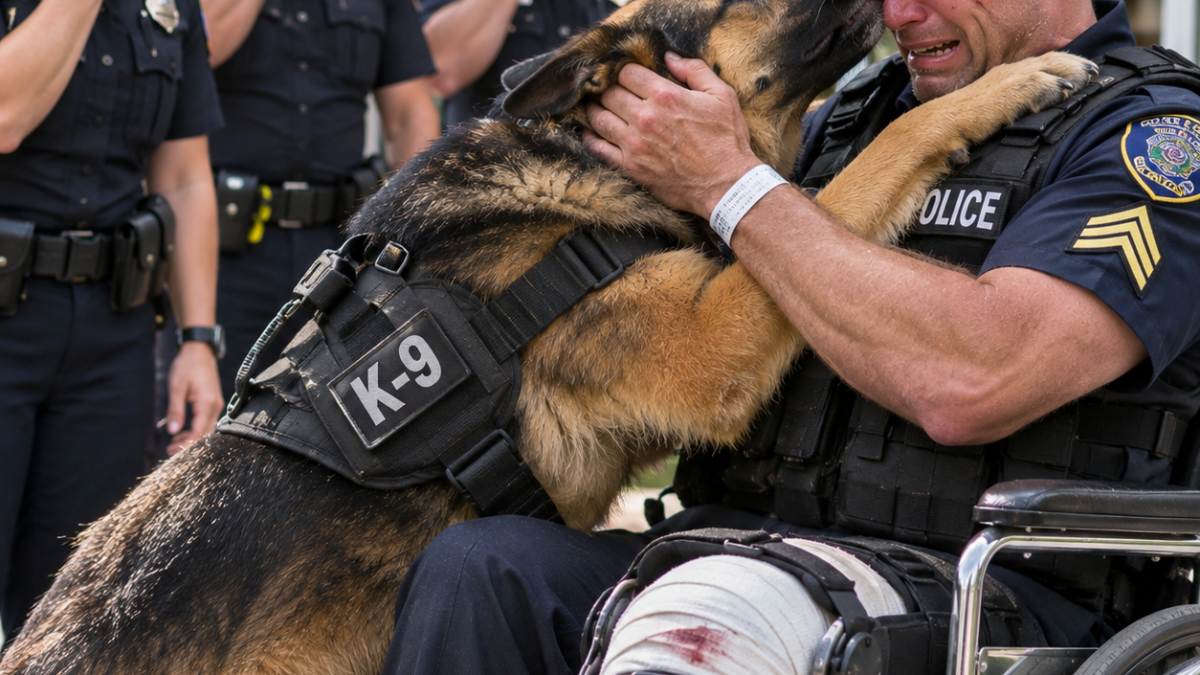
And then Bruno gently lowered his great head into Ethan’s lap.
I have been present at ceremonies for officers who served their communities for decades.
I’ve stood at promotions.
Retirements.
Memorial services.
I’ve watched people struggle to find words for love, loss, and gratitude.
But nothing I’ve witnessed has stayed with me quite like that moment in the hospital.
Ethan’s injured hands rested in Bruno’s fur.
The dog’s head lay motionless across his knees.
His tail still moved against the floor.
But the trembling that had followed him for three days seemed to ease.
Ethan bent toward him as much as he safely could.
“Oh, buddy.”
His voice broke.
“I’m sorry.”
Bruno pressed closer.
“I didn’t mean to leave you.”
I turned my face away.
My eyes were burning.
Ethan stroked the top of Bruno’s head.
Slowly.
Carefully.
Over and over.
The same quiet motion I’d seen him make beside the patrol car after long shifts.
Bruno closed his eyes.
And for the first time since the incident, he looked peaceful.
Not watchful.
Not desperately alert.
Not searching for someone who wasn’t there.
Peaceful.
I glanced around.
A nurse stood near the wall with one hand pressed against her mouth.
Another wiped her eyes.
A visitor had stopped at the end of the corridor.
Nobody seemed willing to interrupt.
Even the ordinary hospital sounds felt distant.
Ethan continued stroking Bruno.
The dog didn’t lift his head.
He simply stayed.
As though he’d spent three days trying to reach that exact place.
As though every minute beside the empty patrol car had been leading him toward the moment when he could finally rest against his partner again.
I stepped closer.
“Ethan.”
He looked up.
His face was wet.
“Captain.”
I tried to smile.
“How’re you doing, son?”
He laughed through tears.
“Better now.”
I nodded.
“I can see that.”
Then I looked toward Bruno.
“I need to tell you something.”
Ethan’s expression tightened.
“What?”
I swallowed.
“He hasn’t eaten properly since you were hurt.”
Ethan looked down at the dog.
I continued.
“He wouldn’t leave the car. We tried everything we could, kept him supervised, got veterinary guidance. But he kept returning to your vehicle.”
Ethan closed his eyes.
“Oh, Bruno.”
The dog’s ears moved at his voice.
Ethan stroked him.
“Three days?”
I nodded.
“He waited.”
For a moment, Ethan couldn’t speak.
Then he lowered his forehead gently toward Bruno.
“I’m here now, big guy.”
The dog sighed.
Long.
Deep.
The kind of sigh a dog gives when its body finally feels safe enough to relax.
Ethan’s fingers tightened softly in the thick fur.
“I’m here.”
Dr. Keller stood nearby, watching.
I’d met her only briefly before Bruno arrived.
She had the calm manner of someone accustomed to caring for people during frightening moments.
But when I looked toward her, her eyes were wet.
She stepped closer.
“Captain.”
I nodded.
“Doctor.”
She watched Bruno resting against Ethan.
“That’s quite a reunion.”
I swallowed.
“Yes, ma’am.”
She smiled faintly.
“I’ve seen patients reunited with family members. I’ve seen remarkable emotional responses.”
Her gaze moved toward the dog.
“But I don’t believe I’ve seen quite this.”
I looked toward Ethan.
His hand was still moving slowly over Bruno’s head.
I lowered my voice.
“They’ve been partners for five years.”
Dr. Keller nodded.
“I understand.”
“Every day,” I continued. “Every patrol. Every shift. Bruno’s used to being wherever Ethan is.”
She watched them quietly.
Then said, “It seems they needed this.”
I smiled sadly.
“I think you’re right.”
A nurse approached to check whether Ethan was becoming tired.
He was.
I could see it.
His shoulders were tense, and the effort of sitting upright for the visit was beginning to show.
Dr. Keller explained that he’d need to return to his room soon.
I nodded immediately.
“Of course.”
But Ethan looked up.
“Captain?”
“Yes?”
His eyes filled.
“Please.”
I knew what he was asking before he said it.
“Just another minute.”
I glanced toward the doctor.
She considered him.
Then looked at Bruno.
The dog hadn’t moved.
His head was still resting in Ethan’s lap.
Dr. Keller nodded.
“A little longer.”
Ethan whispered, “Thank you.”
I stepped back.
“Take your time, son.”
And for several more minutes, we let the two of them sit together.
The world continued around us.
Phones rang.
Doors opened.
A cart moved somewhere beyond the hallway.
Staff members went about their work.
But Ethan seemed to hear none of it.
He looked down at Bruno as though the dog were the only thing keeping him connected to the world outside his hospital room.
“Remember our porch?” Ethan whispered.
Bruno’s ears moved.
Ethan smiled weakly.
“Yeah.”
He rubbed behind one ear.
“You and me.”
The dog’s tail tapped the floor.
“We’re gonna sit out there again.”
I swallowed.
Ethan paused to breathe.
“It might take a little while.”
Bruno lifted his head.
Ethan looked straight into his eyes.
“But I’m coming home.”
The dog leaned forward until his forehead rested against Ethan’s hand.
Ethan smiled.
“You hear me?”
His voice broke.
“I’m coming home.”
I don’t know whether Bruno understood any of the words.
But he understood the familiar voice.
The touch.
The presence of the person who had always returned for him.
And that seemed enough.
When Dr. Keller finally signaled that the visit needed to end, I approached gently.
“Come on, Bruno.”
The dog lifted his head.
Then looked at Ethan.
His tail slowed.
I felt the fear return to my chest.
We’d finally reunited them.
Now I had to separate them again.
Ethan saw the hesitation.
He reached toward Bruno.
“Hey.”
The dog’s ears lifted.
“Be good for the captain.”
I swallowed.
Ethan stroked his muzzle.
“I’m not going anywhere you can’t find me.”
Bruno whined softly.
Then Ethan smiled through his exhaustion.
“I’ll see you again.”
I took the leash.
The dog stayed close to the wheelchair for another moment.
Then, after one final touch from Ethan, he followed me.
He looked back twice.
So did I.
Ethan was still watching us from the chair.
His hand rested where Bruno’s head had been.
I raised one hand.
“Get some rest, son.”
Ethan nodded.
His eyes were bright.
And as we walked back toward the hospital doors, I knew the man we’d left behind was still hurting.
Still facing surgery recovery and rehabilitation.
Still uncertain about how long it would take to get his old life back.
But for the first time since the incident, I had seen him smile as though he genuinely believed he could do it.
Bruno was quiet on the ride back to the station.
Not the defeated quiet I’d seen during those three days beside the patrol car.
This was different.
He lay down in the rear of the vehicle.
Actually lay down.
His chin rested against his front paws, and his eyes were half closed.
Every so often, he lifted his head when I spoke.
Then he settled again.
I glanced at him in the mirror.
“Well, look at you.”
His ears moved.
I smiled.
“Finally getting some rest?”
He sighed.
I looked toward the road.
For three days, every minute with Bruno had felt as though we were waiting for something terrible to happen.
Waiting for him to collapse.
Waiting for another medical update.
Waiting for Ethan to ask a question I couldn’t answer.
Now, for the first time, it seemed possible that both partners might begin moving forward.
I knew one reunion wouldn’t erase everything.
Bruno still needed care, rest, and a normal routine.
Ethan still had a long and painful recovery ahead.
But the dog no longer looked as though he believed his entire world had disappeared.
He’d seen Ethan.
He’d touched him.
He’d heard his voice.
And now, finally, he seemed able to rest.
When we reached the station, I parked and opened the rear door.
Bruno climbed down carefully.
An officer came outside.
“How’d it go, Captain?”
I looked toward the dog.
Bruno sniffed the pavement.
Then walked calmly beside me toward the entrance.
The officer stared.
“Is that Bruno?”
I laughed softly.
“Last time I checked.”
He shook his head.
“He looks different.”
I nodded.
“He saw Ethan.”
The officer’s expression softened.
“Yeah?”
“Yeah.”
He glanced toward the patrol car.
Bruno looked at it briefly.
Then returned his attention to us.
The officer swallowed.
“That’s good.”
I rested my hand against Bruno’s neck.
“That’s very good.”
The news spread through the station before I finished my report.
People came to my office asking about the visit.
Some wanted to know how Ethan looked.
Others wanted to know whether Bruno recognized him.
A few asked whether the dog had become too excited around the wheelchair.
I answered what I could.
Ethan was recovering, but still seriously injured.
The visit had been conducted carefully.
Bruno had recognized him immediately.
And for the first time in three days, we’d seen the dog relax.
One of the younger officers stood near my desk, listening.
When I finished, he looked down.
“What did Ethan say?”
I leaned back.
“He told Bruno he was coming home.”
The officer nodded.
Then turned away.
I noticed him wipe his eyes before leaving.
I understood.
Police departments are strange families.
We work together under stress.
We argue over little things.
We complain about paperwork, broken equipment, and long shifts.
We see each other tired, frustrated, and frightened.
And sometimes, we forget how deeply we’ve become attached until someone is suddenly missing from the room.
Ethan’s empty desk had been bothering me.
His patrol car had been bothering everyone.
Bruno’s refusal to leave that car had made his absence impossible to ignore.
But hearing that Ethan was well enough to see his dog gave the station something it hadn’t had for three days.
Hope.
Not certainty.
Not a promise that everything would return to normal.
Hope that the worst moment had passed and something better could still follow.
Later that afternoon, I checked on Bruno again.
He was resting in a quiet area with fresh water nearby.
One of the officers had been keeping him company.
I looked toward his food.
“How’d he do?”
The officer smiled.
“Better.”
I raised an eyebrow.
“He ate?”
“Some.”
I looked down at Bruno.
“Well, that’s a start.”
The dog lifted his head at my voice.
I crouched.
“Your partner would be pretty annoyed if he knew you’d been skipping meals.”
His tail moved.
I scratched behind his ear.
“Yeah. You know I’m right.”
He lowered his head again.
I sat beside him for a while.
Not talking much.
Just keeping him company.
It reminded me of the way Ethan used to sit with him after long shifts.
The small, ordinary moments I hadn’t paid much attention to before.
Bruno shifted closer.
His shoulder rested against my leg.
I looked down.
“Still miss him?”
The dog sighed.
I nodded.
“Me too.”
Dr. Keller contacted me again the following day.
She explained that, with continued medical approval and proper arrangements, Bruno could visit Ethan regularly during his recovery.
I was grateful.
I had worried the first reunion might be the only one.
But Ethan had responded well emotionally, and the care team believed carefully planned visits could fit into his recovery schedule.
I coordinated with the officers responsible for Bruno.
We arranged appropriate transportation and handling.
We made sure the visits wouldn’t interfere with Ethan’s medical care.
And we continued monitoring Bruno’s physical and behavioral well-being.
I didn’t want to treat him as though his distress were solved forever simply because one good thing had happened.
But I also wasn’t going to ignore how much seeing Ethan seemed to matter.
The next time I brought Bruno to the hospital, he recognized the route sooner than I’d expected.
He became alert as we approached.
At the entrance, he walked with purpose.
Inside, he kept checking the corridor ahead.
Then Ethan appeared.
And Bruno’s tail began moving before we were halfway down the hallway.
“Hey, buddy!” Ethan called.
His voice was a little stronger.
Bruno approached eagerly but carefully.
He sniffed Ethan’s hands.
Looked toward his face.
Then placed his head in Ethan’s lap.
Ethan smiled.
“There you are.”
I watched him stroke the dog’s ears.
“Miss me?”
Bruno’s tail thumped against the floor.
Ethan laughed.
“Yeah.”
Then he lowered his voice.
“I missed you too.”
That became their routine.
Not every moment.
Not every hour.
But regularly, whenever the medical team approved and the arrangements allowed.
Bruno came to the hospital.
He saw Ethan.
He checked him with his nose.
Accepted the familiar touch.
And settled beside him.
Sometimes Ethan was tired.
On those days, the visits were short.
Sometimes he had enough energy to talk.
On those days, he’d tell Bruno about the things they would do when he got home.
Walks.
Quiet evenings.
Sitting on the porch.
Maybe, someday, returning to parts of their working routine if his medical recovery and department requirements allowed it.
I noticed that Ethan rarely talked about dramatic police work during those conversations.
He talked about ordinary life.
A familiar chair.
The sound of summer insects.
The way Bruno liked to settle near his feet.
The small rituals he’d taken for granted before the injury.
One afternoon, Ethan sat with Bruno while sunlight fell across the hospital room.
He looked toward me.
“Captain?”
“Yes?”
“You ever notice how you don’t think about the ordinary stuff until you can’t do it?”
I considered the question.
“All the time.”
He looked down at Bruno.
“I used to complain about him following me everywhere.”
I smiled.
“Did you?”
“Everywhere.”
He laughed quietly.
“Couldn’t even sit on the porch without him taking up half the space.”
Bruno lifted his head.
Ethan scratched his ears.
“Now all I want is to sit on that porch again.”
I looked toward the window.
“You’re working on it.”
He nodded.
“Yeah.”
Then he smiled at the dog.
“We are.”
Rehabilitation was difficult.
The surgeries had addressed the immediate injuries, but healing required time.
Ethan had to regain strength.
Manage pain.
Work through mobility limitations.
And learn what his injured body could safely do as recovery progressed.
His broken leg made ordinary movement difficult.
The fractured ribs made some motions and deep breaths painful.
There were days when progress seemed painfully slow.
And days when fatigue arrived long before he wanted to stop.
I visited whenever my duties allowed.
Sometimes I found him in good spirits.
Other times, he was frustrated.
One afternoon, he sat in his room with his arms folded and his jaw set.
I recognized the expression immediately.
It was the same one he wore when equipment failed during a training exercise.
I pulled up a chair.
“Rough day?”
He looked toward the window.
“Something like that.”
I waited.
Then he said, “I thought I was going to do better today.”
I nodded.
“Physical therapy?”
“Yeah.”
He rubbed his face.
“I know they told me it would be slow.”
“That doesn’t make it easier.”
He gave a humorless laugh.
“No.”
For a moment, he stared at the floor.
Then whispered, “I used to walk miles without thinking about it.”
I said nothing.
He continued.
“Now I need help doing things I never even noticed before.”
His voice tightened.
“I hate it.”
I leaned forward.
“You’re allowed to hate it.”
He looked at me.
I continued.
“But don’t confuse a hard day with failure.”
He swallowed.
“You sound like Dr. Keller.”
I smiled.
“She seems smart.”
Ethan laughed.
Then his expression softened.
“Is Bruno coming today?”
I nodded.
“That’s the plan.”
He looked toward the door.
And for the first time since I’d entered the room, the tension in his face eased.
Bruno was allowed to be present for selected rehabilitation sessions under the team’s supervision.
He didn’t participate in the medical treatment.
He didn’t pull Ethan or attempt to support his weight.
He had a safe place where he could lie down and observe.
But seeing him there seemed to matter.
I remember one session particularly well.
Ethan was working carefully through an exercise directed by his physical therapist.
His face was tight with concentration.
Every movement required effort.
Bruno lay in the corner of the room.
His head rested on his paws.
His eyes followed Ethan.
When Ethan stopped to breathe through discomfort, Bruno raised his head.
His ears moved.
Then, after checking the room, he settled again.
Ethan noticed.
He smiled faintly.
“Look at him.”
The therapist glanced toward the dog.
“He’s paying attention.”
Ethan laughed.
“He always does.”
Then he looked toward Bruno.
“I’m okay, buddy.”
The dog’s tail moved.
Ethan returned to the exercise.
I watched quietly.
The dog who had once spent three days beside an empty patrol car was now resting in a hospital rehabilitation room, watching his partner do the slow work of getting stronger.
He wasn’t trying to drag Ethan home.
He wasn’t barking at the staff.
He was simply there.
And somehow, that steady presence made the difficult room feel a little less lonely.
There were days when Ethan struggled more than he wanted anyone to know.
He’d always been independent.
A man accustomed to being the one who helped.
The one who drove toward danger.
The one who took responsibility.
Now he had to accept assistance.
And that wasn’t easy for him.
One evening, I found him sitting in his wheelchair near the window.
The sun was beginning to set.
Orange light spread across the floor.
Bruno was lying beside him.
Ethan looked tired.
Not physically exhausted in the ordinary way people feel after a long shift.
A deeper kind of tired.
The kind that comes from trying to remain patient with a body that isn’t healing as quickly as you’d hoped.
I entered quietly.
“Hey, son.”
He looked toward me.
“Captain.”
I gestured toward the chair.
“Mind if I sit?”
“Of course not.”
I sat beside him.
For a while, we watched the light change.
Then Ethan said, “I’m scared.”
The words surprised me.
Not because I thought he was incapable of fear.
But because he’d always been careful about when he showed it.
I turned toward him.
“Of what?”
He looked down at his leg.
“That I won’t be the same.”
I waited.
“That I won’t be able to do the job the way I used to.”
His voice tightened.
“That Bruno will need somebody who can keep up with him.”
I felt something pull in my chest.
“Ethan.”
He shook his head.
“I know. It’s early. Everybody keeps telling me that.”
I nodded.
“And they’re right.”
He looked away.
“I don’t want to lose him.”
I stared toward Bruno.
The dog lifted his head at the sound of Ethan’s voice.
Then stood and approached the wheelchair.
He sat beside Ethan’s injured leg without touching it.
His shoulder rested gently against the chair.
Ethan looked down.
For a moment, his expression crumpled.
Then he reached toward the dog.
Bruno pressed his muzzle beneath his hand.
Ethan stroked his head.
I looked toward them.
“Son, I can’t tell you exactly what your working future will look like.”
He nodded slowly.
“But Bruno’s not asking you about your assignment today.”
Ethan swallowed.
I continued.
“He’s not checking whether you can run a training course.”
Bruno rested his head against Ethan’s knee.
“He’s right there because you’re Ethan.”
Ethan closed his eyes.
And for a long moment, he simply held his dog.
I learned something during those hospital visits that I’d never fully understood as a captain.
We spend so much time thinking of partnership in terms of performance.
How well two officers communicate.
How quickly they respond.
Whether they trust each other’s decisions.
How they handle danger.
All of that matters.
But watching Ethan and Bruno during recovery showed me another side of partnership.
The side that remains when neither partner can work.
When there’s no radio call to answer.
No suspect to search for.
No training exercise to complete.
No badge or uniform capable of making the difficult day easier.
Only a wounded man and the dog who wants to be beside him.
I’d seen them work together for years.
I’d admired their discipline.
Their coordination.
Their confidence.
But I had never understood the depth of their bond until I saw Bruno place his head on Ethan’s lap in that hospital hallway.
And I realized the dog wasn’t waiting for a command.
He was waiting for his person.
By the end of the first month, Ethan was making progress.
Slowly.
With setbacks.
But steadily enough that the medical team could begin discussing the next stages of rehabilitation.
His strength was returning.
He could do more than he had during the first difficult days.
He was learning to move with the precautions required by his injuries.
And his sense of humor had begun reappearing.
One afternoon, I arrived to find him talking to Bruno as though they were having an argument.
“Absolutely not,” Ethan was saying.
Bruno sat beside him, head tilted.
“No, sir. You are not getting half my lunch.”
The dog’s ears lifted.
Ethan pointed a finger.
“Don’t give me that look.”
I laughed from the doorway.
“What’d he do?”
Ethan looked up.
“Trying to negotiate.”
I raised an eyebrow.
“Is he winning?”
Bruno’s tail wagged.
Ethan sighed dramatically.
“He usually does.”
I smiled.
It was a small moment.
But it meant more to me than any medical chart.
For a few seconds, I could hear the Ethan I knew from the station.
The man who teased his dog.
The man who smiled after a difficult shift.
The man who treated Bruno like a stubborn family member rather than a piece of department equipment.
He was still there.
Under the fatigue.
Under the pain.
Under the uncertainty.
He was still there.
And Bruno seemed to know it.
The second month brought a different kind of challenge.
At the beginning, everything had been about getting through the immediate medical crisis.
Surgery.
Pain.
Stabilization.
The first difficult movements.
The first meaningful visits.
Now Ethan was focused on becoming independent enough to leave the hospital.
That was a goal everyone wanted.
But it also frightened him.
Inside the hospital, there were nurses nearby.
Therapists who understood exactly what he was allowed to do.
Equipment arranged to protect him.
People who could answer questions whenever pain or uncertainty became overwhelming.
Going home meant accepting responsibility for the next stage of recovery.
It meant looking at familiar places and realizing ordinary tasks might need to be done differently for a while.
And for Ethan, it meant confronting the reality that he wouldn’t immediately return to the same demanding patrol work he’d performed before the injury.
I visited one afternoon while he was reviewing his rehabilitation plan.
He looked up when I entered.
“Captain.”
I smiled.
“How’s the patient?”
He sighed.
“Impatient.”
I laughed.
“That’s a promising sign.”
He shook his head.
“Dr. Keller says I’m doing well.”
“Good.”
“But she keeps using words like gradual and carefully.”
I smiled.
“Both excellent words.”
Ethan rolled his eyes.
“You sound like every doctor I’ve met.”
“Maybe because they’re trying to keep you from undoing their work.”
He laughed.
Then looked down at his injured leg.
“I just want to walk out of here.”
I nodded.
“You’re getting closer.”
For a moment, he was quiet.
Then he glanced toward Bruno, who was resting beside the wheelchair.
“Think he’ll remember the way home?”
I stared at him.
Then laughed.
“Ethan, that dog remembered you after three days and an entire hospital full of strangers.”
Ethan smiled.
“Fair point.”
I looked toward Bruno.
“I don’t think directions are going to be a problem.”
The dog lifted his head.
His tail moved.
Ethan bent toward him.
“Almost there, buddy.”
And for the first time, I believed him without having to force myself.
During one rehabilitation session, Ethan managed a little more than he had the previous week.
Nothing dramatic.
No sudden recovery.
No triumphant march down a hallway without assistance.
Just a little more movement.
A little more steadiness.
A little more confidence.
But when he finished, he looked toward Bruno.
The dog was lying in his usual spot, watching.
Ethan smiled.
“See that?”
Bruno’s ears rose.
“I did it.”
The physical therapist smiled.
“You did.”
Ethan laughed softly.
Then looked toward me.
“Don’t let the boys at the station hear how proud I am of walking a few extra steps.”
I folded my arms.
“Oh, I’m telling everyone.”
He groaned.
“Captain.”
“I might even put it in the morning briefing.”
The therapist laughed.
Bruno’s tail moved at the sound of our voices.
Ethan shook his head, but he was smiling.
And I realized how much I’d missed hearing him laugh without pain or fear dominating the moment.
That afternoon, Bruno walked calmly beside Ethan as the staff guided them through the appropriate part of the visit.
The dog was careful.
He stayed where he was directed.
And whenever Ethan stopped, Bruno waited.
It reminded me of their patrol days.
Not because they were moving fast or doing difficult work.
But because they still seemed to understand how to move together.
One step.
Then another.
No need to rush.
No need to prove anything.
Just the quiet assurance that neither had to go anywhere alone.
Ethan’s discharge was finally scheduled two months after the injury.
I remember receiving the call.
I was in my office reviewing reports when the hospital contacted me about the arrangements.
Ethan was going home.
He still needed rehabilitation.
He still had physical limitations.
His return to full duty, if and when medically appropriate, would be assessed separately.
But he was well enough to leave the hospital and continue recovering outside it.
I leaned back in my chair.
For several seconds, I just stared at the ceiling.
Then I laughed.
It was a sound of pure relief.
One of my officers appeared in the doorway.
“Everything okay, Captain?”
I looked at him.
“Ethan’s coming home.”
The officer froze.
Then smiled.
“Seriously?”
I nodded.
“Two months.”
He let out a breath.
“Thank God.”
I looked toward the parking lot.
Bruno was with his assigned caretaker that morning.
He’d been doing much better since the hospital visits.
Eating.
Resting.
Participating in appropriate activities.
And showing more of the alert, confident behavior we’d known before the incident.
I smiled.
“Let’s make sure his partner’s there to meet him.”
On the morning of the discharge, I arrived at the hospital early.
I don’t know who was more excited.
Me.
Or Bruno.
The dog seemed to recognize that something was different from an ordinary visit.
Perhaps it was the extra activity.
Perhaps it was simply that we’d arrived at a familiar place and he expected to see Ethan.
Whatever the reason, his ears were lifted and his tail moved almost constantly.
We waited near the approved exit area.
The day was warm.
Sunlight fell across the walkway.
A light breeze stirred the leaves of the trees near the entrance.
Bruno stood beside me.
His leash rested comfortably in my hand.
Every time the automatic doors opened, he looked up.
Every time someone came out, he checked their face.
I looked down.
“Sound familiar, buddy?”
He lifted his ears.
I smiled.
“This time you don’t have to wait three days.”
He looked toward the entrance again.
I swallowed.
“Just a little longer.”
Then the doors opened.
A staff member stepped outside.
Behind her came Ethan.
He was walking.
Slowly.
Carefully.
Following the medical guidance he’d been given.
But walking.
I felt my eyes fill before I could stop them.
Two months earlier, he’d been lying in a hospital bed after surgery.
His face pale.
His breathing guarded.
His injuries so severe that none of us knew how long his recovery would take.
Now he was coming through the doors on his own feet, with assistance as needed.
He looked tired.
And a little thinner.
But his eyes were bright.
He saw us.
Then smiled.
“Captain.”
I nodded.
“Welcome back, son.”
His gaze moved toward the dog.
“Bruno.”
The Labrador-sized shadow of grief that had seemed to hang over the animal for three days was gone.
Bruno’s whole body came alive.
His tail wagged wildly.
He moved toward Ethan with the eager confidence of a dog who recognized exactly who was waiting.
Ethan smiled.
“Easy, big guy.”
Bruno slowed.
He approached carefully.
Then circled close, sniffed his partner’s hand, and pressed his head against Ethan’s leg without knocking him off balance.
Ethan laughed.
A full laugh.
Loud and genuine.
The kind I hadn’t heard from him since before the injury.
“There you are!”
Bruno’s tail beat against the air.
Ethan reached down as far as he safely could.
“Miss me?”
The dog whined softly.
Ethan’s smile trembled.
“Yeah.”
He stroked Bruno’s head.
“Missed you too.”
I watched them for a moment.
Then turned away.
I didn’t want Ethan to see me crying.
But he’d already noticed.
“Captain?”
I looked back.
He was smiling.
“You okay?”
I laughed through tears.
“I’m fine.”
He raised an eyebrow.
“Really?”
I shook my head.
“Just got something in my eye.”
Ethan laughed again.
Then looked down at Bruno.
“Come on, buddy.”
His voice softened.
“Let’s go home.”
I helped with the departure arrangements.
Bruno was secured appropriately for the trip.
Ethan settled into the passenger seat, following the precautions required for his injuries.
Then we started toward home.
For the first few minutes, there wasn’t much conversation.
Ethan looked out the window.
Bruno rested in the rear.
I drove.
The hospital disappeared behind us.
Then the familiar streets.
Then the roads leading toward the station.
At a traffic light, Ethan looked back at Bruno.
The dog was lying quietly.
His chin rested against his paws.
His eyes were partly closed.
Ethan smiled.
“Look at him.”
I glanced in the mirror.
“Finally comfortable.”
Ethan nodded.
“He always does that after a long shift.”
I looked toward him.
“Does what?”
“Lies down like the whole world finally makes sense.”
I smiled.
“Sounds about right.”
He watched Bruno for another moment.
Then said quietly, “I hated knowing he was waiting.”
I kept my eyes on the road.
“I know.”
“I kept picturing him beside the car.”
I nodded.
“He was there.”
Ethan swallowed.
“I wish I could’ve told him what happened.”
I glanced toward him.
“You told him enough when he saw you.”
He was quiet.
Then smiled faintly.
“Maybe.”
I looked in the mirror again.
Bruno had closed his eyes.
I thought about the dog who had spent three days watching the station driveway.
And I realized that the most beautiful thing about this moment wasn’t his excitement.
It was his peace.
He no longer had to wonder whether Ethan would return.
His partner was right there.
And for the first time in a long while, Bruno could simply rest.
We stopped at the station on the way.
Ethan hadn’t been back since the incident.
I’d told the officers he might visit briefly, provided he felt up to it.
What I hadn’t told him was how many people wanted to see him.
As we pulled into the lot, I noticed several vehicles parked near the entrance.
Ethan looked toward them.
“What’s going on?”
I shrugged.
“Morning shift.”
He gave me a suspicious look.
“That’s a lot of people for a normal morning.”
I smiled.
“Must be a busy day.”
He shook his head.
Then laughed.
“Captain.”
I parked.
We made sure Ethan could get out safely.
Bruno was brought beside him.
And as we approached the entrance, the station doors opened.
Officers began stepping outside.
One.
Then another.
Then several more.
Someone started clapping.
A few others joined.
Within seconds, the sound filled the parking area.
Ethan stopped.
His face changed.
“Oh, come on.”
I smiled.
“Welcome back.”
One of the officers called out, “PARKER!”
Another whistled.
Someone shouted, “About time!”
Ethan laughed.
His eyes were wet.
He raised one hand.
“Good to see you too!”
Then a voice came from the back.
“AND BRUNO, WE’RE TIRED OF TRYING TO FEED YOU!”
The entire group laughed.
I looked down.
Bruno’s tail was wagging.
Ethan turned toward the speaker.
“Yeah, well, he never liked your cooking!”
More laughter.
For a moment, it felt as though the previous two months had become less heavy.
Not forgotten.
Not erased.
But surrounded by something warmer.
The people who had worried about Ethan were standing there.
And Ethan was standing with them.
Bruno sat beside his partner.
Calm.
Proud-looking.
Alert.
And finally, exactly where he wanted to be.
Ethan moved slowly through the greetings.
Officers shook his hand.
Some embraced him carefully.
Others simply touched his shoulder.
There were jokes.
A few quiet words.
And plenty of people looking away when emotion became too much.
I stood near the edge of the group.
Watching.
Bruno stayed with Ethan.
He didn’t return to the empty patrol car.
Didn’t become frantic.
Didn’t search the driveway.
He remained beside the man he’d waited for.
Eventually, Ethan looked toward his old vehicle.
He grew quiet.
I saw the memories pass across his face.
The parking place.
The rear door.
The spot where Bruno had spent three days.
Ethan walked toward it with care.
Bruno followed.
For a moment, the dog stopped beside the familiar tire.
He sniffed the ground.
Then looked toward Ethan.
I felt my throat tighten.
This was the place where he’d waited.
The place where he’d refused to leave.
Where every passing vehicle had made him hope the man he loved was coming back.
Ethan approached.
“Hey, buddy.”
Bruno turned.
Ethan rested his hand against the patrol car.
For a moment, neither moved.
Then he looked down.
“You don’t have to wait here anymore.”
Bruno stepped toward him.
Sat beside his feet.
And leaned gently against his leg.
Ethan smiled through tears.
“That’s right.”
He stroked the dog’s head.
“I’m here.”
I watched them from a few steps away.
And suddenly, the patrol car no longer looked like a symbol of absence.
It looked like the place where two partners had found each other again.
Ethan didn’t stay at the station long.
He was still recovering, and even a happy reunion could exhaust him.
I could see the fatigue beginning to settle into his face.
So after the greetings, we helped him prepare to leave.
The officers returned to their duties.
The station gradually resumed its familiar rhythm.
Radios crackled.
Phones rang.
Vehicles came and went.
And Ethan stood beside Bruno, looking at the building where they’d spent so much of their lives.
“Feels strange,” he said.
I stood beside him.
“What does?”
“Being here without going on duty.”
I nodded.
“I imagine it does.”
He glanced toward his injured leg.
“Going to take some getting used to.”
I looked at him.
“You’ve got time.”
He sighed.
“I know.”
I rested a hand on his shoulder.
“And you’ve got people who’ll be here for you.”
His eyes softened.
He looked toward the station doors.
Then down at Bruno.
“Yeah.”
The dog lifted his head.
Ethan smiled.
“I guess I do.”
That evening, I stopped by Ethan’s house to make sure everything was settling smoothly.
He lived in a modest home with a porch overlooking a quiet yard.
I’d been there before.
Over the years, Ethan had invited colleagues for occasional meals or to stop by after work.
But I’d never noticed how perfectly the house suited him and Bruno.
There was room for the dog to move.
A shaded place near the porch.
A familiar spot beside Ethan’s chair.
And the quiet of a neighborhood far removed from the urgency of police radios and emergency calls.
When I arrived, Ethan was sitting outside.
The sunset had turned the sky pink and violet.
A warm breeze moved through the trees.
And Bruno lay beside his feet.
His head rested on his paws.
His eyes were open.
But his body was relaxed.
I walked up the path.
“Evening, Sergeant.”
Ethan smiled.
“Captain.”
I looked down at the dog.
“Well, look who’s finally home.”
Bruno lifted his head.
His tail moved against the porch boards.
I crouched and scratched behind his ears.
“Good to see you, buddy.”
He leaned into my hand.
Ethan laughed.
“Careful. He’ll think you came to visit him.”
I smiled.
“Maybe I did.”
He shook his head.
“Wouldn’t blame you.”
I stood and looked toward the yard.
Everything was quiet.
No sirens.
No hospital monitors.
No frightened officers waiting for news.
Just a man and his dog on a porch.
The ordinary scene I’d heard Ethan describe when he was lying in a hospital bed.
Now he was living it.
I took a chair beside him.
For a while, we watched the sunset.
Then Ethan said, “You know what I kept thinking about in the hospital?”
I turned.
“What?”
“This.”
He gestured toward the porch.
I looked around.
“The house?”
He shook his head.
“Not exactly.”
He rested one hand against Bruno’s back.
“Sitting here. Watching the day end. Having him beside me.”
I nodded.
“I remember you talking about it.”
Ethan smiled faintly.
“I used to get home after a long shift, sit right here, and think about everything that had gone wrong.”
He looked down.
“Then Bruno would lie beside me.”
The dog’s ears moved at his name.
“And after a while, none of it felt quite so heavy.”
I watched Ethan stroke his head.
He continued.
“In the hospital, I started wondering whether I’d ever feel normal again.”
I said nothing.
He looked toward the yard.
“I was afraid I’d never work the way I used to.”
His voice grew quiet.
“Afraid everything had changed.”
I nodded.
“Some things may take time.”
“I know.”
He paused.
“But when I saw Bruno that first day…”
His expression softened.
“I realized something hadn’t changed.”
I looked toward the dog.
Ethan smiled.
“He still knew me.”
I swallowed.
“He sure did.”
“And he still wanted to be beside me.”
I nodded.
Ethan rubbed behind Bruno’s ears.
“I wasn’t in uniform. I wasn’t standing. I couldn’t even reach down properly.”
His voice trembled.
“But none of that mattered to him.”
Bruno shifted closer.
Ethan looked at me.
“He just wanted me.”
I felt my throat tighten.
“Yes,” I said softly.
“He did.”
The longer we sat there, the more I thought about those three terrible days.
I remembered walking through the station lot and seeing Bruno against the tire.
The untouched food.
The way he raised his head whenever a vehicle approached.
The way his ears fell when the person climbing out wasn’t Ethan.
I remembered the call to the hospital.
Ethan’s weak voice asking whether Bruno was eating.
And the promise I’d made.
Don’t let him think I forgot him.
I looked toward the dog now.
Bruno had lowered his head onto Ethan’s foot.
His eyes were nearly closed.
His breathing was slow.
Peaceful.
I realized that the promise I’d made hadn’t required any extraordinary skill.
I hadn’t saved Ethan’s life.
The emergency responders, surgeons, physicians, nurses, and rehabilitation professionals had done the difficult medical work.
I hadn’t taught Bruno how to love his partner.
That love had been built over five years of daily life.
What I’d done was recognize that both of them were suffering from the separation.
Then I’d made a phone call.
Helped arrange a visit.
And given two partners a chance to find each other again.
Sometimes, I thought, the most important thing a person can do is notice what someone else needs and refuse to dismiss it.
Even when that someone has four legs and can’t explain the problem.
Eventually, I stood to leave.
Ethan looked up.
“Heading out?”
I nodded.
“You need some rest.”
He smiled.
“So does Bruno.”
I glanced down.
The dog was nearly asleep.
I laughed.
“He’s got about three days of worrying to recover from.”
Ethan’s expression grew tender.
He looked toward Bruno.
“Yeah.”
Then he said quietly, “I hate that he went through that.”
I rested a hand on his shoulder.
“It’s over now.”
He nodded.
“I know.”
I looked toward the yard.
“Focus on getting stronger.”
He smiled.
“That’s the plan.”
“And don’t rush.”
He laughed.
“You and Dr. Keller have been talking.”
“She’s a smart woman.”
Ethan shook his head.
Then held out his hand.
“Captain?”
I took it.
“Yeah, son?”
His eyes were wet.
“Thank you for bringing him.”
I swallowed.
“You don’t have to thank me.”
“Yes,” he said.
“I do.”
For a moment, I couldn’t answer.
Then I squeezed his hand.
“You two belong together.”
He looked toward Bruno.
The dog lifted his head at the sound of our voices.
Ethan smiled.
“Yeah.”
His voice softened.
“We do.”
I walked toward my car.
Halfway down the path, I turned around.
Ethan was still sitting on the porch.
The evening light rested against his shoulders.
Bruno had settled beside his chair again.
One of Ethan’s hands rested on the dog’s head.
There was no conversation.
No dramatic gesture.
No need to prove anything.
Just that familiar hand moving gently through the thick fur.
For five years, they’d ended countless days that way.
Then, for three days, Bruno had waited beside an empty patrol car because the man who usually touched his head hadn’t come back.
Now the hand was there again.
And Bruno could close his eyes.
I stood by my car longer than I meant to.
Then I quietly drove away.
The next morning, Ethan called.
I was drinking coffee at my desk when his name appeared on my phone.
I answered immediately.
“Parker?”
“Morning, Captain.”
His voice sounded tired but cheerful.
“How’s the first morning home?”
“Better than the hospital.”
I laughed.
“That’s a good start.”
There was a pause.
Then Ethan said, “Want to hear something?”
“Of course.”
“I picked up Bruno’s leash this morning.”
I smiled.
“Yeah?”
“He was asleep near the door.”
I waited.
“The second he heard it, he jumped up.”
I laughed.
“Of course he did.”
Ethan continued.
“He went straight to the front door and stood there, waiting for me.”
My throat tightened.
“Ready for a walk?”
“Ready for anything.”
I smiled.
Ethan’s voice softened.
“I opened the door, and he just looked up at me.”
He paused.
“Same as always.”
I closed my eyes.
I could picture it.
Bruno standing beside the door.
Ears lifted.
Tail moving.
Waiting for Ethan to take the first step.
No hospital hallway.
No empty patrol car.
No uncertainty about where his partner had gone.
Just another morning.
And the man he loved beside him.
Ethan laughed quietly.
“Obviously, we didn’t go far. I’m still following my recovery plan.”
“Good.”
“But we stepped outside together.”
I looked toward the window of my office.
The sun was rising over the station lot.
Then Ethan said, “Captain?”
“Yes?”
“He’s back.”
I swallowed.
“What do you mean?”
“The Bruno I know.”
His voice trembled.
“He’s eating. He’s sleeping. He’s wagging his tail. He’s following me around the house again.”
I smiled through tears.
“And yesterday evening he finally slept without getting up every time a car went past.”
I leaned back.
“That’s good, Ethan.”
There was a pause.
Then he whispered, “I think he believes I’m home for real now.”
For several seconds, I couldn’t speak.
Finally, I answered, “So do I, son.”
I’ve thought about Ethan and Bruno many times since that morning.
Sometimes when I walk past the patrol vehicles.
Sometimes when I see another K-9 team preparing for duty.
And sometimes late in the evening, when the station becomes quiet enough that I can hear my own thoughts.
I’ve spent much of my career teaching officers the importance of trust.
Trust in your training.
Trust in your judgment.
Trust in the people beside you.
But Bruno taught me something about trust that no training exercise ever could.
For five years, he had learned that Ethan would come back.
When a shift ended, Ethan came back.
When training was finished, Ethan came back.
When Bruno waited beside a vehicle, Ethan returned to him.
Then one terrible day, that familiar pattern broke.
Ethan was hurt.
The patrol ended without the usual return.
And Bruno couldn’t understand why the person who always came back wasn’t there.
So he waited.
Through the first night.
Through the second.
And into the third day.
He waited even when food was offered.
Even when familiar people tried to comfort him.
Even when the station continued functioning around him.
Then, when we finally brought him to the hospital, he saw Ethan.
Pale.
Injured.
Sitting in a wheelchair.
Nothing like the strong officer who normally stood beside him.
But Bruno recognized him anyway.
He didn’t need Ethan to walk.
Didn’t need him to wear a uniform.
Didn’t need him to give a command.
He needed only to hear the voice, smell the familiar scent, and feel the hand he trusted.
And when he placed his head in Ethan’s lap, something in that frightened dog finally settled.
I don’t know exactly what the future holds for Ethan.
Recovery is a process, not a single triumphant day.
He still has rehabilitation ahead.
The department will make appropriate decisions about his duties based on his health and the requirements of the job.
And Bruno’s working future will be managed with the same care and consideration.
But I know something those uncertainties cannot change.
Their relationship was never only about patrol work.
It existed in the quiet hours before a shift.
In the back seat of the car.
On the station grounds after a difficult call.
In the small routines of feeding, grooming, walking, and resting.
And in the simple act of one partner waiting for the other.
That’s what I saw on the hospital floor.
That’s what I saw outside the station.
And that’s what I saw on Ethan’s porch as the sun went down.
Two lives bound together by years of trust.
A man who refused to stop worrying about his dog even while recovering from serious injuries.
And a dog who refused to stop looking for his person until he found him.
I remember something Ethan told me years ago, when their partnership was still new.
He’s a piece of my heart walking around on four legs.
I understand those words now.
I understand them every time I picture Bruno waiting beside the patrol car.
And every time I remember the moment Ethan appeared at the end of the hospital hallway.
Bruno had waited three days for that familiar face.
Three days of uncertainty.
Three days of watching the door.
Three days of refusing to accept that the man who always came back might not return.
Then Ethan lifted his injured hand and whispered, “Hey, buddy. I’m here.”
And Bruno finally rested his head in his partner’s lap.
The most heartbreaking thing wasn’t that Bruno waited beside the patrol car for three days. It was that he had no way of knowing Ethan was alive, recovering in a hospital, and longing to see him just as desperately.
And the most beautiful thing wasn’t the moment Bruno ran toward the wheelchair. It was the quiet that followed, when he finally closed his eyes because the person he’d been waiting for was right there beside him.
The next morning, Ethan picked up the leash.
Bruno stood.
The door opened.
And together, they stepped into the sunlight.
Not because every injury had healed.
Not because life had suddenly returned to exactly what it had been.
But because the one thing that mattered most to both of them had survived.
They still had each other.
For three days, Bruno waited for the man who had always come back. And when Ethan finally did, his faithful partner needed no explanation—only one familiar hand on his head to know that he was home.








