𝗙𝗨𝗟𝗟 𝗦𝗧𝗢𝗥𝗬:“GET AWAY FROM THE ROAD, GIRL! YOU’RE GOING TO GET K!LLED!” I shouted as a soaking-wet Golden Retriever stumbled toward my eighteen-wheeler in the pouring rain A Starving Golden Retriever Begged Cars for Help in the Pouring Rain—What She Led Me to Beneath the Highway Bridge Changed My Life Forever
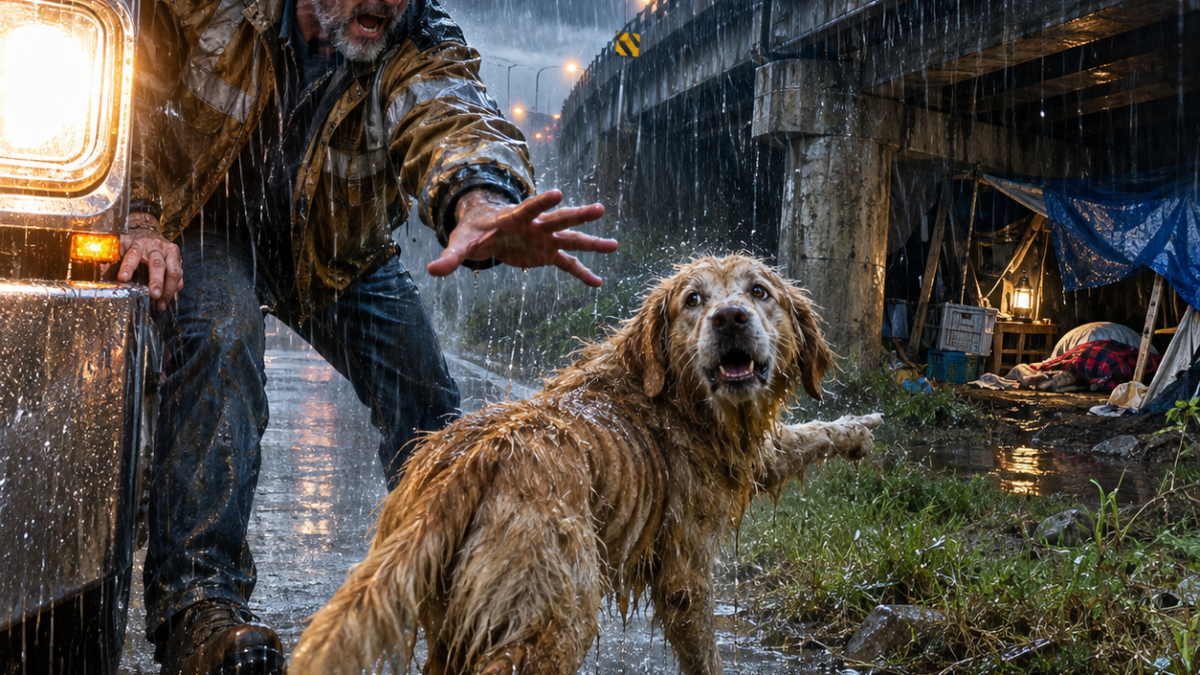
I checked my mirrors and carefully brought the truck onto a safe stretch of shoulder.
The dog stumbled backward as another vehicle passed.
For one terrifying second, I thought she would run straight under its wheels.
But she didn’t.
She turned toward my truck.
And started barking again.
I put on my hazard lights and sat there for a moment.
My dispatcher had already called twice.
I was behind schedule.
The rain was getting worse.
And I knew absolutely nothing about this dog.
Then she came closer.
She was so thin that I could see the shape of her ribs beneath her wet fur.
Her coat hung in muddy clumps.
One ear had a small tear.
Her front paws looked raw.
But her eyes—
I’ll never forget those eyes.
They weren’t simply frightened.
They were desperate.
As though she’d been waiting for someone to notice her and had finally reached the point where she couldn’t wait another minute.
I climbed down from my cab.
The rain soaked my jacket almost immediately.
“Hey, sweetheart.”
She barked.
I crouched carefully.
“Easy. I’m not going to hurt you.”
She approached.
Sniffed my hand.
Then turned and ran several yards toward the bridge.
I stood.
“Where are you going?”
She stopped.
Looked back.
Barked.
I took a step toward her.
She ran farther.
Stopped again.
Barked again.
Something about it made my stomach tighten.
She wasn’t wandering aimlessly.
She was waiting for me.
I followed her toward the grassy embankment, keeping well away from the highway traffic.
Then she suddenly rushed back, grabbed the loose fabric of my pants, and tugged.
Not hard enough to hurt.
Just enough to make me understand that she wanted me to move.
“Okay, girl.”
I looked toward the dark space beneath the bridge.
“Okay. I’m coming.”
She released me and hurried downhill.
The mud was slippery.
I nearly fell twice.
Then I heard something beneath the rain.
A tiny cry.
I stopped.
The dog barked sharply.
I moved closer.
And there, beneath the highway bridge, beside a swollen river, stood a rusted metal cage.
Water was creeping across the ground beneath it.
Something inside was moving.
Then I heard the cry again.
Small.
Weak.
Terrified.
I rushed forward.
Four puppies.
Four tiny Golden Retriever puppies huddled together inside the cage.
Their fur was soaked.
Their bodies trembled.
And the rising water was only inches from reaching them.
I looked at the mother.
She stood beside me, panting, her exhausted body shaking.
Then she pressed her nose against the cage.
One puppy lifted its head.
And the sound it made nearly brought me to my knees.
I reached for the cage door.
It wouldn’t open.
The latch was twisted and rusted.
Behind me, the river roared louder.
I looked at the mother.
Then at her babies.
And realized that if I didn’t get help immediately, I might be the last person to see them alive.
PART2
FULL STORY CONTINUATION
“Come on,” I muttered, gripping the cage latch. “Come on, damn it.”
I pulled again.
Nothing.
The door rattled, but the metal refused to give.
The puppies shrank against one another.
One was lying beneath the others, so small I could barely see its face.
The mother moved beside my elbow.
She whined, touched my hand with her nose, then pressed her muzzle against the bars.
“I know, girl.”
I swallowed hard.
“I know.”
For a moment, I considered trying to drag the entire cage uphill.
But it was heavier than it looked, partly embedded in mud, and I couldn’t safely move it alone across the slick embankment.
The river was already rising.
Another mistake could push the cage into deeper water.
I pulled out my phone.
My fingers were slippery.
I nearly dropped it.
Then I called 911.
“Emergency services. What’s the location of your emergency?”
“I’m beside the highway bridge, just off the southbound shoulder. There’s a dog and four puppies trapped in a metal cage near the river.”
The dispatcher asked for the nearest mile marker.
I gave it to her.
“Are you injured?”
“No. But the water’s rising. I can’t open the cage.”
“Do not enter the river or put yourself in danger. I’m sending assistance.”
I looked down at the puppies.
One tried to lift its head.
It couldn’t quite manage.
“Hurry,” I whispered.
The dispatcher asked me to stay on the line and move to a safe position.
I did as much as I could without leaving the cage unattended.
Then I looked toward the mother.
She had stopped barking.
Now she was standing beside the cage, watching the puppies through the bars.
Rain ran down her muzzle.
Her body shook.
And I suddenly understood something that made my chest ache.
She’d escaped.
Somehow, she’d found a way out of that cage.
She could have run into the woods.
She could have searched for shelter.
She could have saved whatever strength she had left.
Instead, she’d gone all the way up to the highway.
And stood in the rain until someone stopped.
I crouched beside her.
“You came back for them.”
She looked at me.
I reached out carefully.
“You got out, and you came back.”
She leaned against my hand.
Then turned toward the cage again.
I felt tears mix with the rain on my face.
“I’m not leaving them either.”
The next few minutes felt longer than the twelve years I’d spent driving trucks.
I kept looking up toward the highway, hoping to see flashing lights.
Then I looked back at the river.
The water was moving fast, carrying branches, leaves, and pieces of debris downstream.
Rain had swollen the current until the river no longer resembled the narrow, quiet waterway I remembered passing on earlier trips.
A thick branch struck one of the bridge supports.
The sound made me flinch.
The mother dog pressed closer to the cage.
“Easy, girl.”
I crouched beside her.
“We’ve got help coming.”
One of the puppies made a weak sound.
The mother immediately pushed her nose between the bars.
She tried licking the little face closest to her.
But the opening was too narrow.
She whimpered.
I felt something break inside me.
I’d seen plenty of abandoned animals from the highway.
Dogs wandering beside country roads.
Cats disappearing into drainage ditches.
Occasionally a box left near a rest area that made me hope it held trash rather than something alive.
I always told myself I wasn’t equipped to get involved.
I drove a commercial truck.
I worked long hours.
I lived alone.
My schedule was unpredictable.
What could I realistically do?
But now I was standing beneath a bridge, watching a mother desperately try to reach her babies.
And the excuses I’d used for years suddenly sounded terribly small.
I bent toward the cage.
“Hey, little ones.”
The puppies were huddled together.
Their eyes were partly closed.
Their wet fur clung to their tiny bodies.
They didn’t look old enough to understand anything except warmth, hunger, and the need to be close to their mother.
A little puppy near the front tried to move toward my voice.
Its paws slipped against the cage floor.
It cried.
The mother turned toward me.
For a moment, she stared directly into my face.
Then she nudged the cage door.
Again.
And again.
“I know.”
My voice cracked.
“I know exactly what you’re asking.”
I examined the latch more carefully.
The metal was bent, and part of the mechanism had seized.
I didn’t want to injure the puppies by forcing it.
There was no safe way to pull it open with my bare hands.
I looked toward the road.
Still no flashing lights.
My phone buzzed.
A message from dispatch.
Delivery ETA?
I stared at it.
Then at the puppies.
For the first time in my working life, I didn’t care about the answer.
I called my dispatcher.
“Leo, where are you?” he answered.
“Stopped near the river bridge.”
“Mechanical problem?”
“No.”
“Traffic?”
“No.”
He sighed.
“Then what’s going on?”
I looked down.
“A mother dog led me to four puppies trapped in a cage. The river’s rising. I’ve called emergency services.”
There was silence.
Then he asked, “Are you serious?”
“Yeah.”
Another pause.
“Are you safe?”
“For now.”
He exhaled.
“Okay. I’ll notify the customer and adjust the delivery. You handle what’s in front of you.”
I swallowed.
“Thanks.”
“Leo?”
“Yeah?”
“Don’t do anything reckless.”
I looked toward the cage.
“I won’t.”
When I ended the call, I felt something shift inside me.
For twelve years, I’d measured my days in hours remaining, miles traveled, and deadlines met.
Now the only clock that mattered was the water rising beneath that cage.
The first emergency vehicle arrived several minutes later.
I heard the siren before I saw the lights.
Relief hit me so hard that my knees nearly gave out.
I climbed partway up the embankment, keeping a safe distance from traffic, and waved toward the responders.
“DOWN HERE!”
Two responders approached carefully.
I pointed toward the bridge.
“Four puppies. Their mother got out somehow, but the cage is stuck.”
One of them looked toward the river.
“How high is the water?”
“It’s risen since I got here.”
They moved quickly but deliberately.
One assessed the bank.
Another inspected the cage.
Additional assistance was requested, including animal-rescue personnel equipped to handle the animals and stabilize them after removal.
The mother stayed near me.
She watched every unfamiliar person with alarm.
When a responder approached the cage, she barked sharply.
I crouched.
“Hey. Hey, sweetheart.”
She turned toward me.
“They’re helping.”
She pressed against my knee.
A responder looked at her.
“Is she yours?”
I shook my head.
“Never saw her before today.”
He glanced toward the highway.
“She came from up there?”
“Yeah. She was barking at cars.”
He looked at the puppies.
Then back at the dog.
“She led you here?”
I nodded.
The man said nothing for a moment.
Then he returned to the cage.
I stayed back while the team worked.
They had equipment I didn’t.
They understood how to control the latch and handle the animals without putting unnecessary pressure on the rusty frame.
But even as I moved away to give them room, the mother kept turning toward me.
Every time she did, I lowered my hand where she could see it.
“I’m here.”
She would look at me.
Then back at the cage.
And somehow, standing in the rain beside a dog I’d known for less than an hour, I felt responsible for keeping a promise I hadn’t even realized I’d made.
I had stopped.
I was going to see this through.
The first puppy came out wrapped in a towel.
It was so small.
That was the thought that hit me.
Not how frightened it looked.
Not how wet it was.
Just how terribly small.
The responder supported its little body as the veterinary team took over.
The mother surged forward.
I held my hand near her shoulder, careful not to restrain her roughly.
“Easy, girl. They’re taking care of your baby.”
The puppy made a tiny sound.
Its mother whined.
Then the second puppy came out.
Then the third.
The smallest was last.
For one terrible moment, I couldn’t tell whether it was breathing.
I watched the responder examine it.
My stomach turned.
“Come on,” I whispered.
“Come on, little one.”
The team worked quickly, moving the puppy into a protected, warm environment and checking it immediately.
I stood helplessly.
I’d hauled heavy machinery across state lines.
Driven through storms.
Managed breakdowns and blocked highways.
But I’d never felt so powerless as I did while waiting for a tiny puppy to move.
The mother looked toward the rescue vehicle.
Then at me.
Her body trembled.
I crouched beside her.
“Your babies are out.”
She didn’t settle.
Of course she didn’t.
She still needed to know where they were.
A responder approached us carefully.
“We need to get Mom checked too.”
I nodded.
“She’s been out in the rain a long time.”
“Looks like it.”
He examined her briefly from a safe distance.
Her ribs were visible.
Her coat was filthy.
And she had several injuries that appeared older than that afternoon.
When they moved her toward the rescue vehicle, she hesitated.
She looked at me.
Then back toward the bridge.
I stepped closer.
“Go on, girl.”
Her ears lowered.
I spoke gently.
“Your babies are in there.”
She sniffed the air.
Then followed the responder.
At the vehicle, she heard one of the puppies cry.
Her head lifted immediately.
She moved forward.
And for the first time since I’d met her, I saw something besides desperation in her face.
Recognition.
Her babies were there.
Alive.
Being cared for.
I stood in the rain and watched the team settle her safely near them.
Then I bent forward with my hands on my knees.
And cried.
I don’t know how long I stood there.
The rain had begun easing, but I barely noticed.
I remember water dripping from my jacket.
Mud clinging to my boots.
The ache in my shoulders from struggling with the cage.
And the strange emptiness that came after the immediate danger had passed.
For a while, I’d had only one goal.
Keep those puppies alive long enough for help to arrive.
Now the puppies were out.
Their mother was being examined.
The cage stood empty.
And I was suddenly aware of how close things had come.
A few more hours of rain.
A little more water.
One vehicle passing without slowing.
Another frightened driver deciding the shoulder was too dangerous.
Any of those things might have changed the outcome.
I looked toward the highway.
Cars continued passing above us.
Their tires hissed across the wet pavement.
Most of the drivers had no idea what had happened beneath the bridge.
They had somewhere to be.
Just as I had.
Somewhere in the distance, an engine roared.
The sound brought me back to myself.
My truck was still parked up the road.
I had a delivery waiting.
A dispatcher who needed an update.
A schedule that would have to be rearranged.
I should have been thinking about all of that.
Instead, I kept looking toward the mother dog.
She was sitting inside the rescue vehicle beneath a blanket.
A veterinarian was examining her.
The puppies had been placed where they could be stabilized and kept warm.
The mother lifted her head.
Through the window, her eyes met mine.
I felt another unexpected surge of emotion.
She knew me.
Or at least, she recognized the man who had stopped beside the highway.
I lifted my hand.
“Hey, girl.”
Her tail moved once.
Just once.
And somehow, that small movement meant more to me than any thank-you I’d received in years.
I was still standing near the rescue vehicle when a police investigator approached.
He looked to be in his early fifties.
His hair was beginning to turn gray, and his expression suggested a man who’d spent a long career hearing explanations that didn’t always match the evidence.
He introduced himself as Inspector Martinez.
“Are you the driver who called this in?”
I nodded.
“Leo Morgan.”
He looked toward the embankment.
“Tell me what happened.”
So I told him.
I explained the rain.
The dog near the guardrail.
How she’d barked at passing cars.
How I’d stopped.
How she’d led me beneath the bridge.
How I’d found the cage beside the rising river.
Martinez listened without interrupting.
Then he asked, “Had you ever seen this dog before?”
“No.”
“Do you know who left the cage here?”
“No.”
“Did you see anyone around it?”
I shook my head.
“Just her.”
He made a note.
Then looked toward the rescue vehicle.
“She’s the one who brought you?”
“Yeah.”
He studied the Golden Retriever through the window.
For a moment, his expression softened.
Then he asked me to walk him through exactly where I’d first found the cage, staying clear of the area officers were documenting.
I pointed toward the mud beneath the bridge.
The empty cage remained near the bank.
The water had reached the area where it had stood when I first arrived.
Martinez crouched to study the scene.
Then one of the other officers called his name.
“Inspector?”
Martinez turned.
The officer was standing beside a muddy patch near the cage.
Something dark lay partly buried in the wet ground.
A small notebook.
Its leather cover was swollen from the water.
The pages were stuck together.
Martinez approached carefully.
The officer showed him where it had been found.
They documented its position before preserving it for examination.
I watched from several yards away.
At first, I assumed it belonged to whoever had abandoned the cage.
Maybe a list of supplies.
Maybe a forgotten receipt book.
I didn’t know.
But when Martinez began examining the damaged pages as far as their condition allowed, his face changed.
He looked toward the officer.
Then back at the notebook.
I saw him pause.
Turn another page carefully.
Then say something too quietly for me to hear.
He rose.
His expression was suddenly different.
Focused.
Tense.
Almost disbelieving.
I stepped closer.
“Something wrong?”
Martinez looked toward the rescue vehicle.
Then toward the muddy cage.
Finally, he said, “Mr. Morgan, this may be much bigger than an abandoned litter.”
I stared at him.
“What do you mean?”
He held the damaged notebook carefully.
“Names.”
He looked down.
“Addresses. Phone numbers. Amounts of money.”
My stomach tightened.
He continued.
“Enough information that we’re going to have to examine whether this connects to an illegal animal operation.”
I looked toward the Golden Retriever.
She was sitting beneath the blanket.
Her exhausted eyes were fixed on her puppies.
I turned back to Martinez.
“Someone did this to her?”
His expression grew grave.
“We don’t know everything yet.”
Then he looked toward the cage again.
“But we’re going to find out.”
Martinez asked me to remain long enough to give a formal statement.
I agreed immediately.
There was no question of leaving.
The delivery could wait.
My truck could wait.
Everything I’d planned for that afternoon had become unimportant compared with the sight of those puppies trembling inside a cage.
While the officers continued their work, Martinez walked me through the events again.
Where exactly had I first seen the dog?
Which direction was she facing?
Had she appeared to be chasing vehicles?
How long had it taken her to lead me beneath the bridge?
Had I touched anything inside the cage?
Had I noticed another vehicle parked nearby?
I answered as accurately as I could.
When I didn’t know something, I said so.
I didn’t try to make the story more dramatic.
The truth was dramatic enough.
At one point, Martinez lowered his notebook.
“So let me understand this.”
I nodded.
“You were driving southbound.”
“Yeah.”
“You saw a dog barking at traffic.”
“Right.”
“You pulled over.”
“Yes.”
“And she led you down here?”
I glanced toward the rescue vehicle.
“That’s exactly what happened.”
Martinez was silent for a moment.
Then he looked toward the dog.
“I’ve been doing this job for twenty years.”
I waited.
“I’ve seen animals behave in remarkable ways.”
He shook his head.
“But I don’t think I’ve ever had a mother dog bring a stranger to a trapped litter quite like this.”
I swallowed.
“She wouldn’t stop barking.”
He nodded.
“She got you to pay attention.”
I looked toward the bridge.
“The part I can’t get over is that she escaped.”
Martinez followed my gaze.
“The cage?”
“Yeah.”
I pointed toward the rusted corner.
“She must have found a weak section. She was outside when I arrived.”
He studied the damaged frame.
Then looked back at me.
“She could have kept running.”
I nodded.
“But she didn’t.”
We stood quietly.
Above us, traffic continued moving across the highway.
Then Martinez said something that stayed with me.
“Sometimes survival isn’t the same thing as saving yourself.”
I looked at him.
He nodded toward the mother.
“She couldn’t leave those puppies.”
I felt my throat tighten.
“No.”
I looked at the rescue vehicle again.
“She couldn’t.”
The veterinary assessment was difficult to hear.
The mother was severely underweight.
She was dehydrated.
Her paws were injured.
Her coat and skin showed signs of prolonged neglect.
There were wounds that appeared older than that day’s struggle.
The veterinarian believed she’d been living in poor conditions for some time.
The puppies were exhausted and cold, and their small bodies needed careful stabilization.
I watched the rescue team prepare them for transport.
The mother became anxious whenever she lost sight or sound of her litter.
But she was too weak to stand for long.
When a responder gently helped her settle, she lowered herself with a sigh that sounded almost human.
I approached the open side of the vehicle after asking permission.
“Hey, girl.”
Her eyes moved toward me.
I knelt where she could see me.
“You did it.”
She blinked.
“Your babies are safe.”
Of course, I couldn’t know how much of my voice she understood.
But I kept talking anyway.
Because she had spent hours trying to make strangers understand her.
And it seemed only right that someone should speak gently to her now.
The veterinarian joined me.
“She’s a fighter.”
I looked up.
“Is she going to be okay?”
“She’s in rough shape. We’ll need further assessment and treatment, and the puppies will need close monitoring.”
I swallowed.
“But they have a chance?”
He nodded.
“They’re receiving care now. That’s important.”
I looked at the mother.
Her eyes were half closed.
The veterinarian continued.
“She clearly worked hard to get help.”
I glanced toward the embankment.
“Her paws were bleeding when I saw her.”
He nodded.
“The injuries are consistent with a dog who’s been moving over rough ground.”
I lowered my head.
Then asked, “Do you think she was out there long?”
“We can’t know exactly.”
He looked toward the highway.
“But she didn’t give up easily.”
I swallowed.
“No.”
The dog moved her head slightly toward my hand.
I stroked the uninjured fur along her neck.
“No, she sure didn’t.”
Before the rescue vehicle left, I asked where they were taking the family.
The responder gave me the name of the shelter coordinating their care.
I repeated it under my breath so I wouldn’t forget.
Then I wrote it in my phone.
“Can I call for updates?”
The woman smiled.
“I don’t see why not, though there may be restrictions while they’re receiving treatment or while the investigation continues.”
I nodded.
“That’s fine.”
She looked at me.
“You really care about this dog, don’t you?”
The question caught me off guard.
I’d only known the Golden Retriever for a few hours.
Before that afternoon, I had never seriously considered owning a dog.
I didn’t have a leash in my truck.
Or a bag of dog food at home.
Or a yard prepared for a pet.
I barely had time to remember to buy groceries between long trips.
But when she looked at me through the vehicle window, I felt something I couldn’t explain.
I nodded slowly.
“Yeah.”
The responder smiled.
“Then call.”
I stepped back as they closed the doors.
The vehicle pulled away carefully.
For a moment, the mother remained visible through the rear window.
She was lying beneath a blanket.
Her head lifted once.
Then she disappeared from view as the vehicle climbed the road.
I stood beneath the bridge until the engine faded.
And suddenly, the place felt unbearably empty.
The cage was still there.
The mud.
The river.
The scattered debris.
But the little family was gone.
For the first time that day, I allowed myself to hope the next time I saw them would be somewhere warm.
Somewhere dry.
Somewhere safe.
I returned to my truck after completing the statement.
My boots were coated in mud.
My jacket was soaked.
My hands smelled of wet metal and dog fur.
When I climbed into the cab, the familiar interior felt strange.
Everything was exactly where I’d left it.
My coffee cup in its holder.
The navigation screen.
The folded paperwork beside the passenger seat.
A spare jacket behind me.
The old radio that sometimes picked up stations from towns I couldn’t pronounce.
For twelve years, the cab had been the most familiar place in my life.
It was where I ate.
Rested during breaks.
Listened to music.
Talked to dispatchers.
And spent countless hours alone.
Usually, when I climbed behind the wheel, I felt comfortable.
The road made sense to me.
There was a route.
A schedule.
A destination.
But that afternoon, I sat there staring at the empty passenger seat.
I could still see the Golden Retriever standing in the rain.
I could hear her barking.
I could feel the light tug on my pant leg.
I remembered the way she’d looked back every few yards to make sure I was following.
And something about the empty seat bothered me.
I didn’t understand why.
I’d never owned a dog.
Never wanted the responsibility.
Never believed my life had room for another living creature depending on me.
Yet now, when I thought about driving away, I found myself wondering whether I’d ever see her again.
I started the engine.
Checked my mirrors.
And pulled carefully back onto the highway.
The rain had slowed to a drizzle.
Traffic was moving steadily.
The world looked almost normal.
But I wasn’t the same man who’d driven onto that shoulder.
That night, I slept in the cab at a truck stop.
Or tried to.
I ate dinner at a small table near the window, surrounded by people talking about weather, freight rates, and road construction.
Usually, I enjoyed those conversations.
Drivers have a way of becoming temporary friends.
You meet somebody in Arkansas, share a complaint about a closed highway, then see him six months later at a fuel station in Ohio.
You might not know his last name.
But you understand his work.
That night, I barely listened.
I kept looking at my phone.
There were no updates from the shelter.
I knew it was late.
I knew the staff had more important things to do than reassure a truck driver they’d met only once.
Still, I checked.
Again.
And again.
When I finally returned to my cab, I opened the photograph I’d taken of the mother dog before the responders arrived.
She was standing beside the cage.
Her coat hung wet and heavy.
Her ribs were visible.
Her head was lowered toward the bars.
I stared at it.
Then enlarged the image.
Her eyes were fixed on the puppies.
Not on me.
Not on the river.
Not on the highway.
Her babies.
I leaned back against the seat.
And thought about how little I understood that kind of devotion.
I’d spent most of my adult life avoiding attachments because I believed they would interfere with my freedom.
If you don’t depend on anyone, you don’t have to worry about being let down.
If nobody depends on you, you can’t fail them.
That had seemed sensible.
Efficient.
Safe.
But the dog in the photograph had done the opposite.
She had almost nothing left.
She was weak.
Hungry.
Injured.
And she could have escaped alone.
Yet she’d chosen to return.
To stay close.
To find help.
To keep trying until someone listened.
I looked toward the empty passenger seat.
Then whispered into the quiet cab, “I hope you’re okay, girl.”
I didn’t know it then.
But that was the first night in twelve years that my loneliness had a shape.
It looked like an empty seat where a Golden Retriever might someday sit.
Over the following days, I tried to return to my usual routine.
I delivered the delayed load.
Accepted another assignment.
Drove through long stretches of highway where the scenery changed so slowly it felt as though the world were standing still.
But my mind kept returning to the bridge.
Whenever rain struck the windshield, I remembered her.
Whenever I passed a river, I glanced toward the embankment.
Whenever I saw an animal near the road, I slowed down and checked whether it appeared to need help.
My dispatcher called me one afternoon.
“Leo, you all right?”
“Yeah.”
“You’ve been quiet.”
I laughed.
“I’m usually quiet.”
“Not like this.”
I watched a line of trucks pass on the opposite side of the interstate.
“Just thinking about something.”
“The dogs?”
I smiled faintly.
“Yeah.”
He paused.
“Any news?”
“Not yet.”
“Well, I hope they’re okay.”
I swallowed.
“Me too.”
After the call, I looked at the shelter’s number on my phone.
I’d already called once and been told the animals were receiving veterinary care.
I didn’t want to bother the staff unnecessarily.
But by the third day, I couldn’t stand not knowing.
I called again.
A woman answered.
I explained who I was.
There was a pause.
Then her voice warmed.
“Oh. You’re the truck driver.”
I sat straighter.
“Yeah. Leo Morgan.”
“The one who found the mother and puppies?”
“Yes.”
I swallowed.
“How are they?”
“They’re being cared for, and the mother is improving.”
I closed my eyes.
“And the puppies?”
“All four are still receiving care.”
I exhaled.
For a moment, I couldn’t speak.
The woman waited patiently.
Then I asked, “Could I come see them?”
She explained that visits had to be coordinated and the animals’ health and the investigation came first.
I agreed immediately.
Then she said, “We can arrange a short visit.”
My heart lifted.
“When?”
We settled on a time.
I thanked her.
Then sat in silence after the call ended.
Three days earlier, I’d been an exhausted truck driver who wanted to finish his route.
Now I was rearranging my schedule to visit a dog I didn’t own.
And for the first time, I didn’t think that was strange.
I thought it was necessary.
The shelter sat on a quiet road beyond the center of town.
It wasn’t a large building.
The parking lot was simple.
There were trees near the entrance and a small fenced exercise area behind the main rooms.
I arrived earlier than I needed to.
Then stood beside my truck, staring at the front door.
I didn’t know why I was nervous.
I’d helped rescue the dogs.
The staff knew who I was.
They’d agreed to the visit.
Yet I felt like a man preparing to ask a question he was afraid to hear answered.
Finally, I walked inside.
A woman behind the reception desk looked up.
“Can I help you?”
I cleared my throat.
“I’m looking for the Golden Retriever.”
She smiled.
“The mother from the highway bridge?”
“Yes.”
“Leo Morgan?”
I nodded.
She stood.
“We’ve been expecting you.”
I followed her down a hallway.
Dogs barked from somewhere in the building.
I smelled clean bedding, food, and disinfectant.
The woman spoke as we walked.
“She’s doing better. Still weak, but improving.”
I nodded.
“And the puppies?”
“They’ve needed close attention, but they’re here.”
I swallowed.
“Thank God.”
She stopped outside a quiet room.
Then smiled.
“Ready?”
I looked at the door.
For a moment, I couldn’t answer.
Then I nodded.
“Yeah.”
She opened it.
And there, lying on a large soft cushion, was the Golden Retriever.
Her fur had been cleaned.
Her injuries were being treated.
A blanket covered part of the bed.
And nestled close beside her were four tiny puppies.
Clean.
Warm.
Sleeping.
I stopped in the doorway.
My chest tightened.
The mother lifted her head.
For a long moment, she stared at me.
Then her tail moved.
Once.
Twice.
She rose carefully.
Walked toward me.
And sat down at my feet.
I crouched.
“Hey, girl.”
She leaned forward.
Then placed her head against my knee.
Exactly the way she’d rested against me beneath the bridge when the rescue team was working.
I closed my eyes.
“Oh, sweetheart.”
My voice broke.
“You remember me.”
She sighed.
A long, tired sigh.
Then pressed a little closer.
And for the first time since I’d found her in the rain, I was able to hold her without the sound of rising water behind us.
The shelter worker stepped back to give us a moment.
I knelt on the floor with the Golden Retriever’s head resting against my leg.
Up close, I could see just how much care she still needed.
There were areas of irritated skin beneath her fur.
Her body was thinner than it should have been.
And when she shifted her weight, she moved carefully, protecting her sore paws.
But she was clean.
She was warm.
And for the first time, her eyes didn’t look as though she expected the world to hurt her again.
I scratched gently behind her ear.
“You scared me, you know that?”
Her tail brushed the floor.
I laughed through the tightness in my throat.
“Yeah. You did.”
She lifted her muzzle.
For a moment, our eyes met.
Then she leaned closer.
I placed one hand against her shoulder.
“I’ve been thinking about you.”
She sighed.
I looked toward the puppies.
One had rolled partly onto its back, exposing a round little belly.
Another slept with its nose pressed against a sibling’s neck.
A third stirred and crawled closer to their mother.
And the smallest was tucked against the blanket, breathing steadily.
I stared.
“Look at them.”
The shelter worker smiled.
“They’ve come a long way since they arrived.”
I nodded.
“They were so cold.”
“I know.”
I looked toward the mother.
“And she was trying so hard.”
The woman crouched beside me.
“She still checks on them constantly.”
I smiled.
“I bet she does.”
“When one cries, she’s immediately alert.”
I watched the mother lift an ear as a puppy made a small sound.
She turned her head.
Checked the litter.
Then looked back at me.
Something warm spread through my chest.
I couldn’t tell whether she remembered the bridge in any human sense.
But I could see that she no longer had to press her muzzle through rusted bars to reach her babies.
They were beside her.
Safe enough to sleep.
Warm enough to rest.
And that was everything she’d fought for.
The worker asked whether I’d like a chair.
I shook my head.
“I’m fine down here.”
She smiled.
“I thought you might say that.”
For a while, we talked quietly.
She told me the veterinary team was monitoring the mother’s recovery and making sure the puppies received the care they needed.
The shelter wasn’t rushing them into adoption.
The mother needed time to recover physically.
The puppies needed to grow, become healthy, and reach the appropriate stage before moving to permanent homes.
I was grateful.
Part of me wanted to take every one of them home immediately.
That surprised me.
I’d never imagined myself responsible for one dog.
Now, sitting beside a mother and four puppies, I was picturing what it would be like to make space for five.
Then reality returned.
A small house.
A trucking schedule.
Long stretches away from home.
No experience caring for puppies.
And no way to guarantee that all five would receive everything they needed.
I looked toward the shelter worker.
“What happens when they’re ready?”
“We’ll look for suitable homes through our normal adoption process.”
I nodded.
“All four?”
“Yes, when they’re old enough and cleared for adoption.”
I swallowed.
“And their mother?”
The woman looked toward the Golden Retriever.
“She’ll need a home too.”
I stroked the dog’s neck.
Her eyes were partly closed.
I felt an unexpected ache.
The thought of her sitting in a kennel after everything she’d endured seemed almost unbearable.
But I wasn’t ready to say anything.
Not yet.
I hadn’t figured out what kind of life I could offer her.
I only knew I didn’t want her to feel abandoned again.
The shelter worker asked whether the mother had a name when I found her.
I shook my head.
“No collar. No tag. Nothing.”
“We’ve been using a temporary intake name.”
I looked down at the dog.
She was resting comfortably against my leg.
I thought about the highway.
The storm.
The barking.
The rusted cage.
And the moment she turned back toward me, refusing to continue until I followed.
A name came to me before I had time to think it through.
“Hope.”
The woman looked at me.
“What?”
“I’d call her Hope.”
The Golden Retriever lifted her head.
I smiled through tears.
“Because she didn’t give up.”
The worker was quiet for a moment.
Then she smiled.
“Hope.”
I nodded.
“That’s the only name that feels right.”
I looked toward the dog.
“What do you think, girl?”
Her tail moved.
I laughed.
“Hope it is.”
The shelter worker gently touched the dog’s back.
“Well, Hope, you’ve got yourself a pretty good name.”
I looked toward the puppies.
Four little bodies curled against their mother.
Four lives she’d refused to surrender.
Then I looked back at her.
She’d survived long enough to get out of the cage.
Run to the highway.
And persuade a stranger to follow her into the rain.
She had earned a name that meant something.
Hope.
Not because everything had always been good.
But because even when nothing seemed good, she had kept trying.
I stayed as long as the shelter’s schedule allowed.
Before leaving, I sat beside Hope one more time.
She was lying with the puppies.
I crouched.
“I’ve got to go, girl.”
Her eyes opened.
I stroked her head.
“I know.”
She lifted her muzzle.
I swallowed.
“I have a truck waiting.”
The words sounded ridiculous.
Of course she didn’t understand what a delivery schedule was.
Or why the man who’d followed her beneath the bridge couldn’t sit on the floor forever.
But I still felt the need to explain.
I rubbed behind her ears.
“I’ll come back.”
Hope rested her chin against my hand.
I smiled sadly.
“I promise.”
Then I stood.
She watched me walk toward the door.
I glanced back.
Her head was raised.
Her eyes followed me.
I hesitated.
Then stepped outside.
And I carried that image all the way to my truck.
The first time I returned to the shelter, I told myself it was to check on the puppies.
The second time, I admitted I wanted to see Hope.
By the third visit, the staff no longer asked why I was there.
They simply smiled.
“She’s in the back, Leo.”
I began arranging visits around my driving schedule.
Sometimes I could stay only a short while.
Other times, when my route brought me through town, I had enough time to sit with her and talk.
I told her about places I’d driven.
Long highways through Nebraska.
Morning fog in the Tennessee hills.
The desert sunsets out west.
Snowstorms that forced me to park for hours.
Rest areas where the coffee tasted like burnt rubber.
She listened.
Or at least, she stayed beside me while I talked.
And that was more than I’d had in years.
I hadn’t realized how rarely I spoke to anyone without needing something.
Dispatch calls were about schedules.
Customer calls were about deliveries.
Conversations at truck stops were about traffic and weather.
My life was full of voices.
But not many of them belonged to people I expected to see again.
Hope didn’t ask me where I’d been.
Didn’t care whether I was late.
Didn’t look disappointed when I talked too much about the road.
She simply settled near me and let me rest a hand against her warm fur.
And gradually, visiting her became the part of my week I looked forward to most.
Her recovery wasn’t immediate.
Some days, she seemed tired.
Other days, she was more alert.
The veterinary team continued managing her medical needs.
She slowly gained strength.
Her appetite improved.
The wounds on her paws healed.
Her coat began looking healthier.
And the desperate exhaustion I’d seen beneath the bridge gradually gave way to something calmer.
I remember one afternoon when she picked up a soft toy.
The shelter worker brought it into the visiting area.
Hope sniffed it.
Then took it gently in her mouth.
She stood there for a moment, as though trying to remember what she was supposed to do with it.
Then she brought it toward me.
I stared.
“Well, look at you.”
Her tail moved.
I reached for the toy.
She held it for another second.
Then released it.
I laughed.
“Are we playing?”
She lowered her front half slightly.
Not quite a full play bow.
But close.
I tossed the toy a few feet.
Hope followed it.
Picked it up.
Then came back.
The worker standing beside the door smiled.
“That’s new.”
I looked up.
“What?”
“She hasn’t done much playing.”
I looked toward Hope.
The toy was hanging from her mouth.
Her tail moved steadily.
For a moment, I remembered the dog who’d stood in the rain without enough strength to stop trembling.
Now she wanted to play.
I held out my hand.
“Come on, girl.”
She dropped the toy.
And I laughed so loudly that someone in the hallway looked through the door to see what was happening.
The puppies grew stronger too.
At first, they spent most of their time sleeping and staying close to their mother.
Then they began exploring.
Tiny steps.
Clumsy turns.
Little noses sniffing the edges of blankets.
They tumbled into one another, crawled over Hope’s legs, and occasionally seemed surprised to discover they had paws.
I’d never spent much time around puppies.
I had no idea how entertaining four tiny dogs could be.
One was bold enough to investigate everything.
Another preferred to stay close to Hope.
A third seemed to sleep through every opportunity to explore.
And the smallest, once so weak in the cage, became determined to follow whichever sibling was moving fastest.
I watched them one afternoon and shook my head.
“You four have no idea what your mom went through.”
Hope was resting beside them.
Her eyes followed their movements.
I crouched and stroked her shoulder.
“They’re going to have good lives, girl.”
She looked at me.
I smiled.
“That’s what we’re working toward.”
As the puppies reached the appropriate age and health for adoption, the shelter began reviewing prospective families.
The staff took the process seriously.
They checked that the homes were suitable.
They spoke with the applicants about the responsibilities of caring for a dog.
And they made sure the puppies were ready before moving them away from their mother.
I was grateful for every careful decision.
I knew what happened when animals were treated like products.
The rusted cage beneath the bridge had made that clear enough.
I wanted these puppies to be loved.
Not bought impulsively.
Not displayed.
Not forgotten when they grew larger and more demanding.
Loved.
The way their mother had loved them when they had nothing.
The first puppy went home with a family who’d been preparing for a dog for months.
I met them briefly during one of my visits.
They seemed gentle and excited.
The puppy was tucked safely in its carrier, looking bewildered by all the attention.
I watched them leave.
Then looked toward Hope.
She was resting in the shelter’s quiet area.
I felt a strange mixture of happiness and sadness.
One baby had a home.
Three remained.
The shelter staff helped Hope adjust as the puppies gradually transitioned to their new homes at the appropriate time.
I worried about her.
Of course I did.
But the workers monitored her carefully, and she continued receiving attention and care.
The next puppy was adopted.
Then another.
And eventually, the fourth.
One by one, all four found families.
Four tiny lives that had once trembled in rising water beneath a highway bridge were now sleeping in warm houses.
Being fed.
Being held.
Learning to play.
Learning that a human hand could mean affection instead of harm.
I couldn’t stop thinking about it.
The mother had spent every ounce of strength trying to keep her puppies alive.
Now they had futures.
Actual futures.
Full of things they hadn’t known existed when I first opened the door of the rescue vehicle.
Beds.
Toys.
Warm kitchens.
Families who would celebrate the sound of their paws running across the floor.
I felt proud of Hope.
But when the last puppy went home, I noticed the empty space beside her.
And suddenly, another thought became impossible to ignore.
Who was going to take care of her?
The shelter director asked to speak with me one afternoon.
I’d just finished a visit with Hope.
She’d been particularly affectionate, spending most of the time with her head resting on my leg.
When I stood to leave, she followed me toward the door.
I smiled.
“Not yet, girl.”
She sat beside the doorway.
The director watched us.
Then said, “Mr. Morgan, do you have a minute?”
I nodded.
“Sure.”
She invited me into her office.
I sat across from her desk, feeling oddly nervous.
For a moment, I wondered whether I’d been visiting too often.
Maybe the staff thought I was interfering with Hope’s routine.
Maybe they needed to limit the visits now that the puppies had been adopted.
Then the director smiled.
“Hope seems very attached to you.”
I looked down.
“I guess I am too.”
She nodded.
“We’ve noticed.”
I smiled faintly.
“She was there when I came through the door today.”
“She often waits near the entrance when you’re expected.”
My chest tightened.
“Really?”
The director nodded.
“And when you leave, she tends to watch the door for a while.”
I swallowed.
I remembered the first visit.
How Hope had risen from her cushion and placed her head on my knee.
How she’d followed me with her eyes when I left.
The director leaned forward.
“Have you ever considered adopting her?”
The question hit me like a sudden gust of wind.
I stared.
“Me?”
She smiled.
“Yes.”
I opened my mouth.
Then closed it.
“I’ve never had a dog.”
“I understand.”
“And I’m a truck driver.”
“You’ve mentioned that.”
“My schedule’s all over the place.”
She nodded.
“Those are real considerations.”
I rubbed my forehead.
“I can be gone for days.”
“Then we’d need to know how she’d be cared for. This shouldn’t be an impulsive decision.”
I looked toward the doorway.
Somewhere beyond it, Hope was waiting.
The director continued.
“She deserves a stable, suitable home. The question is whether you can provide one.”
I was quiet.
Then I admitted something I’d never said aloud.
“I think about her every time I’m on the road.”
The director waited.
I continued.
“I look forward to seeing her more than anything.”
My voice grew rough.
“I didn’t think I had room for a dog.”
I swallowed.
“But now I can’t imagine never seeing her again.”
The director smiled gently.
“Then perhaps it’s worth finding out whether your life can make room.”
I went home that evening and sat at my kitchen table with a notebook.
I’d never made a serious plan for owning a dog before.
Now I began writing down everything I’d need to consider.
Veterinary care.
Food.
Exercise.
A safe place to rest.
What would happen when I was on long routes.
Whether my company allowed pets in the truck.
Who could look after Hope if I had to take a run she couldn’t join.
Whether my small house and yard were suitable.
How to keep her comfortable during travel.
What routines would help her adjust after everything she’d endured.
The list was longer than I expected.
And for once, that didn’t discourage me.
It made me feel hopeful.
I’d spent years assuming my work left no space for another life.
But I’d never actually tried to build that space.
I’d simply decided it didn’t exist.
Now I made calls.
I spoke with my company about its pet policies.
I contacted people I trusted about helping with care when necessary.
I considered which routes might be suitable for a dog and which would not.
I asked the shelter staff about Hope’s needs and ongoing veterinary follow-up.
I didn’t want to adopt her because of one emotional afternoon.
I wanted to adopt her because I could give her a good life.
A safe one.
A life where she’d never again have to stand in the rain begging strangers to notice her.
It took more planning than I expected.
But every step made the possibility feel more real.
And with each day, I found myself wanting it more.
When the arrangements were finally in place, I returned to the shelter.
The director met me near reception.
“Leo.”
I smiled.
“Hi.”
She looked at the folder in my hand.
“What’s all this?”
“Everything we discussed.”
I sat with her and reviewed the plan.
We talked about my work schedule.
The times Hope could accompany me.
The arrangements for when she couldn’t.
The veterinary care she’d need.
And the importance of keeping her routine predictable as she settled into a new home.
The director listened carefully.
Then asked questions.
Some were easy.
Others made me think.
I answered honestly.
If something needed adjustment, I was willing to adjust it.
Eventually, she closed the folder.
Then looked at me.
“You’ve thought this through.”
I nodded.
“More than anything I’ve thought through in a long time.”
She smiled.
“Are you ready?”
My heart began pounding.
“For what?”
She laughed softly.
“To adopt Hope.”
I stared at her.
Then looked toward the hallway.
For a moment, I couldn’t speak.
Finally, I whispered, “Yeah.”
My voice cracked.
“Yeah, I am.”
I brought Hope home on a Friday evening.
I remember the date not because I wrote it down, but because the whole day felt different.
I’d spent years returning to an empty house after long stretches on the road.
Usually, I’d park, carry my bags inside, check the mail, and sit down in front of the television.
Sometimes I wouldn’t speak a full sentence aloud until the next morning.
That Friday, I wasn’t coming home alone.
Hope had been fitted with a comfortable collar and properly secured for the drive.
The shelter had sent her with care information, familiar items to ease the transition, and everything I needed for the first days.
I thanked the staff.
The director hugged me.
Then she crouched beside Hope.
“You be good, sweetheart.”
Hope wagged her tail.
The woman smiled through tears.
“Go enjoy your home.”
I led Hope carefully toward the vehicle.
She sniffed the air.
Looked toward the shelter.
Then up at me.
I smiled.
“Come on, girl.”
We got settled.
I started the engine.
And as we pulled away, I glanced toward her.
She was sitting comfortably, watching the world through the window.
Her ears moved at every new sound.
Her nose worked constantly, taking in unfamiliar smells.
But she wasn’t trembling.
She looked curious.
I laughed softly.
“Quite a change from the bridge, huh?”
Her tail moved.
I smiled.
“Yeah.”
I looked toward the road.
“We’ve both had quite a change.”
Hope explored my house one room at a time.
I opened the front door, kept her close, and allowed her to sniff without rushing her.
The house was small.
A living room.
A kitchen.
Two bedrooms.
A narrow hallway.
A little yard behind the house.
I’d lived there for years, but standing in the doorway with Hope, I suddenly noticed how empty it looked.
There was nothing wrong with it.
Everything was clean.
The furniture was comfortable enough.
The kitchen worked.
The roof didn’t leak.
But there were almost no signs of another living creature.
No toys.
No blankets on the couch.
No muddy paw prints near the back door.
No water bowl beside the kitchen wall.
Until that evening.
I’d set up a comfortable place for Hope to sleep.
Her bowls were ready.
A familiar blanket from the shelter lay near her bed.
And a few toys waited in the corner.
She sniffed everything.
Checked the hallway.
Walked into the kitchen.
Returned to the living room.
Then stood in the middle of the floor and looked at me.
For a moment, neither of us moved.
I smiled.
“Well?”
Her tail began wagging.
Slowly at first.
Then faster.
I laughed.
“Does it pass inspection?”
She walked toward me.
Pressed her head against my leg.
And sighed.
I bent down.
“Welcome home, Hope.”
Her tail thumped against the floor.
I felt my eyes fill.
Then I added something I hadn’t planned to say.
“You don’t ever have to beg someone to stop for you again.”
I stroked her head.
“I’m already here.”
That first night, I sat on the couch while Hope settled on the blanket beside me.
The television was on.
I couldn’t have told you what was playing.
I kept looking down at her.
Every few minutes, she’d lift her head to check where I was.
Then she’d relax again.
At one point, I reached for my coffee.
Hope raised her ears.
I laughed.
“Just getting a drink, girl.”
She watched me.
I set the mug down.
Then rested my hand on her back.
She sighed and closed her eyes.
I sat there for a long time.
And I realized how much my life had changed without anything about the house changing at all.
The same walls.
The same couch.
The same quiet street outside.
But the silence felt different.
It wasn’t an empty silence anymore.
It was the sound of a dog sleeping safely beside someone who cared about her.
I looked toward the window.
Rain had begun tapping softly against the glass.
Hope opened her eyes.
I watched her carefully.
For a moment, her ears shifted.
Then she looked at me.
I stroked her shoulder.
“It’s okay.”
She lowered her head again.
The rain continued.
But there was no rusted cage.
No rising river.
No highway traffic.
Only a little house.
A warm blanket.
And a man who still couldn’t believe he’d been lucky enough to bring her home.
The investigation into the notebook continued for months.
Martinez contacted me several times for clarification about the original rescue.
He needed details about the cage.
The location.
The dog’s behavior.
Anything I’d noticed that might help establish how the animals came to be abandoned beneath the bridge.
I told him everything I could remember.
He didn’t share every detail of the investigation.
And I didn’t expect him to.
But eventually, the broader picture became clear.
The water-damaged notebook had contained information connected to an illegal dog-breeding and trafficking operation.
Names.
Addresses.
Telephone numbers.
Financial transactions.
Records that investigators were able to compare with other evidence.
The network had been moving animals across state lines.
Dogs were bred and sold under false documents.
Animals were kept in cruel, unsanitary conditions.
And dogs that could no longer produce valuable litters were sometimes discarded.
Hope was believed to be one of those dogs.
I remember the day Martinez explained that part.
I was sitting at my kitchen table.
Hope was lying beside my chair, chewing a toy.
The inspector’s voice came through the phone.
“Leo, the evidence suggests her previous handlers no longer considered her useful.”
My stomach tightened.
“What?”
He explained what investigators had established.
I looked down at Hope.
Her coat was clean now.
Her body was stronger.
She was comfortable enough to fall asleep in my presence.
I couldn’t reconcile the dog in front of me with the idea that someone had treated her as disposable.
“She had four puppies,” I said quietly.
Martinez paused.
“I know.”
“They were alive.”
“Yes.”
I swallowed.
“How could someone put them in a cage beside a rising river?”
He didn’t answer immediately.
Then he said, “That’s part of why we’re pursuing the people responsible.”
I looked toward Hope.
She raised her head.
Her tail moved at the sound of my voice.
I stroked her ears.
For a moment, I couldn’t speak.
I’d spent years believing I’d seen the worst kinds of human carelessness from the highway.
But there was a difference between carelessness and deliberately abandoning helpless animals where rising water could kill them.
Hope had been treated like something that no longer mattered.
Yet she’d fought as though every life in that cage mattered more than her own.
I looked at her.
And felt a fierce, protective love I hadn’t known I was capable of.
The case expanded.
Investigators followed the connections in the notebook and developed additional evidence.
The network had operated for years, moving dogs between states and using falsified records to disguise its activities.
As the investigation progressed, authorities identified more locations and more people involved.
Eventually, dozens of people were arrested.
More than a hundred animals were freed from cruel conditions.
I learned those details gradually through the updates Martinez could share and the public reporting that followed.
Every time I heard about another group of dogs being rescued, I looked toward Hope.
Sometimes she was lying on her bed.
Sometimes she was sitting beside the window.
Sometimes she was following me around the kitchen, hoping I’d drop a piece of food.
She had no idea her desperate actions beside the highway had helped lead investigators to information about so many other animals.
She hadn’t known about the notebook.
She hadn’t known about the names or addresses.
She’d simply wanted her puppies to survive.
But in refusing to give up, she’d brought a stranger to a place where evidence had been left behind.
And that evidence had helped expose a larger operation.
One afternoon, Martinez called with an update.
I stepped outside to answer.
Hope followed me onto the porch.
“Leo,” he said, “I wanted you to know that another group of animals has been removed from one of the locations.”
I looked toward Hope.
“Are they safe?”
“They’re receiving care.”
I took a breath.
“Good.”
Martinez paused.
“Your call that day was important.”
I shook my head even though he couldn’t see me.
“I just stopped.”
“That’s what started it.”
I looked toward the yard.
Hope was sniffing the grass.
I smiled faintly.
“Actually, Inspector, I think the dog started it.”
Martinez laughed quietly.
“Fair enough.”
I glanced toward her.
“She was the one who wouldn’t quit.”
He was silent for a moment.
Then said, “Maybe you both deserve some credit.”
I looked down at my muddy work boots.
“No.”
My voice softened.
“She deserves the credit.”
Life with Hope was not always effortless.
I think that’s important to say.
Loving a dog doesn’t remove the responsibilities that come with caring for one.
She needed regular meals.
Exercise.
Veterinary visits.
A safe routine.
And attention.
Some days, my work schedule was complicated.
There were routes she couldn’t join.
There were weather conditions that required extra planning.
There were times when I depended on arrangements I’d made for her care while I was away.
And there were moments when I worried whether I was doing everything right.
But those responsibilities no longer felt like reasons not to love someone.
They felt like part of loving her.
When I came home from a long trip, Hope would hear my truck before I reached the driveway.
I’d barely set the parking brake before I imagined her waiting inside.
And when I opened the door, there she was.
Tail wagging.
Eyes bright.
Her entire body moving with excitement.
I would crouch.
“Hey, girl!”
She’d press herself against me.
I would laugh, drop my bag, and scratch behind her ears.
“Miss me?”
Her tail would beat harder.
“Yeah.”
I’d smile.
“I missed you too.”
Then we’d go inside.
And the house that had once felt like a place to store my belongings became somewhere I genuinely wanted to return.
My company eventually allowed Hope to accompany me on certain routes.
Not every route.
Not every trip.
Only the ones we could manage safely and appropriately under company rules.
But it changed my working life in ways I hadn’t expected.
I made sure she had secure travel arrangements, water, appropriate rest breaks, and care during stops.
I learned to plan differently.
Not simply around fuel, delivery times, and traffic.
But around another living creature’s needs.
At first, I worried she might dislike the truck.
After all, the highway was where I’d found her.
Rain.
Noise.
Passing vehicles.
The frightening memory of being alone beside the road.
But with gradual, comfortable introductions and careful routines, she adjusted to suitable trips.
Before long, she seemed to enjoy watching the world from her designated place.
Her nose would work whenever we stopped.
Her ears would lift at unfamiliar sounds.
Sometimes she’d settle and sleep for long stretches.
Other times, she’d look toward me as if asking whether it was time for another break.
I talked to her constantly.
“There’s the next town, girl.”
She’d lift her head.
“Nothing special. Just a fuel stop.”
Her tail would move.
“Yeah, I know. Everything’s exciting to you.”
I laughed more on those trips than I had in years.
Sometimes I caught myself singing along to the radio.
Sometimes I told her stories about the roads I’d traveled before I met her.
And occasionally, during a quiet stretch of highway, I’d glance toward her and feel a strange pressure in my chest.
Because a dog once abandoned beside a river was now traveling safely through the country with a man who’d spent years thinking he didn’t need anyone.
Neither of us had expected this life.
But there we were.
Together.
Other drivers began recognizing her.
At first, they asked ordinary questions.
“Is that your dog?”
“Yeah.”
“Golden Retriever?”
“Yep.”
“What’s her name?”
“Hope.”
Then someone would ask how I’d gotten her.
And I’d tell them.
Not always the entire story.
Sometimes there wasn’t time.
But I always told them about the rain.
The highway shoulder.
The way she barked at cars.
The rusted cage.
Her four puppies.
And how she refused to leave until someone followed.
Some drivers went quiet.
Others shook their heads in disbelief.
A few asked to see photographs.
I had plenty.
Hope under the bridge.
Hope at the shelter.
Hope with her puppies.
Hope sitting in my living room.
Hope asleep after a long walk.
I showed them the changes.
The thin, frightened dog she’d been.
And the healthy, peaceful dog she’d become.
One older driver stood beside my truck at a rest stop, studying a photograph of Hope lying on my couch.
Then he looked at her.
“That’s the same dog?”
I nodded.
“Same girl.”
He shook his head.
“Hard to believe.”
I smiled.
“Tell me about it.”
He looked toward the highway.
“Glad you stopped.”
I glanced at Hope.
She was sitting calmly beside me.
I reached down and touched her head.
“Me too.”
The letter arrived on an ordinary afternoon.
I was home between routes, sorting through bills and advertisements at the kitchen table.
Hope lay beside my chair.
She’d finished a walk and was resting with her head across my foot.
Most of the mail was exactly what I expected.
An insurance notice.
A utility bill.
A flyer from a local hardware store.
Then I found a small envelope with a handwritten address.
I didn’t recognize the name.
There was no company logo.
No return address I knew.
I turned it over.
Hope lifted her head as the paper rustled.
“What’s this, girl?”
She blinked.
I opened the envelope.
Inside was a letter.
And a photograph.
I looked at the photograph first.
A little girl sat on the grass with her arms around a beautiful young Golden Retriever.
The dog was much bigger than the tiny puppies I’d found beneath the bridge.
Its coat was thick and golden.
Its eyes were bright.
Its mouth was slightly open in the unmistakable expression of a happy dog.
The little girl was smiling so widely that her cheeks looked ready to burst.
I stared.
Then I read the letter.
The family had adopted one of Hope’s puppies.
They’d named her Lily.
The letter described how Lily had become part of their daily lives.
She followed the little girl around the house.
Played in the yard.
Fell asleep near the family in the evenings.
And greeted everyone as though each arrival were the most exciting event of her life.
Then I reached the final lines.
Thank you for stopping. Our Lily is everything to us.
I stopped reading.
My eyes filled so quickly that the words blurred.
I looked back at the photograph.
The little girl.
The golden dog.
The grass.
The sunshine.
I remembered the cage.
The rain.
The swollen river.
Four puppies trembling together while their mother barked desperately beside the highway.
Then I looked down at Hope.
She was watching me.
I crouched beside her.
“Look, girl.”
I held the photograph where she could see it.
“One of your babies.”
She sniffed the paper.
Her tail moved.
I laughed through tears.
“Her name’s Lily.”
Hope rested her head against my knee.
I looked at the photograph again.
Lily had a family.
A little girl who loved her.
A place to sleep.
A future that stretched far beyond the cage where she’d nearly died.
I thought about the other three puppies.
Each had gone to a carefully selected home.
Each was growing up in a world that could be gentle.
Four lives.
Four families.
And all of it connected to one exhausted mother who refused to stop trying.
I pressed the photograph against my chest.
Then whispered, “You did good, Hope.”
She sighed.
I smiled through my tears.
“You did so good.”
I placed Lily’s photograph on a shelf in the living room.
Beside it, I put a picture of Hope taken shortly after she’d recovered.
She was sitting in my yard, looking toward the camera with her ears raised and her tail resting in the grass.
Sometimes, after a long day, I stood in front of those two photographs.
One showed the mother.
The other showed the daughter.
And I thought about the distance between the two moments.
From a flooded embankment to a warm house.
From a rusted cage to a child’s arms.
From a frightened dog fighting to keep her puppies alive to a family writing a thank-you letter.
No one photograph could tell that entire story.
But together, they reminded me why stopping had mattered.
Not because I was some extraordinary person.
I wasn’t.
I was a truck driver who’d been running late and complaining about the rain.
I hadn’t planned to rescue a family of dogs.
I didn’t wake up that morning expecting my life to change.
I just saw an animal who needed help.
And for once, I didn’t keep driving.
Before Hope, I’d always told people I liked being alone.
And sometimes I did.
There was a freedom in long highways.
A comfort in the predictable rhythm of the truck.
The engine.
The road.
The next town appearing beyond the horizon.
I knew how to live that way.
I’d built a life around it.
But now, when I think back on those years, I realize there was a difference between enjoying solitude and believing I had no room for love.
I’d confused the two.
I told myself I was too busy for a dog.
Too unpredictable.
Too accustomed to doing everything alone.
And I never asked whether my life might become better if I allowed something to change.
Hope made me ask.
Not with words.
Not through some grand lesson she intended to teach.
She simply needed me to stay.
At first, beside the cage.
Then during her recovery.
Then when it was time to decide whether I could give her a home.
And eventually, when she came to depend on me for ordinary things.
Food.
Walks.
Safety.
Companionship.
I discovered that being needed didn’t make my life smaller.
It gave my days a meaning I hadn’t known was missing.
The road was still there.
My work was still there.
The long hours didn’t vanish.
But now, whether Hope traveled with me on an approved route or stayed safely cared for while I worked, I had someone I looked forward to seeing.
And when I returned home, I wasn’t just finishing a trip.
I was coming back to her.
I still drive past the highway bridge sometimes.
Whenever my route takes me through that stretch, I remember the first day.
The gray sky.
Rain beating against the windshield.
A Golden Retriever standing near the guardrail.
The desperate barking.
The moment I nearly kept driving because I was late.
Sometimes I wonder how long she stood there before I arrived.
How many vehicles passed.
How many times she ran toward the road.
Whether she was frightened every time an engine roared past.
Whether she became more exhausted with each unsuccessful attempt to get someone’s attention.
I’ll never know.
What I do know is that she had already done something extraordinary before I stopped.
She’d found a way out of a cage.
She’d survived long enough to reach the highway.
She’d chosen to search for help instead of disappearing into the woods.
And she’d stayed near enough to lead a stranger back to her puppies.
I don’t think about that because I want to imagine she possessed some magical understanding of the world.
I think about it because her actions mattered.
Every bark.
Every step.
Every time she turned back to make sure I was following.
She had no way to explain what was wrong.
But she kept trying to show me.
And I listened.
One evening, after returning from a long route, I sat on the porch with Hope.
The sun was setting behind the neighboring houses.
A light breeze moved through the yard.
Hope lay beside my chair with her paws stretched in front of her.
Her coat was thick and healthy now.
She had gained strength.
The wounds on her paws had healed.
There was a peacefulness in the way she rested that I would never have believed possible when I first saw her beneath the bridge.
I reached down and stroked her head.
“You know something, girl?”
She lifted her eyes.
I smiled.
“I thought I was saving you.”
Her tail moved.
I looked toward the street.
“All those years on the road, I figured I had everything worked out.”
I paused.
“Work hard. Keep moving. Don’t make promises you can’t keep.”
Hope shifted closer.
I rested my hand on her back.
“Then you showed up.”
I laughed softly.
“Covered in mud. Barking at my truck. Refusing to leave me alone.”
She sighed.
I looked down at her.
“And now look at us.”
The house behind me was the same one I’d owned for years.
But it no longer felt empty.
There were dog toys in the living room.
A water bowl in the kitchen.
A leash hanging near the door.
And photographs of Hope and one of her puppies on the shelf.
Little things.
Ordinary things.
The kind of things I’d never known I was missing.
I leaned back.
“You know what I think?”
Hope blinked slowly.
“I think we both got lucky.”
Sometimes people ask which one of us rescued the other.
They expect a simple answer.
I stopped my truck.
I called for help.
The puppies survived.
Hope recovered.
I adopted her.
So I rescued Hope.
That’s one way to tell the story.
But it leaves out everything she gave me afterward.
The reason to come home.
The warmth of another living creature resting beside me after a difficult day.
The laughter I hadn’t realized I’d been missing.
The knowledge that I could care for someone and that my life wouldn’t fall apart because of it.
It would grow.
Hope didn’t plan any of those things.
She was a mother trying to save her puppies.
But in doing so, she changed my life.
And that’s why I can never look at the photograph of Lily without thinking about the choice I made on that rain-soaked afternoon.
I could have continued driving.
I could have told myself the dog belonged to someone else.
I could have decided the shoulder was inconvenient and someone behind me would stop instead.
I could have been another driver who noticed the barking and disappeared down the highway.
But I wasn’t.
I stopped.
Then I followed.
And by doing those two simple things, I found four puppies who needed help.
Investigators found evidence that contributed to the rescue of many other animals.
Four families eventually welcomed puppies into their homes.
Hope found safety.
And I found a kind of love I’d spent years convincing myself I didn’t need.
The last time I looked at that bridge, it was a clear afternoon.
Sunshine fell across the highway.
The river beneath it was calm.
There was no rain.
No emergency vehicle.
No rusted cage.
No dog standing beside the guardrail.
Just another ordinary stretch of road.
Hope was traveling with me on an approved route, resting safely in her place in the cab.
I glanced toward her.
“Remember this place, girl?”
Her ears moved at my voice.
I smiled.
“This is where we met.”
She looked at me.
Then settled her head again.
I couldn’t know whether she remembered the bridge.
Maybe she did.
Maybe she didn’t.
But I remembered enough for both of us.
I remembered the first time her eyes met mine.
The first tug at my pants.
The tiny cries beneath the bridge.
The moment the fourth puppy was carried out.
The leather notebook.
The shelter.
The day I named her Hope.
The first time she rested her head on my knee without fear.
The photograph of Lily.
And the Friday evening I brought her home.
I watched the road ahead.
Then smiled.
“You were worth stopping for.”
Hope sighed softly.
Her breathing settled.
And the miles continued unfolding in front of us.
For twelve years, I’d thought the road was my whole world.
Now I understood it was only the way I traveled through it.
Home was the little house where Hope slept safely, the place where someone would be happy when I walked through the door.
And love wasn’t measured by which one of us had been rescued first.
It was measured by what happened afterward.
By showing up.
By paying attention.
By refusing to abandon someone when the hard part began.
By staying when the danger was over and the ordinary work of caring for each other remained.
I reached toward Hope when we stopped for our next rest break.
She lifted her head and pressed it into my hand.
“Thank you, girl,” I whispered.
Her tail moved gently.
“For not giving up.”
I looked into the same brown eyes I’d seen beside the highway in the pouring rain.
Only now, they were calm.
Safe.
Loved.
And as I stroked her golden fur, I realized the greatest thing Hope had taught me was something no amount of driving ever could.
Sometimes the most important destination in your life isn’t the place you’re trying to reach.
It’s the one you find when you finally stop for someone who needs you.








