𝗙𝗨𝗟𝗟 𝗦𝗧𝗢𝗥𝗬:“DON’T WORRY, MAX… HE PROMISED HE’D COME BACK.” A Starving, Heartbroken German Shepherd Waited at the Airport Every Day for Four Months, Refusing to Eat or Leave—Until Soldiers Arrived Carrying a Folded Flag
𝗙𝗨𝗟𝗟 𝗦𝗧𝗢𝗥𝗬
Max had belonged to him since he was a puppy.
Before Michael deployed, he had driven himself to Westwood with Evelyn and Max.
Flight time?
4:42 p.m. boarding connection.
But what Max remembered was not boarding.
He remembered the last place he saw Michael disappear.
Those glass doors.
Evelyn told me Michael had crouched in front of him, held the dog’s face between both hands, and said:
“Wait for me, buddy.”
Then:
“I’m coming back through those doors.”
Max had watched him leave.
Months passed.
No Michael.
Then somehow, one Tuesday afternoon, Max found his way to the airport.
At exactly 4:42.
The next day, he returned.
Evelyn followed this time.
She tried keeping him home.
He paced.
Whined.
Scratched at the door.
At 4:10 she finally gave up.
She drove him to Westwood.
At 4:42 Max sat down.
Same place.
Same doors.
And waited.
The third day, he returned.
Then the fourth.
Then every day.
Rain.
Snow.
Cold.
Delayed flights.
Holiday crowds.
Max came.
Some passengers thought he was an airport therapy dog.
Others asked if he belonged to security.
Eventually, employees learned his story.
Rosa from the café began bringing water.
A baggage agent named Marcus kept dog treats in his vest.
I started taking my break near 4:30.
Not because I wanted to admit I was waiting too.
But I was.
Every time soldiers came through those doors, Max stood.
Every time a man in uniform appeared, his ears rose.
Sometimes his tail moved.
Then the soldier walked past.
And Max sat again.
Evelyn told us not to encourage him.
“We don’t know when Michael is coming home.”
Her voice always tightened on the word when.
At the time, I assumed she simply meant deployment schedules changed.
I did not understand there was already something she was afraid to tell us.
Something she barely understood herself.
Three months after Max began coming, I arrived for my afternoon shift and saw Evelyn sitting beside him on the floor.
She was crying.
Not loudly.
Max pressed one shoulder against her.
I crouched.
“What happened?”
She looked toward the doors.
Then whispered:
“They haven’t heard from Michael’s unit in six days.”
My stomach dropped.
Max kept watching the doors.
At exactly 4:42, an arrival announcement sounded overhead.
His ears lifted.
And for the first time, I found myself praying that a dog understood the future better than we did.
FULL STORY CONTINUATION
The next six days changed everyone who had become part of Max’s strange little airport ritual.
Evelyn still brought him.
I asked her once why.
She looked at me as though the answer should have been obvious.
“Because if I don’t, he’ll spend the entire afternoon trying to get here.”
She sat beside him.
“And because I need to believe he knows something.”
I understood.
Hope becomes irrational long before people are ready to surrender it.
So Max came.
4:42.
Every day.
He sat.
We waited.
No official news.
Then on the seventh day, Evelyn did not appear.
Max did.
That frightened me more than anything.
He came through the employee parking entrance alone.
How he got there, none of us knew.
Later, Evelyn said he had pushed through a loose section of her backyard fence.
Travelled nearly four miles.
Crossed roads.
Followed whatever memory or scent pulled him toward Westwood.
When I saw him trot into the terminal, I swore aloud.
“Max.”
He came to me.
Let me take his collar.
Then pulled toward arrivals.
I called Evelyn.
She answered immediately.
“I’m coming.”
Her voice sounded broken.
“Evelyn, what happened?”
She began crying.
I knew before she said it.
“We got the call.”
I closed my eyes.
Around me, the airport continued.
Announcements.
Rolling luggage.
Coffee machines.
Children shouting.
Everything ordinary.
I whispered:
“Michael?”
“They’re still confirming details.”
That meant yes.
But bureaucracy had not yet turned grief into official language.
I looked at Max.
He sat at the arrivals doors.
Waiting.
“Do you want me to take him somewhere?”
“No.”
“Evelyn…”
“No.”
Her voice became firm.
“Let him wait.”
Michael Anderson had been killed while deployed overseas.
The exact operational details were not ours to know.
What mattered was brutally simple.
He was not coming home the way Max expected.
The Army notification team went to Evelyn’s house.
Because Michael’s parents were already gone, Evelyn was his closest immediate family.
She told me later that when the officers arrived in dress uniforms, Max stood between them and the front door.
Not growling.
Not threatening.
Just refusing to move.
As if some part of him knew that people who carried terrible news should not be allowed inside.
Evelyn sat on the living-room floor after they left.
Max lay across her feet.
She could not tell him.
People laugh sometimes when we talk about explaining death to animals.
As if language is the only way living things understand absence.
Max already understood something.
The problem was that he had been given a promise.
And German shepherds, as I learned, are extremely serious about promises.
For the next two weeks, Evelyn tried to stop bringing him.
She believed the ritual had become cruel.
Every afternoon, Max stood by the front door.
At 4:00.
Then 4:10.
Then 4:15.
If she ignored him, he paced.
At 4:30, he began whining.
A sound she said he almost never made before Michael left.
So she brought him.
Not every day.
At first.
Then every day again.
At 4:42, he sat.
He looked through the glass.
Evelyn sometimes cried behind him.
The rest of us learned not to ask.
Passengers started noticing.
Someone posted a photograph online.
A German shepherd sitting alone beneath the arrivals sign.
The caption said:
THIS DOG COMES HERE EVERY DAY WAITING FOR HIS SOLDIER TO COME HOME.
The photograph spread.
Evelyn hated it.
“I don’t want him becoming entertainment.”
We agreed.
Airport management asked employees not to encourage photos.
Most respected it.
Some did not.
But something good happened too.
Veterans began stopping.
Not for pictures.
To sit beside him.
One older man wearing a Vietnam veteran cap lowered himself to the floor.
Max sniffed his hand.
The man whispered:
“I waited for people too, buddy.”
They sat together for ten minutes.
No camera.
No speech.
That became common.
Soldiers passed.
Some saluted him jokingly.
Some knelt.
Some simply touched his back.
Max accepted all of it with the patience of a dog who still believed the only person who mattered had not yet arrived.
Then the Army called Evelyn.
Michael’s personal effects were being returned.
There would be a memorial service.
And one other thing.
A small military detail would travel through Westwood carrying the flag that had been presented during an earlier stateside ceremony connected to Michael’s unit.
Lieutenant William Carter was among them.
He had served with Michael.
Evelyn called me.
“They’re coming tomorrow.”
“What time?”
Her voice broke.
“4:36.”
I looked at the arrivals board.
Six minutes before Max’s usual time.
“Does he know?”
She almost laughed.
“How would I tell him?”
I had no answer.
The next afternoon, Westwood felt different.
Maybe only because those of us who knew were watching the clock.
Rosa came out from the café.
Marcus from baggage claim.
Two security officers.
Several customer-service employees.
Nobody announced anything.
No public ceremony.
Just people standing near enough to witness.
Evelyn arrived at 4:29.
Max walked beside her.
He wore Michael’s old leather collar.
No special vest.
No flag.
No decoration.
He reached his usual place.
Sat.
4:34.
4:35.
Then the doors opened.
Three soldiers appeared.
Dress uniforms.
Slow steps.
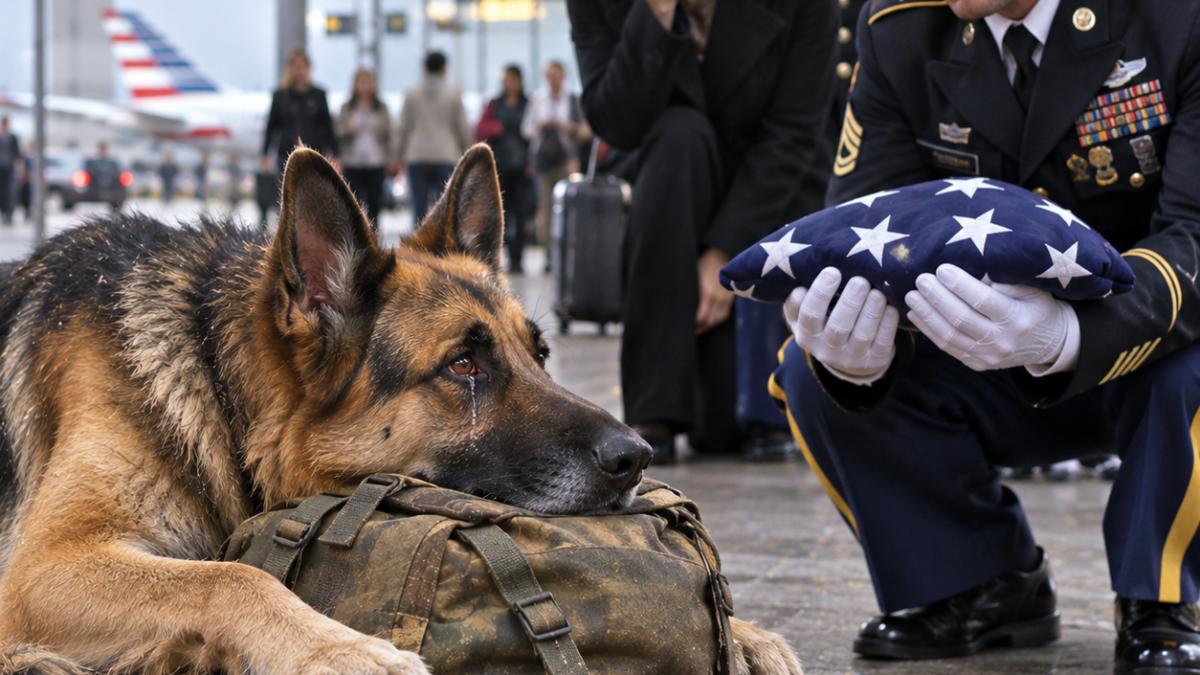
At the center, Lieutenant William Carter held a folded American flag.
Max stood.
His whole body trembled.
I had never seen that before.
Not even when soldiers came through.
His ears rose.
His head lifted.
He did not bark.
He did not whine.
He simply stared.
Carter saw him.
Stopped.
Everything in the young lieutenant’s face changed.
Recognition.
Pain.
Disbelief.
He whispered something to the soldier beside him.
Then stepped forward.
Max began walking.
Slowly.
One step.
Then another.
His legs trembled so hard I thought he might collapse.
Evelyn covered her mouth.
No one moved to stop him.
Max reached Carter.
Then sat at his feet.
Exactly as he sat every afternoon.
But he was not looking at the doors.
He was looking at the flag.
I do not know what dogs understand about folded flags.
I will not pretend I do.
People like to turn animal behavior into poetry because poetry hurts less than uncertainty.
But I know what I saw.
Max lifted his nose.
Sniffed.
Once.
Again.
Then leaned slightly forward.
His entire body became still.
Lieutenant Carter’s hands began shaking.
He knelt.
Still holding the flag.
“Hey, Max.”
The dog’s ears moved.
Carter started crying.
Not quietly.
His voice broke.
“He talked about you all the time.”
Max stared at him.
“Every day.”
Carter swallowed.
“He said you were the best dog in the world.”
Max looked toward the flag again.
Carter whispered:
“And he was right.”
The terminal had become silent.
Not perfectly.
Airports never become truly silent.
But people stopped.
Suitcases stopped rolling.
Conversations softened.
Even the overhead announcements seemed somehow farther away.
A soldier.
A dog.
A folded flag.
And hundreds of strangers discovering they had accidentally entered someone else’s grief.
Evelyn approached.
Slowly.
She lowered herself onto the floor beside Max.
Then wrapped both arms around him.
Max allowed it.
His eyes remained on the flag.
Evelyn cried into his neck.
“I’m sorry.”
She whispered it again and again.
“I’m so sorry.”
I do not know whether she was apologizing to Max.
To Michael.
To herself.
Maybe all three.
Carter placed one hand on Max’s shoulder.
For several minutes, none of them moved.
Eventually, airport operations resumed.
They had to.
Flights do not stop because one heart breaks.
But before people returned to work, many passed Max.
A woman from the café brought water.
He ignored it.
An elderly traveler touched his own chest.
A young Marine stopped several feet away and saluted.
Max kept sitting.
Waiting.
But something had changed.
I could feel it.
Everyone could.
His waiting no longer looked uncertain.
That sounds strange.
Before that afternoon, every opening door carried a question.
Now there was grief.
But not the same question.
Michael had come back.
Not as Max expected.
Not walking.
Not calling his name.
But something connected to him had crossed those doors.
The promise had been fulfilled in the cruelest possible shape.
And somehow Max seemed to know.
Lieutenant Carter stayed with Evelyn for nearly an hour.
They talked about Michael.
Max lay between them.
Carter told stories.
Michael complaining about military coffee.
Michael keeping a photograph of Max taped inside a locker.
Michael volunteering for an extra watch because another soldier had received news his wife was pregnant.
Michael arguing that German shepherds were smarter than half his platoon.
“He probably said three-quarters,” Evelyn replied.
Carter laughed through tears.
“He did.”
Max’s tail moved once.
Small.
Everyone noticed.
No one said anything.
Carter eventually reached into his bag.
“I have something.”
He removed a small object wrapped in cloth.
Michael’s worn identification tag from Max’s old training leash.
Evelyn stared.
“He carried that?”
“Always.”
Carter nodded.
“Said it reminded him where home was.”
Evelyn cried again.
She attached it beside Max’s current tag.
The metal pieces clicked together.
Max looked down.
Then at Carter.
For one second, Carter smiled.
“There you go, buddy.”
The next day, at 4:42, Max came back.
I expected him not to.
Maybe I wanted the story to end neatly.
Dog learns truth.
Dog goes home.
Grief resolved.
Life is rarely so convenient.
Max entered with Evelyn.
Walked to his place.
Sat.
Looked at the doors.
I approached.
“Still waiting?”
Evelyn answered before Max could do whatever dogs do instead of answering.
“I think this is just what he does now.”
I sat beside him.
Maybe she was right.
Waiting had become more than expectation.
It was habit.
Ritual.
Love with a location.
Michael had said:
Wait for me.
Max had built a life around obeying.
Perhaps losing the result did not immediately erase the command.
Weeks passed.
Max continued.
4:42.
Every day.
But he changed slowly.
Before the flag, he barely acknowledged us.
Afterward, he began recognizing people.
Rosa approached.
His tail moved.
Marcus scratched behind his ears.
Max leaned into it.
When I brought water, he licked my hand.
The first time, I almost embarrassed myself by crying over dog saliva.
Max still watched the doors.
But now he sometimes looked away.
That was important.
Evelyn began sitting with us.
At first she stayed several feet back.
Then beside him.
She told stories about Michael.
He had wanted to become a firefighter as a child.
Then a police officer.
Then, after September 11 stories from older relatives, military service had taken hold in his imagination.
He adopted Max from a rescue when the dog was ten months old.
Max had been difficult.
High energy.
Too smart.
Had already been returned once because another family could not manage him.
Michael took one look and said:
“That one.”
Evelyn asked why.
Michael answered:
“He looks like he’s waiting for somebody.”
She laughed when she told us.
Then stopped.
Because now none of us found that sentence funny.
One afternoon, I noticed something beneath Max’s leather collar.
Writing.
Small.
Faded.
I asked Evelyn.
She turned the collar over.
Inside, written in permanent ink, were words I had never seen.
For my best friend. Wait for me. I’m with you even when you can’t see me. — Michael
Evelyn covered her mouth.
“I forgot he wrote that.”
“When?”
“Before deployment.”
I read it again.
Wait for me.
I’m with you even when you can’t see me.
I looked toward the doors.
Maybe Michael had understood dogs better than the rest of us.
Or maybe he had simply known what everyone who leaves fears.
Being forgotten.
Max had solved that problem completely.
Three months after the flag arrived, another face appeared.
She came through international arrivals wearing a backpack and a military jacket folded over one arm.
Young woman.
Late twenties.
Short brown hair.
Tired eyes.
Her name was Sarah Jenkins.
Air Force.
Returning from assignment.
She noticed Max immediately.
Stopped.
I saw recognition on her face.
She walked toward him.
Evelyn was late that day.
Max sat alone.
I stood nearby.
Sarah crouched several feet away.
“Max?”
His ears rose.
She smiled.
“Yeah.”
Her eyes filled.
“You look exactly like the pictures.”
Max sniffed the air.
Sarah sat on the floor.
She did not touch him.
Good instinct.
She simply sat.
“I knew Michael.”
Max looked at her.
Sarah swallowed.
“He talked too much about you.”
Max stood.
Slowly approached.
Sniffed her hand.
Sarah held still.
Then Max did something I had never seen him do with a stranger.
He placed his head in her lap.
Sarah broke.
Both hands covered her face.
Then one slowly lowered onto Max’s neck.
“Oh, buddy.”
He stayed.
Evelyn arrived ten minutes later.
When she saw Sarah, she froze.
Sarah stood.
“Evelyn?”
“Yes?”
“I’m Sarah Jenkins.”
Evelyn’s face changed.
Michael had mentioned her.
Not romantically.
A friend.
Someone he served near during earlier training and later overseas.
Sarah had photographs.
Messages.
Stories.
One of the last people to speak with Michael.
Evelyn hugged her.
They cried.
Max stood between them.
His tail moving.
More than once.
Sarah began visiting.
At first once a week.
Then more.
She would sit beside Max and talk about Michael.
Not just heroic stories.
That mattered.
She told us Michael snored.
Cheated at cards.
Hated powdered eggs.
Once ruined a microwave trying to heat something wrapped in foil.
Evelyn laughed.
“You’re lying.”
“I wish.”
Michael became human again.
Not just Sergeant Anderson.
Not folded flag.
Not memorial.
Brother.
Friend.
Man.
Max seemed calmer when Sarah talked.
Maybe her voice carried some rhythm he associated with Michael’s world.
Maybe she smelled like places Michael had been.
Maybe he simply liked her.
Dogs are allowed ordinary reasons too.
Sarah needed Max as much as he needed her.
That became clear later.
She had come home carrying guilt.
Survivor guilt.
The question military friends sometimes carry:
Why him?
Why not me?
Sarah never said all of it at first.
But one afternoon she sat beside Max after he had fallen asleep.
She whispered:
“He was supposed to be here.”
I did not answer.
She continued.
“I keep thinking if we had changed one thing…”
Evelyn sat across from her.
“Don’t.”
Sarah looked up.
Evelyn’s eyes were wet.
“Michael made his choices.”
“We don’t get to turn love into a courtroom where we keep prosecuting ourselves.”
That sentence stayed with me.
Sarah nodded.
Then put her hand on Max.
He opened one eye.
Closed it.
Maybe that was the beginning of her healing too.
Max started missing days.
The first time, I worried.
At 4:42, no dog.
I called Evelyn.
“Is he okay?”
She laughed.
“He’s asleep.”
“What?”
“He went to the park.”
“The park?”
“He chased a ball.”
I felt ridiculous tears in my eyes.
“That’s good.”
“Yes.”
“Very.”
The next day Max returned.
Then missed two days the following week.
Then came three days straight.
No schedule except his own.
Waiting became a choice rather than an obligation.
That felt like progress.
Evelyn told me he had started playing again.
Sniffing everything.
Pulling toward squirrels.
Barking at the neighbor’s lawn mower.
Normal dog behavior.
She sounded relieved.
“He used to sleep beside the front door.”
“Now?”
“My bed.”
“Better?”
“Much.”
Then she added:
“Sometimes at 4:20 he still gets up.”
I smiled.
“Of course.”
“Then he looks at me.”
“And?”
“Some days we go.”
“Some days he lies back down.”
That was beautiful.
Grief loosening its grip without disappearing.
Airport management eventually proposed a memorial.
I was nervous.
I remembered Evelyn’s dislike of turning Max into a spectacle.
The proposal was simple.
A bench.
No marketing campaign.
No giant photograph.
No “viral dog” branding.
Placed near the arrivals doors where Max had waited.
Evelyn approved.
Sarah helped.
Lieutenant Carter sent a note from his new assignment.
The inscription read:
IN MEMORY OF SERGEANT MICHAEL ANDERSON
AND IN HONOR OF ALL WHO WAIT AND ALL WHO RETURN
Below it:
A small carved dog paw.
Beside it, the outline of a soldier’s boot.
Nothing more.
Perfect.
The dedication happened on a quiet Tuesday morning.
No press invitation.
Employees.
A few military friends.
Evelyn.
Sarah.
Max.
Lieutenant Carter surprised us by coming.
When Max saw him, his entire body changed.
Tail.
Ears.
A little sound deep in his throat.
He walked over.
Carter knelt.
“Hey, old man.”
Max pushed his head against the lieutenant’s chest.
Carter cried immediately.
He was not embarrassed.
Good.
Evelyn spoke briefly.
She hated public speaking.
Her hands shook.
She said:
“My brother made a promise to Max.”
Then stopped.
Took a breath.
“He said he would come back.”
She looked toward the bench.
“For a long time, I thought that promise had been broken.”
Max sat beside her.
“Then I realized Michael did come back.”
Her voice broke.
“In stories.”
“In people.”
“In the flag.”
“In the dog he loved.”
“And in every person Max brought together while waiting.”
She touched Max’s head.
“Maybe promises don’t always return in the shape we expect.”
Nobody moved.
Then Lieutenant Carter placed Michael’s hand on the plaque? No. Let’s keep plausible.
Carter placed one hand on the bench.
Sarah stood beside him.
I looked at Max.
He was not staring at the doors.
He was watching Evelyn.
That mattered.
After the ceremony, people left slowly.
Max walked to his old spot.
Sat.
Looked at the bench.
Then the doors.
Then at us.
No desperate focus.
No trembling.
No question.
Just a dog in a familiar place.
I sat beside him.
“Think he’d like it?”
Max’s ears moved.
I took that as approval.
Months became years.
Max grew older.
Gray appeared around his muzzle.
His hips became stiff.
He came to the airport less often.
Once a week.
Then once every couple of weeks.
Mostly on days Evelyn knew military flights were arriving.
Not because he believed Michael might walk through.
At least, that is what I told myself.
Maybe some part of him always believed.
Dogs are allowed hope humans would call irrational.
He would sit on the bench now instead of the floor.
Yes.
On the bench.
Evelyn placed a small blanket there.
Airport staff tolerated it.
Rules can bend for history.
Max watched passengers.
When soldiers came through, his tail often moved.
Some already knew him.
Others asked.
We told the story carefully.
Not as entertainment.
As memory.
Sarah remained part of his life.
She moved nearby after leaving active service.
Eventually became a physical therapist working with veterans.
She credited Michael and Max for the decision.
I thought that sounded sentimental.
Then remembered I had changed lunch breaks for a dog.
We are all sentimental when the right thing happens to us.
Sarah took Max walking.
Slowly as he aged.
She told him stories.
Sometimes Evelyn joined.
They became family in a way none of them planned.
Loss had created the connection.
Living maintained it.
One winter, Max stopped coming entirely for six weeks.
I worried.
Evelyn told me his arthritis was worse.
Nothing catastrophic.
Age.
I hated age.
It feels unfair that animals survive grief only to become vulnerable to time.
Then one sunny March afternoon, I saw him.
4:42.
Of course.
Evelyn brought him in slowly.
He wore a support harness around his hips.
Sarah walked beside them.
Max reached the bench.
Evelyn helped him sit.
He stared at the doors.
I crouched.
“You’re late.”
Evelyn laughed.
“He is never late.”
True.
My mistake.
Max put one paw against my shoe.
I scratched his neck.
The old identification tags clicked.
Michael’s leash tag still attached.
Home.
A military family came through.
Young soldier.
Wife.
Little boy.
The boy saw Max.
“Dog!”
The soldier approached.
“Can he be petted?”
Evelyn nodded.
“Gentle.”
The little boy touched Max’s head.
Max closed his eyes.
The soldier noticed the plaque.
Read it.
Then looked at Max.
“This is him?”
“Yes.”
The soldier’s face softened.
He knelt.
“Good boy.”
Max’s tail moved once.
The soldier looked toward his family.
Then at the arrivals doors.
For a second, I understood the bench differently.
It was not only for Michael.
It had become a place where people remembered how uncertain every goodbye can be.
How extraordinary an ordinary return is.
Maybe that was why Max still came.
To witness returns.
Not only wait for one.
Evelyn later told me something I had never known.
On the morning Michael left for deployment, he had almost missed his flight.
Max refused to get into Evelyn’s car after they dropped Michael.
He pulled back toward the terminal.
Michael had to come outside once more.
He crouched.
Pressed his forehead to Max’s.
“Buddy.”
Max licked his face.
“I have to go.”
Max leaned into him.
Then Michael whispered:
“Wait for me.”
A promise.
Evelyn said she scolded her brother.
“Don’t tell him that. He’ll actually do it.”
Michael laughed.
“That’s why I’m telling him.”
They had no idea.
No one ever does.
I asked Evelyn once whether she regretted letting Max come to the airport all those months.
She thought for a long time.
“No.”
“Even before the flag?”
“Yes.”
“Why?”
“Because I think I needed to come too.”
That made sense.
Max had given her somewhere to put hope.
Then somewhere to put grief.
People build churches for the same reason.
Locations matter when emotion becomes too large to carry internally.
For Evelyn, arrivals gate three had become both wound and altar.
Max simply understood first.
A year after the bench dedication, Westwood management wanted to move the memorial during renovation.
I argued.
More strongly than reasonable.
“Operations requires—”
“No.”
“David.”
“No.”
My supervisor laughed.
“You know you don’t own the terminal.”
“I’ve worked here twenty years.”
“Exactly. You should understand construction.”
I fought anyway.
We compromised.
The bench moved eight feet.
Eight.
Not twenty.
Max inspected the new position.
Sniffed.
Then sat.
Apparently acceptable.
I felt ridiculous.
The story continued spreading online.
Again.
This time the airport communications office asked Evelyn before posting anything.
She agreed to one official photograph.
Max beside the bench.
No dramatic music.
No exaggerated claim that he “cried every day.”
No invented final salute.
Just the truth.
The caption:
Some passengers wait for flights. Some wait for people. Max reminded us that love can make a place sacred.
I thought it was too poetic.
Then I cried reading it.
Hypocrite.
We received letters.
Children.
Veterans.
Families who had lost someone.
People who had dogs that waited by doors after death.
One envelope came from a woman whose husband died in a mining accident.
Their Labrador slept beside his boots for six months.
Another from a boy whose father was deployed.
He wrote:
Max makes me feel like waiting is brave.
Evelyn kept that one.
Eventually, Michael’s old unit held a reunion.
They invited Evelyn.
She brought Max.
Carter was there.
Sarah.
Men and women who remembered Michael at twenty-two.
Twenty-five.
Thirty.
Different versions.
They sat outside.
Max moved from person to person.
Smelling hands.
Boots.
Uniform bags.
One soldier cried the moment Max approached.
“He used to show me videos of you.”
Max leaned against him.
The man laughed through tears.
“Yeah. You’re still spoiled.”
For several hours, Michael existed in conversation.
That was another kind of return.
I did not attend.
That space belonged to them.
But Evelyn sent me a photograph.
Max lying in the middle of a circle of soldiers.
Everyone smiling.
Michael absent.
Michael everywhere.
I printed it.
Put it in my locker.
Next to a photo of my wife and daughters.
Airports teach you that people can belong to multiple stories.
Max belonged to all of ours by then.
Time kept moving.
Max turned ten.
Then eleven.
Evelyn began talking about “good days.”
Anyone who loves an aging animal knows that phrase.
Good days.
A walk.
Full breakfast.
Tail wag.
No pain.
We counted.
One day, Evelyn called before my shift.
“I think this may be his last airport visit.”
My chest tightened.
“Is he…”
“No.”
“Not today.”
“But he’s tired.”
I understood.
She brought him at 4:30.
Sarah came.
Carter joined by video call on Evelyn’s phone.
Max moved slowly.
Reached the bench.
Stopped.
Evelyn helped him up.
He sat.
4:42.
The doors opened.
Passengers came through.
Businesspeople.
Families.
A college student crying as her mother hugged her.
A soldier.
Then another.
Max watched.
His tail moved.
Slowly.
No desperation.
Just recognition.
This was his place.
At 4:58, Evelyn whispered:
“Ready?”
Max did not move.
She waited.
At 5:03, he stood on his own.
Turned away from the doors.
Then looked back once.
I do not know whether that means anything.
Humans love final glances because we need punctuation.
Maybe Max heard something.
Maybe he simply checked behind him.
But I watched him turn.
Walk toward Evelyn.
Then toward the terminal exit.
No pulling back.
No sitting down again.
He left.
I stood beside the bench and cried.
Not because he was dying that day.
Because for the first time, Max chose to leave before the doors closed.
His waiting was complete.
He lived another seven months.
Good months, mostly.
Park.
Sun.
Short walks.
Sarah visiting.
Evelyn sleeping beside him on the floor when stairs became difficult.
One evening, he stopped eating.
The veterinarian came to the house the next morning.
Max was old.
Painful.
Tired.
Evelyn called me later.
“He’s gone.”
I sat in an airport operations office with flights blinking across a screen.
No words.
“I’m sorry.”
“I know.”
She was crying.
“So was I.”
“He was with me.”
“Sarah was here.”
“He wasn’t scared.”
That mattered.
Everything else could wait.
That afternoon, I went to the bench.
4:42.
I sat.
For the first time in years, no Max.
The space beside me felt enormous.
Rosa brought coffee.
Marcus came.
Sarah arrived later.
Evelyn did not.
She could not.
We sat together.
No ceremony.
No announcement.
Just people who had become friends because a dog once refused to stop waiting.
At exactly 4:42, the arrivals doors opened.
A soldier stepped through.
His little daughter ran toward him screaming.
He dropped his bag.
Lifted her.
Everyone nearby applauded.
I cried harder.
Rosa touched my shoulder.
“Max would’ve liked that.”
“Yes.”
He would have.
Evelyn brought Max’s collar the following week.
She wanted the airport to keep it temporarily.
We declined at first.
Too personal.
Then she said:
“I don’t want it in a glass box forever.”
“Just for the anniversary.”
So we arranged a small display beside the bench.
Michael’s tag.
Max’s tag.
A copy of the inscription inside the collar:
Wait for me. I’m with you even when you can’t see me.
No grand exhibition.
One month.
Then Evelyn took the collar home.
Where it belonged.
Years passed.
I remained at Westwood.
Longer than planned.
Maybe because leaving became complicated after Max.
New employees heard the story.
Some believed parts had been exaggerated.
I corrected them.
“No, he did not howl every day.”
“No, he did not recognize Michael’s coffin from across the terminal.”
“There was no coffin in the airport.”
“Yes, he came at 4:42.”
“Yes, for months.”
“Yes, Lieutenant Carter brought the folded flag.”
“Yes, Max walked to him.”
“Tell it right.”
Why?
Because true stories do not need extra tragedy.
They already hurt enough.
Sarah eventually married.
Evelyn stood beside her.
At the reception, they placed one photograph of Michael and Max on a memory table.
Not because grief had taken over their lives.
Because memory had found its proper size.
Present.
Not controlling everything.
That was what Max had learned too.
Love does not disappear.
It changes from command to companion.
From:
Wait here.
To:
Carry me with you.
Evelyn once said something that changed how I thought about the whole story.
“I used to think Max kept waiting because he didn’t understand death.”
We were sitting at the bench.
Years after both Michael and Max were gone.
“What do you think now?”
She smiled sadly.
“I think he understood love.”
I looked at her.
“That sounds like something you’d put on a greeting card.”
“I know.”
We laughed.
Then she said:
“But maybe animals don’t separate love from routine the way we do.”
“Michael was his life.”
“So waiting was not denial.”
“It was connection.”
Maybe.
I liked that better.
The bench is still there.
Travelers sit on it.
Most do not read the plaque.
That is fine.
Memorials do not require constant attention to remain meaningful.
Sometimes a mother ties a child’s shoe there.
A teenager charges his phone.
A veteran sits quietly.
A tired passenger sleeps against the armrest.
Life uses memorials.
I think Michael would approve.
Max definitely would.
He never cared about ceremony.
Only presence.
On certain days, military flights arrive near 4:42.
I still look toward the old spot.
Habit.
No German shepherd.
Just tile.
People.
Luggage.
Then I remember him.
Not the grieving dog.
Not only that version.
I remember him stealing Marcus’s sandwich once.
Yes.
The famous loyal Max stole half a turkey sandwich from a baggage employee and refused to surrender it.
I remember him sneezing in Rosa’s coffee.
Rolling in snow outside the employee entrance.
Ignoring a child who wanted to pet him because he was too interested in a dropped French fry.
Grief turns the dead into saints if we let it.
Max was a dog.
Michael was a man.
That makes the love more meaningful, not less.
Michael had flaws too.
Evelyn told me he forgot birthdays.
Borrowed tools and never returned them.
Left wet towels on floors.
Drove too fast.
Argued loudly.
Loved deeply.
That was enough.
We do not need perfection to justify grief.
We grieve the whole person.
The irritating parts too.
Sometimes especially those.
The day I retired, Westwood staff surprised me.
My final shift ended at 4:30.
I thought that was intentional so I could avoid sentimental nonsense.
Wrong.
At 4:42, they took me to the bench.
Evelyn was there.
Sarah.
Marcus.
Rosa.
Lieutenant Carter, now Major Carter, joined by video.
Someone had placed a small plaque beneath the bench.
Not permanent.
A joke.
DAVID CALLAHAN — PROFESSIONAL WAITER FOR DOGS
I laughed so hard I nearly cried.
Then I cried anyway.
Evelyn handed me a photograph.
Max at the bench.
Older.
Calm.
Looking not at the doors but directly at the camera.
On the back, she had written:
You waited with him. Thank you.
I still have it.
I am retired now.
Westwood continues without me.
Of course.
Airports are good at teaching that too.
No matter how important you think your shift is, another person eventually takes your radio.
Flights continue.
Doors open.
People come home.
People leave.
But once or twice a year, I visit the bench.
Usually around 4:42.
Old habits.
I sit.
Watch arrivals.
Sometimes someone recognizes the plaque.
Asks:
“Was that dog real?”
“Yes.”
“Did he actually come every day?”
“For a long time.”
“Did he know his owner died?”
That question is harder.
I answer:
“Eventually.”
Then:
“Did he stop waiting?”
I usually look toward the doors.
“Yes.”
“But not all at once.”
That is important.
Healing rarely happens all at once.
Max taught me that.
One day away.
Then back.
Two days away.
Then back.
Park.
Airport.
Ball.
Bench.
Memory.
Life.
People expect grief to have a destination.
It doesn’t.
It has movement.
That is enough.
The part everyone loves most is the flag.
I understand why.
The visual is devastating.
German shepherd.
Soldier.
Folded flag.
Silent airport.
But when I think about Max now, that is not the moment I return to first.
I remember the day he skipped the airport to chase a ball.
Evelyn called me laughing.
“He missed 4:42.”
I looked at the clock.
4:51.
For months, that would have been impossible.
“Is he okay?”
“He’s asleep.”
“After playing.”
“Yes.”
That was the miracle.
Not that Max loved Michael enough to wait.
That was obvious.
The miracle was that he learned loving Michael did not require refusing the rest of life.
That is harder.
For dogs.
For people.
For all of us.
Sarah once said the same thing.
“Surviving someone feels disloyal at first.”
We were at the bench.
She had just gotten engaged.
“What do you mean?”
“Laughing.”
“Planning.”
“Being happy.”
She looked at Michael’s name.
“It feels like you’re leaving them behind.”
Then she smiled.
“Max taught me you can move and still carry someone.”
I thought about that.
“Dogs are very expensive therapists.”
She laughed.
“True.”
Evelyn eventually moved out of Westwood.
Closer to her daughter.
Before leaving, she met me one last time at the airport.
She sat on the bench.
Touched Michael’s name.
Then Max’s paw print.
“I thought leaving town would feel wrong.”
“Does it?”
“A little.”
She smiled.
“But Michael left first.”
“Max eventually did.”
“So I guess I’m allowed.”
She stood.
We hugged.
Then she walked toward departures.
There was something almost too symbolic about that.
I did not point it out.
Some moments become worse if you explain them while they are happening.
The bench remained.
It remains now.
Michael Anderson’s name.
A paw.
A boot.
People waiting.
People returning.
That is enough.
If I learned anything from Max, it is that waiting is not always passive.
Sometimes waiting is work.
You show up.
Again.
Again.
Again.
You keep a place for someone.
You refuse to let absence erase love.
But eventually, if you are lucky, waiting changes.
It stops asking:
When are you coming?
And begins saying:
I remember you.
Those are not the same thing.
Max crossed that distance slowly.
One afternoon at a time.
At first, he believed Michael would walk through the doors.
Then a flag came through instead.
A lieutenant with shaking hands told him:
“He talked about you every day.”
Evelyn held him.
Sarah arrived months later carrying stories.
Carter returned carrying memories.
The bench appeared.
Max began playing again.
He missed days.
Then weeks.
Then one final afternoon, he stood at 5:03 and walked away from the doors without being pulled.
That is the whole story.
Not abandonment.
Release.
Michael had written inside Max’s collar:
Wait for me. I’m with you even when you can’t see me.
For a long time, I thought the important part was:
Wait for me.
Now I think it was the second sentence.
I’m with you even when you can’t see me.
Max eventually learned that.
Maybe Evelyn did too.
Sarah.
Carter.
Me.
We stopped looking for Michael only in one doorway.
We found him in everything he had left behind.
Stories.
Habits.
People.
A dog.
Love has strange storage systems.
People still arrive at Westwood at 4:42.
Different flights now.
Different schedules.
The old route changed years ago.
But sometimes the doors open and a family runs forward.
A child sees a parent.
A soldier sees a spouse.
Someone drops luggage because hugging matters more.
If I happen to be there, I always think of Max.
Sitting.
Ears forward.
Completely convinced that a promise mattered.
And I think he was right.
Not because every promise can be fulfilled exactly as spoken.
Life does not grant us that mercy.
But because promises shape what we do with absence.
Michael said:
Wait.
Max waited.
Then, eventually, he understood the rest.
I’m with you even when you can’t see me.
And he lived.
That was his final act of loyalty.
Not waiting forever.
Living with love after waiting had ended.
My name is David Callahan.
For nineteen years, I watched people arrive and leave through airport doors.
I thought waiting was empty time.
A space between departure and return.
Then a German shepherd taught me otherwise.
Waiting can be devotion.
Grief can be devotion.
Memory can be devotion.
But so can moving forward.
Max did all four.
In that order.
At his own pace.
And because of him, every time I see someone standing at an arrivals gate watching the doors, I understand something I did not before.
They are not doing nothing.
They are holding a place open.
For a face.
A voice.
A promise.
A life they hope will come back to them.
Sometimes it does.
Sometimes it cannot.
But love still finds a way through the doors.
Michael returned in a folded flag.
In Lieutenant Carter’s stories.
In Sarah’s memories.
In Evelyn’s arms.
In a small inscription hidden inside a leather collar.
And finally, in the peaceful old dog who learned he could turn away from the doors without turning away from the man he loved.
Max waited.
Then Max lived.
And perhaps that is the truest promise any of us can keep for the people we lose:
I will remember you.
I will carry you.
And when I am ready, I will keep going.








