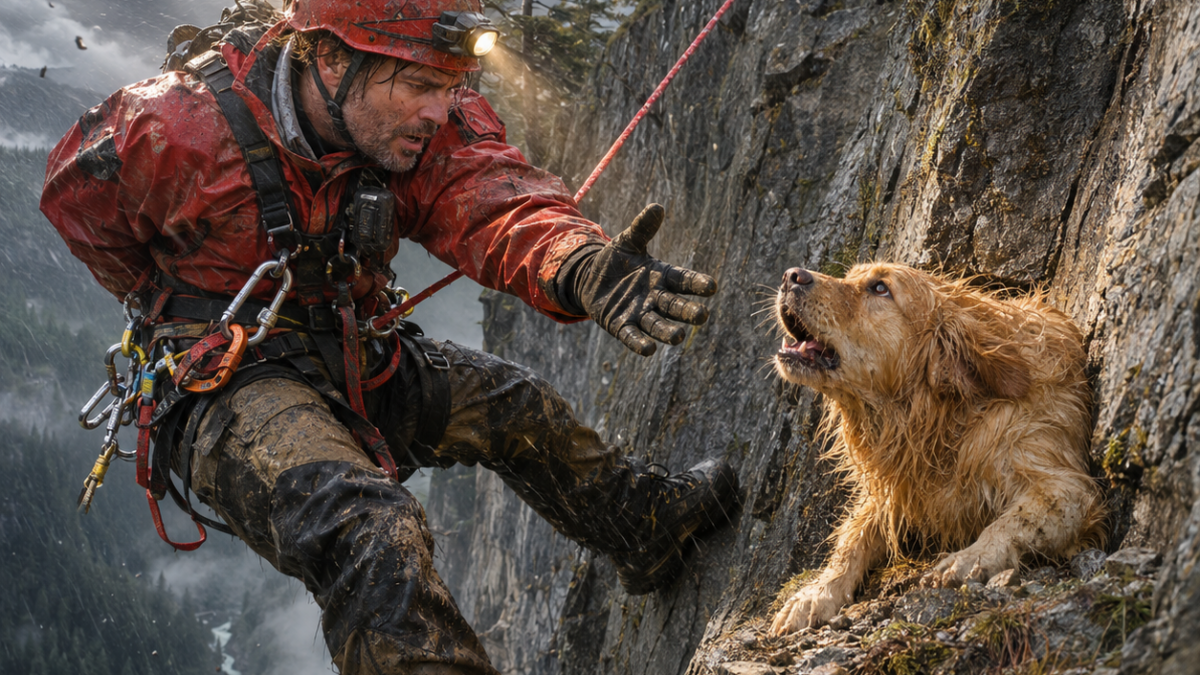
𝗙𝗨𝗟𝗟 𝗦𝗧𝗢𝗥𝗬:“DON’T MOVE, BOY! PLEASE, JUST STAY WHERE YOU ARE!” I shouted into the roaring wind as a terrified Golden Retriever clung to a narrow rocky ledge almost sixty feet below me, his injured hind leg hanging uselessly over the drop —Then I Discovered Why He Was Willing to Die Rather Than Leave…
𝗙𝗨𝗟𝗟 𝗦𝗧𝗢𝗥𝗬
Then I heard a small whimper.
I turned my head.
And saw him.
A Golden Retriever.
He was trapped on a narrow ledge partway down the ravine, his golden coat streaked with mud and dust.
His body was pressed against the cliff.
One hind leg lay at an unnatural angle.
Below him, the ground dropped sharply toward the rocks.
He couldn’t climb.
He couldn’t safely jump.
And judging by the way he trembled every time the wind struck the cliff, he was struggling just to remain where he was.
I stared at him.
“Oh, sweetheart.”
He lifted his head.
For one brief moment, our eyes met across the distance.
Then he barked.
The sound was weak.
Desperate.
Almost pleading.
One of my teammates crouched beside me.
“Can you see him?”
I pointed.
“About sixty feet down. Narrow ledge. Possible hind-leg fracture.”
He followed my gaze.
Then muttered something under his breath.
The dog moved slightly.
A few stones broke loose beneath his front paws.
They bounced down the cliff and disappeared.
“DON’T MOVE!” I shouted.
The Golden Retriever flattened himself against the rock.
My teammate grabbed my arm.
“We need the rope system set before anybody gets near that edge.”
“I know.”
Another gust struck us.
The tree branches overhead bent sharply.
I looked down again.
The dog was still there.
Still trembling.
Still watching us.
I had responded to dangerous calls before. I understood what could happen if a rescuer moved too quickly or ignored the condition of the terrain.
But knowing the risks didn’t make that dog’s frightened face any easier to look at.
There were four of us on the team.
We began establishing a controlled rope-rescue system, checking our anchors, harnesses, helmets, and communication arrangements.
Every piece of equipment mattered.
Every movement had to be deliberate.
Because if one person lost control on that slope, we wouldn’t be dealing with one injured life anymore.
We’d be dealing with two.
I was preparing for the descent when the youngest member of our team stepped beside me.
He’d been with us only a few months.
He looked toward the ravine, then toward the dog.
“Are you sure you want to go down?”
I tightened a strap on my harness.
“No one’s going down until the system is ready.”
He swallowed.
“The wind’s getting worse.”
“I know.”
He looked over the edge again.
“What if the dog panics when you reach him?”
I paused.
That was a real possibility.
An injured animal might bite, struggle, or try to escape even when someone was attempting to help.
I understood that.
But I also understood what could happen if we left him on that ledge for too long.
I checked the rope connection.
Then looked at my teammate.
“We’ll take it slowly.”
Below us, the Golden Retriever tried to lift his injured leg.
He immediately cried out.
The sound cut through the wind.
I looked down.
His body shook.
He lowered his head onto the rock.
And for one terrible second, I thought he was giving up.
“Hey!”
I leaned toward the edge.
“Stay with me, boy!”
His ears moved.
I swallowed.
“I’m coming.”
Our rope system was ready.
My teammates confirmed the safety checks.
I stepped toward the edge.
And began descending toward a dog I’d never met, with no idea that the most extraordinary part of the rescue would happen only after we were both back on solid ground.
PART2
The first few feet were manageable.
I moved slowly over the edge, relying on the rope system while my teammates monitored the descent from above.
The cliff face was rough.
Loose dirt crumbled beneath some of the rock projections.
Wind pressed against my shoulders and made my jacket snap.
I kept my body positioned as carefully as possible.
One controlled movement.
Then another.
Below me, the Golden Retriever watched.
He didn’t bark now.
He simply stared upward.
His ears were pinned back.
His chest rose and fell rapidly.
I spoke to him even though the wind made it difficult to know how much he could hear.
“Hey, buddy.”
I lowered myself a little farther.
“I’m coming to help you.”
The dog lifted his head.
A faint whine reached me.
I looked toward the ledge.
It was narrower than it had appeared from above.
There was barely enough room for the dog to lie against the cliff, and the rock beneath him looked uneven.
I could see loose gravel collected near the edge.
His front paws were tucked beneath his chest.
His injured hind leg remained stretched awkwardly to one side.
The sight made my stomach tighten.
He must have fallen hard.
I tried not to imagine the impact.
A sixty-foot ravine could be unforgiving, even if an animal’s fall was interrupted by a shelf of rock rather than ending at the bottom.
The fact that he was conscious and responding to us was encouraging.
But it didn’t mean he was uninjured anywhere else.
I radioed my teammates.
“Dog is alert. Possible fracture. I’m approaching the ledge.”
A voice answered from above.
“Copy. Maintain your position. We’ve got you.”
I looked up.
Three helmeted figures stood against the bright sky.
They appeared small from where I hung.
The youngest rescuer was watching intently.
I raised one hand.
Then continued down.
A sudden gust struck the cliff.
My body shifted against the rope.
I stopped immediately.
Held position.
Waited for the movement to settle.
Below me, the dog flinched.
A few small stones rolled from the ledge.
I felt my pulse accelerate.
“Easy,” I whispered.
I looked down.
The Golden Retriever was staring at me.
“Easy, sweetheart.”
For a moment, neither of us moved.
Then I lowered myself toward him again.
As I drew closer, the dog tried to stand.
“NO, NO, NO—STAY DOWN, BOY!”
My voice came out much louder than I intended.
He froze.
His front legs were trembling.
His weight shifted toward the outer edge of the rock shelf.
I could see the loose gravel moving beneath him.
One small stone dropped.
Then another.
I watched them disappear into the ravine.
My throat tightened.
If he tried to jump toward me, he could fall.
If he attempted to climb, his injured leg might give way.
And if I startled him badly enough, fear alone could push him over the edge.
I had to approach with more care than I’d ever needed when meeting a frightened dog on level ground.
I stopped my descent.
“Hey, sweetheart.”
I softened my voice.
“I’m right here.”
His ears moved.
“That’s it. Just look at me.”
He stared.
I moved slowly enough that he could watch every adjustment.
Then I settled into a stable position near the ledge while remaining supported by the rescue system.
The dog was only a few feet away.
Close enough for me to see the scratches on his muzzle.
Close enough to notice the dust embedded in his fur.
Close enough to see how hard he was trying not to move.
His hind leg worried me.
It lay awkwardly beneath him, and he reacted painfully whenever it shifted.
But I couldn’t know the full extent of his injuries while suspended against a cliff.
My first priority was to keep him calm and secure him without causing additional harm.
I spoke into my radio.
“I’m beside him. He’s frightened, but he’s allowing me to approach.”
“Copy.”
“Prepare for controlled extraction. I’ll need to support his body and protect the injured leg.”
My teammate confirmed.
I turned back toward the dog.
“Okay, boy.”
He watched my hands.
“I need you to trust me.”
I slowly extended one hand toward him, keeping my movements gentle and avoiding the injured area.
He lowered his head.
For a second, I thought he might retreat.
Then he sniffed my glove.
A tiny movement.
Almost nothing.
But it was the first time he had approached me instead of simply watching in fear.
I waited.
He sniffed again.
Then touched his nose against my fingers.
My chest tightened.
“There you go.”
I gently stroked the side of his neck.
“Good boy.”
His eyes closed briefly.
The wind moved through his fur.
I swallowed.
“You’ve had a terrible day, haven’t you?”
He made a low sound.
Not quite a bark.
Not quite a whine.
I don’t know what he was trying to communicate.
Perhaps nothing beyond pain and fear.
But I kept talking.
“You’re not alone anymore.”
He opened his eyes.
“I’m right here.”
I’ve been asked many times whether animals know when you’re trying to save them.
I don’t have a simple answer.
Some become calm as soon as you approach.
Some panic.
Some resist being touched even when they’re exhausted.
Fear and pain can make any animal unpredictable.
I never assume trust simply because a dog looks gentle.
But there was something about this Golden Retriever that affected me deeply.
He had every reason to be afraid.
He was injured.
Trapped.
Surrounded by unfamiliar sounds.
And now a strange man wearing a helmet and rescue equipment was approaching him from above.
Yet after those first hesitant moments, he allowed my hand to remain against his neck.
His body was still trembling.
But he no longer tried to crawl away.
I let him become accustomed to my presence before bringing the extraction equipment closer.
“Good boy.”
I stroked his shoulder.
“That’s it.”
He leaned the slightest bit toward my hand.
I felt my eyes sting.
Not because the rescue was finished.
We still had the most difficult part ahead.
But because this frightened animal had made a small decision that could help save his life.
He was allowing me to help him.
I looked at his injured leg.
Then toward the rock beneath him.
We had to minimize unnecessary movement.
I used the equipment prepared for the rescue to support and secure his body, taking particular care around the injured limb.
My teammates remained in communication with me throughout.
We didn’t rush.
We checked the arrangement.
Adjusted where necessary.
And made certain the dog would remain supported as we brought him off the ledge.
The wind continued blowing.
The trees above us swayed.
Somewhere below, water struck the rocks.
But inside that little pocket of space against the cliff, I concentrated on one thing.
The dog.
His breathing.
His response to my voice.
The way he shifted his head.
Every sign that he was frightened or in pain.
“Almost ready,” I whispered.
He looked up.
I smiled beneath my helmet.
“Hang in there, buddy.”
When I finally had him secured for extraction, he pressed his muzzle against my chest.
The gesture caught me off guard.
For several seconds, he’d tolerated my handling without struggling.
Now, as I supported him, he seemed to seek contact.
His nose pushed against my jacket.
Then he lowered his head toward my arm.
I felt his warm breath through the fabric.
And suddenly I was more frightened for him than I had been while looking down from the rim.
Because he was close.
Because I could feel how exhausted he was.
Because I understood that if the extraction went badly, there would be no way to pretend I’d simply failed to reach him.
I was responsible for this fragile life in my care.
I looked up.
“Ready for lift.”
My teammate responded.
“System ready. Proceed on your call.”
I checked the dog again.
His body was supported.
His injured leg protected as carefully as we could manage.
I rested one hand against him.
“Okay, sweetheart.”
He looked toward my face.
“We’re going up.”
The extraction began.
Slowly.
Controlled.
The ropes moved through the system.
We rose away from the narrow ledge.
For a brief moment, the dog’s head lifted sharply.
He saw the open space beneath us.
His body tensed.
I spoke immediately.
“Easy, boy.”
He pressed toward me.
“That’s it. Stay with me.”
The wind struck again.
I held steady.
My teammates controlled the movement from above.
I could hear brief instructions over the radio.
Each one confirmed.
Each adjustment deliberate.
We passed a jagged projection in the cliff.
I kept the dog clear of the rock.
Then the next.
The ascent felt endless.
Not because it took an extraordinary amount of time, but because every second demanded attention.
My arms ached.
My shoulders burned.
My knees had already taken a beating from the rock face.
But I didn’t care about any of that.
The dog was breathing against my jacket.
He was alive.
And we were moving toward the top.
Halfway up, the wind shifted.
It came across the ravine in a sudden powerful gust.
I felt the change immediately.
My body moved away from the cliff.
The rope system kept us supported, but the motion made my heart leap.
I tightened my position and concentrated on maintaining control.
The dog flinched.
“It’s okay!”
His muzzle pressed against my chest.
“Stay with me!”
I looked up toward the rim.
One of my teammates raised a hand.
I could hear his voice over the radio.
“We’ve got you. Hold position while the gust passes.”
I acknowledged the instruction.
For several seconds, we remained suspended.
The wind roared through the trees.
Loose leaves spun past us.
The dog trembled against me.
I lowered my face toward his head.
“You’re doing great.”
He gave a small whine.
“I know.”
I swallowed.
“I know you’re scared.”
I could feel my own heartbeat.
Fast.
Heavy.
It had been years since I’d become so intensely aware of every breath.
I thought about how easily someone watching from a safe distance might misunderstand the situation.
They might see a rescuer suspended on ropes and imagine courage meant being fearless.
It didn’t.
I was afraid.
Afraid of making a mistake.
Afraid of causing more pain.
Afraid of the wind changing again before we reached the rim.
But fear didn’t mean I had to abandon the rescue.
It meant I had to respect the risks and keep following the plan.
The gust weakened.
My teammate’s voice came through the radio.
“Movement stabilized.”
I looked toward the dog.
“Ready, boy?”
His head remained against my arm.
I smiled.
“Let’s finish this.”
We continued upward.
The last few feet were the hardest emotionally.
I could see my teammates clearly.
One crouched near the rim, preparing to help receive the dog.
Another maintained the rescue system.
The youngest team member watched closely, ready to assist where directed.
I could hear their voices without relying entirely on the radio.
“Easy.”
“Keep him supported.”
“We’re right here.”
I looked down at the Golden Retriever.
His eyes were half closed.
For a second, panic rushed through me.
“Hey, buddy.”
His ears moved.
“Look at me.”
He opened his eyes.
I exhaled.
“That’s my boy.”
Then we reached the top.
My teammates took over the appropriate parts of the extraction while keeping his body stabilized.
I remained beside him as we moved onto secure ground.
My knees hit the dirt.
I barely noticed.
“Careful with the hind leg.”
“We’ve got it.”
“Keep his body supported.”
“Understood.”
For the first time since I’d begun descending, I felt solid ground beneath both knees.
I looked toward the sky.
The wind was still moving through the trees.
But the dog was no longer on that ledge.
He was safely above the ravine.
I reached toward him.
“Hey, sweetheart.”
He looked at me.
His tail moved once.
Just once.
I laughed through the ache in my chest.
“You did it.”
Then I corrected myself.
“We did it.”
We performed an initial assessment without putting unnecessary weight on his injured leg.
He was frightened and exhausted.
The hind limb appeared seriously injured, and we treated it as a possible fracture.
There could have been other injuries we couldn’t identify without veterinary examination.
But he was conscious.
Responsive.
And breathing on his own.
Those were things to be grateful for.
I wanted him assessed by a veterinarian as quickly as possible.
While my teammates prepared for the next stage, I lowered myself beside him.
My back ached.
My hands were trembling.
I could feel the muscles in my legs beginning to complain now that the urgency of the descent had passed.
The dog looked toward me.
I gently touched the fur along his shoulder.
“It’s over.”
He blinked.
“You’re not going back down there.”
For a moment, he seemed too tired to react.
Then he shifted his head.
Slowly.
Carefully.
And placed it against my knee.
I froze.
I hadn’t expected the contact.
I looked down.
His eyes were partly closed.
His body was still trembling, but less violently now.
I rested my hand on his neck.
“Oh, buddy.”
My voice broke.
“Were you waiting for someone to find you?”
He sighed.
I looked toward the ravine.
The narrow ledge was hidden from where I knelt.
Only the dark opening between the rocks remained.
For hours, he’d been trapped somewhere down there.
In pain.
Unable to reach the top.
Calling into the forest without knowing whether anyone would hear.
Now he was beside me.
And I felt an overwhelming desire to keep him safe.
A voice came from the trail.
“BUDDY!”
I lifted my head.
Another shout followed.
“BUDDY! WHERE ARE YOU?”
The Golden Retriever’s ears rose.
His head lifted from my knee.
I looked toward the trees.
A man and a woman were hurrying up the path toward us.
Both looked exhausted.
The man’s face was pale.
The woman had tears streaming down her cheeks.
They stopped when they saw the rescue team.
Then the woman looked toward the dog.
And screamed.
“BUDDY!”
The dog’s tail began wagging.
She covered her mouth.
“Oh, my God!”
The man rushed toward us.
“Is he alive?”
I stood as carefully as I could.
“Yes. He’s alive.”
The man made a sound of pure relief.
Then the woman dropped to her knees beside the Golden Retriever.
“Buddy!”
She was crying so hard she could barely speak.
“Oh, sweetheart. Oh, my sweet boy.”
The dog reached toward her.
His tail moved faster.
She stroked his head.
Then pressed her forehead gently against his.
“I thought we lost you.”
The man knelt beside them.
His hands trembled as he touched Buddy’s shoulder.
“Hey, old friend.”
His voice broke.
“You scared us.”
The Golden Retriever looked between them.
And for the first time since I’d seen him on the ledge, his face seemed to relax completely.
He knew them.
There was no doubt about it.
These were his people.
And they had finally found him.
I gave them a moment.
Then I explained what we’d observed.
“He has an injury to his hind leg. We’re concerned about a fracture.”
The woman looked up sharply.
“Is he going to be okay?”
“We need a veterinarian to examine him as soon as possible. There may be injuries we can’t fully assess here.”
Her face crumpled.
“Please.”
I crouched beside her.
“He’s conscious and responsive. That’s encouraging.”
She looked toward Buddy.
The dog was resting against her hand.
I continued.
“We’ve kept him as stable as we can. We need to get him to veterinary care without letting him put weight on that leg.”
The man nodded quickly.
“We’ll take him right now.”
I looked at him.
“How long have you been searching?”
“Three hours.”
His voice shook.
“Almost three hours.”
I swallowed.
“We were told rescue had been called.”
He nodded.
“Someone got word to us that a dog had been found down here.”
The woman stroked Buddy’s head.
“We came as fast as we could.”
She looked toward the ravine.
Her expression changed.
“Was he really down there?”
I nodded.
“On a narrow ledge, about sixty feet below us.”
She turned pale.
The man looked over my shoulder toward the drop.
Then stared at the ropes and harnesses.
“You went down there?”
I nodded.
“Our team performed a controlled rope rescue.”
He looked at Buddy.
Then back at me.
For a long moment, he couldn’t speak.
Finally, he whispered, “You saved him.”
I shook my head gently.
“The team got him up.”
The man wiped his eyes.
“But you went down.”
I looked toward the Golden Retriever.
“Somebody needed to reach him.”
The man pressed his lips together.
Then held out a trembling hand.
I took it.
His grip tightened.
“Thank you.”
I swallowed.
“You’re welcome.”
He shook his head.
“No.”
Tears slid down his cheeks.
“You don’t understand.”
He looked toward Buddy.
“Thank you.”
I asked the woman what the dog’s name was, although I’d already heard them call it.
“Buddy,” she whispered.
She stroked his ears.
“His name is Buddy.”
I smiled.
“That’s a good name.”
She nodded through her tears.
“He’s our best friend.”
Buddy looked toward her.
His tail moved.
I crouched beside him.
“Hey, Buddy.”
He turned his head toward me.
I smiled.
“Now I know what to call you.”
His ears moved.
I gently stroked his neck.
“You gave us quite a scare.”
The man looked toward the ravine again.
Then asked, “How did you find him?”
I explained that someone had reported a dog calling from below the trail and the team had been dispatched to investigate.
We’d listened for the barking.
Located him on the ledge.
Set up the rope system.
And brought him up.
The man shook his head repeatedly.
“We walked that trail.”
I looked at him.
“Earlier?”
He nodded.
“We kept calling him.”
The woman’s face crumpled.
“We didn’t hear him.”
I looked toward the trees.
The wind was still strong.
Sound moved unpredictably through the ravine.
A frightened dog on a shelf far below could easily be difficult to hear from the trail, especially when the wind rose.
I spoke gently.
“You were looking for him. Someone finally heard him. That’s what matters.”
The man covered his face.
His shoulders shook.
For a moment, he seemed unable to stand.
I rested a hand on his shoulder.
“Let’s get Buddy to the veterinarian.”
He nodded.
“Yes.”
Then he looked toward his wife.
“Come on, honey.”
She bent toward the dog.
“We’ve got you, baby.”
And Buddy wagged his tail again.
We began preparing Buddy for transport.
His owners stayed close, speaking softly to him while we protected the injured leg and arranged a safe way to move him.
I could tell they were desperate to hold him.
The woman’s hands kept returning to his ears.
The man touched his shoulder and whispered his name over and over.
But they listened when we explained why he needed careful handling.
A frightened dog that has fallen from such a height may have injuries that aren’t immediately obvious.
Even if he’s able to move, that doesn’t mean he should.
We worked slowly.
Buddy remained alert.
Every time his owners spoke, his ears lifted.
When the woman called him her sweet boy, his tail moved.
And when the man knelt beside him and said, “We’re going home, buddy,” the dog gave a soft whine that almost undid me.
I turned away for a second.
Eleven years.
Eleven years of pulling people and animals out of places they couldn’t escape.
Eleven years of trying to remain calm when families were frightened.
You learn to keep your emotions from interfering with the work.
You learn to think clearly while someone cries beside you.
You learn to focus on equipment, safety, and the next necessary step.
But that doesn’t mean the feelings disappear.
Sometimes they wait until the immediate danger is over.
Then they arrive all at once.
I looked toward the woman.
She was wiping tears from Buddy’s muzzle with the edge of a clean cloth.
“I’ve got you,” she whispered.
The dog relaxed beneath her hand.
I swallowed.
And thought about how close she’d come to never being able to say those words to him again.
The moment happened while I was still kneeling beside the transport equipment.
Buddy’s owners had moved close to where we were preparing him for the final transfer.
The woman was speaking softly.
The man had stepped aside to make room for my teammates.
Buddy was looking toward them.
His tail moved.
Then he turned his head.
Toward me.
At first, I didn’t notice.
I was checking that everything was ready and that we could move him without putting weight on the injured leg.
Then I felt something touch my knee.
I looked down.
Buddy had shifted his head toward me from where he was supported.
His nose rested against my leg.
I smiled.
“Hey, Buddy.”
He looked up.
His eyes were tired.
His breathing was slower now.
I gently touched his head.
“Your family’s here.”
He didn’t turn away.
Instead, he pressed his muzzle a little more firmly against me.
Then, as I lowered myself to be closer to his level, he rested his head across my knees.
And stayed there.
For a moment, I forgot about the wind.
Forgot about the aching muscles in my back.
Forgot about the other rescuers standing nearby.
There was only this Golden Retriever.
An animal I’d never seen before that afternoon.
A dog who’d been terrified of me less than an hour earlier.
Now resting his head against my knees as though I were someone he trusted.
I stopped moving.
“Buddy?”
His eyes closed.
I felt my throat tighten.
His owners were watching.
The woman covered her mouth.
The man froze.
One of my teammates had been approaching to help me remove part of my equipment.
He stopped halfway.
I looked toward him.
He was staring at the dog.
Then at me.
His eyes were wet.
I looked down again.
Buddy didn’t move.
He simply rested against me.
I placed one hand gently on his head.
And in that moment, every word I’d ever heard about gratitude seemed inadequate.
I don’t know how long he stayed there.
Perhaps only a few seconds.
Perhaps a little longer.
Time behaves strangely after a dangerous rescue.
There are moments when everything happens too quickly to process.
Then one small gesture seems to last forever.
I remember the weight of Buddy’s head.
The warmth of his fur beneath my glove.
The gentle movement of his breathing.
And the way his owners stood quietly while he rested against me.
Nobody asked him to do it.
Nobody offered a treat.
Nobody called him away.
He’d been reaching toward his family only moments earlier.
They were the people he loved.
The ones he knew.
The ones he’d spent his life beside.
Yet for this brief moment, he turned back toward me.
I couldn’t know exactly why.
Perhaps he recognized the voice that had spoken to him on the ledge.
Perhaps he remembered the contact that had calmed him during the extraction.
Perhaps he was simply exhausted and found comfort in resting against someone who had held him safely.
All of those possibilities made sense.
But whatever the reason, I felt the meaning of the moment deeply.
This frightened dog was no longer trying to escape.
He wasn’t searching desperately for somewhere safe to stand.
He was resting.
With his family nearby.
And his head on my knees.
I stroked his fur.
“It’s okay, Buddy.”
My voice broke.
“You’re okay.”
He let out a small sigh.
The kind of sound animals sometimes make when the tension begins to leave their bodies.
I smiled through tears.
“Go home, boy.”
He opened his eyes.
I touched his cheek.
“Your people are waiting.”
Then, with our help keeping his injured body supported, he turned back toward his owners.
The woman crouched beside him again.
He looked at her.
His tail moved gently.
And I realized I was crying.
One of my teammates placed a hand on my shoulder.
“You all right?”
I looked up.
He was trying to smile.
His eyes were bright.
I nodded.
“Yeah.”
My voice sounded rough.
“I’m good.”
He looked toward Buddy.
Then back at me.
For a moment, he seemed unable to find the right words.
Finally, he whispered, “I’ve never seen anything like that.”
I looked toward the dog.
His owners were preparing to accompany him to veterinary care.
I nodded.
“Neither have I.”
My teammate shook his head.
“Eleven years?”
“Eleven.”
“And nothing like that?”
I wiped my face with the back of my glove.
“Nothing quite like that.”
He looked toward the ravine.
The ropes still hung near the edge.
Wind moved through the trees.
Then he turned back.
“Do you think he was thanking you?”
I looked at Buddy.
The dog was resting near his owners, exhausted but calmer.
I took a long breath.
“I don’t know.”
My teammate nodded.
I continued.
“Maybe he recognized me. Maybe he wanted reassurance. Maybe he was just tired.”
I smiled faintly.
“But whatever he meant, I’m going to remember it.”
My teammate laughed softly.
“Yeah.”
He swallowed.
“I think we all will.”
Buddy’s owners came toward me once more before leaving.
The man still had tears on his cheeks.
He held his wife’s hand so tightly that their fingers were pale.
For a moment, he looked at me without speaking.
Then he said, “I don’t know how to thank you.”
I shook my head.
“You don’t need to.”
His mouth trembled.
“We’ve been looking for him for hours.”
“I know.”
“We thought we’d lost him.”
The woman began crying again.
Her husband put an arm around her.
I looked toward Buddy.
His head was raised.
His ears moved whenever he heard their voices.
I smiled gently.
“Right now, the best thing you can do is get him to the veterinarian and give him time to recover.”
The man nodded.
“Of course.”
He reached for my hand.
I took it.
His grip tightened.
“You didn’t know him.”
I looked at him.
“No.”
“You’d never seen him before.”
I shook my head.
“No, sir.”
He looked toward the ravine.
“And you still went down there.”
I took a breath.
“He needed help.”
The man’s face crumpled.
He nodded slowly.
Then whispered, “He’s everything to us.”
The woman looked at Buddy.
“Everything.”
I swallowed.
“Then let’s make sure he gets home safely.”
We helped them complete the transfer for veterinary care, making certain Buddy remained supported and that his owners understood the urgency of having his injuries examined.
The woman had a blanket ready in the vehicle.
She sat beside the area prepared for Buddy and gently stroked his head.
The dog settled, exhausted.
His eyes were half closed.
The man stood outside for another moment.
Then turned toward me.
“Can I ask your name?”
I told him.
He repeated it quietly.
As if he wanted to make certain he’d remember.
Then he shook my hand again.
“Thank you.”
I smiled faintly.
“Take care of your boy.”
He nodded.
“We will.”
The car door closed.
The engine started.
And I stood with my teammates as the vehicle slowly pulled away along the forest road.
Buddy’s owners were taking him to the veterinarian.
The dog we’d found on a ledge almost sixty feet below was finally leaving the forest with the people who loved him.
I watched until the vehicle disappeared around a bend.
Then I looked toward the empty stretch of road.
The wind was growing colder.
The sun was sinking behind the trees.
And suddenly, I felt every minute of the rescue in my body.
My knees hurt.
My back ached.
My hands trembled.
I was exhausted.
But I couldn’t stop smiling.
We still had work to do.
That part of rescue rarely makes it into the emotional stories people tell afterward.
The animal is safe.
The family leaves.
Everyone wants to go home.
But the ropes still have to be recovered.
The equipment checked.
The site left secure.
The vehicle packed.
The documentation completed.
We couldn’t simply walk away because the most dramatic part was finished.
So we began collecting the equipment.
One teammate checked the rope system.
Another gathered the helmets and bags.
The youngest rescuer helped organize the harnesses.
I knelt beside a section of equipment and began checking it.
My hands were still trembling.
I tried to ignore it.
Then the young man approached.
“Can I ask you something?”
I looked up.
“Of course.”
He hesitated.
Then sat on a nearby rock.
“About Buddy.”
I smiled faintly.
“What about him?”
He looked toward the road where the car had disappeared.
“When he put his head on your knees…”
He stopped.
I waited.
The young rescuer rubbed his hands together.
“Does that happen often?”
I looked toward the ravine.
The sky was turning gold behind the trees.
“No.”
He stared at me.
“Never?”
“Not like that.”
He was quiet.
Then he asked, “Why do you think he did it?”
I considered the question.
For a moment, I almost gave him the answer people like to hear.
He was thanking me.
It’s a beautiful thought.
And maybe there was some truth in it.
But eleven years in rescue work had taught me to respect what I couldn’t know.
I looked back at him.
“I can’t tell you exactly what he was thinking.”
He nodded.
“But I do know he was terrified when I reached him.”
The young man listened closely.
“He didn’t know me. He was hurt. He was trapped.”
I paused.
“Then he let me help.”
I looked toward the road.
“And after we reached the top, he came back for a moment and rested against me.”
The younger rescuer smiled faintly.
“Like he trusted you.”
I nodded.
“That’s what it felt like.”
For a while, neither of us spoke.
Then he asked another question.
One that would stay with me almost as long as Buddy’s gesture.
“Was it worth it?”
I turned toward him.
He gestured toward the ravine.
“The wind. The rocks. The danger.”
His voice grew quieter.
“Was it worth the risk?”
I thought carefully.
Then said, “We took the precautions we needed. We used the equipment and the team. Nobody should confuse rescue work with taking unnecessary chances.”
He nodded.
I continued.
“But when a rescue can be carried out responsibly, and there’s a life we can save…”
I looked toward the forest road.
“That’s why we train.”
The young man watched me.
I smiled.
“And yes. Bringing Buddy safely back to his family was worth every difficult minute.”
We finished collecting the equipment as the daylight faded.
The youngest rescuer remained thoughtful.
He checked the gear twice.
Helped load the ropes.
Then climbed into the vehicle beside the others.
I sat near the window.
Nobody spoke much on the drive back.
The forest passed in darkening shapes.
Tall trees.
Rocky slopes.
The last pale strips of sunlight between the branches.
I watched the scenery without really seeing it.
My mind remained on the ledge.
I remembered Buddy’s frightened eyes looking up at me.
The loose stones sliding beneath his paws.
The injured leg.
The way he’d pressed his muzzle against my arm when the extraction began.
And the sudden wind that made us stop halfway up.
I remembered seeing the rim of the ravine approaching.
Hearing my teammates’ voices.
Feeling solid ground beneath my knees.
Then I remembered the family.
The woman crying as she said Buddy’s name.
The man gripping my hand.
The dog’s tail moving when he recognized them.
And finally, the warmth of Buddy’s head resting against my knees.
I looked down at my hands.
They’d stopped trembling.
But I could still feel that moment.
The trust.
The quiet.
The astonishing simplicity of it.
A living creature that had been frightened and alone was no longer frightened and alone.
That was the part I kept returning to.
Not the ropes.
Not the height.
Not the wind.
The change in the dog’s eyes when he realized he was safe.
By the time we reached the rescue center, darkness had settled over the road.
We unloaded the equipment.
Checked it.
Prepared what needed to be cleaned or inspected.
Completed the necessary records.
Then returned everything to its proper place.
It was familiar work.
Routine.
Necessary.
And somehow, it felt different that evening.
Usually, after a difficult rescue, I’m eager to finish the paperwork and get home.
This time, I lingered.
I checked one piece of equipment twice even though I already knew it was in order.
Then I sat at my desk and looked toward the window.
The young rescuer walked past.
He stopped.
“You okay?”
I nodded.
“Just tired.”
He smiled.
“Good rescue today.”
I looked toward him.
“Good team.”
He nodded.
Then hesitated.
“What happened with Buddy…”
I waited.
He swallowed.
“I don’t think I’ll ever forget it.”
I smiled.
“Neither will I.”
He stood there another moment.
Then quietly returned to his work.
I leaned back in my chair.
Eleven years earlier, I’d entered this profession because I wanted to do something that mattered.
I had imagined dramatic rescues.
Difficult terrain.
Lives saved.
Moments when the work felt heroic.
But the longer I stayed, the more I realized the real meaning of rescue often appeared in places no one expected.
A frightened face becoming calm.
A family hearing that someone they loved was alive.
A small animal taking a tentative step toward a person trying to help.
And sometimes, a Golden Retriever resting his head on your knees after surviving a fall into a ravine.
I turned off my desk lamp.
Then went home.
But Buddy came with me in my thoughts.
I didn’t sleep well that night.
Not because I was frightened of the ravine.
Not exactly.
My body was exhausted, and I knew I needed rest.
But every time I closed my eyes, I saw Buddy on that narrow ledge.
Sometimes I saw him from above, a small golden shape surrounded by dark rock.
Other times, I remembered the moment I reached him and he pressed his nose against my glove.
Then the scene changed.
I saw the extraction.
The wind.
The climb.
And the way Buddy’s body had relaxed when he finally touched solid ground.
I turned onto my side and stared at the bedroom wall.
Had his owners reached the veterinarian safely?
Was his hind leg fractured?
Were there other injuries we hadn’t seen?
Had the fall caused internal damage?
I knew worrying wouldn’t help him.
He was with his family.
He was receiving the care he needed.
My part of the rescue was finished.
But that didn’t make it easy to stop thinking about him.
I got out of bed and walked to the kitchen.
The house was dark.
I poured a glass of water.
Then sat at the table.
For some reason, I remembered the younger rescuer’s question.
Was it worth it?
I looked down at my hands.
There were small marks on my gloves from the rock, and my muscles still ached.
I thought about how carefully we’d worked to make the descent and extraction safe.
How much experience, training, and coordination had gone into a rescue that lasted only a fraction of a day.
And how all of it had come down to one frightened animal allowing a stranger to touch him.
I smiled faintly.
“Yes,” I whispered into the quiet kitchen.
Then I went back to bed.
Over the next few days, work returned to normal.
We trained.
Checked equipment.
Responded to calls.
Completed reports.
And prepared for the next emergency.
There was no grand celebration after Buddy’s rescue.
No special ceremony.
No dramatic announcement.
That’s the nature of the work.
One call ends.
Another begins.
But I noticed small changes in the team.
The youngest rescuer seemed more attentive during equipment checks.
He asked more questions.
He listened more carefully when experienced teammates explained why particular procedures mattered.
He no longer seemed impatient when training required repeating something he’d already practiced.
One afternoon, I found him studying the rescue equipment.
“Something wrong?” I asked.
He shook his head.
“No.”
I looked toward the ropes.
“Then what’s on your mind?”
He hesitated.
“Buddy.”
I smiled.
“Still thinking about him?”
He nodded.
“I keep remembering how quickly things could’ve gone wrong.”
I leaned against the workbench.
“That’s a useful thing to remember.”
He looked at me.
“Really?”
“Yes.”
I gestured toward the equipment.
“Because it reminds you why we check everything and why we work as a team.”
He nodded slowly.
I continued.
“The point isn’t to stop feeling afraid of difficult situations.”
He looked down.
“It’s to understand the risks well enough to make sound decisions.”
For a moment, he was quiet.
Then he smiled.
“I think I get that better now.”
I nodded.
“Good.”
He returned to his equipment check.
And I found myself thinking that Buddy had taught him something I couldn’t have explained nearly as well in a classroom.
The importance of training wasn’t abstract anymore.
He’d seen what it made possible.
A few mornings later, I arrived at the rescue center just after sunrise.
The air was cool.
The building was quiet.
I carried a cup of coffee down the hallway and was almost at my desk when the dispatcher called my name.
“Hey.”
I turned.
“What?”
“Something came for you.”
He held up an envelope.
It was ordinary.
Cream-colored.
Handwritten.
My name was written across the front.
I frowned.
“From who?”
He smiled.
“Open it.”
I walked toward the counter and took it.
For a moment, I simply held it.
Then I noticed the return address.
The names weren’t familiar.
But the town was near the forest where we’d rescued Buddy.
My heartbeat quickened.
I carefully opened the envelope.
Inside was a folded letter.
And a photograph.
I pulled the photograph out first.
A Golden Retriever lay on a couch.
His hind leg was bandaged.
A thick blanket covered part of the cushions.
His eyes were bright.
And even in the still photograph, the movement of his tail had created a golden blur near the edge of the frame.
I smiled immediately.
“Buddy.”
Then I noticed the child.
A little boy sat on the floor beside the couch, his arms wrapped carefully around the dog.
He looked about seven years old.
His face was pressed against Buddy’s neck.
The Golden Retriever was licking his cheek.
Both looked impossibly happy.
I stared at the image.
Then I unfolded the letter.
The message was from Buddy’s owner.
He began by thanking our rescue team again.
Then he explained something I hadn’t known on the day we found the dog.
The rescue had happened on his son’s birthday.
His seventh birthday.
I stopped reading.
Looked again at the photograph.
The little boy’s smile suddenly felt different.
I returned to the letter.
The family had taken Buddy on a walk that day as part of the birthday celebration.
It was supposed to be a happy outing.
Something simple.
A day outdoors.
Fresh air.
Their son walking beside the dog he loved.
Then Buddy had spotted a squirrel.
In an instant, he’d slipped free of his leash and run after it.
His owners had called him.
Followed the trail.
Searched the surrounding area.
But Buddy had disappeared.
They hadn’t seen the fall.
They hadn’t known he’d ended up on a narrow shelf of rock far below the trail.
They’d simply lost sight of him.
And kept searching.
For three hours.
I read that part twice.
Three hours of walking.
Calling.
Listening.
Trying to remain hopeful while the forest grew quieter and the light began to change.
The father wrote that their little boy had become increasingly frightened.
At first, he’d believed Buddy was simply chasing something and would come back.
Then he’d begun asking questions.
What if he can’t find us?
What if he’s hurt?
What if he’s scared?
And finally, the question no parent wants to hear from a child who loves an animal with his whole heart.
What if Buddy never comes home?
I lowered the letter.
My eyes filled.
I looked at the photograph again.
The boy’s little arms were wrapped around Buddy.
The dog’s eyes were partly closed as he accepted the embrace.
I imagined the child on the trail.
Calling his best friend’s name.
Waiting for an answer that didn’t come.
And I suddenly understood why the man had gripped my hand so tightly after the rescue.
He hadn’t only been frightened for his dog.
He’d been carrying his son’s fear too.
The letter continued.
When someone told the family a dog had been found in the ravine and a rescue team had been called, they’d hurried toward the location.
Their son had been crying.
The father wrote that the little boy was convinced they would never see Buddy alive again.
By the time the parents reached the rescue site, our team had brought the dog up.
They’d recognized him immediately.
And although Buddy was injured, he was alive.
I remembered the woman’s voice.
BUDDY!
The way she’d dropped beside him.
The man’s shaking hands.
Their relief.
Now I knew there was another person waiting for news.
A seven-year-old boy whose birthday had turned into the worst day of his young life.
I kept reading.
Buddy had been examined by a veterinarian.
His hind leg had required treatment and restricted activity during recovery.
The family had been worried, but the veterinarian expected him to heal well.
The father wrote that Buddy was already trying to move around more than his care plan allowed, and they were doing their best to keep him calm while his leg recovered.
I smiled through tears.
“That sounds like you, Buddy.”
Then I reached the next paragraph.
The father described the moment after the rescue when Buddy had returned his attention to me.
The dog had been exhausted.
He’d been reunited with his owners.
And then he’d rested his head against my knees.
The family hadn’t forgotten it.
The father wrote that they had never seen anything quite like it.
He couldn’t say exactly what Buddy had been thinking.
But to them, the gesture had felt like gratitude.
A quiet acknowledgment of the stranger who had come down into the ravine to help him.
I swallowed.
Then read the final lines.
Their son had asked about the rescue repeatedly in the days afterward.
He wanted to know how the ropes worked.
How we had reached the ledge.
Why we weren’t afraid to go down.
And how we had kept Buddy safe on the way up.
Then came the sentence that stopped me.
The father wrote:
“Our son says that when he grows up, he wants to become a rescuer. He says, ‘I want to be the one who goes down.’”
I lowered the letter.
And cried.
The dispatcher was still standing nearby.
He looked at me.
“Everything okay?”
I nodded.
But I couldn’t speak.
He glanced toward the photograph.
“Is that the dog?”
I held it up.
“Buddy.”
He smiled.
“He looks good.”
I nodded.
“He’s recovering.”
The dispatcher leaned closer.
“And the little guy?”
I swallowed.
“His owner’s son.”
I looked toward the letter.
“Seven years old.”
The dispatcher smiled.
“Looks happy.”
I nodded again.
Then I handed him the letter.
“Read the last part.”
He did.
At first, he smiled.
Then his expression softened.
He looked toward the photograph.
And finally, toward me.
“He wants to be a rescuer?”
I nodded.
The dispatcher let out a slow breath.
“Well.”
For a moment, he didn’t say anything.
Then he smiled.
“That’s something, isn’t it?”
I looked at the photograph.
“Yeah.”
My voice broke.
“That’s something.”
I carried the letter to my desk.
There was a drawer where I kept things that reminded me why I did this work.
Not awards.
Not certificates.
Not photographs of myself in rescue gear.
Those things had their place.
But the drawer held something more personal.
A few handwritten thank-you notes.
Small photographs.
Messages from people whose lives had intersected with ours during difficult moments.
Things that meant nothing to anyone else but reminded me that the long hours mattered.
I opened the drawer.
Then stopped.
For a moment, I wanted to leave the letter on my desk so I could read it again.
Instead, I unfolded it one more time.
I read about the birthday.
The squirrel.
The three-hour search.
Buddy’s injured leg.
The veterinary prognosis.
The boy holding his dog.
And that final sentence.
I want to be the one who goes down.
I smiled through tears.
Eleven years earlier, I’d been a young man trying to find a meaningful place in the world.
I wanted to do something useful.
Something that mattered.
I’d chosen rescue work because I believed helping someone through the worst day of their life was worth the effort.
But over the years, I’d become accustomed to the difficult parts.
The cold.
The exhaustion.
The paperwork.
The long hours.
The calls that didn’t end the way anyone hoped.
Sometimes it was easy to forget how much a single successful rescue could mean to someone far beyond the immediate scene.
Now I was holding a letter from a father I’d met only briefly.
And because a Golden Retriever had survived a fall into a ravine, a little boy wanted to spend his life helping others.
I placed the letter in the drawer.
Then set the photograph beside it.
I closed the drawer gently.
And sat there for a long time.
Almost a year passed.
The seasons changed.
Summer gave way to autumn.
The trees surrounding the rescue center lost their leaves.
Winter brought difficult weather and long shifts.
Then spring returned, and the hills turned green again.
Through all of it, we kept working.
There were more rescue calls.
More frightened families.
More difficult decisions.
More moments when training and teamwork mattered.
Some calls ended happily.
Others stayed with us for reasons that were harder to explain.
That is the truth about this work.
You don’t get to choose only the beautiful moments.
You have to be prepared for the difficult ones too.
But through every season, Buddy remained in my thoughts.
Sometimes I’d be checking equipment and remember the weight of his head against my knees.
Sometimes the wind would rise suddenly during a training exercise, and I’d think of the gust that stopped our ascent halfway up the cliff.
And sometimes, when a new rescuer asked why we spent so much time rehearsing procedures, I’d remember that narrow ledge and the frightened animal waiting for us below.
I kept the letter in my desk.
Every few months, I’d read it again.
Not because I’d forgotten what it said.
But because I didn’t want to forget how it felt.
The little boy’s seventh birthday.
The family searching for three hours.
Buddy’s return.
And the promise a child had made after seeing what rescue work could accomplish.
I want to be the one who goes down.
It was such a simple sentence.
But it stayed with me.
The youngest rescuer from Buddy’s operation completed his probationary training during that year.
By then, he’d changed.
He was still young.
Still curious.
Still eager.
But there was a steadiness about him that hadn’t been there when he first joined us.
He checked his equipment carefully.
Listened to instructions.
Asked good questions.
And understood that the goal of a rescue wasn’t to appear fearless.
It was to bring everyone home safely.
One morning, he came to find me after completing an assignment.
I was sitting at my desk, reviewing a report.
He knocked on the open door.
“Got a minute?”
I looked up.
“Sure.”
He stepped inside.
For a moment, he seemed uncertain how to begin.
Then he said, “I wanted to thank you.”
I frowned.
“For what?”
He smiled slightly.
“For Buddy.”
I leaned back.
“The Golden Retriever?”
He nodded.
I smiled.
“Hard to forget him.”
The young man looked toward the window.
Then said, “I’ve been thinking about something you told me that day.”
I waited.
“When I asked whether it was worth it.”
I remembered the question immediately.
The wind.
The rocks.
The exhaustion.
Buddy’s head against my knees.
I nodded.
“Yeah.”
He looked back at me.
“You said that’s why we train.”
I smiled.
“That’s still true.”
He took a breath.
“I understand it better now.”
I set down my pen.
He continued.
“Back then, I thought being a rescuer meant being the one who wasn’t afraid.”
I listened.
“The one who could go anywhere. Do anything. Take whatever risk was necessary.”
He shook his head.
“But watching you that day changed how I thought about it.”
I looked at him carefully.
“How?”
“You were careful.”
He smiled faintly.
“You didn’t rush down there just because the dog was crying.”
I nodded.
“You checked the equipment. Waited for the team. Made sure the system was ready.”
He paused.
“And when the wind got bad, you stopped.”
I remembered holding position against the cliff while Buddy trembled beside me.
The young rescuer continued.
“I thought stopping meant hesitating.”
He looked down.
“Now I understand stopping at the right time can be what keeps a rescue from becoming another emergency.”
I smiled.
“That lesson will serve you well.”
He nodded.
Then his expression softened.
“But the other thing I remember is Buddy.”
I didn’t speak.
“The way he came back to you.”
His eyes grew wet.
“I didn’t understand why a dog would do that.”
I looked toward my desk drawer.
“Neither did I, completely.”
He smiled.
“But I remember what you said.”
“What?”
He took a breath.
“That you didn’t know exactly what Buddy was thinking. You just knew he’d trusted you.”
I nodded.
He continued.
“I think that’s the part I wanted to understand.”
I studied him.
“And now?”
He smiled.
“Now I think I do.”
I opened my desk drawer.
The letter was still there.
The photograph too.
I took them out and handed them to him.
He looked at the picture.
Buddy lying on the couch.
His injured leg bandaged.
The little boy wrapped around his neck.
The Golden Retriever licking the child’s cheek.
The young rescuer stared.
“That’s Buddy?”
I nodded.
“After the rescue.”
He smiled.
“He looks good.”
“The family said the veterinarian expected him to recover fully.”
He looked toward the child.
“Who’s that?”
“His owner’s son.”
I paused.
“Seven years old when Buddy fell.”
The young man looked up.
“Really?”
I nodded.
“It was his birthday.”
His expression changed.
I continued.
“They’d gone on a walk to celebrate. Buddy got loose chasing a squirrel.”
He looked down at the photograph.
“They searched for three hours.”
The young rescuer swallowed.
“That’s why the parents were so upset.”
“Yeah.”
I handed him the letter.
“Read the last paragraph.”
He did.
Slowly.
Then he stopped.
His eyes remained on the page.
I watched him read the sentence again.
When I grow up, I want to be a rescuer. I want to be the one who goes down.
He lifted his head.
For a moment, neither of us spoke.
Then he smiled.
A quiet, emotional smile.
“That’s pretty incredible.”
I nodded.
“It is.”
He looked toward the photograph.
“That little boy wants to do what we do?”
I smiled.
“That’s what his father wrote.”
He swallowed.
Then handed the letter back.
“I think I understand why you kept this.”
I placed it carefully on the desk.
“Yeah.”
The young rescuer looked toward the hallway.
Then back at me.
“I’m glad I was there that day.”
I smiled.
“Me too.”
He nodded.
Then said something I will always remember.
“I hope someday I can help somebody feel the way that family felt.”
My throat tightened.
I looked toward the photograph.
Then back at him.
“Keep doing the work the right way,” I said. “And you’ll give yourself the best chance.”
He smiled.
“Thanks.”
Then he left.
I watched him walk down the hallway.
And for a moment, I thought about how strange life could be.
A Golden Retriever fell into a ravine.
Four rescuers answered the call.
A family got its dog back.
A seven-year-old boy decided he wanted to help others.
And a young rescuer already doing that work discovered a deeper reason to keep going.
One rescue.
More lives touched than I would ever be able to count.
People sometimes ask me what it’s like to descend into a dangerous place for an animal.
They ask whether I’m frightened.
Whether the work gets easier.
Whether I ever wonder why I keep doing it after eleven years.
I tell them the truth.
Yes, I feel fear when the situation is dangerous.
No, the work doesn’t become effortless simply because you’ve done it for a long time.
And yes, there are days when I’m exhausted.
Days when my back aches.
Days when my hands are cold.
Days when I would rather be home than out in difficult weather.
But I also tell them about Buddy.
A Golden Retriever lying injured on a narrow rock shelf almost sixty feet below a forest trail.
A dog who kept calling into the wind.
A rescue team that reached him and brought him safely back.
A mother and father who cried when they saw him.
And a small, unexpected moment when the dog rested his head on my knees before leaving with the people he loved.
I tell them about the letter.
The birthday.
The photograph.
And the boy who wanted to become the person who goes down.
Because the most meaningful part of rescue work isn’t always the moment someone reaches safety.
Sometimes it’s what happens afterward.
The life that continues.
The family that gets another day together.
The animal that recovers in a warm home.
The child who begins believing that helping others is something worth growing up to do.
Those are the things that last.
I still have Buddy’s photograph.
His owner’s letter rests beside it in my desk drawer.
The paper has become a little softer along the folds from the number of times I’ve opened it.
I know the words almost by heart.
But sometimes, after a difficult call, I take it out again.
I look at the little boy holding his dog.
Then I remember the forest.
The rocky ledge.
The wind.
The frightened eyes watching me descend.
And I remember the first moment Buddy pressed his nose against my glove.
There was no guarantee then that he would survive.
No certainty about what injuries he’d suffered.
No reason to believe he’d understand that a stranger hanging beside him on ropes was trying to help.
But he let me come closer.
He trusted me enough to let me touch him.
And eventually, he allowed us to bring him home.
I think that trust was one of the greatest gifts I’ve ever received.
Not because it made me feel like a hero.
But because it reminded me how much responsibility comes with being the person someone turns to when they have nowhere else to go.
The last time I read the letter, I stayed at my desk a little longer than usual.
Outside, the rescue center was busy.
Equipment was being checked.
Vehicles were being prepared.
Somewhere down the hall, the younger rescuer—no longer a trainee—was speaking with his teammates.
I could hear laughter.
The ordinary sounds of people preparing for another day.
I looked down at Buddy’s photograph.
Then I smiled.
The little boy in the picture had been seven when his dog fell.
By now, he’d be older.
Buddy’s leg had likely healed, as the veterinarian had expected.
Perhaps they were walking together again.
Perhaps Buddy was chasing a ball through the yard.
Perhaps the boy still talked about becoming a rescuer.
I couldn’t know any of those things for certain.
But I knew what his father had written.
And I knew what I’d witnessed.
Buddy had survived.
His family had taken him home.
And for one brief moment after the rescue, he’d turned back toward the stranger who came down to reach him.
I ran my fingers lightly along the edge of the photograph.
Then returned it to the envelope.
As I closed the drawer, I thought about the question the young rescuer had asked me that evening in the forest.
Was it worth it?
The descent.
The wind.
The exhaustion.
The long hours.
The aching knees and trembling hands.
I thought about Buddy’s owners crying with relief.
About the photograph of their son.
About the young rescuer who now understood his work differently.
Then I looked toward the hallway, where our team was preparing for whatever call came next.
And I knew my answer hadn’t changed.
Yes. It was worth it.
Not because I needed recognition.
Not because I wanted people to call me brave.
But because a frightened Golden Retriever had been waiting alone on a narrow ledge, and our team had been able to bring him safely back to the family who loved him.
I would never forget the sound of his cries drifting through that ravine.
Or the way he finally relaxed against my arm.
Or his exhausted eyes looking up at me when we reached the top.
But above all, I would never forget the quiet pressure of his head against my knees.
One small gesture.
A few precious seconds.
And a memory that would stay with me for the rest of my life.
I went sixty feet down into a rocky ravine to save a dog I’d never met. I came back carrying the knowledge that the smallest act of trust can make the hardest work meaningful.
And nearly a year later, whenever someone asks why I still do this job, I remember Buddy, his family, and a seven-year-old boy who said he wanted to grow up and become the one who goes down.








