We gave our new Labrador everything we thought a dog could want, but he escaped four times and ran straight back to the shelter we had adopted him from
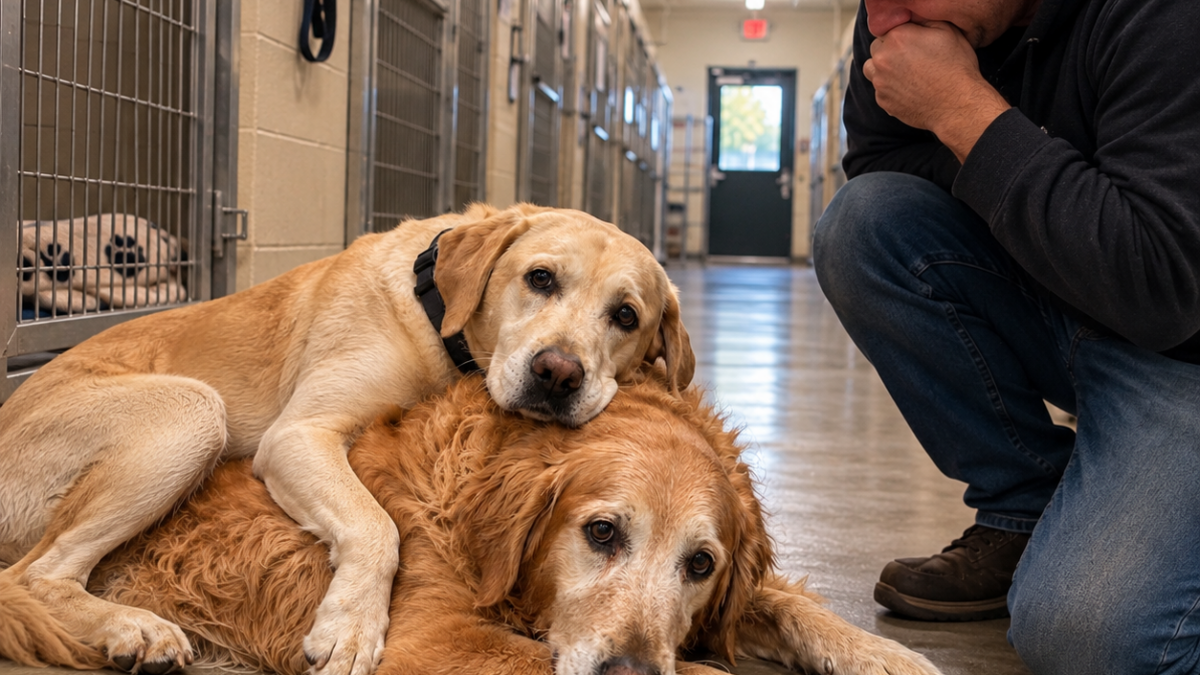
Emily grabbed my arm.
“Michael.”
I did not answer.
Buddy stood on one side of a narrow reinforced window built into the shelter’s rear wall.
On the other side was a dog.
Older.
Dark-coated.
Thin through the hips.
I could only see her face clearly at first.
A black Labrador mix with a white muzzle and cloudy brown eyes.
Buddy’s whole body changed.
His tail did not wag wildly.
He did not bark.
He simply leaned forward until his nose was flat against the glass.
The older dog did the same.
Then she made that sound again.
A soft, trembling whine.
Buddy answered with one of his own.
Emily covered her mouth.
“Oh my God.”
We stood there for several seconds before a shelter employee came running around the corner.
“Buddy?”
It was Rachel, one of the adoption coordinators.
She looked at us.
Then at Buddy.
Then through the window.
Her expression changed immediately.
“What is he doing back here?”
“That,” I said, “is exactly what we were hoping you could tell us.”
Rachel stepped closer.
When the older dog inside saw her, she backed away from the window.
Buddy followed her movement from outside.
He paced three steps.
Stopped.
Returned to the glass.
Rachel stared.
“Wait.”
“What?” Emily asked.
Rachel did not answer.
She opened the service door with her key card.
“Stay here.”
She disappeared inside.
Buddy sat directly beneath the window.
Emily knelt beside him.
He barely acknowledged her.
Not because he did not love her.
Because for the first time since we had adopted him, I could see that his attention belonged somewhere else completely.
Two minutes later, Rachel returned.
She was carrying a tablet.
Her face had gone pale.
“I think we made a mistake.”
My stomach tightened.
“What kind of mistake?”
She turned the screen toward us.
There was an intake photograph.
Two dogs sitting beside each other.
Buddy.
And the older black dog.
Underneath were two names.
BUDDY — GOLDEN LABRADOR, MALE, 3.
MOLLY — LABRADOR MIX, FEMALE, APPROX. 9.
Emily stared.
“They came in together?”
Rachel nodded slowly.
“Looks like it.”
“You didn’t know?”
“I didn’t.”
Her embarrassment was obvious.
“Our intake system separates animals into individual files.”
“If the same person brings in two dogs, there’s supposed to be a bonded-animal note.”
She scrolled.
“There isn’t one on Buddy’s public adoption profile.”
“What about hers?”
Rachel’s finger stopped.
“There is.”
She turned the tablet back toward herself.
I watched her read.
Then she whispered, “Oh.”
“What?”
Rachel took a breath.
“Molly’s intake notes say she showed severe distress when separated from the younger male dog surrendered with her.”
Emily stood.
“What does Buddy’s file say?”
Rachel searched.
“Nothing.”
“Why?”
“I don’t know yet.”
“But the person who processed Molly documented the bond.”
“Buddy was processed by another intake worker.”
“Different shift.”
“Somebody failed to cross-reference.”
My engineer brain immediately wanted to attack the process.
Two files.
Two employees.
One missing link.
A preventable error.
But Buddy did not care about databases.
He was sitting beneath the window waiting for Molly.
“How long has she been here?” I asked.
Rachel looked uncomfortable.
“Longer than Buddy.”
“How long?”
“Almost four months.”
Emily’s voice became very quiet.
“Buddy was only here seven weeks before we adopted him.”
“Yes.”
“So Molly was here before him and stayed after he left.”
Rachel nodded.
“Why wasn’t she available for adoption when we came?”
“She was in medical hold.”
“For what?”
Rachel hesitated.
“Can we go inside?”
Five minutes later, we were sitting in a small consultation room.
Buddy was with us, though getting him away from Molly’s window required Rachel to open the interior kennel door so the two dogs could see each other through a second gate.
Molly came forward slowly.
The moment Buddy saw her, he pressed his whole body against the gate.
Molly did the same.
No jumping.
No barking.
Just contact through metal.
Rachel stood beside us holding the tablet.
“Molly has several medical issues.”
“How serious?” I asked.
“Arthritis.”
“An old knee injury.”
“Some dental disease.”
“And we found a mammary mass during intake.”
Emily’s hand tightened around mine.
“Cancer?”
“We didn’t know initially.”
“A biopsy later showed it was benign.”
“She had surgery six weeks ago.”
“That’s why she stayed in the medical wing.”
“Is she okay now?”
“Medically, she’s improving.”
“But behaviorally…”
Rachel looked toward the gate.
Molly had lowered herself onto the floor.
Buddy lay down directly opposite her.
Their paws almost touched beneath the divider.
“She shuts down.”
“What does that mean?”
“She eats.”
“She drinks.”
“She lets staff handle her.”
“But she doesn’t engage.”
“She rarely plays.”
“She rarely seeks attention.”
“And when she was moved to the public adoption wing after surgery, she stopped eating for two days.”
“So you moved her back?”
“Yes.”
Emily looked at Buddy.
“And he kept coming here.”
Rachel nodded.
“Apparently.”
I leaned back in the chair.
There it was.
A reason.
A logical one.
But somehow knowing it hurt more than not knowing.
Buddy had not been trying to leave us.
He had been trying not to leave her.
“How are they related?” Emily asked.
“We don’t know if they’re biologically related.”
“Who surrendered them?”
Rachel tapped the tablet.
“A man named Harold Bennett.”
“Can we contact him?”
“He died.”
The room went quiet.
“When?” I asked.
“About two weeks after the dogs arrived.”
Rachel scrolled again.
“The surrender was handled by county adult services and Mr. Bennett’s niece.”
“He was hospitalized.”
“Advanced heart failure.”
“He could no longer care for them.”
“The niece lived out of state and could not take either dog.”
Emily’s eyes filled.
“So Buddy and Molly lost their owner.”
“Yes.”
“Then they lost each other.”
Rachel did not answer.
She did not need to.
Buddy had spent weeks in a shelter.
Then strangers came.
We took him into a nice house.
Fed him good food.
Bought toys.
Loved him.
And every night, somewhere two miles away, the dog he had shared his whole previous life with remained behind a kennel door.
Of course he ran back.
The astonishing part was not that he escaped.
The astonishing part was that he returned home with us each time.
I looked at Rachel.
“Why did nobody tell us?”
“I’m sorry.”
She meant it.
I could see that.
But sorry did not make Emily less heartbroken.
It did not give Buddy back those weeks.
It did not make Molly understand why her companion disappeared.
I asked the most obvious question.
“Can we adopt her?”
Emily turned toward me so fast I thought I had startled her.
Rachel blinked.
“Michael.”
My wife’s voice was somewhere between hope and panic.
I looked at her.
“What?”
“We came here to understand Buddy.”
“We understand him.”
She looked at Molly.
“We also have a spare dog bed.”
Rachel almost smiled.
Then her face became serious.
“There are things you need to consider.”
“Her age.”
“Medical care.”
“Arthritis.”
“Possibly expensive dental work.”
“She may need long-term medication.”
“She may have anxiety after everything that happened.”
“She may not adjust quickly.”
I looked through the gate.
Buddy had closed his eyes.
Molly’s muzzle rested between her paws on the other side.
The first relaxed posture I had seen from either of them since we arrived.
“How old did you say she is?”
“Approximately nine.”
Emily whispered, “She could have years left.”
Rachel nodded.
“Yes.”
“Or not as many as you hope.”
That was honest.
Good.
I preferred honest.
Emily looked at me.
Our original plan had been one dog.
One Labrador.
Simple.
Predictable.
We had already spent money on fencing, vet appointments, training equipment, food.
Taking Molly meant another life.
Another expense.
Another responsibility.
A senior dog whose history we did not fully understand.
I could hear the list forming in my head.
Then Buddy opened his eyes and looked at me.
There was something almost accusatory in that expression.
Not because he understood adoption forms.
Because he knew we controlled the gate.
Emily said quietly, “I don’t want him to have to choose.”
That was it.
I looked at Rachel.
“What do we need to do?”
Because Molly had medical needs, the shelter suggested fostering first.
We agreed.
They wanted to observe Buddy and Molly together for several hours before discharge.
That seemed reasonable.
The reunion happened in a fenced yard behind the shelter.
I expected excitement.
Running.
Jumping.
Some dramatic explosion of canine joy.
Instead, the gate opened.
Buddy walked in.
Molly stood at the opposite side.
For several seconds, neither moved.
Then Buddy approached.
Slowly.
Head lowered.
Molly stepped forward.
They touched noses.
Buddy sniffed her face.
Her shoulders.
The scar on her belly where surgery had been done.
Molly sniffed his ears.
His collar.
His chest.
Then Buddy leaned his forehead against the side of her neck.
Molly closed her eyes.
Emily began crying.
Rachel looked away.
I stood there feeling foolishly grateful for a moment so quiet.
Buddy eventually stepped away and circled the yard.
Molly followed.
Not immediately.
But she followed.
Buddy picked up an old tennis ball.
He carried it toward her.
Dropped it.
Molly ignored the ball.
Buddy picked it up again.
Dropped it closer.
Still nothing.
On the third attempt, Molly nudged it with her nose.
Buddy’s tail began wagging.
That was when Rachel said, “We haven’t seen her do that since intake.”
Emily wiped her face.
“Do what?”
“Respond to play.”
Buddy brought the ball again.
Molly took one slow step after it.
Then another.
No running.
No youthful burst of energy.
Just an old dog making the decision to participate.
Buddy bounced once in front of her like a puppy.
Molly’s tail moved.
Rachel started crying too.
“This is embarrassing,” she muttered.
“No,” Emily said.
“It really isn’t.”
We brought both dogs home that afternoon.
This time, Buddy did not ride alone in the back seat.
Molly lay beside him.
For the first ten minutes, Buddy stayed sitting upright as if afraid she might vanish if he looked away.
Then Molly lowered her head onto the seat.
Buddy slowly lowered his beside hers.
By the time we reached our street, both were asleep.
At home, I opened the front door.
Buddy entered first.
Then stopped.
He turned back.
Molly stood on the porch uncertainly.
This was not her house.
Not yet.
Buddy walked back outside.
He touched his nose to her shoulder.
Then came in again.
Molly followed.
Emily covered her mouth.
“He’s showing her.”
I would normally have rejected such a sentimental interpretation.
There could have been a hundred reasons.
Scent.
Social following.
Habit.
But after Buddy’s five shelter runs, I had become less interested in explaining away beautiful things.
Molly explored the living room.
Kitchen.
Hallway.
Then Buddy led her to the backyard.
I watched through the sliding door.
He ran toward the maple tree.
Turned.
Waited.
Molly walked after him.
Buddy ran toward the fence.
Turned.
Waited again.
Molly followed.
The pattern repeated around the yard.
Almost like a tour.
Here is the grass.
Here is the shade.
Here is the gate.
Here is where the humans keep us now.
That night, we placed two dog beds in the living room.
Buddy ignored his.
Molly ignored hers.
They slept together on the rug between them.
Emily and I stood in the hallway looking down.
“We wasted ninety dollars on beds,” I whispered.
“Be quiet.”
“I’m just observing.”
“They look happy.”
“They look uncomfortable.”
“They look happy.”
Buddy had one back leg hanging off the rug.
Molly’s head was on his ribs.
I smiled.
“Okay.”
“Happy.”
The first week with Molly taught us that bonded dogs do not magically erase one another’s trauma.
Buddy stopped trying to escape.
Immediately.
That problem vanished.
The new problems arrived.
Molly panicked when left alone.
Not when Buddy was present.
When both dogs were left without humans.
The first time Emily and I went grocery shopping together, we returned to find Molly had scratched the inside of the front door until one nail bled.
Buddy had apparently stayed beside her, because tufts of his golden fur were mixed into the rug nearby.
We changed our routine.
One person left.
One stayed.
Then short absences.
Two minutes.
Five.
Ten.
A camera near the door.
Treat puzzles.
Calm departures.
No dramatic reunions.
Our trainer, Lisa, told us, “The goal is not to convince them you’ll never leave.”
“Because sometimes you will.”
“The goal is to teach them leaving is temporary.”
I looked at Buddy.
“How long does that take?”
Lisa shrugged.
“How long does grief take?”
Engineer brain disliked that answer.
Dog ownership did not care.
Molly also had strange food habits.
She would not begin eating until Buddy touched his bowl.
Once he started, she ate.
If Buddy walked away, Molly stopped.
We began feeding them side by side with enough distance to avoid conflict.
There was never any guarding.
Just checking.
Buddy looked at Molly.
Molly looked at Buddy.
Then both ate.
They had apparently spent years organizing life around each other.
We found out more about those years through Harold Bennett’s niece.
Her name was Rebecca.
Rachel contacted her after getting permission to share our number.
Rebecca called one Sunday afternoon.
“I’m sorry,” she said before introducing herself properly.
“For what?”
“For everything.”
She told us Harold had been seventy-one.
A widower.
Retired electrician.
No children.
Buddy had come first.
Harold found him as a six-month-old stray near a gas station.
Molly had already been with him four years.
She had belonged to Harold’s wife, Janet, who died from cancer.
“So Molly was hers?” Emily asked.
“Yes.”
“After Aunt Janet died, Molly stopped eating.”
Rebecca’s voice softened.
“Uncle Harold adopted Buddy partly because the shelter volunteer thought another dog might help.”
“And it did?”
“Almost immediately.”
I looked toward the living room.
Molly slept in the sunlight.
Buddy lay beside her.
Rebecca continued.
“Buddy followed her everywhere.”
“She taught him everything.”
“House rules.”
“Walking on leash.”
“Where to sleep.”
“She’d correct him when he got too wild.”
“Uncle Harold used to say Molly raised him.”
That explained the age difference.
Not mother and son biologically.
Something close emotionally.
“What happened when Harold got sick?” I asked.
There was silence.
“It happened fast.”
“Heart failure had been getting worse, but he hid it.”
“By the time I got involved, he couldn’t walk across the house without stopping.”
“I live in Oregon.”
“I flew in.”
“The dogs were still there.”
“Molly slept beside his bed.”
“Buddy slept near the front door.”
“When the ambulance took him, both dogs tried to follow.”
Emily closed her eyes.
Rebecca’s voice shook.
“I promised him I’d keep them together.”
That sentence changed the room.
“What happened?” I asked gently.
“I tried.”
“My landlord has a strict no-dog policy.”
“I called rescues.”
“Breed-specific groups.”
“Friends.”
“Everyone was full.”
“The county shelter could take them immediately.”
“I wrote on every form that they were bonded.”
Her voice cracked.
“I told two people at intake.”
“I assumed it would stay with them.”
“It didn’t,” I said.
“I know.”
“I found out after Buddy was adopted.”
“I called the shelter when I realized Molly was still there.”
“They said Buddy’s adoption was already final and they couldn’t give me adopter information.”
She began crying.
“I thought I had failed Uncle Harold.”
Emily spoke first.
“You didn’t.”
Rebecca did not answer.
“You did what you could.”
“I promised.”
“So did the shelter.”
I said it more sharply than I intended.
Emily looked at me.
I took a breath.
“Rebecca, Buddy is home.”
“Molly is with him.”
“They’re together.”
The line went quiet.
Then Rebecca whispered, “Can I see them?”
Two weeks later, she flew out.
When Rebecca entered our backyard, Buddy reacted first.
His head lifted.
He stared.
Then his tail began moving.
Molly stood more slowly.
Rebecca dropped to her knees.
“Molly.”
The old dog walked toward her.
Not running.
Not dramatic.
But certain.
Rebecca hugged her.
Buddy pushed his way in.
Within seconds, all three were tangled together.
Rebecca sobbed into Buddy’s fur.
“I’m sorry.”
Molly licked her chin.
Buddy stole the tissue from her hand.
That helped.
Over dinner, Rebecca brought photographs.
Harold with Molly on a lake dock.
Janet with Molly as a young dog.
Buddy as a puppy asleep across Molly’s back.
Harold sitting between both dogs on an old green sofa.
One photograph stopped Emily.
Harold was standing on his porch.
Molly at one side.
Buddy at the other.
On the back, in Harold’s handwriting:
MY WHOLE HOUSE.
Emily handed it to me.
I read it twice.
Then looked toward our living room.
Buddy and Molly were asleep beside each other.
Rebecca watched my face.
“He loved them.”
“I can tell.”
“He would be relieved.”
I swallowed.
“I hope so.”
She reached into her bag.
“There’s something else.”
A worn red tennis ball.
Molly lifted her head the moment she saw it.
Buddy stood.
Rebecca laughed through tears.
“This was in Uncle Harold’s coat pocket at the hospital.”
“I forgot I had it.”
She rolled it across the floor.
Molly moved faster than I had ever seen her move.
Not fast by young-dog standards.
Fast for Molly.
She reached the ball.
Picked it up.
Buddy bounced around her.
For ten seconds, the old dog looked years younger.
That night, after Rebecca left for her hotel, Emily and I sat in the kitchen.
“We’re adopting her,” she said.
“I thought we were fostering.”
“We’re failing at fostering.”
“That seems to happen a lot.”
“She’s Buddy’s family.”
“So are we.”
Emily looked at me.
“Exactly.”
We signed Molly’s adoption papers the following Friday.
Buddy came with us.
When Rachel handed over the final folder, she looked emotional.
“I owe all four of you an apology.”
“You didn’t personally make the intake error,” I said.
“No.”
“But we should have had a system that made it harder to make.”
I understood that language.
Systems.
Redundancy.
Failure points.
Rachel continued.
“We changed the intake process.”
“How?”
“Bonded animals now receive linked identification bands.”
“The system flags a warning if one is moved to adoption status without the other file being reviewed.”
“Adoption counselors have to sign off.”
“Medical separation doesn’t remove the bond marker.”
That mattered to me.
Not because Buddy needed it anymore.
Because the next pair might.
One mistake had separated them.
A better process might prevent another.
Months passed.
Buddy never ran away again.
Not once.
The side gate stood open accidentally one afternoon when a landscaper came through.
I saw it from the kitchen.
Buddy saw it too.
He walked toward the opening.
My chest tightened.
I called his name.
He stopped.
Looked outside.
Then looked behind him.
Molly was sleeping beneath the maple tree.
Buddy turned around.
Walked back.
Lay down beside her.
I did not realize Emily was standing behind me until she started crying.
“He chose home.”
I looked at the open gate.
Then at the dogs.
“No.”
Emily frowned.
“What?”
“He chose both.”
That distinction mattered.
For a long time, I had thought home competed with whatever Buddy was returning to.
As if love required replacement.
Us or the shelter.
New life or old life.
But Buddy had never wanted to leave us.
He wanted the part of his old life that mattered to come with him.
Once Molly was there, he did not have to choose.
That taught me something I should have understood sooner.
People often talk about rescue animals as if adoption starts them over.
Fresh start.
New chapter.
Clean slate.
Those phrases sound comforting.
They are also wrong.
Dogs arrive carrying histories.
Smells.
Routines.
Fears.
Relationships.
Losses.
We do not erase those by loving them.
If we are lucky, we make enough room for the history to live beside the new life without controlling it.
Molly changed after several months.
Slowly.
She began greeting us at the door.
Not only Buddy.
Us.
Emily first.
Then me.
One evening, I came home late after a difficult project meeting.
Buddy met me in the entryway with his normal full-body wag.
Molly remained on the rug.
I bent to remove my shoes.
Then felt something against my knee.
Molly had walked over.
She pressed her gray muzzle into my hand.
Only for a second.
Then returned to the rug.
Emily saw.
“She loves you.”
“She wanted me to move.”
“Michael.”
“I’m maintaining emotional neutrality.”
“You bought her an orthopedic bed that cost more than our coffee table.”
“The bed has verified spinal support.”
Emily laughed.
I scratched Molly behind the ear.
She leaned into my fingers.
Emotional neutrality ended quietly.
The following spring, we visited Harold’s grave with Rebecca.
She had asked whether we wanted to come.
Emily said yes immediately.
I was less certain.
We had never known the man.
But we knew what he loved.
That seemed like enough.
We brought Buddy and Molly.
The cemetery allowed dogs on leash.
Rebecca stood beside the stone.
HAROLD JAMES BENNETT.
BELOVED HUSBAND.
BELOVED FRIEND.
Emily placed flowers.
Molly sniffed the ground near the marker.
Then sat.
Buddy sat beside her.
Rebecca cried.
“He’d be so mad he missed this.”
“What?”
“You two.”
She smiled.
“He’d probably inspect your fence.”
“I reinforced it.”
“Of course you did.”
She looked at Molly.
Then Buddy.
“I kept thinking I broke my promise.”
“You didn’t,” Emily said.
Rebecca wiped her face.
“I told him I’d keep them together.”
“They were separated four months.”
“And then they found each other again,” I said.
Rebecca looked at Buddy.
“Five times.”
I almost laughed.
“Yes.”
“Buddy was apparently more committed to the project than the rest of us.”
We stayed until sunset.
On the drive home, Molly slept against Buddy.
Emily looked through the rearview mirror.
“Do you think dogs understand death?”
“I don’t know.”
“Very engineer answer.”
“It’s accurate.”
She smiled.
“Do you think Buddy understood Molly was still at the shelter?”
I thought about his escapes.
The exact routes.
The window.
The gate.
His nose against that glass.
“Yes.”
“I think he understood enough.”
That became my answer to many things.
Enough.
We do not need to know whether Buddy thought in words.
Whether he remembered Harold as a person or simply a scent and a shape.
Whether he understood shelter separation as loss.
He knew Molly was missing.
He knew where she was.
He knew how to get there.
And no amount of comfort at our house could convince him that leaving her behind was acceptable.
That was enough.
A year after Molly came home, her arthritis worsened.
We expected it.
Medication helped.
Weight control helped.
Short walks.
Warm beds.
A ramp to the back deck.
Buddy adjusted to her pace automatically.
He had once been the dog who pulled forward on walks.
Now he stopped whenever Molly stopped.
If she needed thirty seconds to sniff one patch of grass, Buddy waited.
If she turned home early, he turned too.
Sometimes I took Buddy out alone for longer exercise.
He enjoyed it.
But when we came home, he always searched for Molly first.
Every time.
The second year brought kidney disease.
Early stage.
Manageable.
Then less manageable.
Dr. Patel, who had become our regular veterinarian, explained that senior dogs do not decline in neat lines.
Good weeks.
Bad days.
Recovery.
Then another step down.
Emily hated every conversation.
I wanted numbers.
“How long?”
Dr. Patel gave me a patient look.
“I know what you do for a living, Michael.”
“That is not helpful.”
“I cannot engineer you a timeline.”
I looked away.
Emily took my hand.
Dr. Patel continued.
“We watch quality.”
“Eating.”
“Comfort.”
“Interest.”
“Mobility.”
“Connection.”
Connection.
Molly still had that.
Especially with Buddy.
The morning she stopped following him into the backyard, Buddy noticed immediately.
He ran halfway across the grass.
Turned.
Molly remained by the door.
Buddy came back.
He nudged her shoulder.
Molly took three steps.
Stopped.
Buddy sat.
He did not run again.
I watched through the kitchen window.
Emily whispered, “He knows.”
“Yes.”
Molly’s last summer was gentle.
We made it gentle.
Short mornings outside before the heat.
Frozen treats.
Soft rugs.
A shallow splash pool Buddy loved and Molly considered beneath her dignity.
Rebecca visited.
She sat under the maple tree with both dogs.
Molly slept with her head on Rebecca’s leg.
Buddy lay on the other side.
Rebecca stroked them for almost two hours.
Before leaving, she kissed Molly’s gray forehead.
“Tell them when you’re tired.”
I heard her.
Emily heard her.
Nobody commented.
In September, Molly stopped eating breakfast.
Not refusing everything.
Just breakfast.
Then dinner became difficult.
Then she ate only from Emily’s hand.
Buddy stopped eating normally too.
He would stand beside his bowl watching Molly.
If she took a bite, he ate.
If she did not, he waited.
Dr. Patel told us to feed Buddy separately.
We tried.
He scratched the kitchen door.
So we sat between them.
Emily with Molly.
Me with Buddy.
A strange family meal.
One bite Molly.
One bite Buddy.
Some nights it worked.
Some did not.
Then came a cool October morning.
I woke at 5:40 and found Buddy standing beside our bed.
He did not wag.
He stared at me.
“Buddy?”
He turned toward the hallway.
Walked two steps.
Looked back.
I got up.
He led me downstairs.
Molly lay on her bed in the living room.
Her breathing was shallow.
Emily came behind me.
“Oh.”
One sound.
That was all.
Buddy went to Molly and lay beside her.
He pressed his body along hers.
Molly’s eyes opened.
She looked at him.
Then us.
I called Dr. Patel.
She came to the house.
No clinic.
No car ride.
No bright room.
Molly hated the car by then.
Home was right.
Dr. Patel examined her quietly.
Then sat on the floor.
Emily knew before she spoke.
“So this is it?”
Dr. Patel nodded.
“I think she’s telling us she’s tired.”
My engineer brain tried to find another option.
Medication.
Fluids.
Another day.
Another week.
Inputs.
Outputs.
Fixes.
Then Molly looked at Buddy.
He was licking her ear.
Slowly.
The way dogs groom another dog when there is nothing else left to do.
I stopped solving.
We called Rebecca on video.
She answered immediately.
When she saw Molly, she covered her mouth.
“Oh, sweetheart.”
Emily held the phone near the bed.
Rebecca spoke softly.
“Hi, Molly girl.”
Molly’s ear moved.
“You kept your promise.”
Rebecca began crying.
“You took care of everybody.”
“Janet.”
“Harold.”
“Buddy.”
“Then these two crazy people.”
Emily laughed through tears.
“Excuse me.”
Rebecca smiled.
“You can rest now.”
Buddy looked toward the phone.
Rebecca saw him.
“And you.”
Her voice broke.
“You stay with them.”
Buddy’s tail moved once.
I sat beside him.
For two years, we had worried what would happen when Molly died.
Would Buddy run back to the shelter again?
Would he search?
Would he stop eating?
Would he believe he had lost another home?
The answer was not ours to control.
Dr. Patel gave Molly the first medication.
Her body relaxed.
Emily cradled her head.
I kept one hand on her shoulder.
Buddy stayed pressed against her side.
No one moved him.
Molly’s breathing slowed.
Her eyes remained on Buddy.
Then she exhaled.
Long.
Soft.
Her eyes closed.
Dr. Patel listened.
Waited.
Then whispered, “She’s gone.”
Buddy did not react immediately.
That was the hardest part.
He kept lying beside her.
After perhaps a minute, he lifted his head.
He sniffed Molly’s face.
Her neck.
Her paws.
Then he stood.
Circled once.
Returned.
Nudged her shoulder.
Nothing.
He nudged again.
Emily sobbed.
I turned away.
Buddy lay down beside Molly one more time.
His chin rested across her front paws.
We let him stay.
Dr. Patel said it was important that he understand in whatever way dogs understand.
No sudden disappearance.
No Molly going into a car and never coming back.
He needed to know she had not simply vanished.
Eventually, Buddy stood.
He walked to Emily.
Pressed his head against her chest.
Then he came to me.
I put both hands around his face.
“I know.”
That was all I had.
“I know.”
For three days, Buddy barely ate.
He searched the house.
Molly’s bed.
Backyard.
Kitchen.
Hallway.
He stood at the side gate twice.
My chest froze each time.
But he did not try to leave.
On the fourth morning, I opened the gate intentionally.
Emily stared at me.
“What are you doing?”
“I need to know.”
“Michael.”
“I’m not going to let him run into traffic.”
Buddy stood in the yard looking at the opening.
The route to the shelter was available.
Same route he had taken five times.
He walked toward the gate.
Stopped at the threshold.
Sniffed the air.
I held my breath.
Buddy looked down the street.
Then back at us.
Emily was crying silently.
I stood beside her.
Buddy turned around.
Walked back into the yard.
He came straight to us.
Sat at Emily’s feet.
She dropped to her knees and wrapped her arms around him.
“He stayed.”
I crouched beside them.
This time, I agreed.
“Yes.”
He stayed.
Not because Molly no longer mattered.
Because she had taught him something too.
Home could survive loss.
The person—or dog—you loved could be gone without every other bond disappearing with them.
It took Buddy weeks to act like himself again.
Months, maybe.
He stopped waiting by Molly’s empty bed after we moved it.
For a while, I felt guilty about removing it.
Then I remembered what Buddy had taught us from the beginning.
Love does not depend on staying in the same place forever.
We kept Molly’s collar.
Her old red tennis ball.
A photograph of her and Buddy lying beneath the maple tree.
Her ashes came home in a simple wooden box.
Rebecca asked us to place a little beside Harold and Janet someday.
We promised.
The rest stayed with us.
Buddy turned six.
Then seven.
He became calmer.
Still golden.
Still enthusiastic about food.
Still convinced every delivery driver was personally visiting him.
He never escaped again.
Not once.
Rachel occasionally sent us updates from the shelter.
The linked-file procedure became permanent.
In the first year, it prevented three bonded pairs from being accidentally separated during adoption processing.
One pair was two elderly beagles.
Another was a mother and adult daughter.
The third was a pair of dogs whose owner entered assisted living.
Rachel wrote:
Buddy and Molly changed this place.
I showed Emily.
She smiled.
“Molly changed it too.”
“Yes.”
“Don’t give Buddy all the credit.”
“I wouldn’t dare.”
We began volunteering there one Saturday a month.
At first, Buddy stayed home.
Later, Rachel suggested bringing him for controlled visits.
I hesitated.
The shelter had once been the place he repeatedly ran toward.
Would returning restart something?
The first visit answered that.
Buddy entered through the front doors beside us.
He sniffed.
Looked down the kennel hallway.
Then looked at me.
No pulling.
No panic.
Rachel crouched.
“Hey, frequent flyer.”
Buddy wagged.
He greeted her.
Then followed us into the volunteer room.
The shelter was no longer a destination he needed to reach.
It was simply a place in his history.
A place where he lost someone.
A place where he found us.
Both could be true.
We eventually started helping with bonded animals.
Not officially at first.
Just sharing posts.
Transporting dogs to foster homes.
Meeting adopters who were considering taking two animals together.
I became annoyingly detailed about practical planning.
Food costs.
Vet budgets.
Space.
Training.
Insurance.
Separate resting areas.
People sometimes expected me to make emotional speeches.
I gave them spreadsheets.
Emily handled the emotional speeches.
Together, we were apparently effective.
One couple came to meet two senior spaniels surrendered after their owner died.
They wanted only one.
Understandable.
Two old dogs meant double medication.
Double bills.
Double grief eventually.
I did not pressure them.
Neither did Emily.
We explained the bond.
Showed them how the dogs behaved apart and together.
They left.
Came back two days later.
Adopted both.
Six months afterward, they sent a photograph of the spaniels asleep on one enormous bed they were supposedly not meant to share.
I showed Buddy.
He sniffed my phone.
“Your legacy,” I told him.
Emily rolled her eyes.
“He wants lunch.”
“Both can be true.”
Years later, I finally understood what Buddy had challenged in me.
It was not logic.
It was the limits of logic.
I had approached his escapes as a mechanical problem.
Gate failure.
Window failure.
Leash failure.
Input.
Output.
Containment.
But the question was never how to stop Buddy from running.
The question was why running mattered enough that he kept doing it.
Once we understood that, the solution was not a stronger fence.
It was Molly.
Not every problem is solved by preventing behavior.
Sometimes behavior is information.
Sometimes the thing that looks irrational is perfectly logical once you understand what has been lost.
Buddy is ten now.
His face has begun whitening around the muzzle.
Not as white as Molly’s was, but enough that Emily pretends not to notice.
He moves more slowly after long walks.
He has a soft bed in nearly every room because apparently one Labrador requires the sleeping infrastructure of a small hotel.
The old side gate is still there.
New latch.
Reinforced hinges.
But sometimes when I work in the yard, I leave it open.
Buddy notices.
He always does.
He will look down the street.
Then back toward the house.
Sometimes he lies beneath the maple tree where Molly used to sleep.
Sometimes he comes into the garage and drops a tennis ball at my feet.
He has never run through the gate.
Not since Molly came home.
Not even after she died.
Last month, on the anniversary of Molly’s adoption, Rebecca visited.
We took Buddy to Harold and Janet’s grave.
Under a small tree nearby, the cemetery had allowed us to bury a portion of Molly’s ashes.
Rebecca placed the old red tennis ball beside the marker temporarily while we sat.
Buddy sniffed the ground.
Then lay down in the grass.
Rebecca touched his head.
“You really wouldn’t leave her, would you?”
Buddy looked up.
His tail moved once.
Emily sat beside him.
I looked at the three of them and thought about the first morning Buddy ran.
How certain I had been that there must be a simple explanation.
There was.
Love.
Just not the kind I had expected.
We had believed adoption meant Buddy’s old life was finished and his new one had begun.
Buddy knew better.
Life does not divide that neatly.
He loved Harold.
He loved Molly.
Then he loved us.
None of those bonds canceled the others.
We had given Buddy a home.
But he taught us that giving someone a new home does not mean asking them to abandon everyone who made the old one feel like home.
Four times, we dragged him back from the shelter because we thought he was confused.
The fifth time, we finally listened.
And when we did, we discovered that Buddy had never been trying to escape from us.
He had been trying to bring his family back together.








