Cop Slapped a Black Woman He Mistook for a Defendant—Then the Bailiff Called Her “Your Honor”
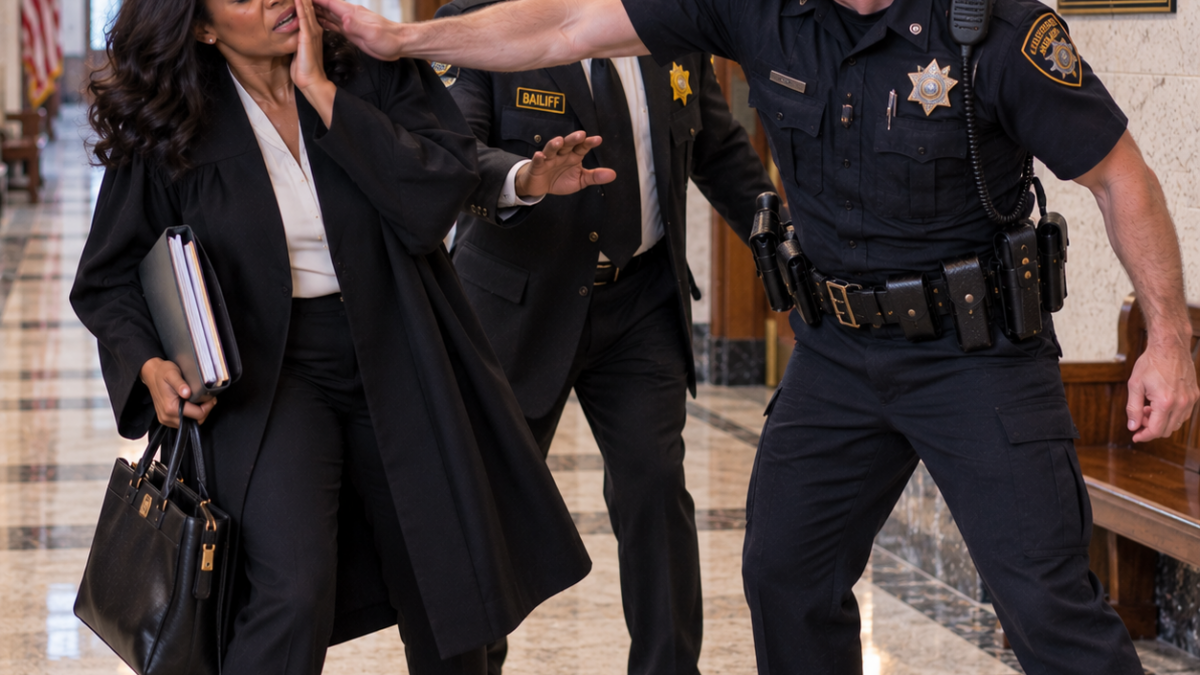
Miller stared at Thomas.
Then at me.
Then back at Thomas.
“What did you call her?”
Thomas Gallagher had spent twenty-eight years inside the Monroe County Courthouse.
He was sixty-two, stocky, gray-haired, and normally so calm that younger attorneys joked the building could catch fire and Tommy would simply point everyone toward the nearest exit.
Now his face was red.
Not embarrassed.
Furious.
“Your Honor.”
He said it again.
Clearer.
Louder.
“Judge Caldwell.”
Miller’s grip disappeared from my shoulder.
His hand seemed to recoil as though he’d touched a hot stove.
“No.”
The word came out as a whisper.
Thomas stepped fully between us.
“Judge Josephine Caldwell.”
Miller looked at my plain coat.
My briefcase.
My face.
Anything except my eyes.
“She’s…”
He swallowed.
“She’s a judge?”
I picked up the white handkerchief I kept in my coat pocket and pressed it against my lip.
“Yes.”
He opened his mouth.
Closed it.
The steel handcuffs were still hanging from his right hand.
A moment earlier, he had been preparing to place them around my wrists.
Now they seemed to weigh twenty pounds.
“I didn’t know.”
That was the first thing he said.
Not:
I’m sorry.
Not:
Are you injured?
Not:
I lost control.
I didn’t know.
Thomas heard it too.
His face hardened.
“You didn’t know she was a judge?”
“No.”
Miller’s voice returned in pieces.
“I thought she was a defendant.”
Thomas stared at him.
“And that makes hitting her acceptable?”
Miller blinked.
“That’s not what I mean.”
“It’s exactly what you mean.”
“Tommy—”
“Don’t Tommy me.”
The hallway was completely silent.
Dozens of people were listening.
Attorneys.
Clerks.
People waiting for arraignments.
A mother holding a sleeping toddler.
Two public defenders who had stopped mid-conversation.
Miller lowered his voice.
“She resisted.”
I spoke from behind Thomas.
“No, Officer Miller.”
He looked at me.
“You grabbed my arm.”
“I attempted to remove your hand.”
“You then struck me.”
Miller’s jaw tightened.
“Judge, I thought you were—”
“A criminal?”
He stopped.
“A twenty-two-year-old Black woman named Maya Reynolds?”
His face changed.
That confirmed the name.
I hadn’t imagined it.
“You were looking for her.”
He said nothing.
“How old is she?”
“I don’t know.”
“You don’t know the age of the defendant you claim I resembled?”
“Early twenties.”
“I’m forty-three.”
“I was working from a description.”
“What description?”
“Black female.”
Thomas gave a bitter laugh.
“That’s it?”
Miller looked trapped.
“No.”
“What else?”
“Dark coat.”
I looked down at my charcoal trench coat.
Half the people in the courthouse wore dark winter coats.
“Height?”
Miller didn’t answer.
“Hair?”
Nothing.
“Photograph?”
His silence told me he had one.
He simply hadn’t cared enough to look closely.
I took one step toward him.
Pain pulsed across my cheek.
“Officer Miller, did you actually compare me to the photograph of the woman you were looking for?”
“I made a reasonable identification.”
“No.”
I said quietly.
“You made an assumption.”
Chief Judge William Abernathy arrived less than two minutes later.
Someone had radioed him.
Or called chambers.
I never learned which.
William was sixty-eight years old, six-foot-three, silver-haired, and possessed the kind of courtroom presence that made even experienced litigators stop shuffling papers when he entered.
He rounded the corner with Captain Richard Hayes behind him.
William saw me first.
He stopped.
“Josephine?”
I nodded.
His eyes fixed on my cheek.
Then on the blood at my lip.
“What happened?”
Thomas pointed at Miller.
“He hit her.”
William turned slowly.
Miller took a step backward.
“Chief Judge—”
William held up one hand.
“Do not speak.”
That was all.
No shouting.
No threats.
Just four words.
Miller shut his mouth.
Captain Hayes walked toward me.
“Judge Caldwell, do you need medical attention?”
“I want to be examined.”
“Of course.”
“But first I want this scene preserved.”
Hayes looked around.
“Preserved?”
“Every witness.”
“Every camera.”
“Every radio transmission.”
“Officer Miller’s body camera.”
“Any hallway surveillance.”
Hayes nodded immediately.
“Done.”
Miller shifted.
William noticed.
“Officer.”
Miller froze.
“Is your body camera active?”
His hand moved toward his chest.
The small light was dark.
Hayes’s face changed.
“Bradley.”
Miller looked at him.
“Why is your camera off?”
“It must have—”
“Do not say malfunction unless you’re prepared to explain it under oath.”
Miller stopped.
Hayes had worked with him for years.
That was obvious.
So was the fact that he had already heard that excuse before.
“Give me your weapon.”
Miller stared.
“Captain.”
“Weapon.”
“You can’t just—”
“Your weapon, Bradley.”
Miller looked around the corridor.
People were recording now.
Phones held openly.
A young public defender had positioned herself near the wall with the camera angled directly at him.
His world had become evidence.
Slowly, he unholstered his pistol.
Hayes took it.
“Taser.”
Miller handed it over.
“Badge.”
That hurt him most.
I could see it.
His fingers stayed on the shield for several seconds before he removed it.
Hayes placed everything in another officer’s hands.
“Now turn around.”
Miller’s head lifted.
“What?”
“You are being detained pending investigation.”
Frank Donnelly appeared before anyone could cuff him.
Frank was the police union representative.
Heavyset.
Close-cropped gray hair.
Red tie.
A permanent expression suggesting every problem could be solved if everyone simply stopped questioning police officers.
He moved through the hallway raising both hands.
“Hold it.”
Hayes looked irritated before Frank even reached us.
“Not now.”
“Absolutely now.”
Frank pointed toward Miller.
“He’s entitled to representation before questioning.”
“Nobody is questioning him.”
“You’re putting him in custody.”
“For assault.”
“Alleged assault.”
Thomas actually laughed.
Frank’s head turned.
“You have something to say?”
Thomas stepped closer.
“I watched the aftermath.”
“The judge’s face is swollen.”
“Her lip is bleeding.”
“There are fifty witnesses.”
Frank ignored him.
He looked at me.
“Judge Caldwell.”
“Mr. Donnelly.”
“Nobody disputes this situation looks terrible.”
Looks.
That word interested me.
“But Officer Miller was operating in a high-stress environment.”
I waited.
“He believed he was dealing with a defendant who had left a designated area.”
“Incorrectly.”
“Obviously.”
Frank lowered his voice.
“He made a mistake.”
I looked at Miller.
Then at Frank.
“A mistake is calling someone by the wrong name.”
Frank stiffened.
“This situation escalated.”
“Who escalated it?”
“Judge—”
“Who put hands on whom first?”
Frank hesitated.
I turned toward Hayes.
“Captain?”
Hayes answered immediately.
“From what I’ve been told, Miller initiated contact.”
“Who struck whom?”
“Miller struck you.”
“Did I strike him?”
“No witness has said that.”
“Thank you.”
I looked back at Frank.
“Then describe the misunderstanding.”
His face flushed.
“I’m trying to prevent this from becoming something bigger than it needs to be.”
There it was.
Not truth.
Containment.
“How big should an officer striking an unarmed woman in a courthouse be?”
He sighed.
“You know how media reacts.”
“I haven’t contacted media.”
“But people are filming.”
“That’s not my doing.”
“If we step into a private conference room—”
“No.”
“Judge.”
“No.”
His expression tightened.
“We can review the facts internally.”
“The officer who struck me believed I was an ordinary defendant.”
I said.
“Correct?”
Frank didn’t answer.
“He thought I lacked status.”
“Correct?”
“That appears to be—”
“And your solution is to move this behind a closed door now that you know I possess status?”
Frank’s face went still.
“That’s exactly why this must remain public.”
He tried again.
“With respect, Judge Caldwell—”
“Respect should have arrived before anyone learned my title.”
That ended the conversation.
William pointed toward the stairwell.
“Mr. Donnelly.”
“Leave.”
Frank turned.
“Chief Judge—”
“Leave my courthouse hallway.”
His voice remained calm.
“If counsel is requested, arrange counsel.”
“You will not interfere with evidence preservation.”
“You will not negotiate this event in the corridor.”
“And you will not describe assault as a public-relations problem in my presence again.”
Frank stared at him.
Then left.
Paramedics examined me in a small conference room.
Bruised cheekbone.
Split inner lip.
Mild swelling near my ear.
No fracture.
No neurological symptoms.
They recommended imaging because of the force involved.
I agreed to go after I addressed my docket.
Bethany, my clerk, arrived carrying my robe.
She saw my face and burst into tears.
“Don’t.”
I said.
She covered her mouth.
“I’m sorry.”
“For what?”
“I don’t know.”
“Exactly.”
I smiled despite the pain.
“Don’t apologize for someone else’s choices.”
She nodded.
Then cried harder.
I hugged her.
That hurt my shoulder more than expected.
So I stopped pretending I was completely fine.
William entered.
He closed the conference room door.
“Josephine.”
“Yes?”
“I canceled your morning docket.”
“No.”
His eyebrows rose.
“No?”
“Move the arraignments.”
“The civil motion can wait.”
“But the sentencing stays.”
“You were assaulted twenty minutes ago.”
“I know.”
“You need a hospital.”
“I’ll go.”
“After.”
He stared at me.
“Why?”
“Because Marcus Bell is on that docket.”
William frowned.
“Persistent petty theft?”
“Yes.”
“You were considering diversion.”
“Correct.”
“Josephine—”
“He has been in county custody six weeks.”
“If I cancel, he’ll likely sit another week before rescheduling.”
William sighed.
“You are bleeding.”
“Not anymore.”
“Your face is swelling.”
“I own mirrors.”
He almost smiled.
Almost.
Then he sat.
“What do you need?”
That question told me why I respected him.
Not:
Are you sure?
Not:
Think about appearances.
What do you need?
“A record preserved.”
“Independent investigation.”
“Not only today’s incident.”
His expression changed.
“You think there’s more?”
“Of course there’s more.”
“Nobody slaps a stranger in a courthouse hallway on his first bad morning.”
“He was comfortable.”
“Too comfortable.”
William leaned back.
“Hayes says Miller’s personnel file has complaints.”
“How many?”
“He doesn’t know yet.”
“Find out.”
“I will.”
“And do not let internal affairs close this before outside counsel reviews it.”
William nodded.
“What else?”
I looked toward the hallway.
“Find Maya Reynolds.”
He frowned.
“The defendant Miller thought you were?”
“Yes.”
“Why?”
“Because I want to know why he was so angry she was late.”
Maya Reynolds was not difficult to find.
She arrived at courthouse security at 8:17 a.m.
Twenty-two years old.
Five-foot-four.
Natural curls pulled into a bun.
Bright blue winter coat.
She looked almost nothing like me.
Her public defender, Elena Ruiz, brought her upstairs.
Maya looked terrified.
Not because she knew what had happened.
Because she thought she’d missed court.
“My bus got stuck behind an accident.”
She blurted.
“I have pictures.”
“I called the office.”
“I swear.”
Elena touched her arm.
“You’re not in trouble for being late.”
Maya looked confused.
Then she saw me.
Her eyes widened at the bruise.
“What happened?”
I studied her.
“Officer Miller was looking for you.”
All color left her face.
That told me more than an affidavit could have.
“No.”
She whispered.
Elena turned.
“Maya?”
The young woman backed toward the door.
“No.”
“What is it?”
“He can’t know I talked.”
“Talked about what?”
Maya’s eyes moved to me.
“You don’t understand.”
I stood.
Slowly.
My cheek hurt.
My pride hurt more.
“Maya.”
“My name is Josephine Caldwell.”
“I’m a judge.”
She looked even more frightened.
Judges had not historically represented safety in her life.
I understood.
“So?”
She asked.
“So I’m not asking you to tell me anything as a judge.”
“I am asking whether Officer Miller has hurt you before.”
Her breathing changed.
Elena’s face hardened.
“Maya?”
The young woman looked at the floor.
Then whispered:
“Yes.”
We moved the conversation to an attorney interview room.
Not chambers.
I didn’t want the setting to feel coercive.
Elena stayed.
Maya chose to have the conversation recorded.
Then she told us.
A year earlier, Miller had arrested her after finding pills in a car where she was a passenger.
The pills weren’t hers.
But she eventually accepted a plea to misdemeanor possession rather than risk felony exposure.
That part wasn’t unusual.
The next part was.
Miller transported her alone.
He drove away from the normal route.
Stopped near an industrial warehouse district.
Turned off his body camera.
Then threatened her.
Not for sex, exactly.
That was how Maya initially described it.
He wanted information.
Names.
Dealers.
People in her neighborhood.
When she said she didn’t know anyone, he told her he could “find more drugs” if he needed to.
She asked for a lawyer.
Miller laughed.
Then struck her.
Backhand.
Across the mouth.
Just like me.
Maya had complained.
Internal Affairs marked the allegation unsubstantiated.
Miller’s body camera contained a twenty-three-minute gap attributed to battery failure.
Elena stared at me.
I already knew what she was thinking.
Pattern.
Captain Hayes pulled Miller’s file.
Thirty-seven civilian complaints in twelve years.
Thirty-seven.
Most verbal abuse.
Nine excessive-force allegations.
Seven racial-profiling complaints.
Four body-camera malfunctions during disputed encounters.
No sustained finding more serious than discourtesy.
I sat in my chambers reading the file after court.
Thirty-seven opportunities.
Not all complaints were true.
Of course not.
Some contradicted available footage.
Some were impossible to prove.
But thirty-seven wasn’t noise.
It was a signal.
Who had reviewed the pattern?
Nobody.
Complaints were treated as isolated events.
Different supervisors.
Different years.
Different divisions.
Different databases.
Institutional fragmentation had become protection.
Not intentionally, perhaps.
But functionally.
Frank Donnelly went on television that evening.
I had not spoken publicly.
He did.
He called Miller’s action:
“A regrettable split-second response during a chaotic courthouse encounter.”
He emphasized that I had “made physical contact with Officer Miller’s arm.”
Technically true.
He omitted that Miller had grabbed me first.
Then he said something that made my mother, had she still been alive, probably rise from the grave out of pure annoyance.
“Judge Caldwell’s status has unfortunately intensified attention on what ordinarily would have been handled through standard administrative review.”
I watched that sentence twice.
Ordinarily.
That was the whole case.
If I had not been a judge, Miller expected ordinary administrative review.
Complaint.
Missing video.
Union lawyer.
No finding.
Continue career.
He had done it before.
Maya proved that.
I released one statement.
Nothing theatrical.
Nothing personal.
“An individual’s constitutional rights do not increase when someone learns that person holds public office.”
“The conduct alleged would be unacceptable if directed toward a judge, defendant, witness, visitor, or any other person.”
“I will cooperate with an independent investigation and will not comment further while that process is active.”
That was it.
Reporters hated it.
They wanted fury.
I gave them a principle.
The Department of Justice opened a civil-rights investigation two weeks later.
Not because I called someone personally.
Despite the mythology around judges, we don’t possess a red phone to Washington.
My attorneys submitted evidence.
Maya’s attorney submitted her prior complaint.
Several other former complainants came forward after the hallway video became public.
The local prosecutor recused from criminal review because of the department’s working relationship with Miller.
A state special prosecutor handled the local assault count.
Federal authorities reviewed potential deprivation-of-rights charges.
That distinction mattered.
One event.
Several legal frameworks.
No magical instant justice.
Evidence first.
The courthouse hallway footage was stronger than Miller expected.
He had apparently assumed the fourth-floor camera pointed toward the elevator doors, not the stairwell.
He was wrong.
The view was partial.
But clear enough.
You could see him approach.
Block my path.
Grab me.
You could see me pull away.
You could see the strike.
No audio.
But a public defender named Jeremy Park had recorded the final thirty seconds on his phone.
His audio captured:
“You people always think you can argue your way out of everything.”
Then the slap.
Then:
“That’s assaulting a police officer.”
It wasn’t everything.
It was enough.
What destroyed Miller’s “reflex” explanation was his body camera.
Not the missing recording.
The metadata.
Investigators discovered he’d manually disabled the device seventeen seconds before approaching me.
The defense argued officers often deactivate cameras in courthouses because of privileged attorney conversations.
Fair point.
Except Miller had activated it several times elsewhere that morning.
Then shut it off specifically as he began looking for Maya.
Twenty-three minutes later, after his weapon had been removed, another officer turned it on.
The manual-off command was logged.
More importantly, investigators compared previous complaint dates.
Three body-camera “battery failures” involving Miller also showed manual shutdown commands.
The same officer.
Same pattern.
Different complainants.
Maya became the most important witness.
Not because her case was identical.
It wasn’t.
Her incident happened in a cruiser.
Mine happened in public.
Her allegation initially lacked witnesses.
Mine had dozens.
But the language matched.
“You don’t have rights I don’t give you.”
Her recollection.
“You people always think you can argue.”
Mine.
And in both situations, Miller turned off recording first.
That mattered.
I struggled with Maya’s involvement.
She was young.
Already carrying a criminal record.
Already distrustful.
The media wanted her.
Civil-rights groups wanted her.
Prosecutors wanted her testimony.
Everybody suddenly considered her valuable.
A year earlier, nobody believed her.
That angered me.
I met her privately with Elena present.
“You don’t owe anybody your story.”
I told her.
She looked skeptical.
“The government wants me.”
“They want your testimony.”
“Different thing.”
“If you don’t want to testify?”
“Then don’t.”
“They said it could help.”
“It could.”
“Then shouldn’t I?”
“That’s your decision.”
She frowned.
“You’re a judge.”
“Not in your case.”
“You could tell me what to do.”
“I could.”
“Wouldn’t make it right.”
Maya stared at me for several seconds.
Then smiled slightly.
“You’re weird.”
“I’ve been called worse.”
She testified.
Her choice.
Not mine.
Six months after the courthouse incident, the federal trial began.
I hated the media’s framing.
COP WHO SLAPPED BLACK JUDGE FACES JUSTICE.
Still too simple.
Miller was not on trial because he’d slapped the wrong woman.
He was on trial for allegedly using state authority to deprive people of rights.
The distinction mattered.
Federal Judge Leonard Carmichael handled the case.
I had known him professionally for years.
No friendship.
No conflict requiring recusal.
He was meticulous.
Sometimes infuriatingly so.
Exactly what the proceeding needed.
Miller’s attorneys challenged several prior-incident witnesses.
Some were excluded.
Rightly.
Pattern evidence must still satisfy evidentiary rules.
Public anger doesn’t erase them.
Maya’s testimony was admitted in limited form after extensive argument.
I testified on the third day.
Walking into a courtroom as a witness felt stranger than walking into one as a judge.
I sat.
Swore the oath.
Assistant U.S. Attorney Michael Kensington approached.
“Judge Caldwell, where were you going on the morning of November fourteenth?”
“From the fourth-floor elevator bank toward the western stairs.”
“Why?”
“The judicial elevator was broken.”
“My chambers are on the sixth floor.”
“Did Officer Miller identify himself?”
“His uniform and nameplate did.”
“Did you tell him who you were?”
“Yes.”
“What did he say?”
“He laughed.”
“Did you threaten him?”
“No.”
“Strike him?”
“No.”
“Push him?”
“I pushed his wrist away after he grabbed my arm.”
“Why?”
“Because I wanted him to stop touching me.”
Then Kensington played the video.
I had seen it before.
Still hated watching.
Miller’s hand.
My head turning.
Briefcase falling.
The entire courtroom heard the slap from Jeremy Park’s phone recording.
I felt my jaw tighten.
Trauma can survive facts.
The body remembers without permission.
On cross-examination, defense attorney Richard Voss stood.
“Judge Caldwell, you are trained in criminal law.”
“Yes.”
“You understand that officers sometimes must make split-second decisions.”
“Of course.”
“You knew Officer Miller was searching for a defendant.”
“I learned that during the interaction.”
“You refused to provide identification immediately.”
“I challenged the basis for his demand.”
“So yes?”
“I did not immediately produce it.”
“And you physically moved his arm.”
“After he grabbed me.”
“Would you agree physical interference with a police officer can create danger?”
“Depending on the circumstances.”
“You told him he had no legal basis to detain you.”
“Correct.”
“You were argumentative.”
“I disagreed with him.”
“That’s not my question.”
“Then define argumentative.”
A few jurors smiled.
Voss did not.
“Your tone was confrontational.”
“My tone became firm.”
“You’re known for being forceful.”
“Professionally.”
“Some might say intimidating.”
I looked at him.
“Mr. Voss, are you suggesting Officer Miller struck me because my vocabulary frightened him?”
Kensington objected.
Judge Carmichael sustained.
“Judge Caldwell, answer only the question asked.”
“Yes, Your Honor.”
I did.
That mattered too.
Even victims can become unfair witnesses if allowed to turn testimony into argument.
Maya testified the next day.
Her hands trembled.
Her voice didn’t.
She described the industrial park.
The disabled camera.
The threat.
The strike.
The complaint.
The dismissal.
Voss challenged her criminal history.
Fair.
He highlighted inconsistent details from her first complaint.
Fair.
Trauma affects memory.
So does time.
“Ms. Reynolds.”
He said.
“You accepted a plea to drug possession.”
“Yes.”
“You were angry at Officer Miller.”
“Yes.”
“You believed he caused your conviction.”
“No.”
“Didn’t you?”
“I caused some of my problems.”
She looked directly at Miller.
“He caused what he did to me.”
That answer quieted the room.
Then the government presented internal records.
Complaint after complaint.
Not every allegation.
Only those meeting the court’s evidentiary ruling.
Metadata.
Body-camera shutdowns.
Supervisor notes.
One email was particularly damaging.
Two years before my assault, a sergeant had written:
Miller demonstrates escalating hostility when subjects challenge his authority verbally. Recommend remedial training and closer camera compliance review.
Recommendation approved.
Training never scheduled.
No follow-up.
Another institutional failure.
Captain Hayes testified.
That surprised people.
Police commanders do not enjoy testifying against officers.
Hayes didn’t enjoy it.
He did it anyway.
“Was Officer Miller authorized to strike Judge Caldwell?”
Kensington asked.
“Not based on the conduct visible in the recording.”
“Was her removal of his hand from her arm an assault requiring that force?”
“No.”
“Would your answer change if she were not a judge?”
Hayes paused.
“No.”
That answer mattered more than every dramatic speech people expected.
No.
Frank Donnelly sat through portions of the trial.
He didn’t testify.
Union representation itself wasn’t misconduct.
People forget that.
Even bad officers have contractual and constitutional rights.
I never blamed Frank for ensuring Miller had counsel.
I blamed him for publicly minimizing the facts before investigation.
Those are different criticisms.
Months later, he admitted privately:
“I handled it wrong.”
I asked:
“Which part?”
He sighed.
“You always do that.”
“Specificity matters.”
“The part where I cared more about protecting the institution than understanding what happened.”
Better.
Closing arguments were restrained.
Kensington did not call Miller a monster.
He said:
“This case is not about whether police work is difficult.”
“It is.”
“It is not about whether officers sometimes encounter deception.”
“They do.”
“The question is whether public authority permits an officer to manufacture danger when lawful disagreement bruises his ego.”
Then he played the video once.
Not slow motion.
Not dramatic music.
Real speed.
That’s what mattered.
Miller grabs.
I pull away.
Miller strikes.
Three seconds.
A career defined not by one second, but by everything investigators discovered around it.
The jury deliberated four hours.
Guilty on the principal federal civil-rights count.
Guilty on one obstruction-related count connected to intentional camera deactivation and false reporting.
Not guilty on one broader conspiracy theory prosecutors had charged.
I appreciated that.
Juries should distinguish evidence.
Justice is not a sweep.
Miller sat motionless.
No dramatic collapse.
No screaming.
His wife, seated behind him, began crying.
That reminded me of something important.
Consequences spread.
Sometimes to innocent people.
His teenage daughter had done nothing.
His ex-wife had done nothing.
His elderly father had done nothing.
I refused interviews asking whether I was “happy.”
Happy was not the word.
Relieved.
Sad.
Validated.
Angry.
All at once.
Human beings rarely experience verdicts in one clean emotion.
At sentencing, Judge Carmichael heard from several people.
Maya spoke.
So did another complainant.
I almost didn’t.
Then decided I should.
I stood at the podium.
Miller watched me.
“Officer Miller’s worst mistake was not failing to recognize a judge.”
I began.
“It would be dangerous if that became the lesson.”
“The lesson cannot be: be careful whom you abuse because the person might be powerful.”
I paused.
“The lesson must be: authority does not erase another person’s dignity.”
“He believed I was a criminal defendant.”
“That belief reduced me in his mind.”
“It made physical humiliation available to him.”
“That is what should concern this court.”
I looked toward Maya.
“The reason my case received immediate attention was my title.”
“Other people complained before me.”
“They did not receive the same response.”
“So I ask the court to treat my position not as a reason my rights mattered more, but as evidence of how differently institutions respond when power is attached to the victim.”
Judge Carmichael listened without interrupting.
The sentence was serious.
Years in federal custody.
Supervised release.
Permanent loss of law-enforcement certification.
The exact number mattered less to me than the findings supporting it.
Abuse of public trust.
Pattern of misconduct.
Efforts to avoid recording.
Harm to people he perceived as vulnerable.
Carmichael said something I never forgot.
“A badge is not a shield from consequences.”
“It is an agreement to accept more responsibility for your choices.”
No biblical language.
No performance.
Just law.
The department reviewed Miller’s entire history.
Several supervisors faced discipline.
One retired before proceedings concluded.
Another received a demotion.
The city created a centralized complaint-pattern system so allegations against one officer could no longer disappear across precinct transfers.
Body cameras were configured so manual shutdowns generated automatic supervisor alerts.
Courthouse officers received scenario training.
Not “diversity day.”
Actual scenarios.
Lost visitors.
Defendants who knew the law.
Attorneys without visible credentials.
Judges out of robes.
People who were angry.
People who were confused.
People who refused voluntary questions.
The key instruction was simple:
Disrespect is not probable cause.
That sentence should have existed long before me.
The union changed too.
Slowly.
Frank Donnelly resisted some reforms.
Supported others.
Eventually, union leadership agreed officers accused of serious force violations could be removed from courthouse duty during independent review without the move being treated automatically as discipline.
Practical.
Not revolutionary.
Important.
Real reform is often boring.
Contracts.
Reporting systems.
Database integration.
Training schedules.
Retention policies.
People prefer dramatic firings.
Systems change on spreadsheets.
Maya’s old conviction received another look.
Not because she was magically innocent.
Evidence regarding her possession case remained complicated.
But misconduct associated with Miller affected the credibility of key evidence.
Her lawyer successfully moved to reopen portions of the case.
Ultimately, the conviction was reduced and later expunged after she completed treatment and remained offense-free.
Maya entered a community-college nursing program.
She invited me to graduation three years later.
I went.
She spotted me in the auditorium.
“You actually came.”
“You sent an invitation.”
“People send invitations all the time.”
“I read mine.”
She hugged me.
Then whispered:
“I hated judges before you.”
I laughed.
“Healthy skepticism is fine.”
“No.”
“I really hated y’all.”
“Also understandable.”
She pulled back.
“You believed me.”
I shook my head.
“Not exactly.”
Her expression changed.
“I investigated you.”
“Elena investigated.”
“Federal agents investigated.”
“Records were checked.”
“Evidence was tested.”
I touched her shoulder.
“That’s better than belief.”
She smiled.
“Still weird.”
“Still a judge.”
My own relationship with the courthouse changed.
For several months, officers treated me like glass.
Doors opened before I reached them.
People straightened visibly.
One deputy nearly saluted me.
I stopped him.
“Please don’t.”
“Sorry, Your Honor.”
“You can also stop apologizing every time I walk past.”
“Yes, Your Honor.”
That lasted about six weeks.
Eventually, people relaxed.
Good.
I didn’t want a building afraid of me.
I wanted a building where nobody feared the people responsible for security.
One morning, I watched a young Black man argue with an officer near screening.
His belt buckle kept triggering the detector.
He was frustrated.
Late for court.
Voice rising.
The officer remained calm.
“Sir.”
“I understand you’re late.”
“We still need to clear the alarm.”
The young man cursed.
The officer didn’t escalate.
“You’re allowed to be angry.”
“I still need the belt off.”
The young man stared.
Then removed it.
Passed screening.
Ran upstairs.
That interaction lasted forty seconds.
Nobody got hit.
Nobody got arrested.
Nobody went viral.
I stood ten feet away thinking:
This is what success looks like.
Nothing happens.
I kept working.
Courtroom 602 became known for a few things.
Punctuality.
Strict disclosure deadlines.
No interrupting witnesses.
And alternatives to incarceration when the law and safety allowed.
Not leniency.
Precision.
Sometimes prison was necessary.
Sometimes treatment accomplished more.
Public defense had taught me that punishment and accountability were not synonyms.
So had Bradley Miller.
My mother used to tell me:
“People reveal themselves when they believe the person in front of them cannot help or hurt them.”
She worked thirty-five years as a school librarian.
Nobody feared her.
Everybody trusted her.
She died before my appointment.
The morning Miller struck me, I wished she had been alive.
Then immediately felt grateful she wasn’t.
She would have tried to fight a police department at seventy-four years old with nothing but a purse and indignation.
She was small.
Terrifying.
I kept her photograph beside my bench.
Whenever someone in authority appeared before me, I sometimes wondered:
How would you behave if the person across from you had no leverage?
That’s character.
Three years after the case, I received an envelope from Miller.
Federal return address.
My clerk asked whether I wanted it screened.
“It already was.”
I opened it.
Four handwritten pages.
He did not ask forgiveness.
That helped.
He wrote about prison.
About anger-management classes.
About reading his old complaint history in one file.
Thirty-seven people.
He wrote:
I spent years calling every complaint a lie because believing all thirty-seven people were wrong was easier than believing I was the common denominator.
I read that sentence twice.
Then:
The worst thing I did to you was not the slap. It was believing your humanity changed depending on who I thought you were.
That was closer.
Not redemption.
Closer.
I never wrote back.
Some people deserve room to change.
That does not mean the people they harmed must participate in the process.
Frank Donnelly retired.
At his farewell, apparently, he told younger union representatives:
“Protect due process, not misconduct.”
Someone sent me the clip.
I smiled.
People can learn late.
Late still counts for something.
Thomas Gallagher retired the following year.
We held a small courthouse reception.
No press.
Cake from a bakery he liked.
Coffee terrible enough to honor government tradition.
William gave a speech.
Then Thomas spoke.
He hated public speaking.
“I didn’t do anything special that day.”
Everyone disagreed immediately.
He raised one hand.
“I said her title.”
“That’s all.”
I spoke from the front row.
“You also put your body between us.”
He looked embarrassed.
“Well.”
“He was being an idiot.”
Everyone laughed.
Then he became serious.
“The part that bothered me afterward?”
He looked toward me.
“I knew Josephine.”
“That’s why I reacted.”
“But there were people Miller treated badly whom I didn’t know.”
“I had heard complaints.”
“I had seen things.”
“And sometimes I told myself it wasn’t my role.”
The room quieted.
“I wish I’d been louder sooner.”
That was the best thing anyone said all afternoon.
Not heroism.
Reflection.
After Thomas retired, a younger bailiff named Marcus Lee replaced him outside courtroom 602.
First week, he asked:
“Judge Caldwell, what do you expect from security?”
“Two things.”
“Okay.”
“Keep people safe.”
“And?”
“Don’t confuse obedience with safety.”
He nodded.
Then wrote it in a notebook.
I liked him immediately.
One rainy November morning, five years after Miller struck me, the judicial elevator broke again.
Bethany walked into chambers.
“You are absolutely not using the public elevator.”
I looked up.
“Why?”
She stared.
“You know why.”
“It’s been five years.”
“Trauma doesn’t own a calendar.”
Fair.
I stood.
Grabbed my coat.
“Come with me.”
“What?”
“We’re taking the public elevator.”
She groaned.
“I hate when you’re psychologically healthy.”
We went downstairs.
The fourth floor was crowded.
Exactly as before.
Defendants.
Families.
Lawyers.
Children.
An officer stood near the western stairwell.
Young woman.
Latina.
She saw me.
No robe.
Plain coat.
“Morning.”
“Good morning.”
I walked past.
Nothing happened.
Halfway down the corridor, she called:
“Ma’am?”
My body stopped before my mind did.
Heart jump.
Old memory.
I turned.
She held up a glove.
“You dropped this.”
I stared.
Then laughed.
“Thank you.”
She looked confused.
“Sure.”
I walked away holding the glove.
Bethany smiled.
“What?”
“Nothing.”
I looked back at the officer.
She was helping an elderly man find probate court.
No suspicion.
No performance.
No need to prove authority.
I realized my hands had stopped shaking.
The story people tell about me usually ends with Thomas saying:
“Your Honor.”
I understand why.
It’s cinematic.
Officer hits Black woman.
Learns she’s the judge.
Instant regret.
Justice.
But that is not the ending I would choose.
Because if the only reason Bradley Miller regretted striking me was that I happened to be a judge, then nothing meaningful changed.
The important question was never:
Who did he slap?
It was:
Why did he believe there was someone he was allowed to slap?
That question exposed everything.
Maya.
The complaints.
The camera shutdowns.
The supervisors.
The union defensiveness.
The fragmented complaint system.
The habits people called instinct.
The fear disguised as order.
I still walk through the public courthouse hallway sometimes.
Not every day.
I’m not proving anything.
But enough.
People recognize me now.
That changes interactions.
I can’t control that.
What I can do is watch how they treat everyone else.
The nervous defendant.
The impatient attorney.
The mother with a stroller.
The homeless man asking whether he’s in the correct building.
The teenager wearing sagging jeans.
The wealthy businessman irritated by screening.
Fairness becomes visible in comparison.
Same rules.
Same restraint.
Same dignity.
One afternoon, I watched a new officer stop a Black woman near the restricted corridor.
My chest tightened instinctively.
“Ma’am.”
The officer said.
“That hallway is staff access.”
The woman frowned.
“I’m an attorney.”
“Understood.”
“Can I see your badge?”
She showed it.
“Thank you.”
He moved aside.
“Sorry for the inconvenience.”
“You’re fine.”
She walked through.
That was it.
Verification.
Respect.
No assumption of criminality.
No wounded ego.
No violence.
The rule applied.
The person remained intact.
I walked back to chambers smiling.
People ask whether becoming a victim changed how I judge police-misconduct cases.
Yes.
But not the way they assume.
It made me more suspicious of narratives from everyone.
Including victims.
Including officers.
Including myself.
I learned how confidently people can describe events while experiencing only one angle.
I learned how memory sharpens some details and blurs others.
I learned the importance of video.
Metadata.
Timing.
Witness separation.
Contemporaneous notes.
I learned how humiliating cross-examination can feel even when legitimate.
Above all, I learned that fairness is not emotional identification with one side.
It’s disciplined curiosity.
Show me.
Prove it.
What else happened?
What is missing?
Who benefits from this version?
That experience made me a better judge.
I wish the tuition had been cheaper.
Maya visited once after becoming a nurse.
She wore blue scrubs.
Hair pulled back.
Hospital ID on a lanyard.
She sat in my chambers.
“You know what’s weird?”
“Many things.”
“Patients trust me.”
“That’s usually helpful for nurses.”
“No.”
She smiled.
“I mean people hand me babies.”
“Old people tell me secrets.”
“Families ask me what to do.”
She looked down.
“Five years ago, Miller made me feel like trash.”
I waited.
“Sometimes I still hear him.”
“What do you do?”
“Go to work.”
I smiled.
“Good answer.”
She pointed at me.
“Learned it from you.”
“No refunds.”
William Abernathy retired before me.
At his farewell ceremony, he mentioned the Miller case.
Not my name.
The institutional failure.
He said:
“The easiest leadership mistake is believing absence of scandal means absence of misconduct.”
I wrote that down.
He saw me.
“You’re stealing my line?”
“Absolutely.”
“At least cite me.”
“No promises.”
Afterward, he hugged me.
“I should’ve known about Miller.”
“You should have known about the complaint pattern.”
“Same thing.”
“No.”
I pulled back.
“Precision.”
He smiled.
“You haven’t changed.”
“Unfortunately.”
The courthouse eventually built a public dashboard.
Complaints against courthouse security.
Status.
Review timelines.
Aggregate demographic data.
Not perfect transparency.
Personnel law limits some details.
But far more than before.
Complaints dropped after the first year.
Use-of-force incidents dropped further.
Some officers complained they felt “watched.”
Thomas, from retirement, emailed me one sentence:
GOOD.
I laughed for five minutes.
Ten years after my appointment, a reporter asked for an anniversary interview.
I declined.
She asked one final question by email:
What image from that morning stays with you most?
I expected the slap.
Thomas’s face.
Miller being disarmed.
Instead, I remembered my papers on the floor.
A sentencing memorandum.
A legal pad.
My reading glasses.
One document had slid beneath a courthouse bench.
People’s shoes stepped around it.
Ordinary paper.
Ordinary hallway.
Ordinary morning.
That was what violence did.
It entered ordinary spaces and made everyone reorganize around it.
I responded:
My briefcase opening on the floor.
The reporter asked why.
I didn’t answer.
Some things belong to the person who remembers them.
I never framed the badge I showed Miller.
Never displayed the bloody handkerchief.
Never kept the incident photographs on my office wall.
Evidence belongs in files.
Not shrines.
The only physical object I kept was a bent corner from one of the case notes that spilled from my briefcase.
Accidentally.
It stayed inside a law book for years.
When I found it, I laughed.
Life preserved the least dramatic souvenir possible.
That felt right.
One morning, years later, Marcus Lee opened court.
“All rise.”
The room stood.
I entered.
A defendant waited at counsel table.
Young Black woman.
Twenty-three.
Possession case.
For half a second, I thought of Maya.
Then reminded myself:
Not Maya.
Not me.
Not a symbol.
One individual.
One case.
Her attorney argued for treatment.
Prosecutor requested incarceration.
I read the report.
Asked questions.
Considered risk.
Then ordered structured treatment with supervision.
The woman cried.
“Thank you, Judge.”
I shook my head.
“Don’t thank me yet.”
“The program is hard.”
“I’ll do it.”
“Then do it.”
I struck the gavel.
Next case.
Justice does not live in dramatic reveals.
Most days, it is paperwork and patience.
It is listening carefully when you are tired.
It is refusing to turn one person’s past into another person’s future.
It is remembering that power exists to create boundaries around your own impulses, not permission to indulge them.
Bradley Miller never understood that while wearing a badge.
I try to remember it every time I wear a robe.
The last time someone asked what Thomas Gallagher’s words meant to me, I finally had an answer.
“Your Honor” did not save me.
Evidence did.
Witnesses did.
Accountability did.
Thomas’s courage did.
Maya’s courage did.
Investigators who reopened files did.
Supervisors willing to admit past failures did.
Systems that changed afterward did.
My title only forced everyone to look sooner.
And that is exactly why the story still troubles me.
Because there were people before me who deserved the same urgency.
They did not get it.
So if anything meaningful came from that morning, it wasn’t that a police officer learned he had slapped the wrong woman.
There was no right woman.
No acceptable defendant.
No harmless stranger.
No powerless person whose dignity mattered less.
That was the lesson I carried from the fourth-floor corridor into every ruling afterward.
A badge does not create humanity.
A robe does not create humanity.
A title does not create humanity.
Those things only create responsibility.
And the true measure of justice is not how carefully a system treats the people powerful enough to demand it.
It is how carefully that system treats the people it believes nobody will hear.








