PART 2: The Cop Laughed at the Stars on My Navy Uniform—Then the Base Commander Walked Through the Door
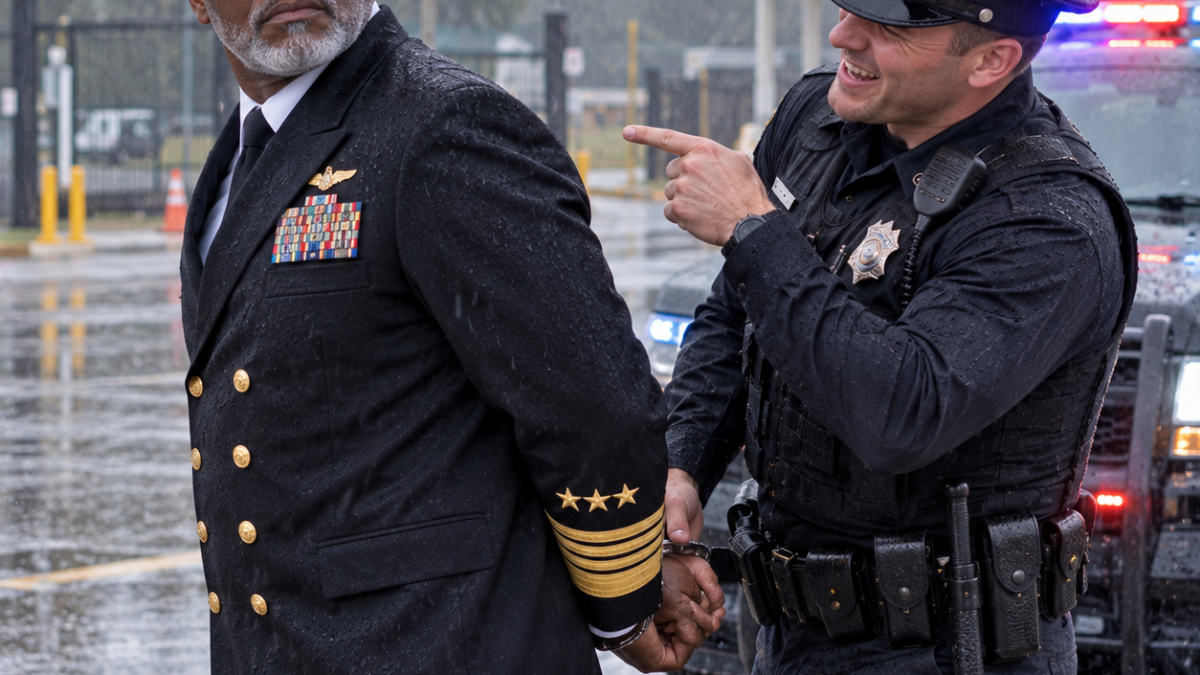
He put me in the back of the patrol car.
That was the moment the night changed for me.
Not when he laughed at the uniform.
Not when he touched my ribbons.
Not even when the cuffs closed.
The back seat changed it.
Hard molded plastic.
Wire partition.
Rain streaking the glass.
My wrists forced behind me while Cole sat in front, dry now, talking into his radio as though he had accomplished something.
“Dispatch, Unit Four.”
He sounded almost cheerful.
“I’ve got one in custody.”
“Older male.”
“Possible fraud.”
“Impersonating a Navy flag officer.”
“Fake military ID.”
“Fake medals.”
I closed my eyes.
Fake medals.
There are insults that strike the ego.
Then there are insults that land somewhere much deeper.
The ribbon Cole had flicked represented the Navy Cross.
He had no reason to know the story behind it.
Most people didn’t.
I preferred that.
Awards are dangerous things when they become identities.
The incident that earned mine had happened decades earlier during operations in the Persian Gulf.
There had been fire.
Smoke.
Screaming alarms.
Men trapped below.
I remember heat more than heroism.
I remember the smell of burned insulation.
I remember one sailor trying to return below deck because his friend was still missing.
I remember ordering him back and going myself.
People later called that courage.
At the time, it felt like responsibility.
There were sailors down there.
I was responsible for sailors.
That was all.
Cole looked at that ribbon and saw costume jewelry.
I tried not to let that matter.
Then he looked at me in the rearview mirror.
“Bet you didn’t think you’d get caught tonight.”
I met his eyes.
“Officer.”
“What?”
“Run the identification.”
“I know what fake credentials look like.”
“No.”
I said.
“You know what you assume fake credentials look like.”
His jaw tightened.
“You want another charge?”
“For speaking?”
“Keep pushing.”
I looked out the window.
That ended the conversation.
There are moments when continuing to argue becomes less about principle and more about giving an unreasonable person additional opportunities.
I had spent forty years commanding people.
One lesson command teaches quickly is that not every battle deserves another sentence.
So I went quiet.
Cole mistook that for defeat.
The precinct was about twelve minutes away.
We arrived shortly after one in the morning.
Cole opened the back door and took my arm.
“You can let go.”
“I’ll decide that.”
“I am not resisting.”
“Everybody says that.”
He walked me through the station.
My uniform was soaked.
Water ran from the hem of my coat onto the tile.
The gold sleeve braid still caught the fluorescent light.
People noticed.
Of course they noticed.
A man in full Navy service dress at one in the morning tends to attract attention.
Especially when he is handcuffed.
Cole seemed to enjoy that.
“Got ourselves an admiral.”
He announced.
A few officers looked up.
Nobody laughed.
That should have told him something.
The desk sergeant was a man named Gregory Miller.
Late fifties.
Heavyset.
Reading glasses low on his nose.
He looked at me.
Then the collar stars.
Then Cole.
“What happened?”
Cole placed my cards on the desk.
“Stolen valor.”
“Pulled him for a bad taillight.”
“He’s running around dressed like a three-star admiral.”
“Military ID looks decent.”
“Probably bought online.”
Miller picked up the common access card.
He turned it over.
Then again.
His face changed slightly.
“You scan this?”
Cole shrugged.
“System was slow.”
Miller looked at him.
“You didn’t verify it?”
“I didn’t need to.”
That was the wrong answer.
Miller examined the card again.
I watched something familiar happen.
Experience overriding assumption.
He had seen military IDs before.
Maybe he had served.
Maybe family had.
Whatever the reason, the small details on the card meant something to him that they had not meant to Cole.
“Sir.”
Miller looked at me.
“Your name?”
“Samuel David Higgins.”
“Date of birth?”
I gave it.
“Current duty status?”
“Active duty.”
“Branch?”
“United States Navy.”
“Rank?”
“Vice Admiral.”
Cole laughed behind me.
Miller did not.
He entered information into the computer.
I could not see the screen.
I did not need to.
Three seconds later, Miller stopped typing.
His shoulders changed.
That was the first sign.
Then he looked at me.
Then at Cole.
Then back at the screen.
“Cole.”
Nothing in his voice resembled panic yet.
But it was coming.
“What?”
“Come here.”
Cole walked around the desk.
Miller pointed.
I watched Cole’s expression.
Confusion.
Then disbelief.
Then something closer to fear.
“That’s him?”
Miller whispered.
Cole stared at the official photograph.
Apparently my portrait was more convincing than my face.
“I don’t…”
“Unlock him.”
Cole turned toward Miller.
“What?”
“Take the cuffs off.”
“But—”
“Now.”
The entire room had gone quiet.
Cole fumbled with the key.
I felt the first cuff loosen.
Then the second.
I brought my arms forward slowly.
Deep red marks circled both wrists.
Miller saw them.
His face tightened.
“I apologize, Admiral.”
Cole stared at me.
Not at my uniform anymore.
At me.
“Sir…”
Interesting.
The word appeared almost immediately once the database confirmed rank.
Sir.
Ten minutes earlier I had been old man.
Same person.
Same uniform.
Only now a computer had given Cole permission to believe me.
I rubbed my wrists.
Miller stood.
“This should never have happened.”
“No.”
I said.
“It should not have.”
“We can arrange transport immediately.”
“No.”
He blinked.
“No, sir?”
“I requested a telephone call.”
“Of course.”
“I will make it now.”
Miller nodded.
Cole found his voice.
“Admiral, I didn’t—”
I looked at him.
He stopped.
I was not interested in his apology yet.
Not because apologies are meaningless.
Because I did not trust an apology produced by fear.
He was sorry that I was an admiral.
I needed time to determine whether he understood why that was not the problem.
Miller gave me a private interview room.
Desk phone.
Plastic chair.
Nothing else.
“Take whatever time you need.”
He closed the door.
I stared at the phone.
My first instinct was to call my wife.
Then I reconsidered.
It was one in the morning.
She would hear my voice and know immediately that something was wrong.
I was not injured beyond the wrists.
I could call her once I had a clearer picture.
My second instinct was legal counsel.
Reasonable.
Necessary eventually.
But there was another issue.
I had been detained wearing the uniform of a serving flag officer immediately outside the largest naval installation on the East Coast.
The local department had accused me of falsifying Department of Defense credentials.
That created military concerns beyond my personal complaint.
So I called the base commander.
Arthur Pendleton answered after two rings.
“Pendleton.”
“Arthur.”
Pause.
“Sam?”
“Yes.”
He became awake instantly.
“It is one in the morning.”
“I noticed.”
“What happened?”
“I am at the Norfolk County Fourth Precinct.”
Another pause.
Longer.
“Why?”
“I was stopped on the way home.”
“All right.”
“The officer believed my uniform was a costume.”
Silence.
“He accused me of stolen valor.”
More silence.
“He arrested me.”
I heard Arthur inhale.
“In uniform?”
“Yes.”
“Are you injured?”
“Cuff marks.”
“Anything else?”
“No.”
“What did they charge you with?”
“Nothing formally yet.”
“My identification has now been verified.”
Arthur’s voice became unnaturally calm.
“Who is there with you?”
“No one.”
“I am coming.”
“Bring legal.”
“Yes.”
“And someone from installation security who can document the military-ID issue.”
“Yes.”
“Do not bring half the base.”
He didn’t answer.
“Arthur.”
“I heard you.”
“That wasn’t agreement.”
“I said I heard you.”
I almost smiled.
We had known each other thirty years.
Arthur Pendleton was a good officer.
He was also physically incapable of arriving anywhere calmly when one of his people had been mistreated.
“Keep this controlled.”
I said.
“Sam.”
“This needs documentation.”
“Not theater.”
“All right.”
The lie was obvious.
But it was the best I was going to get.
Outside the interview room, the station had changed.
I could hear doors.
Phones.
Muted voices.
Once an institution realizes it may have harmed someone powerful, activity accelerates remarkably.
That observation bothered me.
It would bother me more later.
Miller apparently called his precinct captain.
The watch commander called department leadership.
Someone began pulling Cole’s traffic-stop records.
Someone else tried to locate body-camera footage.
All things that should have happened regardless of who sat in the interview room.
The question forming in my mind was simple.
What if I had been nobody?
I use that word carefully.
Nobody.
People say it when they mean not famous.
Not powerful.
Not connected.
But there are no nobodies.
There are only people institutions believe cannot make them answer.
That was the thought sitting with me when the precinct doors opened.
I heard Arthur before I saw him.
Not shouting.
His voice carried.
“Who is the senior officer on duty?”
Classic Pendleton.
I stood.
The interview-room door opened.
Miller appeared.
“Admiral.”
“The base commander is here.”
“I gathered.”
I stepped into the hall.
Arthur stood near the booking desk wearing a dark overcoat over his uniform.
Beside him was Commander Sarah Jenkins from the installation legal office.
Two members of base security remained near the entrance.
Good.
He had listened enough not to invade a civilian police station with a tactical platoon.
Barely.
Arthur saw me.
His gaze went immediately to my wrists.
The marks had darkened.
His jaw tightened.
“Sam.”
“Arthur.”
“You okay?”
“Yes.”
Sarah Jenkins stepped forward.
“Admiral.”
She started to salute.
I stopped her.
“Indoors.”
She lowered her hand.
Arthur almost smiled despite himself.
Then the precinct captain rushed through the front entrance.
Richard Hayes.
Mid-fifties.
Still fastening his coat.
He approached quickly.
“Vice Admiral Higgins.”
“Yes.”
“I am Captain Hayes.”
“I understand.”
“I want to apologize on behalf of this department.”
I looked at him.
“I want the evidence preserved on behalf of this department.”
That stopped him.
“Sir?”
“The stop.”
“Body camera.”
“Dash camera.”
“Dispatch.”
“Computer-query logs.”
“My military identification.”
“Booking-area video.”
“Everything.”
Hayes nodded.
“Of course.”
Commander Jenkins opened her notebook.
“Captain.”
She said.
“We will send a written preservation request before we leave.”
Hayes looked toward Cole.
The young officer stood near the wall.
No smirk.
No confidence.
He looked twenty-six now.
Maybe younger.
Hayes’s face hardened.
“Officer Cole has been relieved of duty pending review.”
Cole looked up.
“Captain—”
“Not now.”
Hayes turned back toward me.
“Admiral, I understand there was an allegation of stolen valor.”
“Yes.”
“Your credentials have obviously been confirmed.”
“Obviously now.”
He flinched.
Good.
Not because I wanted humiliation.
Because discomfort can make people hear what polite language allows them to avoid.
“What was the original reason for the traffic stop?”
I asked.
Hayes looked toward Miller.
“Alleged defective taillight.”
“Alleged?”
“We need to inspect the vehicle.”
“Excellent.”
I said.
“Please do.”
Cole shifted.
I noticed.
So did Arthur.
“Officer Cole.”
I said.
He looked at me.
“Was the taillight malfunctioning before you activated your emergency lights?”
“Yes, sir.”
“Did you document it?”
His mouth opened.
Closed.
“Dashcam should show it.”
Jenkins wrote that down.
“Did you check the light after arresting me?”
“No.”
“Did you photograph it?”
“No.”
“Did you issue a citation?”
“No.”
“Why not?”
Cole swallowed.
“I became focused on the identification issue.”
“Which you did not verify.”
Silence.
Hayes looked worse with each answer.
Arthur stepped forward.
I raised one hand.
He stopped.
This was my conversation.
Not his.
“Officer Cole.”
I said.
“Look at me.”
He did.
“You told me people like me do not become admirals.”
His face drained.
“I didn’t say exactly—”
“You asked whether I expected you to believe someone who looked like me earned the Navy Cross.”
Silence.
That was enough.
Captain Hayes closed his eyes briefly.
Cole whispered:
“I was wrong.”
“Yes.”
I said.
“You were.”
Then came the sentence I had been thinking about since Miller unlocked my cuffs.
“But your worst mistake was not failing to recognize an admiral.”
Cole stared.
“Do you understand?”
He did not.
Not yet.
So I continued.
“If I were a retired chief petty officer, would you have had the right to humiliate me?”
“No.”
“A janitor?”
“No.”
“A teacher?”
“No.”
“A twenty-year-old Black man driving home from a night shift?”
His eyes dropped.
“No.”
“That is the problem.”
I stepped closer.
“You are frightened now because you discovered I have rank.”
“But the Constitution does not assign dignity by rank.”
Nobody spoke.
Not Hayes.
Not Arthur.
Not Jenkins.
Not the officers behind the desks.
I touched the marks around my wrists.
“You did not violate me because you arrested an admiral.”
“You violated your responsibility because you decided what I was before you verified what I had done.”
Cole’s eyes filled.
Maybe shame.
Maybe fear.
Maybe both.
I did not care yet.
The first question was the taillight.
It mattered more than people later understood.
Everyone wanted to talk about the uniform.
The insult.
The stars.
The Navy Cross.
But legality begins earlier.
Why was I stopped?
Hayes sent an officer to my car.
I insisted Jenkins go too.
Not to interfere.
To observe.
Forty minutes later she called.
“Admiral.”
“Yes.”
“Both rear lamps are functioning.”
Hayes looked at Cole.
Cole’s face changed again.
Could a light flicker intermittently?
Yes.
Possible.
Could it have resumed working?
Also possible.
That meant the working lamp did not prove Cole lied.
But it created a question.
The dashcam might answer it.
Hayes requested immediate retrieval.
We waited.
At 2:36 a.m., an evidence technician arrived.
Cole’s dash video began several minutes before the traffic stop.
My sedan appeared ahead.
Both rear lights visible.
Steady.
No flicker.
Cole followed for forty-three seconds.
Then activated his emergency lights.
The room went silent again.
Hayes paused the video.
Replayed it.
Once.
Twice.
No malfunction.
He looked at Cole.
“Explain.”
Cole stood very still.
“I thought I saw it flicker earlier.”
“How much earlier?”
“I don’t know.”
“Before the dash recording?”
“Maybe.”
Hayes stared.
The explanation was technically possible.
The problem was credibility.
Once an officer fabricates or exaggerates one detail, every other detail becomes harder to trust.
I knew that from military investigations.
You do not need to prove someone lied about everything.
You establish where reliability failed.
Jenkins asked:
“Was there any other observed violation?”
Cole hesitated.
“No.”
That answer mattered.
Arthur leaned toward me.
“We’re done here.”
I shook my head.
“No.”
He frowned.
“Sam.”
“I want his body camera reviewed.”
Hayes looked uncomfortable.
“That will take some time.”
“I have time.”
It was after two thirty in the morning.
I absolutely did not have time.
I was sixty-one.
Wet.
Tired.
My wrists hurt.
I wanted tea.
But accountability has an unfortunate schedule.
Cole’s body camera was worse.
The early portion matched my memory.
No greeting.
Flashlight.
Demand for documents.
Then his voice after seeing the uniform.
“Costume party?”
Clear.
My identification.
His accusation.
His refusal to verify.
The order to step out.
Then the pat-down.
His hand lifting toward my chest.
The camera angle did not perfectly show contact with the ribbons.
The audio did.
“You really expect me to believe a guy who looks like you earned this?”
No ambiguity.
Hayes stopped the video.
He could not look at me.
Cole sat down.
For the first time all night, he seemed to understand that memory was no longer his protection.
Then the cuffs.
My warning.
His arrest announcement.
Everything.
At one point, on the roadside, I heard myself say:
“Run the identification.”
Cole replied:
“I know fake when I see it.”
Captain Hayes whispered something I could not hear.
Miller did.
Miller looked toward the ceiling.
Arthur’s hands curled.
Jenkins kept writing.
I watched myself being placed into the patrol car.
Then something happened I had not heard clearly while sitting in the back.
Cole returned to my abandoned vehicle.
He opened the driver’s door.
Looked around.
Then said under his breath:
“Three-star admiral.”
A short laugh.
“Right.”
Then:
“People really will pretend to be anything.”
Arthur muttered:
“Jesus.”
Hayes stopped the footage.
“I have seen enough for tonight.”
“No.”
I said.
He looked at me.
“I haven’t.”
The recording continued.
During the drive, Cole called me a disgrace to veterans.
Mentioned his grandfather’s Vietnam service.
Mocked my age.
Repeated the costume accusation.
Then we reached the station.
The file ended.
Nobody had anything useful to say.
Finally Hayes spoke.
“This will be referred to Internal Affairs immediately.”
“Independent review.”
Jenkins said.
Hayes turned.
“Our department has procedures.”
“I am sure it does.”
She replied.
“But given the potential civil-rights implications and the seniority of the parties involved, preservation and external notification are appropriate.”
Hayes looked at me.
I understood the concern.
Civilian police departments do not answer to Navy commanders.
Nor should they.
Arthur could not storm in and order discipline.
I could not use rank to demand termination.
Military authority does not magically extend into municipal policing.
That mattered.
If we wanted legitimacy, we had to respect jurisdiction even when angry.
So I said:
“Captain Hayes.”
“Yes, Admiral?”
“I am not asking the Navy to discipline your officer.”
He relaxed slightly.
“I am asking your department to investigate him honestly.”
“And I am asking Commander Jenkins to ensure that any federal or military interests are referred through the proper channels.”
Jenkins nodded.
Arthur looked annoyed by how reasonable everyone was being.
He would survive.
At three twenty in the morning, we finally left.
Arthur wanted me in his vehicle.
I refused.
“My car is still drivable.”
“Sam.”
“I have driven ships through typhoons.”
“You were younger.”
“That was unnecessary.”
“It was accurate.”
Jenkins intervened.
“Admiral, for evidentiary reasons, I recommend you do not operate the vehicle until it is photographed and inspected.”
I looked at Arthur.
He smiled.
“She outranks you legally tonight.”
“Apparently.”
So I rode with him.
In the back.
No handcuffs this time.
Halfway to base housing, Arthur said:
“I want his badge.”
“You don’t control his badge.”
“I know.”
“I want it anyway.”
“That is why you are not investigating.”
He grunted.
Then:
“How are your wrists?”
“Fine.”
“That’s not an answer.”
“They hurt.”
He looked ahead.
“I should’ve been there.”
I almost laughed.
“On a random county highway at midnight?”
“I would’ve enjoyed it.”
“That concerns me.”
Silence.
Then he said:
“Sam.”
“Yes?”
“What he said…”
“I heard it.”
“You know he doesn’t speak for—”
“Arthur.”
He stopped.
“I know.”
I looked out at rain sliding across the window.
“I have worn this uniform longer than that boy has been alive.”
“I know.”
“I have been challenged by foreign admirals.”
“Cabinet secretaries.”
“Senators.”
“People far more dangerous than Thomas Cole.”
“I know.”
“Still hurt.”
Arthur nodded.
“That I know too.”
That was friendship.
Not pretending rank makes you immune to humiliation.
My wife, Evelyn, was awake when I arrived.
She saw the cuffs marks before I removed my coat.
“What happened?”
“Traffic stop.”
Her face changed.
“Samuel.”
“I am okay.”
“That sentence has never once made me calmer.”
Fair.
We sat at the kitchen table.
I told her everything.
She listened.
No interruption.
Then she got ice from the freezer.
Wrapped it in a towel.
Placed it beside me.
“You’re filing a complaint.”
“Yes.”
“You’re going to cooperate.”
“Yes.”
“You are not going to turn this into one of your stoic little exercises where you decide being quiet proves character.”
I stared at her.
She pointed toward me.
“Forty years.”
“What?”
“I have watched you swallow things for forty years because you don’t want anyone to say the Black officer is angry.”
I said nothing.
She continued.
“Sometimes restraint is leadership.”
“Sometimes it is just expensive silence.”
That landed harder than anything Cole had said.
Because Evelyn knew where I kept the things I did not discuss.
The promotion delayed without explanation.
The senior officer who once assumed I was a steward at a reception.
The captain who called me “articulate” every time I spoke in a briefing.
The admiral who told me I was “good for recruiting optics.”
Small things.
Larger things.
Things survived.
Things filed away.
I looked at the ice.
“I don’t want this to be about my rank.”
“Then don’t make it about rank.”
She said.
“Make it about the next person.”
Same conclusion I had reached at the station.
Different voice.
Probably better.
The story became public by noon.
Not because I released it.
Police scanners had been monitored.
Someone at the precinct talked.
A reporter obtained confirmation that a sitting Vice Admiral had been detained overnight after an officer questioned his military identity.
By lunch, satellite trucks were outside the department.
The first headline made me angry.
COP ARRESTS BLACK THREE-STAR ADMIRAL AFTER THINKING UNIFORM IS COSTUME.
Accurate enough.
Wrong focus.
The interesting fact was not that Cole failed to recognize an admiral.
The interesting fact was why disbelief came so quickly.
He had my identification.
He had a database.
He had dispatch.
He chose assumption.
That distinction vanished inside the drama.
The Navy public-affairs office asked whether I wanted to make a statement.
I said no.
Then changed my mind.
One paragraph.
No mention of lawsuits.
No demand for punishment.
I wrote:
“I am grateful the facts of last night’s incident can be reviewed through available video and electronic records. My rank does not make the conduct more or less serious. Every person stopped by law enforcement deserves decisions based on observable facts rather than assumptions about race, age, profession, or appearance. I will cooperate fully with the appropriate civilian review process.”
Evelyn read it.
“Very admiral.”
“Complaint?”
“Too boring.”
“Good.”
“People will hate that.”
“Better.”
Internal Affairs found more quickly than I expected.
Cole had complaints.
Five in two years.
Three involving Black drivers.
One involving a Latino college student.
One involving a white teenager.
That mattered.
I did not want a false narrative where every poor decision he made had a single explanation.
The white teenager’s complaint involved unnecessary verbal aggression.
The Latino student’s involved a vehicle search after a minor equipment stop.
Two Black drivers alleged that Cole treated ordinary questioning as hostility.
One complaint described him saying:
“You people always have an excuse.”
None had been sustained.
Why?
Insufficient video.
Conflicting testimony.
Supervisor discretion.
No complainant followed through.
One body camera malfunction.
Familiar patterns.
Then investigators sampled traffic-stop data.
The disparity was difficult to ignore.
Cole stopped Black drivers at a significantly higher rate than the surrounding patrol district would predict.
Search rates were higher.
Citation rates were not proportionately higher.
Statistics do not prove intent by themselves.
They do tell you where to look.
So investigators looked.
Messages between officers.
Nothing dramatically r@c!st.
No slur.
Instead:
Another “suspicious” one.
Bet he argues.
Watch this guy.
Probably stolen.
Ordinary language carrying assumptions.
The kind people later call jokes.
Cole was suspended.
Not fired by eight in the morning.
That version made better storytelling, but real departments have process.
Union rights.
Investigation.
Hearings.
Appeal.
I respected that.
Due process should not disappear simply because I disliked the accused.
That principle becomes meaningless if you defend it only for people you admire.
Captain Hayes called me personally.
“Admiral.”
“Captain.”
“I wanted you to know Officer Cole has been placed on administrative leave pending investigation.”
“Understood.”
“We are also reviewing related complaints.”
“Good.”
“I know people expect immediate termination.”
“People expect many things.”
He paused.
“You aren’t asking for it?”
“No.”
“I am asking you to establish what happened.”
“And then impose whatever consequence your rules and the law support.”
Silence.
“I appreciate that.”
“Don’t.”
I said.
“That’s the minimum.”
Cole requested to meet me.
I refused.
Then he wrote a letter.
I did not open it for three days.
When I finally did, the first paragraph annoyed me.
Admiral Higgins,
I sincerely apologize for the misunderstanding that occurred—
I stopped reading.
Misunderstanding.
No.
I put it down.
Evelyn asked:
“Bad?”
“He called it a misunderstanding.”
“Then he still doesn’t understand.”
Exactly.
Two weeks later, another letter came.
Shorter.
Admiral Higgins,
My first apology was written because my attorney told me I needed to show remorse.
You probably knew that.
I did not understand what I was apologizing for.
I thought the problem was that I failed to verify your rank.
It wasn’t.
The problem started before I saw the uniform.
I saw an older Black man in an ordinary car late at night and decided something was wrong before I had evidence.
Then every fact that contradicted me became proof that you were lying.
The uniform became costume.
The ID became fake.
Your calm became arrogance.
Your questions became defiance.
I don’t expect forgiveness.
I am beginning to understand why “I didn’t know who you were” is not a defense.
Thomas Cole.
I read that one twice.
Then handed it to Evelyn.
She nodded.
“Better.”
“Yes.”
“Forgive him?”
“No.”
“Fair.”
The department investigation sustained several allegations.
Unlawful detention beyond the scope justified by the initial stop.
Failure to verify readily available identification.
Improper arrest.
Discourteous conduct.
Bias-based policing violation.
False or unsupported statements regarding the equipment violation.
Excessively tight restraints.
Not every allegation survived.
The physical handling used to seat me in the patrol car was found within policy.
I disagreed.
My attorney disagreed.
The department stood by it.
Accountability rarely arrives as a perfect list matching your feelings.
Cole received notice of termination.
His union appealed.
Months followed.
Eventually the termination stood.
He did not lose his pension in some dramatic overnight forfeiture.
That would not have matched the governing rules.
He retained whatever contributions and rights the law allowed.
He did lose his position.
His certification entered review.
The civil-rights investigation remained separate.
Federal prosecutors reviewed whether the evidence supported criminal charges under color of law.
They ultimately did not bring a criminal case.
Some people were furious.
I was disappointed.
But disappointment is not evidence.
The legal threshold for a federal criminal civil-rights prosecution is high.
Bad policing is not automatically a prosecutable federal crime.
I had spent my career expecting sailors to understand that standards matter most when they prevent you from reaching the outcome you emotionally want.
So I accepted the distinction.
Administrative wrongdoing had been established.
Civil liability remained possible.
Criminal intent was another question.
Then Captain Hayes called again.
“Admiral, we found something you should know.”
“What?”
“One of the prior complaints.”
A Black Navy chief petty officer.
Three years earlier.
Not Cole.
Another officer.
The complaint alleged the officer mocked his military service during a stop.
Closed.
No discipline.
Another involved a junior enlisted sailor whose base access card had been treated as suspicious.
Another involved a civilian shipyard worker.
No single case looked like mine.
Together they suggested a gap.
Local officers around Norfolk interacted with military personnel constantly.
Yet some had remarkably little training on military credentials, ranks, uniforms, and base-identification systems.
Bias was part of my case.
Ignorance amplified it.
That created a reform opportunity I had not considered.
Arthur loved it.
“Joint training.”
He said.
“Base security and local departments.”
“Not just Norfolk.”
I replied.
“Regional.”
Military ID recognition.
Uniform basics.
Jurisdiction.
Base access.
Veteran fraud versus legitimate service.
De-escalation.
Civilian authority around military personnel.
And most importantly:
Rank should not alter constitutional treatment.
We built a pilot program.
Police officers came to the installation.
Navy legal staff went to departments.
Sailors participated.
So did community groups.
Some people complained we were giving special education because an admiral had been embarrassed.
I understood the criticism.
So we expanded the training beyond military recognition.
Bias.
Traffic-stop articulation.
Verification before escalation.
Documentation.
Disability interactions.
Language access.
The point was not:
Learn what admirals look like.
The point was:
When reality contradicts your assumption, investigate reality.
I sued.
That surprises people because the dramatic version often says I refused money and demanded reform instead.
Life is not a morality play.
Civil lawsuits exist partly because financial liability forces institutions to measure failure.
My counsel filed claims.
The city eventually settled.
I will not pretend I donated every dollar.
Some went to legal costs.
Some went into a trust.
A substantial portion funded a joint community-law-enforcement accountability program.
Not because keeping money would have been shameful.
Because I had enough.
That choice belonged to me.
The settlement also included non-monetary terms.
Data review.
Training.
Complaint tracking.
Periodic publication of stop statistics.
Supervisory audits.
None guaranteed perfection.
No policy does.
Arthur called the agreement weak.
“You wanted heads.”
I reminded him.
“I still want heads.”
“You are a terrible legal strategist.”
“I command ships.”
“Exactly.”
The first community meeting was difficult.
Police officers sat on one side.
Residents on the other.
Too many folded arms.
Too little trust.
I sat in the middle.
A young Black man named DeShawn spoke first.
“Nobody cares until it happens to somebody important.”
Nobody answered.
He looked at me.
“No disrespect, Admiral.”
“None taken.”
“But if you weren’t a three-star officer, we’d never be sitting here.”
He was right.
“That possibility bothers me.”
I said.
“Possibility?”
He laughed.
“Admiral, come on.”
I nodded.
“You’re right.”
The room changed slightly.
People in authority often believe credibility requires defending themselves immediately.
Sometimes credibility requires surrendering a point that is true.
“My rank accelerated attention.”
I continued.
“It should not have been necessary.”
DeShawn leaned back.
“So what changes?”
“Hopefully the mechanism.”
“What does that mean?”
“You should not need a flag officer, television camera, or lawyer to get a complaint reviewed seriously.”
“That sounds nice.”
“Yes.”
“It does.”
“So prove it.”
Fair.
That sentence became more useful to me than almost anything said at the press conferences.
Prove it.
Not announce it.
Not train once.
Not publish a glossy plan.
Prove it.
Over time.
With numbers.
With complaint outcomes.
With discipline consistency.
With fewer repeat officers.
With supervisors who catch patterns before newspapers do.
A year later, the department published its first traffic-stop disparity report.
The numbers were not flattering.
Captain Hayes wanted to delay publication.
His advisers worried the press would weaponize the data.
I told him:
“If your reform begins by hiding the first bad measurement, you are simply building a more sophisticated version of the old problem.”
He published it.
The headlines were ugly.
Good.
Then people went to work.
Supervisors reviewed outliers.
Officers received coaching where patterns lacked misconduct but warranted attention.
Formal investigation where evidence suggested more.
Search-consent procedures changed.
Documentation improved.
Complaint acknowledgment became standardized.
Nothing dramatic.
No heroes.
Administrative work.
That is what institutional change mostly looks like.
Boring people in meeting rooms altering procedures.
I came to respect boring.
I retired from the Navy nineteen months after the traffic stop.
At the ceremony, Arthur gave a speech far too long for human endurance.
Evelyn whispered:
“He’s trying to kill you before retirement becomes official.”
“Probably.”
Arthur mentioned my commands.
Deployments.
Awards.
The Navy Cross.
Pentagon work.
Then, against my explicit request, he mentioned the traffic stop.
I considered having him removed by security.
He said:
“Sam taught me something I should’ve known much earlier.”
That got my attention.
“He did not ask us to use the power of the Navy to avenge an insult.”
“He demanded that we preserve evidence, respect jurisdiction, and make sure the process that protected him could protect someone with no stars.”
Arthur looked toward me.
“That is command.”
I hated that the line was good.
Evelyn squeezed my hand.
“He practiced.”
“Clearly.”
When my turn came, I spoke for seven minutes.
Six minutes and forty seconds longer than I wanted.
Near the end, I looked at the sailors.
“You will hold authority.”
I said.
“Some of you already do.”
“Authority will tempt you to believe that because you have the legal or institutional power to make someone obey, your judgment must therefore be correct.”
“It is not.”
“A uniform does not make you right.”
“Mine didn’t.”
“Officer Cole’s didn’t.”
“What matters is discipline.”
“The discipline to verify.”
“The discipline to listen.”
“The discipline to distinguish disrespect from disagreement.”
“The discipline to stop yourself before power becomes ego.”
Then I retired.
No three stars afterward.
Just Samuel.
I liked that more than expected.
Two years after the incident, I saw Thomas Cole again.
He had requested mediation through attorneys.
I finally agreed.
We met in a neutral office.
No uniforms.
No cameras.
He looked older.
So did I.
“Admiral.”
“Mr. Cole.”
He winced.
Fair.
He was no longer an officer.
“I wanted to apologize in person.”
“You’ve apologized in writing.”
“I know.”
We sat.
For several seconds, neither spoke.
Then he said:
“My grandfather really did serve in Vietnam.”
“I never doubted that.”
“He hated people who lied about service.”
“Understandable.”
“I thought I was defending people like him.”
“No.”
I said.
“You were defending your assumption.”
He nodded.
“I know.”
“I didn’t then.”
He looked at his hands.
“The worst part is I remember believing I was the only person in the situation using common sense.”
That interested me.
“Explain.”
“You said you were an admiral.”
“I thought that proved you were lying.”
“You gave me ID.”
“I thought the quality of the ID proved the scam was elaborate.”
“You stayed calm.”
“I thought that meant you were practiced.”
He looked up.
“Every fact became evidence for what I had already decided.”
Exactly.
“That is why bias is dangerous.”
I said.
“People imagine prejudice as an emotion.”
“Hatred.”
“Disgust.”
“Sometimes it is.”
“But often it behaves like a theory.”
“Once you decide the theory is true, every new fact gets forced inside it.”
Cole nodded.
“I’ve thought about that a lot.”
“What do you do now?”
“Warehouse supervisor.”
“How is it?”
“Less exciting.”
“That may be healthy.”
He laughed nervously.
Then:
“I train new hires.”
I raised an eyebrow.
“In what?”
“Safety.”
That almost made me smile.
“What do you tell them?”
“That being certain is not the same thing as being correct.”
Not bad.
He swallowed.
“Do you forgive me?”
There it was.
People like endings.
Forgiveness gives stories a clean one.
“I don’t know.”
I said.
He looked disappointed.
“I no longer want you destroyed.”
His eyes lifted.
“That is something.”
“Yes.”
“But forgiveness is not a certificate I issue because you finally understand.”
“No.”
“I know.”
“Keep understanding.”
He nodded.
We shook hands.
Not friends.
Not enemies.
Two men who once occupied a dark road together and now understood the memory differently.
That was enough.
The strangest effect of the traffic stop came years later when I was driving through Virginia in another unremarkable gray sedan.
No uniform.
Sweater.
Khakis.
Evelyn beside me.
Blue lights appeared behind us.
She looked at me.
“Samuel.”
“I see them.”
“Speed?”
“Three over.”
“Criminal.”
“Apparently.”
I pulled over.
Hands on the wheel.
An officer approached.
Young.
Black.
Maybe twenty-eight.
“Good afternoon, sir.”
“Afternoon.”
“Do you know why I stopped you?”
“I suspect the three miles per hour.”
He smiled slightly.
“Actually your registration sticker is partly obscured by the plate frame.”
“Fair.”
“License and registration, please.”
I told him where my wallet was.
He nodded.
“Go ahead.”
He checked everything.
Returned.
“I’m giving you a warning.”
“Thank you.”
Then he paused.
“Admiral Higgins?”
I sighed.
Evelyn laughed.
“Retired.”
He smiled.
“We did your case in academy training.”
I did not know whether to be pleased or horrified.
“What did they teach?”
His expression became serious.
“That verification is cheaper than escalation.”
Excellent.
“And?”
“That rank wasn’t the point.”
Better.
He handed back my license.
“Have a safe afternoon, sir.”
I drove away.
Evelyn waited fifteen seconds.
“Three miles over.”
“Let it go.”
“Admiral.”
“Please stop.”
She laughed for the next mile.
Normal.
A traffic stop.
Forgettable except for my wife abusing the opportunity.
That was the kind of policing I had wanted all along.
Professional.
Clear.
Proportionate.
Done.
People still tell the story using the same headline.
Cop laughed at a Black Navy Admiral’s uniform, then the base commander walked through the door.
I understand why.
It contains everything people like.
Disrespect.
Hidden status.
Power reversal.
The arrogant officer realizing he chose the wrong man.
But I have come to dislike one phrase.
The wrong man.
I was not the wrong man to mistreat because I was a Vice Admiral.
There is no right man.
That is the point.
If Officer Cole had pulled over a Black mechanic wearing coveralls instead of an admiral wearing gold braid, he still would have owed him professionalism.
If I had been a homeless veteran wearing a jacket full of old insignia, he still would have owed me basic dignity.
If my military ID had turned out to be invalid, that would not have justified mockery before investigation.
Law enforcement may detain.
Question.
Cite.
Arrest when the law supports it.
That authority is real.
So is the responsibility attached to it.
Authority without verification becomes suspicion.
Suspicion without discipline becomes prejudice.
Prejudice armed with state power becomes dangerous very quickly.
I still have the uniform.
Evelyn had it professionally cleaned after that night.
The rain stains came out.
The shape returned.
The ribbons remained.
Even the Navy Cross ribbon Cole flicked looked exactly as it had before.
Objects recover easily.
People take longer.
Sometimes I open the garment bag.
Not often.
The gold braid reminds me of command.
The stars remind me of responsibility.
The faint memory of wet wool reminds me of something else.
Rank protected me after the harm.
It did not prevent the harm.
That distinction follows me.
People with status often mistake eventual accountability for proof that the system works equally.
It doesn’t.
My phone call was answered.
The base commander came.
Legal counsel arrived.
The precinct verified me.
Media paid attention.
Data was reviewed.
A settlement happened.
Training changed.
What if I had been twenty-one?
What if my mother worked nights?
What if I had no lawyer?
What if nobody important answered the phone?
Those are the questions that matter more than what happened to Thomas Cole.
One afternoon, a group of naval cadets asked me to speak about leadership.
Someone eventually raised a hand.
“Sir, when did Officer Cole realize he had messed up?”
The room laughed.
I didn’t.
“When Sergeant Miller verified my identity.”
I said.
The cadet nodded.
Then I added:
“That was too late.”
The room quieted.
“He should not have needed to discover I was powerful before he became careful.”
I looked around.
“One day, some of you will command ships.”
“Some will command aviation units.”
“Some may become admirals.”
“People will treat you differently because of what is on your collar.”
“That is unavoidable.”
“Your job is to remember that the person with nothing on their collar still deserves procedure.”
A young woman in the front row wrote that down.
I hope she remembered it.
The traffic stop lasted less than an hour.
The consequences lasted years.
That is strange to think about.
Forty years in uniform.
Thousands of days.
Deployments.
Storms.
Funerals.
Promotions.
Commands.
And one rainy hour became the story strangers recognized most easily.
For a while, I resented that.
Then I stopped.
We do not always control which experiences become useful to other people.
We can control what lesson we allow them to carry.
So if anyone remembers mine, I hope they do not remember the moment Arthur Pendleton entered the station as the victory.
That was not victory.
That was simply power meeting power.
The more important moment came earlier.
When Sergeant Miller picked up my identification and actually looked at it.
He had no reason to trust me personally.
He used the tools available.
He verified.
He changed his conclusion when the evidence contradicted the story Cole brought through the door.
That is harder than it sounds.
People become emotionally attached to being right.
Institutions become even more attached.
Miller did something simple.
He checked.
Then he corrected.
That probably saved the department from making the situation even worse.
Years after retirement, Arthur and I had dinner near Norfolk.
He still told the story incorrectly.
“You should’ve seen my face when Sam called.”
“I wasn’t there to see it.”
“Exactly.”
He ignored me.
“I was ready to invade that precinct.”
“You brought two security personnel.”
“In my memory there are twelve.”
“Your memory is undisciplined.”
“You’re retired.”
“Standards remain.”
Evelyn rolled her eyes.
Then Arthur became serious.
“You know what I think about sometimes?”
“What?”
“What if Miller hadn’t checked.”
I knew.
“Eventually someone would have.”
“Probably.”
“But after what?”
Another charge?
A holding cell?
A booking photo?
The story going public as:
MAN ARRESTED IMPERSONATING ADMIRAL.
Falsehood gets distance once released.
Correction rarely catches up at the same speed.
“I think about that too.”
I said.
Arthur took a drink.
“Still wish I’d brought twelve.”
“I know.”
My grandchildren eventually saw an old news clip.
One asked:
“Grandpa, why didn’t the policeman believe you?”
Children ask the most dangerous questions because they do not know which answers adults usually avoid.
I considered telling him:
He was inexperienced.
He was arrogant.
He didn’t understand the uniform.
All true.
Incomplete.
“Because he looked at me and decided what kind of person I was before he knew me.”
My grandson frowned.
“Because you’re Black?”
“Yes.”
Simple.
No lecture.
“That’s dumb.”
“Yes.”
He thought.
“Did he get in trouble?”
“Yes.”
“Did you?”
“For what?”
“I don’t know.”
“No.”
He seemed satisfied.
Then he asked whether admirals could command submarines.
The conversation moved on.
Children are good at not allowing trauma to become the whole person.
Another lesson adults could use.
Sometimes I still hear Cole laughing.
Not often.
Memory loses volume over time.
I remember the cold more clearly.
Rain inside my collar.
Metal around my wrists.
The ridiculous sight of my ribbons shining under a patrol-car spotlight.
I remember telling him:
Verify the identification.
I remember him refusing.
That is the moment I return to.
Not because verification would have preserved my pride.
Because it was the off-ramp.
Every bad encounter has moments where someone can choose a smaller mistake instead of a larger one.
Run the card.
Check the plate.
Ask another officer.
Slow down.
Listen.
Verify.
Cole passed every off-ramp.
By the time we reached the station, the consequences were enormous.
That is true in policing.
It is true in command.
It is true in life.
Mistakes become disasters when pride prevents correction.
The Navy taught me many things.
Navigation.
Weapons systems.
Command.
Crisis response.
But the lesson that mattered most that night was simpler.
When conditions become dangerous, reduce unnecessary motion.
On a ship in heavy seas, panic creates secondary casualties.
On a dark highway, the same principle applies.
I did not shout.
Did not pull away.
Did not use rank as a threat.
Did not give Cole the confrontation he seemed to expect.
Some people later called that heroic restraint.
I reject that too.
I was afraid.
Not terrified.
But afraid enough.
A gun was present.
Authority was present.
Rain.
Darkness.
No witnesses I could identify.
Experience tells Black men things rank cannot erase.
My calm was not proof I felt safe.
It was how I tried to stay safe.
That distinction matters.
People sometimes praise marginalized people for remaining composed under mistreatment.
We should be careful.
A victim should not have to perform perfect calm to deserve fair treatment.
I happened to remain calm.
If I had raised my voice, Cole still would have been responsible for acting lawfully.
Dignity is not earned by emotional perfection.
The old gray sedan lasted another four years.
I could have replaced it the next morning.
Arthur repeatedly complained that three-star admirals should not drive vehicles with cloth seats.
I told him retirement pay requires discipline.
He told me I was cheap.
The car became something of a joke.
One afternoon, I found a note under the windshield wiper outside the commissary.
ADMIRAL—CHECK YOUR TAILLIGHTS.
No signature.
I laughed so loudly a woman nearby stared.
Both lights worked.
I checked anyway.
Some habits remain.
If I could return to that freezing roadside, I would change only one thing.
Not the car.
Not my uniform.
Not my age.
Not even the fact that Cole pulled me over.
Police officers can make traffic stops.
They can investigate genuine concerns.
They can question military credentials if something legitimately appears wrong.
I would change the assumption.
That is where everything began.
Imagine the same stop with curiosity instead of certainty.
“Sir, your military identification is unusual to me.”
“May I verify it?”
“Yes.”
Two minutes.
Maybe three.
Dispatch confirms.
“Thank you, Admiral.”
“Drive safely.”
I go home.
Tea.
Bed.
No scandal.
No lawsuits.
No career destroyed.
No department reform forced by embarrassment.
Boring.
People underestimate boring.
Boring interactions are often evidence that systems are functioning.
Nobody makes documentaries about the officer who verifies something, apologizes for the delay, and lets the driver leave.
Good.
That is exactly how it should be.
The last time I wore service dress blue was at a memorial.
Different city.
Different year.
I stood before a mirror fastening the collar.
Three stars no longer appropriate after retirement in the same operational sense, but the uniform still carried history.
I adjusted the ribbons.
My fingers stopped over the Navy Cross.
For a moment I saw Cole’s hand.
His flashlight.
His smile.
Then another memory replaced it.
A sailor covered in soot.
Flames behind him.
Young face.
Alive.
That was what the ribbon meant.
Not Cole.
Not the news.
Not a traffic stop.
He had not changed its meaning.
I smiled at myself in the mirror.
Then finished dressing.
That was when I finally understood I had stopped giving him ownership of the memory.
So when people tell the story, they usually end it with the doors opening.
The base commander walking in.
The officer realizing whom he had arrested.
The great reversal.
I understand why.
It is satisfying.
But I prefer a different ending.
Years later.
Ordinary afternoon.
An officer stopped me over an obscured registration sticker.
He explained the reason.
I gave him the documents.
He checked them.
He treated me professionally.
Then I drove away.
No commander.
No JAG.
No rank necessary.
Just procedure.
That was the better victory.
Because justice is not really proven when powerful people receive respect.
It is proven when respect no longer depends on power.
Officer Cole once looked at the three stars on my uniform and laughed because he could not imagine someone who looked like me wearing them honestly.
By the time the night ended, he understood the stars were real.
But I hope the institution learned something larger.
The stars should never have mattered.
My rights existed before he knew my rank.
My dignity existed before a database verified my name.
And no person should need a Vice Admiral’s uniform, a base commander, or forty years of service before someone wearing a badge decides to look at the facts.
That is the lesson I carried out of that precinct.
Not that Officer Cole arrested the wrong man.
There should never have been a right one.








