PART 2: A Veteran Cop Handcuffed Me Inside City Hall—Then He Marched Me Into the Room Where Everyone Was Waiting for the Mayor
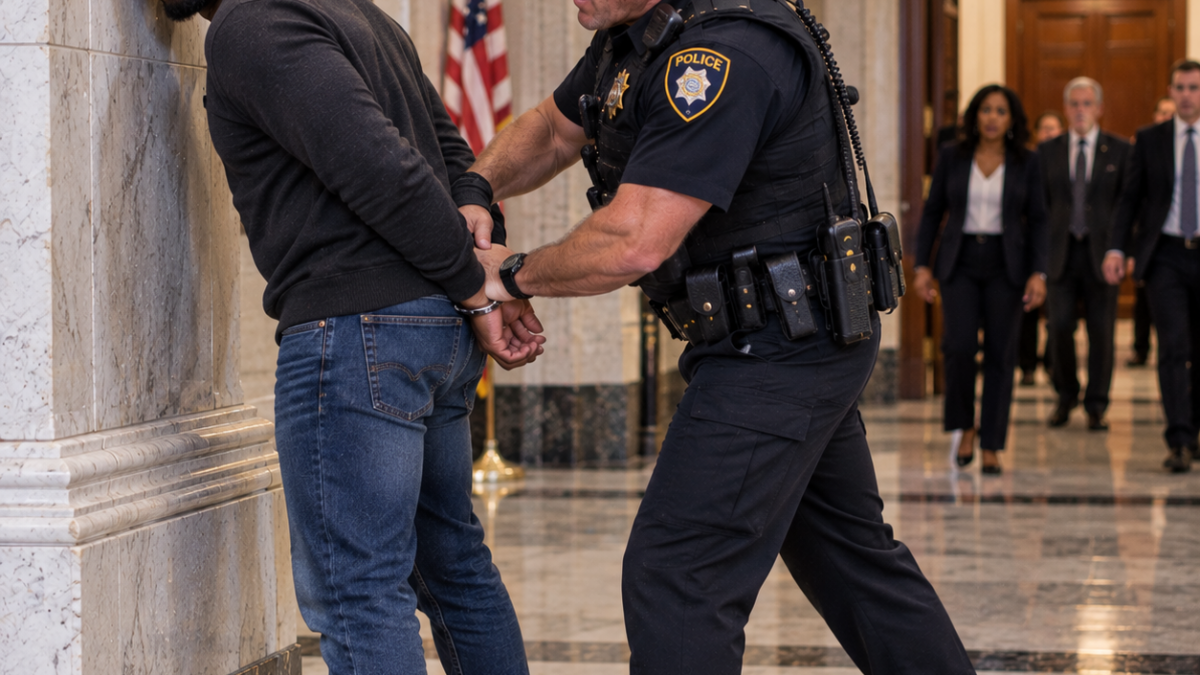
He mistook my answer for surrender.
That was the first thing I noticed.
Officer Jenkins gave the chain between my wrists a sharp tug and started walking.
I followed because resisting would have turned a false story into a complicated one.
The lobby had gone quiet behind us.
Citizens stood beside plastic security bins with phones raised.
A woman who had been arguing about a parking citation had stopped mid-sentence.
An elderly man near the metal detector whispered, “What did he do?”
Nobody answered.
Toby Miller remained at the checkpoint.
For a second, our eyes met.
He looked sick.
Jenkins did not.
He looked energized.
“Keep moving.”
“I am moving.”
“Don’t get smart.”
I said nothing.
We entered the main corridor.
City Hall employees began noticing us almost immediately.
A clerk carrying a stack of folders stopped walking.
Her eyes went to my face.
Then my hands.
Then back to my face.
Recognition started.
I could see it forming.
But Jenkins kept me moving too quickly for anyone to speak.
The strange thing about being mayor is that thousands of people know your photograph while relatively few know you as a person.
A suit helps.
A podium helps.
A campaign banner helps.
Remove those things and familiarity becomes uncertainty.
That morning, uncertainty was protecting Jenkins from reality.
We passed the city attorney’s office.
An assistant prosecutor came out carrying coffee.
He looked at me.
“Mayor—”
Jenkins shoved me forward.
“Police business.”
The lawyer froze.
I heard him say something behind us.
Jenkins did not.
Or pretended not to.
“You know,” he said, almost conversationally, “people think this building is theirs because taxes pay for it.”
I looked ahead.
“It is theirs.”
He laughed.
“That’s cute.”
“It is also legally accurate.”
“Still doing the lawyer thing?”
That interested me.
“You know I’m a lawyer?”
“I know the type.”
“What type?”
He did not answer.
Instead, he tightened his grip on the cuffs.
The council chamber stood at the end of the corridor behind two enormous oak doors.
A young clerk sat outside with a tablet.
When she saw me, she stood so abruptly that her chair rolled backward.
“Mr.—”
Jenkins stepped in front of her.
“Open it.”
“Officer, they’re in executive session.”
“I’ve got a security detainee.”
She stared at me.
Her face had gone white.
“Officer Jenkins—”
“Move.”
I could have saved her from what was about to happen.
I did not.
There are moments in public life when interruption protects the wrong person.
Jenkins pushed one door open.
Then the other.
The sound rolled through the chamber like thunder.
Inside sat Council President Brenda Callahan.
Deputy Mayor Richard Davies.
City Attorney Elena Morris.
Finance Director Peter Shaw.
Several council members.
Police Chief William Granger.
And Sarah Higgins from the Rockford Tribune, who had been allowed inside for background reporting before the public session.
Everyone turned.
I will remember their faces for the rest of my life.
Not because of humiliation.
Because recognition moved through the room in stages.
First confusion.
Then disbelief.
Then horror.
Jenkins walked me into the center.
“Sorry to interrupt.”
His voice boomed proudly.
“Caught this guy trying to access the executive floor without ID.”
He pushed me one step forward.
“Refused instructions.”
“Got combative.”
“Figured I’d bring him here so the sergeant-at-arms can hold him until transport arrives.”
Nobody spoke.
The grandfather clock in the corner ticked.
Once.
Twice.
Three times.
Jenkins smiled at Chief Granger.
He was waiting for approval.
Granger had not moved.
I had known Bill Granger for almost six years.
He was sixty-one.
Thirty-eight years in law enforcement.
Not perfect.
Defensive about his department.
Slow to acknowledge institutional failure.
But he was not stupid.
And he knew exactly who was standing in front of him.
“Bradley.”
His voice came out barely above a whisper.
Jenkins looked confused.
“Yes, Chief?”
“Take the handcuffs off.”
“Sir?”
“Now.”
Jenkins blinked.
“With respect, he’s being detained for—”
“Remove them.”
The room remained silent.
Jenkins looked around.
That was the moment he finally understood something was wrong.
Not what.
Just something.
“Chief, I don’t think you understand.”
Granger stood.
His chair rolled backward.
“I understand perfectly.”
His voice was louder now.
“You are going to unlock those handcuffs.”
Jenkins looked at me.
Then at Granger.
Then at Council President Callahan.
Her hand covered her mouth.
Deputy Mayor Davies had set his coffee down and forgotten to remove his fingers from the cup.
City Attorney Morris was already reaching for her phone.
Jenkins swallowed.
“Who is he?”
Nobody answered immediately.
Granger came around the table.
“Unlock them first.”
Jenkins’s hands shook as he pulled the key from his belt.
The first cuff opened.
Then the second.
I brought my arms forward.
Red marks circled both wrists.
My left shoulder hurt when I rotated it.
I rubbed the joint once.
Granger stopped several feet away.
“Mr. Mayor.”
Jenkins went completely still.
There are expressions too complete for language.
His face became one.
The words appeared to reach him separately.
Mr.
Mayor.
He looked at me.
Then the room.
Then back at me.
“No.”
It was almost whispered.
Granger ignored him.
“Mayor Harrison, are you injured?”
“My shoulder hurts.”
“My face is bruised.”
“Do you require medical attention?”
“Not urgently.”
Granger’s jaw tightened.
Then Jenkins finally spoke.
“Mayor?”
I turned.
The man who had filled the lobby with authority now seemed physically smaller.
“I didn’t know.”
“I know.”
“Sir, I swear, if you’d identified yourself—”
“I gave you my name?”
He stopped.
“No.”
I nodded.
“That is one of the interesting parts.”
He opened his mouth.
“I told you I had legitimate business in the executive suite.”
“Yes, but—”
“I offered to call my chief of staff.”
Silence.
“I asked you to verify me with the mayor’s office.”
He swallowed.
“I thought—”
“Yes.”
I stepped closer.
“That is exactly what I want to discuss.”
Sarah Higgins quietly lifted her phone.
I noticed.
I did not ask her to stop.
“You thought what?”
Jenkins looked toward Granger.
The chief gave him no rescue.
“I thought he was lying.”
“Why?”
“No ID.”
“Plenty of citizens enter this building without government identification.”
City Attorney Morris spoke from the table.
“He’s correct.”
Jenkins turned.
She continued.
“ID is required for restricted areas, not for presence in the public lobby.”
“You could have denied access upstairs.”
“You did not have automatic grounds to arrest him for standing there.”
Jenkins’s breathing quickened.
“He refused to turn around.”
I answered.
“After you told me I was trespassing in a public lobby.”
“You were becoming confrontational.”
Toby Miller’s voice came from the doorway.
“No, sir.”
Everyone turned.
The rookie stood there holding his body camera.
Jenkins stared.
“Miller.”
Miller looked terrified.
But he stepped inside.
“He wasn’t confrontational.”
Jenkins’s face hardened.
“Watch yourself.”
Granger turned sharply.
“Do not speak to him.”
Jenkins stopped.
Miller looked at the chief.
“Sir, he stayed calm.”
“He offered to verify who he was.”
“He never swung.”
“Never pulled away.”
“And when Officer Jenkins took hold of him, he did not resist.”
Jenkins pointed.
“He was refusing lawful commands.”
Miller shook his head.
“You told me to shut my camera off.”
The room changed again.
Chief Granger stared.
“What?”
Miller held up the device.
“Before you put hands on him.”
“You told me to turn it off.”
Jenkins’s voice cracked.
“That is a lie.”
Miller swallowed.
“No, sir.”
“I left it running.”
Sarah Higgins stopped recording only long enough to type something.
City Attorney Morris stood.
“Officer Miller.”
“Yes, ma’am?”
“Do not touch that device again.”
She looked at Granger.
“Chief, that footage needs to be preserved immediately under evidence protocol.”
Granger nodded.
“Agreed.”
Then he looked at Jenkins.
“Officer Bradley Jenkins, you are relieved of duty effective immediately pending investigation.”
Jenkins stared.
“Chief.”
“Give me your badge.”
“Bill.”
“Do not call me Bill.”
Jenkins looked around.
“Twenty-two years.”
Granger’s face remained hard.
“That entitles you to due process.”
“It does not entitle you to remain armed while we investigate an allegation of excessive force and unlawful detention.”
That sentence mattered to me.
Even in that moment.
Especially in that moment.
I did not want Jenkins stripped of procedure because he had denied it to me.
Systems are tested most clearly when the person receiving fairness is someone nobody feels like treating fairly.
Jenkins removed his badge.
Then his duty weapon.
A lieutenant from Granger’s executive detail arrived.
Granger gave instructions.
“Officer Jenkins is suspended from active duty.”
“Transport him to headquarters.”
“Separate interview room.”
“No contact with Officer Miller.”
“No access to body-camera systems.”
“No deletion or alteration of any departmental records.”
Jenkins looked toward me.
“Mr. Mayor.”
I did not answer.
“Please.”
That word sounded unfamiliar in his mouth.
“I have a family.”
I looked at him.
“So do most of the people you’ve detained.”
His face tightened.
“My daughters are in college.”
I nodded.
“I hope they are treated fairly by every public official they ever meet.”
“Sir, I made a mistake.”
“Maybe.”
He seemed stunned by the answer.
I continued.
“That is what the investigation is for.”
“But you know what happened.”
“I know what happened to me.”
“That does not mean I get to personally decide every charge or consequence.”
City Attorney Morris looked at me.
Our eyes met.
She understood.
That was the line we had to hold.
I was mayor.
I had political power.
But I was also the complainant.
I could demand preservation of evidence.
I could require transparent procedures.
I could push policy.
I could not turn City Hall into my personal courtroom.
Granger motioned toward the lieutenant.
“Take him.”
Jenkins was escorted out.
No handcuffs.
That decision generated criticism later.
Some residents said he should have been cuffed exactly as I had been.
I understood the emotion.
But at that moment there had been no independent probable-cause determination for a criminal arrest.
I did not want symbolism to outrun law.
When the doors closed, Brenda Callahan sat slowly.
“David.”
I turned toward her.
She looked ill.
“I am so sorry.”
“Why?”
The question surprised her.
“For what just happened.”
“You didn’t do it.”
“No.”
She looked toward the door.
“But I’ve spent three weeks telling you the police-accountability section of your budget was politically unnecessary.”
The room became uncomfortable.
Good.
Discomfort can be useful when it arrives before people begin inventing excuses.
Richard Davies rubbed his forehead.
“I said the complaint numbers were anecdotal.”
“You did.”
He looked at my wrists.
“I was wrong.”
I walked to the table.
“Maybe.”
He stared.
“Maybe?”
“One officer’s conduct does not automatically prove every allegation made about an entire department.”
Brenda frowned.
“David, after what just happened—”
“No.”
I held up one bruised wrist.
“This is evidence about Officer Jenkins.”
“It may also be evidence about supervision, training, complaint review, or culture.”
“But we investigate those things.”
“We do not turn one outrage into permission to skip evidence.”
Chief Granger looked at me differently after that.
“You still want the oversight board.”
“Yes.”
“More than before?”
“No.”
That surprised him.
“I wanted it yesterday.”
“Before I knew whether I would personally benefit from it.”
Sarah Higgins lowered her phone.
“That is your quote.”
I looked toward her.
“You are recording?”
“Absolutely.”
“Good.”
I looked back at the council.
“For three weeks, we have argued about whether residents’ accounts deserve independent review.”
“This morning, I experienced a version of what many of them described.”
“That gives urgency to the question.”
“It does not replace analysis.”
Finance Director Shaw opened the budget binder.
“The hearing is supposed to begin in twenty minutes.”
Khloe burst through the chamber doors carrying my cleaned suit.
“I got it.”
Then she stopped.
Her eyes landed on my face.
Then wrists.
Then Chief Granger.
“What happened?”
“No emergency.”
She dropped the dry-cleaning bag onto a chair.
“Your face says otherwise.”
“Officer Jenkins arrested me.”
Khloe stared.
“For what?”
“Apparently being badly dressed near executive offices.”
Her face changed from confusion to rage.
“Where is he?”
“Headquarters.”
“I want his—”
“No.”
She looked at me.
“David.”
“We are doing this correctly.”
“He put his hands on you.”
“I know.”
“He bruised your face.”
“I know.”
“And you’re going to stand there being constitutional about it?”
“Yes.”
Sarah Higgins laughed once.
Khloe glared at her.
Sarah raised both hands.
“Sorry.”
I looked at Khloe.
“If I use my office to dictate a criminal outcome because I was the victim, I prove the exact thing we have been arguing against.”
Her anger did not disappear.
But she understood.
“Fine.”
She pointed at the private washroom.
“You still cannot address the press looking like you lost a fight with a parking meter.”
I changed.
The suit felt strange against my shoulder.
Khloe helped me knot the tie because lifting my left arm hurt.
When I looked in the mirror, I almost laughed.
Ten minutes earlier, Bradley Jenkins had seen a potential trespasser.
Now the same man in the mirror looked like a mayor.
Same face.
Same education.
Same authority.
Same human being.
Different fabric.
That was the part I could not stop thinking about.
I stepped back into the chamber.
Chief Granger had called internal affairs.
City Attorney Morris had contacted the county prosecutor to avoid any suggestion that City Hall was handling a potential criminal case privately.
Miller’s body-camera footage was being duplicated under chain-of-custody procedures.
Several citizen videos from the lobby were already online.
One clip had been viewed eighty thousand times.
Khloe showed me the screen.
The video began just before Jenkins grabbed me.
My voice was audible.
“I am asking you to call a supervisor.”
Then Jenkins:
“I am the supervisor.”
Then:
“Turn around.”
Then my question.
“For what?”
Then hands.
Pillar.
Cuffs.
The caption read:
ROCKFORD COP ARRESTS RANDOM BLACK MAN INSIDE CITY HALL.
Nobody online knew yet that the random man was mayor.
Khloe looked at me.
“This is about to explode.”
“I know.”
“What do you want to do?”
I thought.
“Nothing cute.”
“What does that mean?”
“No surprise reveal video.”
“No triumphant post.”
“No caption saying he picked the wrong Black man.”
Sarah Higgins looked disappointed.
I pointed at her.
“Especially you.”
She smiled.
“No promises.”
I continued.
“This story cannot become ‘Officer assaults powerful man and finally faces consequences.’”
“Because then everybody misses the point.”
Brenda Callahan nodded slowly.
“The point being he should have treated you properly even if you weren’t mayor.”
“Yes.”
Granger exhaled.
“I need to see the footage.”
We watched it together.
The full recording lasted six minutes and forty-three seconds.
It was worse than my memory.
Not physically.
Emotionally.
I had not noticed how quickly Jenkins decided who I was.
Within seconds of seeing me, he directed me toward the housing annex.
He never asked my name.
Never asked who I was meeting.
When I offered verification, he refused.
When Miller suggested calling someone, Jenkins told him:
“This is how they test us.”
They.
Then came the arrest.
The footage captured my hands.
Open.
Visible.
Captured the absence of resistance.
Captured Jenkins announcing “resisting” only after he had already grabbed me.
Then came the phrase that caused Granger to pause the video.
“You people always think rules don’t apply to you.”
Chief Granger closed his eyes.
“Jesus.”
I watched him.
“This is one officer.”
He nodded.
“Yes.”
“Do not protect him.”
“I won’t.”
“Do not condemn the entire department to protect yourself either.”
He looked at me.
“What are you asking?”
“Find out whether this behavior has a history.”
His eyes shifted.
That was enough.
“You know something.”
“Jenkins has complaints.”
“How many?”
Granger hesitated.
“Bill.”
“Seven over the last ten years.”
I stared.
“Excessive force?”
“Three.”
“Bias?”
“Two alleged discriminatory language.”
“Disposition?”
“None sustained.”
“Who investigated?”
“Internal affairs.”
“Same unit every time?”
“Yes.”
“Supervisors?”
“Different.”
“Body camera?”
“Some.”
“Then review them independently.”
Granger rubbed his jaw.
“The union will fight that.”
“That is not a legal argument.”
“No.”
“It is not.”
By nine o’clock, the council chamber had become an evidence-preservation room.
The public budget presentation was delayed one hour.
I wanted time to confirm what we actually knew before speaking.
At 9:34, the county prosecutor called.
She had reviewed the first citizen video and Miller’s body camera.
Her office was opening an independent investigation.
Jenkins remained suspended.
No arrest yet.
No charges yet.
Preservation orders issued.
That was slower than social media wanted.
I accepted it.
At 10:05, I entered the briefing room.
Every seat was filled.
Cameras lined the back wall.
Reporters shouted questions before I reached the podium.
I placed both hands on the sides.
The cuff marks were visible.
I had intentionally not hidden them beneath my sleeves.
“Good morning.”
The room quieted.
“I intended to speak today about the City of Rockford’s proposed fiscal-year budget.”
“Instead, I need to address an incident that occurred this morning inside this building.”
I explained what happened.
No adjectives.
No claim that Jenkins was r@c!st as a legal conclusion.
I described his words.
His assumptions.
His actions.
The footage.
The investigation.
Then I said:
“Officer Jenkins did not know I was mayor.”
Cameras clicked furiously.
“He believed I was an ordinary citizen.”
“That is why what happened matters.”
I paused.
“If the lesson from this morning becomes ‘Police officers should be careful because the person in jeans might secretly be powerful,’ then we will have learned nothing.”
Several reporters stopped typing.
“The question is not whether the mayor deserves dignity.”
“The question is whether the man with no title, no lawyer, no cameras, and no council chamber waiting for him deserves the same.”
Chief Granger stepped forward after me.
He announced Jenkins’s suspension.
The external review.
Evidence preservation.
A departmentwide audit of complaints involving Jenkins.
Then came the unexpected part.
“I opposed portions of Mayor Harrison’s proposal for independent civilian review.”
The room shifted.
Granger continued.
“I believed our existing internal systems were sufficient.”
He looked toward me.
“This morning raises serious questions about whether that confidence was justified.”
“That does not mean every allegation against this department is true.”
“It means the public deserves a review process it can trust.”
He publicly supported creating an independent oversight structure.
Not every part of my original proposal.
But the principle.
That distinction mattered.
Politics is rarely a movie scene where one dramatic moment causes everybody to adopt someone else’s entire agenda.
Real policy moves through language.
Compromise.
Funding.
Authority.
Collective bargaining.
State law.
Court decisions.
And very long meetings.
The meeting that followed lasted nine hours.
Brenda Callahan did not simply announce that my entire budget would pass.
She did something better.
She reopened negotiation.
Council members who had refused to discuss civilian review began discussing jurisdiction.
Subpoena power.
Appointment structure.
Conflict-of-interest rules.
Public reporting.
Appeals.
Police representatives were invited.
So were civil-rights groups.
Defense attorneys.
Neighborhood leaders.
Victims of misconduct.
And officers who believed complaints against them had sometimes been investigated unfairly.
That last group mattered to me.
A credible oversight system cannot be built solely to punish.
It has to be capable of clearing an officer too.
Otherwise, nobody trusts it when it sustains a complaint.
By noon, Bradley Jenkins had hired a lawyer.
His union issued a statement.
They said he had encountered an unidentified individual without required credentials attempting to reach a restricted level of City Hall.
They said short online videos lacked context.
They requested patience.
That was fair enough.
Then the full body-camera footage became public through authorized release.
The union’s statement changed.
They condemned “any conduct inconsistent with professional standards” while emphasizing due process.
I agreed with both halves.
Some supporters became angry at me.
“Why are you defending his due process?”
“I am defending due process.”
“After what he did?”
“Especially after what he did.”
A young organizer confronted me outside City Hall.
“If he had done that to someone from West End, nobody would wait before calling us criminals.”
“I know.”
“So why give him fairness we don’t get?”
“Because the answer to unfairness is not to distribute it more evenly.”
She stared at me.
“You sound like a lawyer.”
“I have a condition.”
She laughed despite herself.
Internal affairs placed Jenkins’s personnel history under outside review.
The results were ugly.
Not every prior complaint was substantiated.
Two clearly lacked evidence.
One body-camera review showed Jenkins had acted reasonably during a volatile domestic incident despite a complaint alleging brutality.
That finding mattered.
The remaining files were different.
A Black college student named Andre Collins had complained three years earlier that Jenkins detained him outside a downtown condominium because Jenkins refused to believe he lived there.
The complaint was closed.
A Latino contractor named Luis Mendoza alleged Jenkins called him “illegal” during a traffic stop despite Mendoza being a U.S. citizen.
No audio had been preserved.
A homeless veteran named Walter Briggs said Jenkins arrested him for loitering after the man refused to leave a public plaza.
The charges were later dismissed.
Then investigators found something more troubling.
Jenkins’s body-camera activation rate was dramatically lower than department averages.
Especially during discretionary pedestrian stops.
Not zero.
Not proof by itself.
But a pattern.
Officer Miller’s statement added another piece.
“He told rookies cameras make good cops afraid to do their jobs.”
Miller testified during the administrative investigation.
“He would sometimes say, ‘Old-school policing happened before everybody became a filmmaker.’”
That culture did not begin with Jenkins.
Several veteran officers expressed similar attitudes in interviews.
Most had never been accused of violence.
But many regarded documentation as a threat rather than protection.
Chief Granger read those interviews in silence.
Then called me.
“We have a training problem.”
“Maybe.”
“Maybe?”
“You also have a supervisory problem if officers can repeatedly deactivate cameras without review.”
He sighed.
“You enjoy saying maybe.”
“Certainty is expensive.”
Two weeks after my arrest, the county prosecutor announced charges against Jenkins.
Official misconduct.
Unlawful restraint.
And misdemeanor assault based on the force used during the detention.
The more serious felony assault theory prosecutors had initially considered was not filed because the documented injury and state statute did not support it.
Some supporters were furious.
I was not.
Charges are not symbolic rewards for anger.
They have elements.
Evidence either supports them or it does not.
Jenkins surrendered through his attorney.
No television spectacle.
No mayor ordering officers to use his own handcuffs.
No special cell.
He was processed under the same procedure as other defendants with comparable charges.
Fingerprints.
Photograph.
Release conditions.
Court date.
When reporters asked whether I was disappointed he had not been jailed overnight, I answered:
“No.”
“Why?”
“Because I did not run for mayor to create a more personalized version of unequal justice.”
That quote angered people on both sides.
Usually a good sign.
The council hearings began the following month.
Public comment lasted almost six hours on the first day.
People told stories.
Some were heartbreaking.
Some were angry.
Some conflicted.
An elderly Black man described being stopped repeatedly while walking home from night shifts at a hospital.
A white business owner described officers saving his employee during a mental-health crisis.
A woman whose son had been killed by gun violence begged the council not to make officers afraid to act.
A former public defender described clients whose complaints had disappeared inside internal review.
Officer spouses spoke about threats their families received.
The truth was messy.
Policy had to survive the mess.
Our original proposal had created a civilian board with broad investigative authority.
Police unions opposed it.
Some lawyers raised legitimate concerns about conflicts with state disciplinary law.
So we changed it.
Seven members.
No current city employee.
No active law-enforcement officer.
At least one attorney.
One mental-health professional.
One person with auditing or data experience.
Two members from neighborhoods with historically high police-contact rates.
One member selected from a list created by retired judges.
Fixed terms.
Removal only for defined cause.
Independent investigators.
Access to body-camera footage.
Authority to review patterns and recommend discipline.
Final employment decisions remained subject to existing law and collective bargaining.
The board’s findings would be public after legally required redactions.
Chief Granger supported it.
The union hated it.
Several activists said it was too weak.
That probably meant we had entered the territory of actual governance.
The budget passed seven to two.
Not unanimous.
Not dramatic.
Real.
The mental-health response program received funding.
Community violence-interruption grants increased.
Officer de-escalation and constitutional-law training expanded.
So did funding for body-camera storage and automatic activation technology.
One council member who voted against the package told me privately:
“I agree with most of it.”
“Then why vote no?”
“Politics.”
I smiled.
“At least you’re honest.”
Jenkins’s administrative hearing happened before his criminal trial.
I did not attend.
I submitted my statement.
Officer Miller testified.
So did three lobby witnesses.
The body-camera footage was played.
Jenkins’s lawyer argued that the situation had escalated because I refused repeated instructions.
The hearing officer asked a simple question.
“What crime did Mayor Harrison commit before physical force was used?”
There was no convincing answer.
Jenkins was terminated for violations involving unnecessary force, unlawful detention, dishonesty in characterizing resistance, and body-camera policy.
He appealed.
That was his right.
The termination was later upheld.
His criminal case went to trial eleven months after the incident.
By then, the story had faded nationally.
That suited me.
The courtroom was quieter than cable news.
Facts were easier to hear.
The prosecutor played Miller’s video.
The defense played it too.
That surprised some people.
Their argument was not that the footage was false.
It was that Jenkins had made a mistaken but good-faith assessment of security risk.
His attorney asked me:
“You knew you could end this encounter simply by telling Officer Jenkins that you were mayor.”
“Yes.”
“You chose not to.”
“Yes.”
“Why?”
“Because before the physical detention, I wanted to know whether the officer would follow verification procedures when he believed I was an ordinary citizen.”
The lawyer raised an eyebrow.
“So this was a test?”
“No.”
“You intentionally withheld relevant information.”
“I gave my name when asked later in the encounter.”
“You did not announce your title.”
“No.”
“Why?”
“Because a citizen should not need executive office to prevent an unlawful detention.”
The attorney paced.
“You were running for months on police reform.”
“I had already been elected.”
“You had a political interest in showing the department in a bad light.”
“I had a political interest in knowing whether complaints about the department were accurate.”
“Convenient.”
The judge looked toward him.
“Counsel.”
He nodded.
Then tried another direction.
“When Officer Jenkins ordered you to turn around, you refused.”
“Yes.”
“So you did not comply.”
“With that order.”
“Correct.”
“I asked why I was being detained.”
“You challenged his authority.”
“I asked for the legal basis of detention.”
The lawyer smiled.
“Same thing.”
“No.”
The smile disappeared.
“They are not the same thing.”
The jury convicted Jenkins of unlawful restraint and official misconduct.
They acquitted him of assault.
The jury apparently concluded prosecutors had not proven the force crossed the statutory threshold required for that charge beyond reasonable doubt.
People asked whether the acquittal angered me.
No.
A mixed verdict meant the jury had listened.
That mattered.
At sentencing, I did not ask for jail.
The prosecutor did not ask for significant incarceration either.
Jenkins received probation, community service, mandatory civil-rights and de-escalation training, and a prohibition on future law-enforcement employment during the probation period.
His conviction permanently changed his career.
Some people called it too lenient.
Others called it political persecution.
Reality rarely satisfies people who arrive wanting a slogan.
I gave a short statement.
“Officer Jenkins harmed me.”
“He also revealed weaknesses that existed before our encounter.”
“Punishing him is not the same as repairing those weaknesses.”
“The larger obligation belongs to the city.”
Then I left.
The reforms were harder than the trial.
That surprised everyone except people who actually work in government.
Creating a board takes legislation.
Making it functional takes staffing.
Budgets.
Investigators.
Policies.
Secure evidence systems.
Training.
Public reporting.
Appeal procedures.
Data standards.
Conflict rules.
The first year was rough.
The oversight board sustained twenty-one percent of complaints.
Cleared officers in fifty-seven percent.
Returned the rest for further review or classified them as unresolved because evidence was insufficient.
Activists complained the sustain rate was too low.
Union leaders complained it was too high.
I asked our auditors one question.
“Are they following evidence?”
The answer was yes.
Good.
In one high-profile case, body-camera footage cleared an officer accused of punching a teenager without cause.
The video showed the teenager had attacked another youth with a metal object and then swung at the officer.
The civilian board publicly cleared the officer.
Union president Frank Delaney called me.
“I’ll admit something.”
“What?”
“I didn’t think your board would ever clear anybody.”
“Then you misunderstood the purpose.”
“I may have.”
“That almost sounded like growth.”
“Don’t get used to it.”
Months later, the board sustained a complaint against another officer for escalating a low-level encounter and making false statements in the report.
Because the board had previously demonstrated it could clear officers, the sustained finding carried more credibility.
That was the system I wanted.
Not anti-police.
Not pro-police.
Pro-evidence.
Chief Granger retired two years into my term.
Not because of the Jenkins case.
He was sixty-three and his wife had apparently been telling him for four years that marriage was incompatible with seventy-hour workweeks.
At his retirement ceremony, he asked me to speak.
I told the story of the council chamber.
People expected humor.
I gave them some.
“Bill spilled coffee when Jenkins walked me in.”
Granger shouted from the front row:
“That was a tactical beverage deployment.”
Everybody laughed.
Then I became serious.
“The most important thing Chief Granger did that morning was not recognizing me.”
The room quieted.
“It was recognizing that his own department had to be investigated even though the accusation embarrassed him personally.”
I looked toward him.
“Institutions become dangerous when leaders treat criticism of the organization as criticism of themselves.”
Granger nodded.
Afterward, he pulled me aside.
“You know what I hated most about that day?”
“What?”
“You were right.”
“About?”
“The complaint system.”
I smiled.
“I thought you were going to say the suit.”
“That fleece was criminal.”
We laughed.
Then he added:
“I had convinced myself that because most cops were decent, the system was decent.”
“That isn’t the same thing.”
“No.”
He looked toward the officers gathered in the room.
“I learned that.”
Toby Miller remained on the force.
For a while, everybody treated him like a hero.
He hated it.
He had done one thing.
Left a camera running.
Told the truth.
Three years later, he became a field-training officer.
I visited his precinct during a community meeting.
Afterward, he introduced me to two rookies.
“This is Mayor Harrison.”
One rookie smiled.
“We know.”
Miller laughed.
“He used to dress worse.”
I pointed at him.
“Rank has made you reckless.”
The rookies looked confused.
Miller later walked me outside.
“I still think about that morning.”
“So do I.”
“I almost shut the camera off.”
That surprised me.
“Really?”
“Yes.”
“Why didn’t you?”
“My uncle.”
“The Detroit cop?”
He nodded.
“He told me the first person who asks you to turn off a camera usually has already decided he doesn’t want an honest record.”
I smiled.
“Smart man.”
“He was.”
Miller hesitated.
“I was scared of Jenkins.”
“I know.”
“I should’ve stopped him sooner.”
“Maybe.”
He frowned.
“You always say maybe.”
“It irritates people.”
“Mission accomplished.”
I looked at him.
“You tried to slow him down.”
“You preserved evidence.”
“You told the truth against a senior officer.”
“Don’t turn regret into a reason to ignore what you did right.”
He nodded.
“Still wish I’d stepped between you.”
“So do I.”
That made him laugh.
My mother learned about the incident from television.
She called me before noon that day.
“David Harrison.”
Full name.
Danger.
“Hi, Mom.”
“Do not ‘hi Mom’ me.”
“I am okay.”
“Your face is on television.”
“That happens when you’re mayor.”
“Your face is bruised on television.”
“Also apparently happens when you’re mayor.”
Silence.
Then:
“Are you making jokes because you’re upset?”
“Yes.”
“Good.”
“Means I raised you properly.”
She drove to Rockford the next day.
Inspected my face.
My wrists.
My shoulder.
Then asked:
“Did you know who that officer was?”
“No.”
“Had he ever met you?”
“No.”
“So he saw a Black man in jeans.”
“Yes.”
“And decided the rest.”
“Yes.”
She sat quietly.
My mother had spent thirty-five years teaching public school.
She understood systems better than most politicians.
“Don’t make this story about him.”
I looked at her.
“What?”
“That officer.”
“He’ll be gone.”
“Then everybody will clap.”
“Then they’ll say problem solved.”
She pointed toward me.
“You keep asking what made him comfortable enough to act that way.”
That became the line I carried into the second year of reforms.
What makes behavior comfortable?
Not possible.
Comfortable.
Policies matter.
Consequences matter.
But culture often lives in what people believe nobody will challenge.
We reviewed supervisory systems.
Body-camera compliance.
Complaint patterns.
Stop data.
Promotion criteria.
We discovered Black drivers were searched at substantially higher rates during discretionary traffic stops even though contraband discovery rates were similar across racial groups.
That did not prove every officer was r@c!st.
It did prove the department had a disparity it needed to understand.
We changed consent-search documentation.
Required more supervisory review.
Published quarterly stop data.
Within two years, the disparity narrowed significantly.
Crime did not explode.
Officer safety did not collapse.
The sky remained exactly where we left it.
That irritated certain commentators.
Four years later, I ran for reelection.
My opponent used footage from the Jenkins incident in an advertisement.
Not to attack Jenkins.
To attack me.
He said I had used a personal encounter to wage war against police.
I refused to answer emotionally.
During the debate, the moderator asked:
“Mayor Harrison, did your experience bias your approach to policing?”
“Yes.”
The room became silent.
My opponent smiled.
I continued.
“Every experience affects judgment.”
“The obligation of public officials is not pretending we have no experiences.”
“It is building procedures strong enough that our personal experiences do not become the only evidence.”
I pointed toward the data.
“Violent crime is down.”
“Citizen complaints are resolved faster.”
“Officer retention is higher than it was four years ago.”
“Use-of-force incidents are down.”
“Officer injuries are also down.”
“So judge the reforms by results.”
“Not by the bruise I had four years ago.”
That was the answer I was proudest of during the campaign.
I won.
Not by a landslide.
Democracy is rarely that tidy.
Years after the morning at City Hall, I walked through the same public entrance.
No announcement.
No cameras.
I wore jeans again.
Not the same fleece.
Khloe threw it away after my first term.
She claimed it carried “bad executive energy.”
At the security station stood a young officer I did not recognize.
“Morning, sir.”
“Morning.”
“Anything metal?”
“Boots.”
“Go ahead and remove them if it’s easier.”
I did.
Walked through.
No alarm.
He handed them back.
“Have a good one.”
“You too.”
Then an elderly Black man behind me set off the detector.
The officer smiled.
“Probably your belt buckle, sir.”
The man looked nervous.
“Want me to take it off?”
“Let’s use the wand first.”
Normal.
Professional.
Uninteresting.
I stood farther down the lobby pretending to check my phone.
The officer scanned him.
Buckle.
Exactly.
“That’s it.”
“Have a good day.”
The man nodded.
“Thank you.”
Then walked toward the tax office.
Nobody knew I was watching.
That mattered.
I continued toward the council chamber.
Outside the oak doors was a framed photograph from my first budget presentation.
Not from the arrest.
I had refused to let them display that.
The photograph showed me at the podium later that day.
Bruised cheek.
Navy suit.
Council behind me.
Below it was one sentence from the speech:
A public institution proves its integrity by how it treats people who have no power over it.
I stood there for a moment.
Then Brenda Callahan appeared behind me.
“You admiring yourself?”
“I was admiring the typography.”
“Liar.”
She was still council president.
We had fought about nearly everything imaginable.
Budgets.
Transit.
Housing.
Taxes.
Police staffing.
Snow removal.
That last one nearly ended our friendship.
She looked at the photograph.
“Do you ever wish that morning hadn’t happened?”
The answer came quickly.
“Yes.”
She seemed surprised.
“Really?”
“Of course.”
“I would prefer not to have been assaulted.”
She laughed softly.
“I mean politically.”
I thought.
“No.”
“Why?”
“Because it removed abstraction.”
“For you?”
“For everyone.”
I looked toward the chamber.
“Before that morning, we debated whether people were exaggerating.”
“Afterward, the debate became what we were going to do about documented conduct.”
Brenda nodded.
“You know what bothered me?”
“What?”
“I believed the residents.”
“But not enough.”
I looked at her.
She continued.
“I believed something happened to them.”
“I just assumed they were describing it emotionally.”
“Then I watched Jenkins describe you as combative while you were standing there calmer than anyone in the building.”
She shook her head.
“I realized how much language can rewrite an event.”
Aggressive.
Combative.
Suspicious.
Noncompliant.
Security threat.
Words matter because reports become records.
Records become evidence.
Evidence becomes history.
That was why Miller’s camera mattered so much.
Not because technology is morally superior.
Because it gave the words something to answer to.
The council chamber eventually filled for another budget session.
Different controversy.
Different year.
Someone wanted to cut library funding.
Some things remain unforgivable.
I took my place.
Before the meeting began, a staffer handed me a letter.
No return address.
I opened it after the session.
Bradley Jenkins.
I had not heard from him in years.
The letter was short.
Mayor Harrison,
I do not expect a response.
I spent a long time telling myself that what happened was caused by your refusal to identify yourself.
That story allowed me to avoid the truth.
You tried to identify yourself in every way that should have mattered.
You gave me opportunities to verify your purpose.
I refused because I had already decided who you were.
When Chief Granger called you Mr. Mayor, I remember thinking I had arrested the wrong person.
It took me years to understand there was never a right person to treat that way.
I have no request.
I am sorry.
Bradley Jenkins.
I read the final sentence twice.
Then folded the paper.
I did not answer.
Maybe I should have.
Maybe he did not need an answer.
Forgiveness and accountability are separate questions.
So are remorse and reconciliation.
I was glad he finally understood the lesson.
That was enough.
People still tell the story as instant karma.
Arrogant cop handcuffs Black man.
Marches him into council chamber.
Discovers he arrested the mayor.
Career over.
Audience stunned.
It is satisfying.
I understand why.
But the title hides the harder truth.
If Jenkins had recognized me from the beginning and immediately smiled, called me Mr. Mayor, and escorted me upstairs, nothing about his character would have improved.
He simply would have known I had power.
The useful part of that morning happened because he believed I did not.
He thought the gray fleece meant I was poor.
The work boots meant I did not belong upstairs.
My Black face meant housing office before executive office.
No physical ID meant liar.
A calm legal question meant defiance.
His authority filled every gap where evidence should have been.
Then the council chamber removed the disguise.
Not mine.
His.
That is why I never liked the phrase:
“He arrested the wrong Black man.”
No.
He arrested the wrong way.
That distinction shaped everything we changed afterward.
Public officials sometimes ask me what reform made the biggest difference in Rockford.
They expect an answer like civilian oversight.
Body cameras.
Training.
Data.
Mental-health teams.
Those mattered.
But my real answer is smaller.
Verification.
Verify before assuming.
Verify before escalating.
Verify before writing.
Verify before defending your own people simply because they are your own people.
The morning Bradley Jenkins handcuffed me, he had perhaps six opportunities to verify reality.
He used none of them.
Officer Miller eventually did.
Chief Granger did.
The prosecutor did.
The jury did.
The oversight board learned to.
So did the city.
Years later, I stood outside City Hall while a group of high-school students toured the building.
One boy recognized me.
“Mayor Harrison?”
“Yes?”
“Are you the mayor who got arrested?”
His teacher looked horrified.
I laughed.
“Apparently that’s my legacy.”
The boy grinned.
“Was the cop scared when he found out?”
“Yes.”
“Did that feel good?”
I considered lying.
“No.”
He looked disappointed.
“Why?”
“Because he became scared only after he learned I had power.”
The boy thought about it.
“Wouldn’t you want that?”
“No.”
I pointed toward City Hall.
“I want somebody working in there to treat you correctly even if they think you have none.”
He looked toward the building.
Then back at me.
“That’s harder.”
“Yes.”
I smiled.
“That’s government.”
The students moved on.
I remained on the steps.
Autumn wind moved through the plaza.
Citizens passed through the revolving doors.
Suits.
Uniforms.
Work clothes.
Wheelchairs.
Construction boots.
Parents pushing strollers.
People angry about taxes.
People asking for permits.
People trying to find the correct office.
Nobody looked important enough to deserve more constitutional rights than anyone else.
That was the point.
The day Officer Jenkins cuffed me, the council chamber went silent because everyone suddenly recognized who I was.
The work that followed was about building a city where recognition was no longer required.








