The Sheriff Jailed Me for “Being Difficult”—Then the White House Situation Room Called His Desk
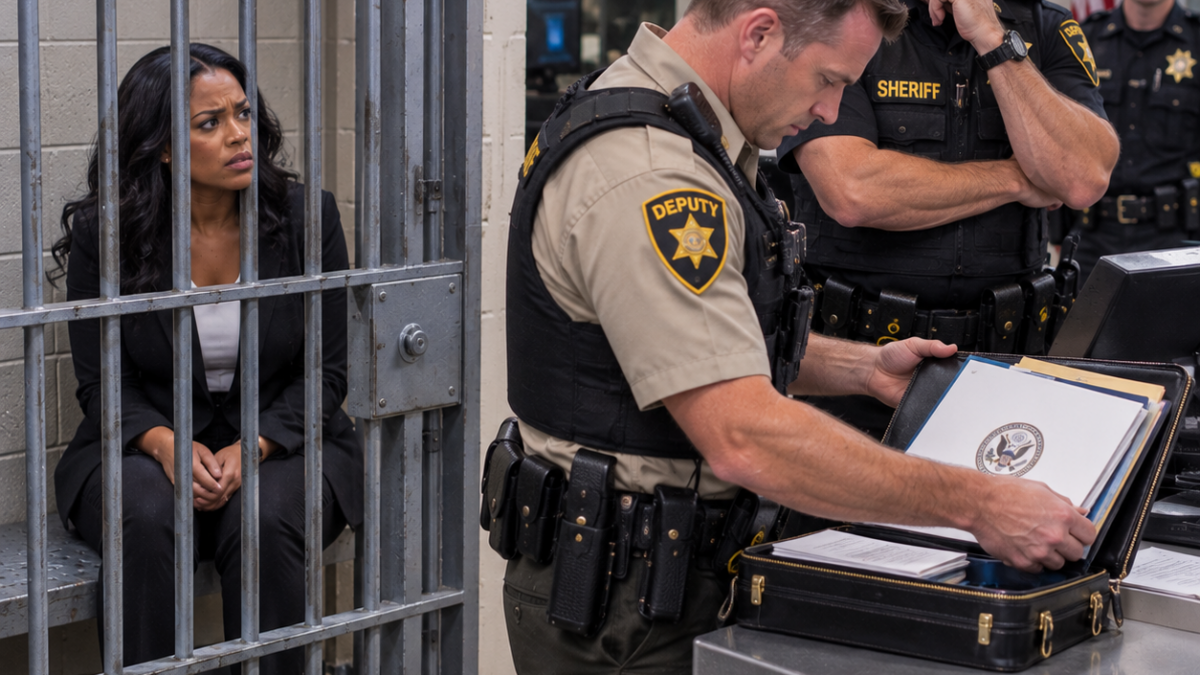
The holding area smelled like disinfectant, old concrete, and coffee that had been sitting on a burner since morning.
I had been in worse rooms.
That didn’t make the room acceptable.
There is a strange discipline that comes with practicing law around powerful institutions for long enough.
You learn very quickly that anger and usefulness are not the same thing.
I was furious.
I also knew fury was not the most useful thing I had available.
So I sat upright on the bench and reconstructed the afternoon in my head.
12:15 p.m.
Entered records office.
12:19.
Submitted request.
12:37.
Asked for supervisor.
12:54.
Asked again.
1:03.
Deputy intervened.
Those times were approximate.
The later ones were not.
Lawyers become obsessive about time when something starts going wrong.
Time tells you sequence.
Sequence tells you intent.
Or at least narrows the possibilities.
At 3:40, I had been booked.
At 3:52, I was given the phone.
I knew the duty desk would log the call.
I knew somebody would ask why I had missed my 3:30 check-in.
I did not know what level of escalation that would trigger.
People imagine working near the White House means everyone carries a secret number that sends black SUVs whenever life becomes inconvenient.
That is not how it works.
Most government security procedures are designed to be boring.
They are checklists.
Duty rosters.
Missed-contact procedures.
Escalation trees.
Boxes somebody is required to check so that an ordinary misunderstanding can be distinguished from the rare incident that isn’t ordinary.
My problem was that, from Washington’s perspective, several unusual facts had arrived at the same time.
I was working near a federally protected communications site.
I had missed a check-in.
My phone had gone dark.
Then I reported being detained by local law enforcement.
Any one of those things would have been manageable.
Together, they created a question the government was required to answer.
Was Maya Ellison having a bad afternoon?
Or had something happened involving the site?
Nobody knew.
That uncertainty was what moved the system.
Not my importance.
Not my ego.
Not politics.
Procedure.
Sheriff Daniel Mercer first saw my name on the afternoon booking sheet.
I learned that later.
He was fifty-three.
Eleven years as sheriff.
Twenty-seven total in law enforcement.
Born in the county.
Raised there.
His father had owned a hardware store two blocks from the courthouse square.
Mercer had the kind of local authority that comes from being recognized before people read the nameplate.
He knew families.
Teachers.
Business owners.
Pastors.
He had arrested some men’s sons and coached other men’s daughters in softball.
The county had fewer than ten thousand residents.
In a place like that, familiarity becomes useful.
It can also become dangerous.
You begin believing experience has given you something procedure cannot.
Instinct.
Mercer liked instinct.
Later, he would tell me that.
“I thought I knew the difference between a real problem and somebody just making noise.”
The problem was that his deputies had learned the same philosophy.
And what counts as noise depends heavily on who’s listening.
He glanced at my booking entry that afternoon.
ELLISON, MAYA RENÉE.
DISORDERLY CONDUCT.
PUBLIC BUILDING DISTURBANCE.
Nothing looked remarkable.
He had approved hundreds of similar bookings.
Not necessarily personally.
Operationally.
A deputy says a person was disorderly.
Booking processes the arrest.
Supervisor reviews it later.
The machinery moves.
Most institutions run because people trust each other’s summaries.
That is unavoidable.
It is also how a bad sentence becomes an official fact.
At 4:52 p.m., Mercer’s assistant answered the desk phone.
She expected county business.
Instead, she heard someone identify herself as calling through the White House Situation Room watch structure.
The exact routing later became the subject of absurd online speculation.
Some people imagined the President sitting beside the phone.
Others insisted it was the Secret Service.
Neither was true.
A White House watch officer had received the escalation through the relevant duty channel and needed local confirmation.
That was it.
Mercer’s assistant put the call on hold.
“Sheriff?”
He looked up.
“It’s the White House.”
Mercer laughed.
Apparently one deputy had once called pretending to be the governor after Mercer confiscated everybody’s phones during a training exercise.
“Which idiot?”
His assistant did not smile.
“They asked for you by name.”
That changed his expression.
He picked up.
“Sheriff Mercer.”
The woman’s voice on the other end was calm.
No threats.
No title flex.
Three questions.
“Sheriff, do you currently have a forty-one-year-old woman named Maya Ellison in custody?”
Mercer looked at the booking sheet.
“Yes.”
“What is the stated charge?”
“Disorderly conduct.”
“Has she been given access to counsel and a reasonable opportunity to communicate following booking?”
That one he couldn’t answer.
He hated not being able to answer.
Sheriffs are accustomed to being the person people ask.
Not the person who says:
I don’t know.
“I’d need to check.”
The caller paused.
“Please do.”
Then came the instruction that changed Mercer’s entire evening.
“Preserve everything connected to this booking.”
“What exactly do you mean by everything?”
“Original arrest narrative.”
“Booking sheet.”
“Property intake.”
“Front-counter records.”
“Video.”
“Communications.”
“Do not rewrite anything.”
“Do not clean anything up.”
“Do not discard drafts.”
Mercer leaned back.
“Ma’am, are you ordering my department to release her?”
“No.”
That surprised him.
“No?”
“No, Sheriff.”
“If you have lawful grounds for detention, your jurisdiction remains your jurisdiction.”
Her tone never changed.
“What I am asking for is accurate information and preservation.”
“Why?”
“I am not authorized to discuss her official assignment with you on this line.”
“Then why am I getting a call from the White House?”
“Because her status and location triggered an interagency security review.”
Mercer looked at his assistant.
She was pretending not to listen.
Failing.
“What kind of review?”
“The kind that becomes easier for everyone if your records are complete.”
That sentence bothered him.
Not because it was threatening.
Because it wasn’t.
Threats give people something to resist.
Procedure just waits.
The caller continued.
“I need you to treat the next ninety minutes carefully.”
Mercer remembered those exact words.
He wrote them down.
Not because he understood them.
Because something in the woman’s tone told him he would later wish he had.
To his credit, Mercer did not immediately run to the holding area demanding to know who I was.
He asked for paper.
The arrest narrative.
Booking sheet.
Records-office front log.
Deputy Tanner had written:
Subject became increasingly agitated after being advised to wait for supervisor.
The records clerk had written:
Customer waiting for supervisor re title flag. Asked ETA multiple times. Deputy Tanner intervened.
Tanner wrote:
Subject refused repeated commands to lower voice.
The clerk’s log included:
Customer speaking firmly but not yelling.
Tanner:
Subject created substantial disruption to county business.
Clerk:
Other customers continued waiting. No threats.
Mercer read both twice.
Then he pulled the county disorderly-conduct ordinance.
The language was embarrassingly broad.
Disruptive behavior inside a public facility that materially interferes with operations or refuses lawful instruction.
What did materially interfere mean?
The ordinance did not say.
What lawful instruction had I refused?
Tanner’s report did not identify one.
Lower your voice.
Was I legally required to obey that when my voice was not creating any actual disturbance?
Mercer found no answer in the report.
So he went to see me.
The first time I saw Sheriff Mercer, he was standing in the doorway of the holding area with three pieces of paper in one hand.
Older than Tanner.
Heavyset.
Gray starting at the temples.
Tired eyes.
He introduced himself.
“Ms. Ellison, I’m Sheriff Daniel Mercer.”
“I know.”
That surprised him.
“Someone tell you?”
“Your photograph is in the lobby.”
He almost smiled.
Almost.
“I’ve been reviewing what happened.”
“Good.”
“I want to ask you a few questions.”
“Before you do, I’d like something in writing.”
“What?”
“The specific ordinance section under which I’m being held.”
He nodded.
“That’s fair.”
“And the specific conduct alleged to satisfy each element.”
His face changed.
Not anger.
Recognition.
He had just been asking himself the same question.
“I’ll get that.”
“Thank you.”
He looked toward the bench.
“Are you hurt?”
“No.”
“Were the cuffs overly tight?”
“No.”
“Anyone use force beyond the arrest?”
“No.”
“Were you threatened?”
“No.”
“All right.”
He seemed almost relieved.
Then I said:
“The arrest can still be unlawful without being violent.”
His relief disappeared.
“I understand.”
“Do you?”
He looked at me.
“I think I’m starting to.”
That was the first useful thing anyone in his department had said.
Mercer was midway through telling me he believed there were problems with the arrest when his assistant appeared.
“Sheriff.”
He turned.
“You need to come up front.”
“What now?”
“Federal team.”
That phrase sounds more dramatic than what happened.
Two black SUVs entered the lot.
Several federal personnel got out.
No tactical formation.
No rifles.
No lights.
No dramatic seizure of the building.
A DHS investigative liaison team had been sent to perform a welfare and property-custody verification because of the security flag attached to my interrupted assignment.
The lead agent was a woman named Karen Alvarez.
Early forties.
Dark hair with silver at the temples.
The kind of expression that suggested she had spent a career listening to people lie slowly.
She showed credentials.
Asked for the sheriff.
Then explained the scope.
“I need to confirm Ms. Ellison’s welfare.”
“I need to verify custody of her official materials.”
“And I need your booking and evidence areas preserved until we establish the chain of custody.”
Mercer bristled slightly.
Not enough to become foolish.
“You understand this is a county law-enforcement facility.”
“I do.”
“And you’re not taking control of my building.”
“No.”
Alvarez looked directly at him.
“I don’t want your building.”
“I want accurate answers.”
Mercer nodded.
That was the second moment that helped him later.
He did not make the encounter about ego.
“She’s in back.”
“Then let’s go see her.”
I stood when Alvarez entered.
Not because I was required to.
Because seeing someone from the federal side meant the security question had become bigger than my booking.
She looked at me.
“Counselor.”
“Agent.”
“You okay?”
“Annoyed.”
“That’s familiar.”
Mercer looked between us.
“I was reviewing the arrest when you arrived.”
I said:
“He was.”
Alvarez looked surprised.
“You’re defending him already?”
“No.”
“I’m preserving facts.”
Something in her face softened.
“Good habit.”
Mercer said:
“I was about three minutes from releasing her.”
I looked at him.
“Five.”
“Four.”
Alvarez sighed.
“Are we bargaining over wrongful detention now?”
For the first time all afternoon, I laughed.
Only briefly.
Then Alvarez’s phone vibrated.
She looked at the screen.
Her entire face went still.
That frightened me.
Professional people show fear by becoming more professional.
She looked at Mercer.
“Sheriff.”
“Yes?”
“Who accessed her property in the last twenty minutes?”
Mercer frowned.
“Booking officer.”
“Anyone else?”
“Why?”
“Because a secured item assigned to Ms. Ellison has just generated a tamper alert.”
My stomach dropped.
“The folio?”
Alvarez looked at me.
“Yes.”
“Was it opened?”
“We don’t know.”
I stood straighter.
“That case cannot be opened locally.”
Mercer looked from me to Alvarez.
“What is in it?”
“Nothing you need access to.”
Alvarez’s answer was immediate.
“That isn’t me being disrespectful.”
“It is me protecting you from information you do not need.”
He accepted that.
“Where is the property locker?”
“Evidence room.”
“Take me there.”
Deputy Wesley Tanner had made the second mistake because he was afraid of the first.
That is the part I eventually understood.
He had arrested me believing he was preventing a scene.
By late afternoon, people were asking questions.
His sergeant had asked why a records-office dispute became an arrest.
Someone mentioned the sheriff was reviewing the paperwork.
Tanner panicked.
He remembered the leather folio had not been itemized beyond:
Document case.
That looked sloppy.
So he went to the locker.
Alone.
He told himself he was improving the paperwork.
All he wanted, he later said, was to describe what was inside.
He did not know the folio had a biometric release.
It was designed for occasional transport of protected government legal materials.
Not cinematic secrets.
Not nuclear codes.
Paper.
The boring kind of paper governments still move physically when digital transmission isn’t appropriate.
Tanner pressed the latch.
It did not open.
So he pulled harder.
The mechanism detected unauthorized manipulation.
A silent alert went to the monitoring system.
No alarm sounded in the evidence room.
No light flashed.
Tanner had no idea.
He tugged again.
By the time Alvarez entered the room, he was holding the case in both hands.
She stopped.
“Put that on the table.”
He froze.
“I was inventorying it.”
“Table.”
“I didn’t open it.”
“Put it down.”
He did.
Mercer stared at him.
“What did you do?”
“Sheriff, I was trying to fix the intake.”
“Fix?”
“I mean finish it.”
“Did you remove evidence from the locker without authorization?”
Tanner looked toward Alvarez.
Then me.
“Yes.”
Mercer’s jaw tightened.
“Why?”
“I knew the report looked bad.”
There it was.
Not espionage.
Not sabotage.
Not some vast conspiracy.
Fear.
A young deputy trying to make yesterday’s mistake look smaller before somebody important read it.
And in doing so, he made it enormous.
At 5:32, Mercer’s desk phone rang again.
His assistant brought it back.
“They want speaker.”
Alvarez nodded.
“Do it.”
Mercer pressed the button.
“This is Sheriff Mercer.”
A man’s voice answered.
Older.
Controlled.
“This is the White House Situation Room watch desk.”
Mercer looked at me.
I said nothing.
“We have confirmation that a secured courier item assigned to Ms. Ellison generated an unauthorized-access alert from your facility.”
Mercer swallowed.
“Yes.”
“Is Ms. Ellison present?”
“I am.”
I stepped toward the phone.
“Are you speaking freely?”
“Yes.”
“Are you injured?”
“No.”
“Has the secured item been opened?”
Alvarez examined the seal.
“No breach.”
She answered.
“Attempted manipulation of the release mechanism only.”
The voice continued.
“Sheriff, I want to be precise.”
Mercer’s hands rested flat on the desk.
“Go ahead.”
“The underlying arrest remains a local legal matter subject to appropriate review.”
“Understood.”
“The attempted access to secured federal property is separate.”
“Understood.”
“Your cooperation so far is noted.”
Mercer looked at Tanner.
The deputy seemed twenty years younger and twenty years older at the same time.
Then came the part everyone online later misrepresented as an ultimatum from the White House.
It was an operational deadline.
Ten minutes.
Release me if the sheriff had independently concluded there was no lawful basis to continue holding me.
Return the property after federal documentation.
Preserve originals.
Provide copies to Alvarez.
Do not revise any arrest paperwork before the originals were captured.
The voice did not say:
Release her because she works for us.
It said:
If you are releasing her, complete it now and document it before this becomes a larger custody problem.
That distinction matters.
I would not tell this story otherwise.
Mercer looked at the clock.
5:34.
Then at me.
“Ms. Ellison.”
“Yes?”
“I reviewed the ordinance.”
I waited.
“I don’t believe your conduct satisfied it.”
“Then what happens next?”
“You’re released.”
Not because Washington called.
Because he finally read his own department’s work.
That is the version I choose to remember.
Mercer moved quickly.
Release form.
Dismissed booking notation.
Property return.
Original paperwork photographed before correction.
Tanner relieved from duty.
Alvarez documented every page.
Mercer even stopped his assistant from fixing a typo in the booking sheet.
“Leave it.”
She looked confused.
“It says District of Colombia.”
“I know.”
“We’re giving them that?”
“We’re giving them exactly what existed at 5:35.”
That was the moment I first respected him.
Not forgave.
Respected.
There is a particular temptation after discovering your organization made a mistake.
You want the record to reflect the organization you wish you had been.
Mercer allowed the record to reflect the one he actually commanded.
That is rare.
Alvarez finished photographing the paperwork.
“Four minutes.”
Mercer signed the final release line.
My property was returned.
Phone.
Wallet.
Keys.
Folio.
Alvarez scanned the seal.
Intact.
I ran my thumb against the biometric release.
The lock recognized me.
I did not open it.
There was no reason.
Somewhere far away, the status changed from tamper alert to authorized possession.
The phone on the counter rang.
5:43.
Mercer answered personally.
“She’s released.”
He listed what had been done.
There was a pause.
Then:
“Noted.”
Mercer surprised everyone.
Including me.
“I want something on the record.”
The voice waited.
“I didn’t release Ms. Ellison because your office called.”
Alvarez raised an eyebrow.
Mercer continued.
“I released her because when I compared my deputy’s report with the records-office log and the ordinance, I couldn’t identify a crime.”
Another pause.
“Understood, Sheriff.”
“What happened would have been wrong if she’d worked at the grocery store.”
I looked at him.
That was when my opinion changed.
Not enough for forgiveness.
Enough for possibility.
The federal side stayed another two hours.
Alvarez reviewed access logs.
Interviewed Tanner.
Confirmed there had been no breach.
No external contact.
No evidence anyone in the county knew what I was working on before the arrest.
That mattered.
For several minutes after the tamper signal, Washington had been required to consider worse scenarios.
A deliberate attempt to access the folio.
A compromised staff member.
Some connection to the communications site.
Those possibilities disappeared quickly because facts killed them.
Tanner’s fingerprints were where expected.
Evidence-room camera showed him entering alone.
He had no unusual financial history.
No relevant contacts.
No connection to the parcel dispute.
Just bad judgment.
Alvarez called the duty desk.
“Procedural error.”
She said.
“No indication of hostile intent.”
No federal criminal escalation was recommended based solely on the tamper event.
That did not mean Tanner escaped consequences.
It meant the government distinguished stupidity from espionage.
A functioning system should.
After my release, Mercer asked:
“Do you still need the deed?”
I looked at him.
“You’re kidding.”
“No.”
I checked my watch.
6:17.
My flight departed later that evening from the regional airport.
“I absolutely still need the deed.”
He laughed.
It was the first time I had seen him do that.
“Come on.”
We walked back to the records office.
The supervisor had returned from lunch hours earlier and spent most of the afternoon wishing she had chosen another career.
The clerk who originally helped me looked ready to disappear beneath the counter.
I smiled.
“I’m not angry with you.”
Her eyes filled.
“I should’ve explained the delay better.”
“You didn’t arrest me.”
She almost laughed.
Then stopped herself.
The supervisor reviewed the title flag.
Signed the request.
Certified the copy.
Seven minutes.
That was how long the transaction took once the correct person was present.
Five hours of consequence built around seven minutes of ordinary bureaucracy.
I put the deed inside another folder.
Not the secured folio.
Mercer noticed.
“Learning experience?”
“For both of us.”
We stood in the parking lot afterward.
The two federal SUVs were still there.
Engines off now.
Less dramatic.
Mercer looked at them.
“I imagine this is going to be a story.”
“I hope not.”
He seemed surprised.
“You don’t?”
“No.”
“Why?”
“Because I don’t need you embarrassed.”
I shifted the folio under my arm.
“I need the next person to have an easier afternoon.”
He became very still.
Then I asked him the question I had been thinking about since the first call.
“How many times have you used that ordinance?”
His face tightened.
“I don’t know.”
“Hundreds?”
“Potentially.”
“How many people asked a question one time too many?”
“I don’t know.”
“How many didn’t have a federal duty desk checking whether they disappeared?”
He looked away.
“I don’t know.”
“Find out.”
That was all.
I left.
My flight boarded early.
I reached the gate with eleven minutes before doors closed.
When the agent scanned my boarding pass, she said:
“Long day?”
I looked at the folio.
“You have no idea.”
Then I went home.
The next morning, Sheriff Mercer pulled every disorderly-conduct arrest from the previous five years involving a public building.
Not because I ordered him.
I had no authority to.
Because my question had bothered him.
Thirty-eight cases met his initial criteria.
Most were straightforward.
Threats.
Fights.
Property damage.
People physically blocking government counters.
A few involved intoxication.
But nine made him uncomfortable.
One was a sixty-two-year-old Black man arrested after arguing about a tax assessment.
No threat.
One was a Latina mother arrested at a school-board office after refusing to leave without an explanation for her daughter’s transportation problem.
One involved a white veteran angry over permit processing.
One involved a homeless man repeatedly demanding access to a warming center after staff said it was full.
Different people.
Different facts.
Same flexible phrase.
Became disorderly.
Mercer brought the files to the county attorney.
Her name was Helen Porter.
She had written half the local ordinances over twenty years.
He dropped them onto her desk.
“We have a problem.”
She looked at the stack.
“Which one?”
“The one where my deputies can arrest somebody because their tone annoys us.”
Helen leaned back.
“That is not what the ordinance says.”
“It is what we’re using it to mean.”
She opened the code.
Read it.
Then one report.
Then another.
“This has survived review for years.”
“That’s not the same as being good.”
She looked at him.
“What happened yesterday?”
“You already heard.”
“I heard two black SUVs showed up.”
“That isn’t what happened yesterday.”
He pointed at the files.
“This happened yesterday.”
That distinction changed what followed.
They rewrote the ordinance.
Not overnight.
Not because one sheriff could unilaterally edit local law.
The county attorney drafted revisions.
County officials reviewed them.
Public notice requirements were followed.
Training bulletins were prepared.
The new standard required observable conduct.
Threat.
Physical obstruction.
Property damage.
Fighting.
Repeated behavior that objectively prevented public business from continuing after clear notice.
What no longer qualified by itself:
Firm questioning.
Repeated requests.
A raised voice without threat.
Refusing to answer irrelevant personal questions.
Criticism of an employee.
The county attorney warned Mercer:
“You understand your deputies are going to hate this.”
“Why?”
“Because you’re taking away discretion.”
“No.”
“I am defining it.”
“They’ll say their hands are tied.”
“If their hands were only free because the rule was vague, maybe they needed tying.”
Helen laughed.
“I need that sentence for the minutes.”
“No, you don’t.”
They changed it anyway.
Tanner served a suspension.
The federal review of the folio incident closed after investigators concluded the attempt was unauthorized but not malicious.
County discipline remained.
Evidence-handling retraining.
Constitutional-law refresher.
De-escalation.
Permanent personnel notation.
A lot of people online wanted him fired.
They had learned fragments of the story by then.
Someone at the county had seen the SUVs.
A reporter asked questions.
Rumors spread.
I refused to comment publicly.
Mercer made a decision that surprised me.
He did not fire Tanner.
When I learned that, I was angry for perhaps ten minutes.
Then I called him.
“Why?”
He answered honestly.
“Because I think firing him would solve the wrong problem.”
“He arrested somebody without a lawful basis.”
“Yes.”
“He interfered with evidence.”
“Yes.”
“He tried to make his report look cleaner.”
“Yes.”
“And he still works there?”
“Under supervision.”
I said nothing.
Mercer continued.
“If I fire him, the department learns one thing.”
“Don’t get caught.”
That got my attention.
“If he stays after real discipline, retraining, and a permanent record, every deputy sees exactly what shortcut caused exactly what consequence.”
“You’re betting on rehabilitation.”
“I’m betting on structure.”
“What if you’re wrong?”
“Then I own that too.”
I looked out my office window.
Washington traffic below.
“You know I’m not going to defend you publicly.”
“I didn’t ask.”
“People will say you protected him.”
“I know.”
“Some will be right.”
“Maybe.”
He sighed.
“But my job isn’t to produce the cleanest headline.”
That sounded annoyingly familiar.
I smiled despite myself.
“You’ve been listening.”
“Worst habit I picked up this week.”
Tanner returned five days later.
According to Mercer, he was different.
That sentence alone means nothing.
Everybody looks different for a week after almost losing a career.
The more interesting part came six months later.
A man entered the records office angry about a zoning map.
He spoke loudly.
Called the clerk incompetent.
Refused to leave until a supervisor explained the discrepancy.
Tanner responded.
Same desk.
Same lobby.
He asked the man to step aside so other customers could be served.
The man refused.
Tanner almost reached for the old ordinance.
Then stopped.
He called a supervisor.
The supervisor came.
Explained the zoning issue.
The map contained an error.
The citizen left twenty minutes later.
No arrest.
No handcuffs.
No federal phone call.
When Mercer told me, I said:
“That’s it.”
“What?”
“That’s the success.”
He sounded disappointed.
“No dramatic redemption?”
“No.”
“No medal?”
“Absolutely not.”
“Just a guy leaving?”
“Yes.”
He laughed.
“That’s a terrible story.”
“That’s the point.”
The records office changed too.
The clerk created a simple laminated card.
FLAGGED RECORD REQUESTS
Supervisor review required.
Typical wait: 20–45 minutes.
If supervisor unavailable, request written callback time.
It listed escalation contacts.
Boring.
Useful.
The clerk later told a trainee:
“If somebody’s frustrated because we’ve left them standing here for forty minutes without explaining anything, that’s not automatically them being difficult.”
“Sometimes that’s us being slow.”
I wish every public building in America had that sentence on a wall.
Not because workers deserve abuse.
They don’t.
Because organizations often confuse frustration with threat when the person expressing it has less institutional power.
Three months after my arrest, I returned to the county.
Same blazer?
No.
I deliberately wore jeans.
Not as a test.
I had been traveling.
Mercer met me outside the courthouse.
“No SUVs?”
He asked.
“Budget cuts.”
He laughed.
We walked to a conference room.
The county had invited me to review, not approve, their revised public-contact training.
I told them from the beginning:
“I am not your police consultant.”
Mercer nodded.
“You are the person our old policy jailed.”
“Fair.”
The training opened with body-camera footage from unrelated scenarios.
Not mine.
I had requested that.
I did not want deputies learning:
Be careful because the person you’re arresting might work for the White House.
That would have missed everything.
Instead, the instructor asked:
“What behavior is illegal?”
“What behavior is merely irritating?”
“When is an instruction legally necessary?”
“When is it merely convenient?”
“What does noncompliance actually mean?”
One deputy raised his hand.
“What if somebody keeps questioning you after you’ve answered?”
The instructor responded:
“Then they keep questioning you.”
Several deputies laughed.
“No, seriously.”
He continued.
“Unless questioning itself materially interferes with a lawful operation or crosses another defined line, annoyance is not probable cause.”
That was the lesson.
Not:
Check whether she has powerful friends.
During lunch, Mercer and I sat in the courthouse cafeteria.
He ate meatloaf.
I made the mistake of ordering what they called a salad.
“What is this?”
I asked.
“Salad.”
“There is ham in it.”
“Protein.”
“There is more cheese than lettuce.”
“Georgia.”
I stared at him.
He smiled.
Then became serious.
“I pulled those old arrests.”
“I heard.”
“Nine bothered me.”
“What are you doing?”
“County attorney reviewing.”
“For expungement?”
“Where legally available.”
“Good.”
He pushed his tray aside.
“One guy won’t talk to us.”
“Why would he?”
“Fair.”
“He spent a night in jail.”
“Tax office argument.”
“I know.”
“I called him.”
“What did you say?”
“That we reviewed his arrest and wanted to discuss corrective options.”
“And?”
“He said he spent five years trying to forget our number.”
I looked at Mercer.
“That’s your answer.”
“To what?”
“Whether paperwork matters.”
He nodded.
The federal easement review finished eleven days after my arrest.
No thriller ending.
No spies.
No sabotage.
An old filing from the 1980s had used an outdated parcel description.
County and federal lawyers reconciled the boundary language.
Corrected deed.
Updated easement notation.
Done.
The communications relay site continued operating.
Most local residents never learned what it was.
Good.
Critical infrastructure works best when it is boring.
The folio I carried that afternoon contained legal materials related to the review.
Nothing that would have changed the world if Tanner had somehow opened it.
That never mattered.
Security rules cannot depend on someone deciding unauthorized access is fine because the contents turn out to be unexciting.
The rule is:
You don’t open what you’re not authorized to open.
Period.
Tanner understood that afterward better than anyone.
Six months later, I received a handwritten letter.
No government letterhead.
County sheriff’s office return address.
From Wesley Tanner.
I almost gave it to counsel without opening it.
Then changed my mind.
He wrote:
Ms. Ellison,
I have rewritten this letter several times because every version sounded like I was explaining myself instead of apologizing.
Good start.
I arrested you because I decided that your persistence was disrespect.
I knew you had not threatened anyone.
I knew you were not shouting.
I told myself I was preventing escalation.
The truth is I wanted control of the conversation.
I stopped reading.
Then continued.
The evidence-room decision was worse because by then I knew the arrest might be wrong.
I tried to make the paperwork cleaner instead of making the truth clearer.
That sentence hurt.
Because it was the whole story.
Sheriff Mercer told me mistakes do not become smaller because you hide them early.
They become harder for the next person to correct.
Then:
Last month a man got angry at me in the same records office.
I called my supervisor instead of arresting him.
The county had made an error.
He left angry, but he left free.
I thought you should know.
I folded the letter.
Put it in my desk.
I never wrote back.
Not because I rejected the apology.
Because I did not know what to say.
Sometimes the best reply to reform is letting the reform continue without turning forgiveness into another performance.
A year later, Sheriff Mercer came to Washington for a law-enforcement conference.
He called.
“Lunch?”
“I have thirty minutes.”
“I thought White House lawyers controlled time.”
“We bill it.”
“You don’t bill.”
“Old habits.”
We met at a restaurant a few blocks away.
He looked uncomfortable in a suit.
“You look like you’re going to court.”
“I feel like I’m going to a funeral.”
“That tie is trying to finish the job.”
He loosened it.
“Better?”
“No.”
We ate.
Then he asked:
“Can I ask you something I’ve never asked?”
“Probably.”
“Why didn’t you tell Tanner who you were?”
I put down my fork.
“Which answer do you want?”
“The real one.”
“The first reason was simple.”
“I didn’t think it mattered.”
He waited.
“I wanted a deed.”
“I wasn’t entering a secure federal facility.”
“I wasn’t directing an operation.”
“I wasn’t asking him to do anything because of my position.”
“I was standing in a county records office.”
“And the second reason?”
I looked at him.
“Once he asked what I did for work, I knew the answer would change how he treated me.”
Mercer frowned.
“You knew?”
“I suspected.”
“And you didn’t want that?”
“No.”
“Why?”
“Because the woman ahead of me in line was a dental assistant.”
“The man behind me drove a landscaping truck.”
“They shouldn’t need a White House badge either.”
Mercer sat quietly.
“That was the question you asked me in the parking lot.”
“Yes.”
“How many people didn’t have somebody to call?”
“Yes.”
He looked toward the window.
“I still don’t know.”
“Neither do I.”
“But fewer will need one now.”
I smiled.
“That’s the only answer worth building.”
People occasionally call the incident proof that powerful people live under different rules.
I understand why.
A White House-connected attorney gets arrested.
A call comes.
Federal agents arrive.
She gets released.
Looks simple.
Looks ugly.
But if that were the lesson, I would hate this story.
Power did protect me in one important way.
It created oversight quickly.
I had an office that noticed when I disappeared.
Most people do not.
That inequity is real.
Pretending otherwise would be dishonest.
But the call itself did not create my rights.
It created a witness.
There is a difference.
The disorderly-conduct arrest lacked a proper basis before anyone in Washington knew about it.
The vague ordinance was vague before my name hit a federal duty log.
The clerk’s written record contradicted Tanner before the SUVs arrived.
Mercer’s department had all the evidence required to correct itself.
What the outside attention did was make ignoring that evidence harder.
That is both comforting and disturbing.
Because ninety-nine times out of a hundred, no outside attention comes.
The paperwork must still be good enough.
The supervisors must still read it.
The rules must still be narrow enough.
The employee must still be willing to say:
This doesn’t add up.
Two years after the incident, I was in another county records office.
Different state.
Different matter.
A zoning archive this time.
I waited thirty-five minutes.
The clerk apologized.
I smiled.
“Take your time.”
Then a man beside me became angry.
White.
Sixties.
Contractor.
He had been waiting longer than I had.
“This is ridiculous.”
The clerk stiffened.
He raised his voice.
“I have three employees sitting on a job site because you people can’t find one permit.”
The room changed.
I felt it.
That old tension.
Public employee.
Angry citizen.
Everybody deciding whether anger is about to become danger.
A security officer approached.
For half a second, my body remembered handcuffs.
Then the officer said:
“Sir, I understand you’re frustrated.”
The contractor pointed at the counter.
“Damn right.”
“Okay.”
The officer kept distance.
“No threats.”
“No blocking the window.”
“You can be angry.”
“Just let them keep serving people while they find your permit.”
The man breathed.
Looked embarrassed.
Then nodded.
“Fine.”
That was it.
No arrest.
No title.
No phone call.
I watched the officer walk away.
He had no idea who I was.
Perfect.
That is what good authority looks like most of the time.
Unremarkable.
The county where I was arrested eventually published its revised arrest policy and complaint statistics.
Not because federal law required it.
Mercer decided transparency made future backsliding harder.
Complaints rose initially.
His county commission panicked.
“Your reforms are making the department look worse.”
Mercer called me afterward.
“You ever hear anything this stupid in Washington?”
“Daily.”
“What do I tell them?”
“The truth.”
“Which is?”
“People report when they think reporting might matter.”
He sighed.
“I hate when you’re reasonable.”
“Occupational hazard.”
Within two years, complaints involving disorderly conduct dropped.
More importantly, supervisor interventions increased before arrests occurred.
Some deputies hated the paperwork.
Good.
Paperwork creates friction.
Friction can save freedom.
Not every time.
Sometimes bureaucracy creates injustice.
But forcing an officer to write:
Specific observable act establishing probable cause
does something valuable.
It makes “she was difficult” look as weak on paper as it always should have.
Sheriff Mercer eventually retired.
I did not attend the ceremony.
He sent me the speech afterward.
One paragraph was highlighted.
For years I thought leadership meant trusting the judgment of the people I trained.
I still believe that.
But trust without verification becomes permission.
A badge does not make instinct evidence.
A supervisor’s job is not to protect a deputy’s decision from scrutiny.
It is to make sure the decision survives scrutiny.
I called him.
“Not bad.”
“That all I get?”
“Paragraph three is too long.”
“Of course.”
“You used ‘accountability’ six times.”
“Consultant wrote that part.”
“Fire consultant.”
“Already did.”
I laughed.
Then he said:
“You know what still bothers me?”
“What?”
“That phone call.”
“Why?”
“If Washington hadn’t called…”
He stopped.
I knew.
“So does it bother me.”
“What do you think would’ve happened?”
“Eventually?”
“Yes.”
“You might have reviewed the arrest the next morning.”
“Maybe.”
“I might have spent the night in jail.”
“Maybe.”
“Tanner might have rewritten the property report.”
Mercer was silent.
“That one hurts.”
“It should.”
“What do we do with that?”
“Build systems that don’t require luck.”
Another silence.
Then:
“That’s going in my next speech.”
“Pay me.”
The White House Situation Room never called Mercer again.
The federal incident was closed.
The folio went back into the system from which it came.
The relay node kept doing its quiet work behind pine trees.
The corrected deed sat in a county file.
Tanner kept working.
The clerk kept processing records.
Mercer retired.
I moved to another assignment.
Life did what life does after the event strangers online insist must have changed everything.
It continued.
But I kept one thing from that afternoon.
Not the arrest paperwork.
My attorney has that.
Not the county’s apology.
Not the federal closure letter.
I kept the original certified deed.
A boring rectangle of paper.
Stamped.
Signed.
Correct.
The document I had asked for at 12:15.
Sometimes I take it out.
Not because the land matters to me personally.
Because that sheet represents the entire absurd distance between what should have happened and what did.
Ask.
Wait.
Supervisor signs.
Clerk stamps.
Go home.
Instead:
Handcuffs.
Booking.
White House call.
Federal response.
Tamper alert.
Policy review.
Years of consequences.
All because several people mistook inconvenience for danger and then tried to make the paperwork match their first impression.
That is how bad systems become expensive.
Not always with malice.
Often with shortcuts.
People also ask whether I forgive Wesley Tanner.
I don’t know.
That answer disappoints them.
Forgiveness makes stories tidy.
I am not interested in tidy.
I do believe he changed.
I believe Mercer changed.
I believe the county changed some of its rules.
I believe those things matter.
I also remember standing with my hands cuffed behind me because I asked what law I had broken.
Both can be true.
Change does not erase harm.
Harm does not make change meaningless.
That is adulthood.
Competing truths without a satisfying slogan.
The question I care about now is not:
What happens when a sheriff arrests someone important?
It is:
What happens when he arrests someone unimportant?
A home health aide.
Teacher.
Mechanic.
Teenager.
Unemployed father.
Grandmother.
Person whose phone call reaches nobody beyond a sister waiting at home.
Do they get a supervisor who reads the paperwork?
Does somebody compare the report with the security video?
Does the evidence log stay untouched?
Does the ordinance require an actual crime?
Does the deputy have enough training to distinguish disrespect from danger?
Those questions are less entertaining than the Situation Room.
They are also the only ones worth answering.
Because I had something most people never have.
A system noticed my absence.
The goal cannot be giving everyone a White House number.
The goal is making sure they don’t need one.
Several years later, I spoke to a class of young government lawyers.
One student asked:
“What was the scariest moment?”
Everyone expected:
The arrest.
The folio alert.
The federal team arriving.
None of those.
“The scariest moment came afterward.”
I said.
“When?”
“When I realized how easily the story could become about who I was.”
They looked confused.
I explained.
“If the moral is ‘don’t arrest her because she’s White House counsel,’ we’ve learned nothing.”
“Then what’s the moral?”
A student in the second row asked.
I thought about Mercer.
Tanner.
The clerk.
The Situation Room caller.
Alvarez photographing original documents before anyone corrected them.
“Write down what actually happened.”
I said.
“That simple?”
“No.”
“That’s why it’s hard.”
I continued.
“Power depends on narrative.”
“Law depends on facts.”
“Institutions fail when people use paperwork to protect the narrative they prefer instead of preserving the facts they have.”
The room became quiet.
“So the paperwork saved you?”
Another student asked.
“No.”
I smiled.
“The paperwork embarrassed everyone into doing their jobs.”
They laughed.
Then I corrected myself.
“Actually, that’s not fair.”
“It gave good people something solid enough to correct a bad decision.”
“That is what records are for.”
On the anniversary of the arrest, I received a photograph from Mercer.
No message.
Just an image.
County records office.
Same counter.
New laminated information card.
And in the background, almost too small to notice, Deputy Tanner speaking to an older woman who looked irritated.
His hands were open.
No cuffs visible.
No other officers.
I zoomed in.
The woman was pointing at a piece of paper.
Tanner appeared to be listening.
A minute later Mercer texted:
She asked the same question six times.
I replied:
Did she survive?
His response came immediately.
Barely. Got her permit and went home.
I laughed.
Then:
Good.
He wrote:
Boring.
I answered:
Exactly.
That photograph remains one of my favorites.
No federal agents.
No black SUVs.
No White House phone line.
No secured folio.
No powerful woman whose absence triggered national-security procedures.
Just a citizen frustrated with government.
And a deputy letting her be frustrated without turning frustration into a crime.
That was what I had asked for in the parking lot.
An easier afternoon for the next person.
So yes, the White House Situation Room called Sheriff Daniel Mercer after his department jailed me for being “difficult.”
That part is true.
But the phone call did not save me because I was special.
It forced people to look closely at facts that should have protected me before anyone knew where I worked.
The most important thing Mercer did was not answer the call.
It was what he did after hanging up.
He pulled the documents.
Compared them.
Noticed they did not match.
Refused to rewrite them.
Read the ordinance.
Realized there was no crime.
Released me.
Then asked a harder question.
How many times had nobody called?
That question changed his county more than two black SUVs ever could.
And if there is one thing I carried away from that Tuesday afternoon, it is this:
Power can make people pay attention.
But justice begins when the system pays attention even when the person standing at the counter has no power at all.








