The Saturday I woke up to strangers launching boats from my shoreline, I still didn’t know which sentence in a 50-year-old deed was about to decide who had the right to be there
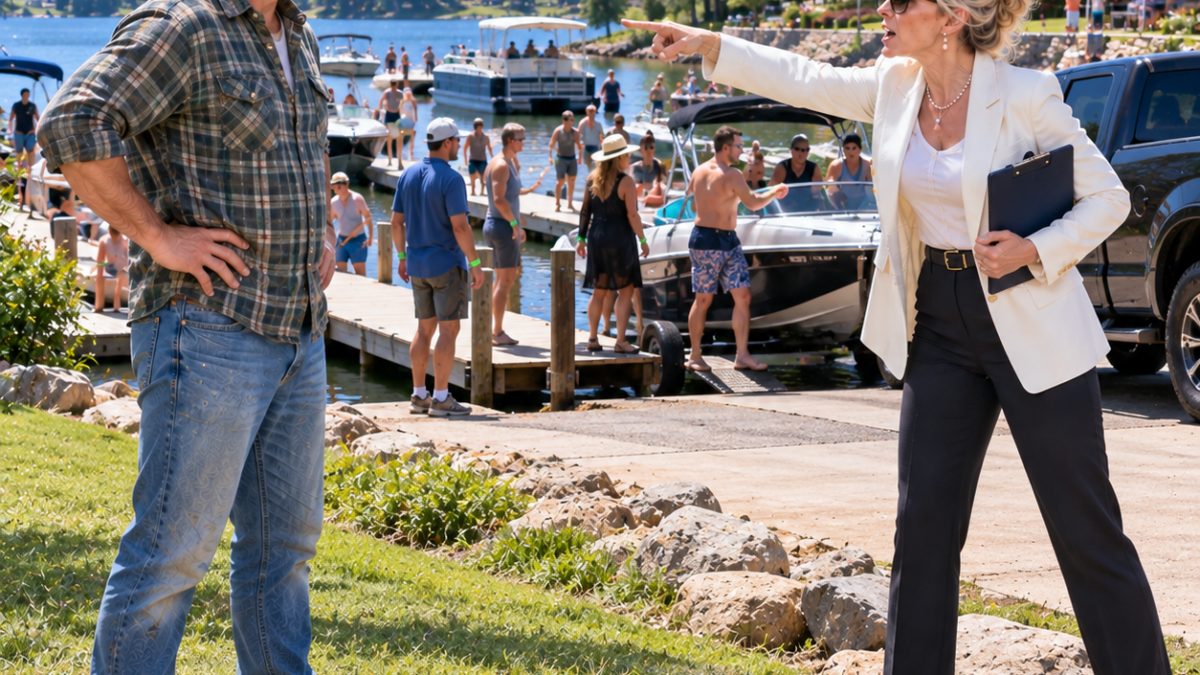
The sheriff arrived twenty-two minutes later.
By then the shoreline looked less like private property and more like a county fair somebody had forgotten to permit.
Cars filled the shoulder.
Two women in reflective vests were directing traffic into the hayfield across the road.
A folding table sat under a pop-up canopy beside the gravel ramp.
Green wristbands.
Cash box.
Clipboards.
Coolers.
Life jackets.
Rental paddleboards.
A barbecue truck idling beside my workshop drive.
And thirty-some people standing on my grass trying to figure out whether they were supposed to keep having fun or prepare to witness an arrest.
Sloan wanted the latter.
Just not hers.
She stood halfway down the slope in white slacks and boat shoes with her clipboard tucked against one hip.
When Sheriff Bo Kesler’s cruiser came through the gate, she immediately started toward him.
That told me something.
People who know the law is on their side usually wait for the law to ask questions.
People who know the audience is on their side rush to control the introduction.
Sloan reached him first.
“Sheriff, thank goodness.”
Bo closed his door.
He was fifty-six, broad through the shoulders, slow-moving, and had been elected four times because Blanco County—
No.
Wrong state.
Lake Brierwood was East Tennessee.
That mattered.
Bo had been sheriff there long enough to know almost every road by the family that used to own it.
He looked at Sloan.
Then at the crowd.
Then at the boat halfway down my ramp.
Then at me.
“What happened?”
Sloan opened her mouth.
“This gentleman has been attempting for months to interfere with a historic community right—”
Bo lifted two fingers.
Not rude.
Just final.
“I’m going to ask three questions.”
Sloan stopped.
“Who holds record title to the ground we’re standing on?”
She pointed toward me.
“He owns the surrounding parcel, but Fox Hollow has established access.”
“Second question.”
Bo looked toward the gravel.
“Where is the easement?”
Sloan lifted the glossy subdivision map.
“Right here.”
Bo did not take it.
“Third question.”
He looked directly at her.
“What is the recorded instrument number?”
For the first time that morning, Sloan went quiet.
Only briefly.
“Our attorney has reviewed the community rights.”
Bo nodded.
“That wasn’t my question.”
Sloan held the map out.
“This document clearly identifies the lake access area.”
Bo finally took it.
He glanced at it for maybe four seconds.
Then handed it back.
“That’s a marketing exhibit.”
Sloan’s smile tightened.
“It is an association planning document.”
“Recorded?”
She hesitated.
“I’d have to ask counsel.”
Bo turned to me.
“Mr. Callahan?”
I handed him the folder.
I had arranged it the night before.
Warranty deed first.
Dean Avery’s sealed survey second.
Certified copy of Book 412, Page 87 next.
Then the four exhibits.
Photographs of the grading work.
The contractor work order bearing Sloan’s signature.
The lake-pass advertisement.
My certified letters.
Green return receipts.
The HOA response.
OUR ATTORNEY DISAGREES.
Bo rested the packet on the hood of his cruiser.
The crowd shifted closer.
He looked up.
“Everybody stay where you are for a minute.”
Nobody argued.
Sloan did.
“Sheriff, I really don’t think we need to turn this into some kind of public title review.”
Bo kept reading.
“You called me.”
A man near the barbecue truck laughed once.
Then immediately pretended to cough.
Sloan’s eyes found him.
He stopped.
Bo read my deed.
Then the survey.
Then Book 412.
Page 87.
His finger moved down the page.
“Dam parcel.”
He turned to Exhibit C.
I watched Sloan watching him.
That was the moment I understood something important.
She had never actually seen the document.
Not the original.
Maybe not even a copy.
She had received an attorney’s summary months earlier, which I would only discover later.
But she had spent ten months speaking with absolute confidence about a deed she had apparently never sat down and read.
Bo found the easement language.
He read silently at first.
Then he said:
“Twelve feet.”
Sloan responded quickly.
“Yes.”
The confidence returned.
“That’s the historic access corridor.”
Bo looked up.
“To inspect the dam.”
“It provides access.”
“For inspection.”
“Access is access.”
Bo stared at her.
“No, ma’am.”
He turned the paper around.
“This says ingress and egress for inspection of drainage structures, emergency access to impoundment infrastructure, and coordination of embankment maintenance.”
Sloan raised one hand.
“That language was written in the 1960s.”
Bo continued.
“And for no other purpose.”
The shoreline became quiet.
Not completely.
A child somewhere behind me was asking for a juice box.
The barbecue truck generator still hummed.
Water moved over the spillway.
But adult conversation stopped.
Bo turned the page.
Then he read the exclusions.
“No right to construct a boat ramp or landing.”
His eyes moved toward the gravel ramp.
“No recreational use including fishing, swimming, or mooring of watercraft.”
A man holding a fishing rod slowly lowered it.
“No right to widen, pave, or improve the easement corridor beyond what is required for inspection access.”
Sloan’s face changed.
Then Bo reached the line.
“No right to grant, assign, license, or sell use of the easement area to third parties.”
He stopped.
Looked toward the green wristbands.
Then toward Sloan.
“Are these people association residents?”
“Some.”
“Some?”
“The pass program is available to neighboring families too.”
“So you sold passes to nonresidents.”
“It is a community-recreation program.”
“That was another question.”
Sloan pressed her lips together.
Bo closed the packet.
“I’m not deciding title out here.”
Sloan’s shoulders loosened slightly.
Too soon.
Bo continued.
“That happens in court.”
“However.”
He tapped my warranty deed.
“Mr. Callahan is standing here with record title to this ground.”
He tapped Dean Avery’s survey.
“He has a licensed survey showing the ramp and event area lie inside that property.”
He tapped the certified easement.
“And the association has a recorded maintenance easement that specifically excludes recreational use and sale to third parties.”
He looked at Sloan.
“You’ve also been given written notice.”
Sloan said:
“Our lawyer disputes his interpretation.”
“Then your lawyer can take that to a judge.”
Bo pointed toward the road.
“Until then, the record owner has told everyone to leave.”
Sloan’s face hardened.
“You’re going to shut down an event for eighty-six families based on one man’s interpretation of a sixty-year-old document?”
“No.”
Bo spoke calmly.
“I’m stopping a trespass complaint from becoming something worse while you people sort out your deed problem.”
She laughed once.
Not because it was funny.
Because she could not believe someone had interrupted her narrative.
“These families paid.”
Bo looked at the crowd.
“That sounds like something they need to discuss with whoever took their money.”
That sentence moved through the people faster than anything else.
A woman wearing a green wristband looked at Sloan.
“You said this was HOA property.”
“It is historically associated with the community.”
“That is not what you said.”
Another man spoke.
“I paid for three passes.”
Sloan turned.
“Everyone will be taken care of.”
“Taken care of how?”
“We will address this administratively.”
Bo stepped between them before the argument grew.
“Everybody who came for lake access today, please load your equipment and leave the Callahan property.”
Nobody needed to be told twice.
Not because they suddenly hated Sloan.
Most did not.
They were embarrassed.
That was worse.
Families started carrying kayaks uphill.
The rental company loaded paddleboards.
The man with the bass boat pulled forward until his trailer cleared the water.
Children complained.
Parents whispered.
Two men folded the check-in table.
One woman took the cash box.
Someone shut down the barbecue generator.
Without that noise, the lake sounded enormous.
Sloan remained at the bottom of the ramp.
I walked toward the newly installed sign.
PRIVATE LAKE ACCESS.
MEMBERS AND PASSHOLDERS ONLY.
Below it:
NO TRESPASSING.
I stared at the words.
Bo came beside me.
“They put that on your property?”
“Yesterday or this morning.”
He shook his head.
“Bold.”
“That’s one word.”
“You removing it?”
“When everyone leaves.”
“Photograph first.”
“I already did.”
He looked at me.
“You’ve been talking to lawyers.”
“I fix pumps.”
“That wasn’t an answer.”
“No.”
“It wasn’t.”
Bo returned the folder.
“Keep this handy.”
“I plan to.”
Sloan was still standing near the water.
I expected her to leave angry.
Instead she walked toward me.
Slowly.
The last trailers were climbing the lane behind her.
“You’re pleased with yourself.”
“No.”
“You just humiliated an entire community.”
“I didn’t sell them passes.”
“You knew exactly what would happen if you called the sheriff.”
“You called him.”
Her jaw tightened.
“That’s cute.”
“It’s accurate.”
She lowered her voice.
“You think this ends here?”
“I hope it does.”
“It won’t.”
“Then show me your deed.”
She stared at me.
I continued.
“I’ve asked you for ten months.”
“Show me one recorded instrument giving Fox Hollow the right to sell boat access across this parcel.”
“Book.”
“Page.”
“I’ll read it.”
She looked toward the cruiser.
Then toward the people leaving.
Finally she said:
“Our counsel will contact you.”
“Good.”
She walked away.
Her SUV left fifteen minutes later.
I believed the worst was over.
I was wrong.
For three days, nothing happened.
I removed the association sign.
The posts had been set in fresh concrete.
I had to dig around one, wrap a chain low, and use a bumper jack to pull it free.
The second came easier.
I hauled both to the metal recycler.
They gave me $2.40 for the sign.
I kept the receipt.
Not for evidence.
Because it made me laugh.
The HOA had spent money having a routed sign made to tell me not to trespass on my own property.
Its final value was less than a gas-station coffee.
The gravel ramp was another matter.
Eighty-five tons of crusher run lay down my slope.
I did not touch it.
Lauren Beckett told me not to.
Lauren was my attorney.
Thirty-nine.
Real-estate specialist.
Fast reader.
Mechanical pencil.
No tolerance for decorative language.
I called her Saturday afternoon after everyone left.
She listened.
Then asked:
“Did anyone get arrested?”
“No.”
“Did anyone get touched?”
“No.”
“Did you block emergency easement access?”
“No.”
“Did Sloan threaten you?”
“Not really.”
“What did she say?”
“Our counsel will contact you.”
Lauren sighed.
“I love that sentence.”
“Why?”
“Because now somebody with malpractice insurance may finally read the document.”
On Tuesday evening, Graham Talbot walked down my driveway.
No car.
No golf cart.
No clipboard.
Just a man carrying a folder.
I recognized him from the clubhouse meeting.
Fifty-two.
Commercial insurance broker.
Board secretary.
He looked exhausted.
“Mr. Callahan?”
“Wade.”
“Can we talk?”
I pointed toward the shop.
We sat on two metal chairs outside the open bay.
Graham placed the folder on his knees.
“I owe you an apology.”
“You personally?”
“Yes.”
“For what?”
“I voted to continue the lake program.”
“Why?”
He looked toward the water.
“Because I believed Sloan.”
I waited.
“That isn’t enough.”
“No.”
“It isn’t.”
He swallowed.
“There’s something else.”
He opened the folder.
Printed emails.
Board correspondence.
A legal memorandum.
The top page had a Knoxville law firm letterhead.
Dated five months before the first lake-pass advertisement I ever saw.
I read the subject line.
FOX HOLLOW ESTATES — SOUTH SHORE ACCESS REVIEW.
My stomach tightened.
“Who commissioned this?”
“The board.”
“Why?”
“Clubhouse budgeting.”
“What does the clubhouse have to do with my shoreline?”
Graham looked embarrassed.
“Read.”
I read.
The association had asked its attorney, Priscilla Vanderver, to evaluate whether Fox Hollow could monetize expanded recreational use around Lake Brierwood.
Monetize.
That word told me where this was going.
Page one summarized Fox Hollow’s historical association with the impoundment.
Page two identified Book 412, Page 87.
Exactly the document Miriam and I had found.
The attorney described the twelve-foot corridor.
Maintenance.
Inspection.
Emergency access.
Then:
“No recorded instrument reviewed grants Fox Hollow Estates recreational rights over the Callahan/Denholm south-shore parcel.”
I stopped.
Looked at Graham.
“You had this.”
“Yes.”
“Five months before the passes.”
“Yes.”
I kept reading.
“Association should not advertise, license, sell, or otherwise grant recreational access to members or third parties over the south-shore parcel absent written agreement executed by the parcel owner and recorded in the county land records.”
Clear.
Not cautious.
Not maybe.
Not historically understood.
Do not sell access.
I turned the page.
The attorney warned that doing so after notice could expose the association to trespass claims, restitution of collected fees, injunctive relief, and potentially individual director exposure depending on conduct.
“What did the board do?”
Graham pointed to the email thread.
Priscilla Vanderver had sent the memo at 9:18 a.m.
Sloan replied at 9:57.
Two sentences.
Thank you for the thorough review.
Then:
We will address title objections if Callahan raises them.
I read it again.
Then once more.
Something inside me shifted.
For ten months, I had believed Sloan was arrogant because she thought the HOA owned something it did not.
That was not what happened.
She knew.
Or at minimum she had been told by her own lawyer that the association did not possess the recreational right she was selling.
And instead of resolving it, she made a calculation.
If Callahan raises them.
Not if we are wrong.
Not if the documents say otherwise.
If Callahan raises them.
She had gambled on me.
Specifically.
A mechanic.
Work boots.
Old cabin.
Equipment trailer.
Man who bought acreage.
She expected the paper would never be checked because she had decided I was not the kind of person who knew where to check.
I handed the email back.
“Why are you showing me this?”
Graham looked down.
“Because Saturday scared me.”
“The sheriff?”
“No.”
“The people.”
“What about them?”
“They had paid.”
He rubbed his face.
“I watched Karen Miller putting her kids’ life jackets in the SUV.”
“She asked Sloan what they had bought.”
“Sloan said we’d fix it.”
“And I realized I didn’t know what that meant.”
He paused.
“I’ve spent six years on that board.”
“I always told myself our arguments were about landscaping, budgets, roofs, insurance.”
“Normal things.”
“This wasn’t normal.”
“No.”
He looked at the shop floor.
“The clubhouse roof is failing.”
I waited.
“The pool decking is also due.”
“How much?”
“Forty-one thousand beyond reserves.”
I almost laughed.
Not because it was funny.
Because of course there was a number.
There is always a number behind a decision people insist is about principle.
“How much did the lake program budget?”
“Projected thirty-eight to fifty thousand annually once expanded.”
“There.”
“Yes.”
“Sloan wanted the lake to fund the clubhouse.”
“Yes.”
“Through my land.”
“Yes.”
“And you voted for it.”
Graham’s face tightened.
“Yes.”
I respected that answer more than any explanation he could have offered.
No excuses.
“Yes.”
“What now?”
“I don’t know.”
“Do the other board members know you’re here?”
“No.”
“Does Sloan?”
“No.”
“Your lawyer?”
“No.”
“You should get your own attorney.”
His eyes lifted.
“That bad?”
“I repair pumps.”
He almost smiled.
“That answer used to work better before I knew you.”
Fair.
I photographed the memorandum.
Then Graham left the original copies with me.
Lauren had them by nine the next morning.
I watched her read.
She reached Sloan’s email.
Stopped.
Read it again.
Then removed her glasses.
“Okay.”
I had learned that Lauren saying okay was not agreement.
It meant something had changed.
“What?”
“This is no longer mainly an easement-interpretation dispute.”
“What is it?”
“A notice case.”
“Explain.”
“The board received legal advice that recreational access was not supported by the recorded instrument.”
“Yes.”
“Then after receiving that advice, it sold recreational access anyway.”
“Yes.”
“To third parties.”
“Yes.”
“After your certified objection, it continued.”
“Yes.”
“After a sealed survey, it continued.”
“Yes.”
“After your second certified notice, it held opening weekend anyway.”
“Yes.”
Lauren leaned back.
“That is a shorter road.”
“To what?”
“Injunction.”
“Restitution.”
“Fees.”
“Potential director issues.”
“I don’t want the homeowners sued.”
“I know.”
“I mean it.”
“So do I.”
“They bought passes because the board told them they could.”
“I agree.”
“I don’t want damages from families.”
“We will not ask.”
“I don’t want Sloan destroyed.”
Lauren looked at me.
“What do you want?”
“My land left alone.”
“The ramp removed.”
“Pass money returned.”
“My survey cost.”
“My legal cost.”
“And I want the association to tell those families the truth.”
“What truth?”
“That the lake isn’t theirs.”
She nodded slowly.
“That’s reasonable.”
“Sounds expensive.”
“Reasonable often is.”
She drafted the demand package.
It was not angry.
Angry letters make the writer feel good.
Effective letters make the reader calculate.
Lauren’s was effective.
It attached:
My warranty deed.
The sealed survey.
Book 412, Page 87.
Exhibit C.
Photographs of the ramp construction.
Sloan’s signed work order.
Lake-pass advertisements.
Certified notices.
Return receipts.
Sheriff incident report.
Attorney memorandum.
Sloan’s email.
Then the demands.
Immediate termination of paid-access program.
Refund every pass.
Return every launch fee.
Return parking fees.
Remove signage.
Remove crusher run.
Restore disturbed ground.
Stop describing Lake Brierwood as an HOA-owned or controlled amenity.
Pay documented survey and reasonable legal costs.
Respect the maintenance easement for exactly what it was.
Nothing more.
No punitive damages.
No payment from residents.
No demand that Fox Hollow never touch the lake again.
Lauren looked at me before sending.
“One more time.”
“You sure you don’t want damages for unauthorized commercial use?”
“I want it stopped.”
“You may be leaving money on the table.”
“Then let it sit there.”
She smiled.
“That may be the most expensive sentence you’ve said.”
“Send it.”
The association carrier became involved within forty-eight hours.
That was when everything accelerated.
Insurance companies dislike surprises.
They dislike known risks even more.
A board ignoring written counsel and selling rights it had been specifically told it did not possess qualified as the second kind.
Fox Hollow’s attorney changed.
Priscilla Vanderver withdrew from advising the board on the dispute because her memorandum had become evidence.
New counsel was appointed through the carrier.
His name was Daniel Hooper.
He called Lauren.
Not me.
Good.
Adults had finally entered the conversation.
The paid-access program was suspended immediately.
Not terminated yet.
Suspended.
Board review pending.
Sloan hated that phrasing.
Pearl Dowy called me.
“They’re having an emergency meeting.”
“Okay.”
“You coming?”
“No.”
“You should.”
“Why?”
“To watch.”
“No.”
Pearl sounded disappointed.
“You’re no fun.”
“I’ve had enough fun.”
Graham attended.
He called afterward.
The vote to suspend was seven to two.
Sloan voted no.
Another board member named Kent Russell voted no.
Everyone else voted yes.
“What did she say?” I asked.
“That suspending the program rewards obstruction.”
I laughed once.
Graham continued.
“She said you manipulated the sheriff.”
“How?”
“She didn’t explain.”
“Anything else?”
“She said historical community use creates equitable rights.”
“Her attorney?”
“New attorney told her to stop talking.”
Smart man.
Two weeks later, the board requested Sloan’s resignation as president.
Not removal from the association.
Not banishment.
Not a dramatic vote with shouting.
A formal request.
Five board members signed.
She resigned the next day.
Her letter was one paragraph.
It described the dispute as:
A difference in interpretation regarding historical community use and the appropriate scope of legacy access rights.
Lauren read it.
Then looked at me.
“That is impressive.”
“What?”
“How many words she used without saying I was wrong.”
I had to give Sloan that.
She could build a bridge out of language without letting any sentence touch the ground.
Settlement negotiations began.
The biggest issue was refunds.
Fifty-three season passes.
Some multiple-person households.
Eight passes sold together to a bass club.
Launch charges.
Parking revenue.
Kayak rentals.
Paddleboard rentals.
Total gross receipts were just under thirteen thousand dollars.
Not life-changing money.
That almost made it worse.
This whole conflict had not been about millions.
It had been about avoiding a forty-one-thousand-dollar clubhouse assessment.
The board had tried to turn my shoreline into a small revenue stream because collecting twelve or thirteen thousand dollars here and there felt politically easier than asking eighty-six homeowners to fund their own roof.
That was it.
No secret development empire.
No criminal syndicate.
No hidden resort deal.
Just people avoiding an unpopular budget vote.
Ordinary incentives can produce extraordinary arrogance.
Every passholder received a refund.
Every launch fee.
Parking fees too.
The bass club got its money back.
So did the family with three passes.
So did the man in the ball cap.
He came to my property about a week after his refund arrived.
This time he stopped at the gate.
Did not cross.
I was replacing a belt on the shop compressor.
“Mr. Callahan?”
“Wade.”
“I’m Dennis Ward.”
“I remember.”
He lifted both hands slightly.
“No fishing rod today.”
“I see that.”
“I wanted to apologize.”
“For what?”
“Trespassing.”
“You didn’t know.”
“I should’ve checked.”
I wiped grease from my hands.
“Checked what?”
“Where we were allowed.”
I shook my head.
“You paid the people who told you.”
“That’s checking enough.”
He looked relieved.
Then said:
“For what it’s worth, that was the best bank-fishing spot on the lake.”
“I know.”
“Any chance you rent it?”
I laughed.
“No.”
He smiled.
“Had to ask.”
The crusher run came out next.
The same contractor returned.
Dale.
Same skid steer.
He climbed down and looked embarrassed.
“Sorry about all this.”
“You had a work order.”
“Still.”
“Take the stone out.”
“Yes, sir.”
Two days.
Bucket after bucket.
Eighty-five tons back up the slope.
Some aggregate had mixed into the soil.
Perfect restoration was impossible.
They regraded.
Seeded.
Installed erosion mat.
The ramp cut softened.
By the following spring, grass covered most of it.
The association removed the concrete signposts.
I did not sell those for scrap.
That joke had already been used once.
Fox Hollow reimbursed my survey.
Paid a negotiated portion of my legal fees.
More important, every household received a correction letter.
One page.
No adjectives.
No spin.
Lake Brierwood is not an amenity owned or controlled by Fox Hollow Estates Homeowners Association.
The association holds a twelve-foot easement over a portion of the south-shore parcel solely for inspection, emergency access, and coordination of dam infrastructure maintenance.
Prior communications describing recreational or paid access were inaccurate.
I kept my copy.
Not because I enjoyed it.
Because documents started this problem.
A document should finish it.
The sheriff report also became part of the file.
Bo did not write that he “read the dam deed and destroyed Karen.”
He wrote what happened.
Complaint of unauthorized commercial recreational access.
Record owner produced deed.
Association produced no recorded recreational easement.
Maintenance instrument reviewed on scene.
Owner requested nonpermitted users leave.
Deputies facilitated orderly departure.
No arrests.
No injuries.
No further incident.
Boring.
Perfect.
Months later, I asked Bo whether he remembered the day.
“Which day?”
“Lake Brierwood.”
“Oh.”
He smiled.
“The barbecue thing.”
“That’s what you remember?”
“Good brisket smell.”
“You shut the event down.”
“You shut it down.”
“You told them to leave.”
“Because you were the record owner telling people to leave your land.”
“What about the deed?”
He shrugged.
“The deed helped me understand nobody was handing me a competing right.”
That was the sheriff’s version.
Simple.
No heroics.
Bo was right.
The deed did not give him magical authority to decide a civil title dispute.
It gave him enough context to prevent a known property owner’s written objection from being steamrolled by a brochure.
The distinction mattered.
I started understanding why after the story reached local social media.
Somebody posted:
SHERIFF DECLARES HOA STOLE PRIVATE LAKE.
Not true.
Another:
HOA PRESIDENT ARRESTED FOR SELLING STOLEN LAND.
Nobody was arrested.
Another:
MECHANIC WINS ENTIRE LAKE FROM HOA.
I already owned my parcel.
Nobody “won” the lake.
Lauren told me to stop reading.
I did not.
Then I started correcting strangers.
That became its own disease.
Finally Miriam Pike called.
The clerk who found Book 412.
“You arguing online?”
“How do you know?”
“My granddaughter showed me.”
“I’m correcting errors.”
“You’re fifty?”
“Forty-six.”
“Too old for that.”
Fair.
She continued.
“People want a story shorter than land records.”
“Doesn’t make them right.”
“No.”
“But the deed will still be there after the comments disappear.”
That cured me.
Mostly.
There was still one problem.
The dam.
For months I had been so focused on keeping recreational users off my parcel that I had barely considered the right Fox Hollow actually did possess.
A real one.
Recorded.
Running with the land.
Twelve feet.
Inspection.
Emergency access.
Maintenance coordination.
The association had abused the concept of access.
That did not erase its legitimate dam interest.
Lauren made that point firmly.
“You cannot treat them the way they treated you.”
“I know.”
“Do you?”
“Yes.”
“The easement stays open.”
“It has been open.”
“Then formalize procedure.”
“Why?”
“Because the board just changed.”
“Future boards will change.”
“Wade, you of all people should understand what happens when everybody relies on memory.”
That landed.
We drafted a dam-access protocol.
Not a new property right.
Operational terms for the existing one.
Annual inspection window.
Emergency contact numbers.
Notice procedure for nonemergency maintenance.
Vehicle limitations because the original twelve-foot corridor crossed soft ground.
No storage.
No widening.
No recreational use.
No public assignment.
No fees.
Fox Hollow adopted it.
The next dam inspection was almost funny.
Three board members.
An engineer.
Me.
No boats.
No green wristbands.
No cash box.
We walked the twelve-foot corridor.
Reached the spillway.
The engineer inspected concrete.
Checked drains.
Looked at seepage.
Took photographs.
Thirty-seven minutes.
Then everybody left.
That was what the easement had been for all along.
I stood there afterward thinking about how easily a narrow right had become a lake club.
Not legally.
Culturally.
The marketing exhibit had started it.
Some graphic designer shaded an area blue.
Maybe somebody in sales called it lake access.
A buyer heard lake access and assumed recreation.
A newsletter repeated community lake.
A board inherited the language.
Nobody pulled the deed.
Then repetition hardened into memory.
Memory hardened into expectation.
Expectation became entitlement.
And when I arrived holding the actual title, Sloan treated the document as the disruption instead of the correction.
That interested me more than her personality ever did.
Systems create confidence.
Sometimes false confidence.
Fox Hollow residents were not stupid.
They had lived twenty years under the same assumption.
Some bought houses believing lake recreation was included.
One woman named Angela Price showed me her original 2004 sales brochure.
There it was.
Lake Brierwood access.
Not legally defined.
No disclaimer.
A photograph of people in a canoe.
Blue water.
Beautiful.
“What am I supposed to do with this?” she asked.
I looked at the brochure.
“Keep it.”
“That’s it?”
“What do you want me to say?”
“I bought because of the lake.”
“Then maybe you have a claim against whoever sold you the representation.”
“Not you?”
“No.”
She stared.
“You really won’t let us use it?”
That question stayed with me.
Not because it was unreasonable.
Because my answer surprised me.
“I didn’t say that.”
Angela frowned.
“What do you mean?”
“I said the HOA cannot sell access it doesn’t own.”
“That’s different from me saying nobody can ever fish.”
She stared.
“You would let residents fish?”
“I might.”
“Why?”
“Because before everybody started sending lawyers after each other, a man with a rod asked me nicely and I didn’t care.”
That conversation started the next chapter.
Not Sloan.
Not the board.
Me.
I called Lauren.
“I want to give Fox Hollow some access.”
Silence.
Then:
“I’m sorry?”
“Limited.”
“Wade.”
“Residents only.”
“Wade.”
“Footpath.”
“No trailers.”
“No motors.”
“No commercial use.”
“No fees.”
“Daylight.”
“Revocable.”
“Wade.”
“What?”
“You spent ten months stopping them.”
“I spent ten months stopping them from selling something that wasn’t theirs.”
“That does not require you to become a park.”
“I know.”
“Then why?”
I looked toward the lake.
“Because Dennis likes fishing.”
“That is a terrible legal rationale.”
“Good thing you’re writing the agreement.”
She sighed so loudly I moved the phone away.
Then she said:
“Fine.”
“But we do it correctly.”
“Book and page?”
“Absolutely.”
That made me smile.
The license took a month.
It was not an easement.
That distinction mattered.
It granted Fox Hollow residents—not guests from outside, not bass clubs, not passholders—a limited personal recreational license.
Marked footpath.
East cove.
Dawn to dusk.
Bank fishing.
Carry-in kayaks and canoes.
No trailers.
No motorized launching.
No parking on my ranch.
No commercial events.
No fees collected by the HOA.
No assignment.
No expansion.
Revocable with thirty days written notice.
Automatic termination if the association advertised Lake Brierwood as HOA-owned or sold access again.
Recorded.
Book.
Page.
Everything.
The board voted unanimously.
Sloan no longer served.
Pearl Dowy brought me a pecan pie after signing.
She called it a peace treaty.
Lauren corrected her.
“It is a revocable license.”
Pearl stared.
“You lawyers ruin everything.”
Dennis Ward became a regular.
Most Sundays, he carried one rod and a folding stool along the path.
He always waved toward the shop.
One Sunday I walked down.
“Anything biting?”
“No.”
“You’ve been here three hours.”
“I’m an optimist.”
We talked.
Turns out Dennis had spent twenty-two years supervising maintenance at a paper mill.
Pumps.
Gearboxes.
Bearings.
Mechanical seals.
My language.
Within twenty minutes, we were arguing about whether cartridge seals were worth the premium on old slurry pumps.
That was the first time I realized how absurd the whole conflict had become.
Ten months earlier, Fox Hollow had been an abstraction.
Blazers.
Letters.
Rules.
Then Sloan’s program turned the residents into a crowd.
But crowds are made of individuals.
Dennis was a maintenance guy.
Pearl baked pie.
Angela was a pharmacist.
Graham sold insurance.
Carol taught third grade.
Most people had never seen Book 412.
Most had never heard my name before the dispute.
They were not stealing my lake.
They had inherited somebody else’s assumption.
Sloan’s mistake was treating their expectation as authority.
My mistake would have been treating their expectation as guilt.
I tried not to make it.
Graham resigned from the board at the next annual meeting.
Not because anyone demanded it.
He said six years was enough.
He came by the shop afterward.
“Feels strange.”
“What?”
“Not having board email.”
“Sounds healthy.”
“I checked it before breakfast every day.”
“That sounds unhealthy.”
“It was.”
He looked toward the lake.
“I still feel responsible.”
“You were.”
He nodded.
“I know.”
“You also brought me the memo.”
“That doesn’t erase the vote.”
“No.”
“It doesn’t.”
We stood there.
Then I asked:
“Why did you finally do it?”
He thought.
“Because Saturday I watched people realize we had sold them something.”
“That’s it?”
“No.”
“I watched Sloan keep talking after she knew nobody believed her.”
“That scared me.”
“Why?”
“Because I realized I had spent years letting confidence substitute for evidence.”
That sentence belonged in a frame.
Instead I gave him a beer.
We sat outside the shop.
No dramatic forgiveness.
No handshake for cameras.
Just two men looking at water.
Sloan stayed in Fox Hollow.
That surprised people.
They expected her to sell.
She did not.
I saw her Escalade at the hardware store.
Grocery store.
County road.
We never spoke.
Then, almost a year after the settlement, I found her standing near the old ramp.
Inside my property.
For one second, anger rose.
Then I saw she had walked down the licensed footpath.
Allowed.
She was alone.
No clipboard.
No blazer.
Jeans.
Gray sweater.
Hands in pockets.
I approached.
“Sloan.”
She turned.
“I know I’m allowed on the path.”
“You are.”
“I didn’t bring a boat.”
“I see that.”
She looked toward where the gravel ramp used to be.
Grass had covered most of it.
“You restored it well.”
“The association paid for it.”
“I know.”
Silence.
Then she asked:
“Do you hate me?”
I was not expecting that.
“No.”
She looked skeptical.
“I was furious.”
“That’s not the same.”
“No.”
She stared across the lake.
“I thought you wanted control.”
“I wanted control of my land.”
“Same thing.”
“No.”
“That was our whole disagreement.”
She shook her head.
“I still think communities need shared assets.”
“I agree.”
That surprised her.
“Then why fight us?”
“Because sharing requires permission.”
She looked down.
“I thought the historical use mattered.”
“It did.”
“Just not the way you wanted.”
“No.”
Another silence.
Then she said:
“The clubhouse roof got fixed.”
“How?”
“Special assessment.”
I laughed.
She almost smiled.
“How much?”
“Five hundred twenty dollars per household.”
“That would have been easier.”
“Yes.”
“Why didn’t you do that?”
She did not answer immediately.
“Election.”
There it was.
“You thought people would vote you out.”
“I thought they would think I failed.”
“So you found revenue somewhere else.”
“Yes.”
“On my land.”
“Yes.”
I appreciated the word.
No interpretation.
No legacy access.
No shared history.
Yes.
She continued.
“Do you know what the worst part was?”
“What?”
“Priscilla’s memo.”
“Why?”
“Because after I received it, I knew what the responsible choice was.”
“Then why didn’t you make it?”
She looked toward Fox Hollow.
“Because I had already told everyone the program was coming.”
That was it.
Not greed alone.
Not ego alone.
Commitment.
She had announced the idea.
Budgeted revenue.
Promised improvements.
Tied her leadership to it.
Then evidence arrived saying stop.
Changing course would require public admission that her plan was built on a right the HOA did not possess.
So she chose escalation.
People imagine leaders become dangerous when they are certain.
Sometimes they become dangerous when they are uncertain but afraid to admit it.
“I should have called you,” she said.
“Yes.”
“I should have brought the memo.”
“Yes.”
“And asked whether we could make an agreement.”
“Yes.”
“Would you have?”
“Probably.”
She looked at me.
“Really?”
“I let your residents fish now.”
“That was afterward.”
“Dennis would have gotten me there eventually.”
That earned a small laugh.
Then she became serious again.
“I was cruel to you.”
“You were condescending.”
“That sounds nicer.”
“I’m being polite.”
“I told people you were trying to take the lake from them.”
“Yes.”
“You owned it.”
“My parcel and dam rights, yes.”
“Still careful.”
“Land teaches careful.”
She nodded.
“I’m sorry.”
There was no performance in it.
At least none I could hear.
“Thank you.”
That was all.
She walked back along the path.
I never became friends with Sloan.
I do not think every apology needs a friendship attached.
Sometimes repair means understanding what happened accurately and then living differently afterward.
Fox Hollow did.
The new board changed its record-retention policy.
Every claimed property right had to be linked to an actual recorded instrument in a shared legal index.
Book.
Page.
Instrument number.
No more maps standing in for deeds.
Any revenue program involving land outside the platted common areas required independent title review and written consent from the owner.
Graham told me they called that the Callahan Rule.
I told him to rename it.
They did.
External Property Verification Policy.
Much better.
Boring names make durable rules.
The dam itself needed work two years later.
Heavy rain exposed erosion near the toe.
The drainage path was functioning, but vegetation had grown where it should not.
Fox Hollow’s new president, Angela Price, called me.
Not texted.
Not sent a crew.
Called.
“Wade, our engineer wants to inspect under Book 412.”
I smiled.
“You memorized the book number?”
“Trauma.”
“When?”
“Thursday.”
“Time?”
“Nine.”
“Come through the east corridor.”
“Thank you.”
Thursday at nine, four people arrived.
Engineer.
Angela.
Maintenance contractor.
Me.
Inspection.
Photographs.
Recommendations.
Fox Hollow paid its share of the coordinated dam-maintenance work required by the original agreement.
I paid mine.
No argument.
The sixty-year-old document worked perfectly once everyone used it for what it actually said.
That fascinated me.
The deed was never the problem.
People’s relationship with the deed was.
A document can sit quietly in a basement for decades while everybody above ground builds a completely different story.
Then one day someone reads it.
Suddenly the paper looks powerful.
It was always powerful.
Nobody was looking.
Miriam retired the following year.
I went to her retirement reception at the courthouse.
She wore the same glasses on the same beaded chain.
A cake said:
31 YEARS OF DEEDS, MORTGAGES & PATIENCE.
I brought her a small brass plate I machined in my shop.
BOOK 412, PAGE 87.
She laughed so hard she had to sit down.
“You’re ridiculous.”
“You found it.”
“You found the reference.”
“You got the basement key.”
“That’s my job.”
I shook her hand.
“You changed my year.”
She pointed one finger at me.
“No.”
“I retrieved a volume.”
“The people who wrote it changed your year.”
“Give dead clerks their credit.”
Fair.
I still have the brass plate’s twin.
It sits above my workbench.
Not because I worship property records.
Because Book 412 reminds me of something industrial maintenance had already taught me.
A system can run wrong for years and still appear functional.
A bearing runs hot.
A pump vibrates.
A gearbox leaks.
People adapt.
They add oil.
Turn up cooling.
Reduce load.
Write workarounds.
Eventually the workaround becomes normal.
Then somebody opens the manual and asks why everyone is operating the machine outside specification.
Fox Hollow had done that with the lake.
Marketing map.
Newsletter.
Historical use.
Board assumptions.
Resident expectations.
Season passes.
Each layer made the next one feel reasonable.
Until the system finally met the original specification.
The deed.
Years later, Lake Brierwood is quieter than it was that Saturday.
Not empty.
That matters.
On Sunday mornings, I often see three or four Fox Hollow residents along the east cove.
Dennis.
Sometimes Angela.
One older couple with matching folding stools.
Children carry kayaks down by hand in summer.
They stay away from the dam unless inspection requires it.
Nobody launches trailers.
Nobody sells wristbands.
Nobody puts up signs.
The access works because everyone knows what it is.
Permission.
Not ownership.
There is a small aluminum sign near the path.
I made it myself.
No routed cedar.
No gold lettering.
No HOA logo.
Black letters on white metal.
PRIVATE PROPERTY.
RESIDENT ACCESS BY RECORDED LICENSE.
NO COMMERCIAL OR PAID ACCESS.
Someone asked why I used the word recorded.
Because I enjoy it.
Maybe too much.
One evening Dennis sat beside me near the spillway.
Water was low.
Summer had been dry.
He asked:
“You ever regret letting us back?”
“No.”
“Not once?”
“The teenagers leave soda cans sometimes.”
“Fair.”
He cast.
Missed whatever he was aiming for.
Then said:
“You know Sloan still lives up there.”
“I know.”
“She comes to meetings sometimes.”
“As a resident?”
“Yes.”
“Doesn’t run anything.”
“Probably healthier.”
Dennis reeled slowly.
“She’s different.”
“People usually are after getting corrected by a sheriff with a deed.”
He laughed.
Then looked toward the dam.
“Was that really the moment?”
“What?”
“When Bo read it.”
“No.”
Dennis frowned.
“Everyone says it was.”
“The sheriff reading the deed was when the crowd understood.”
“When did you understand?”
“Miriam pulling the old volume from the basement.”
“When did Sloan?”
I thought about that.
“Probably five months before I did.”
Dennis stopped reeling.
“Her lawyer memo.”
“Yes.”
“That still bothers you.”
“Less than it used to.”
“What bothers you now?”
“That she thought I wouldn’t look.”
He nodded.
“That’s worse.”
“Yes.”
It was.
Someone being wrong about a deed is ordinary.
Someone knowing the deed may contradict them and betting you are too simple to find out is different.
That was the wound beneath the property dispute.
Not the boats.
Not the gravel.
Not even the money.
Contempt.
She had seen my workshop.
My work clothes.
My old truck.
And built a strategy around the assumption that technical skill in one world meant ignorance in another.
People do that constantly.
They confuse polish with intelligence.
Credentials with judgment.
Work boots with simplicity.
A blazer with authority.
The lake taught me something better.
Documents do not care what you wear.
Neither do bearings.
Neither do pumps.
Neither does water.
The thing either lines up or it does not.
The line either exists or it does not.
The easement either grants the right or it does not.
Everything else is presentation.
Last spring, Fox Hollow replaced part of the clubhouse roof.
Again.
Storm damage.
Angela called me because contractor vehicles needed temporary access near the east corridor.
“Can they cross?”
“When?”
“Tuesday.”
“How many?”
“Two pickups.”
“No heavy equipment?”
“No.”
“Send me a sketch.”
She emailed one.
I replied:
Approved for Tuesday, 7 a.m. to 4 p.m.
No effect on recorded easement rights.
Angela responded:
You have become unbearable.
I replied:
Book and page?
She sent a laughing emoji.
That is what normal neighbor relations look like now.
Not friendship with everyone.
Not no boundaries.
Clear boundaries.
Ask.
Answer.
Record important things.
Go home.
If Sloan had done that on the first Tuesday, there would have been no sheriff.
No attorney.
No survey.
No refunds.
No carrier.
No board resignation.
No eighty-five tons of crushed stone moved twice.
She could have knocked on my door and said:
“We have eighty-six families who believe they have lake access.”
“Can we work something out?”
I probably would have said yes.
Maybe we would have drafted the same limited license years earlier.
Residents fishing.
Kayaks carried down.
No trailers.
No commercial access.
The HOA would have gotten most of what the community actually wanted.
I would have kept control of my property.
Everyone would have saved money.
But permission requires admitting somebody else has the right to say no.
That was the part Sloan could not tolerate.
At least not then.
The property is still mine.
The dam is still mine to maintain under the old agreement.
Fox Hollow still holds its twelve-foot infrastructure easement.
Residents still have the newer limited license I voluntarily granted.
All three things can coexist.
That is the part people miss when they hear the story.
Property rights do not require isolation.
Boundaries do not require hostility.
You can own something and still share it.
You can share something without surrendering it.
The difference is consent.
One evening not long ago, I walked the dam after heavy rain.
Checked the toe drain.
Cleared two branches.
Looked at the spillway.
Everything normal.
On the north shore, porch lights came on one by one in Fox Hollow.
Across the east cove, Dennis was packing up his fishing gear.
He lifted one hand.
I waved.
Then I looked down at the lake.
For years, Fox Hollow newsletters had called it “our private community lake.”
I never replaced that language with “my lake.”
Not in any sign.
Not in any newsletter.
Not anywhere except when describing the legal dispute.
Because water is a strange thing to possess.
You can own the land beneath part of it.
Own the dam.
Hold rights.
Control access from your shoreline.
But the water itself keeps moving.
Rain enters.
Creek feeds it.
Spillway releases it.
Birds land without permission.
Fish ignore surveys.
The law draws lines because people need lines.
Nature does not read them.
That makes our responsibility greater, not smaller.
I walked back toward the cabin.
Passed the little aluminum sign.
PRIVATE PROPERTY.
ACCESS BY PERMISSION.
I stopped and looked at it.
That was the entire story in six words.
Sloan sold access as though repetition had turned an assumption into ownership.
The sheriff read a deed that said otherwise.
But the real ending did not happen beside the cruiser.
It happened later, when I chose to give neighbors some of the access they had wanted all along—this time honestly, narrowly, and on paper.
Because I never wanted to govern Fox Hollow.
I never wanted to keep eighty-six families away from the water.
I only wanted one thing respected.
If you are going to give away something that belongs to another person, ask them first.
And if someone tells you the paperwork says they can do it anyway, ask for the book and page.








