The pregnant dog dug under a fence and vanished into the mountains the night before her puppies were due.
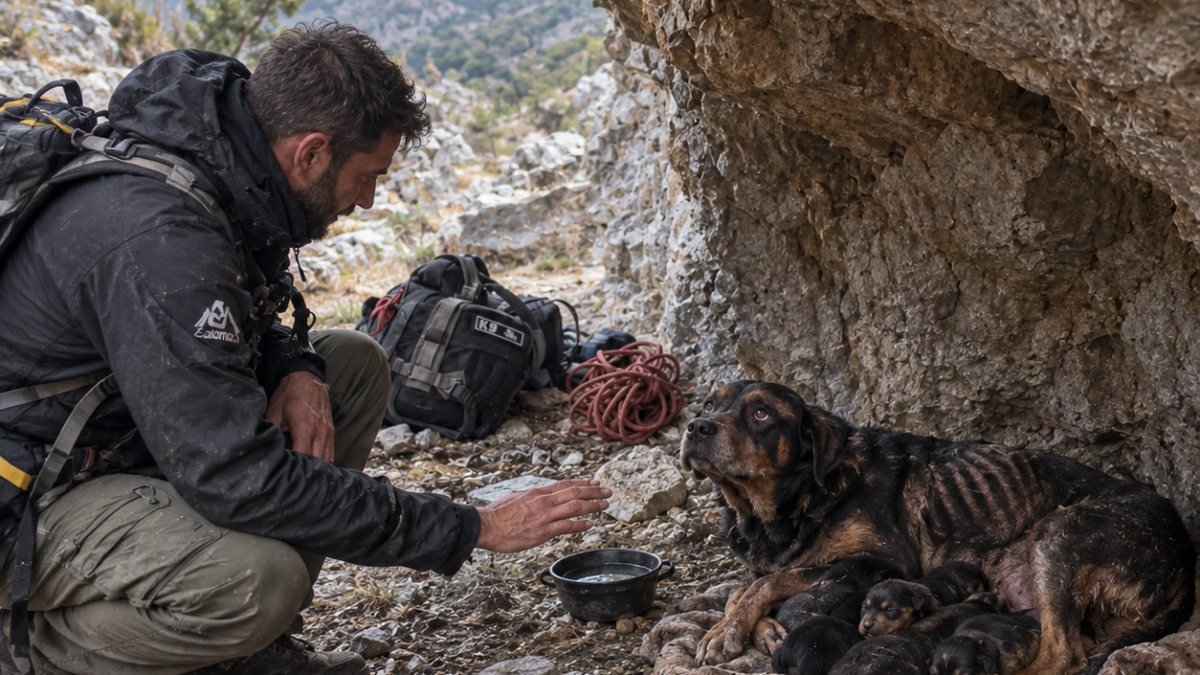
I stopped about eight feet from the opening.
Marcus came up behind me, breathing hard from the climb, and nearly walked into my back.
“What?”
I lifted one hand.
“Don’t come closer yet.”
Then he saw her.
For several seconds, neither of us spoke.
Della and Riley stood behind us with their handlers’ lines held short, both dogs alert but quiet.
The mother dog was tucked deep into the stone hollow with her body curved around the puppies.
She had chosen the place well.
The rock blocked most of the wind.
Dry leaves had collected beneath an overhang and formed a thin layer between her and the cold ground.
It was not comfortable.
It was not safe enough for newborns.
But compared with whatever she had escaped, she had decided this was better.
That realization sat heavily in my chest.
“Five?” Marcus whispered.
“Five.”
“All alive?”
“I can see all of them moving.”
The mother dog watched every movement we made.
Her ears were pinned.
Her chest rose too quickly.
She looked ready to spend the last strength in her body keeping us away.
I knew that look.
Not aggression.
Calculation.
She was deciding what danger cost less.
Stay.
Fight.
Run.
Trust.
A dog in that condition should never have been forced to make one more difficult decision.
I lowered myself onto one knee.
“Hey, sweetheart.”
Her head came up another inch.
“That’s all right.”
I kept my hands where she could see them.
“We’re not going to take them from you.”
Marcus slowly set his pack on the ground.
He did not unzip it yet.
No sudden sounds.
No unnecessary movement.
The rescue dogs remained behind the rocks.
For the next few minutes, we did almost nothing.
People often imagine rescue as action.
Running.
Lifting.
Cutting.
Carrying.
Sometimes rescue begins by proving you are willing to wait.
The mother dog needed to see that we were not going to crowd her.
So I stayed where I was and talked softly.
Not because I believed she understood every word.
Because tone matters.
Rhythm matters.
Predictability matters.
“My name is Caleb.”
Her eyes stayed on me.
“This is Marcus.”
One of the puppies squeaked.
Immediately, she curled tighter around them.
“Yeah.”
I nodded.
“They’re yours.”
Her breathing remained fast.
“We know.”
The mother lowered her head, but she did not close her eyes.
Marcus whispered, “She’s done.”
I knew what he meant.
Not dead.
Not surrendering.
Used up.
Her body had done something extraordinary in the worst possible conditions.
She had escaped a property while heavily pregnant.
Dug beneath a fence.
Crossed uneven mountain terrain.
Found shelter.
Gone into labor alone.
Delivered five puppies.
Kept all five warm through a cold mountain morning.
And she had done it while already thin enough for her hip bones to show.
There is only so much a body can give before the bill comes due.
“We need to get fluids into her,” I said.
Marcus nodded.
“And calories.”
“Slowly.”
He opened the side pocket of his pack and removed a collapsible water bowl.
The sound of the zipper made the dog stiffen.
I stopped talking.
Waited.
Her eyes went from Marcus to me.
Then back.
“No problem.”
I stayed low.
Marcus poured only a small amount of water into the bowl.
He set it on the ground and slid it toward me.
I pushed it forward several inches.
The mother smelled it immediately.
Her nose lifted.
But she did not move.
“Come on.”
Nothing.
I slid it another inch.
She looked down at the puppies.
Then at the water.
Hunger and thirst can fight motherhood in ugly ways.
A nursing mother knows, on instinct, that leaving her babies exposed is dangerous.
Even moving twelve inches can feel impossible if she believes something might take them.
So I stopped pushing the bowl.
Instead, I dipped my fingers into the water.
Held my hand out.
A drop fell from my fingertips onto the rock.
The mother watched it.
I waited.
Then she moved her head forward.
One inch.
Two.
She sniffed.
My hand stayed still.
Her nose touched my wet fingers.
Then her tongue came out.
One lick.
Another.
Marcus exhaled softly behind me.
I dipped my fingers again.
Three more licks.
Then I moved the bowl close enough for her to reach without shifting her body away from the puppies.
She drank.
Too quickly at first.
I gently pulled the bowl away after several seconds.
Her eyes lifted sharply.
“I know.”
I waited.
Then offered more.
Little by little.
No vomiting.
No panic.
Just water.
When she finished the second small amount, she lowered her head.
Her body trembled.
That was when I noticed how much blood had dried around her hind legs.
Not an alarming amount for delivery.
But enough to remind me we had no idea when the last puppy had been born.
No idea whether there was another puppy still inside.
No idea whether she had retained placental tissue.
No idea if she was running a fever.
No idea whether any of the newborns had nursed adequately.
We needed a veterinarian.
And we were hours from the rescue center by foot.
I radioed our base.
“This is Caleb.”
Static.
Then Joanne answered.
“Go ahead.”
“We found her.”
The entire tone on the radio changed.
“Alive?”
“Yes.”
Pause.
“Puppies?”
“Five visible, all alive.”
Someone in the background cheered.
I heard it faintly through the radio.
Joanne came back.
“Condition?”
“Mom is severely exhausted, underweight, dehydrated. Puppies appear newborn, likely delivered overnight or early morning.”
“Location?”
I gave coordinates.
“We need a veterinary transport team to meet us at the lower trailhead.”
“Copy.”
“And notify animal control.”
Another pause.
“The property?”
“Yes.”
“Got it.”
I clipped the radio back.
Marcus had opened a thermal blanket.
The mother dog flinched when it unfolded.
We froze.
Then I rolled it instead of shaking it and placed it beside me.
“She needs a name,” Marcus whispered.
I gave him a look.
“Not now.”
“We’ve been calling her ‘mom’ for twenty minutes.”
“She probably doesn’t care.”
“I care.”
One of the puppies squeaked again.
The mother lowered her head and licked it.
Marcus smiled sadly.
“What about Hope?”
“No.”
“Why?”
“Too obvious.”
He thought.
“Scout?”
“She didn’t scout anything.”
“She literally escaped into mountains.”
“Still no.”
Marcus glanced at her brindle coat.
“Willow.”
That made me pause.
The dog looked delicate in that moment despite everything she had survived.
Bent but not broken.
Rooted to the puppies beneath her.
“Willow,” I repeated.
Her ears twitched.
Marcus grinned.
“She likes it.”
“She moved an ear.”
“Confirmation.”
Fine.
Willow.
Temporary names have a way of becoming real if you say them with care long enough.
I tried it.
“Willow.”
Her eyes lifted.
There was no recognition.
Of course not.
But something about giving her a name changed the way the scene felt.
She was no longer only the pregnant dog from Elena’s story.
She was Willow.
A mother.
An individual.
A life with a future we were trying to reach.
“We have to check the puppies,” Marcus said.
“I know.”
“How?”
“Slowly.”
He looked at Willow.
“She may not let us.”
“Then we earn it.”
I inched closer.
Willow tensed.
Stopped.
I waited.
Another inch.
Waited.
She stared at my face.
“Good girl.”
Another inch.
I was now close enough to smell her.
Cold earth.
Milk.
Dirty fur.
The metallic scent of recent birth.
Fear.
Dogs do not literally smell like fear to a human nose in some poetic way.
But you can feel fear around an animal.
In the muscle tension.
The shallow breaths.
The eyes that never leave your hands.
I reached toward her, then stopped before touching.
Willow sniffed.
My fingers were six inches from her muzzle.
Four.
Two.
She extended her nose.
Touched me.
Then pulled back.
I left my hand there.
She sniffed again.
This time longer.
Then something changed.
Only slightly.
Her forehead lowered until it rested against my palm.
I stopped breathing.
Marcus did too.
Willow closed her eyes.
One second.
Two.
Three.
She did not collapse.
She did not suddenly trust humanity.
She simply allowed the weight of her head to rest somewhere other than the ground.
That was enough.
“You’re okay,” I whispered.
Her eyes remained closed.
“Just for a minute.”
I stroked the side of her face once.
Slow.
No reaction.
Again.
Her breathing eased.
That gave us the first opening.
Marcus moved around the opposite side, staying far enough back not to trap her.
We could see the puppies more clearly now.
Five.
Two brindle.
One mostly black.
One tan with a white chest.
One tiny gray female pressed beneath Willow’s front leg.
Their umbilical cords were fresh.
Eyes sealed.
Ears folded.
No more than several hours old.
I touched the closest puppy with one finger.
Warm.
Moving.
Good.
Willow opened one eye.
“I’m not taking him.”
I gently lifted the puppy just enough to check breathing and color.
Then immediately placed him back against her.
Willow licked him.
I checked the second.
The third.
The fourth.
The gray female worried me.
Smaller than the others.
Less active.
Her body was warm because she had been tucked beneath Willow, but her movements were weak.
“She needs attention,” I said.
Marcus leaned closer.
“She breathing okay?”
“Yes, but shallow.”
I looked at Willow.
“This one needs us.”
Of course she could not understand.
But again, tone.
Slow movement.
Predictability.
I lifted the gray puppy in both hands.
Willow’s head rose immediately.
I held the puppy close to her nose.
She sniffed frantically.
“I know.”
Marcus opened a fleece-lined pouch from our neonatal kit.
I rubbed the puppy gently with a towel.
No fluid obstruction.
No obvious injury.
Just weak.
Possibly not nursing enough.
I returned her to Willow and helped guide her toward a nipple.
The puppy searched.
Missed.
Searched again.
Then latched.
I smiled.
“There.”
Willow looked at my hand.
Then down at the baby.
Something in her body softened.
Maybe she understood we were helping.
Maybe she was simply too tired to resist.
Either way, she allowed me to stay.
We were on that mountain another hour before we moved anyone.
I gave Willow small amounts of water.
A few bites of high-calorie wet food from our emergency kit.
Marcus created a better nest using leaves beneath a thermal blanket.
The puppies nursed.
Willow dozed in tiny fragments, waking every time one of us shifted.
At one point, Della whined from behind the rocks.
Willow’s eyes snapped open.
“Dogs,” Marcus said.
“We need to move them farther back.”
I radioed the handlers.
They withdrew another fifty yards.
Willow settled.
She was not ready for strangers.
Not canine ones.
Probably not human ones either.
We were simply the least frightening option available.
When the veterinary transport team confirmed they were waiting below, we faced the difficult part.
Getting six animals off the mountain.
The puppies could not make that trip exposed.
Willow could probably walk some of it, but asking her to hike several miles after giving birth would be cruel and potentially dangerous.
We had brought an emergency carry sling, but she was too weak and protective for us to strap her in while the puppies were separate.
So we improvised.
Marcus emptied the largest hard-bottom rescue pack.
We lined it with fleece and chemical warmers wrapped beneath several layers so there would be no direct heat against the puppies.
One by one, I transferred them.
Willow watched every movement.
The black puppy first.
Then the tan.
The two brindles.
Finally the tiny gray female.
Every time I lifted one, I brought the puppy past Willow’s nose first.
She smelled them.
Watched.
Counted in her own way.
When all five were in the carrier, Willow tried to stand.
Her legs buckled.
I caught her under the chest.
She made a frightened sound.
Not at me.
At her own body.
That hurt worse.
“It’s okay.”
Marcus moved beside us.
“We can carry her.”
“Not without the puppies visible.”
We placed the puppy carrier directly in front of the sling.
Willow sniffed it.
Five small bodies squirmed inside.
Then she allowed us to slide the fabric beneath her.
Even with her weight loss, she was not light.
Maybe forty-five pounds.
Should have been closer to sixty.
Marcus took the rear handles.
I took the front.
The puppy carrier was secured against my chest.
We started down.
Slowly.
Very slowly.
I have carried injured animals out of ravines.
Dogs hit by cars.
A goat trapped in a drainage ditch.
Once, an eighty-pound hound with a fractured pelvis.
Nothing felt as heavy as Willow.
Not because of the weight.
Because she watched me.
Every time the carrier shifted and a puppy squeaked, her eyes moved toward my chest.
Every time I stumbled, her muscles tightened.
She had trusted us just enough to let us carry everything she had.
I refused to betray that.
The rocks were slick.
Twice Marcus called for a stop.
Once I nearly went to one knee.
Willow’s eyes widened.
“I’ve got you.”
I regained balance.
“You hear me?”
She rested her head against the edge of the sling.
“I’ve got you.”
The phrase became a rhythm.
Step.
“I’ve got you.”
Rock.
“I’ve got you.”
Downhill turn.
“I’ve got you.”
At some point, Willow stopped trembling.
Her eyes closed.
She actually slept while we carried her.
Only for a few minutes.
But she slept.
That may have been the first moment I understood what the rescue meant to her.
Not freedom yet.
Not home.
Relief from having to make every decision alone.
By late afternoon, we reached the bottom.
Elena was waiting near the fence.
She had spent the entire day there.
I saw her before she saw us.
Standing near her car.
Hands clasped beneath her chin.
Pacing.
Then Della’s handler came out of the tree line ahead of us.
Elena looked up.
Saw the dogs.
Saw Marcus.
Then saw me carrying the front of Willow’s sling.
Her hands flew to her mouth.
She ran three steps.
Stopped herself.
Good instinct.
Willow was awake again.
She noticed Elena.
Her body stiffened.
Elena froze.
“Is she—”
“She’s alive.”
Elena started crying.
“And the babies?”
“All five.”
Her knees seemed to weaken.
Marcus lowered his side of the sling carefully.
We set Willow down near the veterinary van.
The puppy carrier remained against me.
Elena crouched ten feet away.
She did not reach.
Did not call.
Did not try to turn the moment into forgiveness she had not earned yet.
She only looked.
“Oh, honey.”
Willow stared at her.
No wag.
No obvious recognition.
Then Elena whispered, “I’m sorry.”
The words were barely audible.
“I’m so sorry I waited.”
Willow lowered her head.
Elena cried harder.
“I should’ve helped you sooner.”
I put one hand on Elena’s shoulder.
She looked up at me.
“If I had called months ago—”
“You called today.”
“That’s not the same.”
“No.”
I was not going to lie to make guilt disappear.
She had waited.
That mattered.
But so did what she did after deciding not to wait anymore.
“Elena, listen to me.”
She tried to stop crying.
“You gave us the direction.”
She nodded.
“You showed us the tunnel.”
Another nod.
“You told us what you heard.”
Her eyes dropped.
“If you hadn’t come in this morning, we wouldn’t have known she was out there.”
“I was afraid.”
“I know.”
“I hate that I was afraid.”
“Use it.”
She looked at me.
“Next time fear tells you to wait, remember today.”
Her mouth trembled.
Then she nodded.
“Okay.”
“You helped find her.”
She looked at Willow.
“Does she know?”
“Probably not the way you mean.”
That hurt her.
Good truths sometimes do.
“But she’s alive.”
I glanced at the carrier.
“So are they.”
The veterinarian waiting in the van was Dr. Hannah Lee.
She examined Willow on a padded platform before transport.
Temperature slightly low.
Heart rate elevated.
Dehydrated.
Severely underweight.
Some abrasions along her stomach and shoulders from digging beneath the fence and traveling through rough terrain.
Paws scraped.
No serious external injuries.
Her postpartum bleeding was within normal limits.
But Dr. Lee was concerned about infection and whether all placentas had passed.
The puppies were examined one by one.
Four were strong.
The little gray female was weak but stable.
“Are they going to make it?” Elena asked.
Dr. Lee gave the answer good veterinarians always give when people want certainty too soon.
“They have a chance.”
Elena nodded.
That was enough for now.
Willow was loaded into the van with the puppies beside her.
I expected to close the door and follow in our truck.
Willow lifted her head when I stepped back.
Then she tried to stand.
Dr. Lee put a hand near her.
“Easy.”
Willow ignored her.
Her eyes stayed on me.
I moved closer.
She stopped trying to rise.
Marcus grinned.
“Oh, you’re going.”
“I’m not riding in the veterinary van.”
Willow whined.
Marcus raised both eyebrows.
I looked at Dr. Lee.
“Is there room?”
She smiled.
“Barely.”
I climbed in.
Willow put her head on my boot.
Marcus shut the door.
Through the window, I saw him laughing.
I gave him a gesture I will not document.
The rescue clinic was forty-five minutes away.
Willow slept nearly the entire drive.
The puppies were kept warm in a nesting crate beside her.
Every few minutes, one squeaked.
Her ear moved.
That was all.
She knew they were there.
For once, she allowed herself to rest.
At the clinic, tests confirmed what we already suspected.
Willow had been underfed for a long time.
Not days.
Longer.
Her body condition was poor before pregnancy.
Her bloodwork showed anemia.
She had intestinal parasites.
Her paws had minor cuts.
She needed fluids, antibiotics, nutritional support, and close monitoring.
But there was no retained puppy.
No emergency surgery.
No major internal injury.
The puppies, considering everything, were astonishingly healthy.
The little gray female needed supplemental feeding.
We named her Cricket because she was tiny and noisy once she discovered her voice.
Marcus chose that one.
I approved.
The others eventually became Jasper, Blue, Rosie, and Finn.
Those were foster names.
At least, that was what we told ourselves.
Willow remained Willow.
The name fit too well to change.
Animal control opened the investigation that afternoon.
The facts were complicated only in paperwork.
Morally, they were simple.
Willow’s owner, a man named Travis Keene, admitted she was his.
He initially reported that she had “run away.”
When asked why he had not reported her missing, he said he assumed she would return.
When investigators photographed the property, they found the enclosure Elena described.
Little shelter.
Dirty water container.
Sparse food.
Evidence consistent with long periods outdoors.
Willow’s escape tunnel beneath the fence.
Keene denied mistreatment.
Elena eventually gave a formal statement.
Then another neighbor did too.
And another.
Fear has a strange pattern.
One person speaks.
Then someone else realizes they were not the only witness.
Then silence begins collapsing.
The case moved through the legal system over the next several months.
I was not part of every detail.
My job was Willow.
That was enough.
For the first week at the rescue clinic, she slept as though she had been saving sleep for years.
She woke to nurse.
Eat.
Drink.
Check every puppy.
Then sleep again.
The first forty-eight hours, she panicked whenever a staff member removed a puppy for weighing.
Not aggressive.
But immediate.
Head up.
Body tense.
Whining.
So we changed the routine.
Willow came with them.
Puppies were weighed beside her bed.
If we needed to examine one more closely, she could watch.
Trust is easier when nothing disappears behind a closed door.
Cricket worried us most.
She struggled to gain weight.
Willow had milk, but not enough for five growing puppies while rebuilding her own starved body.
We supplemented everyone.
Cricket required extra bottle feeding around the clock.
At two in the morning, she screamed like an animal five times her size.
Marcus took one overnight shift.
The next morning, he walked into the office looking destroyed.
“She hates me.”
“She’s three days old.”
“She rejected the bottle twice.”
“You’re taking it personally?”
“She looked judgmental.”
“Her eyes aren’t open.”
“Exactly.”
Cricket survived.
More than survived.
She became ridiculous.
By three weeks, she was still the smallest but absolutely convinced the other puppies should respect her authority.
Rosie was gentle.
Finn ate constantly.
Blue liked sleeping upside down.
Jasper discovered human shoelaces before he could reliably walk straight.
Willow watched all of it.
And little by little, we watched Willow return.
Not to the dog she had been.
We did not know that dog.
To the dog she might have been if she had ever felt safe.
Her coat improved.
Ribs disappeared beneath healthy weight.
Her eyes became brighter.
At first, she stayed pressed against the back wall of the maternity room.
Even when puppies spread across the bedding, she kept one side of her body touching something solid.
Wall.
Cabinet.
Corner.
Safety, to Willow, still meant knowing nothing could approach from behind.
Then one afternoon, I came in and found her sleeping in the middle of the room.
Flat on her side.
Legs stretched.
No wall.
Five puppies scattered around her like someone had dropped them from a basket.
I stopped in the doorway.
Willow opened one eye.
Her tail tapped the floor.
That image hit me harder than the mountain rescue.
A dog sleeping in the center of a room should not be extraordinary.
For Willow, it was.
She had begun to believe danger did not require a wall.
Elena visited almost every day.
The first few times, Willow showed no special interest.
Elena sat quietly near the doorway.
Brought blankets.
Puppy pads.
Food from our approved list.
Never reached unless Willow approached.
That mattered.
Elena’s guilt made her want to do something dramatic.
To apologize in a way Willow could understand.
There was no such gesture.
So I told her, “Be boring.”
She stared at me.
“What?”
“Sit.”
“Read.”
“Bring food.”
“Leave when she’s tired.”
“Come back tomorrow.”
“That’s it?”
“That’s trust.”
She did.
For two weeks, Elena sat on the floor and read paperback novels.
Willow ignored her.
Then one morning, Elena arrived with a blanket.
She placed it near the door.
Sat down.
Opened her book.
Willow stood.
Walked across the room.
Sniffed Elena’s sleeve.
Elena did not move.
Willow sniffed her hand.
Then returned to the puppies.
Elena cried silently for ten minutes.
The next visit, Willow stayed beside her for almost a minute.
By the end of the month, Elena could scratch beneath her chin.
Guilt did not disappear.
But it became responsibility instead of punishment.
That was healthier.
For both of them.
When the puppies were four weeks old, Elena brought her aunt.
Her name was Ruth Parker.
Seventy-one.
Widowed.
Small woman with white hair cut neatly around her face and a voice so calm that even the puppies seemed to lower their volume when she spoke.
Ruth stood at the maternity room window for several minutes.
She did not say much.
Then she watched Willow guide Cricket away from the edge of the pen.
Willow nudged the tiny puppy once.
Cricket ignored her.
Willow nudged again.
Cricket turned around dramatically.
Ruth smiled.
“She’s patient.”
“More than she should have had to be,” Elena said.
Ruth looked at her niece.
There was history in that glance.
Not judgment.
Knowledge.
Then she asked me, “Willow will be adopted separately from all the puppies?”
“Possibly.”
“Is that better?”
“Depends on the dog.”
“We evaluate each relationship.”
“Some mothers are ready for independence once pups are weaned.”
“Some benefit from staying with one.”
Ruth nodded.
“Which is Willow?”
“Too early to know.”
She turned back toward the room.
Cricket had climbed onto Willow’s neck and fallen asleep.
Ruth laughed softly.
“That little one?”
“Cricket.”
“She’s trouble.”
“Absolutely.”
Ruth visited again.
Then again.
She told no one she was considering adoption.
Not at first.
She simply came.
Sat.
Met Willow.
Helped socialize puppies under supervision.
Asked intelligent questions.
Fenced yard?
Yes.
One-story home?
Yes.
Other animals?
No.
Hours alone?
Very few.
Veterinary reference?
Excellent.
Previous dogs?
Three, all lived into old age.
The last, a collie named Ben, had died two years earlier.
“I said I was done,” Ruth told me.
“Why?”
She shrugged.
“Because goodbye hurts.”
“That’s a common reason.”
“Is it a good one?”
I looked through the glass at Willow.
“No.”
Ruth smiled.
“I didn’t think so.”
She applied to adopt Willow.
Then surprised us by adding one puppy.
Cricket.
I expected that.
So did Marcus.
“What about the others?” Elena asked.
“They’ll have homes,” I said.
Applications had already begun.
“You sure?”
“Yes.”
“Good ones?”
“We reject more than we approve.”
That made her smile.
“Good.”
Blue went to a young couple with an older Labrador.
Jasper went to a teacher and her teenage son.
Rosie was adopted by a family whose previous dog had died the year before.
Finn went to a retired paramedic with a fenced property and an embarrassing number of dog toys.
All four adoptions happened after eight weeks and full veterinary clearance.
Cricket stayed longer because of her small size.
That meant Willow did too.
No one minded.
Ruth certainly did not.
By ten weeks, Willow had mostly weaned the puppies.
She played.
That surprised me.
I had never seen it until one afternoon when Marcus rolled a soft blue ball across the room.
Willow watched it.
The ball stopped near her paw.
She sniffed.
Pushed it.
It rolled.
She jumped backward.
Marcus laughed.
Willow looked at him.
Then pounced on the ball.
I stared.
She pounced again.
Tail up.
Front legs down.
A play bow.
The puppies went wild.
Cricket tackled Willow’s ear.
Willow flopped onto her side and let the tiny dog climb across her face.
Elena stood outside the gate watching.
Her eyes filled.
“She never did that over there.”
I did not need to ask what she meant.
At Keene’s property.
“She probably couldn’t.”
Elena wiped her face.
“I hate that.”
“I know.”
Willow chased the ball again.
“But that’s not where she lives anymore.”
Elena watched.
“No.”
“That matters.”
“Yes.”
Adoption day came in early spring.
Sunlight.
Blue sky.
The kind of day people think rescue stories should end on.
But endings are mostly beginnings wearing nicer clothes.
Ruth arrived with two harnesses.
One adult.
One absurdly small.
A crate in her SUV.
Seatbelt attachments.
Two beds at home.
Food already purchased.
Veterinary appointment scheduled.
Baby gates installed.
Fence inspected.
She was more prepared than most new parents.
Cricket greeted Ruth like they had known each other for years.
Willow was more careful.
She walked to the open shelter door.
Stopped.
Looked outside.
Then back at me.
Doorways still meant decisions.
I crouched.
“Go ahead.”
Willow looked toward Ruth.
Cricket was already beside her.
Ruth did not pull the leash.
Did not call repeatedly.
She waited.
That was the right answer.
Willow took one step.
Then another.
Outside.
Sun hit her coat.
She sniffed the air.
Cricket bounced around her legs like a windup toy.
Elena stood near the parking lot crying openly.
Willow noticed her.
Walked over.
Elena crouched.
“You made it.”
Willow sniffed her face.
Elena laughed through tears.
“You really made it.”
Then Willow did something Elena had not expected.
She leaned her shoulder into Elena’s chest.
Not dramatic.
Not forgiveness declared in a movie.
A dog simply choosing contact.
Elena wrapped one arm around her carefully.
“I’m sorry.”
Willow licked her chin.
Elena broke completely.
Ruth waited several feet away.
When Willow stepped back, Elena whispered, “Go.”
The dog looked at her.
“Go have everything.”
Willow walked toward Ruth.
Cricket followed.
Before climbing into the SUV, Willow came back to me.
She pressed her forehead against my knee.
Exactly the way she had rested her head in my palm on the mountain.
I put both hands along her face.
“You don’t need us anymore.”
Her tail moved.
“That’s the point.”
Marcus stood beside the door.
“Technically, we have follow-up inspections.”
“Don’t ruin it.”
“I’m just accurate.”
Willow turned.
Ruth helped her into the car.
Cricket immediately climbed on top of the larger dog despite having an entire seat.
Of course.
The vehicle pulled away.
Elena cried.
Marcus cleared his throat.
I pretended the wind bothered my eyes.
That should have been the end.
It was not.
Rescue stories rarely stop at adoption paperwork.
The first week in Ruth’s house was difficult.
Willow would not sleep deeply.
She paced after dark.
Every sudden vehicle sound sent her toward the back door.
She refused to eat unless Cricket was nearby.
She startled when Ruth carried a broom through the kitchen.
The first time a delivery driver knocked loudly, Willow hid behind the sofa and trembled.
Ruth called me.
Not because she wanted to return her.
Because she wanted to understand.
“What do I do?”
“Nothing right now.”
“Nothing?”
“Sit near her.”
“Don’t reach into the hiding place.”
“Let her decide when to come out.”
Ruth sat on the floor for forty minutes.
Cricket crawled beneath the coffee table.
Willow eventually followed her out.
Ruth did not celebrate.
Did not grab.
She went back to reading.
That was perfect.
Healing is often ruined by people demanding proof it is happening.
Ruth never demanded proof.
She built routine.
Breakfast at seven.
Garden at seven-thirty.
Short walk at nine.
Cricket nap.
Willow nap.
Lunch.
Another garden break.
Ruth’s afternoon tea.
Dinner.
Quiet evening.
Same doors.
Same bowls.
Same bed.
Same voice.
Predictability became medicine.
Within a month, Willow slept through most nights.
Within two, she stopped flinching when Ruth lifted ordinary household objects.
Within three, she discovered the couch.
That became a problem.
Apparently freedom includes ignoring furniture rules.
Ruth sent a photo.
Willow sprawled across the entire sofa.
Cricket asleep on her stomach.
The message read:
I believe I have lost ownership of the living room.
I replied:
Correct.
Summer came.
Ruth invited us to visit.
Marcus refused at first because he claimed visiting adopted animals made him “emotionally inefficient.”
He came anyway.
Elena came too.
Ruth’s home sat on a quiet country road outside Asheville.
A modest white house.
Large fenced garden.
Vegetable beds.
Flowers.
One huge maple tree in the center.
Beneath it lay a thick outdoor dog bed.
Willow was asleep in the sun.
For a second, I barely recognized her.
She was not thin.
Not trembling.
Not curled around puppies in a rock hollow.
Her brindle coat shone.
Muscles filled her legs.
Her body looked solid and healthy.
Cricket, now nearly grown, lay with her head draped across Willow’s back.
I closed the gate behind me.
Willow’s head came up.
She stared.
Then she ran.
Not trotted.
Ran.
Straight toward me.
I barely had time to kneel.
She hit me in the chest with enough enthusiasm to nearly knock me over.
I laughed.
“Okay!”
Her tail whipped back and forth.
She licked my cheek.
Then Marcus.
Then went to Elena.
Elena dropped to her knees.
Willow pressed into her.
No hesitation.
Ruth came out of the house carrying iced tea.
“She does that now.”
“What?”
“Runs toward people.”
Elena looked at her.
“Everyone?”
“Most people.”
Ruth smiled.
“Not the mailman.”
“Reasonable,” Marcus said.
Cricket arrived and attempted to eat my shoelace.
Some things remain consistent.
We spent the afternoon beneath the maple.
Ruth told us Willow had developed routines.
At six every morning, she placed her head on Ruth’s mattress.
If ignored, she added one paw.
If still ignored, Cricket joined the operation.
Together they were unstoppable.
Willow loved sitting in the garden.
Hated thunderstorms.
Preferred chicken to beef.
Snored.
Stole Ruth’s spot in bed during winter.
Had learned to chase a ball but still seemed surprised when it moved.
Cricket was loud, fearless, and convinced every visitor existed specifically to admire her.
“They’re happy,” Ruth said.
Simple words.
The kind people use too casually.
But I looked at Willow asleep at my feet and understood how enormous happy could be.
Elena stared across the yard.
“I thought she was going to die.”
Ruth touched her arm.
“She didn’t.”
“I waited too long.”
“You did.”
Elena looked at her aunt.
Ruth did not soften the truth.
Then she added, “And then you stopped waiting.”
Elena nodded.
That became important later.
She began volunteering with us.
Not dramatically.
One shift a week.
Then two.
She helped answer cruelty reports.
Transport animals.
Organize supplies.
She became particularly good at talking to frightened witnesses.
People who said the things she once said.
I’m afraid.
I don’t want trouble.
Maybe I’m misunderstanding.
What if no one believes me?
Elena never shamed them.
She told them, “You can be afraid and still make the call.”
That sentence helped more animals than I can count.
The legal case against Keene took nearly a year.
Witness statements.
Veterinary records.
Property photographs.
Evidence.
Negotiation.
He eventually pleaded guilty to animal cruelty-related charges and was prohibited from owning animals for a period under the court order.
People asked whether the punishment was enough.
I never knew how to answer that question cleanly.
Nothing makes suffering mathematically fair.
No fine gives Willow back the time before she escaped.
No court order erases fear.
Justice in animal cruelty cases often feels smaller than the harm that created the case.
But prevention matters.
Documentation matters.
Having multiple neighbors speak after one person finally did matters.
And Willow was not going back.
That mattered most.
Ruth attended one hearing.
Not because she needed to.
Because she wanted to see the door close.
Afterward she called me.
“It’s over.”
“For now.”
“No.”
She corrected me.
“For her, it’s over.”
I liked that better.
Years passed.
We stayed in touch.
Cricket grew into a compact, muscular little dog with a white patch on her chest and the confidence of a much larger animal.
Willow became calmer each year.
Not fearless.
There is a difference.
She still disliked angry voices.
She still moved away if someone stood over her too suddenly.
Fireworks required medication and a quiet room.
Thunderstorms sent her searching for Ruth.
But fear no longer organized her entire life.
She could be afraid and recover.
That is one of the clearest signs of healing I know.
Not never reacting.
Coming back.
Willow came back faster and faster.
At four years in her new home, Ruth sent me a video during a storm.
Thunder cracked in the distance.
Willow lifted her head from the couch.
Cricket looked toward the window.
Willow stood.
Walked to Ruth.
Pressed against her leg.
Ruth scratched her chest.
Thirty seconds later, Willow returned to the couch.
No hiding.
No hours of shaking.
Only fear arriving, being noticed, and leaving.
I watched that video several times.
Sometimes progress is thirty seconds long.
The other puppies did well too.
Jasper grew into a large brindle dog who loved children.
Blue became inseparable from the older Labrador in his home.
Rosie slept in her family’s teenage daughter’s bed every night.
Finn gained the unfortunate habit of stealing kitchen towels.
We received birthday photos.
Holiday photos.
Bad Halloween costumes.
Graduation pictures where a grown dog sat beside the child who had once been small enough to carry him.
Five puppies who had started life inside a cold mountain hollow became ordinary family dogs.
Again, ordinary was the miracle.
Willow saw Rosie once at a rescue fundraiser.
The two sniffed politely.
Played for five minutes.
Then Willow returned to Ruth.
Humans wanted the reunion to mean something enormous.
Dogs are better than that.
Willow had loved and protected her puppies when they needed her.
They grew.
They moved on.
So did she.
Motherhood was part of her story.
It was not the only thing she was allowed to become.
Ruth understood that.
She stopped introducing Willow as “the dog who escaped abuse.”
When people asked about her, Ruth said, “This is Willow.”
Sometimes that was all.
I loved her for it.
Animals deserve identities larger than the worst thing that happened to them.
Willow became the dog who stole toast.
The dog who dug holes beneath the maple even though she already had a perfectly good bed.
The dog who hated baths but loved garden hoses.
The dog who slept upside down.
The dog who barked at one particular ceramic frog Ruth kept near the porch.
The dog who refused to walk around puddles but happily rolled in mud.
The dog who had survived, yes.
But mostly, the dog who lived.
When Willow was around eight, Ruth’s health began to decline.
Nothing dramatic at first.
Hip pain.
Then surgery.
Then recovery that took longer than expected.
For the first time since adoption, Ruth needed help more than Willow did.
Cricket adapted quickly.
Willow struggled.
Ruth used a walker.
The sound of metal legs against the floor frightened Willow initially.
She kept her distance.
Ruth never forced it.
Day one, Willow watched from the hallway.
Day two, she sniffed the walker when it was parked.
Day three, Ruth sat beside it and fed her chicken.
By the end of the week, Willow walked beside the walker.
Slowly.
Carefully.
On bad days, Ruth rested one hand lightly on Willow’s back while moving from the bedroom to the kitchen.
Not using the dog for support.
Using her for courage.
I visited during that period.
Ruth sat beneath the maple with a cane beside her chair.
Willow lay at her feet.
Cricket, older now too, slept in the grass.
“She’s taking care of me,” Ruth said.
I smiled.
“You took turns.”
Ruth looked down.
“I suppose we did.”
Willow lifted her head at Ruth’s voice.
Tail moved.
“Do you ever think about the mountain?” I asked.
Ruth took a long time before answering.
“I think she does when she dreams.”
“What makes you say that?”
“Sometimes she runs in her sleep.”
I looked at Willow.
“Maybe she’s chasing squirrels.”
“Maybe.”
Ruth smiled.
“I hope so.”
That was the right hope.
Not that Willow forgot.
That memory had become ordinary enough to share space with squirrels.
Ruth recovered.
Slowly.
Willow aged.
So did Cricket.
The little puppy we had once worried might not survive reached nine years old with almost no concept of caution.
Cricket went first.
Cancer.
Fast-moving.
By the time it was found, there was little meaningful treatment to offer.
Ruth called me.
“I don’t know what this will do to Willow.”
I drove out.
Willow stayed near Cricket’s bed for two days.
When the veterinarian came to the house, Ruth allowed Willow to remain in the room.
No forced separation.
No sudden disappearance.
Cricket died with Ruth’s hand on her and Willow lying close enough that their paws touched.
Afterward, Willow sniffed Cricket’s body.
Stayed for several minutes.
Then walked into the garden.
She searched the next morning.
Not frantically.
But she checked Cricket’s bed.
The couch.
The porch.
The maple.
Ruth left Cricket’s blanket in place.
Willow slept on it for weeks.
Grief changed her.
She became quieter.
Stayed closer to Ruth.
Stopped running to the gate as quickly.
But she did not collapse.
That mattered.
The dog who once believed survival required escaping alone had learned another truth.
You can lose someone and remain loved.
Ruth grieved with her.
They moved through it together.
A year later, Ruth told me something I have never forgotten.
“Willow used to think safety meant keeping everyone she loved within reach.”
I looked at her.
“And now?”
“She knows safety can survive goodbye.”
That was one of the wisest things anyone had ever said to me about a dog.
Willow lived three more years.
Thirteen, maybe fourteen.
We never knew her exact age.
Her muzzle turned white.
Arthritis settled into her hips.
Walks shortened.
The garden became enough.
Ruth added ramps.
Non-slip rugs.
An orthopedic bed.
Pain medication.
Joint supplements.
The practical architecture of old love.
Elena came often.
By then she had volunteered with our rescue for years.
She had helped dozens of animals.
Made difficult calls.
Testified in two other neglect cases.
Fostered frightened dogs.
Never adopted one herself.
When I once asked why, she said, “I think my place is helping them reach someone else.”
Fair.
Willow always greeted Elena warmly.
That relationship had outgrown guilt long before either woman noticed.
One autumn afternoon, I visited Ruth and found Elena asleep in a chair on the porch.
Willow was sleeping beside her.
Ruth brought me coffee.
“They’ve forgiven each other,” she said.
I looked at her.
“Willow needed forgiving?”
Ruth smiled.
“No.”
“Elena did.”
I considered that.
“Did Willow forgive her?”
“Dogs don’t keep moral ledgers the way we do.”
“Then what happened?”
Ruth looked at the two sleeping figures.
“Elena finally stopped asking Willow to absolve her.”
That was probably true.
Guilt can become selfish if we demand the harmed person—or animal—make us feel clean.
Elena eventually accepted that Willow’s happy life was not a certificate declaring the past harmless.
It was simply the life Willow deserved.
Nothing more needed to be asked of her.
Willow’s last winter came quietly.
She slept more.
Ate less.
Stopped going to the far side of the garden.
The maple tree remained her favorite place whenever sunlight reached the grass.
Ruth called me in February.
“She had a bad night.”
“What happened?”
“She couldn’t get up.”
I drove there.
Willow was on her bed by the back window.
Blanket beneath her.
Ruth beside her.
Elena had already arrived.
Willow lifted her head when she saw me.
Her tail moved once.
That one movement brought the mountain back so fast I had to stop in the doorway.
The hollow.
The five puppies.
Her head resting in my palm.
“You remember me?”
Another tiny tail movement.
I knelt.
Her face was white now.
Eyes cloudy.
But still Willow.
I placed my hand in front of her nose.
She sniffed.
Then lowered her head into it.
Exactly like the first day.
Elena covered her mouth.
Ruth whispered, “She knows you.”
I could not answer.
The vet arrived around noon.
Kidney disease.
Advanced arthritis.
Other age-related problems.
There were treatments that might buy a little time.
Not good time.
Ruth asked the hardest question.
“Would treatment be for her or for me?”
The veterinarian paused.
“For you.”
Ruth nodded.
“Then no.”
It was that simple.
Not easy.
Simple.
Willow’s final day was warm for February.
Ruth asked if we could take her outside.
We carried her bed beneath the maple.
Sunlight touched her brindle coat.
Elena brought a blanket.
I sat in the grass.
Marcus came too.
He had left active field rescue years earlier but still volunteered sometimes.
He stood over Willow.
“Hi, mountain girl.”
Her ears moved.
“You know I named you.”
I looked at him.
“We both named her.”
“Historical revision.”
Ruth laughed.
Willow closed her eyes.
For a while we told stories.
Not about the cruelty case.
Not much.
About Willow stealing a roast from Ruth’s kitchen counter at age six.
About Cricket barking at a lawn statue for three summers.
About Willow running directly through wet paint during a porch repair.
About the time she escaped Ruth’s bedroom and climbed into a guest’s bed at four in the morning.
Ordinary stories.
The best kind.
Elena sat near Willow’s back.
At one point she whispered, “I’m glad I called.”
Willow breathed softly.
Elena continued.
“I wish I had called sooner.”
Ruth touched her knee.
“Both can be true.”
Elena nodded.
That was finally enough.
When the time came, Willow remained outside.
Ruth held her head.
I sat near her shoulders.
Elena touched one paw.
Marcus stayed a little farther back.
The veterinarian gave the first medication.
Willow relaxed.
Her breathing deepened.
Ruth whispered, “You don’t have to run anywhere.”
That sentence destroyed me.
Because running had saved Willow once.
Running had been courage.
Necessity.
Motherhood.
Fear.
Life.
But now?
Now she had nowhere left to escape.
She was already home.
Ruth kissed her forehead.
“You did enough.”
Willow’s eyes closed.
I touched the side of her face.
I thought about that cold mountain cavity.
Five newborn puppies tucked beneath her.
A body so tired it shook.
The moment her head finally settled into my palm.
“I’ve got you,” I whispered.
The same words from years earlier.
This time she did not need me to carry her down a mountain.
Only to stay.
Willow died beneath the maple tree.
Sun on her coat.
Ruth’s hands around her face.
No fence.
No owner shouting.
No cold rock.
No puppies depending on her body for warmth.
No need to protect anything.
Just rest.
Afterward, Elena sat in the grass for a long time.
Then she got up and walked to the edge of the yard.
I joined her.
“I thought this would feel like punishment,” she said.
“What?”
“Losing her.”
I waited.
“Like I would have to feel everything I failed to do all over again.”
“And?”
She looked back at Ruth beside Willow.
“It doesn’t.”
“What does it feel like?”
Elena cried.
“Like we were lucky she got all these years.”
I nodded.
“That sounds right.”
Willow was cremated.
Ruth kept her ashes beside Cricket’s.
Not displayed dramatically.
Two simple wooden boxes on a shelf beside a photograph of both dogs under the maple.
Weeks later, Elena brought something to our rescue office.
A small framed picture.
It had been taken during Willow’s first summer with Ruth.
Willow standing in the garden.
Healthy.
Mouth open.
Tail lifted.
Cricket beside her.
Flowers behind them.
Nothing about the image suggested what Willow had survived.
Elena placed it in our intake room.
I asked why there.
“People come in here scared,” she said.
“Like I was.”
She looked at the photograph.
“I want them to see what one phone call can lead to.”
Under the frame she placed a small card.
It did not say BE A HERO.
It did not say SPEAK UP OR YOU’RE GUILTY.
Elena chose something kinder.
It said:
YOU DON’T HAVE TO STOP BEING AFRAID BEFORE YOU DO THE RIGHT THING.
That card has helped more people than she knows.
The mountain hollow is still there.
I went back once.
Only once.
Not as a pilgrimage.
We had another search nearby, and I recognized the ridge.
When the call was finished, I walked to the rock opening.
It looked smaller than I remembered.
Most places from powerful memories do.
Leaves.
Stone.
Wind.
Nothing mystical.
No sign that five puppies had started their lives there.
No sign that Willow had lain in that shadow after dragging her pregnant body through miles of mountain terrain.
I stood outside for a few minutes.
Then left.
I did not need to preserve the place.
Willow’s life was not in that hollow.
The hollow was only where she refused to let the story end.
That distinction matters to me.
People hear Willow’s story and often focus on the escape.
The digging.
The mountains.
The five puppies.
They say she was brave.
She was.
They say a mother’s instinct is incredible.
It can be.
But when I remember Willow, I think just as often about what happened after.
The ordinary years.
That is where rescue becomes complete.
Anybody can understand the drama of a dog digging beneath a fence.
It is harder to appreciate the thousand quiet mornings afterward.
A full food bowl.
A safe yard.
A hand reaching without making her flinch.
A door opening that she did not need to escape through.
Sleeping in the center of a room.
Learning a ball was a toy.
Watching her puppies leave without believing they were being harmed.
Trusting that Ruth would return.
Growing old.
Grieving Cricket.
Resting beneath a maple tree.
Those things are not the epilogue.
They are the point.
The night Willow escaped, she did something extraordinary.
She used whatever strength she had left to dig beneath a fence and choose a different future.
Maybe she knew labor was coming.
Maybe she simply knew she had to get away.
We cannot know exactly what passed through her mind.
I do not need to turn instinct into a human speech to respect it.
The evidence was enough.
The dirt beneath the fence.
The fur on the boards.
The trail into the mountains.
Five living puppies.
A mother wrapped around them against the cold.
And one exhausted head finally lowering into a stranger’s hand because, for the first time, she could stop making every decision alone.
My name is Caleb Morrison.
I have worked search-and-rescue long enough to know we do not always arrive in time.
That truth never becomes easy.
But sometimes we do.
Sometimes someone who was afraid decides this morning will not become another tomorrow.
Sometimes search dogs catch a scent on cold rock.
Sometimes a mother dog finds one small hollow where the wind cannot reach her newborns.
Sometimes five tiny hearts keep beating until help climbs the mountain.
And sometimes the first thing you give a frightened animal is not a home.
Not even love.
Sometimes the first gift is simply this:
You don’t have to keep running.
Someone is here now.








