The patrolman sneered at my clothes, cuffed me in the rain, and never asked the one question that would have changed everything
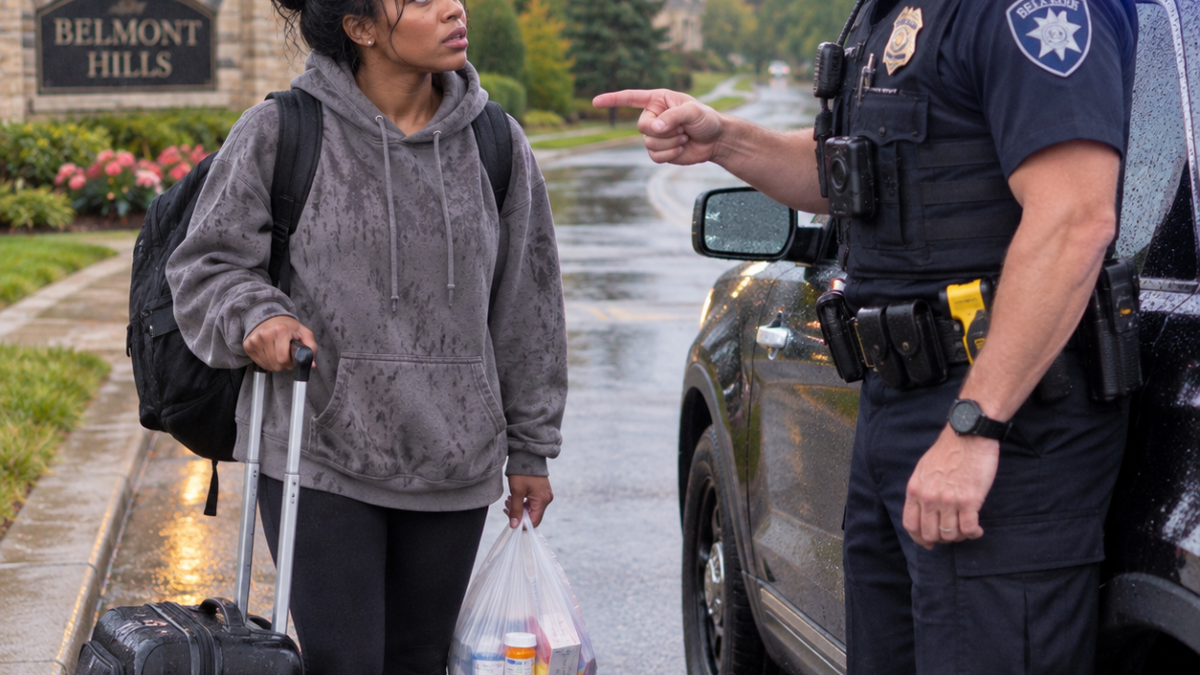
The back seat of a patrol car has a smell you never forget.
Plastic.
Disinfectant.
Old sweat.
Sometimes fear.
I had sat in one before, but never in handcuffs.
Years earlier, when I was a federal prosecutor, I had ridden with local officers during organized-crime investigations.
Back then, the back seat had been transportation.
That Sunday morning, it was architecture.
Hard plastic beneath me.
Plexiglass in front.
No door handle.
No control over temperature.
No control over destination.
No control over how tightly steel pressed into my wrists.
Those details matter when you spend your career reading arrest reports.
Words like transported without incident can conceal an extraordinary amount of human experience.
Officer Darren Hayes glanced at me through the rearview mirror.
“Quiet now.”
I said nothing.
He grinned.
“Usually your type starts yelling about lawyers.”
Officer Lewis looked toward him.
“Darren.”
“What?”
“Come on.”
Hayes laughed.
“What?”
Lewis lowered his voice.
“We still haven’t run her.”
“We’ll run her downtown.”
“She gave us a name.”
“Probably fake.”
“Why would it be fake?”
Hayes glanced at him.
“You really have six months on the job, don’t you?”
Lewis went silent.
I watched him.
He knew.
Not everything.
But enough.
That is one of the most uncomfortable truths about institutional misconduct.
Most systems are not sustained solely by monsters.
They are sustained by people who notice something is wrong and convince themselves they are too junior, too uncertain, too afraid, or too dependent on the paycheck to say so.
Lewis looked at me in the mirror.
I held his gaze.
He looked away first.
Hayes drove faster than necessary through wet streets.
“You’re looking at loitering.”
He counted on his fingers.
“Failure to identify.”
“Suspicion of attempted burglary.”
“Resisting.”
I finally spoke.
“What did I do that constituted resisting?”
He looked at the mirror.
“There she is.”
“I asked a question.”
“You refused commands.”
“Which command?”
“Turn around.”
“I did not physically resist you.”
“You stiffened.”
“I was standing.”
“You people always think you know the law.”
Officer Lewis’s shoulders tightened.
I almost asked Hayes who he meant by you people.
I didn’t need the answer.
I had spent the previous twenty-one days reviewing personnel files.
Darren Hayes had appeared twice.
Not because he was under active investigation.
Because patterns around him bothered me.
Traffic stops disproportionately involving Black drivers.
Searches that rarely produced contraband.
Resisting charges attached to otherwise minor incidents.
Citizen complaints dismissed for insufficient evidence.
Body-camera “equipment failures” at convenient moments.
Nothing alone enough to prove corruption.
Together, enough to deserve attention.
I had planned to request his complete Internal Affairs file after my swearing-in.
Now I was wearing his handcuffs.
The city had given me an extraordinary orientation program.
Lewis finally spoke.
“Ma’am, where’s your car?”
“Westbrook Avenue.”
“What kind?”
“Ten-year-old blue Honda Accord.”
He looked at Hayes.
“That’s not exactly what somebody casing luxury cars usually drives.”
Hayes shook his head.
“You’re adorable.”
Lewis flushed.
“I’m serious.”
“So am I.”
Hayes tapped the steering wheel.
“People steal up and drive anything.”
“That doesn’t make sense.”
“Police work isn’t academy textbooks.”
“No.”
Lewis looked out the window.
“Apparently not.”
Hayes heard the tone.
“Careful.”
Lewis went silent again.
I thought about my mother.
The medication.
Time.
Evelyn’s episodes could escalate quickly.
My neighbor, Mrs. Grant, was sitting with her.
I had told her I would be gone forty minutes.
It had already been nearly an hour.
“Officer Lewis.”
He looked back.
“The pharmacy bag.”
His face changed.
“What?”
“It fell when Officer Hayes handcuffed me.”
“I saw.”
“It contains medication my mother needs this morning.”
“I’ll call somebody.”
Hayes snorted.
“No, you won’t.”
Lewis looked at him.
“Why?”
“We’re transporting a prisoner.”
“We can radio another unit.”
“For a bag?”
“For medication.”
Hayes shook his head.
“Don’t let them manipulate you.”
I spoke carefully.
“If my mother suffers harm because her medication was discarded during an unlawful detention, the city will have a very specific liability problem.”
Hayes laughed.
“See?”
He pointed toward the mirror.
“Always threatening lawsuits.”
“No.”
I met his eyes.
“I am explaining foreseeable consequences.”
For the first time, something in my voice unsettled him.
His smile faded.
Only briefly.
Then ego repaired the damage.
“Save it for the judge.”
We arrived at the 42nd Precinct at 6:49 a.m.
I knew that because I checked the dashboard clock as Hayes parked.
The 42nd was one of the reasons I had accepted the commissioner’s job.
Oak Haven had twelve precincts.
The 42nd generated more use-of-force complaints than any other.
It also somehow produced one of the lowest Internal Affairs sustainment rates.
That combination rarely means a community complains too much.
It usually means oversight investigates too little.
Hayes opened my door.
“Out.”
The cuffs had numbed two fingers on my right hand.
I shifted forward carefully.
He grabbed my upper arm anyway.
“I can stand.”
“Then stand.”
He pulled harder.
My shoulder protested.
I made a mental note.
Not for revenge.
For accuracy.
Every fact.
Every action.
Every witness.
We entered booking.
Phones rang.
A television mounted near the ceiling played local news with the sound off.
Three officers stood around drinking coffee.
A handcuffed man slept against a wall.
Another detainee argued with a desk officer.
Behind the booking counter sat Sergeant Greg Miller.
I recognized him immediately.
His file had been worse than Hayes’s.
Complaints.
Missing evidence.
Allegations that he pressured junior officers to rewrite reports.
An unusual number of cases collapsing after discovery disputes.
Nothing criminally proven.
Yet.
Miller looked at me.
Then at Hayes.
“What’d you drag in?”
“Belmont prowler.”
Hayes sounded proud.
“Caught her checking cars.”
That was false.
Not exaggeration.
False.
I watched Lewis.
His eyes moved toward Hayes.
Good.
He noticed.
Miller looked at my clothes.
“Sunday morning and they’re already commuting north.”
A few officers laughed.
I felt something in me become colder.
Not personal humiliation.
Confirmation.
This was a supervisor.
Not one reckless patrol officer.
Culture.
“Name?”
Miller asked.
“Valerie Monroe.”
“DOB?”
I gave it.
“Social?”
“No.”
He looked up.
“No?”
“You can verify my identity through standard records.”
“You don’t have ID.”
“Correct.”
“Why?”
“I left home during a family emergency.”
Miller rolled his eyes.
“Of course.”
Hayes grinned.
“Told you.”
Miller began typing.
I watched the monitor angle.
He entered my name incorrectly.
Monroe became Munroe.
Possibly accident.
Possibly habit.
“No result.”
I said:
“You spelled it wrong.”
He looked at me.
“What?”
“M-O-N-R-O-E.”
He stared at the screen.
Then at me.
“You want to do my job too?”
“No.”
“I want you to perform it accurately.”
Several officers turned.
Miller leaned over the counter.
“Listen, sweetheart.”
“Don’t call me sweetheart.”
The room quieted slightly.
He smiled.
“Okay.”
He drew out the word.
“Your Majesty.”
Hayes laughed.
Lewis did not.
“I am requesting the cuffs be loosened.”
Miller looked at my wrists.
“They’re fine.”
“My right hand is numb.”
“Then stop fighting them.”
“I am standing still.”
He ignored me.
I continued.
“I am also requesting Captain Robert Jenkins.”
Miller laughed louder.
“Oh, she wants the captain.”
“I do.”
“Captain doesn’t meet every street arrest who knows legal words.”
“Tell him Valerie Monroe is here.”
“Why?”
“Because he knows the name.”
Hayes stepped closer.
“You’re really committed to this act.”
“What act?”
“Important lady.”
I looked at him.
“I haven’t claimed to be important.”
“Then why should the captain know you?”
“Ask him.”
Miller shook his head.
“Process her.”
Hayes reached for my arm again.
I stepped back as far as the cuffs allowed.
“Do not touch me unnecessarily.”
His expression hardened.
“Still giving orders?”
“Yes.”
That answer surprised him.
It surprised several others too.
Hayes moved closer.
“Lady, you are in my house now.”
“No.”
I looked around the precinct.
“This belongs to the public.”
Something changed in the room.
A few officers looked at one another.
Lewis stared at me.
Miller’s smile disappeared.
“You some activist?”
“No.”
“Lawyer?”
“Not currently.”
“Then what?”
Before I answered, an irritated voice came from the administrative hallway.
“What is going on out here?”
Captain Robert Jenkins stepped through the door carrying coffee.
Gray hair.
Pressed white command shirt.
No tie yet.
He looked like a man whose Sunday had been interrupted before it officially began.
“Miller.”
“Yes, Captain?”
“Why is everyone standing around?”
“Hayes brought in a suspected prowler.”
Jenkins barely looked at me.
“Then book her.”
“She demanded you.”
That earned a glance.
Jenkins sighed.
“Since when do I come downstairs because every detainee—”
“Captain Jenkins.”
I spoke.
He stopped.
Not dramatically.
A fraction of a second.
But I saw recognition begin somewhere behind his eyes.
He turned fully.
I continued.
“We were scheduled to review the 42nd Precinct’s transition briefing tomorrow at eight.”
His coffee cup remained halfway to his mouth.
Lewis stared.
Hayes frowned.
Miller looked annoyed.
Jenkins walked closer.
Rainwater still darkened my hoodie.
My hair was coming loose.
My wrists were red around the cuffs.
I looked nothing like the professional headshot he had received from City Hall.
Then he reached my face.
Recognition completed itself.
“Oh, God.”
Hayes looked at him.
“Captain?”
Jenkins did not respond.
“Robert.”
I kept my voice calm.
“Please have these cuffs removed.”
His face lost color.
“Commissioner Monroe.”
Nobody moved.
It was almost fascinating.
Thirty seconds earlier, I had been a suspected thief.
The word Commissioner passed through that room like electricity.
Hayes stepped backward.
Miller’s mouth opened.
Lewis looked from me to Jenkins.
Then everything happened at once.
“Keys.”
Jenkins shouted.
“Get the cuffs off her.”
Lewis reacted first.
He approached with shaking hands.
“Commissioner, I—”
“Breathe.”
He stopped.
“Ma’am?”
“Breathe first.”
He did.
“Now unlock them.”
His hands steadied enough.
Click.
One cuff.
Then the other.
My arms came forward.
Pain shot through my shoulders.
Deep red marks circled both wrists.
Lewis stared at them.
“I am sorry.”
I rubbed my right hand.
“Did you place the cuffs?”
“No.”
“Did you tighten them?”
“No.”
“Then save your apology for the part you actually did.”
He swallowed.
“I stayed quiet.”
“Yes.”
His eyes dropped.
“That part is yours.”
Hayes finally found his voice.
“Commissioner, I had no idea.”
There it was.
The sentence I had expected.
I looked at him.
“No.”
“You didn’t.”
His shoulders loosened slightly.
He thought I was agreeing with his defense.
I wasn’t.
“You didn’t know I was commissioner.”
I stepped closer.
“And you should not have needed to.”
His face tightened.
“I had reasonable suspicion.”
“State it.”
He opened his mouth.
“Gray hoodie?”
No answer.
“Black woman?”
“Ma’am—”
“Walking from a pharmacy?”
“We had prowler calls.”
“What description?”
He hesitated.
“A person wearing dark clothing.”
“Sex?”
“I don’t remember.”
“Race?”
“Unknown.”
“Height?”
“Unknown.”
“Direction of travel?”
“Ma’am, the call was vague.”
“So your answer to a vague call was me.”
“I used experience.”
“No.”
I shook my head.
“You used assumption.”
Jenkins stepped in.
“Commissioner, let me handle—”
I turned.
“Handle what?”
He stopped.
“This officer.”
“No.”
I looked around.
“This precinct.”
Nobody spoke.
“I was arrested on a public sidewalk without anyone confirming the report Hayes claims justified the stop.”
“I was transported without my name being checked.”
“I was brought here with numb hands.”
“Your booking sergeant repeated discriminatory language.”
“And not one supervisor asked to see the pharmacy receipt, contact the store, review body-camera video, or verify the dispatch call before accepting Hayes’s story.”
I looked at Jenkins.
“That is not an Officer Hayes problem.”
His face tightened.
“That is a command problem.”
I turned to Lewis.
“The medication.”
His eyes widened.
“I’ll go back.”
“Immediately.”
“Yes, ma’am.”
He took one step.
Then stopped.
“Wait.”
An officer near the evidence desk raised his hand.
Samuel Bennett.
Wire-rimmed glasses.
Quiet demeanor.
I had noticed him when we entered.
He walked over holding a damp white pharmacy bag.
“I recovered this from the curb before Officer Lewis and Officer Hayes drove away.”
I accepted it.
The seal was intact.
My breath left me.
“Thank you.”
“Of course.”
He held my gaze slightly longer than necessary.
Then I understood.
Not from his face.
From the way he stood.
“Agent Bennett.”
Jenkins frowned.
“Agent?”
Bennett reached into his shirt.
Produced credentials.
“Samuel Bennett.”
“FBI Public Corruption Task Force.”
The silence returned.
This time, fear moved differently.
Sergeant Miller’s hand drifted toward his computer keyboard.
Bennett noticed.
“Sergeant.”
Miller froze.
“Step away from the terminal.”
“What?”
“Now.”
“This is my desk.”
“And that computer may contain evidence relevant to an ongoing federal investigation.”
Jenkins looked at me.
“Commissioner?”
I held the pharmacy bag against my chest.
“The mayor’s office did not bring me here because the old commissioner embarrassed City Hall.”
I looked around the room.
“We knew there were deeper problems.”
“Agent Bennett has been working inside this precinct under authorized cover for several weeks.”
Hayes stared at him.
“You’re a fed?”
Bennett ignored him.
Miller’s face turned red.
“This is insane.”
“No.”
I looked at him.
“This is oversight.”
He pointed toward me.
“You staged this?”
That mattered.
“No.”
I answered immediately.
“My detention was not staged.”
“I went to the pharmacy because my mother was sick.”
“Officer Hayes decided to stop me.”
“He decided to arrest me.”
“Everything that happened on that sidewalk belongs to him.”
I glanced at Lewis.
“And to the people who had opportunities to intervene.”
Then Bennett spoke.
“Commissioner.”
“Yes?”
“Federal preservation orders are ready.”
That was the moment the room understood this was larger than my arrest.
Not revenge.
Not instant punishment.
Evidence.
Process.
Records.
Accountability.
“Serve them.”
Bennett nodded.
He and two officers loyal to Internal Affairs moved toward the server room.
Jenkins swallowed.
“What do you need from me?”
“First?”
I looked at my wrists.
“Medical documentation.”
His face fell.
“Second?”
“Officer Hayes is relieved of street duty pending investigation.”
Hayes stared.
“Pending?”
“Yes.”
He seemed confused.
“You aren’t firing me?”
“Not in this room.”
“Why?”
“Because I am not going to build a lawful department by ignoring due process when I’m angry.”
That landed harder than if I had screamed.
“You will surrender your department-issued firearm and badge under standard administrative procedure.”
“You will receive union representation.”
“You will be interviewed with counsel if requested.”
“Your body-camera recording will be preserved.”
“Your arrest history will be audited.”
“And if investigators establish criminal conduct, prosecutors—not me—will decide what charges are appropriate.”
Hayes’s face changed.
The certainty that had protected him all morning disappeared.
Not because I threatened him.
Because the rules were finally going to apply.
Miller started objecting.
“Commissioner, union agreement—”
“I know the agreement.”
“Then you know you can’t—”
“I said administrative relief.”
He stopped.
That was permitted.
“You also know the contract does not authorize evidence tampering.”
His eyes flicked toward his computer.
I saw it.
So did Bennett from across the room.
Miller said nothing.
“Sergeant Miller, you are also relieved of supervisory duties pending investigation.”
His face exploded red.
“For what?”
“Your conduct this morning is sufficient for immediate administrative review.”
“That doesn’t mean—”
“No.”
“It means exactly what I said.”
“Review.”
“Not conviction.”
He looked furious.
I continued.
“And Captain Jenkins.”
His shoulders stiffened.
“Commissioner.”
“You remain in command for the next thirty minutes.”
He looked surprised.
“Thirty?”
“Long enough to transfer operational control to Deputy Chief Ramirez.”
His face drained again.
“You’re suspending me?”
“Administrative leave.”
“Why?”
“Because a precinct with this complaint history cannot be evaluated credibly while its commander controls records and personnel.”
“I didn’t know Hayes would—”
“This is not about knowing what one officer would do on one morning.”
I looked at him.
“This is about what you allowed to become normal.”
That ended the conversation.
My phone rang.
Mrs. Grant.
I answered immediately.
“Valerie?”
“I’m here.”
“Your mother is awake.”
My entire body changed.
Commissioner disappeared.
Daughter returned.
“How is she?”
“Confused.”
“Agitated.”
“She keeps asking for you.”
“I have the medication.”
“When will you be home?”
I looked at Jenkins.
At Bennett.
At the precinct.
“Twenty minutes.”
“I’ll keep her calm.”
“Thank you.”
I ended the call.
Lewis stood near the door.
“Commissioner.”
“Yes?”
“I can drive you.”
I looked at him.
Not as reward.
As opportunity.
“Fine.”
He straightened.
Then I added:
“But first you are writing a statement.”
His face fell slightly.
“About Hayes?”
“About yourself.”
He understood.
“Everything.”
“Everything.”
“Yes, ma’am.”
Twenty-three minutes later, Brian Lewis drove me home.
No lights.
No siren.
Just rain easing against the windshield.
He held the steering wheel tightly.
“Commissioner.”
“Yes?”
“I should’ve stopped him.”
“Yes.”
No comforting lie.
“I was scared.”
“I know.”
“He’s been here fifteen years.”
“I know.”
“Everyone says if you contradict senior officers, nobody backs you when you need help.”
“I know.”
He glanced at me.
“How?”
“I’ve spent twenty years investigating organizations where loyalty replaced ethics.”
He looked back at the road.
“I thought once I became a cop, the hard part would be knowing what’s right.”
“No.”
“What is?”
“Doing it when the wrong thing is easier.”
He nodded.
“Am I going to lose my job?”
“I don’t know.”
That surprised him.
“You don’t?”
“Internal Affairs will review your actions.”
“But you said earlier—”
“I said you may be salvageable.”
His eyebrows rose.
“I thought that.”
“You heard me?”
“I have excellent hearing.”
For the first time, he smiled slightly.
Then I said:
“Being uncomfortable is not misconduct.”
“Standing silent during an unlawful arrest can become misconduct depending on what you knew and what you could reasonably do.”
His smile disappeared.
“You will tell investigators the truth.”
“Yes.”
“Even if it hurts.”
“Yes.”
“Especially if it hurts.”
He nodded.
We reached my street.
East Oak Haven.
Brick row houses.
Corner store.
Church parking lot.
Two boys bouncing a basketball despite wet pavement.
Lewis looked around.
“This is where you live?”
“Yes.”
“I thought the commissioner would live in Belmont Hills.”
“Why?”
He flushed.
“Exactly.”
I opened the door.
Before stepping out, I turned.
“Officer Lewis.”
“Yes?”
“Don’t confuse what happened this morning with me rescuing you.”
“I won’t.”
“You don’t earn trust because you felt bad.”
“I understand.”
“You earn it through what you do next.”
“Yes, ma’am.”
I went inside.
My mother was sitting in her bedroom.
Gray hair loose around her shoulders.
Eyes frightened.
When she saw me, relief spread across her face.
“Valerie.”
“Hi, Mama.”
“You were gone.”
“I know.”
“Your father was worried.”
My chest tightened.
“He knows I’m home.”
She smiled.
“Good.”
I prepared the medication.
She swallowed it with water.
Then touched my wrist.
Her fingers moved across the bruises.
“What happened?”
I considered telling her.
Instead:
“Long morning.”
She looked into my eyes.
For one brief moment, dementia loosened its grip.
She was entirely present.
“You always did take the long way.”
I laughed.
Then cried.
Quietly.
My mother pulled me closer.
For ten minutes, I wasn’t commissioner.
Wasn’t prosecutor.
Wasn’t reformer.
I was a tired daughter sitting beside her mother while rain tapped the window.
That was the part television cameras never saw the next day.
City Hall was packed Monday morning.
Reporters filled the rotunda.
Community leaders.
Police union attorneys.
Civil-rights organizations.
Officers.
Families who had filed complaints against the 42nd.
The mayor asked if I wanted to postpone my swearing-in.
“No.”
“You haven’t slept.”
“I’ll sleep when journalists stop shouting.”
“So never.”
“Correct.”
I wore the dress uniform prepared for the ceremony.
Dark navy.
Gold trim.
Commissioner’s stars.
My wrists remained bruised.
I refused makeup over them.
Not for drama.
Evidence should not be hidden because cameras are present.
I took the oath.
Then stepped to the podium.
Every network wanted the same story.
New commissioner arrested by her own officers.
Instant karma.
Boss arrests boss.
The headlines almost wrote themselves.
I refused that frame.
“What happened to me yesterday is not important because I am Police Commissioner.”
The room quieted.
“It is important because no resident of Oak Haven should have needed my title to make that stop unacceptable.”
Pens moved.
Cameras clicked.
“I was detained after leaving a pharmacy.”
“No specific conduct linked me to a reported offense.”
“My clothing and presence in an affluent neighborhood became substitutes for evidence.”
“I was arrested.”
“My medication was dropped.”
“My restraints caused documented injury.”
“And supervisory review failed at several points.”
I paused.
“Those are facts under investigation.”
A reporter shouted:
“Have you fired Officer Hayes?”
“No.”
Surprise.
“Why not?”
“Because administrative action and criminal guilt are different things.”
“He has been relieved of police powers pending investigation.”
“His weapon and badge are secured.”
“He has representation.”
“Internal Affairs and independent federal investigators will review his conduct.”
Another reporter:
“Isn’t that lenient after what he did to you?”
“No.”
“Due process is not leniency.”
“It is legitimacy.”
That quote spread further than I expected.
Then I announced the real reforms.
Independent review of all 42nd Precinct use-of-force cases from the previous five years.
Audit of arrest patterns.
Body-camera compliance review.
Evidence-room audit.
External civil-rights counsel.
A new rule requiring supervisors to document the factual basis whenever a stop escalated from consensual contact to detention.
No more “officer intuition” without articulable facts.
The police union president stood near the back looking furious.
I expected that.
Then I addressed officers.
“Most of you are not Darren Hayes.”
I meant it.
“You come to work.”
“You answer calls.”
“You enter homes when other people are running out.”
“You tell parents their children are dead.”
“You intervene in violence.”
“You carry experiences civilians may never understand.”
I paused.
“That difficulty does not excuse abuse.”
“And accountability is not anti-police.”
“It is how honorable officers stop being forced to carry the reputation of dishonorable ones.”
Some officers nodded.
Others stared.
Good.
I was not running for applause.
The investigation took months.
That mattered.
Real accountability is rarely finished by lunchtime.
Darren Hayes’s body-camera footage confirmed most of my account.
Dispatch records showed the original prowler call described a tall man wearing a dark raincoat.
Male.
Six feet or taller.
Last seen attempting door handles two blocks north.
I matched none of it.
Hayes had heard the call.
Then stopped me anyway.
Worse, investigators discovered similar cases.
Black delivery driver stopped after a burglary call describing a white teenager.
Latino landscaper detained because a resident thought his truck “looked suspicious.”
Black college student searched while walking home from a friend’s house.
Charges often added after people questioned Hayes.
Disorderly conduct.
Resisting.
Obstruction.
The pattern became hard to explain as coincidence.
Sergeant Miller’s audit was worse.
Reports altered after incidents.
Complaints redirected.
Body-camera footage incorrectly classified.
Evidence logs changed.
Federal prosecutors became involved based on conduct far beyond my arrest.
Captain Jenkins was not charged criminally.
That distinction angered people.
I understood.
But poor leadership is not automatically a federal crime.
He had ignored warning signs.
Protected problematic supervisors.
Prioritized complaint reduction over complaint accuracy.
The city terminated him after an administrative hearing.
Not because he personally ordered racial profiling.
Because command responsibility includes what you repeatedly refuse to see.
Miller eventually faced criminal charges related to evidence tampering and obstruction.
Hayes faced civil-rights charges tied to multiple incidents after federal investigators built cases independent of mine.
My arrest became one piece.
Not the whole case.
That mattered to me.
I did not want a justice system where assaulting the commissioner was treated more seriously than abusing an unknown resident.
Officer Lewis testified.
Truthfully.
He admitted that he doubted Hayes.
Admitted he saw the medicine.
Admitted he did not intervene strongly enough.
Admitted he was afraid of retaliation.
Internal Affairs sustained a failure-to-intervene finding.
He received suspension and remedial training.
People criticized me for not promoting him.
The original story would have made a wonderful movie.
Young rookie shows conscience.
New commissioner rewards him.
Detective badge by afternoon.
Reality needed something better.
I called Lewis into my office three months later.
He looked nervous.
“You asked to see me.”
“Yes.”
He sat.
“Your suspension ends Monday.”
“Yes, ma’am.”
“Where are you assigned?”
“Community response unit.”
“Good.”
He looked disappointed.
“You expected detective?”
His face reddened.
“No.”
“Liar.”
He looked down.
“I thought maybe…”
“Because you felt guilty after watching an unlawful arrest?”
“No.”
“Because you eventually told the truth?”
He said nothing.
“Officer Lewis, truth is the minimum.”
He nodded.
“I know.”
“I don’t think you are a bad officer.”
He looked up.
“I think you were a frightened one.”
“That can be dangerous too.”
“Yes.”
“So I want you somewhere you will have to practice making decisions without hiding behind senior partners.”
“Community response?”
“Schools.”
“Mental-health calls.”
“Neighborhood meetings.”
“Domestic follow-up.”
He looked skeptical.
“That doesn’t sound like a punishment.”
“It isn’t.”
“Or a promotion.”
“Correct.”
“What is it?”
“Police work.”
He smiled slightly.
I slid a folder toward him.
“Your academy instructors described you as empathetic, careful, and good with de-escalation.”
“I didn’t know you read that.”
“I read everything.”
He opened the folder.
“One year.”
I said.
“Do that job well.”
“Then we talk about what comes next.”
He nodded.
“Yes, Commissioner.”
He stood.
At the door, I stopped him.
“Brian.”
He turned.
“The next Hayes you meet may outrank you.”
“I know.”
“The next person in cuffs may not secretly be commissioner.”
He swallowed.
“I know.”
“That is the test.”
He nodded.
“I won’t forget.”
Neither did I.
The reforms became harder after headlines faded.
Politicians loved announcing change.
Budgeting for it was less glamorous.
Body-camera storage cost money.
Independent investigators cost money.
Mental-health teams cost money.
Training cost overtime.
The council wanted reform and lower taxes simultaneously.
I told them arithmetic had not yet evolved enough to make that possible.
The union fought several proposals.
Some objections were reasonable.
Some weren’t.
I listened to both.
That surprised people.
One union attorney asked why I was willing to negotiate after what happened.
“Because collective bargaining did not arrest me.”
I said.
“Individuals did.”
“If I begin treating every officer as the worst officer I’ve encountered, then Officer Hayes taught me nothing.”
That meeting became productive.
Not friendly.
Productive.
We created a body-camera policy with strict activation requirements and legitimate privacy exceptions.
Failure to activate during enforcement required written explanation.
Repeated unexplained failure triggered review.
Citizen complaints received tracking numbers visible to complainants.
Supervisors could no longer close certain misconduct allegations alone.
Stop data was published quarterly.
Race.
Reason.
Search.
Contraband found.
Arrest outcome.
Not because data answers every question.
Because hidden systems rarely improve.
The first quarterly report was ugly.
Black residents represented thirty-one percent of Oak Haven’s population.
They accounted for fifty-eight percent of pedestrian stops.
Some disparity correlated with deployment patterns.
Not all.
The union attacked the numbers.
Activists attacked the department.
I published them anyway.
“Commissioner.”
The mayor said privately.
“You’re giving everybody ammunition.”
“They already have ammunition.”
“What I’m giving them is shared facts.”
Six months after my arrest, I returned to Belmont Hills.
Same pharmacy.
Same early hour.
Different season.
My mother still needed medication adjustments periodically.
I could have sent an aide.
I didn’t.
I parked three blocks away.
On purpose.
I wore jeans and a sweatshirt.
Not my late husband’s hoodie.
That one remained folded in my closet.
It smelled faintly of him if I imagined hard enough.
I walked from the pharmacy carrying another white bag.
A patrol cruiser approached.
My body reacted before my mind did.
Shoulders tightened.
Heartbeat changed.
Memory does that.
The cruiser slowed.
Officer inside lowered the window.
Young woman.
Black.
“Morning.”
“Morning.”
“You all right?”
“Yes.”
She gestured toward the rain starting again.
“Need a ride?”
I almost laughed.
“No.”
“My car’s right there.”
“All right.”
She drove on.
No recognition.
No ID request.
No suspicion.
No revelation.
Just ordinary interaction.
I stood on the sidewalk watching the cruiser disappear.
That was the moment I understood what success might look like.
Not a corrupt officer losing his badge.
Not cameras at City Hall.
Not headlines calling me fearless.
Boring.
Success looked boring.
A woman in worn clothes walking through an expensive neighborhood and nobody inventing a crime around her.
A rookie questioning a veteran before harm escalates.
A supervisor reading a report critically.
A body camera staying on.
A citizen complaint receiving an answer.
A police officer driving past because there is no legal reason to stop.
Ordinary dignity.
That afternoon, I visited the 42nd Precinct.
It looked different.
Not cosmetically.
Same ugly building.
Same fluorescent lights.
Same terrible coffee.
But complaint forms sat openly near the entrance.
Body-camera status indicators were checked before shifts.
Supervisors reviewed stops randomly.
Community representatives met there twice monthly.
Officer Lewis stood near the front desk speaking with an elderly man.
The man appeared confused.
Lewis did not rush him.
Did not raise his voice.
He pulled over a chair.
Sat at eye level.
I watched from the doorway.
Eventually the man’s daughter arrived.
Lewis walked them outside.
When he came back, he saw me.
“Commissioner.”
“How’d you know?”
He smiled.
“You’re wearing actual shoes today.”
I looked down.
Leather flats.
“Observant.”
“I’ve been training.”
“How’s community response?”
He exhaled.
“Harder than patrol.”
“Why?”
“You can’t just leave after the call.”
“Exactly.”
He looked toward the door.
“That man has dementia.”
My chest tightened slightly.
“His daughter works nights.”
“He wanders.”
“We’re connecting them with a support program.”
“Good.”
He hesitated.
“Your mother?”
“Stable.”
“I’m glad.”
A pause.
Then:
“Commissioner?”
“Yes?”
“I think about that morning.”
“So do I.”
“I keep wondering why I didn’t stop Hayes.”
“You know why.”
“Fear.”
“Yes.”
“Feels smaller every time I say it.”
“Good.”
He looked surprised.
“Good?”
“Excuses should shrink under examination.”
He nodded.
Then:
“I don’t want to be that guy again.”
“Then don’t be.”
Simple.
Not easy.
Simple.
A year after taking office, I stood in the same City Hall rotunda.
Not for scandal.
Graduation ceremony for a new academy class.
One hundred and six recruits.
Different backgrounds.
Different neighborhoods.
Same nervous expressions.
I looked at them.
“When you leave this building, people will call you officer.”
I said.
“That title will open doors.”
“It will make people afraid.”
“It will make some people cooperative.”
“It will make some people angry before you speak.”
“It will make witnesses trust you.”
“It will make witnesses lie to you.”
“It will give you legal authority ordinary citizens do not possess.”
I paused.
“That authority is real.”
“And because it is real, it must make you more disciplined, not more important.”
The room quieted.
“You will meet people on their worst days.”
“You will meet people whose clothes offend your assumptions.”
“Whose neighborhoods make you nervous.”
“Whose accents you do not understand.”
“Whose anger feels disrespectful.”
“Whose poverty looks suspicious to you.”
“You will sometimes be right.”
“You will sometimes be wrong.”
“The badge does not make your instinct correct.”
“It makes the consequences of your mistakes greater.”
I saw Brian Lewis standing along the wall.
Still patrol officer.
No detective shield.
Not yet.
He nodded slightly.
I continued.
“One morning before I took this office, I was stopped by an officer who looked at my clothes and decided he knew my story.”
“He did not ask enough questions.”
“He did not verify enough facts.”
“He did not understand that certainty can become dangerous when authority outruns evidence.”
Every recruit knew the story.
I did not need to name Hayes.
“My title should not have mattered.”
“That is what I need you to remember.”
A young recruit in the first row listened intensely.
“If your behavior changes when you learn someone is wealthy, connected, politically important, famous, a judge, a prosecutor, or your commissioner…”
I let the sentence hang.
“…then you are not practicing equal justice.”
“You are calculating risk.”
Silence.
“The person who cannot call the mayor deserves the same Constitution as the person who can.”
That was the line I wanted them to carry outside.
Not my arrest.
Not my revenge.
That.
Years later, people still occasionally asked about Darren Hayes.
They expected satisfaction.
Did it feel good when he was convicted?
Did I enjoy watching him lose his pension?
Was I glad Sergeant Miller went to prison?
The questions misunderstood the experience.
No.
Nothing about discovering that citizens had been mistreated for years felt good.
Nothing about officers disgracing a badge I had chosen to lead felt triumphant.
Accountability was necessary.
It was not entertainment.
Hayes eventually stood in federal court and admitted parts of what he had done.
Not everything.
Enough.
He acknowledged writing inaccurate reports.
Using resisting charges to justify escalation.
Targeting people based on assumptions he called experience.
At sentencing, he asked to speak.
I attended because several victims asked me to.
He looked older.
Smaller.
Not because prison had humbled him.
Because uniforms magnify people.
Without one, he was simply Darren.
He looked toward the gallery.
Then toward me.
“I didn’t know who she was.”
I closed my eyes briefly.
Even then.
Still that sentence.
The judge interrupted him.
“It should not have mattered.”
I looked at the bench.
The judge continued.
“That is precisely why this case is serious.”
For the first time, Darren seemed to understand.
Maybe.
I cannot know.
He served his sentence.
I continued doing my job.
My mother died two years later.
Peacefully.
At home.
I was holding her hand.
Dementia had taken most of her memories by then.
But near the end, she looked at my uniform.
Touched one of the gold stars.
“You work for the police?”
I smiled.
“Something like that.”
“You be careful.”
“I will.”
She looked at me with surprising seriousness.
“Police should be kind.”
I swallowed.
“Yes, Mama.”
Then she closed her eyes.
Of all the policy manuals I approved as commissioner, that may have been the best instruction anybody gave me.
Not soft.
Not weak.
Kind.
Kindness with authority does not mean refusing to enforce law.
It means remembering the person in front of you remains a person while you do.
Years after Belmont Hills, I kept Darren Hayes’s handcuffs in a drawer.
Not displayed.
Not framed.
Not symbolic décor.
Evidence had returned them after the case closed.
I almost threw them away.
Instead, I kept them beneath old notebooks.
Occasionally, before a difficult meeting, I opened the drawer.
Cold steel.
Simple mechanism.
A tool.
Neither good nor evil.
Everything depended on the hand using it.
That was true of almost every form of power I had ever known.
A badge.
A courtroom.
A prosecutor’s subpoena.
A commissioner’s office.
Power does not reveal character by existing.
It reveals character through use.
Darren believed authority meant deciding who belonged.
Sergeant Miller believed authority meant protecting his own.
Captain Jenkins believed authority meant keeping problems quiet.
Brian Lewis almost learned that authority meant obedience to senior officers.
I wanted Oak Haven to learn something else.
Authority is borrowed.
From the public.
Temporarily.
Conditionally.
And the moment you forget who lent it to you, you become dangerous.
People still tell my story as the morning a r@c!st cop arrested his own police commissioner.
It makes a sharp headline.
But that was never the real story.
The real story was that Darren Hayes thought his behavior was safe because he believed I was nobody.
No money he could see.
No title he recognized.
No clothes that demanded respect.
No connection worth fearing.
He was comfortable because he believed consequences belonged only to important people.
My job afterward was not to make sure police officers knew Valerie Monroe was important.
It was to build a department where importance did not determine dignity.
Where a woman carrying medicine home to her mother did not need gold stars on her collar before an officer bothered to ask whether his assumptions were wrong.
Where the next rookie did not have to discover courage after the cuffs were already closed.
Where sirens could mean somebody was coming to help.
Not that somebody with a badge had already decided who you were.
And every morning I entered police headquarters after that, I reminded myself of the same thing I eventually taught every recruit in Oak Haven.
The person standing in front of you should never have to become your boss before you remember that they have rights.








