The one-year-old Chihuahua had stopped looking at the world, until an eleven-year-old blind Chihuahua was placed beside him for one night
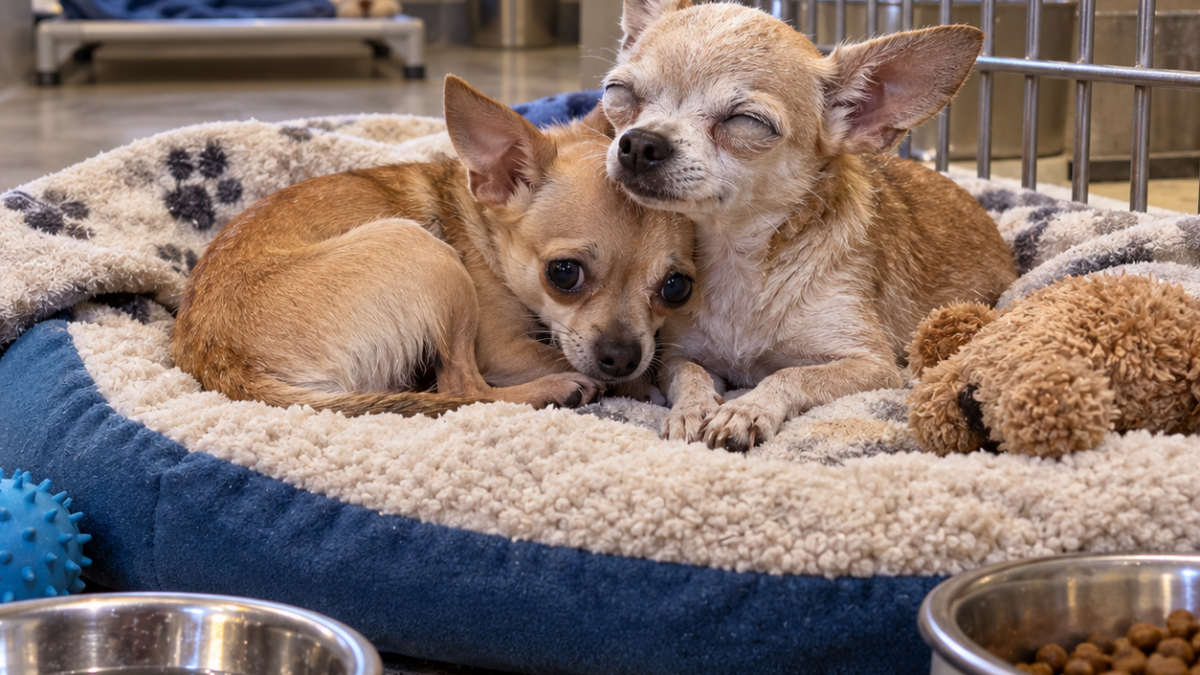
Her cheek touched him first.
It was barely a touch, no more than the weight of an old dog’s face settling against the shoulder of a frightened young Chihuahua.
Rocky’s body went rigid.
His ears flattened.
For several seconds, I could see every muscle beneath his thin coat tighten as though he were waiting for whatever usually came after contact.
Nothing came.
Brunon did not pin him.
She did not crowd him.
She did not try to lick his face or climb over him.
She simply rested her head against his shoulder and stood there.
Rocky looked at her.
Really looked at her.
It was the first time since his arrival that I had seen him study another living creature instead of turning away from one.
Brunon’s cloudy eyes faced somewhere beyond him.
She could not see his ribs.
She could not see the old marks beneath his fur.
She could not see the way his front paws trembled against the blanket.
Maybe that was part of what made the moment possible.
There was nothing in her expression that changed when she got close enough to know what he had been through.
She had already decided to stay.
I stood outside that kennel with one hand pressed against my mouth because I was suddenly afraid even breathing too loudly might break whatever was happening.
Rocky’s shaking did not stop immediately.
It faded in small waves.
His shoulders loosened first.
Then his paws.
Then his head lowered by less than an inch.
Brunon remained beside him.
Five minutes passed.
Then ten.
Eventually, she became tired of standing.
She lowered herself onto the blanket beside Rocky, turned once in the slow careful way older dogs do, and settled with her back touching his side.
Rocky stayed awake.
I know because his eyes followed the faint movement of my shadow outside the kennel.
But he did not move away from her.
For a dog who had spent three days trying to disappear into a concrete wall, that felt enormous.
I left shortly before three.
I did not turn on any additional lights.
I did not enter their kennel.
I simply walked backward down the hallway, closed the door quietly, and drove home with Brunon’s worn burgundy collar and Rocky’s frightened eyes replaying in my head.
When I returned at seven that morning, our kennel technician, Maya, was already standing near their run.
She had one hand over her mouth.
I knew that expression.
“What happened?” I whispered.
She pointed.
Rocky was asleep.
Not curled against the wall.
Not hiding beneath a blanket.
He was lying beside Brunon on the fleece bed we had placed there the day before.
His small head rested across her front paws.
Brunon was asleep too.
Their sides rose and fell almost together.
Maya looked at me.
“Did you put him there?”
I shook my head.
“No.”
“Did anybody?”
“No.”
She looked back through the gate.
“Then he moved there himself.”
That mattered even more than the sleeping.
Rocky had chosen something.
Until that morning, everything about him had been withdrawal.
Do not look.
Do not eat.
Do not move.
Do not hope.
Some time between two and seven in the morning, he had made a decision.
He had crossed the kennel.
He had climbed onto the bed.
He had placed his head against another dog.
I unlocked the gate slowly.
Brunon’s ears moved first.
Rocky’s eyes opened.
His head snapped up.
For a moment, I saw the old panic return.
His body tightened beneath him.
Brunon lifted her head too.
She did not know I was standing there, but she knew something had changed.
She touched her nose briefly to Rocky’s cheek.
I stopped moving.
Rocky looked at her.
Then he looked at me.
Straight at me.
There was still fear in his eyes.
Of course there was.
One safe night cannot erase whatever taught an animal that contact means pain.
But something else had appeared beside it.
Curiosity.
I crouched.
“Morning, buddy.”
Rocky’s ears twitched.
I kept my hands resting on my knees.
Brunon stretched, her tiny front paws sliding forward across the fleece.
Rocky watched me for another few seconds.
Then he stood.
Maya caught my arm from outside the kennel.
Neither of us spoke.
Rocky took two steps toward me.
Stopped.
Looked back at Brunon.
Then took another step.
He sniffed the air near my hand without touching it.
I turned my palm slightly downward.
Rocky leaned forward.
His nose brushed one knuckle.
That was all.
He retreated immediately and returned to Brunon.
But I sat there staring at my hand as though he had placed something precious inside it.
“You better not start crying this early,” Maya whispered.
“I am not crying.”
“You absolutely are.”
“I have allergies.”
“In January?”
“Very aggressive allergies.”
She laughed quietly.
Rocky looked toward the sound.
His ears rose.
The movement was tiny, but even that felt different.
He was listening to the world again.
Breakfast came at eight.
We carried two stainless-steel bowls into the kennel.
Brunon knew the routine.
The moment she heard the bowls touch the floor, she stood and began sniffing.
Her blindness had made her careful, not helpless.
She knew exactly where her food normally appeared.
Rocky backed away when I placed his bowl down.
I expected him to retreat to the wall again.
Instead, Brunon walked past him toward her breakfast.
Rocky watched her eat.
He took one step toward his own bowl.
Stopped.
Brunon kept crunching.
Rocky took another step.
He sniffed.
Then, with the caution of someone approaching a trap, he took one piece of kibble.
He jumped backward.
Nothing happened.
He waited.
Brunon continued eating.
Rocky stepped forward again.
This time he ate three pieces.
By the time Maya and I walked away, half the bowl was gone.
At 8:23 that morning, Maya wrote the time on the whiteboard in the staff room.
ROCKY ATE.
She drew three exclamation marks after it.
Nobody erased the message for weeks.
Recovery did not happen in a straight line after that.
People like neat rescue stories.
They like before and after.
A frightened animal enters a shelter.
Someone shows kindness.
The animal understands.
Music swells.
Everything is fixed.
Real recovery does not work like that.
It moves forward, backward, sideways, and sometimes in circles.
Rocky ate breakfast that morning and refused dinner that evening.
The next day, he allowed me to touch his chest for two seconds and then spent an hour hiding behind the bed because a metal bucket fell in the laundry room.
Three days later, he followed Brunon into the hallway.
A door closed somewhere near reception.
Rocky froze so suddenly that Brunon walked into him.
His legs began trembling.
Brunon stopped.
She turned toward him and waited.
I was holding both leashes.
I did not pull.
Maya stood several yards away so there would be no feeling of being surrounded.
“You’re okay,” I said quietly.
Rocky did not look at me.
Brunon sat down.
She waited.
Thirty seconds passed.
Then a minute.
Rocky’s breathing slowed.
He stepped closer to Brunon.
She stood.
They continued walking.
It became their pattern.
Brunon could not see where she was going.
Rocky was afraid to go anywhere.
Somehow, together, they became capable of moving through the world.
At first, we guided Brunon with a soft harness and kept Rocky close beside her.
But after several days, something unexpected happened.
Rocky began walking slightly ahead.
Not far.
Never enough to tighten the leash.
Just half a body length.
If Brunon approached a corner too quickly, Rocky slowed.
If she drifted toward a water bucket, he stepped sideways.
If she hesitated at a doorway, he stopped and waited until her nose found his shoulder.
Nobody taught him that.
Maya noticed it first.
“Look at him.”
We were standing in the indoor exercise room.
Rocky and Brunon were crossing the rubber floor together.
A foam step had been left near the wall.
Rocky reached it, paused, then moved around it.
Brunon followed the sound of his collar and went around too.
Maya folded her arms.
“He’s guiding her.”
I watched them make another circle.
Rocky’s old intake collar was still around his neck.
It was a plain blue nylon collar an officer had placed on him the night he was removed.
Too large.
Faded.
A small tear ran through one side.
I had intended to replace it immediately.
But touching his neck had frightened him during the first few days, so we left it alone.
Now the metal ring on that collar gave a faint sound whenever he walked.
Brunon had learned to listen for it.
Rocky had become her bell.
That afternoon, I found a softer collar in our donated supplies.
Dark green.
Lightweight.
No buckle that would click loudly.
I sat on the kennel floor with it beside me for almost twenty minutes before Rocky came close enough to sniff it.
Brunon was sleeping on her bed.
I touched the new collar to Rocky’s shoulder.
He flinched.
I removed it immediately.
“That’s all,” I said.
The next day, I tried again.
This time, he allowed it to touch his neck for two seconds.
On the fourth day, I was finally able to replace the old blue collar.
I expected to throw the damaged one away.
Instead, I stood beside the trash bin holding it.
There were tooth marks near the edge.
A streak of dirt that would not wash out.
One place where the nylon had almost worn through.
I thought about the frightened little dog who had arrived wearing it.
Then I put it in a clear plastic bag, wrote ROCKY — INTAKE on a label, and placed it in the cabinet where we kept special belongings.
Shelter workers become sentimental about strange things.
A collar.
A chewed toy.
A blanket.
A leash brought in by a family who never came back.
Objects sometimes become the only witnesses to the lives animals had before us.
Brunon had her burgundy collar.
Rocky had his blue one.
Neither object was beautiful.
Both mattered.
Two weeks after Rocky arrived, he barked for the first time.
It happened because Maya walked into the room carrying a squeaky yellow duck.
Brunon loved toys that made noise.
She could no longer chase things visually, but if a toy squeaked, she would follow the sound across the floor with surprising determination.
Maya squeezed the duck.
Squeak.
Brunon’s ears shot up.
She trotted three feet in the wrong direction.
Maya squeezed it again.
Brunon corrected herself.
Rocky watched.
When Maya squeezed it a third time, Brunon found the toy and grabbed it.
The duck squealed beneath her mouth.
Rocky jumped backward.
Then something happened that none of us expected.
He barked.
One sharp, offended Chihuahua bark.
Brunon dropped the duck.
The entire room went silent.
Maya looked at me.
I looked at Rocky.
Rocky seemed startled by himself.
Then Brunon picked up the duck again.
Squeak.
Rocky barked twice.
Maya started laughing.
I did too.
Rocky stared at us.
Brunon shook the duck so hard her ears flapped.
Rocky moved forward.
He touched the toy with one paw.
Brunon released it.
Rocky grabbed it and ran three feet away.
Not far.
But he ran.
For the first time, he moved quickly because he wanted something instead of because he feared something.
That yellow duck became their toy.
Rocky liked stealing it.
Brunon liked finding it.
Sometimes he would carry it to another part of the room, place it down, and tap it with his paw until it squeaked.
Brunon would turn toward the sound.
He would wait.
When she got close, he would pick it up and move again.
I accused him of cheating.
Maya accused him of inventing hide-and-seek for blind dogs.
Brunon did not appear offended.
She played every time.
Visitors began noticing them.
It was impossible not to.
Rocky had gained weight, though he was still slender.
His coat began to shine.
His eyes no longer stayed fixed on the floor.
Brunon seemed younger too.
Before Rocky, she spent most afternoons asleep.
Now she followed the sound of his green collar around the kennel.
She ate more.
She asked to go outside more often.
She even began scratching lightly at the gate in the mornings when she heard staff arrive.
It was as if being needed had awakened something in her.
That was the part I had not understood when we first put them together.
I thought Brunon would help Rocky.
I had imagined one direction.
Old dog comforts young dog.
Stable dog helps frightened dog.
Simple.
But Rocky was changing Brunon too.
She had spent months being passed over by families.
She had been loved once.
I was sure of it.
You could tell by the way she responded to household sounds.
The opening of a refrigerator made her lift her head.
The sound of keys caused her to wait near doors.
If someone crumpled a paper bag, her tail began tapping because she clearly remembered treats coming from bags like that.
Those memories made the shelter harder for her, not easier.
Brunon understood what a home was.
She knew what she had lost.
Then Rocky arrived.
Suddenly she had something to listen for besides footsteps that passed her kennel.
One afternoon, I sat beside them during a thunderstorm.
The first crack of thunder shook the windows.
Rocky dropped flat to the floor.
His pupils widened.
His breathing changed.
Brunon, who had been asleep, lifted her head.
Another boom sounded.
Rocky scrambled beneath the edge of the raised bed.
His body began trembling.
I lowered the blinds and turned on a fan.
Normally, Brunon disliked storms too.
That day, she did not hide.
She walked toward the sound of Rocky’s breathing.
He was wedged partly beneath the bed.
Brunon could not fit beside him.
So she lay down outside.
She placed one paw near the edge.
Rocky’s nose appeared.
Brunon’s paw touched his muzzle.
They stayed like that through the entire storm.
I sat against the wall and watched.
For the first time, I understood why Brunon’s blindness might have been part of what allowed Rocky to trust her so completely.
Humans use our eyes constantly.
We stare without realizing it.
We approach frightened animals face-first.
We track every movement.
We react to scars and posture and appearance.
Brunon did none of that.
She met Rocky through sound.
Through scent.
Through touch.
She knew him without inspecting him.
For a dog who seemed terrified of being watched, perhaps that felt like freedom.
A month passed.
Then six weeks.
Rocky was no longer the same Chihuahua who had arrived in the gray carrier.
He still startled easily.
He still disliked metal clanging.
Men wearing heavy work boots frightened him.
Raised voices sent him searching for Brunon.
But he also did things we had never imagined during those first days.
He stood at the front of the kennel when I arrived.
He accepted treats from three staff members.
He allowed Maya to clip his leash without freezing.
He played with the yellow duck.
He discovered sunlight.
That last one sounds ridiculous until you see a dog realize that lying in a warm patch of sunlight can be safe.
Our outdoor yard had a small concrete patio beside the grass.
Every afternoon, sunlight crossed one corner around two.
Brunon knew exactly where it was.
She would walk out, sniff the ground, make one slow circle, and settle in the warm spot.
Rocky began joining her.
At first, he sat nearby.
Then closer.
Eventually he stretched out with his side against hers.
Brunon’s white muzzle would point toward the sky.
Rocky’s eyes would close.
For twenty minutes, sometimes thirty, neither moved.
I began scheduling my lunch break during that time.
I would sit on the other side of the fence with a sandwich and watch them sleep.
Those afternoons became the quietest part of my day.
Then the adoption application came.
It was for Rocky.
A family with two teenagers had seen his photo online.
They had experience with Chihuahuas.
They owned their home.
Their references were good.
Their veterinarian confirmed years of responsible care.
On paper, it was the type of application we hoped for.
I should have been thrilled.
Instead, I stared at the screen.
Maya leaned over my shoulder.
“What?”
“Rocky has an application.”
Her face changed.
“Only Rocky?”
“Only Rocky.”
We both looked down the hall toward the kennel.
Brunon was lying on the bed.
Rocky sat beside her chewing the corner of the yellow duck.
Maya pulled out the chair next to mine.
“Can we separate them?”
I did not answer.
Shelters make difficult choices constantly.
We are always balancing what is ideal against what is possible.
Bonded animals are complicated.
If we label every close pair bonded, we can make adoption much harder.
Two dogs cost more.
Two dogs require more space.
Two dogs narrow the number of available homes.
And Brunon was eleven, blind, and beginning to develop arthritis.
Rocky was young.
He could potentially live another fifteen years.
It would have been easy to make the practical argument.
Rocky had a chance.
We should not take it away.
I printed the application.
Then I spent the rest of the afternoon watching them.
That evening, I performed a test.
Not a dramatic one.
We moved Rocky into the exercise room with Maya while Brunon stayed in the kennel with me.
Rocky knew Maya.
He liked the room.
The yellow duck was there.
Treats were scattered across the floor.
At first, he seemed fine.
He ate two pieces of chicken.
Then he looked toward the door.
He waited.
Maya squeaked the duck.
Rocky ignored it.
He went to the door.
Back in the kennel, Brunon was standing.
Her ears pointed toward the hallway.
She paced to the gate.
Then back to the bed.
Then to the gate again.
I sat beside her.
“He’s okay.”
She ignored me.
Rocky began scratching the other side of the exercise room door.
Not frantically.
Just once.
Then again.
Maya opened it.
He ran down the hallway.
Straight to Brunon’s kennel.
When I opened the gate, he rushed inside, touched his nose to her cheek, then circled her once.
Brunon’s entire body relaxed.
So did his.
Maya looked at me.
“That answers that.”
I nodded.
The next morning, I called the family.
I explained everything.
The mother was kind.
She listened.
When I finished, she said, “So he has to go with the older dog?”
“I believe they should stay together.”
There was a pause.
“I don’t think we can take two.”
“I understand.”
Another pause.
“My daughter is going to be disappointed.”
“I’m sorry.”
“No. Don’t be. If they’re attached like that, you’re doing the right thing.”
After we hung up, I sat at my desk for several minutes.
Doing the right thing did not guarantee a good outcome.
That was what frightened me.
Rocky’s application disappeared.
Brunon still had none.
Weeks continued.
People came.
People looked.
Some loved Rocky.
Then they heard about Brunon.
They hesitated.
“She’s blind?”
“Completely.”
“Does she have accidents?”
“Rarely.”
“How expensive are her medications?”
“Currently very manageable.”
“How long do Chihuahuas live?”
“Sometimes well into their teens.”
That question always carried another question underneath it.
How soon will she die?
People rarely said it directly.
I could not blame them entirely.
Adopting a senior dog means accepting a type of uncertainty most people prefer to postpone.
But every time a visitor crouched beside Rocky, Brunon would move toward the sound.
Rocky would stand between them until he felt comfortable.
Then he would relax.
They functioned like a small two-dog system.
He watched for her.
She steadied him.
After two months, the shelter director called me into her office.
Her name was Denise.
She had worked in rescue for twenty-three years and had learned how to make difficult decisions without pretending they were easy.
She closed the door.
“We need to talk about Rocky and Brunon.”
My stomach tightened.
“Okay.”
“We have had four qualified applications for Rocky.”
“I know.”
“And none for Brunon.”
“I know.”
She folded her hands.
“We can’t keep turning away good homes indefinitely without discussing whether separation is possible.”
I stared at her desk.
There was a framed photo of an old beagle beside her computer.
I knew that dog.
Denise had adopted him at thirteen.
He lived fourteen more months.
She still kept his photo there seven years later.
“I tested them apart,” I said.
“I know.”
“They both became distressed.”
“I read your notes.”
“Then you know.”
“I know what you believe.”
I looked up.
“What do you believe?”
Denise sighed.
“I believe bonded pairs are real.”
“But?”
“But I also believe shelters can become so afraid of making the wrong decision that we make no decision at all.”
I hated that she was right.
She continued.
“If Brunon stays here another year, is that better for her?”
“No.”
“If Rocky stays because of her, is that better for him?”
“I don’t know.”
“Neither do I.”
That was the point.
Nobody did.
We agreed to give it another month.
During that month, we would advertise them only as a pair.
We would contact senior-dog networks.
We would reach out to Chihuahua rescue groups.
We would create a video showing how Rocky guided Brunon.
If nothing happened, we would reassess.
I left Denise’s office feeling as though I had been given a deadline I could not explain to two dogs.
That evening, I sat inside their kennel.
Rocky climbed into my lap.
That was new.
He had started doing it only the week before.
Brunon lay beside my leg.
I rubbed the soft fur behind her ears.
“You two are making my job very difficult.”
Rocky licked my wrist.
“That is not an apology.”
Brunon sighed.
“And you are no help.”
She rested her chin on my shoe.
I stayed with them until the cleaning crew turned off the lights in the front lobby.
The video went online three days later.
It was simple.
No dramatic music.
No sad narration.
Just two minutes of Rocky and Brunon in the yard.
Rocky walking slowly ahead.
Brunon following the faint sound of his collar.
Rocky stopping before the step.
Brunon touching his side with her nose.
Both lying in the sun.
At the end, Maya squeezed the yellow duck.
Brunon searched.
Rocky stole it.
For the first time since entering the shelter, he wagged his tail so hard his entire back end moved.
The video traveled farther than we expected.
Messages arrived from several states.
Most were kind.
Some were impractical.
People living twelve hours away offered to adopt them immediately without meeting them.
Others had dogs who were not compatible.
Some wanted Rocky and promised Brunon could “stay temporarily,” which was another way of saying they did not understand.
Then, nine days before our one-month deadline, Mara and Ethan walked into the shelter.
They did not come because of the video.
That was the strange part.
They had not seen it.
They were driving home from visiting Ethan’s sister when Mara noticed our sign.
“We’ve been talking about another dog,” she explained at reception.
They were both in their early fifties.
Mara worked from home as a medical billing specialist.
Ethan was a high school librarian.
They had owned Chihuahuas for almost twenty years.
Their last dog, Peanut, had died at sixteen.
They had waited eight months before considering another.
“What kind of dog are you looking for?” I asked.
Mara looked at Ethan.
“Honestly?”
“Please.”
“Older.”
I almost laughed from surprise.
“How old?”
“Senior is fine.”
“Any medical limitations?”
“We’re not scared of medication.”
“Blindness?”
Ethan shrugged.
“Our Peanut was mostly blind the last three years.”
I stopped writing.
“Would you consider two dogs?”
Mara smiled.
“We came in saying one.”
My heart sank slightly.
Then she continued.
“But that is how we ended up with three the last time.”
Ethan laughed.
“We are apparently bad at math.”
I stood.
“There are two dogs I’d like you to meet.”
I did not tell them the story first.
That felt important.
I did not want them to meet tragedy.
I wanted them to meet Rocky and Brunon.
When we entered the quiet room, Rocky stood behind Brunon.
That was his usual response to strangers.
He no longer hid, but he assessed.
Brunon turned toward the sound of the door.
Mara sat on the floor without calling either dog.
Good sign.
Ethan sat several feet away.
Another good sign.
Rocky watched.
Brunon sniffed the air.
Mara placed one hand flat against the floor.
Brunon walked toward her.
She bumped lightly into Mara’s knee.
“Hi, sweetheart.”
Brunon sniffed her hand.
Mara touched her shoulder.
Rocky moved closer.
He sniffed the back of Mara’s wrist.
She did not turn suddenly.
She did not reach.
She waited.
Rocky looked at Brunon.
Brunon leaned into Mara’s hand.
Rocky stepped closer.
Ethan smiled.
“Who’s the nervous one?”
“Rocky.”
“Young?”
“One.”
“And she’s?”
“Brunon. Eleven.”
Ethan looked at the two dogs.
“Mother and son?”
“No.”
“Siblings?”
“No.”
Mara finally glanced at me.
“Then what are they?”
I smiled.
“That’s a longer story.”
They stayed almost two hours.
I told them everything.
Rocky’s arrival.
The gray carrier.
The untouched food.
Brunon’s months of being ignored.
The night we placed them together.
The head on the shoulder.
The breakfast.
The thunderstorms.
The guidance.
The failed separation test.
I did not make it prettier than it was.
I told them Rocky could regress.
I told them Brunon had arthritis.
I told them she might eventually need more medication, dental care, blood work, or help navigating unfamiliar spaces.
I told them Rocky still froze at certain noises.
Mara listened carefully.
Ethan asked practical questions.
“What happens when Brunon dies?”
The room became quiet.
I appreciated him for asking.
Most people avoided the question.
“I don’t know,” I said.
He nodded.
“Do you think he’ll collapse?”
“I think he’ll grieve.”
“Could he bond with people enough before then?”
“I hope so. That’s part of what we’d work on.”
Mara looked at Rocky.
He was lying against Brunon.
“So adopting them together doesn’t mean keeping him dependent forever.”
“No.”
“It means giving him safety while he learns other forms of safety.”
“Exactly.”
Ethan rubbed his chin.
“And giving her a home.”
“Yes.”
Mara’s eyes filled.
She looked away.
“I’m sorry.”
“You don’t have to apologize.”
“Our last dog went blind before he died.”
She swallowed.
“People kept telling us how sad it was. They would come into the house and say, ‘Oh, poor Peanut.’ But he wasn’t sad. He knew where the couch was. He knew where his food was. He knew the backyard. He would bark at the mail carrier he couldn’t see.”
Ethan smiled.
“He was very committed to national security.”
Mara laughed.
Then she touched Brunon’s back.
“I hate when people think blind means finished.”
I knew then.
Not that they would definitely adopt.
Shelter work teaches you never to assume that until paperwork is signed and the animal is actually in the car.
But I knew they understood her.
That was rarer.
We scheduled a second visit.
Then a home check.
Their house sat at the end of a quiet street with a fenced backyard.
The fence was secure.
No pool.
No steep interior staircase.
Most of the flooring was textured wood and low-pile rugs, easier for Brunon to navigate than slippery tile.
Mara had already begun thinking about scent markers.
“We used different rugs for Peanut,” she said.
“One by the back door, one near the water bowl.”
“That’s perfect.”
Ethan pointed to the porch.
“We can build a shallow ramp here instead of the step.”
“You don’t have to.”
“I know.”
He was already measuring it.
They had not even been approved yet.
When I returned to the shelter, Denise was waiting.
“Well?”
“I hate them.”
She stared at me.
“They’re terrible.”
“Why are you smiling?”
“They might be perfect.”
Denise smiled too.
“Don’t say that until after the trial.”
The trial began the following Saturday.
We planned a full afternoon.
No commitment.
Just Rocky and Brunon spending several hours at Mara and Ethan’s house while I stayed nearby.
Before leaving the shelter, I packed a canvas bag.
Food.
Medication.
Two bowls.
Leashes.
Brunon’s burgundy collar stayed on her.
Rocky wore his green collar.
I packed the yellow duck.
Then, after hesitating, I opened the cabinet and looked at Rocky’s old blue intake collar inside the plastic bag.
I almost left it.
Instead, I placed it at the bottom of the canvas bag.
I did not know why.
Maybe I felt that if he left the shelter someday, the evidence of where he had begun should go with him.
The drive was quiet.
Rocky rode in a crate beside Brunon.
Every few minutes, he touched his nose to her shoulder.
When we arrived, he refused to leave the crate.
Brunon stepped out first.
Her paws touched the driveway.
She sniffed.
New place.
New sounds.
New air.
Rocky watched her.
Brunon took three steps.
Rocky came out.
Mara was waiting near the front door but did not approach.
“Hi, guys.”
Ethan sat on the porch.
“Welcome to the neighborhood.”
Inside, Brunon moved slowly.
New homes are difficult for blind dogs.
She bumped into a chair.
Stopped.
Adjusted.
Rocky stayed beside her.
He was nervous too.
His tail remained low.
But he followed.
They explored the kitchen.
The living room.
The hallway.
Mara had placed textured runners along the main paths.
Brunon’s paws found them.
Within twenty minutes, she understood that the rug near the back door meant outside.
Rocky discovered a couch.
He had apparently never encountered one he trusted.
He sniffed it for several minutes.
Then Mara lifted a blanket onto one cushion.
Rocky jumped up.
Immediately jumped down.
Looked at Brunon.
Jumped up again.
Brunon heard him moving above her and placed her front paws against the couch.
Rocky leaned over the edge.
She sniffed his nose.
Then Ethan lifted her gently beside him.
Both dogs lay down.
Mara looked at me.
“You realize if they stay, that’s their couch now.”
“I’m legally required to inform you that’s how it works.”
“I suspected.”
The afternoon went better than any of us expected.
Not perfectly.
Rocky panicked when Ethan dropped a baking sheet in the kitchen.
He ran beneath a table.
Brunon found him.
Five minutes later, he came out.
Brunon became confused near the hallway and walked into a wall.
Rocky stood beside her until Mara redirected them.
At four, both dogs fell asleep on the couch.
Mara whispered, “What happens now?”
“We take them back.”
Her expression fell.
“Today?”
“It’s part of the trial.”
Ethan nodded even though he looked disappointed too.
“We knew that.”
Rocky woke when I picked up the canvas bag.
He saw the leash.
His body changed.
He looked toward Mara.
Then toward Brunon.
Mara’s eyes watered.
“Does he think he’s being moved again?”
“Maybe.”
She crouched.
“We’re not disappearing, buddy.”
Rocky stared at her.
She did not reach for him.
“We’ll see you again.”
Back at the shelter, Rocky walked into his kennel without resistance.
But that evening, something strange happened.
He stood at the gate.
Normally, once he returned from an activity, he settled beside Brunon.
Instead, he kept looking toward the hallway.
Brunon lay on the bed behind him.
Rocky waited.
Maya noticed too.
“You think he’s waiting for them?”
“I don’t know.”
At eight, he finally climbed onto the bed.
He rested his head on Brunon.
But his ears remained pointed toward the door.
Mara called the next morning.
She did not say hello.
“When can they come back?”
I laughed.
“We haven’t approved you yet.”
“Then approve faster.”
Two days later, the paperwork was complete.
Adoption day should have been simple.
It was not.
I arrived early because I knew I would be emotional and hoped to finish crying before anyone saw me.
That plan failed immediately.
Maya found me inside the supply room holding Rocky’s old blue collar.
“Oh no.”
“I’m fine.”
“You’re holding garbage and crying.”
“It’s not garbage.”
“I know.”
She stepped beside me.
For a moment, neither of us spoke.
“What are you going to do with it?”
“Send it.”
“Good.”
I packed the canvas bag again.
This time, I added Brunon’s medical records.
Rocky’s behavioral plan.
The yellow duck.
Two blankets from their kennel.
Brunon’s favorite soft treats.
Rocky’s old collar.
At the last moment, Maya added the stainless-steel bowl from which Rocky had eaten his first meal.
“You cannot steal shelter property.”
“I’m not stealing it.”
“You are absolutely stealing it.”
“I’m emotionally reassigning it.”
I stared at her.
“That is not a thing.”
“It is now.”
The bowl went into the bag.
Mara and Ethan arrived at ten.
Brunon recognized their voices before they entered the kennel wing.
She stood.
Her tail began moving.
Rocky heard them.
He ran to the gate.
Not walked.
Ran.
Mara stopped when she saw him.
Rocky barked.
One sharp bark.
Then another.
His front paws lifted against the gate.
Ethan turned to me.
“Is that good?”
“Very.”
I opened the kennel.
Rocky ran straight to Mara.
He stopped six inches from her.
For one second, the old caution returned.
Then he jumped into her lap.
Mara made a sound halfway between a laugh and a sob.
“Oh, buddy.”
She wrapped her arms loosely around him.
Rocky pressed his face into her jacket.
Brunon walked toward Ethan.
He crouched.
She found his hand.
He rubbed her chest.
“Hey, old girl.”
Rocky climbed down.
He touched noses with Brunon.
Then he went back to Mara.
I stood by the gate pretending I had something important to inspect on the clipboard.
Maya whispered behind me.
“Allergies?”
“Severe.”
“January again?”
“Tragic.”
The adoption paperwork took thirty minutes.
The goodbye took longer.
Every staff member came.
Some brought treats.
One brought a small orthopedic bed donated the week before.
Another brought a fleece sweater for Brunon.
Rocky received a tiny green blanket that matched his collar.
Denise knelt beside both dogs.
“You two caused a lot of paperwork.”
Rocky licked her chin.
“That doesn’t make us even.”
Brunon leaned against Denise’s knee.
Denise’s face changed.
She kissed the top of Brunon’s head.
“Go home.”
Those two words broke me.
Because that was what this was.
Not a transfer.
Not placement.
Not an adoption statistic.
Home.
We walked them outside.
The sunlight was bright.
Rocky paused at the shelter door.
For a fraction of a second, he looked back.
I wondered what the building meant to him.
Fear.
Food.
Brunon.
Safety.
Maybe all of it.
Then Brunon moved forward.
Rocky followed.
Mara secured them in the back seat with harnesses.
Before closing the door, I handed her the canvas bag.
“What’s all this?”
“Their things.”
She looked inside.
She found the yellow duck.
The bowl.
The blankets.
Then the plastic bag containing Rocky’s old blue collar.
She lifted it.
“Is this what he came in wearing?”
“Yes.”
Her fingers traced the outside of the plastic.
“Do you want to keep it at the shelter?”
I looked at Rocky.
He was sitting beside Brunon.
“No.”
“It belongs to him.”
Mara nodded.
She put it carefully back inside.
“I’ll keep it.”
“Not somewhere he can chew it.”
She smiled.
“Understood.”
They drove away.
Rocky watched through the window.
Brunon lay beside him.
I stood in the parking lot until the car disappeared.
Maya came beside me.
“You know they’ll send pictures.”
“I know.”
“You know this is the goal.”
“I know.”
“You look miserable.”
“I am very happy.”
“Your face is confusing.”
“So is rescue.”
Their first night at home was difficult.
Mara called me at 11:47.
I answered immediately.
“What’s wrong?”
“Rocky’s under the dining table.”
“Is Brunon with him?”
“Yes.”
“What happened?”
“Ethan turned on the garbage disposal.”
I closed my eyes.
Of course.
“Is he shaking?”
“A little.”
“Is he responsive?”
“Yes.”
“Don’t pull him out.”
“We haven’t.”
“Sit nearby. Keep the house quiet. Let Brunon do what she does.”
Mara lowered her voice.
“She’s lying against him.”
“Good.”
“Should I stay awake?”
“If you want to.”
There was silence.
Then Mara said, “I was going to anyway.”
At 1:10, she texted me.
He came out.
The next morning, she sent a photo.
Brunon was asleep on the couch.
Rocky was sprawled upside down beside her with all four paws in the air.
Caption: APPARENTLY TRAUMA RECOVERY INCLUDES STEALING PILLOWS.
I laughed so loudly Maya came into the office to see what happened.
The next week brought progress.
Then a setback.
Then progress again.
Rocky learned the sound of Ethan’s car.
By the third week, he waited near the front door around four in the afternoon.
Brunon learned the map of the house.
Mara used small rugs to mark important locations.
A rough mat beside the water.
A soft runner near the bedroom.
A rubber mat at the back door.
Rocky became part of that map.
If Brunon became confused, she listened for his collar.
At night, they slept in two beds placed side by side in Mara and Ethan’s bedroom.
That arrangement lasted exactly three nights.
On the fourth morning, Mara woke and found both dogs in one bed.
The empty bed remained beside them for another month before she finally removed it.
Rocky also began bonding with Ethan.
It happened more slowly.
Men still frightened him.
Ethan never forced contact.
Every evening, he sat on the floor beside the couch and read.
Not aloud.
Just read.
Rocky watched him.
After a week, Rocky sat six feet away.
Then four.
Then two.
One evening, Ethan was halfway through a book when Rocky walked over and sat against his leg.
Ethan did not move.
He finished the entire chapter with Rocky leaning against him.
Mara took a picture from the kitchen.
Ethan later told me he had no idea she was there.
The photo became one of my favorites.
A grown man sitting cross-legged on a rug with a book open in one hand.
A tiny Chihuahua pressed against his knee.
Brunon asleep nearby.
Nothing dramatic.
That was why I loved it.
Safety should look ordinary.
Three months after the adoption, I visited.
Rocky met me at the door.
He barked first.
Then recognized my voice.
His whole body changed.
He jumped against my legs.
I crouched.
“Hey, trouble.”
He climbed onto my knee.
Mara laughed.
“He remembers you.”
“I bribed him with chicken for months.”
“That would explain why he likes the refrigerator more than us.”
Brunon approached more slowly.
I said her name.
Her ears lifted.
She walked toward me.
Her nose found my hand.
Then she pressed her forehead against my palm.
I sat on the floor beside her.
“You remember too.”
Her tail tapped once.
Rocky pushed between us.
“Jealousy is not attractive.”
He licked my chin.
The backyard had changed.
Ethan built the ramp.
Not just a board over the step.
A proper low wooden ramp with textured strips and rails along the sides.
Brunon used it confidently.
Rocky ran down beside her, then waited at the bottom.
The grass was warm.
Brunon stepped into the sunlight.
Rocky ran a circle around the yard.
His legs moved fast.
His ears bounced.
He grabbed a fallen leaf and shook it.
Then he raced past us again.
Brunon turned her head each time he passed.
She followed the sound.
Mara stood beside me.
“She knows exactly where he is.”
“Always.”
Rocky ran toward Brunon.
At the last moment, he slowed.
He touched his nose to her cheek.
Then sprinted away.
Brunon’s tail wagged.
Mara folded her arms.
“I thought we were adopting her for him.”
“So did I.”
“But sometimes I think we adopted him for her.”
“That is closer to the truth.”
We sat outside for almost an hour.
Brunon eventually lowered herself into the grass.
Rocky returned.
He lay beside her.
Then, just as he had that first night at the shelter, he rested his head across her shoulder.
The posture had changed meaning.
Once, Brunon had done it to tell a terrified dog he was not alone.
Now Rocky did it almost daily.
Mara called it their reset button.
Storm.
Strange visitor.
Bad dream.
Veterinary appointment.
New sound.
One head on one shoulder.
Everything slowed.
A few weeks after my visit, Brunon became sick.
Mara called on a Tuesday morning.
“This isn’t an emergency,” she said immediately.
Those words never calm a shelter worker.
“What happened?”
“She didn’t finish breakfast.”
That was unusual.
Brunon loved breakfast.
Mara took her to the veterinarian.
Blood tests showed a mild kidney issue that had likely been developing with age.
Nothing catastrophic.
Not yet.
But it meant medication.
Diet changes.
More monitoring.
Mara sounded frightened.
“I knew she was old.”
“Knowing isn’t the same as feeling ready.”
“No.”
“How’s Rocky?”
“Different.”
“Different how?”
“He won’t leave her.”
At the clinic, Rocky had sat beside Brunon during the entire exam.
When the veterinary technician carried Brunon into the treatment area for bloodwork, Rocky cried at the door.
Not barked.
Cried.
Mara had to hold him.
When Brunon returned, Rocky inspected her from nose to tail.
Then he lay on her carrier blanket for the drive home.
For the next several days, Brunon slept more.
Rocky changed too.
He stopped bringing her the yellow duck.
Instead, he brought it to the edge of her bed and left it there.
Mara sent me a photograph.
The duck lay beside Brunon’s paw.
Rocky sat nearby.
That image stayed with me.
For months, Brunon had known when Rocky needed quiet.
Now he knew.
Brunon’s appetite returned after the medication was adjusted.
Her energy improved.
Within two weeks, she resumed her slow patrols of the backyard.
Rocky resumed annoying her with the duck.
Life settled again.
But none of us forgot the warning.
Brunon was eleven.
Then twelve.
A year for a senior Chihuahua is not a small thing.
Mara called me on Brunon’s twelfth birthday.
“We’re having a party.”
“Does Brunon know?”
“She knows there is chicken.”
“Then she understands the important part.”
Ethan made a tiny dog-safe cake.
Mara bought a soft burgundy blanket to match Brunon’s old collar.
Rocky received nothing because, as Mara explained, “It is not his birthday and he needs boundaries.”
Rocky stole half a piece of chicken.
Boundaries remained theoretical.
They invited shelter staff.
Maya and I went.
Brunon wore her original burgundy collar.
It had become softer with age.
The place where the missing tag had once rubbed against the fabric was almost smooth.
Mara had resisted replacing it.
Instead, she had added a new identification tag beside the worn spot.
The tag carried Brunon’s new address.
That detail affected me more than I expected.
For years, the worn patch had represented absence.
Something removed.
Someone gone.
Now a new tag hung there.
A new address.
A new home.
Rocky wore his green collar.
His old blue one had been framed.
I discovered that when Mara showed me the hallway.
Inside a simple shadow box were the blue collar and a photograph of Rocky sleeping against Brunon at the shelter.
Beneath them was a small brass plate.
I leaned close.
Mara watched my face.
“It doesn’t say anything dramatic.”
The plate read:
THE NIGHT HE CHOSE TO STAY.
I had to look away.
Mara touched my arm.
“Too much?”
“No.”
“Good.”
“Maybe a little.”
She smiled.
“I’ll take it.”
Brunon spent most of her birthday party asleep in the sun.
Rocky guarded the cake.
Ethan read outside.
Maya threw the yellow duck.
Rocky chased it.
For several hours, they were simply dogs in a backyard.
No rescue story.
No trauma.
No abandonment.
No blindness.
Just dogs.
That mattered.
Sometimes the best ending we can give an animal is the right to become ordinary.
Rocky’s healing continued in ways that were easy to miss if you were waiting for dramatic milestones.
He stopped freezing when Ethan dropped books.
He learned that the garbage disposal was not dangerous.
He began sleeping through thunderstorms if Brunon was near.
He allowed strangers to toss him treats without retreating.
He discovered that delivery drivers were suspicious and must be monitored from the couch.
He learned the sound of Mara’s laptop closing at five.
That sound meant backyard.
He learned the word “walk.”
He learned “dinner.”
He learned “bed.”
He learned “Brunon.”
That last one fascinated us.
If Mara said, “Where’s Brunon?” Rocky searched.
If Brunon wandered into another room, he found her.
If she became stuck behind a chair, he stood nearby until someone noticed.
In the backyard, his guidance became more deliberate.
Brunon’s hearing remained good, but her arthritis worsened.
She moved more slowly.
Rocky adapted.
He stopped racing far ahead during their walks.
He walked beside her.
When the sidewalk changed height, he paused.
When Brunon became tired, he waited.
The frightened young Chihuahua who once refused to move had become someone else’s reason to keep moving.
Two years after Rocky’s arrival at the shelter, I visited again.
He was three.
Brunon was thirteen.
Time had changed both.
Rocky had filled out.
His ribs were no longer visible.
His coat shone.
His body was small but strong.
His eyes remained cautious around unfamiliar people, but with those he loved, he was ridiculous.
He rolled onto his back for belly rubs.
He stole socks.
He barked at squirrels.
He tried to climb into grocery bags.
Brunon had slowed significantly.
Her muzzle, already white, seemed softer.
She slept more.
She sometimes needed help standing after long naps.
But when Rocky moved, her ears still followed him.
That afternoon, the weather was warm.
We sat in the yard.
Rocky ran toward the fence.
Brunon lifted her head.
He returned.
She relaxed.
I rubbed Brunon’s neck.
Her collar was still there.
Burgundy.
Old.
Faded.
A little frayed near the buckle.
“You’ve had this thing forever.”
Mara sat beside me.
“I tried replacing it once.”
“What happened?”
“She wouldn’t settle.”
“Really?”
“Probably coincidence.”
“Maybe.”
“So I put it back.”
I touched the worn fabric.
Shelter workers learn not to romanticize everything.
Dogs do not attach symbolic meaning to objects the same way humans do.
A collar is not a wedding ring.
A blanket is not a diary.
Still, scent matters.
Familiarity matters.
Texture matters.
And sometimes what an object means to us matters too.
That collar had followed Brunon through one family, a surrender, six lonely months, Rocky’s arrival, adoption, illness, recovery, and hundreds of afternoons in the sun.
It had earned the right to stay.
Rocky returned carrying the yellow duck.
The same duck.
Or at least what remained of it.
One wing was missing.
The squeaker sounded weak.
Mara groaned.
“That disgusting thing refuses to die.”
“Symbolic.”
“It smells like a crime scene.”
Rocky dropped it beside Brunon.
She sniffed it.
Her tail tapped once.
He lay down.
I looked at Mara.
“Still does that?”
“Every day.”
That evening, before I left, Ethan asked me something.
“Do you remember what Rocky was like the first night?”
“Yes.”
“Exactly?”
“More than I’d like.”
He looked across the room.
Rocky was asleep with his head against Brunon.
“Sometimes I can’t picture it.”
“I can.”
“Was he really that shut down?”
“Yes.”
Ethan nodded slowly.
Then he said, “I’m glad I can’t picture it.”
I understood.
His version of Rocky was different.
Not false.
Just later.
The dog Ethan knew barked at the mail carrier.
Demanded chicken.
Slept under blankets.
Waited by the door.
Loved Brunon.
Loved Mara.
Trusted Ethan.
The shelter version of Rocky still existed in my memory, but it no longer defined him.
That was exactly what we wanted.
A year later, Brunon had another health scare.
This one was more serious.
Her kidneys had worsened.
She became dehydrated.
She spent a night at the emergency clinic.
Mara called me from the parking lot.
Rocky was with her.
“He won’t stop looking at the door.”
I heard him whining in the background.
“Did the veterinarian say she can come home tomorrow?”
“If her numbers improve.”
“They might.”
“I know.”
Mara’s voice broke.
“Sloan, what happens to him if we lose her?”
There are questions shelter workers cannot answer honestly without hurting people.
So we learn to sit beside the uncertainty instead.
“He’ll grieve.”
“I know.”
“But he won’t be alone.”
She was silent.
“He has you.”
Another pause.
“He has Ethan.”
Rocky whined again.
“And he knows that now.”
Mara breathed out.
“Do you really believe that?”
“Yes.”
I did.
Not because I thought Brunon was replaceable.
She was not.
Not because Rocky would not suffer.
He would.
But Brunon’s greatest gift to Rocky had not been making herself the only safe thing in his world.
It had been teaching him that safety could exist.
Once he learned that lesson through her, he slowly allowed other people into it.
Me.
Maya.
Mara.
Ethan.
The veterinarian.
The neighbor who gave him treats through the fence.
Brunon had opened the first door.
Rocky had walked through many more.
The next morning, Brunon’s numbers improved.
She came home.
Mara placed her bed in the living room.
Rocky climbed into it before Brunon could.
“Move,” Mara told him.
Rocky refused.
Brunon arrived.
She stepped into the bed anyway.
Rocky compressed himself into half the space.
Brunon lay partly on top of him.
Mara sent me a picture.
Under it she wrote:
YOUR EMOTIONAL SUPPORT SYSTEM HAS POOR SPATIAL AWARENESS.
Brunon recovered slowly.
She never returned completely to her previous energy.
Her walks became shorter.
The backyard became enough.
Rocky adjusted again.
Instead of asking her to follow him, he brought things to her.
The duck.
A sock.
A leaf.
Once, inexplicably, Ethan’s reading glasses.
He would deposit each object near her bed as though reporting the day’s discoveries.
Brunon sniffed everything.
Mara called them gifts.
Ethan called them stolen property.
Rocky did not care.
During one visit, I watched him bring Brunon a small pinecone.
He dropped it near her paw.
She sniffed.
Rocky sat.
Brunon touched his face with her nose.
Rocky’s tail moved.
I thought back to their first night.
Brunon approaching a terrified dog with nothing to offer except herself.
Now Rocky approached her with whatever small thing he had found.
A toy.
A leaf.
A stolen sock.
His presence.
Maybe that was what love looked like between dogs.
Not sacrifice.
Not speeches.
Not the dramatic things humans liked to imagine.
Attention.
I know where you are.
I noticed you were afraid.
I noticed you were tired.
I brought you something.
I stayed.
When Brunon turned fourteen, we did not throw a large party.
She tired too easily.
Instead, Mara invited only Ethan, Maya, me, and Denise.
We sat in the backyard late in the afternoon.
Brunon rested on her burgundy blanket.
Rocky lay beside her.
The yellow duck, now almost unrecognizable, remained near his paws.
Denise looked at it.
“Why does that still exist?”
Mara pointed at Rocky.
“Ask the museum curator.”
Denise shook her head.
“I’ve destroyed better toys for health reasons.”
Rocky pulled the duck closer.
Nobody touched it.
Ethan brought Brunon a small plate of chicken.
She ate every piece.
We applauded.
Rocky barked because he wanted some.
He received one piece.
Mara protested.
“It is still not his birthday.”
“It has been three years,” I said.
“He continues to need boundaries.”
Rocky stole another piece.
Some traditions survive.
As evening settled, Brunon fell asleep.
Rocky remained awake.
He rested his chin across her shoulder.
Denise watched them.
“I remember when you argued with me about keeping them together.”
“I was right.”
“I didn’t say you weren’t.”
“You implied I was emotional.”
“You were emotional.”
“I was also right.”
Denise smiled.
“Both can be true.”
Mara looked between us.
“You almost separated them?”
“Almost isn’t the right word,” Denise said.
“We discussed it.”
Mara looked horrified.
“We had to.”
“I understand.”
She looked at Rocky.
Then Brunon.
“I’m just glad you didn’t.”
“So am I.”
Denise leaned back in her chair.
“Sometimes policies need numbers. Sometimes decisions need observation.”
That stayed with me.
Shelters run on systems because they must.
Vaccination schedules.
Kennel rotations.
Behavior notes.
Medical protocols.
Adoption standards.
Capacity limits.
Without systems, animals suffer.
But no system can fully measure the quiet exchange between two living beings.
You cannot put “sits beside him until trembling stops” into a spreadsheet and expect the number to explain why it matters.
You cannot quantify the way Rocky changed when Brunon entered the room.
You cannot assign a score to belonging.
We did our best.
Then sometimes we listened.
One winter morning, several months after Brunon’s fourteenth birthday, Mara asked me to come over.
Her message was simple.
No emergency.
Just come when you can.
I drove there after my shift.
Snow had fallen lightly during the afternoon.
Not enough to cover the road.
Just enough to soften the edges of the yard.
Mara opened the door before I knocked.
Brunon was sleeping beside the heater.
Rocky lay with her.
“Is she okay?”
“She’s okay.”
Mara smiled.
“I scared you.”
“A little.”
“Sorry.”
She handed me tea.
“I wanted you to see something.”
Ethan joined us.
He carried a cardboard box.
“What is that?”
“You’ll see.”
Inside were photographs.
Hundreds.
Printed.
Old-fashioned.
Rocky in the backyard.
Brunon on the couch.
Both dogs beneath a Christmas tree.
Rocky wearing a sweater he clearly hated.
Brunon asleep beside Ethan’s books.
Rocky standing beside the ramp while Brunon walked down.
The yellow duck appearing in nearly every fifth photo.
Mara sat beside me.
“We’re making albums.”
“Albums?”
“One for Rocky. One for Brunon. And one that’s both.”
I picked up a photograph.
It showed Brunon in profile.
Rocky stood beside her.
His nose touched her cheek.
“Why now?”
Mara looked toward the dogs.
“Because memory gets messy.”
That sentence landed harder than she intended.
She continued.
“I remember things wrong already. I remember Rocky always being confident. Then I look at the early pictures and realize how far he came.”
Ethan placed another photograph beside me.
Rocky asleep against Brunon in the shelter.
One Maya had taken the first morning.
“I want him to have a history that doesn’t start with whatever happened before the shelter,” Mara said.
“He does.”
“I know.”
“But I want us to remember it.”
She looked at Brunon.
“And I want her story to include more than being old and blind.”
I nodded.
“She would approve.”
“You think?”
“She likes attention.”
Brunon’s ears moved at the sound of her name.
Rocky raised his head.
We laughed.
Mara reached into the box again.
She pulled out a clear plastic bag.
Rocky’s blue intake collar.
“I’ve been thinking about taking it out of the frame.”
“Why?”
“Because I don’t know if it belongs on a wall.”
I understood what she meant.
Display can turn pain into identity.
Rocky was not the collar.
He was not the property.
He was not whatever someone had done to him.
The collar mattered because it marked a beginning we had witnessed.
But beginnings are not definitions.
“What do you want to do with it?”
Mara considered.
“Put it in the album box.”
“Then do that.”
She smiled.
“No ceremony?”
“No ceremony.”
She removed the collar from the shadow box.
Folded it gently.
Placed it beneath the photographs.
Then closed the box.
That was all.
Rocky slept through the entire thing.
Good.
Some symbols belong to humans.
Dogs are often wiser.
They live where they are.
In spring, Brunon began spending more time outside again.
She moved slowly.
Rocky matched her pace.
I visited one Sunday.
The yard smelled of wet soil and new grass.
Mara had planted lavender near the fence.
Brunon liked lying beside it.
Maybe because of the scent.
Maybe because that part of the yard was warm.
Rocky ran toward me when I entered.
He was four now.
Still young.
Still small.
Still carrying a few invisible fears.
But when I crouched, he climbed directly into my arms.
I held him against my chest.
“Look at you.”
He licked my nose.
“You used to hate me.”
Mara laughed from the porch.
“He has standards now.”
Brunon heard us.
She lifted her head.
I carried Rocky closer, then set him down.
He went immediately to her.
Nose to cheek.
Their greeting.
I sat in the grass.
Rocky wandered.
Brunon rested beside me.
After a while, Rocky began running.
Not because anyone threw something.
Not because he was frightened.
Just running.
Across the yard.
Around the tree.
Past the porch.
Back again.
His green collar gave a faint jingle.
Brunon’s ears tracked him.
Every pass.
Every turn.
Every burst of speed.
She could not see him.
She knew exactly where he was.
I placed my hand against her side.
Her breathing was slow.
Steady.
Rocky came racing toward us.
He stopped before colliding with Brunon.
Then lowered himself beside her.
He was panting.
Brunon sniffed his face.
Rocky rested his head across her shoulder.
I smiled.
Four years earlier, Brunon had done that for him.
Now it had become his habit.
Maybe he remembered.
Maybe he did not.
It did not matter.
The meaning remained.
I am here.
You are not alone.
For years, I said Brunon saved Rocky.
That was the easiest version of the story.
A blind senior Chihuahua saw what humans could not.
She reached a frightened young dog.
She gave him peace.
Beautiful.
Simple.
Incomplete.
Because Rocky saved Brunon too.
Before he arrived, she was waiting.
Waiting for footsteps.
Waiting for a family.
Waiting through adoption events while people chose someone younger.
Waiting through quiet afternoons in a kennel she had learned too well.
She had lost her home.
Then she lost her sight.
And slowly, she was losing her reason to get up when footsteps came down the hallway.
Rocky changed that.
He gave her something to listen for.
Something to guide.
Something to protect.
Then, as she aged, he became the guide.
He gave back what she had given him.
That was the part I almost missed.
Rescue is rarely one direction.
We like to imagine ourselves saving animals.
Sometimes animals save one another.
Sometimes they save the people who witness them.
Sometimes being needed is its own kind of home.
Late that afternoon, I prepared to leave.
Mara walked me to the gate.
Ethan was inside making dinner.
Brunon remained in the grass.
Rocky beside her.
Mara looked at them.
“Do you remember what you said when we adopted them?”
“What?”
“That someday Brunon would be gone and Rocky would need us.”
“I remember.”
She folded her arms.
“I used to be terrified of that.”
“And now?”
“I’m still terrified.”
She smiled faintly.
“But I understand something I didn’t then.”
“What?”
“She already taught him what she needed to teach him.”
I looked at Rocky.
He raised his head.
Mara continued.
“He trusts us.”
“Yes.”
“He loves Ethan.”
“Clearly.”
“He loves me.”
“Mostly around dinner.”
She laughed.
“He even likes the vet now.”
“Let’s not exaggerate.”
“Fine.”
Her smile softened.
“Brunon didn’t make him dependent.”
“No.”
“She made him possible.”
I had never heard it put better.
I repeated the words quietly.
“She made him possible.”
Mara nodded.
Rocky stood.
Brunon stood too.
Her back legs trembled slightly.
Before either of us moved to help, Rocky stepped close.
Brunon’s shoulder touched his side.
She steadied herself.
Then they walked toward the porch together.
Slowly.
Rocky could have run.
He did not.
He matched her pace.
At the ramp, he stopped.
Brunon found the textured surface with one paw.
Rocky waited.
She climbed.
He climbed beside her.
Mara and I watched them disappear through the open door.
Neither of us spoke for several seconds.
I thought about the first time I saw Rocky.
The gray towel.
The concrete wall.
The untouched bowl.
A dog so young who already behaved as though nothing ahead could be better than what was behind him.
Then I remembered Brunon sitting outside his kennel.
Head tilted.
Listening.
She could not see the frightened dog inside.
She did not need to.
That night, when she rested her head against him, she did not heal him.
Not all at once.
She did something smaller.
Something more believable.
She gave him one safe minute.
Then another.
Then another.
Enough minutes became a night.
Enough nights became trust.
Trust became movement.
Movement became play.
Play became attachment.
Attachment became home.
And eventually, a dog who once pressed his face against a wall because he had stopped expecting anything good began running through a sunny backyard simply because running felt good.
Brunon never saw that.
Not with her eyes.
But she heard every footstep.
She heard his collar.
She heard his bark.
She heard him race through grass.
She felt him settle beside her when he came back.
Maybe seeing was never the important part.
I used to tell people Brunon was blind.
Now, when I think of her, blindness is almost the least interesting thing about her.
She knew where Rocky was when nobody else could reach him.
She knew when to move closer.
She knew when to stay still.
She knew how to wait without demanding.
And Rocky learned from her.
Years later, when Brunon needed patience, he gave it.
When she needed guidance, he slowed down.
When she needed company, he stayed.
Two Chihuahuas.
One young and frightened.
One old and blind.
Neither looked like anyone’s idea of a hero.
Maybe that is why I remember them so clearly.
The most important rescues do not always happen when someone opens a cage.
Sometimes they happen after the door is already open.
When one frightened animal refuses to step through it.
And another sits beside him until he finally believes he can.
My name is Sloan.
I still work at the shelter.
Rocky’s old kennel has held dozens of dogs since then.
Brunon’s bed was eventually replaced.
The stainless-steel bowl Maya “emotionally reassigned” has scratches all over it now.
Mara still uses it.
The yellow duck somehow continues to exist.
And on warm afternoons, Rocky still lies beside Brunon in the sun.
Sometimes he rests his head on her shoulder.
Sometimes she rests hers against him.
Neither asks anything.
Neither needs an explanation.
They simply stay.
And after everything I have seen in rescue, I think that may be one of the purest forms of love there is.
Not fixing.
Not saving.
Not promising forever when forever is something none of us can control.
Just this:
I know you are here.
You know I am here.
For this moment, neither of us has to be alone.








