The old Chihuahua arrived at our shelter carrying his dead owner’s blue coat in his mouth, and for months he refused to sleep without it
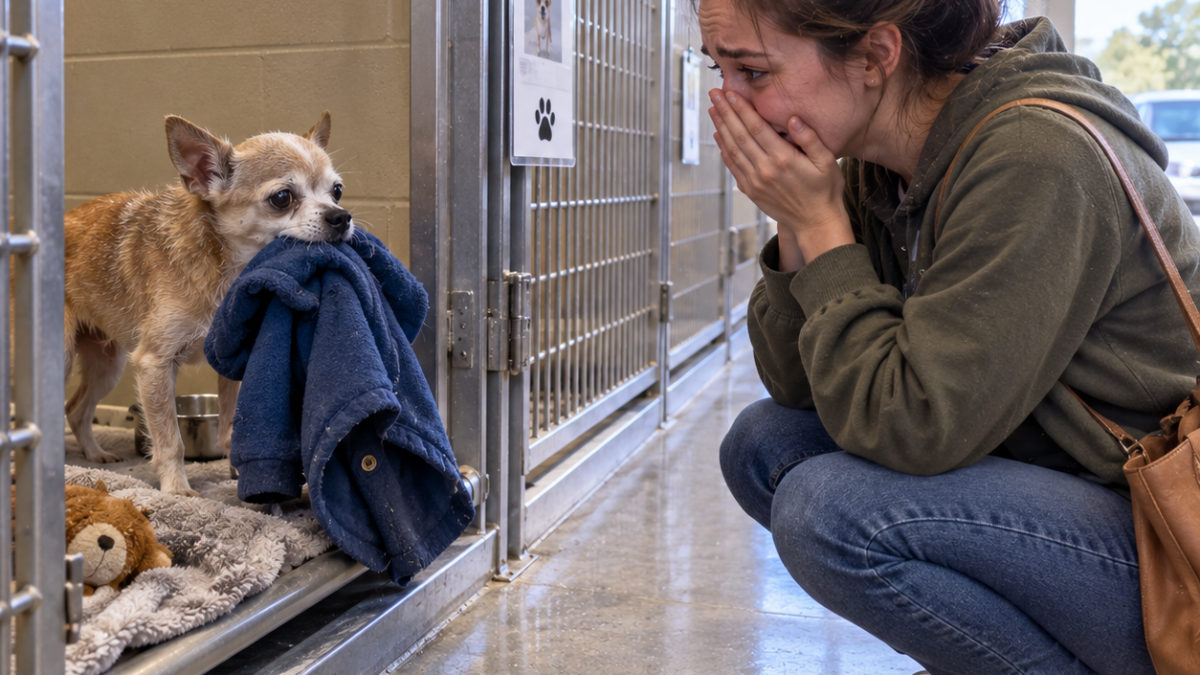
“I know this dog.”
For a moment, I honestly thought I had misunderstood her.
The adoption hallway was noisy that afternoon.
A shepherd mix two kennels down had started barking because someone was rolling a food cart through the service corridor, and somewhere behind us a puppy was whining in the high, breathless way puppies do when they think every closed door is a personal tragedy.
But Emma’s voice cut through all of it.
“I know him,” she said again.
Her eyes never left Charlie.
I looked through the kennel gate at the tiny old Chihuahua standing there with the blue coat hanging from his mouth.
“You’ve met Charlie before?”
Emma pressed her fingers to her lips and nodded.
“That wasn’t his name.”
Charlie’s ears twitched.
Emma crouched slowly.
The moment she lowered herself, the coat slipped from Charlie’s mouth.
He stepped toward the gate and stared at her.
Not excitedly.
Not like dogs sometimes react when they smell treats or hear a friendly voice.
He simply stared.
Emma stared back.
“What was his name?” I asked.
She swallowed.
“Benny.”
Charlie’s head tilted.
I felt the hair rise along my arms.
“Benny,” Emma repeated softly.
The little Chihuahua took one more step toward the gate.
His tail moved.
Once.
Then again.
Emma covered her face.
“Oh my God,” she whispered.
I unlocked the kennel.
Normally, we followed a fairly strict introduction procedure.
Leash first.
Neutral meeting area.
Slow contact.
Watch body language.
But Charlie had never shown aggression toward anyone, and something was happening in front of me that felt less like an introduction and more like an unfinished conversation.
I opened the gate.
Charlie did not rush out.
He looked down at the blue coat.
Then he looked at Emma.
He picked up the coat again.
Step by slow step, he walked toward her.
Emma sat down right there on the shelter floor.
She didn’t reach for him.
She let him decide.
Charlie stopped inches from her knees.
He sniffed the cuff of her jacket.
Then her hand.
Then her shoe.
His cloudy eyes moved up toward her face.
Emma whispered, “You remember me?”
Charlie dropped the blue coat into her lap.
Emma broke.
She bent forward, one hand clutching the coat and the other hovering above Charlie’s shoulders as if she were afraid touching him would make the moment disappear.
Charlie solved the problem for her.
He stepped between her knees, leaned his thin little body against her chest, and rested his chin on her arm.
Emma wrapped herself around him.
She cried into his gray fur.
Charlie closed his eyes.
I backed away.
There are moments in a shelter when you learn that privacy has nothing to do with walls.
Sometimes privacy is simply deciding that something belongs to two living creatures and not to you.
I went to the front desk and told my coworker Maya that I needed her to cover the hallway for a few minutes.
“What happened?” she asked.
I glanced back.
Emma was still sitting on the floor with Charlie against her chest and the blue coat wrapped around both of them.
“I’m not sure yet.”
When I returned, Emma had moved into our small meeting room.
Charlie was beside her on the couch.
He normally disliked couches.
We had tried to put him on one during his adoption photos and he immediately climbed down.
Now he was pressed against Emma’s thigh.
The coat lay across her lap.
She was running her thumb across the torn pocket.
“I remember this rip,” she said.
I sat across from her.
“Tell me.”
Emma took a slow breath.
“I grew up next door.”
She looked at Charlie.
“At least, next door to where he lived.”
Charlie’s eyes were closed, but his ears remained angled toward her voice.
“The man who owned him was named Walter.”
She smiled faintly.
“Walter Hayes.”
I knew the name.
It had been on Charlie’s intake paperwork.
No relatives had been willing or able to take the dog after Walter died.
The house had gone into probate.
Animal control had brought Charlie to us.
Emma touched the blue fabric.
“Mr. Hayes had that coat forever.”
“How long ago did you live there?”
“From the time I was nine until I left for college.”
She looked down.
“Almost fifteen years.”
Charlie would have been young then.
Emma nodded as if reading my thought.
“Benny was a puppy when Mr. Hayes got him.”
She laughed softly.
“I remember because everyone in the neighborhood thought it was funny.”
“What was funny?”
“Mr. Hayes had always had big dogs.”
Emma leaned back.
“German shepherds when he was younger, apparently. Then some kind of hound mix. He was this tall, broad-shouldered guy who worked construction most of his life. Rough hands, old truck, steel-toed boots.”
She scratched gently behind Charlie’s ear.
“Then one summer he showed up with a Chihuahua that could practically fit inside one of his work gloves.”
I smiled.
Emma did too.
“People teased him for months.”
“What did he say?”
“He said Benny had more courage than every big dog he’d ever owned put together.”
Charlie opened one eye.
Emma laughed through the tears.
“Yeah. You heard that, didn’t you?”
She looked back at me.
“Mr. Hayes lived alone. His wife had died before we moved into the neighborhood. His son lived out of state and almost never visited. At least, that’s what my parents told me.”
There was a pause.
“Benny became his whole routine.”
Emma began tracing the stitching on the coat.
“In the morning, Mr. Hayes drank coffee on the porch, and Benny sat beside his boot.”
“In the afternoon, if Mr. Hayes worked in the yard, Benny followed him.”
“When he washed his truck, Benny sat on the driveway.”
“When he fixed the porch railing, Benny sat under the ladder.”
“When he walked to the mailbox, Benny walked with him.”
She smiled.
“He didn’t even need a leash most of the time.”
“Was he friendly?”
“To me?”
She glanced at Charlie.
“Eventually.”
That one word carried another story.
Emma settled deeper into the chair.
“I was terrified of dogs when I was little.”
That surprised me.
She seemed completely comfortable with Charlie.
“My cousin had a big dog that knocked me down when I was five,” she explained.
“It didn’t bite me.”
“But when you’re five, getting knocked flat by something twice your size is enough.”
“So when we moved next door and I saw a dog in the yard, I avoided the fence.”
“Even a Chihuahua?”
Emma laughed.
“Especially that Chihuahua.”
“Benny barked at everything.”
Charlie lifted his head.
“You did,” Emma told him.
His tail tapped once against the couch.
“He would stand behind that chain-link fence like he personally owned the entire county.”
Emma’s smile softened.
“But one afternoon I lost a bracelet.”
She paused.
“My mother had given it to me for my tenth birthday.”
“It was cheap.”
“Little silver-colored stars.”
“But I loved it.”
“I was crying in our driveway because I couldn’t find it.”
“Mr. Hayes came over and asked what was wrong.”
“I told him.”
“He went back into his yard.”
“Five minutes later Benny came trotting out with something hanging from his mouth.”
“The bracelet?”
Emma nodded.
“He’d found it near the fence.”
That had been the beginning.
After that, Emma started visiting.
At first she talked to Charlie—Benny—through the fence.
Then Walter began inviting her to sit on the porch.
She learned that Benny liked tiny pieces of apple.
She learned he hated thunderstorms.
She learned he would burrow under Walter’s blue coat when the autumn wind came through the neighborhood.
She learned Walter talked to his dog as if Benny were another person.
“What do you think, Benny?”
“Rain tomorrow?”
“Should we fix that loose board?”
“You think the Cardinals have any chance this year?”
Emma laughed.
“I used to think it was ridiculous.”
“Then eventually I started answering for him.”
“What did Walter think about that?”
“He loved it.”
Her expression changed.
The smile remained, but there was sadness inside it now.
“Mr. Hayes wasn’t my grandfather.”
“But sometimes he felt like one.”
Emma’s father traveled constantly for work.
Her mother worked nights as a nurse.
Many afternoons, Emma came home from school to an empty house.
Walter noticed.
He never made a big thing of it.
He simply started leaving an extra glass of lemonade on the porch.
Sometimes Emma did homework at the small metal table while Walter repaired things in his garage.
Benny usually curled on the blue coat at her feet.
The coat became part of the picture.
Walter wore it every fall.
Heavy canvas.
Brass zipper.
One pocket that never closed correctly.
When he worked outside and got warm, he took it off and tossed it over the back of a porch chair.
Benny immediately claimed it.
“He loved the smell,” Emma said.
“Mr. Hayes used to say the dog was stealing his body heat.”
One October evening, the temperature dropped sharply.
Emma had been sitting on the porch working on algebra.
Walter went inside to make coffee.
Benny started shivering.
Emma remembered Walter coming back outside, seeing the dog, and shaking his head.
“You are the most spoiled eight pounds in Missouri,” he said.
Then he removed the blue coat and wrapped it around the Chihuahua.
Benny disappeared inside it.
Emma said only his ears remained visible.
They had laughed until Walter had tears in his eyes.
After that, the coat belonged to both of them.
Walter still wore it.
Benny still slept on it.
Neither seemed to mind the arrangement.
“What happened when you moved?” I asked.
Emma looked at her hands.
“College.”
She sighed.
“I left at eighteen.”
“Then my mother sold our house two years later and moved closer to my aunt.”
“I came back a few times.”
“Mr. Hayes was still there.”
“So was Benny.”
“Older, obviously.”
“Still barking at me through the fence before realizing who I was.”
Charlie had fallen asleep against her leg.
Emma looked down at him.
“The last time I saw them together, Mr. Hayes was on the porch.”
“He had the blue coat around his shoulders.”
“Benny was under the chair.”
“I told Mr. Hayes I was moving to Denver for a job.”
“He told me not to forget where I came from.”
She smiled painfully.
“He said people get so busy building their future that they start pretending their past belongs to somebody else.”
Neither of us spoke for a few seconds.
“Did you know he died?” I asked.
“Not right away.”
Emma’s eyes filled again.
“A friend from the neighborhood posted something online.”
“I saw it almost three weeks later.”
“I tried calling the number I still had for Mr. Hayes.”
“Disconnected.”
“I messaged people.”
“No one knew what happened to Benny.”
“I even called the county shelter.”
“He wasn’t there.”
That made sense.
Charlie had initially gone through animal control processing in another district before being transferred to us.
His records would have been difficult for a stranger to follow.
“I kept thinking about him,” Emma said.
“I should have tried harder.”
“You didn’t know where he was.”
“I could have come back.”
“Maybe.”
She looked at me.
“But I didn’t.”
I knew that kind of guilt.
Shelter work exposes you to it constantly.
People regret not noticing sooner.
Not checking a fence.
Not making a phone call.
Not visiting an aging relative.
Not asking who would care for a pet if something happened.
Regret loves hindsight because hindsight gives every road a sign.
Real life rarely does.
“You’re here now,” I said.
Emma looked at Charlie.
“Yes.”
The word was quiet.
But certain.
I needed to tell her everything.
I explained Charlie’s age.
His arthritis.
The heart murmur our veterinarian had detected.
The mild kidney disease.
His dental problems.
His cloudy vision.
The fact that he might have months.
Maybe a year.
Possibly longer.
Possibly much less.
Emma listened without interrupting.
Then she asked, “Does he hurt?”
“Some days his joints bother him.”
“We manage it with medication.”
“Can he still enjoy things?”
“Yes.”
“Does he eat?”
“Very enthusiastically.”
She smiled.
“Still likes apple?”
That stopped me.
“We’ve never given him apple.”
Emma looked down at Charlie.
“Can we try?”
We had some sliced apples in the staff refrigerator.
Maya brought a small piece.
Emma held it near Charlie’s nose.
His eyes opened instantly.
He sniffed.
Then the old Chihuahua sat up with more energy than I had seen from him in weeks.
Emma laughed.
“No way.”
Charlie took the apple.
Chewed.
Swallowed.
Then stared at her hand.
Maya whispered, “That dog has never looked at me like that.”
Emma wiped her face.
“I told you.”
That was when I knew.
Not that the adoption would definitely happen.
There were still procedures.
Forms.
Veterinary review.
A discussion with the director because Charlie was scheduled for sanctuary transfer.
But something had shifted.
For months, people had looked at Charlie and seen an old dog with a limited future.
Emma looked at him and saw a life that had already happened.
There is a difference.
A profound one.
The shelter director, Karen, joined us twenty minutes later.
She was cautious.
Not because she wanted to prevent the adoption.
Because elderly dogs like Charlie required honest expectations.
Karen explained the medical costs.
Possible emergencies.
The possibility of nighttime confusion.
Incontinence.
Loss of mobility.
Loss of appetite.
The emotional difficulty of taking home an animal knowing the goodbye might come quickly.
Emma listened.
Then she placed one hand over the blue coat.
“I understand.”
Karen studied her.
“You came here today planning to adopt?”
“Yes.”
“Did you come looking for Charlie?”
“No.”
“You didn’t know he was here?”
“No.”
Karen leaned back.
“That’s quite a coincidence.”
Emma looked at Charlie.
“I don’t think it feels like one.”
Karen did not respond immediately.
Neither did I.
There are sentences you can analyze until they lose their meaning.
That one did not need analysis.
We started the paperwork.
Under “Name,” Emma paused.
“Do I have to keep Charlie?”
“No.”
She looked at him.
“Then he’s Benny.”
His ear moved.
Emma smiled.
“Definitely Benny.”
The old name returned to his chart that afternoon.
Benny Hayes.
Not officially, of course.
Dogs do not carry surnames in our database.
But that is how Emma said it.
And somehow it fit.
While we processed the adoption, Emma asked whether the blue coat could come with him.
I almost laughed.
“I don’t think we could get him out the door without it.”
She folded it carefully.
Benny immediately stood and pawed at her knee.
Emma unfolded it again.
“Okay.”
She laid it beside him.
He stepped onto it and sat.
“Apparently he’ll be packing his own luggage,” I said.
Emma smiled.
“He always did know what mattered.”
We scheduled his departure for the next afternoon so our veterinarian could perform one final exam and give Emma detailed instructions.
I expected Emma to leave reluctantly.
Instead, she sat with Benny until closing.
For nearly three hours.
She talked to him.
Not constantly.
Sometimes she simply sat with one hand resting beside him on the coat.
When she finally stood, Benny followed her toward the door.
Then realized she was leaving without him.
He stopped.
The look on his face nearly undid me.
Emma crouched.
“I’m coming back tomorrow.”
Benny stared.
“I promise.”
She touched his collar.
It was a simple red shelter collar.
Emma frowned.
“He used to have a brown leather collar.”
“We didn’t find one.”
Her face fell.
“It had a little brass tag.”
She sighed.
“Probably gone.”
Benny leaned against her hand.
Emma whispered, “Tomorrow.”
After she left, Benny stood at the kennel gate for several minutes.
Then he returned to the coat.
But something was different.
He did not curl tightly into it.
He lay on top of it with his head facing the hallway.
Waiting.
The next morning, I arrived early.
Benny was already awake.
He ate breakfast.
Took his medication.
Walked outside.
Then returned to the kennel and positioned himself by the gate.
At 9:07, the front door opened.
Benny heard Emma’s voice from two hallways away.
His head snapped up.
I had never seen him move so quickly.
He scrambled to his feet.
His nails clicked against the kennel floor.
His tail started moving.
Not once.
Not twice.
Constantly.
Emma rounded the corner carrying a small brown paper bag.
“Benny.”
The Chihuahua barked.
One sharp bark.
Then another.
Emma knelt.
I opened the gate.
He ran.
It was not graceful.
His arthritic back legs slipped once.
Emma reached out.
Benny collided gently with her knees.
She gathered him up.
He licked her chin.
Emma laughed.
Everyone in the hallway stopped.
Maya cried openly.
One of the volunteers pretended she had something in her eye.
I gave up pretending.
Emma placed the paper bag on the floor.
“I brought something.”
Inside was a collar.
Brown leather.
Soft and narrow.
Attached to it was a small round brass tag.
BENNY.
Nothing else.
Emma held it.
“I know it isn’t the original.”
She looked at him.
“But I thought you should have your name back.”
We removed the red shelter collar.
Emma fastened the brown one.
The brass tag rested against Benny’s chest.
He shook his head once.
The tag jingled.
Emma closed her eyes.
“That sound.”
“What?”
“I remember that sound.”
She laughed.
“He used to come running across the porch and that tag would hit his food bowl.”
Benny looked up at her.
Emma picked up the blue coat.
“Ready?”
He walked beside her.
No hesitation.
No looking back at his kennel.
At the front door, however, he stopped.
Emma waited.
Benny turned his head toward me.
I know better than to pretend dogs think in human sentences.
I don’t know what he understood.
I don’t know whether he knew I had been one of the people feeding him, medicating him, sitting with him during storms.
But he looked at me for several seconds.
I crouched.
“You got lucky, old man.”
He walked over.
Sniffed my hand.
Licked my thumb.
Then returned to Emma.
I opened the door.
Cold November air rushed inside.
Emma had parked near the entrance.
She spread the blue coat across the passenger seat.
Benny put his front paws on the car frame but could not climb.
Emma lifted him carefully.
He settled onto the coat.
Then she sat in the driver’s seat.
Before closing the door, she looked at me.
“Thank you for keeping him safe.”
I shook my head.
“He did most of the hard part.”
Emma looked at Benny.
“No.”
“He waited.”
She was right.
Waiting can be hard work.
The car pulled away.
Benny stood for a moment with his paws against the window.
Then he turned.
Emma later told me that before she reached the first traffic light, he had curled up with his head against her thigh.
The sanctuary transfer scheduled for Thursday disappeared from our board.
Under Charlie’s name, Maya drew a line.
Then she wrote:
BENNY — HOME.
That could have been the end of the story.
For most adoptions, it is.
We watch a car leave.
We save a photo.
Sometimes we receive an update.
Then another dog arrives.
Another kennel needs cleaning.
Another frightened animal needs us to stop looking backward.
But Emma stayed in touch.
The first message arrived that evening.
It contained a photo.
Benny was asleep on the blue coat in front of a fireplace.
Beside him sat a new bed that he was completely ignoring.
Emma wrote:
I bought him the softest bed in the store.
Apparently Walter’s coat has a better warranty.
I laughed so loudly Maya came over to see.
Two days later, another photo.
Benny standing in a fenced backyard under a maple tree.
The blue coat lay on the grass beside him.
One week later, Emma called.
“I need help.”
My stomach dropped.
“What happened?”
“He won’t sleep in the bedroom.”
“That’s not necessarily concerning.”
“No.”
She laughed.
“He insists on sleeping by the front door.”
I knew immediately.
Walter’s house.
Emma had told me Benny used to lie near the door whenever Walter was inside.
“He’s guarding.”
“That’s what I thought.”
“Let him.”
So she did.
Emma moved Benny’s bed to the entryway.
He still chose the coat.
But every morning, when she came downstairs, he stood and followed her into the kitchen.
A routine began.
Medication hidden in a spoonful of canned food.
A slow trip outside.
Breakfast.
A piece of apple.
Then the backyard.
Emma worked remotely three days a week.
On those days, Benny slept beneath her desk.
On office days, her neighbor, a retired teacher named Mrs. Alvarez, checked on him at noon.
At first Benny barked at Mrs. Alvarez.
Emma sent me a video.
The bark sounded weak but determined.
I texted back:
That is apparently his version of a security system.
Emma replied:
Walter would be proud.
Over December, Benny gained nearly a pound.
For a Chihuahua, that was significant.
His coat improved.
His eyes brightened.
The arthritis did not disappear.
Age did not reverse itself.
But he began doing things we had never seen at the shelter.
He rolled onto his back when Emma scratched his chest.
He barked at delivery trucks.
He waited beneath the kitchen table during dinner.
He carried one sock from the laundry room into the living room every morning.
Never two.
Always one.
“Did he do that before?” I asked.
Emma didn’t know.
So she started keeping the socks in a basket.
By Christmas, Benny had collected eight.
Emma called it his inventory.
The blue coat remained different.
He never chewed it.
Never dragged it carelessly.
If a sleeve folded under him, he pawed until he could lie properly across the fabric.
Emma never washed it.
That worried her at first.
She asked our veterinarian whether there was a sanitary reason she should.
Dr. Patel shrugged.
“If it isn’t dirty enough to cause skin problems, leave it.”
Emma hesitated.
“Is that ridiculous?”
“No.”
Dr. Patel had worked in shelter medicine for twenty years.
He had seen dogs refuse food after losing owners.
He had seen animals wait beside hospital beds.
He had seen dogs sleep next to wheelchairs no one used anymore.
“Scent matters,” he said.
“Memory matters.”
Emma left the coat alone.
At Christmas, she drove back to her old neighborhood.
She almost didn’t.
She told me later that she sat in the car for ten minutes before turning onto the street.
The neighborhood had changed.
Two houses had been painted.
One had been torn down and replaced with something large and modern.
The old maple tree near her childhood driveway was gone.
But Walter’s house remained.
Empty.
A real estate company had placed a sign in the yard.
Emma parked across the street.
Benny had been sleeping.
Then his eyes opened.
He lifted his head.
Emma rolled down the window.
Benny stood.
The brass tag on his collar jingled.
His nose began moving.
Emma started crying before she even opened the door.
She carried him across the street.
The front gate was locked.
They could not go inside.
So she sat on the curb.
Benny stared through the fence.
For several minutes, he did nothing.
Then his tail moved.
Emma placed the blue coat beside him.
Benny sniffed the air.
A car passed.
A dog barked somewhere behind a house.
Wind moved dry leaves across the sidewalk.
Benny walked to the fence.
He pressed his nose through the gap.
Emma said she could almost imagine Walter opening the front door.
Blue coat on his shoulders.
Coffee in his hand.
Calling, “Come on, Benny.”
But the door remained closed.
After a while, Benny turned away.
He walked back to Emma.
He climbed awkwardly into her lap.
That was what surprised her most.
He did not stay facing the house.
He did not cry.
He did not pull at the gate.
He looked once.
Then chose her.
Emma wrapped the blue coat around them both.
“I think that was the day I understood something,” she told me later.
“What?”
“That remembering isn’t the same as refusing to move.”
Benny had remembered.
Then he had gone home.
His new home.
January brought snow.
Benny hated it.
Apparently some things about Chihuahua stereotypes were accurate.
Emma bought him a sweater.
He refused to walk in it.
She bought him a warmer coat.
He stood frozen in the hallway looking deeply offended.
Finally she spread Walter’s old blue coat on the floor.
Benny stepped onto it immediately.
“Traitor,” Emma told him.
She cut nothing.
Altered nothing.
Instead she wrapped one side loosely around him and carried him outside.
Benny tolerated that arrangement.
Mrs. Alvarez saw them one morning and laughed so hard she had to hold the fence.
“That dog has trained you.”
Emma looked down at Benny.
“Apparently I’m not his first student.”
By February, Benny knew the sound of Emma’s car.
On the days she worked at the office, Mrs. Alvarez said he began waiting near the window around 5:15.
Emma usually arrived between 5:30 and 5:45.
At the sound of her car door, Benny walked to the entryway.
When the key entered the lock, his tail started moving.
Emma began sitting on the floor for the first five minutes after coming home.
She said it felt wrong to immediately rush into dinner, laundry, email, dishes.
Benny had waited all day.
Five minutes belonged to him.
She would sit.
He would climb into her lap.
Sometimes he brought the blue coat.
Sometimes he brought a sock.
One evening, Emma found something in the coat pocket.
She had reached inside because the fabric was bunched strangely.
Her fingers touched metal.
She pulled out an old key.
It was small.
Brass.
Probably a house key.
Attached to it was a faded plastic tag.
No writing remained visible.
Emma stared at it for several minutes.
Then she remembered.
Walter used to keep a spare key in that coat.
She called me.
“I don’t know why this is upsetting me.”
“Because it belonged to him.”
“I already have his coat.”
“Objects aren’t logical.”
She laughed weakly.
“That sounds like something from a greeting card.”
“It probably is.”
She turned the key over in her fingers.
“I keep thinking about his door.”
“What about it?”
“He used this key thousands of times.”
Probably.
“Benny heard it.”
Yes.
“He heard that key in the lock and knew Mr. Hayes was home.”
Emma was quiet.
Then she said, “I’m going to keep it.”
She placed it in a small wooden box beside her bed.
Not as a relic.
Not exactly.
More like a punctuation mark.
A tiny piece of metal connecting one home to another.
Spring came slowly.
Benny’s health remained stable.
His kidneys were no worse.
His heart murmur had not progressed significantly.
His arthritis improved with medication and gentle movement.
Dr. Patel warned Emma not to mistake stability for permanence.
She nodded.
She understood.
But she also stopped measuring every good day against the possibility of a bad one.
That had been difficult at first.
She confessed to me that during the first month, every time Benny slept deeply, she checked whether he was breathing.
Every time he skipped part of a meal, she panicked.
Every time he stumbled, she imagined the end.
One afternoon, Dr. Patel finally told her, “You cannot love him properly if you spend every hour grieving him before he’s gone.”
Emma repeated that sentence to me.
“I hated hearing it.”
“Because he was right?”
“Exactly.”
So she changed.
Not completely.
Fear does not disappear because someone gives it good advice.
But she learned not to let fear become Benny’s atmosphere.
She took pictures.
Not obsessively.
Enough.
Benny under the desk.
Benny glaring at rain through the window.
Benny asleep with one ear standing upright.
Benny beside a plate containing three apple slices.
Benny sitting in the backyard with the blue coat behind him.
Benny curled against Mrs. Alvarez.
Benny riding in the car.
Benny staring suspiciously at a ceramic garden rabbit.
Normal pictures.
That was important.
Emma did not want every memory to feel like a countdown.
In April, something unexpected happened.
Walter’s son called.
His name was David.
Emma had never met him as an adult.
He had apparently heard from the real estate agent that a woman had brought Walter’s old dog back to the house around Christmas.
The agent had heard it from a neighbor.
The neighbor remembered Emma.
Eventually the story reached David.
He found her through social media.
Emma almost ignored the message.
It read:
Are you the Emma Carter who lived next door to my father, Walter Hayes?
She answered cautiously.
Yes.
David called the next evening.
Emma told me afterward that she expected him to be defensive.
Perhaps embarrassed.
Perhaps angry that a stranger had adopted his father’s dog.
Instead, he sounded tired.
“I should have taken Benny.”
Emma didn’t know what to say.
David filled the silence.
“I know what people probably think.”
Emma said, “I don’t know what people think.”
“I do.”
David lived in Oregon.
His wife had multiple sclerosis.
Their house had two large dogs already.
When Walter died, David flew back for the funeral and stayed four days.
He tried to arrange temporary care for Benny.
A cousin initially agreed.
Then changed his mind because his apartment did not allow pets.
David’s flight home could not be delayed without jeopardizing his job.
He contacted a local rescue that was full.
He called a neighbor who said no.
Animal control eventually became the only option.
“I told myself I would figure something out once I got home.”
David’s voice broke.
“Then my wife had a relapse.”
Days became weeks.
By the time David began calling shelters, Benny had moved through the system.
Records were incomplete.
One facility told him there was no Chihuahua matching the description.
Another never returned his call.
He assumed the worst.
“I thought he was dead.”
Emma sat at her kitchen table listening.
Benny slept beneath the chair.
“I’m sorry,” she said.
David exhaled.
“I’m the one who should be saying that.”
Then he asked the question Emma had been waiting for.
“Is he okay?”
She looked down.
Benny’s head rested on the blue coat.
“He is.”
“Happy?”
“I think so.”
David cried.
Quietly.
Embarrassed by it.
Emma pretended not to notice.
After a while, he said, “Dad loved that dog more than almost anything.”
“I know.”
“You remember them?”
“Very well.”
David laughed softly.
“Then you probably remember that stupid blue coat.”
Emma looked at the fabric.
“Benny brought it to the shelter.”
Silence.
“What?”
“When animal control took him out of the house, he carried the coat.”
David did not speak for nearly half a minute.
Then Emma heard him inhale sharply.
“That was Dad’s work coat.”
“I know.”
“He had it before I graduated high school.”
“I know.”
Another silence.
“I couldn’t find it.”
David sounded stunned.
“After the funeral, I looked for it.”
“Why?”
“I wanted it.”
That sentence changed the conversation.
Emma instinctively placed her hand on the coat.
Benny opened his eyes.
For one uncomfortable second, she felt possessive.
Not of the coat for herself.
Of it for Benny.
She imagined someone taking it away.
She imagined Benny searching.
Then David said, “But I think I know where it belongs.”
Emma relaxed.
They arranged a video call.
The next Sunday, David appeared on Emma’s laptop screen.
He was in his late forties.
Gray at the temples.
He had Walter’s eyebrows.
Emma noticed immediately.
Benny was asleep.
David asked if he could see him.
Emma lifted the laptop and angled the camera downward.
“Hey, Benny.”
The Chihuahua’s eyes opened.
David leaned closer to his screen.
“Hey, buddy.”
Benny stared.
His ears moved.
David smiled and cried at the same time.
“You got old.”
Benny stood.
He approached the laptop.
He sniffed the speaker.
David laughed.
“I guess I did too.”
Emma sat beside him.
For twenty minutes, David told stories she had never heard.
Walter had found Benny at a gas station.
Not purchased him.
Not adopted from a breeder.
Found him.
The puppy had been hiding beneath a vending machine enclosure behind the building.
Walter bought a package of beef jerky and spent forty minutes coaxing him out.
He planned to bring the puppy to a shelter.
Instead, Benny fell asleep inside the blue coat on the passenger seat.
Walter drove home.
“He called me that night,” David said.
“He said, ‘I accidentally got a dog.’”
Emma laughed.
“That sounds exactly like him.”
David nodded.
“Dad was lonely after Mom died.”
“He would never admit it.”
“Benny gave him someone to take care of.”
On the screen, Benny had settled again.
David’s eyes moved toward the coat.
“Can I ask you something?”
“Of course.”
“When Benny’s gone…”
He stopped.
Emma’s throat tightened.
David tried again.
“When you don’t need the coat for him anymore, would you consider letting me have one piece of it?”
Emma looked down.
“One piece?”
“I don’t want to take it away from you.”
“Or him.”
“I thought maybe a small square.”
“My daughter sews.”
“She could put it into something.”
Emma nodded.
“Of course.”
David wiped his eyes.
“Thank you.”
They stayed in contact after that.
A strange little family formed around an elderly Chihuahua.
Emma.
David.
Mrs. Alvarez.
Me.
Maya.
Dr. Patel.
None of us owned Benny’s entire story.
Each of us held a section.
Walter held the largest part.
But Walter was gone.
So the rest of us became witnesses.
Summer arrived.
Benny turned fifteen.
We did not know the exact date of his birth.
David remembered Walter estimating “sometime in June.”
Emma chose June 14.
“Why the fourteenth?” I asked.
“Because the fourteenth was the day Mr. Hayes found him.”
So June 14 became Benny’s birthday.
Emma invited five people.
Mrs. Alvarez.
Her sister Rachel.
Two old neighborhood friends who remembered Walter.
And me.
I almost declined.
Shelter staff are warned about becoming too involved in post-adoption lives.
Boundaries matter.
But I went.
Benny wore no party hat.
Emma said he would file a complaint.
There was no giant celebration.
Just a backyard dinner.
Benny got a small bowl of chicken and rice.
Afterward, Emma gave him one thin slice of apple.
He ate it slowly.
Then he walked to the shade beneath the maple tree.
The blue coat was already spread there.
Benny lay down.
David joined through video.
When he saw the gathering, he smiled.
“My dad would think this was ridiculous.”
Emma laughed.
“Would he secretly love it?”
“Completely.”
For a while we told Walter stories.
The people who knew him remembered different things.
One remembered his terrible jokes.
Another remembered how he shoveled snow from three driveways every winter without being asked.
Emma remembered the porch.
David remembered fishing trips.
I had never met Walter.
Yet by the end of the afternoon, I felt as though I could almost picture him.
Tall.
Weathered.
Blue coat.
Coffee.
Tiny dog near his boots.
At sunset, Benny woke.
He walked toward Emma.
She lifted him gently.
He rested against her chest.
David watched through the screen.
“Happy birthday, buddy.”
Benny licked Emma’s wrist.
David laughed.
“Still ignoring me.”
That was one of the happiest days.
I mention that because stories about old dogs can become dishonest if every happy moment is treated only as preparation for death.
Benny was dying in the broad sense that all living creatures are.
But that summer, he was also living.
He chased a moth once.
He stole half a piece of toast.
He barked at a vacuum cleaner.
He discovered watermelon and became mildly obsessed with it.
He escaped through an open bathroom door during bath time and ran dripping through the hallway.
Emma said she had not seen him move that fast since the shelter.
He attended a neighborhood cookout and spent most of it asleep beneath a chair.
He learned Mrs. Alvarez carried treats in her cardigan pocket.
He began waiting at her fence.
He barked at a Labrador twenty times his size and then hid behind Emma.
He lived.
Autumn brought the first warning.
Benny stopped eating breakfast.
One meal did not alarm Emma.
Two did.
By dinner, he ate only half.
The next morning she called Dr. Patel.
Bloodwork showed his kidney values had worsened.
Not catastrophically.
But enough.
His medication changed.
His diet changed.
Emma learned how to give subcutaneous fluids at home.
The first time, her hands shook.
Benny looked annoyed.
Dr. Patel guided her.
“Breathe.”
“I am breathing.”
“Not convincingly.”
Emma laughed nervously.
The needle went in.
Benny barely reacted.
“You’re braver than I am,” Emma told him.
His appetite improved.
For several weeks, things stabilized again.
But Emma knew.
The road had changed.
She called me one evening.
“How do you know when it’s time?”
It is one of the worst questions anyone can ask a shelter worker.
Not because we do not understand it.
Because we understand it too well.
“There isn’t one answer.”
“I’m afraid I’ll wait too long.”
“That’s normal.”
“I’m afraid I’ll do it too soon.”
“That’s also normal.”
She was quiet.
“What do I watch?”
“Comfort.”
“Interest.”
“Whether the good moments still belong to him or whether you’re keeping them for yourself.”
Emma cried then.
Not dramatically.
Just quiet tears on the other end of the phone.
“I don’t want to be selfish.”
“Loving him isn’t selfish.”
“Keeping him because you can’t bear to lose him could become selfish.”
“I know.”
“But you aren’t there yet.”
“How do you know?”
“Because today you told me he stole chicken from your plate.”
She laughed.
“That little criminal.”
“Exactly.”
Benny remained with her through another winter.
He slowed.
His walks became trips to the end of the driveway.
Then halfway.
Then just the yard.
Emma bought a stroller.
She felt ridiculous pushing it at first.
Benny loved it.
He sat inside wrapped in the blue coat like a retired king.
Neighbors waved.
Children asked to pet him.
Benny accepted attention with the gravity of a public official.
Emma took him through the park.
To a small lake.
Past a café where she bought coffee.
Benny watched the world from the stroller.
Wind moved his ears.
Sometimes he slept.
Sometimes he sniffed.
One afternoon, Emma pushed him past a construction site.
The sound of a hammer made Benny sit upright.
Emma froze.
Walter had worked construction.
She wondered whether the sound meant anything to him.
Benny listened.
Hammer.
Pause.
Hammer.
His nose lifted.
Emma touched the blue coat.
“Remembering him?”
Benny looked at her.
Then settled back down.
It became their pattern.
The past would appear.
A sound.
A smell.
A place.
Benny noticed.
Then returned to the present.
That was his gift to Emma.
She had spent years believing memory was something that pulled backward.
Benny taught her that memory could travel beside you.
In March, David came to visit.
He had not seen Benny in nearly twelve years.
Emma met him at the airport.
David carried only one suitcase.
The moment he entered Emma’s house, he stopped in the entryway.
Benny was asleep on the coat.
David whispered, “Wow.”
Benny woke.
David crouched.
“Hey, little man.”
Benny stared.
David did not move closer.
After a few seconds, Benny stood.
He walked toward David.
Sniffed his hand.
Then his shoes.
Then the cuff of his jeans.
David’s face changed.
“He used to do this when I came home.”
Benny circled him once.
Then sat.
David laughed.
“I think I passed inspection.”
Emma watched.
Later, David admitted that coming had frightened him.
“Why?”
“Because I thought he might hate me.”
“Dogs don’t think like that.”
“I know.”
“But I thought maybe I’d look at him and see everything I failed to do.”
Instead, he saw his father.
Not literally.
Not supernaturally.
In habits.
Benny waited near the kitchen when David made coffee.
He climbed onto the blanket beside David’s boots.
When David picked up the blue coat, Benny placed one paw on it.
David immediately let go.
“Okay.”
He smiled.
“Still yours.”
That evening, they sat in the backyard.
David told Emma more about Walter.
Father and son had been complicated.
Walter believed love was best demonstrated through practical things.
Fixing brakes.
Replacing a roof.
Driving four hours to help install a water heater.
David had wanted words.
Walter rarely had them.
After David’s mother died, the distance between them grew.
Then Benny appeared.
Oddly, the Chihuahua improved their relationship.
David called more often because Walter always had Benny stories.
“Dog stole my sandwich.”
“Dog chased a squirrel.”
“Dog hates your Christmas gift.”
“Dog slept through the tornado siren.”
Small talk became connection.
“Dad never said, ‘I miss you,’” David explained.
“He’d say, ‘Benny keeps checking the driveway.’”
Emma smiled.
“That meant he missed you.”
“I know that now.”
David looked across the yard.
“I wish I knew it then.”
Benny was sleeping between them.
The blue coat covered his back.
Emma touched David’s arm.
“He knew you loved him.”
“Maybe.”
“Mr. Hayes wasn’t easy to fool.”
David laughed.
“No.”
“He wasn’t.”
The next morning, David asked if he could visit the old house.
Emma drove.
Benny came too.
The property had finally sold.
A young couple lived there now.
Emma had contacted them beforehand.
They knew the story from neighbors.
They welcomed them.
The house looked different inside.
New floors.
White walls.
Modern lights.
But the porch remained.
David stepped onto it and froze.
“This is exactly the same.”
Benny stood near the door.
His nose moved.
The new owner, Michael, opened the back gate.
“You can take him around if you want.”
They walked into the yard.
Walter’s workshop was gone.
The old garden beds had been replaced.
But one thing remained.
A large oak near the back fence.
Benny walked toward it.
Slowly.
He stopped at the base.
David covered his mouth.
“What?”
Emma asked.
“Dad used to sit here.”
There had once been a bench.
Benny sniffed the ground.
Then sat.
They stayed there nearly twenty minutes.
Nobody spoke much.
Before leaving, Michael handed David something.
“We found this in the garage when we moved in.”
It was a small cardboard box.
Inside were screws.
Nails.
A tape measure.
Two old photographs.
One showed Walter on the porch.
Benny sat beside him.
Walter wore the blue coat.
The second photograph showed a much younger Emma standing by the fence.
Benny was in her arms.
Emma gasped.
“I don’t remember this.”
David turned the photo over.
Walter’s handwriting covered the back.
EMMA FINALLY ADMITS BENNY IS NOT TERRIFYING.
Summer 2006.
Emma laughed so hard she cried.
David took a picture of the photograph.
Then he handed the original to her.
“You should have this.”
“It belongs to your family.”
David looked at Benny.
“You are family.”
Emma accepted it.
That photograph later went into a frame near her front door.
Benny’s decline accelerated in late spring.
His heart became weaker.
Some nights he coughed.
His kidney disease progressed.
He slept more.
Emma stopped working from the office.
Her manager allowed her to work remotely.
Mrs. Alvarez continued visiting.
David called every Sunday.
I visited once.
When I arrived, Benny did not come to the door.
That scared me.
Then I found him in the backyard.
Blue coat beneath him.
Sun on his face.
He opened his eyes when I sat nearby.
“Remember me?”
His tail moved once.
Good enough.
Emma brought lemonade.
We sat on the grass.
“He had a bad night,” she said.
“I’m sorry.”
“He seems better today.”
I looked at Benny.
His breathing was slow.
Not distressed.
Just tired.
Emma had lost weight.
Not much.
Enough that I noticed.
“You sleeping?”
“Some.”
“Eating?”
She gave me a look.
“I’m not the patient.”
“No.”
“But you’re part of the case.”
She sighed.
“Yes, Mom.”
We laughed quietly.
Benny woke.
He struggled to stand.
Emma immediately moved toward him.
I raised my hand.
“Wait.”
She stopped.
Benny tried again.
His legs shook.
Then he stood.
He took several steps.
Reached Emma.
And leaned against her ankle.
She picked him up.
“He hates being helped.”
“I noticed.”
Emma held him.
“I think that’s why I love him so much.”
“Because he’s stubborn?”
“Because he keeps choosing.”
She looked down.
“He lost Walter.”
“Lost his house.”
“Lost everything familiar.”
“And somehow he still chose me.”
That sentence stayed with me.
A few weeks later, Benny stopped wanting the stroller.
Emma knew that meant something.
He had always liked going out.
Now he preferred the backyard.
Then the porch.
Then the entryway.
One morning, he refused apple.
Emma called Dr. Patel.
Blood tests confirmed what everyone expected.
His kidneys were failing.
There were treatments that could buy time.
Hospitalization.
IV fluids.
More medication.
Possibly several days.
Possibly several weeks afterward.
Emma asked the only question that mattered.
“Would it make him feel good?”
Dr. Patel answered carefully.
“It might make the numbers better.”
“That isn’t what I asked.”
Dr. Patel looked at Benny.
Then at Emma.
“No.”
Emma nodded.
“Then I’m taking him home.”
They discussed hospice.
Pain control.
Nausea medication.
Hydration.
Signs of distress.
Benny went home wrapped in the blue coat.
That evening, Emma called David.
“He’s close.”
David was silent.
“How close?”
“I don’t know.”
“Days.”
“Maybe.”
“I can come.”
Emma looked at Benny.
He was asleep.
“You don’t have to.”
“I know.”
David arrived the following evening.
Mrs. Alvarez came too.
No one called it a goodbye gathering.
That would have been unbearable.
They simply spent time together.
David sat on the floor.
Benny slept beside him.
Mrs. Alvarez brought chicken.
Benny ate two tiny bites.
Emma offered apple.
He sniffed it.
Then turned away.
She cried.
Not because an apple mattered.
Because it did.
Late that night, David placed his hand beside Benny.
“Tell Dad I’m sorry I didn’t call more.”
Emma looked at him.
David smiled sadly.
“That’s stupid.”
“No.”
“Maybe.”
He stroked Benny’s head.
“Tell him I figured it out eventually.”
Benny breathed slowly.
David left two days later because his wife needed him.
Before going, he knelt beside Benny.
“I love you, little man.”
Benny lifted his head.
Licked David’s finger.
Then lowered his head again.
David stood quickly and walked outside.
Emma found him crying near the car.
“I thought I was coming to say goodbye to the dog.”
He wiped his face.
“I think I came to say goodbye to Dad.”
Emma hugged him.
“He would understand.”
“How do you know?”
“Because Benny does.”
The last morning began quietly.
Emma woke before sunrise.
Something had changed.
She did not know what.
The house felt different.
She walked downstairs.
Benny was not on his bed.
He had moved several feet away.
The blue coat lay near the door.
Benny was beside it.
Emma knelt.
“Hey.”
His eyes opened.
He tried to stand.
Couldn’t.
Emma lifted him.
His body felt lighter than it should have.
She carried him outside.
The sky was pale.
The grass was wet.
She spread the blue coat beneath the maple tree.
Benny lay on it.
For a while, they watched morning arrive.
Birds started calling.
A truck passed somewhere beyond the neighborhood.
Emma drank coffee.
Benny slept.
At 7:20, he woke.
He looked toward the house.
Then toward Emma.
She knew.
Not because of magic.
Because she had spent a year learning his face.
His breathing had changed.
His eyes were tired in a way sleep could not fix.
Emma called Dr. Patel.
He offered to come to the house.
Emma agreed.
Then she called me.
“I think it’s today.”
I closed my eyes.
“Do you want me there?”
A pause.
“Yes.”
I arrived forty minutes later.
Mrs. Alvarez was already sitting on the porch.
Her eyes were red.
Emma was in the backyard.
Benny rested against her chest.
The blue coat covered both of them.
I sat nearby.
No one talked much.
Eventually Emma said, “Do you remember the first day?”
“Yes.”
“I thought he dropped the coat in my lap because he recognized me.”
“Maybe he did.”
“I think I was wrong.”
“How?”
She looked at him.
“I think he was asking whether I could carry it with him.”
That was better.
More honest.
Walter’s memory had never transferred from Benny to Emma.
It had been shared.
Dr. Patel arrived.
He examined Benny gently.
His expression told us the truth before he spoke.
“He’s very tired.”
Emma nodded.
“Is he suffering?”
“He’s uncomfortable.”
“Can you fix it?”
“Not in a lasting way.”
Emma pressed her face against Benny’s head.
“Okay.”
Dr. Patel explained the process.
Emma had heard it before.
Still, he explained.
She deserved clarity.
We all did.
Emma asked for a few minutes.
Dr. Patel stepped away.
Mrs. Alvarez returned to the porch.
I stayed only because Emma reached for my hand.
Benny’s head rested over her heart.
She spoke to him.
“Mr. Hayes loved you.”
Benny’s eyes remained half closed.
“He loved you so much.”
Emma breathed.
“And I love you too.”
Her voice broke.
“You don’t have to keep waiting.”
That sentence nearly destroyed me.
Because waiting had defined Benny’s life with us.
Waiting beside Walter’s chair.
Waiting in the house.
Waiting in the shelter.
Waiting at his kennel gate.
Waiting by Emma’s front door.
Waiting was love to him.
Emma stroked the brown leather collar.
The brass tag was scratched now.
BENNY.
“You can go if you’re tired.”
His breathing softened.
Dr. Patel returned.
The first medication made Benny deeply sleepy.
He relaxed against Emma.
For the first time in days, every muscle seemed to release.
Emma smiled through tears.
“There you are.”
Benny’s nose rested against the blue coat.
Dr. Patel waited.
Emma nodded.
The final medication went slowly.
No struggle.
No fear.
Benny’s breathing became lighter.
Then quieter.
Then stopped.
Emma remained still.
I don’t know how long.
Minutes.
Maybe more.
The world kept behaving offensively normally.
Birds.
Wind.
A lawn mower starting several houses away.
Sunlight moving across the grass.
Emma held Benny.
Finally she whispered, “He’s gone.”
Dr. Patel nodded.
“Yes.”
Emma wrapped him completely in Walter’s coat.
Then she changed her mind.
She uncovered his face.
She laughed through her tears.
“He hated having his ears covered.”
We laughed too.
Even Dr. Patel.
That small laugh saved us.
Emma kept Benny at home for another hour before the cremation service arrived.
She carried him inside.
Placed him on the bed by the door.
The same bed he had ignored for months.
The blue coat remained under him.
When it was time, Emma removed the coat.
That was difficult.
Benny’s paws had rested on it.
She pulled the fabric slowly.
For a second she almost put it back.
Then she remembered David.
Remembered Walter.
Remembered herself.
The coat no longer belonged to death.
It belonged to the story.
She kissed Benny’s head.
“Go find him.”
Then she let him go.
Two weeks later, Emma received Benny’s ashes.
The container was simple.
Wooden.
She placed the brass tag on top.
The brown collar lay beside it.
The blue coat remained folded nearby.
For several months, Emma could not move any of them.
Then one Sunday, David called.
They talked.
Eventually he asked, “Are you ready?”
Emma knew what he meant.
“Yes.”
She mailed him a section of the inside lining.
Not the outer blue canvas.
She could not bring herself to cut that.
Instead, she carefully opened one seam and removed a piece of the soft inner fabric.
David’s daughter sewed it into a small square pillow.
David kept it on a chair beside a photograph of Walter.
Emma repaired the seam herself.
Poorly.
The stitches were crooked.
She liked them that way.
The coat had carried Walter.
Then Benny.
Now it carried her repair too.
The following autumn, Emma visited the shelter.
She walked through the same front door.
For one terrible second, I expected to see Benny behind her.
Grief does that.
It turns absence into a reflex.
Emma carried a paper bag.
Inside were apples.
“For the staff?”
I asked.
She smiled.
“Mostly.”
We sat in the meeting room.
The same room where she had told me about Walter.
She showed me a photograph.
Benny’s ashes had been buried beneath the maple tree.
Not all of them.
David received a small portion.
Emma kept a little too.
The rest went beneath the tree where Benny had spent so many afternoons.
A flat stone marked the place.
No elaborate inscription.
Just:
BENNY
GOOD DOG
I smiled.
“Walter would approve.”
“I think so.”
Emma reached into her bag.
She pulled out the blue coat.
I stared.
“You brought it.”
“I wanted you to see something.”
She turned the coat around.
Inside, near the lower seam, she had stitched two small pieces of fabric.
One was brown.
One was red.
“What are those?”
“The brown one is from Benny’s bed.”
“The red one?”
She smiled.
“His shelter collar.”
I stared at her.
“You kept it?”
“Of course.”
She ran her fingers over the patches.
“Walter’s coat.”
“Benny’s bed.”
“Your shelter collar.”
“All the homes.”
That was exactly what it was.
Not an object preserved unchanged.
A map.
Walter had worn it through years of work.
Benny had slept on it through grief.
The shelter had protected it.
Emma had carried it through his final year.
David had taken part of the lining home.
Memory had not remained frozen.
It had accumulated.
Emma folded the coat.
“I used to think I rescued him.”
I smiled.
“Everyone says that.”
“I know.”
“And now?”
She thought.
“I think we just found each other at the right part of the story.”
That answer was better.
Before leaving, Emma asked if she could walk through the adoption hallway.
“Of course.”
We passed kennels.
Young dogs.
Old dogs.
Loud dogs.
Quiet dogs.
Halfway down, Emma stopped.
Inside one kennel sat a senior Chihuahua.
Female.
Cream-colored.
Ten years old.
She had been surrendered after her owner moved into assisted living.
Emma crouched.
The Chihuahua looked at her.
I held my breath.
Emma glanced at me.
“No.”
I laughed.
“I didn’t say anything.”
“You were thinking it.”
“I was absolutely thinking it.”
Emma smiled.
“I’m not ready.”
“That’s okay.”
She stood.
Then the little Chihuahua walked to the gate.
Emma paused.
She put two fingers through.
The dog sniffed them.
Emma’s eyes filled.
“I’m really not ready.”
“I know.”
She stayed another five minutes.
Then she left.
Three months passed.
Emma returned.
This time she brought a leash.
The cream-colored Chihuahua was still there.
Her name was Lucy.
Emma adopted her.
She did not bring the blue coat.
That mattered.
Lucy deserved her own beginning.
But the coat remained at home.
Folded inside a wooden chest near the front door.
Sometimes Emma took it out.
Usually in autumn.
She would sit on the porch.
Lucy would settle nearby.
Emma would hold the fabric and think about Walter.
About Benny.
About a lonely man who accidentally got a Chihuahua because a frightened puppy fell asleep in his coat.
About a girl who learned not to fear dogs because that same Chihuahua returned her bracelet.
About an old animal who lost almost everything and carried one familiar object through the door.
About a shelter kennel.
A brown collar.
A brass tag.
A piece of apple.
A locked gate.
A maple tree.
A final morning.
Years later, Emma told me she eventually understood why the coat mattered so much.
It was never because Benny believed Walter would come back.
We humans tend to project that kind of story onto animals because we need grief to behave like ours.
Maybe Benny understood absence differently.
Maybe he didn’t understand it at all.
But the coat smelled like safety.
It belonged to mornings on the porch.
Coffee.
Work boots.
Autumn.
A familiar voice.
A hand reaching down.
A world that made sense.
When that world disappeared, Benny carried one piece of it.
Then Emma appeared.
Someone from that world.
Someone who remembered.
And Benny did something remarkable.
He let the past lead him toward another home instead of trapping him inside the old one.
I have worked at the shelter for many years now.
I have seen hundreds of dogs arrive carrying invisible histories.
Some find homes immediately.
Some wait.
Some are returned.
Some surprise us.
There are dogs whose stories I struggle to remember.
Then there is Benny.
I still remember the first time animal control placed him in that kennel.
Tiny body.
Gray muzzle.
Blue coat larger than he was.
I remember visitors walking by.
I remember Thursday written on the transfer board.
I remember Emma freezing in the hallway.
I remember her saying, “I know this dog.”
But most of all, I remember the day he left.
Benny walking beside her.
The blue coat trailing from his mouth.
Brown collar around his neck.
Brass tag making a faint sound with every step.
He looked old.
He looked tired.
He looked completely ordinary.
There were no cameras.
No dramatic music.
No crowd cheering.
Just a woman opening a car door for a Chihuahua who had spent months waiting for someone to understand what he was carrying.
And someone finally did.
People sometimes ask whether shelter work makes me believe in fate.
I don’t know.
I have seen too much randomness to answer that easily.
Wrong doors left open.
Cars arriving one minute too soon.
Illness.
Accidents.
Animals found because one person happened to turn down a road they rarely used.
Lives changed by coincidence.
So I do not know whether Emma was meant to walk into our shelter two days before Benny’s transfer.
I do not know whether Walter would have called it fate.
I suspect he would have rolled his eyes and said something practical.
But I know this.
Benny waited.
Emma came.
She recognized the coat.
She remembered the man.
And when Benny placed that faded piece of blue canvas into her lap, she understood that she was not being asked to replace anyone.
Walter could not be replaced.
His porch could not be rebuilt.
His years with Benny could not be repeated.
Emma was being offered something harder.
The chance to love a dog whose heart already contained another home.
She accepted.
And for the final chapter of Benny’s life, nobody asked him to forget.
That may have been the greatest kindness of all.
Emma allowed Walter to remain part of the house.
His name was spoken.
His stories were told.
His coat stayed near Benny.
His son was welcomed back into the circle.
The past was never treated as competition.
It became foundation.
Benny died knowing two kinds of home.
The first home that shaped him.
And the second home that honored the first.
Sometimes, when autumn arrives and I see someone wearing an old blue work coat, I think of him.
A tiny Chihuahua carrying a garment nearly as large as his body.
Determined not to leave it behind.
People often say dogs live in the present.
Maybe they do.
But Benny taught me that the present can hold the past without being imprisoned by it.
Love can survive inside a smell.
A sound.
A collar.
A torn pocket.
A key forgotten in a coat.
A name spoken after years of silence.
And sometimes, the most important thing we can say to an old animal is not, “Forget what you lost.”
It is something much simpler.
I know who you were.
I know who you loved.
You don’t have to leave any of it behind.
Come home anyway.








