The old Border Collie had already been removed from our adoption list when a couple called the shelter and said, “That’s our dog.”
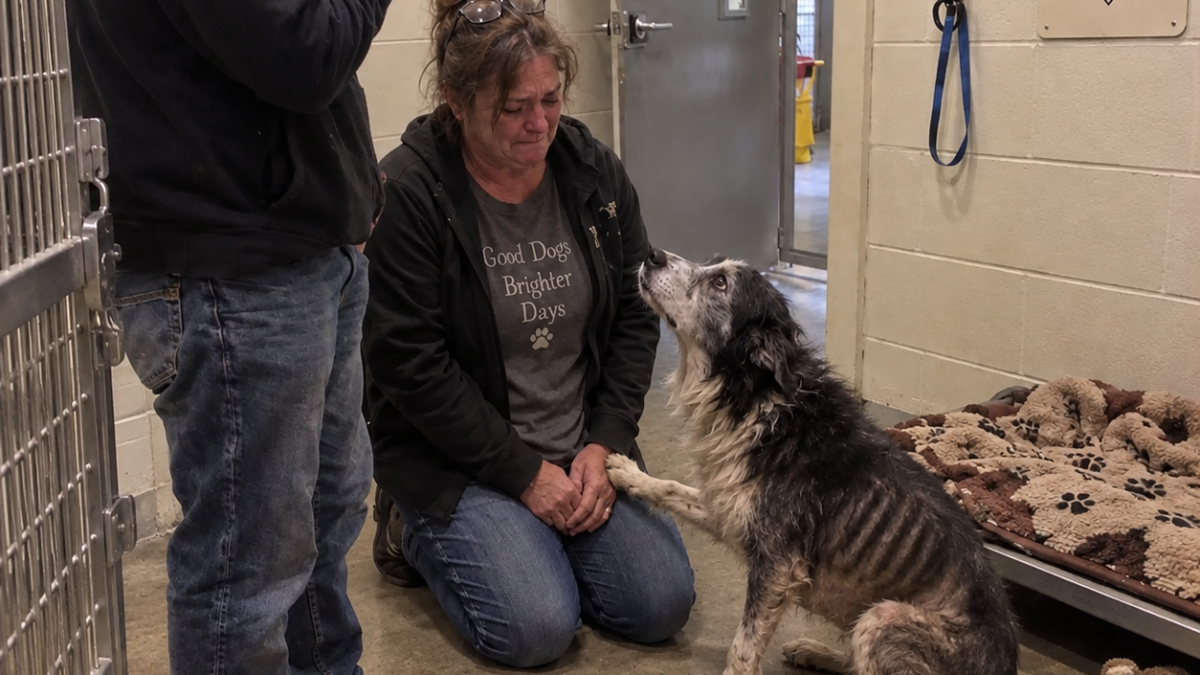
For several seconds after the call ended, I stood behind the front desk with the receiver still pressed to my ear.
The line had already gone silent.
I could hear the shelter around me waking into another ordinary Thursday.
Kennel doors opening.
Metal bowls being stacked.
Dogs barking for breakfast.
The washing machine thumping in the laundry room.
Someone laughing near intake because a young beagle had stolen a roll of paper towels and was sprinting through the hallway with it.
Everything was normal.
Except nothing was normal anymore.
I put down the phone.
Then I ran.
I did not walk toward the hospice wing.
I ran through the treatment hallway, past the supply room, past the volunteer lockers, nearly collided with Marcus from maintenance, apologized without stopping, and reached Blue’s room breathless.
He was still there.
Still lying in the same corner.
Still on the faded green blanket he had used for months.
His head rested on his paws.
The morning light came through the narrow window and fell across the white fur on his neck.
For one awful second, I imagined I was too late.
“Blue?”
His ear twitched.
I had never called him that before.
To us, he had been listed as BC-117 when he first arrived.
Later, staff started calling him Old Man.
Then Charlie for a few weeks because someone said every gentle Border Collie looked like a Charlie.
But none of those names had ever changed him.
“Blue?”
This time, his eyes opened.
Slowly.
Cloudy brown.
Tired.
But open.
I dropped to my knees.
“Listen to me.”
He watched me.
“I don’t know how much of this you understand.”
His ears shifted.
“But somebody is coming.”
His head lifted an inch.
I swallowed.
“Somebody who knows your name.”
Blue looked at me for a long moment.
Then his head rose farther.
It took effort.
Everything took effort for him now.
But he was no longer resting completely on the blanket.
“They said you belonged to them years ago.”
His eyes stayed on mine.
“They said they never forgot you.”
I laughed once through the tears already running down my face.
“Apparently your name really is Blue.”
His tail moved.
Barely.
One small movement against the blanket.
I froze.
“Blue?”
Another movement.
It could have been coincidence.
Muscle reflex.
Wishful thinking.
I did not care.
“You remember that name, don’t you?”
He lowered his head again.
But something in his face had changed.
Not dramatically.
Not enough for anyone else to notice.
I noticed.
For months, Blue had looked at doors.
Now he looked at me.
I sat beside him until one of the technicians found me.
“Sloan?”
I turned.
Jenna stood in the doorway holding a medication cup.
“You know his transfer paperwork is ready.”
“Cancel it.”
She blinked.
“What?”
“Don’t cancel the hospice care.”
I stood quickly.
“Just stop the transfer.”
“Why?”
I wiped my face.
“His family is coming.”
Jenna stared.
“His what?”
I told her.
Not elegantly.
I spoke too quickly, mixing the phone call with the white heart-shaped mark and the photograph and the couple driving in from two counties away.
By the time I finished, Jenna had tears in her eyes too.
“You’re sure?”
“No.”
That was the truth.
“They’re sure.”
“What if they’re mistaken?”
“I don’t know.”
“What if Blue doesn’t recognize them?”
I looked at him.
“I don’t know.”
The hope that had exploded inside me suddenly became frightening.
What if we had built a miracle too quickly?
Old dogs change.
Coats fade.
Faces narrow.
Scars appear.
People misremember.
A couple desperate to repair some old regret might see what they needed to see.
Or Blue might have forgotten.
Years are long.
Perhaps dogs are better at letting go than people.
Perhaps the name reaction had been nothing.
I forced myself to breathe.
“We verify everything.”
Jenna nodded.
“Microchip?”
“None when he came in.”
“Records?”
“They’re bringing old veterinary records and photos.”
“Good.”
She crouched beside Blue.
“Hey, Blue.”
His ear moved again.
Jenna looked at me.
“Well.”
We both began crying again.
The couple arrived at 12:46.
I know the exact time because I had been looking at the clock every thirty seconds since ten in the morning.
A silver sedan pulled into the parking lot.
It stopped crooked across the space.
The passenger door opened before the engine fully shut off.
A woman stepped out.
She looked around fifty-five, maybe sixty.
Light brown hair streaked with gray.
Blue sweater.
Hands shaking visibly.
Her husband came around the car and caught her elbow as though he thought her legs might stop working.
He was taller, broad-shouldered, with gray hair and glasses.
Neither of them walked quickly.
That surprised me.
After the urgency of the phone call, I had imagined them running through the doors.
Instead, they moved as if approaching something sacred.
Something that might vanish if they hurried.
The woman reached the entrance first.
I opened the door.
“Sloan?”
“Yes.”
“I’m Rebecca.”
Her voice broke immediately.
“This is my husband, Thomas.”
Thomas held out his hand.
Then dropped it.
“I’m sorry.”
“For what?”
“I don’t know.”
He laughed nervously.
“Everything.”
Rebecca gripped his hand with both of hers.
“Where is he?”
“In our quiet wing.”
“Is he…”
She could not finish.
“He’s alive.”
Her eyes closed.
“Can he walk?”
“A little.”
“Is he in pain?”
“We manage it.”
“Does he…”
She swallowed.
“Does he know his name?”
That question hit me.
“I said Blue this morning.”
Rebecca stopped breathing.
“And?”
“He looked at me.”
She covered her mouth.
Thomas turned away and wiped his face.
I stepped aside.
“Before you see him, I need to verify a few things.”
“Of course.”
They had brought a folder.
Not a small one.
A thick blue binder filled with old veterinary records, registration documents, photographs, vaccination certificates, and printed emails.
The first photo showed a young Border Collie puppy with oversized ears sitting between Rebecca and Thomas on a kitchen floor.
The second showed Blue at maybe one year old chasing a red Frisbee.
Another showed him sleeping upside down on a couch.
Another showed him beside a Christmas tree wearing a green collar.
The white mark on his left shoulder was visible in several pictures.
Crooked.
Heart-shaped.
Exactly the same.
I turned another page.
There was a veterinary record.
Name: Blue.
Breed: Border Collie.
Male.
Black and white.
Date of birth estimated eleven years earlier.
A note mentioned a healed fracture on the right hind leg from a puppyhood accident.
Blue had an old deformity in that exact leg.
I looked up.
“It’s him.”
Rebecca made a sound I will never forget.
Half sob.
Half breath.
Thomas closed both hands over his face.
For a moment, neither of them moved.
Then Rebecca asked the question I had been waiting for.
“How did he get here?”
“I don’t know.”
Her face fell.
“We were told the family who took him would keep him forever.”
I sat across from them in our small meeting room.
“What happened?”
Rebecca looked at Thomas.
He nodded for her to answer.
Blue’s history began eight years earlier.
Rebecca and Thomas had owned him from puppyhood.
They had no children.
Blue had been, in Rebecca’s words, “our whole noisy little house.”
He slept beside their bed.
Ran beside Thomas every morning.
Followed Rebecca from room to room.
Knew how to open the laundry-room door with his nose.
Hated thunderstorms.
Loved apples.
Could recognize the sound of Thomas’s old pickup from two blocks away.
Then Thomas was injured at work.
A fall from scaffolding.
Broken pelvis.
Spinal damage.
Months of surgery and rehabilitation.
He lost his construction job.
Medical bills piled up.
Rebecca cut her hours to care for him.
Within a year, they lost their house.
They moved into a small apartment owned by Rebecca’s sister.
No dogs over twenty-five pounds.
They begged for an exception.
Denied.
They looked for another apartment.
Nothing they could afford allowed Blue.
They tried friends.
Family.
Breed rescues.
Everyone was full.
Then a coworker of Rebecca’s offered a solution.
Her brother and his wife lived on a farm.
They had two dogs already.
Large property.
Experience with herding breeds.
They offered to take Blue.
“We thought it was temporary,” Rebecca said.
Her voice trembled.
“Then Thomas’s recovery went badly.”
“I had two more surgeries,” Thomas said.
“We moved again.”
Rebecca continued.
“For the first year, we got pictures.”
She opened the binder.
Blue running through a pasture.
Blue beside another dog.
Blue sitting on a porch.
“He looked happy.”
Thomas stared at the photographs.
“We told ourselves we did the right thing.”
“What changed?”
“The couple divorced.”
Rebecca wiped her eyes.
“The husband moved away. The wife kept the farm for a while. Then sold it.”
“And Blue?”
“We asked.”
Her mouth tightened.
“She told us he had gone with her ex-husband.”
Thomas shook his head.
“But he said he didn’t have him.”
“Then what?”
“We lost the trail.”
They called shelters.
Rescues.
Animal control agencies.
Posted online.
Drove through the town where the farm had been.
Nothing.
Years passed.
Every few months, Rebecca searched again.
Every birthday, she looked at the old photographs.
Thomas kept Blue’s first collar in his desk drawer.
“We thought he was dead,” he whispered.
Rebecca closed her eyes.
“And I hated myself for not knowing.”
I looked down at the binder.
There are many forms of abandonment.
Some are cruel.
Some are careless.
And some are decisions people make while drowning, then spend years wondering whether the thing they let go survived without them.
I thought about our intake form.
Previous family abandoned.
That was what we had assumed.
The truth was larger.
Messier.
More human.
“Are you ready to see him?”
Rebecca began crying before she answered.
“Yes.”
I led them through the hallway.
At the hospice-room door, both stopped.
“You can take your time,” I said.
Rebecca squeezed Thomas’s hand.
“I’m scared.”
“Of what?”
She looked at me.
“That he won’t remember.”
I had no answer that would make that fear smaller.
So I opened the door.
Blue was lying in his corner.
Head on paws.
Exactly as he had been the night before.
The light was lower now.
Quiet.
His breathing slow.
Rebecca did not move.
Neither did Thomas.
They stood on the threshold staring at him.
Rebecca’s hand flew to her mouth.
“That’s him.”
Her knees seemed to weaken.
Thomas caught her.
“That’s Blue.”
His voice cracked on the name.
Blue did not move.
Rebecca stepped inside.
One step.
Then another.
She did not approach directly.
She lowered herself onto the floor several feet away.
Thomas stayed behind her.
Rebecca’s hands shook in her lap.
“Blue.”
Nothing.
I felt fear go through me.
Maybe his hearing was worse than we knew.
Rebecca tried again.
“Blue, sweetheart.”
His ear moved.
Thomas gasped.
Rebecca’s eyes flooded.
“I’m here.”
Blue’s eyes opened.
Slowly.
He did not raise his head.
Not yet.
Rebecca remained completely still.
“I’m here, baby.”
Blue’s eyes shifted toward her.
His brow tightened.
Border Collies have expressive faces.
Even old ones.
Even sick ones.
I watched confusion move through his.
Not fear.
Not recognition yet.
Something like searching.
Rebecca whispered a phrase.
One I had never heard.
“Blueberry boy.”
Blue’s head came up.
Fast enough that he winced.
Rebecca began sobbing.
Thomas dropped to his knees.
“Oh my God.”
Blue stared.
At Rebecca.
At Thomas.
Back at Rebecca.
His whole body trembled.
Rebecca did not move toward him.
That restraint still moves me when I remember it.
She could have rushed him.
Thrown her arms around him.
Demanded the reunion her heart had waited years for.
Instead, she waited for him.
“Blueberry boy,” she whispered again.
Blue tried to stand.
His back legs slipped.
I moved instinctively.
Thomas lifted one hand.
“Wait.”
Blue tried again.
His front paws found the floor.
His rear legs shook.
He rose.
Barely.
Rebecca cried harder.
“You don’t have to.”
Blue took one step.
Then another.
He stumbled.
Thomas leaned forward, but did not touch him.
Blue kept moving.
Three steps.
Four.
When he reached Rebecca, he stopped.
He sniffed her hands.
Long.
Carefully.
Then her sleeve.
Her shoulder.
Her hair.
Rebecca closed her eyes as his nose moved over her face.
“You remember me.”
Blue sniffed again.
Then his tail moved.
One slow sweep.
Rebecca made a broken sound.
His tail moved again.
Then faster.
His back end could barely support him, but that tail began beating against the floor as if the years between them were collapsing one second at a time.
“Blue.”
Rebecca opened her arms.
He stepped into them.
Not jumped.
Not lunged.
Simply leaned.
All of his old, tired weight poured against her chest.
She wrapped both arms around him.
Thomas moved forward.
Blue lifted his nose.
Thomas whispered, “Hey, buddy.”
Blue turned.
For a moment, they stared at each other.
Thomas removed his glasses because tears covered them.
“You remember the truck?”
Blue’s tail accelerated.
Thomas laughed and sobbed at once.
“That’s my boy.”
He knelt beside Rebecca and placed one hand against Blue’s cheek.
Blue pushed into it.
Then the three of them folded together on the floor.
Rebecca holding Blue’s neck.
Thomas rubbing his chest.
Blue leaning between them, tail hitting the blanket again and again.
I stood in the doorway and cried so hard I eventually had to turn away.
Jenna came down the hall.
She saw my face.
Then looked into the room.
She covered her mouth.
“He remembered?”
I nodded.
We stood there quietly.
Inside, Rebecca kept repeating the same words.
“I’m sorry.”
“I’m sorry.”
“I’m sorry.”
Blue did not care about apologies.
Dogs rarely seem interested in the courtroom we build inside our own heads.
He had his people.
That was enough.
After nearly twenty minutes, Rebecca looked at me.
“We want to take him home.”
I knew she would say it.
Still, I had to be responsible.
“He has significant medical needs.”
“We know.”
“Arthritis.”
“We’ll manage it.”
“Heart disease.”
Rebecca nodded.
“Medication.”
“We’ll pay for it.”
“His stomach is sensitive.”
“We remember.”
I paused.
“He may not have long.”
Rebecca looked down at Blue.
His head rested across her knees.
“We know.”
Thomas answered this time.
“That’s why we don’t want to lose another day.”
I swallowed.
There are moments in shelter work when policy feels enormous.
And moments when it suddenly becomes very simple.
Blue was legally eligible for adoption.
Rebecca and Thomas passed identification checks.
Their current home allowed dogs.
They had veterinary references.
They had photographs proving prior ownership.
They understood his condition.
There was no reason to delay.
Management reviewed the case.
Our director, Pamela Reed, listened without interrupting while I told her everything.
When I finished, she leaned back in her chair.
“Do we have documentation?”
“Yes.”
“Medical plan?”
“Yes.”
“Current housing approved?”
“Yes.”
“Blue’s behavior?”
I almost laughed.
“He is lying with his head in Rebecca’s lap and refusing to let Thomas leave the room.”
Pamela looked at me.
“Then why are you still in my office?”
I blinked.
“You approve?”
She sighed.
“Sloan, take that dog home.”
I ran.
Again.
The adoption fee was waived.
Rebecca protested.
Pamela refused.
Thomas donated twice the amount before leaving.
Paperwork took forty minutes.
Blue slept through most of it with his head on Rebecca’s shoe.
When it came time to go, we brought a support harness because he struggled with the long hallway.
Thomas insisted on learning how to use it.
I demonstrated.
He practiced twice.
“Too tight?”
“No.”
“Here?”
“Yes.”
Blue looked mildly offended by the attention.
Rebecca laughed through her tears.
“That face.”
“What?”
“He always made that face when Thomas put his raincoat on wrong.”
Thomas pointed at Blue.
“I never put it on wrong.”
Blue blinked.
Rebecca looked at me.
“See?”
For the first time, I saw something beyond tragedy.
A family.
Not a perfect one.
Not a family untouched by mistakes or loss.
Just people with a shared language that had survived years apart.
We walked toward the front door.
Blue moved slowly between them.
Very slowly.
Every few steps, Thomas supported him.
Rebecca kept one hand near his shoulder.
At the entrance, Blue stopped.
I thought he was tired.
Then he turned his head.
He looked back toward the kennel corridor.
Toward the building where he had spent months waiting.
I crouched.
“You’re okay.”
His eyes found mine.
There is no sensible reason to believe Blue understood what I said next.
I said it anyway.
“You don’t need to watch the door anymore.”
His tail moved once.
Then he turned back toward Rebecca.
They went outside.
Thomas had placed blankets across the rear seat.
Blue could not climb into the car alone, so they lifted him carefully.
Rebecca sat beside him.
The moment she settled, Blue rested his head across her lap.
Exactly as if years had not passed.
Thomas closed the door.
Then came back to me.
He hugged me.
I stiffened.
Shelter workers become good at touching animals.
People can be harder.
But I hugged him back.
“You saved him,” Thomas said.
“No.”
“Yes.”
“You found the post.”
He shook his head.
“You took the picture.”
I looked through the car window.
Blue’s eyes were already closed.
Rebecca’s hand moved slowly over his head.
“I just didn’t want him to disappear unseen.”
Thomas nodded.
“Sometimes that’s enough.”
They drove away.
I stood in the parking lot until the car disappeared.
Then I walked back inside and went straight to Blue’s room.
Empty.
The silence felt enormous.
His green blanket remained in the corner.
So did the stainless-steel water bowl.
One piece of kibble had rolled beneath the bed frame.
I sat on the floor.
For months, I had hated seeing Blue there.
Now I missed him so badly the room felt wrong without him.
Jenna found me sitting with the blanket in my lap.
“You okay?”
“No.”
She sat beside me.
“That good?”
“Yes.”
“Those are the worst.”
I laughed.
“Happy endings?”
“They destroy you.”
She was right.
I took Blue’s blanket home.
Not because I wanted to keep something that belonged to him.
Rebecca had already packed several newer blankets in the car.
The green one smelled like disinfectant and shelter laundry more than Blue.
But I needed an object.
Something to prove the room had once held him.
I folded it into the bottom drawer of my bedroom dresser.
I expected the story to end there.
It did not.
Three days later, Rebecca called.
I answered so quickly I almost dropped the phone.
“Is he okay?”
She laughed.
“Yes.”
Then began crying.
“He slept between our bed and the door last night.”
I smiled.
“That sounds like Blue.”
“He used to sleep there when he was young.”
“How’s he eating?”
“Better.”
“How much?”
“Half a bowl this morning.”
“That’s good.”
“He asked for apple.”
I stopped.
“What?”
Rebecca laughed again.
“Thomas was cutting one.”
Blue had walked from the living room to the kitchen and sat beside him.
“He remembered.”
My eyes filled.
Thomas’s voice came from somewhere behind her.
“Tell Sloan he stole the slice.”
“You gave it to him.”
“That is unproven.”
Blue barked in the background.
I froze.
“Was that him?”
Rebecca became quiet.
“Yes.”
“He barked?”
“First time.”
I sat down.
The dog who barely lifted his head in our hospice wing was barking over apple slices three days after going home.
“Send me a video.”
She did.
I watched it six times.
Blue stood in their kitchen.
Thin.
Stiff.
Still obviously ill.
But upright.
His tail wagged.
Thomas held an apple slice.
Blue barked once.
Then again.
Rebecca laughed behind the camera.
For the first time, Blue’s eyes looked bright.
Not young.
Bright.
There is a difference.
He was still old.
Still sick.
Still limited by his body.
But he was interested in life again.
That continued.
Not as a miracle cure.
I am careful about that.
Love did not erase heart disease.
Recognition did not cure arthritis.
No reunion could undo years of aging.
Blue still needed medication.
He still had bad days.
He still struggled on stairs.
Sometimes he refused breakfast.
Sometimes he slept most of the afternoon.
But something fundamental had returned.
Engagement.
Interest.
Appetite.
The desire to follow Rebecca from room to room.
The need to supervise Thomas in the garden.
The old habit of sleeping across doorways where everyone had to step over him.
He began taking short walks.
At first, just to the mailbox.
Then halfway around the block.
Rebecca sent photographs.
Blue under a tree.
Blue on the porch.
Blue asleep with his head on Thomas’s work boot.
Blue watching Rebecca wash dishes.
One afternoon, a month after his adoption, Rebecca sent a video with no message.
I opened it during my lunch break.
Blue was in the backyard.
Thomas stood perhaps ten yards away holding a faded red Frisbee.
“Ready?”
Blue’s ears lifted.
Thomas rolled the Frisbee gently across the grass.
Blue walked after it.
Then his walk became a trot.
Three steps.
Four.
Five.
Not fast.
Not graceful.
But running.
Blue reached the Frisbee and put one paw on it.
Rebecca began crying behind the camera.
Thomas laughed.
I cried over my sandwich in the staff room.
Marcus walked in.
He looked at me.
“Blue?”
I nodded.
He looked at the phone.
“Running?”
“Running.”
Marcus took a tissue from the box.
“Happy endings are terrible.”
“Apparently.”
Word spread through the shelter.
Blue became something of a quiet legend.
Not because we wanted attention.
Because shelter staff need stories like his.
People think working with animals means spending your day petting dogs.
Sometimes it does.
Mostly it means cleaning.
Medication.
Paperwork.
Fear.
Animals arriving faster than homes appear.
People surrendering pets while crying.
Other people surrendering them without looking back.
Watching healthy puppies leave while old dogs remain.
Making decisions no compassionate person wants to make.
Hope is necessary.
Blue gave us some.
Months later, Rebecca invited me to visit.
I hesitated.
Not because I did not want to see him.
Because I was afraid.
She had told me he was doing better.
My mind had built an image.
What if I arrived and saw the truth of his age again?
What if he did not remember me?
Then I realized how ridiculous that was.
Recognition belonged to him.
Not me.
I drove out on a Saturday morning.
Rebecca and Thomas lived in a small ranch-style house at the edge of town.
Nothing fancy.
White siding.
Blue shutters.
Ramp leading to the front porch.
I smiled when I saw it.
They had built the ramp for Blue.
Rebecca opened the door before I knocked.
“Sloan.”
She hugged me.
Then she stepped back.
“Ready?”
I heard nails on hardwood.
Slow.
Uneven.
Coming closer.
Blue appeared from the hallway.
For a second, I could not move.
He looked different.
Still thin compared with the young photographs.
Still gray around the muzzle.
Still stiff.
But his coat shone.
His eyes were awake.
His head was up.
“Hey, Blue.”
He stopped.
His ears lifted.
Then his tail began to wag.
“Oh no.”
I was already crying.
Blue came toward me.
Walked at first.
Then the last few steps became a strange, crooked little trot.
I dropped to my knees.
He pressed his face against my chest.
I wrapped my arms around him.
“You remember me.”
He licked my cheek.
Rebecca laughed.
“Apparently.”
I held him carefully.
“You look terrible.”
His tail wagged harder.
Rebecca gasped.
“Sloan.”
“He knows I mean handsome.”
Blue leaned into me.
I buried my face in his fur.
The last time I had held him, he barely reacted.
Now he smelled like grass, dog shampoo, and home.
Thomas came from the kitchen carrying coffee.
“Watch this.”
He went to a drawer.
Blue immediately left me.
“Excuse me?”
Thomas opened the drawer.
Apple slices.
“You bribed him.”
“I rebuilt his personality.”
Rebecca rolled her eyes.
Thomas held up a slice.
“Blue?”
Blue barked.
One sharp sound.
Then another.
The entire room laughed.
Later, we sat in the backyard.
Blue lay beneath the table with his head across Rebecca’s foot.
Thomas told me things they had remembered after bringing him home.
Blue used to sleep under that same table when he was young.
He hated the vacuum cleaner.
Still did.
He knew the word garden.
Still did.
He had once learned to ring a bell by the door when he needed to go outside.
They bought another bell.
The first day, he ignored it.
The third day, he rang it.
Rebecca cried for twenty minutes.
“His memory was still there,” she said.
Thomas looked at Blue.
“Buried under everything.”
I thought about the shelter.
The bowed head.
The empty eyes.
Maybe we had mistaken exhaustion for disappearance.
Maybe the dog we thought was fading had simply been waiting for familiar pieces of himself to return.
Rebecca touched my hand.
“I need to tell you something.”
“What?”
Her face changed.
Serious.
“When we gave Blue to the farm family, we believed we were doing the least harmful thing.”
I nodded.
“I know.”
“No.”
She took a breath.
“I need to say this for me.”
I waited.
“For years, I imagined he hated us.”
Blue slept beside her.
“I thought if we ever found him, he would turn away.”
Thomas stared at his coffee.
“I thought we had forfeited the right to love him.”
Rebecca’s eyes filled.
“But he didn’t punish us.”
I looked at Blue.
“No.”
“I don’t understand.”
“Maybe he understood more than you think.”
“Or less.”
“Maybe.”
Dogs do not tell us which interpretation is correct.
That is part of their mercy.
Rebecca stroked his ear.
“I wasted years imagining his anger.”
I shook my head.
“You spent years missing him.”
She nodded.
“There’s a difference.”
“Yes.”
Blue opened one eye.
Thomas smiled.
“He thinks we’re being dramatic.”
“He’s probably right.”
Two months after that visit, Blue had a bad week.
Rebecca called.
His appetite was lower.
He slept more.
His breathing was sometimes labored after walking.
Their veterinarian adjusted medication.
He improved for several days.
Then declined again.
I knew what was happening.
So did they.
Nobody said it directly at first.
Blue’s heart was getting tired.
Rebecca called me one Friday evening.
“You should come.”
My stomach dropped.
“Tonight?”
“If you can.”
I drove over.
The ramp seemed longer that evening.
Thomas opened the door.
He looked as if he had not slept.
Blue was in the living room on a thick bed.
Rebecca sat on the floor beside him.
His head rested across her lap.
He lifted his eyes when I entered.
His tail moved once.
“Hey, Blue.”
I sat beside him.
He smelled the same.
Home.
Apple.
Old dog.
Love.
Rebecca touched his face.
“Our vet thinks tomorrow.”
I understood.
Home euthanasia.
Peace before pain became panic.
I nodded.
“How are you?”
She laughed bitterly.
“Terrible.”
“Good answer.”
Thomas sat on the other side.
For a long time, we told stories.
Not sad ones.
The Frisbee.
The bell.
The vacuum cleaner.
The time Blue stole an entire roast when he was two and hid behind the couch despite being visibly wider than the couch.
Thomas said Blue once herded six children into the corner of a backyard birthday party because they were running in different directions and he found the lack of organization offensive.
Rebecca laughed until she cried.
Blue slept through most of it.
At one point, he woke and looked toward the kitchen.
Thomas stood.
“Apple?”
Blue’s tail moved.
“Absolutely.”
The veterinarian allowed a few thin pieces.
Blue ate them slowly.
His final meal was apple from Thomas’s hand.
There are worse ways to finish a life.
The next morning, I returned.
Their veterinarian, Dr. Lisa Morgan, came shortly after ten.
Blue lay in the backyard beneath his favorite maple.
Rebecca had placed his old puppy collar beside him.
The tiny green one from the photographs.
It could not have fit around his neck anymore.
It did not need to.
Thomas sat with one hand on Blue’s shoulder.
Rebecca held his paw.
I sat near his back.
The air smelled like cut grass.
Birds moved through the trees.
Blue’s eyes were tired.
But calm.
Rebecca bent down.
“Blueberry boy.”
His ears moved.
Her voice broke.
“Thank you for remembering us.”
Thomas pressed his forehead against Blue’s.
“I’m sorry it took so long.”
Blue breathed out.
Rebecca began crying.
“We found you.”
Another breath.
“You’re home.”
Dr. Morgan waited until they nodded.
Then she helped him go.
Blue died with his head on Rebecca’s lap, Thomas’s hand over his heart, and the people who had once lost him making sure that this time, he did not leave alone.
I cried.
Of course I did.
But the grief felt different from the night I photographed him at the shelter.
Back then, I had cried because I believed he would die forgotten.
Now I cried because he would be remembered by too many people to count.
He spent four months at home after leaving us.
Only four.
People sometimes hear that and say, “That’s so sad.”
I understand.
Four months sounds small.
Until you count it properly.
More than one hundred mornings waking beside his people.
Hundreds of apple slices.
Dozens of afternoons in the garden.
Walks to the mailbox.
Naps on Rebecca’s feet.
Thomas scratching his ears.
Barks in the kitchen.
The red Frisbee moving across the grass.
His name spoken in voices he remembered.
A dog does not measure love with calendars.
Neither should we.
Rebecca called me a week after Blue died.
“We have his things.”
Her voice sounded exhausted.
“I don’t know what to do with them.”
“Take your time.”
“We want the shelter to have some.”
I hesitated.
“You sure?”
“Yes.”
They brought his newer bed, unopened medication that could legally be donated, his bowls, several blankets, and toys.
Rebecca held back the red Frisbee.
“I can’t.”
“You shouldn’t.”
She also kept the green puppy collar.
Everything else went to hospice dogs.
The first dog to sleep on Blue’s bed was a thirteen-year-old Shepherd named Norman.
He had been surrendered after his owner entered long-term care.
Nobody wanted him.
Rebecca and Thomas came to the shelter to drop off supplies the week Norman arrived.
They saw him.
That was dangerous.
Rebecca stood outside his kennel.
Norman looked at her.
Thomas said, “No.”
Rebecca said, “I didn’t say anything.”
“You made the face.”
“What face?”
“The Blue face.”
I pretended not to listen.
Norman was adopted by Rebecca and Thomas eleven days later.
Not because he replaced Blue.
Nothing does.
They adopted him because Blue had taught them something about time.
A short future can still be a future worth choosing.
Norman lived eighteen months with them.
He died on the same bed Blue had used.
Rebecca later told me those eighteen months were among the best of their lives.
They continued adopting senior dogs after that.
Not many at once.
One or two.
The overlooked ones.
The medically manageable ones.
The dogs people stepped past after hearing the age.
Thomas called their house “the retirement village.”
Rebecca called him an idiot.
Their veterinarian called them saints.
They rejected all three descriptions.
“We’re just making up for lost time,” Rebecca once told me.
I shook my head.
“No.”
“What?”
“You’re using the time you have.”
That became something of a motto at the shelter.
Blue changed us too.
Management never reversed the hospice system.
We still need it.
Reality does not disappear because one story ends beautifully.
But we changed how hospice dogs were shown to the public.
They were no longer invisible.
We created a page called Still Here.
Older dogs.
Chronically ill dogs.
Dogs receiving palliative care.
Dogs who might have weeks.
Dogs who might surprise everyone and have years.
No dramatic countdowns.
No guilt.
No manipulation.
Just honest photographs and honest stories.
Blue’s photograph was the first image on the page.
The same photograph I took that Wednesday night.
Old Border Collie.
Head on paws.
Looking toward the door.
Underneath, I wrote:
He was not waiting for the perfect family.
He was waiting to be remembered by the one he had already loved.
The page worked.
Not every time.
Some hospice dogs still died with staff beside them.
That hurts.
But fewer died unseen.
A twelve-year-old Lab named Rosie went home with a retired nurse for seven weeks.
Seven weeks.
She slept in a bed.
Ate chicken.
Sat in sunlight.
Died with her head on someone’s lap.
That was not failure.
A ten-year-old hound named Chester was given three months.
He lived two years.
A blind Shepherd named June was adopted by a couple who rearranged their furniture and never moved it again.
A sixteen-year-old Chihuahua called Beans went home with a college student and became internet-famous for yelling at kitchen appliances.
Not every ending was miraculous.
All were meaningful.
Blue’s green shelter blanket stayed in my drawer.
For years.
I could have donated it.
Washed it again.
Used it for another dog.
But I kept it.
Sometimes you need one object that belongs to the person you were before a story changed you.
Before Blue, I believed shelter work meant saving animals.
After Blue, I understood something more complicated.
Sometimes saving means returning.
Sometimes it means witnessing.
Sometimes it means taking one photograph at the exact moment you feel hopeless and placing it where the right pair of eyes might see it.
And sometimes saving does not mean changing the ending.
It means changing who is there when the ending arrives.
Years later, a new volunteer asked me about the blanket.
We were organizing donated supplies, and she saw it folded at the bottom of my locker.
“Why don’t we use that one?”
I looked at the faded green fabric.
“That belonged to Blue.”
“Who’s Blue?”
The question surprised me.
Of course she did not know.
She had started long after his death.
Stories feel permanent to the people who lived them.
To everyone else, they disappear unless we tell them.
So I sat with her during lunch.
I told her.
The old Border Collie.
The hospice transfer.
The photograph.
The phone call.
Rebecca and Thomas.
Blueberry boy.
The tail.
The apple.
The final four months.
When I finished, the volunteer wiped her face.
“That actually happened?”
“Yes.”
She looked toward the kennel hallway.
“Do you think he really remembered them?”
I considered the question.
“I know he responded to his name.”
“To the nickname?”
“Yes.”
“He wagged?”
“Like he had been saving it.”
She smiled.
“So yes.”
I smiled too.
“Yes.”
I believe he remembered.
Maybe not each day.
Maybe not each room.
Maybe memories in dogs do not work the way ours do.
But something endured.
A voice.
A scent.
A phrase.
The shape of safety.
Whatever it was, it survived.
That is enough for me.
Rebecca sends a card every Christmas.
Even now.
Usually a photo of whichever senior dog currently owns their couch.
Thomas adds sarcastic captions.
Rebecca crosses them out.
One year, their card showed a fourteen-year-old mixed-breed dog named Eleanor asleep between them.
On the back, Rebecca wrote:
Blue taught us that love does not ask how much time is left before deciding whether the time is worth having.
I framed that one.
It sits beside Blue’s original photograph in our staff room.
New employees ask about him.
We tell the story.
Not because Blue was the only old dog who mattered.
Because he helps people understand all the others.
The quiet one.
The sick one.
The dog who does not perform at adoption events.
The dog whose file has too many medical notes.
The dog visitors love until they ask the age.
The dog someone believes does not have enough future to justify loving.
Blue had four months.
Four months changed Rebecca and Thomas.
Changed me.
Changed our hospice program.
Changed dogs he never met.
How much time does love need to matter?
Apparently not much.
I am older now than I was when Blue arrived.
That has changed the way I see him too.
I used to look at an old dog and think about what was ending.
Now I notice what remains.
Appetite.
Routine.
A favorite blanket.
A familiar voice.
The desire to sit in sunlight.
A tail moving once when the right person enters.
There is so much life inside the part we call the end.
Blue taught me that.
He also taught me something about memory.
For years, Rebecca and Thomas believed Blue might have forgotten them.
They imagined forgetting as proof that he had healed.
Then they feared remembering might mean he hated them.
Neither was true.
He remembered without punishment.
When they arrived, Blue did not ask where they had been.
He did not demand an explanation for the years.
He did not count the birthdays missed or the nights spent elsewhere.
He smelled Rebecca’s hands.
He heard a name from his old life.
And he walked toward her.
That was all.
Humans spend years building courtrooms out of regret.
Dogs seem to prefer doors.
Open one.
See who comes through.
Blue’s door opened late.
But it opened.
That is why I still take photographs.
Every hospice dog.
Every senior.
Every overlooked face.
Not glamorous photographs.
Real ones.
Soft light.
Clear eyes.
The dog as they are.
Sometimes a post receives twelve likes and nothing else.
Sometimes nobody calls.
Sometimes I sit beside a dog at the end and tell them they mattered anyway.
And sometimes the phone rings.
A niece recognizes her uncle’s missing dog.
A former foster sees a familiar scar.
A retired couple decides a dying dog deserves a couch.
A family falls in love with the animal everyone assumed was too old.
You never know.
Hope is not certainty.
That is what makes it hope.
My name is Sloan Mercer.
I have worked in animal rescue long enough to know that not every story ends the way Blue’s did.
I wish it did.
But I also know something I did not know before that Wednesday night.
Being forgotten is not the same thing as being gone.
Somewhere, a photograph may still exist.
A name may still mean something.
A voice may still be stored inside an old dog’s heart.
And even when time has done everything it can to change a face, love sometimes recognizes what age cannot erase.
Blue had been removed from our adoption list.
He had been moved toward a room where nobody was expected to come looking.
He was old.
He was ill.
He had almost stopped lifting his head.
Then one photograph traveled farther than we expected.
A woman saw a white mark shaped like a crooked heart.
A man opened a drawer of old veterinary records.
Two people got into a car.
And an old Border Collie heard someone whisper:
“Blueberry boy.”
He raised his head.
He remembered.
And after years of being lost from one another, they finally got the ending they had stopped believing was possible.
Not forever.
Nothing is forever.
They got something better.
They got enough time to say:
I am here.
I remember.
You are still mine.
And this time, when Blue closed his eyes, he was not watching a shelter door.
He was home.








