The Officer Grabbed My Wheelchair While I Was Seven Months Pregnant—And He Had No Idea What Record He Was Creating
The woman who crossed the road wore heels.
That is one of the details I remember most clearly.
Not because the shoes mattered.
Because everything around me had become so strange that my mind started collecting small things.
Heel.
Heel.
Heel.
Across asphalt.
Toward a pregnant woman in a wheelchair surrounded by police.
She stopped several feet away.
“Officer, I was behind her.”
Tully turned toward her.
His hands left my chair.
Finally.
“She was driving really slowly.”
The woman continued.
“Honestly, someone in her condition probably shouldn’t be driving.”
I stared at her.
I had never seen her before.
Tully asked:
“Did you observe anything unusual?”
She nodded eagerly.
“She took forever to pull over.”
I almost laughed.
Not because anything was funny.
Because sometimes a lie arrives so confidently that your brain cannot immediately process the amount of work it would take to correct it.
“I pulled over as soon as it was safe.”
I said.
The woman looked down at me.
“If you’d just do what he asked, this wouldn’t be a problem.”
I held her eyes.
“Ma’am, I don’t know you.”
Four words.
Nothing more.
She blinked.
Then looked at Tully as if waiting for him to correct me for speaking.
He did not.
She remained near the shoulder.
Commenting.
Narrating.
Explaining me to people who had known me longer than she had.
“She has an attitude.”
“See?”
“This is what I’m talking about.”
I stopped answering.
My baby was moving more now.
Fast little kicks.
Not the slow afternoon roll I had become used to.
I placed both hands over my stomach.
Behind Tully stood Corporal Wells Hadley.
He had arrived as backup.
His body-camera light was still red.
For a while.
Then it wasn’t.
I did not notice the exact second.
Later, footage would show Hadley glance down toward his chest.
Within seconds, the recording stopped.
Nine minutes disappeared.
That missing nine minutes would eventually become one of the most argued-over pieces of evidence in the entire case.
But while I was sitting there, I did not know there was a gap.
I thought everything was being preserved.
That belief changed how I behaved.
I believed facts would save me if I remained precise enough.
Tully returned from his cruiser with a notepad.
“You’re being detained.”
“For what?”
“Obstruction.”
“What did I obstruct?”
“Stop talking.”
“I have a right to know why I’m being detained.”
“You have a right to sit there and be quiet.”
His tone had become almost bored.
That frightened me.
Anger can burn out.
Bored authority is different.
It makes cruelty feel routine.
“Badge number?”
I asked.
His eyes lifted.
“Case number for this stop?”
“Stop talking.”
“I want the information for my records.”
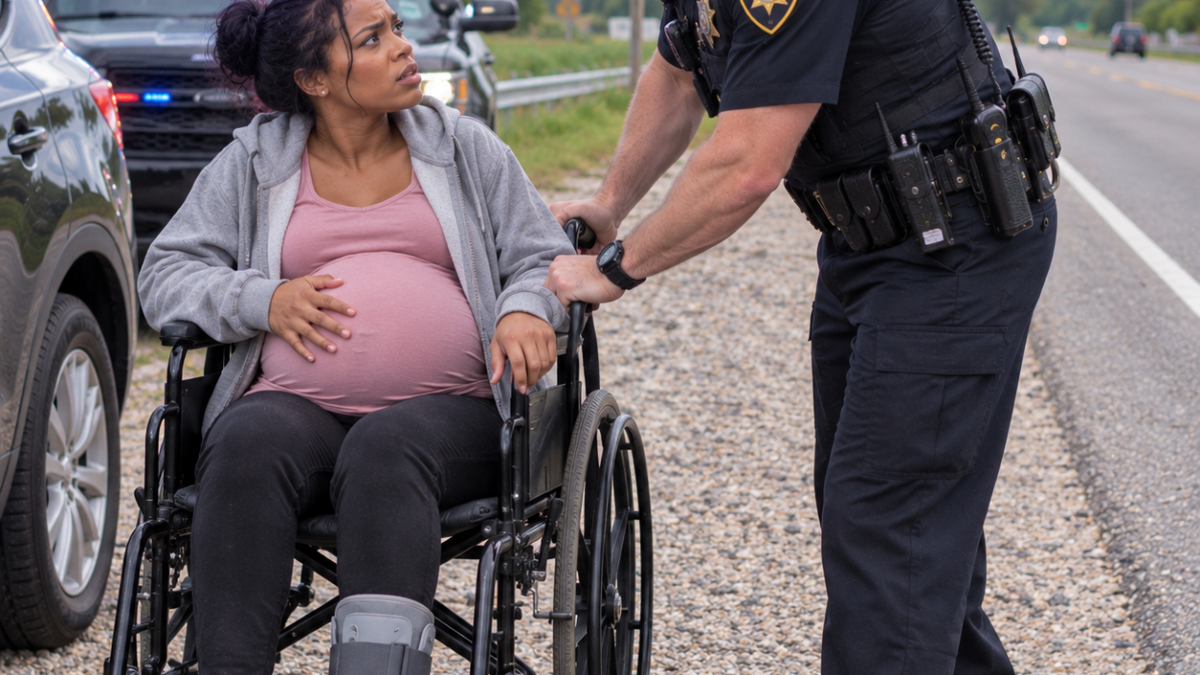
That was when he went behind my wheelchair again.
I felt his hands close around the push handles.
“Do not.”
My voice rose for the first time.
He pulled.
Then tilted.
The front of my chair came off the ground.
My body slid backward into the seat.
The restraint belt tightened.
My stomach shifted.
I grabbed the armrests.
“Do not!”
He released it.
The chair dropped forward.
The front wheels struck the gravel.
Hard.
The impact traveled through the frame and into my spine.
Then my abdomen tightened.
Not pain exactly.
Pressure.
Deep.
Wrapping around me.
I had felt Braxton Hicks before.
My doctor had explained them.
Stress.
Dehydration.
Physical strain.
Usually irregular.
Usually harmless.
At thirty weeks, knowing that intellectually did not make the first tightening less terrifying.
I put both hands on my belly.
Breathed in.
Four counts.
Out.
Six.
“I need medical attention.”
Tully kept writing.
“I am having contractions.”
Nothing.
Hadley looked toward him.
“Gage.”
Tully finally looked up.
“She says she’s having contractions.”
Hadley said.
Tully glanced at my stomach.
Then my face.
“She has been saying a lot of things.”
That sentence stayed with me.
Not because it was the worst thing said that day.
Because it explained the whole encounter.
My words had stopped functioning as information.
Everything I said was being filtered through the assumption that I was difficult.
Pregnant?
Claim.
Injured?
Claim.
Unable to stand?
Excuse.
Contractions?
Another thing I was saying.
Hadley did not call an ambulance.
He did not tell Tully to step back.
He stayed quiet.
A third patrol car arrived at 3:06.
The officer who stepped out was younger.
Nolan Briggs.
I would later learn he had been on the department barely more than a year.
He walked toward us.
Stopped.
Actually stopped.
Four seconds, according to his dash camera.
Four seconds staring at the scene.
Me in the wheelchair.
Hands over my stomach.
Tully writing.
Hadley standing with his arms crossed.
Then Briggs asked:
“What happened?”
“Equipment violation.”
Tully answered.
“Noncompliant subject.”
“She is claiming medical distress.”
Briggs looked at me.
“Should we call EMS?”
Hope came so fast it almost hurt.
Tully clicked his pen.
“She’ll be fine.”
“We’re almost done.”
Briggs looked uncomfortable.
Then he did what people do every day when conscience and hierarchy collide.
Nothing.
He was young.
Tully had seniority.
Hadley outranked him.
Briggs had a mortgage.
A baby on the way.
A career barely started.
I learned those things later.
At the time, I only knew a third officer had arrived, recognized something was wrong, and still waited for someone else to fix it.
No officer called EMS.
A stranger did.
Across the road, a man in a gray pickup had watched the stop unfold.
He had positioned his phone against his dashboard.
At 3:11, he called 911.
“There is a pregnant woman in a wheelchair.”
He said.
“An officer pulled her backward.”
“She looks like she needs help.”
That stranger never gave me his name.
I never met him.
For years I wished I could thank him.
Then I realized he probably did not want to be part of the story.
He simply saw something wrong and made one phone call.
Sometimes that is enough to change the record.
The ambulance arrived at 3:17.
Paramedic Dana Lee walked toward me.
She was small.
Maybe five-four.
Tully towered over her.
It did not matter.
She looked at the scene once and immediately understood what everyone else had spent twenty minutes pretending not to see.
“Ma’am, I’m Dana with Garner Fire.”
“What is happening?”
I gave her the facts.
Thirty weeks.
Fractured ankle.
Wheelchair.
Pulled backward twice.
Tilted once.
Two contractions.
Right wrist pain.
She listened.
No interruptions.
No suspicious expression.
No accusation that I was making things harder.
She wrapped the blood pressure cuff around my arm.
142 over 94.
Pulse 98.
Then she looked at my wrist.
The bruising was already beginning.
Four pressure marks.
She turned toward Tully.
“This woman needs transport.”
“She is being detained.”
“She is reporting contractions at thirty weeks.”
“She can go when we’re done.”
Dana stood.
Something changed in her face.
Not rage.
Decision.
“Officer.”
She said.
“I am going to document this conversation in my patient-care report.”
Tully looked at her.
“The time is 3:19 p.m.”
She continued.
“I have informed the detaining officer that the patient is experiencing symptoms consistent with possible preterm labor.”
“The officer has declined to release the patient for immediate transport.”
Silence.
Dana looked at Briggs.
His camera was recording.
Then she looked back at Tully.
“You understand what I just documented?”
Tully said nothing.
That moment would matter later.
Because documentation changes behavior.
Not always immediately.
But once someone realizes another professional is writing down exactly what they are doing, the room changes.
Dana returned to me.
She started an IV.
Normal saline.
Then placed a portable fetal monitor across my stomach.
A sound filled the shoulder.
Fast.
Steady.
152 beats per minute.
My daughter’s heartbeat.
I started crying.
Quietly.
I had not cried when Tully grabbed my wrist.
Not when he dragged my chair.
Not when the stranger accused me of driving badly.
But hearing my baby’s heart made everything I had been holding back collapse.
Dana squeezed my shoulder.
“Heart rate looks good.”
I nodded.
“What about the contractions?”
“I still want you monitored.”
She looked toward the hospital sign visible down the road.
“You were headed there?”
“Yes.”
“My appointment was fifteen minutes ago.”
Her mouth tightened.
“Then that’s where we’re going.”
At 3:26, after thirty-five minutes on the side of the road, Tully handed back my license and registration.
No citation.
No arrest.
No obstruction charge.
Nothing.
“Get that light fixed.”
That was all.
I stared at him.
Thirty-five minutes.
Bruised wrist.
Stress contractions.
Ambulance.
Three police units.
And the result was:
Get that light fixed.
I wanted to say something devastating.
Something he would remember.
Nothing came.
I was too tired.
Dana wheeled me toward the ambulance.
Behind me, the hydraulic lift of my van remained extended.
A small platform hanging over gravel like evidence.
At Wake County Hospital, the contractions slowed.
Then stopped.
Braxton Hicks.
Stress induced.
My daughter was fine.
That sentence became the only sentence I cared about.
Baby is fine.
Baby is fine.
Baby is fine.
The bruise on my wrist darkened.
My blood pressure remained elevated.
A nurse named Rhonda asked for my emergency contact.
“Marcus Rowan.”
She dialed.
My husband answered on the second ring.
Always the second.
“Mr. Rowan?”
“This is Rhonda at Wake County Labor and Delivery.”
“Your wife has been admitted for monitoring.”
“She and the baby are stable.”
“She was involved in an incident during a traffic stop.”
Silence.
Three seconds.
Then Marcus said:
“I’ll be there in twenty-five minutes.”
He arrived in twenty-three.
White shirt.
Sleeves rolled.
Khaki pants.
Black shoes.
No badge visible.
No gun.
No dramatic entrance.
He looked like someone from accounting.
That was one of the reasons he was good at his job.
Marcus entered the room.
Looked at me.
Then the fetal monitor.
Then my wrist.
He sat beside the bed.
He did not say:
Who did this?
He did not demand a name.
He did not promise revenge.
He took out his phone.
Photographed my wrist.
Close.
Medium.
Wide.
In the wide photograph, he included my hospital bracelet and the clock.
Then the fetal monitor.
Then he turned to Rhonda.
“What time was she admitted?”
She told him.
“Attending physician?”
She told him.
“Has the paramedic’s original patient-care report been scanned?”
Rhonda stared.
“Are you a lawyer?”
Marcus put the phone into his left pocket.
“I’m her husband.”
Classic Marcus.
Technically true.
Intentionally incomplete.
After Rhonda left, he pulled his chair closer.
“Tell me.”
I looked at him.
“Everything?”
“Start with the time.”
So I did.
7:42 a.m.
Doctor’s office.
2:27 departure.
2:51 lights.
Tag lamp.
Request to exit.
Lift.
Backup.
Wrist.
Wheelchair.
Contractions.
Third officer.
EMS.
I gave estimates when I wasn’t sure.
Exact times when I was.
Marcus asked almost no questions.
When I finished, he sat quietly.
Then he said:
“We need the original paramedic report preserved.”
“I know.”
“Photographs daily.”
“I know.”
“Vehicle GPS.”
“I know.”
“Your hospital records.”
“Yes.”
He studied me.
“You’ve done this before?”
“Social worker.”
He nodded.
Then I finally asked:
“What are you going to do?”
His face changed slightly.
“I cannot investigate this.”
“What?”
“Camille.”
He leaned forward.
“If this touches my work, I need to be out before anyone can argue that I influenced anything.”
My stomach tightened.
“You already know something.”
He didn’t answer immediately.
That was an answer.
“What?”
“There is a preliminary matter involving Garner.”
My heart started beating faster.
“What kind of matter?”
“I can’t discuss it.”
“Marcus.”
“I cannot discuss it.”
He said it gently.
“But I can tell you this.”
He looked toward my bruised wrist.
“I need to recuse before I know more.”
That frightened me more than anything else he could have said.
My husband was an FBI special agent assigned to public corruption.
He almost never discussed active matters with me.
I knew only enough to understand the boundaries.
That evening, he walked into the hospital parking lot and made one phone call.
Eleven minutes.
The next morning, he filed a formal recusal memorandum.
From that moment forward, he did not touch the investigation involving Garner Police.
He did not search Tully’s name.
Did not call the chief.
Did not contact Internal Affairs.
Did not interview witnesses.
Did not use FBI databases.
He removed himself.
Some people later called that restraint.
It wasn’t.
It was protection.
A case contaminated by my husband’s involvement could become a gift to the very people we were challenging.
Marcus knew that.
If there was going to be accountability, it could not depend on being married to an FBI agent.
It had to depend on evidence.
While I lay in the hospital, Gage Tully and Wells Hadley were writing.
Their reports told a different story.
I had become verbally confrontational.
I had refused to exit.
I had displayed noncompliant behavior.
I had been “briefly detained.”
I had “claimed” medical distress.
Hadley’s report added something new.
It said I grabbed Tully’s forearm.
That detail justified the wrist control.
There was one problem.
I had not touched him.
And the truth existed outside their reports.
A camera across the road had seen it.
A phone in a gray pickup had seen it.
Nolan Briggs’s dash camera had seen more than he was yet willing to admit.
Dana’s medical report had recorded the timing of the bruise.
My van had GPS data.
My body had evidence.
But for several days, none of that had reached the people reading the police paperwork.
And paperwork has enormous power.
A report is not reality.
But until something challenges it, institutions often treat it like reality.
Four days after the stop, I went to Garner Police headquarters to file a complaint.
My wrist was purple.
My boot still on.
Wheelchair beneath me.
I had printed the department’s complaint policy before leaving home.
Good thing.
The front desk sergeant, Dorian Voss, looked at me as if paperwork itself were a favor he might choose to grant.
“I need to file a formal complaint against Officer Gage Tully.”
He pulled out a form.
“You need a witness signature.”
“No.”
He looked up.
“Excuse me?”
“Your General Order 3.14 does not require a witness signature to file.”
“It may be needed during investigation.”
“But not to accept the complaint.”
His expression hardened.
“We’re trying to process this efficiently.”
“So am I.”
I said.
“Please accept the form.”
He did.
Reluctantly.
Then told me the system might take several days.
“I’d like written confirmation of filing.”
“We don’t issue receipts.”
I unfolded the printed policy.
“Section D.”
His jaw tightened.
He wrote a complaint number on a note.
GRN-IA-2025-0041.
I placed it in the zippered pouch on my wheelchair.
That little number mattered.
Dates matter.
Receipts matter.
Complaint numbers matter.
People dismiss bureaucracy as boring.
Bureaucracy decides whether something happened officially.
My complaint sat nine days before an investigator was assigned.
The department’s average was seventy-two hours.
Nobody explained the delay.
Then the first outside video appeared online.
Six minutes.
Fourteen seconds.
Uploaded by someone using only the initials TM.
The image shook slightly.
But it showed enough.
Tully gripping my wrist.
My body twisting.
My wheelchair rocking.
Tully stepping behind me.
Pulling the chair backward.
My hands going to my stomach.
The chair tilting.
Dropping.
No attack by me.
No grabbing his forearm.
The video spread through local Facebook groups.
Then a woman named Kayla Munoz saw it.
Kayla managed the night shift at Quick Fuel.
The gas station across the road.
She recognized her parking lot.
Checked the store DVR.
Their exterior camera had captured the stop.
Wider.
Steadier.
Different angle.
And one important detail was completely clear.
When Tully reached for my wrist, my hand was flat on the armrest.
Hadley’s written statement said I grabbed Tully first.
The camera said I did not.
Kayla did something nobody ordered her to do.
She downloaded forty-one minutes of footage.
Put it on a USB drive.
Labeled it.
Drove to the district attorney’s office.
And handed it to the intake clerk.
No press conference.
No speech.
Eleven minutes of effort.
That decision became one of the most important events in my case.
I sometimes think about how fragile truth can be.
The DVR automatically overwrote footage after fourteen days.
Kayla saw the Facebook post on day six.
Eight days later, the video might have vanished.
Not because anyone destroyed it.
Because a machine would have recorded over it.
History sometimes survives because the right person notices something before Tuesday becomes Wednesday.
Internal Affairs assigned Investigator Mara Colvin.
I didn’t know her.
Marcus did not know her.
That mattered.
She pulled Tully’s report.
Hadley’s supplemental.
Dispatch.
Body cameras.
The 911 call.
The timelines didn’t fit.
Tully radioed me as “noncompliant” at 2:54.
His report suggested my confrontation began later.
Hadley’s camera had a nine-minute gap.
Department IT called it a firmware issue.
Colvin asked for maintenance records.
No previous problem.
No later problem.
She didn’t write:
He turned it off.
She wrote:
Discrepancy noted.
Further review recommended.
That is how good investigators write before evidence supports certainty.
Then, twenty-seven days after the stop, Colvin received notice that a federal agency had issued a records preservation directive.
All use-of-force complaints involving Tully.
Three years.
Do not alter.
Do not delete.
Do not lose.
She pulled his personnel file.
Four complaints.
All four reviewed by the same supervisor.
Lieutenant Sloan Avery.
All four closed.
Insufficient evidence.
No further action.
Then Colvin learned the DA already had outside footage.
Quick Fuel.
She requested it.
Watched it.
Then watched it again.
Afterward she called the number on the federal preservation letter.
“I have the footage.”
The person on the other end said:
“We know.”
That was the moment the local investigation finally touched the larger one.
Not because Marcus called from home demanding federal action.
Because the FBI public-corruption unit he worked in had already been looking at Garner for nine months.
Before my traffic stop.
Before my tag light burned out.
Before Tully ever saw my van.
The unit had been gathering data about use-of-force complaints concentrated in one patrol group.
Complaints reviewed by one supervisor.
Cases ending without discipline.
There wasn’t enough yet.
Patterns are not proof.
Suspicion isn’t probable cause.
The file existed in that frustrating space between:
Something is wrong.
And:
We can prove what.
My stop did not create the federal inquiry.
It gave the existing pattern something it had lacked.
Independent video.
Medical documentation.
A civilian complaint.
Witnesses.
Public attention.
Momentum.
Marcus was formally outside it.
His supervisor, Assistant Special Agent in Charge Lenora Cross, was not.
My daughter was born November 2.
Healthy.
Seven pounds, four ounces.
We gave her a name that belonged to no relative.
No legacy.
No obligation.
Just hers.
Holding her changed my relationship with the case.
Before she arrived, part of me wanted to fight everything.
Every report.
Every officer.
Every lie.
Afterward, time became physical.
Feeding.
Sleeping.
Laundry.
Doctor visits.
Thirty-minute windows of silence.
My attorney warned that civil litigation could consume years.
Depositions.
Medical records.
Defense experts.
Motions.
The city would examine everything.
My history.
My marriage.
My pregnancy.
My social work career.
Any sentence I had ever written that could be made useful.
I told myself I could handle it.
I probably could.
The better question became:
What would handling it cost?
That answer would come later.
First came the administrative hearing.
March 4.
Five and a half months after the stop.
I was eight and a half months pregnant in the original timeline of the source record, although my daughter had already been born by then; the dates themselves were imperfect in the material we later reconstructed, one of several reasons I learned never to confuse narrative neatness with evidence.
What mattered in the hearing was what could actually be verified.
The room was beige.
Fluorescent lights.
Long table.
Three-member panel.
Tully wore a navy suit.
Hadley sat behind him.
Lieutenant Avery did not attend.
Scheduling conflict.
Of course.
My attorney sat beside me.
We submitted:
Tully’s report.
Hadley’s report.
Dispatch audio.
The anonymous bystander recording.
Quick Fuel footage.
Dana Lee’s patient-care report.
Body cameras.
911 call.
The union lawyer challenged the Quick Fuel video.
Chain of custody.
Civilian download.
USB.
No affidavit initially.
The panel reviewed the forensic authentication.
Embedded timestamps.
No splices.
No edits.
Footage admitted.
Then they played it.
Watching yourself be hurt is strange.
Memory happens from inside the body.
Video happens outside it.
On the screen, I looked smaller than I remembered.
Tully looked less dramatic.
There was no cinematic music.
No heroic framing.
Just a man reaching down.
My wrist moving because he moved it.
My wheelchair rolling backward because he pulled it.
My hands staying on the chair.
Then my stomach.
Hadley’s report said I grabbed Tully.
The screen said otherwise.
Tully’s lawyer stopped writing for several seconds.
Then Dana testified.
Blood pressure.
Pulse.
Bruising.
Timing.
She was asked whether the marks could predate the traffic stop.
Her answer was clinical.
The bruising stage was consistent with recent trauma.
Her first contact with me came twenty-six minutes after the stop began.
The timeline fit.
Nothing dramatic.
That is what made it powerful.
Truth often sounds boring under oath.
Then the hearing recessed.
When we returned, a woman entered carrying a leather portfolio.
She walked directly toward the panel.
“My name is Lenora Cross.”
“I am Assistant Special Agent in Charge of the FBI Charlotte Field Office Public Corruption Unit.”
Everything inside me went still.
Marcus was not there.
He had told me he would not come.
Recusal.
He meant it completely.
Cross placed a sealed envelope on the table.
She explained the preservation directive.
Then said:
“Special Agent Marcus D. Rowan is the spouse of the complainant.”
Tully looked toward me.
For the first time since the traffic stop, I watched recognition happen.
Not of me.
Of context.
Cross continued.
Marcus had recused on September 18.
No access.
No investigative activity.
No contact with Colvin.
No participation.
Then she delivered the part Tully had not expected.
Marcus’s unit had already been examining a pattern of use-of-force complaints in Garner.
For nine months before my stop.
My husband had not opened a case because someone hurt his wife.
His unit had been looking at the same environment before I ever entered it.
Then Cross mentioned Raymond Vickers.
Bail bondsman.
Federal corruption investigation.
Tully’s personal phone records showed fourteen calls to Vickers during a three-month span.
Several calls occurred close to arrests where people later used Vickers’s bonding company.
Cross was careful.
The FBI was not asking the panel to conclude guilt.
The investigation was ongoing.
Tully was a subject.
Not convicted.
Not even necessarily a target.
But suddenly the burned-out tag light existed inside a much larger context.
I watched Tully’s attorney lean toward him.
Whisper.
Tully shook his head once.
And I understood something.
He had known my husband’s name only minutes earlier.
But my husband’s title was not the dangerous part.
The dangerous part was that evidence had been accumulating long before either of us knew we would intersect.
During the recess, Nolan Briggs approached Investigator Colvin.
He looked terrible.
Pale.
Jaw clenched.
He placed a USB drive beside her coffee.
“My dash cam.”
Colvin looked at him.
“From September?”
“Yes.”
“This was not submitted.”
“I know.”
“You’ve had it?”
“Yes.”
“Why now?”
Briggs looked toward the FBI envelope.
Then down.
“Because if I don’t do it now, I become the officer I said I’d never be.”
Nobody congratulated him.
Good.
He had waited five months.
His conscience had arrived late.
Late conscience is still better than permanent silence, but it does not erase the cost of delay.
Colvin logged the drive.
Chain of custody began there.
The dashcam filled Hadley’s nine-minute body-camera gap.
Clear audio.
Clear enough video.
My hands did not touch Tully.
The wheelchair moved because Tully moved it.
Hadley stood nearby.
Watched.
At one point, he glanced at his camera.
Seconds later, the red recording light disappeared.
Could anyone prove he deliberately switched it off?
No.
The footage did not show his finger pressing a button.
That distinction mattered.
But the timing mattered too.
The panel wrote:
Suggestive of intentional deactivation pending technical review.
Not proof.
Not nothing.
Four days later, the decision came.
Tully suspended without pay pending further proceedings.
Potential state assault referral.
Federal civil-rights referral under color of law.
Hadley suspended pending investigation into the report and camera gap.
His claim that I grabbed Tully was referred for review as a possible false statement.
Lieutenant Avery?
No action.
Insufficient evidence.
He transferred to another agency weeks later.
No disciplinary notation followed him.
Same pension.
New uniform.
New jurisdiction.
That part made people angry when the story became public.
It made me tired.
Systems do not always protect people dramatically.
Sometimes protection is administrative.
A checkbox left empty.
A reference call never made.
A transfer described as lateral.
A file that says:
No sustained finding.
A person moves on.
The record forgets.
Unless somebody refuses to let it.
The city offered a settlement.
Confidential amount.
NDA.
My lawyer put two paths in front of me.
Path one:
Take it.
Protect my time.
Raise my daughter.
Keep the evidence I was legally allowed to keep.
Move forward.
Path two:
Federal civil litigation.
Two or three years.
Maybe longer.
Possible larger verdict.
Possible loss.
Depositions.
Experts.
Appeals.
Media.
Defense attorneys questioning every decision.
I stared at my daughter sleeping beside me in a bassinet.
People imagine settlement decisions are about courage.
Sometimes they are about arithmetic.
Not financial arithmetic.
Life arithmetic.
How many evenings do I want to spend preparing for deposition instead of rocking my child?
How many times do I want to explain the worst thirty-five minutes of my pregnancy to strangers?
How much of motherhood do I want this officer to continue owning?
I took the settlement.
Some supporters were disappointed.
One person online wrote:
She let them buy her silence.
Easy sentence to type when it isn’t your life.
I signed the NDA.
I did not discuss the amount.
I did not pretend the agreement transformed the police department.
It didn’t.
The city council adopted a mandatory body-camera policy.
Four-to-three vote.
The policy said cameras must be active during enforcement contacts.
Good.
It said failures would trigger “administrative review.”
What did administrative review mean?
The policy didn’t define it.
What about cameras deliberately turned off?
Unclear.
Retention?
Not enough detail.
Independent auditing?
No.
Funding for storage?
No.
Training?
Limited.
A policy existed.
Whether behavior changed remained another question.
That was one of the central lessons of the entire case.
Institutions are good at announcing reform.
Implementation is quieter.
Harder.
Less photographed.
The federal pattern inquiry continued.
Civil Rights Division personnel visited Garner.
Personnel files.
Internal Affairs logs.
Supervisor interviews.
Five years of complaints.
The department cooperated.
Slowly.
Marcus still remained out.
At home, he never discussed what his office knew.
I never asked.
That was part of our marriage after the incident.
Boundaries became a form of trust.
Then Raymond Vickers was indicted.
Conspiracy.
Honest-services fraud.
Other officers mentioned in filings.
Tully’s phone contacts referenced.
But Tully himself was not indicted in that case at the time.
That disappointed people too.
They wanted a clean ending.
Dirty cop.
FBI husband.
Handcuffs.
Prison.
Justice.
Life rarely arranges itself that neatly.
Phone calls alone did not prove bribery.
Prosecutors needed money trails.
Witnesses.
Intent.
Corroboration.
Tully remained under investigation.
His assault referral followed a separate route.
Grand jury.
Secret proceedings.
No public timeline.
Months passed.
No indictment announced.
He remained suspended.
His union challenged the length of the suspension.
Hadley’s camera investigation ended ambiguously.
Firmware issue or manual deactivation.
Could not determine.
Written reprimand.
Returned to duty.
Briggs received no formal discipline.
His delayed disclosure was documented.
He transferred to another patrol unit.
Not by request.
Operational needs.
Again, the language of systems.
Neutral words covering human discomfort.
Avery had already moved on.
There were days when I wanted to scream.
Not because nothing happened.
Plenty happened.
But because reality had refused to give me the satisfying ending strangers expected.
The officer was not dragged from court in cuffs.
The supervisor was not publicly exposed in some perfect final scene.
The department did not suddenly become righteous.
Instead:
One suspension.
One reprimand.
One transfer.
One policy.
One federal inquiry.
One grand jury.
One corruption case still moving.
Incomplete.
Messy.
Real.
Nearly a year after the stop, I was sitting in our living room reading.
Our daughter was asleep down the hall.
Marcus worked in his home office.
The house was quiet.
He walked in.
Sat at the opposite end of the couch.
That was us.
People who loved each other without needing to be physically attached every second.
“She still asleep?”
He asked.
“Yes.”
His phone buzzed.
He looked at it.
Turned it face down.
“What?”
I asked.
“Work.”
“Useful answer.”
“I try.”
I closed my book.
“Vickers?”
He looked at me.
“Camille.”
“Fine.”
I smiled slightly.
“Boundary.”
“Boundary.”
For a while we said nothing.
Then I looked at my wrist.
No bruise.
No visible mark.
Only memory.
“Do you ever think about what would’ve happened if that gas-station camera wasn’t there?”
“Yes.”
“What?”
He didn’t answer immediately.
“Hadley’s report would’ve had more weight.”
“And the stranger’s phone?”
“Helpful.”
“Dana’s report?”
“Very helpful.”
“Briggs?”
He looked toward the nursery.
“Maybe eventually.”
I understood.
No single piece of evidence saved the truth.
The truth survived because multiple records overlapped.
One camera.
Another camera.
GPS.
Medical documentation.
Dispatch.
Photographs.
Complaint receipt.
Dashcam.
Different people preserving different fragments.
That bothered me.
Because it meant without enough fragments, an equally truthful person might lose.
“What about someone who doesn’t have all that?”
I asked.
Marcus looked at me.
“That is the question.”
Not:
The system works.
Not:
Justice wins.
The question.
Years later, people still introduce the story wrong.
They say:
A cop attacked a pregnant woman in a wheelchair and didn’t know her husband was FBI.
It is dramatic.
I understand why people use it.
But Marcus being FBI was never the reason what happened to me was wrong.
And it was not the reason the evidence mattered.
If Marcus had been a plumber, Tully still should not have grabbed my wrist.
If Marcus had been unemployed, Hadley still should not have written something that video contradicted.
If I had been unmarried, Briggs still should have called EMS.
If nobody at the FBI knew my name, Dana’s medical report would still be true.
If no reporter ever cared, Kayla’s camera would still show what it showed.
My husband’s job affected what happened afterward because his unit had already encountered the same names in a separate inquiry.
That coincidence gave the story power.
It should not become the moral.
The moral is far less satisfying.
Records matter.
Independent witnesses matter.
Policies matter only when enforced.
Rank does not automatically create courage.
Silence can protect abuse even when the silent person never throws a punch.
Good people can fail because they are afraid of hierarchy.
Institutions can respond to scandal without actually reforming.
Settlements can be rational choices without becoming moral victories.
And sometimes accountability is not one courtroom scene.
It is evidence surviving long enough that people can no longer pretend they do not see a pattern.
I eventually returned to social work.
Not immediately.
Motherhood changed my schedule.
The case changed how I viewed agencies.
For a while, every official form made me angry.
Then I remembered why I had entered the field in the first place.
People still needed help navigating systems.
Especially when systems became more complicated the moment someone was frightened, disabled, poor, pregnant, elderly, undocumented, or simply unfamiliar with bureaucratic language.
I started helping clients document interactions.
Not obsessively.
Practically.
Date.
Time.
Name.
What was requested.
What was answered.
Case number.
Receipt.
Who witnessed it.
What document exists.
People sometimes laughed.
“You sound like a detective.”
“No.”
I would say.
“I sound like somebody who has waited for an institution to remember what happened.”
Records became part of my work.
Not because records are perfect.
Police reports proved that.
Records can lie too.
What matters is plural records.
Independent records.
A record written by someone whose interest differs from yours.
Dana was not my friend.
Kayla had never met me.
The unidentified man did not know my husband.
Briggs had every professional incentive to remain quiet.
Colvin had no reason to protect me personally.
Cross made sure Marcus was out of the case.
That independence made the pieces stronger together.
One afternoon, years after my daughter was born, she found the wheelchair in our garage.
I had kept it.
Folded against the wall.
The medical boot was long gone.
The van modification had been removed.
But the chair stayed.
In the side pouch was the index card.
Complaint number.
Date.
Time.
Sergeant Voss.
My daughter unfolded it.
“What is this?”
She was old enough to read.
Not old enough to know the whole story.
“Something I had to remember.”
“Why?”
“Because somebody wrote down something different from what happened.”
She frowned.
“Did you forget?”
“No.”
“Then why write it?”
I smiled.
“Because knowing something and proving something are different.”
She thought about that.
Children can hold profound ideas for about three seconds before returning to something more interesting.
“Can I ride the chair?”
“No.”
“Why?”
“Because you’re going to drive it into the lawn mower.”
“I won’t.”
“You absolutely will.”
She grinned.
Marcus walked into the garage.
“What are we doing?”
“Mom says I can’t drive this.”
“She is correct.”
“Why are both of you always on the same team?”
Marcus looked at me.
“Efficient.”
I laughed.
There it was.
Our life after the case.
Normal enough to argue about an old wheelchair.
That was not a small victory.
I saw Nolan Briggs once after everything.
At a grocery store.
Years later.
He recognized me first.
He froze beside the produce section.
“Mrs. Rowan?”
“Camille.”
He nodded.
“Camille.”
He looked older.
Not much.
Enough.
“How are you?”
“Good.”
“The baby?”
“Not a baby anymore.”
He smiled.
Then the smile disappeared.
“I’ve wanted to apologize.”
I waited.
He looked down.
“I knew.”
“Knew what?”
“That day.”
He swallowed.
“I knew something was wrong when I got there.”
“I asked about EMS.”
“I should’ve called.”
“Yes.”
No comfort.
He nodded.
“I was scared of Tully.”
“Hadley.”
“The department.”
“I told myself I was too new.”
“I told myself I needed to understand what happened first.”
“I told myself the camera was running, so if something was wrong, someone else would catch it.”
He looked at me.
“I was waiting for the system to protect you instead of understanding that I was part of the system.”
That sentence impressed me.
Not because it excused him.
Because it was accurate.
“What made you turn over the dashcam?”
“The hearing.”
“The FBI letter?”
“Partly.”
He admitted it.
“I thought if federal investigators were already there, then staying quiet wasn’t protecting my career anymore.”
I laughed softly.
“That’s painfully honest.”
“I know.”
He looked ashamed.
“And then I realized that was disgusting.”
“What?”
“That I became brave only when I thought silence might become riskier than speaking.”
I considered him.
“Most people don’t calculate it that clearly.”
“I didn’t then.”
“I do now.”
“Did you stay in policing?”
“Yes.”
“Different unit.”
“I supervise now.”
That surprised me.
“What do you tell rookies?”
He smiled sadly.
“Don’t wait for the senior officer to be the adult.”
That was a good line.
“You use my case?”
“Without names.”
“Good.”
He hesitated.
“Do you forgive me?”
People love that question.
They want moral closure.
I had learned to dislike it.
“I understand you better.”
I said.
His face fell slightly.
“That isn’t forgiveness.”
“No.”
“But it’s not hatred.”
He nodded.
“Fair.”
We walked away in opposite directions.
The produce aisle returned to being a produce aisle.
That is how most endings happen.
Without music.
The Garner body-camera policy survived.
Then changed.
Then was strengthened after another controversy unrelated to me.
Independent audits were eventually added.
Not because my case alone transformed the department.
Because cases accumulate.
Pressure accumulates.
Budgets shift.
Leadership changes.
One reform creates the language for the next one.
The DOJ pattern inquiry produced findings that were more complicated than activists wanted and more serious than the department wanted.
Supervision failures.
Complaint-processing weaknesses.
Inconsistent camera practices.
Insufficient review of force.
Data gaps.
No dramatic declaration that every officer was corrupt.
Good.
That would not have been credible.
The problem was more ordinary.
Too many warning signs had depended on supervisors willing to notice them.
Too many complaints had been closed at the same level where relationships mattered.
Too much discretion.
Too little independent review.
Systems do not need everyone to be bad.
They only need bad behavior to encounter enough passive people.
Marcus eventually transferred out of public corruption.
Not because of my case.
Career timing.
Our daughter started school.
I returned to full-time work.
The old Dodge was replaced.
The hydraulic lift disappeared from our lives.
Every now and then Marcus would still check the tag lights before a road trip.
I noticed.
Of course I noticed.
“You know normal people don’t perform pre-trip inspections on minivans.”
I told him once.
“Normal people receive equipment citations.”
“Normal people replace a five-dollar bulb.”
“Preventive maintenance.”
“Trauma response.”
He looked at me.
“Both can be true.”
I hated when he won.
The strangest part of healing was how rarely I thought about Tully eventually.
For months he occupied enormous space.
Every headline.
Every legal conversation.
Every bruise photograph.
Then less.
A week without his name.
A month.
One day I realized I could not remember the exact shape of the scar above his eyebrow until I deliberately tried.
That felt like getting something back.
The incident remained part of my life.
It stopped being the center of it.
I did not become an activist with a microphone at every police-reform rally.
I respected people who did.
That wasn’t my path.
My path was smaller.
Clients.
Forms.
Systems.
Motherhood.
My marriage.
Occasional testimony.
Policy consultations when disability-access advocates asked.
Teaching people that accommodation is not defiance.
Explaining that “noncompliance” can be a dangerously imprecise word when the person physically cannot perform the requested action.
That part mattered deeply to me.
I had said:
I cannot stand.
Tully heard:
I will not obey.
Those are not the same sentence.
Institutions need to be trained to hear the difference.
One evening, much later, I found Marcus looking at the framed photograph from my graduate-school ceremony.
The same one he had kept above his desk during the federal inquiry.
“You look young.”
He said.
“I was young.”
“You’re still young.”
“Careful.”
He smiled.
Our daughter was asleep upstairs.
The house quiet.
His phone buzzed.
He ignored it.
That still happened rarely enough that I noticed.
“Work?”
“Can wait.”
“Who are you?”
“Retired personality.”
“Temporary.”
“Probably.”
I sat beside him.
Closer than our usual opposite-couch arrangement.
“What do you think people get wrong about what happened?”
I asked.
He didn’t answer immediately.
“That I saved you.”
I looked at him.
“You did help.”
“Yes.”
“But I didn’t save you.”
He pointed toward the drawer where we still kept copies of the records.
“Dana helped.”
“Kayla.”
“The man in the truck.”
“Briggs, eventually.”
“Colvin.”
“Cross.”
“You.”
He looked at me.
“Mostly you.”
“I was sitting in a wheelchair.”
“You kept the record alive.”
I thought about that.
“No.”
I said.
“The record kept me alive.”
He understood what I meant.
When someone else’s official account says you were confrontational, resistance becomes invisible.
When a report says you grabbed first, bruising changes meaning.
When medical distress becomes “claimed distress,” a contraction becomes an excuse.
The record decides what later readers believe unless another record exists.
That afternoon, I had been lucky enough to leave multiple trails.
Not all victims get that.
That fact still bothered me.
It probably always would.
People want the final lesson to be:
Be careful who you mistreat because her husband might be FBI.
I reject that completely.
Officer Tully should not have needed to know Marcus Rowan existed.
Hadley should not have needed federal letterhead before understanding a false report was dangerous.
Briggs should not have needed a public hearing before choosing conscience.
Sergeant Voss should not have needed me to quote his own policy before accepting a complaint.
And the department should not need scandal to notice repeated use-of-force allegations involving the same officers and supervisor.
My husband’s badge did not create my rights.
My pregnancy did not create my rights.
My wheelchair did not make me more deserving of dignity.
Those facts only made the disregard easier to see.
The right to explain a physical limitation without being labeled defiant should belong to everyone.
The right to medical care should not depend on whether a stranger calls 911.
The right to an accurate report should not depend on whether a gas station happens to have a camera pointed the right direction.
And accountability should not depend on whether someone loves you who knows how federal evidence rules work.
I still have the index card.
Complaint number GRN-IA-2025-0041.
Faded ink.
Fold down the center.
I also kept one photograph Marcus took.
Not the close-up of the bruise.
The wide one.
My wrist.
IV line.
Hospital bracelet.
Clock.
It is not dramatic.
Nobody would share it online.
That is why I kept it.
It reminds me what accountability actually looked like.
Not revenge.
Not an FBI raid with helicopters.
A timestamp.
A bruise.
A nurse’s note.
A call log.
A camera angle.
A citizen who saved a video before the DVR overwrote it.
A rookie finally handing over a drive.
An investigator writing “discrepancy noted” instead of pretending certainty.
A husband stepping away from a case because loving me meant understanding when he could not be part of it.
People say power is loud.
Sometimes.
The power that changed my case was mostly quiet.
A paramedic documenting.
A store manager downloading.
A stranger recording.
A woman asking for a receipt.
A supervisor preserving a file.
Facts refusing to disappear.
If I could return to that shoulder, I would not change the burned-out tag light.
That surprises people.
I would not change the stop.
I would obviously change what Tully did.
But if the traffic stop still occurred, I would want the version where everyone did their jobs.
He approaches.
Explains the equipment issue.
Sees my wheelchair.
I explain the fracture.
He adjusts.
Maybe he writes a warning.
Maybe a citation.
He tells me to replace the bulb.
I drive six-tenths of a mile to my appointment.
Twenty minutes.
Forgettable.
That is what good government often looks like.
Forgettable.
No hero.
No victim.
No viral video.
No federal file.
A boring interaction where authority recognizes reality and moves on.
People sometimes think justice means a dramatic punishment after something terrible.
I think justice also means designing systems so fewer terrible moments happen in the first place.
Boring is underrated.
I would have loved boring.
Our daughter once asked me why I kept saying “the record” when talking about the story.
She was older then.
Old enough for the real version.
“Because memory changes.”
I told her.
“People remember what protects them.”
“Is that lying?”
“Sometimes.”
“Sometimes it’s fear.”
“Sometimes it’s ego.”
“Sometimes people genuinely remember differently.”
“So cameras are always right?”
“No.”
She frowned.
“Then what is?”
“Nothing alone.”
I said.
“You compare things.”
“Video.”
“Documents.”
“People.”
“Timing.”
“Physical evidence.”
“Who benefits.”
“Who had the opportunity.”
“Whether one piece agrees with another.”
She considered it.
“You mean facts need friends.”
I smiled.
“That’s actually pretty good.”
She grinned.
“Better than Dad’s explanations.”
“Everything is better than Dad’s explanations.”
Marcus shouted from the kitchen:
“I heard that.”
Normal.
Still the ending I value most.
I do not know exactly what finally happened to every person connected to the investigation.
Some cases remained sealed longer than the public cared.
Some careers continued.
Some ended.
Some people learned.
Some probably did not.
That used to frustrate me.
Now I see it differently.
Justice is not a television episode.
A system is never finished.
My case revealed failures.
It triggered reviews.
It preserved evidence.
It contributed to a wider inquiry.
Some consequences followed.
Some did not.
The system did not transform overnight.
It rearranged.
Then people kept pushing.
That distinction matters.
Rearrangement can look like reform from a distance.
A new policy.
A transferred officer.
A press release.
A training day.
Real reform asks harder questions.
Who audits the policy?
Who can access the footage?
Who reviews complaints against supervisors?
How long are records retained?
Can officers retaliate against someone who files?
Does disability accommodation appear in training scenarios?
Are medical calls independently logged?
What happens when a camera goes dark?
Who notices patterns before the fifth complaint?
Those questions are less satisfying than:
Did the bad officer go to prison?
They are also more likely to protect the next person.
Sometimes, late at night, I still hear one sentence.
“I’m figuring out why you think the rules don’t apply to you.”
For years it made me angry.
Then I realized how backward it was.
I had been the person explaining the rule.
Physical limitation.
Medical need.
Accommodation.
Due process.
Complaint policy.
Documentation.
The rules did apply to me.
That was exactly why I kept asking what rule justified what he was doing.
Authority sometimes confuses being questioned with being disobeyed.
Those are not the same thing either.
A person asking:
Why?
What statute?
What am I being detained for?
What is your badge number?
May I receive medical care?
Those questions do not erase legitimate authority.
They test whether authority is legitimate in that moment.
Good authority can survive questions.
Bad authority often interprets questions as threat.
If you ask me what I remember most, it isn’t the wrist.
It isn’t the chair dropping.
It isn’t Tully’s face.
It is my baby’s heartbeat coming through Dana Lee’s monitor on the side of the road.
152 beats per minute.
Fast.
Strong.
Alive.
Everything else narrowed around that sound.
For a few seconds, there were no police.
No corruption investigation.
No FBI.
No reports.
Just my daughter telling me, in the only language she had, that she was still there.
Years later, when she runs through our house, leaves shoes in hallways, loses pencils, talks too loudly while Marcus is on work calls, and somehow manages to turn every horizontal surface into a storage area, I sometimes think about 152.
About gravel.
About the hospital sign less than a mile away.
About how close fear came to making that afternoon something different.
Then I stop.
I refuse to give the memory more than it deserves.
She is here.
Marcus is here.
I am here.
The record survived.
And somewhere in a file, behind case numbers and policy revisions and sworn statements, the truth remains stubbornly simple.
I was pregnant.
I was injured.
I explained what I physically could and could not do.
My hands were visible.
I did not grab anyone.
An officer grabbed me.
Others watched.
A stranger called for help.
A paramedic documented what she saw.
Cameras contradicted the reports.
And my husband, who happened to be an FBI agent, did the most important thing his position allowed him to do.
He stepped away.
Because the truth did not need his badge to become true.
It only needed enough people to stop helping it disappear.








