The night Silverleaf Ridge launched fireworks beside my dry hayfield, I was standing at the fence wondering why the one safety measure they had promised me was still nowhere I could see
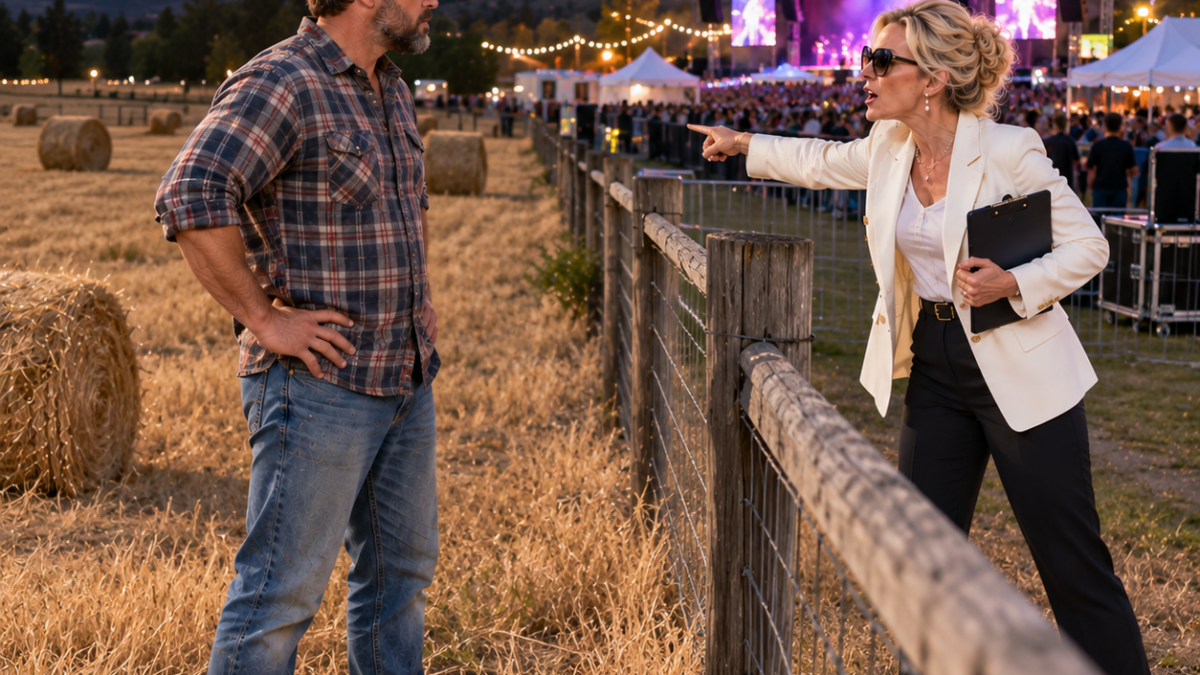
Yolanda had the radio against her mouth before I finished pointing.
“West response, confirm spread direction.”
Static.
Then a voice.
“East-southeast along service vegetation.”
Another voice cut in.
“Limited extension onto adjacent agricultural property.”
Adjacent agricultural property.
That was me.
Technically accurate.
Emotionally insufficient.
About thirty feet of my hayfield had already turned black at the edge.
The flame was not tall.
That was the part I remember most clearly.
People imagine grass fires as walls.
This one looked almost modest from a distance.
Low orange.
Fast.
It moved through dry fuel quicker than the people chasing it.
The first firewatch team hit it with water.
For maybe twenty seconds, they seemed to gain control.
Smoke thickened.
The line narrowed.
One worker waved the second unit forward.
Then the wind pushed again.
Not much.
Enough.
A narrow strand of flame slipped through untouched grass beside the wet section.
A few seconds later, it appeared farther east.
Yolanda swore.
I had spent two days watching her remain calm while everyone around her used phrases like readiness package and operational coverage.
That single curse frightened me more than anything else had.
“Shut down west production access,” she said into the radio.
“Move everyone off the service side.”
The fireworks stopped.
Not instantly.
One shell was already airborne.
It climbed while the firing sequence was cut.
Gold opened above the festival at the exact moment people on the ground began turning toward smoke.
For half a second, it was beautiful.
Then nobody cared.
Security personnel moved toward the western edge of the crowd.
They did not scream.
They did not run.
That mattered.
Whatever mistakes had happened before the show, the evacuation itself was handled well.
Staff began redirecting people toward the main exits.
Parents gathered children.
Volunteers moved folding chairs aside.
The MC announced a temporary interruption.
Then, less than a minute later, the wording changed.
The festival was ending.
Please follow staff directions.
Please move calmly toward marked exits.
No stampede.
No panicked crush.
That probably prevented the worst outcome of the night.
The fire kept moving.
It reached a band of low brush beside the service lane and flared higher.
For the first time, I felt heat across the fence.
Not enough to burn.
Enough to notice.
Then I saw a fire engine turning toward the wrong approach.
Silverleaf’s primary service entrance narrowed near a drainage cut.
I knew that ground because water from the ridge crossed there after heavy rain.
The shoulder looked hard.
It was not.
A loaded engine trying to angle across it could bury wheels.
I ran for my gate.
“Megan!” Yolanda called.
“I’m opening the farm lane.”
She understood immediately.
The gate caught on the ground.
Of course it did.
I had been telling myself for six months I would reset the bottom hinge.
Every small neglected job waits for the worst possible night to become important.
I pulled harder.
Metal scraped gravel.
It opened enough.
The first engine came toward me.
A firefighter stepped down before committing the truck.
“This access solid?”
“Yes.”
“Stay left at the first bend.”
I pointed.
“Drainage ditch on your right.”
“Soft shoulder past the cottonwood.”
“Straight through gets you behind production.”
He looked once.
Nodded.
That was it.
No dramatic speech.
No thank-you.
Good emergency work rarely has time for either.
The truck entered.
A second followed.
Then a smaller brush unit.
I moved away.
I knew the property.
They knew fire.
Roles mattered.
A few seconds later, the stage lights flickered.
Once.
Twice.
Then went black.
The crowd reacted to that.
A wave of noise moved across the main lawn.
The giant LED wall disappeared.
Speaker arrays went silent.
Emergency aisle lighting remained on near the front.
Behind the stage, the production compound was becoming obscured by smoke.
The stage itself was mostly steel.
Steel truss.
Roof.
Deck system.
That was not the expensive fragile part.
Around it sat everything required to make a modern festival stage function.
Temporary fabric walls.
Power distribution.
Lighting control.
Video processors.
Cable trunks.
Audio racks.
Equipment cases.
Backline storage.
Portable flooring.
Computers.
Networking systems.
All the infrastructure people never photograph because it sits behind whatever they came to watch.
The fire reached that outer perimeter.
One fabric wall caught.
Then another.
Crew members began moving cases.
Security ordered them farther back.
They got one rack clear.
A second remained.
Someone shouted for electrical isolation.
Then came a sharp crack.
Not an explosion.
Electrical equipment failing.
Several people ducked automatically.
Another section of lighting died.
Water hit the edge of the production area.
Steam mixed with smoke.
For several minutes, I could not tell what had burned and what had simply been soaked.
That distinction would matter tremendously later.
That night it did not.
Yolanda returned through the haze.
Dust streaked her face.
“Everybody clear your side?”
“Yes.”
“Stay behind the fence.”
“Gladly.”
I looked past her.
The main truss still stood.
The speaker arrays still hung.
From a distance, someone could have taken a photograph and claimed the stage survived.
In a narrow structural sense, it did.
Operationally, the production package was collapsing.
Control systems shut down.
Video went dead.
Smoke entered cases.
Water ran beneath temporary flooring.
Distribution equipment had been isolated.
Heat reached technical zones never designed to experience heat.
Some cables melted.
Some did not.
Some equipment never touched flame but would still require inspection before anybody dared energize it again.
That is one thing people misunderstand about expensive production equipment.
You do not need to reduce it to ash to destroy its usefulness.
Heat.
Smoke.
Water.
Contamination.
Electrical faults.
Any one can turn a functioning system into a liability.
By the time fire crews stopped the main front, the festival was over.
Not paused.
Over.
The crowd had cleared.
The fireworks sector was secure.
No one had suffered a serious injury.
That was the sentence I repeated to myself all night.
No one seriously hurt.
Everything else could be replaced.
At eleven, I stood beside Luis Mendoza at the edge of my field.
He had driven over when he saw emergency lights.
The corner nearest Silverleaf was black.
Not acres.
Not the entire crop.
A bite.
Ugly enough that you could see exactly where healthy hay ended.
Luis nudged the burned edge with his boot.
“Could’ve been worse.”
“Yes.”
He looked toward the dark stage.
“Could’ve been a lot worse.”
“Yes.”
“Marcy’s order is going to be short.”
“Yes.”
“You going to say anything besides yes?”
“Not tonight.”
He accepted that.
Around midnight, I went home.
My clothes smelled like smoke.
My hair smelled like smoke.
Even after showering, I smelled smoke.
I slept three hours.
At six-thirty the next morning, Silverleaf posted a preliminary statement.
No serious injuries.
Emergency procedures activated.
Fire contained.
Investigation underway.
Then one sentence tightened my stomach.
The fire spread rapidly through adjacent dry agricultural vegetation.
I read it twice.
It was not false.
That made it worse.
My hay had been dry.
It had carried part of the fire.
I watched it.
But the statement began with what happened after ignition.
Nothing about the fieldside preparation item.
Nothing about my photographs.
Nothing about Yolanda’s recommendation.
Nothing about Colin’s decision to proceed while the specific condition remained unverified.
I understood why.
Early incident statements are cautious.
Nobody wants to speculate about cause.
But words frame investigations before investigations are complete.
In my work at the veterinary clinic, I saw the same thing constantly.
A dog comes in vomiting.
Owner says:
“He was poisoned.”
Maybe.
Or he ate a sock.
Or pancreatitis.
Or kidney disease.
The first theory becomes emotionally sticky.
People begin arranging facts around it.
Silverleaf’s first public sentence had already given people a picture.
Dry agricultural field.
Fire.
Stage damage.
By lunchtime, someone messaged me:
Was your hay overdue for cutting?
Another:
Did Silverleaf ever warn you about field maintenance?
A third:
Are they blaming you?
I did not answer.
I called my insurance agent.
Her name was Teresa Bell.
I explained everything.
She listened.
Then said the most useful sentence anybody gave me that day.
“Do not argue online.”
“I wasn’t planning to.”
“Everybody says that until Facebook.”
“I don’t use Facebook.”
“Excellent.”
“What do I do?”
“Preserve.”
That word I understood.
Photographs.
Emails.
Notices.
Texts.
Names.
Dates.
No editing.
No deleting.
No rewriting history after you know the ending.
I forwarded the pre-event notice.
My three photographs.
Messages with Yolanda.
My final timestamped statement.
Teresa told me a claims representative would contact me.
One already had.
By early afternoon, I received an email titled:
REQUEST FOR PRESERVATION AND PROPERTY INFORMATION — SILVERLEAF FESTIVAL INCIDENT.
Professional.
Neutral.
The claims firm wanted records about hay cutting.
Field maintenance.
Recent photographs.
Use of the property.
Dates of agricultural work.
Communications with Silverleaf.
No accusation.
But when somebody asks you to preserve everything about your field after a two-million-dollar production loss, your nervous system does not care how politely the email is written.
Luis read it beside me.
“They coming after you?”
“I don’t know.”
“Helpful.”
“That is the answer.”
Teresa confirmed it.
A preservation request meant investigators were building a timeline and considering every plausible factor.
That was normal.
Still uncomfortable.
That evening, I called Yolanda.
“I received the claims request.”
“I figured you would.”
“What are they asking Silverleaf?”
“A lot.”
“Is my message in the incident file?”
“Yes.”
“The photos?”
“Yes.”
“Your recommendation?”
“Yes.”
“And Colin’s decision?”
A pause.
“Yes.”
That mattered.
Then she added:
“Internal review is separating ignition, spread, and site readiness.”
I leaned against my kitchen counter.
“Meaning?”
“Meaning they are not treating your dry hay as the same question as whether the west-edge mitigation was verified.”
For the first time that day, my shoulders relaxed.
“Good.”
“Megan.”
“Yes?”
“Colin is standing by the public statement.”
“Of course he is.”
“He says the sentence is factual.”
“It is.”
“He says changing it before causation review could look like Silverleaf is accepting responsibility.”
“That is not what I want.”
“What do you want?”
“The record to start before my field caught.”
Silence.
“I understand.”
The next morning, I walked toward the festival grounds.
The place looked completely different without people.
No music.
No cheering.
No fireworks.
Production crews cataloged damage.
Insurance adjusters photographed everything.
Black equipment cases sat open.
Cables had been coiled into wet loops.
The stage structure still stood.
That made the loss look strange.
Like a car after a flood.
Body intact.
Systems questionable.
Colin was near the operations trailer.
He saw me.
“I assume this is about the statement.”
“Yes.”
“We did not say your property caused the ignition.”
“I know.”
“We said the fire spread through dry agricultural vegetation.”
“It did.”
His expression changed.
He had expected denial.
“Then what exactly are we discussing?”
“What happened before that.”
He folded his arms.
I pointed toward the western edge.
“You knew my field was dry.”
“Yes.”
“Yolanda knew.”
“Yes.”
“You added extra firewatch because conditions were dry.”
“Yes.”
“Your own event checklist contained a fieldside vegetation item because this exposure existed.”
He did not answer.
“That item wasn’t verified.”
“We had other controls.”
“I know.”
“Professional fireworks vendor.”
“I know.”
“Approved launch sector.”
“I know.”
“Two firewatch teams.”
“I know.”
“Water units.”
“I know.”
He sounded frustrated.
“The vegetation accelerated the spread.”
“I know.”
I said it harder.
“My hay carrying fire and Silverleaf failing to verify the protection intended to manage that known exposure can both be true.”
That stopped him.
Not because it was brilliant.
Because that was the entire case.
Two things can be true.
That concept causes more trouble in claims disputes than almost anything else.
People want one cause.
One guilty party.
One sentence.
Reality tends to arrive as several systems failing at once.
Colin looked toward the damaged production compound.
“Claims will have the complete record.”
“Make sure Yolanda’s pause recommendation is there.”
“It is.”
“And your decision to proceed?”
His eyes came back to me.
“Yes.”
“Then I’m done.”
He seemed surprised.
“You’re not asking me to amend the statement?”
“I’d prefer context.”
“But I care more about the investigation file.”
He nodded.
That was the first moment I believed we might get through the entire mess without turning each other into enemies.
The formal review began immediately.
It involved more people than I could keep track of.
Silverleaf’s insurer.
Production vendors.
Fireworks contractor.
Grounds contractor.
Claims consultants.
Fire investigator.
Equipment insurers.
My carrier.
Attorneys.
Event safety personnel.
Every one looked at a different slice.
Ignition.
Fuel.
Wind.
Fire-response timing.
Work orders.
Site maps.
Vendor scope.
Property boundaries.
Equipment damage.
Business interruption.
Agricultural loss.
Emergency access.
The fire itself had taken minutes.
The paperwork took months.
That seemed fair.
The first major question was ignition.
Nobody produced a cinematic answer.
No single shell recovered with a smoking tag.
No video showing a spark falling directly into one exact blade of grass.
Fire investigation rarely gives people that kind of satisfaction.
The conclusion was careful.
Probable show-related pyrotechnic fallout igniting dry vegetation near the western event interface.
Probable.
Not absolute.
The fireworks contractor had operated within its approved launch sector.
Its equipment layout was compliant.
Its crew response was professional.
The contractor had inspected the part it was responsible for.
That mattered.
I did not want them blamed for somebody else’s missing grounds verification merely because they happened to be the people launching fireworks.
Wesley Chatham, the site lead, had told us before the event:
The launch compound is ours.
The broader vegetation treatment is Silverleaf’s.
The review agreed.
That line became important.
Silverleaf had divided event preparation into separate work packages.
General grounds.
Production.
Pyrotechnics.
Emergency response.
The grounds contractor completed the tasks actually assigned to it.
Mowing.
Trim.
Service-lane cleanup.
Common-area finish.
The contractor marked its package complete.
That status then migrated upward into overall event readiness.
But the specific fieldside vegetation condition originated elsewhere.
Silverleaf’s own readiness plan.
Nobody had assigned clear ownership for verifying it.
That was the crack.
Not malicious.
Not dramatic.
Organizational.
One person assumed general grounds covered it.
Another assumed event operations checked it.
Events leaned on the completed grounds package.
Management leaned on professional pyro approval.
Pyro assumed the client had completed client-side preparation.
Every individual piece could point to something reasonable.
Together, they created a blank nobody owned.
Yolanda saw the blank.
She raised it.
Colin made a judgment call.
He chose to proceed because other safeguards existed.
That was the hardest part for people online to understand once the report became public.
They wanted Colin to be a cartoon villain.
He was not.
He had reasons.
Bad reasons in hindsight.
But real ones.
Thousands of residents arriving.
Vendors already deployed.
Fireworks contractor ready.
Launch sector accepted.
Firewatch increased.
Water units staged.
Emergency plan active.
No one standing there saying:
This specific strip is unsafe.
Only:
This specific strip has not been affirmatively verified.
That distinction is precisely the kind of thing organizations become tempted to rationalize under schedule pressure.
Documentation gap.
That phrase appeared several times in emails.
I came to hate it.
Because a documentation gap can mean two very different things.
Something happened and nobody recorded it.
Or nobody checked whether it happened.
Those are not the same.
Silverleaf assumed the first.
The review could not prove it.
The second major question was spread.
My field absolutely contributed.
There was no hiding from that.
The hay was dry.
Late-August dry.
Some was awaiting cutting.
Fire moved through it.
My carrier asked whether I should have harvested sooner.
Luis provided our normal schedule.
Weather conditions.
Customer orders.
Historical cutting dates.
Agricultural practice.
No ordinance required me to remove the hay because Silverleaf chose to launch fireworks next door.
No safety notice had instructed me to mow.
In fact, Silverleaf’s own adjacent-owner notice had said the association would manage its event-side interface.
That helped.
But I refused to pretend my hay was irrelevant.
It burned.
It carried flame.
The review mapped it.
One branch of fire moved into my crop.
Another moved eastward through Silverleaf’s own patchy service vegetation.
That second branch became the damaging one.
The fire did not travel from my field all the way around and attack the stage like some revenge plot.
It moved through connected fuels on both properties.
Silverleaf’s service corridor provided continuity toward backstage.
The fieldside strip that had worried me was not a perfect untouched wall of grass.
Parts had been trimmed.
Parts had not.
That made the situation worse to interpret visually.
Enough work had been done to make the area look managed.
Not enough evidence existed that the specific protection intended by the readiness plan had been completed.
The third question was response.
Firewatch crews reacted fast.
That finding surprised nobody who watched them.
First ignition spotted quickly.
Extinguisher deployed.
Water used.
Secondary flame identified.
Additional team called.
Fireworks stopped.
Crowd moved.
Fire service requested.
The problem was not lazy response.
The problem was rate of spread.
Dry grass plus wind plus connected fuel can outrun a small initial suppression effort.
The review praised the evacuation.
That mattered to me.
People love disaster stories that punish every person involved.
But the same organization can make a bad readiness decision and an excellent emergency decision five minutes later.
Silverleaf did.
Security staff kept people calm.
Production crews shut power.
Fire crews used my farm lane after the primary approach became inefficient.
Nobody was seriously injured.
That was not luck alone.
It was competent response after an avoidable problem began.
When the consolidated report finally came, Teresa called before sending it.
“You’re going to like some parts.”
“That sounds ominous.”
“You’re going to dislike other parts.”
“Better.”
“Why?”
“Means it’s probably honest.”
She laughed.
Then emailed it.
I read everything.
Not just the executive summary.
My profession had trained me never to trust executive summaries when full records existed.
The findings were exactly as Yolanda predicted.
Dry agricultural vegetation contributed to fire propagation.
Silverleaf had recognized western-edge dry-fuel exposure before the event.
A specific fieldside vegetation management requirement existed in its own readiness package.
General grounds had been marked complete.
The specific requirement had no affirmative completion verification.
The pyrotechnics vendor had not owned that requirement.
Yolanda Dunn raised the discrepancy before public operations.
Colin Pratt chose to proceed while relying on other mitigations.
Additional firewatch did not substitute for confirmation of the originally identified site control.
Probable ignition was show-related pyrotechnic fallout.
Then came the sentence that mattered most to me.
The presence of dry hay on adjacent private agricultural property did not, by itself, establish responsibility for Silverleaf’s production loss.
I sat back.
Read it again.
No giant victory.
No dramatic payout.
Just the difference between being part of the fire pathway and being legally responsible for creating the event risk.
My hay had burned.
That was true.
Silverleaf had failed to close its own identified readiness gap.
Also true.
The final allocation among Silverleaf, contractors, vendors, and insurers was not public.
And frankly, I did not care.
My own claim was modest.
Lost hay.
Fence repairs.
Farm-lane surface damage from emergency vehicles.
That stupid gate hinge.
Silverleaf paid for the hinge.
Luis found this hilarious.
“You ignored it six months.”
“I know.”
“Festival finally fixed your gate.”
“Apparently.”
“You should thank them.”
“I will not.”
“Ungrateful.”
He laughed.
Marcy took fewer bales that season.
Pine Hollow adjusted.
My property tax still arrived.
Life continued.
The stage loss became more complicated.
The headline number—nearly $2 million—represented the production package on site.
Not two million dollars of equipment reduced to ashes.
Some pieces were total losses.
Some suffered smoke contamination.
Some water exposure.
Some required specialized testing.
Some were repairable.
Some rental assets were out of service long enough that business interruption became part of the claim.
LED processors.
Lighting control.
Power distribution.
Audio electronics.
Temporary infrastructure.
Cabling.
Cases.
Soft goods.
The steel structure itself survived much better than internet retellings suggested.
But a festival stage is a system.
You can leave the skeleton standing and still destroy the event.
Silverleaf never tried to pretend otherwise after the report.
That surprised me.
Colin remained facilities and events director.
Some residents demanded his firing.
The board declined.
I agreed with them.
He made the wrong call.
The report said so in much more professional language.
But he had documented it.
Cooperated.
Did not alter records.
Did not blame subordinates.
Did not claim Yolanda had failed to warn him.
When asked why he proceeded, he gave the same answer after the fire that he gave before it.
He believed cumulative controls reduced risk enough.
Wrong judgment.
Not dishonesty.
Organizations learn almost nothing when every error ends with sacrificing the nearest person and calling the system repaired.
Silverleaf changed the system instead.
Future fireworks events required independent safety signoff for site-specific readiness conditions involving adjacent property exposure.
General work-package completion could no longer close a specific condition by implication.
Responsibility had to be named.
Verification had to be recorded.
If a required control was replaced by another mitigation, the substitution needed formal risk approval.
Yolanda helped write that procedure.
I found that appropriate.
Then something happened I did not expect.
Colin came to my property.
About two weeks after the report.
No radio.
No event polo.
Jeans.
Work boots.
He stopped at the gate.
“Got a minute?”
I was replacing fence staples.
“Depends.”
“I brought no checklist.”
“Promising.”
He smiled weakly.
Then walked over.
For a while, neither of us said anything.
The burned strip had started greening along the edges.
Nature wastes very little time worrying about insurance.
Colin looked toward the festival grounds.
“I should have paused it.”
I hammered one staple.
“Yes.”
He nodded.
No defense.
That made the conversation easier.
“I kept looking at the total control picture.”
“I know.”
“That phrase is going to haunt me.”
“Probably.”
He laughed once.
“I had six different teams telling me their areas were ready.”
“Except the one item.”
“Except the one item.”
He kicked lightly at the dirt.
“I thought I was preventing one blank box from shutting down a six-figure event.”
“Two-million-dollar production package.”
“Thank you.”
“You’re welcome.”
He looked at me.
“I’m serious.”
“So am I.”
He smiled despite himself.
Then said:
“The worst part is Yolanda asked the right question.”
“Yes.”
“And I answered a different one.”
That was exactly what had bothered me from the first conversation.
Grounds complete.
Pyro approved.
Firewatch added.
Event permitted.
Every answer technically useful.
None answered:
Who checked this strip?
“I do that at the clinic,” I told him.
“What?”
“People call asking whether their dog should be seen tonight.”
“And sometimes I explain vaccination history.”
“Lab results.”
“Medication.”
“Everything except whether the dog should come in.”
He laughed.
“Why?”
“Because the answer they asked for is uncomfortable.”
“That’s depressing.”
“It’s human.”
We stood by the fence.
Then Colin said:
“I’m sorry about your field.”
“Thank you.”
“Luis says it’ll recover?”
“You talked to Luis?”
“He talks to everybody.”
True.
“He says next year you won’t be able to tell.”
“Probably.”
“I wish I could say the same for the stage.”
“Insurance.”
He groaned.
“Never say that word again.”
We shook hands.
Not friends.
No enemies.
That was enough.
The following spring, Luis came out to inspect the field.
New grass covered most of the burn.
A few fence posts still showed smoke discoloration.
He walked the edge.
“See?”
“What?”
“Told you.”
“You say many things.”
“Mostly correct.”
“That is not remotely true.”
He pulled a stem.
Green.
Flexible.
“Marcy wants her normal order.”
“Good.”
“Pine Hollow too.”
“Good.”
“You still owe me twenty bucks.”
This argument had started the night before the fire.
If nothing happened, I had said losing twenty dollars to his bet would be the best twenty dollars I ever spent.
Something happened.
Therefore, according to Luis, I owed him.
“That is not how betting works.”
“That is how my betting works.”
“Your betting is fraudulent.”
“You manage a veterinary clinic.”
“What do you know about gambling law?”
“More than you.”
“Prove it.”
We never settled.
A year after the fire, Silverleaf announced its summer festival.
That email made my stomach tighten.
Not much.
Enough.
I opened the event map.
The stage remained on the main lawn.
Food trucks.
Kids zone.
Music.
Same basic layout.
Then I looked for fireworks.
They were not launching from the west side.
Silverleaf had contracted with a municipal site farther east.
Separate launch area.
More distance from the festival production zone.
No adjacency to my hayfield.
I read the map twice.
Then closed it.
No phone call.
No questions.
No photographs.
Location had answered what paperwork did not need to.
Festival day arrived.
Bass from the stage reached my kitchen around three.
By five, cars lined the road.
Kids ran toward the entrance.
Barbecue smoke drifted over the fence.
I walked outside.
The stage looked almost exactly as it had the year before.
Different vendor package.
Different LED configuration.
But large.
Bright.
Expensive.
Luis pulled into my lane.
“You nervous?”
“Not really.”
“That’s new.”
“Look east.”
He did.
No pyro trucks on our side.
No launch compound.
No fireworks racks.
“Ah.”
“Location helps.”
He nodded solemnly.
“Technical term.”
“Very.”
At nine, we heard the crowd counting down.
Ten.
Nine.
Eight.
Luis leaned against the fence.
Seven.
Six.
Five.
Four.
Three.
Two.
One.
A white streak rose far beyond the stage.
Much farther east.
Gold opened against the sky.
From my property, it looked smaller.
That was fine.
Another shell rose.
Then red.
Then blue.
The crowd cheered.
I stood in dry hay.
No firewatch cart passed my fence.
No operations coordinator checked the west edge.
Nobody needed to.
The risk had not been perfectly eliminated.
Nothing is.
But the relationship between ignition source, dry agricultural fuel, crowd, and production equipment had fundamentally changed.
That was visible.
I did not need Colin to explain a total control picture.
I could see it.
That became the lesson I carried back to the clinic.
Not fireworks.
Systems.
A month after the second festival, one of our veterinary assistants made a medication mistake.
Small.
No patient harmed.
Wrong label placed on a bottle before final check.
Caught before dispensing.
The assistant was terrified she would be fired.
Old me might have focused on her.
Who made the error?
Why?
Had she been distracted?
Instead, I remembered Silverleaf.
I asked:
“How did the wrong label get far enough that one person could almost hand it out?”
We mapped the process.
Prescription entered.
Label printed.
Medication pulled.
Phone rang.
Assistant stepped away.
Second employee moved the basket.
Visual marker indicating incomplete verification was hidden beneath paperwork.
Final check caught it.
We changed the tray system.
Bright separator.
Unverified medication could not physically occupy the same lane as verified medication.
One tiny operational change.
I told Yolanda about it when we had coffee months later.
She laughed.
“So the fire improved veterinary pharmacy.”
“I wouldn’t phrase it that way.”
“Too late.”
Yolanda had eventually become Silverleaf’s director of risk operations.
Colin recommended her.
That told me something good about him.
She remained annoyingly precise.
I liked her.
We occasionally met for coffee because after enough shared incident documentation, friendship becomes almost inevitable.
One morning I asked:
“Did you think I was being difficult that weekend?”
“Yes.”
She answered immediately.
I laughed.
“At least hesitate.”
“You were asking the same question repeatedly.”
“Because nobody answered.”
“I know.”
“But at first?”
“At first I thought you were an anxious adjacent owner.”
“Fair.”
“When did that change?”
“When you asked for the unresolved condition to be timestamped instead of demanding we cancel the show.”
“Why?”
“Because people who want attention demand outcomes.”
“People who want records ask for records.”
That stayed with me.
I had not thought of myself that way.
I was not building a lawsuit.
Not consciously.
I wanted someone to answer one question.
Did the promised fieldside protection exist?
The most important evidence later came from the fact that I kept asking the same narrow thing without exaggeration.
No accusation.
No prediction.
No:
Your fireworks are going to burn everything down.
Just:
Who checked this?
That distinction protected me when everybody knew the ending.
Memory becomes dishonest after disaster.
People suddenly remember warnings as prophecies.
They remember concerns as certainty.
I was not certain.
I explicitly wanted to be wrong.
My messages proved it.
That matters.
Another year passed.
Silverleaf held the festival again.
Still used the eastern municipal launch site.
Then the HOA board made a surprising decision.
They invited adjacent property owners to a preseason coordination meeting.
Me.
Two families north of me.
A church owning land near the shuttle route.
A small nursery beside the eastern service road.
Nothing dramatic.
Coffee.
Maps.
Traffic.
Noise.
Emergency gates.
Vegetation.
One board member joked:
“We learned that neighboring property lines do not stop risks from moving.”
I almost said:
Fire already taught you that.
I kept my mouth shut.
Growth should be allowed dignity.
They asked whether my farm lane could remain designated as emergency secondary access.
“Yes.”
Conditions?
Repair any damage.
Call before events.
Keep gate clear.
No routine festival traffic.
They put it in writing.
Good.
Luis later complained.
“You gave the HOA an easement?”
“No.”
“Temporary emergency access agreement.”
“That sounds worse.”
“You hate paperwork.”
“I hate your paperwork.”
“Different.”
The clinic grew.
I hired another veterinarian.
Cut back my management hours.
Spent more time on the property.
The hayfield was never a fortune.
But it mattered.
There is something satisfying about producing something physical when your workday mostly involves schedules, invoices, anxious owners, and animals incapable of telling you exactly where it hurts.
Hay is simpler.
Rain.
Sun.
Cut.
Dry.
Bale.
Stack.
Mostly.
Fire complicates it.
For years, the burn line remained visible to me even after nobody else could see it.
I knew which fence post had been replaced.
Which patch regrew differently.
Which corner Luis reseeded.
Memory maps land more precisely than surveyors sometimes.
One evening, a new Silverleaf resident walked along the boundary path while I was checking fence.
She stopped.
“You’re Megan?”
“Yes.”
“I heard your field burned down during the festival.”
“No.”
She looked confused.
“That’s what people say.”
“One corner burned.”
“I heard the HOA burned your entire farm.”
“I have twelve acres.”
“Hardly a farm.”
She laughed.
“I also heard you sued them for two million dollars.”
“I did not.”
“The stage was two million.”
“The production package was valued around that.”
“Different.”
“So what actually happened?”
I looked across the field.
“Several things.”
She waited.
People hate that answer.
So I explained.
Dry conditions.
Event preparation.
Missing verification.
Professional fireworks operation.
Firewatch.
Ignition.
Spread.
Response.
Stage damage.
Claims.
Changes afterward.
When I finished, she said:
“That’s less satisfying.”
“Reality usually is.”
“So nobody was really the villain?”
“I didn’t say that.”
“Who was?”
I thought.
Then:
“The assumption.”
She frowned.
“What assumption?”
“That somebody else had checked.”
She stood quietly.
Then nodded.
“That’s terrifying.”
“Yes.”
More terrifying than a villain.
Villains are easy to remove.
Assumptions live inside competent organizations.
Years later, Colin retired.
Silverleaf held a reception.
I went.
Not because we became close.
Because he invited me personally.
His speech was short.
Thanked staff.
Board.
Residents.
Contractors.
Then he said:
“The most expensive lesson of my career came from a blank box I decided was less important than everything around it.”
The room went quiet.
I looked at Yolanda.
She looked at me.
Colin continued:
“I was not reckless.”
“I was not careless.”
“I was experienced.”
“That was part of the problem.”
“I had enough experience to build an argument for proceeding.”
“I did not have enough humility to stop when one control could not be verified.”
No excuses.
No drama.
That was accountability.
Afterward, I told him:
“Good speech.”
“You hated speeches.”
“I hate most speeches.”
“High praise.”
He looked older.
Happier.
“You ever forgive me?”
“I was never trying to punish you.”
“That is not what I asked.”
I thought.
“Yes.”
He nodded.
“Thank you.”
Then:
“Still have dry hay?”
“Every August.”
“Terrifying.”
We both laughed.
The stage fire became part of Silverleaf lore.
Naturally, the story grew.
One version claimed flaming fireworks landed directly on my barn.
I do not have a barn.
Another claimed the entire two-million-dollar stage burned to the ground.
It did not.
Another claimed I had warned the HOA president personally that people would die.
I never did.
One social-media post said I stood in the field with a hose while officials ignored me.
Completely false.
The truth was less dramatic and more useful.
A requirement existed.
Responsibility for verifying it was unclear.
General completion obscured specific incompletion.
A staff member identified the gap.
A decision-maker chose mitigation rather than pause.
Fire occurred.
Mitigation helped but did not fully stop spread.
Emergency response prevented injuries.
Investigation separated facts instead of forcing one simple culprit.
Procedure changed.
That is the story.
People prefer revenge.
Systems prefer lessons.
I learned that from animals too.
A dog does not care whether your excuse is compelling.
If you leave chocolate where he can eat it, he eats it.
A horse does not care that the gate was “probably latched.”
A cat does not respect your intention to close the carrier after grabbing your keys.
Reality interacts with conditions.
Not explanations.
Fire is the same.
It did not care that Silverleaf had professional vendors.
It did not care that the general grounds package was complete.
It did not care that Colin had extra firewatch.
It did not care that the specific item was probably handled somewhere.
Fuel.
Heat.
Wind.
Connection.
That was enough.
But accountability is different from blame.
That took me longer to understand.
My hay burned.
It contributed fuel.
I could acknowledge that without accepting responsibility for Silverleaf’s event planning.
The fireworks contractor launched the show.
That did not automatically make the contractor responsible for client-side vegetation.
Colin decided to proceed.
That did not mean he wanted a fire.
Yolanda raised the warning.
That did not make her a prophet.
Firefighters used my property.
That did not mean they damaged it negligently.
Multiple truths.
Adults are supposed to hold more than one at once.
Insurance adjusters apparently charge by the hour to do exactly that.
One spring, Silverleaf reimbursed me for gravel repairs along the farm lane.
The check arrived with a formal letter thanking me for emergency access assistance.
I read it to Luis.
He said:
“You finally got paid for the gate.”
“They paid for gravel.”
“Gate too.”
“Yes.”
“Best neglected hinge you ever owned.”
“I hate you.”
“No, you don’t.”
He was right.
Luis eventually stopped cutting hay for me.
His knees gave him trouble.
His son Mateo took over.
First time Mateo came alone, he parked exactly where Luis always parked.
Walked into the field.
Bent a stem.
Listened to it snap.
“Dry.”
I stared.
“You people have one diagnostic technique.”
“It works.”
“Technical term?”
“Very.”
I laughed.
Traditions are strange.
Silverleaf’s festival continues.
Different leadership now.
Yolanda left for a regional events company.
The independent safety signoff process remains.
Every adjacent-owner notice includes the name of the person responsible for each boundary-related item.
Not department.
Person.
That was Yolanda’s idea.
Ownership should have a name.
If everyone owns something, nobody owns it.
That principle now appears in my clinic too.
Medication check?
Name.
Controlled-drug log?
Name.
Closing freezer temperature?
Name.
No more “staff verifies.”
Which staff?
Responsibility is not punishment.
It is clarity.
Last August, I stood at the fence three days before the festival.
Hay knee high.
Dry.
Mateo planned to cut the following week.
A Silverleaf utility cart approached.
Young woman got out.
Orange vest.
Tablet.
“Ms. Sorrell?”
“Yes.”
“I’m Dana.”
“Event safety.”
“I’m verifying the western boundary condition.”
I almost laughed.
“Go ahead.”
She walked the entire edge.
Photographed it.
Checked map coordinates.
Looked at the vegetation on Silverleaf’s side.
Then showed me the tablet.
“Protective treatment completed yesterday.”
“Independent verification today.”
“Here’s the record.”
I looked.
Photograph.
Timestamp.
Name.
Status.
Verified.
She asked:
“Any concerns from your side?”
“No.”
“None?”
“Do you want me to invent one?”
She smiled.
“No, ma’am.”
“Then none.”
She drove away.
I stood there for another minute.
The grass on my side was just as dry as the year of the fire.
That was the point.
My hay had never been something Silverleaf could control simply because it created risk for their event.
They controlled their event.
Their layout.
Their buffers.
Their launch location.
Their mitigations.
Their decision whether conditions were acceptable.
Property boundaries do not stop fire.
But they do help assign responsibility for what each person can reasonably manage.
That is a more useful idea than demanding everybody eliminate every possible hazard around you.
The festival happened.
No fire.
A week later, Mateo cut the field.
Marcy got her bales.
Pine Hollow got theirs.
I repaired a fence post.
Life remained beautifully unremarkable.
Sometimes I walk to the corner that burned.
There is nothing special there now.
Grass.
Fence.
Service road beyond.
If I point out the exact path, most people cannot see it.
I can.
Memory provides its own charcoal lines.
But I do not look at that corner and think about winning.
There was no winner that night.
Silverleaf lost equipment.
Vendors lost revenue and inventory.
My hay burned.
Families had their festival evacuated.
Staff spent months in investigations.
Insurers wrote checks.
Colin carried a decision longer than any report required.
Nobody seriously hurt was the closest thing we got to victory.
That is enough.
The title people give the story is usually:
HOA Set Off Fireworks Over My Dry Hayfield — The Grass Fire Destroyed Their $2M Festival Stage.
Accurate enough for conversation.
Incomplete enough to be memorable.
What actually happened is harder to fit in one line.
An HOA recognized a risk.
Created a control.
Failed to clearly assign verification.
Confused broader completion with specific completion.
Saw the gap before the event.
Chose to proceed because other safeguards existed.
Then discovered the difference between having safeguards and having the safeguard you thought you had.
That difference cost a lot of money.
It could have cost much more.
Whenever somebody asks whether I feel vindicated, I tell them the same thing.
I did not want to be right.
The best possible outcome would have been waking Monday morning embarrassed.
I would have paid Luis his twenty dollars.
Walked to the fence.
Looked at untouched hay.
Seen crews dismantling a perfectly functional stage.
Maybe received a message from Yolanda:
Everything went fine.
I would have been delighted.
Being right about risk is usually a terrible prize.
That is something online stories forget.
Warnings are not wishes.
Good safety people hope their warnings look ridiculous afterward.
Because nothing happened.
The next time you see somebody asking the same boring question for the fourth time, do not assume they are difficult.
Maybe they are.
I certainly can be.
But ask yourself whether everyone keeps giving them answers to a different question.
“Is the event permitted?”
Yes.
“Is the contractor qualified?”
Yes.
“Is the launch area approved?”
Yes.
“Is firewatch staffed?”
Yes.
“Was this specific fieldside control actually verified?”
Silence.
That silence mattered.
Not because checklists are sacred.
Because every line on a serious checklist should represent a reason somebody once decided the condition mattered.
If you decide the line no longer matters, fine.
Change the plan.
Document the substitution.
Own the decision.
Do not simply assume another completed box swallowed it.
That is what Silverleaf learned.
It is what Colin learned.
It is what I learned.
Confidence is not verification.
Professionalism is not verification.
Experience is not verification.
A green dashboard is not verification.
Sometimes verification is embarrassingly simple.
A person walks outside.
Looks.
Checks.
Signs a name.
Then everybody gets to enjoy the fireworks.
The festival still happens every year.
The stage still rattles my kitchen cabinets.
Kids still run toward the entrance.
Luis still claims I owe him twenty dollars even though he no longer cuts my hay.
And when the fireworks rise from the municipal site far to the east, I usually walk outside.
Not because I am worried.
Because I still like fireworks.
That surprised me.
For a while, I thought the sound would bother me forever.
It does not.
Context matters.
Distance helps.
Good planning helps more.
The first shell climbs.
Bursts over the eastern sky.
Gold over Silverleaf.
My hay whispers around my boots.
The festival cheers.
Nothing catches fire.
Nobody runs.
No radios crackle.
No one asks whose job it was to check the grass.
And that ordinary ending is better than any victory I could have asked for.








