The moment we cut the chain from the pregnant pit bull’s neck, she stretched out on the ground as if her body had finally remembered what freedom felt like.
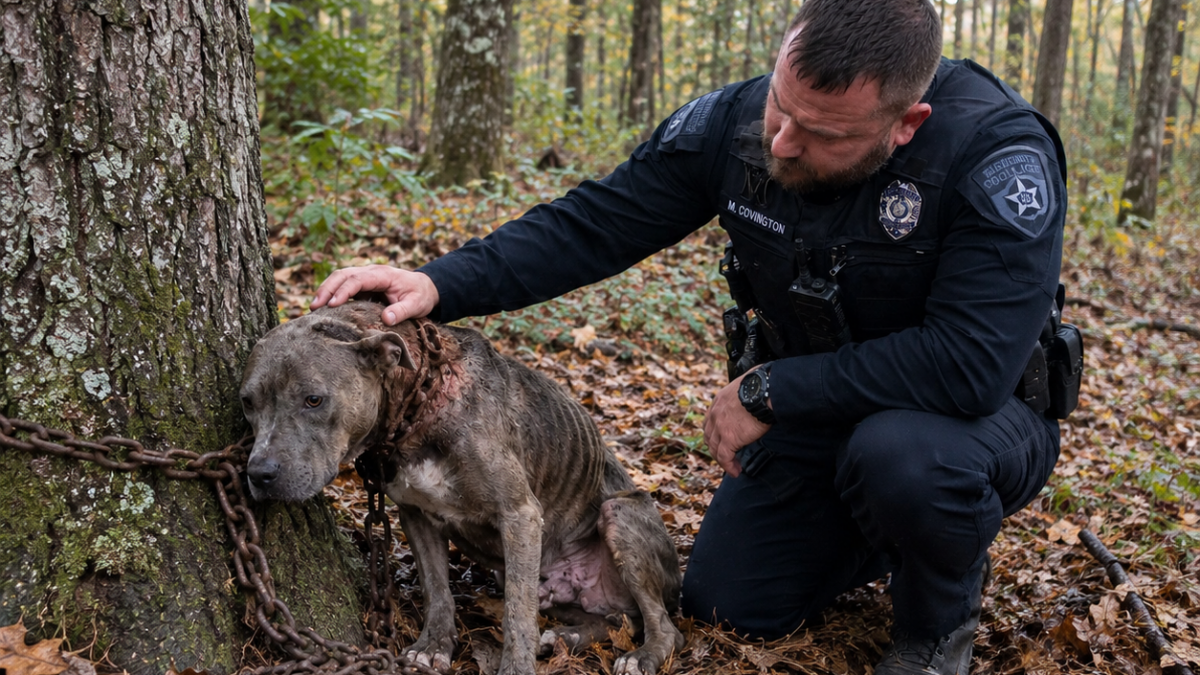
Thomas was the first one to say what both of us were thinking.
“We can’t move her.”
I looked at the dog.
Another contraction tightened her body, and she dug her front paws into the leaves.
“No.”
The nearest emergency veterinary clinic was almost forty minutes away under good conditions.
We were on a mountain service road, half a mile from pavement, with wet ground, cold wind, and a dog who had probably been without proper food and water for days.
Moving her during active labor could create more danger than leaving her where she was.
I reached for my radio.
“Dispatch, unit twelve.”
Static.
Then Karen’s voice.
“Go ahead, twelve.”
“We have an animal welfare emergency off Forest Service Road Sixteen.”
There was a pause.
“Animal welfare?”
“Pregnant dog chained to a tree.”
Thomas looked down at the cut chain.
I continued.
“She’s been freed, but she’s actively giving birth.”
Silence.
Then Karen said, “You’re kidding.”
“Wish I was.”
“Do you need animal control?”
“We need anyone with veterinary experience who can reach us fast.”
“I’ll call county animal services and Dr. Mercer’s clinic.”
“Tell them we’re about thirty yards south of marker eleven. No trail.”
“Copy.”
I clipped the radio back to my vest.
Thomas crouched beside the dog but kept his distance.
“We should give her a name.”
I looked at him.
“We’re delivering puppies in the woods and you’re naming her?”
“She can’t be ‘the dog’ all day.”
Fair point.
The pit bull looked at us through half-closed eyes.
Her coat was gray, though beneath the dirt I could see a white patch running from her chest toward her throat.
“Grace,” I said.
Thomas glanced at me.
“Why Grace?”
I looked at the broken chain lying in the leaves.
“Feels like she’s due some.”
Thomas nodded.
“Grace it is.”
Another contraction came.
Grace whimpered.
I had attended births before.
Human births.
Not as a participant.
As a cop.
Once in the back seat of a sedan during a snowstorm.
Once in the lobby of an apartment building while EMS fought traffic.
Both times, there had been trained medical professionals on the phone telling everyone what to do.
This was different.
Grace could not tell us how long she had been contracting.
We did not know whether this was her first litter.
We did not know her age.
We did not know whether she had complications.
We knew almost nothing.
But she knew us now.
That mattered more than I expected.
Every time I shifted farther away, her eyes followed me.
So I stayed.
Thomas spread one of our emergency blankets over the driest patch of ground.
Grace tried to stand.
Her back legs trembled.
“Easy.”
I slid one arm beneath her chest but did not lift.
She leaned against me.
For an animal who had every reason to distrust humans, she gave me her weight almost immediately.
That stayed with me.
People often say abused dogs are naturally forgiving.
I do not think that is the right word.
Forgiveness implies they owe us a moral decision.
Grace owed humans nothing.
What she gave us was trust under pressure.
That was different.
And far more humbling.
We helped her shift onto the blanket.
The second she settled, she turned her head toward her belly.
Then came another contraction.
Stronger.
I looked toward the trees.
“Come on, animal control.”
Thomas took off his jacket and rolled it into a cushion beneath Grace’s head.
“You know that’s not department-issued animal bedding.”
“I’ll file a report.”
“Make sure you include bodily fluids.”
“I’m burning it afterward.”
Grace suddenly pushed.
Both of us stopped talking.
For several seconds, the forest seemed unnaturally quiet.
Wind.
Breathing.
Leaves moving somewhere far away.
Then something small appeared.
Thomas’s face drained of color.
“Mike.”
“I see it.”
Neither of us touched.
Grace handled the first part instinctively.
Within moments, the first puppy was born.
Tiny.
Wet.
Dark gray.
Motionless for one horrifying second.
Then Grace turned immediately.
Despite her exhaustion, despite the chain, despite hunger, she knew exactly what to do.
She cleaned the puppy.
Nudged it.
The little body twitched.
Then came a sound.
Tiny.
High.
Alive.
Thomas sat back on his heels.
“Oh, thank God.”
Grace continued licking the puppy until it began searching for warmth.
I moved the emergency blanket slightly to create a cleaner fold.
The puppy crawled toward her belly.
Grace looked at me.
“Good girl,” I whispered.
Her tail moved once.
The sight of that first puppy changed everything.
Until then, we had been rescuing a dog.
Now there were two lives on the ground.
And more coming.
I called dispatch again.
“Karen, first puppy is here.”
“You have got to be kidding.”
“Nope.”
“How is it?”
“Alive.”
“And mom?”
“Exhausted.”
“I have animal control en route. Dr. Mercer is sending a tech and says not to transport unless there’s a clear emergency.”
“Copy.”
Karen paused.
“Mike?”
“Yeah?”
“Good luck.”
The radio clicked off.
I looked at Thomas.
“Dispatch just wished us luck.”
“That’s reassuring.”
Grace rested for several minutes.
She drank a small amount of water.
The puppy nursed.
We covered her hindquarters as much as we could without interfering.
Thomas went back to the truck and returned with towels, two more blankets, a first-aid kit, bottled water, and half a turkey sandwich.
Grace smelled the food immediately.
Her eyes opened wider.
“Think she can eat?”
“Small amount.”
He tore off a piece of turkey.
I offered it from my palm.
Grace took it so gently that I barely felt her teeth.
One piece.
Then another.
I did not give her more.
She needed strength.
But we did not know how her stomach would handle food after deprivation.
A second contraction came.
This one lasted longer.
Grace panted heavily.
The first puppy squeaked beneath her.
I moved it carefully away from her hind legs but kept it against her belly.
“Come on, Mama.”
Thomas looked at me.
“Did you just call her Mama?”
“Focus.”
“I’m just documenting.”
Grace pushed.
A second puppy came.
Tan this time, with a dark muzzle.
It cried almost immediately.
“Two,” Thomas said.
“Two.”
Grace cleaned the puppy.
I used one of the clean towels around the edge of the blanket.
My hands were shaking.
I did not realize it until Thomas noticed.
“You okay?”
“No.”
“Same.”
We both laughed once.
Not because anything was funny.
Because fear sometimes leaks out as laughter when there is nowhere else for it to go.
The animal control truck arrived after the second puppy.
We heard the engine up on the road, then a voice calling through the trees.
“Covington?”
“Down here!”
A woman in dark green coveralls appeared carrying a large medical bag.
Behind her came another officer with a collapsible stretcher and more blankets.
The woman introduced herself quickly.
“Rachel Kim, county animal services.”
She saw Grace.
Then the puppies.
Her professional expression shifted.
“How long since first puppy?”
“About twenty-five minutes.”
“Second?”
“Seven.”
She washed her hands with sanitizer, pulled on gloves, and crouched several feet from Grace.
“Can I approach?”
I looked at Grace.
She watched Rachel.
No growling.
No raised lip.
Just exhaustion.
“Slow.”
Rachel moved closer.
Grace’s eyes followed every inch.
I kept one hand near her shoulder.
“It’s okay.”
Rachel examined her visually first.
“Very underweight.”
“We know.”
“Dehydrated.”
“Yes.”
“Any vomiting?”
“No.”
“Discharge before labor?”
“Unknown.”
Rachel checked the puppies.
“Both look viable.”
Thomas exhaled.
“Thank God.”
Rachel glanced at the chain.
“Was she attached to that?”
“Yes.”
“How short?”
I pointed to the tree ring.
Her mouth tightened.
“That’s criminal.”
“We’re treating the scene as evidence after we get her safe.”
Rachel nodded.
“Good.”
There would be time for police work later.
Photographs.
Chain measurements.
Tool marks.
Tire tracks if any survived.
Interviews with property owners.
Records.
Possible cameras near access roads.
At that moment, none of it mattered as much as Grace breathing.
A young vet tech named Alyssa arrived ten minutes later, hiking down with another bag.
She had been sent by Dr. Mercer.
Alyssa listened to Grace’s heart and checked what she safely could without stressing her.
“She’s weak, but labor appears normal right now.”
“How many puppies?”
“No way to know without imaging.”
“Could we move her?”
Alyssa shook her head.
“Not while she’s progressing normally and puppies are coming this close together.”
Rachel looked at the sky.
Clouds were thickening.
“Temperature’s dropping.”
“We make shelter.”
So we did.
Two police officers, two animal rescue workers, one laboring pit bull, and two newborn puppies began building what was probably the strangest maternity ward in the history of the national forest.
We stretched a tarp between two trees above the blanket.
Used our jackets and spare towels to block wind.
Moved wet leaves away.
Placed chemical hand warmers under layers of blanket where the puppies could benefit without touching them directly.
Rachel had an insulated emergency pad in her vehicle, and Thomas hiked back up to retrieve it.
When he returned, he was carrying the pad under one arm and a large cardboard box under the other.
“What’s that?”
“Future puppy transport.”
Rachel nodded approvingly.
“Smart.”
“I have moments.”
Grace watched all of us working around her.
At one point, she lifted her head and looked at the open space where the chain had been.
Then back at us.
I wondered whether she understood yet.
Nothing was pulling her backward.
No metal weight.
No limit around the tree.
She could move if she wanted.
But she chose to stay there now because her puppies were there.
That difference mattered.
The third puppy arrived forty minutes after the second.
This one was white with gray patches and smaller than the others.
Too quiet.
Grace licked it.
Nothing.
Alyssa stepped in.
“Let me.”
Grace hesitated.
I touched her shoulder.
“Please.”
Maybe she understood tone.
Maybe she was simply too tired to resist.
Alyssa lifted the puppy with a towel, cleared fluid, rubbed its tiny body briskly, and stimulated it.
Seconds stretched.
Thomas stared at the ground.
Rachel watched Alyssa’s hands.
Grace tried to raise herself.
I kept her calm.
“Come on, baby,” Alyssa whispered.
Still nothing.
Then the puppy jerked.
A tiny gasp.
Another.
Then a squeak so weak it was almost only breath.
Nobody moved for half a second.
Alyssa smiled.
“There you are.”
Thomas swore under his breath in relief.
Alyssa returned the puppy to Grace.
Grace immediately began licking.
The tiny puppy found its mother’s warmth.
Three.
I thought of the tree.
No food.
No water.
A chain too short to stretch.
And three lives that had been inside Grace while she endured it.
Anger rose in me so hard I had to stand and walk several feet away.
Thomas noticed.
He followed.
“You good?”
“No.”
“Yeah.”
I stared at the oak tree.
“Someone screwed that ring in.”
“I know.”
“They brought her all the way up here.”
“I know.”
“They knew she was pregnant.”
“Probably.”
My jaw tightened.
Thomas spoke quietly.
“Don’t make promises in your head yet.”
I looked at him.
“You know what I mean.”
He did.
In police work, anger can sharpen you or ruin you.
You do not get to decide guilt because something disgusts you.
You gather evidence.
You build the case.
You let facts stand where rage wants shortcuts.
Thomas knew me well enough to remind me.
“We’ll find what we can,” he said.
I nodded.
Then another sound came from Grace, and both of us turned immediately.
The fourth puppy was coming.
By early afternoon, there were five.
Three males.
Two females, as far as Rachel could quickly tell.
The fifth was strong, black with a white chest.
He came out protesting loudly, which made everyone laugh.
“This one has opinions,” Thomas said.
Rachel rubbed her forehead.
“You two realize you are now emotionally compromised witnesses.”
“I was compromised at puppy one.”
“Same.”
Grace was becoming weaker.
That worried Alyssa.
The contractions slowed.
Her gums were pale.
We gave tiny amounts of water more frequently.
Alyssa called Dr. Mercer and described everything.
I could hear the vet’s voice faintly through the phone.
Afterward, Alyssa said, “We need to monitor closely. If she stops progressing or shows distress, we transport.”
“How long?”
“If there’s another puppy retained, timing matters.”
That phrase landed heavily.
Another puppy retained.
We still did not know how many there were.
Grace rested.
The five puppies nursed in a small cluster against her belly.
She looked down at them.
Then at me.
I sat beside her.
“Doing okay?”
Her eyes closed halfway.
I scratched gently behind her ear.
She leaned into it.
That was the first voluntary affection she had given me.
Not tolerance.
Not exhausted surrender.
She moved her head toward my hand.
My throat tightened.
Rachel saw.
“She likes you.”
“She has terrible judgment.”
Grace’s tail tapped weakly.
Thomas pointed.
“She disagrees.”
For almost an hour, nothing happened.
Then Grace became restless.
She tried to stand.
Could not.
Panted.
Turned toward her side.
Alyssa’s posture changed.
“What?”
“Something’s off.”
She checked Grace carefully.
Another contraction came.
Grace pushed.
Nothing.
Again.
Nothing.
Alyssa looked at Rachel.
“We may need to move.”
The mood changed instantly.
No more jokes.
No more waiting.
Rachel brought the stretcher closer.
Thomas cleared our route through the brush.
I moved the puppies into the padded cardboard box one by one, wrapped in warm towels.
They protested.
Grace became frantic when the first puppy left her side.
“Easy, Mama.”
She tried to follow.
I held the box where she could see and smell them.
“They’re here.”
Her breathing slowed slightly.
Alyssa watched her abdomen.
“Another contraction.”
Grace pushed.
Nothing.
“That’s enough. We go.”
Moving a dog who had recently given birth down thirty yards of uneven mountain terrain while keeping five newborn puppies warm was not simple.
Grace could not walk safely.
We lifted her onto the collapsible stretcher.
Rachel and Thomas took the handles.
I carried the puppy box tight against my chest.
Alyssa walked beside Grace, monitoring.
The moment we started moving, Grace lifted her head.
She stared at the box.
“I have them.”
She whined.
“They’re right here.”
I lowered the box briefly so she could smell it.
Her head settled again.
Step by step, we moved uphill.
It felt much farther than thirty yards.
Branches caught our pants.
Mud slipped under boots.
The stretcher tilted once, and all four of us froze.
“You good?”
“Good.”
Grace never took her eyes off the box.
At the road, Rachel had a heated transport van ready.
Grace went inside.
The puppies remained beside her in a secured warming container.
I expected to return to our patrol truck.
Instead, Grace lifted her head as I stepped away.
Then she whined.
Rachel looked at me.
“You’re going with her.”
“Am I?”
“You are now.”
Thomas laughed.
“Go.”
“What about the scene?”
“I’ve got it.”
“You need help.”
“I have backup coming.”
He looked into the van at Grace.
“She needs you more.”
I hesitated.
Thomas lowered his voice.
“Mike.”
I looked at him.
“This is why we have partners.”
That settled it.
I climbed into the animal control van.
Grace’s head dropped onto the blanket.
I sat on the floor near her.
Rachel drove.
Alyssa rode in back with me, watching the puppies.
Every few minutes, Grace contracted.
Still no puppy.
Alyssa called Dr. Mercer.
“We’re ten minutes out.”
Pause.
“Yes.”
Pause.
“Five live pups.”
Pause.
“Mom is weak.”
She hung up.
“They’re ready for us.”
The veterinary clinic had cleared an exam room before we arrived.
Grace was taken straight in.
The puppies went with her.
For the first time since I found her, I was forced to stay behind.
A veterinary assistant closed the double doors.
I stood in the hallway holding a chain cutter in one hand because I had somehow never put it down.
I looked ridiculous.
Covered in mud.
Leaves stuck to my pants.
My uniform smeared with dirt.
No jacket because Thomas had turned it into a pillow in the forest.
And bolt cutters in my fist like I intended to threaten the furniture.
A receptionist named Joan approached carefully.
“Officer?”
I looked down at the cutters.
“Sorry.”
I set them against the wall.
“Do you need anything?”
“News.”
“I’ll tell the doctor.”
I sat.
Then stood.
Then sat again.
My phone rang.
My wife, Emily.
I stared at the screen.
I had forgotten completely that I had told her that morning I would be home for an early dinner.
I answered.
“Hey.”
“You sound strange.”
“I’m at a veterinary hospital.”
Pause.
“What happened?”
“It’s not me.”
“I assumed you were not being treated by a veterinarian.”
Despite everything, I laughed.
“We found a dog.”
“That sentence never ends simply with you.”
“She was chained in the forest.”
Emily went quiet.
“Pregnant.”
Another pause.
“She started giving birth after we freed her.”
“Michael.”
“Five puppies so far.”
“Oh my God.”
“There may be another one stuck.”
Her voice softened.
“Are you okay?”
I looked at the closed doors.
“No.”
“Is she?”
“I don’t know.”
“What’s her name?”
“Grace.”
“You named her?”
“Thomas made me.”
“Of course he did.”
I rubbed my face.
“She trusted me, Em.”
“I know.”
“You don’t even know her.”
“No.”
She paused.
“But I know you.”
The exam doors opened.
Dr. Mercer appeared in dark blue scrubs.
“I have to go.”
“Call me.”
“I will.”
I stood.
The vet came toward me.
Dr. Samuel Mercer was in his fifties, calm-faced, with gray hair and the steady expression of someone who had delivered both good news and terrible news often enough to know neither should be rushed.
“Officer Covington?”
“Yes.”
“Grace is stable.”
My knees nearly weakened.
“And puppies?”
“Five are stable.”
“Five?”
“There was a sixth.”
The word was not past tense yet, but his voice made me brace.
“Alive?”
“Yes.”
I exhaled.
“But?”
“The puppy was positioned poorly and was in distress.”
“What did you do?”
“We were able to assist delivery.”
I closed my eyes.
“Six.”
“Six.”
“Grace?”
“Very tired. Malnourished. Dehydrated. Anemic. But she did remarkably well considering her condition.”
“Six puppies?”
He smiled.
“Six.”
I sat down because my legs finally decided they had participated enough.
Dr. Mercer continued.
“We need to monitor them closely. Especially the smallest puppy.”
“The white one?”
“You noticed.”
“Hard not to.”
“She’s weaker than the others.”
“Will she make it?”
Dr. Mercer did not give me the answer people want.
He gave me the true one.
“I don’t know.”
That became the first lesson of the next several weeks.
Rescue is not a single moment.
Cutting a chain feels like an ending because metal falls, freedom becomes visible, and everyone can point to the instant something changed.
But sometimes that is only the beginning.
Grace and her six puppies were alive.
That did not mean they were safe yet.
Thomas arrived at the clinic two hours later.
He had spent the afternoon photographing the clearing, bagging portions of the chain, documenting the tree hardware, checking nearby roads, and speaking with forest service staff.
When he walked in, his pants were muddy up to the knees.
“You look terrible,” I told him.
“You’re barefoot.”
I looked down.
One boot was missing.
I genuinely had not noticed.
“What happened to your boot?” he asked.
I thought back.
“Stuck in mud carrying the stretcher.”
“You left it?”
“Apparently.”
Thomas stared at me.
“You’re a detective’s nightmare.”
“Puppies.”
“Fair.”
He sat beside me.
“How many?”
“Six.”
His face changed.
“Six?”
“Six.”
“All alive?”
“For now.”
We both went quiet at those words.
For now.
There it was again.
The uncomfortable truth.
The smallest puppy was struggling to nurse.
Grace’s milk supply was low because she had been malnourished.
The veterinary staff began supplemental feeding.
The puppies were weighed, labeled with colored soft bands, and monitored constantly.
The little white-and-gray female was marked with a purple band.
Thomas immediately called her Purple.
I objected.
“That is not a name.”
“It’s accurate.”
“She deserves better.”
“You named the mother Grace in twelve seconds.”
“Yes, and that was excellent.”
“Debatable.”
Dr. Mercer eventually told us we could see them.
We entered quietly.
Grace lay in a large padded kennel with all six puppies nestled against her.
She looked impossibly tired.
But when she saw me, her head came up.
Her tail moved.
Once.
Twice.
I crouched outside the kennel.
“Hey, Mama.”
She stood.
Slowly.
Walked toward the door.
Then pressed her forehead against the bars.
I put my fingers through.
She leaned into them.
Thomas stood behind me.
“Well.”
“Don’t.”
“I didn’t say anything.”
“You were going to.”
“I was going to say she obviously prefers me.”
Grace ignored him completely.
I laughed.
“She has excellent judgment.”
The sixth puppy was dark brown with white paws.
Strong.
Loud.
He had been the one stuck.
The tiny white female lay farther forward near Grace’s front legs.
I pointed.
“How’s Purple?”
Thomas grinned.
“You said it.”
“Temporary.”
Dr. Mercer joined us.
“She took three milliliters from a bottle.”
“Is that good?”
“It’s something.”
Grace licked the small puppy gently.
Dr. Mercer watched.
“Mom is attentive. That helps.”
“Will she have enough milk?”
“We’ll supplement all of them.”
“How long will Grace stay?”
“At least several days.”
“Then where?”
“That depends on animal control and the investigation.”
The investigation.
I had almost forgotten.
The chain came back into my mind.
The ring in the tree.
Someone had done this.
Grace had not wandered there and become tangled.
She had been placed.
Abandoned.
Pregnant.
Without food or water.
I stood.
Thomas knew the look on my face.
“We have a lead.”
That got my attention.
“What?”
“Forest service found tire impressions near an old access gate.”
“Vehicle?”
“Could be pickup or SUV.”
“Recent?”
“Within the weather window.”
“That’s not much.”
“No.”
He leaned against the wall.
“But I also found a torn feed bag about fifty yards uphill.”
“Brand?”
“Common.”
“Anything else?”
“Receipt.”
I looked at him.
“Readable?”
“Partial.”
“Store?”
“Farm supply place in Hawthorne.”
Twenty-five miles away.
Not proof.
But something.
“When do we go?”
“Tomorrow.”
I looked toward Grace.
Thomas smiled faintly.
“You are still on duty, Officer Puppy.”
“Stop calling me that.”
“Not a chance.”
We went to the farm supply store the next morning.
The manager was cooperative.
The receipt fragment matched their paper stock and register formatting.
No transaction number remained.
But we knew a rough date based on weather exposure and the products visible on the torn bag.
Dog feed.
Cheap chain.
Carabiners.
Hardware.
The manager pulled several days of transaction history.
Too many possibilities.
Then an employee remembered a man asking whether the thick utility chain could “hold a strong dog.”
That changed things.
“Describe him.”
Forties or fifties.
Baseball cap.
Work jacket.
Maybe drove an older black pickup.
Still broad.
Still weak.
But better.
Security cameras covered the parking lot.
The footage quality was poor, but we found three black pickups during the relevant time.
One had a partially visible plate.
We ran it.
Registered to a man named Curtis Hale.
Rural address twelve miles from the forest access road.
Prior animal complaints.
Nothing severe enough for charges.
Mostly loose dogs.
Noise.
One welfare call years earlier deemed unfounded.
Thomas looked at me across the computer.
“Could be coincidence.”
“Could.”
“We do this correctly.”
“I know.”
“You sound like you don’t.”
“I know.”
We did.
Search warrant application.
Evidence review.
Coordination with animal control.
No cowboy nonsense.
No rage.
Facts.
The warrant came through two days later.
At Hale’s property, we found three more dogs.
Alive.
Fed.
Thin but not critical.
One was chained.
Two were in outdoor pens.
None pregnant.
In a shed, we found matching chain.
Matching eye bolts.
A bolt-driver attachment consistent with the hardware in the oak.
More importantly, inside a trash barrel we found veterinary paperwork for a gray female pit bull named Nova.
Estimated three years old.
Pregnant.
Owner: Curtis Hale.
Thomas held the form.
“Nova.”
I looked at Grace’s photograph on my phone.
Nova.
That had been her name before the tree.
At the vet clinic later, I stood outside her kennel.
“Nova.”
She looked at me.
No reaction.
I tried again.
“Nova?”
Her ears moved slightly.
Maybe recognition.
Maybe only sound.
Grace felt like her name now.
Not because I had a right to rename her history.
Because whatever life “Nova” belonged to had ended beneath that oak.
I told Dr. Mercer.
He shrugged.
“Dogs can have more than one name.”
“Confusing?”
“Humans have nicknames.”
Grace lifted her head.
I scratched under her chin.
“What do you think?”
Tail wag.
“Grace it is.”
Hale was interviewed.
At first, he denied everything.
Then admitted owning the dog.
Then said he had “given her away.”
Then could not name the person.
Then claimed she had escaped.
Then had no explanation for her veterinary paperwork in his shed or matching chain hardware.
Eventually, the story became uglier but clearer.
Grace had become pregnant unexpectedly.
Hale said he did not want puppies.
He claimed he could not afford veterinary care.
He drove her into the forest intending to “leave her where someone might find her.”
Thomas stared at him across the interview room.
“You chained her to a tree thirty yards off a road.”
Hale looked away.
“I figured hikers would hear her.”
“There is no hiking trail there.”
“I didn’t know.”
“You purchased heavy chain.”
“She was strong.”
“You attached an eye bolt to the tree.”
“I didn’t want her following me.”
That sentence entered the room and changed its temperature.
I did not speak for several seconds.
Thomas did.
“So you understood she would try.”
Hale said nothing.
Charges followed.
Animal cruelty.
Abandonment.
Other violations based on the dogs found on the property and conditions documented by animal control.
The legal case would take months.
I could live with months.
Grace had time now.
That was what mattered.
The puppies survived the first seventy-two hours.
Then the smallest female began losing weight.
Purple.
The name had stuck despite my objections.
By day four, everyone at the clinic called her Purple.
Even Dr. Mercer.
I arrived after shift and found Alyssa bottle-feeding her.
“She’s not latching well.”
“Why?”
“We don’t know yet.”
The puppy was so small in Alyssa’s hands that it barely seemed real.
Her eyes were still closed.
Her ears folded.
Tiny paws flexing against the towel.
I had held evidence bags heavier than she was.
“What happens?”
“We keep feeding.”
“And if she keeps losing?”
Alyssa did not answer directly.
“We keep feeding.”
So we did.
Or rather, they did.
But I started appearing every evening.
Thomas came too.
He claimed he was there because my carpooling habits were inconvenient.
Nobody believed him.
Emily visited on the fifth day.
Grace had never met her.
I worried she might be wary.
Instead, Emily sat outside the kennel, turned sideways, and waited.
Grace sniffed through the bars.
Emily offered her hand.
Grace licked one finger.
Emily looked at me.
“Oh no.”
“What?”
“I see the problem.”
“What problem?”
“You’re already in love with her.”
“I’m not.”
Grace put one paw against the kennel door.
Emily raised an eyebrow.
“You were saying?”
“We cannot adopt a dog with six puppies.”
“I said nothing about six puppies.”
I looked at her.
She smiled.
That smile scared me more than any suspect interview.
The puppies were too young to go anywhere, obviously.
Grace was not legally available.
The case was active.
We had no idea how she would behave in a home.
We had another dog already, a nine-year-old mutt named Winston who believed personal space was a communist conspiracy.
There were a thousand reasons not to think ahead.
So naturally, we both thought ahead.
But Purple got worse.
On the sixth night, Dr. Mercer called me.
That alone terrified me.
Veterinarians do not normally call police officers at eleven-thirty unless something has changed.
“She’s having difficulty breathing.”
I sat up in bed.
“Purple?”
“Yes.”
Emily was awake immediately.
“What?”
I held up one finger.
“What are you doing?”
“Supplemental oxygen, warming, feeding carefully. She may have aspirated a small amount earlier or she may be developing infection.”
“Is Grace with her?”
“Yes.”
“Can I come?”
Dr. Mercer paused.
“You don’t need to.”
“I know.”
“Come.”
Emily drove because I was too distracted.
At the clinic, only overnight staff were present.
The building was quiet.
Purple was inside a small oxygen enclosure.
Grace lay directly beside it on the other side of the clear wall.
She could not touch her puppy.
That made her frantic.
She stood.
Lay down.
Stood again.
Whined.
Scratched lightly at the enclosure.
Then looked at me.
I sat beside her.
“I know.”
She pressed against my leg.
Emily sat on the other side.
For two hours, we watched a puppy breathe.
That is all.
Nothing dramatic.
Nothing heroic.
Just a tiny chest rising too fast.
Then slowing.
Then fast again.
Humans are terrible at accepting helplessness.
We want tasks.
Buttons.
Solutions.
Give me something to lift.
Something to cut.
Someone to arrest.
Something to fix.
There was nothing I could do for Purple.
So I stayed.
Around two in the morning, Grace finally lay down with her head in my lap.
Emily stroked the side of her neck.
“Do you remember when Winston had surgery?”
“Yeah.”
“You paced for seven hours.”
“He ate a sock.”
“He ate half a sock.”
“Important distinction.”
“He was fine.”
“He had excellent insurance.”
I smiled weakly.
Grace sighed.
Inside the oxygen enclosure, Purple shifted.
A vet tech checked her.
“Still fighting.”
That phrase bothered me.
Fighting.
People use it because it sounds hopeful.
But sometimes survival is not a battle someone wins by wanting hard enough.
Purple was not morally responsible for living.
Grace was not responsible if she did not.
Still, in that room, I understood why the word exists.
The little puppy kept breathing.
Morning came.
Purple stabilized.
Not dramatically.
Her oxygen levels improved little by little.
By eight, Dr. Mercer believed she could remain outside the chamber for short periods.
When they returned her to Grace, the mother dog did something that silenced the room.
She pulled Purple beneath her chin instead of toward her belly.
Held her there.
Licked her entire tiny body.
Then nudged her toward nursing.
Purple latched.
Alyssa whispered, “There you go.”
Grace closed her eyes.
So did I.
Purple lived.
Slowly.
Stubbornly.
She remained the smallest puppy for weeks.
But she gained weight.
First a little.
Then steadily.
She developed an absurdly loud bark for such a tiny animal.
Thomas called it “compensation.”
By the third week, all six puppies had names.
We had not intended to name them permanently.
That was another lie.
Purple remained Purple.
The first gray male became Oak, after the tree.
Thomas named him.
I objected to that too.
The tan male became Teddy.
The black-and-white male was Boots.
The brown puppy with white paws became Milo.
The other female, a dark brindle girl, became Ruby.
Grace seemed indifferent to names as long as everybody was returned to her after weighing.
She transformed as her body recovered.
Food filled out her sides.
Her coat began to shine.
Her eyes changed most.
In the forest, they had looked heavy.
Not empty.
But ready for disappointment.
At the clinic, they became curious.
Then playful.
The first time she picked up a toy, every staff member within sight stopped.
It was a blue rubber ball.
She stared at it.
Sniffed it.
Picked it up.
Dropped it.
Jumped backward.
Then pounced.
I laughed so loudly Grace froze.
“Sorry.”
She grabbed the ball again.
Her tail wagged harder.
There was a young dog under all that suffering.
Only about three.
Maybe less.
She had not become old.
She had become exhausted.
Those are not the same thing.
The puppies opened their eyes.
Then became mobile.
Then became chaos.
Six puppies can turn a veterinary recovery room into a riot using less than three pounds of collective body weight.
Oak was adventurous.
Boots climbed everything.
Ruby bit everybody’s ears.
Milo preferred sleeping.
Teddy screamed if a meal was thirty seconds late.
Purple became the smallest dictator in North Carolina.
She would crawl directly across her larger brothers rather than around them.
Thomas loved her.
He denied this.
“You’re holding her.”
“She climbed onto me.”
“You picked her up.”
“For officer safety.”
Purple was asleep inside his jacket.
“Of course.”
At four weeks, Grace and the puppies were moved from the veterinary hospital to a foster home run by a rescue organization called Mountain Haven.
The foster volunteer was a retired teacher named Linda Parker.
Linda lived on six fenced acres with an old farmhouse, three foster rooms, and the patience of a saint who had seen enough puppies to no longer be impressed by destruction.
Grace was nervous when we arrived.
New driveway.
New house.
New smells.
She stopped at the threshold.
The puppies were inside in a heated pen.
She could hear them squeaking.
But she would not cross.
I stood beside her.
No leash pressure.
No coaxing.
We waited.
Linda sat several feet inside the doorway.
“Take your time, Mama.”
Grace looked at me.
Then toward the house.
One paw crossed.
Then another.
She walked inside.
No chain stopped her.
That image hit me harder than cutting the metal had.
Freedom is not the chain breaking.
Sometimes freedom is the first doorway you choose to walk through afterward.
Grace found the puppies and immediately counted them with her nose.
One.
Two.
Three.
Four.
Five.
Six.
Satisfied, she lay down.
Linda smiled.
“She’s going to be okay.”
I wanted to believe that.
The legal case still meant Grace belonged technically to the evidence chain of a cruelty investigation.
Hale surrendered ownership before trial, likely on advice of counsel.
That allowed the rescue to begin formal placement planning.
The puppies would become adoptable after weaning, vaccinations, and medical clearance.
Grace would need more evaluation.
Linda called me three days after intake.
“She’s afraid of men in caps.”
My stomach tightened.
“Specific caps?”
“Baseball caps.”
Hale wore one in store surveillance.
“Damn.”
“She doesn’t react aggressively. She hides.”
“Anything else?”
“Raised male voices.”
“Cars?”
“Fine.”
“Chains?”
Linda went quiet.
“I’m not testing that.”
“Good.”
“She likes women. Loves children from a distance. Not ready for contact yet.”
“Other dogs?”
“Calm dogs, yes.”
I thought of Winston.
Then immediately told myself I was not thinking of Winston.
Linda continued.
“She also sleeps pressed against the wall.”
I closed my eyes.
The tree.
The short chain.
Limited space.
“She doesn’t use the center of the room?”
“Not yet.”
That changed over the next two weeks.
Linda sent a photo one morning.
Grace asleep on her side in the middle of a rug.
Legs completely extended.
No wall.
No corner.
No chain.
The caption was:
Look who discovered sprawling.
I stared at that photograph during roll call until Thomas nudged me.
“You okay?”
I showed him.
His face softened.
“She remembers.”
“Maybe.”
“Or she’s forgetting.”
I shook my head.
“I don’t think dogs need to forget to heal.”
Thomas looked at me.
“Since when are you philosophical?”
“Since puppy six.”
“Purple changed you.”
“Shut up.”
The puppies reached six weeks.
That was when personalities became impossible to ignore.
Oak followed Grace everywhere.
Ruby tackled every sibling.
Boots stole blankets.
Teddy remained food-motivated to a level bordering on criminal.
Milo became the calm one.
Purple was fearless.
She was half the size of Oak and twice as convinced she owned the world.
Watching them was joyful.
And painful.
Because each week brought them closer to leaving Grace.
The rescue handled adoptions carefully.
Applications.
Home checks.
Veterinary references.
Breed restrictions.
Commitment contracts.
No same-day take-home decisions.
Linda was relentless.
Good.
The puppies deserved relentless.
The first approved family wanted Milo.
A middle-aged couple with a twelve-year-old daughter, fenced yard, older calm dog, excellent vet history.
I happened to be there when they met him.
Not officially.
I had “stopped by.”
Linda called it hovering.
The little girl sat on the floor.
Milo walked over, climbed into her lap, and went to sleep.
Her mother cried.
Her father pretended not to.
Linda looked at me.
“Don’t.”
“I didn’t say anything.”
“You’re doing the cop face.”
“What face?”
“The one where you investigate joy for possible fraud.”
Fair.
Milo went home two weeks later.
Grace watched him leave.
That was harder than I expected.
She stood near the gate as the family carried him to their car.
No panic.
No frantic barking.
Just watching.
Linda stood beside her.
I stood on the other side.
After the car disappeared, Grace sniffed the ground where Milo had been.
Then turned back toward the house.
Five puppies remained.
One by one, they left.
Ruby went to a veterinary technician with two children.
Boots went to a young couple who had recently lost an elderly pit bull.
Teddy was adopted by a retired firefighter who promised to never let a meal run late.
Oak took longest.
He was deeply attached to Grace.
They slept touching.
Played gently.
Grace corrected him when he got too rough.
The rescue considered keeping them together.
Then a family applied specifically for a bonded or harder-to-place pair.
For a moment, I thought Oak might stay with Grace.
But the family’s resident dog did not tolerate Grace during introductions.
Oak, however, adored him.
The rescue had to decide based on each animal, not the story humans wanted.
Oak went home alone.
Grace stood at the gate again.
This time, she whined once.
I crouched beside her.
“I know.”
She leaned into me.
Then there were two.
Grace and Purple.
Purple had not been adopted yet.
Not because nobody wanted her.
Everybody wanted her.
Her early medical issues made the rescue wait longer.
At nine weeks, she still had a slight size difference but was otherwise thriving.
Thomas had already submitted an application.
Without telling me.
I found out from Linda.
“You knew?”
“No.”
“You’re his partner.”
“That does not give me access to his adoption paperwork.”
“He applied three weeks ago.”
I called him immediately.
“You applied for Purple?”
Silence.
Then, “Define applied.”
“You filled out an adoption application.”
“So yes.”
“You told me she was annoying.”
“She is.”
“You called her a defective alarm clock.”
“She screams.”
“You said small dogs make you nervous.”
“She isn’t a dog. She’s Purple.”
That was when I knew he was finished.
His wife, Rachel, had apparently approved months ago.
Their two teenage sons had built a dog ramp to the couch before Purple was even medically cleared.
The adoption was inevitable.
Purple went home with Thomas.
Grace watched the truck leave.
Then turned toward me.
Linda folded her arms.
“Well?”
“Well what?”
“She’s alone.”
“She has you.”
“For foster.”
“Yes.”
“And what happens when she’s adopted?”
“That’s good.”
“Of course.”
Linda was smiling.
I hated that smile.
“You already know.”
“Know what?”
“She waits for your truck.”
“No, she doesn’t.”
“She does.”
“She likes trucks.”
“She ignores mine.”
“That’s because yours smells like cat.”
“It does not.”
“I have smelled your car.”
“That’s off-topic.”
Grace walked over.
Sat on my boot.
Linda raised one eyebrow.
Traitor.
I went home and told Emily.
She listened without interrupting.
Then asked one question.
“Do you want her?”
“Yes.”
I answered too fast.
Emily smiled.
“That was easy.”
“It’s not easy.”
“It sounded easy.”
“We have Winston.”
“They’ve met?”
“Not yet.”
“We have to test compatibility.”
“Yes.”
“We work.”
“I have irregular shifts.”
“She may have trauma triggers.”
“Yes.”
“Pit bull restrictions exist in some places.”
“We own our house.”
She nodded.
“So those are logistics.”
I stared at her.
“What’s the emotional objection?”
I looked toward the living room.
Winston was asleep upside down on the couch, one leg in the air.
“Maybe I’m too attached because I found her.”
Emily waited.
“Maybe she deserves someone who sees her as a dog and not a rescue story.”
“That’s a good concern.”
“She shouldn’t spend her life being the dog chained to a tree.”
“No.”
“She should get to be annoying.”
“Hopefully.”
“Steal food.”
“Within reason.”
“Destroy cushions.”
“No.”
“Have normal problems.”
“Yes.”
I looked at Emily.
“And if I adopt her, I don’t want to keep looking at her like she’s broken.”
Emily reached across the table.
“Then don’t.”
Simple.
Infuriatingly simple.
Winston met Grace the next weekend.
We chose neutral ground.
Quiet fenced yard at Linda’s.
Two handlers.
Parallel walk.
No forced face-to-face greeting.
Winston was nine, mostly hound and something inexplicably fluffy, with the social skills of an uncle who talks too much at weddings.
Grace noticed him.
Winston noticed Grace.
He wagged.
She looked away.
Good.
No fixation.
We walked.
Closed distance slowly.
Winston sniffed grass.
Grace sniffed grass.
Eventually they moved near each other.
Winston sniffed her shoulder.
Grace froze.
We redirected.
Again later.
This time, Grace sniffed him first.
Winston sneezed.
Grace jumped.
Then Winston wagged so hard he nearly fell over.
Grace stared.
Then her tail moved.
Not much.
Enough.
By the end of the session, they were walking side by side.
Second meeting, better.
Third, Grace play-bowed.
Winston looked shocked.
He had not seen a dog do that enthusiastically in years.
Then he attempted to respond and nearly pulled a muscle.
We stopped him for elder dignity.
The home trial began the following Friday.
I brought Grace through our front door on a loose leash.
She stopped inside.
Looked around.
Living room.
Kitchen.
Hallway.
Stairs.
Winston stood several feet away.
Emily sat on the couch.
No crowd.
No celebration.
No “welcome home” banner.
Just space.
Grace sniffed the entry rug.
Walked to the living room.
Stopped at a metal floor lamp.
The cord shifted.
She flinched.
I crouched.
“It’s okay.”
She recovered.
That mattered.
Recovery.
Not absence of fear.
She checked the kitchen.
Found the water bowl.
Drank.
Then walked back to me.
Sat.
Emily whispered, “Hi.”
Grace looked at her.
Then walked over and placed her head beneath Emily’s hand.
My wife started crying.
I pretended not to see.
The first night, Grace slept in the dog bed we had placed near ours.
At two in the morning, I woke.
She was standing by the bedroom door.
I sat up.
“Need out?”
She looked toward the hallway.
I got dressed and took both dogs outside.
Grace stepped onto the backyard grass.
Cold moonlight.
No leash once inside the fenced yard.
Winston wandered to his favorite tree.
Grace stood still.
Then she began walking.
Slowly.
A circle.
Then another.
She moved farther from me.
Ten feet.
Twenty.
Thirty.
Stopped.
Looked back.
I stayed where I was.
She ran.
Not away.
Around the yard.
One loop.
Then another.
Her legs stretched fully beneath her.
For the first time I had ever seen, Grace ran because she chose to.
No chain.
No emergency.
No puppies depending on her.
No person asking anything.
She simply ran.
Winston watched her pass, considered joining, and made the mature decision not to embarrass himself.
I stood in the dark wearing sweatpants and cried like an idiot.
Grace came back.
Her mouth open.
Tongue out.
Tail high.
She bumped my leg.
I scratched her chest.
“Yeah.”
She looked toward the yard.
“Go.”
She ran again.
The adoption became official three weeks later.
Mountain Haven asked what name we wanted on the paperwork.
I looked at Grace asleep beside Winston.
“Grace.”
Emily nodded.
“Definitely Grace.”
Her old name remained in the case file.
Nova.
I did not erase it.
I did not need to.
But Grace was who she became when the chain stopped deciding the limits of her world.
The criminal case concluded the following spring.
Hale pleaded guilty to animal cruelty and abandonment as part of a broader agreement.
There were fines.
Probation.
Restrictions on animal ownership.
Other conditions.
Some people asked if that felt like enough.
I never knew how to answer.
Punishment does not unchain a dog retroactively.
It does not feed the days she went hungry.
It does not erase the tree.
The value of the case was not that a sentence made everything balanced.
Life rarely balances cleanly.
The value was documentation.
Accountability.
A record saying what happened mattered.
And restrictions designed to prevent another animal from ending up where Grace did.
That mattered.
But Grace did not care about court.
Her concerns were more immediate.
Breakfast.
Winston’s bed.
Our couch.
Squirrels.
Emily returning from the grocery store.
Whether I had cheese.
She became remarkably normal.
That was perhaps my favorite outcome.
She stole dish towels.
She discovered pillows could be rearranged violently before sleeping.
She hated rain.
Loved snow.
Barked at the vacuum.
Feared baseball caps for almost a year.
Then one day, Thomas arrived wearing one.
I forgot to warn him.
Grace saw him.
Stopped.
Her body tightened.
Thomas noticed immediately.
He removed the cap.
Crouched sideways.
“Hey, Grace.”
She stared.
Then Purple jumped out of his truck.
By then Purple was nearly a year old, still small, still loud, and completely convinced Thomas existed for her convenience.
Grace saw her daughter.
Everything changed.
Purple ran to the fence.
Grace ran too.
Mother and daughter sniffed through the gate.
Tails flying.
Thomas entered without the cap.
Purple exploded into the yard.
Grace chased her.
They played for twenty minutes.
Later, Thomas sat on the ground.
The cap lay beside him.
Grace approached it.
Sniffed.
Backed away.
Returned.
Sniffed again.
Thomas did not touch it.
The next visit, he brought the same cap.
Placed it on the ground.
Grace sniffed.
Third visit, he held it.
Fourth, briefly placed it on his knee.
Months later, he wore it for two minutes while Purple played nearby.
Grace noticed.
Then looked away.
That day felt as important as any court ruling.
Fear had lost a little territory.
The puppies grew.
We stayed in contact with every adopter through the rescue.
Milo became inseparable from the twelve-year-old girl who had chosen him.
Ruby slept under her family’s dining table and stole socks.
Boots grew huge and gentle.
Teddy remained food-obsessed and once opened a lower cabinet to reach dog biscuits.
Oak matured into a calm dog who visited senior living facilities with his family.
Purple became Thomas’s shadow and routinely attended backyard cookouts wearing sweaters his sons claimed not to buy.
Every year around their birthday, the adopters sent photos.
Six dogs.
Alive.
Loved.
Different homes.
Different lives.
Grace saw some of them in person during carefully managed reunions.
We never forced it into sentimental theater.
Dogs do not need family reunions because humans like narratives.
But when the circumstances were right, she saw them.
Purple most often.
Oak a few times.
Milo once.
She greeted them as familiar dogs.
Sometimes playful.
Sometimes indifferent.
That was fine.
She had done her job.
They had grown.
She was allowed to become something besides their mother.
That mattered to me.
For so much of her story, everything had been done to her.
Chained.
Abandoned.
Pregnant.
Rescued.
Mother.
Evidence.
Foster.
Survivor.
People love labels because they make stories easier to understand.
Grace eventually rejected all of them by becoming simply herself.
A dog who snored.
A dog who hated wet grass.
A dog who stole my side of the bed after Winston died two years later.
Losing Winston was Grace’s first major loss in our home.
He was eleven.
Cancer.
Fast.
Grace searched for him for days.
She checked the couch.
His bed.
The backyard.
Waited near the door.
I knew that kind of searching.
I had watched families do it after death too.
The body expects a routine the world can no longer deliver.
Emily and I left Winston’s bed in place.
Grace slept on it.
Eventually, she stopped checking the door.
Grief moved through her instead of trapping her.
Watching that taught me something.
The tree had not made her fragile forever.
She could hurt and still continue.
That distinction mattered.
Years passed.
Grace’s gray face became lightly white around the muzzle.
Her body thickened into the healthy shape she should always have had.
A faint line around her neck remained where the chain once rubbed.
You had to know where to look.
I always knew.
Sometimes, when I touched that spot, anger returned.
Then Grace would roll onto her back and demand a belly scratch, destroying the moment.
She was good at that.
Turning tragedy back into ordinary life.
At seven, she developed arthritis in one knee.
At eight, she started taking joint supplements.
At nine, she preferred shorter walks.
Thomas joked that Purple, now an older dog herself, still had more energy than her mother.
Grace disagreed by stealing Purple’s toy during a visit and refusing to return it.
When Grace turned ten, Emily made her a dog-safe cake.
I invited Thomas and his family.
Linda came.
Dr. Mercer came.
Alyssa came.
Rachel from animal control came.
Even Karen from dispatch came, which was the first time Grace met the voice that had coordinated her rescue from a radio miles away.
Karen knelt.
“So you’re the famous girl.”
Grace sniffed her.
Then checked whether she had food.
Karen laughed.
“Exactly like Mike.”
“Unnecessary.”
Purple sat beside Thomas.
Now gray-muzzled.
Still wearing a purple collar, of course.
There were photos of the other puppies on the table.
Six adult dogs.
One mother.
Ten years old.
I stood looking at them and thought of the forest.
The cold leaves.
The chain.
How impossible this room would have seemed then.
Dr. Mercer came beside me.
“You know what I remember?”
“What?”
“You in my hallway holding bolt cutters.”
I laughed.
“I lost a boot.”
“I remember that too.”
“You saved Purple.”
He shook his head.
“Purple saved Purple. We assisted.”
I looked at him.
“That sounds like something you tell people to keep them humble.”
“It works.”
Grace wandered over and leaned against his leg.
He scratched her ears.
“She got a good life.”
“Yes.”
“That is the part to remember.”
I knew what he meant.
Rescue workers, police officers, veterinarians—we can become obsessed with the moment of injury.
The scene.
The evidence.
The wound.
The crisis.
But an animal’s life should not be defined forever by the worst photograph.
Grace deserved the years after.
The boring ones.
The birthday cakes.
The naps.
The rainy mornings she refused to go outside.
The nights she snored so loudly Emily kicked me awake because she thought it was me.
The stolen chicken breast at Christmas.
The squirrel feud.
The way she stood at the bathroom door every morning waiting for me to finish brushing my teeth.
Those things were not less important because they were ordinary.
They were the whole point.
Grace reached twelve.
Then thirteen.
Old for a pit bull.
Especially one who had started adult life the way she had.
Her hearing faded.
Eyes clouded slightly.
Stairs became hard.
We added rugs.
A ramp.
Raised bowls.
Medicine.
The same things people do when love becomes practical.
She still recognized my patrol truck long after I retired from field duty.
Whenever I brought the department SUV home briefly, her tail moved before I reached the door.
Maybe it was the engine.
Maybe scent.
Maybe routine.
I liked thinking she remembered the kind of vehicle that once brought water and bolt cutters to a mountain road.
The last year was gentle until it wasn’t.
That is often how old age works.
Grace slowed through winter.
Then one April morning, she did not want breakfast.
I knew.
Not intellectually.
In my body.
The same way I had known when she was in labor before any professional confirmed it.
Emily knew too.
She sat beside Grace’s bed.
“No.”
One word.
I called Dr. Mercer.
He had mostly retired but still took calls from old cases he cared about.
He came to the house himself.
Gray-haired now.
Slower.
Grace lifted her head when she saw him.
Her tail moved.
“Hello, Mama,” he said.
He still called her that.
He examined her.
Listened.
Felt her abdomen.
Checked gums.
Then he looked at me.
Kidney failure.
Advanced.
We had options to support her temporarily.
Fluids.
Medication.
Maybe hospitalization.
Days.
Perhaps weeks.
Not a return to health.
Emily asked the question I could not.
“Is she hurting?”
“Not severely right this second.”
“And if we wait?”
“She may become uncomfortable quickly.”
Grace rested her head on my foot.
The decision was not immediate.
We gave her that day.
Not because we were avoiding it.
Because she was comfortable enough to have one more day at home.
Thomas came.
Purple was gone by then, having passed the previous year at nearly thirteen.
That loss had devastated him.
He brought Purple’s collar.
Set it near Grace.
Grace sniffed it.
Then rested her nose beside it.
Thomas cried.
No one teased him.
Linda came.
Alyssa came after work.
Rachel stopped by briefly.
Not a parade.
Not a spectacle.
People who had been part of her beginning came quietly to honor her ending.
That afternoon, I drove Grace to the edge of the national forest.
Not the exact clearing.
I had no desire to bring her back to the tree.
We went to an overlook several miles away.
Emily came.
Thomas too.
Grace could not walk far, so we carried her blanket from the car to a patch of afternoon sun.
She lay there.
Wind moved through pines.
Birds called.
The mountains looked exactly as they had the morning we found her.
Beautiful.
Indifferent.
Full of secrets.
I sat beside Grace.
Her head rested across my leg.
“You know,” I said, “you caused a lot of paperwork.”
Emily laughed through tears.
Thomas said, “Six puppies will do that.”
Grace opened one eye.
“You also cost me a boot.”
Tail movement.
“Very expensive department boot.”
Another tail movement.
“She has no remorse,” Thomas said.
“Never did.”
We stayed until the sun lowered.
Then we took her home.
That night, Grace ate a small piece of chicken from Emily’s hand.
Drank water.
Walked once into the backyard.
Slowly.
She stood near the middle of the grass.
Not the fence.
Not the wall of the house.
The middle.
She looked around.
Then lay down fully stretched.
The same position she had taken when the chain first fell away.
The memory hit me so hard I had to grip the porch rail.
Emily came beside me.
“You see it too?”
“Yes.”
Grace released a long sigh.
Not pain.
Relief.
Again.
Years apart.
Different ground.
Same sound.
I went to her.
Sat in the grass.
Put one hand against her side.
She leaned toward me.
The next morning, Dr. Mercer returned.
Grace lay on her favorite bed in the living room.
Sun through the window.
Purple’s collar nearby.
Winston’s old blanket beneath one paw.
Emily sat against her back.
I sat by her head.
Thomas sat on the floor a few feet away, crying silently.
Dr. Mercer prepared everything slowly.
No rush.
Grace watched him.
Then looked at me.
Her eyes were cloudy but calm.
I touched the faint scar around her neck.
For years, that scar had made me think about the person who put the chain there.
That morning, it meant something else.
It marked the place where the chain stopped.
That mattered more.
I leaned close.
“You remember the tree?”
Emily looked at me, tears falling.
Grace breathed slowly.
“I do.”
I scratched beneath her chin.
“You were lying in mud.”
Tail moved once.
“Skin and bones.”
Another small breath.
“You had six ridiculous babies inside you.”
Thomas laughed through tears.
“Especially Purple.”
Grace’s ear twitched.
I smiled.
“They all made it.”
Her eyes stayed on mine.
“Milo made it.”
I named them.
“Ruby.”
“Boots.”
“Teddy.”
“Oak.”
“Purple.”
“All loved.”
My voice broke.
“All because you held on.”
Dr. Mercer gave the first medication.
Grace relaxed.
Her head became heavier in my hands.
Emily kissed the side of her face.
I kept talking.
“You never had to be brave again after that day.”
I swallowed.
“But you were anyway.”
Grace exhaled.
“The chain’s gone.”
That was the last thing I told her before her eyes closed.
“The chain’s been gone a long time.”
She passed quietly.
No forest.
No mud.
No hunger.
No labor.
No metal.
Home.
Afterward, I stayed on the floor with her for nearly an hour.
Nobody told me to get up.
Dr. Mercer waited.
Thomas waited.
Emily held my hand.
Eventually, I looked at the old collar Grace had worn for years.
Soft red leather.
Her identification tag.
Not a chain.
A collar we could remove anytime.
I unbuckled it.
Held it.
The difference between a collar and a chain is not simply material.
One says you belong with someone.
The other says you cannot leave.
Grace taught me that.
Weeks later, the rescue held a small gathering in her memory.
Not because she was famous.
She had been, briefly, when the local paper covered the cruelty case and puppies.
But fame fades.
This was for the people who knew her.
All six puppy families were invited.
Five came in person.
Oak’s family lived too far away, so they joined by video.
The dogs were old by then too.
Gray faces.
Slower bodies.
Children who had grown up beside them.
Milo rested his head in his girl’s lap—she was in college now.
Ruby stood beside the woman who had adopted her.
Boots had arthritis.
Teddy remained extremely interested in food.
Oak appeared on a screen asleep by a fireplace.
And Thomas brought a framed photo of Purple.
Six lives radiating outward from one exhausted mother beneath one oak tree.
Linda stood beside me.
“You did not save one dog that day.”
I shook my head.
“No.”
“You know what I mean.”
I looked around.
“I think she saved six before we ever arrived.”
Linda smiled.
“That too.”
At the rescue, there is now a large fenced maternity yard used for pregnant and nursing dogs.
They named it Grace’s Garden.
I argued against the name.
Lost.
Thomas supported it.
Traitor.
There is a shade tree in the center.
Not an oak.
That was intentional.
Near the gate is a small plaque.
No graphic story.
No photograph of Grace starving.
No chain displayed.
Just a sentence.
EVERY MOTHER DESERVES A SAFE PLACE TO REST.
I like that.
Because Grace’s story is not really about cruelty.
Cruelty started it.
But cruelty does not deserve the final word.
Her story is about what happened after the metal broke.
She stretched out.
She sighed.
She brought six lives into the world.
She trusted again.
She learned toys.
She ran in a backyard at two in the morning.
She slept in the middle of rooms instead of against walls.
She watched her puppies leave for good homes.
She grew old.
She became ordinary.
And ordinary was the greatest victory we could have given her.
I still work in the district, though I spend more time training younger officers now.
When I teach animal welfare calls, I tell them about evidence.
Documentation.
Safety.
Warrants.
Animal control coordination.
Veterinary care.
I teach them not to let anger replace procedure.
But at the end, I tell them about Grace.
Not the whole story.
Only one part.
I tell them that when we cut her chain, she did not immediately run.
She lay down.
Fully.
For the first time in however many days she had been there, she stretched her body across the ground without metal pulling her back.
Then she sighed.
I ask the younger officers what that means.
They usually say relief.
Freedom.
Exhaustion.
All correct.
Then I tell them the thing I learned later.
Sometimes the first thing a rescued animal does with freedom is rest.
That matters.
We are so focused on dramatic transformations that we forget what safety actually looks like.
Sometimes it is not a dog running toward the sunset.
It is a dog realizing nothing will hurt her if she closes her eyes.
Grace taught me that.
And then, because apparently the universe has a sense of timing, she went into labor.
Six puppies.
Six complicated little reminders that rescue does not stop where freedom begins.
You still have to stay.
Warm them.
Feed them.
Investigate.
Foster.
Clean.
Bottle-feed the smallest one at two in the morning.
Find homes.
Deal with fear.
Let healing become boring.
Then let the dog belong to herself.
Years later, when I think about that October morning, I do not picture the chain first.
I picture Grace after it fell.
Gray body stretched across gold leaves.
Eyes closing.
One long breath leaving her chest.
For one moment, she was not a cruelty case.
Not evidence.
Not pregnant.
Not abandoned.
She was simply a tired dog finally allowed to take up as much space as her body needed.
Then the contraction came.
Thomas looked at me.
I looked at him.
And everything changed.
We had entered those woods believing we were there to save one life.
By sunset, seven living hearts were beating because someone had heard a faint whimper from the road and decided it was worth stopping for.
That is the part I never forget.
The sound was almost nothing.
We could have driven past it.
Wind through trees.
A bird.
An animal too far away.
Any excuse would have worked.
But Thomas said, “Stop.”
So I stopped.
We listened.
And somewhere beyond the road, Grace was still holding on.
Sometimes rescue begins with strength.
Sometimes with training.
Sometimes with courage.
And sometimes it begins because, for one quiet second, somebody decides a weak sound in the woods deserves to be heard.








