The Little Dog Waited Outside the Hospital Door for a Man Who Would Never Come Back
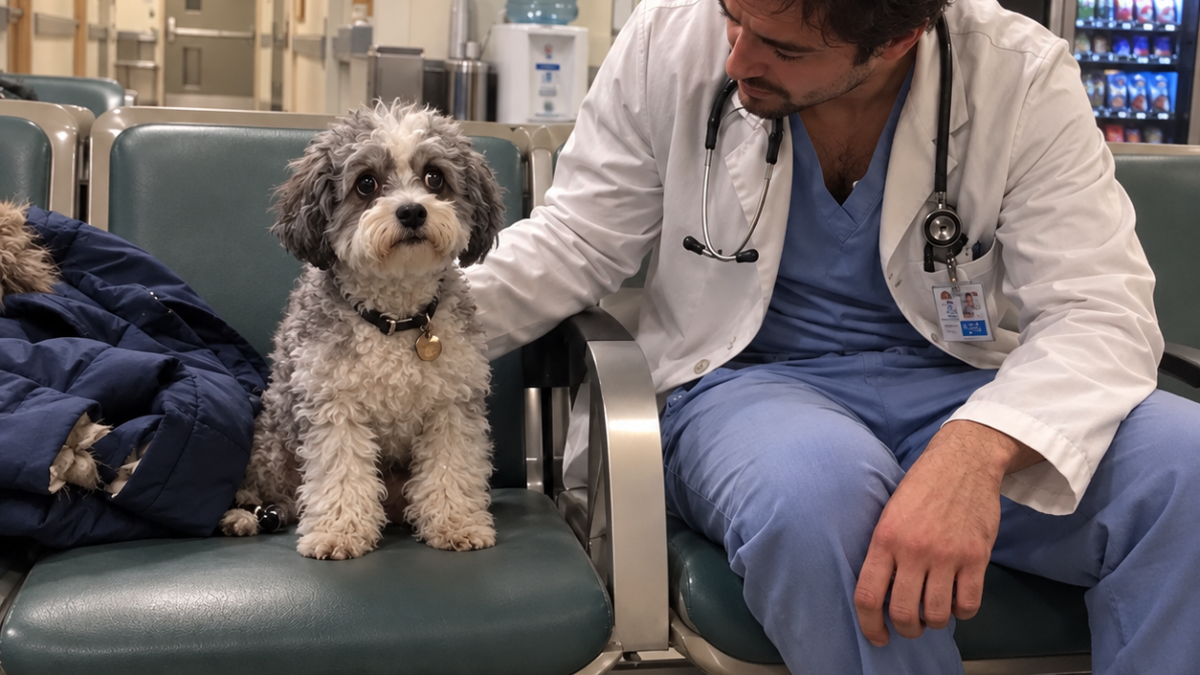
The doors closed.
The little dog kept looking.
The animal control officer carrying him was a woman in her forties named Rebecca Sloan.
I knew her by sight.
Emergency departments and animal services cross paths more often than people realize.
Car crashes.
House fires.
Elderly patients brought in with pets nobody knows what to do with.
Domestic disputes where the dog is the only family member nobody thought to list on a form.
Rebecca had always struck me as competent in a quiet way.
She did not pull at him when he twisted around.
She stopped.
Turned slightly.
Let him look.
“He thinks someone’s coming,” she said.
I swallowed.
“Yes.”
She glanced at the coat still folded on the bench.
“Can that go with him?”
I looked toward the nurses’ station.
Arthur’s personal effects technically needed to be documented.
But nobody was going to fight me over a coat.
“Yes.”
I picked it up.
The wool was old and rough, dark brown at the shoulders and worn shiny along the cuffs.
When I brought it close, the dog began struggling toward it.
Rebecca lowered him.
He buried his nose into the fabric immediately.
His whole body softened.
Not much.
Enough.
Rebecca looked at me.
“That’s his anchor.”
I nodded.
She folded the coat into the transport crate.
The dog stepped inside after it willingly.
That hurt worse somehow.
He had trusted the coat.
Trusted us.
Trusted that following Arthur’s scent would eventually lead back to Arthur.
“What’s his name?” Rebecca asked.
I realized I did not know.
Claire searched Arthur’s intake paperwork.
“No pet name.”
His wallet contained an ID, insurance cards, two grocery receipts, an old photograph of a woman, and a folded piece of paper with medication instructions.
Nothing about a dog.
Rebecca crouched at the crate.
“What did Arthur call you, buddy?”
The dog looked at her.
Then at me.
“I heard him say ‘my dog,’” I said.
“That’s all.”
Rebecca sighed.
“We’ll scan for a chip.”
“If he has one, maybe we can find family.”
Family.
That word seemed hopeful.
I held on to it.
Maybe Arthur had a daughter in another state.
A nephew.
A sister.
Someone who knew the dog.
Someone who would want him.
Someone who could answer that waiting look.
Rebecca lifted the crate.
“I’ll call if we find anything.”
I almost said, You don’t have to.
I was a doctor.
Arthur had been my patient for a few hours.
The dog was not my responsibility.
I had rounds to finish, notes to complete, people waiting in exam rooms.
Instead, I took a business card from Rebecca and wrote my cell number on the back.
“Please.”
She looked at me once, then nodded.
“I will.”
Then they left.
The emergency department swallowed me again.
That is what hospitals do.
There is always another chest pain.
Another fall.
Another fever.
Another frightened parent.
Another ambulance backing into the bay.
Grief cannot stop the line.
By eight, I was stitching a teenager’s hand after he punched a window.
At nine, I explained to a woman that her husband’s dizziness was probably dehydration, not a stroke.
At ten, I finally sat down with coffee that had been poured two hours earlier and tasted like something brewed from roofing material.
Claire dropped into the chair across from me.
“You’re thinking about the dog.”
I looked at her.
“What dog?”
She raised an eyebrow.
I sighed.
“Yes.”
“Me too.”
I rubbed both hands over my face.
“Arthur had no emergency contact listed.”
“Social work is checking.”
“Maybe somebody knows him.”
Claire picked at the paper sleeve around her cup.
“You think dogs understand death?”
I thought about the waiting-room doors.
“No.”
Then I reconsidered.
“I don’t know.”
“My parents had a Lab when my dad died,” she said.
“Sadie searched the house for him for weeks.”
“Every car in the driveway, she thought it was him.”
“What happened?”
“She stopped eventually.”
That did not comfort me.
Claire must have seen it.
“She didn’t forget him.”
“How do you know?”
“She slept beside his chair until she died six years later.”
There are things doctors should know how to respond to.
That was not one of them.
My phone buzzed shortly before noon.
Unknown number.
I answered immediately.
“Dr. Mercer?”
“Rebecca?”
“Yes.”
“We scanned him.”
I sat straighter.
“And?”
“He has a chip.”
Relief moved through me.
“Good.”
“Maybe.”
Something in her voice changed the relief into caution.
“The registration is old.”
“Owner listed is Arthur Bennett.”
“Address matches.”
“No secondary contact.”
“Phone is Arthur’s landline.”
“What about the chip company?”
“No backup.”
I leaned against the desk.
“So we still don’t know his name?”
“We do.”
I held my breath.
“Milo.”
Milo.
The name fit immediately.
Small.
Soft.
Almost too gentle for the grief sitting inside him.
“Milo,” I repeated.
Rebecca’s voice softened.
“He reacted.”
“How?”
“When I said it, he looked right at me.”
For some reason, my eyes burned.
I looked away from the nurses’ station.
“How is he?”
“Medically?”
“Yes.”
“He’s older than I expected.”
“Vet thinks nine or ten.”
“Dental issues.”
“Early cataracts.”
“Mild heart murmur.”
“Arthritis in the hips.”
“Nothing immediately dangerous.”
“And otherwise?”
There was a pause.
“He hasn’t eaten.”
My chest tightened.
“Since when?”
“Since he came in.”
“He drinks a little.”
“Mostly he lies on the coat facing the kennel door.”
I closed my eyes.
“He’s waiting.”
“Yes.”
The word hung between us.
Rebecca continued.
“We’re trying to locate relatives through county records.”
“I’ll let you know.”
“Thank you.”
I almost ended the call.
Then asked, “Can I visit?”
Another pause.
“You want to?”
The question exposed me more than I liked.
“Yes.”
“Shelter closes to the public at six.”
“I’m done at seven.”
“I’ll stay.”
“You don’t have to.”
“Neither do you.”
Fair.
I reached the shelter at 7:25 that evening.
It was a low brick building behind the county public works garage, cleaner and warmer than the stereotype people carry in their heads.
Still, the first sound when I entered was barking.
Dozens of voices bouncing off concrete and steel.
High yips.
Deep booming barks.
A hound baying somewhere in the back.
Milo made no sound at all.
Rebecca led me down the kennel corridor.
He was in the last run on the left.
Arthur’s coat covered half the bed.
Milo sat on it with his body facing the gate.
Exactly as he had sat on the hospital bench.
I stopped.
Rebecca watched my face.
“Yeah.”
Milo saw me.
His ears lifted.
For a moment, his expression changed so dramatically I felt physically struck.
He stood.
His tail began to wag.
Fast.
Hopeful.
He came to the gate.
I crouched.
“Hi, Milo.”
His nose pushed through the bars.
He sniffed my hands.
Then my sleeves.
Then my chest.
Searching.
I understood.
He was not happy to see me.
Not exactly.
I was part of the place where Arthur had disappeared.
Maybe I smelled like hospital disinfectant.
Maybe like Arthur’s room.
Maybe like the last night of his life.
Milo looked behind me.
Nobody.
He looked down the hallway.
Nobody.
The wag slowed.
Then stopped.
I wanted to apologize.
Instead, I put my fingers through the kennel bars.
Milo pressed his forehead against them.
Rebecca unlocked the gate.
“You can sit with him.”
The kennel was not large, but I stepped inside and sat on the concrete.
Milo returned immediately to the coat.
I moved beside him.
For ten minutes, we said nothing.
He sniffed the coat.
I stared at the floor.
Finally, I asked Rebecca, “Did he eat anything?”
“Half a teaspoon of chicken from my hand.”
“That’s it?”
“Yes.”
“What about treats?”
“No.”
“Milo.”
He looked at me.
“You need to eat.”
The absurdity of giving medical advice to a grieving bichon would have been funny under different circumstances.
Rebecca handed me a small piece of warmed chicken.
I held it near him.
Milo sniffed.
Turned away.
I tried again.
Nothing.
Then I had an idea.
I rubbed the chicken lightly against the sleeve of Arthur’s coat.
Rebecca looked at me.
“Seriously?”
“I’m improvising.”
I set the piece on the coat.
Milo stared.
Sniffed.
Then ate it.
Rebecca exhaled.
“Well.”
I placed another.
He ate that too.
Not hungrily.
Not with enthusiasm.
But he ate.
We got maybe six bites into him before he stopped.
It felt like a victory.
A ridiculous, tiny victory.
Medicine had trained me to think in blood gases, heart rhythms, imaging, survival curves.
That night, six pieces of chicken mattered more than anything on a chart.
I visited again the next evening.
And the next.
On the fourth night, Milo met me at the kennel door instead of remaining on the coat.
On the fifth, he wagged for me and did not immediately look behind me.
I told myself that was good.
Part of me hated it.
Because every step he took toward me looked like a step away from Arthur.
That thought made no logical sense.
Grief rarely asks logic for permission.
Rebecca noticed.
“You look guilty.”
“I’m not.”
“Doctors are terrible liars.”
I glanced at her.
“Why would I feel guilty?”
“Because he likes you.”
I stared through the kennel gate.
Milo was eating from a bowl now.
Slowly.
“That feels wrong.”
“No.”
“It feels like he’s replacing him.”
Rebecca folded her arms.
“Dogs don’t replace people.”
“You sure?”
“No.”
Then she softened.
“But I think they add safety where there used to be absence.”
That sentence stayed with me.
County social services finally located a niece.
Her name was Susan Bennett, fifty-three, living in Arizona.
She had not seen Arthur in eleven years.
Not because of a family feud.
Nothing dramatic.
Life.
Distance.
A marriage.
Children.
Then divorce.
Phone calls that became Christmas cards.
Christmas cards that became nothing.
She cried when Rebecca told her Arthur had died.
She cried again when she heard about Milo.
“I didn’t know he had a dog.”
That answered the first hope.
She could not take him.
Her apartment did not allow pets over a certain age?
No.
That would have been absurd.
The truth was simpler.
She traveled constantly for work, lived across the country, and had two large dogs already.
“I’m sorry,” she kept saying.
Rebecca told her she did not need to apologize to us.
Susan came to Ohio for the funeral arrangements three days later.
She asked to meet Milo.
I happened to be there.
By then, that was no longer coincidence.
I was visiting every day.
Susan walked into the meet-and-greet room holding a grocery bag with Arthur’s belongings from the house.
Milo sat beside my chair.
When Susan opened the bag, he froze.
She took out a pair of old slippers.
Milo stood.
His whole body trembled.
Susan began to cry.
“He kept these by his chair.”
Milo went to her.
Not because he knew her.
Because the slippers smelled like Arthur.
Susan set them on the floor.
Milo buried his nose in one and inhaled.
Then he lay down beside them.
The room became silent.
Susan sat on the floor across from him.
“I should’ve called,” she whispered.
Milo closed his eyes.
“I kept thinking there’d be time.”
Rebecca looked away.
I understood why.
Hospitals are full of that sentence.
I kept thinking there’d be time.
Susan spent an hour telling us about Arthur.
He had been a machinist for thirty-six years.
His wife, Helen, died twelve years earlier.
He had no children.
He hated flying.
Loved baseball.
Cooked terrible eggs.
Called every microwave “the radar.”
Collected pocketknives.
He had stopped attending family gatherings after Helen died.
Susan believed the loneliness had become a habit.
“How did he get Milo?” I asked.
Susan shook her head.
“No idea.”
That mystery was solved by Arthur’s neighbor.
A seventy-one-year-old woman named Mrs. Delaney.
She called the shelter after seeing a community post.
“I know that dog,” she said.
Apparently, six years earlier, Arthur had found Milo wandering near the highway after a thunderstorm.
No collar.
No chip at that time.
Arthur took him in “just for the night.”
Mrs. Delaney laughed when she told Rebecca.
“Arthur said that dog was temporary for six months.”
Then he paid to have Milo chipped in his own name.
Temporary.
The word would become important later.
According to Mrs. Delaney, Milo changed Arthur.
Before Milo, Arthur rarely left the house except for groceries and doctor appointments.
After Milo, he walked every morning.
Then every evening.
He began speaking to neighbors again.
Children learned that the old man on Maple Street always carried dog biscuits.
Mrs. Delaney said Arthur once told her, “I saved that little fool from the highway, and he’s been paying me back every day since.”
I looked at Milo sleeping on the coat.
The circle hurt.
Arthur had saved Milo from being alone.
Then Arthur died, leaving Milo alone again.
Maybe that was why the dog waited so absolutely.
His entire life with Arthur had taught him one certainty.
This man came back.
Walk outside.
Arthur came back.
Wait by the bathroom.
Arthur came back.
Sit at the window.
Arthur came back.
Sleep beside the door.
Arthur came back.
Until one night, he didn’t.
After the legal hold expired, Milo became available for adoption.
That should have been good news.
Instead, it made me anxious.
Applications came quickly at first.
He was small.
Fluffy.
Photogenic.
People like those things.
Then they read his age.
Ten.
Heart murmur.
Arthritis.
Dental work needed.
Separation anxiety.
Grief.
Interest dropped.
One couple met him and loved him until Rebecca explained that Milo barked for several minutes when left alone.
“We both work,” the man said.
“We need something easier.”
Something.
Not someone.
They left.
A woman in her twenties came next.
She wanted a “senior rescue” because she had seen videos online.
Milo hid under the chair after she tried to pick him up before he was ready.
She looked disappointed.
“I thought he’d be cuddly.”
Rebecca politely ended the meeting.
Another family wanted him but had two toddlers.
Milo became anxious around sudden noise.
Not a good fit.
One retired man seemed perfect.
Quiet home.
Experience with older dogs.
Then his landlord reversed approval.
Weeks passed.
Milo waited.
Not for Arthur now.
At least, not only.
He began waiting for me too.
That realization came one Tuesday when I got stuck at the hospital.
A highway pileup filled the ER.
I missed my usual visit.
At 9:40, I checked my phone and saw three missed messages from Rebecca.
Nothing urgent.
Just:
Your little friend is staring at the door.
Then:
Still staring.
Then a photo.
Milo sitting on Arthur’s coat facing the kennel entrance.
I felt something inside me collapse.
I finished my shift at 11:15.
The shelter had been closed for five hours.
Rebecca met me at the side door anyway.
“You have a problem,” she said.
“I know.”
“No, I don’t think you do.”
We walked to Milo’s kennel.
He was asleep.
The moment he heard my steps, his head lifted.
He stood.
His tail wagged so hard his entire back end moved.
When Rebecca opened the gate, Milo walked straight to me and put both front paws against my shin.
I picked him up.
He tucked himself against my chest.
No searching behind me.
No hospital scent.
No question about Arthur.
Just me.
I closed my eyes.
Rebecca leaned against the kennel wall.
“You’re his person now.”
I opened my eyes.
“No.”
“Yes.”
“I’m a physician.”
“I’m aware.”
“I work twelve-hour shifts.”
“Sometimes longer.”
“I live alone.”
“He likes quiet.”
“I haven’t had a dog since residency.”
“Terrible excuse.”
“I travel.”
“Twice a year, according to Claire.”
I stared at her.
“You talked to Claire?”
“She called to ask how Milo was doing.”
“Of course she did.”
Rebecca smiled.
Then her face softened.
“Daniel, you don’t have to adopt him because you feel sorry for him.”
“I know.”
“You don’t have to save him because Arthur died.”
“I know.”
“You do have to ask yourself why you’re here at almost midnight on a Tuesday when you worked fourteen hours.”
Milo sighed against my chest.
I looked down at him.
The answer terrified me.
Because he was waiting.
Because I knew what it meant to be the person someone expected.
Because somewhere between Arthur’s death and the shelter, Milo had become part of the shape of my day.
I had started checking the clock around six, wondering when I could leave.
I had bought chicken I did not eat because Milo liked it.
I had learned the difference between his anxious bark and his impatient bark.
I knew he preferred the left side of the coat.
I knew he hated stainless steel bowls.
I knew he sneezed when excited.
I knew the exact weight of him asleep against my chest.
“No,” I said quietly.
Rebecca waited.
“I’m not ready.”
“That’s different.”
“From what?”
“From not wanting him.”
Damn her.
I took Milo home for a weekend foster three days later.
Just a weekend.
The shelter needed a break from overcrowding.
Milo needed time away from kennel noise.
I needed, according to Rebecca, “data.”
Doctors like data.
That was how she trapped me.
My house had never looked particularly empty to me before Milo entered it.
It was a two-story brick place in a quiet neighborhood fifteen minutes from the hospital.
Clean.
Organized.
Neutral furniture.
Bookshelves.
One plant I kept alive mostly through guilt.
The kind of house that said someone slept there but did not necessarily live there.
Milo stepped inside and stopped.
Arthur’s coat was folded inside his carrier.
I placed it near the couch.
He walked to it immediately and lay down.
I crouched.
“You don’t have to stay there.”
He looked at me.
“You can explore.”
Nothing.
I went to the kitchen.
Milo stayed.
I opened the refrigerator.
Nothing.
I poured water into a ceramic bowl.
Nothing.
Then I opened a packet of chicken.
His head appeared around the corner.
Progress.
By evening, he had inspected the living room, kitchen, downstairs bathroom, and three feet of hallway.
The stairs were rejected immediately.
Fair.
His arthritis would not enjoy them.
I carried him upstairs at bedtime.
That was mistake number one.
The moment I set him on the bedroom floor, he panicked.
He ran to the door.
Scratched.
Whined.
Looked toward the hallway.
Arthur’s coat was downstairs.
I carried him back down.
He ran to it.
Curled on top.
I stood there feeling stupid.
“Right.”
I brought my pillow and blanket downstairs.
I slept on the couch.
At 2:13 a.m., I woke with Milo sitting beside my face, staring at me.
“What?”
He stared.
“Emergency?”
Nothing.
“Need outside?”
He sneezed.
I took him out.
He wandered in the yard for five minutes, found the exact coldest patch of grass available, completed his business, and walked back toward the door.
As we entered, he paused.
Looked up at me.
Then wagged.
A tiny wag.
My heart behaved embarrassingly.
Saturday went well.
Sunday went better.
On Sunday afternoon, I had to leave for groceries.
The moment I picked up my keys, Milo noticed.
His entire body changed.
Ears back.
Breathing faster.
He followed me to the door.
I crouched.
“I’ll be back.”
The phrase hit me before I finished saying it.
Arthur must have said it a thousand times.
I’ll be back.
Milo stared at me.
I left anyway.
At the grocery store, I abandoned my cart after six minutes and drove home.
When I unlocked the door, Milo was sitting directly behind it.
He had dragged Arthur’s coat from beside the couch.
His front paws rested on it.
He looked up at me.
I knelt.
“I came back.”
Milo pressed his face against my chest.
That was the first time I understood how adoption might work for us.
Not one grand promise.
A thousand departures followed by returns.
Over and over until his body believed the pattern again.
On Monday morning, I was supposed to take him back to the shelter.
I packed his medication.
Food.
Coat.
Toy.
He watched.
My chest felt increasingly wrong.
At the shelter, Rebecca met us outside.
Milo refused to get out of the car.
I opened the passenger door.
“Come on.”
He backed against the seat.
Rebecca leaned in.
“Well.”
“It’s arthritis.”
“No.”
“Cars make him nervous.”
“He got into this car fine Friday.”
“Maybe he’s tired.”
Rebecca looked at me.
I looked at Milo.
Milo looked at both of us and then turned his face toward the window.
Rebecca smiled.
“Data.”
I hated that word.
I signed the foster extension that afternoon.
Two weeks.
Then another month.
The hospital adjusted surprisingly well to my new complication.
Claire volunteered to check on Milo during long shifts.
Then my neighbor, Evelyn Park, a retired elementary-school principal, saw me struggling to carry groceries and Milo at the same time.
“Give me the dog,” she said.
“Hello to you too.”
“You’ll drop one.”
“I’m a physician.”
“You’re holding milk under your chin.”
She became Milo’s midday companion.
Evelyn had lost her husband three years earlier.
She claimed she did not want another dog because “grief is expensive.”
Then she began carrying treats in her coat pocket.
Milo waited by the window for her around noon.
She read books in my living room while he slept on Arthur’s coat.
Sometimes she took him into her house next door.
She bought him a ramp for her porch without consulting me.
Milo’s world grew.
That mattered.
I did not want him to survive one loss by becoming terrified of another person’s absence.
He needed more than me.
We both did.
His separation anxiety improved slowly.
Five minutes alone.
Ten.
Twenty.
An hour.
I set up a camera.
At first, he sat by the door the entire time.
Then one afternoon, I watched from the hospital cafeteria as he left the door, walked to the couch, turned three circles, and went to sleep.
I nearly called Rebecca.
Then realized I was a forty-six-year-old emergency physician about to telephone animal control because a dog took a nap.
I sent the video instead.
She replied:
HEALING.
Then:
Also please do your actual job.
Milo became part of mine in unexpected ways.
I never took him into the emergency department during regular shifts.
Too chaotic.
Too unsafe.
But our hospital had a small courtyard near the staff entrance, and Claire began bringing nurses out on breaks when Milo visited with Evelyn.
He had a gift for exhausted people.
Maybe because he understood waiting rooms.
A respiratory therapist named Jasmine sat on a bench after losing a pediatric patient and buried her fingers in Milo’s curls.
He placed one paw on her shoe.
She cried quietly.
A young resident who had made his first serious mistake sat beside him for twenty minutes without speaking.
Milo leaned against his leg.
Even Dr. Patel, who claimed dogs were “fine from a respectful distance,” started keeping treats in his desk.
I noticed and said nothing.
Medicine teaches us to intervene.
Fix.
Correct.
Reverse.
Milo taught us something medicine often struggles to accept.
Sometimes presence is the treatment.
Not cure.
Treatment.
There is a difference.
Arthur’s funeral happened three weeks after Milo came to my house.
Susan invited me.
I almost declined.
I had known Arthur for one night.
Then she asked if Milo could come.
So I went.
The service was small.
Susan.
Mrs. Delaney.
Two former coworkers.
A man from Arthur’s bowling league who had not seen him in years.
Claire came too.
Milo wore a simple black harness.
Arthur’s coat stayed in my car.
I did not know whether bringing it inside would help or hurt.
During the service, Milo sat beside my chair.
He did not understand the photographs.
The flowers.
The folded flag from Arthur’s Army service.
The urn on the table.
But when Susan played a recording she had found on Arthur’s old answering machine, everything changed.
Arthur’s voice filled the room.
“This is Arthur Bennett.”
“Leave a message.”
“If this is Susan, I’m probably fine.”
“If this is the pharmacy, I already picked it up.”
“And if you’re trying to sell me windows, I have enough.”
People laughed through tears.
Milo stood.
Every muscle in his small body tightened.
His ears shot forward.
Then came another sound from the recording.
Arthur laughing.
“Get down, Milo.”
“Not yours.”
Milo barked.
Once.
Sharp.
Joyful.
He ran toward the speaker.
The room broke.
Susan covered her face.
Mrs. Delaney sobbed.
Claire grabbed my arm.
Milo stood beneath the speaker, tail wagging wildly, searching for Arthur.
Then the recording ended.
Silence.
Milo waited.
His tail slowed.
He looked behind the table.
Around the chairs.
Toward the hallway.
My heart cracked open all over again.
I walked to him.
He looked up.
I knelt.
“I know.”
What else could I say?
I picked him up.
He pressed against me.
During the burial, he stayed in my arms.
That night, back at home, Milo took Arthur’s coat and dragged it from beside the couch into my bedroom.
He had never carried it that far before.
He stopped at the foot of the stairs.
Looked up.
Then looked at me.
I understood.
I carried him.
And the coat.
Upstairs.
Milo slept beside my bed that night.
Not on Arthur’s coat.
Beside it.
The adoption became official the next morning.
I did not announce it.
No dramatic social-media post.
No ceremony.
I drove to the shelter before work, signed the papers, paid the fee, and stood there while Rebecca tried not to look unbearably pleased with herself.
“Name staying Milo?”
“Of course.”
“Primary veterinarian?”
I told her.
“Emergency contact?”
I paused.
That field mattered differently now.
I wrote Evelyn Park.
Then Susan Bennett as secondary.
Rebecca saw.
“Good.”
“I learned from Arthur.”
Her face softened.
“Yes.”
She stamped the form.
Then slid it toward me.
“Congratulations.”
I looked down.
Owner: Daniel Mercer.
The word made me uncomfortable.
Owner.
Milo did not feel owned.
He felt entrusted.
There is a difference.
Arthur had held that trust.
Now I did.
I carried the papers home in my work bag and placed them in the drawer beside Milo’s medications.
Then I went to the hospital and spent twelve hours pretending my life had not changed completely.
It had.
Milo’s first year with me was full of small recoveries.
He gained weight.
His dental disease was treated.
His arthritis improved with medication.
The heart murmur remained mild.
His cloudy eyes got cloudier, but his confidence grew.
He learned the sound of my garage door.
The shift pattern of my work shoes.
The days Evelyn came.
The smell of Claire’s hand sanitizer.
He learned that when I left in blue scrubs before sunrise, I returned smelling like hospital corridors but still returned.
Every time.
On hard shifts, I came home and found him waiting just inside the door.
Not on the coat anymore.
On the rug.
That change happened so gradually I did not notice until one evening.
I opened the door.
Milo was there, wagging.
Arthur’s coat was still folded beside the couch.
Untouched.
I froze.
Milo sneezed impatiently.
I looked at the coat.
Then him.
“You okay?”
His tail wagged.
I sat on the floor.
He climbed into my lap.
I realized then that remembering Arthur no longer required waiting for him.
That may be the closest thing to healing any of us get.
Susan visited twice that year.
She and Milo developed a quiet relationship.
He did not know her as family in the way humans define it.
But she smelled like Arthur’s belongings, and she carried stories.
That mattered.
She brought boxes from Arthur’s house.
Photographs.
A ceramic dog bowl with MILO painted crookedly on the side.
A red leash.
A little Christmas sweater.
An old blanket.
And a notebook.
The notebook was filled with Arthur’s handwriting.
Mostly ordinary things.
Blood pressure numbers.
Grocery lists.
Appointments.
Reminders.
But throughout the pages were notes about Milo.
Milo vet Thursday 10.
Buy heart pills.
Milo won’t eat dry food unless I add chicken.
Ask Delaney who trims nails.
Rain tomorrow—short walk.
Milo scared during thunder.
Remember he likes lamp on if I leave after dark.
One entry stopped me.
If something happens to me, somebody has to take Milo.
Underneath, Arthur had written:
He waits too hard.
I read that line three times.
Susan saw my face.
“He knew.”
“Yes.”
“He worried.”
“Yes.”
She touched the page.
“I wish he’d called me.”
I did not say anything.
Some regret cannot be corrected by reassurance.
She looked toward Milo sleeping beneath the table.
“Did he suffer?”
The question was about Arthur.
Not Milo.
I chose my answer carefully.
“We kept him comfortable.”
“That’s doctor language.”
“Yes.”
She looked at me.
I put the notebook down.
“He was very sick.”
“We tried.”
“He wasn’t alone.”
That last part mattered most.
Susan nodded.
“Thank you.”
Then she looked at Milo.
“And thank you for him.”
“I didn’t save him.”
She smiled sadly.
“Maybe not.”
We both knew what she meant.
Life settled.
For a while, beautifully.
Milo discovered spring.
Not his first spring, obviously.
But his first in my backyard.
He became obsessed with one corner near the hydrangeas for reasons no human investigation could determine.
He barked at squirrels with the confidence of a dog who had never considered his own size.
He hated rain but loved snow.
He tolerated the groomer only if I stayed in sight.
He learned that Evelyn’s house contained superior biscuits.
He slept in my office while I completed charts at home.
He snored.
Loudly.
Shockingly loudly for twelve pounds of dog.
Sometimes I woke at two in the morning thinking an appliance had malfunctioned.
It was Milo.
Arthur would have laughed.
I began talking to Arthur sometimes.
Not out loud at first.
Then out loud because living alone with a dog erodes certain kinds of self-consciousness.
“Your dog hates broccoli.”
“Milo stole my sock.”
“You could have warned me he snores.”
“His heart murmur is stable.”
I did not believe Arthur was listening.
Not exactly.
But speaking to him felt like maintaining a chain of custody for love.
I wanted somebody to know Milo was okay.
Even if that somebody was gone.
Two years after Arthur’s death, the hospital administration approved a grief-support program involving trained therapy animals.
Milo was too old and too selectively obedient for formal certification at first.
Then a trainer evaluated him.
Her name was Carmen Ruiz.
She watched him with patients for an hour.
Milo ignored commands twice, stole a cracker from a volunteer, and fell asleep during the obedience assessment.
I assumed we had failed.
Carmen smiled.
“He’s perfect.”
I stared at her.
“He just ignored you.”
“He’s ten.”
“Eleven.”
“Then he’s earned discernment.”
“What exactly makes him perfect?”
She looked toward the waiting-room benches.
Milo was sitting beside a woman whose husband was in surgery.
He was not demanding touch.
Not performing tricks.
Just sitting.
“Look.”
The woman’s hand rested lightly on Milo’s back.
Her shoulders had lowered.
Her breathing had slowed.
Carmen said, “Some therapy dogs bring joy.”
“He brings permission to wait.”
That phrase went through me.
Permission to wait.
Of course.
Milo knew waiting rooms.
He knew doors.
He knew the particular loneliness of not knowing what would happen next.
The hospital became his second home.
Not the emergency department floor.
We kept him away from acute care.
But the family waiting areas, oncology lounge, rehabilitation wing, and palliative-care unit welcomed him.
He wore a blue therapy vest and a badge with his photograph.
The first time I saw it, I laughed.
Milo looked more professionally credentialed than several interns.
Patients loved him.
Especially older patients.
Maybe because he was old too.
He did not bounce.
Did not pull.
Did not overwhelm.
He simply arrived.
Sat.
Waited.
One afternoon, he met a man named Carl whose wife was dying upstairs.
Carl had been sitting alone in the family lounge for six hours.
He refused food.
Refused offers to call someone.
Refused the chaplain.
Milo walked over and sat on Carl’s shoe.
Carl looked down.
“Whose dog?”
“Mine,” I said.
“He allowed in here?”
“More than I am some days.”
Carl gave the smallest smile.
Milo leaned against his ankle.
Carl’s face collapsed.
“My wife hates dogs.”
“That may complicate things.”
Carl laughed through tears.
Then he started talking.
Forty-eight years married.
Two daughters in California.
Wife loved birds.
Hated dogs because a shepherd chased her as a child.
Made terrible meatloaf.
Excellent pie.
Terrified of dying.
Carl had not told anyone the last part.
Not until Milo sat on his shoe.
An hour later, Carl went upstairs and held his wife’s hand until she died.
He stopped me in the hallway afterward.
“Doctor.”
“Yes?”
He pointed at Milo.
“That dog knows.”
I looked down.
Milo was sitting beside my foot, watching a closed door.
“Yes,” I said.
“I think he does.”
Milo became particularly important to patients who had no family.
There were more of them than I wanted to know.
Older people.
Estranged people.
Homeless people.
People whose families lived far away.
People who had outlived everyone.
Milo sat with them.
I began to understand Arthur differently.
Not as the elderly man whose heart I could not save.
As a person who had lived quietly enough that the system almost believed he belonged to no one.
But Milo had belonged to him.
Arthur had belonged to Milo.
That counted.
It should always count.
The hospital changed one policy because of him.
For elderly or incapacitated patients brought in from home, intake now included a question:
Is there an animal depending on you?
It sounds obvious.
It was not routine before.
After Arthur, Claire and I pushed for it.
A small line in the electronic chart.
Pet at home?
Emergency contact?
Care plan?
That one question saved a cat left in an apartment for two days when her owner had a stroke.
It got a neighbor to feed two rabbits while their owner underwent surgery.
It connected a hospice patient’s Labrador with her sister before discharge to long-term care.
Arthur’s death changed hospital paperwork.
Milo’s waiting changed what we considered family.
I liked that.
Years passed.
Milo became grayer.
That seemed unfair in a dog who had arrived gray already.
His cataracts worsened.
His arthritis slowed him.
The heart murmur became more significant.
He no longer jumped onto furniture.
He used ramps.
He slept more.
Therapy visits shortened.
Carmen retired him officially at fourteen.
Milo ignored retirement and continued visiting the nurses’ station whenever I brought him for checkups.
Claire said, “Some doctors also refuse to retire when appropriate.”
I pretended not to hear.
At home, Arthur’s coat remained.
By then, it no longer smelled like Arthur.
Time had taken that.
Still, Milo sometimes chose it during thunderstorms.
I kept it clean but never replaced it.
The wool grew softer.
One cuff frayed.
I repaired it badly.
Evelyn repaired my repair correctly.
“Arthur would be horrified,” she said.
“You never met Arthur.”
“I know enough.”
One winter evening, I found Milo asleep on the coat beside the fireplace.
His head rested near the collar.
I sat beside him.
“You waited a long time for him.”
Milo opened one eye.
“You know he didn’t leave you on purpose, right?”
His tail moved once.
“Good.”
I leaned back against the couch.
“For what it’s worth, I think he worried about you.”
Milo sighed.
Maybe at my sentimentality.
Maybe because old dogs sigh.
I placed my hand on his side and felt his heartbeat.
Not perfect.
Still there.
That became my measure.
Still there.
Milo’s final year began quietly.
He stopped enjoying long walks.
Then medium walks.
Then the mailbox became enough.
His appetite changed.
Some mornings he wanted chicken.
Some mornings nothing.
Dr. Patel joked that Milo had become more medically complex than several of our patients.
I told him Milo had better insurance.
He did not.
The joke was terrible.
We laughed anyway.
That is what people in medicine do near endings.
Humor makes a narrow ledge wider.
Dr. Helen Morris, Milo’s veterinarian, began making house calls when car rides became stressful.
She had known him since the shelter.
One spring afternoon, she listened to his heart for longer than usual.
I recognized the expression.
Doctors recognize other doctors trying to find kinder words.
“Say it.”
She removed the stethoscope.
“His heart is working harder.”
“I know.”
“Kidneys are declining too.”
“How long?”
She looked at Milo sleeping on Arthur’s coat beneath the window.
“Could be weeks.”
“Could be a few months.”
The precision I wanted did not exist.
It never had.
I nodded.
“What do I watch?”
She gave me the list.
Breathing.
Appetite.
Pain.
Restlessness.
Collapse.
Confusion.
Good days.
Bad days.
The same list I had given families in other forms for nineteen years.
Suddenly, none of my training made me better at hearing it.
After she left, I sat on the kitchen floor.
Milo walked over slowly.
He placed his chin on my knee.
I laughed once.
“You always do that.”
His eyes were cloudy now.
But he knew me.
That was enough.
Susan came from Arizona one final time in June.
She sat in the yard with Milo on a blanket.
Evelyn brought lemonade.
Claire stopped by after shift.
Rebecca came too, though she had moved into supervisory work and claimed she was “only checking compliance.”
We all knew.
Milo moved from person to person slowly, collecting touch.
When he reached Susan, she held Arthur’s old notebook in her lap.
“I brought something,” she said.
She opened to a page near the back.
Arthur had written:
Milo is getting older.
So am I.
He still waits by the door when I go get the mail.
Fool dog.
Maybe we are both afraid the other one will disappear.
Susan read it aloud.
No one spoke afterward.
Milo slept with his head on her shoe.
That night, I understood Arthur more completely than I ever had.
He had been afraid too.
Of leaving Milo.
Of being left by him.
Love does that.
The closer something becomes, the more ways the world can take it.
Some people respond by holding tighter.
Some by pulling away.
Arthur had kept walking Milo every morning.
Kept buying chicken.
Kept leaving the lamp on.
Kept loving despite the clock.
I decided I would do the same.
Milo’s last good day came in September.
Clear sky.
Cool air.
Evelyn brought biscuits.
Claire came over with coffee.
I carried Milo into the backyard and set him on his favorite patch near the hydrangeas.
He sniffed the grass.
Sat in the sun.
A squirrel ran along the fence.
Milo lifted his head and produced one weak bark.
The squirrel survived the encounter.
Barely, according to Milo.
I laughed.
He looked at me, pleased.
For lunch, he ate chicken from my hand.
Then half a biscuit.
He slept most of the afternoon with his head on my foot.
It was such an ordinary day.
Thank God.
I had spent my career around dramatic endings.
Sirens.
CPR.
Alarms.
Families arriving too late.
I did not want that for him.
The next morning, Milo would not get up.
His breathing was faster.
His eyes opened when I said his name, but the effort seemed large.
I carried him to Arthur’s coat.
He settled immediately.
I knew.
Knowing did not help.
I called Dr. Morris.
Then Claire.
Then Evelyn.
Then Susan.
Rebecca too.
Not because Milo needed a room full of people.
Because they needed the chance to say goodbye.
We kept it small.
Quiet.
Evelyn came first and sat beside him.
“You caused a lot of trouble for someone so short,” she whispered.
Milo’s tail moved.
Claire arrived still wearing scrubs.
She knelt and pressed her forehead against his.
“You made the waiting room better than we did.”
Rebecca came with tears already on her face.
She sat where Milo could smell her hand.
“Remember me, buddy?”
He licked one finger.
Rebecca laughed through tears.
“I carried you out of that hospital.”
Milo closed his eyes.
“And you spent the next six years proving I didn’t know where home was yet.”
Susan joined by video because her flight could not arrive in time.
I put the phone near Milo.
She spoke softly.
“Milo.”
His ears moved.
“I’m sorry Uncle Arthur couldn’t stay.”
My throat closed.
“But Daniel did.”
Milo opened his eyes.
Susan cried.
“You waited long enough, sweetheart.”
Dr. Morris arrived at four.
The afternoon light came through the living-room window.
Arthur’s coat lay beneath Milo.
His old red collar rested beside him because wearing it had become uncomfortable.
I had brought Arthur’s notebook too.
I do not know why.
It felt right.
Dr. Morris examined Milo gently.
Then she looked at me.
I had given that look to families.
I hated receiving it.
“He’s ready.”
I shook my head before I could stop myself.
Not no.
Just the body refusing agreement.
Milo looked toward me.
I sat on the floor.
Lifted him carefully.
Placed his head in my lap.
The same position he had chosen against my shoulder in the hospital waiting room years earlier.
His breathing was shallow.
I stroked the curls between his ears.
“Hey, little man.”
His tail moved once beneath the coat.
I laughed through tears.
“You know, I never answered your question.”
Claire was crying near the doorway.
Evelyn held both hands over her mouth.
Rebecca stared at the floor.
I looked down at Milo.
“That first morning.”
“You looked at me like I knew when Arthur was coming.”
My voice broke.
“I’m sorry.”
Milo’s eyes stayed on mine.
“He wasn’t coming back.”
I swallowed hard.
“But he didn’t leave you because he wanted to.”
Milo exhaled slowly.
“He loved you.”
Another breath.
“He worried about you.”
I touched the old coat.
“He left you every piece of home he could.”
My tears fell into his fur.
“And then somehow you found me.”
His eyes softened.
Or maybe mine blurred.
I leaned closer.
“You don’t have to wait at the door anymore.”
His ear twitched.
“No more waiting.”
Dr. Morris placed one hand on my shoulder.
I nodded.
She gave the first medication.
Milo relaxed.
Completely.
For the first time in years, there was no tension in his body.
No listening for footsteps.
No watching doors.
No worry about who might leave.
His head became heavier in my lap.
I whispered, “Arthur’s got you.”
I do not know whether I believed it literally.
At that moment, I wanted to.
Dr. Morris gave the final injection.
Milo’s heart slowed beneath my hand.
Then stopped.
No alarm.
No monitor.
No code team.
No announcement of time.
Just silence.
For nineteen years, I had been the man who said when life ended.
That afternoon, I could not speak.
Dr. Morris looked at the clock for her records.
I did not ask.
It did not matter.
Milo was not a time.
He was six years of coming home.
A waiting-room bench.
Arthur’s coat.
Chicken on shelter floors.
A dog by my door.
A paw on grieving shoes.
A hospital policy changed.
People comforted.
A life stretched between two men who both thought they were rescuing him.
We sat there for a long time.
Eventually, Claire picked up Arthur’s notebook.
It had fallen open.
One line was visible.
He waits too hard.
Claire showed me.
I laughed once through tears.
“Not anymore.”
We had Milo cremated.
Susan asked that a small portion of his ashes be buried with Arthur.
The cemetery allowed it.
Two weeks later, I stood beside Arthur Bennett’s grave with Susan, Claire, Rebecca, Evelyn, and a small cedar box.
Arthur’s headstone was simple.
His wife Helen’s name beside his.
Susan placed Milo’s old red collar on the grass.
I held the ashes.
For once, no one expected me to speak.
I did anyway.
“I’m sorry I couldn’t save you, Arthur.”
The words had lived somewhere in me for six years.
“I know medicine doesn’t work that way.”
“I know.”
“But I’m still sorry.”
Wind moved through the trees.
I looked at the small box.
“I took care of him.”
Susan touched my shoulder.
“You did.”
“No.”
I shook my head.
“We took care of each other.”
I buried some of Milo’s ashes beside Arthur.
The rest came home with me.
Arthur’s coat stayed too.
I could not bury it.
For months, it remained folded near the fireplace.
Then one winter night, the hospital called about an elderly woman admitted after a stroke.
She lived alone.
She had a senior cat at home.
Because of the policy Milo inspired, the intake nurse had asked.
Is there an animal depending on you?
Yes.
Cat named Pearl.
Eleven years old.
Needs thyroid medication.
Evelyn and I went to the house with permission from the patient’s niece.
Pearl hid beneath the bed for forty minutes.
Eventually, she came out.
I sat on the floor, holding food, waiting.
I knew how to do that now.
Pearl went to the niece temporarily.
The patient recovered enough to return home six weeks later.
When Pearl saw her, the cat climbed into her lap and did not move for two hours.
Claire sent me a video.
I watched it three times.
Then I looked at Milo’s ashes on my shelf.
“Still working,” I told him.
The program grew from there.
Not because anyone planned it.
Because once you notice a gap, it becomes hard to unsee.
Our hospital partnered with the county shelter and a volunteer network.
Patients living alone could list pet contacts.
If no one was available, temporary foster care could be arranged.
We called it Companion Continuity.
Administrators loved the professional name.
Staff called it Milo’s List.
The nickname won.
A laminated card went into emergency intake folders:
PET AT HOME?
NAME:
SPECIES:
MEDICATIONS:
EMERGENCY CARE CONTACT:
A simple box.
A tiny change.
It saved animals from empty apartments, locked houses, missed meals, and days of confusion.
It also gave patients peace.
You would be amazed how often an elderly person in distress says not, “Am I going to die?” but, “Who will feed my dog?”
Now we had an answer.
We know.
We’ll handle it.
Your animal will not be forgotten.
I wish Arthur had heard those words.
Maybe Milo heard them for him.
Every September, on the anniversary of Milo’s adoption, Rebecca brings shelter staff to the hospital for an outreach day.
We help older patients create pet emergency plans.
Volunteers update microchips.
Families fill out cards.
People choose backup caregivers.
Nobody likes discussing what happens if they cannot come home.
That discomfort is exactly why we do it.
Arthur thought there would be time.
Susan thought there would be time.
I thought Milo would be in my house longer than six years.
Time is generous until it isn’t.
The least love can do is prepare.
I am fifty-two now.
Still working emergency medicine.
Claire became our nursing supervisor and terrifies new residents in the most educational way possible.
Rebecca retired from animal control last spring and immediately began fostering senior dogs, proving retirement has no authority over certain people.
Evelyn is eighty-one and still critiques my housekeeping.
Susan calls every Christmas.
Dr. Morris keeps a photograph of Milo in her exam room.
The picture was taken in the hospital courtyard.
Milo is wearing his therapy vest.
His gray head is tilted slightly.
Behind him is a set of double doors.
He is not watching them.
He is looking at me.
That detail matters.
I keep another photograph at home.
Arthur and Milo.
Susan found it after we thought we had gone through everything.
Arthur is sitting in his old recliner.
Milo is on his lap.
Arthur’s brown wool coat hangs over the chair arm.
Both are looking away from the camera toward something outside the frame.
On the back, Arthur wrote:
Best thing that ever waited for me.
The first time I read it, I had to sit down.
I framed it beside Milo’s ashes.
Arthur’s coat hangs in my hall closet now.
I do not keep it as a shrine.
At least, I do not think I do.
Sometimes grief becomes ordinary enough to coexist with winter jackets and umbrellas.
Once a year, I take it out.
Brush it.
Fold it.
Remember a small gray dog sitting on a hospital bench.
I remember how helpless I felt.
All those years of medical training, and I could not explain death to twelve pounds of curls and hope.
Maybe that was the lesson.
Not everything needs explanation first.
Sometimes what the grieving need before understanding is someone willing to sit beside them while the door stays closed.
Milo waited for Arthur.
Then I waited with Milo.
Eventually, Milo stopped waiting for the man who could not return and began trusting the man who did.
I did return.
Every night I could.
Every morning after overnight shifts.
Every time my keys frightened him.
Every time his old fear asked the same question.
Are you coming back?
Yes.
Yes, Milo.
I’m coming back.
Until the final day, when he was the one leaving and I was the one who had to learn that love cannot demand another return.
Patients still ask me sometimes whether medicine gets easier after enough years.
They mean death.
Loss.
Bad news.
They assume repetition builds armor.
It does, somewhat.
You learn how to function.
How to speak.
How to call families.
How to walk into the next room and treat someone else without carrying the whole previous room on your face.
But I do not think it should become easy.
Milo taught me that too.
The day I can look at a waiting creature, human or animal, and feel nothing because I have seen too much is the day I should leave medicine.
We are not meant to become untouched.
We are meant to become useful without becoming numb.
There is a difference.
So when a family asks me whether they can stay five more minutes, I say yes whenever I can.
When an old man asks who will feed his cat, I make sure someone writes the name down.
When a patient’s daughter feels foolish for worrying about the dog at home, I tell her she is not foolish.
And when I walk through the hospital waiting room before dawn, I still look at the bench near the double doors.
It has been replaced since then.
Different vinyl.
Different color.
Nobody would know.
But I do.
Sometimes I can almost see him there.
Small gray body.
Arthur’s coat beneath him.
Dark eyes fixed on the doors.
Waiting with the absolute faith only a dog can give.
Back then, I thought the tragedy was that Milo did not understand Arthur was gone.
Now I think the deeper truth is something else.
Milo understood love perfectly.
He simply could not imagine love failing to return.
For six years after that night, I had the privilege of teaching him that sometimes it does return.
Not in the same body.
Not through the same door.
Not in the way we begged for.
But in a neighbor carrying treats.
A shelter worker staying late.
A niece flying across the country.
A nurse stopping after shift.
A doctor sleeping on his couch beside an old coat.
A hospital remembering to ask about the animal waiting at home.
Love returned to Milo in pieces.
And Milo returned it to every one of us.
That is why I still tell his story.
Not because he waited beside a hospital door.
Because eventually, he stopped.
He learned the difference between holding on and being abandoned.
He learned that sleeping while someone leaves is possible when enough returns have taught your body what safety feels like.
And on his last day, when I told him he did not have to wait anymore, I finally understood what I had been trying to say since that first morning.
Arthur was not coming through the door.
But Milo’s love had not been wasted.
It had simply been handed forward.
First to me.
Then to Claire.
Rebecca.
Evelyn.
Susan.
Patients.
Families.
Animals we would never have remembered to ask about before him.
One little dog waited for one old man.
And because he did, countless animals would never again have to wait alone in an empty house wondering why their person did not come home.
That is a legacy large enough for any life.
Especially one that fit in my arms.
And whenever I pass those double doors now, I still hear the question in Milo’s eyes.
Do you know where he is?
I could not answer then.
I cannot answer completely now.
But I know where Milo went.
Home.
Twice.
First with Arthur.
Then with me.








