The HOA built twenty luxury cabins in the burn-scar canyon below my property, and for months I was the only person asking what had been moved to make all twenty fit
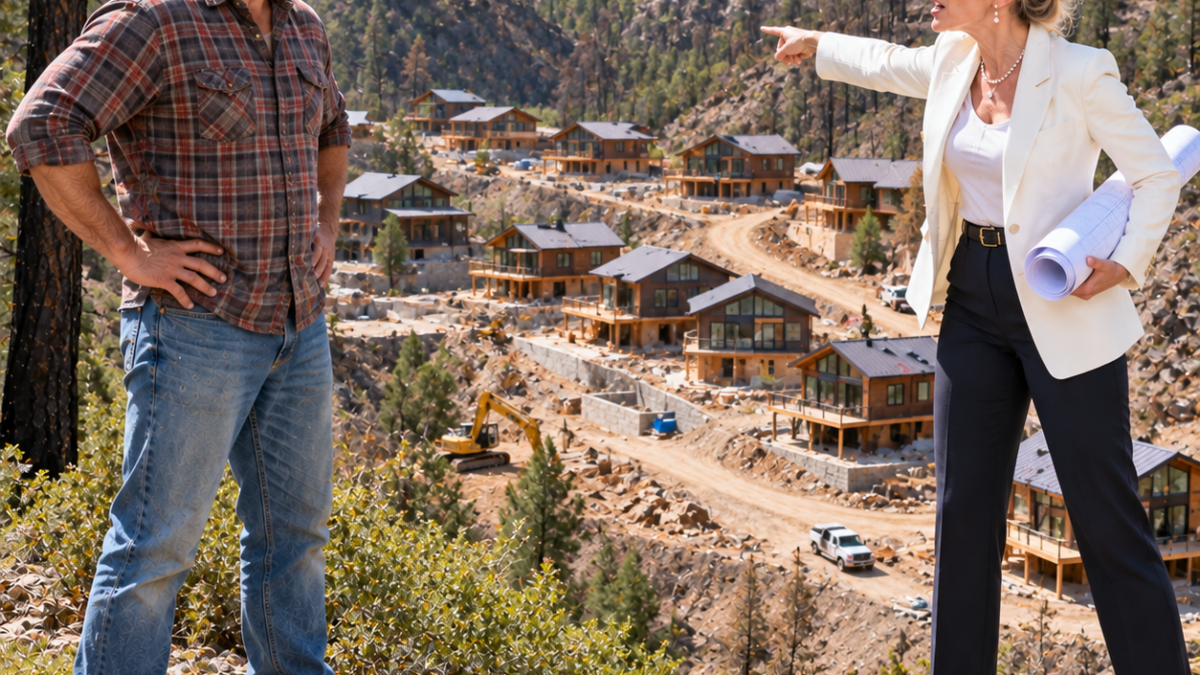
The warning tone on my phone was still echoing through the kitchen when I heard the first vehicle start below.
I went to the window.
Rain streaked the glass.
The cabins were visible only in fragments through the gray.
Porch lights.
Cedar roofs.
Headlights moving along the loop road.
For months, I had looked down there and counted cabins.
That afternoon I counted vehicles leaving.
One.
Two.
Three.
Then several at once.
I grabbed my raincoat and drove down toward the upper service gate.
Maggie called before I reached it.
“You get the warning?”
“Yes.”
“How bad?”
“Don’t know.”
“Dad.”
“I’m staying high.”
“That wasn’t my question.”
“I don’t know, Maggie.”
That answer had become familiar lately.
Preston had taught me to dislike certainty.
Or maybe he had taught me to respect what uncertainty was for.
People often hear an expert say “I don’t know” and think he is avoiding responsibility.
Usually the responsible ones are the people willing to stop at the edge of what they actually know.
I had spent weeks wanting Preston to tell me those cabins were dangerous.
Not because I wanted them destroyed.
Because certainty would have been easier to fight with.
He never gave it to me.
Now I was standing above twenty occupied cabins with a county debris-flow warning on my phone, and I was grateful he hadn’t.
“Call me when you’re somewhere safe,” Maggie said.
“I will.”
“You promise?”
“Yes.”
“I know what your promises sound like.”
“Love you too.”
She hung up.
At the gate, rain hammered the metal roof of the little equipment shelter hard enough to make conversation difficult.
Justine’s utility cart came uphill.
She was driving.
No makeup.
Hair under a rain hood.
Radio clipped to her jacket.
She stopped when she saw me.
“We’re clearing everyone.”
“All guests?”
“Yes.”
“Staff?”
“Cabin checks now.”
“Anybody staying?”
“No.”
That was the first moment in the entire story when I understood exactly who Justine Whitmore was.
Not the woman from the presentation boards.
Not the HOA development chair who had kept twenty cabins in the program.
Not the person I had spent months questioning.
A woman who had received an emergency warning and immediately started getting people out.
No argument.
No concern about refunds.
No attempt to protect the launch weekend.
Just evacuation.
That mattered.
People like simple stories because simple stories let you decide who deserves your anger.
Real people make that inconvenient.
“If you need the upper service road,” I said, “open the gate.”
“We may.”
“Use it.”
She nodded.
“Thank you.”
A maintenance truck came up behind her.
Then another utility cart.
Justine pulled forward.
I opened the gate.
The road on my property ran along higher ground before reconnecting with the county route near the old turnout.
It had never been designed as an emergency evacuation route.
But it was above the drainage.
That was enough.
Within fifteen minutes, two HOA vehicles and a county truck were using it.
Rain intensified.
Water began moving through the rock-lined upper channel.
At first it looked normal.
Brown.
Fast.
Nothing I had not seen during summer storms.
Then it changed color.
Black.
Not completely.
Black mixed with brown.
Ash.
Soil.
Charcoal fragments.
The burned slope had been stable enough for grass to return in places, but fire changes ground in ways you can’t see from a porch.
Water moves differently.
Roots are gone.
Soil structure changes.
Channels that once absorbed rainfall suddenly shed it.
Preston had explained it.
I had nodded like I understood.
Watching it was different.
A burned branch spun through the channel.
Then a second.
Then a rock the size of a basketball bounced once against the side and disappeared downstream.
I stepped farther under the shelter.
The sound changed.
That was what I remember most.
Not thunder.
Not rain.
Rock.
A deep grinding underneath everything else.
Stone moving against stone.
Branches cracking.
Gravel traveling at a speed gravel should never travel.
I called Preston.
He answered immediately.
“You high?”
“Yes.”
“Stay high.”
“That was the plan.”
“Do not go down for a better look.”
“I’m sixty-three, Preston.”
“I work with engineers.”
“That doesn’t answer anything.”
“It answers enough.”
I looked toward the lower canyon.
“The upper channel is carrying debris.”
“How much?”
“More every minute.”
“You see overtopping?”
“Not yet.”
“Don’t predict it.”
“I wasn’t.”
“Yes, you were.”
He knew me too well after six weeks.
“Call emergency management if you see something their crews need.”
“Otherwise stay out of the drainage.”
“Understood.”
I ended the call.
For several minutes, the system did exactly what it had been built to do.
Debris came down.
The lower control area caught it.
Branches slowed.
Rock spread.
Mud widened across the storage zone.
I remember thinking maybe this was the answer.
Maybe I had spent six weeks worrying about a design that worked.
Maybe Monday morning I would send Justine the embarrassing email I had joked about with Maggie.
I hoped for that.
Then the volume changed.
Not dramatically at first.
Another drainage line above us began running.
Water came off a burned side slope.
The dark flow thickened.
What had looked like a fast creek began moving like wet concrete.
The lower storage area filled.
Branches lodged against one another.
More debris stacked behind them.
The flow spread west.
Exactly toward the side Preston and I had spent weeks studying.
I did not feel vindicated.
I felt sick.
I called Justine.
She answered on the first ring.
“Everybody clear?”
“I’m confirming maintenance.”
“That’s not what I asked.”
“I know.”
Her voice was tight.
“Guests are all out.”
“Security?”
“One truck doing final sweep.”
“Get them uphill.”
“They’re moving.”
“Use my road.”
“We are.”
I looked toward the loop.
The last white security SUV appeared between two cabins.
Its headlights moved slowly through the rain.
Mud crossed the gravel behind it.
Then in front.
The driver stopped.
Backed up.
Turned.
Tried climbing toward the service connection.
For a few seconds I thought he would make it.
Then the rear wheels spun.
The vehicle shifted sideways.
Stopped again.
Mud climbed around the tires.
A door opened.
The security officer got out.
He ran uphill.
A firefighter met him halfway.
I could not hear them.
The firefighter pointed toward the upper route.
The officer ran.
Justine called again.
“Security is out.”
“Maintenance?”
“Upper road.”
“All people?”
“All accounted for.”
I leaned against the shelter post.
Only then did I realize how hard I had been gripping my phone.
Nobody was down there.
That fact separated what happened next from tragedy.
Buildings can be repaired.
Roads rebuilt.
Money argued about.
People are different.
The flow reached the first west cabin.
It did not hit like a movie wave.
No wall of mud swallowed the building.
Mud simply arrived.
A dark sheet crossed the road.
Wrapped around porch steps.
Filled the low spaces.
A planter floated sideways.
Hit a railing.
Stopped.
Then more material came.
Branches.
Gravel.
Chunks of burned wood.
Mud pushed beneath the porch.
Another cabin took flow around the back.
Then another.
The road disappeared in sections.
I watched the loop become disconnected.
First west side.
Then center.
Then lower cluster.
One utility pedestal leaned.
A second vanished behind brown water.
Something cracked.
Decking maybe.
A railing.
Not the cabin itself.
The buildings stayed standing.
That almost made the scene worse.
Twenty neat little cedar boxes with warm porch lights surrounded by a landscape that had stopped behaving like landscaping.
Justine reached the turnout twenty minutes later.
She was soaked through.
Her hood hung behind her.
Hair plastered against her cheek.
“Everyone’s out,” she said.
“I heard.”
“All twenty cabins cleared.”
“Good.”
“Security truck is stuck.”
“I saw.”
“Driver’s safe.”
“Good.”
That was all either of us could say for a minute.
Rain ran off the shelter roof.
Below us, mud filled the lower bench.
Justine stared.
I wondered what she saw.
A failed project?
Twenty capital assets?
Months of meetings?
A board decision?
I saw porch lights.
That sounds strange.
But that is what stayed with me.
Warm yellow squares over dark mud.
The rendering had shown those same lights.
They were part of why I had liked the project.
Now they made everything below look both occupied and abandoned at the same time.
Justine finally said, “I never thought this would happen.”
I looked at her.
“I know.”
She turned.
“You believe me?”
“Yes.”
Her face tightened.
“I don’t know if that makes me feel better.”
“It shouldn’t.”
That was harsher than I intended.
She looked back toward the canyon.
“No.”
“It shouldn’t.”
Neither of us said anything about sixteen.
That came later.
Emergency crews kept everyone above the closure line through the night.
Around midnight, rainfall eased.
Not stopped.
Eased.
County crews monitored the drainage.
Firefighters checked the upper routes.
Nobody went into the lower bench.
I drove home at one in the morning.
Maggie called before I made coffee.
“You okay?”
“Yes.”
“Cabins?”
“Mud.”
“How bad?”
“All of them are in the affected area.”
“All twenty?”
“Yes.”
Silence.
Then she asked the question I had been afraid she would ask.
“Do you feel right?”
“No.”
I sat at the kitchen table.
Wet coat on the floor.
Boots leaving mud near the chair.
“I feel like an old man who spent six weeks asking whether there was enough room for dirt.”
“And?”
“There wasn’t.”
“You don’t know that yet.”
I almost laughed.
“You sound like Preston.”
“Good.”
“He’s annoying.”
“So are you.”
She became quiet.
“Anybody hurt?”
“No.”
“That’s the important thing.”
“Yes.”
“Then sleep.”
“I’m making coffee.”
“Of course you are.”
Morning made the damage easier to understand.
And harder to look at.
Clouds lifted slowly.
The lower canyon emerged piece by piece.
Mud connected areas that had been separated by roads the day before.
The white security SUV sat near the west loop buried almost to the hubs.
A picnic table lay sideways.
Debris pressed against several porches.
The road existed only in fragments.
Some cabins looked worse than others.
One on the west side had a mud line halfway up its steps.
Another had branches piled against the railing.
One lower unit had water cutting beside its foundation pad.
Others appeared almost untouched until you noticed there was no safe way to reach them.
All twenty were inside the debris field.
Every one.
I stood at the turnout.
County trucks around me.
Justine a few yards away.
Neither of us spoke.
That morning became the opening scene every reporter wanted later.
Twenty luxury cabins.
Mud.
Burn scar.
The retired shop teacher who had warned the HOA.
People wanted anger.
They wanted me pointing down the canyon saying I told you so.
I never did.
Because the truth was less satisfying.
I had liked those cabins.
I had wanted the project.
I had watched the first walls rise and imagined Maggie standing beside me at Christmas looking at lights instead of burned trunks.
The failure belonged partly to a decision process I had questioned.
But grief over that failure belonged to me too.
The canyon had not punished people I hated.
It had taken something I had hoped might work.
That mattered.
We were allowed onto the lower bench late the next afternoon.
Preston arrived in rubber boots with a survey crew.
I wore old work boots that had already survived thirty years of bad decisions.
The mud smelled different from ordinary mud.
Wet earth.
Ash.
Rotting vegetation.
Something mineral.
Something burned even years after the fire.
One cabin door would not open.
Debris had packed against the threshold.
At another cabin, mud reached the bottom edge of cedar siding.
A branch was wedged through the porch railing.
The planters were gone.
Half the decorative gravel had migrated somewhere else.
A small cabin-number sign stuck out of the mud at an angle.
Twenty became seven and a half.
I stared at it.
Preston came beside me.
“You okay?”
“Yes.”
“You’ve been staring at that sign for a while.”
“I liked the signs.”
“That is a very shop-teacher thing to say.”
“They were level.”
“Tragedy.”
“Mock me again and I’ll bill you for coffee.”
He smiled.
Then became serious.
“We don’t know anything yet.”
“I know.”
“The storm itself may have exceeded what the original system was designed for.”
“I know.”
“The original configuration might also have overtopped.”
“I know.”
“The fact that cabins got hit does not prove your theory.”
“I know, Preston.”
“You’re saying that aggressively.”
“Because I know.”
“Good.”
He pointed toward the lower control area.
“We map.”
That took all day.
Survey stakes appeared.
Orange flags.
Elevation marks.
Debris lines.
Top-of-deposit points.
Completed embankment measurements.
Overflow path.
Storage boundaries.
Mud made the drawings real.
Before the storm, I had looked at plans and tried to imagine what lines meant.
Afterward, the canyon had drawn its own plan in branches and rock.
Where material stopped.
Where it climbed.
Where it escaped.
Where it crossed the road.
Where it spread between cabins.
Water does not care what color your rendering used.
It leaves evidence.
Two days later, Preston came to my house.
Three drawings.
Original stabilization plan.
Completed grading survey.
Post-storm debris deposition.
He put them side by side.
“This is the part you need to hear before the part you want to hear.”
I sat.
“The storm was significant.”
“How significant?”
“Still being analyzed.”
“But large enough that the original system would have been heavily loaded.”
“Possibly overtopped?”
“Possible.”
“So sixteen cabins might still have gotten mud.”
“Yes.”
That mattered.
I did not want the story becoming:
Russell warned them.
They ignored him.
Storm proved Russell perfectly right.
Reality was not that generous.
Preston continued.
“Now the other part.”
He traced the original storage footprint.
Then the as-built configuration.
“The completed system had less available debris-storage area.”
“I knew that.”
“Now we can quantify it.”
He gave me numbers.
I will not pretend I remember them all.
Volumes.
Elevations.
Cross-sectional differences.
I understood enough.
“Materially less?”
“Yes.”
“Overflow path?”
“Tighter.”
He moved to the deposition map.
“This debris fan crossed where the reduced storage and revised overflow geometry gave it room to go.”
“Toward the west cabins.”
“Yes.”
“Did the redesign cause the storm damage?”
“No.”
I stared.
He repeated it.
“No.”
“The storm caused the storm damage.”
“The redesign affected performance.”
“That is what I can support.”
“How much?”
“Enough that in my professional opinion it materially contributed to the amount and distribution of debris that reached the cabin loop.”
There it was.
Not victory.
Not proof that all twenty would have been dry under the sixteen-unit concept.
A narrower truth.
The system had less room to do its job.
When it needed room, that difference mattered.
I leaned back.
For weeks, I had wanted a sentence exactly like that.
Hearing it gave me no satisfaction.
Preston folded his hands.
“You all right?”
“I keep thinking about four cabins.”
“That is understandable.”
“They found room for four roofs by taking room away from dirt.”
“Careful.”
I looked at him.
He pointed toward the drawings.
“They did not simply trade four cabins for debris storage.”
“Design changed in multiple ways.”
“Drainage changed.”
“Road elevation changed.”
“Geometry changed.”
“Don’t turn a complicated engineering process into a slogan.”
“You are exhausting.”
“It’s why Maggie hired me.”
“She didn’t hire you.”
“She found me.”
“Still counts.”
The official review meeting happened that afternoon.
Justine.
Preston.
The HOA’s project manager.
Association counsel.
Civil consultant.
Two board members.
Me.
No audience.
No reporters.
No angry homeowners.
Just drawings.
Counsel began with the recorded postfire covenant.
The system could be modified.
Nobody disputed that anymore.
Maintenance.
Regrading.
Repair.
Vegetation work.
Design adaptation.
All allowed.
Then the sentence that mattered.
The required debris-control function had to be maintained until formal release from postfire stabilization status.
The project manager opened the design history.
Sixteen-unit concept.
Eighteen-unit alternative.
Twenty-unit preferred plan.
Final twenty-unit layout.
Different road alignments.
Different pad locations.
Different treatment of the west side.
Then he displayed the owner directive Preston and I had found.
Maintain twenty-unit site count.
Preserve loop-road clearance.
Recover west-pad area.
Maintain premium view inventory where feasible.
Nobody gasped.
No villain confession appeared.
Justine stared at it.
I had shown it to her before.
It looked different after the storm.
Preston presented his findings.
He was careful.
Painfully careful.
The storm was significant.
Original controls were not guaranteed to contain it completely.
However, the as-built layout reduced available debris-storage volume and altered overflow geometry compared with the baseline stabilization configuration.
Post-storm mapping indicated those changes materially contributed to debris reaching the cabin loop.
One board member asked, “Would the sixteen-cabin concept have prevented this?”
Preston said, “I cannot say that.”
The man frowned.
“Then how do we know twenty was wrong?”
Preston did not move.
“I did not say twenty was wrong.”
“I said the final configuration had less protective capacity than the baseline.”
“Those are not the same statement.”
The board member looked frustrated.
“So nobody can tell us whether four fewer cabins save the site?”
“No.”
“Then what are we supposed to do?”
That was when Justine spoke.
“We stop asking that question.”
Everyone looked at her.
She had been quiet through most of the meeting.
Now she turned the sixteen-unit concept toward herself.
“We keep asking whether sixteen would have saved the project.”
“That isn’t what matters.”
She tapped the twenty-unit directive.
“The project was funded around twenty.”
“Reservation revenue.”
“Guest capacity.”
“Operating assumptions.”
“Board expectations.”
“Every time a design problem came up, twenty stayed fixed.”
“The site had to move.”
“The road had to move.”
“Grading had to move.”
“Everything else was flexible.”
“Twenty wasn’t.”
She looked at the project manager.
“We treated twenty as if it were the law of physics.”
Nobody answered.
Justine looked at Preston.
“If the technical team had told us the only acceptable configuration was sixteen, would we have accepted it?”
The project manager shifted.
“We never got that recommendation.”
“That’s not my question.”
Silence.
Justine asked again.
“Would we?”
A board member said, “We would have asked them to keep studying alternatives.”
There it was.
Not corruption.
Not criminal negligence.
Something more ordinary.
And maybe more useful.
A number became a promise.
Once leadership promised it, every expert conversation happened inside that promise.
How do we fit twenty?
How do we preserve twenty?
How do we redesign around twenty?
Nobody asked early enough:
What number does the canyon want?
I was a shop teacher for thirty-seven years.
Teenagers taught me this problem long before an HOA ever built cabins.
A student decides the shelf must be forty-eight inches wide because that is what he drew first.
Then discovers the wall is forty-six.
Instead of changing the shelf, he shaves trim.
Moves brackets.
Cuts corners.
Changes everything except the original assumption.
Sometimes he gets away with it.
Sometimes the shelf falls.
Good builders learn that the first number written on paper has no feelings.
Change it.
We had treated twenty like it could be offended.
The board closed the cabin complex indefinitely.
That decision came before insurance.
Before final reports.
Before blame.
Several cabins required structural inspection.
Electrical service was damaged.
Road access had to be rebuilt.
Debris removed.
Slope stabilization reviewed.
The west cluster was unusable.
The lower cluster had access problems.
Nobody was sleeping there anytime soon.
Residents became angry.
Understandably.
Some had supported the project.
Some had opposed the cost from the beginning.
Some hated Justine.
Some blamed the engineers.
Some blamed the wildfire.
Some blamed climate change.
Some blamed county permitting.
One man blamed me.
His name was Dennis Kroll.
I barely knew him.
He stopped me outside the clubhouse after a board update.
“You happy now?”
I looked at him.
“No.”
“You’ve been trying to shut this project down for months.”
“That isn’t true.”
“You hired an engineer.”
“I asked a question.”
“You filed objections.”
“I submitted notice about the stabilization function.”
“Same thing.”
“No.”
He stepped closer.
“My kids were supposed to stay there Thanksgiving.”
“I’m sorry.”
“You cost this association millions.”
I stared at him.
“The storm put mud through twenty cabins.”
“The storm.”
“Not me.”
“You stirred up doubt.”
I almost argued.
Then stopped.
Dennis was angry because something he had been promised disappeared.
People look for a face when systems fail.
Mud does not have a face.
Budget assumptions do not have a face.
Design governance does not have a face.
I did.
So did Justine.
We were convenient.
“I wanted those cabins to work,” I said.
Dennis laughed.
“Sure.”
“I did.”
“You think that makes it better?”
“No.”
“It makes it true.”
He walked away.
That night Maggie called.
“Heard you’re destroying civilization.”
“Word travels.”
“Dennis posted online.”
“Of course he did.”
“He says you used an engineer to undermine the project because you hate development.”
“That is impressive given I spent six months telling you I liked the cabins.”
“Internet does not accept nuance.”
“I taught high school.”
“Neither do sophomores.”
I laughed.
Then I told her something I had not admitted.
“I feel guilty.”
“Why?”
“If I had pushed harder earlier—”
“No.”
“Maggie.”
“No.”
“You raised the issue.”
“Yes.”
“You hired someone qualified.”
“Yes.”
“You sent the letter.”
“Yes.”
“You did not have authority to close their property.”
“No.”
“You did not know a storm would hit.”
“No.”
“Then stop rewriting yourself as the only adult in the canyon.”
I stared at the kitchen wall.
“That sounded harsh.”
“It was meant lovingly.”
“You get that from your mother.”
“Thank God.”
Her mother, Elaine, had died eight years before the wildfire.
Stroke.
Fast.
No long illness.
No chance to prepare.
For months after, Maggie and I had kept reaching for our phones to call her.
The burn scar came later.
People assumed the fire was why the canyon felt so personal to me.
It wasn’t only that.
Elaine had been there for those burger evenings too.
Not always.
Enough.
She hated storms.
Loved watching them from a distance.
Every time thunder came too close, she made us get back in the truck while Maggie and I complained she was ruining everything.
She would have hated the cabin project meetings.
Too many slides.
Too many phrases like stakeholder value.
She would also have loved the finished porches.
Elaine liked any place with coffee and a view.
That was part of why I had wanted the cabins.
I had started to imagine recovery as replacement.
Burn scar disappears.
Cabins arrive.
Ugly becomes pretty.
Story ends.
The canyon had rejected that version.
Insurance investigators arrived.
Then engineers for the HOA carrier.
Then contractors.
Then more surveyors.
The lower bench became a work site again.
Temporary fences.
Mud pumps.
Excavators.
Utility locates.
Every few days another person in a reflective vest stood near my gate staring at the same drainage.
For months, the claims process produced very little drama.
That disappointed reporters.
Insurance is not cinematic.
It is photographs.
Depreciation.
Coverage letters.
Scope disputes.
Contractor estimates.
Subrogation discussions.
Who owns which damaged pipe.
Who designed what.
Who relied on what.
Who approved what.
Who maintained what.
No single person wrote a check for the whole project.
No one went to jail.
No HOA president was marched away.
Justine remained on the board.
That surprised people too.
Some residents demanded her resignation.
I did not.
At a meeting in October, Harold Pierce stood and said, “Twenty cabins got buried and the person who led the project is still sitting up there.”
Justine did not defend herself immediately.
Then she said, “Yes.”
The room quieted.
“I led the amenity program.”
“I supported twenty units.”
“I accepted the technical team’s conclusion that the revised site could satisfy the project requirements.”
“After the storm, review found the completed configuration had less debris-control capacity than the baseline and that this materially affected the damage.”
“That happened on a project I helped lead.”
A woman asked, “So why haven’t you resigned?”
Justine answered, “Because the board asked me to remain through remediation and because I believe leaving before the work is corrected would make me feel better without fixing anything.”
I watched Harold.
He did not look satisfied.
Neither did I.
But I respected the answer.
Then Justine added something else.
“When the warning came, we evacuated.”
“No guests were injured.”
“That does not erase the design failure.”
“But I want the record to show that emergency procedures worked when they were needed.”
That mattered too.
Failures often contain things that worked.
If you refuse to acknowledge those, you do not learn.
The county warning system worked.
The evacuation plan worked.
The upper route worked.
Staff checked cabins.
Guests left.
Security got out.
Emergency crews staged high.
Nobody entered the debris flow.
Those decisions were why our story involved insurance adjusters instead of funerals.
Preston said that during the technical review.
“Do not let design findings erase operational success.”
I wrote it down.
Shop teachers steal good sentences.
By November, the practical decision had been made.
Twenty cabins would not return to that bench.
Not repaired in place.
Not rebuilt in the same layout.
The board voted nine to two.
Some structures were salvageable.
A few could be moved.
Others had damage that made dismantling cheaper than restoration.
The west units came apart first.
Watching a cabin get disassembled is less dramatic than watching it get built.
Roof panels.
Porch sections.
Siding.
Windows.
Wall framing.
One piece at a time.
People imagine demolition as destruction.
Most of the time it is logistics.
I stood at the turnout when the first damaged cabin left on a trailer.
Justine came up beside me.
Neither of us spoke until the truck disappeared.
Then she said, “That was number nineteen.”
I looked at her.
“You remember them by number?”
“I remember all twenty.”
“That sounds unhealthy.”
“Probably.”
She smiled weakly.
Then said, “I still think the project was a good idea.”
That surprised me.
“Do you?”
“The idea?”
“Yes.”
“Guest lodging.”
“Bringing life back down there.”
“I still think that part was good.”
“The site plan was wrong.”
“The process was wrong.”
“But wanting something positive after the fire?”
“No.”
“I don’t think that was wrong.”
I looked toward the mud-stained lower bench.
“I don’t either.”
She seemed relieved.
“Russell.”
“Yeah?”
“Thank you for opening your service road.”
I shrugged.
“People needed out.”
“I know.”
“That’s why it mattered.”
We did not become friends.
That would have made the story too neat.
We became something harder to describe.
Two people who had been on opposite sides of a question neither understood completely until rain answered part of it.
Winter came early.
Snow covered the canyon.
For a few weeks, everything looked clean again.
White over black trunks.
White over mud.
White over equipment tracks.
The remaining empty cabins sat behind fencing.
From my window, the site looked peaceful.
Snow lies beautifully.
Spring exposed everything again.
The association approved stabilization reconstruction before deciding what the lower bench would eventually become.
That order mattered.
Protection first.
Amenity later.
The first excavator arrived on a Tuesday.
Backup alarm at seven fifteen.
I stood in my kitchen with coffee.
For one disorienting second, I was back after the wildfire.
Machines.
Raw dirt.
Temporary fencing.
Then I drove to the turnout.
The west storage area was being widened.
Earth moved back into spaces the road and cabins had occupied.
The embankment grew.
Rock drainage reopened.
The overflow corridor became obvious again.
Broad.
Awkward.
Expensive.
Ugly.
I loved it.
Preston found me there a week later.
“You look emotional.”
“I have dirt in my eye.”
“You are eighty yards from the excavator.”
“Wind.”
“There is no wind.”
“Why does everybody in my family talk like you?”
“Because everyone in your family is tired of you.”
We stood looking down.
The rebuilt earthwork blocked some of the clean sightline the cabins had created.
It took space.
That was the whole point.
Safety infrastructure often looks inefficient when nothing is happening.
Firebreaks waste land.
Drainage channels occupy buildable area.
Setbacks create empty strips.
Detention basins sit unused most days.
People see unused space and start imagining value.
Another building.
Another parking row.
Another cabin.
Another patio.
That temptation is not evil.
It is normal.
The discipline is remembering empty space may already have a job.
I had taught versions of that lesson in shop.
Leave clearance around a blade.
Leave expansion gaps.
Leave room behind a cabinet for plumbing.
Students always wanted to use every inch.
Every inch feels valuable until something needs to move.
The canyon needed room to move.
We had forgotten that.
Or maybe we had understood it intellectually and stopped feeling it once the danger became old.
That was the other lesson.
The wildfire happened.
Years passed.
Grass returned.
Black trunks softened.
People got tired of looking at emergency infrastructure.
Success made the protection look unnecessary.
That is the curse of things built to prevent disaster.
When they work, nothing happens.
And people begin asking why they are there.
By early summer, native grasses appeared on the reconstructed slope.
Small.
Bright green.
Nothing like the glossy landscape plan.
Better.
Maggie came home in June.
She pulled into my driveway around noon with burgers.
“You bought lunch?”
“I’m developing maturity.”
“Wrong fries?”
“Obviously.”
We drove down to the turnout.
Same place we had gone when she was twelve.
Same ridge.
Different canyon.
We sat on the tailgate.
Clouds stacked west of us.
Not threatening.
Just summer weather.
Maggie looked down.
The rebuilt debris-storage area spread across the lower bench.
No cabins.
No loop road through the west side.
Rock channels.
Grass.
Survey stakes still in a few places.
“It’s ugly,” she said.
I nodded.
A year earlier, that sentence would have disappointed me.
Now it made me smile.
“Yeah.”
She ate a fry.
“Do you miss the cabins?”
That took longer.
“The idea of them.”
“Not the actual cabins?”
“Some.”
“The porch lights.”
“You really liked those lights.”
“I did.”
She looked toward me.
“What do they do with the site now?”
“Still reviewing.”
“More cabins?”
“Not there.”
“Something smaller maybe.”
“Maybe.”
“Trails.”
“Day-use shelter.”
“Open space.”
“They’re not rushing it.”
“Good.”
She nodded toward the earthwork.
“That thing stays?”
“Yes.”
“For how long?”
“Until the canyon is formally released from stabilization status.”
“And then?”
“Someone fifty years younger than me gets to make a bad decision.”
She laughed.
We ate.
Thunder rolled far away.
Maggie looked toward the burned trunks.
“You know what I remember about coming down here with Mom?”
“What?”
“She always made us leave too early.”
“She hated lightning.”
“She was right.”
“Don’t tell her.”
“I think we missed our chance.”
We sat quietly.
Then Maggie said, “I used to think the fire ruined this place.”
“I did too.”
“Now?”
I looked at the canyon.
Some black trunks remained.
Others had fallen.
Young growth covered parts of the slope.
The rebuilt protection looked raw.
The site where the cabins had stood was mostly open.
“I think ruined is too permanent a word.”
Maggie smiled.
“That sounded suspiciously wise.”
“I’m retired.”
“It happens accidentally.”
The HOA eventually relocated five salvageable cabins to an uphill association parcel.
Not twenty.
Five.
They became guest cottages near the clubhouse.
No dramatic canyon views.
No burn-scar branding.
No premium reservation package.
Just small cedar buildings where residents’ families could stay.
The first one reopened before Thanksgiving.
Justine sent me a photograph.
Porch light on.
Snow beginning to fall.
Her message read:
Thought you’d want to see one of them working.
I looked at the picture for a long time.
Then sent back:
Looks level.
She replied:
That may be the nicest thing you’ve ever said to me.
The lower canyon stayed open.
At least for several years.
The association built a walking path along the upper edge.
Nothing permanent inside the debris corridor.
Interpretive signs explained wildfire recovery, slope stabilization, and why portions of the canyon had to remain undeveloped.
I hated the signs.
Too much text.
Bad font.
But the message was right.
One included a photograph of the twenty cabins.
Not the disaster photograph.
A picture from opening week.
Cedar siding.
Warm lights.
Green landscaping.
Below it, another image after the storm.
Mud.
Branches.
Broken road.
The text did not blame one person.
It described the design change.
The storm.
The reduced storage capacity.
The reconstruction.
Then one sentence:
RESILIENCE REQUIRES SPACE FOR NATURAL SYSTEMS TO MOVE.
I liked that.
I did not tell Justine.
She already had enough satisfaction.
Years later, people still told the story wrong.
They said the HOA stole part of my canyon.
It didn’t.
They said I warned them a storm would destroy the cabins.
I didn’t.
They said Justine ignored an evacuation warning.
She didn’t.
They said the original sixteen-cabin design would definitely have survived.
Nobody could prove that.
They said I sued the HOA for millions.
I didn’t.
My damaged road and gate were repaired.
My upper slope was stabilized.
That was my personal claim.
The association and insurers handled the rest.
No fortune.
No revenge.
No villain ruined.
The truth was more useful.
A project started with a fixed number.
Twenty.
That number shaped everything after it.
The site changed to protect the number.
The storm exposed the cost of that decision.
And when the evidence became clear, the same people who had made the mistake had to decide whether to defend it or fix it.
They fixed it.
Slowly.
Expensively.
Without pretending it had never happened.
That is harder than finding somebody to hate.
Maybe that is why it makes a worse headline.
But it makes a better lesson.
I learned one too.
I had wanted the canyon healed.
That sounds noble.
It wasn’t entirely.
I wanted not to look at the fire anymore.
I wanted porch lights to cover the black trunks.
Landscaping to soften the scar.
Families carrying coffee.
Children on porches.
I wanted recovery to look like replacement.
Then the storm taught me that some scars are doing work.
Burned ground tells you something.
A broad ugly embankment tells you something.
Empty space tells you something.
Not every reminder of disaster is damage that needs hiding.
Sometimes it is memory built into land.
A warning.
A boundary.
A place deliberately left unused because somebody remembered what water can do.
I think about that whenever I stand at the turnout now.
The view is not prettier than it was with the cabins.
That would be dishonest.
Twenty warm roofs looked better.
They did.
Human beings like lights.
Symmetry.
Cedar.
Landscaping.
We like proof that we have organized things.
The reconstructed canyon does not look organized.
A wide dirt structure.
Rock.
Grasses.
Open ground.
The drainage path wandering through it.
But when storms come, I no longer look down and see wasted space.
I see room.
There is a difference.
Last summer, a thunderstorm built over the ridge while Maggie was visiting.
We took burgers down to the turnout.
Same paper bags.
Same wrong fries.
She does it intentionally now.
I pretend to be angry because traditions need structure.
The clouds turned purple.
Lightning flashed far to the west.
We stayed on the tailgate.
Rain had not reached us yet.
Below, the canyon was green.
Young trees coming back between the black trunks.
Grass along the restored embankment.
The open debris area broad and awkward.
No porch lights.
No cabin roofs.
Maggie pointed toward the lower bench.
“You ever wish none of it happened?”
“The fire?”
“The cabins.”
“The storm.”
“All of it.”
I thought for a while.
“Yes.”
“Sometimes.”
“What would you change?”
“Your mother would still be here.”
She smiled sadly.
“That wasn’t one of the choices.”
“It’s my answer.”
She leaned against my shoulder.
We watched the clouds.
After a minute, I said, “I wish the cabins had worked.”
“All twenty?”
“All twenty.”
“That surprised her.”
“Still?”
“Yes.”
“Why?”
“Because wanting them wasn’t the mistake.”
She waited.
“The mistake was deciding the canyon had to make room for what we wanted.”
Maggie nodded.
Below us, the broad protective area sat empty.
No cars.
No guests.
Nothing profitable.
Nothing picturesque.
Just space.
Thunder rolled again.
Closer.
Maggie looked at me.
“Mom would make us leave.”
“Yep.”
“Should we?”
I looked toward the darkening ridge.
“Probably.”
We stayed another thirty seconds anyway.
Then packed the food.
Climbed into the truck.
As I pulled away, I looked once more through the windshield.
The canyon was not restored to what it had been before the fire.
It never would be.
Recovery had not erased anything.
It had simply learned to live around what happened.
Black trunks beside green ones.
New grass over old ash.
A repaired road.
An ugly embankment.
Open ground where twenty beautiful cabins once stood.
For years, I had believed healing meant making the scar disappear.
Now I understood something my daughter probably knew before I did.
A place does not have to look untouched to be safe.
It does not have to look pretty to be valuable.
And sometimes the smartest thing anyone can build is nothing at all.
The first drops hit the windshield as we reached the upper gate.
Behind us, water began moving into the canyon.
This time, it had somewhere to go.








