The HOA built 12 model homes along the gas easement beside my property, then sent an excavator toward a line I had spent three days warning them not to cross
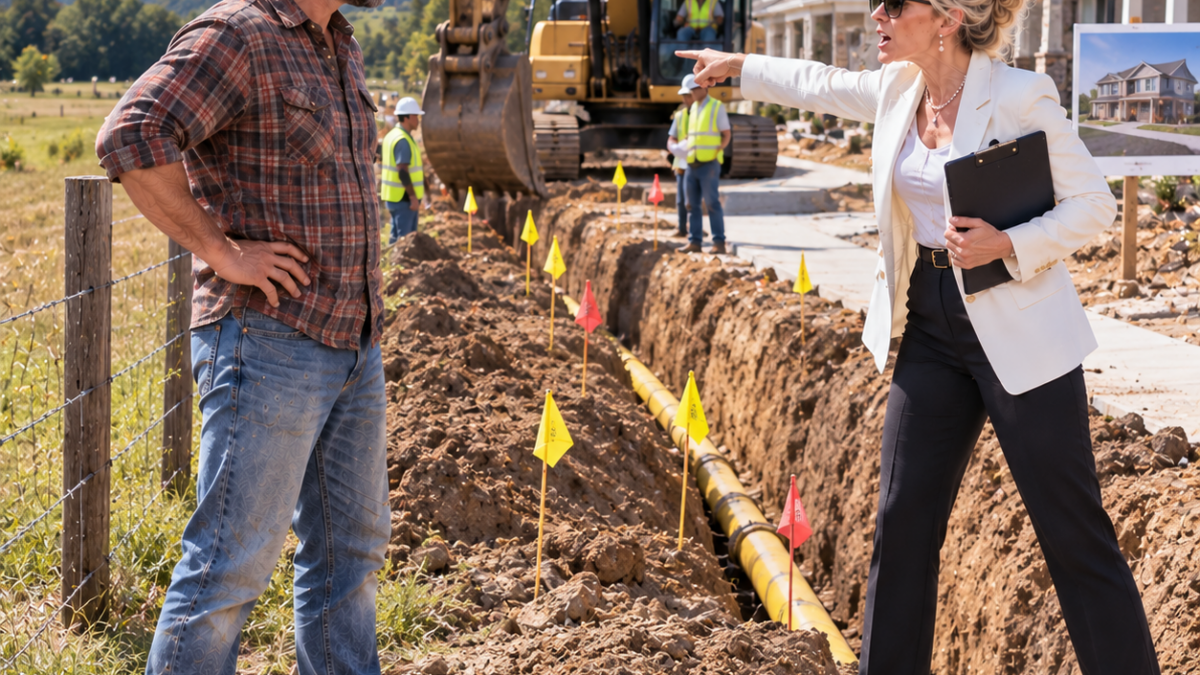
The excavator stopped.
Not gradually.
Instantly.
The operator froze inside the cab.
The foreman threw both hands into the air.
“Back up!”
The bucket lifted.
The engine died.
For perhaps half a second, nobody moved.
Then everybody did.
A worker near the trench ran toward the sales court.
Another shouted for people to clear the area.
Sheila grabbed my arm.
“What happened?”
“I don’t know.”
And I didn’t.
I had spent three days worried about that crossing, but standing there beside my fence, I wasn’t interested in being right.
I was interested in getting people away from whatever had just happened.
Natalie came running from the temporary sales office.
“What happened?”
The foreman pointed toward the work zone.
“Clear the court.”
Her face changed.
“Everybody out!”
Sales agents started coming out of the models.
The photographer grabbed his equipment.
Workers abandoned carts and landscaping tools.
People moved toward the entrance.
I backed toward my gate with Sheila.
Sirens came next.
Utility vehicles.
Fire crews.
Emergency responders.
Nobody walked toward the trench except the people whose job required it.
Then we saw the first visible flame near the damaged utility area.
It wasn’t some giant Hollywood fireball.
It was worse in a different way.
It was real.
A concentrated flame appeared where there had been nothing but dirt and machinery minutes earlier.
Smoke began rising.
The nearest model home was close.
Too close.
Responders established a perimeter while utility personnel worked the active hazard.
From where Sheila and I stood, we couldn’t understand the technical sequence.
We didn’t need to.
Smoke began moving across the first houses.
Then fire reached one.
A porch roof darkened.
Flames caught higher.
Another model began burning.
The spotless sales court I’d watched workers polish all week changed in minutes.
The photographer’s tripod spot disappeared behind emergency vehicles.
Glass reflected orange.
Smoke rolled across white siding.
People stood far back while crews worked.
Sheila searched the crowd.
“Do you see Natalie?”
I found her near the command area.
“Yeah.”
“The workers?”
“The foreman’s over there.”
That mattered more than anything else.
People first.
Always.
The houses could wait.
The launch could wait.
The arguments could wait.
The fire didn’t consume twelve houses in one dramatic sweep.
It moved unevenly.
Several models burned badly enough that it was obvious they were total losses.
Others remained standing but suffered major damage.
Rooflines burned.
Porches blackened.
Windows failed.
Heat warped siding.
Smoke entered structures farther down the court.
By the time emergency crews brought the scene under control, every one of Stonehaven’s twelve showcase homes had been affected.
Some were ruined.
Others were badly burned.
The rest had enough fire, heat, smoke, window, roof, or exterior damage that none could remain in the model program.
Twelve finished houses.
Twelve damaged houses.
Zero grand opening.
A blue launch banner still hung near the entrance.
That was the detail I remember most.
The banner.
It kept moving in the breeze while everything it had been advertising sat behind emergency tape.
By evening, the site was quiet except for responders, utility crews, investigators, and people taking photographs.
The excavator remained where it had stopped.
Most of the orange stakes were gone.
Sheila and I went inside after dark.
I sat at the kitchen table.
For three days, I had imagined how satisfying it would feel if somebody finally admitted I had been right to ask questions.
There was nothing satisfying about twelve damaged houses.
People had built those homes.
Carpenters.
Electricians.
Painters.
Roofers.
Landscapers.
Crews had spent months getting them ready.
I rubbed both hands over my face.
“Could I have done something else?”
Sheila was standing at the counter.
She turned.
“You warned them.”
“I know.”
“You asked them to verify the route.”
“I know.”
“You didn’t move it.”
“No.”
“You didn’t release the excavation.”
“No.”
“Then stop taking responsibility for decisions you didn’t make.”
I looked toward the dark window.
She had been telling me some version of that for years.
The following morning, an email arrived requesting a written timeline of my conversations with Stonehaven.
I opened the attached preliminary incident summary.
Most of it was administrative language.
Then I reached one phrase.
Adjacent property access and easement coordination associated with field route modification.
I read it twice.
Then a third time.
Sheila came behind me.
“What?”
I pointed.
She read the sentence.
Her expression hardened.
“That makes it sound like you caused the reroute.”
“That’s how I read it.”
“But you didn’t.”
“No.”
I opened the old crossing exhibit.
Then the revised drawing.
Then my first email raising the concern.
The sequence was simple.
Stonehaven changed the route.
Then I noticed the stakes.
Then I questioned it.
I hadn’t refused an existing route and forced them toward another one.
I hadn’t asked them to relocate anything.
I hadn’t demanded that the trench be moved.
I had discovered a move they had already made and asked them to verify it.
That distinction suddenly mattered enormously.
I called an attorney.
Her name was Paula Morgan.
She handled property disputes and construction-related matters locally.
I showed her everything.
The old exhibit.
The emails.
The revised route.
My notes.
The preliminary incident summary.
She read quietly.
Then she looked at me.
“I’m not going to run their investigation.”
“Good.”
“My job is to make sure your cooperation doesn’t become an admission.”
“That sounds even better.”
Three days after the fire, we sat inside a temporary Stonehaven site trailer.
The burned model court was visible through the window.
Blackened rooflines.
Boarded openings.
Wet plywood.
A porch that had been ready for photographs less than a week earlier now sagged behind fencing.
Natalie sat across from me.
Derek was there.
So was the excavation contractor’s project manager.
Stonehaven’s builder-risk representative opened the meeting.
“We’re reconstructing the route-decision and work-release timeline.”
Paula placed her notebook on the table.
I didn’t speak until they asked me to.
The claims representative turned toward me.
“Mr. Carter, your concern is that the preliminary wording suggests your property objection contributed to the reroute.”
“Yes.”
Natalie answered.
“It wasn’t intended as a fault determination.”
“I understand.”
“It was preliminary language.”
I slid the printed sentence forward.
“But the route had already changed before I knew anything about it.”
The contractor’s project manager looked toward Derek.
“That should be easy to establish.”
Derek connected his tablet to a screen.
The first document appeared.
The old crossing exhibit.
Revision three.
The route Stonehaven had originally coordinated.
Then revision five.
The field route the excavator had actually followed.
Derek opened the utility record.
“Prior utility coordination was completed under revision three.”
The claims representative nodded.
“And the route used on the day of the incident?”
“Revision five.”
Then Derek opened an internal field-change log.
A timestamp appeared.
2:41 p.m.
The day before I first noticed the orange stakes.
The claims representative checked the contact history.
My first documented communication happened the following morning.
The contractor’s project manager leaned forward.
“So revision five was approved before Mr. Carter discovered the change?”
“Yes.”
“Before he objected?”
“Yes.”
There it was.
Not my opinion.
Not Sheila defending me.
Not my memory.
The project’s own records.
The reroute existed before my involvement.
The reviewer looked toward Natalie.
“Why was revision five created?”
She answered directly.
“To avoid reopening completed hardscape and improve final closeout access.”
That was exactly what she’d told me before the fire.
The old route would have required tearing through finished pavers, concrete edging, landscaping, and other completed work.
Somebody had decided a different trench made more sense.
Maybe financially.
Maybe operationally.
Probably both.
That decision itself wasn’t necessarily the disaster.
The next question was.
“What utility verification was attached to revision five before release?”
Derek opened the project package.
Utility coordination complete.
Then he opened the record underneath it.
Revision three.
The contractor’s project manager frowned.
“Our field crew saw utilities complete.”
“Yes.”
“We received a released package.”
“Yes.”
“No active utility hold.”
“Correct.”
The claims reviewer looked at Derek.
“Can you produce a route-specific verification for revision five completed before excavation?”
Derek was quiet.
Then he shook his head.
“No.”
Nobody spoke for several seconds.
The air conditioner hummed.
I looked through the window.
Twelve damaged homes sat beyond temporary fencing.
The entire chain was visible now.
Original route.
Utility coordination.
Completed status.
Later reroute.
Old status carried forward.
Released package.
Excavation.
Strike.
Fire.
The claims reviewer picked up the preliminary incident summary.
“This wording needs correction.”
Natalie nodded.
“I agree.”
Then she looked at me.
“The reroute wasn’t caused by your access objection.”
“No.”
“It predates your objection.”
“Yes.”
A few months earlier, I would have stopped there.
Somebody important had acknowledged the mistake.
Problem solved.
But I looked through that window again.
Then I heard Sheila’s voice in my head.
Stop taking ownership of decisions you didn’t make.
So I continued.
“I need the final record to say that clearly.”
Natalie looked tired.
“It will.”
“I don’t want ‘associated with.’”
Paula remained silent.
She knew I needed to say this myself.
“I don’t want ‘complicated by.’”
The claims reviewer started writing.
“I don’t want somebody opening this file six months from now and deciding the route moved because Ben Carter refused access.”
I tapped the timeline.
“You approved the reroute before I knew it existed.”
Nobody disagreed.
“I discovered the stakes the next morning.”
Derek nodded.
“I asked you to verify the changed route before excavation.”
Another nod.
I looked directly at Natalie.
“Don’t make me the reason those houses burned because I was the one asking you not to dig there.”
She held my eyes.
Then turned toward the reviewer.
“Correct the chronology.”
He wrote something down.
The final incident record eventually stated that the field reroute preceded my objection.
My objection did not cause the reroute.
Stonehaven also confirmed that no portion of the model-home fire loss would be assigned to me.
There was no dramatic courtroom victory.
No giant settlement check.
No developer handing me millions.
And frankly, I didn’t want one.
I wanted my name attached to the right part of the story.
I was the neighbor who noticed something didn’t match.
I asked a question.
Then I asked it again.
Stonehaven made the decisions after that.
The claims process moved forward without me.
Insurers.
Contractors.
Developers.
Utility representatives.
Engineers.
People whose jobs involved figuring out exactly who owed what.
I stayed out of conclusions I couldn’t prove.
The only thing I cared about was the documented sequence.
Two months later, I stood near my fence and watched another excavator enter Stonehaven.
Different machine.
Different crew.
Different purpose.
This time, it was demolition.
Several model homes were gone completely.
Others had been stripped back for extensive repairs.
One roof had been removed to bare framing.
Another house was wrapped where finished siding had once been.
Temporary fencing cut through the sales court.
Contractor vehicles occupied the visitor spaces.
Utility markings covered the frontage.
You couldn’t walk fifty feet without being reminded that something important ran underground.
The grand-opening banners were gone.
The public launch had been delayed for months.
The weekend everybody had been rushing to protect never happened.
Stonehaven didn’t disappear.
The development survived.
Homes still sold eventually.
People still moved in.
Life continued.
But the release process changed.
During the remaining developer-controlled buildout, a material field-route change near a protected utility corridor could no longer rely automatically on a prior coordination status.
The changed route had to be matched to fresh route-specific verification before excavation could proceed.
Gary from the utility side explained it to me later in one sentence.
“The green check doesn’t travel with the line anymore.”
That was exactly it.
Move the route.
Move the verification.
Simple.
Painfully simple.
Natalie kept her job.
But she no longer had the same authority to push a changed utility route through closeout without the new verification.
I didn’t celebrate that.
She had made a decision inside a system that allowed the decision to happen.
Fixing only the person would have been easier.
Fixing the process mattered more.
My own property suffered minor damage from emergency access and cleanup.
A section near the fence was disturbed.
There were vehicle ruts.
Stonehaven repaired them.
Fence repaired.
Ground restored.
No giant check.
No mansion.
No retirement yacht.
Just my property put back the way it was supposed to be.
One afternoon, Natalie stopped near my driveway.
She wore the same type of blazer I’d seen during launch week.
But this time there were no banners behind her.
No photographers.
No salespeople carrying brochures.
Across the road, a crew was loading burned framing into a dumpster.
Natalie looked toward the model court.
“Not exactly the opening we planned.”
“No.”
She laughed quietly.
Not because anything was funny.
Sometimes people laugh because the alternative is admitting how exhausted they are.
“For what it’s worth,” she said, “the revised process is better.”
I nodded.
“For what it’s worth, I never wanted the old one to fail.”
She looked at me.
“I know.”
That answer surprised me.
Maybe because for several days before the fire, I had felt like Stonehaven saw me as nothing but an obstacle.
The Carter easement issue.
The homeowner holding up closeout.
The guy next door asking another question.
But somewhere between the fire and the investigation, the roles had become clearer.
I wasn’t against the development.
I wasn’t against construction.
I wasn’t even against changing the trench route.
I was against pretending an approval for one route automatically answered the safety questions for another.
Natalie looked toward the reconstruction crews.
“Take care, Ben.”
“You too.”
Then she left.
And slowly, Stonehaven stopped being the center of our lives.
Our kitchen table became a kitchen table again.
No drawings.
No printed emails.
No revision histories.
No utility records.
Just mail.
Grocery lists.
Sheila’s reading glasses.
My coffee.
One Saturday morning, I was replacing a cracked shelf bracket in the garage when somebody knocked on the side door.
A young utility subcontractor stood outside.
Reflective vest.
Tablet.
“Mr. Carter?”
“That’s me.”
“We’re doing a short access check along the side easement.”
I waited.
“We may need to come through your gate for about twenty minutes.”
“Sure.”
The answer came automatically.
Then I stopped.
The young man waited.
Somewhere inside the house, I imagined Sheila smiling.
I pointed toward his tablet.
“Where exactly?”
He turned the screen toward me.
“Through your gate here.”
He traced the route.
“Along the gravel edge.”
Another point.
“Then back out.”
“No equipment beyond that?”
“No, sir.”
I studied the route.
It stayed away from Sheila’s garden.
It stayed off the lawn.
It didn’t cross anything that concerned me.
“Okay.”
He smiled.
“Appreciate it.”
I unlocked the gate.
Twenty minutes later, he came back exactly the way he’d promised.
“Thanks, Mr. Carter.”
“No problem.”
I closed the gate behind him.
Then I went back to my shelf bracket.
Sheila appeared in the doorway.
“You asked where?”
“Yes.”
“You asked what equipment?”
“Yes.”
“You asked how long?”
“Yes.”
She smiled.
“Look at you.”
“Don’t start.”
She laughed and went back inside.
I stood there holding my screwdriver.
Maybe that was the only lesson I actually needed from Stonehaven.
I didn’t become suspicious of everybody.
I didn’t start treating every contractor like an enemy.
I didn’t stop saying yes.
I just stopped assuming that being cooperative required me to stop asking questions.
Because the strangest part of the whole thing wasn’t the fire.
It wasn’t even the twelve model homes.
It was how ordinary every decision looked before the excavator reached that crossing.
The original utility review had been completed.
That was true.
The route had later changed.
That was true.
The construction drawing had been released.
True.
The contractor had followed the drawing.
True.
The project system still displayed utility coordination as complete.
Also true.
Every person involved could point to something that looked reasonable.
The problem lived between those truths.
The approval belonged to an earlier route.
The route moved.
The approval didn’t.
And because nobody stopped long enough to reconnect the two, a green check mark on a screen became more persuasive than the orange stakes sitting in real dirt.
I had stared at those stakes for three days.
I had nearly convinced myself to stop asking.
That still bothers me.
Not because I could have prevented everything.
I don’t know that.
I wasn’t the utility engineer.
I wasn’t the project manager.
I wasn’t the excavation contractor.
I wasn’t the person with authority to issue a stop.
But I remember standing in my kitchen while Natalie explained how many schedules depended on that trench.
Broker previews.
Photography.
Opening weekend.
Contractors.
Twelve finished houses.
I remember feeling guilty.
That is the part I understand differently now.
Pressure doesn’t always sound like a threat.
Sometimes it sounds perfectly reasonable.
“We have crews waiting.”
“We already completed coordination.”
“The package is released.”
“We can’t stop everything over one unanswered question.”
Every sentence can be true.
And the unanswered question can still matter.
The rebuilt Stonehaven model court eventually reopened.
It looked different.
Not dramatically.
Most buyers probably never knew why.
New landscaping.
Repaired sidewalks.
Replacement structures.
Fresh paint.
Clean windows.
People eventually walked through those homes carrying brochures and imagining where their furniture might go.
The gas corridor remained where it had always been.
Underground.
Quiet.
Easy to forget.
But the project’s paperwork no longer treated a changed route like the same route simply because both appeared inside the same development.
And whenever I saw a new set of utility flags near Stonehaven, I noticed something else.
People stopped treating them like decorations.
That mattered.
A year after the fire, Sheila and I walked past the entrance one evening.
Families lived farther inside the neighborhood now.
Kids rode bicycles.
Somebody was grilling.
A dog barked behind a fence.
Nothing about the place looked like a disaster site anymore.
Sheila looked toward the model court.
“Do you ever think about it?”
“Sometimes.”
“The fire?”
I shook my head.
“The phone call before it.”
She knew exactly which one.
The evening Natalie told me they intended to proceed under the existing coordination status.
I had almost said okay.
Not because I believed the question had been answered.
Because I was tired of being the person asking it.
Sheila slipped her hand into mine.
“You didn’t.”
“No.”
We kept walking.
Near the corner, a utility marker stood beside the sidewalk.
No drama.
No excavator.
No smoke.
Just a reminder that some of the most important things in a neighborhood are the things nobody can see.
Gas lines.
Property rights.
Recorded easements.
Approval histories.
And the difference between a question that is inconvenient and a question that is answered.
Stonehaven had spent days treating those as the same thing.
They weren’t.
I never wanted twelve houses damaged to prove that.
I would have preferred to be wrong.
I would have preferred Derek to call me that first afternoon and say, “Ben, I found the new verification. Revision five was checked. Everything matches.”
I would have folded the old exhibit.
Gone inside.
Made dinner.
And probably forgotten the whole thing by Christmas.
Instead, I watched an excavator lower its bucket into a route that nobody could tie to a fresh route-specific verification.
Afterward, the project spent months rebuilding what had looked too expensive to disturb before the accident.
That’s another detail I think about sometimes.
The original route had been changed partly because Stonehaven didn’t want to tear up finished hardscape.
Pavers.
Concrete.
Landscaping.
A few days of closeout work.
After the fire, crews tore up far more than the original route would ever have required.
Not because anyone wanted revenge.
Not because the neighborhood needed some dramatic punishment.
Because shortcuts have a strange way of sending the bill later.
Sometimes the bill is paperwork.
Sometimes it’s delay.
Sometimes it’s reconstruction.
Stonehaven learned that lesson in the most expensive way possible.
I learned a quieter one.
I still open my gate when people have a legitimate reason to use it.
I still move my truck when a contractor needs room.
I still try not to make somebody’s job harder just because I can.
Being easy to work with is still a virtue.
Being easy to override isn’t.
And now, whenever somebody points at a drawing and tells me everything has already been approved, I don’t argue.
I ask one question.
“Approved for exactly what?”
Then I wait for the answer.
THE END
[FACEBOOK CAPTION — POST THIS PART FIRST]
The HOA built twelve model homes along the gas easement beside my property, then sent an excavator toward a line I had spent three days warning them not to cross.
They had already changed the approved trench route to avoid tearing up their brand-new sidewalks and landscaping, but nobody could show me that the new route had ever been cleared against the gas corridor.
By the time the excavator bucket reached the final crossing, twelve spotless houses were waiting for opening weekend behind it.
My name is Ben Carter, and until Stonehaven Crossing appeared next door, I had never considered myself the kind of homeowner who argued with developers.
For almost a year, their crews had worked around my property.
Surveyors crossed the edge of the lawn.
Delivery trucks left mud near the gate.
Contractors occasionally blocked something they shouldn’t.
Most of the time, I let it go.
My wife Sheila said that was both my best quality and my most irritating one.
Then one afternoon, I noticed orange stakes running toward the protected gas corridor beside my property.
Stonehaven’s twelve model homes were already finished.
Fresh sod.
Clean porches.
Decorative paving.
New landscaping.
Everything looked ready for photographs.
The only unfinished piece was an excavator sitting beside a newly marked trench.
I walked to the fence.
“You guys digging this today?”
The foreman nodded.
“Final utility trench.”
I pointed toward the stakes.
“You’re not crossing there, are you?”
His expression changed.
“The gas easement runs through that section.”
He pulled out the current construction drawing.
According to his paperwork, that was exactly where his crew had been told to dig.
That bothered me because seven months earlier, Stonehaven had sent me an exhibit showing a completely different crossing.
I found the old email that night.
The original trench went farther down the frontage before crossing the utility corridor.
The new stakes turned toward it much sooner.
There was an obvious reason.
Stonehaven had finished the area where the old route was supposed to go.
New pavers.
Concrete edging.
Landscape beds.
A stone planter.
Following the original route now meant ripping all of that back out days before the grand opening.
Natalie Faraday, Stonehaven’s community-launch director, eventually admitted the route had been changed partly to avoid reopening the finished hardscape.
“Field revisions happen,” she told me.
“I understand.”
“Utility coordination for the project is complete.”
“That isn’t what I’m asking.”
She stared at me.
I pointed toward the orange stakes.
“Was that route checked after you moved it?”
For the first time, she didn’t have an immediate answer.
The next morning, Stonehaven’s utility coordinator, Derek Hall, found something worse.
The project really did have a completed utility-coordination record.
But the completion date came several weeks before the trench was rerouted.
The green check mark was real.
It just belonged to the old route.
“Can you find anything showing the revised alignment was checked?” I asked.
“Not anything I can confirm yet.”
That afternoon, Natalie brought Derek and the excavation foreman together beside the model court.
The contractor had a released drawing.
Stonehaven’s system showed utility coordination complete.
Nobody had issued an active utility stop.
Everything looked official until Derek opened the underlying record.
The clearance referenced the previous revision.
I pointed toward the finished pavers.
“You moved the trench to save that.”
Natalie’s jaw tightened.
“We moved it because the revised route worked better for closeout.”
“Fine.”
I pointed toward the excavator.
“But when you moved the route, did anyone move the clearance with it?”
Nobody answered.
By the following morning, contractors were referring to the delay as “the Carter easement issue.”
Sales staff asked Sheila when our property problem would be resolved.
Stonehaven had broker previews scheduled.
Flowers were arriving.
Launch banners were hanging.
Twelve furnished houses were waiting.
And somehow I had become the obstacle because I kept asking one question.
Did anyone qualified verify the new crossing?
That evening, Natalie called.
“We’re proceeding tomorrow under the existing coordination status unless site operations identifies a specific reason not to.”
I looked through my kitchen window toward the model homes.
“So nobody confirmed the exact revised route?”
“No new route-specific confirmation was issued today.”
There it was.
The next morning, the excavator was running before I finished my coffee.
I walked outside with Sheila.
Natalie stood beside the foreman.
Derek held his tablet.
I asked the question one final time.
“Does the completed utility confirmation cover the exact route marked on the ground today?”
Derek hesitated.
Then quietly said, “I can’t give you a route-specific yes.”
Natalie looked at the foreman.
“Proceed under the released package.”
I didn’t shout.
I didn’t step into the work zone.
I didn’t try to stop the machine.
I had no authority over their crew.
So Sheila and I stood behind our fence as the bucket began cutting through the dirt.
One orange stake disappeared.
Then another.
The trench crept closer to the protected corridor.
Behind the excavator, a photographer set up near one of the models.
Workers straightened decorations.
Salespeople carried materials inside.
The houses looked perfect.
The operator repositioned the machine.
The foreman raised his hand.
The bucket swung over the final crossing.
For a second, everything stopped.
Then the foreman lowered his hand.
And when that bucket came down, the first sound wasn’t an explosion.
It was a hard metallic jolt that made every worker near the trench suddenly turn their head.
[END OF FACEBOOK CAPTION]
[FIRST COMMENT / FULL STORY CONTINUATION]
The excavator stopped.
Not gradually.
Instantly.
The operator froze inside the cab.
The foreman threw both hands into the air.
“Back up!”
The bucket lifted.
The engine died.
For perhaps half a second, nobody moved.
Then everybody did.
A worker near the trench ran toward the sales court.
Another shouted for people to clear the area.
Sheila grabbed my arm.
“What happened?”
“I don’t know.”
And I didn’t.
I had spent three days worried about that crossing, but standing there beside my fence, I wasn’t interested in being right.
I was interested in getting people away from whatever had just happened.
Natalie came running from the temporary sales office.
“What happened?”
The foreman pointed toward the work zone.
“Clear the court.”
Her face changed.
“Everybody out!”
Sales agents started coming out of the models.
The photographer grabbed his equipment.
Workers abandoned carts and landscaping tools.
People moved toward the entrance.
I backed toward my gate with Sheila.
Sirens came next.
Utility vehicles.
Fire crews.
Emergency responders.
Nobody walked toward the trench except the people whose job required it.
Then we saw the first visible flame near the damaged utility area.
It wasn’t some giant Hollywood fireball.
It was worse in a different way.
It was real.
A concentrated flame appeared where there had been nothing but dirt and machinery minutes earlier.
Smoke began rising.
The nearest model home was close.
Too close.
Responders established a perimeter while utility personnel worked the active hazard.
From where Sheila and I stood, we couldn’t understand the technical sequence.
We didn’t need to.
Smoke began moving across the first houses.
Then fire reached one.
A porch roof darkened.
Flames caught higher.
Another model began burning.
The spotless sales court I’d watched workers polish all week changed in minutes.
The photographer’s tripod spot disappeared behind emergency vehicles.
Glass reflected orange.
Smoke rolled across white siding.
People stood far back while crews worked.
Sheila searched the crowd.
“Do you see Natalie?”
I found her near the command area.
“Yeah.”
“The workers?”
“The foreman’s over there.”
That mattered more than anything else.
People first.
Always.
The houses could wait.
The launch could wait.
The arguments could wait.
The fire didn’t consume twelve houses in one dramatic sweep.
It moved unevenly.
Several models burned badly enough that it was obvious they were total losses.
Others remained standing but suffered major damage.
Rooflines burned.
Porches blackened.
Windows failed.
Heat warped siding.
Smoke entered structures farther down the court.
By the time emergency crews brought the scene under control, every one of Stonehaven’s twelve showcase homes had been affected.
Some were ruined.
Others were badly burned.
The rest had enough fire, heat, smoke, window, roof, or exterior damage that none could remain in the model program.
Twelve finished houses.
Twelve damaged houses.
Zero grand opening.
A blue launch banner still hung near the entrance.
That was the detail I remember most.
The banner.
It kept moving in the breeze while everything it had been advertising sat behind emergency tape.
By evening, the site was quiet except for responders, utility crews, investigators, and people taking photographs.
The excavator remained where it had stopped.
Most of the orange stakes were gone.
Sheila and I went inside after dark.
I sat at the kitchen table.
For three days, I had imagined how satisfying it would feel if somebody finally admitted I had been right to ask questions.
There was nothing satisfying about twelve damaged houses.
People had built those homes.
Carpenters.
Electricians.
Painters.
Roofers.
Landscapers.
Crews had spent months getting them ready.
I rubbed both hands over my face.
“Could I have done something else?”
Sheila was standing at the counter.
She turned.
“You warned them.”
“I know.”
“You asked them to verify the route.”
“I know.”
“You didn’t move it.”
“No.”
“You didn’t release the excavation.”
“No.”
“Then stop taking responsibility for decisions you didn’t make.”
I looked toward the dark window.
She had been telling me some version of that for years.
The following morning, an email arrived requesting a written timeline of my conversations with Stonehaven.
I opened the attached preliminary incident summary.
Most of it was administrative language.
Then I reached one phrase.
Adjacent property access and easement coordination associated with field route modification.
I read it twice.
Then a third time.
Sheila came behind me.
“What?”
I pointed.
She read the sentence.
Her expression hardened.
“That makes it sound like you caused the reroute.”
“That’s how I read it.”
“But you didn’t.”
“No.”
I opened the old crossing exhibit.
Then the revised drawing.
Then my first email raising the concern.
The sequence was simple.
Stonehaven changed the route.
Then I noticed the stakes.
Then I questioned it.
I hadn’t refused an existing route and forced them toward another one.
I hadn’t asked them to relocate anything.
I hadn’t demanded that the trench be moved.
I had discovered a move they had already made and asked them to verify it.
That distinction suddenly mattered enormously.
I called an attorney.
Her name was Paula Morgan.
She handled property disputes and construction-related matters locally.
I showed her everything.
The old exhibit.
The emails.
The revised route.
My notes.
The preliminary incident summary.
She read quietly.
Then she looked at me.
“I’m not going to run their investigation.”
“Good.”
“My job is to make sure your cooperation doesn’t become an admission.”
“That sounds even better.”
Three days after the fire, we sat inside a temporary Stonehaven site trailer.
The burned model court was visible through the window.
Blackened rooflines.
Boarded openings.
Wet plywood.
A porch that had been ready for photographs less than a week earlier now sagged behind fencing.
Natalie sat across from me.
Derek was there.
So was the excavation contractor’s project manager.
Stonehaven’s builder-risk representative opened the meeting.
“We’re reconstructing the route-decision and work-release timeline.”
Paula placed her notebook on the table.
I didn’t speak until they asked me to.
The claims representative turned toward me.
“Mr. Carter, your concern is that the preliminary wording suggests your property objection contributed to the reroute.”
“Yes.”
Natalie answered.
“It wasn’t intended as a fault determination.”
“I understand.”
“It was preliminary language.”
I slid the printed sentence forward.
“But the route had already changed before I knew anything about it.”
The contractor’s project manager looked toward Derek.
“That should be easy to establish.”
Derek connected his tablet to a screen.
The first document appeared.
The old crossing exhibit.
Revision three.
The route Stonehaven had originally coordinated.
Then revision five.
The field route the excavator had actually followed.
Derek opened the utility record.
“Prior utility coordination was completed under revision three.”
The claims representative nodded.
“And the route used on the day of the incident?”
“Revision five.”
Then Derek opened an internal field-change log.
A timestamp appeared.
2:41 p.m.
The day before I first noticed the orange stakes.
The claims representative checked the contact history.
My first documented communication happened the following morning.
The contractor’s project manager leaned forward.
“So revision five was approved before Mr. Carter discovered the change?”
“Yes.”
“Before he objected?”
“Yes.”
There it was.
Not my opinion.
Not Sheila defending me.
Not my memory.
The project’s own records.
The reroute existed before my involvement.
The reviewer looked toward Natalie.
“Why was revision five created?”
She answered directly.
“To avoid reopening completed hardscape and improve final closeout access.”
That was exactly what she’d told me before the fire.
The old route would have required tearing through finished pavers, concrete edging, landscaping, and other completed work.
Somebody had decided a different trench made more sense.
Maybe financially.
Maybe operationally.
Probably both.
That decision itself wasn’t necessarily the disaster.
The next question was.
“What utility verification was attached to revision five before release?”
Derek opened the project package.
Utility coordination complete.
Then he opened the record underneath it.
Revision three.
The contractor’s project manager frowned.
“Our field crew saw utilities complete.”
“Yes.”
“We received a released package.”
“Yes.”
“No active utility hold.”
“Correct.”
The claims reviewer looked at Derek.
“Can you produce a route-specific verification for revision five completed before excavation?”
Derek was quiet.
Then he shook his head.
“No.”
Nobody spoke for several seconds.
The air conditioner hummed.
I looked through the window.
Twelve damaged homes sat beyond temporary fencing.
The entire chain was visible now.
Original route.
Utility coordination.
Completed status.
Later reroute.
Old status carried forward.
Released package.
Excavation.
Strike.
Fire.
The claims reviewer picked up the preliminary incident summary.
“This wording needs correction.”
Natalie nodded.
“I agree.”
Then she looked at me.
“The reroute wasn’t caused by your access objection.”
“No.”
“It predates your objection.”
“Yes.”
A few months earlier, I would have stopped there.
Somebody important had acknowledged the mistake.
Problem solved.
But I looked through that window again.
Then I heard Sheila’s voice in my head.
Stop taking ownership of decisions you didn’t make.
So I continued.
“I need the final record to say that clearly.”
Natalie looked tired.
“It will.”
“I don’t want ‘associated with.’”
Paula remained silent.
She knew I needed to say this myself.
“I don’t want ‘complicated by.’”
The claims reviewer started writing.
“I don’t want somebody opening this file six months from now and deciding the route moved because Ben Carter refused access.”
I tapped the timeline.
“You approved the reroute before I knew it existed.”
Nobody disagreed.
“I discovered the stakes the next morning.”
Derek nodded.
“I asked you to verify the changed route before excavation.”
Another nod.
I looked directly at Natalie.
“Don’t make me the reason those houses burned because I was the one asking you not to dig there.”
She held my eyes.
Then turned toward the reviewer.
“Correct the chronology.”
He wrote something down.
The final incident record eventually stated that the field reroute preceded my objection.
My objection did not cause the reroute.
Stonehaven also confirmed that no portion of the model-home fire loss would be assigned to me.
There was no dramatic courtroom victory.
No giant settlement check.
No developer handing me millions.
And frankly, I didn’t want one.
I wanted my name attached to the right part of the story.
I was the neighbor who noticed something didn’t match.
I asked a question.
Then I asked it again.
Stonehaven made the decisions after that.
The claims process moved forward without me.
Insurers.
Contractors.
Developers.
Utility representatives.
Engineers.
People whose jobs involved figuring out exactly who owed what.
I stayed out of conclusions I couldn’t prove.
The only thing I cared about was the documented sequence.
Two months later, I stood near my fence and watched another excavator enter Stonehaven.
Different machine.
Different crew.
Different purpose.
This time, it was demolition.
Several model homes were gone completely.
Others had been stripped back for extensive repairs.
One roof had been removed to bare framing.
Another house was wrapped where finished siding had once been.
Temporary fencing cut through the sales court.
Contractor vehicles occupied the visitor spaces.
Utility markings covered the frontage.
You couldn’t walk fifty feet without being reminded that something important ran underground.
The grand-opening banners were gone.
The public launch had been delayed for months.
The weekend everybody had been rushing to protect never happened.
Stonehaven didn’t disappear.
The development survived.
Homes still sold eventually.
People still moved in.
Life continued.
But the release process changed.
During the remaining developer-controlled buildout, a material field-route change near a protected utility corridor could no longer rely automatically on a prior coordination status.
The changed route had to be matched to fresh route-specific verification before excavation could proceed.
Gary from the utility side explained it to me later in one sentence.
“The green check doesn’t travel with the line anymore.”
That was exactly it.
Move the route.
Move the verification.
Simple.
Painfully simple.
Natalie kept her job.
But she no longer had the same authority to push a changed utility route through closeout without the new verification.
I didn’t celebrate that.
She had made a decision inside a system that allowed the decision to happen.
Fixing only the person would have been easier.
Fixing the process mattered more.
My own property suffered minor damage from emergency access and cleanup.
A section near the fence was disturbed.
There were vehicle ruts.
Stonehaven repaired them.
Fence repaired.
Ground restored.
No giant check.
No mansion.
No retirement yacht.
Just my property put back the way it was supposed to be.
One afternoon, Natalie stopped near my driveway.
She wore the same type of blazer I’d seen during launch week.
But this time there were no banners behind her.
No photographers.
No salespeople carrying brochures.
Across the road, a crew was loading burned framing into a dumpster.
Natalie looked toward the model court.
“Not exactly the opening we planned.”
“No.”
She laughed quietly.
Not because anything was funny.
Sometimes people laugh because the alternative is admitting how exhausted they are.
“For what it’s worth,” she said, “the revised process is better.”
I nodded.
“For what it’s worth, I never wanted the old one to fail.”
She looked at me.
“I know.”
That answer surprised me.
Maybe because for several days before the fire, I had felt like Stonehaven saw me as nothing but an obstacle.
The Carter easement issue.
The homeowner holding up closeout.
The guy next door asking another question.
But somewhere between the fire and the investigation, the roles had become clearer.
I wasn’t against the development.
I wasn’t against construction.
I wasn’t even against changing the trench route.
I was against pretending an approval for one route automatically answered the safety questions for another.
Natalie looked toward the reconstruction crews.
“Take care, Ben.”
“You too.”
Then she left.
And slowly, Stonehaven stopped being the center of our lives.
Our kitchen table became a kitchen table again.
No drawings.
No printed emails.
No revision histories.
No utility records.
Just mail.
Grocery lists.
Sheila’s reading glasses.
My coffee.
One Saturday morning, I was replacing a cracked shelf bracket in the garage when somebody knocked on the side door.
A young utility subcontractor stood outside.
Reflective vest.
Tablet.
“Mr. Carter?”
“That’s me.”
“We’re doing a short access check along the side easement.”
I waited.
“We may need to come through your gate for about twenty minutes.”
“Sure.”
The answer came automatically.
Then I stopped.
The young man waited.
Somewhere inside the house, I imagined Sheila smiling.
I pointed toward his tablet.
“Where exactly?”
He turned the screen toward me.
“Through your gate here.”
He traced the route.
“Along the gravel edge.”
Another point.
“Then back out.”
“No equipment beyond that?”
“No, sir.”
I studied the route.
It stayed away from Sheila’s garden.
It stayed off the lawn.
It didn’t cross anything that concerned me.
“Okay.”
He smiled.
“Appreciate it.”
I unlocked the gate.
Twenty minutes later, he came back exactly the way he’d promised.
“Thanks, Mr. Carter.”
“No problem.”
I closed the gate behind him.
Then I went back to my shelf bracket.
Sheila appeared in the doorway.
“You asked where?”
“Yes.”
“You asked what equipment?”
“Yes.”
“You asked how long?”
“Yes.”
She smiled.
“Look at you.”
“Don’t start.”
She laughed and went back inside.
I stood there holding my screwdriver.
Maybe that was the only lesson I actually needed from Stonehaven.
I didn’t become suspicious of everybody.
I didn’t start treating every contractor like an enemy.
I didn’t stop saying yes.
I just stopped assuming that being cooperative required me to stop asking questions.
Because the strangest part of the whole thing wasn’t the fire.
It wasn’t even the twelve model homes.
It was how ordinary every decision looked before the excavator reached that crossing.
The original utility review had been completed.
That was true.
The route had later changed.
That was true.
The construction drawing had been released.
True.
The contractor had followed the drawing.
True.
The project system still displayed utility coordination as complete.
Also true.
Every person involved could point to something that looked reasonable.
The problem lived between those truths.
The approval belonged to an earlier route.
The route moved.
The approval didn’t.
And because nobody stopped long enough to reconnect the two, a green check mark on a screen became more persuasive than the orange stakes sitting in real dirt.
I had stared at those stakes for three days.
I had nearly convinced myself to stop asking.
That still bothers me.
Not because I could have prevented everything.
I don’t know that.
I wasn’t the utility engineer.
I wasn’t the project manager.
I wasn’t the excavation contractor.
I wasn’t the person with authority to issue a stop.
But I remember standing in my kitchen while Natalie explained how many schedules depended on that trench.
Broker previews.
Photography.
Opening weekend.
Contractors.
Twelve finished houses.
I remember feeling guilty.
That is the part I understand differently now.
Pressure doesn’t always sound like a threat.
Sometimes it sounds perfectly reasonable.
“We have crews waiting.”
“We already completed coordination.”
“The package is released.”
“We can’t stop everything over one unanswered question.”
Every sentence can be true.
And the unanswered question can still matter.
The rebuilt Stonehaven model court eventually reopened.
It looked different.
Not dramatically.
Most buyers probably never knew why.
New landscaping.
Repaired sidewalks.
Replacement structures.
Fresh paint.
Clean windows.
People eventually walked through those homes carrying brochures and imagining where their furniture might go.
The gas corridor remained where it had always been.
Underground.
Quiet.
Easy to forget.
But the project’s paperwork no longer treated a changed route like the same route simply because both appeared inside the same development.
And whenever I saw a new set of utility flags near Stonehaven, I noticed something else.
People stopped treating them like decorations.
That mattered.
A year after the fire, Sheila and I walked past the entrance one evening.
Families lived farther inside the neighborhood now.
Kids rode bicycles.
Somebody was grilling.
A dog barked behind a fence.
Nothing about the place looked like a disaster site anymore.
Sheila looked toward the model court.
“Do you ever think about it?”
“Sometimes.”
“The fire?”
I shook my head.
“The phone call before it.”
She knew exactly which one.
The evening Natalie told me they intended to proceed under the existing coordination status.
I had almost said okay.
Not because I believed the question had been answered.
Because I was tired of being the person asking it.
Sheila slipped her hand into mine.
“You didn’t.”
“No.”
We kept walking.
Near the corner, a utility marker stood beside the sidewalk.
No drama.
No excavator.
No smoke.
Just a reminder that some of the most important things in a neighborhood are the things nobody can see.
Gas lines.
Property rights.
Recorded easements.
Approval histories.
And the difference between a question that is inconvenient and a question that is answered.
Stonehaven had spent days treating those as the same thing.
They weren’t.
I never wanted twelve houses damaged to prove that.
I would have preferred to be wrong.
I would have preferred Derek to call me that first afternoon and say, “Ben, I found the new verification. Revision five was checked. Everything matches.”
I would have folded the old exhibit.
Gone inside.
Made dinner.
And probably forgotten the whole thing by Christmas.
Instead, I watched an excavator lower its bucket into a route that nobody could tie to a fresh route-specific verification.
Afterward, the project spent months rebuilding what had looked too expensive to disturb before the accident.
That’s another detail I think about sometimes.
The original route had been changed partly because Stonehaven didn’t want to tear up finished hardscape.
Pavers.
Concrete.
Landscaping.
A few days of closeout work.
After the fire, crews tore up far more than the original route would ever have required.
Not because anyone wanted revenge.
Not because the neighborhood needed some dramatic punishment.
Because shortcuts have a strange way of sending the bill later.
Sometimes the bill is paperwork.
Sometimes it’s delay.
Sometimes it’s reconstruction.
Stonehaven learned that lesson in the most expensive way possible.
I learned a quieter one.
I still open my gate when people have a legitimate reason to use it.
I still move my truck when a contractor needs room.
I still try not to make somebody’s job harder just because I can.
Being easy to work with is still a virtue.
Being easy to override isn’t.
And now, whenever somebody points at a drawing and tells me everything has already been approved, I don’t argue.
I ask one question.
“Approved for exactly what?”
Then I wait for the answer.








