The Flight Attendant Told Me People Like Me Didn’t Belong in First Class—Then I Made One Call She Never Expected
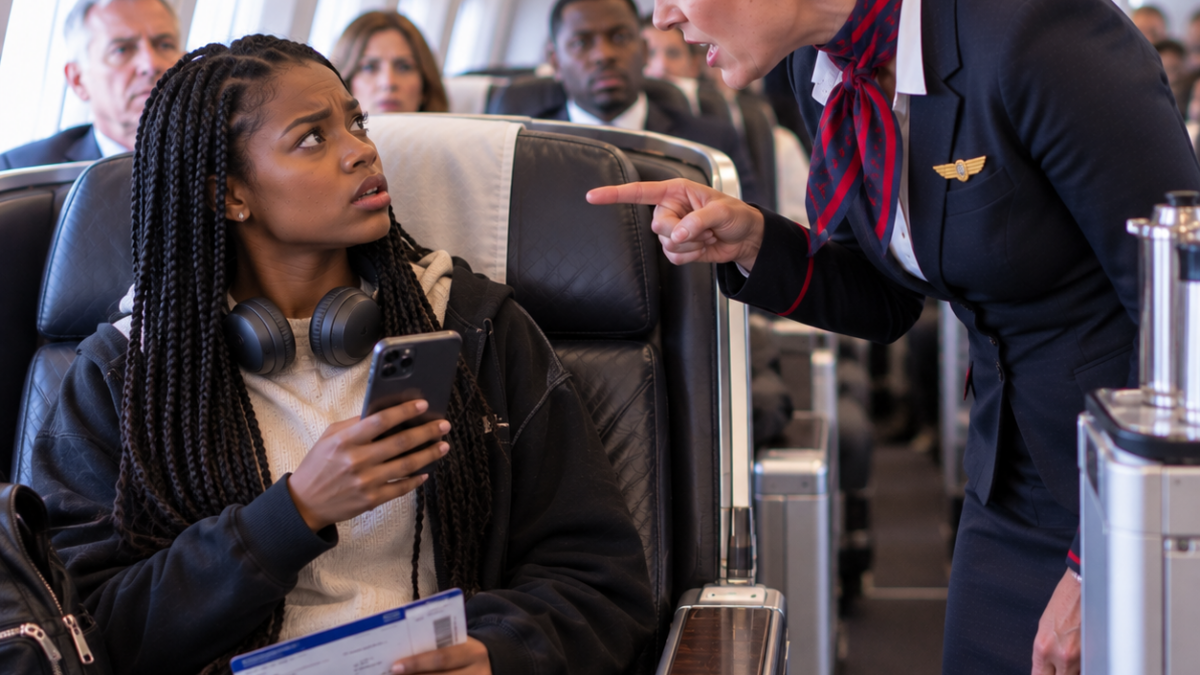
For a few seconds, nobody moved.
The engines hummed beneath us.
A glass clinked somewhere behind me.
Veronica stood in the aisle with her shoulders squared as if she had just said something completely reasonable.
I could hear my own breathing.
Slow.
Controlled.
Barely.
“People like me?”
I asked.
Her eyes narrowed.
“You heard me.”
“Yes.”
I said quietly.
“I did.”
That was important.
My phone had heard her too.
Across the aisle, Judge Eleanor Prescott rose from her seat.
She was probably in her seventies, silver hair perfectly shaped around a face that looked kind until someone gave her a reason not to be.
“Young woman.”
She addressed Veronica.
“I suggest you think carefully about what you say next.”
Veronica laughed once.
“Ma’am, please return to your seat.”
“No.”
Judge Prescott said.
The single word carried more authority than anything Veronica had said all morning.
“This passenger has a valid first-class boarding pass.”
“She has been disruptive.”
“How?”
Veronica pointed toward me.
“She has repeatedly challenged crew instructions.”
I almost laughed.
“I asked for water.”
“You complained about meal service.”
“You told me there were no first-class meals left while serving the same meal to another passenger.”
“I don’t control catering.”
“You do control honesty.”
Her face flushed.
“See?”
She looked around.
“This is exactly what I’m talking about.”
A man behind Judge Prescott leaned into the aisle.
He was Asian, maybe mid-forties, wearing a dark business suit.
“I’ve been watching her since boarding.”
He said.
“She hasn’t done anything.”
Veronica turned.
“Sir, this doesn’t concern you.”
“It concerns me when you tell a Black teenager she doesn’t belong in the cabin where she’s ticketed.”
The man’s eyes met mine.
“Anthony Chen.”
He said.
“Attorney.”
Of course.
Apparently I had accidentally booked the legal profession’s favorite flight.
Another uniform appeared from the galley.
Tall.
Broad shoulders.
Dark hair.
His badge read MARCUS REED — LEAD FLIGHT ATTENDANT.
Relief almost came.
Then I saw the way Veronica looked at him.
Not like a coworker.
Like backup.
“What is going on?”
Marcus asked.
Veronica answered immediately.
“This passenger has been hostile since boarding.”
“No.”
I said.
“She has demanded special treatment.”
“No.”
“She is now refusing crew instructions and accusing me of R@c!sm.”
“That last part is true.”
I said.
Marcus turned toward me.
“Excuse me?”
“I am accusing her of discriminatory treatment because she just shouted that people like me don’t belong in first class.”
Veronica threw up her hands.
“I never said that.”
My heart actually stopped for a beat.
The lie came so easily.
No hesitation.
No uncertainty.
Just:
I never said that.
Judge Prescott stepped closer.
“I heard you.”
“So did I.”
Anthony said.
Veronica’s face tightened.
Marcus looked at both witnesses.
Then at me.
And I watched him make a decision.
Not about what happened.
About whom he was going to protect.
“Miss…”
He checked the passenger manifest on his tablet.
“Johnson.”
“Yes.”
“Let’s speak privately.”
“I would rather stay where witnesses can hear us.”
His smile vanished.
“That wasn’t a request.”
I looked at Judge Prescott.
She gave me the smallest nod.
Go.
But document.
I followed Marcus toward the forward galley.
My phone remained in my hand.
Recording.
Once we were partially shielded by the curtain, his voice changed.
“Listen to me carefully.”
I did.
“You are making a very serious accusation against a valued employee.”
“I have evidence.”
That stopped him.
For less than a second.
But I saw it.
“What evidence?”
“Recordings.”
He leaned closer.
“Recording flight crew without permission may violate airline policy.”
“Then we can let lawyers argue about that later.”
“You are seventeen.”
He said.
Not as a fact.
As a threat.
I felt my stomach twist.
“Which means you need to think about what happens if this flight is diverted because of your behavior.”
“My behavior?”
“Interference with a flight crew is a federal matter.”
“I have not interfered with anyone.”
“That’s your opinion.”
“No.”
I kept my voice steady.
“That is what happened.”
His eyes went cold.
“Delete the recordings.”
There it was.
Not investigate.
Not listen.
Delete.
I looked directly at him.
“No.”
Behind us, Veronica muttered:
“I told you at Thanksgiving that these people always create problems.”
My eyes moved from her to Marcus.
Thanksgiving.
Marcus closed his eyes briefly.
Too late.
Then Veronica added:
“Don’t let Sophie hear about this.”
“She’s already stressed about the wedding.”
Marcus shot her a furious look.
Everything clicked.
“Sophie?”
I asked.
Nobody answered.
“Your fiancée?”
Marcus stared at me.
Veronica’s expression confirmed it.
Family.
Or almost.
Marcus was not a neutral supervisor reviewing a complaint about a subordinate.
He was protecting the woman who would soon become part of his family.
Anthony appeared at the edge of the galley.
“Miss Johnson.”
He held out a business card.
“Keep this.”
Marcus stepped between us.
“Sir—”
Anthony smiled.
“Anthony Chen.”
“Civil-rights attorney.”
“And I am personally recording this conversation.”
Marcus looked like someone had opened an emergency exit behind him.
Anthony leaned closer to me.
“Back up everything.”
He whispered.
“Cloud storage.”
“Immediately.”
I nodded.
Then returned to 3A.
Judge Prescott was waiting.
“I heard enough.”
She said.
“So did I.”
I sat.
My hands were shaking now.
Not visibly, I hoped.
But enough that typing took two tries.
I uploaded the audio.
Then another copy.
Then emailed one to an account Mom had created years earlier for important documents.
Then I texted her.
MOM.
ON HORIZON 237.
FLIGHT ATTENDANT VERONICA WHITLEY HAS BEEN RACIALLY TARGETING ME SINCE BOARDING.
SHE SHOUTED “PEOPLE LIKE YOU DON’T BELONG IN FIRST CLASS.”
LEAD FA MARCUS REED IS DEFENDING HER.
THEY ARE RELATED THROUGH HIS FIANCÉE.
I HAVE RECORDINGS.
THEY’RE THREATENING DIVERSION/ARREST IF I DON’T DELETE THEM.
PLEASE CALL ME WHEN YOU CAN.
Her response appeared in less than a minute.
STAY CALM.
DO NOT DELETE ANYTHING.
BACK UP EVERYTHING.
DO NOT ARGUE MORE THAN NECESSARY.
I AM CALLING HORIZON NOW.
WHAT TIME DO YOU LAND?
3:45.
LOGAN.
GATE B7.
Another reply.
I’VE GOT YOU.
My eyes filled.
I stared out the window until they stopped.
Those three words mattered.
I’ve got you.
Not:
I’ll destroy them.
Not:
Don’t worry.
Not:
Use my title.
Just:
I’ve got you.
For about twenty minutes, things became quieter.
That should have comforted me.
It didn’t.
People who have decided to build a case against you become most dangerous when they stop arguing.
Veronica brought me water.
Finally.
She set the plastic cup down hard enough that some splashed onto my tray.
“Your water.”
“Thank you.”
She stared at me.
“You’re welcome.”
The hatred in those two words was almost impressive.
My meal never came.
Eventually she brought a cold sandwich from economy.
No explanation.
No apology.
Across the aisle, Judge Prescott had chicken.
Anthony had steak.
A teenage white boy two rows ahead had the same chicken Veronica had said was unavailable to me.
I photographed everything.
Not because unequal airline meals were going to change federal law.
Because patterns matter.
Then I saw Marcus interviewing another passenger.
The man had slept through most of the confrontation wearing noise-canceling headphones.
Marcus bent beside him.
“Sir, we need a statement regarding a passenger issue.”
The man looked confused.
“Okay.”
“Did you observe the passenger in 3A becoming agitated?”
The passenger glanced at me.
“I’ve been asleep.”
“But you noticed her demeanor just now.”
“I mean…”
Marcus waited.
“She seems upset.”
Marcus typed.
“And did you see her drinking?”
The passenger frowned.
“No.”
“Any alcohol?”
“I really couldn’t say.”
Marcus typed again.
From the angle of the tablet, I could not see what he wrote.
I didn’t need to.
He wasn’t collecting evidence.
He was manufacturing ambiguity.
Anthony leaned forward.
“They’re building the report.”
“I know.”
“Don’t react.”
“I know.”
“Say it like you mean it.”
I took a breath.
“I know.”
He smiled faintly.
“Better.”
Then Veronica appeared with a tray carrying glasses of red wine.
She passed behind me.
Too close.
Her foot stumbled.
The tray tilted.
A full glass emptied over my shoulder.
Red wine soaked my white blouse.
Ran down the front of my navy blazer.
Splashed across the edge of my portfolio.
I froze.
“Oh.”
Veronica said.
“How clumsy of me.”
My throat closed.
“My interview clothes.”
“I suppose you’ll have to change.”
She smiled.
I knew.
Judge Prescott knew.
Anthony knew.
There was no way to prove intent from the spill alone.
That made it almost worse.
She had found something she could plausibly call an accident.
My eyes burned.
I refused to cry.
Judge Prescott stood.
“Come with me.”
She took me to the lavatory.
Inside that tiny room, she pulled club soda and tissues from her bag.
“You travel with club soda?”
“I was a judge for thirty-two years.”
She said.
“I travel prepared for stains, liars, and delayed flights.”
I laughed despite myself.
Then the laugh became a sob.
Only one.
I covered my mouth.
She put a hand on my shoulder.
“Do not confuse composure with not feeling.”
I looked at myself in the mirror.
Blazer ruined.
Blouse pink with diluted wine.
Hair starting to frizz.
Eyes red.
I thought about Harvard.
About walking into a room tomorrow with strangers already deciding whether I was impressive enough.
“They’re going to ruin my interview.”
“No.”
Judge Prescott said.
“They may ruin your clothes.”
“They may complicate your trip.”
“They do not get to decide what Harvard thinks of your mind.”
I stared at her.
“You don’t know that.”
“No.”
She admitted.
“But I know you will walk into that room if you have to wear my jacket.”
That made me laugh again.
“You’re five inches shorter than me.”
“It would be memorable.”
We photographed the stains.
Then went back out.
My phone buzzed before I sat.
Email.
HORIZON AIRLINES.
RETURN RESERVATION CANCELLED.
Due to reported passenger-conduct concerns aboard Flight 237, your return itinerary has been canceled in accordance with Horizon’s conditions of carriage.
Safety decisions made by operating crew are final.
I read it twice.
Then showed Anthony.
His jaw tightened.
“Screenshot.”
“I did.”
“Forward it.”
“I will.”
Judge Prescott looked over my shoulder.
“They’re trying to scare you into surrendering.”
“I have a Harvard interview tomorrow.”
“I know.”
“They can put me on a no-fly list.”
“Not by themselves.”
Anthony said.
“Airline restrictions are not the same as a federal no-fly list.”
“But they can make travel painful.”
Judge Prescott added.
I looked toward the galley.
Marcus was watching me.
Then the captain came on.
“Ladies and gentlemen, we are monitoring an onboard situation that may require an unscheduled landing.”
Whispers spread.
My stomach dropped.
People turned.
Some had seen the beginning.
Many had not.
Now they were hearing:
Situation.
Passenger issue.
Possible diversion.
The narrative was moving.
Exactly as Anthony predicted.
Judge Prescott leaned toward me.
“This is how institutions convert complaints into misconduct.”
“What do I do?”
“Nothing.”
She said.
“That’s the hardest part.”
The plane did not divert.
We continued to Boston.
But the final half hour felt like waiting for a verdict.
Marcus made another announcement.
“When we arrive, please remain seated until authorities address a passenger matter.”
My hands began shaking again.
I texted Mom.
LANDING.
POLICE ARE WAITING.
She replied:
I KNOW.
I’M WORKING ON IT.
RECORD EVERYTHING.
Judge Prescott touched my wrist.
“You’re not alone.”
Anthony leaned forward.
“Do not consent to searches beyond what lawfully applies.”
“Do not argue physically.”
“If they want the phone, back up first.”
“I already did.”
“Good.”
We landed.
Through the window, I saw airport police near the gate.
Blue lights.
My excitement from that morning felt like something that had happened to another girl.
Marcus appeared beside me.
“Miss Johnson.”
I looked up.
“Authorities would like to speak with you.”
“Am I being arrested?”
“They will explain.”
“Do I have to surrender my phone?”
“They’ll explain.”
Of course.
I gathered my backpack.
Portfolio.
Wine-stained blazer.
Judge Prescott stood.
“So am I.”
Marcus frowned.
“You can deplane normally after authorities finish.”
“No.”
She said.
“I am a witness.”
Anthony stood too.
“As am I.”
Marcus rubbed his jaw.
“This is an airline matter.”
Anthony smiled coldly.
“You keep saying that as if civil rights stop at the aircraft door.”
We walked toward the exit.
Veronica stood beside it.
She would not look at me.
Good.
At the jet bridge, two officers waited.
Marcus spoke first.
“This is the passenger.”
The older officer looked at me.
“You’re Zara Johnson?”
“Yes.”
“We need you to come with us.”
“May my witnesses accompany me?”
“They can provide statements separately.”
Marcus interrupted.
“She has been combative and disruptive throughout the flight.”
I looked at the officer.
“That is false.”
“She also admitted to unauthorized recordings.”
“I recorded discriminatory statements and threats directed at me.”
Marcus’s tone became smooth.
“She has consistently challenged crew instructions.”
Judge Prescott stepped forward.
“I am Eleanor Prescott.”
The officer looked at her.
“Retired United States District Judge.”
That got attention.
“I witnessed material portions of this incident.”
Anthony followed.
“Anthony Chen.”
“Civil-rights attorney.”
“Also a witness.”
The officers exchanged a look.
For the first time, Marcus seemed less comfortable.
Still, they took me to airport security.
Travelers stared as we walked through the terminal.
A local camera crew was already filming.
I wondered who had called them.
Later, I would learn the answer.
Horizon.
They wanted footage of the “disruptive passenger” being escorted by police before my recording became public.
They wanted the first image to belong to them.
Inside the security office, the older officer sat across from me.
“You’re accused of threatening crew members.”
“I didn’t.”
“Refusing safety instructions.”
“I didn’t.”
“Disruptive conduct.”
“I didn’t.”
“You have recordings?”
“Yes.”
“We need your phone.”
I held it.
“My recordings are evidence.”
“We’re asking to inspect it.”
“I want copies preserved before anyone handles it.”
His expression hardened.
“Are you refusing?”
“No.”
I opened my cloud storage.
Backed up the most recent files again.
Emailed another copy.
Then placed the phone on the table.
“I am complying.”
The younger officer picked it up.
Before they could begin, the door opened.
Veronica.
Marcus.
And a man in an expensive suit.
“Richard Thornfield.”
He introduced himself.
“Chief Operating Officer of Horizon Airlines.”
My skin went cold.
His surname.
Whitley.
Maybe nothing.
Then he looked at Veronica.
Not like an employee.
Like family.
Judge Prescott noticed too.
Anthony absolutely noticed.
Richard sat.
“We take safety incidents extremely seriously.”
Anthony spoke.
“Are you counsel?”
“No.”
“Then please don’t interrogate my witness.”
Richard looked annoyed.
“Miss Johnson is not your client.”
“She is if she wishes.”
I looked at Anthony.
“Yes.”
I said.
“I wish.”
Anthony nodded.
“Now she is.”
Richard’s face tightened.
Veronica leaned toward the officer.
“You should check her bag.”
I looked at her.
“Why?”
“She appeared intoxicated.”
I actually laughed.
“I am seventeen.”
“Exactly.”
Marcus said.
“She was behaving erratically.”
Judge Prescott’s voice cut through the room.
“She consumed no alcohol.”
Richard raised a hand.
“Let’s allow security to investigate.”
The officer opened my backpack.
Laptop.
Portfolio.
Chargers.
Makeup bag.
Sweater.
Then he reached into a side pocket.
And pulled out two miniature liquor bottles.
My blood turned cold.
I had never seen them.
“What?”
The officer placed them on the table.
Veronica lowered her eyes.
Not fast enough.
Anthony saw.
So did I.
“Those are not mine.”
Marcus sighed.
“Zara—”
“Don’t say my name like you know me.”
I turned to the officer.
“Fingerprint them.”
Everybody went quiet.
“What?”
“Fingerprint the bottles.”
I pointed.
“Check the exterior.”
“Check the caps.”
“Check the inside of the side pocket.”
“Review gate footage.”
“Review cabin footage.”
“I never touched those.”
Judge Prescott leaned forward.
“She had that backpack under her seat most of the flight.”
Anthony added:
“And I personally observed crew members moving through the cabin near her belongings during lavatory trips.”
Richard’s face had become harder.
The frame was cracking.
Not because they had failed to create evidence.
Because they had underestimated how many people would insist the evidence be examined.
Then the door opened again.
A woman entered.
Tailored charcoal suit.
Dark curls.
Government identification in one hand.
My mother.
“Dr. Amara Johnson.”
She said.
“United States Department of Justice.”
Her eyes found me.
For just one second, she wasn’t the head of anything.
She was Mom.
She saw the wine stain.
My face.
My shaking hands.
Something passed across hers.
Then it was gone.
Professional again.
“I understand my daughter is being detained.”
Richard stood.
“Dr. Johnson.”
“We spoke earlier.”
“Yes.”
“I was told Horizon was investigating.”
“We are.”
She looked at the liquor bottles.
“What are those?”
“Items recovered from your daughter’s bag.”
“They aren’t mine.”
I said.
Mom looked at the officer.
“Has anyone processed those for prints or reviewed chain of custody?”
“No, ma’am.”
“Then please do not call them my daughter’s.”
Richard stepped forward.
“This is an internal airline matter involving serious passenger misconduct.”
Mom turned toward him.
Slowly.
“Racial discrimination by a federally regulated carrier is not rendered internal merely because the company prefers fewer witnesses.”
His face changed.
“Dr. Johnson, with respect, your personal relationship creates an obvious conflict.”
“Correct.”
That answer surprised everyone.
“I will not direct any Justice Department investigation involving my daughter.”
Richard relaxed.
Too soon.
Mom continued.
“But I remain her parent.”
She looked at Anthony.
“And she has private counsel.”
Then Judge Prescott.
“And independent witnesses.”
Then the officers.
“And you have an obligation to preserve evidence neutrally.”
Richard’s jaw tightened.
“Horizon intends to pursue charges.”
Mom looked at me.
“Do you have the recording?”
“Yes.”
“Backed up?”
“Four times.”
A tiny smile.
“Good.”
Then she looked at Richard.
“My daughter learned from me.”
Mom and I were given a private room.
The moment the door closed, she hugged me.
I had been holding myself together for hours.
That ended.
“I didn’t do anything.”
“I know.”
“They planted alcohol in my bag.”
“I know.”
“They contacted police.”
“I know.”
“They ruined my clothes.”
“I know.”
I cried against her shoulder.
“Harvard.”
“Zara.”
“I have the interview tomorrow.”
“I know.”
“What if they contacted Harvard?”
She went still.
That was the first time I saw real fear.
Not because Harvard controlled my future.
Because the idea was plausible.
“They might.”
“What do I do?”
She put both hands on my shoulders.
“You go.”
“In this?”
I indicated the blazer.
She almost smiled.
“We can buy clothes.”
“What about everything else?”
“Evidence.”
“Lawyers.”
“Witnesses.”
“And time.”
Her voice became firmer.
“But tonight, we do not let Horizon decide what tomorrow looks like.”
My phone was eventually returned.
No charges were filed that evening.
Not because Horizon withdrew its accusations.
Because the officers had too much contradictory evidence to justify immediate action.
Judge Prescott and Anthony gave statements.
The sleeping businessman whose words Marcus tried to shape admitted he had witnessed nothing.
The liquor bottles were retained for examination.
And my recordings remained intact.
We left the airport after dark.
That should have been the end of the first chapter.
Instead, it was when Horizon made the worst decision of its corporate life.
They attacked.
Before we reached the hotel, Horizon released a public statement.
It described an “onboard passenger disturbance.”
It praised the crew’s commitment to safety.
It warned against rushing to judgment based on “edited recordings and incomplete accounts.”
They did not use my name.
They didn’t need to.
News footage already showed me leaving the security office.
Within an hour, social media split into camps.
Some people believed me.
Others believed Horizon.
Some had not listened to the recording at all but somehow had detailed opinions about my personality.
Then anonymous accounts began posting that I was “entitled.”
That Mom had abused her federal position.
That I had demanded first-class treatment because of family connections.
That I had been intoxicated.
Someone leaked the liquor-bottle allegation.
That terrified me.
“Only people in that security room knew.”
I said.
Mom nodded.
“Horizon knew.”
“They’re feeding it out.”
“Yes.”
Then another alert.
My return ticket cancellation leaked.
Another.
A post claiming I had “threatened to destroy the airline.”
False.
Then someone uploaded old photographs from my school social accounts.
Debate tournaments.
Community-service events.
A birthday party.
They were building a dossier.
Mom called a friend.
Maya Washington.
Investigative journalist.
Then a private civil-rights attorney named Caroline Mercer.
Then Anthony.
Judge Prescott came to the hotel voluntarily.
By midnight, our suite no longer looked like a hotel room.
It looked like a litigation war room.
Laptops.
Chargers.
Legal pads.
Pizza nobody ate.
Timeline on the wall.
I sat at the desk reconstructing every moment of Flight 237.
Boarding time.
Veronica’s first ticket check.
Water request.
Spill.
Meal denial.
Restroom confrontation.
Marcus’s threat.
Recording demand.
Wine spill.
False witness questions.
Airport detention.
Liquor bottles.
Mom made me write exact words only when I remembered them.
No dramatic additions.
No “basically.”
No “something like.”
Evidence.
Not story.
Maya looked up from her laptop around 1:00 a.m.
“I found prior complaints.”
“How many?”
Mom asked.
“Twenty-seven in three years.”
Everyone stopped.
“Against Veronica?”
“No.”
“Horizon.”
“Premium-cabin discrimination.”
“Ticket rechecks.”
“Seat disputes.”
“Passengers of color accused of being in wrong cabins.”
“Service disparities.”
“Most settled.”
“NDAs?”
“Yes.”
Anthony exhaled.
“There it is.”
Mom shook her head.
“Not yet.”
“What?”
“Pattern is not proof of centralized policy.”
She looked at me.
“Remember that.”
I nodded.
Facts first.
Always.
Then the hotel phone rang.
Mom answered.
Nobody spoke on the other end.
Then the line disconnected.
Five minutes later, I received an email.
Resolution proposal.
Seven figures.
Full scholarship to any university.
First-class travel for life.
Complete confidentiality.
Twenty-four-hour deadline.
Judge Prescott read it.
“They’re terrified.”
Mom looked at me.
“What do you want?”
I stared at the number.
It was more money than I had ever seen associated with my name.
Enough for college.
Graduate school.
A house.
Whatever came after.
And all I had to do was stop talking.
For a moment, I understood exactly why companies use NDAs.
Not because everyone is greedy.
Because exhaustion has a price.
Fear has a price.
Uncertainty has a price.
Sometimes a settlement isn’t buying silence.
It’s buying rest.
I almost wanted it.
Then Maya burst through the adjoining door.
“I found your answer.”
She put a laptop on the table.
Internal emails.
Horizon executives discussing “Operation Damage Control.”
Richard Thornfield’s name appeared repeatedly.
Get complete background on Zara Johnson.
Identify vulnerabilities.
Contact university relations.
Assess DOJ conflict issue.
Coordinate government-relations response.
Protect Horizon premium brand.
Then one line:
Use every available relationship before the Johnson side defines this.
My hands went cold.
“They contacted Harvard.”
“Yes.”
Maya said.
“And your mother’s supervisors.”
Another document showed outreach to a bank connected to Horizon’s credit-card program.
Metropolitan Bank.
The bank holding our mortgage.
Mom stared.
“This is retaliation.”
Anthony shook his head.
“This is institutional panic.”
I looked at the settlement email.
Then clicked decline.
No explanation.
The next morning, I went to Harvard.
That sounds heroic when written quickly.
It wasn’t.
I was terrified.
I had slept four hours.
Mom bought me a charcoal suit at 7:00 a.m.
Judge Prescott drove us to Cambridge because our attorneys didn’t want us using traceable rideshare accounts after multiple suspicious login attempts.
Was that paranoid?
Maybe.
Then Horizon leaked my interview time to reporters.
News vans waited outside.
Paranoia started looking like preparation.
Harvard arranged a side entrance.
Associate admissions director Theresa Lou met us.
“We can postpone.”
She said.
“No penalty.”
I shook my head.
“No.”
“You’re sure?”
“If I postpone because Horizon scared me away, I’ll remember that longer than whatever happens in the interview.”
She studied me.
“Okay.”
Mom hugged me before I entered.
“Do not make this interview about them.”
“I won’t.”
“Make it about you.”
Professor Rivera interviewed me.
Sociology.
Public policy.
Community work.
My food-desert initiative.
Leadership.
Debate.
Implementation failures.
One question about why our produce program lost two partner stores in its second year.
I loved that question.
Because there was an answer.
Not R@c!sm.
Not Horizon.
Logistics.
Refrigeration.
Community outreach.
Real work.
For forty minutes, I became myself again.
Then near the end, Professor Rivera closed one folder.
“Ms. Johnson.”
“Yes?”
“We have received communications concerning an incident yesterday.”
I felt heat rise through me.
“Horizon?”
“I won’t discuss the source.”
Fair.
“Would you like to address anything you believe is relevant?”
I took a breath.
“Yesterday, I experienced discriminatory treatment on my flight to Boston.”
“I documented it.”
“The airline disputes my account.”
“Independent witnesses support it.”
“And the matter is now being handled through appropriate legal channels.”
He waited.
“I don’t want it to define this interview.”
I continued.
“But it did clarify something for me.”
“What?”
“I’ve always been interested in systems.”
“Community systems.”
“Food access.”
“Education.”
“Law.”
“Yesterday reminded me that systems are most dangerous when they can turn a person into a problem simply because the person points out a failure.”
Professor Rivera made a note.
“Thank you.”
That was it.
No applause.
No dramatic acceptance.
Good.
I wanted my admission to come from an actual process.
When I walked out, Mom stood.
“How?”
“I think okay.”
Judge Prescott smiled.
“That’s teenager for excellent.”
Then Theresa Lou hurried toward us.
“Reporters are at every exit.”
Of course they were.
Mom looked at me.
“We can leave privately.”
I thought about Horizon’s statement.
The fake liquor allegation.
The photos.
The whisper campaign.
“No.”
Mom raised an eyebrow.
“Brief statement.”
“You sure?”
“Yes.”
We walked out the main entrance.
Cameras erupted.
“Zara, did you threaten flight attendants?”
“Is your mother abusing federal power?”
“Were you drinking?”
“Are you suing?”
I stepped toward the microphones.
“My name is Zara Johnson.”
The noise lowered.
“Yesterday, I experienced discrimination aboard Horizon Flight 237.”
“I documented it.”
“I have provided that evidence to my legal representatives.”
“I will not discuss an active matter in detail.”
“But I will say this.”
I looked directly into the cameras.
“No passenger should have to prove who their mother is, where they’re going to school, or how much money they have before they are treated with dignity.”
Then I left.
That became the first moment the story belonged to me publicly.
Not Horizon.
Me.
The retaliation became uglier.
Our mortgage account was flagged for “routine review.”
Mom’s supervisors placed her on temporary administrative leave to avoid conflict-of-interest questions.
I understood the legal reason.
The timing still hurt.
Calls reached my high school.
Some parents complained that media attention might disrupt graduation.
A friend told me her father, who worked for a Horizon contractor, didn’t want her seen with me.
Then came anonymous threats.
We know where you are.
Drop it.
We know where your mother parks.
One message included a photograph of our hotel garage.
Anthony insisted on private security.
I hated every second of it.
Mom hated it more.
Then our Chicago apartment was entered.
Nothing valuable stolen.
My laptop tampered with.
Mom’s papers moved.
No obvious forced entry.
Police documented it.
Little else.
The purpose wasn’t theft.
It was fear.
It worked.
I started waking at night convinced someone was inside.
Phone notifications triggered panic.
Unknown cars made me stop walking.
My grades remained high because fear can produce extraordinary focus when school is the last thing you can control.
But I wasn’t okay.
Then Mom’s car was tampered with.
That changed everything.
She was driving toward a Justice Department meeting when the accelerator surged.
Her brakes failed.
She managed to get the vehicle onto an exit ramp and stop against a safety barrier using the emergency brake.
She survived with bruises.
A mechanic found evidence consistent with deliberate interference.
I sat beside her that night with an ice pack on her shoulder.
For the first time, I wanted to quit.
Not settle strategically.
Quit.
“Mom.”
“Yes.”
“This isn’t worth your life.”
She looked at me.
“My Harvard interview happened.”
“The recording exists.”
“Veronica exposed herself.”
“We’ve done enough.”
Mom stared at the wall for a long time.
Then said:
“You may be right.”
I almost cried with relief.
Then her phone rang.
Maya.
She had new evidence.
Internal communications.
Private security contractors.
Contacts between Horizon executives and outside firms involved in monitoring our movements.
Not proof of the car tampering.
But enough to show the retaliation was larger and more coordinated than Horizon admitted.
Mom ended the call.
The woman who turned toward me looked different.
Not angrier.
Finished with fear.
“They tried to make us feel alone.”
She said.
“They aren’t going to like what happens when we stop fighting alone.”
The coalition grew.
Maya Washington.
Anthony Chen.
Judge Prescott.
Three private civil-rights lawyers.
Digital-security experts.
Former federal investigators.
Consumer advocates.
Congresswoman Elaine Turner.
Most importantly:
Former Horizon employees.
Once one spoke, others followed.
An HR manager described complaints being quietly settled.
A training supervisor produced material about “premium cabin culture preservation.”
The language was coded.
Enhanced verification for passengers inconsistent with premium customer expectations.
Discretion in maintaining cabin environment.
Proactive management of nontraditional premium profiles.
Nobody wrote:
Black people don’t belong in first class.
They didn’t need to.
Employees understood.
One former attendant told us:
“You were rewarded for recognizing who looked like they belonged.”
My stomach turned.
That was exactly what Veronica had been doing from the second she saw me.
Not improvising.
Interpreting culture.
Then a whistleblower delivered the most damaging evidence.
Richard Thornfield himself was Veronica’s uncle.
Marcus Reed was engaged to Veronica’s daughter, Sophie.
The senior chain on Flight 237 had been linked by family.
And when Mom called Horizon during the flight, Richard had contacted Veronica directly.
A message preserved from the crew system:
Build the passenger-conduct file.
Protect the crew.
Record noncompliance.
Find corroborating witnesses.
Then another:
Her mother is DOJ Civil Rights.
Contain before landing.
That sentence changed the legal landscape.
Horizon had not merely mishandled my complaint afterward.
A senior executive had influenced the response while I was still on the aircraft.
We chose 8:00 a.m. on a Tuesday.
Everything went public together.
Maya’s investigative article.
My full unedited audio.
Judge Prescott’s sworn statement.
Anthony’s recordings.
Former employee documents.
Complaint statistics.
Emails showing Horizon’s campaign against my Harvard application.
Bank pressure.
Political contacts.
Surveillance allegations supported by contracts and invoices.
We did not publish anything we couldn’t authenticate.
Mom insisted.
“If we’re wrong about one thing, they’ll use it to attack everything.”
At 8:02, the recording of Veronica’s voice hit social media.
Know your place.
People like you don’t belong in first class.
By 8:15, millions had heard it.
At 9:00, Horizon released a statement calling the recording “selectively framed.”
At 9:10, Anthony published the full thirty-seven-minute file.
At 9:30, Horizon stopped claiming it was edited.
By noon, the stock had fallen sharply.
Travel partners announced reviews.
Customers began canceling.
Current employees started speaking anonymously.
Five hundred workers called out in protest over two days.
Not because every Horizon employee was guilty.
Because many had been waiting years for someone to force the company to listen.
Richard appeared on television.
“Isolated conduct.”
The interviewer played the recording.
Richard said context mattered.
She displayed internal training documents.
He said he had not seen them.
She displayed his electronic approval.
His face changed.
That was the moment Horizon lost the public.
Not when Veronica shouted at me.
When the company could no longer pretend Veronica was alone.
Congress announced hearings.
Mom formally recused herself from any Justice Department matter directly involving me.
That decision disappointed commentators who wanted a dramatic mother-versus-airline showdown.
Reality needed cleaner ethics.
Independent officials handled the federal review.
Mom testified only where appropriate.
I testified as a private citizen.
The hearing room was colder than I expected.
Cameras everywhere.
Names on brass plates.
People whispering before the session began.
I sat beneath bright lights and tried not to think about being seventeen.
Congresswoman Turner asked me to describe Flight 237.
I did.
Ticket check.
Water spill.
Meal denial.
Bathroom confrontation.
Recording.
Threats.
Wine.
False crew report.
Liquor bottles.
Airport detention.
Retaliation.
I avoided adjectives unless necessary.
Facts are brutal enough when they’re good.
Then they played Veronica’s recording.
Even though I had heard it dozens of times, my stomach tightened.
People like you don’t belong in first class.
Congresswoman Turner leaned forward.
“What happened after you reported that statement?”
“Horizon treated me as a security threat.”
“You were seventeen?”
“Yes.”
“Traveling to a college interview?”
“Yes.”
“Did you threaten anyone?”
“No.”
“Consume alcohol?”
“No.”
“Were alcohol bottles recovered from your bag?”
“Yes.”
“Were your fingerprints found on them?”
“No.”
“Whose were?”
The room shifted.
“Investigators later identified partial prints associated with a Horizon crew-service employee.”
Murmurs.
The inquiry continued.
Then Horizon’s counsel testified.
No systemic discriminatory policy.
No corporate approval.
Rogue employees.
Then committee staff displayed the premium-cabin training materials.
Enhanced verification.
Nontraditional profiles.
Cabin preservation.
“Did you approve this document?”
A representative asked Richard.
Richard stared at the screen.
“I would need context.”
“Your digital signature is on page fourteen.”
Silence.
The hearing was over long before anyone formally adjourned.
Everyone knew.
Horizon fired Veronica and Marcus that evening.
Too late.
The announcement called them employees who had “failed to uphold company values.”
Former employees immediately released emails showing managers rewarding the same conduct.
The company tried to separate itself from the people it had trained.
It didn’t work.
Richard went on medical leave.
Then disappeared from public view.
The board announced emergency restructuring.
A new name.
New policies.
New executives.
Nobody trusted them.
Regulators opened deeper investigations.
The Department of Transportation reviewed discrimination complaints.
The FAA examined whether crew safety reporting had been misused to punish passenger complaints.
Federal prosecutors examined retaliation and evidence manipulation.
Credit agencies downgraded Horizon debt.
Banks tightened financing.
Passengers shifted to competitors.
Corporate partners terminated agreements.
The airline entered a cash crisis.
Then something happened none of us expected.
Richard contacted us.
He wanted a meeting.
Anthony said no.
Judge Prescott said maybe.
Mom said:
“We listen.”
We met in a private room with security and attorneys nearby.
Richard looked twenty years older.
No expensive confidence.
No television smile.
He placed a thumb drive on the table.
“Horizon is done.”
He said.
“Bankruptcy filing is being prepared.”
I stared at him.
“You destroyed your company to avoid admitting a flight attendant discriminated against a teenager.”
He rubbed his eyes.
“It wasn’t that simple.”
“No.”
Mom said.
“It was worse.”
Richard looked at me.
“What happened to you wasn’t unique.”
“I know.”
“No.”
He pushed the drive closer.
“You don’t.”
Inside were communications among aviation executives from multiple carriers discussing how to preserve “premium demographics” without explicit racial classifications.
Not every airline.
Not every executive.
But enough.
Richard wanted cooperation credit.
He knew federal agents were closing in.
Mom did not promise anything.
Neither did our lawyers.
Then all our phones buzzed.
News alert.
Federal search warrants executed at Horizon headquarters.
Another.
Search of Richard’s residence.
He closed his eyes.
“Guess I’m late.”
“Yes.”
I said.
He looked at me.
“All this from one flight.”
I shook my head.
“No.”
“All this from years of people complaining and your company deciding they were easier to silence than to hear.”
He did not answer.
Horizon filed for Chapter 11 weeks later.
For a short period, it tried to keep flying.
Routes were cut.
Aircraft returned to lessors.
Employees furloughed.
Partners left.
Then regulators and creditors forced the issue.
Operations were suspended.
The once-national airline stopped flying.
News programs used the simplest headline.
TEEN’S RECORDING HELPS BRING DOWN AIRLINE.
I hated it.
It made me sound like I had called someone and ordered thousands of people out of work.
I hadn’t.
Horizon did not collapse because I was angry.
It collapsed because a discriminatory incident exposed deeper problems.
Then leadership retaliated.
Then executives lied.
Then evidence emerged.
Then customers left.
Then lenders lost confidence.
Then regulators moved.
Collapse is rarely one dramatic button.
It’s a staircase.
Horizon had been walking down it long before I boarded Flight 237.
I simply turned on the lights.
Three weeks after my interview, Harvard emailed me.
I was afraid to open it.
Mom stood in the kitchen.
“Do it.”
“You do it.”
“No.”
“Why?”
“Because it’s yours.”
I clicked.
Congratulations.
I stopped breathing.
Then screamed.
Mom screamed louder.
We both cried.
Full merit scholarship.
Professor Rivera’s evaluation mentioned academic preparation, community leadership, and “unusual composure under sustained external pressure.”
I laughed when I read that.
“Unusual composure?”
Mom smiled.
“He didn’t see you at 2:00 a.m. eating cereal in the hotel bathtub.”
“That was strategic recovery.”
“Of course.”
For ten minutes, Horizon didn’t exist.
We were just mother and daughter.
I got into Harvard.
That moment belonged to us.
The legal aftermath lasted years.
Not weeks.
Veronica faced federal civil-rights charges connected to the broader investigation and separate consequences for evidence-related conduct discovered after the flight.
Marcus faced his own proceedings.
Richard cooperated eventually.
That reduced some exposure but did not erase it.
The car-tampering investigation led to contractors who had worked with an outside security firm Horizon retained during its retaliation campaign.
No neat conspiracy board appeared where every person knew every detail.
Reality was more fragmented.
Orders traveled downward.
People interpreted them.
Some crossed lines to impress superiors.
Others looked away.
That’s how institutional wrongdoing often works.
Not one mastermind pulling every string.
A culture where enough people believe the result matters more than the rule.
My story changed my plans.
Before Flight 237, I thought I would study business.
Maybe public policy.
Maybe nonprofit management.
At Harvard, I moved toward law and government.
Not because one flight converted me into my mother.
I still disagreed with her constantly.
But I wanted to understand how systems defend themselves.
And how law can force them to answer.
Judge Prescott helped establish a scholarship for students pursuing civil-rights work.
Anthony expanded his practice into transportation discrimination.
Maya’s reporting won major journalism awards.
Former Horizon employees created SpeakUp, a network helping airline workers report discriminatory or unsafe practices without standing alone.
The strangest development arrived by email before move-in.
Subject:
YOUR ROOMMATE.
Hi Zara.
My name is Sophia Reed.
Marcus Reed is my father.
I know exactly how strange that sentence is.
I’ve spent the summer trying to understand what he did and how someone I love could participate in something that hurt you so badly.
I requested to be assigned with you.
That probably sounds insane.
Maybe it is.
I don’t expect forgiveness on his behalf.
I don’t even think I’m allowed to ask for it.
I only know I don’t want to spend my life pretending the difficult parts of my family don’t exist.
If you’d rather have another roommate, I will completely understand.
Sophia.
I stared at the email for twenty minutes.
Then showed Mom.
“No.”
She said instantly.
I laughed.
“You didn’t even think.”
“I thought very efficiently.”
“She’s not Marcus.”
“I know.”
“Then why no?”
“Because you’re going to college, not restorative-justice summer camp.”
I laughed harder.
Then became serious.
“What if she’s sincere?”
Mom sighed.
“I knew raising a principled child would eventually inconvenience me.”
I replied.
Sophia,
Thank you for telling me before move-in.
I don’t know what this will be like.
It may be uncomfortable.
But your father’s choices aren’t yours.
If you want to try, I’m willing.
See you tomorrow.
Zara.
I hit send.
Mom stared.
“You’re impossible.”
“Genetic.”
“From your father.”
“My father lives in Seattle.”
“Exactly.”
We both laughed.
Sophia and I did become roommates.
The first week was awkward beyond belief.
She apologized too often.
I told her to stop.
She avoided mentioning her father.
I told her pretending he didn’t exist was weirder.
Eventually we talked.
Not once.
Dozens of times.
She loved him.
She was angry with him.
She remembered him helping neighbors fix cars.
Coaching soccer.
Cooking pancakes.
She also understood he had participated in something wrong.
That complexity was important to me.
People online had turned Marcus into a monster.
Sophia had to live with the fact that monsters don’t usually make breakfast.
People do.
People capable of kindness in one room can commit cruelty in another.
That truth makes accountability harder.
It also makes it more necessary.
If bad acts only came from obviously evil people, systems would be easy to protect.
Six months after Flight 237, I stood in Harvard Yard wearing a crimson sweatshirt.
Scaffolding surrounded a new center focused on transportation equity and corporate accountability.
Funding came partly from settlements and bankruptcy distributions.
I was uncomfortable with anything carrying my name.
So it didn’t.
Good.
Mom had returned to DOJ after independent ethics review cleared her of improper use of authority.
More importantly, she was not assigned direct control over the Horizon matter involving me.
A separate task force investigated industry-wide discrimination using evidence from whistleblowers, passengers, and Richard’s thumb drive.
Congress passed tighter reporting requirements.
Airlines began publishing complaint data.
Premium-cabin discrimination policies were audited.
Independent review became more common.
People started calling the resulting reforms “the Johnson Rule.”
I hated that too.
Rules should be remembered for what they do.
Not who got famous before they existed.
Years later, students still asked me about the call.
The one call.
The moment I texted Mom.
They imagined it like a movie.
A frightened Black teenager makes one call to the Justice Department.
Powerful mother answers.
Airline destroyed.
That isn’t what happened.
Mom couldn’t simply shut down an airline.
She couldn’t order arrests because I was her daughter.
She couldn’t personally investigate the case without ethical problems.
Her title mattered.
Of course it did.
It made people listen faster.
That itself was uncomfortable.
But the airline shut down because evidence accumulated.
Passengers witnessed.
I recorded.
Judge Prescott spoke.
Anthony documented.
Former employees produced records.
Journalists investigated.
Lawyers filed.
Congress asked questions.
Regulators reviewed.
Employees revolted.
Customers left.
Banks stopped lending.
Executives lied.
And each lie required another lie to protect it.
My call did not destroy Horizon.
It stopped me from being alone.
That was more important.
Veronica wrote to me once.
Five years later.
I almost deleted it.
Then curiosity won.
Zara,
I don’t expect an answer.
I have spent years telling myself I was following a culture someone else created.
There is truth in that.
It is also an excuse.
No company policy forced me to look at you and decide you did not belong.
No executive forced me to spill water on your papers.
No one forced me to deny you a meal.
No one forced me to say the words you recorded.
Richard protected me.
Marcus protected me.
The company rewarded me.
But first, I chose.
I thought experience had taught me how to identify problem passengers.
What I had actually learned was how to disguise prejudice as instinct.
The sentence that follows me most is not “people like you don’t belong in first class.”
It is what I thought before I said it.
I believed I was right.
I’m sorry.
Veronica.
I read it twice.
Then closed my laptop.
Sophia, who was visiting for the weekend, noticed.
“What?”
“Your aunt.”
Her face changed.
“Do you want to talk about it?”
“No.”
Then:
“Maybe.”
We sat for an hour.
I never responded to Veronica.
Not because I hated her.
I simply didn’t need to participate in her redemption.
Her growth could belong to her.
My life belonged to me.
Years later, I boarded a flight from Chicago to Boston.
Different airline.
Same route.
I was twenty-six.
A lawyer now.
Mom still corrected my grammar.
First class again.
Not because first class proved anything.
Because my job paid for it and I liked legroom.
Seat 3A.
Yes.
On purpose.
A Black teenage girl boarded wearing a college sweatshirt.
She stopped at 2C.
A white man was sitting there.
“Excuse me.”
She showed her boarding pass.
“I think that’s my seat.”
He looked.
“Oh.”
He laughed.
“My mistake.”
He moved.
The flight attendant approached.
“Everything okay?”
“Yes.”
The girl sat.
That was all.
No scrutiny.
No announcement.
No one asked whether she was an actual first-class passenger.
She opened a notebook and started studying.
I watched for a moment.
Then looked away.
She deserved privacy.
She didn’t need a stranger projecting history onto her ordinary flight.
That became the ending I wanted.
Not a company collapsing.
Not executives punished.
Not headlines.
A Black teenage girl sitting in a premium seat while absolutely nothing happens.
Normal dignity.
Boring fairness.
No recording necessary.
When we landed in Boston, I walked through Logan.
I remembered being seventeen.
Wine on my blazer.
Two police officers beside me.
Travelers staring.
That terrible feeling that an entire institution could decide who I was faster than I could defend myself.
I remembered Mom walking into the security office.
Her DOJ credentials.
Richard’s face changing.
For years, people told me that was the best moment.
They loved the power reversal.
The R@c!st airline discovers the teenager’s mother is one of the most powerful civil-rights officials in America.
Instant justice.
But they misunderstood.
Richard becoming nervous was not justice.
Veronica becoming afraid was not justice.
The airline collapsing was not justice by itself.
Justice was every rule afterward that applied to someone whose mother wasn’t powerful.
Every complaint that couldn’t disappear behind an NDA.
Every employee who could report misconduct without losing a career.
Every teenager whose boarding pass was believed the first time.
Every passenger who didn’t need a federal judge in the next seat.
That’s what mattered.
I stopped near the window overlooking the gates.
Aircraft moved slowly across the runway.
I could almost see Flight 237 again.
Seventeen-year-old me.
Hands trembling.
Phone recording.
Trying desperately not to cry.
I wish I could tell her something.
Not:
Your mother is coming.
Not:
Harvard will accept you.
Not:
Horizon will collapse.
Not even:
You will win.
I would tell her:
Keep the recording.
Keep your voice calm if you can.
Cry if you need to.
Ask for help.
Accept witnesses.
Don’t confuse independence with isolation.
And most importantly, don’t let them make you believe that your dignity depends on how impressive your mother is.
You belonged in 3A before anyone knew her title.
You belonged there because your boarding pass said 3A.
Nothing more.
Nothing less.
That was the lesson Veronica never understood until much later.
People still tell the story by saying a flight attendant shouted at the wrong Black girl.
I understand why.
It makes a great headline.
But Veronica did not choose the wrong girl.
There should never have been a right one.
No teenager should be safe from discrimination only because she can call someone powerful.
No passenger should need a recording before her word deserves investigation.
No company should be allowed to turn a complaint into a security threat simply because admitting the truth would be expensive.
And no institution should be so afraid of accountability that it destroys itself trying to silence a seventeen-year-old girl.
Horizon thought my greatest weapon was my mother’s position.
It wasn’t.
It was the truth.
My mother simply taught me how not to surrender it.
And once enough people were willing to stand beside that truth, not even an airline was big enough to bury it.








