The Deputy Sh0t Me After I Said I Was Army—Then His Partner Planted a G:u:n Beneath My Seat
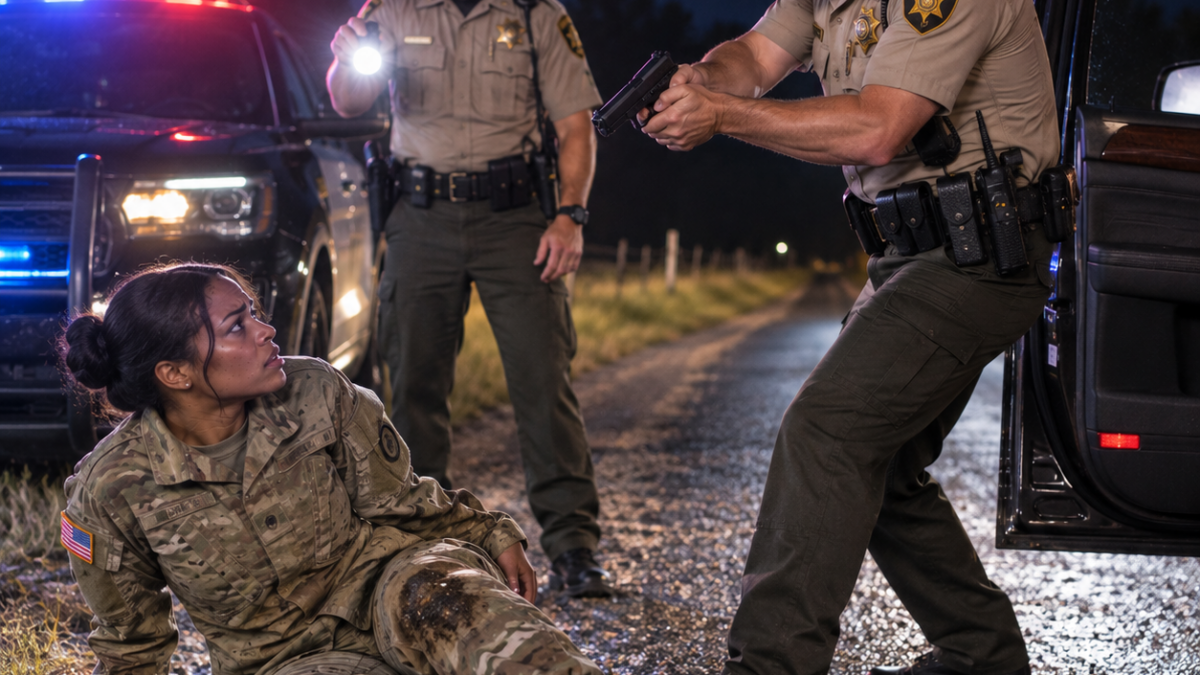
I did not know the call was still connected.
That would matter later.
At that moment, almost nothing existed beyond pain.
My right arm felt as if somebody had driven a steel rod through the shoulder joint.
My left hip burned with a deeper, uglier pressure.
Every heartbeat pushed warmth between my fingers where I was pressing the wound.
Brandon’s boot remained on my shoulder.
“Playing soldier doesn’t give you authority out here.”
His voice sounded strangely distant.
“You’re nobody.”
He leaned more weight into the wound.
“Do you understand me?”
I screamed again.
Not words.
Just sound.
There are moments when training disappears.
Pain does not care what schools you attended.
It does not care how many combat patches are sewn onto a uniform hanging at home.
But even through that pain, I saw Severt moving beside my car.
He crouched.
Reached beneath the driver’s seat.
When his hand came back out, there was a revolver in it.
My mind cleared instantly.
Not because the pain disappeared.
Because I understood.
That gun was not mine.
I had never owned a revolver.
My issued weapon remained secured on post.
The only firearm I personally owned was a locked twelve-gauge shotgun at my mother’s house that had belonged to my father.
Severt held the revolver up.
“There it is.”
Brandon lifted his boot from my shoulder.
Then he reached for his radio.
“Dispatch, Unit Seven.”
His voice became professional.
Flat.
Controlled.
The voice of an officer who had suddenly remembered he was being recorded somewhere, even though he thought no camera could see him.
“Shots fired.”
“Old Mill Road near mile marker fourteen.”
“Suspect produced a firearm.”
“Suspect is down.”
“Request EMS.”
I tried to speak.
“That’s not…”
My mouth was dry.
My breathing too fast.
Brandon crouched beside me.
His expression was calm again.
“Save it.”
I stared at him.
He stared back.
And that was when I realized something that frightened me more than the gunshots.
This was not panic.
He was not standing over me in shock because a traffic stop had gone wrong.
He was already building the report.
The ambulance arrived nine minutes later.
I remember the doors opening.
Boots on gravel.
A woman’s voice.
“Two gunshot wounds.”
“Let’s move.”
Her name was Sarah Lynn.
I learned that later.
Twenty-eight years old.
Paramedic.
Five years in emergency medicine.
She knelt beside me and immediately put two gloved fingers against my neck.
“Ma’am, can you hear me?”
“Yes.”
“Name?”
“Denise Holloway.”
“Do you know where you are?”
“Old Mill Road.”
“Do you know what happened?”
“I was shot.”
“Who shot you?”
I looked past her.
Brandon was standing several feet away.
Watching.
I returned my eyes to Sarah.
“The deputy.”
Her expression did not change.
Professionals learn how to hide reactions.
But I saw something in her eyes.
“Okay.”
She began cutting fabric around the wounds.
Then Brandon stepped closer.
“She stays cuffed.”
Sarah looked up.
“What?”
“She is in custody.”
“I need both arms.”
“She stays cuffed.”
I looked at my left wrist.
A deputy I had not noticed had already snapped metal around it.
Sarah stood.
She was small.
Maybe five-foot-three.
Brandon towered over her.
“She has a gunshot wound in the right shoulder.”
Sarah’s voice stayed level.
“I need access for IV placement and monitoring.”
“Left arm is available.”
“She has trauma on both sides of the body.”
“She stays cuffed.”
Sarah stared at him for a moment.
Then nodded.
“Fine.”
I thought she had surrendered.
She had not.
She began treating me.
IV.
Pressure dressings.
Oxygen.
Vitals.
She asked me questions repeatedly.
Name.
Date.
Location.
Medical history.
Allergies.
Medication.
My answers remained clear.
Then she pulled out her phone.
Brandon noticed.
“What are you doing?”
“Documenting injuries.”
“You don’t need pictures.”
“Traumatic injury during a law-enforcement encounter.”
She sounded almost bored.
“Field protocol.”
Brandon’s eyes narrowed.
Sarah kept taking photographs.
My forehead.
My shoulder.
My hip.
Then she paused.
“What?”
I asked.
She did not answer immediately.
She angled the phone toward my right shoulder.
Brandon’s boot had left a darkening bruise around the gunshot injury.
In the center was a tread pattern.
Distinct.
Geometric.
A signature pressed into skin.
Sarah photographed it from three angles.
Later she told me she had uploaded the images to a private cloud account before the ambulance even left the scene.
At the time, all she said was:
“I’ve got it.”
The ambulance doors closed.
The world became smaller.
Sarah.
The monitor.
The IV bag.
My breathing.
“Denise.”
She leaned toward me.
“I need you to tell me something.”
“What?”
“Were you drinking?”
“No.”
“Any drugs?”
“No.”
“Prescription medications?”
“Anti-inflammatory for my shoulder sometimes.”
She nodded.
“Your pupils are normal.”
“Your speech is normal.”
“You are oriented.”
Then she lowered her voice.
“Tell me what happened.”
I did.
Hands visible.
Identification offered.
Search refused.
Wrist lock.
Head into roof.
Shots.
Boot.
Gun planted.
Sarah wrote everything.
“Will that matter?”
I asked.
“It matters to me.”
That answer stayed with me.
Ridgerest County General Hospital received us at 7:42 p.m.
By 7:51, before a surgeon had fully examined me, a deputy handcuffed my left wrist to the bed rail.
I stared at the cuff.
“You cannot be serious.”
“Orders.”
“From whom?”
“Sheriff’s office.”
“I have not been charged with anything.”
“Ma’am, don’t make this difficult.”
That sentence.
I would hear variations of it repeatedly over the next twenty-four hours.
Don’t make this difficult.
Translation:
Accept what we are doing quietly enough that we don’t have to acknowledge it.
The intake sheet described me as:
ARMED SUSPECT.
RESISTED LAWFUL ORDERS.
WEAPON RECOVERED.
I asked the nurse to read it aloud twice.
“Who supplied that information?”
“Sheriff’s office.”
“It is false.”
“I’ll note that you dispute it.”
“No.”
I looked at her.
“Please document specifically that the patient states she complied, possessed no firearm, and alleges the recovered firearm was planted.”
The nurse hesitated.
Then typed.
I watched the screen until she finished.
Military policing had taught me something civilians rarely think about.
Paper becomes reality very quickly.
If a false statement enters a record first, every later truth must fight uphill against it.
I was not going to let their version stand uncontested simply because I was injured.
At 8:15, Sheriff Dale Hartwick held a press conference.
I did not see it live.
My mother did.
So did my brother Terrence.
So did half the county.
Hartwick stood behind a podium with an American flag behind him.
He described a lawful traffic stop.
He described an armed suspect.
He described deputies acting in defense of their lives.
Then he said:
“My deputies acted with professionalism and restraint.”
Professionalism.
Restraint.
I had two bullets in my body.
My shoulder carried a bootprint.
And he had described restraint.
A reporter asked whether body cameras had captured the incident.
Hartwick said there appeared to have been a technical malfunction.
That statement would become important.
Not because the cameras had malfunctioned.
Because they had not.
My mother arrived at the hospital around nine.
The deputies initially tried to stop her.
Gloria Holloway is five-foot-four on a generous day.
She teaches Sunday school.
She grows tomatoes.
She also possesses the terrifying persistence of a Black mother who has just listened to her daughter being shot over the phone.
“I am going in that room.”
“Ma’am—”
“You can either move, or you can explain to every camera downstairs why the mother of a wounded soldier cannot see her child.”
They moved.
She entered.
Saw the cuff.
Stopped.
“What is that?”
“Mom.”
“What is that?”
I tried to smile.
“I’m okay.”
“No, you’re not.”
Her hands started shaking.
Then she touched my face very carefully.
“Oh, baby.”
That broke me.
Not the bullets.
Not Brandon.
My mother’s hand.
For ten seconds I became a child again.
Then she leaned close.
“The call recorded.”
I opened my eyes.
“What?”
“Your phone called me before he walked up.”
“It never disconnected.”
My pulse changed.
“Mom.”
“I heard everything.”
“The shots?”
She nodded.
“After?”
Another nod.
“What he said?”
“Yes.”
“Severt?”
“I could hear voices.”
Her eyes filled.
“Denise, I have it.”
I closed my eyes.
For the first time since the stop, I felt something other than pain.
Leverage.
“Do not give your phone to the sheriff.”
She drew back.
“I wasn’t planning to.”
“Call Terrence.”
“He’s coming.”
“Have him make copies.”
“I already called him.”
Of course she had.
My mother was ahead of me.
Elsewhere that night, other people were making choices they did not yet understand would become part of my life forever.
At the Fuel and Go gas station two hundred yards from Old Mill Road, Deputy Brandon walked into the manager’s office.
Wayne Vance owned the station.
He had spent twenty-two years building it.
His daughter’s college fund depended on it.
His retirement depended on it.
Brandon told him the south-facing camera had captured the road.
Then he ordered Wayne to delete the footage.
Not requested.
Ordered.
When Wayne hesitated, Brandon explained what resistance would cost.
Building inspections.
Fuel-storage permit reviews.
Code violations.
Business license problems.
The quiet machinery of small-county power.
Wayne was afraid.
I never blamed him for that.
Courage is easy to demand from somebody else’s life.
Wayne agreed.
He opened the security archive.
Found the video.
Prepared to delete it.
Then, while Brandon stood behind him, Wayne inserted a memory card.
He copied the file first.
Forty-one seconds.
Then he deleted the original.
Emptied the recycle folder.
Cleared the visible cache.
Brandon left believing reality had disappeared.
It had not.
At the hospital, Sarah Lynn was walking toward the elevator after uploading my field report when Deputy Severt stopped her.
“We need to talk about your documentation.”
“My documentation is submitted.”
“It needs amendment.”
Sarah looked at him.
“How?”
“The patient was agitated.”
“She wasn’t.”
“Combative.”
“No.”
“Displayed signs consistent with narcotics.”
“No.”
Severt moved closer.
Sarah later told investigators she could see road dust on his boots.
“The report is going to reflect the facts we observed.”
“You mean the facts you want.”
“I mean what happened.”
Sarah stared at him.
He lowered his voice.
“Certification renewal coming up?”
She said nothing.
“Would be a shame if questions developed about response times.”
Still nothing.
“Ambulance protocols.”
“Controlled-substance inventory.”
“You understand?”
Sarah finally nodded.
“I’ll review my report.”
He smiled.
He thought fear had won.
Sarah entered the elevator.
When the doors closed, she pulled out her phone.
The photographs remained.
She had also kept the handwritten margins of her report.
During a joint military-civilian emergency training exercise the previous year, she had been given contact information for an Army investigator.
Captain Aisha Jordan.
Sarah sent four photographs.
My wounds.
The bootprint.
Then a message.
SFC DENISE HOLLOWAY.
ACTIVE DUTY.
TWO GSW.
CURRENTLY RESTRAINED IN COUNTY HOSPITAL.
INJURIES INCONSISTENT WITH OFFICIAL ACCOUNT.
DEPUTY ATTEMPTED TO PRESSURE ME TO ALTER MEDICAL RECORD.
URGENT.
That message reached Captain Jordan before ten.
The Army had already been notified.
Colonel Marcus Tate, commander of my military police battalion, received the first call shortly after eight.
I did not learn any of that until later.
Colonel Tate had been a JAG attorney before returning to operational command.
He understood exactly what the Army could and could not do.
Local officers did not lose jurisdiction simply because the person they shot wore a uniform.
The Army could not storm into a county sheriff’s department and take control.
But it had responsibilities toward an active-duty soldier.
It could verify my status.
Provide counsel.
Protect military records.
Conduct liaison.
Preserve evidence connected to service matters.
And if there was evidence of civil-rights violations or obstruction, it could put information in front of federal agencies much faster than a wounded soldier chained to a hospital bed could.
Colonel Tate called Army CID.
Captain Aisha Jordan received the assignment.
She arrived at the hospital at 9:58 p.m.
Two deputies blocked my door.
“This area is restricted.”
Jordan held up her credentials.
“Captain Aisha Jordan.”
“United States Army Criminal Investigation Division.”
“Sergeant First Class Holloway is an active-duty soldier.”
“I am here to conduct a welfare check and preliminary interview.”
The deputy said he needed to call the sheriff.
“Call him.”
Jordan stepped around him.
“I’ll be inside.”
When she entered my room, I saw the uniform first.
Army.
Not sheriff brown.
Not hospital scrubs.
Army.
Something in my chest loosened.
She closed the door.
“Sergeant Holloway.”
“Ma’am.”
“Your commanding officer sent me.”
She pulled a chair beside my bed.
“I need you to tell me everything.”
“No rush.”
“No assumptions.”
“Start before the traffic stop.”
That sentence mattered.
No assumptions.
I gave her the incident like an after-action report.
Time.
Location.
Road conditions.
Vehicle position.
Deputy approach.
Commands.
My responses.
Search.
Force.
Shots.
The planted weapon.
Brandon’s statement after the shooting.
I did not call him r@c!st.
I did not speculate about motive.
I reported what I observed.
Jordan listened without interrupting.
Then she opened the photographs Sarah had sent.
She compared the tread-pattern bruise to the wound.
“Sergeant.”
“Yes?”
“Did Brandon step directly on the gunshot wound?”
“Yes, ma’am.”
“How long?”
“Maybe five seconds.”
“Could have been longer.”
“Pain distorts time.”
She nodded.
“That’s the correct answer.”
Then she asked:
“Did either deputy acknowledge your military identification?”
“Severt saw it.”
“What did he do?”
“Tossed it onto the passenger seat.”
Jordan wrote something.
“Your mother has an audio recording?”
“Yes.”
“Where is the phone?”
“With her.”
“Good.”
She stood.
“Sergeant Holloway.”
“Ma’am?”
“The Army is opening an inquiry regarding your treatment and preserving evidence.”
“If what you’re telling me is supported by independent evidence, this will not remain only a county matter.”
I looked at the handcuff.
“And this?”
Her eyes followed mine.
“That comes off.”
“The sheriff’s office says—”
“I didn’t ask what the sheriff’s office says.”
It came off at 11:17 p.m.
I remember the exact time because Jordan showed me her watch.
“Three hours and thirty-five minutes.”
She photographed the cuff marks.
“Add them to the file.”
The deputy who unlocked me would not make eye contact.
Afterward Jordan leaned toward me.
“Rest.”
“I don’t think I can.”
“Try.”
“What happens now?”
“We verify.”
“That simple?”
“No.”
Her expression hardened.
“But that clear.”
Before dawn, Army digital forensics specialist Renee Deloqua was driving toward the Fuel and Go.
She was twenty-four.
Close-cropped hair.
Mixed-race.
Quiet.
Jordan later described her as somebody who could make a hard drive confess without ever raising her voice.
She walked into Wayne Vance’s gas station carrying a Pelican case.
“Mr. Vance?”
He looked at her uniform and went pale.
“I’m Specialist Deloqua.”
“Army CID digital forensics.”
“I need to talk about your cameras.”
Wayne immediately said:
“The files were deleted.”
Renee answered:
“I’m not here for the deleted files.”
He stopped.
She watched his face.
“I’m here for the copy you made first.”
Wayne’s hand moved toward his shirt pocket instinctively.
Not because the card was there anymore.
Because fear remembers locations.
Renee saw it.
She did not threaten him.
She did not promise miracles.
She explained the truth.
“We know a deputy came here.”
“We know you were pressured.”
“If you destroyed material because you believed your livelihood was being threatened, investigators can account for that.”
“But if you preserved a copy, now is the time.”
Wayne asked:
“Will Brandon know?”
“Eventually.”
His face tightened.
Renee continued.
“But if the footage shows what we believe it shows, Deputy Brandon will have larger problems than your business license.”
Wayne stood silently for almost a minute.
Then he walked into the manager’s office.
Opened a drawer.
Returned with a microSD card.
“Everything’s there.”
Renee viewed the footage inside her rental car.
Thirty frames per second.
Wide-angle.
Not perfect.
More than enough.
My Honda sat clearly on the shoulder.
Hazard lights blinking.
The video showed me exiting.
Hands visible.
Hands on roof.
Brandon twisting my arm.
My head striking the car.
Severt searching.
Then me standing still.
Perfectly still.
Brandon stepping backward.
Drawing.
Three muzzle flashes.
My body collapsing.
Then the boot.
Renee stopped the video.
Rewound.
Watched again.
Then Severt crouched at my driver’s seat.
His hand went beneath it empty.
His hand came out holding a revolver.
Renee slowed the sequence.
Frame by frame.
She created seventeen still images.
Then called Jordan.
“I have it.”
Jordan said nothing for a moment.
“All of it?”
“All of it.”
“Compliance.”
“Shooting.”
“Boot.”
“Planting.”
Another pause.
“Authenticate it.”
“Already cloning the card.”
“Create hashes.”
“Already did.”
“Renee.”
“Yes, ma’am?”
“Good work.”
At the same time, my mother’s audio was copied under controlled conditions.
That recording made even hardened investigators quiet.
My voice:
“I’m active-duty military.”
Brandon:
“I didn’t ask for your life story.”
My request to know why I was stopped.
The sounds around the car.
The impact of my head.
Three shots.
Then Brandon’s voice.
“Playing soldier doesn’t give you authority out here.”
Then my scream.
My mother had listened to that live.
I did not fully understand what that meant until months later.
There are injuries that do not bleed.
Hers was one.
The next breakthrough came from the county courthouse.
David Miller was an IT administrator.
Forty years old.
Methodical.
Nearly invisible to the powerful people who worked around him.
The night I was shot, an automated security monitor flagged unusual access from a sheriff’s-department terminal.
A dormant administrative account had been used to delete surveillance footage covering roads feeding toward Old Mill Road.
The person tried to reach the backup partition.
Failed.
David looked at the logs.
He did not call Sheriff Hartwick.
That decision may have saved the case.
Instead, he used an automated federal notification process created for unauthorized access to government systems.
Timestamp.
Encrypted record.
Immutable alert.
Then David copied the logs to another secured location.
The following morning, investigators knew somebody inside the sheriff’s department had been destroying evidence.
Federal lawyers moved quickly.
Preservation letters.
Emergency orders.
Subpoenas.
The sheriff’s department claimed the body-camera files were corrupted.
A federal court officer requested the physical storage devices.
That was the end of the corruption story.
Because the footage was there.
Both cameras.
Brandon’s.
Severt’s.
Continuous.
Clear audio.
Clear video.
I watched it only once before trial.
Brandon approached my car.
No traffic violation stated.
No threat.
No contraband.
My military identification mentioned.
My refusal to consent to a search.
The wrist lock.
My head striking the roof.
Then the sentence:
“Your rights are whatever I say they are out here.”
The shooting was recorded from Brandon’s chest.
My hands were on the car.
He drew.
He fired.
No weapon in my hands.
No turn toward him.
No sudden movement.
Nothing.
Severt’s camera was worse in a different way.
It showed the revolver.
Not merely appearing.
It showed him holding it before he pushed it beneath my seat.
The lie was no longer an inference.
It was video.
Jordan called Colonel Tate.
“Sir.”
“We have independent surveillance.”
“Body cameras.”
“Phone audio.”
“Medical photographs.”
“Evidence of witness coercion.”
“Evidence of digital deletion.”
“And the weapon plant is recorded.”
Tate asked:
“How certain?”
“One hundred percent.”
Then Jordan added:
“I also believe they planted additional evidence after impound.”
That suspicion came from a late-night secondary search order Hartwick had issued after my car reached the county lot.
Federal investigators secured the vehicle before another local search could occur.
When the trunk was opened under warrant, technicians found methamphetamine beneath the spare-tire cover.
I almost laughed when Jordan told me.
Not because it was funny.
Because it was so desperate.
I had spent fifteen years under military drug-testing requirements.
My record was clean.
No drug history.
No reason for narcotics to be in my car.
Investigators traced the packaging.
Then the weight.
Exactly 1.4 grams.
An evidence ledger from a closed county case showed 1.4 grams missing.
That was how small arrogance became.
A decimal point.
A missing amount on a shelf nobody expected anyone to inspect.
By Monday morning, the case had become a joint federal civil-rights investigation.
Army CID remained involved in matters connected to me as a soldier and in evidence coordination.
The FBI took the lead on federal criminal investigation.
The Department of Justice Civil Rights Division entered.
That distinction mattered to Colonel Tate.
He told me later:
“The Army did not arrive to punish local police.”
“We arrived because one of our soldiers was wounded and we had reason to believe evidence was being destroyed.”
“Once federal crimes became apparent, the people with lawful authority to investigate those crimes took over.”
That was how it should work.
Not one institution overpowering another.
Institutions doing their jobs when another institution refused to.
At 10:15 Monday morning, Sheriff Hartwick was in a meeting about what his department would say publicly next.
Investigators later recovered notes from the meeting.
The strategy was simple.
Reinforce the armed-suspect narrative.
Announce narcotics found in my vehicle.
Characterize me as unstable.
Suggest my military service involved trauma that might explain “erratic behavior.”
That phrase angered me more than almost anything.
They had shot me.
Then planned to use the fact that I had served in combat as a way to make me look dangerous.
Colonel Tate arrived at the sheriff’s office with Captain Jordan.
Behind them came FBI agents and a Justice Department attorney.
Tate introduced himself.
Hartwick barely looked impressed.
“Colonel, this is a local law-enforcement matter.”
Tate answered:
“Your account of what happened to my soldier is false.”
Then Jordan opened her laptop.
She played Wayne’s video.
No speech.
No accusation.
Just evidence.
Hartwick watched me leave the car.
Watched Brandon hurt me.
Watched the shots.
Watched the boot.
Watched the planted gun.
Then Jordan played my mother’s audio.
Then the body-camera recording Hartwick had publicly called corrupted.
When it ended, nobody spoke.
Six deputies in the room stared anywhere except at their sheriff.
Jordan summarized the medical documentation.
Then the evidence-log discrepancy.
Then the attempted pressure on Sarah.
Then the digital deletion discovered by David Miller.
Finally, an FBI agent placed a warrant on Hartwick’s desk.
Search of sheriff’s department records.
Electronic devices.
Evidence-storage areas.
Communications.
Impound files.
Additional federal warrants were being executed simultaneously.
Hartwick stared at Colonel Tate.
“This is my county.”
Tate’s answer was quiet.
“No, Sheriff.”
“It is a county in the United States.”
Hartwick called his attorney.
Within forty-eight hours, he was on administrative leave.
Brandon and Severt were removed from duty.
Federal agents seized the evidence room.
Computers.
Body-camera storage.
Personnel files.
Internal affairs records.
Then the investigation widened.
That was when everyone realized my case had never been the beginning.
Brandon had seven prior excessive-force complaints.
All cleared internally.
Four involved Black motorists.
Two described almost identical circumstances.
An aggressive driver.
A sudden movement.
A possible weapon.
In one old report, an officer wrote that a handgun had been recovered from a vehicle.
No gun existed in the evidence log.
No property receipt.
No photograph.
Nothing.
Another case involved a twenty-six-year-old Black mechanic named Jamal Price.
He had been stopped after midnight two years earlier.
Brandon fractured his wrist during the arrest.
The report claimed Jamal reached beneath his seat for a weapon.
Jamal insisted there had been no weapon.
The complaint disappeared.
Jamal had stopped fighting because legal bills became impossible.
Federal investigators reopened his case.
Then another.
Then another.
People began calling.
The department’s history came out one complaint at a time.
Not every accusation was substantiated.
Some officers had never been involved.
That mattered.
I did not want an entire department judged by rumor any more than I wanted to be judged by Brandon’s report.
But there was enough evidence to show a pattern.
Certain officers had been protected.
Certain complainants had been dismissed.
Internal affairs functioned less like an investigative unit and more like a shield.
The federal grand jury met three months later.
By then, I had undergone two surgeries.
The bullet in my hip was removed.
My shoulder required reconstruction.
Physical therapy hurt worse than I expected.
People imagine recovery from a shooting as a dramatic montage.
It is mostly repetition.
Lift the arm.
Lower the arm.
Again.
Again.
Again.
Some days I could not fasten my own bra.
That humiliation nearly broke me more than the injury itself.
My mother stayed with me.
She made breakfast.
Drove me to therapy.
Pretended not to notice when I cried in the bathroom.
One evening, I found her sitting alone at the kitchen table listening to the audio recording.
I took the phone away.
“Mom.”
“I needed to know.”
“You know.”
“I keep thinking I should have called 911 faster.”
“You didn’t know what was happening.”
“I heard you.”
“Mom.”
“If I had—”
“No.”
My voice became harder.
“You do not get to carry his decision.”
She stared at me.
“You understand?”
Tears filled her eyes.
I sat beside her.
“He pulled the trigger.”
“Not you.”
“You kept the call.”
“That call helped prove what happened.”
She put her face in her hands.
For fifteen years, my family had worried about Afghanistan.
Iraq.
Deployments.
Explosives.
They had been prepared, in the terrible way military families prepare, for danger overseas.
Nobody had prepared Gloria Holloway to hear her daughter being shot by a county deputy less than fifteen minutes from home.
We started therapy together.
I resisted at first.
Military people are excellent at finding sophisticated vocabulary for avoiding help.
Resilience.
Compartmentalization.
Mission focus.
Sometimes those are healthy.
Sometimes they mean you are awake at three in the morning staring at a ceiling because every pair of headlights in the rearview mirror makes your pulse explode.
My first time driving again, a police cruiser appeared behind me.
I knew logically I had done nothing wrong.
My body did not care.
My hands shook.
My breathing shortened.
I pulled into a grocery-store parking lot and sat there for twenty minutes.
That was when I understood something.
Surviving the road was one battle.
Trusting a road again was another.
The federal indictments came six months after the shooting.
Brandon.
Severt.
Hartwick.
Two deputies involved in planting the narcotics.
Another supervisor who helped manipulate evidence records.
The charges included federal civil-rights violations, obstruction, evidence tampering, conspiracy, false statements, and witness intimidation.
The state filed additional charges related to the shooting.
I did not celebrate the arrests.
People expected me to.
News crews camped near my mother’s house.
Reporters asked:
“How does it feel to see the men who shot you in handcuffs?”
I answered:
“Like an indictment happened.”
They looked disappointed.
That was not enough drama.
One journalist asked:
“Don’t you feel vindicated?”
“Evidence vindicated me months ago.”
“What do you feel now?”
“Tired.”
That became the headline.
SHOT SOLDIER SAYS SHE IS “TIRED” AFTER DEPUTIES INDICTED.
It made me laugh.
The trial began the following spring.
Brandon went first.
His defense lawyer argued that roadside encounters unfold in seconds.
True.
That officers must make rapid decisions under uncertainty.
Also true.
That hindsight should not replace the perspective of an officer at the scene.
Again, generally true.
Then the prosecutor played the video.
My hands on the roof.
No weapon.
No sudden movement.
Brandon drawing.
Three shots.
The courtroom became silent.
His lawyer tried another route.
Maybe I had turned slightly.
Maybe Brandon saw something Severt’s camera did not.
Maybe the revolver recovered from the vehicle supported his fear.
Then the prosecution played Severt planting it.
Some cases become complicated because truth is incomplete.
Ours became simple because the people who lied had recorded themselves.
I testified on the fourth day.
Walking into court was harder than deployment ceremonies.
Harder than press conferences.
Brandon sat at the defense table.
I had not seen him in almost a year.
He looked smaller.
That surprised me.
The prosecutor asked me to describe the stop.
I did.
The defense attorney stood.
“Sergeant Holloway, you are trained in law enforcement.”
“Yes.”
“You understand officers face danger during traffic stops.”
“Yes.”
“You understand a motorist’s movements may appear different to an officer than to the motorist.”
“Yes.”
“You were questioning Deputy Brandon repeatedly.”
“I asked why I had been stopped.”
“You refused a search.”
“I did not consent to a search.”
“You asserted your rights.”
“Yes.”
“Would you agree that your training gave you confidence ordinary citizens might not possess?”
I looked at him.
“Yes.”
“Could that confidence have been interpreted as defiance?”
The courtroom changed.
I understood what he was asking.
Maybe I had been too calm.
Too informed.
Too unwilling to submit silently.
I answered carefully.
“A citizen knowing her rights does not create probable cause to shoot her.”
The prosecutor did not react.
The jury did.
Small movements.
Pens stopping.
Eyes lifting.
The defense lawyer continued.
“That’s not what I asked.”
“I know.”
“Could your tone have been perceived as confrontational?”
“Possibly.”
He seemed pleased.
Then I added:
“But the body camera records my tone.”
He looked less pleased.
“Jurors can decide for themselves.”
He moved on.
Severt eventually cooperated.
Not out of conscience.
Because the evidence against him was overwhelming.
His cooperation exposed Hartwick’s role in the coverup.
Orders to preserve the gun story.
Orders for the secondary vehicle search.
Pressure to manage witnesses.
Instructions involving the camera files.
Hartwick’s trial was uglier.
He had not been on Old Mill Road.
His defense argued he inherited the deputies’ account and believed it.
The government produced texts.
Emails.
Access logs.
Evidence-room records.
Instructions.
Then David Miller testified.
Soft voice.
Glasses.
No drama.
The prosecutor asked:
“Mr. Miller, how did you know the deletion came from the sheriff’s department?”
“Network logs.”
“Could those logs have been changed?”
“Yes.”
“Were they?”
“No.”
“How do you know?”
“Because the deletion event triggered an immutable audit record.”
“What does that mean in ordinary language?”
David paused.
“It means the system was designed so someone could delete a file without being able to delete the fact that they deleted it.”
I almost smiled.
That sentence buried Hartwick more effectively than any angry speech could have.
Wayne testified too.
His hands shook.
Brandon’s lawyer tried to portray him as dishonest because he had deleted the original footage.
Wayne answered:
“Yes.”
“I deleted it.”
“Why?”
“Because your client’s friend told me he would destroy my business.”
“You could have refused.”
“Yes.”
“Why didn’t you?”
“Because I was scared.”
“Then why make a copy?”
Wayne looked toward the jury.
“Because I was scared of him.”
“Not blind.”
Sarah testified in her paramedic uniform.
She described my vital signs.
My mental status.
The wounds.
The bootprint.
Then Severt’s attempt to pressure her.
The defense suggested she had become emotionally invested.
Sarah responded:
“I was medically invested in accurate documentation.”
The courtroom laughed.
Even the judge smiled.
Gloria did not want to testify.
I told prosecutors not to force her unless necessary.
She chose to anyway.
When they played the call recording, she stared straight ahead.
My voice came from the speakers.
Then Brandon’s.
Then the shots.
My mother’s hands tightened around the witness-box rail.
The prosecutor asked:
“Mrs. Holloway, why did you keep the call connected?”
She answered:
“Because I did not know how to save my daughter.”
“So I saved what I could.”
There was no sound in the courtroom after that.
Brandon was convicted.
So was Hartwick.
Severt entered a plea under his cooperation agreement.
Sentencing came months later.
I gave a victim-impact statement.
I kept rewriting it.
Every version sounded either too angry or too forgiving.
Neither felt true.
Finally, I stood before the judge and said:
“I do not want anyone in this courtroom to believe the worst thing Deputy Brandon did was shoot a soldier.”
I paused.
“The uniform should not be the reason this case matters.”
“If I had been a nurse driving home from work, the shooting would be wrong.”
“If I had been unemployed, it would be wrong.”
“If I had never served this country, it would be wrong.”
I looked toward Brandon.
“What my uniform changed was visibility.”
“The Army had resources.”
“Investigators.”
“Lawyers.”
“A chain of command that noticed when I disappeared into a hospital under guard.”
“Most people do not have that.”
I turned toward the judge.
“So if there is a lesson in what happened to me, I hope it is not that officers should be careful because the person they stop might belong to a powerful institution.”
“The lesson should be that the law must protect people who belong to no powerful institution at all.”
That was the only thing I said publicly that I remained completely satisfied with.
Ridgerest County changed.
Not because people suddenly became good.
Systems changed.
Federal oversight.
Independent use-of-force review.
Body-camera retention controls.
External complaint review.
Evidence-room audits.
Random traffic-stop analysis.
A civilian oversight board.
Supervisors could no longer close repeated force complaints without outside review.
The department hated the reforms at first.
Some deputies resigned.
Others complained federal oversight treated everyone like criminals.
I understood the resentment.
Then I remembered being handcuffed to a hospital bed before anybody had bothered to watch the video.
Accountability often feels insulting to people who have become accustomed to trust without verification.
Jamal Price, the mechanic whose wrist Brandon had broken two years earlier, had his case reopened.
The department officially corrected the record.
He received a settlement.
When we met, he said:
“They believed you because you’re Army.”
I did not defend myself.
“Probably.”
He looked surprised.
“You admit that?”
“Yes.”
“I had a commander calling.”
“You had nobody.”
He nodded.
“That bothered me for a long time.”
“It bothers me too.”
He stared at me.
“Then what?”
“We use my case to change what happens to the next person.”
He laughed without humor.
“That’s what everybody says.”
“I know.”
“What’s different?”
“Nothing unless we actually do it.”
Years later, Jamal joined the county civilian review board.
He became one of its harshest members.
Also one of its fairest.
He once voted to clear an officer accused of excessive force because the video supported the officer’s account.
People attacked him online.
He told me:
“If I want them to believe video when it helps us, I have to believe it when it doesn’t.”
That was justice.
Not always giving one side what it wanted.
Following evidence even when the result was uncomfortable.
My Army career changed too.
My shoulder never returned to full strength.
I could qualify.
I could work.
But certain physical tasks became difficult.
The medical board offered options.
I remained on active duty.
Eventually moved into training and policy.
At first I hated that.
I wanted my old job back.
The road had already taken enough.
I did not want it taking my career identity too.
Colonel Tate called me into his office.
“You think training is a demotion?”
“No, sir.”
“You’re lying.”
I almost smiled.
“Yes, sir.”
He leaned back.
“How many MPs have you trained?”
“Hundreds.”
“How many traffic-stop scenarios have you run?”
“Thousands.”
“How many instructors can stand in front of a classroom and say they know exactly what happens when authority forgets restraint?”
I stopped.
Tate continued.
“You survived something terrible.”
“I am not asking you to turn trauma into a motivational speech.”
“I am telling you your experience has operational value.”
That reframed it.
I began teaching.
Lawful authority.
Escalation.
Bias.
Search and seizure.
Report integrity.
The duty to intervene.
I hated the phrase implicit bias when it was used as a substitute for responsibility.
So I taught behavior.
What did you see?
What did you assume?
What did you verify?
What action followed?
Could a different interpretation of the same facts have changed your decision?
What do you do when another officer crosses the line?
One young soldier asked:
“Sergeant, what if it’s your team leader?”
“Then the duty gets harder.”
“What if speaking up ruins your career?”
I looked at him.
“What if staying quiet ruins somebody else’s life?”
He did not answer.
Good.
Some questions should remain uncomfortable.
Sarah Lynn kept working EMS.
The Justice Department commended her documentation.
So did the Army.
She refused most interviews.
Years later, she became a flight paramedic.
Every birthday, she texts me:
YOU STILL OWE ME A POUND CAKE.
I send one.
Wayne kept the Fuel and Go.
His daughter went to college.
When I stopped there for the first time after the trial, he looked terrified.
“Sergeant.”
“Denise.”
He swallowed.
“Denise.”
We stood beside the counter where he had handed over the card.
“I should have told him no.”
I shook my head.
“You made the copy.”
“I still deleted it.”
“You were threatened.”
“I was still scared.”
“Wayne.”
He looked at me.
“Bravery isn’t only refusing fear.”
“Sometimes it’s doing one useful thing while you’re terrified.”
His eyes filled.
He turned away.
Then asked:
“Coffee?”
“Please.”
He never charged me.
I eventually stopped arguing.
David Miller remained almost aggressively anonymous.
He declined medals.
Interviews.
Ceremonies.
The county upgraded his position and salary after the federal investigation revealed how important his security system had been.
When I thanked him, he said:
“The alert worked.”
“That was the job.”
I told him:
“Most heroism sounds unimpressive when the person describing it actually knows what they’re doing.”
He stared at me.
“That’s very military.”
“Yes.”
The Army held a ceremony after my recovery.
I did not want one.
General Patricia Vaughn insisted.
The assembly hall was full.
Soldiers.
Families.
Sarah.
Wayne.
David refused the invitation but watched online.
Captain Jordan sat near the front.
Renee Deloqua beside her.
My mother wore a blue dress and earrings I had given her years before.
Terrence sat with one arm around her.
I stood in dress uniform.
My right shoulder still ached in cold weather.
There was a scar near my hip.
Another above my eyebrow.
General Vaughn spoke about courage outside combat.
About discipline under unlawful force.
About maintaining restraint when escalation would have made the truth easier for others to distort.
Then she presented me with the Soldier’s Medal.
I had mixed feelings about accepting it.
I told her beforehand:
“Ma’am, I didn’t rescue anyone.”
“You stayed alive.”
“That’s not heroism.”
“No.”
She looked at me.
“But you also maintained control when every instinct and every skill you possessed could have turned that roadside into something much worse.”
“I complied.”
“Yes.”
“That shouldn’t require a medal.”
“No.”
She paused.
“But after what happened, you spent two years turning it into training that may keep other soldiers and civilians alive.”
“That part I can recognize.”
So I accepted.
When General Vaughn pinned the medal above my ribbons, the room stood.
Twelve hundred people.
Applause everywhere.
My mother cried openly.
I did not.
Not then.
Colonel Tate waited at the bottom of the stage.
Instead of shaking my hand, he saluted.
I returned it.
Left-handed because my right shoulder still did not tolerate the position well.
It was not regulation-perfect.
Neither was I anymore.
Then I walked down the center aisle.
My mother reached out.
Caught my hand.
I squeezed hers.
And kept walking.
Outside, sunlight filled the parade ground.
A formation of soldiers in the distance stopped.
Several recognized me.
One raised a hand.
Then another.
I stood there longer than I intended.
People later described my story as the Army coming to save one of its own.
I understand the appeal.
It sounds powerful.
A Black female soldier is shot by r@c!st deputies.
Then the Army arrives.
The bad men discover they chose the wrong woman.
But that version misses almost everything important.
The Army mattered.
Absolutely.
Colonel Tate mattered.
Captain Jordan mattered.
Renee mattered.
General Vaughn mattered.
The FBI mattered.
The Justice Department mattered.
But before any uniform with rank walked into that sheriff’s office, the truth had already survived because ordinary people protected pieces of it.
My mother did not hang up.
Sarah took photographs.
Wayne made a copy.
David trusted a security log more than a sheriff’s badge.
Those people did not know whether anybody powerful would ever arrive.
They acted anyway.
That is why the truth survived long enough for power to find it.
I also learned something harder.
Brandon did not become dangerous the night he stopped me.
Hartwick did not learn to cover for officers after I was shot.
Systems rehearse their failures.
Small complaints dismissed.
Reports softened.
Videos ignored.
Supervisors protecting favorites.
Citizens deciding a lawyer costs too much.
Officers learning that the story written first usually wins.
By the time I reached Old Mill Road, everyone involved had already practiced their part.
Brandon knew how to use force.
Severt knew how to make evidence appear.
Hartwick knew how to stand behind a podium.
The department knew how not to ask questions.
What they were not prepared for was interruption.
A call that stayed connected.
A camera they did not know existed.
A paramedic who documented exactly what she saw.
A computer system that remembered deletion.
An Army investigator who arrived before the narrative hardened.
That was enough.
Years after the case, I visited my mother again on a Sunday evening.
Same house.
Same kitchen.
Same pound cake.
When it was time to leave, she stood at the door holding a container of leftovers.
“You want me to follow you?”
“Mom.”
“Just asking.”
“No.”
“You’ll call when you’re home?”
“Yes.”
I hugged her.
Then walked toward my car.
For a long time after the shooting, I avoided Old Mill Road.
I took a route seventeen minutes longer.
Therapists told me avoidance could make fear stronger.
I knew that academically.
Knowing and doing are different things.
That evening, I turned toward Old Mill.
My hands tightened on the wheel.
The trees looked almost exactly the same.
The Fuel and Go sign glowed ahead.
The shoulder where I had fallen was just gravel.
No memorial.
No marker.
Cars passed over the place every day without knowing what had happened there.
I slowed.
Not much.
Just enough to see it.
Then blue lights appeared in my mirror.
My body reacted before thought.
Heart.
Hands.
Breathing.
I checked the speedometer.
Fifty-three in a fifty-five.
The lights moved into the other lane.
A state trooper passed me chasing another vehicle.
I started laughing.
Then crying.
At the same time.
I pulled into the Fuel and Go.
Wayne was still behind the counter.
He looked up.
“You okay?”
“No.”
I laughed through tears.
“Yes.”
“I don’t know.”
He came around the counter.
We stood there awkwardly.
Then he hugged me.
Neither of us said anything.
Sometimes recovery is not a ceremony.
Sometimes it is standing beneath fluorescent gas-station lights, crying because a police car passed you without stopping.
I drove the rest of the way home.
When I arrived, I called my mother.
“You made it?”
“I made it.”
“Good.”
I could hear television in the background.
Then she asked:
“You took Old Mill?”
Mothers know.
“Yes.”
Silence.
“Okay?”
I looked out my window.
“Getting there.”
That remains the most accurate description of my life after the shooting.
Getting there.
Justice did not erase the bullets.
It did not restore my shoulder.
It did not give my mother back the seconds before she heard three shots through a phone.
It did not give Jamal Price back the years when nobody believed his complaint.
It did not make Ridgerest County suddenly pure.
Justice is not time travel.
It is accountability applied forward.
A corrected record.
A truthful verdict.
A department forced to change.
An officer learning that a badge does not make his memory more valuable than video.
A young soldier learning that intervention is part of duty.
A paramedic knowing her notes mattered.
A gas-station owner discovering that one frightened decision to make a copy changed everything.
When people ask me whether the Army saved me, I tell them the truth.
The Army showed up for me.
That mattered more than I can explain.
But by the time it arrived, the most important battle had already begun.
It was the battle over what was real.
Brandon had a badge.
Hartwick had a podium.
They had reports.
Radios.
Evidence lockers.
A press office.
For a few hours, they had almost everything institutions use to manufacture credibility.
We had a phone call.
A handful of photographs.
A memory card.
Server logs.
And the truth.
The truth looked smaller.
It wasn’t.
And that is the part of Old Mill Road I choose to carry with me.
Not the gravel against my face.
Not Brandon’s boot.
Not the sound of gunfire.
The moment people who owed me nothing decided that what they had seen mattered enough to preserve.
Because the Army could only step in after there was still something left to find.
And sometimes justice begins exactly there—with one person refusing to let the evidence disappear.








