The delivery driver was supposed to leave one package at the door, but what he saw through the gate made him stop instead
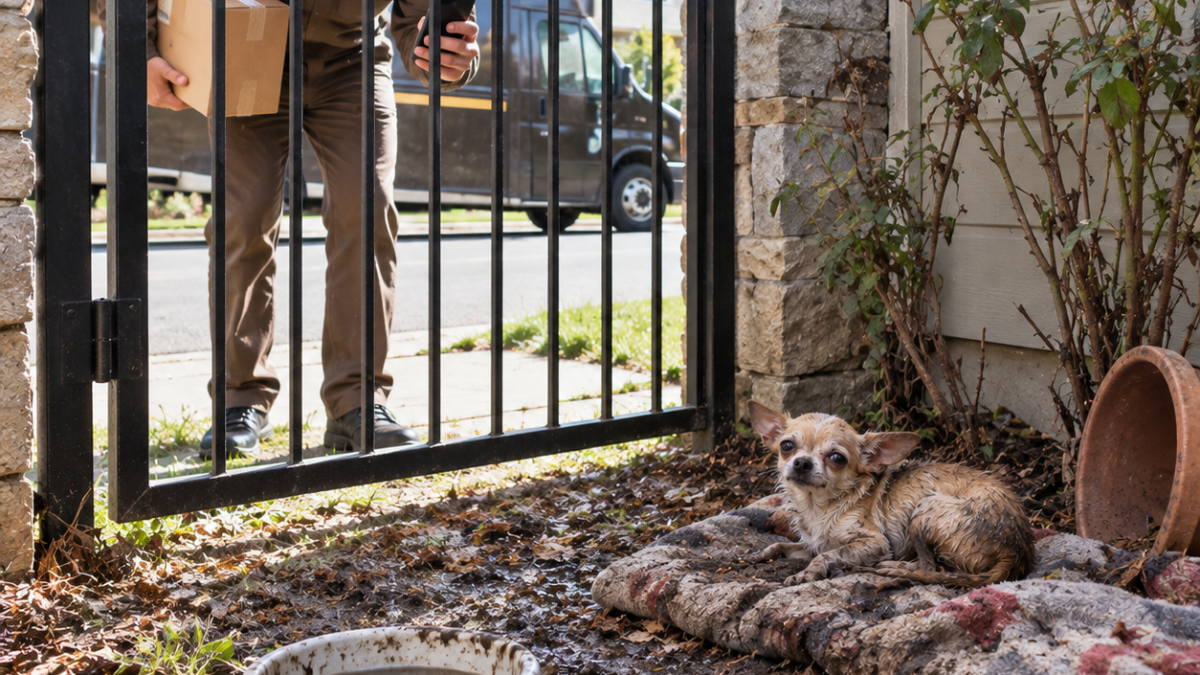
I looked through the gate before I answered.
Clover was lying on a folded gray blanket in the farthest corner of the enclosure, her little body curled so tightly that her nose almost touched her hind legs.
For a Chihuahua, she was unusually still.
There was no trembling bark, no suspicious pacing, no bright-eyed curiosity.
Only stillness.
“What does she do?” I asked.
Dr. Parker gave me a small nod toward the latch.
“Go in and find out.”
The temporary shelter had been set up in a converted county storage building behind the regular animal services facility.
The main shelter was already crowded, and the eleven dogs from Hensley Road had been designated as evidence in an active cruelty investigation, which meant we had to keep their intake records, medical exams, photographs, collars, leads, and identifying information carefully documented.
The county had moved several supply shelves out of the back wing and brought in portable kennels, washable bedding, heat lamps, and folding tables.
It wasn’t beautiful.
But it was clean.
It was warm.
And most important, there were no chains.
I opened Clover’s gate slowly.
She raised her head.
That alone surprised me.
During the rescue, she had barely reacted when I carried her out of the shed.
During her first medical examination, she had allowed Dr. Parker to touch her only by going completely rigid, the way some frightened animals do when fighting or running both feel impossible.
Now her ears lifted slightly.
“Hey, Clover,” I said.
Dr. Parker had asked me to name her the night we brought the dogs in.
Most of the others had already been assigned temporary names by shelter staff.
A black Chihuahua with a cloudy left eye became Pepper.
A cream-colored male with one bent ear became Benny.
Two sisters who refused to sleep apart became June and May.
When Dr. Parker pointed toward the tiny brown-and-white female and asked what we should call her, I had looked at the four pale marks on one of her paws.
They almost formed a clover.
The name had stayed.
I stepped inside and sat on the floor.
Clover did not approach me.
But she did something Dr. Parker apparently considered important.
She uncurlled.
Then she moved her front paws forward.
Maybe two inches.
That was it.
I glanced back.
Dr. Parker smiled.
“She hasn’t done that for anyone else.”
“You called me here for two inches?”
“I called you here because yesterday she spent six hours facing the wall.”
I looked back at Clover.
Her eyes were on me now.
Not warmly.
Not fearfully, either.
She was watching.
Measuring.
Trying to decide what kind of person had entered her space.
I had interviewed witnesses who looked at me the same way.
People who had learned that speaking too soon could cost them something.
So I treated Clover the way I treated them.
I didn’t pressure her.
I didn’t reach toward her.
I didn’t fill the silence because it made me uncomfortable.
I simply sat down.
I had paperwork with me from the case, so I opened my notebook and began reviewing the property inventory.
There were photographs to label.
Evidence numbers to match.
Statements from Daniel and two neighbors to compare.
A warrant affidavit to revise before submitting it to the prosecutor.
After about ten minutes, I forgot Clover was watching me.
After twenty, I heard the faint scrape of a paw.
I kept reading.
Another scrape.
Then silence.
When I finally looked up, she had moved halfway across the enclosure.
She froze as soon as our eyes met.
“All right,” I said softly.
“You win.”
Her head tilted almost imperceptibly.
I looked back down at my notebook.
From outside the gate, Dr. Parker whispered, “Keep doing exactly that.”
So I did.
I stayed for nearly an hour.
Clover never came close enough to touch.
But when I stood to leave, she was sitting only three feet away.
The next day, I returned.
That became the beginning of a routine neither of us planned.
My shift usually started at seven.
If the morning was quiet, I stopped at the shelter before patrol briefing.
If the morning wasn’t quiet, I went after work.
Some days that meant I arrived at five in the afternoon.
Some days it was nearly nine at night.
I never stayed for the same amount of time.
Sometimes twenty minutes.
Sometimes more than an hour.
I didn’t bring special treats at first.
Dr. Parker told me food needed to remain predictable and uncomplicated because several of the dogs had digestive problems from long-term malnutrition.
So I brought only myself.
I sat.
I wrote reports.
Sometimes I read pieces of them aloud.
“Vehicle one entered from the south side of the property,” I would say in the same flat voice I used for official dictation.
Clover would watch me from her blanket.
“Officer observed multiple animals tethered without accessible water.”
One ear would turn toward me.
“Animal control arrived at fourteen thirty-seven hours.”
By the fourth visit, she began sitting near the front of the enclosure before I arrived.
By the sixth, she stayed there after I opened the gate.
The other dogs were changing too.
Pepper had discovered that staff members carried biscuits in their pockets and had become shameless about demanding them.
Benny barked at mops.
June and May slept wrapped together in the same bed, their bodies forming a tiny knot beneath a fleece blanket.
A long-haired Chihuahua we called Oscar had started spinning in circles whenever breakfast arrived.
Those small behaviors meant something.
They meant personality was returning.
Fear had not disappeared.
But it no longer occupied every inch of them.
Clover was slower.
She ate only when nobody stood nearby.
If a metal bowl scraped across the floor, she flattened herself.
If someone reached over her head, she closed her eyes.
Once, a maintenance worker dropped a wrench in the hallway.
The sound rang through the building.
Clover threw herself behind her bed and remained there for almost an hour.
Dr. Parker sat with me outside her enclosure afterward.
“She may always carry some of this,” she said.
“I know.”
“Recovery doesn’t mean forgetting.”
“I know.”
She glanced at me.
“You keep saying you know.”
“I’m a police officer.”
“That doesn’t make you a veterinarian.”
“No, but it means I’ve met people who survive terrible things.”
“And?”
“They don’t become who they were before.”
Dr. Parker nodded.
“That’s true.”
“They become whoever comes after.”
For the first time that day, she smiled.
“That’s true too.”
The investigation moved forward while the dogs recovered.
The owner of the property, a man named Russell Vane, had initially claimed the Chihuahuas belonged to several relatives and that he was merely watching them temporarily.
The records inside the shed told another story.
There were breeding schedules spanning years.
There were photographs of litters.
There were handwritten prices beside descriptions of coat colors and body size.
There were buyers listed by first name and phone number.
There were notes about transporting puppies across county lines.
Some animals appeared repeatedly in the records.
Clover’s identifying markings matched one of the females listed only as “W-4.”
According to those sheets, she had produced litter after litter.
No proper medical records accompanied the notes.
No veterinary histories.
No licensing documents consistent with what we found.
The animals had not been treated like pets.
They had been treated like equipment.
That was the part I found hardest to explain when people asked about the case.
Cruelty is often imagined as one dramatic act.
Something loud.
Something obviously violent.
But sometimes cruelty is a system.
A routine.
A way of looking at a living creature every morning and seeing only what it can produce.
Clover had lived inside that system.
The heavy collar we removed from her on the first day was kept as evidence.
It was brown leather, cracked along the edges, with a metal ring much larger than necessary for a dog her size.
There was no name tag.
No phone number.
Nothing that suggested she had ever belonged to anyone in the way ordinary people use that word.
Just a strip of leather and a number written inside with black marker.
W-4.
The first time I saw the collar sealed in the evidence bag, I felt something colder than anger.
A name can be called.
A number can be counted.
That distinction stayed with me.
About ten days after the rescue, Daniel came to the station to sign a supplemental witness statement.
I recognized him when I walked through the lobby.
He was out of uniform this time.
Jeans.
Gray sweatshirt.
Work boots.
Without the delivery vest, he looked younger.
He stood when he saw me.
“How are they?”
That was his first question.
Not, “What’s happening with the case?”
Not, “Did you arrest the guy?”
Not even, “Do you still need me?”
“How are the dogs?”
“They’re improving.”
“All of them?”
“So far.”
He exhaled.
I realized he had been holding his breath.
“And the little white one?”
“Clover.”
He smiled.
“You named her.”
“I did.”
“How is she?”
I considered giving him the simple answer.
Better.
Stable.
Recovering.
Instead I told him the truth.
“She’s afraid of almost everything.”
His smile disappeared.
“But she’s eating.”
“That’s good.”
“And yesterday she sat three feet from me voluntarily.”
He looked relieved again.
“That’s really good.”
I handed him the statement.
“You understand the defense may want to question what you could actually see from the public access point.”
“I figured.”
“They may suggest you misunderstood what you saw.”
“I didn’t.”
“I know.”
“They can ask whatever they want.”
There was no bravado in his voice.
He sounded exactly as he had on the phone.
Calm.
Certain.
He read the statement slowly.
When he reached the line describing Clover lifting her head from the dirt, he stopped.
“You know what’s strange?” he said.
“What?”
“I deliver to hundreds of houses.”
He tapped the page.
“I don’t remember most of them.”
“That isn’t strange.”
“But I remember everything about that place.”
He looked toward the lobby windows.
“The sound of the gate.”
I waited.
“The empty bowls.”
He swallowed.
“And how quiet they were.”
I understood.
I remembered the silence too.
Daniel signed the statement.
Before leaving, he asked whether ordinary people were allowed to donate blankets or supplies to the temporary shelter.
I gave him the facility number.
Two days later, Dr. Parker sent me a photograph.
A stack of small fleece blankets had arrived.
No note.
The shipping label showed Daniel’s name.
I didn’t tell Clover where they came from.
She probably wouldn’t have cared.
But I put one in her enclosure.
Dark blue.
Soft.
Thick enough to fold twice.
She avoided it for the first day.
On the second, she sniffed one corner.
On the third, I found her sleeping on it.
Progress with Clover never arrived in dramatic leaps.
It arrived in inches.
A paw stretched outside the bed.
A meal eaten while I sat six feet away.
A tail lifted instead of tucked.
One afternoon, I sneezed.
Clover jumped.
Then, for the first time, she barked.
Just once.
A sharp little Chihuahua bark that seemed too large for her body.
I stared at her.
She stared at me.
From the next room, a shelter technician called, “Was that Clover?”
Dr. Parker came running.
“What happened?”
“I sneezed.”
“You made her bark?”
“I guess.”
Dr. Parker crouched outside the enclosure.
Clover looked suspiciously pleased with herself.
Then she barked again.
We both laughed.
It was the first sound I had ever heard her make.
I knew it was ridiculous to feel emotional over a bark.
But I did.
Because silence had once been part of how Clover survived.
Now she had discovered that she could make noise and nothing bad happened afterward.
The following week, something even more important happened.
I had worked an early accident call and arrived at the shelter still wearing my winter patrol jacket.
The building was warmer than outside, so I took it off and draped it over a chair before going to speak with Dr. Parker.
We spent twenty minutes reviewing medical reports.
When I returned to Clover’s enclosure, my jacket was gone.
For a second, I thought a staff member had moved it.
Then I saw one sleeve extending through the partially open gate.
Clover was lying on top of the jacket.
Her head rested on the folded shoulder.
The fabric practically swallowed her.
Only her face and front paws were visible.
I stopped.
She raised her head.
I expected her to scramble away.
She didn’t.
I sat on the floor outside the gate.
“Comfortable?”
Clover blinked.
I opened the gate.
She stood.
Then she did something she had never done before.
She walked directly toward me.
Slowly.
No sudden movements.
No trembling.
She stopped at my boots.
I didn’t touch her.
My heart was beating harder than it had during some arrests.
Clover looked up.
I lowered one hand.
Palm open.
She leaned forward and sniffed my fingers.
Then she pressed the side of her face against my palm.
I almost moved instinctively to stroke her head.
I stopped myself.
She needed to control the moment.
So I held still.
Clover shifted closer.
Her tiny body settled between my shoes.
Then she lowered her head fully into my hand.
Her eyes closed.
I heard Dr. Parker behind me.
She didn’t speak for several seconds.
When she finally did, her voice was quiet.
“Well.”
I looked back.
“Don’t ruin it.”
“I wasn’t going to.”
“You were definitely going to say something veterinarian-ish.”
“I was going to say she trusts you.”
I looked down at Clover.
“No.”
Dr. Parker frowned slightly.
“No?”
“I think she’s trying to.”
That felt more accurate.
Trust wasn’t a switch Clover had flipped.
It was a bridge she was building one board at a time.
I was simply standing on the other side, trying not to move too quickly.
After that afternoon, everything changed.
Not all at once.
Not magically.
Clover still startled at loud sounds.
She still refused to walk through certain narrow doorways.
She still ate faster when alone.
But she began coming to the gate when I arrived.
She ate while I sat inside.
She followed me several feet down the shelter hallway on a leash, then ten feet, then twenty.
The first time we went outside together, she froze at the doorway.
Sunlight filled the concrete ramp.
Clover stood with all four paws inside the building.
I stepped onto the ramp.
She stayed where she was.
I waited.
A minute passed.
Then another.
A shelter volunteer offered to carry her.
“No,” I said.
Clover had been carried because other people wanted her somewhere.
Dragged because other people wanted her somewhere.
Tethered because other people wanted her somewhere.
This time, the choice needed to be hers.
So we waited.
Five minutes later, she stretched one front paw across the threshold.
Then the other.
The instant both paws touched the outdoor concrete, she pulled back.
I said nothing.
She tried again.
This time she stayed.
Her nose lifted.
A breeze moved across the yard.
I watched her take in smells I couldn’t begin to separate.
Grass.
Wet dirt.
Cars.
Pine trees.
Other dogs.
Food from a restaurant two blocks away.
Maybe freedom has a smell to a dog.
I don’t know.
But Clover stood there for almost a full minute with her eyes half closed and her nose pointed into the wind.
Then she walked forward.
Three steps.
Five.
Ten.
Her tail remained low.
But it was no longer tucked.
We made it to the grass.
She sniffed one patch for so long that I sat down beside her.
A truck passed on the road.
Clover flinched.
Then returned to sniffing.
That became our first walk.
Twenty-eight feet from the door and back.
I know the exact distance because later Dr. Parker measured it.
She wrote it on Clover’s medical board.
FIRST OUTDOOR WALK: 28 FEET.
Underneath, one of the technicians added a small drawing of a paw.
The next morning, Clover made it fifty-three feet.
Within a week, she reached the fence.
The other rescued Chihuahuas began moving into foster care once the court approved temporary placement.
Pepper went first.
A veterinary technician named Rachel took him home and discovered he liked sleeping inside laundry baskets.
Benny went to a retired schoolteacher who lived alone and wanted “a dog with opinions.”
June and May were placed together with a family who promised never to separate them.
Oscar went to a foster home with two calm senior dogs and immediately began stealing their beds.
Each departure affected Clover.
She watched the carriers leave.
Then she would sit close to the front of her enclosure for hours.
At first I worried the disappearances reminded her of whatever had happened to puppies or other dogs at Hensley Road.
Dr. Parker had the same thought.
So we made the transitions visible.
Whenever possible, Clover watched staff gently leash the dog.
She watched the foster family offer treats.
She watched the dog walk willingly toward the exit.
Nothing secret.
Nothing dragged away.
Nothing disappearing behind a closed shed door.
“Predictability,” Dr. Parker said.
“That’s what she needs.”
So we gave her as much as we could.
Breakfast came at the same time.
Her clean water bowl stayed in the same place.
Her bed remained against the same wall.
The blue blanket from Daniel stayed with her.
My visits were less predictable because police work does not care about routines, but even there, Clover began adapting.
If I missed a morning, I came at night.
If I missed a day completely, Dr. Parker said Clover sometimes waited near the gate around the usual hour.
That information made me feel both good and guilty.
“You have a life,” Dr. Parker reminded me.
“I know.”
“She needs to learn that someone leaving does not mean they’re gone forever.”
“I know.”
“There you go again.”
“What?”
“‘I know.’”
“I do know.”
She smiled.
“You hate being therapized by a veterinarian.”
“I hate that you use that word like it exists.”
“It exists now.”
The case eventually moved from investigation to prosecution.
Russell Vane had been arrested after evidence review and charged under several animal cruelty statutes along with violations related to unlawful commercial breeding.
The prosecutor assigned to the case, Assistant District Attorney Leah Moreno, was methodical.
She wanted photographs arranged chronologically.
Medical findings summarized clearly.
Chain-of-custody records checked twice.
Witness statements stripped of anything speculative.
“You say what you saw,” she told me.
“Daniel says what he saw.”
“Dr. Parker explains the medical condition of the animals.”
“And the records speak for themselves.”
“Exactly.”
Leah did not like dramatic language.
Neither did I.
The facts were dramatic enough.
Eleven underweight Chihuahuas.
Multiple untreated dental problems.
Parasites.
Skin conditions.
Dehydration.
Old injuries.
Females whose bodies showed repeated breeding.
Dogs displaying fear responses consistent with prolonged confinement and poor handling.
We did not need to exaggerate anything.
The truth had weight.
Clover’s file was especially difficult.
Dr. Parker believed she was probably between five and seven years old.
No microchip.
No legitimate veterinary history.
Several missing teeth.
A small healed fracture in one rib.
Scarring around the neck where the heavy collar had rubbed.
Evidence that she had likely delivered multiple litters.
Every finding was written clinically.
But when I read the report, all I could see was Clover asleep on my jacket.
The prosecutor asked whether I could testify about her behavior during recovery.
“Only what I personally observed,” I said.
“That’s all I want.”
I looked at the trial preparation folder.
“How much of this do you think will matter?”
“All of it.”
“Even the fact she wouldn’t cross a doorway?”
“Maybe.”
Leah leaned back in her chair.
“People understand injuries they can see.”
She tapped Clover’s behavioral report.
“They need help understanding the ones they can’t.”
The legal process took months.
During that time, Clover changed enough that anyone who had seen her on the first day would have struggled to recognize her.
She gained weight.
Her coat became glossy.
Her ears stood upright more often.
Her eyes became brighter.
And she developed preferences.
Strong ones.
She hated rain.
She loved scrambled eggs.
She tolerated carrots but would spit them out if she believed something better might be available.
She despised a squeaky green frog toy for reasons nobody understood.
She loved a faded red tennis ball too large for her mouth.
She liked sleeping beneath blankets rather than on top of them.
She became offended when breakfast was more than five minutes late.
Most surprising of all, Clover discovered she liked being brushed.
The first time a volunteer tried, she stiffened.
The woman stopped immediately.
Two days later, the brush was placed on the floor where Clover could inspect it.
She sniffed it.
Walked away.
Returned.
Sniffed it again.
A week later, she allowed one stroke along her back.
Then two.
By the following month, she would sit with her back toward the volunteer and wait.
Those ordinary preferences mattered more to me than any dramatic milestone.
Abuse had reduced Clover to survival.
Recovery gave her the luxury of being picky.
The day she refused one brand of canned food and demanded another, I laughed until Dr. Parker told me not to encourage her.
“She’s becoming spoiled.”
“Good.”
“That is not a medical treatment plan.”
“It should be.”
“No.”
“Moderately spoiled.”
“No.”
“Emotionally supported.”
“James.”
Clover barked at Dr. Parker.
I pointed toward her.
“She agrees with me.”
That little dog had found her voice.
The trial began in early spring.
By then, the rescued Chihuahuas were no longer just evidence numbers.
Most were thriving in foster homes.
Several foster families had already filed adoption applications in case permanent placement was approved after the legal process.
Clover remained at the shelter longer than the others because her fear history made placement more complicated.
I told myself that was the only reason.
Dr. Parker knew better.
“You’re attached,” she said one afternoon.
“She’s evidence.”
“She is not evidence anymore.”
“She’s still connected to an active case.”
“So are you.”
I ignored that.
Dr. Parker watched me clip Clover’s leash.
“Are you thinking about adopting her?”
“No.”
That answer came too quickly.
She raised an eyebrow.
“I work long shifts.”
“True.”
“I get called out at night.”
“Also true.”
“I live in an apartment.”
“Chihuahua.”
“I’m not home enough.”
“That part is a real concern.”
I looked down.
Clover was sitting beside my boot.
She had learned that the leash meant something good.
When I picked it up, she came willingly now.
“I want her to have a house,” I said.
Dr. Parker’s expression softened.
“A yard.”
“Okay.”
“Someone around more often.”
“Okay.”
“Quiet.”
“Okay.”
“People who won’t treat her like a project.”
“That last one matters.”
I nodded.
I loved Clover.
By then I could admit it.
But loving an animal did not automatically make me the best home for her.
Sometimes you help someone reach the door without being the person who walks through it with them.
That thought hurt more than I expected.
The courtroom was nearly full on the first day of testimony.
Animal cruelty cases attract people.
Some come because they care deeply.
Some come because the details horrify them.
Some come because they knew the defendant.
Some simply want to see what happens.
Daniel sat on a wooden bench near the aisle.
He wore a dark button-down shirt and had clearly tried to make his hair behave.
It hadn’t.
When he saw me, he nodded.
“Nervous?” I asked.
“A little.”
“Just tell the truth.”
“That’s the plan.”
He looked toward Leah Moreno’s table.
“Do I have to look at him?”
“No.”
“Good.”
Russell Vane sat beside his attorney.
I had seen him many times during the investigation.
He had explanations for everything.
The dogs were thin because they were picky eaters.
The chains were temporary.
The shed was used only during bad weather.
The records were old.
The breeding operation belonged to someone else.
The supplies were for emergencies.
Every fact had an explanation.
The problem was that none of the explanations fit together.
Daniel testified before I did.
Leah began simply.
“What is your occupation?”
“I deliver packages.”
“Were you working on the afternoon of January fourteenth?”
“Yes.”
“Did your route take you to a property on Hensley Road?”
“Yes.”
“Had you been there before?”
“Maybe once or twice, but I don’t specifically remember.”
“What happened when you arrived?”
Daniel took a breath.
“I walked to the front door.”
He described placing the parcel down.
Taking the required delivery photo.
Turning toward the driveway.
Then hearing a chain drag across the ground.
The courtroom became very quiet.
“What did you do?”
“I looked through the side gate.”
“What did you see?”
“A small dog.”
“What kind?”
“A Chihuahua.”
“What condition was the dog in?”
Daniel paused.
The defense attorney stood.
“Objection, calls for an unqualified medical opinion.”
“Sustained,” the judge said.
Leah nodded.
“Describe only what you personally observed.”
Daniel did.
“I could see its ribs.”
He swallowed.
“There was a chain attached to its collar.”
“Anything else?”
“There were other dogs farther back.”
“How many?”
“I could see three from where I stood.”
“What did you do next?”
“I called the police.”
“Why?”
Daniel looked toward the jury.
“Because I was leaving.”
Leah waited.
“And?”
“I got almost all the way back to my truck.”
His voice remained calm, but his hands tightened around each other.
“Then one of the dogs raised her head.”
I knew immediately which dog he meant.
“She looked at me.”
Daniel’s eyes dropped for a moment.
“And I thought, if I drive away and something is wrong, I’ll know I saw it.”
Leah did not speak.
The silence allowed his words to settle.
“So I called.”
The defense tried to weaken his testimony during cross-examination.
“You never entered the property before law enforcement arrived, correct?”
“Correct.”
“You could not see inside the shed?”
“No.”
“You did not know who owned the animals?”
“No.”
“You did not know whether they were under veterinary care?”
“No.”
“You did not know whether their physical appearance resulted from disease?”
“No.”
The attorney spread his hands slightly.
“So in reality, Mr. Reed, you knew almost nothing about the situation when you called police.”
Daniel considered the question.
“That’s true.”
The attorney looked pleased.
Daniel continued.
“But I knew enough to ask someone to check.”
The attorney’s expression changed.
I looked down to hide a smile.
When my turn came, I described the rescue.
No speeches.
No dramatic language.
Just the gate.
The yard.
The empty bowls.
The chains.
The shed.
The dogs.
The records.
The collar marked W-4.
Then Leah asked about Clover.
“Did this animal display aggressive behavior toward you?”
“No.”
“Did she attempt to flee?”
“No.”
“Did she bark?”
“No.”
“What did she do?”
“She stayed still.”
“Why was that notable?”
“Because even after the chain was removed, she didn’t move toward the open space.”
The defense objected when Leah asked what I believed Clover understood about freedom.
The judge sustained it.
That was fair.
I could not testify to what a dog thought.
Only what she did.
And what Clover did that day was remain sitting beside a chain no longer attached to her.
Dr. Parker testified after me.
Her testimony was harder to hear.
Medical facts have a way of stripping away comforting ambiguity.
She explained dehydration.
Muscle loss.
Parasites.
Dental neglect.
Skin irritation.
Old injuries.
The physical effects of repeated breeding.
Stress behaviors.
She never raised her voice.
She never called the defendant cruel.
She didn’t need to.
When she finished, the jury had seen exactly what those dogs had lived with.
The trial lasted several days.
During breaks, Daniel and I sometimes stood in the courthouse hallway near the vending machines.
He never talked much about the defendant.
He asked about the dogs.
Pepper?
Adoption pending.
Benny?
Foster family wanted to keep him.
June and May?
Still together.
Oscar?
Apparently convinced every couch belonged to him.
Clover?
I always had more to say about Clover.
On the final day, the courtroom felt different.
Everyone knew there was nothing left to present.
The facts had been spoken.
Photographs entered.
Records reviewed.
Witnesses questioned.
All that remained was judgment.
The verdict came back on the primary cruelty counts and related offenses.
Guilty.
I watched Daniel close his eyes briefly.
Not triumphantly.
Just relief.
Sentencing came later.
The court imposed penalties that included incarceration, fines, and a prohibition against owning or operating a commercial animal enterprise.
The surviving dogs were permanently released from evidentiary hold.
Legally, they could finally be adopted.
When we walked out of the courthouse after the sentencing hearing, Daniel stopped beside the stone steps.
“I’m glad I called,” he said.
“I’m glad you did too.”
“I had no idea there were eleven.”
“Nobody did.”
“I just saw three.”
“That was enough.”
He stared across the street where traffic moved through the afternoon light.
“You ever think about how close you come to not doing something?”
“All the time.”
“I mean really close.”
He rubbed his hands together.
“I had my truck door open.”
I looked at him.
“One foot inside.”
He gave a quiet laugh without humor.
“If she hadn’t looked up, I might’ve left.”
“Maybe.”
“That bothers me.”
“It shouldn’t.”
“How can it not?”
“Because you didn’t leave.”
Daniel looked unconvinced.
I continued.
“People like to judge decisions by imagining the version where they failed.”
He nodded slowly.
“But the version that matters is the one you chose.”
For once, he had nothing to say.
He held out his hand.
I shook it.
“Take care of Clover,” he said.
“I’m trying.”
The adoption search began the following week.
Applications poured in for several of the dogs.
Clover received fewer.
Her photograph was beautiful.
She now looked healthy.
Big brown eyes.
White blaze down her chest.
One ear that leaned slightly to the side.
But her profile included honest language about her needs.
Quiet household preferred.
Patient adopters.
No young children initially.
Slow introductions.
History of fear around confinement and sudden movement.
Some applicants lost interest after reading that.
That was okay.
Clover did not need many homes.
She needed one right home.
Dr. Parker and the adoption coordinator, Melissa, reviewed applications carefully.
A young couple with three energetic dogs wanted her.
Too chaotic.
A family with toddlers loved her photo but had never owned a dog.
Too unpredictable.
A college student wanted an emotional support companion but worked two jobs and planned to move soon.
Not stable enough.
Then Margaret and Thomas Hale applied.
They were both retired.
Margaret had taught elementary school for thirty-two years.
Thomas had repaired musical instruments and still restored old guitars in a workshop behind their house.
They had owned dogs most of their married life.
Their last one, a senior terrier named Lucy, had died eighteen months earlier.
They had waited before applying for another.
Their home had a fenced yard.
No children lived there, though adult grandchildren visited.
No other pets.
Their veterinarian had treated their previous animals for more than twenty years and gave them a glowing reference.
The most important line in their application was written by hand at the bottom.
“We are not looking for the easiest dog. We are looking for the dog who would be happiest with the kind of quiet life we already live.”
Melissa showed it to me.
I read it twice.
“When can they meet her?”
“Saturday.”
“I’m working.”
“We can schedule around you.”
“That isn’t necessary.”
Melissa gave me the same look Dr. Parker had been giving me for months.
“It is absolutely necessary.”
So Saturday morning, I stood in the shelter’s small visitation room with Clover beside me.
She wore a soft green harness instead of a collar.
Her old evidence collar remained sealed in a storage box associated with the case.
I had bought the harness myself.
It had no metal chain ring large enough to clang against anything.
Just a small loop and lightweight leash.
Margaret entered first.
She was in her late sixties, silver hair cut to her shoulders, cardigan buttoned crookedly at the bottom.
Thomas followed with a careful gait and a face that seemed naturally serious until he smiled.
Neither approached Clover.
That mattered immediately.
Margaret sat in a chair.
Thomas chose the chair farthest away.
“Hello, Clover,” Margaret said.
Then she looked at me instead of staring at the dog.
Melissa had clearly coached them.
I sat on the floor.
Clover remained close to my knee.
Margaret asked me questions.
What frightened her?
What did she like?
Did she sleep through the night?
Did she enjoy walks?
Was she comfortable being picked up?
I answered honestly.
“She tolerates being picked up when necessary, but she prefers having a choice.”
Margaret nodded.
“Fair enough.”
“She hates rain.”
“So do I.”
“She likes eggs.”
Thomas spoke for the first time.
“Excellent taste.”
“She will steal your blanket.”
“We have blankets.”
“Probably not anymore.”
Thomas smiled.
“We can negotiate.”
After ten minutes, Clover looked toward Margaret.
Margaret ignored her.
After fifteen, Clover sniffed the air.
Margaret had been given a small piece of chicken by Melissa but had not offered it.
She simply held it loosely at her side.
Clover took one step.
Stopped.
Another.
Stopped.
Then she approached.
Margaret did not move her hand.
Clover sniffed her fingers.
Took the chicken.
Retreated.
Nobody celebrated.
That was important too.
Clover hated sudden reactions.
We talked for another twenty minutes.
Clover approached Margaret three more times.
On the fourth, she stayed.
She stood beside the woman’s shoe, sniffing the edge of her cardigan.
Margaret looked at me.
“May I?”
“Let her decide.”
She lowered her hand to the side of the chair.
Clover touched it with her nose.
Margaret kept still.
A minute later, Clover sat beside her shoe.
Thomas watched quietly.
His eyes were wet.
He pretended they weren’t.
The second meeting took place at Margaret and Thomas’s home.
Their house sat on a quiet street at the edge of town.
Single story.
Blue shutters.
A covered back porch.
The yard was not enormous, but to Clover it probably looked like a continent.
There were patches of clover in the grass.
That made Margaret laugh when she noticed.
“I guess the yard already knows her name.”
Clover stopped at the back door.
Her old problem with thresholds returned.
One paw forward.
Then back.
Margaret stood several feet inside.
Thomas went outside with us so Clover would not feel pushed from behind.
The open doorway waited.
Nobody pulled the leash.
Nobody carried her.
We gave her time.
After three minutes, she crossed.
She explored the kitchen.
Sniffed the table legs.
Inspected the hallway.
Refused to enter the laundry room.
Found a sunbeam in the living room and stood inside it.
Then she discovered the back door again.
This time she walked through without hesitation.
Outside, she moved slowly across the patio.
The grass touched her paws.
She stopped.
The yard was quiet except for wind in the trees.
Clover walked farther.
Ten feet.
Twenty.
Then she looked back.
At me.
At Margaret.
At Thomas.
Then at the open door.
Every option remained available.
For the first time since I had known her, Clover suddenly ran.
Not away.
Just ran.
A quick crooked burst across the grass.
Her ears flew back.
Her leash trailed loosely because we were inside the secured fence.
She reached the far end of the yard, turned, and ran toward us again.
Margaret laughed.
Thomas laughed.
I didn’t.
I couldn’t.
Something in my throat had closed.
Clover made another loop.
Then another.
When she finally stopped, she stood in the middle of the yard panting, eyes bright, tail high.
Dr. Parker had told me months earlier that recovery did not mean becoming who you were before.
Clover had become someone new.
Someone who ran simply because she could.
The adoption was approved.
I should have been happy.
I was.
I also spent the next night staring at my apartment ceiling wondering whether I had made a mistake.
Not because Margaret and Thomas were wrong.
Because they were right.
That was harder.
Clover had become part of my life.
My mornings.
My off-duty hours.
My routines.
The little bark that greeted me when I entered the shelter.
The quiet weight beside my boot.
The trust I had watched arrive piece by piece.
Letting her go felt dangerously similar to abandoning her, even though logically I knew it was the opposite.
Dr. Parker recognized the problem before I said anything.
“You’re allowed to be sad.”
“I’m not sad.”
“You look terrible.”
“Thank you.”
“You know she can love them without forgetting you.”
“I know.”
“That one I believe you actually know.”
I looked through the glass window into Clover’s enclosure.
The blue blanket Daniel had donated was folded beneath her bed.
“She waited for me.”
“She did.”
“What if she waits there?”
“At their house?”
“Yes.”
“She might.”
That answer hurt.
Dr. Parker continued.
“Then they’ll sit with her while she waits.”
I looked at her.
“And eventually she’ll realize you still come back.”
That was the lesson Clover had been learning all along.
Leaving did not always mean disappearing.
The day we took her home, I packed her belongings into a canvas bag.
Green harness.
Leash.
Red tennis ball.
Food.
Medication.
Medical records.
A soft brush.
Two blankets.
Her favorite bed.
And the blue fleece blanket from Daniel.
I almost left it at the shelter.
Then I changed my mind.
It had arrived when Clover still slept facing the wall.
It belonged with her.
Margaret and Thomas were waiting when we arrived.
The back door stood open.
Clover stepped out of my car but stopped halfway up the path.
She knew the house.
We had visited twice more.
Still, she looked uncertain.
I carried the canvas bag.
Thomas carried the bed.
Margaret waited near the porch.
Nobody called Clover forward.
Finally she walked.
At the doorway, she paused.
Then crossed.
No five-minute wait this time.
No retreat.
Just one careful step over the threshold.
Margaret knelt several feet away.
“Welcome home, sweetheart.”
Clover sniffed her hand.
Then walked toward the living room.
We unpacked everything.
Her bed went near the window.
Food bowls in the kitchen.
Blue blanket folded inside the bed.
Tennis ball beside it.
I stayed longer than necessary.
Everyone knew it.
Nobody mentioned it.
Eventually, I clipped the leash off Clover’s harness.
That small motion felt bigger than it should have.
I stood.
Clover immediately stood too.
My chest tightened.
Margaret saw it.
“James.”
I looked at her.
“You can come back tomorrow.”
“I know.”
“And the next day if you need to.”
“I don’t want to confuse her.”
Margaret smiled gently.
“I wasn’t talking about Clover.”
Thomas suddenly became fascinated by something outside the window.
I laughed once.
Then I crouched.
Clover walked toward me.
I placed my hand beside my knee.
She pressed her head into my palm.
Exactly as she had the first time.
Her eyes closed.
I scratched lightly beneath her chin.
“You’re okay.”
She opened her eyes.
“You hear me?”
Her tail moved once.
“You’re okay.”
I stood before I changed my mind.
Clover followed me to the entryway.
I stepped outside.
She remained inside.
For a second, neither of us moved.
The open doorway was between us.
Months earlier, she had been afraid to cross thresholds.
Now I was the one struggling.
Margaret stood behind her.
Clover looked at me.
Then back at Margaret.
Then she turned around.
She walked into the house.
I made it to my car before I cried.
Not much.
Just enough to make me grateful nobody from the department was around to see it.
The next morning, my phone buzzed at six forty-two.
A photograph from Margaret.
Clover was asleep in her bed, almost completely buried beneath the blue blanket.
The message said:
She ate breakfast.
She went outside twice.
She slept beside our bed.
She checked the front door around 5:30.
We told her you would come back.
I stared at that line for a long time.
Then I went to work.
I waited three days before visiting.
That felt like three weeks.
When I reached the Hale house, Clover was in the yard.
I stepped through the side gate.
She saw me.
For half a second, she froze.
Then she ran.
Straight at me.
I crouched.
She hit my knees with enough force to almost knock herself backward.
Her tail moved so fast her entire body twisted.
She barked.
Once.
Twice.
Five times.
I laughed.
“All right.”
She jumped against my shin.
“I missed you too.”
Margaret stood on the porch.
“I’d say she remembers.”
Clover followed me around the yard for ten minutes.
Then something happened that made the entire adoption feel right.
Margaret sat on the porch step.
Clover noticed.
She left me.
Walked over to Margaret.
Climbed beside her.
And leaned against her leg.
No hesitation.
No guilt.
No conflict.
She did not need to choose.
Trust was not a single chair with room for only one person.
Clover could belong to herself and still love many people.
Over the next year, I watched her life become wonderfully ordinary.
She learned the sound of Thomas opening the refrigerator.
She learned that Margaret dropped toast crumbs during breakfast.
She learned where sunlight crossed the living room floor at ten in the morning.
She learned that thunderstorms sounded frightening but ended.
She learned that the mail carrier was not a threat.
She learned that squirrels deserved serious surveillance.
She learned that the couch was technically forbidden and practically available.
Thomas built her a small wooden ramp so she could climb onto it without jumping.
The first time I saw the ramp, I raised an eyebrow.
“I thought she wasn’t allowed on the couch.”
Thomas looked offended.
“She isn’t.”
Clover was asleep on the couch behind him.
I pointed.
He glanced over.
“That is unrelated.”
Margaret laughed from the kitchen.
Clover opened one eye.
Then went back to sleep.
Some memories took longer.
One summer afternoon, Thomas dropped a metal garden chain while repairing a gate.
The sound sent Clover under the porch.
She stayed there trembling.
Margaret called me, worried they had somehow undone months of progress.
“You didn’t,” I told her.
“She was doing so well.”
“She still is.”
“But she’s terrified.”
“Right now.”
I drove over after my shift.
Clover remained beneath the porch.
I sat in the grass.
Margaret sat several feet away.
Thomas stayed near the door.
We didn’t reach under.
We didn’t pull her out.
After twenty minutes, a small nose appeared.
Then her face.
Then one paw.
Clover came out on her own.
She walked to Margaret first.
Then to me.
That mattered.
Her past had not vanished.
But the difference between then and now was enormous.
At Hensley Road, fear had nowhere safe to end.
Now when Clover became frightened, she had places to go.
People to find.
A bed.
A house.
A porch.
A lap.
A hand she recognized.
That is what safety really is.
Not a life where nothing frightening ever happens.
A life where fear is no longer something you face alone.
Daniel visited Clover once.
It happened almost by accident.
I had stayed in touch with him occasionally because of the case.
A few months after the adoption, he texted me asking whether the dogs were still doing well.
I told him yes.
Then, after checking with Margaret and Thomas, I invited him to meet Clover.
He seemed nervous when he arrived.
More nervous than he had been in court.
“What if she doesn’t remember me?”
“She probably doesn’t.”
“Oh.”
“Daniel, you saw her for a few seconds.”
“Right.”
“She was terrified.”
“Right.”
“What matters is that you remember her.”
He nodded.
We entered the yard.
Clover was sleeping in a patch of sun.
She raised her head when she heard us.
Daniel stopped.
For several seconds, he said nothing.
The dog in front of him looked nothing like the one beside the chain.
Her coat shone.
Her body was healthy.
Her ears were upright.
She wore a light green collar with a small identification tag.
Her name was engraved on it.
CLOVER.
Not W-4.
Daniel crouched.
Clover did not approach immediately.
She sniffed.
Walked in a circle.
Then came closer.
Daniel extended his hand.
She smelled his fingers.
Then moved on to investigate his shoe.
He laughed quietly.
“That’s it?”
“What were you expecting?”
“I don’t know.”
“A movie reunion?”
“Maybe a little.”
Clover returned.
This time she accepted a treat.
Daniel’s eyes became wet.
He looked away.
“I almost left.”
I had heard that sentence before.
“I know.”
He watched Clover walk toward Margaret.
“I think about that all the time.”
I sat beside him on the porch step.
“Then think about what happened after you didn’t.”
He nodded.
Clover climbed into Margaret’s lap.
Daniel smiled.
“She has no idea who I am.”
“Probably not.”
“That’s kind of perfect.”
I understood exactly what he meant.
Clover did not need to remember the stranger who saved her.
She needed the freedom to forget the day she required saving.
One afternoon the following spring, I took Clover for a walk in a neighborhood park.
Margaret had an appointment, Thomas was helping his grandson with a guitar, and I had a rare day off.
Clover walked beside me in her green harness.
She had become good on a leash.
Not perfect.
She still believed certain smells required emergency investigation.
But she walked with confidence.
Near the playground, she stopped.
A group of children were playing on the grass.
They chased a red ball.
Laughed.
Shouted.
Ran in circles.
Clover watched them.
A year earlier, the noise might have frightened her.
Now she stood still with her ears forward.
One little girl noticed her.
“Can I pet your dog?”
I almost said no automatically.
Then I looked at Clover.
Her body was relaxed.
Tail neutral.
Eyes curious.
I crouched.
“Let her come to you.”
The girl stopped several feet away.
She couldn’t have been more than eight.
She held out one small hand.
Clover looked at me.
Then at the girl.
Then took two steps forward.
She sniffed the child’s fingers.
The girl stayed very still.
Clover moved closer.
“Can I touch her?”
“Under the chin.”
The girl stroked Clover gently.
Clover’s tail moved.
Once.
Twice.
Then faster.
The girl smiled.
“She likes me.”
“Looks that way.”
Another child called her back to the game.
She ran away.
Clover watched.
Then looked up at me.
There was no way to know what she remembered.
Dogs do not tell their histories in words.
Maybe she remembered nothing specific.
Maybe only sensations.
Noise.
Movement.
A chain.
A door.
Hands.
Maybe memory for her lived in the body more than the mind.
But I knew what I saw.
A Chihuahua who once closed her eyes when people reached toward her had just chosen to walk toward a child’s open hand.
I scratched beneath her chin.
“You’ve come a long way.”
Clover sneezed.
Then kept walking.
The other ten dogs found their own versions of home.
Pepper was officially adopted by Rachel, the veterinary technician.
Benny became the retired teacher’s constant companion and developed a habit of sitting beside her during online book club meetings.
June and May remained together and reportedly slept under the same blanket every night.
Oscar became famous among his foster family for stealing socks and hiding them behind a recliner.
Two others, Rosie and Pip, went to separate quiet households.
Another pair were adopted by sisters who lived three houses apart and arranged weekly playdates.
One senior male named Walter never adjusted well to ordinary adoption visits, so the shelter made him a permanent resident in the front office.
He spent his days sleeping beneath Melissa’s desk and barking furiously at delivery carts.
Eleven dogs.
Eleven different endings.
None perfect.
All better.
Years of police work had trained me to think in terms of incidents.
Call received.
Arrival time.
Scene secured.
Evidence collected.
Suspect identified.
Case referred.
Court disposition.
Closed.
But Clover taught me that “closed” is a paperwork word.
Lives continue after cases end.
The arrest was not the end.
The conviction was not the end.
Even adoption was not the end.
The real story happened afterward.
Breakfasts.
Walks.
Storms.
Vet visits.
Naps.
Trust.
Ordinary Tuesdays.
That was the part no police report could capture.
Nearly eighteen months after the rescue, I ran into Daniel downtown.
He was stepping out of a coffee shop.
I was off duty.
For a moment, we both stared because people look different when removed from the setting where you know them.
Then he grinned.
“Officer James.”
“Just James today.”
“Right.”
We sat outside with coffee.
He had changed delivery companies.
Better hours.
Better pay.
Still drove most days.
“Do you still look into every yard?” I asked.
He laughed.
“More than I used to.”
“That could become a problem.”
“I’m not trespassing.”
“Good.”
He stirred his coffee.
“Clover okay?”
“Very.”
“The others?”
“Very.”
He nodded.
Then he looked toward the street.
“I still remember the gate.”
I knew he would.
“Sometimes I wish I didn’t.”
“That’s normal.”
“Do you?”
“Wish I didn’t remember?”
“Yes.”
I thought about it.
“No.”
Daniel looked surprised.
“Why not?”
“Because forgetting the bad part would mean forgetting what changed.”
He nodded.
“I guess.”
“We don’t have to live inside those memories.”
“No.”
“But we can let them teach us where to stop.”
Daniel was quiet for a while.
Then he said, “I never told anyone this.”
“What?”
“The package.”
“What about it?”
“It was dog food.”
I stared at him.
“You’re kidding.”
“No.”
“For that house?”
He nodded.
“A box of premium puppy food.”
The irony was ugly.
Somewhere, someone had paid to have expensive food delivered while adult dogs sat chained beside empty bowls.
Daniel looked down at his cup.
“That’s why I looked through the gate twice.”
I had not known that.
“Do you ever wonder who ordered it?”
“All the time.”
We sat with that for a moment.
Then Daniel shook his head.
“Doesn’t matter now.”
“No.”
“Clover eats good food?”
“Better than I do.”
He laughed.
“Then I can live with that.”
A few weeks later, Margaret invited Dr. Parker, Melissa, Daniel, and me to a small backyard dinner.
There was no anniversary being formally celebrated.
But everyone knew the date.
One year and seven months since Hensley Road.
Thomas grilled burgers.
Margaret made potato salad.
Daniel brought a pie from a bakery.
Dr. Parker brought dog treats despite being the person most likely to lecture everyone about overfeeding.
Clover wandered among us like she owned the property.
In fairness, she did.
At one point, Thomas brought out an old cardboard box.
“I found something.”
Inside was Clover’s first shelter photograph.
Melissa had printed it for the adoption file.
I had forgotten the Hales were given a copy.
The photograph showed Clover three days after rescue.
Thin.
Head lowered.
Eyes distant.
No collar.
Gray blanket beneath her.
Margaret held the picture beside Clover, who was currently standing under the table hoping somebody dropped hamburger.
The contrast silenced us.
Daniel looked away first.
Dr. Parker folded her arms.
“She looks like a different dog.”
“She is,” I said.
Margaret shook her head.
“No.”
We looked at her.
“She’s the same dog.”
She set the photograph on the table.
“She just finally has enough safety to show us who she is.”
I liked that better.
Clover barked because nobody was dropping hamburger quickly enough.
Thomas slipped her a tiny piece.
Dr. Parker saw him.
“Thomas.”
“What?”
“You know exactly what.”
“It fell.”
“You handed it to her.”
“Gravity assisted.”
Margaret laughed.
Clover swallowed the evidence.
The photograph remained on the table.
After dinner, Margaret asked whether she should put it away.
I looked at Clover.
She was lying in the grass on her side, belly exposed, completely asleep while six people talked around her.
“No,” I said.
“Keep it.”
“Why?”
“Because that dog deserves witnesses to both versions.”
The dog in the photograph deserved to be remembered.
Not as a symbol of suffering.
Not as a tragedy.
But as the beginning of a life that did not end there.
Clover woke when the evening cooled.
She stretched.
Walked toward me.
And rested her head against my leg.
I placed my palm on her shoulder.
The little white patch was still there.
The mark that had inspired her name.
Her green collar carried a silver tag now.
On one side:
CLOVER HALE.
On the other:
HOME.
Margaret had chosen that word instead of an address because the tag was too small for much text.
I had teased her about it.
She defended the decision.
“If she gets lost, the phone number is underneath.”
“And ‘home’ helps how?”
“It helps me.”
I couldn’t argue with that.
One morning, almost two years after the rescue, I had to retrieve old evidence for a record review.
The clerk brought out several sealed containers from the Hensley Road case.
Photographs.
Paper records.
Equipment.
And Clover’s old collar.
W-4 was still written inside.
I stared at it through the plastic evidence bag.
The leather looked even heavier than I remembered.
For a second, the storage room disappeared.
I saw the yard.
Dust.
Empty bowl.
Chain.
A small Chihuahua who looked at Daniel once.
That single look had traveled farther than anyone could have imagined.
From a yard to a phone call.
From a phone call to a patrol car.
From a patrol car to a search.
From a search to eleven rescues.
From rescue to shelter.
From shelter to courtroom.
From courtroom to homes.
All because one ordinary person decided uncertainty was not a reason to leave.
I returned the collar to the clerk.
That evening, I visited Clover.
Margaret was watering flowers in the front yard.
Thomas was in his workshop.
Clover came running from the porch.
No hesitation.
No careful steps.
No checking for danger.
She ran hard enough that her ears flattened against her head.
I crouched.
She jumped against me.
I lifted her.
Clover had once gone rigid when I carried her.
Now she relaxed immediately against my chest.
Her body was warm.
Solid.
Healthy.
“You’re heavier,” I told her.
Margaret looked over.
“Don’t say that to a lady.”
“She used to weigh almost nothing.”
“I know.”
I set Clover down.
She ran toward the porch.
Then stopped and looked back.
“Walk?” I asked.
Her ears rose.
That word she understood.
I clipped on her leash.
We headed toward the park.
The evening was quiet.
Clover stopped at almost every tree.
She argued with a squirrel.
She tried to investigate a sandwich wrapper.
She barked at a trash truck and then seemed embarrassed by her own courage.
Nothing remarkable happened.
That was exactly why I loved the walk.
I used to think rescue stories were about dramatic moments.
The call.
The door opening.
The chain coming off.
They are not.
Those moments matter.
But real rescue is what comes after.
It is teaching an animal that dinner is not a competition.
That footsteps in a hallway do not always mean danger.
That a hand can carry a brush instead of pain.
That a door can lead to a yard.
That a collar can hold a name.
That someone can leave in the morning and still return at night.
We reached the playground.
No children that evening.
Just empty swings moving slightly in the wind.
Clover stopped near the same patch of grass where she had met the little girl months before.
She looked toward the swings.
Then up at me.
“You thinking deep thoughts?”
She sneezed.
“I’ll take that as no.”
We continued.
At the far end of the park, I sat on a bench.
Clover jumped beside me using the low concrete edge.
She settled against my thigh.
The sunset turned the tops of the trees gold.
I thought of Daniel.
Dr. Parker.
Margaret and Thomas.
All the shelter workers.
The prosecutors.
The foster families.
People often want one hero in a story.
One person to credit.
One moment when everything changed.
Life rarely works that way.
Daniel made the call.
My partner and I entered the property.
Animal control removed the dogs.
Dr. Parker kept them alive.
Shelter staff taught them routine.
The prosecutor carried the facts into court.
Foster families gave them quiet rooms.
Adopters gave them years.
Clover did the hardest part.
She chose, again and again, to try.
Trust the bowl.
Trust the doorway.
Trust the leash.
Trust the hand.
Trust the house.
Trust that love could remain after someone walked out the door.
A dog who had every reason to retreat from the world kept stepping back into it.
That was courage.
Not fearlessness.
Clover was afraid many times.
Courage was what she did next.
Several months later, Thomas called me late one evening.
My stomach tightened when I saw his name.
“Is Clover okay?”
“She’s fine.”
I exhaled.
“What happened?”
“Nothing happened.”
“Thomas.”
“I need your opinion.”
“About what?”
There was a pause.
“We’re thinking about fostering.”
I smiled.
“A Chihuahua?”
“Maybe.”
“Margaret’s idea?”
“Mostly.”
I could hear her in the background.
“Tell him it was your idea too.”
Thomas covered the phone badly.
“She says it was my idea too.”
“I heard her.”
He sighed.
“We saw one at the shelter.”
“What’s wrong with him?”
“Nothing exactly.”
“That means something.”
“He’s old.”
“How old?”
“Maybe twelve.”
“Medical issues?”
“Some.”
“Fearful?”
“Very.”
I leaned back in my chair.
“You already applied, didn’t you?”
Another pause.
“Yes.”
A week later, Clover met a senior Chihuahua named Henry.
Henry was gray around the muzzle, missing several teeth, and suspicious of everyone.
When Margaret brought him into the yard, Clover watched from the porch.
No barking.
No rushing.
She had become good at giving nervous dogs space.
Henry circled the fence.
Sniffed a bush.
Avoided Clover.
Clover waited.
Twenty minutes later, Henry sat in the grass.
Clover moved halfway across the yard.
Stopped.
Lay down.
Henry stared.
Clover looked away.
Dr. Parker, who had come to supervise the introduction, whispered, “She remembers.”
“Maybe.”
Clover stayed where she was.
Eventually Henry approached.
Not close.
Close enough.
They sniffed.
Separated.
Sniffed again.
By evening, both dogs were sleeping on opposite ends of the porch.
A month later, Margaret sent me a photograph.
Clover and Henry under the same blue blanket.
The blanket Daniel had donated after the rescue.
It had become worn around the edges.
Margaret offered several times to replace it.
Clover refused newer blankets whenever the blue one was available.
Now half of it covered Henry.
I sent the photograph to Daniel.
His reply came almost immediately.
I remember buying that blanket.
I stood in the store for twenty minutes because I didn’t know what dogs liked.
I wrote back:
Apparently you chose well.
Henry never became as outgoing as Clover.
He didn’t need to.
He followed Thomas around the workshop.
Slept beside the back door.
Accepted affection on his own terms.
Clover showed him the house.
Where the water bowl was.
Where the sunbeam appeared.
How to use the couch ramp.
Which kitchen cabinet contained treats.
She had gone from needing another dog to show her nothing.
To showing another dog everything.
The first night Henry stayed permanently, Margaret told me Clover slept beside his bed instead of in her usual place.
Maybe she understood fear.
Maybe she simply liked company.
Either explanation was enough.
Years passed.
Not many.
Just enough for Clover’s story to settle into family history.
Daniel married.
Dr. Parker opened a small nonprofit program offering veterinary support for animals seized in cruelty investigations.
Melissa became shelter director.
I made detective.
Margaret began walking slower.
Thomas finally admitted the couch belonged to the dogs.
And Clover’s face began showing small white hairs around her muzzle.
She remained unmistakably herself.
Still hated rain.
Still loved eggs.
Still distrusted the green frog toy.
Still barked at trash trucks.
Still pressed her head into my palm whenever I visited.
One autumn afternoon, Margaret brought out the old canvas bag we had packed on adoption day.
“I’m cleaning the closet.”
Inside were items Clover no longer used.
Her first green harness, now too small around the chest.
An old leash.
A medical cone.
The red tennis ball, nearly destroyed.
Several papers.
At the bottom lay a photocopy of the evidence intake form from the original case.
Clover’s temporary identification was written there.
DOG 4.
FEMALE.
WHITE/BROWN.
APPROX. 6 YEARS.
FOUND REAR STRUCTURE.
I looked from the page to Clover.
She was sleeping beneath the porch table with Henry nearby.
“Hard to believe,” Margaret said.
“Yeah.”
She touched the faded canvas bag.
“Do you want any of this?”
“No.”
“You sure?”
“It belongs here.”
Margaret nodded.
Then she found one more item.
A photograph Daniel had taken accidentally with his delivery app.
The edge of the package filled most of the frame.
Beyond it, out of focus, was part of the side yard.
A chain.
A metal bowl.
And Clover’s small white paw.
Nothing else.
You could barely tell a dog was there.
Margaret covered her mouth.
“I’ve never seen this.”
“Neither have I.”
Daniel must have given investigators a copy during evidence collection.
Somehow a duplicate ended up in the adoption records.
That tiny paw in the corner of the image bothered me more than graphic photographs from the search.
Because it showed how easy she had been to miss.
One step.
One photograph.
One glance.
Daniel could have returned to his truck.
The world would have continued moving.
Traffic on Hensley Road.
Packages delivered.
Dinner cooked.
Lights turned off.
And behind the gate, eleven Chihuahuas would have remained where they were.
I turned the photograph face down.
Margaret touched my arm.
“She isn’t there anymore.”
“I know.”
“James.”
I looked at her.
“She isn’t there anymore.”
This time I heard what she meant.
I put the photograph back in the bag.
Clover woke.
She stretched.
Walked toward us.
Margaret bent down.
Clover leaned into her legs.
Then came to me.
Same ritual.
Same trust.
I offered my hand.
She placed her head into my palm.
Years had passed since the first time.
The gesture still stopped me.
I had handled hundreds of calls before Hensley Road.
I handled hundreds after.
Some ended well.
Some didn’t.
Some I remember in detail.
Others have blurred with time.
But I remember the first call from Daniel.
The calm voice.
“I think you need to send somebody out here.”
I remember the gate.
The silence.
The dogs.
The shed.
I remember Clover looking at the loose chain as though freedom were a language she had never learned.
Most of all, I remember what came afterward.
The first bark.
The jacket.
The hand.
The doorway.
The yard.
The run.
The adoption.
The tag with one word.
HOME.
People sometimes ask whether police work makes you cynical.
It can.
You see what people are capable of when they believe nobody is watching.
You see neglect hidden behind fences.
Cruelty behind ordinary doors.
Excuses offered for things that have no good excuse.
But that is only half the truth.
You also see the delivery driver who stops.
The veterinarian who stays past midnight.
The shelter technician who hand-feeds a frightened dog for forty minutes.
The retired couple who rearrange their life around an animal who may never trust them.
The prosecutor who spends hours organizing evidence for victims who cannot testify.
You see people choose kindness when nobody is rewarding them.
That matters too.
Maybe especially then.
The last time I saw Daniel, we happened to be at Margaret and Thomas’s house on the same afternoon.
Clover was older.
Her steps were slower.
She still came to meet us.
Daniel crouched.
This time, Clover walked directly to him.
Maybe she remembered him.
Maybe she didn’t.
She sniffed his hand.
Then rested her chin on his knee.
Daniel froze.
He looked at me.
“You seeing this?”
“I’m seeing it.”
He swallowed.
“Do you think she knows?”
I could have said yes.
It would have made a beautiful story.
But I didn’t know.
So I told him the truth.
“I don’t know.”
Daniel stroked beneath Clover’s chin.
She closed her eyes.
After a while, he smiled.
“Doesn’t matter.”
“No.”
“She’s here.”
“That’s what matters.”
Clover opened her eyes.
Walked toward the yard.
Henry followed.
Margaret called them away from the flower bed.
Thomas pretended not to notice Clover stealing something from his gardening basket.
Daniel and I stood on the porch.
Eleven dogs had once waited behind one gate.
One man saw three of them.
One Chihuahua looked up.
One phone call followed.
That sounds small when you list it that way.
A glance.
A choice.
A call.
But lives are often changed by things small enough to be missed.
A door held open.
A question asked.
A stranger believed.
A dog noticed.
A person who could have walked away deciding not to.
My name is James.
I’m still a police officer.
I still answer calls from angry people, frightened people, confused people, and people who simply do not know what else to do.
And every once in a while, I hear a voice like Daniel’s.
Quiet.
Uncertain.
Saying something just doesn’t feel right.
I listen carefully to those calls now.
Because I know what can be waiting behind an ordinary gate.
I know what eleven small dogs can look like when the world has forgotten them.
I know what one frightened Chihuahua can become when people finally give her time, food, patience, and the right to choose.
And I know that heroism does not always arrive wearing a uniform.
Sometimes it is wearing a delivery vest.
Sometimes it is holding a cardboard package.
Sometimes it is standing beside a truck with one foot already inside.
And sometimes the difference between leaving and staying is nothing more than one tiny dog lifting her head and asking, without a sound, to be seen.








