The CEO Threw Whiskey in My Face at 35,000 Feet—He Had No Idea Why I Was Really on His Jet
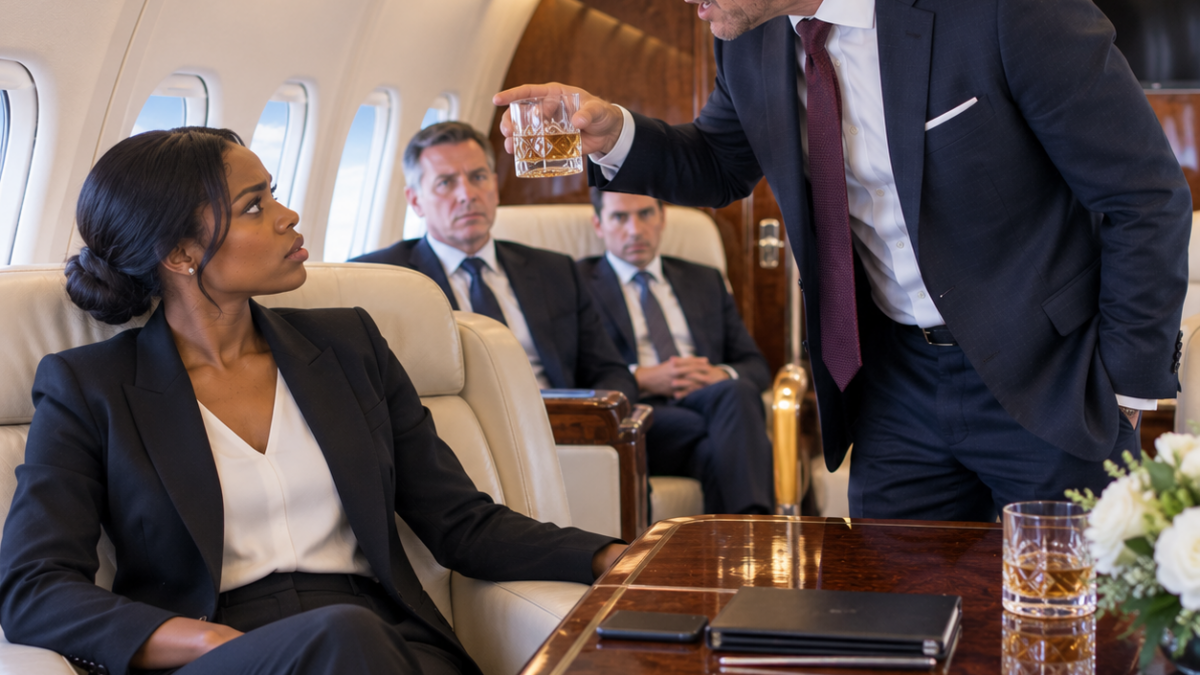
For the first time that evening, Victor did not have an immediate answer.
He looked around the cabin as if someone might rescue him from the question.
No one did.
Marjorie Klein, Titan’s sixty-year-old senior vice president of operations, lowered her eyes to the notebook in her lap.
Tom Hensley stared openly at me now.
Kelly remained beside the galley with her hands folded tightly in front of her.
Victor finally laughed.
It was thinner than before.
“You expect me to be intimidated by some consultant’s mystery sponsor?”
“No.”
I lifted my coffee.
“I expect you to continue behaving exactly as you have.”
His eyes narrowed.
“What does that mean?”
“It means you’re being useful.”
That landed harder than any insult I could have given him.
Men like Victor understood hostility.
They understood fear.
They understood flattery.
What they could not tolerate was the suggestion that their own arrogance had made them predictable.
He turned toward Kelly.
“I gave you an order.”
Kelly hesitated.
“Mr. Grayson, Captain Reese says diverting requires an operational reason.”
“I am the operational reason.”
Victor’s voice filled the cabin.
“Tell him we have a disruptive passenger.”
Kelly looked at me.
Then at the whiskey stains on my blouse.
“Sir…”
Victor’s expression changed.
“You want to keep your job?”
She went pale.
“Yes.”
“Then move.”
Kelly disappeared toward the cockpit.
I watched her go.
Tom leaned slightly toward me.
“You’re really just going to sit there?”
“What would you prefer?”
“I don’t know.”
He looked toward Victor.
“Something.”
“Something dramatic?”
Tom almost smiled.
“Maybe.”
“Drama is usually what people reach for when they don’t have leverage.”
Victor heard enough to understand we were talking about him.
“You two having fun?”
Tom immediately looked away.
Victor noticed.
Of course he did.
Bullies are experts at locating fear.
“You laughing at me again, Hensley?”
“No, sir.”
“That sounded like laughter.”
“It wasn’t.”
Victor walked down the aisle.
Tom was thirty-one and had worked for Titan only eighteen months.
His wife was pregnant.
I knew that from the personnel briefing my team had prepared.
Victor knew none of it.
To him, employees existed mostly as extensions of his authority.
“Stand up.”
Tom blinked.
“Sir?”
“Stand up.”
He did.
Victor stepped close.
“You think this woman is impressive?”
Tom swallowed.
“I didn’t say that.”
“Do you think I’m funny?”
“No.”
“Then why have you been smirking all night?”
Tom looked at me.
That made Victor angrier.
“Don’t look at her.”
Tom returned his eyes to Victor.
“I apologize.”
“Too late.”
Victor smiled.
“You’re fired.”
The words came casually.
Almost pleasantly.
Tom’s face lost color.
“What?”
“Effective immediately.”
“Sir, please.”
“You’re done.”
“My wife is seven months pregnant.”
“Then I suggest you start updating your résumé.”
The cabin became utterly silent.
I put my coffee down.
“Victor.”
He turned.
“What?”
“Sit down.”
His face changed.
Several people inhaled.
Victor almost laughed.
“Excuse me?”
“You heard me.”
“You don’t give me orders.”
“No.”
I looked toward Tom.
“But you are intoxicated, abusing personnel authority in flight, and creating an unnecessary safety distraction.”
I returned my gaze to Victor.
“So as a fellow passenger, I’m asking you to sit down.”
He took a step toward me.
“I could destroy you with one phone call.”
I almost smiled.
“That sentence tells me more about Titan’s leadership problem than the last six months of financial reports.”
“Leadership problem?”
“Yes.”
“My company made twelve billion dollars last year.”
“And missed margin targets in four of six major divisions.”
His expression shifted.
“Employee attrition in your North American operations is twenty-nine percent above the industry comparison group.”
Marjorie’s head rose.
Victor stared.
I continued.
“Your defense systems unit has lost three senior engineers in eleven months.”
“Customer retention in logistics is weakening.”
“You spent forty-eight million dollars on outside culture and efficiency consultants while ignoring most of their recommendations.”
“And your board’s compensation committee has questioned whether your incentive structure rewards short-term revenue at the expense of long-term value.”
Victor’s mouth opened.
Closed.
“How do you know that?”
I tilted my head.
“You still haven’t asked who sent me.”
Marjorie was looking at me differently now.
She knew enough to understand those figures were not public in that form.
Victor realized it too.
Then his ego did what egos like his always do when confronted by information they cannot explain.
It called the information fraudulent.
“You’ve been stealing confidential material.”
“No.”
“Then somebody leaked it.”
“No.”
“You’re lying.”
“No.”
His voice rose.
“Stop saying no to me.”
I looked at him for a second.
Then I laughed.
I shouldn’t have.
But the absurdity finally broke through.
Victor stared as though I had slapped him.
“What is funny?”
“You.”
His face reddened.
Tom sat down before his legs seemed to give out.
Marjorie covered her mouth.
Victor pointed at her.
“You too?”
“I didn’t say anything.”
“You were laughing.”
“No, Victor.”
She finally met his eyes.
“I was breathing.”
That earned a few more smiles.
Victor saw them.
The room had shifted.
Not to me.
Not yet.
Away from him.
That was enough to make him dangerous.
The cockpit door opened.
Kelly returned.
“Captain Reese has begun coordinating a diversion to Henderson Executive Airport.”
Victor smiled immediately.
“Good.”
Kelly continued.
“But he wants it documented that the diversion was requested by you personally and is not related to an aircraft emergency.”
Victor’s smile faltered.
“Fine.”
“He also needs the reason.”
“Disruptive passenger.”
Kelly glanced at me.
“Nia Jackson?”
“Yes.”
Kelly swallowed.
“Okay.”
She walked away.
Victor sat again.
“Forty minutes.”
He poured another whiskey.
“You’ll be off the plane.”
I returned to my files.
That infuriated him more than an argument would have.
Ten minutes passed.
Then Victor spoke again.
“What are you writing?”
“Notes.”
“About what?”
“You.”
He laughed.
“Planning to complain to HR?”
“No.”
“Legal?”
“No.”
“The board?”
I looked up.
That one had come too quickly.
Interesting.
Victor saw my expression.
“What?”
“Nothing.”
“You’re doing that thing again.”
“What thing?”
“Acting like you know something.”
“I know many things.”
“About me?”
“Yes.”
He leaned back.
“What do you think you know?”
I considered the question.
“Do you really want the answer?”
“Yes.”
“You inherited more influence than you earned.”
His grip tightened on his glass.
“You surround yourself with people whose compensation depends on your mood.”
“You confuse fear with loyalty.”
“You interpret disagreement as betrayal.”
“You use humiliation to establish dominance.”
“You’ve spent years making Titan executives compete for access rather than collaborate.”
“And now you’re so insulated that you think an aircraft owned by a public corporation is your personal living room.”
Tom’s mouth dropped open.
Marjorie stopped pretending to take notes.
Victor stared at me.
The whiskey in his glass trembled slightly.
“My father built this company.”
“Your father helped build it.”
“He built it.”
“Thousands of engineers, machinists, analysts, salespeople, managers, and investors might disagree.”
“You know nothing about my father.”
“I know what his company became after he died.”
Victor shot to his feet again.
“You arrogant—”
Kelly appeared before he finished.
“Mr. Grayson.”
“What?”
“Captain Reese needs Ms. Jackson in the cockpit.”
The cabin froze.
Victor looked at Kelly.
Then at me.
“Why?”
“I don’t know.”
“Yes, you do.”
Kelly shook her head.
“He asked for her specifically.”
Victor’s eyes narrowed.
“No.”
Kelly blinked.
“What?”
“She isn’t going anywhere.”
I stood.
Victor blocked the aisle.
“This is my flight.”
I lowered my voice.
“Move.”
“No.”
“Victor.”
“You don’t tell me to move.”
Behind him, Marjorie spoke.
“Victor.”
He turned.
“Let her pass.”
His disbelief was almost comical.
“You’re taking her side?”
“I am taking the pilot’s side.”
Victor looked around.
Again, nobody saved him.
He stepped aside.
I walked past.
At the cockpit door, Kelly entered a code.
Before opening it, she whispered:
“What is happening?”
I looked at her.
“You’ll know soon.”
Captain Reese was waiting.
He was in his late fifties.
Former military aviation.
Twenty years flying corporate aircraft.
He closed the cockpit door behind me.
“Ms. Jackson.”
“Captain.”
“I received a priority message from Titan legal.”
“Good.”
He handed me a tablet.
The message came from Serena Cho, outside counsel for Jackson Meridian Capital.
My company.
OWNERSHIP TRANSFER CLEARED.
ESCROW RELEASE CONFIRMED.
VOTING CONTROL EFFECTIVE 18:00 PACIFIC.
BOARD NOTICE SCHEDULED AFTER LANDING.
I read it twice.
Three years of work.
Two years of quiet share accumulation.
Private purchases from institutional holders.
Debt conversions.
A negotiated acquisition of preferred voting stock.
An irrevocable proxy agreement with Titan’s largest pension investor.
And finally, regulatory clearance.
As of twelve minutes earlier, Jackson Meridian controlled 54.2 percent of Titan Industries’ voting power.
Not Victor.
Not his family’s remaining shares.
Me.
Captain Reese watched my face.
“Everything okay?”
“Yes.”
He lowered his voice.
“Legal also informed me that operational authority for the aircraft has changed.”
I looked at him.
“How?”
“The registered corporate operator remains Titan.”
“But executive travel authority now requires confirmation from the board chair or controlling shareholder representative.”
I smiled faintly.
“And Victor’s diversion?”
“No longer authorized.”
“Then continue to New York.”
“That’s what I thought.”
“Captain.”
“Yes?”
“Do not announce anything yet.”
He hesitated.
“Understood.”
“I want the cabin treated normally.”
He looked at the whiskey stain on my blouse.
“That ship may have sailed.”
I smiled.
“Fair.”
When I returned to the cabin, Victor looked pleased with himself.
“So?”
I sat.
“So what?”
“What did the pilot want?”
“Operational question.”
“About?”
“The diversion.”
Victor grinned.
“Good.”
I opened my file.
Ten minutes later, the aircraft stopped descending.
Victor noticed first.
He looked out the window.
Then at the altitude display.
“Why are we leveling?”
No one answered.
He pressed the call button repeatedly.
Kelly arrived.
“Where’s Reese going?”
“New York.”
Victor stared.
“What?”
“We’re resuming the original route.”
“I ordered a diversion.”
Kelly’s hands shook.
“Captain received updated corporate authorization.”
“From whom?”
She looked at me.
It was tiny.
Half a second.
But Victor saw it.
His face changed.
He turned slowly toward me.
“What did you do?”
“Nothing.”
“You called someone.”
“No.”
“Then why did Reese cancel my order?”
“I imagine because your order no longer carried enough authority.”
His expression became almost blank.
“What does that mean?”
“You’ll find out.”
He grabbed the satellite phone.
“Get Ethan Cole.”
Ethan was Titan’s general counsel.
Greg handed him the phone.
Victor called.
No answer.
He called again.
Then the CFO.
Then the board chair.
No one answered.
His confidence began leaking away one unanswered call at a time.
Finally, he reached someone.
“Harold.”
Harold Vance was Titan’s longtime board vice chairman.
Victor stood near the galley.
“What the hell is happening?”
We could hear only his half of the conversation.
“What do you mean documents?”
“No.”
“No, that’s impossible.”
“Who approved it?”
His face drained.
“What percentage?”
Silence.
Then:
“Since when?”
More silence.
He slowly lowered the phone.
Every person in the cabin watched him.
Victor looked at me.
“What did you buy?”
I closed the file.
“Titan.”
Tom actually laughed out loud.
Victor’s head snapped toward him.
Then back to me.
“No.”
“Yes.”
“No.”
“It wasn’t exactly a convenience store transaction, Victor.”
His mouth opened.
“You’re lying.”
“Your board counsel will provide the documents after landing.”
“You can’t buy my company.”
I looked at him.
“There it is again.”
“What?”
“Your company.”
I stood.
“Titan is publicly held.”
“Your family owns eleven percent.”
“Jackson Meridian now controls fifty-four-point-two percent of voting rights after today’s escrow release.”
Marjorie whispered:
“Oh my God.”
Victor looked at her.
Then at me.
“Jackson Meridian?”
“Yes.”
Recognition came slowly.
Everybody in corporate finance knew the name.
Private investment group.
Industrial technology.
Infrastructure.
Defense logistics.
Quiet.
Profitable.
Famously private founder.
The press knew almost nothing about that founder.
Victor did now.
“You’re Nia Jackson.”
“I told you my name when I boarded.”
“No.”
His voice became weaker.
“You’re the Jackson from Jackson Meridian.”
“Yes.”
Tom leaned back and closed his eyes.
“Holy hell.”
Victor looked toward the cockpit.
Then the cabin.
Then me.
“That still doesn’t make you CEO.”
“No.”
“Good.”
For one second, some life returned to his face.
I continued.
“The board does that.”
His relief disappeared.
“And they have a meeting scheduled for nine tomorrow morning.”
“You can’t remove me.”
“I can vote.”
“You need cause.”
“No.”
“Under your employment agreement, the board can remove you without cause.”
His eyes widened.
I knew his contract.
Of course I did.
“You’ve read my contract?”
“I’ve read everything.”
He sat down.
For almost a minute, nobody spoke.
Then something strange happened.
I felt no satisfaction.
I had imagined this moment during the acquisition.
Not the whiskey.
Not the racism.
I had not predicted those.
But I had imagined Victor discovering that the consultant he ignored had been evaluating him for the new controlling owner.
I assumed it would feel triumphant.
Instead, I felt tired.
Because his behavior had answered questions I had hoped would be harder.
Was he arrogant?
Yes.
Was he reckless with authority?
Yes.
Did fear distort internal decision-making?
Clearly.
Did racial and gender prejudice influence his judgment?
I had whiskey drying on my collar.
Yes.
Victor stared at me.
“Why were you on this plane?”
“To observe.”
“So this was a setup.”
“No.”
“You hid who you were.”
“I used my legal name.”
“You presented yourself as a consultant.”
“I am a consultant to Jackson Meridian.”
“You tricked me.”
“No, Victor.”
I shook my head.
“I simply didn’t warn you that consequences were present.”
His face hardened.
“You planned to fire me from the beginning.”
“No.”
That was true.
Our investment committee had debated keeping him.
Titan’s operating performance was uneven, but not catastrophic.
He understood certain markets well.
Some institutional shareholders believed a strong board could constrain his worst instincts.
I had boarded the jet genuinely undecided.
Then Victor gave me whiskey as evidence.
“You weren’t already decided?”
“No.”
He looked confused.
“Then if I had treated you differently—”
I stopped him.
“That is not the lesson.”
He frowned.
“If you had known who I was and treated me well, that would have told me nothing.”
“I wanted to see how you treated someone you believed could not affect you.”
His face went still.
“And you showed me.”
Marjorie looked down.
So did several others.
They understood this applied to them too.
They had watched.
Some had laughed.
Most had stayed silent.
Tom had been the first to object.
And Victor had fired him instantly.
I looked toward Tom.
“Your termination is rescinded.”
Victor snapped:
“You can’t do that.”
I turned.
“Actually, I can recommend it.”
Tom stared.
“You don’t have to—”
“Yes.”
I said it firmly.
“You were terminated for objecting to abusive conduct.”
“That decision will be reviewed.”
Tom swallowed.
“Thank you.”
“Don’t thank me yet.”
He looked confused.
“Tomorrow, I’m going to ask why it took you until Victor threatened your own job before you spoke.”
His face fell.
“Fair.”
“Good answer.”
Marjorie gave a small nod.
Victor looked around.
“This is insane.”
“No.”
I sat again.
“This is governance.”
The remaining hours to New York were remarkably quiet.
Victor stopped drinking.
The crew stopped trembling.
People began speaking to one another in normal tones again.
It was astonishing how quickly a room changed when one man’s mood no longer controlled everybody’s employment.
At JFK, two black SUVs waited beside the corporate terminal.
Victor stood before the door opened.
“You’ve made your point.”
“I wasn’t trying to make a point.”
“Then what do you want?”
“A functioning company.”
“You think you can run Titan?”
“I think Titan can be run without terrorizing its employees.”
He laughed bitterly.
“You have no idea what leadership costs.”
“I’ve built three companies.”
His expression shifted.
“I employ fourteen thousand people across my portfolio.”
Silence.
“And none of them has ever had to laugh at my jokes to keep health insurance.”
The door opened.
Cool night air entered.
Victor walked off first.
No security dragged him away.
No dramatic arrest.
No handcuffs.
That would have been easier for him.
Instead, he had to walk past every executive he had humiliated over the years knowing they had seen the exact moment his power became conditional.
I exited last.
Tom waited beside the stairs.
“Ms. Jackson.”
“Nia.”
He nodded.
“Nia.”
He looked back toward Victor.
“What happens tomorrow?”
“I don’t know.”
He looked surprised.
“You control the votes.”
“That doesn’t mean I control facts we haven’t examined.”
“But after tonight?”
“Tonight matters.”
I looked at him.
“But if I fire a CEO entirely because he insulted me personally, then Titan is still being governed by one person’s emotions.”
Tom absorbed that.
“So investigation.”
“Board process.”
“Documented findings.”
“Then decisions.”
He smiled faintly.
“You’re less dramatic than I expected.”
“It’s a terrible burden.”
The next morning, I entered Titan headquarters at eight fifteen.
Victor was already there.
Of course he was.
Men like him rarely recognize a final warning until after it has become evidence.
The board convened at nine.
Eleven directors.
Outside counsel.
Corporate secretary.
Victor.
Me.
The first hour was procedural.
Ownership confirmation.
Voting rights.
My appointment as executive chair pending broader governance restructuring.
Then the jet incident.
Video from the cabin existed.
Audio too.
Tom had recorded parts.
So had Marjorie.
The crew provided statements.
Victor’s whiskey toss was undisputed.
His racial remarks were undisputed.
His order to fire Tom was undisputed.
His attempted diversion was documented.
The most disturbing thing was not Victor’s behavior.
It was how practiced everyone else’s response had been.
They expected it.
That led us into his history.
HR records.
Turnover data.
Confidential settlements.
Former executives.
Women he called emotional.
Black managers described as aggressive.
Asian engineers described as technically gifted but “not leadership material.”
Latino operations staff disciplined more harshly for comparable infractions.
Not every case proved bias.
Some disciplinary decisions were legitimate.
But a pattern emerged.
Victor did not run Titan through standards.
He ran it through hierarchy.
People closest to his image of authority received benefit of the doubt.
People farther from it carried the burden of proof.
Three days later, the board voted.
Ten to one.
Victor was removed as CEO.
The single dissenting vote was Victor himself, using shares still under his personal control.
I did not vote on the employment decision.
That surprised everyone.
Victor’s lawyer asked why.
“Conflict.”
I looked at Victor.
“He directly targeted me.”
“I want the decision independent of my personal grievance.”
Victor laughed.
“So you get everyone else to do it for you.”
The board chair replied before I could.
“No, Victor.”
“We’ve been doing it for you for eight years.”
Victor stopped laughing.
The board appointed me interim chief executive.
I refused at first.
I had not spent three years accumulating Titan because I wanted another full-time operating job.
My plan had been to install leadership.
Restructure governance.
Fix capital allocation.
Then step back.
But the company needed stability.
Several candidates declined because the scandal had become public.
Employees were frightened.
Customers were calling.
Contracts were under review.
So I accepted a six-month interim term.
That was how the man who had thrown whiskey in my face learned I was his new boss.
Not in the air.
Not with an announcement designed to humiliate him.
In a conference room at 2:17 on a Thursday afternoon when the corporate secretary read the resolution into the minutes.
“Effective immediately, Dr. Nia Jackson is appointed interim Chief Executive Officer of Titan Industries.”
Victor looked at me.
His expression was not rage.
It was disbelief.
“You?”
“Yes.”
“You have never run Titan.”
“Neither had you until someone gave you the chance.”
His jaw tightened.
“My father built this place.”
“And then you inherited responsibility for it.”
I leaned forward.
“Inheritance is not immunity.”
He stood.
“This company will collapse without me.”
I said nothing.
He waited.
Then laughed bitterly.
“You don’t believe me.”
“I believe Titan is larger than either of us.”
That was the first principle I introduced as CEO.
Titan is larger than any executive.
The second was simpler.
No retaliatory terminations.
Tom returned.
Not as my assistant.
Not as a mascot.
He returned to his original strategy role with back pay for the forty-eight hours he had technically been terminated.
I also documented his delayed response on the jet.
He asked why.
“Because integrity isn’t something we award only after people become useful to us.”
He accepted that.
Six months later, he received a promotion.
He earned it.
Marjorie became chief operating officer.
That decision was controversial.
Some employees accused her of enabling Victor.
They were right.
I asked her directly:
“Why did you remain silent?”
Her answer was not flattering.
“Because I had stock options vesting.”
I almost admired the honesty.
She continued.
“And because after years around Victor, I had convinced myself managing him was the same as challenging him.”
“What changed?”
“You.”
I shook my head.
“No.”
She corrected herself.
“Watching him fire Tom.”
“Why?”
“Because I realized I had spent years telling younger employees to show courage while I protected my own compensation.”
That was better.
Marjorie spent the next year rebuilding internal reporting.
Not because I believed confession erased complicity.
Because people who understand how a bad system survives can be useful in dismantling it.
Kelly left corporate aviation.
Before she did, she requested a meeting.
“I should have refused the diversion request immediately.”
“You followed the captain’s direction.”
“I still participated.”
“Yes.”
She swallowed.
“I was terrified of Victor.”
“I know.”
“That doesn’t excuse it.”
“No.”
She looked relieved by my refusal to absolve her.
“I thought you’d say it wasn’t my fault.”
“I don’t know enough to say that.”
She nodded.
“Fair.”
“Fear explains behavior.”
“It doesn’t automatically excuse it.”
She later joined a commercial airline.
Three years afterward, she emailed me.
A passenger had been unfairly targeted by another crew member.
Kelly intervened.
She wrote one sentence:
I remembered the jet and decided I didn’t want to need another Nia in the room before I did the right thing.
I kept that email.
Titan’s internal investigation lasted nine months.
The findings were worse than the board expected.
Not criminal conspiracy.
Not movie villains.
Something more ordinary.
And therefore more believable.
Promotions shaped by favoritism.
Expenses approved for executives who socialized with Victor.
Women penalized for behavior praised as decisive in men.
Repeated complaints about racialized language minimized as personality conflicts.
Engineering warnings delayed because employees feared contradicting Victor during earnings periods.
That last category terrified me.
A company that punishes disagreement does not merely create discrimination.
It creates operational risk.
If people fear speaking when something is unsafe, eventually something breaks.
We changed incentives.
Whistleblower channels moved outside the executive chain.
Executive complaints went to independent board counsel.
Performance reviews required measurable evidence for subjective categories like leadership presence and cultural fit.
We audited compensation.
Promotion.
Termination.
Vendor selection.
Nothing became perfectly equal overnight.
Anyone promising that is selling something.
But inconsistencies became visible.
That mattered.
The most difficult change involved me.
Six months passed.
The board asked me to remain permanent CEO.
The vote was unanimous.
I said no.
Marjorie came to my office afterward.
“You’re serious?”
“Yes.”
“Why?”
“I bought Titan because I thought governance was broken.”
“So fix it.”
“I have.”
“You’ve started.”
“Exactly.”
She frowned.
“You think leaving proves something?”
“No.”
“I think staying because everyone suddenly likes me would.”
She sat.
“Then who?”
I had spent four months recruiting.
William Carter.
Fifty-six.
Aerospace engineer.
Former president of Titan’s most profitable competitor.
Black.
That fact generated headlines.
It was also the least interesting part of his résumé.
Victor’s defenders immediately called it political.
I called it predictable.
William survived nineteen interviews.
Two independent assessments.
Board review.
Employee panel.
Customer panel.
His first question to me after accepting was:
“What power are you keeping?”
I smiled.
“Good question.”
“Well?”
“Executive chair for twelve months.”
“Then?”
“Ordinary board seat.”
“Controlling shareholder?”
“For now.”
He nodded.
“And if we disagree?”
“You run the company.”
“That simple?”
“No.”
I smiled.
“But that clear.”
Victor sued.
Of course he did.
Wrongful removal.
Breach of fiduciary duty.
Fraud related to our share acquisition.
He claimed Jackson Meridian had secretly manipulated Titan ownership.
That last allegation gained traction because our acquisition had indeed been quiet.
Quiet was not illegal.
Every transaction had been disclosed where required.
Every beneficial ownership threshold reported.
Our voting control became effective only after regulatory and contractual conditions were met.
The court dismissed the central ownership claims.
One sentence in the ruling made national news:
“Plaintiff’s surprise at lawful ownership does not render that ownership fraudulent.”
Tom framed it.
I told him that was tacky.
He framed it anyway.
Outside the courthouse, reporters asked whether the case finally proved I had defeated Victor.
I hated the word defeated.
“Victor was not my project.”
They looked disappointed.
“Titan was.”
Another reporter shouted:
“Did you buy the company to destroy him?”
“No.”
“But you investigated him for years.”
“I evaluated the company for years.”
“What’s the difference?”
“About fourteen thousand employees.”
That answer traveled farther than I expected.
The press eventually uncovered that Jackson Meridian had begun buying Titan shares almost three years before the jet incident.
Some people accused me of orchestrating the confrontation.
That was absurd.
I had arranged the strategic trip.
I had chosen to travel under the consultant title because I wanted an unfiltered view.
I had not asked Victor to drink too much.
I had not asked him to insult me.
I certainly had not asked him to throw whiskey.
But there was one accusation that contained a grain of truth.
I let him continue.
Once I understood what he was revealing, I did not rescue him from himself.
Did that bother me?
Yes.
For a long time.
I discussed it with my mother.
She was seventy-one and had the irritating moral clarity mothers reserve for adult children.
“You wanted to know who he was.”
“Yes.”
“He showed you.”
“Yes.”
“Then why are you guilty?”
“Because I knew more than he did.”
She laughed.
“Nia.”
“What?”
“Women like us have spent entire lifetimes entering rooms where everybody else knew rules we weren’t told.”
I became quiet.
She continued.
“You knew one thing he didn’t.”
“That consequences were coming.”
“That isn’t cheating.”
I smiled.
“You’d make a ruthless board chair.”
“I raised one.”
The comment that stayed with me most came from a Titan maintenance supervisor in Ohio.
His name was Earl Bennett.
White man.
Sixty-three.
Thirty-eight years with the company.
He approached me during a plant visit.
“Ms. Jackson.”
“Nia.”
“Ma’am, I’m too old to call the owner Nia.”
“Then we’re going to be standing here awhile.”
He laughed.
“All right.”
“Nia.”
He looked around the production floor.
“I didn’t know about the stuff with Victor.”
“Most people didn’t.”
“I voted for politicians who said companies waste time on diversity nonsense.”
I waited.
He rubbed his chin.
“Still think some of it is nonsense.”
I smiled.
“Fair.”
“But I understood something after your investigation.”
“What?”
“My crew stopped reporting problems to one manager.”
“Why?”
“He punished people he didn’t like.”
“Same problem?”
“Different reason.”
Earl nodded.
“But same result.”
“No one talked.”
“And when no one talks, quality goes bad.”
I smiled.
“You’ve just summarized nine months of governance work.”
He laughed.
“Send me consultant money.”
I almost did.
Three years after the jet, Titan’s operating margins were higher.
So was employee retention.
Safety reporting increased at first.
Some analysts called that bad news.
It wasn’t.
The number of reported concerns rose because employees trusted the system enough to report them.
Then serious incidents declined.
That was the curve I wanted.
Silence first.
Then reporting.
Then correction.
Customer retention improved.
Engineering recruitment improved.
The stock rose substantially.
People who had once accused me of destroying Titan now praised the turnaround.
I distrusted both extremes.
The company had not been saved by one woman.
And it had not been ruined by one man.
Organizations are rarely that simple.
Victor mattered because the system had concentrated too much cultural power around him.
I mattered because ownership gave me enough formal power to interrupt it.
But thousands of employees did the rebuilding.
I never forgot that.
Five years after the incident, Titan sold the old corporate jet.
I learned about it from Tom.
He was a vice president by then.
He sent me a picture.
THE SCENE OF THE CRIME IS FOR SALE.
I replied:
DO NOT CALL IT THAT IN THE MARKETING MATERIAL.
He answered:
TOO LATE.
The aircraft eventually sold to a medical transportation company.
I liked that.
Something once used as a status symbol would now move transplant teams and specialized doctors.
That felt like better work.
Victor disappeared from public corporate life.
His lawsuits ended.
His remaining family shares declined as a percentage after capital restructuring, though he remained wealthy.
There was no prison.
No dramatic destruction.
People occasionally seemed disappointed by that.
They wanted the villain ruined.
I did not.
I wanted him powerless to hurt employees.
Those were different goals.
We met once after everything ended.
Accidentally.
A restaurant in Chicago.
I was leaving.
He was entering.
We stopped.
Five years changed him.
More gray.
Less weight.
No entourage.
“Nia.”
“Victor.”
For a few seconds, neither of us spoke.
Then he said:
“I hear Titan’s doing well.”
“It is.”
“You came to gloat?”
“We are standing in a restaurant, Victor.”
He almost smiled.
“Right.”
I started to leave.
“Nia.”
I stopped.
He looked uncomfortable.
“I’ve thought about that flight.”
“So have I.”
“I was drunk.”
“Yes.”
“I was under pressure.”
“Yes.”
“My father had just—”
I raised a hand.
“Don’t.”
He stopped.
“Those things may explain the man you were that night.”
“They don’t explain away what you chose.”
He looked down.
“I know.”
That surprised me.
He continued.
“When Harold called and told me you owned the votes, my first thought wasn’t that I’d behaved badly.”
I waited.
“My first thought was that I’d been nice to the wrong people my whole life.”
I felt something cold move through me.
Victor shook his head.
“Took me a while to understand how ugly that was.”
“Yes.”
“I kept thinking if I had known who you were, none of it would have happened.”
“Exactly.”
“Then one day I realized that made it worse.”
I said nothing.
He looked at me.
“You weren’t asking me to treat the owner well.”
“No.”
“You were watching how I treated someone I thought was beneath me.”
“Yes.”
He nodded.
“I don’t expect forgiveness.”
“Good.”
That almost made him laugh.
“But I’m sorry.”
I studied him.
“Then do something useful with it.”
“What?”
“You still own shares.”
“So?”
“Vote like you’re sorry.”
He laughed.
Actually laughed.
“I deserved that.”
“Yes.”
We walked in opposite directions.
I do not know what Victor did with the rest of his life.
That is his story.
Mine continued.
Jackson Meridian reduced its Titan position over time.
Not because I lost faith.
Because control should never become addiction.
Employees received a larger equity pool.
Long-term institutional investors came in.
Our board became more independent.
By the tenth anniversary of our initial investment, no individual or family controlled Titan.
Including me.
I remained chair emerita for a while.
Then stepped away.
At the final annual meeting I attended, Tom found me backstage.
“Remember when he fired me?”
“Yes.”
“I thought my life was over.”
“You were unemployed for approximately forty-eight hours.”
“Longest forty-eight hours of my life.”
I laughed.
He became serious.
“You know what bothers me?”
“What?”
“I waited too long.”
“On the jet?”
“Yes.”
“I laughed when Victor insulted you.”
“You did.”
“Then got scared when he turned on me.”
“Yes.”
“I’ve thought about that.”
“Good.”
“I wish I had been brave before it cost me something.”
I looked at him.
“Most people do.”
“That’s not comforting.”
“It isn’t supposed to be.”
He smiled.
“What am I supposed to do with it?”
“The next room.”
“What?”
“You cannot redo that cabin.”
“You can decide who you are in the next room where somebody powerful humiliates someone weaker.”
He nodded.
“I’ve tried.”
“I know.”
That was true.
I had watched him intervene for junior employees.
Push back against executives.
Take uncomfortable positions.
Not theatrically.
Consistently.
That mattered.
Before going onstage, I stood alone near the curtain.
I remembered the private jet.
Whiskey running down my cheek.
Victor laughing.
Executives staring at their shoes.
Kelly trembling.
Tom laughing nervously.
Marjorie’s silence.
And my own anger sitting beneath everything like fire under stone.
People later called my calm extraordinary.
It wasn’t.
I was furious.
Calm and anger are not opposites.
Sometimes calm is simply anger with a destination.
That night, mine had one.
I wanted to know the truth.
Not only about Victor.
About Titan.
Could a company survive a leader who confused domination with leadership?
Could a board admit it had tolerated behavior because performance once looked good?
Could employees relearn how to speak after years of learning silence?
Could people who had participated in a bad culture help build a better one?
Could I hold enormous power without becoming another person who believed ownership meant obedience?
Those questions mattered more than revenge ever could.
When I stepped onto the stage, several thousand employees watched in person and online.
I had prepared a long speech.
I abandoned most of it.
Instead, I told them something simple.
“The first time many people heard my name was because a CEO told me I didn’t belong on his aircraft.”
I paused.
“The irony was that legally, he had far less control over that aircraft than he believed.”
Laughter moved through the auditorium.
“But the important part of that story was never who owned the jet.”
The room quieted.
“The important part was what he did before he knew who I was.”
I looked across the faces.
Engineers.
Assistants.
Plant workers.
Executives.
People who would never appear in a corporate press release.
“Character is what remains when status information is removed.”
“If you need a title before you offer someone dignity, that is not respect.”
“If you need wealth before you listen, that is not fairness.”
“If you need power before you apologize, that is not accountability.”
I took a breath.
“Titan nearly lost good people because too many employees learned that power mattered more than truth.”
“We changed that.”
“Not perfectly.”
“Not permanently unless you protect it.”
I looked toward Tom and Marjorie.
“You will always have another Victor.”
“Maybe not with the same face.”
“Maybe not with the same politics.”
“Maybe not with the same prejudice.”
“But every institution eventually meets someone who believes position makes them more important than principle.”
“The question is whether everyone else remembers that the institution belongs to more than the loudest person in the room.”
Afterward, a young Black engineering intern approached me.
She could not have been older than twenty-two.
“Dr. Jackson?”
“Nia.”
She smiled nervously.
“Nia.”
“What can I do for you?”
“My dad sent me the video from the jet when I was in high school.”
I groaned.
“That video will outlive me.”
She laughed.
“I thought the best part was when everybody found out you owned the company.”
“Most people do.”
“Now I don’t.”
That caught my attention.
“What changed?”
She looked around the auditorium.
“This.”
“The company?”
“The people.”
She pointed toward a group of engineers.
“My manager is a white guy from Kansas.”
“My team lead is an Indian woman.”
“My mentor is a Black man who grew up in Detroit.”
“My best friend here is from Korea.”
“Nobody acts like that’s a corporate campaign.”
“It’s just work.”
I smiled.
“That is better than any speech I gave tonight.”
She shrugged.
“I still like the boss reveal.”
“So do I.”
We laughed.
Then she said:
“My father told me something about your story.”
“What?”
“He said Victor thought the worst thing that could happen was finding out the Black woman he insulted was his boss.”
I waited.
“My dad said the worse thing was realizing she shouldn’t have needed to be.”
I felt my throat tighten.
“Your father is a smart man.”
“I’ll tell him.”
She walked away.
I stood there for a while.
That was it.
The whole story reduced to one sentence.
Victor thought he had chosen the wrong woman to humiliate.
Eventually he learned there is no right person to humiliate.
People love the twist.
CEO mocks Black woman.
Black woman becomes his boss.
It is satisfying.
I understand.
Power reversal is emotionally clean.
But it can teach a dangerous lesson if we stop there.
Be careful who you disrespect.
They might secretly be important.
No.
That isn’t the lesson.
The lesson is to stop measuring human dignity against importance.
The cleaning woman Victor invoked on that plane deserved respect.
The assistant pouring coffee deserved respect.
Tom deserved respect before he challenged Victor.
Kelly deserved protection from retaliation.
The engineer nobody had heard of deserved to tell a CEO he was wrong.
And I deserved respect before Victor knew whose signature ultimately controlled Titan’s voting rights.
My title changed his behavior too late.
It should never have been necessary.
Years after leaving Titan, I boarded another corporate flight.
Not mine.
A startup founder had invited me to advise her board.
The jet was much smaller.
No polished marble.
No whiskey bar.
Just six seats and a tired crew.
A young Black woman greeted me at the door.
“Dr. Jackson?”
“Yes.”
“I’m Leah.”
“Nice to meet you.”
She helped me with my bag.
Then stopped.
Her eyes narrowed.
“Wait.”
I knew that look.
Recognition.
“You’re her.”
I sighed.
“Unfortunately.”
She laughed.
“My mother loves that story.”
“So does half the internet.”
“Can I ask you something?”
“Sure.”
“What did it feel like when Victor learned you were his boss?”
I thought for a moment.
“Sad.”
She blinked.
“Sad?”
“Yes.”
“I expected you to say powerful.”
“I had power before he learned about it.”
She considered that.
“So what was sad?”
“That his respect arrived at exactly the same moment as information about my status.”
Leah’s smile faded.
“Wow.”
I nodded.
“That is why the reveal was never my favorite part.”
“What was?”
I looked through the cabin toward the cockpit.
“Watching people who had been afraid of him realize they could speak.”
The engines started.
Leah buckled into the crew seat.
As we climbed above Los Angeles, sunlight stretched across the clouds.
I opened my notebook.
No whiskey came flying.
No one questioned why I was there.
No one cared whether I owned anything.
It was wonderfully boring.
And after everything Victor Grayson taught me at 35,000 feet, boring dignity still feels like one of the finest luxuries in the world.








