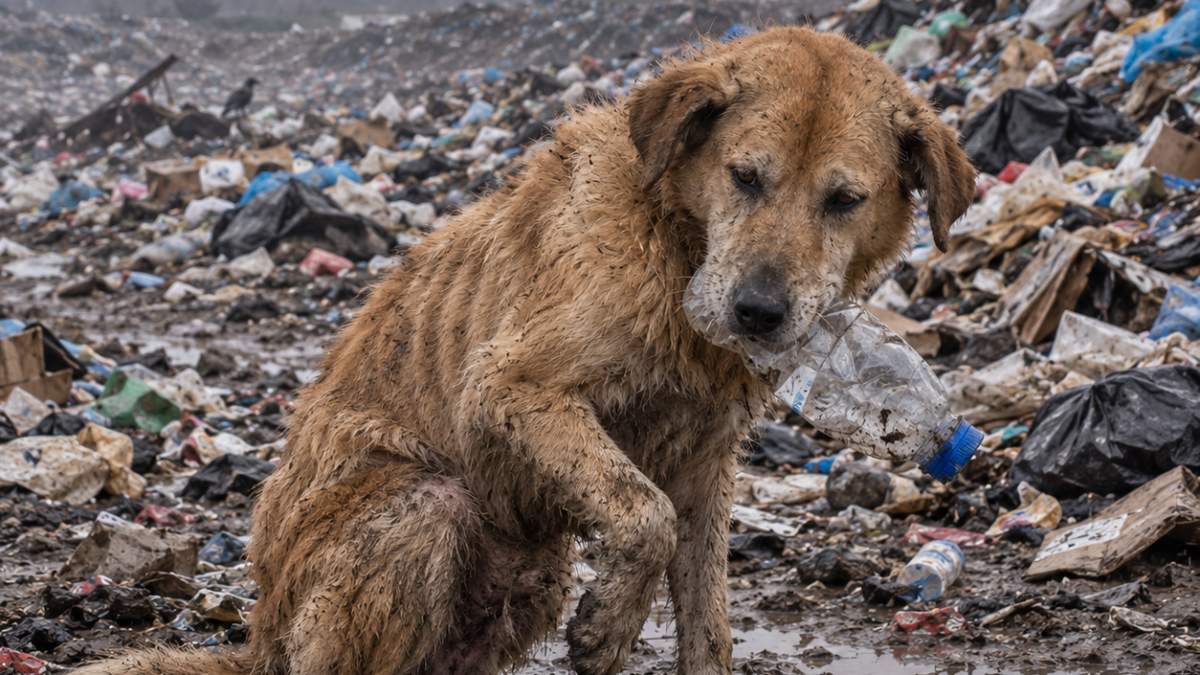
The blind old dog had been standing in the same place at the county dump for three days, listening for footsteps he still believed would bring his owner back
He leaned against my hand as if he had been waiting three days for that exact touch.
Not my touch specifically.
That was the part that hurt.
Any familiar hand would have done.
Any hand carrying the promise of return.
His nose moved along my fingers, then my wrist, then the sleeve of my jacket.
He was searching by scent now.
Trying to solve the mistake.
I was close enough to see how thin he really was.
His coat was matted across his shoulders and belly.
Mud had dried in hard plates between his toes.
One ear had a small split near the edge, old and healed badly.
His claws were too long.
His hips stood out beneath the wet fur.
And his eyes, completely clouded, moved toward sounds rather than shapes.
He sniffed my jacket again.
His tail slowed.
Then stopped.
I watched the moment hope became confusion.
The dog backed up half a step.
His ears dropped.
He turned his head toward the road behind me.
Listening again.
Waiting for another engine.
Another door.
Another set of footsteps.
Not mine.
His.
The man who had left him.
“I’m sorry,” I whispered.
I do not know why I apologized.
I had not abandoned him.
I had never seen him before.
But standing there in that dump, I felt ashamed on behalf of every human being who had ever taught an animal trust and then used that trust to hurt it.
The old dog shifted his weight.
His right hind leg nearly buckled.
He caught himself.
“Easy.”
I moved slowly.
He lifted his head toward my voice.
I reached into my bag and opened a pouch of wet food.
The smell caught his attention instantly.
His nose lifted.
For the first time since I arrived, something other than waiting entered his face.
Hunger.
I placed a small amount on a plastic lid and slid it toward him.
He sniffed.
Then hesitated.
It would have been easier if he had devoured it.
Starving animals often do.
But this dog waited.
As though eating without permission might be wrong.
I pushed the food closer.
“It’s yours.”
His tongue touched the edge.
Then he ate.
Slowly.
Carefully.
Every few bites, he stopped and turned his head toward the road.
Listening.
I hated the road.
I hated every sound coming from it.
A truck engine in the distance made his ears rise.
A car door somewhere beyond the trees made him stand straighter.
Each time, his whole body prepared for a reunion that did not happen.
I gave him only a little food at first.
Then water.
He drank longer than he ate.
When he finished, he stood there with his muzzle dripping and his body trembling.
I pulled a blanket from the truck and came closer.
This time, he did not back away.
I let him smell it first.
Then I draped it over his shoulders.
He sighed.
A long, deep sound.
The kind old dogs make when something inside them has finally been allowed to unclench.
I took out the slip leash.
The moment the rope touched his neck, he froze.
Not violently.
Not aggressively.
Just stopped breathing for a second.
I withdrew it.
“All right.”
I sat back on my heels.
“No rush.”
A blind dog cannot see what your hands are doing.
He has to trust the sound of your breathing.
The scent of your clothes.
The pressure of your fingers.
The memory of what human hands have meant before.
I had no idea what hands had meant to him.
Maybe kindness.
Maybe neglect.
Maybe both.
So I waited.
The rain strengthened.
Cold water ran down the back of my neck.
The dog shivered under the blanket.
I talked.
Not about anything important.
I told him my name.
I told him the truck was close.
I told him the heater worked.
I told him my coffee had probably become undrinkable.
I told him that if he cooperated, there was a clinic twenty-five minutes away with a veterinarian named Dr. Maria Keller who had a weakness for old dogs and no tolerance for human excuses.
His ears moved with my voice.
Eventually, I touched the leash to his neck again.
He stood still.
I slipped it over.
No resistance.
When I tried to lead him, though, he refused to move.
He planted all four paws in the mud.
I thought at first he was afraid.
Then he turned his head toward the road again.
My chest tightened.
He did not want to leave.
Because his owner might come back while he was gone.
That realization was somehow worse than finding him.
I crouched beside him.
“He’s not coming.”
The words felt cruel.
The dog’s ears tilted toward me.
“I wish I could tell you something else.”
The rain tapped against the rusted car beside us.
“He left you.”
His tail remained still.
“You waited.”
I swallowed.
“But I’m not leaving you here.”
I placed one hand beneath his chest.
He resisted.
Not me.
The direction.
The idea of going away from the spot where he believed his person would return.
I had seen animals cling to terrible homes because terrible was still familiar.
I had seen dogs run back toward chains because chains were where dinner had once appeared.
Home is not always where safety lives.
Sometimes home is simply the place where memory learned its shape.
I did not force him.
Instead, I walked him in a slow circle.
One step.
Stop.
One step.
Stop.
Letting him feel that the leash did not mean pain.
Then I moved slightly toward the truck.
He followed one step.
Stopped.
Listened.
Another distant engine.
He turned his head.
Waited.
Nothing.
I moved again.
Another step.
This continued for almost twenty minutes.
Thirty yards.
A distance I could have walked in seconds.
For him, it was the longest goodbye of his life.
At the truck, he stopped again.
I opened the back door.
Warm air flowed out.
He sniffed.
His front paws touched the running board.
His hind legs did not follow.
They could not.
I slid one arm beneath his chest and another under his hips.
He stiffened at first.
Then his body gave way into mine.
He was heavy, but not as heavy as a dog his size should have been.
That scared me.
Under the wet coat, I could feel his spine.
I lifted him onto the padded floor.
He stood unsteadily.
Then immediately turned toward the open door.
Toward the dump.
I closed it before he could try to jump.
He pressed his nose to the glass.
Blind eyes facing the place he had been left.
Waiting even as we began to leave.
I sat beside him while my partner, Luis Moreno, who had arrived after my second radio call, drove.
Luis had been with animal protection for eight years.
He was younger than me by almost fifteen, patient with animals, impatient with paperwork, and capable of eating gas station burritos at hours that should have been illegal.
He looked at us through the rearview mirror.
“He okay?”
“No.”
“Medical?”
“No.”
Then I corrected myself.
“Probably that too.”
Luis watched the dog.
“He keeps looking back.”
“He thinks someone’s coming.”
Luis’s jaw tightened.
“People.”
That was all he said.
Sometimes one word carries enough disgust.
The truck pulled onto the county road.
The dog lost the sounds of the dump behind us.
At first, he stood.
Listening.
Then the turns disoriented him.
His legs shook harder.
I guided him onto the blanket.
He resisted for a moment.
Then lay down.
His head rested against my thigh.
I froze.
We had known each other less than an hour.
Still, his head was there.
Heavy.
Warm.
Trusting in the way old dogs sometimes trust when they no longer have energy for caution.
I placed my hand on his shoulder.
His body slowly stopped trembling.
Ten minutes later, he slept.
The first real sleep he had probably had in three days.
At Dr. Keller’s clinic, we carried him inside.
Maria took one look at his eyes and sighed.
“Blind?”
“Looks like it.”
“How long outside?”
“At least three days.”
“In February?”
“Yes.”
Her face hardened.
“Wonderful.”
Maria used sarcasm when she was angry enough to need somewhere safe to put it.
She examined him while I stood near his head.
His temperature was low.
He was dehydrated.
Underweight by nearly twenty pounds.
Both ears were infected.
He had severe arthritis in his hips and spine.
His teeth were worn and several were broken.
The skin beneath his collar line showed scars.
Not fresh.
Not necessarily abuse.
But evidence of a long life that had not always been gentle.
His cataracts were advanced.
Maria switched off the exam light and performed several reflex tests.
The old dog did not respond to movement.
“He has almost no functional vision,” she said.
“Maybe light perception.”
“Could surgery help?”
“At his age, with everything else?”
She shook her head.
“Not realistically.”
“How old?”
“Ten?”
She examined his teeth again.
“Maybe eleven.”
“Large mix.”
“That’s old.”
The dog leaned against my leg.
Maria looked at him.
“Chip?”
Luis scanned.
Beep.
We all looked at one another.
“He has one,” Luis said.
For one foolish second, hope lifted in me.
A chip meant a name.
A history.
An owner.
Maybe not the owner who abandoned him.
Maybe a previous family.
Maybe someone searching.
Luis entered the number.
We waited.
The database loaded.
Registered name: Samson.
Registered owner: Bradley Keene.
Address: twelve miles from the dump.
Phone number active.
The room went silent.
Samson.
I looked down.
His ears moved when I said it.
“Samson.”
His tail moved.
There was no question.
That was his name.
Luis stared at the screen.
“Well.”
Maria looked at me.
“You calling?”
“Yes.”
I stepped into the hallway.
My heart was beating faster than it should have.
I had made thousands of difficult calls.
Neglect investigations.
Seizures.
Warnings.
Owners angry that we had removed animals from unsafe conditions.
But this one felt different.
Because Samson was in the next room.
And for three days, that blind old dog had believed the man attached to this phone number was coming back.
Bradley Keene answered on the fourth ring.
“Hello?”
“Mr. Keene?”
“Yeah.”
“My name is Thomas Reed.”
“I’m with county animal protection.”
Silence.
I heard a television in the background.
Then, “Okay.”
“We found a dog today.”
Another silence.
“Microchip lists you as the owner.”
Longer pause.
“What kind?”
He knew.
I could hear it.
“A large honey-colored Lab mix.”
Nothing.
“Name is Samson.”
The television muted.
Finally, Bradley sighed.
“Yeah.”
My hand tightened around the phone.
“Yeah what?”
“He’s mine.”
“Was.”
The word came out before I could stop it.
Bradley did not react.
“He ran off.”
“No.”
Another silence.
“We found him at the old county dump.”
Bradley said nothing.
“A witness says he had been standing in the same spot for three days.”
Still nothing.
“He’s blind.”
“I know.”
“He’s sick.”
“I know.”
“He’s underweight.”
“I’ve been having trouble getting him to eat.”
“Then why was he at the dump?”
Bradley exhaled.
The kind of irritated breath people use when they believe circumstances are more unreasonable than they are.
“I couldn’t handle him anymore.”
I closed my eyes.
“What does that mean?”
“He started having accidents.”
“He bumps into things.”
“He cries at night.”
“He can’t do stairs.”
“My wife is pregnant.”
“We have another kid.”
“We can’t live around a dying dog.”
The hallway seemed to tilt.
“So you drove him to a dump?”
“I left food.”
I laughed once.
I could not help it.
Not because anything was funny.
Because sometimes rage comes out sideways.
“You left food?”
“Yeah.”
“He wasn’t in danger.”
“He was at a garbage dump.”
“It’s fenced.”
“Parts of it.”
“I thought somebody would find him.”
“He waited for you.”
That stopped him.
I continued before professionalism could return.
“He stood in February rain for three days because he thought you were coming back.”
Bradley’s voice hardened.
“What do you want me to say?”
I wanted many things.
None were useful.
“I want to know whether you are surrendering ownership.”
“Yes.”
Immediately.
No hesitation.
“Yes.”
“Put it in writing.”
“Fine.”
“You’ll receive forms electronically.”
“Fine.”
“And, Mr. Keene?”
“What?”
“You may be hearing from our investigator regarding abandonment charges.”
His tone changed.
“Come on.”
“No.”
“I didn’t hurt him.”
“You left a blind elderly dog at a dump.”
“I left food.”
“You keep saying that like food turns abandonment into care.”
“I couldn’t keep him.”
“Then you call a shelter.”
“They said they were full.”
“You call us.”
“I didn’t know.”
“You call a rescue.”
“I had work.”
“You call anyone.”
Silence.
I lowered my voice.
“What you do not do is teach a dog to trust you for ten years and then drive away while he waits in the rain.”
Bradley hung up.
I stood in the hallway staring at the phone.
Luis had heard enough through the partly open door.
He did not say I had crossed a professional line.
He only asked, “Surrender?”
“Yes.”
“Good.”
Maria came out carrying Samson’s blood results.
“Kidneys are stressed but not failing.”
“Liver enzymes elevated.”
“Mild anemia.”
“No immediate catastrophe.”
I breathed.
“Meaning?”
“Meaning he’s an old blind dog with a long list of manageable problems.”
“Manageable?”
“With money, medication, patience, and someone who understands that he is not going to turn young again.”
I looked through the glass.
Samson was standing on the exam-room floor.
His head moved slowly.
Listening for me.
Then his nose pointed toward the hallway.
He heard my footsteps.
His tail wagged.
Not because he thought I was Bradley anymore.
At least I hoped not.
Maybe because my voice had become familiar.
That mattered.
We admitted him overnight.
I went home.
Or tried to.
At home, my wife, Karen, knew something was wrong before I took off my coat.
“What happened?”
“Dog at the dump.”
She waited.
After twenty-four years of marriage, Karen knew when information had a second floor.
“Old?”
“Yes.”
“Bad?”
“Yes.”
I sat at the kitchen table.
She poured coffee.
“Tell me.”
So I did.
Blind.
Three days.
Waiting.
Chip.
Owner.
Surrender.
When I finished, Karen sat across from me quietly.
Then she said, “What did you name him?”
“Samson.”
“No.”
“That’s his actual name.”
“Oh.”
She took a sip.
“Good name.”
“He’s big.”
“You like big dogs.”
“I’m not bringing him home.”
Karen looked at me over the mug.
“I didn’t ask.”
“I know that look.”
“What look?”
“The one where you are already rearranging the living room mentally.”
“I am not.”
“You did it with Rosie.”
Rosie had been our old shepherd who died three years earlier.
Karen’s face softened at the name.
“So did you,” she said.
“Rosie could see.”
“Thomas.”
“I work long shifts.”
“So do many people with dogs.”
“He has medical problems.”
“You have medical problems.”
“I have high cholesterol.”
“You complain about it more than he does.”
I tried not to smile.
“This is different.”
“Yes.”
She leaned forward.
“He was abandoned.”
I looked down at my coffee.
“We are not fostering.”
“Of course not.”
“You’re agreeing too quickly.”
“I’m agreeing with the words you need right now.”
That was my wife.
Samson stayed at the clinic for four days.
The first night, he paced.
Not far.
Blind dogs do not pace confidently in unfamiliar rooms.
He moved three steps, touched a wall, turned, moved back.
Three steps.
Turn.
Three steps.
Turn.
Maria put a soft mat along the edges.
He still paced.
At midnight, the overnight tech called me.
“He won’t settle.”
I went back.
I told myself it was because I was the responding officer.
I told myself consistency mattered.
I told myself many things.
When I entered the kennel room, Samson stopped.
His ears lifted.
I said his name.
His tail wagged.
I sat beside him.
Within five minutes, he lay down.
His head rested on my boot.
The tech smiled.
I ignored her.
By day two, he ate.
By day three, he accepted medication hidden in cheese.
By day four, he barked once when Luis came through the door.
It was not an aggressive bark.
More like an announcement.
Luis froze.
“Did he just yell at me?”
“He has standards.”
Samson wagged.
“He loves me.”
“No.”
“Jealous.”
“No.”
Maria gave us discharge instructions thick enough to qualify as literature.
Arthritis medication.
Antibiotics for his ears.
Eye lubricant.
Joint supplements.
High-calorie food.
Routine.
No furniture rearranging.
Carpet runners to map pathways.
Baby gates near stairs.
Voice cues before touching.
Never approach silently from behind.
Keep water and food in consistent locations.
Use scent markers if needed.
Samson listened to the whole explanation with his head against my leg.
Maria looked at me.
“Where is he going?”
“Temporary foster.”
Karen had already texted me a photograph of our living room with rugs arranged in lines from the back door to the kitchen, couch, and bedroom hallway.
I showed Maria.
She smiled.
“Temporary.”
“Don’t start.”
Karen was waiting when we arrived.
She had opened the front gate and left the porch light on even though it was still afternoon.
Samson stood in the truck.
He smelled the air.
New house.
New yard.
Two humans.
No dump.
Still, he would not move.
I clipped his leash and sat beside him.
Karen stayed near the porch and did not call.
Smart woman.
Eventually, Samson lowered one paw to the running board.
Then the second.
I supported his hips as he stepped down.
His nose worked constantly.
He mapped the yard through smell.
Wet grass.
Fence wood.
Karen’s shoes.
The rosemary bush.
Our neighbor’s ridiculous cedar mulch.
At the porch, he stopped.
One step.
Blind.
Arthritic.
Uncertain.
I tapped the first stair with my foot.
“Step.”
His ears moved.
I guided his paw forward.
“Step.”
He found it.
Then another.
Inside, he froze.
Dogs who can see enter a room and take it in.
Blind dogs enter a room and wait for the world to explain itself.
I let Samson stand.
Karen sat on the floor ten feet away.
“Hi, old man.”
His head turned.
Her voice was softer than mine.
He took one step toward it.
Then another.
His shoulder bumped the wall.
He stopped.
Karen said, “You’re okay.”
He followed the sound.
When he reached her, she placed one hand on the floor.
He sniffed.
Touched her fingers.
Then, without ceremony, put his head in her lap.
Karen looked at me.
I looked away.
I was not giving her the satisfaction.
Her eyes filled anyway.
“Temporary,” she whispered.
“Stop.”
The first week was an education.
For all three of us.
Samson hated the kitchen tile.
His paws slipped, and he panicked.
So we covered the floor with runners.
He learned the route from bed to water in two days.
Bed to back door in four.
Back door to grass in six.
He bumped into the coffee table three times.
I moved it.
He bumped into a chair once.
Karen moved it.
Then she stood in the living room with her hands on her hips.
“No more moving furniture.”
“Why?”
“Because now he has a map.”
She was right.
Samson’s world became a map of scent, sound, texture, and memory.
Living-room rug.
Three steps.
Wood threshold.
Hallway runner.
Turn left when the furnace hum is louder.
Bedroom.
Turn right where the lemon-scented floor cleaner begins.
Kitchen.
Two mats.
Water.
He learned faster than I expected.
People underestimate blind dogs.
They see the eyes first and forget the nose, ears, feet, whiskers, memory, adaptability.
Samson was not helpless.
He needed consistency.
There is a difference.
The hardest part was the front door.
Every time a car stopped outside, Samson went there.
Every engine.
Every door slam.
Every set of footsteps.
He would stand with his nose inches from the wood, tail moving.
Waiting.
At first, I thought he was simply reacting to sound.
Then one evening, a pickup pulled into the neighbor’s driveway.
Samson woke from sleep.
He stood so quickly his legs slipped.
He hurried toward the door.
Tail wagging.
Whole body shaking.
When the truck engine stopped, he whined.
A small sound.
Barely there.
I knew.
It sounded like Bradley’s vehicle.
Or close enough.
Samson waited.
The neighbor walked into his house.
Our porch remained empty.
The tail stopped.
Samson lowered himself onto the mat.
Karen came beside me.
“How long do you think he’ll do that?”
“I don’t know.”
She looked at him.
“He still thinks that man is looking for him.”
“Yes.”
“That bastard.”
Karen rarely swore.
When she did, the subject had earned it.
At night, Samson sometimes woke barking.
Not loud.
One bark.
Then listening.
I would sit beside him.
“You’re home.”
The word felt dishonest at first.
Was he?
Home is not something humans can declare for animals with paperwork and rugs.
Home is something the body has to believe.
So I stopped saying it for a while.
I said only, “I’m here.”
That was true.
Karen was there too.
Every day.
Every night.
Again.
Again.
Again.
Three weeks after Samson came home, Bradley Keene signed the final surrender paperwork.
The county prosecutor also decided to pursue an abandonment citation.
Not a dramatic criminal case.
No television cameras.
No handcuffs.
A fine.
Court appearance.
Mandatory animal-care education.
A restriction on acquiring another dog for a period of time.
Some people wanted harsher.
Others said it was too much.
I stopped caring about what punishment would satisfy strangers.
Samson needed a future more than Bradley needed to become the center of his story.
Still, I attended the hearing because I had filed the report.
Bradley looked younger than I expected.
Late thirties.
Clean jacket.
Wedding ring.
Exhausted face.
Not a monster.
That bothered me.
Monsters are convenient.
Ordinary people are harder.
Ordinary people get overwhelmed.
Ordinary people make selfish choices.
Ordinary people convince themselves there was no alternative because alternatives required effort.
When the judge asked why he abandoned the dog, Bradley said, “I didn’t know what else to do.”
The judge asked, “Did you call animal protection?”
“No.”
“Did you contact rescues?”
“One shelter.”
“Did you contact your veterinarian?”
“No.”
“Did you ask family or friends?”
“No.”
“Did you consider euthanasia if the dog’s quality of life was truly poor?”
Bradley looked uncomfortable.
“No.”
The judge leaned back.
“Then, Mr. Keene, what you mean is not that you did not know what else to do.”
“You mean you did not want to do the difficult things available to you.”
The courtroom went quiet.
I remembered that sentence.
Not only for Bradley.
For myself.
For everyone.
Difficulty and impossibility are not the same thing.
After the hearing, Bradley approached me outside.
I did not want him to.
He did anyway.
“How is he?”
I stared at him.
“Why?”
His face tightened.
“Because I had him ten years.”
There it was.
Had him.
Ten years.
That mattered whether I wanted it to or not.
“He’s improving.”
Bradley nodded.
“Does he still…”
He stopped.
“Still what?”
“Wait.”
My anger cooled into something sadder.
“Yes.”
He looked away.
“I didn’t think he would.”
That answer stunned me.
“You didn’t think your blind dog would wait where you left him?”
“I thought he’d walk around.”
“Where?”
“I don’t know.”
“The dump?”
Bradley covered his face briefly.
“I know how it sounds.”
“No.”
I said it quietly.
“You know how it feels now.”
His eyes reddened.
For one second, I saw remorse.
Real remorse.
Not enough to erase.
Enough to exist.
“Can I see him?”
“No.”
The answer came instantly.
Bradley flinched.
I continued.
“Maybe someday.”
“But not because you feel guilty.”
“And not until I believe seeing you would help Samson instead of helping you.”
He nodded slowly.
“That’s fair.”
It was.
Months passed.
Samson gained eleven pounds.
His coat changed from dull, greasy honey to a soft golden brown.
The ear infections cleared.
His arthritis remained.
His blindness remained.
His age remained.
We did not fix him.
That was never the goal.
We made his life comfortable enough for the dog inside his failing body to come back.
And he did.
The first sign was the kitchen.
Karen dropped a slice of turkey while making sandwiches.
Samson heard it land from the hallway.
He arrived in under three seconds.
Blindness, apparently, had no power over deli meat.
Karen laughed so hard she had to lean against the counter.
“Look at him.”
Samson stood beneath her, nose high.
“You were dying last month.”
His tail wagged.
“Now you’re a thief.”
She gave him the turkey.
I objected.
She ignored me.
The second sign was the yard.
At first, Samson went outside only to relieve himself.
He stayed near the porch.
Then one warm March afternoon, he followed the fence line farther.
His nose touched every post.
He found the rosemary bush.
Sneezed.
Found it again.
Sneezed again.
Then barked at it.
I sat on the porch and laughed.
He wagged.
The third sign was me.
One evening, I came home late.
Karen had already fed him.
The house was quiet.
I opened the door softly.
Samson was asleep on his bed.
His ears lifted.
I said nothing.
My boot touched the floor.
His entire body woke.
He stood.
Tail wagging.
He came directly toward me.
Not the door.
Not past me.
To me.
He stopped at my knees and pressed his forehead against my leg.
I froze.
Karen watched from the kitchen.
“He knew your steps.”
I looked down at Samson.
“You knew?”
His tail wagged harder.
That was the first time he did not search for someone behind me.
For months, I had believed healing would look like him forgetting Bradley.
I was wrong.
Healing looked like recognizing someone else’s footsteps and knowing they were enough.
A month later, we signed the adoption papers.
Karen wrote his name on the form before I finished pretending to think about it.
SAMSON REED.
I looked at her.
“What?”
“You were going to do it.”
“You could let me have the illusion of agency.”
“You married me.”
“That was my last independent decision.”
She smiled.
Samson slept under the desk while we completed the paperwork.
No dramatic tail wag.
No awareness that humans had just changed his legal status.
He had already made the decision in a language more important than forms.
He slept deeply in our house.
That was home.
Spring brought new challenges.
Thunderstorms.
Samson hated them.
We discovered that on the first stormy night in April.
Thunder rolled.
He jumped from his bed.
Bumped into the wall.
Panted.
Paced.
His blindness made lightning irrelevant, but thunder belonged to a world he could not predict.
Karen sat on the floor beside him.
I turned on soft music.
He paced between us.
Finally, I put one hand against his shoulder.
He pressed his body into my leg.
We stayed that way through the storm.
The next day, Karen ordered a ridiculous expensive pressure wrap and a white-noise machine.
I made fun of both.
The wrap worked.
I stopped making fun of it.
Summer was good.
Hot.
Slow.
Samson loved lying beneath the air-conditioning vent.
He learned the sound of the refrigerator opening.
The leash.
The treat jar.
Karen’s car.
My truck.
Luis’s voice.
Dr. Keller’s clinic door.
He hated nail trims with a conviction suggesting personal betrayal.
He loved children who sat quietly.
He disliked men wearing heavy cologne.
We did not know why.
We respected it.
Blindness gave Samson boundaries people had to honor.
No reaching suddenly.
No touching without voice.
No grabbing from behind.
No moving his bed.
No surprise.
Watching visitors learn to approach him changed the way I thought about old animals.
People often say they want a dog who loves everyone.
Samson did not.
He loved selectively.
Carefully.
That was not a flaw.
It was wisdom earned expensively.
Mrs. Evelyn Hayes, the woman who had called us from near the dump, visited in June.
She brought homemade biscuits for us and store-bought dog treats for Samson because, according to her, “people should not eat dog treats and dogs should not eat my biscuits.”
Samson heard her voice and approached.
She sat on the porch step.
He sniffed her.
Then rested his chin on her knee.
Evelyn cried.
“I watched him from my window,” she said.
“The first day, I thought someone would come back.”
I looked at her.
“The second day?”
“I drove out.”
“You did?”
“I left food.”
“Why didn’t you call sooner?”
Her face fell.
“I thought maybe the owner was looking.”
She wiped her eyes.
“Third morning, I saw him standing in the rain in the exact same place.”
“That’s when I understood.”
She stroked Samson’s head.
“I should’ve called the first day.”
Maybe she wanted absolution.
I did not give it too easily.
But I did not punish her either.
“You called.”
“Eventually.”
“Yes.”
She nodded.
Samson leaned harder against her knee.
Evelyn whispered, “I’m sorry, boy.”
His tail moved once.
Animals forgive without needing people to deserve the timing.
That does not mean humans should stop learning.
The county dump became part of Samson’s story, but I refused to make it his identity.
When local reporters heard about the abandonment citation, two asked for interviews.
I declined one.
Accepted one only because they agreed to focus on senior animal abandonment and options for overwhelmed owners.
Samson did not appear on camera.
I did not want his fear turned into entertainment.
Instead, I spoke about what people can do.
Call animal services.
Call rescues.
Talk to veterinarians.
Ask family.
Ask neighbors.
Seek hospice foster programs.
Discuss humane euthanasia when suffering cannot be managed.
Anything before abandonment.
The reporter asked, “What would you say to people who think leaving an animal somewhere public guarantees someone will find it?”
I looked at the camera.
“I would say hope is not a care plan.”
That quote traveled.
Shelters printed it.
Rescues shared it.
Our county office put it on a poster.
HOPE IS NOT A CARE PLAN.
Underneath were phone numbers for surrender assistance, low-cost veterinary services, pet food support, and senior-animal foster networks.
Bradley’s failure became useful.
I did not know how to feel about that.
Maybe pain deserves to become instruction when possible.
Samson became a kind of unofficial ambassador for old dogs.
Not because we planned it.
Because everyone who met him remembered him.
He visited our office sometimes.
He slept behind my desk while people came to report loose dogs or apply for licenses.
One afternoon, a woman arrived crying.
Her mother had entered hospice.
She had a thirteen-year-old collie, deaf, arthritic, incontinent sometimes.
The woman could not take the dog because her apartment prohibited large pets.
She had called three shelters.
All full.
“I’m scared someone will tell me to just put her down,” she said.
Samson lifted his head from behind my desk.
The woman noticed.
“Is he yours?”
“Yes.”
She crouched.
“Can he see?”
“No.”
“How old?”
“Eleven, maybe twelve.”
Samson walked toward her voice.
She let him sniff her hand.
He leaned against her.
The woman started crying harder.
“My mother’s dog does that.”
I pulled up a chair.
“We’ll figure something out.”
We did.
A senior-dog rescue found a foster.
The collie spent eight months in a quiet farmhouse with another old dog, then died peacefully in a home.
Her owner’s daughter sent me a photograph afterward.
Samson was lying near my feet when I opened it.
I looked at him.
“You did that.”
He slept through the compliment.
That became a pattern.
Samson’s presence changed conversations.
People saw an old blind dog who still enjoyed food, sun, grass, touch, routine, and familiar voices.
They saw disability without tragedy.
Age without shame.
Dependence without worthlessness.
He was not inspirational in the cheap sense.
He had bad days.
He sometimes urinated inside.
He got confused when tired.
He cried if his hips hurt.
He became anxious when furniture moved.
He was not here to teach humans neat lessons.
But if we paid attention, lessons happened anyway.
The biggest one came the following winter.
Almost a year after I found him.
February again.
Gray rain.
Cold mud.
The weather smelled exactly like that first day.
I had taken Samson to the clinic for a routine check.
His kidneys were stable.
Arthritis worse but manageable.
Weight good.
Heart strong enough.
Maria said, “For a dog who was supposedly too much work, he is inconveniently alive.”
I smiled.
On the drive home, Samson became restless.
He stood in the back seat.
Nose toward the cracked window.
I thought he needed a bathroom break.
Then I realized where we were.
The road that passed the old dump.
I had avoided it with him for a year.
Not deliberately at first.
Then deliberately.
The dump entrance appeared ahead.
Samson’s ears lifted.
His breathing changed.
I slowed.
I could have kept driving.
Maybe I should have.
Instead, I pulled over before the gate.
The dump was closed that afternoon.
No machinery.
No trucks.
Only rain and gulls.
Samson stood in the back of the vehicle, nose working.
His body trembled.
I opened the door.
“Want out?”
He hesitated.
Then stepped down with my help.
We did not enter.
We stood near the roadside where he could smell the place.
Trash.
Mud.
Rust.
Wet earth.
Old oil.
The geography of abandonment.
Samson froze.
His tail lowered.
For a moment, I feared I had made a terrible mistake.
Then a truck came down the road behind us.
Engine rumbling.
Samson’s ears snapped toward it.
His body lifted.
Tail beginning to move.
My heart broke.
One year.
Still.
Some memory had survived.
The truck passed.
Samson listened.
The tail stopped.
He turned his head toward me.
I said his name.
“Samson.”
His ears moved.
I stepped once.
My boot pressed into the wet gravel.
He heard my footsteps.
Tail wag.
I stepped again.
He came toward me.
Not the road.
Not the passing truck.
Me.
He found my leg with his nose and leaned against it.
I dropped to one knee.
Rain soaked my jeans, just as it had the first day.
“You know my steps now.”
His tail wagged.
I put both hands around his face.
Cloudy eyes.
White muzzle.
Old dog.
Still here.
“You know my steps.”
We went home.
I never took him back there again.
There was no need.
That was not where his story lived anymore.
Years passed.
More than Maria predicted.
Fewer than I wanted.
Samson reached what we guessed was fourteen.
Maybe fifteen.
His world became smaller.
But not sadder.
That distinction mattered.
Long walks became yard walks.
Yard walks became porch time.
His hearing began to fade, which complicated blindness in ways we had prepared for but still hated.
Voice cues stopped working from across the room.
We used floor vibration.
Gentle touch.
Scent.
He learned Karen’s hand lotion.
My aftershave.
The vibration of my boots.
The tap pattern I made on the floor before touching him.
Two taps.
Pause.
Then hand.
He learned.
Even when hearing became almost nothing, he knew me.
Not by voice.
By presence.
There is something humbling about being known without your face or voice.
Only scent, steps, touch, rhythm.
Essence reduced to what another creature has learned is safe.
Karen once said, “He knows your soul.”
I told her that was melodramatic.
Then went to the garage because I was crying.
Samson’s last year was gentle.
We worked hard to make it so.
Ramps.
Extra rugs.
Pain medication.
Night lights, though he could barely perceive them.
Warm beds in three rooms because old dogs should not have to travel far to rest.
A water bowl on the porch.
Another in the kitchen.
One by the bedroom.
Karen said we had turned the house into a retirement facility.
She was right.
We loved it.
Luis visited every Wednesday with meatballs he claimed were accidentally dog-sized.
Evelyn visited once a month until her own health made driving difficult.
Maria came to the house for exams.
People from the office sent holiday cards addressed to Samson before our names.
He had become, somehow, part of a network.
The dog discarded like trash had more people checking on him than many humans I knew.
Then came the morning he stopped eating.
No turkey.
No egg.
No cheese.
Nothing.
I knew before Maria came.
Old instincts.
Professional instincts.
Love’s instincts.
They all reach the same terrible conclusion.
Maria examined him on the living-room rug.
Samson lay with his head in Karen’s lap.
His breathing was slow.
His body tired.
His kidneys had declined sharply.
His hips hurt despite medication.
He no longer stood without help.
Maria looked at me.
“Thomas.”
I shook my head.
Not denial.
Just pain needing motion.
“I know.”
She waited.
Karen stroked Samson’s ear.
“When?”
Maria said, “Soon.”
I asked, “Hours?”
“Could be a day.”
“But I don’t think more time will give him more comfort.”
There are sentences that divide life.
Before.
After.
That was one.
We chose afternoon.
I called Luis.
Evelyn’s daughter drove her over.
Karen made scrambled eggs even though we knew Samson would not eat them.
He smelled them.
That seemed enough.
Luis sat on the floor.
“You were a pain in the ass,” he told Samson.
Karen glared.
“What?”
“He knows it’s affection.”
Samson’s tail moved faintly.
Luis laughed, then covered his face.
Evelyn sat beside him.
Her hands were thinner now.
She placed them on Samson’s shoulders.
“I called,” she whispered.
Her voice broke.
“I’m glad I called.”
Samson pressed his nose against her wrist.
She cried.
Then Bradley Keene called.
I had not spoken to him in almost three years.
The number appeared on my phone just after two.
I almost ignored it.
Instead, I answered.
“Thomas.”
His voice sounded older.
“Bradley.”
“I heard.”
Of course he had.
Small county.
People talk.
“Maria said…”
He stopped.
I did not ask how he knew.
“How is he?”
“Leaving today.”
Silence.
Then a sharp breath.
“I’m sorry.”
I said nothing.
“I know that means nothing now.”
Still nothing.
“I haven’t gotten another dog.”
I looked at Samson.
Clouded eyes closed.
Body resting against Karen.
“Good.”
Bradley swallowed.
“Can I ask something?”
“What?”
“Does he hate me?”
The question made me angry at first.
Then tired.
“Dogs don’t organize things that way.”
“I don’t know.”
“He waited for you.”
Silence.
“For a long time.”
Bradley began crying.
Not loudly.
I heard him trying to hide it.
“I think about that.”
“You should.”
“I know.”
That was cruel.
True.
Sometimes both.
He said, “Tell him I’m sorry.”
I almost refused.
Then I looked at Samson.
This was not about Bradley anymore.
“Okay.”
After the call, I sat beside Samson.
Karen watched.
“What did he want?”
“To apologize.”
“To who?”
“Samson.”
She stared at me.
“And?”
“I said I’d tell him.”
Karen nodded.
No anger.
Interesting.
Maybe she had moved beyond Bradley before I had.
I placed my hand beneath Samson’s chin.
He lifted his nose.
“Hey, old man.”
His tail moved once.
“That man who left you…”
My throat tightened.
“He says he’s sorry.”
Samson breathed.
Nothing else.
No miracle forgiveness.
No symbolic reaction.
He was a tired dog.
That was enough.
Then I leaned close.
“But you don’t have to wait for him anymore.”
His ears were almost deaf.
Still, I spoke.
“You haven’t had to for years.”
I touched his forehead to mine.
“You came home.”
Maria arrived just before four.
She brought her black bag.
No clinic smell.
No bright lights.
No steel table.
Samson lay on his favorite blanket near the porch door.
Rain began outside.
Of course.
February rain.
Thin.
Cold.
Familiar.
I wanted to hate it.
Instead, I listened.
Karen sat behind Samson with one hand on his side.
Luis stood by the wall.
Evelyn sat in the chair.
Maria knelt.
I sat on the floor beside his head.
My hand rested where he had first touched me at the dump.
Near his muzzle.
He sniffed my fingers.
Even now.
Even at the edge of everything.
Then he pushed his head weakly against my palm.
The same movement.
First day.
Last day.
A circle.
I could not speak for several seconds.
Finally, I said, “Remember my steps?”
His tail moved.
One small sweep against the blanket.
Maybe coincidence.
I chose not to care.
“I’m here.”
Another breath.
“Karen’s here.”
Another.
“Luis.”
“Evelyn.”
“You’re not alone.”
Rain tapped the porch roof.
“No dump.”
My voice broke.
“No waiting.”
I bent close.
“No one is leaving you behind.”
Maria gave the first medication.
Samson relaxed.
His body, which had carried age and pain so long, softened completely.
His breathing slowed.
I kept my hand under his head.
“You were never trash.”
Karen began crying.
Evelyn covered her mouth.
“You hear me?”
I knew he probably could not.
I said it anyway.
“You were never something to throw away.”
His nose rested in my palm.
“You were a good dog.”
A breath.
“A very good dog.”
Maria looked at me.
I nodded.
She gave the final injection.
Samson exhaled.
Then did not inhale again.
No struggle.
No fear.
No engine driving away.
No footsteps disappearing.
He left with four people beside him and rain outside a home he knew by heart.
For a long time, I did not move.
My hand remained beneath his head.
Warm at first.
Then less.
That is one of the cruelties of death.
Love stays the same temperature inside you while the body beneath your hand changes.
Karen sat beside me.
She placed her forehead against mine.
Luis walked out to the porch.
Evelyn whispered something I could not hear.
Maria waited.
Good veterinarians know time after death belongs to the living.
Eventually, I stood.
The house looked wrong.
The runners.
The water bowls.
The ramp.
The bed.
All those adaptations that had become ordinary now became evidence.
He had been here.
He had needed us.
We had built the house around his life.
That was worth the pain of seeing it empty.
We cremated Samson.
Half his ashes stayed with us.
The other half went somewhere I never expected.
Not the dump.
Never the dump.
Three weeks after his death, Evelyn called.
“There’s an old oak beside the road before the landfill.”
I knew it.
A wide tree on county land, far enough from the trash to smell rain instead of garbage.
She said, “That’s where I parked when I watched him.”
“I could see him from there.”
“He couldn’t see me.”
Her voice cracked.
“Maybe we put something there.”
So we did.
Not a grave exactly.
A small memorial.
Luis made a simple wooden marker.
Karen chose the words.
I argued with both and lost.
We planted it beneath the oak.
It read:
SAMSON.
HE WAITED FOR SOMEONE WHO DID NOT RETURN.
THEN HE LEARNED NEW FOOTSTEPS.
BE KIND BEFORE HOPE HAS TO WAIT.
I scattered a little ash beneath the roots.
Not enough to tie him to the place.
Just enough to reclaim the road.
Then we left.
No ceremony.
No reporters.
Only rain-soft earth and one old tree.
The rest of Samson came home.
Months later, our department started a program for senior and disabled pets whose families could no longer care for them.
The Samson Project.
I resisted the name.
Karen insisted.
Luis won.
The program connected people with hospice fosters, low-cost veterinary care, food assistance, mobility equipment, and temporary emergency boarding.
Most importantly, it gave overwhelmed owners a number to call before desperation became cruelty.
The first case was an elderly woman entering assisted living with a blind spaniel named Tilly.
The facility did not allow pets.
Her son lived overseas.
She cried through the entire intake call.
“I don’t want her to think I left her.”
Those words stopped me.
I drove out personally.
Tilly was fourteen.
Blind.
Gray.
Sweet.
The woman sat on the floor holding her.
“I keep telling her I’m sorry.”
I knelt.
“You’re not abandoning her.”
“It feels like it.”
“You called.”
That mattered.
We found Tilly a foster home with a retired couple.
Her owner visited every Saturday until she died six months later.
Tilly stayed with the couple permanently.
That case alone would have justified the program.
There were more.
A deaf shepherd whose owner entered cancer treatment.
A tripod pit bull whose family lost their home.
Two ancient Chihuahuas after their caretaker died.
A blind beagle whose owner developed dementia.
A Great Dane with arthritis whose family needed help with ramps and medication but wanted desperately to keep him.
Not every surrender is abandonment.
Samson taught me the difference.
Asking for help before walking away is love too.
Admitting you cannot do everything is not failure.
Refusing to seek help because inconvenience hurts your pride is something else.
We taught that.
We still do.
Bradley donated anonymously to the program the second year.
I knew because the accounting office is terrible at secrets.
I almost sent the money back.
Then Karen said, “Let it pay for a dog.”
So I did.
Maybe remorse should have work to do.
A few years later, Bradley wrote me a letter.
I still have it.
He said his daughter had asked for a dog.
He told her no.
Not yet.
He said before he ever owned another animal, he wanted her to understand what had happened to Samson.
He told her the whole story.
Not a cleaned-up version.
She cried.
Then she asked if they could volunteer instead.
They began walking dogs at a rescue on Saturdays.
I did not write back for months.
Eventually, I sent one sentence.
Keep showing up.
That was enough.
I am older now.
Seventeen years in animal protection became twenty.
Then twenty-one.
My knees hurt.
Luis supervises younger officers and claims he has become “administration,” though he still jumps fences better than anyone.
Karen and I foster old dogs now.
Only old ones.
We say it is because younger dogs have too much energy.
That is partly true.
The other part is Samson.
Once you have loved a dog whose clock is already loud, you stop believing shorter time means lesser love.
We have fostered nine since him.
Three stayed.
Of course.
Karen remains terrible at temporary.
Every one has taught us something different.
A deaf shepherd taught us hand signals.
A toothless terrier taught us that soup is a lifestyle.
A twelve-year-old mastiff named Clyde taught us our couch was structurally stronger than expected.
None replaced Samson.
Replacement is not how love works.
They came after.
There is room for after.
That matters.
Samson’s photograph hangs in our hallway.
Not the dump photo.
There is no dump photo.
I am grateful.
The image in my mind is enough.
The photograph we display was taken the summer after his adoption.
He is lying in the yard beneath the rosemary bush.
Eyes cloudy.
Muzzle gray.
Mouth open slightly.
His head is turned toward me because I had just walked across the porch.
You cannot see what he is looking at.
He could not see me.
But his ears are up.
His tail is blurred against the grass.
He knew.
That is the picture I want people to remember.
Not the old blind dog standing beside garbage.
The dog who learned a new set of footsteps.
Sometimes school groups visit our office to learn about animal care.
I tell Samson’s story carefully.
I do not make Bradley into a monster.
That would be too easy.
I tell them someone got overwhelmed and made a cruel choice.
I tell them cruelty can come from anger.
But it can also come from avoidance.
From laziness.
From refusing responsibility.
From telling yourself someone else will fix what you walk away from.
Then I tell them about Evelyn.
She saw Samson.
Waited too long.
Then called.
That call saved him.
I tell them about Maria.
Karen.
Luis.
The foster program.
The other blind dogs who found homes because one old dog stood in the rain long enough to expose a failure we could repair.
One child once asked, “Did Samson ever know the first man wasn’t coming back?”
I thought about that question for a long time.
“I don’t know.”
“Was he sad?”
“Yes.”
“Forever?”
I looked at the photograph on the wall.
“No.”
The child seemed relieved.
“How do you know?”
“Because eventually he stopped waiting for old footsteps.”
“And?”
“He started waiting for mine.”
The child smiled.
That answer was enough for both of us.
On February mornings, I still think of him.
Especially when the rain comes thin and cold.
Sometimes I drive past the landfill road on purpose.
The old oak is still there.
The marker has weathered.
The wood is darker now.
Moss grows along one corner.
Someone leaves flowers there occasionally.
I do not know who.
Once, I found a dog biscuit in a plastic bag.
Another time, a blue collar.
Last winter, there was a handwritten note sealed against the rain.
It said:
We called before leaving him.
He is safe now.
Thank you, Samson.
I stood beneath the oak for a long time after reading that.
That is legacy.
Not being remembered because something terrible happened to you.
Being remembered because what happened to you stopped happening to someone else.
I placed my hand on the rough wood of the marker.
Rain hit my jacket.
Traffic moved on the distant road.
I closed my eyes.
And for one moment, I was back at the dump.
Mud beneath my knees.
Cold rain on my neck.
An old blind dog standing perfectly still.
I could hear my first step.
Then another.
I could see his ears rise.
His tail begin to move.
The impossible hope in a body that had been abandoned but had not yet learned how to stop loving.
Back then, I thought that was the saddest part of Samson’s story.
Now I think it was also the most beautiful.
They took away his sight.
Age took his strength.
Pain took his easy movement.
One person took his home.
But nobody managed to take his capacity to believe footsteps could mean love.
Eventually, they did.
Not the footsteps he expected.
Mine.
Karen’s.
Luis’s.
Maria’s.
Evelyn’s.
All the people who came after the person who failed him.
That is what I remember when someone says an old abandoned dog is too damaged.
Maybe he is damaged.
Maybe she is frightened.
Maybe trust will take weeks.
Maybe years.
Maybe they will never become the uncomplicated dog somebody hoped for.
That is not the same as being beyond love.
Samson never got his sight back.
He never became young.
He never forgot every bad memory.
He never stopped needing medication, rugs, routines, and patient hands.
Healing did not erase what happened.
Healing gave what happened less power over what came next.
That is enough.
More than enough.
The last thing I said to Samson was that nobody was leaving him behind.
I meant it in that room.
I mean it still.
Because his story now walks into homes with old dogs people are afraid to keep.
It sits beside families making difficult decisions.
It answers phones when someone says, “I cannot do this anymore, but I do not want to abandon him.”
It lies beneath the oak outside the dump.
It hangs in our office hallway.
It lives in every animal we help before desperation reaches a roadside.
And sometimes, on a cold February morning, when I cross the house before sunrise, one of our senior fosters lifts her head at the sound of my boots.
Her tail taps the floor.
I stop.
Every time.
Because I know now what footsteps can mean to a dog who has waited too long.
I walk the rest of the way slowly.
So she can hear me coming.








