Starving Chihuahua kept running into the path of my empty bus at one in the morning, and I was about to learn why she refused to leave that highway.
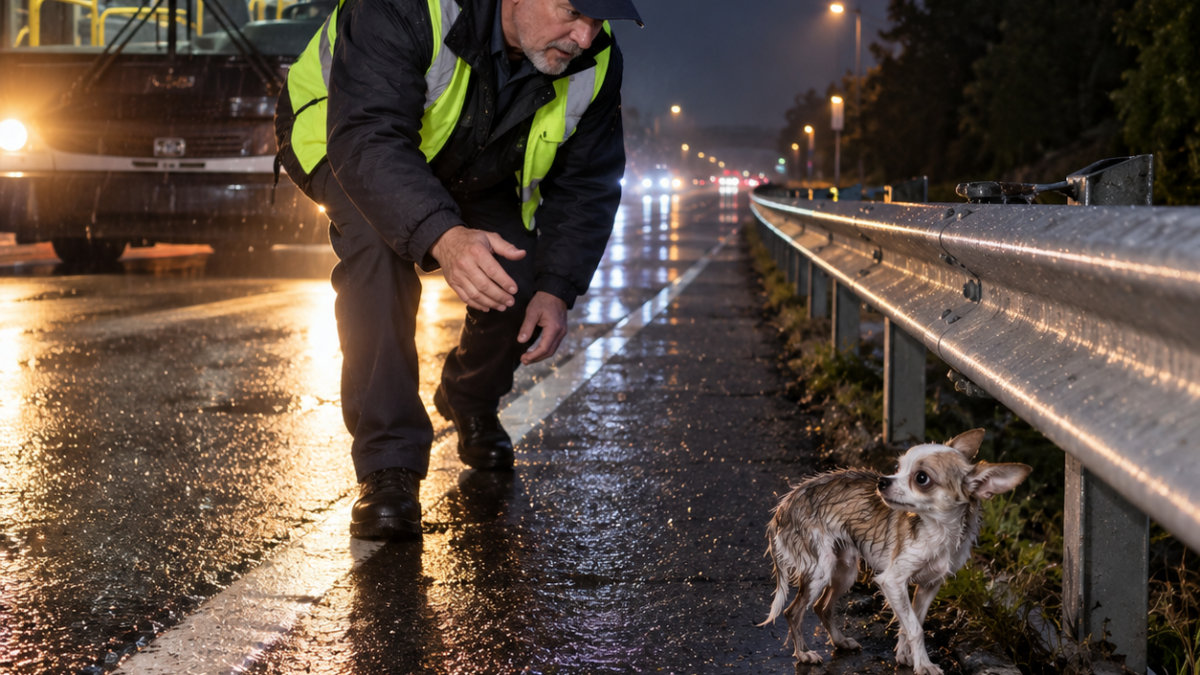
I pushed my arm farther into the drainage pipe until my shoulder pressed against the concrete rim.
The mother Chihuahua stood so close beside me that her wet fur brushed my cheek.
“Come on,” I whispered.
My fingertips touched something warm and trembling.
The first puppy.
I curled my hand gently around its tiny body and slowly pulled it toward me.
It weighed almost nothing.
When I brought it into the light, I could see every rib beneath its soaked tan coat.
Its eyes were only partly open, and its little paws flexed weakly against my palm.
The mother immediately leaned forward.
She sniffed the puppy from nose to tail, then began licking its face with frantic little strokes.
“Okay,” I said.
“One.”
I opened my rain jacket and tucked the puppy against the dry lining near my chest.
The mother watched closely.
For a second I worried she might panic when the puppy disappeared beneath my jacket.
Instead, she looked back toward the pipe.
There were still four inside.
I lay down again.
The ground was cold enough that I could feel it through my uniform pants.
Rainwater ran beneath my collar and down my back.
The second puppy was farther in, wedged partly behind the first.
I stretched until my shoulder protested.
My fingers caught one tiny back leg.
I stopped immediately.
I didn’t want to drag it.
I shifted my arm and reached farther until I could support its chest.
“Easy.”
The puppy squeaked when I lifted it.
The mother Chihuahua made a sound I had never heard from a dog before.
It was almost a sob.
Not quite a whine.
Not quite a bark.
Just one breathy noise as she watched me bring her baby out of the pipe.
She inspected the second puppy just as carefully as the first.
Then she touched her nose to my wrist.
I didn’t think anything of it at the time.
Later, I would remember that moment more clearly than almost anything else.
It was the first time she touched me voluntarily.
I tucked the second puppy inside my jacket.
Two.
The third was easier.
It had crawled closer while I was working.
When my hand reached it, the puppy tried to climb toward me.
Its claws were so tiny I could barely feel them against my skin.
Three.
The fourth was curled against the side of the pipe.
I had to flatten myself completely in the mud to reach it.
My cheek was against the concrete.
My arm disappeared almost to the shoulder.
Behind me, the mother paced in tight circles.
Every time a truck passed above us, the pipe vibrated.
The puppies seemed to feel it too.
The fourth one began crying.
That cry was stronger than the others.
For the first time that night, I felt hopeful.
I caught the puppy under its chest and slid it slowly toward the opening.
Four.
I placed all four puppies inside the front of my jacket and zipped it halfway.
There was barely enough room.
Tiny bodies shifted against my shirt.
One puppy rooted blindly at the fabric.
Another rested its chin on my chest.
The mother stood on her hind legs and tried to look inside.
“They’re here,” I told her.
“They’re okay.”
But both of us knew one was missing.
I picked up my phone again and aimed the flashlight inside.
The fifth puppy was nearly twice as far back as the others had been.
It was lying near a shallow curve in the drainage pipe where leaves and small branches had collected.
Water slipped around its body.
It wasn’t moving.
I stared at it.
“No.”
The mother Chihuahua suddenly pushed her head into the pipe.
She tried to crawl inside.
I caught her gently around the chest.
“No, sweetheart.”
She struggled against me.
I could feel every bone beneath her skin.
“You won’t fit.”
She pulled forward again.
The pipe narrowed just beyond the entrance.
Even if she managed to squeeze through, she might become trapped herself.
I held her for another second.
Then she stopped struggling.
She looked directly at me.
People sometimes say animals can speak with their eyes.
I used to think that was something people said because they wanted animals to be more human than they were.
That night changed my mind.
There was no misunderstanding the look that Chihuahua gave me.
Her puppy was inside.
She could not reach it.
I could.
That was all that mattered.
“I know,” I said.
“I’m going.”
I removed the four puppies from inside my jacket and placed them carefully on the driest patch of ground I could find beneath the overhang of the embankment.
Then I took off the jacket completely and folded it around them.
The mother hurried over.
She climbed partly onto the jacket and curled her body around the puppies.
They immediately pressed against her belly.
She began licking them.
I took one look at them before turning back toward the pipe.
The water was higher.
Not dramatically higher.
Maybe half an inch.
But it was enough to make me nervous.
Rain had been falling for hours.
Every drainage ditch in the area was feeding somewhere.
If the water rose quickly, the puppy wouldn’t have much time.
I lay on my stomach again.
This time I shoved my right arm as far as it would go.
Nothing.
My fingertips were still several inches short.
I pulled back.
There had to be another way.
I ran toward the bus.
Mud splashed up the legs of my uniform.
I climbed inside and started searching.
City buses are not exactly stocked for animal rescues.
I had a flashlight.
A small emergency kit.
A reflective vest.
A first-aid pouch.
A short maintenance pole used for checking things during breakdowns.
An old towel I kept beneath the driver’s seat.
And a collapsible umbrella that had been broken for months.
I stared at the umbrella.
Then at the maintenance pole.
Neither would let me safely hook a puppy.
I needed to reach it without dragging or injuring it.
I grabbed the flashlight and towel.
Then I noticed the long-handled ice scraper stored behind my seat.
It was September.
The scraper had been sitting there since the previous winter.
The handle extended nearly three feet.
The plastic blade at the end was wide and smooth.
I carried it back toward the pipe.
The mother was exactly where I had left her.
All four puppies were pressed against her body.
She looked up when I approached.
“I have an idea.”
I wasn’t sure if it was a good one.
I lay down and pushed the scraper handle inside the pipe, blade first.
Using the flashlight, I slowly guided it along the concrete.
The blade reached the puppy.
I positioned it behind the tiny body.
Then I pulled very gently.
The puppy moved perhaps two inches.
I stopped.
It still wasn’t responding.
I adjusted the blade.
Another few inches.
Then it slipped sideways.
My heart stopped.
The puppy rolled onto its back.
I immediately pushed the scraper away.
“No, no, no.”
I could hear my own breathing echoing inside the pipe.
The mother Chihuahua stood behind me.
She did not bark.
She did not whine.
She simply waited.
I tried again.
This time I used the scraper like a tiny sled, sliding the blade beneath the puppy instead of pushing from behind.
It took several attempts.
My hands were shaking so badly that I had to stop twice and steady myself.
Eventually the puppy’s chest rested partly on the blade.
I tilted the handle slightly.
Slowly, inch by inch, I drew it toward me.
Halfway out, the puppy slipped again.
But now it was close enough.
I dropped the scraper.
I reached into the pipe with both hands.
My fingers closed around a tiny wet body.
I pulled.
The puppy came free.
For one terrible second, it felt completely limp.
I rolled onto my back with the puppy against my chest.
The mother ran toward me.
“Come on.”
I rubbed the puppy gently with both hands.
Its coat was almost black with mud.
It was smaller than the others.
Much smaller.
I wiped its nose.
Nothing.
I rubbed again.
“Come on, little guy.”
The mother Chihuahua climbed onto my legs.
She sniffed the puppy.
Then she licked its face.
Once.
Twice.
Again.
The puppy’s mouth opened.
A bubble of water appeared near its nose.
I turned it slightly downward, supporting its head and neck.
A tiny cough came out.
Then another.
The mother froze.
The puppy took one shallow breath.
Then it cried.
It was not a strong sound.
It was barely more than a squeak.
But I started laughing.
Actually laughing.
Sitting in the mud beside an interstate at almost two in the morning, soaked through my clothes, holding a half-frozen Chihuahua puppy, I laughed like something wonderful had happened.
Because something wonderful had.
The mother licked the puppy so fast her whole head moved.
“Yeah,” I said.
“I know.”
My voice cracked.
“I know.”
I put the fifth puppy beside the others inside my jacket.
The mother immediately curled herself around all five.
She was shaking harder now.
At first I thought it was cold.
Then I realized she was exhausted.
Whatever strength had kept her running beside that highway had finally run out.
She laid her chin across the edge of my jacket.
Her eyes closed.
I sat beside her and looked toward the highway.
My bus was visible through the rain, hazard lights still flashing.
For a few minutes, I did nothing.
I just sat there.
Five Chihuahua puppies were alive because their mother had somehow understood that the enormous machine passing on the highway contained a person.
And that if she could make that person stop, maybe he would follow her.
I still don’t know how long she had been trying.
There were tire tracks along the wet shoulder.
Maybe she had chased other cars.
Maybe drivers had slowed and kept going.
Maybe nobody had noticed her.
I imagined that tiny Chihuahua standing beside headlights again and again while her puppies cried beneath the road.
The thought made my throat tighten.
I pulled out my phone.
The screen was wet enough that I had to wipe it on my shirt.
I called the county animal rescue number.
A tired woman answered after several rings.
“Emergency animal services.”
“My name is James.”
I looked at the mother and puppies.
“I’m a city bus driver, and I’ve got a Chihuahua and five puppies near Highway 17.”
The woman became more alert immediately.
“Are they injured?”
“I don’t know.”
“They’re freezing.”
I looked at the smallest puppy.
“One was in water.”
“Are the puppies breathing?”
“Yes.”
“The mother?”
“Yes, but she’s extremely thin.”
The woman asked for my location.
I gave her the nearest mile marker.
“We have a rescue technician coming from the north side,” she said.
“Probably twenty minutes.”
I checked the drainage ditch.
“Water is rising.”
“Can you move them somewhere dry?”
I looked toward the bus.
“Yes.”
“If the mother allows it, get them out of the rain.”
That sounded simple.
It wasn’t.
The mother Chihuahua might trust me enough to retrieve her puppies.
That did not mean she would let me carry them away.
I stood slowly.
Her eyes opened.
“Okay, mama.”
The word came out without thinking.
“We’re going to the bus.”
I reached toward the jacket.
She stood immediately.
Not aggressive.
Alert.
I paused.
“I’m taking them with us.”
She stared at my hands.
Then she looked toward the highway.
I lifted the jacket like a sling, keeping all five puppies bundled together.
The mother walked beside me.
Every few feet she jumped up to check them.
“Still here,” I told her.
We climbed the embankment.
The highway shoulder felt strangely bright after the darkness near the pipe.
My bus looked enormous.
The mother Chihuahua stopped at the folding door.
She stared at the steps.
I stepped inside and placed the bundled puppies on the lower platform.
Then I backed away.
“Come on.”
She remained outside.
The bus engine hummed.
Rain drummed on the roof.
She looked at the puppies.
Then at me.
Finally she placed one paw on the first step.
Then another.
She climbed slowly.
The moment she reached the platform, she rushed to the puppies.
I closed the door.
For the first time since I had seen her, she was dry.
I turned up the heat.
City buses are not famous for being cozy, but that bus suddenly felt like the safest place in the world.
I spread the old towel on the floor behind the driver’s barrier.
Then I transferred the puppies onto it.
The mother followed every movement.
When I finished, she stepped into the middle of the towel and circled twice.
Then she collapsed onto her side.
The puppies crawled toward her.
One by one they found her belly.
The mother closed her eyes.
I sat on the floor a few feet away.
Under the bright interior lights, I could finally see her clearly.
She was even thinner than I had realized.
Her hip bones protruded sharply.
There were small cuts on two paws.
One ear had a healed notch near the tip.
Her pink collar was old and frayed.
A brass ring hung from it, but whatever tag had once been attached was gone.
I wondered whose dog she had been.
A Chihuahua does not usually end up beside a highway by accident.
Someone had fed her once.
Someone had put that collar around her neck.
Someone had probably held her small enough to fit in one hand when she was a puppy.
Now she was lying on the floor of an empty city bus, so underweight that I could count every rib.
I wanted to be angry.
But I didn’t know the story.
Maybe she had escaped.
Maybe someone had lost her.
Maybe something had happened to her owner.
Maybe she had been abandoned.
All I knew was what was in front of me.
I opened my first-aid kit and found a foil emergency blanket.
The mother lifted her head when it crackled.
“It’s ugly,” I said.
“But it’s warm.”
I laid it over part of the towel, leaving enough space so she could move away from it.
She didn’t.
I found a bottle of water and poured some into a clean plastic container from my lunch bag.
The Chihuahua sniffed it.
She drank too quickly.
I pulled the bowl back.
“Slow.”
She looked offended.
“You can have more.”
I waited thirty seconds and offered it again.
She drank.
Then she returned immediately to the puppies.
A few minutes later, she placed her chin on the floor.
Her eyes were open but unfocused.
“Stay with me, mama.”
Her eyes shifted toward my voice.
I didn’t know her name.
So I kept calling her that.
Mama.
The rescue vehicle arrived seventeen minutes later.
I know because I watched the clock the entire time.
A white SUV pulled behind the bus with amber lights flashing.
A woman in a dark waterproof jacket stepped out carrying a large plastic crate.
Another man followed with blankets and a medical bag.
I opened the bus door.
“James?”
“That’s me.”
“I’m Elena.”
She climbed aboard.
The moment Elena saw the Chihuahua, her expression changed.
“Oh, sweetheart.”
Mama lifted her head.
Her body tensed.
Elena stopped moving.
“She’s scared,” I said.
“She led me to the puppies.”
Elena looked at me.
“Led you?”
I explained quickly.
Highway.
Drainage pipe.
Five puppies.
Rising water.
Elena listened while keeping her eyes on the dog.
“You pulled all five out?”
“Yes.”
She looked down at my uniform.
Mud covered me from chest to knees.
“I guess that explains you.”
I laughed once.
“Probably.”
Elena crouched several feet away.
She did not reach for the Chihuahua.
Instead she placed a soft blanket on the floor.
“Hi, mama.”
The little dog watched her.
Elena looked at the puppies.
“How old do you think they are?” I asked.
“Three weeks, maybe four.”
“That young?”
“Could be.”
She pointed gently.
“Eyes are open, but they’re still very dependent on her.”
The smallest puppy made a noise.
Elena’s attention shifted immediately.
“That one was in water?”
“Yes.”
“We need to get them to the clinic.”
Her partner, Marcus, brought the crate closer.
Elena lined it with blankets.
Then she looked at me.
“She trusts you.”
“I think she trusts the puppies being near me.”
“Good enough.”
She handed me one side of the blanket.
“Can you help?”
Together, we moved all five puppies into the crate.
Mama stood.
She became anxious the second the puppies were inside.
I expected her to bark.
Instead she jumped directly into the crate after them.
Elena smiled.
“That solves that.”
Mama turned twice, curled around the puppies, and stared out through the crate door.
I crouched beside her.
“Go with them.”
Her nose touched the wire.
“You’re okay now.”
I’m not sure why I said it.
I had no idea if she was okay.
But I needed to believe it.
The rescue team carried the crate toward the SUV.
I followed.
Rain was still falling, though lighter now.
Before Elena closed the rear hatch, she turned.
“Do you want the clinic number?”
“Yes.”
She wrote it on the back of a rescue card.
“We’ll check for a microchip.”
I looked at the faded pink collar.
“What happens if she has an owner?”
“We try to contact them.”
“And if she doesn’t?”
“We treat her.”
Elena glanced at the puppies.
“Then we figure out what comes next.”
I nodded.
“Will you call me?”
She studied me for a second.
“You really want to know?”
“Yes.”
She smiled.
“I’ll make sure someone calls.”
The SUV pulled away.
I stood on the shoulder holding the little card.
For the first time all night, I noticed how quiet everything was.
I climbed back onto the bus.
The towel was still on the floor.
There were tiny wet paw prints across it.
One of the puppies had left a smear of mud near the seat base.
I stared at it longer than I should have.
Then I returned to the driver’s seat.
The depot supervisor was going to ask why I was nearly an hour late.
I rehearsed several explanations.
None sounded believable.
A Chihuahua stopped my bus and led me to five puppies trapped beneath the highway.
It sounded like something someone would invent after falling asleep in a parking lot.
I called dispatch.
“Depot.”
“It’s James on 412.”
“Where are you?”
“Highway 17.”
“You should’ve been here thirty-five minutes ago.”
“I know.”
“What happened?”
I looked toward the drainage ditch.
“There was a dog.”
Silence.
“A dog.”
“Yes.”
Another pause.
“Is the bus damaged?”
“No.”
“Are you damaged?”
I looked down at the mud.
“Not exactly.”
My supervisor, Dennis, sighed.
“James.”
“There were puppies in a drainage pipe.”
Longer silence.
Then he said, “Of course there were.”
“I’m serious.”
“I know you are.”
“How?”
“Because nobody could make that up at two in the morning.”
When I finally reached the depot, Dennis was standing outside the office.
He took one look at me.
“You look like you crawled under the highway.”
“I did.”
He stared.
“Literally?”
“Pretty much.”
He shook his head.
“Go home.”
I started toward my car.
“James.”
I turned.
Dennis pointed toward my uniform.
“You know the company charges for replacement shirts.”
I looked at him.
He managed to hold a straight face for two seconds.
Then he laughed.
“Go home.”
I drove back to my apartment just after three.
I stood beneath the shower until the water stopped running brown around my feet.
I should have gone straight to bed.
Instead I sat at my kitchen table with Elena’s rescue card in front of me.
The clinic opened for public calls at seven.
I watched the clock.
At 6:58, I made coffee.
At 7:01, I called.
A receptionist answered.
I gave her the case number Elena had written on the card.
“One moment.”
I heard typing.
Then her tone softened.
“Oh.”
My stomach tightened.
“What?”
“The mother and puppies made it through the night.”
I exhaled.
I hadn’t realized I was holding my breath.
“All of them?”
“All six.”
I closed my eyes.
“The smallest puppy is still being monitored closely.”
“What’s wrong?”
“Low body temperature, dehydration, and possible aspiration from the water.”
“Is he going to make it?”
“I can’t promise that.”
The answer hurt more than I expected.
“But he’s stable right now.”
“Can I visit?”
There was a pause.
“Are you the finder?”
“Yes.”
“Let me ask.”
She put me on hold.
Two minutes later, she returned.
“You can come after ten.”
I arrived at 9:47.
The rescue clinic occupied a low brick building behind the county shelter.
I sat in my car until ten exactly.
Then I walked inside.
A woman at reception recognized the case number.
“You’re the bus driver.”
Apparently word had traveled.
“That’s me.”
She smiled.
“Elena told us.”
I wasn’t sure what Elena had told them.
Probably that a muddy man had carried five puppies onto a city bus at two in the morning.
A veterinary technician named Rachel met me at the door.
“Come on.”
She led me through a hallway.
The clinic smelled like disinfectant, wet fur, and laundry detergent.
Dogs barked behind closed doors.
A cat hissed somewhere.
We stopped outside a treatment room.
“Before you go in,” Rachel said, “I should tell you she’s doing better than she looked last night.”
“The mother?”
“Yes.”
“And the puppies?”
“Four are responding well.”
“The fifth?”
Rachel hesitated.
“He’s fighting.”
That was not the answer I wanted.
But it was something.
She opened the door.
Mama was lying inside a large recovery kennel on a pile of clean blankets.
For a second I barely recognized her.
Her coat had dried.
She was a tiny cream-and-tan Chihuahua with enormous dark eyes and ears that seemed too large for her thin face.
Without the rain flattening her fur, she looked younger.
Not old at all.
Maybe three or four.
Four puppies were nursing.
The smallest lay inside a clear warming unit beside the kennel.
A thin tube supplied oxygen.
I stepped closer.
Mama’s head lifted.
Her ears rose.
She stared at me.
Then her tail moved.
Just once.
A small thump against the blanket.
I smiled.
“Hey.”
Her tail moved again.
Rachel looked at me.
“Well.”
“What?”
“She hasn’t done that for anybody yet.”
I crouched beside the kennel.
Mama stood carefully.
The puppies complained as she shifted.
She walked toward the door.
Rachel opened it.
The Chihuahua came straight to me.
No hesitation.
She placed both front paws on my knee.
Then she pressed her forehead against my hand.
I swallowed.
“Good morning.”
Her tail wagged faster.
Rachel leaned against the counter.
“I guess you made an impression.”
“I think she remembers the jacket.”
“I think she remembers more than that.”
Mama sniffed my sleeves.
My uniform was clean now.
No mud.
No rain.
No puppies hidden inside.
Still, she stayed close.
“What’s her name?” I asked.
“No chip.”
Rachel glanced at the chart.
“No tag.”
“So you don’t know.”
“Not yet.”
I looked at the faded pink collar hanging from a labeled plastic bag near the counter.
They had removed it during examination.
Without it, she looked even smaller.
“Can she keep that?”
“The collar?”
“Yes.”
“If it’s safe.”
Rachel picked up the bag.
“It’s worn out.”
“I know.”
There was something about it.
Evidence of a life before the highway.
Whatever had happened, someone had once chosen pink for her.
Someone had once fastened that collar around her neck.
Rachel seemed to understand.
“We’ll keep it with her belongings.”
I looked toward the warming unit.
The smallest puppy barely moved.
“Can she see him?”
“We’ve been putting him back with her for short periods.”
“Does she know he’s there?”
Rachel smiled sadly.
“She definitely knows.”
As if to prove it, Mama left my knee and walked toward the warming unit.
She stood beneath it.
She stared through the clear wall.
The tiny puppy shifted.
Mama whined.
A very quiet sound.
Rachel opened the incubator and lifted him carefully.
“We can give him a few minutes.”
She placed the puppy beside his mother.
Mama immediately curled around him.
She licked his head.
The puppy moved weakly toward her.
Rachel watched his breathing.
“Good boy.”
I sat on the floor.
For ten minutes, none of us spoke.
There are moments when conversation only makes things smaller.
That was one of them.
Before leaving, I asked what would happen next.
Rachel explained that the puppies needed several weeks before they could be adopted.
Mama needed weight, rest, parasite treatment, vaccinations, and time.
“She’s been nursing five puppies while barely eating enough for herself,” Rachel said.
“How bad is she?”
“Eleven pounds would be heavy for some Chihuahuas.”
She looked at the chart.
“She’s just under five.”
I stared at Mama.
Five pounds.
Five puppies.
Somehow she had kept them alive.
“How?”
Rachel understood the question.
“Animals can be remarkably resilient.”
“That’s not what I mean.”
“I know.”
She leaned against the kennel.
“She gave them everything she had.”
That sentence followed me home.
She gave them everything she had.
For the next four days, I called the clinic every morning.
The smallest puppy became “Five” in my head.
Not because I thought that should be his name.
Because he had been the fifth puppy I pulled from the pipe.
The one farthest back.
The one who had stopped crying.
Day one, Five needed oxygen.
Day two, he was breathing better.
Day three, he nursed without assistance for nearly five minutes.
Day four, Rachel told me he had gained almost an ounce.
An ounce.
I celebrated an ounce.
I told Dennis at the depot.
“The tiny one gained an ounce.”
Dennis looked up from a maintenance report.
“Is that good?”
“Apparently.”
He nodded seriously.
“Then congratulations on the ounce.”
Word spread among the drivers.
For the rest of the week, people I barely knew stopped me.
“How are the highway dogs?”
“They’re Chihuahuas,” I would correct them.
“How are the highway Chihuahuas?”
“Better.”
Someone taped a small paper bag to my locker.
Inside were two clean towels and a note.
FOR THE BUS DOGS.
No name.
Another driver left a pack of puppy pads.
Someone else bought a soft blanket.
I took everything to the shelter.
Mama recognized me every time.
The first visit, she wagged her tail.
The second, she ran to the kennel door.
The third, she climbed into my lap and fell asleep.
That was when Rachel said, “We need a name.”
I looked down at the Chihuahua curled against my stomach.
“You name them.”
“We’ve been waiting for you.”
“Why?”
“You found them.”
“She found me.”
Rachel smiled.
“Then maybe you owe her one.”
I studied the little dog.
Her ears twitched in her sleep.
The faded pink collar sat on a shelf above the kennel.
I thought about rain.
Highway lights.
The way she had kept looking back.
“How about Rosie?”
Rachel considered it.
“Rosie.”
The Chihuahua opened one eye.
“That wasn’t a vote,” I told her.
Her tail tapped my leg.
Rachel laughed.
“I think it was.”
So she became Rosie.
The puppies were temporarily named Pepper, Bean, Cricket, Scout, and Milo.
Five became Milo.
He was the smallest.
By the end of the first week, he no longer needed oxygen.
The first time I saw him outside the warming unit for an entire visit, he was sleeping across Rosie’s front legs.
“You made it,” I whispered.
Milo opened one eye.
Then he yawned.
Rosie licked the top of his head.
Over the next two weeks, the puppies changed almost daily.
At first they mostly slept and ate.
Then they started wobbling.
Five tiny Chihuahua puppies learning to walk is one of the funniest things I have ever seen.
They would stand with absolute confidence, take three steps, and fall sideways.
Scout was the boldest.
He climbed over everyone.
Bean liked sleeping beneath Rosie’s chin.
Pepper barked at things she didn’t understand.
Cricket discovered my shoelaces.
Milo remained smaller than the others, but he followed them everywhere.
Rosie watched constantly.
If one puppy wandered too far, she retrieved it.
If two wrestled too roughly, she stepped between them.
If someone entered the room, she placed herself between that person and the litter.
Except with me.
When I entered, Rosie would leave the puppies and come directly to the kennel door.
At first that made me feel special.
Then one afternoon Rachel said something that complicated it.
“She might expect you to take her.”
I looked at Rosie.
“What?”
“You’re her safe person.”
“I visit.”
“I know.”
“She’ll be adopted.”
“I know.”
The way Rachel said it made me uncomfortable.
I lived alone in a second-floor apartment.
My shifts changed constantly.
Some weeks I worked evenings.
Others I started before sunrise.
Dogs need routines.
A Chihuahua might be small, but small does not mean effortless.
Rosie also deserved more than a man who disappeared for ten-hour shifts.
“I’m not the right home,” I said.
Rachel nodded.
“I didn’t say you were.”
“Then why say it?”
“Because you should be prepared.”
“For what?”
“She may be attached to you.”
I looked through the kennel door.
Rosie was sitting beside my shoe.
Her entire body could have fit inside my work bag.
“I’m attached too,” I admitted.
“That’s the harder part.”
The shelter began searching for Rosie’s previous owner.
They posted her photo.
They checked lost-dog reports from nearby counties.
They contacted clinics.
No one came forward.
Her pink collar had no identifying marks.
No microchip.
No tattoo.
Nothing.
For ten days, I found myself imagining someone walking into the shelter.
A crying family.
A relieved child.
Someone saying Rosie had escaped weeks earlier.
Part of me wanted that.
If she had been loved, maybe she could go home.
Another part of me remembered her weight.
Five pounds.
The cuts on her paws.
The empty collar ring.
The way she had been running beside traffic.
Whatever her story was, it did not come looking for her.
After the legal stray period ended, Rosie officially became available for rescue placement.
The puppies were still too young.
Rosie would remain with them until they were fully weaned.
Then the adoption process would begin.
Rachel explained this to me while I sat in the puppy room.
Cricket was chewing my sleeve.
Pepper had fallen asleep on my shoe.
Milo was attempting to climb into my lap and failing spectacularly.
Rosie lay beside me.
Her ribs were less visible now.
She had gained almost two pounds.
Her coat had developed a shine.
Her eyes looked different too.
The first night, those eyes had been enormous with fear.
Now she watched things.
She investigated sounds.
She sometimes played.
One afternoon I saw her chase a soft rubber ball.
She caught it.
Then seemed surprised by what she had done.
She looked at me.
I threw it again.
Rosie ran after it.
That was the first time I saw her behave like a dog who had nothing urgent to worry about.
No highway.
No drainage pipe.
No hungry puppies.
Just a ball.
It affected me more than I expected.
A month after the rescue, the puppies were moved with Rosie into a foster home.
The shelter needed kennel space, and a volunteer named Marcy specialized in nursing mothers and small breeds.
I worried Rosie would struggle.
Rachel told me not to.
“She needs a house again.”
“Do we know she ever had one?”
Rachel pointed to the faded pink collar.
“Somebody put that on her.”
Marcy invited me to visit.
Her house sat on a quiet street with a fenced backyard.
When I arrived, five Chihuahua puppies exploded out of a playpen.
Exploded might be generous.
They ran about six feet before colliding with one another.
Rosie came behind them.
When she saw me, she froze.
Then she sprinted.
I had never seen her run toward anything with that much joy.
She launched herself at my legs.
I caught her.
“Hey, Rosie.”
She licked my chin.
Marcy laughed.
“Oh, so you’re James.”
“I guess.”
“I was wondering who she was waiting for.”
“What do you mean?”
“For the first two days, every time a car stopped outside, she went to the window.”
I looked at Rosie.
“That could be anybody.”
“No.”
Marcy smiled.
“It was somebody.”
Rosie pressed herself against my chest.
I sat on the floor.
The puppies surrounded me.
For the next hour, I became furniture.
They climbed my legs.
Bit my shoelaces.
Crawled beneath my arms.
Milo eventually fell asleep inside the bend of my elbow.
Marcy brought coffee.
“I heard about the pipe.”
“Everybody has.”
“Elena tells the story.”
“I’m sure she improves it every time.”
“She says you crawled halfway inside.”
“I did not.”
Marcy raised an eyebrow.
“Quarterway.”
“That sounds less heroic.”
“Good.”
I sipped the coffee.
“I’m a bus driver.”
Marcy looked at Rosie.
“Not to her.”
I didn’t respond.
The puppies became eligible for adoption two weeks later.
Applications came quickly.
Chihuahua puppies are easy to place.
People see small faces, oversized ears, tiny paws.
They imagine carrying them in sweaters and taking photos on couches.
The shelter screened applicants carefully.
The staff made sure people understood these were living animals, not accessories.
Pepper went first.
A retired woman named Linda had recently lost her seventeen-year-old Chihuahua.
She sat on the floor and waited.
Pepper climbed into her lap.
Linda started crying.
Pepper licked the tears from her chin.
That was that.
Scout went to a young couple who worked from home.
Cricket went to a family with another small dog.
Bean was adopted by a veterinary assistant.
Milo took longer.
Not because nobody wanted him.
Because Rachel was protective.
“He almost drowned,” she told every applicant.
“He was underweight.”
“He may always be small.”
One couple seemed perfect on paper.
Then the man said, “We want one that stays tiny.”
Rachel ended the meeting within five minutes.
Milo eventually met a quiet school librarian named Anne and her husband, Patrick.
They had no children.
They had a fenced patio.
Their previous Chihuahua had lived to eighteen.
Anne sat beside Milo without touching him.
Milo sniffed her hand.
Then he climbed onto her shoe.
Patrick laughed.
“He picked you.”
Anne looked at Rachel.
“Can we come back tomorrow?”
Rachel was surprised.
“You don’t want to take him today?”
“I want to buy the right food.”
She looked at Milo.
“And a bed he can climb into safely.”
Rachel approved them.
I happened to be there the afternoon Milo left.
I didn’t plan it.
At least that’s what I told myself.
Anne carried him in a soft gray blanket.
Before she reached the door, she stopped beside Rosie.
Rosie sniffed her puppy.
Milo licked her nose.
Rosie stood very still.
Then she stepped back.
Anne looked at me.
“Does she understand?”
“I don’t know.”
I had learned not to pretend I knew everything dogs understood.
“But I think she knows he’s safe.”
Milo left.
Rosie watched the door for almost a minute.
Then she walked to the empty puppy pen.
She sniffed the blankets.
Every puppy was gone.
For the first time since the highway, she had no babies beside her.
That night, Marcy called me.
“She’s looking for them.”
I sat on the edge of my bed.
“Is she okay?”
“She will be.”
“Should I come?”
There was a pause.
“If you want.”
I was already putting on my shoes.
Rosie was sitting beside the puppy pen when I arrived.
The house felt strangely quiet.
For weeks, there had always been squeaks, tiny footsteps, toys sliding across floors.
Now the pen was empty.
Rosie walked inside it.
She sniffed each corner.
Then she came back out.
I sat beside her.
“Yeah.”
I rubbed her chest.
“I miss them too.”
She rested her head on my leg.
Marcy sat across the room.
“She was a good mother.”
“The best.”
“She can be Rosie now.”
I looked down.
“What does that mean?”
“For weeks, everything she did was about keeping five puppies alive.”
Marcy smiled.
“Now she gets to figure out who she is without them.”
That idea stayed with me.
Who was Rosie when she wasn’t somebody’s mother?
Over the next week, I started to find out.
She liked sunbeams.
She hated vacuum cleaners.
She would carry a tennis ball even though it was almost too large for her mouth.
She liked scrambled egg but refused carrots.
She barked at delivery trucks.
She slept completely buried beneath blankets.
She was suspicious of men wearing hats.
She adored Marcy’s elderly neighbor.
And whenever I visited, Rosie wanted to sit directly beside me.
The shelter posted her adoption profile.
Her photo showed a healthy little Chihuahua sitting on a blue blanket.
No ribs.
Bright eyes.
Huge ears.
The description mentioned that she had raised five puppies.
It did not mention the entire highway story.
Rachel said they didn’t want people adopting an idea.
They wanted someone adopting Rosie.
Applications arrived.
Some were rejected.
Some people had young children who were too rough with small dogs.
One applicant worked fourteen-hour days.
Another wanted an outdoor dog.
Rachel stared at that application for several seconds.
“She weighs seven pounds.”
“I know.”
“What outdoor job do they think she’s applying for?”
I laughed.
The first serious family came on a Saturday.
A couple in their thirties.
Nice people.
Quiet house.
Good references.
Rosie met them in the shelter visiting room.
They sat on the floor.
Rosie sniffed them.
Accepted treats.
Allowed the woman to pet her.
Everything went well.
Then the couple stood to leave.
Rosie ran to me.
She pressed against my leg.
The woman smiled.
“She really loves you.”
I didn’t know what to say.
They decided not to adopt her.
“She’s already chosen somebody,” the woman told Rachel.
I heard about it later.
“That’s ridiculous,” I said.
Rachel looked at me.
“Is it?”
“Yes.”
“You were there.”
“She knows me.”
“Exactly.”
“I can’t adopt her.”
“Then eventually she’ll bond with somebody else.”
The words felt harsher than Rachel intended.
I went home irritated.
Not at Rachel.
At myself.
I opened my apartment door and looked around.
One bedroom.
Small kitchen.
Small living room.
No yard.
Second floor.
My schedule was taped beside the refrigerator.
Late shift four days.
Early shift two days.
I imagined Rosie waiting alone.
I imagined missing walks.
I imagined her barking while I was gone and my downstairs neighbor complaining.
I imagined something going wrong.
Then I imagined her sitting beside someone else.
That bothered me too.
I called my sister, Claire.
She answered immediately.
“Are you adopting the highway Chihuahua?”
“Hello to you too.”
“That’s a yes.”
“No.”
“Then why are you calling?”
“I didn’t say I was.”
“You have talked about this dog for five weeks.”
“She has a name.”
“Exactly.”
I sighed.
“Rosie.”
“I know her name, James.”
“How?”
“You sent me fourteen photos.”
“Did I?”
“Fourteen.”
Claire had two kids and a dog of her own.
She understood animals better than I did.
“I work too much.”
“So do many people.”
“My apartment is small.”
“She’s a Chihuahua.”
“That doesn’t mean she doesn’t need space.”
“It means your apartment is not the main issue.”
“What is?”
“You’re scared.”
I stood.
“Of what?”
“That you’ll get attached.”
“I am attached.”
“More attached.”
“That makes no sense.”
“It makes perfect sense.”
I didn’t like the conversation anymore.
Claire continued.
“You found her during the worst night of her life.”
“That doesn’t mean I’m supposed to keep her.”
“No.”
Claire’s voice softened.
“It doesn’t.”
That surprised me.
“I thought you were pushing me.”
“I’m pushing you to be honest.”
“About what?”
“Whether saying no is best for Rosie or easiest for you.”
I sat down again.
The apartment was very quiet.
“I don’t know.”
“That’s the honest answer.”
The next day, I asked Dennis about schedules.
He looked suspicious.
“You want regular shifts?”
“Maybe.”
“You’ve complained about regular shifts for six years.”
“I know.”
“What happened?”
“Nothing.”
He stared at me.
“The dog.”
I didn’t answer.
Dennis smiled.
“The dog.”
“Could I get mostly afternoons?”
“You trying to adopt her?”
“I’m asking about scheduling.”
“That means yes.”
“It means I’m considering options.”
Dennis leaned back.
“We can probably move things around next bid.”
“How long?”
“Three weeks.”
That was not an answer to my real question.
Three weeks was a long time when a dog was available for adoption.
I drove to Marcy’s after work.
Rosie ran to the door.
I sat with her in the backyard.
The rain from that first night felt like something from another life.
It was warm now.
Rosie lay in the grass.
Her pink collar had been replaced with a soft red one.
The original collar was still kept with her shelter belongings.
I watched her roll onto her back.
Then she sneezed.
I laughed.
“What am I supposed to do with you?”
Rosie stared at me upside down.
Marcy came outside carrying two glasses of iced tea.
“You know,” she said, “there’s a possibility nobody tells you about.”
“What?”
“You don’t have to adopt her just because you rescued her.”
“I know.”
“And you don’t have to refuse just because you think rescuers aren’t allowed to become adopters.”
I looked at Rosie.
Marcy sat beside me.
“The right question is boring.”
“What’s that?”
“Can you give her a stable life?”
“I work.”
“So do I.”
“I don’t have a yard.”
“She uses a leash.”
“She might be alone.”
“Hire a walker on long shifts.”
I looked at Marcy.
“You make everything sound simple.”
“No.”
She took a drink.
“I make it sound solvable.”
That night, I filled out an adoption application.
I completed every section.
Name.
Address.
Employer.
Work schedule.
Landlord permission.
Veterinary reference.
I reached the final question.
Why do you want to adopt this animal?
I stared at the blank box.
Because she stopped my bus.
Too sentimental.
Because I rescued her.
Too much about me.
Because she trusts me.
Not enough.
Finally I wrote:
Because I know what she has survived, I know what she needs, and I want to give her a home where she never has to search a highway for help again.
I read it twice.
Then I closed the browser without submitting it.
The next morning, Rachel called.
“We have another application.”
My stomach dropped.
“For Rosie?”
“Yes.”
“Good.”
The word came out too quickly.
Rachel noticed.
“It looks promising.”
“That’s good.”
“They’re coming tomorrow.”
“Okay.”
“James.”
“What?”
“If you want her, you need to decide.”
I hated that sentence.
Not because Rachel was wrong.
Because she was right.
I spent my entire shift thinking about Rosie.
At every red light.
Every stop.
Every empty seat.
I remembered her in the rain.
But I also remembered Marcy’s words.
Rosie needed to become Rosie.
Not my rescue story.
Not the highway dog.
Not the heroic mother Chihuahua.
Just Rosie.
Maybe the best thing I could do was let someone else give her that life.
After my shift, I opened the adoption form.
I did not submit it.
The next afternoon, I went to the shelter before Rosie’s appointment.
I told myself I only wanted to see her.
Rachel looked at me but did not comment.
Rosie climbed into my lap.
I held her for twenty minutes.
Then a family entered the lobby.
A man named David.
His wife, Karen.
Their twelve-year-old daughter, Nora.
Rachel stood.
“That’s them.”
I felt something twist inside my chest.
Nora saw Rosie.
She didn’t rush forward.
That caught my attention.
Most people did.
Instead, she sat on the floor several feet away.
Rosie watched her.
Nora placed a small treat on the ground.
Then she folded her hands in her lap.
Rosie looked at me.
I didn’t move.
She stepped down from my legs.
She walked toward the treat.
Sniffed.
Ate it.
Nora smiled.
She didn’t touch her.
Rosie moved closer.
Nora stayed still.
Eventually Rosie sniffed her shoe.
Then her knee.
Then her hand.
Nora whispered, “Hi.”
Rosie’s ears lifted.
David and Karen sat nearby.
No one pressured her.
No one tried to pick her up.
For almost fifteen minutes, they simply let Rosie decide what happened.
Then Rosie did something unexpected.
She climbed into Nora’s lap.
Nora looked at her parents.
Her eyes filled with tears.
She still didn’t hug Rosie.
She just let the little Chihuahua settle.
I knew then.
Not because Rosie had forgotten me.
She hadn’t.
Every few minutes she looked toward where I sat.
But she looked comfortable.
Safe.
Curious.
The family asked sensible questions.
What food did Rosie eat?
Did she have separation anxiety?
How was she with other dogs?
Did she bark at night?
Did she need dental care?
Would she tolerate a crate?
What frightened her?
What helped her relax?
They had owned a Chihuahua mix before.
He had died at sixteen.
They had waited nearly a year before considering another dog.
Their yard was fenced.
Karen worked from home three days a week.
David’s mother lived nearby and loved dogs.
Nora came home from school before four.
The more they talked, the quieter I became.
Rachel glanced at me once.
I nodded.
She understood.
The family asked if they could think overnight before making the decision.
That surprised me.
“You don’t have to decide today,” Rachel told them.
David nodded.
“We want to make sure we’re right for her.”
Not whether Rosie was right for them.
Whether they were right for Rosie.
That mattered.
They left.
Rosie ran back to me.
She jumped onto my leg.
I picked her up.
“Well,” Rachel said.
“Don’t.”
“Don’t what?”
“Look at me like that.”
“I’m not.”
“You are.”
Rosie rested her chin on my arm.
I stared at the door.
“They’re good.”
“Yes.”
“Really good.”
“Yes.”
Rachel waited.
I rubbed Rosie’s ear.
“I didn’t submit the application.”
“I know.”
“How?”
“It isn’t in the system.”
“Right.”
Rachel sat beside me.
“You still can.”
I looked at her.
“That family would give her a better setup.”
“Maybe.”
“They have a yard.”
“Rosie doesn’t care about real estate.”
“They’re home more.”
“That matters.”
“Nora loves her.”
“She met her twenty minutes ago.”
“Rosie climbed into her lap.”
“She climbs into your lap.”
“That’s different.”
Rachel smiled faintly.
“Yes.”
I looked down.
Rosie was falling asleep.
“What would you do?”
Rachel shook her head.
“No.”
“What?”
“I’m not making that decision for you.”
“That’s inconvenient.”
“Good.”
The family called the following morning.
They wanted Rosie.
Rachel gave me the news.
I stood beside my bus at the depot.
“When?”
“Saturday.”
Three days.
“All right.”
“You okay?”
“Yes.”
I wasn’t.
But I also was.
Both things could be true.
I visited Rosie every day until Saturday.
I did not act sad around her.
Dogs notice too much.
We played with the ridiculous tennis ball.
We walked around Marcy’s neighborhood.
I let her sleep on my lap.
On Friday evening, Marcy handed me a small plastic bag.
Inside was the faded pink collar.
“What’s this?”
“Her old collar.”
“I know.”
“Shelter was going to send it with her belongings.”
I stared at it.
The nylon was permanently stained.
The metal ring was scratched.
“What should we do with it?”
Marcy asked.
I ran my thumb along the edge.
“Send it with her.”
“You sure?”
“It belongs to her.”
The next morning, I arrived at the shelter before the Carter family.
Rosie was wearing her new red collar.
Her old pink one sat inside a paper bag with her medical records.
There was also a small blanket from her foster home.
A bag of food.
Her favorite rubber ball.
A printed schedule.
Medication.
Everything a normal adopted dog might have.
That normalcy made me strangely emotional.
No dramatic ceremony.
No heroic ending.
Just supplies.
A leash.
A dog.
A family.
The Carters arrived at eleven.
Nora was carrying a small blue blanket.
She stopped when she saw Rosie.
“Hi, Rosie.”
Rosie’s tail moved.
Nora knelt.
Rosie walked to her.
Then she turned and came back to me.
I crouched.
For several seconds, I couldn’t think of anything to say.
I had imagined this moment too many times.
In every version, I had a speech.
Something meaningful.
Something worthy of what she had done.
Instead I said, “You be good.”
Rosie licked my nose.
I laughed because otherwise I might have embarrassed myself in front of everyone.
“Okay.”
I scratched behind her ears.
“You don’t have to be that good.”
Nora smiled.
I handed her the paper bag.
“There’s something in here.”
“The collar?”
“Her old one.”
Nora looked inside.
“It’s pink.”
“She was wearing it when I found her.”
Nora touched it carefully.
“Was it from her old family?”
“I don’t know.”
“What should we do with it?”
I looked at Rosie.
“Keep it.”
“Why?”
I thought for a moment.
“Because it’s part of where she came from.”
Nora nodded.
She understood better than I expected.
“I’ll keep it safe.”
David clipped Rosie’s leash to the red collar.
They walked toward the parking lot.
Rosie went willingly.
Halfway to the car, she stopped.
She turned.
Our eyes met.
For one brief second, I saw the highway again.
Rain.
Headlights.
A tiny Chihuahua standing beside the road, begging a stranger to follow her.
But Rosie’s body was different now.
Healthy.
Relaxed.
Tail up.
She looked at me.
Then Nora called softly.
“Rosie.”
Rosie turned toward her.
She climbed into the back seat beside Nora.
The door closed.
I stood outside the shelter as the car pulled away.
Rachel appeared beside me.
“You did good.”
I shook my head.
“She did.”
“I meant letting her go.”
“That part wasn’t good.”
“No.”
Rachel smiled.
“But it was right.”
The shelter gave me updates.
Not constantly.
Just enough.
The first photo arrived that evening.
Rosie was asleep beneath Nora’s blue blanket.
Only her ears were visible.
The second came three days later.
Rosie was sitting in a patch of sunlight near a sliding glass door.
The third showed her carrying a tennis ball.
The ball still looked absurdly large.
A week later, Nora sent a photo through Rachel.
Rosie was wearing no sweater.
No bow.
No costume.
She was simply lying on the couch with one paw touching Nora’s hand.
That became my favorite.
The puppies were doing well too.
Pepper gained confidence in Linda’s quiet house.
Scout became obsessed with watching squirrels.
Cricket learned to ring a bell when she needed to go outside.
Bean slept every night beneath the veterinary assistant’s blankets.
Milo grew slowly.
He remained the smallest.
But he grew.
Anne sent a picture of him standing proudly beside a tiny ramp they had bought so he could reach the couch.
I showed it to Dennis.
“That’s Five?” he asked.
“Milo.”
“The wet one?”
“Yes.”
Dennis studied the photo.
“He looks spoiled.”
“He almost drowned.”
“That’s not an argument against being spoiled.”
Fair point.
Life returned to normal.
Or almost normal.
I drove my routes.
Passengers complained about delays.
Teenagers left wrappers beneath seats.
People fell asleep and missed their stops.
Old men thanked me.
Children waved.
Rain came and went.
But every time I drove Highway 17 after midnight, I slowed near the mile marker.
Not enough to cause trouble.
Just enough to look.
The drainage pipe was still there.
County workers eventually cleared the debris and improved the ditch.
They never knew why I noticed.
One evening, several months later, I saw a small animal near the shoulder.
My heart jumped.
I slowed.
It was a raccoon.
The raccoon looked at my bus and disappeared into the grass.
I laughed at myself.
“You’re on your own, buddy.”
Winter arrived.
Then spring.
Almost a year passed.
I thought about Rosie often, but the sharp ache faded.
She belonged to the Carters now.
That was how it should be.
Then one Saturday in early September, my phone rang.
It was a number I didn’t recognize.
“James?”
“Yes.”
“This is Karen Carter.”
For half a second I panicked.
“Is Rosie okay?”
Karen laughed.
“She’s fine.”
I sat down.
“Sorry.”
“No, I understand.”
“What happened?”
“Nothing happened.”
She paused.
“Nora has been asking if we could invite you over.”
“For what?”
“For Rosie’s gotcha day.”
I looked at the calendar.
Almost exactly one year.
“She wants you to come.”
“I don’t want to confuse Rosie.”
“That’s what I said.”
“And?”
“Our vet said it would be fine.”
Karen laughed again.
“Also, Nora told me I was overthinking it.”
“She sounds smart.”
“She usually is.”
I agreed.
Their house was twenty minutes from my apartment.
I arrived carrying a small bag.
Inside was a tennis ball.
Not because Rosie needed another one.
Because I couldn’t think of anything else.
Nora opened the door.
She had grown taller.
“James!”
“Hey.”
Rosie was nowhere in sight.
For one irrational second, I felt disappointed.
Then I heard nails on hardwood.
A Chihuahua appeared around the corner.
She froze.
So did I.
Rosie looked incredible.
Her coat was full and glossy.
Her body was healthy but lean.
Her ears stood high.
The red collar was still around her neck.
For two seconds, she only stared.
Then her entire body began moving.
Not just her tail.
Her whole body.
She ran.
I barely had time to crouch before she hit my chest.
“Rosie!”
She climbed halfway up my shirt.
She licked my chin.
My cheek.
My nose.
Nora laughed.
“She remembers you.”
I could not answer immediately.
Rosie made a strange little whining noise and pressed her face beneath my jaw.
I held her.
“Hey, mama.”
The old name slipped out.
Rosie’s tail moved even faster.
Karen stood behind Nora.
“I guess the vet was right.”
I sat on the floor.
Rosie stayed in my lap.
David brought coffee.
We spent the afternoon talking.
They told me about Rosie’s habits.
She slept with Nora most nights.
She barked at the mail carrier but loved the UPS driver.
Nobody knew why.
She hated thunderstorms.
She adored scrambled eggs.
She had stolen an entire hamburger once and hidden beneath the dining table.
“She weighs eight pounds now,” David said.
“Eight?”
“Eight point two.”
I looked at Rosie.
“You’re huge.”
Rosie licked my hand.
Nora disappeared upstairs.
She returned carrying a small wooden box.
“I want to show you something.”
She opened it.
Inside was the faded pink collar.
Clean.
Dry.
Preserved.
The empty brass ring was still attached.
Beside it was a printed photograph.
Rosie on the first day of adoption.
“What made you keep it like this?” I asked.
Nora sat beside me.
“You said it was part of where she came from.”
I nodded.
“So I didn’t want to throw it away.”
She touched the box.
“But she doesn’t wear it.”
“No.”
“She has a new collar for now.”
Nora smiled.
“And someday she’ll have another one.”
That sentence struck me.
The pink collar wasn’t Rosie’s identity.
It was history.
Something she had survived.
Something worth remembering but not living inside forever.
Nora closed the box.
Rosie climbed into her lap.
I watched them together.
That was when I finally understood something that had been bothering me since the night on the highway.
For months, people had called Rosie heroic.
Shelter volunteers.
Bus drivers.
Friends.
People who heard the story.
They talked about the tiny Chihuahua who stopped a bus.
The mother who refused to abandon her puppies.
The dog who somehow found help.
All of that was true.
But hero was not the most important thing Rosie became.
She became ordinary.
A family dog.
A couch thief.
A mail-carrier critic.
A blanket burrower.
A companion to a twelve-year-old girl.
She got to be silly.
Stubborn.
Sleepy.
Annoying.
Loved.
She no longer needed to be brave every minute.
That might have been the best ending of all.
Before I left, Nora asked if I wanted to take Rosie into the backyard.
We walked outside.
The yard was small.
Grass.
A wooden fence.
Two trees.
A porch.
Rosie explored every corner as though she owned it.
Maybe she did.
I threw the tennis ball I had brought.
She chased it.
She brought it back.
I threw it again.
She chased it again.
On the fourth throw, she decided she was finished and carried the ball beneath a chair.
“That’s it?” I asked.
Rosie stared at me.
Nora laughed.
“She decides when the game is over.”
“That sounds right.”
The sun was beginning to set.
I sat on the porch steps.
Rosie climbed beside me.
For a few minutes, she leaned against my leg.
Then Nora called from the kitchen.
“Rosie!”
The Chihuahua’s ears lifted.
She looked at me.
Then toward the house.
“Go ahead.”
Rosie jumped down.
She ran inside.
No hesitation.
That mattered.
More than I expected.
She did not look back because she was afraid I would disappear.
She did not need to make sure I followed.
She knew where she belonged.
I drove home after dark.
My route took me near Highway 17.
I almost kept going.
Then, without really deciding to, I took the exit.
A few minutes later, I reached the place where it had happened.
There was no rain.
No flashing hazard lights.
No starving Chihuahua running beside the road.
I parked safely at a nearby turnout and walked toward the drainage ditch.
The pipe was still there.
Grass had grown thick around the opening.
I stood above it.
A year earlier, five tiny Chihuahua puppies had been trapped inside that darkness.
A mother weighing barely five pounds had left them long enough to do something extraordinary.
She had gone toward the loudest, brightest, most dangerous place she could find.
The highway.
She had run beside traffic.
She had barked at headlights.
And when one driver finally stopped, she had trusted him enough to lead him back.
I used to think rescue worked in one direction.
Human saves dog.
Simple.
That night taught me differently.
Rosie had asked for help.
I had answered.
But afterward, something in me changed too.
I began noticing more.
Animals beside roads.
People sitting alone at bus stops after midnight.
Passengers who looked lost.
Old people struggling with grocery bags.
Kids who seemed scared to ask whether they were on the right route.
Small things.
Things I might once have passed without thinking.
Stopping for Rosie had reminded me that sometimes the difference between being abandoned and being helped is simply whether someone notices.
A month after her gotcha-day visit, I was driving the late route through downtown.
Rain had started.
Nothing heavy.
Just enough to blur the lights.
At a stop near the hospital, an elderly man climbed onto the bus.
He looked confused.
“Does this go to Weston Avenue?”
“Not directly.”
His face fell.
“My wife’s waiting.”
I checked the time.
My route ended three blocks short.
Normally I would have explained the transfer.
That night, I thought about a Chihuahua standing beside an empty highway.
“Sit down,” I told him.
“I’ll get you close.”
When my route ended, I called dispatch.
Dennis answered.
“You’re going to be late again, aren’t you?”
“Maybe ten minutes.”
He sighed.
“Dog?”
“No.”
“Puppies?”
“No.”
“Drainage pipe?”
“No.”
I looked in the mirror at the old man sitting behind me.
“Just somebody who needs a ride.”
Dennis was quiet.
Then he said, “Ten minutes.”
I smiled.
“Thanks.”
I dropped the man near Weston Avenue.
His wife was waiting beneath an umbrella.
He stepped off the bus.
Before the door closed, he turned.
“Thank you.”
“No problem.”
I drove toward the depot.
Rain tapped against the windshield.
The road ahead was almost empty.
For a moment, I remembered Rosie exactly as I had first seen her.
Tiny.
Soaked.
Starving.
Running beneath my headlights.
Sometimes I wonder what would have happened if I had been more tired.
If I had been looking at the clock.
If I had assumed she was simply a stray and kept driving.
I try not to think about it for long.
Because I did stop.
And because I stopped, five Chihuahua puppies grew up.
Pepper got a quiet home.
Scout got squirrels to chase through a window.
Cricket got another dog to sleep beside.
Bean got a veterinary assistant who spoiled her.
Milo, the smallest puppy from the deepest part of the pipe, got a little ramp leading to a couch.
And Rosie got Nora.
Maybe that is enough.
More than enough.
People sometimes ask me whether Rosie knew what she was doing that night.
They want a scientific answer.
Was she intentionally seeking human assistance?
Was she simply distressed?
Did she associate vehicles with people?
Did instinct lead her back and forth?
I don’t know.
I’m a bus driver.
Not an animal behaviorist.
But I know what I saw.
Rosie ran ahead.
Stopped.
Looked back.
Waited.
When I followed, she continued.
When I slowed, she slowed.
When I reached the pipe, she stopped running.
She had found what she needed.
Someone who would come with her.
You can call that instinct.
You can call it intelligence.
You can call it coincidence.
I call it a mother refusing to give up.
A few months after that first anniversary, Nora mailed me a Christmas card.
On the front was a photo of Rosie sitting beneath their tree.
No costume.
No ridiculous hat.
Just Rosie.
Around her neck was a green collar.
Her red one had apparently worn out.
I laughed when I noticed.
Inside the card, Nora had written:
Rosie still remembers you.
I placed the card on my refrigerator.
Beside it I keep one other thing.
The rescue card Elena gave me that night.
The ink is smudged from rain.
The edges are bent.
The clinic number has faded.
I could throw it away.
I don’t.
Sometimes objects become markers between one version of your life and another.
Rosie had her pink collar.
I had that rescue card.
Neither of us needed those things to move forward.
But there was nothing wrong with remembering.
Two years have passed now.
I still drive buses.
Dennis still complains when I am late.
Claire still reminds me that I almost adopted a Chihuahua even though I spent years saying I was not a dog person.
For the record, I never said I disliked dogs.
I simply thought my life was too busy for one.
Maybe it still is.
Rosie remains with the Carters.
The puppies are grown.
All five.
Even Milo.
He is still small.
But apparently nobody has told him.
Anne sent a recent photograph of him standing on the back of their couch barking at a Labrador outside.
I showed Rachel.
She laughed.
“He almost drowned in a pipe and now he thinks he owns the neighborhood.”
“Good.”
I meant it.
Rosie visits the shelter once a year with Nora.
Not because she needs anything.
Nora volunteers now.
She helps fold blankets and prepare adoption packets.
The first time I heard that, I thought about the empty bus.
The wet highway.
How one act keeps moving outward.
You stop for a Chihuahua.
A Chihuahua saves five puppies.
A girl adopts that Chihuahua.
The girl starts volunteering.
Maybe someday she will be the person who notices another animal nobody else sees.
Stories continue in ways we rarely get to watch.
Last spring, I met Rosie at the shelter again.
She walked through the same hallway where I first visited her after the rescue.
The kennels were noisy.
Rosie stayed close to Nora.
When she saw me, her tail started moving.
I crouched.
She came over.
She still remembered.
But after greeting me, she returned to Nora.
That made me happier than if she had stayed beside me.
Nora scratched her ears.
Rosie leaned against her.
Home, I realized, is not always the person who saves you.
Sometimes the person who saves you is simply the bridge.
The hand that pulls you from the pipe.
The jacket that keeps you warm.
The bus that stops when everyone else keeps moving.
Home can come later.
Home can be a girl sitting quietly on a shelter floor who does not reach for you until you are ready.
Before they left, Nora handed me her phone.
“You have to see this.”
It was a video.
Rosie was asleep in Nora’s bed.
Her legs were twitching.
“What’s she doing?”
“Dreaming.”
Rosie suddenly kicked both back feet and made a tiny sound.
Nora laughed in the video.
I watched it twice.
“What do you think she dreams about?” Nora asked.
I handed the phone back.
“I hope nothing important.”
She looked confused.
I smiled.
“I hope she dreams about chasing tennis balls.”
Nora understood.
“Me too.”
They left.
I watched Rosie trot through the shelter doors beside her family.
Her ears were high.
Tail relaxed.
No looking over her shoulder.
No fear.
Just a Chihuahua going home.
That evening, my shift ended after midnight.
The bus was empty.
The city lights faded behind me as I headed toward the depot.
Highway 17 stretched ahead.
The sky was clear.
When I passed the old drainage ditch, I glanced toward it.
Nothing was there.
That emptiness felt beautiful.
No puppies crying beneath the road.
No mother searching for help.
No emergency waiting in the dark.
Just grass moving in the night wind.
I drove on.
And I finally understood why that memory has never left me.
It was not because I rescued Rosie.
It was because on the worst night of her life, when she was hungry, exhausted, soaked, and terrified for five tiny Chihuahua puppies trapped beyond her reach, Rosie still believed there might be someone worth asking for help.
She ran toward the road.
She kept trying.
Eventually, someone stopped.
I am grateful that person happened to be me.








