Saturday my neighbor called 911 on our family barbecue, she had no idea why the responding sergeant suddenly went quiet when he saw me standing behind the grill
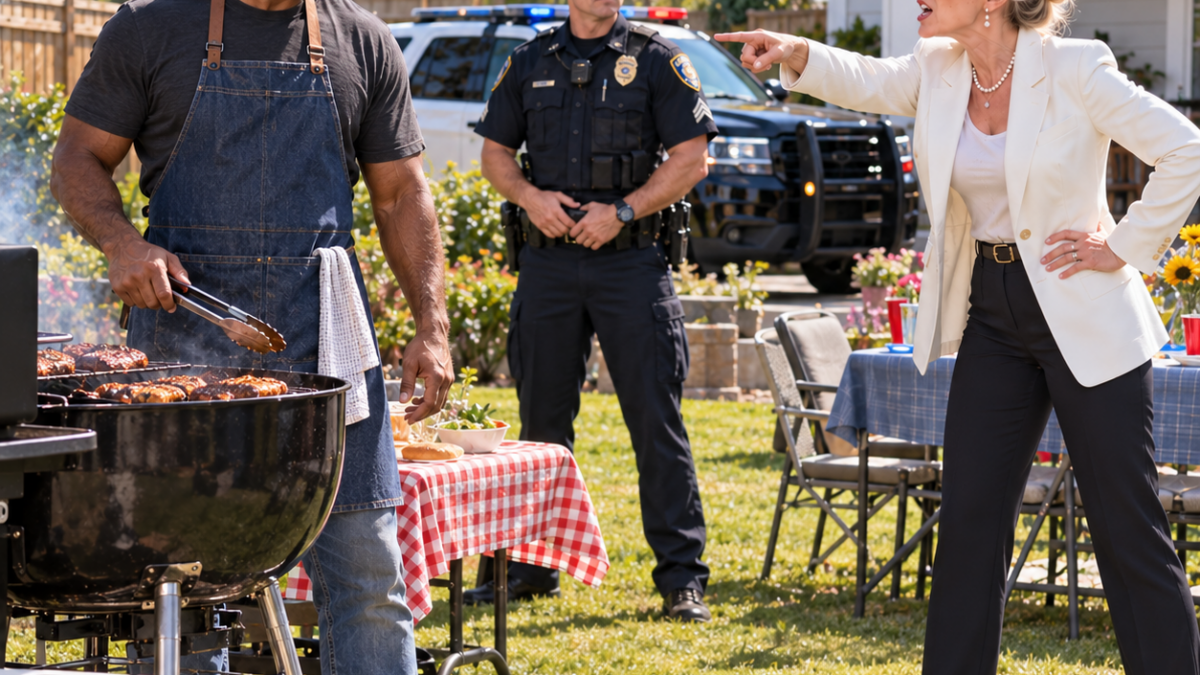
Sergeant Holt Dawson took two steps toward me.
Then stopped.
He was forty-five, broad-shouldered, ten years with another department before transferring to Ridgewood, and exactly the officer I had wanted working that Saturday.
He had never served directly under me.
He had met me once during a command briefing three months earlier.
Apparently that had been enough.
“Chief Fletcher?”
Diane’s smile disappeared.
Not all at once.
First the corners dropped.
Then her eyebrows tightened.
Then she looked at Dawson as if he had spoken in another language.
I nodded.
“Sergeant.”
Dawson looked toward the crowd.
Then at the grill apron I was wearing.
Then back at me.
“Didn’t expect to see you here, sir.”
“I live here.”
Diane laughed.
A strange, sharp little sound.
“No.”
Everybody looked at her.
She stepped closer.
“No, he doesn’t.”
I almost asked what that meant.
Then she clarified.
“I mean he’s not—he can’t be the police chief.”
Dawson remained expressionless.
“He is.”
Diane looked at me.
“You told me you worked for the city.”
“I do.”
“You said you were in administration.”
“I am.”
Her face flushed.
“That is intentionally misleading.”
“No.”
“It was intentionally boring.”
A few people laughed.
I didn’t.
Neither did Denise.
This was not funny yet.
A county deputy named Marcus Bell came through the side gate.
He had responded because Diane had separately contacted the sheriff’s office claiming local police had ignored repeated dangerous activity at our address.
Bell looked around.
A smoker.
Two grills.
Kids.
Cornhole.
An inflatable splash pool no deeper than my ankle.
A newspaper photographer pretending very badly not to look interested.
Attorney Vivian Slater sitting beneath an oak tree with a paper plate.
Bell turned toward Dawson.
“What’ve we got?”
Dawson said, “Private barbecue.”
“Any violation?”
“None I can see.”
Bell nodded.
Then Diane marched toward them.
“There are sixty people here.”
“Sixty-three,” Naomi called from the picnic table.
Denise looked at her.
“What?”
“I counted.”
A few guests laughed again.
Diane pointed toward the driveway.
“Cars are everywhere.”
Dawson looked toward the street.
Every vehicle was legally parked along the curb.
Nobody blocked a hydrant.
Nobody blocked a driveway.
The nearest intersection remained clear.
Dawson asked, “Which car is violating parking restrictions?”
“That’s not the point.”
“What is the point, ma’am?”
Diane gestured toward my backyard.
“This.”
Dawson waited.
Diane became more agitated.
“The crowd.”
“The smoke.”
“The noise.”
“The strangers.”
One of Elijah’s teammates looked down at his plate.
A church friend of ours quietly picked up her toddler.
I saw something shift through the yard.
The barbecue had been warm five minutes earlier.
Now everybody was aware of themselves.
How loudly they laughed.
Where they stood.
What they looked like.
Whether Diane might describe them as threatening simply because they were present.
That feeling was familiar to me.
I hated that my children were learning it in their own backyard.
Dawson said, “We’ve received no complaint that describes criminal conduct.”
“I called 911.”
“Yes, ma’am.”
“That means you need to investigate.”
“We are.”
“Then do something.”
“What would you like us to do?”
She looked at me.
“Shut this down.”
“On what legal basis?”
Diane’s mouth opened.
Nothing came out.
Bell asked, “Was there a fight?”
“No.”
“Threat?”
“No.”
“Fire outside containment?”
“No.”
“Weapons displayed?”
“No.”
“Someone injured?”
“No.”
“Property damaged?”
“No.”
“Then why did you call 911 instead of the non-emergency number?”
Diane crossed her arms.
“Because nobody listens when I call the other number.”
That sentence landed harder than she realized.
Dawson glanced at Bell.
Bell glanced at Dawson.
Neither said anything.
I did.
“Diane, how many times have you called police about this house?”
She stared at me.
“I don’t keep count.”
“I do.”
Denise touched my wrist.
Not to stop me.
To remind me to stay inside the line I had set for myself.
I took a breath.
The investigation into Diane’s previous calls was not mine.
I had made sure of that.
Once I realized her behavior involved my family, I referred the review to Deputy Chief Lena Brooks and asked county dispatch to produce records through ordinary channels.
I had no intention of standing in my backyard and announcing conclusions before the review was finished.
So I changed direction.
“Sergeant Dawson.”
“Yes, sir?”
“Treat this call exactly as you would if I were not here.”
His answer came immediately.
“That’s what I’m doing.”
“Good.”
Diane threw up both hands.
“This is unbelievable.”
Then she pointed at me.
“He’s your boss.”
“That’s why county is here too,” Bell said.
Diane spun toward him.
“And you think this is normal?”
Bell shrugged slightly.
“I think people having ribs in their own backyard is pretty normal.”
That got the first real laugh.
Diane’s face hardened.
“This neighborhood has standards.”
Ray Hutchens stood near the lemonade table.
He had lived three houses down for nineteen years.
White.
Sixty-two.
Retired HVAC contractor.
The kind of man who spoke so rarely that when he finally did, people usually listened.
“Diane.”
She turned.
Ray held a plastic cup of lemonade.
“Go home.”
Her mouth dropped.
“Excuse me?”
“You heard me.”
“I am trying to protect this street.”
“From what?”
She looked toward my guests.
Ray followed her gaze.
Then looked back.
“From potato salad?”
Someone choked on a drink.
Diane’s face turned crimson.
“You know exactly what I mean.”
“No.”
Ray set down his cup.
“That’s the problem.”
“For three months, you’ve been saying things without saying them.”
“You told me property values would drop if I didn’t sign your petition.”
“You called that DoorDash kid suspicious.”
“You called the guys who cut my grass suspicious.”
“They’re Hispanic, Diane.”
“They’ve been cutting my grass for seven years.”
Diane’s eyes widened.
“You’re twisting everything.”
Ray shook his head.
“No.”
“I’m finally saying what I should’ve said months ago.”
The yard became completely quiet.
Diane looked around.
For the first time, she seemed to understand that the audience was not hers.
She pointed toward Ray.
“You are going to regret humiliating me.”
Ray almost smiled.
“That’s the kind of thing you say when you’re not trying to intimidate people?”
Attorney Vivian Slater stood.
She had been deliberately invisible until then.
Forty-five.
Dark suit despite the June heat.
Sunglasses.
Paper plate with one rib she had barely touched because Vivian approached food the same way she approached witnesses: cautiously.
She walked toward us.
“Ms. Covington?”
Diane stared.
“Who are you?”
“Vivian Slater.”
“I represent the Fletcher family regarding the HOA matters and related harassment concerns.”
I saw Dawson’s posture shift.
Not because he was intimidated.
Because once attorneys formally enter a scene, good officers become even more careful about language.
Vivian continued.
“For clarity, nobody here is serving you with a lawsuit.”
That mattered.
The original version of this story people later told made it sound as though Vivian dramatically handed Diane a federal civil-rights complaint while officers applauded.
That would have been excellent television.
It was not how good legal work happened.
Vivian held a folder.
“This contains a preservation notice.”
Diane stared.
“A what?”
“A formal request that you preserve relevant emails, text messages, HOA communications, photographs, petitions, and records connected to complaints regarding the Fletcher household and other incidents under review.”
“I’m not giving you my phone.”
“Nobody asked you to.”
“This is harassment.”
“No.”
“It is notice not to destroy evidence.”
Diane laughed.
“You think I’m scared of you?”
Vivian removed her sunglasses.
“No.”
“I think you should hire an attorney.”
That sentence finally quieted Diane.
She looked toward me.
Then at the officers.
Then at Vivian.
Then at Cynthia Norwood, editor of the Ridgewood Gazette, who was standing near my porch beside photographer Miguel Santos.
Diane recognized her.
“Oh, you have got to be kidding me.”
Cynthia lowered her notebook.
“I’m attending a neighborhood barbecue.”
“With a photographer?”
“I bring Miguel to lots of barbecues.”
Miguel looked at her.
“No, you don’t.”
Even I laughed.
Diane pointed at Cynthia.
“This is a setup.”
Cynthia replied, “I was invited.”
“You planned this.”
“I planned ribs.”
I said it before thinking.
Diane turned on me.
“This.”
She swept her arm across the yard.
“This entire thing.”
“You invited reporters.”
“You arranged which officers would respond.”
“You made sure your attorney was here.”
“You wanted me to call.”
I shook my head.
“I expected you might.”
“That’s different.”
“No, it isn’t.”
“It is legally.”
Vivian said it quietly.
“Entrapment requires government inducement of criminal conduct under circumstances far more specific than a neighbor hosting a lawful barbecue and you choosing to call 911.”
Diane looked at her.
“Are you threatening me?”
“I’m correcting vocabulary.”
Ray coughed into his fist.
Dawson stepped between the conversational groups.
“Everybody needs to keep this calm.”
Then he looked at Diane.
“Ma’am, based on what we’ve observed, there is no unlawful gathering here.”
“We’ll document the call.”
“If you have an HOA complaint, that is separate.”
Diane looked almost relieved.
Maybe she thought that meant the police interaction was ending without consequence.
Then Deputy Bell asked, “Can I speak with you at your residence for a moment?”
Her relief vanished.
“Why?”
“Because county dispatch wants clarification about information provided in your call.”
“What information?”
Bell did not answer publicly.
“Let’s speak across the street.”
Diane crossed her arms.
“Am I under arrest?”
“No.”
“Then I’m not going anywhere with you.”
“That’s your choice.”
“We can speak here.”
Bell glanced at Dawson.
Then at me.
He clearly did not want to discuss details in front of sixty-three people.
Neither did I.
“Diane,” I said.
She looked at me.
“I’m not asking anyone to arrest you at my barbecue.”
She laughed.
“How generous.”
“I mean it.”
“If you made statements dispatch needs to verify, answer the deputy.”
“But my family is going to keep eating.”
“My guests are going to keep talking.”
“And my kids are going to keep playing in their own backyard.”
“You do not get to turn this into something else.”
Diane stared at me for several seconds.
Then she looked at the crowd.
Something in her changed.
Maybe she realized she had lost control.
Maybe she was frightened.
Maybe she was simply furious.
Whatever it was, she chose the worst possible response.
She raised her voice.
“You think this proves anything?”
Nobody answered.
“You think because he has a badge that suddenly I’m the bad person?”
Denise stepped forward.
“This was happening before you knew about the badge.”
Diane ignored her.
“I have lived here fifteen years.”
“I know what this neighborhood was.”
“I know who belongs here.”
There it was.
No ambiguity.
No HOA language.
No property values.
No traffic counts.
No quiet hours.
Just belongs.
My stomach tightened.
Naomi stood beside the dessert table.
She was watching.
Diane continued.
“You people move in and act like everybody else has to change for you.”
Denise said, “Which people?”
Diane froze.
Same question.
Second time.
This time she had a larger audience.
Cynthia’s pen stopped.
Miguel’s camera remained lowered.
Nobody needed a photograph of that moment.
It existed on three security cameras already.
Diane looked at Denise.
“I mean people who don’t respect standards.”
“No,” Denise said.
“You don’t.”
“You said ‘you people.’”
“What people?”
Diane’s cheeks went red.
“I’m done explaining myself.”
She turned toward her house.
Ray called after her.
“That’s been the problem.”
She stopped.
Ray continued.
“You never explain.”
“You accuse.”
Diane went home.
She slammed the door.
Nobody arrested her.
Not then.
That matters.
False-reporting cases require proof of knowing falsity.
A 911 caller can be unreasonable, biased, mistaken, dramatic, or offensive without automatically committing a crime.
The responding officers documented what she said.
County dispatch preserved the recording.
Dawson completed his report.
Bell completed his.
Everybody did what they were supposed to do.
Then Dawson looked at me.
“Anything else, Chief?”
I looked around the yard.
“Hungry?”
He smiled.
“I’m on duty.”
“That wasn’t my question.”
“Then yes.”
I handed him a plate.
Bell took one too.
They ate standing near their cars.
Not as guests in uniform.
Not part of some victory tableau.
Just officers finishing a call and accepting food before heading back out.
The party resumed slowly.
That surprised me.
I expected a switch to flip.
Police leave.
Music returns.
Everybody laughs.
Instead people needed time.
The first ten minutes felt awkward.
Conversations were lower.
Parents checked their children.
Guests looked toward Diane’s house.
Then Elijah did something I will always love him for.
He walked to the Bluetooth speaker.
Scrolled his phone.
Pressed play.
The opening horns of “September” came through the yard.
Ray Hutchens shouted, “Finally.”
People laughed.
Naomi grabbed Denise’s hands.
A few kids started dancing.
Then adults.
The yard came alive again.
Not because Diane had been defeated.
Because she no longer got to decide the emotional temperature of our home.
That distinction mattered.
Around four, Cynthia found me near the smoker.
“Can I quote you?”
“No.”
“You invited me.”
“To observe.”
“That’s cruel.”
“You’ll survive.”
She looked toward Diane’s house.
“What is this story?”
“You tell me.”
“I’m asking you.”
I turned a rack of ribs.
“The story isn’t that I’m police chief.”
“Everybody else will make it that.”
“I know.”
“What’s the story?”
I looked at my daughter dancing with Denise.
“The story is that she should’ve treated me the same before she knew.”
Cynthia stopped writing.
Then wrote that sentence down.
I pointed my tongs at her.
“I said no quotes.”
“You said that before saying something quotable.”
“Journalists are thieves.”
“Allegedly.”
Her article appeared Tuesday.
The headline was far less sensational than the internet versions that followed.
MAGNOLIA LANE DISPUTE RAISES QUESTIONS ABOUT COMPLAINT PATTERNS, HOA ENFORCEMENT.
Cynthia did not call Diane racist as a fact.
She described what had occurred.
Diane’s 911 call.
Prior HOA complaints.
The “you people” confrontation captured on video.
Records showing repeated calls involving residents, workers, and visitors later found to be engaged in lawful activity.
She quoted Diane’s attorney, who said his client denied racial animus and believed she had raised legitimate neighborhood safety and quality-of-life concerns.
That sentence mattered too.
People deserve their position represented even when evidence looks bad.
Cynthia also quoted me.
Against my wishes.
The line was exactly the one I feared.
He should have been treated the same before anyone knew he was chief.
It spread.
Local television picked it up.
Then Atlanta.
Then national blogs.
Most reduced six months of ugly neighborhood behavior into one clean headline.
WHITE NEIGHBOR CALLS COPS ON BLACK BBQ — LEARNS HOMEOWNER IS POLICE CHIEF.
That was catchy.
It was also incomplete.
Being chief did not solve anything.
In some ways, it created more complications.
By Wednesday morning, I had twelve interview requests.
I declined all of them.
Deputy Chief Lena Brooks called from my office.
“You’re famous.”
“I’m taking personal leave.”
“That’s why you’re famous.”
“I hate you.”
“CNN called.”
“Tell them I’m smoking pork.”
“I already did.”
“You did not.”
“No.”
“But I considered it.”
Lena became acting chief for the internal portion of the review.
That was my decision.
Anything involving police responses to my home would be handled by someone else.
Anything involving Diane’s historical calls would be audited independently.
I did not want a single officer wondering whether the chief expected a particular conclusion.
The dispatch review expanded.
The number twenty-three turned out to need context.
This is another place where the viral version became too neat.
Diane had made twenty-three calls involving neighborhood concerns over five years.
Not every one went through 911.
Several were non-emergency.
A few involved situations where an officer reasonably checked something out.
One involved a car parked awkwardly near a hydrant.
Another involved late-night noise that did exist, though officers found it within allowable limits by arrival.
The pattern was still troubling.
But “twenty-three false 911 calls, every one targeting a person of color” was an exaggeration.
The real evidence was more complicated and therefore more credible.
Fifteen calls involved people Diane identified as suspicious, trespassing, unsafe, or out of place.
Twelve of those involved Black, Latino, Middle Eastern, or Asian individuals or families.
Several were workers or delivery drivers.
Three involved my household.
One involved a Black teenager jogging.
One involved a Latino landscaping crew.
One involved a South Asian family parked outside a friend’s birthday party.
No crime was found in any of those incidents.
The remaining calls involved parking, noise, loose dogs, and neighborhood issues affecting various residents.
That did not prove what was in Diane’s mind.
But when combined with her words, petitions, complaint pattern, and differing treatment of comparable conduct, it created a question too serious to dismiss as coincidence.
Vivian Slater was careful.
“This is evidence of possible discriminatory targeting,” she told us.
“Do not call it proven motive until a process establishes it.”
I appreciated that.
My brother Jerome had taught me what happens when systems decide conclusions first and build explanations afterward.
I would not repeat that mistake just because this time the evidence favored my family.
Jerome was sixty now.
He lived outside Macon.
Worked nights managing inventory at a warehouse.
Married to a woman named Angela who had more patience than anybody I knew.
His arrest at nineteen had shaped our family.
Broken taillight.
Escalation.
Charges.
Eleven months before the case collapsed.
The facts had been uglier and more complicated than family legend.
Jerome had argued.
He had refused an order to exit the car.
Police had mishandled the stop.
Prosecutors later concluded key charges could not be sustained.
Nobody came out clean.
But Jerome lost almost a year.
He never trusted police again.
My decision to become an officer nearly ended our relationship.
At my academy graduation, he did not attend.
When I made sergeant, he sent a text.
Congratulations.
Nothing else.
When I became chief, Denise called him.
He said, “Tell Aaron I hope he remembers what uniforms do to people who don’t have them.”
That hurt.
Because I knew what he meant.
After the barbecue story went public, Jerome called me himself.
First time in months.
“You famous now?”
“Unfortunately.”
“Angela showed me the article.”
“Don’t believe everything.”
“She called the cops on you?”
“Sort of.”
“Sort of?”
“It’s complicated.”
“It always is with you.”
I smiled.
Then he became quiet.
“You okay?”
“Yeah.”
“Kids?”
“Not really.”
“What happened?”
I told him about Elijah asking whether we belonged.
Jerome went silent for so long I thought the call dropped.
Then he said, “I asked Mama that once.”
I sat down.
“When?”
“After they wouldn’t show us that house in Decatur.”
I remembered.
I had been eight.
Jerome twelve.
Our mother told us the seller had changed his mind.
Years later, Dad admitted the agent had refused to show the property to a Black family.
“I didn’t know you remembered.”
“I remember everything.”
He breathed slowly.
“You gonna sue her?”
“Maybe.”
“You gonna arrest her?”
“That’s not mine to decide.”
“Good.”
That surprised me.
“Good?”
“You arrest her yourself and everybody says you used the badge.”
“I know.”
“Let the badge stay out of it.”
That was the wisest advice anyone gave me.
The HOA situation moved faster.
Gerald Trask called an emergency board meeting.
For once, more than half the neighborhood attended.
Diane did not.
Her attorney advised her to stay away.
Gerald stood at the podium.
He looked ten years older than he had six weeks earlier.
“I owe the Fletcher family an apology.”
The room remained quiet.
“I received repeated complaints from one member.”
“I treated frequency as evidence.”
“I should have compared those complaints to actual rule violations.”
“I did not.”
“I also allowed community concerns to be framed in language about ‘character’ and ‘values’ without asking what those phrases meant in practice.”
He looked toward Denise.
“I’m sorry.”
Denise nodded.
Not forgiveness.
Acknowledgment.
Gerald continued.
“The proposed guest restriction is withdrawn.”
A few people clapped.
He raised a hand.
“There will also be an independent review of enforcement practices for the past three years.”
Diane’s seat on the Architectural Review Committee was suspended pending that review.
She resigned from the committee the next morning.
Not removed.
Resigned.
Another detail legend simplified.
Then homeowners began talking.
Really talking.
A Latino family on Cedar Court said Diane once photographed their contractor’s truck and asked whether “day laborers” were authorized to work in the neighborhood.
A Black couple near the entrance said she questioned whether their adult son lived there after seeing him use the pool.
A white family admitted Diane had complained about their graduation party too—but privately, politely, and without calling police.
That comparison became important.
The issue was not whether Diane had ever complained about white neighbors.
She had.
The issue was tone.
Frequency.
Escalation.
Assumption.
Who received a text.
Who received police.
Who received benefit of the doubt.
Bias often hides in those differences.
Not always in explicit slurs.
Sometimes in who is presumed dangerous before anyone checks.
The board hired outside counsel to review enforcement.
It also commissioned a fair-housing consultant.
Diane’s lawyer publicly complained that the process had become a “trial by neighborhood gossip.”
He had a point about one thing.
Public accusation can become dangerous fast.
Someone spray-painted RACIST across Diane’s driveway one night.
I was furious.
I called Gerald.
Then Dawson.
The vandalism was documented.
I issued a public statement through the department.
Whatever concerns exist about Ms. Covington’s conduct, vandalism and harassment are unacceptable.
Nobody should be targeted at home.
Some people online called me weak.
Others called me a hypocrite.
I didn’t care.
Rules do not become optional when the target is someone you dislike.
Two teenagers from another neighborhood were eventually identified through a doorbell camera.
They admitted they had seen the story online.
Neither knew Diane.
That incident shook her badly.
For the first time, I saw what it meant for someone to feel watched in their own home.
I did not enjoy it.
The irony was obvious.
It still was not justice.
Vivian Slater agreed.
“We don’t build your case by becoming what we’re complaining about.”
The legal case also changed.
A claim under federal civil-rights statutes was not as simple as the original internet retelling suggested.
Diane was a private neighbor, not automatically a state actor.
Section 1983 generally concerns conduct under color of state law.
Vivian explained that carefully.
“If we sue, we do not throw statutes into a complaint because they sound powerful.”
“What are our strongest claims?”
“Potential fair-housing theories depending on the evidence.”
“Intentional infliction claims are difficult.”
“Interference with property use.”
“Defamation if provable false statements caused actual damage.”
“Possibly misuse of HOA process.”
“And we examine whether any association actions created separate liability.”
“What about false police reports?”
“Criminal charging belongs to prosecutors.”
“Not us.”
Exactly.
I liked Vivian because she removed drama from serious things.
The county prosecutor reviewed the June barbecue call.
The question was whether Diane knowingly fabricated an emergency.
Her call described a large gathering, smoke, unfamiliar people, and concern that it might get out of hand.
Biased?
Possibly.
Unreasonable?
Arguably.
Knowingly false enough for criminal prosecution?
Harder.
The prosecutor declined to charge that call by itself.
That angered many people.
It did not anger me.
Criminal law should require proof.
Later, investigators found something stronger.
An earlier report Diane had made concerning a teenage boy walking through the neighborhood.
She told dispatch he had attempted vehicle door handles.
Doorbell footage from three houses showed he had never approached a vehicle.
He was jogging.
Diane later admitted during a recorded interview that she had not personally seen him touch a car.
She said she “assumed he was checking them.”
That incident became the basis for one misdemeanor false-report count.
A second count involved a delivery driver she claimed had tried multiple doors.
Video again contradicted her.
Those cases resulted in a plea.
No dramatic jail sentence.
Probation.
A fine.
Community service.
Required completion of a court-approved conflict and bias-awareness program.
The judge told her something simple at sentencing.
“Fear does not convert assumption into fact.”
I wrote that down.
Because police need to remember it too.
The civil case took nearly a year.
We did not ask for millions.
We asked for relief that made sense.
An agreement prohibiting Diane from contacting my family except for legitimate HOA or emergency matters.
No direct interference with our guests.
Retraction of false statements about unlawful activity at our address.
Attorney fees where available.
Compensation for documented harms.
The HOA entered separate mediation.
That mattered because the association had amplified Diane’s behavior by issuing warnings without neutral verification.
The mediation lasted nine hours.
By hour six, I hated everyone.
By hour eight, I hated sandwiches.
At hour nine, we had terms.
The HOA withdrew every unsupported violation against our property.
It adopted a written complaint-verification policy.
Anonymous complaints alone could no longer generate fines.
Comparable violations had to be handled under the same process.
Board members received fair-housing and anti-discrimination training from an outside provider.
Complaints involving possible criminal conduct went to appropriate authorities without HOA embellishment.
No more homemade investigations.
No more dossiers from architectural committee members.
Diane agreed to stay away from our property.
There was also a confidential financial settlement.
Not life-changing.
Enough to cover legal fees and counseling expenses we had incurred for the kids.
I cared about the policies more.
Elijah went to counseling twice.
Then refused.
Teenage boys can make therapy sound like a dental procedure.
One night he found me cleaning the grill.
“Dad.”
“Yeah?”
“Did you ever want to hit her?”
I looked at him.
“Why?”
“Because I did.”
I set down the scraper.
“That feeling doesn’t make you bad.”
“Would you?”
“No.”
“Because you’re chief?”
“No.”
“Because I don’t want her deciding who I become.”
He stared at the grill.
“I hate that she made me feel scared to invite people over.”
“I know.”
“What if everybody thinks we’re trouble now?”
“Everybody doesn’t.”
“Some do.”
“Yes.”
He looked up.
“How do you ignore that?”
“I don’t.”
“I decide whose opinion gets to live in my house.”
He frowned.
“That sounds like counselor stuff.”
“Your mother has contaminated me.”
He smiled.
Then grabbed the second scraper.
We cleaned together.
Naomi handled things differently.
She drew.
Always had.
After the barbecue incident, her sketchbooks filled with houses.
Dozens.
Different colors.
Different sizes.
Front porches.
Apartment buildings.
Farmhouses.
Townhomes.
One page showed a long table running through an entire street.
People of every color sitting together.
Magnolia blossoms overhead.
Denise found it.
“What’s this?”
Naomi shrugged.
“A neighborhood where nobody calls the police because people are eating.”
That drawing broke something open in Denise.
She showed it to me that night.
We sat at the kitchen table.
Neither spoke for a while.
Then Denise said, “I want to move.”
I had expected it.
Still hurt.
“You sure?”
“No.”
“That’s why I’m telling you.”
She looked around the kitchen.
“I love this house.”
“I love the schools.”
“I love the yard.”
“But every time I see Diane’s place, my shoulders tighten.”
“That’s not home.”
I understood.
What I did not know was whether leaving meant surrender.
That thought embarrassed me.
Property should not become a battlefield just because somebody else acted badly.
Our children did not owe Magnolia Lane a symbolic victory.
Neither did Denise.
I asked, “What do the kids want?”
“Elijah says stay.”
“Naomi says move to Hawaii.”
“Smartest one.”
“Obviously.”
We waited.
No decision.
Then something happened that changed the neighborhood before we had to choose.
Ray Hutchens knocked on our door one Sunday morning.
He held a casserole dish.
“Please tell me that isn’t potato salad.”
“It’s peach cobbler.”
“You can come in.”
He laughed.
Then became serious.
“I need help.”
“With what?”
“I’m hosting next Saturday.”
Denise looked at him.
“Hosting what?”
“A barbecue.”
I stared.
Ray shrugged.
“You people can’t have all the ribs.”
The phrase hit the room.
Ray’s eyes widened.
“Jesus.”
“I did not mean—”
I started laughing.
Denise covered her mouth.
Ray turned red.
“That came out catastrophically.”
“Keep going,” I said.
“I deserve this.”
He explained.
Several neighbors had been talking.
They wanted to host rotating dinners.
Not as a diversity program.
Not a committee initiative.
Just neighbors.
One house each month.
Food.
Kids.
No agenda.
“I figured if your house is always the one hosting, people will keep treating it like your event.”
“So we make it everybody’s.”
Denise looked at him for a long moment.
“That was your idea?”
“Mostly my wife’s.”
“That makes more sense.”
“Fair.”
The first Open Table dinner happened at Ray’s house.
Forty people.
No smoked brisket.
Ray attempted burgers.
Burned half.
His wife saved the evening with baked ziti.
The next month, the Patels hosted.
Sanjay made biryani for fifty.
Diane remained across the street.
Curtains closed.
She did not participate.
Nobody pressured her.
That was important.
Inclusion cannot become another form of coercion.
She had the right to stay home.
Three months later, her house went on the market.
The internet story says she was driven out in disgrace.
That is not how I remember it.
She listed quietly.
No moving-truck crowd.
No neighbors cheering.
No triumphant music.
One Tuesday morning, I saw a moving company carrying boxes.
Diane stood near the garage.
We had not spoken since mediation.
I considered staying inside.
Then I walked across the street.
She saw me.
Her posture stiffened.
“I’m not here to argue.”
“I didn’t think you were.”
“Where are you going?”
“Roswell.”
I nodded.
“Closer to my sister.”
“Good.”
Silence.
Then Diane said, “You won.”
I hated that sentence.
“No.”
She looked surprised.
“You lost your committee position.”
“You pleaded to criminal charges.”
“You’re moving.”
“But I didn’t win anything.”
She gave a bitter laugh.
“Of course you did.”
“My daughter asked why you hated us.”
“That isn’t winning.”
Her face changed.
I continued.
“My son asked whether he belonged in his own neighborhood.”
“My wife cried on the kitchen floor because of an anonymous letter.”
“I had to think about whether wearing a badge made my family safer or made every response to our home look compromised.”
“Nobody won.”
Diane looked toward her house.
“I didn’t hate your family.”
I said nothing.
“I know that sounds impossible.”
“I was scared.”
“Of what?”
She took a long time.
“The neighborhood changing.”
“That’s not an answer.”
“It’s the only one I have.”
She folded her arms.
“When I moved here, everybody knew everybody.”
“The same families.”
“The same traditions.”
“Then people started selling.”
“New people came.”
“I felt like everything familiar was disappearing.”
I looked at her.
“So you called police on delivery drivers?”
She closed her eyes.
“I said it wasn’t a good answer.”
“No.”
“It isn’t.”
I wanted to tell her fear did not excuse bias.
She already knew.
The court had told her.
Her lawyer had told her.
Half the state had told her online.
Instead I asked, “Why us?”
Her eyes filled.
“Because you didn’t seem afraid of me.”
That was not the answer I expected.
She continued.
“Everybody else either argued or apologized.”
“You just said okay and kept living.”
“I thought you were mocking me.”
“I wasn’t.”
“I know that now.”
She wiped one eye.
“I’m sorry about your kids.”
Not the calls.
Not the petitions.
The kids.
That was the first apology that felt human.
I nodded.
“Thank you.”
She looked at me.
“Do you forgive me?”
I thought about Jerome.
Elijah.
Naomi’s drawing.
Denise crying.
Ray’s cobbler.
The Open Table dinners.
“I don’t know yet.”
Diane nodded.
“Fair.”
The moving truck left that afternoon.
Her house sold to a family from Charlotte.
Mixed-race couple.
Two little boys.
When they moved in, Ray texted me.
DO NOT TELL THE INTERNET.
I laughed for five minutes.
The story could have ended there.
It didn’t.
My brother Jerome came to visit that fall.
He had not been to my house before.
He drove up from Macon in an old Lexus with one headlight slightly cloudy and a bumper sticker that said QUESTION AUTHORITY.
I met him in the driveway.
He looked at my house.
Then Magnolia Lane.
Then me.
“Fancy.”
“Jealous?”
“No.”
“Taxes?”
“Terrible.”
“Thought so.”
Angela got out.
Hugged me.
Jerome did the half-handshake-half-hug brothers use when full affection feels suspicious.
Denise came outside.
Then the kids.
Elijah had grown nearly two inches since Jerome last saw him.
Naomi showed him the magnolia mural she had painted on a backyard fence panel.
That evening, I cooked.
Of course.
Jerome stood beside the smoker.
“You still using Dad’s rub?”
“Improved it.”
“You ruined it.”
“You haven’t tasted it.”
“Still ruined.”
Some things survive decades.
Later, after everyone went inside, Jerome and I sat on the porch.
Fireflies.
Cold beer.
Same porch where I had documented Diane’s complaints.
Jerome looked at the security camera.
“That the famous one?”
“Unfortunately.”
“You really had everything recorded?”
“Most.”
“Wish we had one in ’89.”
There it was.
I stared at my beer.
“Me too.”
He looked toward the street.
“You know what bothered me about your story?”
“What?”
“Everybody loved that you were chief.”
“That bothered me too.”
“They act like the punch line is she picked the wrong Black man.”
I turned toward him.
He continued.
“What if you were a plumber?”
“Teacher?”
“Warehouse guy?”
“Then what?”
“Still wrong.”
“Exactly.”
I smiled.
“You finally understand my job.”
“Don’t push it.”
We sat.
Then I told him something I had never said.
“You’re why I became a cop.”
He looked at me.
“No.”
“Yes.”
“I thought if people like us weren’t inside the system, nothing changed.”
Jerome shook his head.
“And did it?”
“Some.”
“Enough?”
“No.”
He nodded slowly.
“That’s the first answer I’ve believed from you in twenty years.”
I laughed.
Then he said, “I’m proud of you.”
Four words.
I looked toward the yard because suddenly the oak tree was fascinating.
Jerome noticed.
“Don’t cry, Chief.”
“Shut up.”
“Federal media hero.”
“I hate you.”
“Love you too.”
The next spring, the township council asked me to present recommendations about repeated nuisance calls.
I refused to make it about Diane.
Policy built around one villain usually becomes bad policy.
Instead we looked at data.
Dispatch burden.
Repeated unfounded complaints.
Fair-housing implications.
Officer discretion.
The risk of discouraging legitimate callers.
That last part mattered.
You cannot solve biased reporting by making residents afraid to call police when something is genuinely wrong.
So we designed something narrower.
Repeat-caller review.
If a resident generated a pattern of unfounded or unsupported calls involving the same individuals or locations, a supervisor reviewed the history.
Not to punish automatically.
To identify whether mediation, education, mental-health outreach, code clarification, or formal warning was appropriate.
Officers received training on separating suspicious behavior from unfamiliar people.
Dispatchers were encouraged to ask concrete questions.
“What is the person doing?”
Not:
“What do they look like?”
until appearance was actually relevant.
A neighborhood association coalition adopted voluntary fair-enforcement standards too.
The HOA’s role became simple.
Rules in writing.
Rules applied comparably.
No informal penalties.
No architectural committee members conducting surveillance.
Nothing revolutionary.
Which is usually what good policy looks like.
Jerome’s name did end up on something.
Not a five-thousand-dollar scholarship created overnight from dramatic settlement money.
That part of the popular story was fiction.
What happened was smaller.
And more meaningful.
The Fletchers started a community-service award through the high school foundation.
Denise came up with it.
The Jerome Fletcher Courage Grant.
One thousand dollars the first year.
Funded mostly from barbecue donations and friends.
Awarded to a student who had stood up for someone else when it would have been easier to stay silent.
I called Jerome.
“I need permission.”
“For what?”
“Using your name.”
“Absolutely not.”
“Listen first.”
“No.”
“It’s a student award.”
“No.”
“For courage.”
He laughed.
“You named a courage award after the guy who got arrested at nineteen?”
“I named it after the man who survived what happened at nineteen without becoming cruel.”
Silence.
“That’s manipulative.”
“Police technique.”
“I hate you.”
“So yes?”
Long pause.
“Ask Angela.”
Angela said yes.
Jerome cried at the first ceremony.
He denied it.
There were witnesses.
The first recipient was not a Black student.
Her name was Grace Kim.
Seventeen.
Korean American.
She had intervened when classmates mocked a new student’s accent.
Not dramatically.
She sat beside him at lunch.
Reported repeated harassment.
Kept showing up when friends told her to leave it alone.
Jerome handed her the plaque.
He said, “Courage is usually boring while you’re doing it.”
I stole that sentence later.
He pretended not to notice.
Magnolia Lane changed slowly.
That is the part people skip.
Neighborhoods do not transform because one barbecue goes viral.
Ray still complained when people parked too close to his mailbox.
The Patels’ dog still got loose.
Gerald still made terrible potato salad.
New HOA fights appeared.
Solar panels.
Fence height.
Short-term rentals.
A trampoline that became the subject of a twenty-seven-email thread.
Normal suburban warfare.
Beautifully ordinary.
The Open Table continued.
Different host each month.
At first it felt intentional.
Then it became habit.
Habit is better.
One August evening, our house hosted again.
About forty people.
Not sixty-three.
No reporter.
No attorney.
No police.
Marvin Gaye on the speaker.
Ribs on the smoker.
Naomi, now thirteen, painting with two younger kids at a folding table.
Elijah arguing with Ray about whether brisket needed sauce.
It did not.
I will die on that hill.
Denise came beside me.
“You watching the street?”
“No.”
“You are.”
“Occupational disease.”
She looked toward the porch camera.
“You know, you could turn that thing off.”
“I could.”
“Will you?”
“No.”
She laughed.
“I knew it.”
I had considered it.
The viral story says I switched it off because I finally trusted the neighborhood.
Nice ending.
Terrible security practice.
I did not spend twenty-eight years in law enforcement to uninstall a perfectly useful camera because my neighbors became friendlier.
The camera stayed.
Trust and cameras are not opposites.
But something else changed.
I stopped checking the feed every time a car slowed near our house.
I stopped saving every ordinary interaction.
I stopped expecting the next knock to be another complaint.
That was how I knew home had returned.
Not because surveillance disappeared.
Because vigilance no longer consumed me.
One Saturday, about two years after Diane moved, a new neighbor came over while I was grilling.
White guy.
Early thirties.
Red hair.
Toddler on his shoulders.
He introduced himself as Ben Walker.
Bought the Covington house.
I nearly dropped my tongs.
“The Covington house?”
“Yeah.”
“You knew?”
“Knew what?”
Denise heard from the patio.
“Oh, Lord.”
Ben looked between us.
“What?”
I said, “Nothing.”
“Welcome to the neighborhood.”
He looked suspicious.
“There’s something about the house, isn’t there?”
“Plumbing is fine.”
“Foundation?”
“Fine.”
“Ghost?”
Ray shouted from across the fence, “DEFINITELY HAUNTED.”
Ben stared.
I laughed.
Then told him enough.
Not everything.
He already knew something from disclosures and internet searches.
His wife had found the articles.
They bought anyway.
“People change houses,” he said.
“Houses don’t change people.”
I liked him.
His family came to Open Table the following month.
His toddler spilled lemonade on Ray.
Ray declared generational revenge.
Life moved on.
I remained police chief another four years.
Then retired.
Thirty-two total years.
The retirement ceremony was at the municipal building.
Too many speeches.
Bad cake.
Jerome attended.
Front row.
That mattered more than every commendation on the wall.
Officer Tanya Bowen had become lieutenant by then.
She gave the final speech.
“Chief Fletcher taught us something simple.”
“Your authority matters most when you refuse to use it for yourself.”
I looked down.
She continued.
“Some of us learned that before the rest of the country found out he could cook ribs.”
Everybody laughed.
After the ceremony, Dawson handed me an envelope.
Inside was a photograph from that June barbecue.
Not the badge moment.
Miguel had taken it after officers left.
I was at the grill.
Apron.
Tongs.
Elijah beside me.
Naomi blurred in the background dancing.
Denise laughing.
Ray reaching illegally for ribs before they were served.
On the back, Dawson had written:
NO VIOLATION FOUND.
I framed it.
It hangs in my kitchen.
Not my office.
I don’t have an office anymore.
Retirement gave me what I thought I wanted thirty years earlier.
Time.
Then I discovered time requires hobbies.
Apparently grilling four days a week does not count as emotional development.
Denise made me volunteer.
I started mentoring young officers and high school students.
Some came from families suspicious of police.
Good.
Police should be able to sit in rooms with people who distrust them without treating distrust as disrespect.
Jerome joined one session by video.
A nineteen-year-old student asked him, “Do you trust cops now?”
Jerome looked at me on the screen.
“No.”
The room went silent.
Then he continued.
“I trust some cops.”
“I trust systems more when they show their work.”
“And I trust my brother, which is annoying because he is a cop.”
The students laughed.
Then he said something I never forgot.
“Trust isn’t a gift communities owe institutions.”
“It’s a receipt.”
“You get it after payment.”
I wrote that down.
He saw me.
“You better cite me.”
“Absolutely not.”
Years later, Magnolia Lane still hosts Open Table.
Not every month anymore.
People get busy.
Children grow.
Jobs change.
Ray had knee surgery.
Gerald moved closer to grandchildren.
The Patels travel half the year.
Elijah went to Georgia Tech.
Naomi became frighteningly good at art.
She painted the original long-table drawing again when she was seventeen.
This time on canvas.
Magnolia trees overhead.
Families seated together.
Empty chairs mixed among full ones.
I asked about the empty chairs.
“For people who haven’t come yet.”
That painting hangs in the community center.
No plaque about Diane.
No explanation of the controversy.
Just a title.
ROOM FOR MORE.
That is a better memorial than any court judgment.
Diane’s name rarely comes up now.
I heard she rebuilt her life in Roswell.
Worked in real estate again after a period away.
Joined a church.
Took care of her sister through breast cancer.
People are more than their worst chapter.
I believe that.
Even when their worst chapter hurt my children.
A few years after she moved, a Christmas card arrived.
No return name.
Inside was a short handwritten note.
Aaron and Denise,
I hope your family is well.
I have thought many times about Magnolia Lane and about the way I treated your family.
Fear does not excuse what I did.
Neither does habit.
I am sorry.
Especially to Elijah and Naomi.
I do not expect a response.
Diane.
Denise read it.
Then handed it to me.
“What do you think?”
“I think she meant it.”
“Do you forgive her?”
I smiled.
“Everybody asks that.”
“Because you never answer.”
I looked toward Naomi’s painting.
“More than I did before.”
Denise nodded.
“That’s enough.”
We did not write back.
Not from cruelty.
Some apologies close a door without reopening a relationship.
That can be healthy too.
The last time Jerome visited Magnolia Lane, we sat beside the smoker before dawn.
He had gotten older faster than I liked.
Gray beard.
Bad knee.
Same sarcastic mouth.
I mixed brown sugar, paprika, salt, black pepper, cayenne.
He watched.
“You’re still doing it wrong.”
“You’re welcome to leave.”
“This was Daddy’s recipe.”
“I improved it.”
“You added mustard powder.”
“Exactly.”
“Blasphemy.”
We worked quietly.
Then Jerome said, “You know what I think the funniest part is?”
“What?”
“That woman called the police chief.”
I groaned.
“Not you too.”
“I know, I know.”
“That’s not the point.”
“I know the point.”
He smiled.
“But it’s still funny.”
I laughed.
“Fine.”
“It’s a little funny.”
“Thank you.”
Smoke started curling from the pit.
The neighborhood was still asleep.
No traffic.
No complaints.
No police cars.
Just brothers in a backyard.
Jerome looked toward the old porch camera.
“Still recording?”
“Yep.”
“Paranoid.”
“Professional.”
“You’re retired.”
“Still Black.”
He laughed so hard he started coughing.
When he recovered, he said, “Fair.”
Sunrise came slowly through the magnolias.
I thought about that first summer.
How badly I wanted to prove we belonged.
Years later, I finally understood we never needed to prove it.
Belonging is not permission issued by the longest-tenured homeowner.
It is not an HOA vote.
Not property value.
Not whether your music sounds familiar to the person across the street.
We belonged because we lived there.
Paid our mortgage.
Mowed the lawn.
Helped neighbors.
Raised children.
Burned a few ribs.
Made mistakes.
Apologized.
Showed up.
Same as everybody else.
And Diane’s biggest mistake was not failing to recognize the police chief.
It was believing Aaron Fletcher deserved less respect before she knew the title.
That is why I never loved the viral version of our story.
The satisfying reveal.
The badge.
The shocked neighbor.
The officers suddenly standing straighter.
It suggests dignity arrives with rank.
It does not.
If I had been a mechanic, Diane’s calls would still deserve scrutiny.
If I had driven a bus, my family still had the right to barbecue.
If Denise had been a single mother renting that house, she still belonged.
If Elijah had been walking home alone in a hoodie, he still deserved to be described by what he was doing rather than what someone imagined he might do.
The badge changed the audience.
It did not change the principle.
That is what I taught young officers after retirement.
When somebody calls and says a person looks suspicious, ask what the person is doing.
When somebody says people do not belong, ask what law defines belonging.
When somebody sounds certain, remember certainty is not evidence.
And when you discover the person being accused has status, wealth, influence, or a badge, ask yourself whether you would have treated the same facts differently without knowing.
That question will tell you more about your professionalism than most training manuals ever will.
The smoker lid rattled.
Jerome pointed.
“Temperature.”
I checked it.
“Two twenty-five.”
“Too low.”
“It’s perfect.”
“Daddy ran two fifty.”
“Daddy also thought seatbelts were government overreach.”
“Respect your father.”
We argued another ten minutes.
Then Denise opened the back door.
“Are y’all fighting over dead people’s barbecue instructions again?”
“Yes,” we answered together.
She shook her head.
“Coffee’s ready.”
Jerome looked at me.
“She still puts up with you?”
“Somehow.”
“Miracle.”
Inside, family photographs covered the hallway.
Elijah at graduation.
Naomi beside her painting.
Denise and me at my retirement.
Jerome and Angela at their thirtieth anniversary.
One photo from the famous barbecue.
Not the badge.
Not the officers.
Not Diane.
Just the long table after sunset.
Paper plates.
Half-empty bowls.
Children leaning against tired parents.
Ray telling a story with both hands.
Gerald laughing.
Denise holding Naomi.
People staying after the moment everybody online thought was the ending.
That was the picture I liked.
Because justice was not Diane leaving.
Justice was everybody else learning how to stay.
We never created a perfect neighborhood.
Thank God.
Perfect neighborhoods are usually the ones trying hardest to hide something.
We created a normal one.
Messy.
Loud sometimes.
Quiet sometimes.
Different people.
Different food.
Different politics.
Different churches.
Different lives.
Boundaries.
Arguments.
Apologies.
Room at the table.
That was enough.
By noon, smoke rolled over the fence.
Ben Walker appeared carrying macaroni salad.
Ray arrived with lemonade and a cane he pretended not to need.
The Patels brought samosas.
Naomi came home from college with two friends.
Elijah arrived late and immediately criticized my brisket bark.
Some traditions require disrespect from children.
Jerome stood beside me at the grill.
The yard filled.
Not sixty-three people.
Maybe thirty-five.
Enough.
A little boy from Ben’s house ran across the grass chasing bubbles.
Someone changed the music to Marvin Gaye.
“What’s Going On.”
Same song from that first morning years ago.
I looked toward Diane’s old house.
New family.
Open windows.
A bicycle on the lawn.
Nothing threatening.
Nothing symbolic.
Just a house.
Then I looked at the security camera beneath the eave.
Still there.
Little green light.
Recording.
I did not turn it off.
I didn’t need to.
Because trust is not pretending nothing bad can happen.
Trust is knowing something bad happened once and refusing to let it become the only story the place can tell.
I lifted the smoker lid.
Heat rolled over my face.
Jerome leaned in.
“Needs another hour.”
“Forty minutes.”
“Hour.”
“You’ve been wrong since 1987.”
“You put mustard powder in Daddy’s rub.”
“Get out of my yard.”
He laughed.
Across the lawn, Naomi had taped a new paper sign above the food table.
No HOA slogan.
No political message.
No lesson.
Just three handwritten words:
GRAB A PLATE.
I stared at it.
Then smiled.
After everything Magnolia Lane had argued about—who belonged, who was invited, who looked suspicious, whose gatherings counted as community—my daughter had reduced the answer to three words.
Grab a plate.
Jerome nudged me.
“You getting emotional?”
“Smoke.”
“We’re twenty feet from the smoker.”
“Wind.”
“No wind.”
“Shut up.”
He handed me a beer.
We stood together while the backyard filled with people.
No one asked where anyone was really from.
No one counted cars.
No one measured decibels.
No one watched through curtains.
And nobody needed to know who the police chief used to be.
I was just Aaron.
At my grill.
In my yard.
At home.








