Rich Man Hum!liated Me in First Class—Then Froze When the Airline Learned Who I Really Was
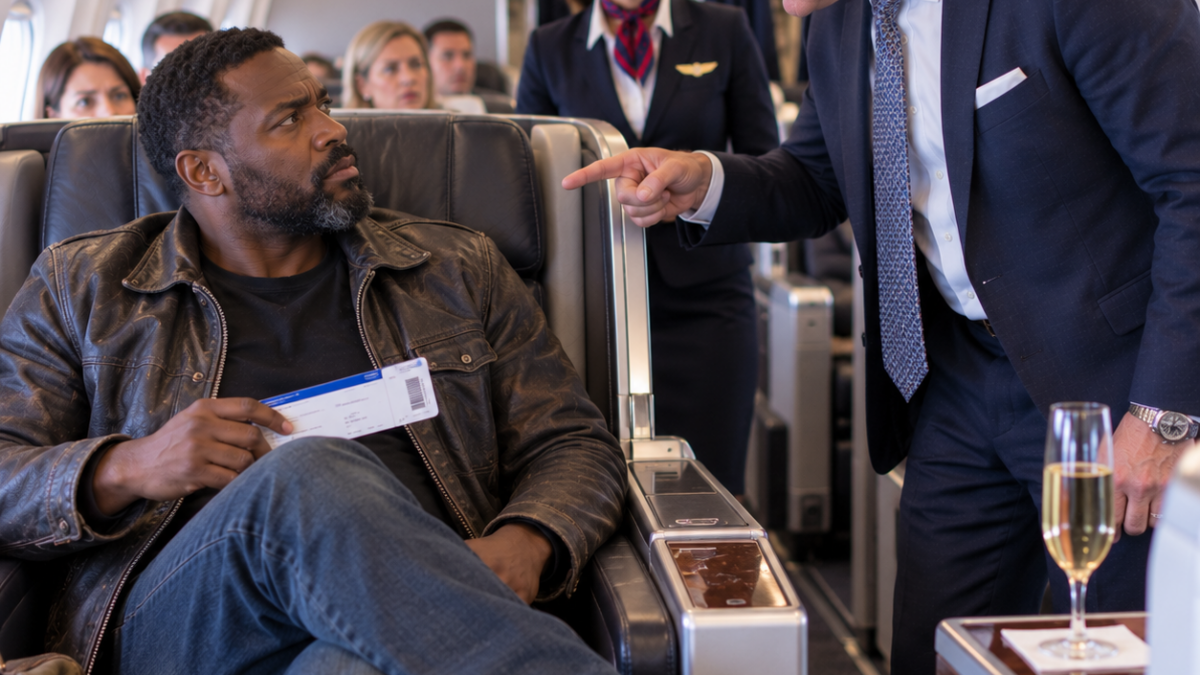
I should have moved on.
Not seats.
Mentally.
I should have put on headphones, opened my laptop, and treated Victor Langston like the temporary irritation he was.
Instead, I turned toward him.
“Belonging according to who?”
He gave me an almost pitying smile.
“Don’t make this into something it isn’t.”
“You’re the one telling me where I belong.”
“I said luxury has a culture.”
I laughed quietly.
“What does that even mean?”
“It means people who are used to certain environments know how to carry themselves.”
I looked down at my jacket.
Then at his suit.
“So tailoring is character?”
Victor’s face tightened.
“You know exactly what I’m saying.”
“Unfortunately, I do.”
He turned toward his tablet.
Conversation over.
Or so I hoped.
The next thirty minutes passed in uneasy silence.
Kelly brought drinks.
Victor ordered Scotch.
I kept my water.
The sky outside shifted toward orange and purple as evening settled over the country.
I tried to focus on Miami.
The meeting involved a supplier we’d been courting for nearly a year.
If everything went well, Tate Auto Group could move more of our parts distribution in-house.
That meant better margins.
More jobs.
Faster service.
It mattered.
And I refused to let some stranger with an expensive watch occupy more space in my head than the future I had spent years building.
Then Victor cleared his throat.
“Fifteen shops.”
I didn’t respond.
“Not bad.”
Still nothing.
“What neighborhoods?”
I named several.
South Side.
Oak Lawn.
Evanston.
Naperville.
A couple farther out.
Victor nodded slowly.
“You know, I own property in a few of those areas.”
“Congratulations.”
He laughed.
“You don’t like me much.”
“I don’t know you.”
“That’s never stopped people from judging me.”
The irony was almost impressive.
I looked at him.
“You opened this conversation by implying I didn’t belong in my seat.”
“I made an observation.”
“No.”
“You made an assumption.”
He raised his Scotch.
“Difference of opinion.”
I turned away.
That should have been the end.
Then nature gave me the excuse I needed to escape him.
I stood.
“Excuse me.”
Victor pulled his knees aside.
Barely.
I stepped into the aisle and walked toward the lavatory.
I was gone perhaps three minutes.
Four at most.
When I returned, Victor was looking at his tablet.
Calm.
Almost bored.
Nothing about him suggested that while I had been gone, he had leaned across my empty seat, opened the small duffel beneath the row ahead, and slipped a fifty-dollar bill between my notebook and spare shirt.
I learned that later.
At the time, all I saw was a man pretending I no longer existed.
I sat down.
Buckled my belt.
Opened my laptop.
And thought perhaps the night had finally run out of ways to surprise me.
Victor waited less than a minute.
“Excuse me.”
Kelly stopped several rows back.
He raised his hand.
“Could you come here?”
Something in his tone made me close my laptop.
Kelly approached.
“Yes, sir?”
Victor put one hand over his jacket pocket.
“I think we’ve got a problem.”
“What kind of problem?”
He pointed at me.
“This man stole money from my wallet.”
For a moment, I thought I’d misunderstood.
Then Kelly looked at me.
Every muscle in my body went still.
“I’m sorry?”
Victor leaned forward.
“Fifty dollars.”
“It was in my wallet.”
“I saw him messing around when he came back.”
“Now it’s gone.”
I stared at him.
“You are lying.”
Several passengers turned.
Victor shrugged.
“I expected you’d say that.”
Kelly’s expression became uneasy.
“Sir, are you certain?”
“Absolutely.”
“I want his bag searched.”
I laughed.
Not because it was funny.
Because the accusation was so outrageous that for one stupid second, my brain treated it like theater.
Then nobody else laughed.
Kelly looked at me.
“Mr. Tate.”
“No.”
Her face tightened.
“I haven’t asked yet.”
“You don’t need to.”
“You want to search my bag because he says fifty dollars disappeared?”
Victor smiled.
“What’s the problem if you’re innocent?”
That sentence.
People love that sentence when the privacy being surrendered belongs to someone else.
I looked at Kelly.
“Do you have authority to search my personal bag?”
She hesitated.
“It’s a serious allegation.”
“That isn’t what I asked.”
Victor interrupted.
“See?”
“Already defensive.”
I turned toward him.
“You’ve spent this entire flight trying to prove I don’t belong here.”
“And now money magically vanishes?”
His eyes hardened.
“Are you accusing me?”
“Yes.”
The woman in the red blazer behind us whispered something.
An older man across the aisle watched openly.
Kelly lowered her voice.
“Mr. Tate, we’re in the air.”
“I need both of you to stay calm.”
“I am calm.”
Victor laughed.
“Doesn’t look calm.”
I closed my eyes for a second.
Then I picked up the duffel.
“Fine.”
I put it on my lap.
“Open it.”
Kelly blinked.
“What?”
“If that’s what ends this.”
“Open it.”
She crouched.
Unzipped the bag.
My spare shirt.
Notebook.
Charging cable.
A paperback I’d been pretending for six months I would finish.
Then her hand stopped.
My stomach tightened before I even saw what she had found.
Kelly pulled out a crisp fifty-dollar bill.
Nobody said anything.
Victor leaned back.
And smiled.
“Told you.”
I stared at the money.
Then at him.
“I have never seen that bill.”
Victor shook his head.
“Unbelievable.”
“Look at me.”
He did.
“You put that there.”
The woman behind us gasped softly.
Someone across the aisle muttered:
“Come on.”
Victor gave a humorless laugh.
“Now I’m framing you?”
“Yes.”
“Why would I bother?”
“You tell me.”
Kelly stood.
The bill remained between her fingers.
“Mr. Tate, I’m going to notify the captain.”
“Good.”
“I want this documented.”
“Security may meet us in Miami.”
My mouth went dry.
“But until then—”
She paused.
“Please remain cooperative.”
There are words that sound neutral until you’ve spent a lifetime hearing who they’re disproportionately aimed at.
Cooperative.
Calm.
Nonthreatening.
Professional.
Words that can describe behavior.
And sometimes quietly demand submission.
I handed Kelly my identification when she requested it.
She looked at the driver’s license.
Then at me.
Then wrote something on her pad.
Victor watched everything.
Satisfied.
As Kelly walked away, he leaned toward me.
“Should’ve stayed in coach.”
I turned.
His expression had changed.
The polite prejudice was gone.
Now he wanted me to know.
“This is what happens when people reach too high.”
My hands clenched.
I kept them on my lap.
“You’re going to regret this.”
He smiled.
“Is that a threat?”
“No.”
I stared into his eyes.
“It’s a prediction.”
The cabin changed after that.
Before the accusation, I had been a passenger.
Afterward, I became a story.
People who hadn’t seen anything suddenly had opinions.
The woman in the red blazer moved her purse from beneath her seat and placed it against her leg.
The older man across the aisle glanced at me, then shook his head.
Someone farther back whispered:
“First class.”
As though theft became more shocking when committed near champagne.
Victor noticed every reaction.
He fed on them.
He told the couple in front that I’d been “acting strange” since boarding.
He suggested I might have upgraded using someone else’s points.
He mentioned crime around some of the neighborhoods where my shops operated.
None of it mattered legally.
All of it mattered socially.
He was building a version of me.
And people were volunteering to live inside it.
Kelly returned my ID.
“Security has been notified.”
I looked at her.
“Did you ask him for proof the money came from his wallet?”
She blinked.
“What?”
“Serial number?”
“Withdrawal receipt?”
“Anything?”
Victor laughed loudly.
“This guy’s unbelievable.”
Kelly’s face reddened.
“We’ll let airport security sort everything out.”
“Meaning you’ve already decided who needs sorting out.”
“Mr. Tate—”
“Did you ask him a single question?”
Her lips tightened.
“Please don’t make this more difficult.”
I leaned back.
There it was again.
Me.
Making it difficult.
I looked toward Victor.
He raised his glass.
A tiny toast.
I wish I could say everyone on the plane joined him.
They didn’t.
Most did something more ordinary.
Nothing.
They looked uncomfortable.
Then looked away.
The woman in the red blazer whispered.
The silver-bearded man returned to his phone.
A teenage girl three rows back started recording small clips whenever something happened.
Nobody asked whether I’d been searched fairly.
Nobody asked how Victor knew the exact denomination that would be found.
Nobody asked why a man supposedly worried about theft looked so delighted.
Silence does not always mean agreement.
But to the person being cornered, the distinction can become difficult to feel.
I stared out at the darkening sky.
My father came into my mind.
Not as the man I remembered near the end.
Weak from cancer.
Thin.
Tired.
I remembered him at fifty.
Broad shoulders.
Calloused hands.
Standing beside me in the first garage I’d rented.
The place had one lift.
One broken heater.
A bathroom door that wouldn’t close.
He looked around and said:
“Looks expensive.”
I had laughed.
“It’s a dump.”
“Exactly.”
“Expensive dump.”
Then he’d handed me his old leather jacket.
The one I was wearing now.
“You’re going to need something warm if that heater never gets fixed.”
Dad had worked city buses for twenty-nine years.
He never owned anything worth putting in a newspaper.
But he gave me the habit that eventually mattered more than money.
He hated humiliation.
Not experiencing it.
Inflicting it.
“Never make a man smaller just because you can.”
Victor had built his entire identity around the opposite philosophy.
Make people smaller.
Then call their discomfort proof that they deserved it.
A young flight attendant appeared about twenty minutes later.
Black.
Early twenties.
Slim.
Long dreadlocks tied back.
His name tag said JAMAL.
He pushed a snack cart slowly through first class.
When he reached my row, he placed a bag of pretzels on my tray.
“I didn’t order these.”
“Complimentary.”
Victor snorted.
“Better count them.”
Jamal ignored him.
Then bent slightly.
His voice dropped low enough that only I could hear.
“I saw him.”
My chest tightened.
“What?”
“The money.”
I looked at him.
He kept his eyes on the snack cart.
“When you went to the restroom.”
“He opened your bag.”
“Put something inside.”
Relief hit so quickly I almost felt dizzy.
“You saw it?”
He nodded once.
“Tell Kelly.”
“I will.”
“Tell the captain.”
“I will.”
For the first time since the fifty-dollar bill appeared, I could breathe fully.
“Thank you.”
Jamal looked at me.
“I’m sorry I didn’t say something immediately.”
“You are now.”
He pushed the cart forward.
Victor watched him go.
His eyes narrowed.
I tore open the pretzels.
Ate one.
Then looked at Victor.
I shouldn’t have smiled.
I did anyway.
“What?”
He asked.
“Nothing.”
“Doesn’t look like nothing.”
I put another pretzel in my mouth.
He followed my glance toward Jamal.
And I saw the calculation begin.
Several minutes later, Victor stood.
He adjusted his jacket.
Walked toward the galley.
I assumed he was getting a drink.
Jamal was alone there.
I couldn’t hear everything.
Only fragments beneath the engines.
“…know who I am…”
“…investor…”
“…career…”
Then silence.
Victor returned.
Smiling.
He sat.
Crossed his legs.
Checked his watch.
Nothing dramatic happened.
That made it worse.
A few minutes later, Jamal approached.
He didn’t look at me.
He stopped beside my seat.
“I’m sorry.”
My relief vanished.
“What happened?”
“I tried.”
“What do you mean?”
“They’re not listening.”
His eyes flicked briefly toward Victor.
Then down.
“I can’t help.”
Before I could respond, he walked away.
Victor leaned back.
“Problem?”
I stared at him.
“What did you say to him?”
“Who?”
“You know who.”
He shrugged.
“Maybe he realized supporting thieves isn’t a great career move.”
My stomach turned.
“You threatened him.”
Victor looked toward the aisle to make sure nobody was close.
Then he leaned toward me.
“Money talks.”
His smile widened.
“Louder than your kind.”
I sat very still.
A lifetime of being told to control my reaction condensed into one moment.
I wanted to hit him.
Not metaphorically.
I wanted my fist to remove that smile.
Instead, I picked up my water.
Finished it.
Put the empty glass down carefully.
My father again:
Never give a man your future because he had a bad five minutes with your pride.
I breathed.
Once.
Twice.
Victor laughed.
He thought restraint meant defeat.
People like him often do.
The temperature in the cabin dropped as night settled outside.
Kelly offered blankets.
Not to me.
Victor noticed.
“Anything else, sir?”
She asked him.
“I’m good.”
Then his eyes moved toward me.
“Just keep an eye on things.”
Kelly nodded.
I watched her walk away.
Something had changed.
Earlier she had treated Victor’s allegation as a problem to investigate.
Now she treated me like a risk to contain.
Maybe Victor had said something to the captain.
Maybe his claimed influence had reached them.
Maybe fear simply had momentum.
Whatever the reason, I stopped expecting help.
Then Victor ordered coffee.
I remember the cup because it was white porcelain.
Too elegant for what happened next.
Kelly placed it on his tray.
The coffee steamed.
Victor waited until she had moved away.
Then shifted his arm.
The cup tipped.
Hot liquid poured over my thighs.
I yelled.
Not loudly.
A sharp involuntary sound.
I stood halfway, trapped by the tray.
The heat burned through my jeans.
“Jesus!”
Victor pulled the empty cup upright.
“Sorry.”
He wasn’t sorry.
His mouth twitched.
I grabbed napkins.
Pressed them against my legs.
“You did that intentionally.”
“Oh, come on.”
He leaned closer.
“Accidents happen.”
The skin beneath the denim burned.
Kelly looked over.
I expected her to rush toward us.
She didn’t.
Victor lowered his voice.
“Stay in your lane, boy.”
The last word changed everything.
I looked at him.
No smile.
No ambiguity.
He wanted me to hear exactly what he thought I was.
“Say it again.”
His eyes glittered.
“You heard me.”
I turned toward the aisle.
“Kelly.”
She approached reluctantly.
“Yes?”
“He poured hot coffee on me.”
Victor laughed.
“It spilled.”
“I need burn treatment.”
She looked at my wet jeans.
“I can bring a cold towel.”
“And I want this documented.”
“Of course.”
Victor lifted both hands.
“Unbelievable.”
Kelly returned with towels.
I pressed them to my legs.
No one moved Victor.
No one asked whether I wanted another seat.
We were flying in an aircraft with empty seats elsewhere.
Yet somehow the solution remained for me to endure him.
That would matter later.
At the time, I only knew the pain was real.
And my options were shrinking.
The seat-belt light illuminated.
Turbulence ahead.
Everyone buckled.
Victor kept glancing at me.
A man not satisfied merely with winning.
He wanted proof that I knew he had won.
The aircraft hit a pocket of rough air.
The cabin shook.
My tray bounced.
Victor grabbed its edge.
And shoved.
Hard.
The tray slammed into my burned thighs.
White pain flashed through me.
“Stop.”
He laughed.
The plane shook again.
He pushed once more.
I grabbed the tray.
“Don’t.”
“What?”
He leaned closer.
“Can’t handle a little nudge?”
Then he shoved again.
Something inside me snapped.
Not my judgment.
My limit.
I caught his wrist.
Twisted it away from the tray.
“Touch me again.”
My voice was low.
“And you’ll regret it.”
Victor yelped.
Loud.
Much louder than the pressure justified.
“Help!”
The cabin turned.
“This man’s attacking me!”
I released him immediately.
Kelly came running with another attendant.
A thin man with a buzz cut.
Victor held his wrist dramatically.
“He grabbed me.”
“He threatened me.”
I raised both hands.
“He shoved the tray into burns he caused.”
The woman in the red blazer spoke.
“I saw him grab Mr. Langston.”
“Did you see what happened before?”
She hesitated.
“No, but—”
Victor interrupted.
“It was completely unprovoked.”
The buzz-cut attendant pulled plastic restraints from a compartment.
My stomach dropped.
“You cannot be serious.”
“Sir, sit back.”
“I’m already sitting.”
“Keep your hands visible.”
“I just told you what happened.”
Kelly looked at me.
Fear had replaced uncertainty.
“Mr. Tate, please don’t make us restrain you.”
I stared at her.
“You already decided to.”
The other attendant took my arm.
Instinct told me to pull away.
I didn’t.
He brought my wrists together.
The plastic ties tightened.
The sound was small.
Click.
But emotionally it was louder than any insult Victor had delivered.
I was restrained in a first-class seat on a commercial airplane while the man who had planted evidence, threatened a witness, burned me, and provoked the confrontation sat beside me smiling.
Victor whispered:
“Now you look like you belong.”
I closed my eyes.
That was the closest I came to losing control.
The crew contacted the ground.
Police would meet us in Miami.
The announcement wasn’t public.
But people heard enough.
The cabin filled with whispers.
“Unruly passenger.”
“Assault.”
“Theft.”
Every label added another brick.
I tried explaining again.
Nobody listened.
Eventually the captain warned over the intercom that further disturbance could require a diversion.
That ended my protests.
I stopped talking.
The plastic restraints cut into my wrists.
My thighs burned.
My shoulder ached from the position.
And I thought about something I had deliberately not told Victor.
Or Kelly.
Or anyone else.
Tate Auto Group was not the largest thing I owned.
Eight years earlier, one of my oldest customers had introduced me to a small aerospace-parts manufacturer struggling to survive.
They made specialized high-stress components.
Brilliant engineering.
Terrible business systems.
I understood logistics.
Fleet maintenance.
Supply chains.
And more importantly, I understood what it meant to build something while everyone richer than you waited for you to fail.
I invested.
Then invested again.
The company became Tate Aeronautics.
I owned half.
Our parts were now used across commercial aviation.
Including by the airline carrying us to Miami.
I had a scheduled supplier meeting the next morning with their procurement division.
The reason Kelly had greeted me by name wasn’t because she knew I was famous.
I wasn’t.
My corporate travel profile was flagged as a high-level supplier contact.
Most cabin crew wouldn’t know why.
And I’d never seen a reason to explain it.
Even sitting in restraints, I didn’t.
Because something else had become painfully clear.
If telling them I was wealthy changed whether they believed I deserved dignity, then the problem was larger than Victor.
I shouldn’t have needed to be important.
That thought stayed with me.
It would guide what I did later.
About ninety minutes from Miami, the cabin quieted.
Fatigue took over.
Passengers dozed.
Screens dimmed.
Victor sat beside me like a man savoring the final quarter of a game he believed he had already won.
Then a woman in 4C moved.
Her name was Carla Ruiz.
I learned it later.
At the time, I knew only that she had dark hair tied loosely and had spent much of the flight reading a paperback.
She had watched more than anyone realized.
When Victor spilled the coffee, Carla noticed.
When he shoved the tray during turbulence, she noticed.
When he leaned toward me and said:
“Stay in your lane, boy.”
She noticed.
Most importantly, she recorded.
Quietly.
Her phone rested near the edge of her seat with the camera angled between rows.
The recording caught Victor’s hand.
His voice.
My warning.
His manufactured cry afterward.
Carla connected to the onboard Wi-Fi.
Uploaded the clip.
She wrote a simple caption.
This man is lying.
Then tagged several news organizations.
I knew none of this.
Not until Kelly’s phone began vibrating repeatedly.
She pulled it out.
Looked at the screen.
Then froze.
The buzz-cut attendant leaned over.
I watched their faces change.
Kelly replayed something.
Her eyes moved from the phone.
To Victor.
To me.
Then back to the phone.
She walked quickly into the galley.
Moments later, the captain called them.
Something was happening.
Victor noticed too.
“What?”
He looked at me.
“You do something?”
My hands were still bound.
“Clearly.”
His phone started vibrating.
Once.
Twice.
Then constantly.
He pulled it out.
His face changed.
Carla’s video was spreading.
Thousands of views.
Then hundreds of thousands.
Comments appeared faster than he could scroll.
Someone had identified him.
Victor Langston.
Founder and CEO of Langston Properties.
And while the internet was doing what the internet does, airline headquarters received a call from its social-media team.
Then legal.
Then supplier relations.
Somebody cross-checked my name.
My profile surfaced.
Marcus Tate.
Co-founder and fifty-percent owner of Tate Aeronautics.
One of the airline’s major component suppliers.
The next change happened so fast it almost insulted me more than the original mistreatment.
Kelly rushed toward my row.
“Mr. Tate.”
Her voice shook.
“We’re so sorry.”
I stared at her.
The other attendant carried scissors.
“We’ve reviewed new information.”
He cut the restraints.
Blood rushed into my hands.
Painful.
I rubbed my wrists.
Kelly kept talking.
“There has been a serious misunderstanding.”
I looked at her.
“No.”
She stopped.
“This isn’t a misunderstanding.”
Victor had gone pale.
His eyes moved between us.
“What information?”
Nobody answered him.
Kelly crouched beside me.
“Is there anything you need?”
I laughed once.
A short, bitter sound.
“Ten minutes ago you wouldn’t give me water.”
Her face reddened.
“I’m sorry.”
“Why?”
“Sir?”
“Why are you sorry now?”
She said nothing.
“Is it because the video showed I was telling the truth?”
I asked.
“Or because you learned I have money?”
The silence answered.
Victor stared.
“Money?”
I flexed my hands.
The restraint marks circled both wrists.
Kelly swallowed.
“Mr. Tate is an owner of Tate Aeronautics.”
Victor frowned.
Then recognition hit.
Everyone in certain industries knew the name.
Aviation components.
Precision manufacturing.
Government-certified facilities.
Major contracts.
Victor looked at me as if I had changed bodies.
“You’re Marcus Tate?”
“I’ve been Marcus Tate the entire flight.”
His mouth opened.
Closed.
“Why didn’t you say—”
I turned toward him.
“Say what?”
“That you were…”
He stopped.
“Important?”
I asked.
The word sat between us.
Victor looked away.
I leaned toward him.
“Would you have treated me differently?”
No answer.
“That’s the problem.”
Passengers who had stared at me with suspicion now stared at Victor.
The woman in the red blazer loosened her grip on her purse.
The silver-bearded man suddenly seemed fascinated by the floor.
A man who had agreed with Victor earlier muttered:
“Guy’s an idiot.”
I almost laughed.
Not because Victor wasn’t.
Because nothing about the evidence had changed except my résumé.
Carla’s video had changed the facts people could see.
My wealth changed who they believed deserved apologies.
Those were not the same thing.
I looked toward Carla.
She met my eyes.
Nodded slightly.
I mouthed:
“Thank you.”
She smiled.
No applause.
No heroic pose.
Just a woman who had decided to record what others were willing to ignore.
That mattered more than the corporate phone call.
Victor’s phone kept buzzing.
Sponsors.
Partners.
Associates.
News outlets.
His company communications director.
He answered one call.
“What?”
He listened.
“No.”
“Do not issue anything.”
Another pause.
“I said don’t respond.”
He ended the call.
His hands were shaking.
I had never seen a man lose social control in real time before.
Not money.
Not yet.
Control.
The ability to determine which version of events dominated.
He turned toward me.
“You destroyed my reputation.”
I stared.
“I was restrained.”
“What exactly did I do?”
“You know how these clips work.”
“They never show context.”
Carla spoke from behind us.
“I recorded the context.”
Victor turned.
“You.”
Her face stayed calm.
“Me.”
“Delete it.”
“No.”
“I’ll sue you.”
“You can try.”
Victor looked around.
Nobody supported him now.
People who had laughed earlier avoided his eyes.
Power often looks permanent until it shifts.
Then everyone insists they were never really on the wrong side.
The captain announced our descent into Miami.
Thirty minutes.
Seat belts.
Upright seats.
The crew moved Victor away from me to an open seat across the aisle.
He sat rigid.
His phone on his lap.
For the first time all night, he looked frightened.
I should have felt relief.
Instead, something bothered me.
The way he kept reaching into his jacket.
The way his breathing changed.
The way his eyes moved constantly.
He looked like a cornered man searching for one final exit.
During descent, he suddenly stood.
Against crew instructions.
“Sit down!”
Kelly shouted.
Victor ignored her.
He lunged toward me.
There was a pen in his hand.
Not a weapon designed to kill.
But held like one.
“You think you’ve won?”
He swung.
I moved sideways.
The pen tore through my leather jacket at the shoulder.
Pain flashed across my skin.
I caught his wrist.
Forced his arm against the seat.
The pen dropped.
This time, everybody saw the beginning.
Nobody called me the aggressor.
People shouted.
Kelly and the other attendant rushed in.
I held Victor down only long enough for them to control him.
“You’re finished.”
I said.
Not triumphantly.
Just exhausted.
They moved him across the aisle.
Passengers were filming openly now.
Carla too.
I sat down.
My shoulder bled through the torn jacket.
Kelly brought first aid.
The symbolism wasn’t lost on me.
She had ignored my burns.
Now she was kneeling beside me because everyone knew who I was.
“Please stop apologizing.”
I said.
Her hands froze.
“I mean it.”
“What happened needs more than apologies.”
She nodded.
“I understand.”
“I don’t think you do yet.”
But maybe she would.
Victor went strangely calm.
That frightened me more than the attack.
He sat across the aisle.
Breathing slowly.
Typing something on his phone.
Then he put it away.
A faint smile returned.
I remember thinking:
What does he still think he controls?
The answer was waiting at the gate.
Miami police boarded almost immediately after the aircraft stopped.
Four officers.
One walked directly toward me.
“Marcus Tate?”
“Yes.”
“Stand up.”
The crew intervened.
“Officer, no.”
“It’s the passenger across—”
“Sir, stand up.”
His hand rested near his holster.
My chest tightened.
“What is this about?”
“We received information concerning narcotics.”
I stared.
“Narcotics?”
The officer reached beneath the seat.
Pulled out my duffel.
My stomach dropped.
“No.”
He opened it.
Shirt.
Notebook.
Then a small plastic bag.
White powder.
Victor leaned back.
And smiled.
Everything inside me went cold.
“That’s not mine.”
The officer held it up.
“Of course.”
Carla stood.
“Wait.”
Nobody listened.
The officer pulled my hands behind my back.
Metal cuffs this time.
My wrists were still raw from the plastic ties.
The pain was immediate.
“You are making a mistake.”
Victor watched.
His face restored.
Not fully.
But enough.
One final victory.
The woman in the red blazer whispered:
“Oh my God.”
I looked at Carla.
Her expression had changed.
She was staring at her phone.
Then at Victor.
Then back at the screen.
“Officer!”
She shouted.
“Stop!”
They moved me toward the jet bridge.
Carla stepped into the aisle.
“I recorded him.”
The lead officer barely looked.
“Ma’am, move aside.”
“No.”
She held up the phone.
“He planted it.”
That stopped Kelly.
Not the officers.
Yet.
Carla pressed play.
I couldn’t see the screen.
But I heard Victor’s voice from minutes earlier.
Then chaos.
His lunge.
My reaction.
Passengers screaming.
And in the corner of Carla’s frame, while everyone focused on the struggle, Victor bent toward my duffel.
His hand moved.
A small bag disappeared inside.
The cabin erupted.
Victor’s face went white.
The lead officer stopped.
I turned as far as the cuffs allowed.
“Play it again.”
Carla did.
The officer watched.
His expression changed.
Then another officer’s phone rang.
He stepped away.
Answered.
Looked toward Victor.
Then toward the officer holding me.
Something even worse was unfolding.
The narcotics tip had come through a personal contact.
An officer who knew Victor.
A man who had golfed with him.
A man who had apparently accepted more than friendship over the years.
This wasn’t just Victor improvising.
He had called ahead.
They still took me off the aircraft.
Procedure.
Evidence.
Statements.
But I was no longer being treated as the obvious suspect.
Victor came too.
Separated.
Airport police secured the drug package.
Carla’s original recording.
Her second recording.
Passenger videos.
The pen.
My torn jacket.
Photographs of my burns.
And the first fifty-dollar bill.
My attorney arrived before I expected her.
Lena Carter.
No relation to anyone else in the story.
Just Lena.
Five-foot-five.
Braided hair.
A voice that could make an entire conference room sit straighter.
She walked into the airport police office carrying a tablet.
“What exactly are you charging my client with?”
Nobody answered immediately.
“That’s what I thought.”
She placed the tablet on the table.
Carla’s video played.
“Your source accused my client of drugs before the bag was even discovered.”
Lena said.
“Your officer boarded with a specific target.”
“And the video shows another passenger placing the evidence.”
The police supervisor looked furious.
Not at me.
At his own people.
The cuffs came off.
Again.
I rubbed my wrists.
Metal over raw skin leaves a specific ache.
I still remember it.
Lena looked at me.
“Hospital?”
“Later.”
“Marcus.”
“Later.”
She knew arguing would be useless.
“Fine.”
Then she turned to the supervisor.
“You are preserving every communication between Mr. Langston and every member of this department.”
He nodded.
“Already ordered.”
“And the officer who received the tip?”
“Removed from duty pending investigation.”
Lena looked at me.
“You still think Miami is relaxing?”
I laughed for the first time in hours.
Victor was arrested.
Not because I was wealthy.
Not because the video was viral.
Because by then, police had evidence.
False allegation.
Evidence planting.
Assault.
Interference.
Potential conspiracy.
The exact charges would change as prosecutors sorted jurisdiction and proof.
Real investigations are slower and less satisfying than social media.
But Victor left the airport in handcuffs.
The sight did not make me happy.
That surprised people later.
They wanted the photograph to feel like justice.
It felt like exhaustion.
He looked smaller without the cabin around him.
Without people laughing.
Without crew members responding to his confidence.
Without an audience accepting his version first.
As he passed me, he stopped.
“This is your fault.”
I almost pitied him.
Almost.
“No.”
I said.
“This is the first thing tonight that belongs entirely to you.”
They moved him away.
I went to the hospital.
First-degree burns with a few areas approaching superficial partial thickness.
A small cut on my shoulder.
Bruised wrists.
Nothing permanent physically.
The emotional part lasted longer.
Lena sat in the chair beside the bed while a nurse dressed my legs.
“You’re not meeting the supplier tomorrow.”
“I am.”
“Marcus.”
“They came to Miami.”
“You were assaulted.”
“I’m aware.”
“You were restrained twice.”
“Also aware.”
“Then behave like a normal person.”
“I’ve never claimed to be normal.”
She rubbed her forehead.
“At least move the meeting.”
I did.
Two days.
Compromise.
When the nurse left, Lena handed me my phone.
“Your mother.”
I stared at it.
“How much does she know?”
“Internet.”
“So everything except the parts I wish she didn’t.”
“Correct.”
I called.
Mom answered before the first full ring.
“Marcus Anthony Tate.”
Full name.
Bad sign.
“Hi, Mama.”
“What happened to you?”
“I’m okay.”
“I saw handcuffs.”
“I’m okay.”
“I saw hot coffee.”
“Superficial burns.”
“I saw a man come at you with something.”
“Pen.”
“Do not tell me ‘pen’ like office supplies can’t stab people.”
I smiled.
“Fair.”
Then her voice broke.
“Baby.”
My eyes closed.
“I’m okay.”
“I know.”
She was crying.
“That doesn’t mean I am.”
There was nothing to say to that.
So I let her cry.
Then I did something I rarely did.
I joined her.
The story exploded nationally.
Headlines simplified everything.
R@c!st Mogul Frames Black Millionaire on First-Class Flight.
Businessman Picks Wrong Passenger.
Secret Aviation Owner Humiliated Before Identity Reveal.
I hated most of them.
They made the lesson too easy.
Victor’s mistake was not choosing the wrong Black man.
There should have been no correct Black man to treat that way.
If I’d actually been only a mechanic, would Carla’s video matter less?
If I owned one garage instead of fifteen?
If I earned forty thousand dollars a year?
If Tate Aeronautics belonged to someone else?
The evidence would be identical.
The burns would still hurt.
The false accusation would still be false.
The restraints would still cut.
Yet I watched how quickly public sympathy intensified once reporters attached words like millionaire, entrepreneur, supplier, investor.
That bothered me deeply.
It also forced me to examine myself.
For years, I had believed success could protect me.
Not consciously.
But somewhere inside.
Work hard enough.
Own enough.
Build enough.
Walk into rooms with enough accomplishments and perhaps prejudice would need to take a number and wait outside.
Victor proved how childish that idea was.
The jacket had covered the résumé.
And for some people, skin had covered everything else.
The airline called.
CEO.
Chief operating officer.
General counsel.
Head of customer experience.
They offered private transportation.
Lifetime premium status.
Medical expenses.
A settlement before I had even threatened litigation.
I declined the conversation until after their internal review.
The CEO sounded surprised.
“Mr. Tate, we want to make this right.”
“You can’t make that flight unhappen.”
“No.”
“So tell me what you’re investigating.”
“The crew response.”
“Good.”
“The restraints.”
“Good.”
“Mr. Langston’s influence claims.”
“Better.”
“And whether any staff member altered their decisions because they believed he was a major investor.”
I paused.
“Was he?”
“Not directly.”
Interesting.
“He exaggerated?”
“Significantly.”
Victor’s power had partly been theater.
People obeyed because he acted powerful enough to punish them.
That detail stayed with me.
“So Jamal was threatened with influence Victor didn’t actually have?”
“Apparently.”
“Then your culture has a bigger problem.”
“How so?”
“Your employee believed a wealthy passenger could end his career with a business card.”
Silence.
“If that fear felt plausible, you built a system where it could be believed.”
The CEO didn’t argue.
That earned him some respect.
Jamal called me.
He sounded terrified.
“Mr. Tate.”
“Marcus.”
“I wanted to apologize.”
“You were threatened.”
“I still lied.”
“You said they weren’t listening.”
“I should’ve said what actually happened.”
“Yes.”
He was silent.
I didn’t rescue him from it.
“Do you hate me?”
“No.”
“Why?”
“Because being afraid doesn’t make you evil.”
I paused.
“But what you do with fear matters.”
He breathed slowly.
“I’ve been thinking about resigning.”
“Don’t.”
“Why?”
“Because if every decent employee leaves after failing once, the workplace gets handed to people who never cared.”
Silence.
“What should I do?”
“Tell the truth in the investigation.”
“All of it.”
“Let them know Victor threatened you.”
“And then learn from it.”
“I will.”
“Good.”
I almost ended the call.
Then remembered something.
“Jamal?”
“Yeah?”
“You did one thing right before you got scared.”
“What?”
“You told me I wasn’t crazy.”
He was quiet.
“That mattered.”
His voice broke slightly.
“Thank you.”
Kelly’s apology came in writing.
Then in person.
I agreed to meet.
Not because corporate counsel wanted it.
Because I needed to understand.
She sat across from me in a conference room at the airline’s Chicago office.
No uniform.
Plain clothes.
She looked younger.
“I failed you.”
I waited.
She swallowed.
“When Mr. Langston accused you, I believed him too quickly.”
“Why?”
Her eyes filled.
“I’ve asked myself that every day.”
“That’s not an answer.”
“No.”
She wiped one cheek.
“I believed him because he looked like what I thought a victim should look like.”
I sat back.
“And I looked like what?”
She cried harder.
I didn’t help her.
Some truths need room to be said fully.
“Like someone who could have done it.”
There it was.
She continued.
“I hate admitting that.”
“You should.”
She nodded.
“I know.”
“Did Victor’s race matter?”
“Yes.”
“His suit?”
“Yes.”
“My clothes?”
“Yes.”
“My race?”
She looked directly at me.
“Yes.”
I appreciated the honesty more than any apology.
“What happened after headquarters learned who I was?”
Her face crumpled.
“I felt sick.”
“Why?”
“Because my first thought was that we’d restrained somebody important.”
I waited.
“Then I realized how horrible that thought was.”
“Exactly.”
“It shouldn’t have mattered.”
“No.”
She whispered:
“I’m sorry.”
I believed she meant it.
Forgiveness came later.
Trust never fully did.
Those are different things.
Carla wanted no attention.
Of course the world ignored that.
Reporters found her.
Talk shows invited her.
Someone called her “the woman who saved a millionaire.”
She declined nearly everything.
I eventually reached her through the airline.
We met for coffee.
She worked as a public-school counselor.
Thirty-four years old.
Two sons.
The paperback she’d been reading was a library book she was embarrassed anyone had seen because she said it was “terrible romance.”
I bought her coffee.
She argued.
“I can pay for my own coffee.”
“I didn’t say you couldn’t.”
“Then why are you paying?”
“Because you kept me out of jail.”
She laughed.
“Okay.”
I became serious.
“Why did you record?”
Her smile faded.
“Because my brother got arrested five years ago.”
“Wrong guy.”
“Wrong description.”
“Wrong block.”
She stirred her coffee.
“He was released.”
“But everybody kept saying the police had reasons.”
“Nobody had video.”
She looked at me.
“When Victor poured the coffee on you, I knew exactly how the story was going to change if you reacted.”
“So I started recording.”
“You could have spoken up earlier.”
“I know.”
“Why didn’t you?”
She looked ashamed.
“I was scared.”
That answer echoed Jamal’s.
“I had my kids at home.”
“I thought, what if this rich guy sues me?”
“What if the airline removes me?”
“What if I misunderstand?”
I nodded.
“So I hid behind my phone.”
“Your phone mattered.”
“But so would my voice.”
“Yes.”
She looked at me.
“I’ve thought about that.”
“Good.”
We sat quietly.
Then I said:
“Don’t let anyone turn you into a superhero.”
She smiled.
“Wasn’t planning on it.”
“You did something brave.”
“And something late.”
“Both can be true.”
“Exactly.”
That became one of the phrases I used often afterward.
Both can be true.
People can fail and still repair.
People can be afraid and still become courageous.
Institutions can apologize and still deserve scrutiny.
Victims can survive and still carry damage.
Justice can arrive and still feel incomplete.
Victor’s legal consequences developed over the next year.
Some charges were stronger than others.
The drug planting was captured.
The physical assault was captured.
Witness intimidation toward Jamal became part of the investigation.
The fifty-dollar setup was harder initially because no camera directly showed it.
Then investigators recovered cabin service footage from another angle.
Not perfect.
Enough.
His financial relationship with the Miami officer created another investigation.
The officer had accepted gifts.
Trips.
Golf fees.
A discounted property transaction tied to one of Victor’s companies.
Victor had not literally purchased an arrest.
Reality was messier.
But the relationship was improper enough that prosecutors became interested.
Victor’s companies suffered.
Some projects continued.
Employees still needed paychecks.
I refused every suggestion that my company should use supplier leverage to destroy Langston Properties.
Lena stared at me one afternoon.
“He tried to send you to jail.”
“I know.”
“And you’re worried about his employees?”
“Yes.”
“You’re exhausting.”
“So I’ve heard.”
I didn’t want revenge disguised as ethics.
Victor needed accountability.
His receptionist did not need unemployment because her CEO was R@c!st.
The airline changed too.
Not because I threatened to cancel contracts.
I explicitly refused.
That mattered to me.
I told their CEO:
“If you change because you fear losing Tate Aeronautics, you’re repeating the same problem.”
He understood.
So we brought in outside reviewers.
Not my consultants.
Independent ones.
They studied restraint policies.
Passenger accusations.
Bias in conflict assessment.
How crew members respond when high-status travelers invoke influence.
One training scenario recreated an important piece of my flight.
Two passengers accuse each other.
One is wealthy.
Polished.
Confident.
The other is visibly angry.
Tired.
Casually dressed.
Trainees must separate demeanor from evidence.
Confidence is not credibility.
Anger is not guilt.
Those sentences entered the manual.
Jamal later helped teach the course.
Kelly volunteered to speak during some sessions.
She told new crew members:
“The moment I heard an accusation, I stopped investigating two people and started managing one suspect.”
That line was better than anything an outside consultant wrote.
Because it came from failure.
My Miami meeting eventually happened.
The supplier executive saw the bruises.
“Rough flight?”
I looked at him.
“You have no idea.”
We signed the deal.
Tate Auto Group expanded.
Tate Aeronautics grew.
Life continued.
That’s another thing dramatic stories rarely show.
After the cameras leave, you still have payroll on Friday.
Mothers call.
Invoices arrive.
Employees quit.
Refrigerators break.
Trauma has to coexist with routine.
For months, every time I boarded a plane, my body remembered before my mind did.
Tight chest.
Sweaty hands.
Awareness of whoever sat beside me.
I began choosing aisle seats.
Then caught myself.
Why was I changing my preferences for Victor?
So one day I selected 2A again.
Window.
Chicago to Miami.
Same route.
My mother called the decision stupid.
Lena called it exposure therapy.
I called it unfinished business.
The man in 2B that day was a kindergarten teacher from Indiana.
He spent half the flight sleeping.
At one point, he woke up.
Looked at me.
Said:
“Sorry if I snored.”
“You did.”
“Bad?”
“Impressive.”
He laughed.
Then went back to sleep.
That flight did more for me than any corporate apology.
Nothing happened.
That’s what healing sometimes needs.
Not a dramatic correction.
An ordinary day where the feared thing fails to repeat.
Victor eventually reached a plea agreement covering several of the criminal matters.
He paid restitution.
Accepted probationary conditions on some offenses while other more serious charges carried custody exposure that was resolved through negotiated sentencing.
The exact legal outcome disappointed people who wanted a cinematic ending.
I understood.
But I had sat inside enough business litigation by then to know justice systems are built from evidence, statutes, jurisdiction, negotiation, and imperfect choices.
Not audience satisfaction.
Victor lost leadership control of his company.
His board forced him out.
Not because they suddenly developed morals.
Because he became financially toxic.
Again:
Both can be true.
Bad motives can produce useful consequences.
He issued an apology.
I did not meet him.
His attorney asked.
Then a mediator asked.
I declined.
People sometimes confuse forgiveness with access.
I did not hate Victor.
I also did not owe him my presence.
One day, nearly eighteen months after the flight, I received a letter.
Handwritten.
No corporate stationery.
Victor.
Lena inspected it first.
Then handed it over.
It was four pages.
He did not excuse himself.
That surprised me.
He wrote about growing up wealthy but insecure.
A father who measured human worth through hierarchy.
Schools where status was oxygen.
A business career built on domination.
He wrote:
I believed respect was something scarce, and giving it to someone I had placed beneath me somehow reduced my own.
That sentence stayed with me.
Then:
When you asked what I inherited, I heard an accusation I could not tolerate because part of me knew the answer.
He admitted the fifty dollars.
The threats.
The coffee.
The drug planting.
Not as legal confession.
Those matters were already known.
As moral admission.
The last paragraph said:
I don’t expect forgiveness. I am trying to understand why I needed you to be smaller so badly.
I folded the letter.
Put it away.
Lena asked:
“You writing back?”
“No.”
“Ever?”
“I don’t know.”
I never did.
Sometimes accountability is the final communication.
Carla and I remained friends.
So did Jamal and I.
Kelly stayed with the airline.
Many people online demanded she be fired.
I opposed that.
Not because her failure was small.
It wasn’t.
Because she admitted it, cooperated fully, and became part of changing what had failed.
If accountability has only one setting—exile—people learn to hide mistakes rather than confront them.
Some acts require removal.
Others require repair.
Leadership is knowing the difference.
The buzz-cut attendant received discipline too.
He eventually left aviation voluntarily.
Jamal became a cabin-safety trainer.
He once introduced me at an event by saying:
“This is the man who taught me that being afraid isn’t shameful.”
“What matters is whether fear becomes your boss.”
I told him afterward he’d stolen that from me.
He said:
“Add it to the lawsuit.”
Two years after Flight 372, the airline asked me to speak at a leadership conference.
I almost declined.
Then they told me the topic.
Status Bias in High-Stakes Decision Making.
That was bigger than aviation.
I accepted.
I stood before pilots.
Crew supervisors.
Airport managers.
Executives.
I wore the same leather jacket.
People laughed when they realized.
I didn’t.
“This jacket caused part of your problem.”
The room became quiet.
“Not because there’s anything wrong with it.”
“But because people use visual shortcuts.”
“Clothing.”
“Race.”
“Age.”
“Accent.”
“Job.”
“Confidence.”
“Wealth.”
I looked around.
“Victor Langston saw the jacket and decided I didn’t belong.”
“Some passengers saw a suit and decided Victor must be credible.”
“Your crew saw anger from me and confidence from him and treated confidence as evidence.”
“Then headquarters learned I was wealthy and supplier relations changed the speed of your apology.”
Nobody moved.
“Every stage involved status.”
I paused.
“So if your lesson from my flight is ‘be careful because the casually dressed Black guy might secretly be a millionaire,’ you’ve learned absolutely nothing.”
Several people lowered their eyes.
“The correct lesson is simpler.”
“You shouldn’t need to discover someone’s importance before treating them fairly.”
That line became part of their training deck.
I allowed it.
No royalties.
Lena was disappointed.
My mother framed a newspaper article about the incident.
I told her not to.
She ignored me.
Parents become strangely immune to adult children’s authority.
The headline said:
CHICAGO ENTREPRENEUR TURNS AIRLINE ORDEAL INTO INDUSTRY REFORM.
I hated it.
Mom hung it beside a photo of Dad.
“Why?”
I asked.
“Because your father would be proud.”
“He’d hate the headline.”
“He’d hate all headlines.”
“True.”
She touched the old photograph.
Dad wearing a work jacket.
Standing beside a city bus.
“He’d be proud you didn’t let that man change what kind of man you are.”
That hit me harder than anything else.
Because there had been moments on that flight when Victor almost did.
He wanted anger.
He wanted violence.
He wanted proof.
He needed me to become the stereotype he had already chosen.
For one second, when I caught his wrist, I gave him enough to weaponize.
I don’t blame myself for defending against pain.
But I learned something from it.
Some people provoke precisely because your reaction is useful to them.
Self-control isn’t submission.
Sometimes it’s strategy.
Years passed.
Tate Auto Group reached twenty-two locations.
Tate Aeronautics expanded into new components and maintenance analytics.
I became wealthier.
Publicly, more recognizable.
That part was inconvenient.
Airports occasionally came with:
“Are you the guy from that flight?”
I always wanted to answer:
“No, I’m the guy from fifteen other things.”
But sometimes stories choose the label people remember.
I learned to live with it.
What mattered more was what followed.
A pilot wrote to say our training had changed how she handled a conflict involving a homeless-looking veteran seated in premium economy.
A flight attendant wrote that she challenged a celebrity who tried to have a Latino family moved.
An airport supervisor told me he had stopped an employee from escalating against a passenger because the passenger’s anger was being treated as evidence of danger rather than a response to mistreatment.
Small things.
No headlines.
Those meant more.
Carla once asked me:
“Do you think the video saved you?”
We were having dinner with her husband and sons.
I thought carefully.
“It saved the truth from depending entirely on whether people believed me.”
She nodded.
“That’s different.”
“Very.”
Her younger son asked:
“Mom was famous?”
Carla groaned.
“No.”
“She got millions of views.”
“That is not fame.”
“It literally is.”
I laughed.
Carla pointed at me.
“This is your fault.”
“Obviously.”
Then her older son looked at me.
“Would you have gone to jail without the video?”
The table became quiet.
“Maybe not.”
I said.
“There were other ways the truth might have come out.”
“But?”
“But it would’ve been harder.”
That was the honest answer.
Evidence changes power.
Especially when social assumptions have already picked a winner.
That is why systems need documentation before crisis.
Body cameras.
Cabin reports.
Independent complaint channels.
Transparent procedures.
Not because technology is morally superior.
Because memory is vulnerable to bias.
So is authority.
One winter morning, I flew from Chicago to Los Angeles.
First class.
Seat 2A.
A young Black man sat beside me.
Maybe twenty-three.
Hoodie.
Backpack.
Nervous.
He kept checking the seat number.
Finally he looked at me.
“First time up here.”
I smiled.
“Mine wasn’t that long ago.”
He laughed.
“I used points.”
“Points are money with extra steps.”
That relaxed him.
The flight attendant approached.
“Mr. Tate.”
Then looked at him.
“Mr. Brooks.”
“Welcome.”
Same tone.
Same smile.
No suspicion.
No hierarchy.
The young man ordered ginger ale.
I ordered water.
And nothing happened.
I found myself absurdly emotional.
Not because one polite interaction proved the world had changed.
It didn’t.
But because dignity had become ordinary in that moment.
Ordinary is underrated.
Justice should not always require bravery.
Sometimes systems should simply work.
I still own the leather jacket.
The shoulder was repaired where Victor’s pen tore it.
Mom wanted me to throw it away.
“Bad memories.”
I refused.
Dad gave it to me.
Victor doesn’t get ownership of that story.
The burn scars faded.
The restraint marks disappeared.
For a while, the emotional ones didn’t.
But eventually, when I put on the jacket, I stopped remembering Victor first.
I remembered Dad.
Cold garage.
Broken heater.
His voice:
Never make a man smaller just because you can.
That became the rule I passed to my managers.
My executives.
My nephews.
Anyone who asked me what leadership meant.
Power doesn’t reveal character because of what it allows you to buy.
Power reveals character because of what it allows you to do to people who cannot stop you.
Victor had spent his life using power downward.
Money.
Connections.
Threats.
Status.
On Flight 372, he believed he had found someone beneath him.
The irony was not that I secretly had more money than he thought.
The irony was that his entire definition of beneath was wrong.
People love the reveal.
I understand why.
Rich R@c!st insults casually dressed Black man.
Black man turns out to be millionaire aviation owner.
Instant regret.
Perfect headline.
But if that’s all you hear, you miss everything important.
Victor should have regretted his behavior before learning my net worth.
Kelly should have investigated carefully before supplier relations called.
Passengers should have questioned the story before they learned my title.
Jamal’s fear should have mattered before corporate leadership discovered Victor had exaggerated his influence.
Carla’s video should have freed me because it showed the truth, not because the truth happened to involve someone wealthy.
That is the story I tell now.
Not:
Be careful who you insult because they might be powerful.
Instead:
Be careful what your power convinces you you’re allowed to do.
Because the person in front of you does not need to outrank you to deserve dignity.
The last time I flew to Miami, Carla happened to be on the same flight.
Neither of us knew beforehand.
She boarded during first-class service and spotted me.
“Absolutely not.”
I laughed.
“What?”
“I’m not sitting anywhere near you.”
“Fair.”
“Your flights are stressful.”
“One flight.”
“Historically significant sample size.”
She was in 4C again.
By coincidence.
I was in 2A.
After takeoff, she leaned into the aisle.
“Anybody plant money in your bag yet?”
A flight attendant looked confused.
I laughed so loudly the man beside me jumped.
“Not yet.”
“Let me know.”
She held up her phone.
“Fully charged.”
That joke would have been impossible two years earlier.
Now it felt like healing.
When we landed in Miami, I waited for her at the jet bridge.
Sunlight poured through the glass.
Travelers hurried past.
No reporters.
No police.
No cameras aimed at us.
Just another landing.
Carla looked at me.
“Better ending.”
“Much.”
We walked toward the terminal.
I thought about the first time I’d arrived there.
Burned.
Cuffed.
Angry.
A torn boarding pass in my pocket.
A man beside me believing he could write my entire future because he had money and confidence.
He couldn’t.
But not because I was secretly powerful.
Because eventually someone told the truth.
Someone recorded.
Someone admitted fear.
Someone corrected a mistake.
Someone changed a system.
And I refused to let humiliation become identity.
That mattered more than every business I owned.
At baggage claim, Carla headed toward another terminal.
I raised a hand.
“See you around.”
“Hopefully not on another viral flight.”
“No promises.”
She laughed.
Then disappeared into the crowd.
I stood for a moment beneath the airport lights.
Same city.
Different man.
Or maybe not different.
Maybe simply clearer about something I’d spent years confusing.
I used to believe success meant becoming important enough that people could no longer dismiss me.
Flight 372 taught me that there will always be someone willing to dismiss what they don’t understand.
So that couldn’t be the goal.
The goal had to be simpler.
Know who you are before anybody else tries to tell you.
Know what belongs to you.
Know what doesn’t.
My seat was mine.
My businesses were mine.
My dignity was mine.
But Victor’s prejudice?
His lies?
His fear?
His need to make another man smaller?
Those had never belonged to me.
I had carried them for a few terrible hours because everyone around me kept trying to place them in my lap.
Eventually, I put them back where they belonged.
With him.
And I walked away.
That, more than the money, the headlines, the lawsuits, or the reveal of who I really was, is the part I consider victory.








