Police Destroyed Twin Black Brothers’ $1.5M Rolls-Royce—Unaware One Was FBI Director, Other Led Probe
The registration floated faceup for three seconds before rainwater soaked through the corner.
I watched it.
Did not bend down.
Did not give Sterling the satisfaction of making me scramble for something he had deliberately discarded.
Officer Vasquez looked at the paper.
Then at her captain.
Something moved behind her eyes.
Doubt, maybe.
Or recognition.
I had seen that expression countless times during corruption cases.
The instant a person who has spent months explaining away misconduct sees one small act that becomes impossible to explain.
Sterling walked around the front of my Rolls-Royce.
His fingertips moved across the hood.
“Nice car.”
I said nothing.
“Real nice.”
Still nothing.
“You boys coming from somewhere?”
“Pinerest Memorial.”
“Funeral?”
“Cemetery.”
“Why?”
“My father is buried there.”
Sterling smiled.
“That’s touching.”
Kalin shifted his weight beside me.
Not threatening.
Not defensive.
Simply balanced.
My brother had spent most of his adult life around federal agents trained to notice hands, exits, lines of fire, changes in breathing.
He could look completely relaxed while noticing everything within fifty feet.
Sterling mistook that calm for arrogance.
“You got something to say?”
Kalin looked at him.
“No.”
“Good.”
The second officer, Sergeant Clayton Briggs, had moved behind the vehicle.
His hand rested near the rear quarter panel.
I knew Briggs too.
His name appeared repeatedly in the financial records my task force had been following.
Nothing sufficient for an arrest yet.
Enough that seeing him beside Sterling was not a coincidence I intended to ignore.
Vasquez spoke again.
“Captain, dispatch says the plate returns properly.”
Sterling ignored her.
“VIN?”
“They’re checking.”
I looked at Sterling.
“If the registration is valid and the VIN clears, we are leaving.”
He turned toward me slowly.
“You get real comfortable telling police what you’re going to do.”
“I am telling you what the law permits.”
His mouth tightened.
Then he moved close enough that his vest almost touched my jacket.
“You think because you have money, you’re special?”
“No.”
“Because you’re dressed nice?”
“No.”
“Because you know some legal language?”
“No.”
“Then what?”
I held his gaze.
“I think your authority has limits.”
That was the wrong sentence for a man like Garrett Sterling.
I knew it the second his face changed.
He planted his palm against my chest.
Pushed.
Not enough to knock me down.
Enough to make the point.
My heels slid half an inch on wet pavement.
Kalin’s head turned.
“Captain.”
One word.
Sterling looked at him.
“What?”
Kalin’s voice became quieter.
“Do not touch him again.”
Sterling laughed.
“What are you going to do?”
“Nothing.”
“That’s what I thought.”
Kalin did not blink.
“I said nothing about what happens afterward.”
Something in Sterling’s expression flickered.
Then disappeared.
“Hands where I can see them.”
They already were.
A sedan slowed in the opposite lane.
Phone visible against the driver’s window.
Across the road, two people outside a small coffee shop had stopped talking.
One had already started recording.
Good.
Sterling reached for my driver’s door.
I stepped slightly toward him.
“You do not have my consent to search the vehicle.”
“I don’t need it.”
“Then state your probable cause.”
He smiled.
“Suspicion of stolen property.”
“The registration is valid.”
“You could have fake documents.”
“Then verify them.”
“I decide when I’m satisfied.”
Behind him, Vasquez said:
“Captain.”
He snapped around.
“What?”
“The VIN just cleared.”
Silence.
I watched Sterling’s face.
He had wanted the car to be stolen.
That was the problem.
Not that he had suspected something.
Police are allowed suspicion.
They are required to abandon it when facts defeat it.
Sterling had no intention of doing that.
He turned back toward the Rolls-Royce.
“Open it.”
“No.”
He stared.
“No?”
“You have a valid registration.”
“A clean VIN.”
“No warrant.”
“No articulable evidence of a crime.”
“I am not consenting to a search.”
Sterling looked toward the officers around him.
“Everybody hearing this?”
Nobody answered.
He laughed.
“Rich guy thinks Fourth Amendment means cops can’t touch him.”
Kalin finally spoke.
“The Fourth Amendment means cops cannot search people simply because being told no irritates them.”
Sterling crossed toward him.
Fast.
Close.
“You want to lecture me about police work?”
Kalin’s eyes never left his.
“No.”
“I want you to perform it correctly.”
I had known my brother fifty-one years.
Technically fifty-one years minus seven minutes.
I was older.
I reminded him whenever useful.
There was a specific silence he developed before confrontation.
Not anger.
Focus.
Sterling did not recognize it.
I did.
“Let’s keep this simple,” I said.
Sterling looked back.
“Run everything.”
“Document the stop.”
“Then we leave.”
He smiled.
“You’re not leaving.”
“Why?”
“Because I haven’t decided you can.”
There it was.
That sentence would later become one of the most replayed lines in the federal case.
At that moment it was simply rain and arrogance on a county road.
Sterling opened my driver’s door.
I stepped toward him.
“I do not consent.”
He shoved me again.
Harder.
Vasquez moved.
“Captain.”
“Stay back.”
“There’s no basis for this.”
He turned.
“You want desk duty?”
“No, sir.”
“Then shut your mouth.”
Vasquez’s jaw tightened.
She did not shut off her camera.
Not yet.
Sterling leaned into my car.
He opened the center console.
Pulled out charging cables.
Registration copies.
Sunglasses.
A sealed envelope.
He threw everything onto the seat.
Briggs opened the rear door.
Kalin moved closer.
“Do not search the rear compartment.”
Sterling straightened.
“What are you hiding?”
“Nothing relevant to you.”
“That’s interesting.”
“No.”
“It is precise.”
Sterling looked at Briggs.
“Search it.”
Vasquez said:
“Captain, we need consent, probable cause, or a warrant.”
His patience broke.
“Officer Vasquez.”
“Yes, sir.”
“Turn off your body camera.”
She froze.
That mattered.
“Captain?”
“You heard me.”
Department policy permitted deactivation only under narrow circumstances.
This was not one of them.
“Sir, we’re in an active enforcement encounter.”
Sterling stepped toward her.
“Camera off.”
I watched Vasquez.
So did Kalin.
She looked at Sterling.
Then me.
Then Briggs.
Her hand rose to the camera.
Pressed the control.
The red light disappeared.
Sterling relaxed.
What none of us knew at that exact moment was that Vasquez had activated a secondary recording function on her phone inside her vest pocket.
We learned later.
That decision helped save her career.
And helped destroy several others.
Sterling returned to the car.
Briggs reached beneath the passenger-side dashboard.
His fingers found the first federal module.
Small.
Black.
Reinforced.
Wired into the electrical system.
He frowned.
“What the hell is this?”
My head turned.
“Leave it alone.”
Sterling heard.
That was enough.
“What is it?”
“Equipment.”
“What kind?”
“Not relevant to this stop.”
He grinned.
“Everything in this car is relevant now.”
He grabbed the module.
I stepped forward.
“Captain Sterling.”
He looked at me.
“If you remove that device, you will destroy property you do not understand.”
“Whose property?”
“I am advising you to leave it installed.”
“Whose?”
I said nothing.
The operational plan had clear boundaries.
Our identities remained protected unless life or serious bodily injury made disclosure necessary.
Our task force knew our route.
The surveillance equipment was active.
But Sterling had not been instructed to stop us.
That was the remarkable part.
There was no manufactured sting.
No officer had been told to target the Rolls.
My brother and I had actually been returning from our father’s cemetery.
Sterling made the stop himself.
Everything that followed belonged to him.
He pulled the module free.
Wires snapped.
A small indicator light flickered.
Then went dark.
I closed my eyes for half a second.
“Idiot.”
Sterling heard.
“What did you call me?”
I opened my eyes.
“You heard me.”
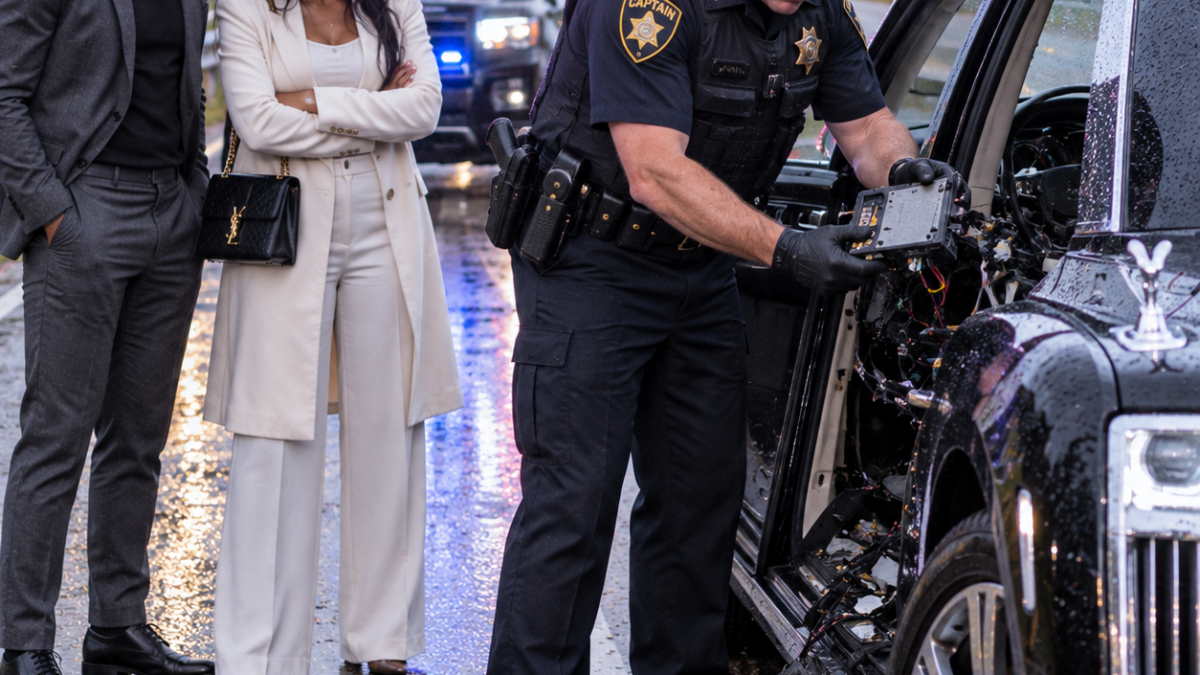
He placed the module on the hood.
Then raised his boot.
“Don’t.”
Crack.
Plastic broke beneath his heel.
Kalin’s entire body became still.
Sterling ground the device into the pavement.
“There.”
He smiled.
“Whatever game you’re playing, that’s gone.”
I looked at the broken casing.
“No.”
“What?”
“It uploaded.”
The smile faded.
I continued.
“Before you destroyed it.”
His face changed slightly.
“What uploaded?”
I said nothing.
Sterling stared at me.
Then at Kalin.
Then back at the device.
“Cuff him.”
Briggs moved toward me.
Vasquez stepped forward again.
“Captain, for what charge?”
“Obstruction.”
“Obstruction of what?”
“Investigation.”
“What investigation?”
Sterling spun.
“I said enough.”
She stopped.
Briggs reached for my wrist.
I offered both hands without resistance.
If we had chosen to end the encounter, we could have.
Kalin’s credentials alone would have done it.
Mine too.
Neither of us wanted that.
Not yet.
The cuffs closed.
Metal against skin.
My father’s voice entered my memory.
Power doesn’t make a man important.
It only shows you what kind of man he already was.
Sterling walked toward Kalin.
“Your turn.”
My brother looked at him.
“Charge?”
“You’re detained.”
“For?”
“Interference.”
“With?”
Sterling’s jaw clenched.
“I don’t need to debate you.”
“No.”
Kalin extended his hands.
“You need to document me.”
For the first time Sterling hesitated.
There was something in Kalin’s tone.
Command without performance.
Men who spent enough years around senior authority sometimes recognized it instinctively.
Sterling almost did.
Almost.
Then ego won.
He cuffed my brother.
Nobody on that road knew they had just handcuffed the sitting Director of the Federal Bureau of Investigation.
That statement sounds absurd now.
It was less absurd then.
Kalin had been confirmed only weeks earlier after spending most of his career in operational and counterintelligence posts.
His public profile was intentionally low.
Blackwood Ridge was a county department where most officers had never expected the Bureau director to appear on their road in civilian clothes beside a ruined Rolls-Royce.
More importantly, Sterling was not asking who we were.
He had already decided.
Briggs continued searching.
He found the reinforced case under the rear seat.
That was the dangerous part.
Not physically.
Legally.
It contained sealed task-force documents and encrypted storage related to the investigation we had spent seven months building.
“Put that down.”
My voice changed.
Sterling heard it.
So did Briggs.
Sterling smiled.
“This?”
“Yes.”
“What is it?”
“Sealed material.”
“Open it.”
“No.”
“You’re cuffed.”
“That does not change your legal authority.”
“You’re starting to annoy me.”
“I passed annoyed fifteen minutes ago.”
He pulled a compact pry tool from the cruiser.
Vasquez stepped between him and the hood.
“Captain.”
He stared at her.
“Move.”
“You need a warrant.”
“Move.”
“Sir.”
“Last warning.”
Vasquez looked around.
Phones were recording.
The coffee-shop crowd had grown.
An older man in a faded green jacket stood nearest.
Donald Price.
I knew the name.
His son Nathan had filed one of the first complaints that led us to Blackwood Ridge.
Nathan’s landscaping truck had been seized during a traffic stop two years earlier.
No criminal charge ever followed.
The truck disappeared into a private auction network eleven weeks later.
Donald had spent nearly two years trying to get somebody to explain how.
Nobody did.
Now he was watching Sterling pry open a case Sterling had no authority to touch.
Vasquez stepped aside.
Not because she agreed.
Because Sterling outranked her and had made clear he would punish resistance.
Later she would tell investigators that stepping aside was the moment she felt most ashamed.
Sterling jammed the tool into the case lock.
Once.
Twice.
The housing cracked.
Briggs lifted the lid.
The first folder had a federal classification marking inside.
His face changed immediately.
“Captain.”
Sterling grabbed it.
“What?”
He opened the folder.
Read the header.
I watched fear arrive.
Not fully.
Just enough.
FEDERAL ASSET FORFEITURE PUBLIC CORRUPTION TASK FORCE.
His eyes moved to me.
Then Kalin.
Then the broken equipment.
“What is this?”
I did not answer.
He shoved the folder against my chest.
“What is this?”
“Something you should not be reading.”
“You threatening me?”
“No.”
“I am informing you.”
“Informing me of what?”
“That you need counsel.”
He laughed.
Too loudly.
“I need counsel?”
“Yes.”
“For stopping a suspicious vehicle?”
“For several things you have done after the vehicle stopped being suspicious.”
His laugh died.
Sterling reached for my jacket.
Kalin spoke.
“Don’t.”
Sterling turned.
“What?”
My brother stood cuffed in the rain.
Hair soaked.
Jacket dark with water.
No visible credential.
No visible weapon.
Nothing that should have mattered.
Yet every federal agent who knew Kalin would have recognized his voice.
“Do not put your hands on him again.”
Sterling’s hand hovered.
Then dropped.
He turned away.
Good instinct.
Too late.
His radio crackled.
Dispatch.
“Captain Sterling.”
He keyed it.
“Go.”
“State Police Command is requesting immediate contact.”
“Why?”
“Federal coordination message.”
Sterling glanced toward us.
“Put them through.”
Static.
Then another voice.
“Captain Sterling, stand down from the current stop.”
Sterling stared at his radio.
“Identify yourself.”
“Virginia State Police operations desk relaying federal task-force instruction.”
“What task force?”
“Stand down.”
“Do not search additional property.”
“Do not transport detainees.”
“Preserve the scene.”
Sterling’s face reddened.
“This is my jurisdiction.”
“Captain—”
“Who authorized this?”
The voice paused.
“Federal command.”
Sterling laughed.
“Federal command can call my sheriff.”
“Captain, this is a direct safety and evidence-preservation request.”
“No.”
Vasquez stared at him.
Sterling released the radio key.
Kalin looked at me.
Very slight movement.
Four minutes.
That was my estimate too.
Our telemetry had stopped transmitting when Sterling destroyed the primary unit, but the backup had completed.
The task force had received enough.
Kalin’s watch vibrated against his cuffed wrist.
Convoy inbound.
Sterling turned toward the Rolls again.
There was a second module beneath the driver’s panel.
He found it.
I spoke immediately.
“Stop.”
He looked at me.
“Another toy?”
“Leave it.”
“Or?”
“Or you add destruction of federal evidence to whatever your evening has already become.”
He raised the pry tool.
Vasquez said:
“Captain, don’t.”
Briggs said nothing.
The other officers looked uncertain.
Sterling drove the tool into the panel.
Plastic cracked.
Cable tore.
He ripped out the module.
Held it up.
“Federal evidence?”
“Yes.”
He smashed it against the hood.
Once.
Twice.
Then threw the pieces onto the road.
I looked toward Kalin.
My brother sighed.
Not dramatically.
The sigh of a man watching somebody make paperwork substantially longer.
“Backup completed thirty seconds after activation.”
I said.
Sterling stopped.
“What?”
“You gave it considerably longer than thirty seconds.”
His expression emptied.
“What did it send?”
Kalin answered this time.
“Enough.”
Headlights appeared around the curve.
One SUV.
Then another.
Then ten more.
Dark vehicles.
Disciplined spacing.
No emergency lights.
No sirens.
The kind of convoy that looked more serious because it did not need theatrics.
Sterling lifted his radio.
“Dispatch, identify those vehicles.”
No answer.
He tried again.
“Dispatch.”
Static.
Then:
“Captain, federal units are arriving.”
He stared.
“Federal what?”
Nobody answered.
The first SUV stopped behind his cruiser.
Doors opened.
Dark jackets.
Gold lettering.
FBI.
IRS Criminal Investigation.
Federal task-force personnel.
State investigators.
Sterling raised a hand.
“Hold it.”
Nobody obeyed.
A tall man stepped from the first SUV.
Special Agent Zachary Cole.
He looked at me.
Then at Kalin.
Then at the handcuffs.
His face did something between anger and disbelief.
He walked directly toward us.
Sterling stepped into his path.
“This is my scene.”
Cole moved around him.
Not quickly.
Not aggressively.
As though Sterling had become furniture.
He reached me first.
“Sir.”
“Get my brother first.”
Cole looked at Kalin.
Walked over.
Unlocked his cuffs.
Then mine.
Sterling stared.
“You can’t release suspects.”
Cole finally looked at him.
“Suspects?”
“Possible stolen vehicle.”
“The vehicle is registered to him.”
Sterling’s face tightened.
“Possible financial crimes.”
Cole looked toward me.
“Status?”
I answered.
“Primary recorder destroyed.”
“Secondary likely transmitted.”
“Case breached.”
“Documents exposed.”
“Two unlawful searches after registration and VIN confirmation.”
“Physical contact.”
“Threats.”
“Body-camera shutdown order.”
Cole nodded once.
Then spoke into his radio.
“Preserve entire scene.”
Agents moved immediately.
Photos.
Evidence markers.
Witness names.
Broken modules bagged.
The damaged case documented before anybody touched it.
The road changed character in ninety seconds.
What had been Sterling’s stage became an evidence scene.
He could feel it.
“What is going on?”
I walked toward the ruined dashboard.
Cole followed.
“We executed the secondary warrants?”
“Three locations.”
“Servers?”
“Recovered.”
“Subjects?”
“Seven detained.”
“Accounts?”
“Frozen twenty-two minutes ago.”
Sterling went pale.
“What accounts?”
I turned toward him.
“You really want the answer?”
“Yes.”
“Blackwood Ridge asset seizures.”
His mouth opened.
Nothing came out.
“Vehicles.”
“Cash.”
“Construction equipment.”
“Work trucks.”
“Property taken from people never convicted of anything.”
Briggs stepped backward.
One federal agent noticed.
Good.
“We followed shell companies.”
I continued.
“Private auctions.”
“Family-linked accounts.”
“Falsified seizure paperwork.”
“Cases that disappeared internally.”
Sterling shook his head.
“This is insane.”
“No.”
I gestured toward Donald Price across the road.
“Ask him.”
Sterling looked.
Donald stepped forward.
Rain ran down the brim of his cap.
“You remember Nathan Price?”
Sterling’s face gave him away.
Just a flicker.
Donald saw it.
“So you do.”
“My son’s truck.”
“You took it.”
“No charges.”
“You sold it.”
“You told us there was nothing we could do.”
Sterling recovered.
“That was a lawful forfeiture.”
I spoke.
“There was no judicial forfeiture order.”
He turned toward me.
“You don’t know what you’re talking about.”
“I have the bank records.”
Silence.
Then Briggs said:
“Captain.”
Sterling looked toward him.
Briggs’s face was destroyed.
Not physically.
Psychologically.
The moment a person realizes the conspiracy he thought was invisible has become a spreadsheet on somebody else’s server.
Sterling pointed at us.
“They set us up.”
“No.”
I said it quietly.
“You stopped us.”
“You chose this car.”
“You chose not to accept valid registration.”
“You chose to search after the VIN cleared.”
“You chose to destroy equipment after being warned.”
“You chose to ignore a stand-down order.”
“Nothing about those decisions was ours.”
Sterling looked at Kalin.
“And who exactly are you?”
There it was.
The question he should have asked much earlier.
Kalin stared at him.
Before he could answer, one of the senior federal officials approaching from the convoy stopped several feet away.
Her posture became formal.
“Director Vance.”
Sterling blinked.
“What?”
The woman looked at him.
“Director Kalin Vance.”
“Federal Bureau of Investigation.”
The road went silent.
Not metaphorically.
Even the people holding phones seemed to stop breathing.
Sterling stared at my brother.
“No.”
Kalin said nothing.
Sterling looked at Cole.
Then the agents.
Then Kalin again.
“You’re the FBI director?”
“Yes.”
That was all.
No speech.
No dramatic reveal.
Just yes.
Sterling looked at me next.
“And him?”
Cole answered.
“Special Agent in Charge Damian Vance.”
“Federal Public Corruption Task Force.”
I almost corrected the title.
Technically my current assignment was more complicated.
It did not matter.
Sterling’s mouth opened.
Closed.
Rain ran down his face.
Then came the sentence I knew would come.
“Director, if I’d known—”
Kalin raised one hand.
“Stop.”
Sterling stopped.
My brother stepped closer.
“Say that again.”
Sterling swallowed.
“If I’d known who you were, this never would’ve happened.”
Kalin nodded.
“Exactly.”
Sterling looked confused.
Kalin continued.
“That is the problem.”
“Sir, I—”
“You had his registration.”
He pointed toward me.
“Valid.”
“You had the VIN.”
“Clean.”
“You found no warrant.”
“No stolen-vehicle entry.”
“No contraband.”
“No probable cause.”
“You continued because you believed two Black men in an expensive car required an explanation.”
Sterling shook his head.
“No.”
Kalin’s voice remained calm.
“You said it.”
“You asked where the money came from.”
“You said the car cost more than your pension.”
“You said men like us didn’t simply own things like this.”
Vasquez’s eyes moved toward Sterling.
So did several other officers.
He realized too late how many people had heard him.
“My concern was legitimate.”
“Then you should have ended the stop when the facts answered it.”
Sterling glanced at me.
“The equipment looked suspicious.”
“You found that after the unlawful search began.”
He had no response.
Kalin stepped closer.
“The worst part of tonight is not that you failed to recognize me.”
Sterling looked up.
“The worst part is that you believe recognition should have changed the standard.”
Nobody spoke.
“My title should not matter.”
“My brother’s title should not matter.”
“The car should not matter.”
“A mechanic driving a twenty-year-old pickup deserves the same constitutional protection.”
At that word, mechanic, I looked toward him.
Dad.
Kalin knew what he was doing.
Sterling’s shoulders sagged.
Behind him, Officer Vasquez stepped toward Agent Cole.
“I have a recording.”
Sterling turned.
“What?”
She took out her phone.
“My body camera was ordered off.”
“You complied.”
“I did.”
Her voice shook.
“But I restarted an independent recording.”
Sterling’s face changed.
“You disobeyed a direct order?”
“Yes.”
“I’m suspending you.”
Cole looked at him.
“No.”
Sterling snapped toward him.
“She works for me.”
“Not tonight.”
Vasquez handed Cole the phone.
“It captured the continued search.”
“The module destruction.”
“The case being forced open.”
“And a conversation between Captain Sterling and Sergeant Briggs about rewriting the stop as a suspected narcotics investigation after nothing was found.”
Briggs went white.
Sterling spun toward him.
“You idiot.”
Briggs stared.
“You were the one talking.”
“Shut up.”
“You told me what to put in the report.”
“Shut your mouth.”
Agents moved between them.
I watched the alliance collapse.
Corrupt systems often look solid until consequences become personal.
Then loyalty becomes arithmetic.
Who knows what?
Who recorded whom?
Who gets charged first?
Briggs pointed toward Sterling.
“He approved the auction transfers.”
Sterling lunged.
Agents stopped him.
“You lying son of a—”
I stepped closer.
“Captain.”
He looked at me.
“This is why evidence matters.”
“Not your statement.”
“Not Briggs’s.”
“Records.”
“Messages.”
“Bank transfers.”
“Video.”
“Witnesses.”
I gestured toward the road.
“That is what will decide what happens next.”
The K-9 incident from the original investigation unfolded differently than anyone expected.
A county handler who had arrived before federal units reported that his dog alerted to Briggs rather than my vehicle.
Investigators searched Briggs pursuant to the circumstances and discovered contraband inside his jacket.
Briggs immediately claimed it had been planted.
Maybe it had.
Maybe it hadn’t.
We refused to build our corruption case around an ambiguous discovery.
I ordered it separated from our investigation.
Sterling stared at me.
“You’re protecting him?”
“No.”
“I’m protecting the integrity of the case.”
That distinction mattered.
If evidence could not be trusted, it did not belong in my prosecution theory simply because it was convenient.
The federal financial evidence was already stronger.
Shell corporations.
Auction invoices.
Signed approvals.
Messages.
Transfers.
Missing judicial orders.
No theatrical bag of powder was necessary.
Donald Price gave his statement.
Then another resident did.
Then another.
The crowd had grown.
A woman described money taken from her husband during a stop.
A landscaper described equipment seized and never returned.
An older man described a fishing boat.
Names entered notebooks.
Phone numbers.
Case numbers.
Dates.
Complaints Sterling’s department had treated as unrelated suddenly existed in one place.
That was the turning point.
Not the FBI shield.
Not my brother’s title.
People realizing they were not alone.
Cole returned to us.
“We have the warrant.”
Sterling heard.
“What warrant?”
Cole approached him.
“Garrett Sterling.”
“For what?”
“You are being taken into custody pursuant to federal warrants connected to conspiracy, obstruction, evidence tampering, and the Blackwood Ridge unlawful asset-seizure investigation.”
Sterling stared at Kalin.
Then me.
“You can’t do this.”
Nobody answered.
“I served this county twenty-four years.”
Kalin looked at him.
“Then you had twenty-four years to understand what your badge required.”
“One stop.”
Sterling’s voice cracked.
“One mistake.”
I looked toward the Rolls-Royce.
Broken dashboard.
Destroyed electronics.
Damaged doors.
Shattered interior trim.
Rain blowing through the cabin.
Then toward Donald.
Vasquez.
The people giving statements.
“This is not one stop.”
I said.
“It was never one stop.”
Cole cuffed him.
No one cheered.
I was glad.
There should be something sobering about watching a police captain lose his freedom.
Even when he earned the moment himself.
Briggs was detained separately.
Several officers were ordered to surrender devices.
Others were released after interviews.
That distinction mattered too.
Not every person standing beside Sterling was corrupt.
Some were frightened.
Some were passive.
Some had made bad choices.
Some had resisted him.
Investigations needed to identify which was which.
We were not replacing Sterling’s arbitrary judgment with ours.
That would have taught the wrong lesson.
By midnight, the road was still an active scene.
Agents had erected lights.
Rain finally stopped.
My car sat under white evidence lamps.
Kalin stood beside it.
He looked through the ruined interior.
“That is catastrophic.”
“Yes.”
“How much?”
I sighed.
“Probably total loss.”
“How much did you pay?”
“You know.”
“I want to hear you say it.”
“No.”
“One point five?”
“Approximately.”
He stared.
“For a car.”
“It was customized.”
“For a car.”
“It has an umbrella.”
“That makes it worse.”
I almost laughed.
Then stopped.
Dad would have loved this moment.
Not the corruption.
The argument.
I could hear him.
Million and a half dollars and it still gets wet in the rain.
Kalin looked at me.
“You okay?”
“Wrists hurt.”
“Car hurts more?”
“Emotionally.”
He smiled.
Then his face became serious.
“Did you know Sterling would stop us?”
“No.”
“Neither did I.”
“He made the case better than anything we could’ve staged.”
“I hate that sentence.”
“Why?”
“Because it sounds like we wanted this.”
We looked toward Donald Price.
Toward residents giving statements.
“I wanted evidence.”
I said.
“I did not want him to prove every complaint true in one night.”
Kalin nodded.
“There’s a difference.”
The Rolls remained federal evidence for weeks.
Insurance investigators nearly had nervous breakdowns.
The manufacturer sent two engineers who stared at the torn dashboard in silence.
One finally asked:
“What happened?”
I answered:
“Government.”
He nodded as though that somehow explained everything.
Four months later, Blackwood Ridge looked almost unchanged.
That was the strange thing about institutional scandal.
Buildings remain.
Traffic lights work.
Coffee shops open.
People go to work.
But underneath ordinary life, records were being reopened.
Thirty-one questionable asset seizures became forty-seven.
Then sixty-three.
Cars.
Cash.
Work vans.
Equipment.
Property taken from people who were never convicted of crimes.
Some seizures turned out to be lawful.
We said so publicly.
Others were administrative mistakes.
Some clearly involved misconduct.
A smaller group formed the core criminal case.
That distinction mattered to Kalin.
“This cannot become the story of the FBI deciding everybody in Blackwood Ridge is corrupt.”
He told our team.
“We prove what we can prove.”
“Nothing more.”
“Nothing less.”
Forensic accountants traced proceeds through three states.
Auction companies connected to relatives of department officials.
Properties transferred below market value.
Accounts receiving payments after seizures.
Missing court approvals.
Backdated forms.
One pattern at a time.
Briggs eventually agreed to cooperate.
Not because he became honorable.
Because prison exposure clarified his priorities.
His testimony helped investigators reach auction operators and two additional officials.
Sterling refused every plea offer.
He went to trial.
I attended only when required.
The prosecution did not lead with the FBI director reveal.
I insisted on that.
The case opened with Nathan Price.
Landscaper.
Truck seized.
No criminal charges.
Business nearly collapsed.
Then another family.
Then another.
Only later did prosecutors show the traffic-stop video involving us.
The jury watched Sterling receive valid documents.
Watched him continue.
Watched the illegal search.
Watched him destroy equipment.
Watched him ignore Officer Vasquez.
Watched him order the report changed.
The defense argued the stop was confused.
Fast-moving.
Potentially dangerous.
That officers make difficult decisions.
All true principles.
None explained continuing after the facts were known.
That became the case.
Not whether police can make mistakes.
Whether a mistake remains a mistake after a person repeatedly receives opportunities to correct it and chooses escalation instead.
The jury convicted Sterling on the major corruption and obstruction counts supported by the evidence.
Not everything prosecutors charged.
That mattered too.
Justice is more credible when it can say no.
Some officers were cleared.
One young officer who had hesitated when ordered to search my vehicle kept his job.
He later testified that my expression while standing cuffed had stayed with him.
“I realized I was waiting for someone above me to tell me whether something wrong was wrong.”
He said.
“I didn’t want to do that again.”
Officer Elena Vasquez became one of the most discussed people in the case.
Reporters called her a hero.
She hated it.
“I stayed quiet too long.”
She told one interviewer.
“People call you brave after the moment is over.”
“They don’t see how scared you were during it.”
An independent review found Sterling had retaliated against her several times before our stop.
Performance warnings after she questioned searches.
Shift changes.
Promotion delays.
The kind of pressure subtle enough to look administrative.
Strong enough to teach silence.
She returned to duty.
A year later, she transferred to a state oversight unit.
Not because I arranged it.
She applied.
Competed.
Earned it.
That distinction mattered to her.
And to me.
Donald Price finally received a call about his son’s truck.
The original vehicle was gone.
Sold long ago.
But investigators recovered enough proceeds to compensate Nathan.
The morning Nathan bought another landscaping truck, Donald rode beside him.
A local reporter asked what the money meant.
Donald looked annoyed.
“Money?”
He shook his head.
“The money’s late.”
“What mattered is somebody finally had to write down that we were telling the truth.”
That quote stayed with me longer than any headline involving my brother.
Kalin hated the headlines anyway.
FBI DIRECTOR HANDCUFFED BY CORRUPT SMALL-TOWN COP.
DIRECTOR’S TWIN LED SECRET PROBE.
$1.5 MILLION ROLLS-ROYCE DESTROYED IN FEDERAL STING.
He rejected every major television interview.
So did I.
When one producer offered us a prime-time special, Kalin answered:
“Interview Nathan Price.”
They did.
Then Donald.
Then Vasquez.
Then families whose names had never meant anything to anyone outside Blackwood Ridge.
Good.
Four months after the stop, Kalin and I returned.
Not in the Rolls.
Insurance had declared it a total loss.
I rented a gray sedan from the airport.
My brother looked around the interior.
“No umbrella.”
“I hate you.”
“Dad would approve.”
We drove to the Blackwood Ridge public library.
No motorcade.
Federal security stayed discreet.
Inside, residents had arranged folding chairs.
Maybe eighty people.
Donald sat near the front.
Nathan beside him.
Vasquez stood near the rear wall.
We did not give speeches.
We listened.
For two hours.
A woman described losing five thousand dollars seized from her husband despite charges being dismissed.
A mechanic described tools held as evidence for nearly a year.
A fisherman described his boat disappearing into auction.
Some cases we already knew.
Some were new.
Some would ultimately prove legitimate.
We took all of them.
Near the end, an elderly woman raised her hand.
“Director Vance?”
Kalin turned.
“Yes, ma’am?”
“I’ve been wanting to ask you something.”
“Go ahead.”
“Why didn’t you tell Sterling who you were?”
The room became quiet.
Kalin looked at me.
Then answered.
“Because it shouldn’t have mattered.”
The woman frowned.
“Wouldn’t it have stopped him?”
“Probably.”
“Then why not?”
My brother leaned forward.
“If I had shown him my credentials and he suddenly became respectful, what would that have proven?”
Nobody answered.
“That he respected me?”
Kalin shook his head.
“No.”
“It would have proven he respected power.”
He looked around the room.
“Every person stopped on a road deserves the same legal protection whether they’re the FBI director, a mechanic, a teacher, unemployed, rich, poor, famous, unknown.”
Donald stared at the floor.
“The troubling part of that night wasn’t how Sterling behaved after he learned who we were.”
Kalin continued.
“It was who he believed we were before.”
I finally spoke.
“Our positions gave us something most victims never have.”
People turned toward me.
“A federal task force was already watching.”
“Servers were already receiving evidence.”
“Agents were already coming.”
I looked at Nathan.
“You didn’t have that.”
He nodded.
“That is why this cannot end with Sterling.”
“It has to change what happens to the next person.”
A younger man raised his hand.
“What about officers?”
“What about them?”
“What if somebody like Vasquez sees something wrong but reporting means losing a career?”
Good question.
I looked toward her.
She answered before I could.
“You report anyway.”
The man smiled slightly.
“Easy for you to say now.”
Vasquez nodded.
“You’re right.”
“It isn’t easy.”
She stepped away from the wall.
“I almost didn’t.”
“More than once.”
“The answer isn’t telling officers to magically become fearless.”
“The answer is giving them somewhere to report that the person they’re reporting cannot control.”
I nodded.
“Exactly.”
Independent complaint channels.
External review.
Protected reporting.
Audit trails.
Boring infrastructure.
People expect reform to look like speeches.
Usually it looks like databases and reporting protocols.
We stayed almost three hours.
No cameras inside.
That was intentional.
Afterward, Donald approached me.
“You brothers going to see your father?”
I smiled.
“How’d you know?”
“Same road.”
“Same month.”
People notice things in small places.
“Yes.”
He nodded.
“Tell him he raised you right.”
My throat tightened slightly.
“I’ll try.”
Pinerest Memorial was quiet that afternoon.
Autumn had begun coloring the trees.
Gold.
Rust.
Brown.
The Rolls-Royce was gone.
The rented sedan looked almost insulting beside the cemetery gate.
Kalin glanced at it.
“Dad would prefer this.”
“Dad rode the bus.”
“He repaired buses.”
“Same economic bracket.”
We walked to Arthur’s grave.
I put down flowers.
Neither of us spoke for a while.
His headstone was simple.
ARTHUR VANCE.
Two dates.
Then the sentence he had selected himself.
HE DID THE WORK AND HE DID IT HONESTLY.
No title.
No mention of sons.
No career.
Just that.
Kalin read it.
“He would’ve hated the convoy.”
“Yes.”
“Twelve SUVs?”
“Fourteen.”
“Worse.”
“He would’ve asked why fourteen federal vehicles were needed when one honest cop could’ve ended the whole thing by reading a registration.”
I laughed.
“That is exactly what he would’ve said.”
Silence returned.
Then Kalin looked at me.
“How much did insurance pay?”
“Don’t.”
“All of it?”
“Most.”
“One point five million dollars.”
“Stop.”
“For a car.”
“It was bespoke.”
“You sound ridiculous.”
“Director of the FBI drives a government Suburban.”
“Paid for by taxpayers.”
“Exactly.”
I looked at him.
“Your car costs more than mine emotionally.”
He laughed.
For a minute we were boys again.
Two kids in Arthur Vance’s garage handing him the wrong wrench.
Then I touched the headstone.
“Sixty-three families.”
Kalin nodded.
“Some property returned.”
“Some compensated.”
“Some cases still open.”
“Yes.”
“You think Dad would be proud?”
“No.”
I looked at him.
“He’d ask why it took us seven months.”
Kalin smiled.
“Probably.”
The breeze moved across the cemetery.
I remembered Sterling’s face when he saw the badge.
The terror.
The apology beginning.
If I had known.
That sentence became the one I thought about most.
Not because it exposed his stupidity.
Because it exposed a larger temptation.
People behave differently around power.
Police officers.
Waiters.
Executives.
Judges.
Everybody.
The easiest story to tell afterward was that Sterling made the mistake of stopping two powerful men.
That story was wrong.
He did not choose the wrong victims.
There should never have been a right victim.
My brother did not deserve constitutional rights because he directed the FBI.
I did not deserve them because I led a federal task force.
Nathan Price deserved them.
Donald deserved them.
The woman whose husband’s money disappeared deserved them.
The fisherman.
The mechanic.
People whose names would never appear on television.
A month later, Kalin addressed a class of new federal agents at Quantico.
He invited me.
I sat in the back.
No introduction.
He spoke for forty minutes about discretion.
Then showed one minute of footage from Blackwood Ridge.
Not the reveal.
Not Sterling being arrested.
Just the beginning.
Registration handed over.
VIN confirmed.
Sterling refusing to stop.
Kalin paused the video.
“What is the most dangerous thing on this screen?”
A trainee raised his hand.
“The captain’s bias.”
“Partly.”
Another.
“His refusal to update his assessment after new evidence.”
Kalin pointed.
“That.”
He restarted the clip.
“Law enforcement requires judgment.”
“Judgment means forming conclusions.”
“Professionalism means changing those conclusions when facts change.”
He paused Sterling after the VIN verification.
“At this second, Captain Sterling has a choice.”
“The original suspicion has weakened dramatically.”
“The law gives him an exit.”
“He refuses it.”
Another clip.
Search begins.
“Another exit.”
Module warning.
“Another exit.”
State command call.
“Another exit.”
Kalin looked around.
“People talk about catastrophic misconduct as though one giant decision creates it.”
“Usually it is smaller.”
“One unjustified step.”
“Then another decision made to defend the first.”
“Then another.”
“Eventually ego becomes more important than truth.”
He shut off the screen.
“No badge protects you from that human weakness.”
“That is why procedure matters.”
I watched the trainees.
Some taking notes.
Some simply staring.
Afterward, one approached me in the hallway.
“Sir?”
“Yes?”
“Were you the driver?”
I smiled.
“Unfortunately.”
“Why unfortunately?”
“Insurance paperwork.”
He laughed.
Then became serious.
“Were you scared?”
The question surprised me.
People assumed federal agents stop being afraid after enough years.
“No.”
I thought again.
“That’s not true.”
“When?”
“When Sterling’s hand moved near his weapon.”
I said.
“Not because I thought my brother and I couldn’t handle ourselves.”
“Because I knew how many outcomes become irreversible once somebody draws a gun.”
The trainee nodded.
“You didn’t tell him.”
“No.”
“Who you were.”
“No.”
“Why?”
I gave him the shorter answer.
“Because law should not become safer after somebody learns your résumé.”
He wrote that down.
I almost told him not to.
Then decided Dad would have liked it.
Years later, the Rolls-Royce appeared one final time.
Not on a road.
Not in a garage.
In a federal training warehouse.
Insurance had transferred the remains after the criminal case ended.
The Bureau asked whether parts of the vehicle could be preserved for training.
I agreed.
A section of the dashboard.
The destroyed module housing.
Photographs of the broken federal case.
A small exhibit about evidence preservation and unlawful search escalation.
No plaque mentioning how much the car cost.
I insisted on that.
One instructor called.
“You sure?”
“Yes.”
“People like the $1.5 million detail.”
“That’s exactly why I don’t.”
“Why?”
“Because then the story becomes about destroying an expensive car.”
“It wasn’t.”
“What was it about?”
I looked out my office window.
“Destroying trust.”
That was the expensive part.
Cars can be insured.
Dashboards can be rebuilt.
Federal hardware can be replaced.
Trust behaves differently.
It takes years to build.
Seconds to damage.
Sometimes generations to restore.
Blackwood Ridge did not become perfect.
No investigation creates perfection.
A new sheriff took office.
Independent asset-seizure review became mandatory.
No vehicle could be sold before external legal review and documented court authority.
Cash seizures received automatic audit trails.
Complaints against command-level officers moved outside the department.
Body-camera deactivation required specific documented justification.
Retaliation against internal reporters became easier to identify because reviews no longer remained inside the same chain of command.
Did every officer love those reforms?
No.
Good policies do not require universal affection.
They require legitimacy.
Vasquez eventually trained new officers.
She showed them the stop.
When the recording reached the moment Sterling ordered her camera off, she paused it.
“That is me.”
Trainees usually looked surprised.
“I was scared.”
She told them.
“I knew opposing him could cost me.”
“One of the mistakes people make when discussing integrity is pretending good people don’t feel fear.”
“They do.”
“Integrity is not absence of fear.”
“It is deciding fear does not get the final vote.”
Then she played the next section.
The camera returning.
That became her lesson.
Mine was different.
Mine remained Sterling’s first question.
Where’d you get the money for something like this?
He had looked at me and decided wealth on a Black man required explanation.
He already had the registration.
Already had my identity.
Yet the paper was less convincing than his assumption.
That is what bias does at its most dangerous.
It makes evidence compete against expectation.
Once a person begins defending expectation instead of examining evidence, authority magnifies every error that follows.
My father understood that without ever reading a constitutional-law case.
Power doesn’t make a man important.
It only shows you what kind of man he already was.
Sterling had more local authority on that road than Vasquez.
She had less rank.
Less protection.
Less certainty.
Yet when the critical moment came, she chose the harder path.
That was character.
Kalin had enormous authority.
So did I.
But our titles were almost irrelevant until other people decided to care about them.
That was the lesson too.
The most important person in the Blackwood Ridge case was not the FBI director.
Or the federal agent leading the task force.
It might have been a frightened young officer who quietly preserved a recording.
Or an old man with a cane who refused to stop asking what happened to his son’s truck.
Or the first resident who filed a complaint even after everyone around him said nobody would listen.
Systems change when enough people preserve truth long enough for denial to become more expensive than accountability.
Years after Sterling’s conviction, Kalin and I returned to our father’s grave again.
Same week.
Same flowers.
Different rental car.
He looked at it.
“Still no umbrella.”
“I am buying another Rolls.”
“You wouldn’t.”
“I might.”
“Dad will haunt you.”
“Dad already haunts you.”
“Fair.”
We reached the stone.
I brushed leaves from the base.
Kalin stood beside me.
For a while, neither of us spoke.
Then he said:
“You ever wish you’d shown him the badge immediately?”
I thought.
“Sometimes.”
“Why?”
“Would’ve saved the car.”
He laughed.
“I knew it.”
“Mostly?”
I looked at Dad’s name.
“No.”
“Why?”
“Because then we would’ve learned nothing.”
Kalin nodded.
“And Blackwood Ridge?”
“Maybe the investigation still gets there.”
“Eventually.”
“Maybe.”
I looked toward the trees.
“But Donald might still be waiting.”
“Nathan might still think nobody believed him.”
“Vasquez might still be telling herself staying quiet was safer.”
“And Sterling might still think the only people he needed to respect were the ones powerful enough to punish him.”
Kalin put his hands in his coat pockets.
“So you don’t regret it.”
“I regret the leather.”
He shook his head.
“Hopeless.”
We stood quietly again.
Then I touched Dad’s headstone.
“We remembered.”
The wind moved through the grass.
No answer.
None needed.
The public still remembers Blackwood Ridge as the night police officers destroyed a $1.5 million Rolls-Royce belonging to two Black brothers they failed to recognize.
That description is true.
It is also the least important version of the story.
The car was replaceable.
Our titles were incidental.
The convoy was dramatic but temporary.
The real story existed long before our headlights reached that road.
It belonged to every person Sterling stopped when no federal agents were watching.
Every vehicle taken from someone who could not hire a powerful lawyer.
Every complaint buried by the people assigned to investigate themselves.
Every young officer who noticed something wrong and wondered whether telling the truth would destroy a career.
And every ordinary resident who deserved the same rights my brother and I had before anyone knew our names.
Garrett Sterling believed dignity was something authority allowed him to distribute.
He learned too late that it never belonged to him.
Not on his road.
Not behind his badge.
Not inside his department.
Because justice means almost nothing if it arrives only after someone discovers the victim is important.
It means something when the mechanic, the landscaper, the teacher, the unemployed father, the woman driving home from work, and two Black men in an expensive car all receive the same protection before anyone asks who they know.
That was what Arthur Vance had tried to teach two boys holding flashlights beneath a city bus decades earlier.
Power does not tell the world how important you are.
It tells the world who you become when you believe nobody can stop you.
Captain Sterling answered that question one decision at a time.
Officer Vasquez answered it differently.
So did Donald Price.
So did the families who kept filing complaints after years of being ignored.
And in the end, those were the people who changed Blackwood Ridge.
Not because anyone finally discovered an FBI director standing in the rain.
Because enough ordinary people had finally been heard before another powerful man could tell them they did not matter.








