PART 2: I was driving an empty bus back to the depot after midnight when a starving dog ran into my headlights and refused to let me pass
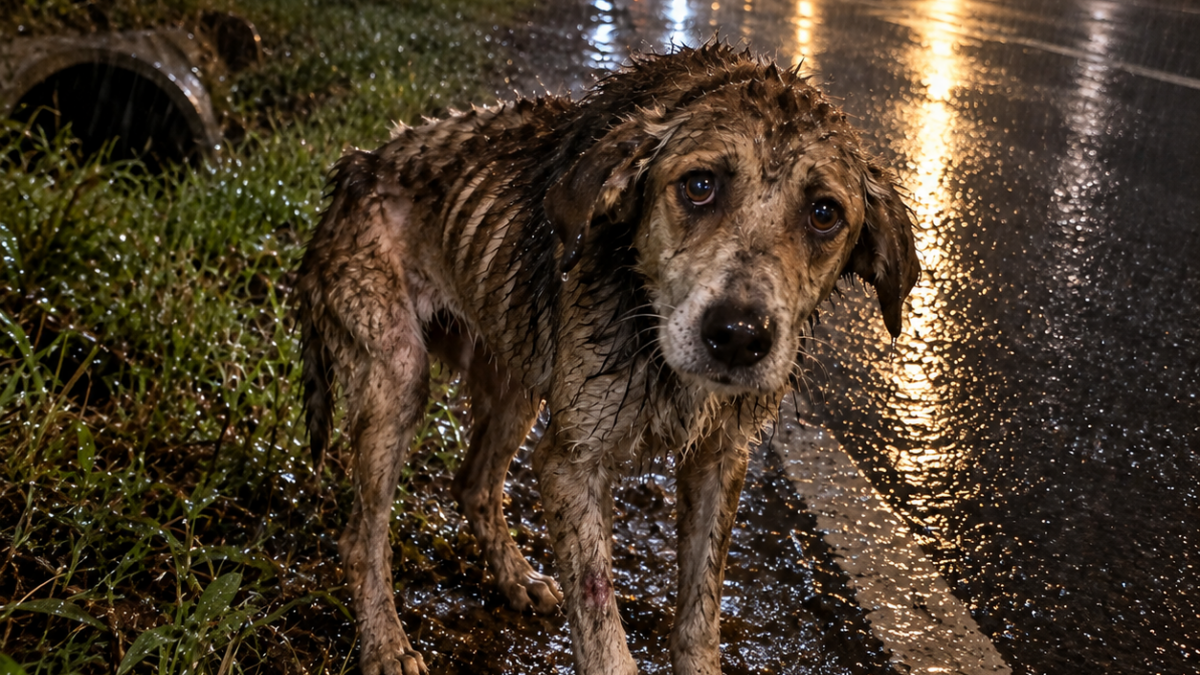
There were puppies inside.
For one second, that was all my brain could understand.
Puppies.
Small shapes pressed together on a bed of soaked leaves and trash several feet inside the drainage pipe.
My flashlight shook in my hand.
The mother dog stood beside me, trembling so violently I could see it even through the rain.
I lowered myself into a crouch.
“Oh, girl.”
She looked at me.
Then toward the culvert.
Then back at me.
There were six puppies that I could see.
Maybe more behind them.
They were very young, perhaps three or four weeks old, though I am no veterinarian.
Their fur was wet.
Their bodies were crowded tightly together in the driest patch they could find, but water had already begun flowing along one side of the concrete channel.
One puppy lifted its head when the light passed over it.
Its mouth opened.
The sound that came out was barely a sound at all.
The mother immediately moved forward.
She crawled into the culvert, licked the puppy’s face, then came back toward me.
She did not stay with them.
That was what struck me.
She came back to me.
As if she had finally found the part of her plan she could not accomplish alone.
I looked toward the highway.
My bus hazards flashed faintly through the rain above us.
I pulled out my phone.
One bar.
Then none.
“Come on.”
I raised it.
One bar again.
I called dispatch.
“Daniel?”
It was Marlene, our night supervisor.
She already sounded worried.
“I’m okay.”
“You said you were stopping for a dog.”
“I found her.”
There was a pause.
“And?”
“She has puppies.”
“What?”
“Six that I can see. They’re in a drainage culvert below the highway.”
Marlene was silent for half a second.
Then her supervisor voice took over.
“Are you safe?”
“Yes.”
“Is the bus secure?”
“Yes.”
“Location?”
I gave her the nearest mile marker.
“I’m calling highway patrol and animal services.”
“Tell them water is coming through this culvert.”
“How bad?”
I looked inside.
The narrow stream along the concrete edge was not deep yet.
But rain had become heavier.
“I don’t know.”
That was the truth.
“Daniel, do not crawl into a flooded drainage pipe.”
“I know.”
“I mean it.”
“I know.”
“You drive a bus.”
“Thank you for reminding me.”
“This is not funny.”
“I’m scared, Marlene.”
My own words surprised me.
I was.
Not for myself exactly.
For those tiny sounds in the darkness.
Marlene’s voice softened.
“Help is coming.”
I ended the call and put my phone inside my jacket.
The mother dog stood at the culvert entrance.
Rain ran down her face.
Up close, I could see just how bad her condition was.
Her hip bones looked sharp beneath her skin.
Her teats were enlarged from nursing.
One rear paw had a cut along the side.
Her fur was tangled with mud and burrs.
There was no collar.
No tag.
No sign that anyone had cared where she went.
And yet she had been running beside a highway in the middle of a storm, risking herself again and again because her puppies were trapped somewhere she could not fix.
“You found the bus,” I whispered.
Her ears moved.
“You found me.”
I thought about that.
Thousands of vehicles probably passed that stretch of road every day.
But after midnight, traffic thinned.
Maybe she had tried earlier.
Maybe cars had frightened her back.
Maybe no one stopped.
Maybe I had simply arrived at the right moment.
I took off my reflective work jacket.
It was already wet but warmer than the ground.
I spread it near the culvert entrance.
The mother sniffed it suspiciously.
Then she turned toward the puppies.
Water dripped steadily from the concrete ceiling.
I crawled closer, but not inside.
“Come here, babies.”
The puppies did not come.
Of course they did not.
They probably did not even understand what my voice meant.
I counted again.
Six.
Then a movement behind the group.
Seven.
“Oh, Lord.”
Seven puppies.
I sat back in the mud.
The mother came to me.
For the first time, she approached close enough that I could smell wet fur and dirty water.
I held out my hand.
She sniffed my fingers.
Her body stayed tense.
Then her nose touched my palm.
I did not try to pet her.
She had already asked me for something far more important than affection.
I needed her to keep trusting me.
“Seven,” I whispered.
She looked toward the culvert.
“Yes.”
She knew.
Of course she knew.
A distant rumble passed over the highway.
Then headlights flashed through the trees.
Help.
I stood and waved the flashlight.
“Down here!”
Voices answered.
A state highway officer appeared over the embankment first, followed by a second man carrying a larger flashlight.
Behind them came a woman in a raincoat with ANIMAL SERVICES printed across the back.
They climbed carefully down the wet slope.
“I’m Daniel Foster.”
The officer nodded.
“Trooper Hayes.”
He looked toward the mother dog.
“This her?”
“Yes.”
The animal services woman crouched immediately.
“I’m Carla Mendoza.”
She assessed the mother before looking into the culvert.
“How long have you been here?”
“Maybe fifteen minutes.”
“Puppies?”
“Seven.”
Her expression tightened.
“How far in?”
“Six or seven feet.”
She aimed her flashlight.
One puppy whimpered.
Carla breathed out slowly.
“Okay.”
Trooper Hayes looked at the water.
“Storm cell is still moving over us.”
Carla nodded.
“We need them out.”
Marlene’s warning echoed in my head.
Do not crawl into a flooded drainage pipe.
Trooper Hayes radioed for fire rescue.
Carla prepared a collapsible animal carrier and towels from her vehicle.
The mother dog watched every movement.
When Carla moved toward the culvert, the dog stepped in front of her.
Not growling.
Just blocking.
Carla stopped.
“Good mama.”
The dog’s ears flattened.
Carla lowered herself.
“You don’t know me.”
The mother stared.
“But you know him.”
Carla pointed at me.
I blinked.
“Daniel, can you come closer?”
I crouched beside her.
The dog’s eyes shifted toward me.
Carla held out a slip lead but did not attempt to use it.
“She brought you here.”
“I think so.”
“Then you may be our bridge.”
I had spent eighteen years transporting strangers.
People got on my bus and trusted me to carry them somewhere safely.
That was my entire job.
But no passenger had ever looked at me the way that dog did.
Carla handed me a towel.
“Let her smell it.”
I did.
The dog sniffed.
Carla placed another towel inside the open carrier.
“We’re not putting Mom in yet.”
“What do you need?”
“We need her to understand we’re taking the puppies, not hurting them.”
“How?”
“Slowly.”
We waited for fire rescue.
Those were the longest twelve minutes of my life.
The water in the culvert rose visibly.
Not dramatically.
An inch maybe.
But an inch around puppies that small felt enormous.
One of them began crying louder.
The mother darted inside.
She returned carrying a puppy gently by the scruff.
I stared.
“She can bring them out.”
Carla shook her head.
“Maybe.”
The dog stepped onto the wet grass and placed the puppy beside my jacket.
Then immediately turned back.
I grabbed the towel and carefully wrapped the puppy.
Its body was cold.
So small.
Too light.
Carla checked it quickly.
“Female. Breathing. Hypothermic.”
The mother disappeared into the culvert again.
Another puppy emerged in her mouth.
Then another.
She was doing what she could.
One at a time.
Rain coming harder.
Water rising.
Her body nearly spent.
She brought out the fourth puppy and stumbled.
I reached forward instinctively.
Carla caught my wrist.
“Give her a second.”
The mother regained her footing.
Placed the puppy down.
Turned toward the culvert.
Then stopped.
Her back legs shook.
She tried again.
One step.
Two.
Collapsed.
“Oh, no.”
I moved toward her.
This time Carla came too.
The mother lifted her head but could not rise.
Four puppies were outside.
Three were still inside.
Carla looked toward the pipe.
“We’re out of time.”
Sirens sounded above us.
Fire rescue.
Two firefighters came down carrying helmets, rope, and protective equipment.
One of them, a compact man named Luis Ortega, lay flat at the culvert entrance and aimed his light inside.
“I see three.”
“Can you reach?”
“First one, yes.”
He stretched one arm inside.
The concrete opening was barely large enough for his shoulders.
He pulled out the fifth puppy.
Carla took it.
The mother watched from the ground.
Her eyes were wide.
I sat beside her.
“They’re helping.”
She panted.
Her head sank toward my knee.
I placed my hand against her neck for the first time.
She did not flinch.
“You did your part.”
Luis crawled farther in.
Trooper Hayes held his boots.
“Got six.”
Another puppy came out.
Six.
One left.
The seventh had been behind the others.
Farther back.
Luis aimed the light deeper.
“I see him.”
Water rushed slightly faster now.
The puppy was pressed against the side of the culvert.
Not moving.
My stomach dropped.
“Is he alive?”
Luis did not answer.
He pulled himself farther in.
His shoulders disappeared.
“Ortega,” the second firefighter warned.
“I’ve got room.”
“You’ve got rising water.”
“I know.”
He stretched.
Nothing.
Then his hand disappeared around the curve.
“Come on.”
His voice echoed.
“Come on, little dude.”
I held the mother’s head.
She suddenly lifted it.
A tiny sound came from the culvert.
Then Luis shouted.
“Got him.”
He backed out holding a little brown puppy in one hand against his chest.
The puppy was limp.
Carla took him immediately.
She cleared his mouth with a towel.
Rubbed his body.
“No breathing.”
My heart seemed to stop.
Carla rubbed harder.
“Come on.”
The mother tried to stand.
Failed.
I kept one hand against her.
“Come on, baby,” Carla whispered.
One of the firefighters handed her a small oxygen mask from the emergency animal kit.
She gave tiny breaths.
Rubbed again.
The puppy coughed.
It was the smallest sound in the world.
Everyone froze.
Then he coughed again.
Carla closed her eyes for half a second.
“There you are.”
The mother whined.
The puppy squeaked.
I cried.
I did not care who saw me.
A sixty-one-year-old city bus driver, sitting in mud at one-thirty in the morning, crying over a puppy the size of a loaf of bread.
Luis laughed once from the ground.
“That’s a good sound.”
All seven were alive.
Barely.
But alive.
We carried them up the embankment.
Carla and I lifted the mother on a blanket because she still could not walk.
The moment we moved her away from the puppies, she panicked.
Her body twisted despite exhaustion.
“Wait,” I said.
We shifted the puppies closer.
As soon as she could see them, she stopped struggling.
The rescue van was parked behind my bus.
Its side door stood open.
Warm light poured from inside.
Carla arranged the puppies in a heated carrier while the mother lay beside them on blankets.
One by one, she counted.
“One.”
The mother sniffed.
“Two.”
Sniff.
“Three.”
By seven, the dog lowered her head.
Only then.
Only after every puppy was present.
Carla looked at me.
“She was counting too.”
I nodded.
“I know.”
The van doors closed.
I felt strangely panicked.
“Where are you taking them?”
“Blue Ridge Emergency Veterinary Center.”
“Can I follow?”
Carla looked at my forty-foot city bus.
“You plan to bring that?”
I looked behind me.
The empty bus sat flashing hazard lights in the rain.
For the first time in nearly an hour, I remembered that I was technically at work.
Trooper Hayes laughed.
“I’ll call your dispatch.”
“You don’t know Marlene.”
“I’ve dealt with homicide detectives with less authority than the woman who answered your radio.”
“That sounds like her.”
He spoke with dispatch.
Five minutes later, Marlene came through my radio.
“Daniel.”
“Yes?”
“Bring the bus back.”
I sighed.
“I know.”
“And then go to the vet.”
I looked at the radio.
“What?”
“You heard me.”
“I thought you were going to yell.”
“I’m saving it.”
“Thank you.”
“And Daniel?”
“Yes?”
“You did good.”
Her voice broke slightly before the transmission ended.
I drove the bus back to the depot with muddy shoes, soaked pants, and the strangest feeling I had ever carried through those familiar streets.
Every traffic light seemed unnecessary.
Every empty stop looked different.
I kept thinking of the mother dog running through my headlights.
If I had been looking at the clock instead of the road.
If I had been ten minutes earlier.
If I had been ten minutes later.
If I had decided a dog beside the highway was someone else’s problem.
I hated those thoughts.
They were useless.
But they came anyway.
At the depot, Derek from maintenance took one look at me.
“What happened to you?”
“Dog.”
He waited.
“Seven puppies.”
He stared.
“What?”
“Marlene will explain.”
I grabbed my keys.
“You’re leaving?”
“Yes.”
“You look like you fell into a swamp.”
“Pretty close.”
I drove to the veterinary center in my own car.
It was nearly three in the morning.
Carla was in the lobby, filling out paperwork.
When she saw me, she smiled.
“You came.”
“Of course.”
The words surprised me.
Of course.
As if these dogs had already entered some category of my life that required no explanation.
“How are they?”
“The puppies are warming.”
“And Mom?”
“Critical but stable.”
The phrase terrified me.
“Can I see her?”
“Maybe for a minute.”
A veterinarian named Dr. Rachel Singh met me in the treatment area.
She looked exhausted but kind.
“Are you the bus driver?”
“That seems to be my new name.”
“She responds to your voice.”
I stopped.
“What?”
“The mother.”
Dr. Singh pushed open a quiet room.
The dog lay on a thick blanket with an IV line in one leg.
The puppies were in a warmed enclosure beside her, close enough that she could see and smell them.
Her wet coat had been towel-dried.
Without the rain plastering it down, I could see she was some kind of shepherd-hound mix.
Maybe forty pounds at a healthy weight.
She was nowhere near that now.
Her eyes were closed.
“Hey, girl.”
One ear moved.
Her eyes opened.
Then her tail made the smallest movement against the blanket.
Dr. Singh smiled.
“There.”
My throat tightened.
I crouched beside her.
“You scared me half to death.”
She blinked.
“All seven are here.”
Her eyes shifted toward the warming enclosure.
“We counted.”
I rested my hand near her paw.
She moved her paw until it touched my fingers.
That was it.
No dramatic embrace.
No lick.
Just contact.
Dr. Singh gave us a minute.
I stayed for twenty.
Nobody made me leave.
When I finally stood, the mother’s eyes followed me.
“I’ll come back.”
Her ears moved.
I realized as soon as I said it that I had made a promise.
So I came back.
Every day.
The first morning, I returned after sleeping only three hours.
The second morning, I brought coffee for the overnight staff.
The third, I brought towels because Carla had mentioned they were always short on clean ones.
By the fourth day, everyone at the clinic knew me as “Bus Daniel.”
I objected.
No one cared.
The mother slowly improved.
Dr. Singh estimated she was around four years old.
Severely malnourished.
Dehydrated.
Skin infection.
Parasites.
A healing wound on her rear leg.
Her body had given almost everything it had to produce milk.
“Would she have survived much longer?” I asked.
Dr. Singh did not pretend.
“No.”
The answer hit harder than I expected.
“What about the puppies?”
“Without intervention?”
She looked through the window toward them.
“With that storm?”
She shook her head.
I looked away.
The mother needed a name.
Animal services had listed her temporarily as HWY FEMALE 07-18.
I hated that.
A dog who had stopped a bus deserved better.
Carla asked me to choose something.
“Why me?”
“She chose you first.”
That was difficult to argue with.
I thought of the rain.
The dark highway.
The way she kept turning back to make sure I followed.
“Beacon.”
Carla smiled.
“Beacon?”
“She found the lights.”
The mother lifted her head when I said it.
Beacon.
Her tail moved.
“Looks like she approves,” Carla said.
So Beacon it was.
The puppies received temporary names from the veterinary staff.
Rain.
Puddle.
Storm.
Cloud.
Misty.
Thunder.
And the smallest one, the puppy Luis pulled from the water, became Lucky.
Luis tried to object.
“I did not name him.”
Everyone ignored him.
Lucky became his name.
For the first week, Beacon would not eat unless her puppies were nearby.
Even when nursing was limited because her body needed recovery, she watched them.
Counted them.
If one puppy was taken for examination, she followed every movement until it returned.
Dr. Singh said maternal behavior could be intense after a traumatic period.
I think that was clinical language for what the rest of us could see plainly.
Beacon had spent too long believing she was the only thing between her babies and death.
She did not yet understand that help could remain after the emergency.
I understood that feeling more than I expected.
My wife, Claire, died nine years earlier.
Cancer.
Fifteen months from diagnosis to goodbye.
Our daughter, Hannah, was twenty-three then and living in Denver.
After Claire died, Hannah begged me to move west.
I refused.
My job was in Asheville.
My house was here.
My whole life was routes and schedules and familiar roads.
That was what I told her.
The truth was that I did not know who I would be if I changed anything else after losing Claire.
So I kept driving.
Same depot.
Same routes.
Same empty bus home.
Same house.
I was not miserable.
That distinction matters.
I had friends.
Coworkers.
Hannah called every Sunday.
I watched baseball.
Cooked badly.
Went fishing twice a year with my brother.
But I had become very good at living without needing anyone urgently.
Beacon ruined that in one rainy night.
On the sixth day, Dr. Singh called while I was driving my regular afternoon route.
I could not answer until my break.
I called back immediately.
“Is something wrong?”
“No.”
I exhaled.
“Then why does every veterinarian begin a call by terrifying people?”
She laughed.
“I wanted to tell you Beacon stood up.”
My heart jumped.
“She did?”
“Walked six steps.”
“That’s it?”
“That’s huge.”
I smiled so hard a passenger waiting outside my bus probably thought I had lost my mind.
“Did the puppies see?”
“Yes.”
“Did she?”
“She immediately tried to climb into their pen.”
“That sounds right.”
After work, I went directly to the clinic.
Beacon was standing when I entered.
Thin.
Weak.
Legs slightly unsteady.
But standing.
The moment she saw me, her tail wagged.
A real wag.
Not much.
But undeniable.
“There you are.”
I crouched.
She walked toward me.
One step.
Two.
Three.
Then pressed the side of her face into my chest.
I sat down on the floor.
There are moments that make a man realize he has been lonelier than he admitted.
That was one.
I put both arms around her carefully.
“You did it.”
She leaned harder.
“You crazy girl.”
Her tail moved.
“I suppose this is my fault now.”
Dr. Singh watched from the doorway.
I looked over.
“Don’t say it.”
“Say what?”
“Whatever foster-home speech is forming in your head.”
“I wasn’t going to.”
“You were.”
She smiled.
“Maybe.”
“I drive buses ten hours a day.”
“You also have a fenced yard.”
“How do you know?”
“Carla.”
“Traitor.”
“And you live twelve minutes from the depot.”
“Carla talks too much.”
Beacon settled at my feet.
Dr. Singh folded her arms.
“She will need a foster once medically cleared.”
“There are professionals for that.”
“Yes.”
“Experienced people.”
“Yes.”
“People who know dogs.”
“Yes.”
“Good.”
Dr. Singh waited.
I hated waiting.
“Stop looking at me like that.”
“I’m not doing anything.”
Beacon rested her chin on my shoe.
“Both of you are manipulative.”
A week later, I agreed to foster Beacon.
Temporary.
That word again.
I used it repeatedly.
To Carla.
To Dr. Singh.
To Marlene.
To my daughter.
Especially to myself.
“The puppies stay with the rescue,” I told Hannah over the phone.
“And Beacon stays with you?”
“Temporarily.”
Hannah laughed.
“What?”
“Nothing.”
“I know that laugh.”
“Dad, you once kept a broken lawn mower for eleven years because you said you were ‘temporarily storing it.’”
“This is different.”
“Sure.”
“She needs somewhere quiet.”
“And your house needs…”
She stopped.
“What?”
“Nothing.”
“Hannah.”
“I was going to say your house needs something alive in it.”
The words landed softly.
I looked across my kitchen.
Claire’s old mug still sat on the shelf because I had never been able to throw it away.
The second chair at the table had become a place for mail.
Maybe Hannah was right.
I did not tell her.
Beacon came home on a Wednesday.
Carla brought her.
The puppies remained in rescue foster care together until they were old enough for adoption.
Beacon entered my house cautiously.
She sniffed the front mat.
The hallway.
The couch.
The kitchen.
Then she walked straight to the back door.
I opened it.
She stepped into the yard and immediately began searching.
Fence.
Bushes.
Shed.
Under the deck.
She checked everything.
Then stood in the center of the grass and looked at me.
“No puppies here.”
Her ears lowered.
My chest hurt.
“They’re safe.”
She did not know those words yet.
I sat on the back step.
After a while, Beacon came to me.
She lay down at my feet.
That first night, she refused the dog bed I bought.
She slept by the front door.
The second night, same thing.
Third night.
Same.
Every small sound woke her.
Truck.
Car.
Wind.
Rain.
Rain was the worst.
The first storm after she came home began around midnight.
I woke to scratching.
Beacon was pacing from the back door to the front door.
Panting.
Whining.
I turned on the light.
“Beacon.”
She looked at me.
Then ran to the window.
Rain hammered the glass.
Her whole body shook.
I realized.
She was looking for them.
Her puppies.
In her mind, rain still meant babies in a culvert.
I sat on the floor.
“They’re safe.”
Beacon paced.
“They’re safe.”
She whined.
I called Carla at twelve-forty in the morning.
She answered sleepily.
“Someone better be dying.”
“Beacon thinks her puppies are outside.”
Carla immediately woke up.
“Storm?”
“Yes.”
“She’s searching?”
“Yes.”
“Do you have the foster’s number?”
“No.”
“I’ll video call.”
Ten minutes later, I was sitting on my living room floor holding my phone while Beacon watched a video call.
The rescue foster, Maya, pointed the camera toward a large puppy pen.
Seven round little bodies were sleeping together beneath blankets.
Lucky was on his back.
Thunder had his paw over Misty.
Beacon stared at the screen.
She sniffed it.
Whined once.
Then sat down.
Maya softly said, “See, Mama?”
Beacon watched.
For nearly a minute.
Then she lay beside me.
The storm continued.
She did not pace again.
After that, we made videos.
Maya sent one every day.
The puppies eating.
Playing.
Sleeping.
Learning to walk on grass.
Beacon would watch them.
Not obsessively.
Just long enough.
Then something changed.
She began to trust that they existed even when she could not see them.
That was the first step toward letting go.
A month later, Beacon visited the puppies.
I drove her to Maya’s property on a Saturday morning.
The moment we turned into the driveway, Beacon stood in the back seat.
Her nose worked furiously.
When Maya opened the gate, seven puppies came tumbling out like badly coordinated footballs.
Beacon froze.
Then chaos.
They climbed over her.
Bit her ears.
Crawled beneath her belly.
Licked her face.
Lucky ran into one of her legs and fell over.
Beacon sniffed every one of them.
One.
Two.
Three.
Four.
Five.
Six.
Seven.
Then again.
She counted twice.
Finally, she lowered herself into the grass while they climbed over her.
I stood by the fence and cried.
Maya stood beside me.
“She kept them alive.”
“Yes.”
“And then she found you.”
“I just stopped a bus.”
Maya looked at me.
“That’s what saving sometimes is.”
“What?”
“Stopping.”
The word stayed with me.
Stopping.
Not heroics.
Not knowing everything.
Not being fearless.
Stopping.
Looking.
Listening.
Following.
The puppies began going to adoptive homes at ten weeks.
I thought Beacon would struggle.
She did, a little.
The first two, Rain and Cloud, went together to a retired couple with a big yard.
Beacon watched them leave after a careful goodbye.
She stood at the gate for several minutes.
Then came back to me.
Puddle went to a family with two teenage girls.
Storm went to a firefighter.
Misty was adopted by a veterinary technician.
Thunder went to a young couple who hiked every weekend.
Lucky took longer.
Luis Ortega, the firefighter who pulled him from the culvert, kept “visiting.”
Then he started taking Lucky home for weekends.
Then he bought a dog bed.
Then food.
Then a harness.
Then he continued insisting he was not adopting him.
Everyone tolerated this lie for three weeks.
Finally, Carla handed him adoption papers.
“You’re embarrassing yourself.”
Luis signed.
Lucky became Lucky Ortega.
The smallest puppy, the one who had stopped breathing in the storm, grew into a broad-chested, energetic dog who adored water.
Not deep water.
Sprinklers.
Puddles.
Hoses.
Luis said the irony was exhausting.
Beacon visited him often.
Their relationship changed.
She was still his mother.
But she no longer counted him frantically.
She trusted his world.
That was healing too.
The puppies were all placed.
Beacon remained with me.
Temporary, naturally.
Three months after she entered my house, Carla called.
“We have an application.”
I was standing in my kitchen making coffee.
“For what?”
“For Beacon.”
My hand stopped.
“Oh.”
Silence.
“A family in Hendersonville.”
“That’s good.”
“Very good.”
“Kids?”
“Two. Eleven and fourteen.”
“Other dogs?”
“One senior Lab.”
“Yard?”
“Fenced.”
“Experience?”
“Yes.”
“Work schedules?”
“Someone home most days.”
Every answer was perfect.
I hated every answer.
Carla knew.
“You want me to continue?”
“Yes.”
“They met her profile exactly.”
“Good.”
“They’d like to meet her Saturday.”
I looked down.
Beacon was lying near the table.
She had stopped sleeping by the door weeks earlier.
Now she slept near my chair.
Her collar, a soft green one I had finally introduced once she trusted me, rested comfortably around her neck.
Her coat had become rich and golden-tan.
Her ribs were no longer visible.
She had learned to chase a tennis ball badly.
She had learned the bus depot maintenance crew kept treats in three different lockers.
She had learned that at five-thirty in the morning, I dropped pieces of scrambled egg when I thought no one was watching.
“She deserves them,” I said.
Carla’s voice was very gentle.
“Maybe.”
“What does that mean?”
“It means meet them.”
Saturday came too quickly.
The family arrived at noon.
Nice people.
That made it worse.
The mother, Melissa, sat on the floor rather than reaching for Beacon.
Good.
The father, Tom, let Beacon sniff him before speaking.
Good.
Their daughter asked thoughtful questions about her fear of storms.
Good.
Their son brought no toy because Carla had told them not to overwhelm her.
Good.
Their old Labrador, Rosie, stayed home for the first meeting.
Responsible.
Perfect.
I wanted to dislike them.
There was nothing to dislike.
Beacon liked them.
Not instantly.
But enough.
She took a treat from Melissa.
Sat near the daughter.
Allowed Tom to scratch her shoulder.
My stomach hurt.
After they left, I sat on the porch.
Beacon came out.
She sat beside me.
“You liked them.”
Her tail moved.
“Traitor.”
She leaned into my leg.
I put my hand on her head.
“You’d have a good life.”
She looked toward the yard.
I thought of Claire.
My wife.
Our daughter growing up.
The house after Claire died.
How quiet it had become.
How Beacon had slowly filled it with water bowls, muddy paw prints, medication bottles, blankets, and reasons to come straight home after work.
I had thought I was fostering a dog because she needed somewhere safe.
I had not considered that a house could be medically stable and emotionally starving.
Maybe that was what mine had been.
The adoption coordinator called Monday.
“The family wants her.”
I closed my eyes.
“Okay.”
“They’re approved.”
“Okay.”
“Daniel.”
“Okay.”
“You don’t sound okay.”
“She deserves a family.”
“You are a family.”
The words hit me.
“I’m one man.”
“Still a family.”
“I work.”
“So do they.”
“I’m sixty-one.”
“Beacon is not requesting your birth certificate.”
I almost laughed.
Carla waited.
“What do you want?”
That was the question.
Not what is responsible?
Not what is selfless?
Not what would a good foster do?
What do you want?
I looked at Beacon.
She was sleeping under the kitchen table.
One paw touched my shoe.
“I want her to stay.”
“Then tell me properly.”
My voice broke.
“I want to adopt Beacon.”
Carla exhaled so loudly I heard it through the phone.
“You people make everything difficult.”
“You knew?”
“Daniel, half the bus depot knew.”
“That seems inappropriate.”
“Marlene called me two weeks ago asking what brand of orthopedic dog bed she should buy as an adoption gift.”
I stared at the phone.
“That woman has boundary problems.”
“She has excellent instincts.”
The Hendersonville family was disappointed but kind.
Carla told them another dog at the rescue might suit them.
Two weeks later, they adopted a five-year-old hound mix named Penny.
Penny had been waiting nearly a year.
That helped me.
Beacon did not take a home away from another dog.
Love moved.
It rearranged.
It found another place.
I signed Beacon’s adoption papers at the depot.
Marlene insisted.
“Why here?”
“Because she stopped one of my buses.”
“She stopped my bus.”
“Company property.”
“That is not how emotional ownership works.”
The maintenance crew gathered.
Derek brought a bag of treats.
My regular route partner, Sam, brought a ridiculous stuffed bus toy.
Luis arrived with Lucky.
Maya brought photos of all seven puppies in their homes.
Carla had the paperwork.
Beacon sat beside me.
Lucky tried to steal the pen.
I signed.
Daniel Foster.
Beacon Foster.
The name made everyone laugh.
“She sounds like a lighthouse,” Sam said.
“She was.”
I looked at her.
“She found me.”
Marlene shook her head.
“You found her.”
“No.”
I clipped her new tag onto the collar.
“She definitely found me.”
That winter, Beacon rode a bus again.
Not my regular passenger bus during service.
We had a depot family day, and pets were allowed for a short charity event.
I brought her after debating it for a week.
The moment she saw my bus, she stopped.
Her ears lifted.
She looked at me.
Then at the steps.
“You remember.”
Her tail moved.
She climbed aboard.
Slowly.
Sniffed the aisle.
Walked past the empty seats.
Then stopped near the driver’s area.
The same place from which I had first seen her running through rain.
She sat.
I knelt beside her.
“You did all that.”
She licked my chin.
Marlene took a photo.
In it, I am laughing.
Beacon is looking at me.
Not the camera.
Not the aisle.
Me.
I framed that picture.
It sits beside Claire’s photograph in my living room.
Hannah visited for Christmas that year.
She had met Beacon over video calls but not in person.
When I opened the front door, Beacon greeted her cautiously.
Hannah sat down.
No rushing.
Good girl.
Within fifteen minutes, Beacon’s head was in her lap.
Hannah looked at me.
“You’re in trouble.”
“What?”
“She loves me more.”
“She barely knows you.”
Beacon rolled onto her side.
Hannah rubbed her chest.
“Evidence suggests otherwise.”
That night, after dinner, Hannah noticed Claire’s photograph and Beacon’s bus photo side by side.
She stood there quietly.
Then looked at me.
“Mom would have loved her.”
I nodded.
“Probably.”
“She would have said you took too long to adopt her.”
“Definitely.”
Hannah smiled.
Then her eyes filled.
“You seem different.”
I looked down at Beacon sleeping near the couch.
“Different good or different old?”
“Both.”
“Thank you.”
“You used to call me from the grocery store because you couldn’t decide which frozen dinner looked least terrible.”
“I still do that.”
“No.”
She pointed at the kitchen.
“There are vegetables in your refrigerator.”
“Beacon likes carrots.”
“That is exactly what I mean.”
I laughed.
Then Hannah hugged me.
A long hug.
“I worried about you.”
The words were quiet.
I held her tighter.
“I know.”
“I know you were okay.”
She looked toward Beacon.
“But there’s okay, and then there’s living.”
That dog had been running beside a highway trying to save seven puppies.
Somehow she had pulled me back into my own life too.
Years passed.
Beacon became a familiar face at the depot.
She never came during active service, but on days off she sometimes joined me for coffee with the night crew.
Drivers who claimed not to like dogs carried treats.
Maintenance workers built her a raised platform near the office window.
Someone made a little reflective vest for her.
No text.
Just bright material.
She hated it.
We retired it after nine minutes.
Her puppies stayed connected through Maya’s group chat.
Every birthday—estimated from the night we found them—we received pictures.
Rain and Cloud sleeping together on a couch.
Puddle in a swimming pool wearing an expression of spiritual fulfillment.
Storm hiking in Tennessee.
Misty asleep at the veterinary clinic where her owner worked.
Thunder sitting beside a newborn baby.
Lucky riding in Luis’s truck looking far too proud of himself.
Beacon seemed to recognize some of them during occasional reunions.
Especially Lucky.
He always ran to her like he was still tiny.
She would sniff him once, then correct his manners.
Motherhood does not end simply because the children become heavier than you.
On the fifth anniversary of the rescue, Luis suggested we return to the highway.
I said no.
Immediately.
“Why?”
“Beacon doesn’t need that.”
“I meant us.”
I thought about it.
Eventually, a small group went.
Without Beacon.
Me.
Luis.
Carla.
Marlene.
Trooper Hayes, now retired.
We stood near the safe access road above the culvert.
The county had installed better drainage barriers and fencing after animal services reported the location.
The pipe was still there.
The weeds were cut back.
The place looked ordinary.
That bothered me.
Places where lives almost end should look different afterward.
But they rarely do.
Luis stood with his hands in his pockets.
“I still remember that last puppy.”
“Lucky.”
“He was blue around the mouth.”
I looked at him.
“You brought him out.”
“He coughed because Carla knew what to do.”
“Both can be true.”
Marlene looked at me.
“You know what I remember?”
“What?”
“That you were worried about returning the bus late.”
Everyone laughed.
“I was employed.”
“You called me from a drainage ditch with seven puppies and still said, ‘I’m sorry about the schedule.’”
“That sounds responsible.”
“That sounds insane.”
We placed nothing there.
No plaque.
No marker.
The story did not need the location turned into a shrine.
The living dogs were the memorial.
Beacon aged gracefully.
Then not gracefully.
Age does not ask permission.
At nine, she slowed.
At ten, arthritis entered her hips.
At eleven, her hearing faded slightly.
She began sleeping through the mail carrier.
This was once impossible.
I retired when Beacon was almost twelve.
My coworkers threw a party at the depot.
Marlene had retired the year before but returned just to embarrass me with stories.
Hannah flew in from Denver.
Luis brought Lucky, now a gray-faced old dog himself.
Beacon came too.
We took one final photograph beside Bus 1842.
Not the original bus from that rainy night—it had been retired years earlier—but close enough.
Beacon sat beside my leg.
I rested one hand on her shoulder.
The next morning, for the first time in eighteen years, I had nowhere I had to drive.
I woke at five anyway.
Habit.
Beacon lifted her head.
“What do retired people do?”
She stared.
“Breakfast?”
Her tail moved.
“Good plan.”
Retirement gave us slow mornings.
Long porch time.
Short walks.
Afternoon naps I claimed were Beacon’s idea.
Hannah convinced me to visit Denver for a month, but I would not fly Beacon at her age, so we drove.
A retired bus driver and an elderly dog crossing half the country in an old Subaru.
We stopped every two hours.
Beacon judged motel rooms.
Hannah called constantly.
“Where are you?”
“Kansas.”
“You said that yesterday.”
“Kansas is excessive.”
Beacon learned mountains that were not North Carolina mountains.
Snow that came too early.
Air thin enough to make both of us complain.
She loved Hannah’s fenced yard.
She loved Hannah’s husband, Mark, because he cooked bacon.
She loved my grandson Noah, who was six and immediately decided Beacon required one blanket per body part.
When we returned home, I realized something.
For years, I had believed the route mattered.
Same roads.
Same schedules.
Same depot.
But home had become portable.
It was wherever that old dog lay down and sighed because I had arrived too.
Beacon developed cancer at thirteen.
Dr. Singh was still practicing, though now she had more gray in her hair.
She remembered Beacon immediately.
“The highway mom.”
I smiled.
“The bus hijacker.”
Beacon rested her head on my shoe.
Dr. Singh examined her carefully.
The mass was in her abdomen.
Treatment options existed, but Beacon’s age, arthritis, and overall condition made aggressive treatment hard.
We chose comfort.
Good days.
Pain control.
Food she loved.
Sunshine.
Puppy reunions in small doses.
Luis brought Lucky over one afternoon.
He was old too.
His muzzle nearly white.
Lucky walked slowly toward Beacon.
For a moment, he seemed like the tiny brown puppy in the culvert again.
Beacon lifted her head.
He touched his nose to hers.
Then lay beside her.
Luis sat on my porch step.
Neither of us spoke.
Some conversations do not need language.
Lucky died two months later.
Peacefully at Luis’s home.
When Luis called, I cried harder than I expected.
He said, “He got thirteen years because you stopped.”
I corrected him.
“Because Beacon stopped me.”
Luis was quiet.
“Fair.”
After Lucky died, Beacon declined faster.
Maybe coincidence.
Maybe time.
Maybe mothers know when the last fragile thread of an old chapter has finally been laid down.
One morning in October, she did not get up for breakfast.
I knew.
I had told myself I would not panic when that morning came.
I did not panic.
That surprised me.
I sat beside her bed.
“Hey, girl.”
Her eyes opened.
Her tail moved once.
“Not hungry?”
Nothing.
I called Dr. Singh.
Then Hannah.
Then Luis.
Then Carla, though she had retired from animal services years earlier.
By noon, my living room was full of people trying not to behave like a gathering.
Hannah appeared on video because flights from Denver had been delayed by storms.
She hated not being there.
I put the phone near Beacon.
“Hi, sweet girl,” Hannah said through tears.
Beacon’s ears moved.
Noah, older now, came into view behind her.
“Grandpa?”
“Yes?”
“Tell Beacon thank you.”
My throat closed.
“For what?”
“For finding you.”
Children sometimes understand the whole story while adults are still describing pieces.
“I will.”
I carried Beacon outside.
Not because she could not walk at all.
Because she had carried enough.
We placed her bed on the porch facing the yard.
The air was cool.
Leaves moved across the grass.
Dr. Singh sat beside us.
Luis on one step.
Carla on another.
I rested Beacon’s head in my lap.
For years, people had told me I saved her.
I never believed it.
I had stopped a bus.
That was all.
She had done the impossible part.
She had run into headlights while starving.
She had left her puppies because she understood help might exist somewhere beyond the ditch.
She had trusted a stranger.
She had kept turning back to make sure he was still following.
That was the image that stayed with me.
Beacon looking back.
Always checking.
Are you coming?
Are you still there?
Will you follow me where I need you to go?
I stroked the silver fur around her face.
“Remember the bus?”
Her eyes opened.
“You nearly gave me a heart attack.”
Her tail moved faintly.
“You were so skinny.”
I swallowed.
“And bossy.”
Luis laughed through tears.
Carla shook her head.
“She still is.”
Beacon looked toward them.
Then back at me.
“I thought you needed me.”
My voice failed.
I tried again.
“You did.”
I bent close.
“But I needed you too.”
Her head grew heavier in my lap.
“You found seven puppies that night.”
I placed my hand over her chest.
“And one old bus driver.”
Luis covered his face.
Carla cried openly.
Dr. Singh waited.
I thought of the empty bus.
The highway.
The rain.
My empty house waiting at the end of another shift.
Everything I had thought I wanted that night was quiet.
A shower.
Sleep.
No surprises.
Beacon brought me exactly the opposite.
Noise.
Responsibility.
Fear.
Vet bills.
Mud.
Hair.
Worry.
Love.
Life.
“Thank you for stopping me,” I whispered.
Dr. Singh gave her peace.
Beacon’s breathing slowed.
Her eyes remained on mine until they closed.
Her body softened.
No rain.
No highway.
No frightened running.
No puppies crying in darkness.
Only the porch.
Autumn.
Friends.
My hand.
Home.
She left the world with her head in my lap.
For a long time, I stayed there.
Luis eventually went inside to make coffee nobody drank.
Carla sat quietly beside me.
Dr. Singh packed her things and did not rush.
When I finally looked up, the yard seemed impossibly large.
That was the first thing grief did.
It changed the dimensions of the house.
The doorway became too wide.
The kitchen too quiet.
The porch too empty.
Beacon’s food bowl sat near the refrigerator for three weeks.
I knew I should move it.
I did not.
Her leash stayed on the hook for months.
Not because I believed she was coming back.
Because grief is not confusion.
It is attachment with nowhere physical to go.
Hannah came home for a week.
She did not ask me to put anything away.
We took Beacon’s bed outside one afternoon and sat beside it.
“She changed you,” Hannah said.
“I know.”
“She changed me too.”
“You only lived with her for visits.”
“That isn’t how family works.”
I smiled.
She was right.
We buried Beacon’s ashes beneath the maple tree beside my porch.
Not all of them.
I kept a small portion.
Luis did the same with Lucky.
Months later, when the highway department finished another drainage project near the place where we found them, Carla asked whether I wanted to place anything there.
A plaque.
A marker.
I said no.
Then I changed my mind.
Not a memorial to suffering.
A small roadside safety marker funded through the rescue foundation.
No names.
Just a simple message for drivers who saw animals near roadways:
SLOW DOWN.
NOTICE.
CALL FOR HELP.
That was enough.
I began volunteering with animal services after retirement.
Nothing dramatic.
I drove transport vans.
Of course I did.
Apparently, once a driver, always a driver.
I transported dogs from overcrowded shelters to foster homes.
Cats to veterinary appointments.
Food to rural rescue groups.
Once, seven puppies from an abandoned barn.
Seven.
I nearly refused the trip because the number hit too hard.
Then one of the puppies climbed into my lap while we were parked.
I looked down.
“Fine.”
I drove them.
My old transit coworkers joked that I had simply changed passengers.
They were not wrong.
The new passengers were worse about seat belts.
Better about tips.
Years later, I still drive that stretch of highway sometimes.
Not at one in the morning.
I am too old for that nonsense now.
But I know the place.
I know exactly where the bus headlights found her.
The shoulder looks ordinary.
Cars pass.
People talk.
Music plays.
Drivers think about dinner, work, sleep, arguments, bills.
Somewhere beyond the guardrail is a culvert.
It has been rebuilt.
Wider drainage.
Better grates.
Less danger.
You would never know seven tiny lives once cried in there while their starving mother ran into traffic looking for a human willing to understand her.
Sometimes I pull into the safe turnout farther down the road.
I sit for a moment.
Not long.
I think about that night.
About how close I came to continuing.
Not because I was cruel.
Because I was tired.
That is what frightens me most.
Most people do not walk past suffering because they are monsters.
They walk past because they are late.
Tired.
Distracted.
Uncertain.
Afraid of overreacting.
Convinced someone else will stop.
Beacon taught me the danger in that.
She did not need a hero.
She needed one person to interrupt his routine.
One person to say, I see you.
Then follow.
That lesson changed the way I look at everything.
Dogs beside roads.
People alone at bus stops.
A child crying quietly in the back row.
An elderly passenger who seems confused about which stop is home.
The person everyone else assumes someone else will notice.
Driving a bus taught me that a route is made of stops.
Beacon taught me why stopping matters.
My retirement photo still sits in the living room beside Claire.
Me in my old uniform.
Beacon beside my leg.
Her coat healthy.
Her eyes bright.
Nothing like the starving dog in the rain.
Below it is the first picture Carla ever took of the puppies at the clinic.
Seven tiny bodies sleeping together.
Lucky in the middle.
On the back, Carla wrote something years ago.
I did not read it until after Beacon died.
It says:
She ran into the road because she believed somebody would stop.
She was right.
I used to think those words were about me.
They are not.
They are about Beacon.
About faith.
Not the comfortable kind.
The desperate kind.
The kind that runs on empty.
The kind that tries one more set of headlights.
The kind that looks back after every few steps to see whether help is still following.
Every now and then, I dream about that night.
The bus is empty.
The highway is wet.
The headlights sweep across the shoulder.
Beacon appears.
Thin.
Soaked.
Running.
She looks at me.
Barks once.
Then runs toward the darkness.
In the dream, I always know exactly what she is asking.
So I stop the bus.
I step into the rain.
And I follow.








