PART 2: I sold every cow on my family farm, and then my Chihuahua began going into the empty barn every day to cry
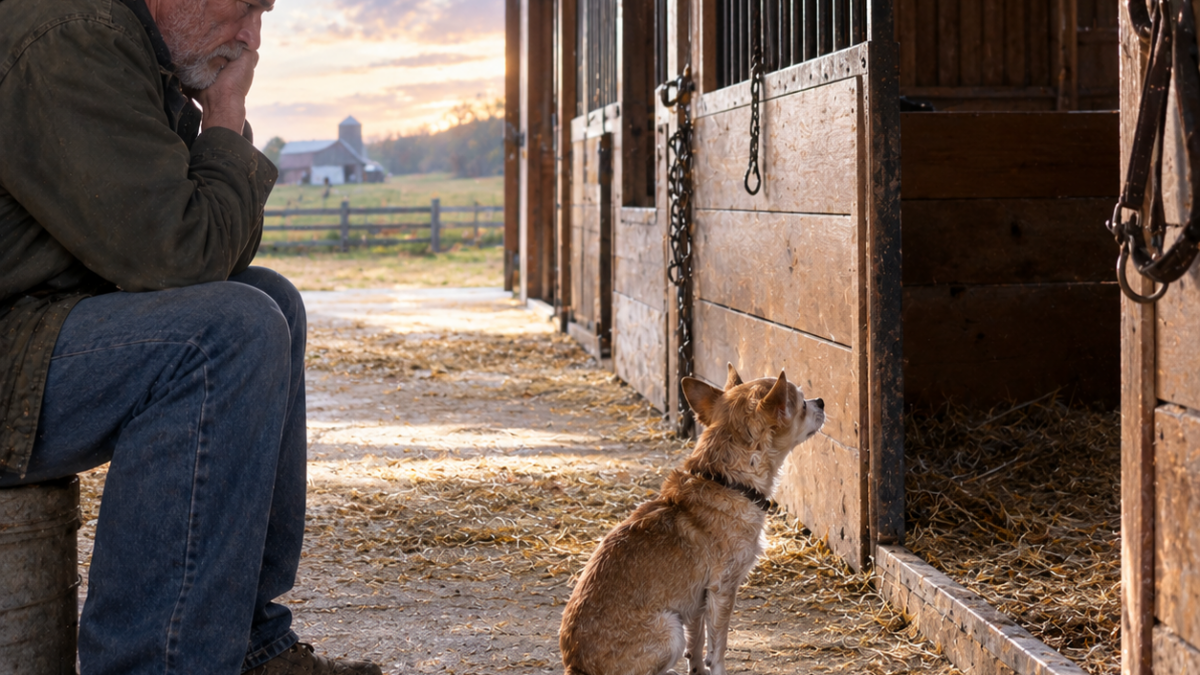
I stayed on the threshold long after the sun went down.
Benson sat thirty feet away inside Margaret’s old stall.
The barn had always been noisy at that hour.
Cows shifting their weight.
Chains clinking.
Water valves clicking.
Flies buzzing around the windows.
The old ventilation fan rattling like it had loose change trapped inside.
My father used to complain that the barn never shut up.
I would have given almost anything to hear it again.
Instead, there was only Benson.
A nine-pound Chihuahua sitting in the straw where a fourteen-hundred-pound Jersey had once stood.
His ears were down.
His back curved.
His nose rested between his front paws.
Every few minutes, he lifted his head toward the empty feed aisle.
Waiting.
That was the part I could not bear.
Not the crying.
The waiting.
I had been doing the same thing in quieter ways.
I still woke at 4:15 every morning.
For thirty-two years, my body had known that hour before any alarm.
I would lie in bed for a second, confused by the silence, then remember there was nothing to milk.
No gates to open.
No calves to check.
No feed mixer to start.
I would make coffee anyway.
Then stand at the kitchen window staring toward the barn.
Sometimes I walked out there and pretended I needed a wrench.
Or a length of chain.
Or a box of fencing staples.
Anything that gave me an excuse to enter without admitting I missed the smell of hay and warm animals.
Benson had no pride to protect.
He simply went where he hurt.
Maybe that was why watching him finally broke me.
I got up from the threshold and walked toward him.
My boots sounded too loud in the empty aisle.
Benson did not turn around.
“Hey, buddy.”
One ear moved.
That was all.
I stepped into Margaret’s stall.
There was still a worn place on the wood where she used to rub her neck.
A dent in the lower rail from years of leaning.
I had almost replaced that board twenty times.
Never did.
Now I was glad.
I lowered myself into the straw beside Benson.
My knees complained.
Fifty-three is not old until you try sitting on a barn floor after thirty-five years of lifting feed sacks.
Benson glanced at me.
Then looked back at the empty stall.
“She’s gone,” I whispered.
His ears lowered again.
“I know.”
The words came out rough.
“I know you don’t understand.”
He leaned slightly against my leg.
That tiny amount of contact undid me.
I had not cried when I signed the sale papers.
Had not cried when the first truck came.
Had not cried when the lender called me to confirm the debt restructuring.
Had not cried when my oldest son, Jacob, told me over the phone that selling the herd was not failure.
I had thanked him.
Said I knew.
Lied.
I did not cry when Margaret stepped onto the trailer either.
I scratched the white star on her forehead and told the buyer she liked apples cut in half.
Then I stood by the road with my hands in my pockets until the truck disappeared.
Farmers learn early that crying does not fix weather.
It does not lower feed prices.
It does not keep sick animals alive.
It does not stop banks from sending letters.
So you become practical.
Practical can become another word for numb if you are not careful.
That night, sitting beside Benson, practical finally failed.
I covered my face with both hands.
The first sound that came out of me embarrassed me.
A broken gasp.
Then another.
Benson turned.
I cried harder.
For the cows.
For my father.
For my grandfather.
For the 1923 date carved above the barn door.
For the idea that someday Jacob or my daughter Emily might raise their children there.
For Margaret.
For all the mornings I had cursed the work while secretly believing the work would always be waiting for me.
Mostly, I cried because I had spent months saying I saved the farm when every part of the farm that made me understand who I was had driven away on trucks.
Benson stood.
He climbed onto my thigh.
Nine pounds.
Four small paws.
A little warm body shaking almost as hard as mine.
He licked my chin.
Then curled against my chest.
“I’m sorry,” I said into his fur.
“I couldn’t keep them.”
His ears twitched.
“I tried.”
That was the first time I had said it aloud.
I tried.
Not I made a business decision.
Not the market collapsed.
Not the drought.
Not the bank.
I tried.
And I lost.
Benson pressed closer.
We sat there until the barn became completely dark.
That should have been the turning point.
It was not.
Real grief rarely respects story structure.
The next morning, Benson returned to Margaret’s stall.
He still refused breakfast.
By afternoon, he vomited water.
That scared me enough to stop treating his mourning as something time alone would fix.
I called Dr. Ellen Porter.
Ellen had been our farm veterinarian for eighteen years.
She had delivered calves at two in the morning, stitched my thumb after a heifer kicked a gate into it, euthanized my father’s old collie on the kitchen floor, and once told me I was the most stubborn man in the county while helping pull a calf from a cow I had insisted did not need assistance.
She arrived that afternoon in the same muddy white truck she had driven since approximately the Civil War.
Benson was in Margaret’s stall.
Of course.
Ellen crouched several feet away.
“Benson.”
His head lifted.
“Come here, tiny foreman.”
Nothing.
Ellen looked at me.
“How long has he been eating badly?”
“Maybe ten days.”
“You said three on the phone.”
“I said really badly for three.”
She gave me the look.
Veterinarians and schoolteachers have the same look when they know you are lying badly.
“He’s lost weight.”
“I know.”
“How much?”
“I don’t know.”
“You own a livestock scale.”
“He weighs nine pounds.”
“Kitchen scale.”
I looked away.
“Thomas.”
“Maybe a pound.”
Her expression changed.
On a Chihuahua, a pound mattered.
She examined him gently.
Heart.
Lungs.
Gums.
Abdomen.
Temperature.
Teeth.
Hydration.
Then she sat back on her heels.
“Physically, I’m not finding an obvious illness.”
“So he’s grieving?”
“He may be.”
“Dogs absolutely respond to loss and routine disruption.”
“But.”
There is always a but.
“But we do not get to call it grief until we rule out disease.”
She drew blood.
Benson tolerated the needle with profound disappointment in everyone involved.
Ellen packed the sample.
Then she looked around the barn.
“This place is probably reinforcing it.”
I frowned.
“How?”
“Everything he associates with the herd is here.”
“Smell.”
“Stalls.”
“Routine.”
“You.”
“I’m here everywhere.”
“Yes.”
“But you are also grieving.”
That annoyed me.
“Are we discussing the dog or me?”
“Both.”
“I called you for Benson.”
“And Benson lives with you.”
“He’s not a machine with an isolated malfunction.”
I crossed my arms.
“I hate when you talk like my sister.”
“I like your sister.”
“Of course you do.”
Ellen smiled.
Then her face softened.
“Thomas, what does he do all day?”
“Comes here.”
“And?”
“Sometimes walks the fields.”
“With you?”
“Sometimes.”
“What work does he have?”
I nearly laughed.
“He’s a Chihuahua.”
She stared.
“Have you met him?”
Fair.
Benson believed strongly in employment.
When the herd was here, he had jobs he invented for himself.
Inspecting the barn before dawn.
Following calves.
Alerting me to anything unfamiliar.
Sitting beneath Margaret during milking.
Patrolling the feed room for mice despite being terrified of actual mice.
He had structure.
Purpose.
A social group.
Then one Friday afternoon, all of it vanished.
“So what do I do?” I asked.
“First, we get him eating.”
“High-value food.”
“Hand-feed if necessary.”
“Small meals.”
“We’ll check his labs.”
“Second, routine.”
“New routine.”
“Not pretending the old one still exists.”
I looked toward Margaret’s empty stall.
“And the barn?”
“Don’t lock him out completely.”
“That may make him more distressed.”
“But stop letting this be the only place his day happens.”
“How?”
“Give him somewhere else to need to be.”
The sentence irritated me because I had no idea how.
Apparently Benson and I shared another problem.
Neither of us knew where else we were needed.
The bloodwork came back normal.
That should have relieved me.
Instead, it meant I could no longer blame an illness.
Benson’s body was fine enough.
His world was not.
For three days, I tried everything Ellen suggested.
Cooked chicken.
Scrambled egg.
Warm rice.
A spoonful of cottage cheese.
Benson ate if I fed him by hand.
Then went back to the barn.
I took him for truck rides.
He tolerated them.
Then scratched at the truck door when we returned until I let him out so he could run to the barn.
I walked the back pasture.
He followed for half a mile.
Then turned around and went home without me.
On the fourth day, I called my daughter Emily.
She lived forty minutes away with her husband, Chris, and my two granddaughters.
Emily answered on speaker.
“Dad?”
“Hey.”
“You okay?”
That question again.
Everybody had started asking it with too much care.
“I need to borrow your kids.”
Silence.
“What?”
“For a few hours.”
“Are you kidnapping your granddaughters?”
“Borrowing.”
“For what?”
I looked at Benson sleeping beside Margaret’s empty feed trough.
“I need noise.”
Emily came over Saturday with Lily, eight, and Kate, six.
The girls exploded from the minivan carrying enough energy to power irrigation pumps.
Benson met them near the driveway.
For the first time in weeks, his tail moved more than once.
Lily crouched.
“Benson!”
He walked to her.
Not quickly.
But he went.
Kate had brought a pink rubber ball approximately the size of Benson’s head.
She rolled it.
Benson watched the ball pass.
Then looked at her with an expression that suggested she had misunderstood his professional qualifications.
“I think he wants you to throw it,” I said.
Kate picked it up.
Threw.
Benson trotted after it.
Only three steps.
Then five.
Then all the way.
He did not bring it back.
He stood over it as if confirming containment.
Kate ran toward him.
He darted away.
She squealed.
Something shifted.
Not cured.
Not fixed.
But for twenty minutes, Benson stayed outside the barn.
Twenty minutes became a victory.
After lunch, the girls followed me to the garden.
Benson followed them.
Then he heard a truck on the county road.
His head snapped toward the barn.
He ran.
I found him in Margaret’s stall again.
Lily came in behind me.
She stood quietly.
Children are sometimes wiser around sorrow when adults do not explain too much.
“Is he waiting for the cows?” she asked.
“Yes.”
“Are they coming back?”
“No.”
She looked at Benson.
Then at me.
“Does he know?”
“I don’t think so.”
Lily frowned.
“Maybe you have to show him.”
I nearly said I had.
Empty stalls seemed fairly clear.
Then I realized what she meant.
Not show him absence.
Show him what came next.
The problem was, I did not know what came next.
After the girls left, I sat at the kitchen table with my farm books.
For months, I had avoided them except when absolutely necessary.
Income.
Debt.
Property taxes.
Equipment payments.
The numbers were ugly but no longer fatal.
Selling the herd had done what it was supposed to do.
It stopped the bleeding.
I still owned the land.
The house.
Barn.
Most of the equipment, though I planned to sell more.
I had taken part-time work repairing machinery for a neighboring operation.
Not enough to feel like a new life.
Enough to keep electricity on.
I opened a notebook and wrote:
WHAT IS THE FARM NOW?
Then stared at it.
Nothing came.
I tried again.
WHAT CAN I STILL AFFORD?
That was easier.
Land.
Barn.
Hay field if rainfall improved.
Garden.
Some chickens.
Maybe goats.
I crossed out goats immediately.
I had known goats.
Grief had limits.
Then I wrote:
ONE COW?
I stared at those words for a long time.
Emotion moved faster than reason.
I imagined Margaret’s stall occupied.
Benson trotting down the aisle.
Morning breath from a living animal.
Then the practical man in me returned.
Feed.
Vet.
Fencing.
Winter hay.
Insurance.
One cow does not make economic sense.
A cow is not a decorative grief appliance.
I crossed it out.
Then wrote it again underneath.
ONE OLD COW?
That was worse economically.
Possibly better ethically.
Ellen had mentioned a livestock rescue once.
A place thirty miles south that took surrendered farm animals.
Old dairy cows.
Injured goats.
Horses owners could no longer keep.
Animals that had stopped having economic value but still had plenty of life.
I called Sunday morning.
A woman named Maria Delgado answered.
“Second Pasture Sanctuary.”
I nearly hung up.
Instead I said, “This is going to sound strange.”
“That is usually how our calls begin.”
“I sold my dairy herd.”
“I’m sorry.”
“My dog is grieving them.”
Pause.
“What kind of dog?”
“Chihuahua.”
Longer pause.
“Your Chihuahua is grieving cows?”
“He thinks he is management.”
Maria laughed.
Not cruelly.
Warmly.
“I understand.”
“I’m thinking maybe…”
I stopped.
“Maybe what?”
“I don’t know.”
“That is allowed.”
“I can’t afford a herd.”
“I’m not trying to start again.”
“I don’t want to start again.”
I said the last part too quickly.
Maria heard it.
“What do you want?”
I looked through the kitchen window toward the barn.
“Something alive in there.”
She did not answer immediately.
Then she said, “We have a cow you should meet.”
Her name was Rosie.
Of course it was.
Rescue animals always seem to have names too gentle for what happened to them.
Rosie was a twelve-year-old Brown Swiss cross.
Huge.
Bony.
One horn broken years earlier.
Chronic arthritis in one rear leg.
She had spent her life on a small dairy farm whose owner died.
The man’s family sold the younger cows.
Nobody wanted Rosie.
The sanctuary took her.
“She doesn’t need production,” Maria said.
“She needs pasture.”
“Shelter.”
“Routine hoof care.”
“Senior feed in winter.”
“Vet monitoring.”
“Companionship.”
“That last part is the problem.”
“I only have Benson.”
“Is Benson aware he is not bovine?”
“No.”
“Then maybe we’re halfway there.”
I drove to Second Pasture that afternoon.
Without Benson.
I needed to know whether I was making a decision for him or using him as an excuse to undo my own grief.
Maria met me near a red equipment shed.
She was in her forties, sun-browned, practical, boots covered in mud despite three dry weeks.
“Thomas?”
“Yes.”
“You look like a dairy farmer.”
“What does that look like?”
“Tired even when retired.”
Fair.
Rosie stood under a cottonwood tree in the far pasture.
She was enormous.
Not Margaret.
That mattered immediately.
Different color.
Different shape.
Different eyes.
Brown Swiss cattle have a stillness to them that can feel almost judgmental.
Rosie watched me approach.
I stopped near the fence.
“She friendly?”
Maria shrugged.
“She is honest.”
Again, fair.
I held out my hand.
Rosie walked over slowly.
Sniffed my palm.
Then pushed her broad forehead against my shoulder.
My body knew what to do before my mind did.
I braced one hand against her neck.
The weight.
The heat.
The animal smell.
Something in me cracked.
I stepped back.
Maria pretended not to notice.
“I can’t do this.”
She nodded.
“That may be true.”
“I sold them because I couldn’t keep doing this.”
“Then don’t.”
I looked at her.
“What?”
“Do not become a dairy farmer again.”
“You asked about one old cow.”
“That is not the same life.”
“It will feel like it.”
“Some days.”
“That’s the danger.”
Maria leaned against the fence.
“Thomas, rescue is not supposed to rebuild the exact thing that broke you.”
“It can build something smaller.”
“Different.”
“Manageable.”
I looked at Rosie.
She had returned to chewing hay, apparently unconcerned about my identity crisis.
“What does fostering look like?”
Maria smiled slightly.
“Now you’re asking a better question.”
We made a plan.
Not adoption.
Not permanent.
A thirty-day foster trial.
Second Pasture would retain ownership.
They would help with major medical expenses.
I would provide pasture, shelter, hay, daily care.
If it became too much financially or emotionally, Rosie returned.
No shame.
No failure.
The words no shame mattered more than I admitted.
I went home and told Benson.
He was in the barn.
Naturally.
“Tomorrow, you’re getting a visitor.”
He stared at Margaret’s stall.
“You are not in charge.”
One ear moved.
“I mean it.”
He looked at me.
Then at the stall.
“That is exactly why you are not in charge.”
The next day, a stock trailer backed down my lane.
Benson heard it before I did.
He came flying from the porch.
Nine pounds of tan-and-white fury.
His barking echoed across the yard.
The trailer stopped.
Benson stopped too.
He knew that sound.
Trailers had taken the herd away.
His body went rigid.
Tail dropped.
He looked at me.
Then ran backward toward the house.
My heart sank.
I had not considered that.
Of course.
The trailer itself was part of the loss.
Maria climbed out of the truck.
“Give him time.”
I sat on the gravel.
“Benson.”
He stayed near the porch.
Rosie shifted inside the trailer.
The low thud of a hoof reached us.
Benson’s ears rose.
Another sound.
A deep bovine exhale.
Benson froze.
Then took one step.
Another.
His nose worked.
Maria lowered the trailer ramp.
Rosie stood inside.
The moment Benson saw her, he stopped breathing.
At least it looked that way.
His little body became absolutely still.
Rosie looked down.
Benson looked up.
A twelve-year-old cow and a seven-year-old Chihuahua meeting in the middle of a farm that had forgotten what it sounded like to contain either.
Rosie walked down the ramp.
Benson backed up.
Not fear exactly.
Overwhelm.
Rosie reached the grass.
She lowered her head toward him.
Benson sniffed her nose.
Then he made the sound.
That same deep, broken whine I had heard the morning after Margaret left.
Only this time it rose.
Changed.
Turned into something almost like a squeal.
Benson spun once.
Ran around Rosie.
Barked.
Ran toward the barn.
Stopped.
Looked back.
Barked again.
Rosie continued eating grass.
Benson ran to her.
Ran toward the barn again.
“You think he wants her inside?” Maria asked.
“Yes.”
“He’s giving her a tour.”
“He is.”
Rosie eventually followed because the path led toward shade.
Benson trotted three feet ahead like a tiny foreman with an extremely large new employee.
When Rosie stepped into the barn, Benson became frantic.
Not panicked.
Alive.
He ran down the aisle.
Into Margaret’s stall.
Out again.
Around Rosie’s front legs.
Back into the stall.
Rosie ignored him until he stopped.
Then she walked into the empty stall beside Margaret’s old one.
Not Margaret’s stall.
The next stall.
She sniffed the feed rail.
Lowered her head.
Benson stood at the opening.
For several seconds, he stared.
Then he walked into Margaret’s stall.
Sat.
Looked at the empty space.
Looked at Rosie.
Then walked out.
He did not cry.
That night, Benson ate an entire bowl of food.
I called Ellen.
“He ate.”
“Good.”
“All of it.”
“Very good.”
“Then he stole part of my chicken.”
“Recovery is moving fast.”
I laughed.
It felt strange.
Rusty.
But real.
Rosie was not magic.
That matters.
On day two, Benson still visited Margaret’s stall.
On day four, he cried for a few minutes after Rosie went to pasture.
On day six, he woke at 4:15 and scratched at my bedroom door until I got up.
He ran toward the barn.
My old body followed automatically.
For one dangerous second, it felt exactly like the old life.
Dark morning.
Boots.
Barn.
Animal waiting.
The milking system was silent.
No herd.
No business.
Rosie only needed breakfast and a health check.
Ten minutes.
Not six hours.
I stood in the aisle after filling her hay rack.
My hands were shaking.
Benson was beneath Rosie’s stall rail.
Same position he used to take beneath Margaret.
I backed away.
Went outside.
Sat on the step.
The old panic surprised me.
I had not called it panic before.
Farmers of my generation preferred phrases like “pressure” or “bad nerves” because anxiety sounded too much like something requiring attention.
But there it was.
The memory of debt.
Dead pasture.
Feed invoices.
Milk checks.
A sick cow at midnight.
No sleep.
No margin.
What if Rosie got sick?
What if hay prices rose?
What if one cow became two?
What if I started again because I did not know how not to?
Benson came outside.
He sat beside my boot.
“I can’t go back,” I told him.
He looked at me.
“I won’t.”
Rosie mooed inside.
Benson’s ears lifted.
He did not run.
He stayed beside me.
That mattered.
Maybe he was learning too.
We sat there until sunrise.
Thirty days passed.
Rosie stayed.
Not because I needed to restore the farm.
Because one cow was manageable.
Because Second Pasture helped.
Because Benson was eating.
Because I was sleeping.
Because the barn no longer felt like a tomb.
It felt like a building again.
That difference saved me.
I signed a long-term foster agreement.
Not adoption.
Maria insisted.
“So you remember help exists.”
“I don’t need help.”
She stared.
I corrected myself.
“I dislike needing help.”
“Better.”
Emily brought the girls again.
Lily ran into the barn and stopped when she saw Rosie.
“Grandpa!”
“I see her.”
“You got a cow!”
“I am fostering a cow.”
“That sounds like getting a cow with paperwork.”
She was eight.
Already dangerous.
Benson trotted behind her.
Kate knelt and tried to hug him.
Benson tolerated two seconds, then escaped under Rosie.
The girls laughed.
The sound filled the barn.
I stood in the aisle listening.
The empty stalls were still empty.
Most of them.
But emptiness no longer felt like failure.
Space can be empty without being dead.
That took me a long time to learn.
By fall, I had found more work repairing equipment.
Neighbors started calling me when old tractors would not start.
I was good at it.
Better than I realized.
Years of farming make a person part mechanic, part veterinarian, part electrician, part meteorologist, part accountant, and mostly exhausted.
I converted one side of the machine shed into a small repair shop.
Not fancy.
Enough.
A handwritten sign at the road said:
HALE FARM REPAIR
The first week, three jobs came in.
Then five.
Then a combine gearbox that took me two days and paid more than a week of milk checks used to.
I stood in the shop holding the invoice like I had discovered fraud.
My neighbor Earl looked at me.
“What?”
“That’s too much.”
“You rebuilt a gearbox.”
“I know.”
“You want less?”
“No.”
“Then stop insulting money.”
Earl had always been practical.
I needed that.
Benson divided his time between the repair shop and Rosie.
He spent mornings in the barn, afternoons lying on a folded blanket near my workbench, evenings patrolling the house.
His ribs disappeared.
His coat brightened.
The dark hollows under his eyes faded.
Sometimes I still found him sitting in Margaret’s stall.
But he no longer cried every time.
Sometimes he only sat.
Memory without panic.
Grief without drowning.
I began doing the same.
On the anniversary of the herd sale, I walked into Margaret’s stall alone.
Benson followed.
I put my hand on the worn wood.
“Year.”
Benson sniffed the straw.
Rosie shifted next door.
I expected the day to break me.
It did not.
It hurt.
Different.
Pain is not always an emergency.
That was new.
I called the buyer who had taken Margaret.
I had avoided doing that for twelve months.
Part of me was afraid she had died.
Part of me was afraid she was thriving and I would feel replaced.
Both fears were selfish.
The buyer’s name was Paul Henderson.
He answered.
“Thomas?”
“Yeah.”
“How are you?”
“Okay.”
That strange farmer word.
Okay.
“Margaret?”
I asked it quickly.
Paul laughed.
“Still bossing everybody.”
My eyes closed.
“She’s alive?”
“Very much.”
“She retired from milking.”
“What?”
“She wasn’t producing enough to justify keeping her in the main group.”
My stomach tightened.
Paul continued before I could panic.
“My wife got attached.”
“She’s with three other old cows on the back pasture.”
“Mostly eats and judges us.”
I sat down on the barn rail.
Benson watched me.
“Can I see her?”
Paul did not hesitate.
“Come tomorrow.”
I did not sleep.
The next afternoon, Benson and I drove forty miles to Paul’s farm.
I almost left Benson home.
Then thought better of it.
If Margaret was alive, he deserved to know.
Paul met us by a pasture fence.
“Little dog came too?”
“He would have driven himself.”
We walked over a hill.
Four cows stood beneath an oak.
I knew Margaret before I saw her face.
The way she held her back leg.
The slight outward angle of her left ear.
Fourteen years of knowing an animal does not disappear because she changes fields.
“Margaret.”
Her head lifted.
Benson stopped.
His whole body went rigid.
The old Jersey stared.
Then began walking toward us.
Slow.
Very slow.
Benson started whining.
Not crying.
Whining high and fast, pacing along the fence.
Margaret reached us.
I put my hand through the rails.
She sniffed.
Then leaned her forehead into my palm.
I cried immediately.
No defense.
No practical man left.
“Hi, old girl.”
Benson squeezed under the lowest rail before I could stop him.
“Benson!”
Paul laughed.
“He’ll be fine.”
Benson ran toward Margaret.
A nine-pound Chihuahua in a pasture with four retired cows.
He stopped beneath her head.
Margaret sniffed him.
Benson stood on his back legs, front paws reaching uselessly upward.
Margaret lowered her nose.
Benson licked it.
Then he ran in a circle.
Barked.
Ran another circle.
Margaret watched him with patient indifference.
The other cows came closer.
Benson looked like the happiest fool in three counties.
I sat on the grass.
Paul sat beside me.
“You thought she was gone?”
“I knew where she went.”
“That’s not what I asked.”
I looked at him.
He understood.
“I sold them,” I said.
“Felt like I gave up.”
Paul pulled a piece of grass apart between his fingers.
“You stopped losing money.”
“Same thing some days.”
“No.”
He looked at Margaret.
“Not same thing.”
“She’s alive.”
“You’re alive.”
“Farm’s still there.”
“Different isn’t dead.”
There it was again.
The lesson everyone seemed determined to teach me.
Different isn’t dead.
We stayed two hours.
When it was time to leave, Benson refused.
Absolutely refused.
I called.
Nothing.
Offered chicken.
Nothing.
Walked toward the truck.
He stared at me like I was making a historical mistake.
Finally, Margaret moved away toward the oak.
Benson followed three steps.
Stopped.
Looked at her.
Then came back to me.
He cried in the truck for the first ten miles.
Then fell asleep with his head on my thigh.
Back home, he went straight to the barn.
Rosie was waiting near the gate.
Benson sniffed her.
Then lay beneath her stall.
That night, he did not go to Margaret’s empty space.
He stayed with Rosie.
The next morning, same.
A week passed.
Then two.
Margaret’s stall remained empty.
Not forgotten.
Empty.
There is a difference.
I started visiting Paul’s farm once a month.
Benson came every time.
Margaret slowly became older.
Stiffer.
Still herself.
Rosie became Benson’s daily companion.
Margaret became part of his past that he was allowed to revisit.
That arrangement healed something in both of us.
We did not have to pretend the old life was gone beyond reach.
We also did not have to rebuild it exactly.
One cow here.
One old cow there.
A repair shop.
Grandchildren on weekends.
A little dog moving between memory and now.
That was enough.
The farm changed again the following spring.
Maria called from Second Pasture.
“I have a problem.”
“No goats.”
“I didn’t say goats.”
“Then continue.”
“A calf.”
“No.”
“Orphan.”
“No.”
“Recovering from pneumonia.”
“No.”
“Needs three weeks of quiet foster care.”
“Absolutely not.”
“Rosie is calm.”
“No.”
“Benson likes calves.”
“He likes cows.”
“Same department.”
“No.”
“Three weeks.”
I looked at Benson.
He was asleep beneath Rosie’s stall.
“Why me?”
“Because you know cattle.”
“Because your barn is quiet.”
“Because Rosie may help settle him.”
“And because you need to practice saying yes without assuming it means forever.”
“I hate that you know me.”
“So does everyone.”
The calf arrived Friday.
His name was Otis.
Six weeks old.
Black with a white blaze.
Thin.
Awkward.
Benson despised him immediately.
Otis tried to sniff Benson.
Benson barked.
Otis jumped.
Benson looked satisfied.
Rosie intervened by stepping between them and eating hay.
Within four days, Benson had appointed himself Otis’s supervisor.
He followed during bottle feeding.
Barked if Otis wandered too far.
Slept outside the pen.
At night, I sometimes heard Benson’s nails in the barn.
Then silence.
No crying.
Just movement.
Living movement.
When Otis left three weeks later, I worried.
Benson watched the trailer.
His ears lowered.
He looked at me.
I crouched.
“He’s going somewhere good.”
The truck drove away.
Benson stood beside me.
Did not chase.
Did not run to Margaret’s stall.
Did not stop eating.
He watched until the trailer disappeared.
Then turned toward Rosie.
That was when I knew he had changed.
Grief had not disappeared.
He had learned departure did not always mean disaster.
So had I.
Second Pasture started using my barn occasionally for short-term livestock fostering.
Only one animal at a time.
Only when I agreed.
A senior goat once slipped through because Maria called me while I was distracted.
I accused her of strategic deception.
She admitted nothing.
Benson barked at the goat for twelve straight minutes.
The goat head-butted a bucket.
Peace negotiations took days.
Mostly, though, we fostered calves.
Old cows.
One injured sheep.
A miniature donkey named Walter who screamed at sunrise and nearly ended the entire program.
Each animal came.
Stayed.
Left.
Benson learned the rhythm.
So did the barn.
The barn became a place of temporary safety instead of permanent production.
No quotas.
No milk checks.
No calculations about whether a sick animal was costing more than it earned.
That took adjustment.
I had spent my whole life trained to think like a farmer because farming requires numbers.
Feed conversion.
Production.
Weight.
Yield.
Margin.
You cannot run a farm on sentiment.
But rescue required a different kind of accounting.
Comfort.
Recovery.
Time.
Safety.
A good death when recovery was impossible.
Those things are harder to fit into a ledger.
They still count.
Maria asked if I wanted to formally partner with the sanctuary.
I said no.
Then yes.
Then clarified I wanted no board meetings.
She put me on the advisory committee.
This is how manipulative rescue people work.
We created a program called Old Barn Foster.
My barn.
My grandfather’s 1923 barn.
The place I had believed became useless when the herd left.
Now older farm animals and recovering rescues came for temporary care before moving to sanctuary pastures or adoptive farms.
A local newspaper wrote about it.
The reporter asked, “Did you plan for this when you sold your cows?”
I laughed.
“No.”
“What did you plan?”
“Mostly to survive.”
She wrote that down.
I hated seeing it in print.
Emily loved it.
Jacob called from Colorado.
“I read the article.”
“Your mother would have mailed you a copy if she were alive.”
“I know.”
“Dad?”
“Yeah?”
“I’m proud of you.”
I stared at the barn wall.
Jacob had said those words before.
Graduations.
Birthdays.
After my knee surgery.
But this time, they landed differently.
“I sold the herd.”
“I know.”
“I couldn’t make it work.”
“I know.”
“That doesn’t feel like something to be proud of.”
Jacob was quiet.
Then he said, “You stopped the farm from taking you down with it.”
My throat tightened.
“And then you figured out another use for the place.”
“That sounds like farming to me.”
I smiled.
“You live in Denver.”
“What do you know about farming?”
“Enough to know farmers adapt.”
He was right.
My grandfather had begun with horses.
My father switched more acreage into dairy.
I added milking automation.
The farm had never been one permanent thing.
I had mistaken tradition for stillness.
Tradition is not repeating exactly.
It is carrying forward what matters.
The barn mattered.
The land mattered.
Caring for animals mattered.
The debt did not.
The suffering did not.
The business model did not.
Once I understood that, I breathed easier.
Benson turned eight.
Then nine.
He remained tiny.
Opinionated.
Dedicated.
He became locally famous because the newspaper photographer took a picture of him standing between Rosie’s front legs.
The caption called him “the smallest cattle manager in the county.”
I framed it.
Pretended I did not.
People started dropping off donations.
Blankets.
Old feed buckets.
Hay.
One woman mailed Benson a miniature reflective vest.
I refused to put it on him.
Emily put it on him.
He looked like a municipal employee.
The grandchildren laughed until Kate fell over.
Benson tolerated the humiliation because there was cheese involved.
Margaret died when Benson was nine.
Paul called me early one morning.
I knew before he said it.
“She went down in the night.”
I sat on the kitchen chair.
Benson was eating breakfast.
“Was she alone?”
“No.”
“My wife was there.”
“Vet came.”
“Peaceful.”
I closed my eyes.
“Thank you.”
“I mean it.”
“Thank you for keeping her.”
Paul’s voice softened.
“She was easy to keep.”
I laughed through tears.
“That is a lie.”
Margaret had once destroyed a gate because breakfast was seven minutes late.
“She mellowed.”
“How long ago?”
“Recently.”
I told Benson.
Of course he did not understand the words.
Maybe he understood me.
I took him to Paul’s farm one final time.
Margaret was already gone.
The pasture looked wrong without her.
Benson searched.
Under the oak.
Near the trough.
Along the fence.
He sniffed the place where she usually stood.
Then came back to me.
No crying at first.
He sat beside my boot.
We stayed there.
After ten minutes, he made one small sound.
I knelt and lifted him.
He rarely liked being carried.
That day he let me.
I held him against my chest.
“She’s gone this time.”
His head rested under my chin.
“I know.”
We buried a small clipping of her old halter beneath the maple tree behind my barn.
Not ashes.
Paul kept those on his farm.
Just a piece of worn leather.
A symbol.
Benson sat beside me while I covered the hole.
Then he went inside the barn.
Straight past Margaret’s stall.
To Rosie.
He curled in the straw beneath her.
Grief had a place now.
It no longer owned the whole building.
Rosie lived another two years.
She became so much part of the farm that I forgot her arrival was supposed to be temporary.
When Second Pasture formally transferred her to me, Maria brought adoption papers.
I stared at them.
“You said foster.”
“That was three years ago.”
“Exactly.”
“You built her a heated water system.”
“Winter.”
“You special-order senior feed.”
“Nutrition.”
“You sleep in the barn when she has arthritis flares.”
“Monitoring.”
“You introduced her to your grandchildren as family.”
“That was Lily.”
Maria pushed the papers toward me.
“Sign.”
I did.
Rosie Hale.
Ridiculous.
Correct.
When Rosie’s time came, Benson was eleven.
Her arthritis worsened.
Then she stopped rising easily.
Ellen came to examine her.
Same white truck.
More rust.
Same eyes.
“She’s tired, Thomas.”
I knew.
Knowing is not consent.
But love eventually has to become consent to loss.
We gave Rosie one more week.
Good food.
Sun.
Soft bedding.
Benson stayed with her constantly.
The morning Ellen returned, Rosie lay in the grass outside the barn.
Benson was tucked against her front leg.
I sat on her other side.
Rosie’s head rested in my lap.
Ellen gave the medication slowly.
I talked to Rosie.
Told her she had fixed a barn she never knew was broken.
Told her Benson loved her.
Told her I did too.
At the end, her breathing slowed.
Benson stood.
Sniffed her face.
Waited.
Then lay down.
No frantic barking.
No scratching.
No running.
He rested beside her for almost an hour.
That afternoon, when we moved Rosie, Benson followed us to the gate.
The trailer left empty except for her body.
Benson watched.
Then turned around.
He walked into the barn.
I followed.
He stopped at Margaret’s stall.
Then Rosie’s.
Two empty stalls side by side.
My heart tightened.
Benson looked at them.
Then looked at me.
I crouched.
Here we go, I thought.
Back to the beginning.
But Benson walked past both.
He went to the aisle.
Curled on his old blanket.
And slept.
I sat beside him.
That was the day I understood healing is not forgetting enough to stop hurting.
Healing is knowing what empty means and surviving the sight of it.
We kept fostering.
Not immediately.
I needed a month.
Benson did too.
Then Maria called.
“Cow?”
I asked.
“Actually—”
“No donkey.”
“Calf.”
“Fine.”
That was how life moved forward.
Benson became twelve.
His face whitened.
His heart developed a murmur.
His knees stiffened.
Ellen told me to stop letting him jump off the porch.
Benson disagreed.
I built a ramp.
He ignored it for two weeks, then used it only when nobody appeared to be watching.
His work schedule reduced itself.
Mornings in the barn.
Midday naps in the repair shop.
Evenings on my lap.
He no longer chased calves.
He supervised from blankets.
When new animals arrived, Benson still walked to the trailer.
Checked.
Approved or disapproved.
Then returned to his bed.
A young volunteer named Mason once asked me, “How did you train him to be good around cattle?”
“I didn’t.”
“He trained himself.”
“He thinks this is his farm.”
Mason looked around.
“Isn’t it?”
I had no answer.
Maybe it was.
By then, Old Barn Foster had helped thirty-seven animals.
Some stayed days.
Some months.
Two died here.
That hurt.
But they died warm.
Fed.
Known by name.
Not alone.
One old Holstein named Belle arrived unable to gain weight.
Cancer.
Nothing to cure.
Maria asked whether I could give her hospice care.
I almost said no.
Cancer had taken my father.
My sister.
Three cows over the years.
I was tired of endings.
Then Benson walked to Belle.
She lowered her huge head.
He touched noses with her.
Decision made.
Belle stayed six weeks.
Benson slept near her every night.
When she died, I buried her halter clip beside Rosie’s.
The maple tree became a kind of history.
Not cemetery exactly.
Memory map.
Each small marker represented an animal who passed through.
Some stayed.
Some left.
Some died.
All counted.
I turned sixty.
Emily threw a party.
I objected.
She ignored me.
Jacob flew in from Denver.
The grandchildren decorated the barn with lights.
Not the working side.
The clean aisle.
Benson wore the reflective vest again.
Betrayal by family.
People brought food.
Neighbors.
Rescue volunteers.
Farmers.
Ellen.
Maria.
Paul.
Alan from the feed store.
At one point, I stood near the barn door and looked inside.
There were no dairy cows.
No milking line operating.
No employees.
No monthly production sheet.
Instead, an elderly sheep slept in a pen near the back.
A calf recovering from pneumonia chewed hay.
Benson lay under a chair.
My grandchildren laughed.
My son argued with Earl about football.
Maria tried to recruit two guests.
The barn was alive.
Different.
Not dead.
Paul came beside me.
“You okay?”
I smiled.
“Yeah.”
He nodded toward the aisle.
“Looks like you saved the farm.”
The old version of me would have agreed.
The newer version knew better.
“No.”
I looked down at Benson.
“I stopped asking it to be what it was.”
Paul thought about that.
“Same thing sometimes.”
Maybe.
Benson’s last year began quietly.
He was thirteen.
Old for a Chihuahua, though small dogs can be stubborn about clocks.
His heart murmur progressed.
Medication helped.
Then kidney values changed.
More medication.
Special food.
Ellen started visiting every few months instead of me driving him to the clinic because he hated long rides now.
Benson still went to the barn every morning.
Slower.
Sometimes I carried him.
He would stand at the entrance while I lowered him.
Then walk inside under his own power.
Pride matters to old dogs too.
One winter morning, snow covered the yard.
Benson refused to step outside.
Reasonable.
I carried him inside my coat to the barn.
His little head stuck out beneath my chin.
“You have become soft.”
He licked my neck.
“Disgusting.”
Inside, a foster cow named Grace lay in deep straw.
Benson walked to her.
Curled beside her front leg.
I watched from the aisle.
The image took me back thirteen years.
A younger Benson beneath Margaret.
Then Rosie.
Belle.
Grace.
A whole life measured in animals larger than him.
Maybe he never thought he was a cow.
Maybe he simply understood belonging better than I did.
That spring, Benson stopped eating breakfast.
My chest tightened immediately.
Ellen came that afternoon.
Bloodwork.
Exam.
Heart.
Kidneys.
She sat with me on the porch afterward.
“He’s declining.”
“How fast?”
“You know I can’t answer that.”
“A month?”
“Maybe.”
“Six?”
“Maybe.”
“A year?”
She looked at me.
I nodded.
“Not likely.”
“No.”
Benson slept on my lap.
I rubbed one thumb between his ears.
“What do I watch?”
“Food.”
“Breathing.”
“Comfort.”
“Interest.”
“Whether he still wants the barn.”
That last one mattered.
For weeks, he did.
Even on bad mornings, he lifted his head when I said, “Barn?”
His ears rose.
I carried him.
He walked the aisle.
Checked the animals.
Rested.
Returned home.
Then one morning in August, I said, “Barn?”
Benson looked at me.
No ear movement.
No attempt to stand.
My throat closed.
“Buddy?”
He placed his chin back on the blanket.
I knew.
I hated knowing.
I called Ellen.
Then Emily.
Jacob was in Denver.
He booked the next flight.
I told him not to.
He came anyway.
That afternoon, my children stood in the kitchen with me.
Benson slept in his bed.
Emily cried quietly.
Jacob crouched beside him.
“He’s tiny.”
“He has always been tiny.”
“I forgot.”
“No, you got bigger.”
My grandchildren came later.
Lily was nineteen.
Kate seventeen.
They had known Benson their entire remembered lives.
Lily sat on the floor.
“Can he go to the barn?”
I looked at Benson.
“I don’t know.”
His eyes opened at the word.
Barn.
One ear moved.
Very slightly.
I laughed through tears.
“Apparently.”
We carried him together.
Not because he could not be carried by one person.
Because everybody wanted a hand on him.
I held his body.
Lily carried his blanket.
Kate brought water.
Jacob opened doors.
Emily walked beside me.
The barn was quiet.
One foster cow stood in the far pen.
A calf slept near the aisle.
Late-afternoon light came through the old boards in narrow gold stripes.
I placed Benson on his blanket in Margaret’s old stall.
I had not planned that.
My feet chose.
He lifted his head.
Looked around.
Thirteen years of memory in one small body.
Margaret’s stall.
Rosie next door.
The aisle.
The feed room.
The fan.
The place he cried until I finally cried with him.
Benson tried to stand.
I helped.
He walked three steps.
Stopped at the stall opening.
The foster cow noticed him and came closer.
She lowered her nose.
Benson touched it.
Then sat.
His work complete.
We stayed there until sunset.
Nobody talked much.
At one point, Jacob said, “Dad?”
“Yeah?”
“Are you okay?”
I looked around.
That question had followed me for years.
After the herd sale.
After Margaret.
After Rosie.
Now.
“No.”
Then I smiled.
“But I will be.”
That was the first time I ever answered honestly without fearing honesty meant collapse.
Benson slept in my room that night.
At dawn, his breathing changed.
I called Ellen.
She arrived at seven.
I asked if we could do it in the barn.
She nodded.
Of course.
We carried Benson back to Margaret’s stall.
I sat in the straw.
He lay in my lap.
Emily on one side.
Jacob on the other.
Lily and Kate near the rail.
Ellen prepared everything quietly.
The barn smelled like hay.
Wood.
Summer.
Animals.
Life.
I looked down at Benson.
His eyes were cloudy now.
Still soft.
“You know, you caused a lot of trouble.”
Tail movement.
Barely.
“You made me get another cow.”
Emily laughed through tears.
“Technically he made you foster one.”
“Same thing with paperwork.”
I scratched his chest.
“You cried until I stopped pretending.”
His breathing slowed.
“I thought you were mourning the herd.”
I swallowed.
“Maybe you were mourning me too.”
Benson looked at me.
Or maybe simply toward my voice.
It did not matter.
“I’m sorry it took me so long to understand.”
Ellen gave the first medication.
His little body relaxed.
No tension.
No pain.
I bent my head.
“You were a very bad cow.”
Jacob laughed.
Kate sobbed.
I continued.
“Terrible milk production.”
“Poor weight gain.”
“Questionable attitude.”
Benson’s tail moved once.
Everyone broke.
I pressed my cheek against his head.
“But you were the best farm dog I ever had.”
His heartbeat fluttered beneath my hand.
“You kept the barn alive until I figured out what to do with it.”
My voice failed.
I waited.
Then found it again.
“You kept me alive too.”
The final medication went in.
Benson breathed once.
Twice.
Then one long exhale.
His body became still in my arms.
No cry.
No empty waiting.
Just rest.
We buried Benson beneath the maple tree behind the barn.
Beside the small markers for Margaret’s halter clip, Rosie, and the animals who had passed through Old Barn Foster.
Jacob made the marker himself.
Simple cedar.
It reads:
BENSON
2013–2026
SMALLEST COW ON THE FARM
HE KEPT US HERE
I argued about the cow line.
Lost.
Correctly.
For months after Benson died, I still looked for him every morning.
At the porch.
Under the workbench.
Near the stall.
Grief makes ghosts from routine.
I would drop a piece of chicken and wait for the sound of tiny nails.
Nothing.
I would enter the barn expecting one sharp bark at a new animal.
Nothing.
Silence returned.
But it was not the same silence as after the herd left.
Back then, the silence meant ending.
Now it held memory.
Animals still came.
A calf.
An old sheep.
Two senior cows over the winter.
Volunteers came.
My granddaughters came.
The repair shop stayed busy.
The barn door opened every morning.
Life did not sound exactly right without Benson.
It never would.
But it still sounded alive.
A year after his death, Second Pasture held a small fundraiser at the farm.
Maria insisted on putting Benson’s photograph near the entrance.
The famous one.
Tiny reflective vest.
Rosie towering behind him.
A child asked me, “Was he really a cow dog?”
I looked at the picture.
“He thought so.”
“Did he herd cows?”
“Not successfully.”
The child frowned.
“Then what did he do?”
I thought about that.
“He noticed when they were gone.”
The child waited.
“And he made sure I noticed too.”
That was the truth.
I had spent my life measuring usefulness by production.
How much milk.
How much hay.
How many acres.
How much money after expenses.
Benson produced nothing.
He weighed nine pounds.
Could not pull a gate.
Could not guard livestock from anything larger than a determined squirrel.
He cost money.
Needed food.
Needed medication.
In the economic language that had ruled most of my life, Benson was useless.
And yet that useless little dog saved the most important thing on the farm.
Meaning.
Not the old meaning.
A new one.
He made me sit in the empty barn long enough to admit I was grieving.
He made me bring life back without rebuilding the machine that had nearly crushed me.
He taught me departure could happen without abandonment.
He taught me an empty stall could remain empty and still be loved.
He taught me that saving a farm does not always mean saving the business that once occupied it.
Sometimes you save the part that still knows how to care.
I am sixty-one now.
I still introduce myself as a farmer.
It took me years to do that again.
For a while, I said former farmer.
Repairman.
Volunteer.
Foster.
Anything except the word that hurt.
Now I understand farmer never meant dairy cattle alone.
It meant rising because something depended on me.
Watching weather.
Fixing fences.
Caring for land.
Knowing animals individually.
Accepting that life and death share the same barn.
Learning every season requires different work.
That is still what I do.
Some mornings, before anyone arrives, I stand in Margaret’s old stall.
The board she rubbed smooth is still there.
Rosie’s stall beside it is empty.
Benson’s blanket is folded on a shelf above the feed room.
I could turn the barn into storage.
Sell the lumber.
Modernize it.
I won’t.
Not because the past owns it.
Because the future uses it too.
Last month, Maria brought an elderly Jersey named Pearl.
Fourteen.
Nearly blind in one eye.
Owner entering hospice.
No family able to keep her.
Pearl stepped off the trailer slowly.
I stood near the gate.
For one impossible second, the angle of her head reminded me of Margaret.
My chest tightened.
Then Pearl sneezed directly onto my shirt.
Memory solved.
Different cow.
Maria laughed.
“You okay?”
I wiped my face.
“Yeah.”
Pearl walked into the barn.
She chose Rosie’s old stall, not Margaret’s.
I smiled.
Good.
Nothing needs to repeat exactly.
That evening, after everyone left, I checked Pearl one last time.
She was chewing hay.
Settled.
Safe.
The barn lights cast soft shadows along the aisle.
I reached the doorway and stopped.
For the briefest moment, I thought I heard tiny nails behind me.
Click.
Click.
Click.
I turned.
Nothing.
Of course.
But I smiled anyway.
“Come on, Benson,” I whispered to an empty aisle.
“Closing time.”
Then I shut off the lights and left the barn door partly open.
I always leave it partly open now.
Not because I expect the past to return.
Because Benson taught me something about doors.
Loss closes them whether we are ready or not.
Grief can keep us sitting on the wrong side, listening for footsteps that will never come.
But eventually, another animal arrives.
Another person calls.
Another morning begins.
And the door has to open again.
When I sold my herd, I thought the emptiness inside that barn meant my life as a farmer was over.
Benson knew before I did that something had died there.
He just refused to let it be everything.
He cried until I listened.
He waited until I stopped running from the same empty stalls.
And when I finally brought life back through those doors, not as a business, not as proof I had won, but simply because there was still room to care for something, Benson stopped crying.
Maybe that is what he had been asking for all along.
Not the old herd.
Not Margaret.
Not yesterday.
Just proof that love had not left the farm with the last truck.
It hadn’t.
It was sitting in the straw.
Nine pounds.
Huge ears.
Waiting for me to notice.








