PART 2: I Saw a Dog in the Wildfire Smoke Dragging an Injured Foal Toward Safety
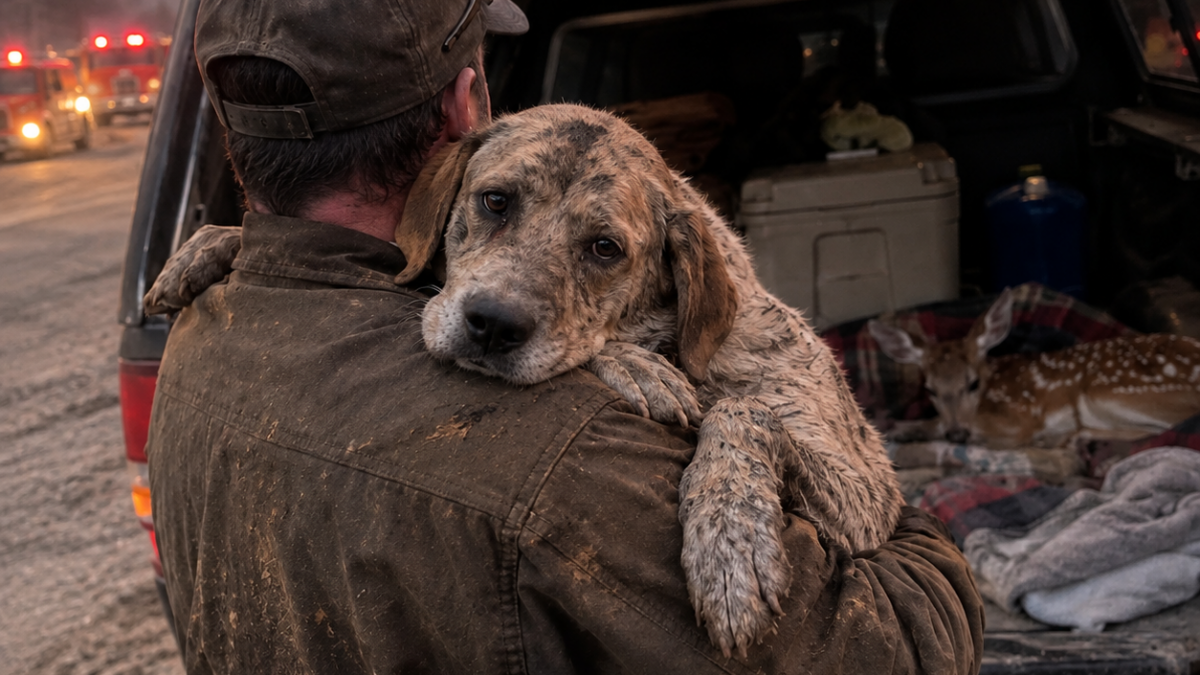
People began running toward us the moment we broke through the tree line.
Someone shouted for the veterinary team.
Another person brought a stretcher.
A woman carrying a stack of blankets dropped half of them when she saw Daniel holding the foal.
For a few seconds, everything became noise.
“Over here!”
“Get oxygen ready!”
“Clear the truck!”
“Water!”
“Watch that leg!”
But the dog in my arms seemed to hear none of it.
He had gone almost completely limp.
Not unconscious.
Just finished.
There is a difference.
His body had reached the point where determination was the only thing keeping it upright, and now that other hands were carrying the foal, that determination finally let go.
“I’ve got you,” I whispered.
I do not know why I said it.
Maybe because he was trembling.
Maybe because I needed to hear it myself.
Daniel lowered the foal onto a thick blanket several yards from the road.
Two veterinary volunteers immediately knelt beside the little horse.
One checked its breathing.
The other carefully examined the hind leg the dog had been pulling.
The foal tried weakly to raise its head.
The Labrador lifted his too.
Even half-collapsed against me, he was watching.
“Easy,” I said.
His body tensed.
“He’s right there.”
The foal made a thin, frightened sound.
Immediately, the dog tried to stand.
His legs folded beneath him.
I caught him.
“No.”
He struggled again.
Not violently.
Desperately.
“Buddy, they’re helping him.”
The dog looked at me.
Then at the foal.
Then back at me.
There was something in that expression I will remember for the rest of my life.
He was asking a question.
Not with human language.
Not with anything mystical.
He simply wanted to know one thing.
Are you leaving him?
I turned my body so he could see the foal clearly.
“We’re not leaving him.”
His breathing slowed slightly.
A woman named Rachel from the emergency animal team hurried over with a water bowl.
“Let him take small amounts.”
I lowered the dog carefully onto another blanket.
He remained sitting rather than lying down.
Watching.
Rachel placed the bowl near him.
At first, he ignored it.
“Come on,” I said.
He looked at the water.
Then toward the foal.
Daniel crouched beside us.
“The horse is still here, buddy.”
Only then did the dog drink.
Three laps.
Stop.
Look.
Five more.
Stop.
Look again.
Every time the foal moved, the dog’s head came up.
Rachel touched the back of his neck carefully.
“He’s badly dehydrated.”
“Can you tell how long he was in there?”
“No.”
She examined his paws.
“Long enough.”
The pads were raw from heat and rough ground, though thankfully there were no severe burns.
His coat was filthy with ash.
Small branches and burrs were caught around his legs.
His nose was dry.
But underneath all of that, he was young.
Maybe three or four.
A strong dog who had simply spent everything he had.
Daniel came closer.
“You saw him pulling the foal before I got there?”
“For maybe thirty seconds.”
“How far do you think he’d already gone?”
I looked back toward the forest.
Smoke hung low among the trees.
I could no longer see the place where I had first spotted them.
“No idea.”
Daniel rubbed ash from his forehead.
“He may have been doing that for a long time.”
The thought made my stomach tighten.
A dog moving backward through smoke.
Pulling.
Stopping.
Going back.
Pulling again.
He could have saved himself.
That was the part I could not understand.
Animals run from fire.
Every instinct should have sent him toward open ground.
Instead, something had overridden instinct.
The foal cried again.
The Labrador forced himself upright.
Rachel reached for his harness area, though he had no collar.
“Easy.”
He ignored her.
One shaking step.
Then another.
He moved toward the foal.
Nobody stopped him.
The veterinary workers shifted slightly to make room.
The dog reached the blanket, lowered his nose, and touched the foal’s muzzle.
The little horse stopped struggling.
Just like that.
Its entire body seemed to soften.
One of the veterinarians looked up.
“Well.”
Daniel exhaled.
“They know each other.”
I had been thinking the same thing.
This was not random.
Or at least it did not feel random.
The Labrador had not simply encountered a trapped animal and decided to help for a few minutes.
The foal trusted him.
And the dog acted as though protecting that foal was not a choice he had made today.
It was a job he already knew.
“Can we keep them close?” I asked.
The vet nodded.
“For now.”
The foal’s hind leg did not appear broken through.
That was the first good news.
A serious sprain was possible.
Maybe a small fracture.
The animal was also exhausted, dehydrated, and breathing too rapidly from smoke exposure and panic.
But it had a chance.
The Labrador seemed to sense the change in everyone around him.
His shoulders lowered.
For the first time since I had seen him in the woods, he stopped preparing to move.
He lay beside the foal.
Not touching.
Close enough that the foal could reach him.
I walked back toward my truck to get another blanket.
Halfway there, I heard claws scraping pavement behind me.
I turned.
The Labrador was following.
Barely.
“What are you doing?”
He walked directly toward me.
Not Daniel.
Not Rachel.
Not the veterinarians who had water and food.
Me.
I stopped.
He reached me and stood there for one second, swaying.
Then I knelt.
That was when he did it.
He raised both front paws and placed them on my shoulders.
His body came forward.
I caught him instinctively.
Suddenly I had sixty pounds of exhausted dog pressed against my chest.
His paws tightened against the back of my jacket.
His head went over my shoulder.
I could feel each ragged breath against my neck.
For a moment, I thought he had simply lost his balance.
Then I tried to lower him.
His paws tightened.
He held on.
Daniel stopped walking.
Rachel looked over.
Nobody said anything.
I put one hand behind the dog’s shoulders and the other against the side of his head.
“You’re safe.”
His whole body trembled.
“You got him out.”
Another breath.
“You did it.”
Slowly, almost imperceptibly, the tension began leaving him.
His weight settled into me.
His head rested against my shoulder.
And something inside my chest broke open.
I had come there because I owned a truck.
That was all.
I expected to carry crates.
Move animals.
Fill water bowls.
Maybe drive back and forth until someone said the roads were closing.
I had not expected another living creature to trust me with the exact second he stopped being brave.
That was what it felt like.
In the forest, he had no room to collapse.
The foal needed him.
Out here, finally, he decided someone else could hold the weight.
So I did.
I held him until my knees hurt.
Until the smoke shifted east.
Until the foal had been stabilized enough for transport.
Only then did Rachel crouch beside us.
“We need to check him more thoroughly.”
I nodded.
“I know.”
I tried again to ease him onto the blanket.
Immediately, one paw caught my jacket.
The dog looked up.
Not panicked.
But unwilling.
I laughed through tears I had not realized were there.
“Okay.”
Rachel smiled faintly.
“You’ve been selected.”
“Apparently.”
Daniel crouched across from me.
“What do we call him?”
I looked at the dog.
No collar.
No tag.
Nothing.
“Don’t know.”
“We need something for the intake sheet.”
I looked toward the forest.
The smoke had given everything a copper-colored haze.
“Maybe Ember.”
Daniel raised an eyebrow.
“Ember?”
“He came out of the smoke.”
The dog looked at me.
Rachel scratched gently behind his ear.
“Ember works.”
So for the moment, that became his name.
Ember.
The foal was transported first.
A livestock trailer had arrived from a nearby ranch that was serving as an emergency holding site.
When the veterinary team lifted the foal, Ember stood immediately.
His exhaustion seemed to vanish.
He followed.
I followed him.
At the trailer ramp, the foal became frightened.
Its front legs locked.
The rescuers paused.
Ember stood beside me, ears forward.
Then he made the same strange sound I had heard in the forest.
Not quite a bark.
A low, breathy whine.
The foal turned its head.
Saw him.
And stepped forward.
One step.
Then another.
Rachel looked at me.
“Yeah.”
“What?”
“They definitely know each other.”
Ember tried to climb into the livestock trailer.
Daniel caught him gently.
“No, partner.”
Ember resisted.
The foal called out.
Ember pulled harder.
I stepped forward.
“Can he ride near him?”
The livestock handler hesitated.
“Not inside the horse compartment loose.”
“What about my truck?”
Everyone looked at the pickup.
I had blankets covering the bed, but carrying an exhausted dog back there alone suddenly felt wrong.
“I’ve got the extended cab.”
Rachel nodded.
“Keep him secured. Follow the trailer.”
I opened the rear door.
Ember looked inside.
Then back toward the foal.
The trailer began moving.
Ember tried to follow it.
I caught him around the chest.
“Hey.”
He twisted.
“Listen to me.”
He could not understand the explanation.
So I pointed.
“Horse.”
Then the truck.
“Us.”
Then toward the road.
“We follow.”
Maybe it was nonsense to him.
But when Daniel helped me lift Ember onto the back seat, he stayed.
I climbed in beside him.
Someone else drove my truck.
That was how little I trusted the situation.
Ember stood with his front paws on the center console, watching the trailer through the windshield the entire way.
Every turn.
Every stop.
Every time another emergency vehicle passed.
He never looked away.
The safe zone had been established at the Fairview County livestock grounds, normally used for weekend horse shows and agricultural events.
That day, it looked like a field hospital.
Temporary pens.
Water tanks.
Volunteer tents.
Veterinary trailers.
Crates.
Livestock trucks arriving every few minutes.
Animals everywhere.
Horses.
Dogs.
Goats.
Sheep.
Cats in carriers.
One extremely angry turkey.
Smoke still drifted across the sky, but the fire line was miles away.
The moment the foal’s trailer stopped, Ember became restless.
I opened the truck door only after attaching a spare leash Rachel had given me to a temporary harness.
Ember jumped down too quickly.
His legs almost failed.
“Slow.”
He ignored me.
He limped toward the trailer.
The handlers unloaded the foal into a small medical pen.
Ember stood outside the fence.
The foal limped directly to him.
They touched noses through the rails.
Everyone nearby stopped what they were doing for a second.
One volunteer whispered, “Oh my God.”
The vet from the roadside station arrived a few minutes later.
Her name was Dr. Lisa Merritt.
She examined the foal more thoroughly and ordered portable X-rays.
No major break.
A severe ligament injury.
Smoke exposure.
Dehydration.
Minor cuts.
Exhaustion.
The prognosis was cautiously good.
“He’s lucky,” she said.
I looked at Ember.
“Yeah.”
Dr. Merritt followed my gaze.
“Very.”
Then she examined Ember.
She listened to his lungs.
Checked his paws.
Eyes.
Gums.
Temperature.
No microchip scanner result.
No collar line visible under the soot.
No obvious identification.
“Smoke irritation,” she said.
“Dehydration. Paw damage. Exhaustion. Nothing immediately life-threatening.”
I released a breath.
She looked at me.
“He shouldn’t have been doing what you described.”
“I know.”
“I mean physically.”
She nodded toward the foal.
“Dragging that animal in this condition?”
“How much does the foal weigh?”
“At least a hundred and fifty pounds, maybe more.”
I stared.
Ember was perhaps sixty.
Dr. Merritt shook her head.
“Adrenaline and determination do strange things.”
“What happens now?”
“To the dog?”
“Both.”
“The foal stays under veterinary observation.”
“And Ember?”
“We need to locate an owner.”
The answer seemed obvious.
Of course.
Somewhere there might be a family frantic over a missing dog.
Someone calling shelters.
Posting photos.
Standing beside a burned fence hoping their animal had survived.
I should have been relieved by that possibility.
Instead, I felt Ember’s body lean against my leg.
Something tightened in my chest.
“He can stay near the foal?”
“For now.”
That became the arrangement.
A blanket outside the foal’s pen.
Water.
Small meals.
Medication.
Me.
Every time I stood to leave, Ember stood too.
The first time I went to the restroom, he tried to follow until a volunteer held his leash.
When I returned, he pressed into my legs so hard I nearly stumbled.
“You really don’t trust me to come back.”
His eyes remained on mine.
I scratched the side of his neck.
“I get it.”
At sunset, a county animal-control officer named Mark Jensen came to take photographs for missing-pet listings.
He crouched near Ember.
“Male. Lab mix. Around three?”
“Vet thinks three to four.”
“No chip?”
“No.”
Mark photographed his face, chest, paws, and markings.
“Any idea where he came from?”
“No.”
“The foal?”
“Also no.”
Mark looked at the two animals.
“Could be same property.”
“That’s what we think.”
“There are several ranches inside the evacuation zone.”
“Anyone report them?”
“Still sorting reports.”
He stood.
“It’ll take time.”
“How much?”
“Could know tonight. Could be days.”
Ember rested his head against my knee.
Mark smiled.
“You staying?”
I looked down.
Apparently.
“Yeah.”
I slept there that night.
Or tried to.
Someone found me a folding cot inside a volunteer tent.
Ember refused it.
The tent, not the cot.
He wanted to remain near the foal.
So I dragged the cot outside the medical pen and placed it under an awning.
Ember lay underneath me.
Every few hours, I woke.
Sometimes because fire trucks arrived.
Sometimes because a horse called out.
Once because Ember was standing at the fence, watching the foal sleep.
I climbed off the cot.
“Hey.”
He looked at me.
The foal shifted.
Ember relaxed slightly.
I sat on the ground beside him.
“You saved him.”
His ears moved.
“I don’t know why.”
He looked toward the pen.
“But you did.”
I thought about the moment he had grabbed me.
The paws around my shoulders.
The desperate grip on my jacket when I tried to set him down.
Maybe Ember was not only protecting the foal.
Maybe he was afraid that letting go of anything meant losing it.
The thought stayed with me.
At six the next morning, Mark returned.
He was holding his phone.
“We may have something.”
I stood so quickly Ember startled.
“What?”
“A ranch about three miles from where you found them.”
My heart jumped.
“They reported a foal missing?”
“Foal and dog.”
I looked down at Ember.
His ears lifted at the change in my voice.
“Owner?”
Mark’s expression became complicated.
“Maybe.”
“What does that mean?”
“The property belongs to a man named Harold Mercer.”
“Is he okay?”
“He was evacuated yesterday afternoon.”
Relief came first.
Then confusion.
“Yesterday?”
“Yes.”
“But these two were already deep in the forest.”
Mark nodded.
“Harold is seventy-nine. Lives alone. He was hospitalized two weeks ago after a fall.”
I frowned.
“Who was caring for the animals?”
“Neighbor was supposed to be.”
“Supposed to?”
“We’re checking.”
My stomach tightened.
“What are their names?”
Mark looked at his phone.
“The dog is Cooper.”
Ember—Cooper—looked at us.
“And the foal?”
“Finn.”
I turned toward the pen.
Finn.
The little horse lifted his head.
“Do they belong together?”
Mark smiled faintly.
“Very much.”
He held out his phone.
On the screen was a photograph.
Harold Mercer standing beside a chestnut mare.
At his feet sat Cooper.
Beside the mare stood a much younger Finn.
Cooper was clean in the photograph.
Golden coat.
Bright eyes.
Blue collar.
And Finn was touching his nose to the dog’s head.
I stared.
“How long have they known each other?”
“Since Finn was born.”
Mark swiped to another photo.
Cooper lying outside a stall while newborn Finn slept inside.
Another.
Finn several weeks old, following Cooper across a pasture.
Another.
Cooper sitting beside the foal while the mare grazed nearby.
“They’re buddies,” Mark said.
That word felt insultingly small.
“What happened to the mare?”
Mark’s smile disappeared.
“That part isn’t good.”
I already knew.
“The fire?”
He nodded.
“Ranch workers found her this morning in another pasture. She didn’t make it.”
I looked toward Finn.
The foal stood on three good legs, Cooper outside the fence.
My throat closed.
“Does Harold know?”
“Not yet.”
I crouched beside Cooper.
His real name.
“Cooper.”
His head snapped toward me.
Everything changed.
His ears rose.
His tail moved.
Once.
Then again.
“Oh.”
Mark exhaled.
“Yeah. That’s him.”
I said the name again.
“Cooper.”
He stood and pressed against me.
My eyes filled.
“You had a name the whole time.”
Cooper pushed his muzzle beneath my hand.
“And you knew exactly who Finn was.”
The story became clearer over the next several hours.
Harold Mercer had bred and raised horses most of his adult life.
Not commercially anymore.
He was almost eighty.
The small ranch had become less a business than a retirement home filled with animals he refused to give up.
Cooper had wandered onto the property as a young stray nearly three years earlier.
Harold fed him.
The dog never left.
When Finn was born that spring, Cooper became obsessed with the foal.
He slept near the stall.
Walked the fence when Finn went outside.
Played carefully around him.
Harold joked to neighbors that Finn had two mothers.
One was a mare.
The other was a Labrador with no understanding of biology.
Then Harold fell from a ladder.
Broken hip.
Hospital.
Rehabilitation.
A neighbor named Curtis agreed to feed the animals while Harold recovered.
When the wildfire spread unexpectedly, several gates were opened so livestock could move toward a lower field.
Something went wrong.
Horses scattered.
Finn became separated.
Cooper followed him.
That was why they were together in the forest.
Not coincidence.
Cooper had followed Finn because Cooper always followed Finn.
And when Finn became injured and could not outrun the smoke, Cooper stayed.
Of course he stayed.
That was his baby.
Not in species.
In loyalty.
I called the rehabilitation hospital where Harold was staying after Mark obtained permission.
I expected a weak old man.
Instead, the voice that answered sounded impatient enough to argue with gravity.
“This is Harold.”
“My name is Ethan Cole.”
Silence.
“Animal-control fellow said you found my dog.”
“Yes, sir.”
“And Finn?”
“Yes.”
Another silence.
Longer.
“Alive?”
“Both.”
I heard something on the line.
Not quite a sob.
A breath breaking.
“Cooper?”
“He’s here with me.”
“He won’t leave that colt.”
“No, sir.”
Harold laughed once, painfully.
“Course he won’t.”
I looked at Cooper lying by the fence.
“Mr. Mercer, he pulled Finn through the forest.”
“What?”
“When I found them, Cooper had Finn’s hind leg in his mouth. He was dragging him toward the road.”
Nothing.
“Mr. Mercer?”
“You sure?”
“Yes.”
The old man began crying.
Not loudly.
The kind of crying a man tries to hide because he learned seventy years ago that men should not do it.
“Stupid dog.”
His voice shook.
“He could’ve died.”
“Yes.”
“He’s always been like that.”
“With Finn?”
“With anything smaller than him.”
Harold cleared his throat.
“Cat had kittens in my barn once. Cooper guarded the stall like he’d been elected sheriff.”
I smiled.
Then remembered.
“Mr. Mercer, there’s something else.”
He became quiet.
“The mare?”
I closed my eyes.
He already knew what silence meant.
“Yes.”
Another long pause.
“Rosie?”
“Yes, sir.”
This time, Harold did not try to hide the tears.
“Damn fire.”
“I’m sorry.”
“Finn saw?”
“I don’t know.”
“Cooper did.”
Maybe.
That explained something else.
Perhaps Cooper had stayed because Finn had lost the one animal that should have been beside him.
Perhaps the dog knew before any of us did that leaving Finn alone was no longer an option.
Harold asked me to put the phone near Cooper.
I felt foolish doing it.
Then I remembered the way Cooper reacted to his name.
I crouched.
“Cooper.”
His eyes lifted.
I switched to speakerphone.
“Hey, you hardheaded fool,” Harold said.
Cooper froze.
His whole body changed.
The tail began moving.
Slowly at first.
Then harder.
Harold’s voice broke.
“That’s my boy.”
Cooper whined.
For the first time since I had found him, he made a true dog whine.
High.
Soft.
Heartbroken.
He sniffed the phone.
Then licked the screen.
I laughed through tears.
Harold laughed too.
“I’m coming back, buddy.”
Cooper listened.
“I’m working on it.”
His tail continued wagging.
“You look after Finn.”
Cooper turned toward the pen.
Harold said, “You hear me?”
Cooper pressed his nose to the fence.
“I knew you would.”
When the call ended, I sat beside Cooper for a long time.
Now I understood why he held me so tightly.
I was not Harold.
I was not home.
But I had been the first person inside the smoke who helped him carry the responsibility he believed was his.
He had held onto me because I had finally made the burden lighter.
That realization changed something.
I stopped thinking of that moment as Cooper choosing me.
He had not.
Not exactly.
He had trusted me.
There is a difference.
And trust can be just as profound without becoming ownership.
Harold could not return home immediately.
The ranch had suffered heavy damage.
One barn was lost.
Fencing destroyed.
Power lines down.
Several animals were being housed elsewhere.
Harold himself still had weeks of physical rehabilitation ahead.
So Finn went temporarily to an equine rescue facility called Cedar Ridge.
There were other horses there.
Veterinary staff.
Proper rehabilitation.
Cooper was the complication.
Animal control could house him.
Harold hated that idea.
I hated it too.
“He’s never lived in a kennel,” Harold told Mark over the phone.
“He’d hate it.”
I looked at Cooper.
He was sleeping with his nose through Finn’s fence.
“I can foster him.”
The words came out before I had fully considered them.
Mark looked at me.
“You can?”
I owned a small house on three acres.
Fenced backyard.
No pets.
My old dog, Ranger, had died five years earlier.
I had told myself ever since that I enjoyed the freedom of being dogless.
No schedules.
No vet bills.
No fur.
No goodbye.
Especially no goodbye.
“I can,” I repeated.
Harold was silent on the phone.
“You know he’s mine.”
“Yes, sir.”
“I’m getting him back.”
“I know.”
“He sleeps on furniture even though he knows better.”
“Fine.”
“He steals socks.”
“Okay.”
“He knows how to open screen doors.”
“That seems important.”
“And he’s going to want to see Finn.”
I looked toward the foal.
“We’ll figure that out.”
Harold cleared his throat.
“Why would you do this?”
Cooper woke and lifted his head toward me.
I scratched the ash-free fur behind his ear.
“Because he held onto me.”
Harold was quiet.
Then he said, “Yeah.”
As if that explained everything.
Maybe it did.
Cooper came home with me three days after the fire.
Not home-home.
My home.
Temporary.
The distinction mattered.
I reminded myself constantly.
When we arrived, Cooper stood in the driveway and stared at my house.
His body had been washed.
The soot was gone.
His coat was pale gold again.
His paws were bandaged lightly.
He wore a borrowed blue collar.
But he still looked tired.
I opened the front door.
“Come on.”
He did not move.
I stepped inside.
He remained outside.
Then I realized what he was doing.
Looking behind him.
Searching for Finn.
I walked back.
“He’s safe.”
Cooper looked at me.
I had arranged with Cedar Ridge to visit the foal in two days.
“You’ll see him.”
Of course he understood none of that.
So I sat on the front step.
After a minute, Cooper sat beside me.
We stayed there together.
No forcing.
No pulling.
Eventually, he stood and walked through the door.
The first night, he did not sleep in the bed I bought.
He slept against the front door.
The second night, same thing.
Third night, same.
Every morning, when I opened the door, he rushed outside, searched the property, then returned.
Waiting for Harold.
Or Finn.
Probably both.
I did not take it personally.
That was another thing Cooper taught me.
Love does not become more valuable because it is exclusive.
He could trust me and still belong emotionally to people and animals who were somewhere else.
On the fourth day, we visited Finn.
Cedar Ridge had placed the foal in a quiet recovery paddock beside an older mare named Belle.
Belle had raised several foals and had the temperament of a kindergarten teacher who had already seen every possible disaster.
Finn was limping less.
When Cooper saw him through the fence, he pulled so hard I nearly lost the leash.
“Easy.”
Finn lifted his head.
Then came directly toward us.
Cooper whined.
They touched noses through the fence.
Then Finn began mouthing Cooper’s ears.
Cooper tolerated it for approximately six seconds before stepping backward with the expression of someone questioning every sacrifice he had made.
I laughed.
“You dragged him through a burning forest for this.”
Cooper looked at me.
Finn reached for his ear again.
“Ungrateful youth.”
One of the ranch workers laughed.
Cooper eventually lay beside the fence.
Finn lay inside.
For nearly an hour, neither moved far from the other.
That became our schedule.
Twice a week, sometimes three times.
Work.
Cedar Ridge.
Home.
Cooper learned my truck meant Finn.
The second I picked up his leash on visiting days, he ran to the garage.
When Harold called, I put him on speaker.
Cooper always reacted.
Sometimes he whined.
Sometimes his tail moved.
Sometimes he simply listened with his head tilted.
Harold worked hard in rehabilitation.
Harder than his therapists expected.
He told me the animals were the reason.
“I’m seventy-nine,” he said once.
“People keep talking like I should accept slowing down.”
“You did break your hip.”
“Technicality.”
I laughed.
He continued.
“I’ve got a dog waiting.”
“And Finn.”
“And Finn.”
His voice softened.
“I need to make sure that colt knows not everybody disappears.”
I thought about Cooper lying at the foot of my bed now.
He had stopped sleeping at the door after two weeks.
That felt like an honor.
Harold returned to the ranch six weeks after the fire.
Not permanently at first.
Just a visit.
Cedar Ridge arranged to bring Finn because the ranch was still being repaired.
I drove Cooper.
The moment my truck turned onto Harold’s road, Cooper stood.
His whole body vibrated.
He knew.
Of course he knew.
The landscape looked different.
Blackened trees.
Sections of fence replaced with temporary panels.
A barn missing.
The house survived, though one side was smoke-stained.
Harold stood on the porch with a walker.
Cooper saw him.
The sound that came out of that dog was unlike anything I had heard.
Half bark.
Half cry.
I stopped the truck.
Before I could fully open the door, Cooper squeezed past me.
“Cooper!”
He ran.
Not fast as a young healthy dog might have.
His paws were still healing.
But fast enough.
Harold let go of one side of the walker.
“Boy!”
Cooper reached him.
The old man sank awkwardly onto the porch step.
Cooper climbed into him.
Paws on shoulders.
Exactly the way he had held me.
But this was different.
There was recognition in every inch of him.
Harold wrapped both arms around Cooper’s body and buried his face in the dog’s neck.
“You damn fool.”
Cooper licked his cheek.
“You beautiful damn fool.”
I turned away.
Some reunions are not meant to be watched too closely.
Then the livestock trailer arrived with Finn.
Cooper left Harold only when he heard the foal.
Harold laughed through tears.
“Yeah, yeah. I know where I rank.”
Finn came down carefully.
His leg was stronger.
Still healing.
The second he saw Cooper, he called out.
Cooper ran to him.
Harold stood with his walker.
I stood beside him.
He watched his dog and foal touch noses.
“You saw him doing it?”
“Pulling him?”
“Yeah.”
“Yes.”
Harold shook his head.
“He must’ve followed Finn when the gates opened.”
“That’s what we think.”
“Rosie would’ve stayed with the colt if she could.”
His voice changed.
“Maybe Cooper knew she couldn’t.”
I looked at him.
“You think dogs understand that?”
Harold stared at Cooper.
“I think humans spend a lot of time pretending animals understand less than they do.”
Fair enough.
Cooper stayed with me another month while Harold transitioned home.
That was the hardest part for me.
Not because Cooper was difficult.
Because he was becoming easy.
His bed moved from the door to the living room.
Then from the living room to beside my bed.
He stopped checking the driveway every ten minutes.
He learned I worked from my home office on Fridays and spent most of those days sleeping against my chair.
He learned where I kept treats.
Unfortunately.
I learned he really did steal socks.
Harold had not exaggerated.
He did not chew them.
He collected them.
Every evening, I had to recover two or three from his bed.
The first time Cooper greeted me at the door when I returned from work, I stood frozen.
Tail wagging.
Sock in mouth.
Happy.
For me.
That was dangerous.
I knew it.
The temporary line in my mind was blurring.
But Harold was alive.
Healing.
Waiting.
And Cooper belonged with him.
Love sometimes means returning what you desperately want to keep.
I had not understood that before.
When Harold finally called and said, “I’m ready for my dog,” I sat at my kitchen table for a long time after we hung up.
Cooper lay beneath it.
His head rested on my shoe.
I touched his ear.
“You’re going home.”
He looked up.
“Real home.”
Tail movement.
“You’re happy about that?”
More tail.
I laughed despite the ache.
“Good.”
The next Saturday, I drove him back.
His bed went with him.
His food.
His favorite borrowed blanket.
Three toys.
Seven stolen socks I had placed in a bag as a joke.
Harold laughed when he saw them.
“Told you.”
“You owe me socks.”
“No returns after thirty days.”
Finn had also returned to the ranch by then.
His leg healed enough for turnout in a small paddock.
The moment Cooper arrived, he checked Harold.
Then Finn.
Then the house.
Then the barn.
Then Harold again.
His world restored piece by piece.
I stood beside my truck feeling like a visitor in something I had briefly been allowed to join.
Harold noticed.
“You’re not done with him.”
I looked at him.
“What?”
“He’ll be mad if you disappear.”
I swallowed.
“I don’t want to interfere.”
“Interfere?”
Harold snorted.
“That dog climbed on you in the middle of a wildfire.”
“After.”
“Same difference.”
He pointed toward the porch.
“You come whenever you want.”
So I did.
At first, weekly.
Then every other week.
Sometimes more.
I helped Harold repair fences.
He criticized my post spacing.
I reminded him I owned a landscaping business.
He told me landscaping was “gardening with invoices.”
We argued constantly.
It became friendship.
Cooper split his attention between us without difficulty.
When I arrived, he ran to the truck.
Paws on my chest.
Not as desperately now.
A greeting instead of survival.
Then he would return to Harold.
Finn grew.
Fast.
Within a year, the fragile foal from the forest had become a tall chestnut yearling with an uneven white marking down his face and a habit of following Cooper along the pasture fence.
The ligament injury healed well.
Not perfectly.
Dr. Merritt said Finn might never be suited for hard competitive riding.
Harold laughed.
“I’m seventy-nine. What competition did you think I was planning?”
Finn’s job became existing.
A job he performed beautifully.
The first anniversary of the fire came quietly.
None of us planned anything.
Then Daniel Hayes called.
I had not seen him for months.
“Going up to Mercer’s place tomorrow?”
“Why?”
“Date.”
I looked at the calendar.
October 18.
One year.
My chest tightened.
“Yeah.”
When I arrived, Daniel was already there.
So were Rachel, Dr. Merritt, and several volunteers from the rescue operation.
Harold claimed he had not invited them.
Nobody believed him.
Finn grazed in the field.
Cooper wandered between people collecting attention like overdue taxes.
At one point, Daniel stood beside me.
“Remember what he looked like?”
I did.
Ash.
Exhaustion.
Eyes that refused to leave Finn.
“Yeah.”
Daniel watched Cooper stealing a piece of bread from Harold.
“Hard to believe.”
“No.”
I smiled.
“Actually, that part is very easy to believe.”
Later that afternoon, Harold brought something out of the barn.
A framed photograph.
Someone from the rescue team had taken it just after we emerged from the smoke.
I had never seen the picture.
Daniel carrying Finn.
Me bent beside Cooper.
The dog filthy and exhausted, head lifted toward the foal.
Behind us, the forest gray with smoke.
Harold handed the photograph to me.
“For your house.”
I shook my head.
“You should keep it.”
“I have one.”
He pointed toward the porch.
Another copy was already hanging beside the door.
I stared at the picture.
“I don’t like seeing him like that.”
Harold nodded.
“I know.”
“Then why frame it?”
“Because he made it out.”
I looked at him.
The old man leaned on his cane.
“That photo isn’t about the fire.”
He touched the frame.
“It’s about the direction he was going.”
Toward safety.
And not alone.
I took the photograph home.
It still hangs in my hallway.
Years passed.
Harold turned eighty.
Then eighty-one.
Cooper’s muzzle started whitening.
Finn became a full-grown gelding with a calm temperament and an unusual attachment to dogs.
Harold never rode him.
Nobody did.
Finn had survived enough humans deciding what animals should be useful for.
His job remained being Finn.
Cooper grew slower.
Still visited the pasture every morning.
Still checked Finn.
Still slept on Harold’s porch when the weather was good.
Whenever I visited, he greeted me with the same paws-on-shoulders routine, though eventually I had to kneel because his hips no longer allowed him to stand tall enough.
One spring afternoon, Harold called me.
His voice sounded wrong.
“Ethan.”
“What happened?”
“It’s Cooper.”
I was in the truck before he finished.
At the ranch, Cooper lay beneath the old oak tree near Finn’s pasture.
Harold sat beside him.
Dr. Merritt was there.
That told me everything.
I knelt.
Cooper lifted his head.
His tail moved.
Barely.
I put both hands around his face.
“Hey, hero.”
Harold wiped his eyes.
“Kidneys.”
Dr. Merritt nodded.
“They’ve been declining.”
I had known Cooper was old.
I had known this would happen.
Knowing did absolutely nothing.
Finn stood at the fence twenty feet away.
Watching.
Cooper kept looking toward him.
Harold whispered, “Bring him closer.”
Dr. Merritt hesitated.
Then nodded.
We opened the small adjoining gate.
Finn walked over slowly.
He was enormous beside the dog who once dragged him through the forest.
Cooper lifted his head higher.
Finn lowered his.
Their noses touched.
The same greeting.
Years later.
Different bodies.
Same bond.
Then Finn did something none of us expected.
He folded his front legs.
Slowly.
Carefully.
And lowered himself onto the grass beside Cooper.
Harold made a sound like his heart had cracked.
I covered my mouth.
Finn lay there, huge head near Cooper’s small golden body.
Cooper rested his muzzle against Finn’s face.
Nobody spoke.
What could we possibly add?
They remained like that for almost twenty minutes.
The foal who once could not stand.
The dog who once refused to leave him.
Now the horse lowering himself because the dog no longer could.
Eventually, Finn rose.
He touched Cooper once more.
Then stepped back.
Cooper watched him.
His tail moved.
One last small sweep through the grass.
Dr. Merritt asked Harold if he was ready.
Harold looked at me.
Neither of us was.
That was irrelevant.
Ready is not the requirement when love becomes mercy.
We sat on either side of Cooper.
Harold held his collar.
I held his front paw.
“You scared the hell out of everybody,” Harold whispered.
Cooper’s eyes stayed on him.
“Best dog I ever had.”
My throat closed.
I leaned closer.
“You pulled him out.”
Cooper’s ear moved.
“You remember?”
I looked toward Finn.
The horse stood quietly by the fence.
“You got him home.”
Dr. Merritt gave the first injection.
Cooper relaxed.
His breathing slowed.
For a moment, he looked exactly like the dog who had collapsed into my arms after the wildfire.
The difference was that this time, he did not need to hold on.
We were already holding him.
I whispered the same words I had said years earlier.
“You’re safe.”
Harold bent over him.
Cooper’s eyes closed.
And he left peacefully beneath the oak tree while Finn stood nearby and the afternoon wind moved through grass that had once burned black.
Afterward, Harold and I stayed there for a long time.
Finn remained by the fence.
Eventually, he began grazing.
That hurt.
Then healed something.
Life continuing is cruel when grief is fresh.
Later, it becomes instruction.
Cooper’s ashes were divided.
Harold kept most.
He gave a small portion to me in a wooden box.
I protested.
He refused the protest.
“He chose you too.”
I looked at him.
“He chose Finn.”
“First.”
Harold smiled sadly.
“Then you.”
We buried part of Cooper’s ashes near the oak tree.
Another part went near the pasture where Finn liked to sleep.
I kept the small wooden box beside the wildfire photograph.
Not because Cooper belonged to me.
Because for a little while, he trusted me to help him carry something too heavy to carry alone.
Harold died two years later.
Eighty-four.
At home.
Finn was still on the property.
By then, Harold and I had become close enough that his niece contacted me about the animals before the funeral.
Harold had left instructions.
Finn was to remain at the ranch if possible.
If not, I was to decide where he went.
I stood in Harold’s kitchen reading the letter three times.
At the bottom, beneath instructions about feed, veterinary records, and fencing, Harold had written:
Ethan knows what Cooper would want.
That was unfair.
Completely unfair.
But I knew.
The ranch was sold to a younger couple, Maria and Lucas Bennett, who operated a small equine therapy program.
They agreed Finn could stay for life.
No riding requirement.
No sale.
No relocation.
A permanent pasture.
Dogs were part of the therapy program too.
The first one Finn met was a little black mutt named Pepper.
Pepper wandered under the fence one morning and lay near him.
Maria sent me a photograph.
Finn standing over the small dog.
Careful.
Protective.
I stared at it for a long time.
Love repeats what saved it.
That sentence came to me then.
I have never forgotten it.
Cooper taught Finn that when someone is vulnerable, you stay.
Finn carried the lesson forward.
And maybe I did too.
After Harold died, I started volunteering regularly with the county animal evacuation team.
Not because I wanted another wildfire.
God knows I did not.
Because when the next flood came, or barn fire, or evacuation order, someone needed trucks.
Blankets.
Water.
Hands.
People willing to go where fear made everything confusing and help another creature move toward safety.
Daniel and I still work together sometimes.
Every so often, a new volunteer asks how I got involved.
Daniel always answers before I can.
“He got hugged by a Labrador.”
Technically true.
I usually add the rest.
Years have passed now.
The forest recovered.
That shocked me.
For months after the wildfire, whole hillsides looked dead.
Black trunks.
Gray soil.
Silence.
Then grass returned.
Wildflowers.
Young pine.
Birds.
Life did not replace what burned.
It grew among it.
I think about grief the same way now.
Harold is gone.
Cooper is gone.
Rosie is gone.
The old ranch buildings damaged by the fire are mostly gone.
But Finn is still there.
Older now.
His chestnut coat darker in winter, bright in summer.
A faint stiffness remains in the leg Cooper once held between his teeth.
When I visit, Finn comes to the fence.
He knows me.
Not like Cooper did.
Different.
That is all right.
I usually bring carrots.
He usually searches my pockets before pretending affection was the reason he approached.
Harold would approve.
Near Finn’s pasture stands a small wooden plaque Maria had made.
Nothing dramatic.
No photograph.
No long story.
Just three words.
HE WOULDN’T LEAVE.
Visitors ask what it means.
Sometimes Maria tells them.
Sometimes I do.
I tell them about the October wildfire.
The smoke.
The abandoned foal.
The exhausted dog moving backward through the trees.
I tell them how Cooper could have run.
How every instinct should have told him to save himself.
How instead he returned to Finn again and again.
Grabbed that small hind leg gently.
Pulled.
Rested.
Went back.
Pulled again.
I tell them how Daniel carried Finn and I helped Cooper walk.
How the moment we reached clear air, Cooper finally allowed himself to collapse.
And sometimes I tell them about the hug.
People smile at that part.
I do too.
But I understand it differently now than I did that afternoon.
Cooper was not thanking me because I was some hero.
I was not.
I was a man with a truck and a blanket who happened to be standing where he needed another pair of hands.
Cooper had been alone with a responsibility too heavy for one body.
Then we arrived.
Daniel lifted Finn.
I lifted Cooper.
For the first time since the fire separated him from everything familiar, Cooper understood he was no longer carrying that responsibility alone.
That was why he held onto me.
I believe that.
Not gratitude exactly.
Relief.
The kind so deep that the body gives up before the mind knows how to explain it.
I know that feeling better now.
There have been days in my own life when I did not need someone to fix anything.
I only needed somebody to take one side of the weight.
Cooper understood that before I did.
Sometimes I stand near Finn’s pasture in the late afternoon and remember the first moment I saw them through the smoke.
I can still picture it perfectly.
A sandy-colored dog almost disappearing in gray air.
A tiny horse behind him.
One step.
Stop.
Turn.
Go back.
Grab the leg.
Pull again.
The world behind them was becoming more dangerous by the minute.
Safety was in front of Cooper.
He knew it.
He could see it.
And still, every time he gained a little distance, he turned around for Finn.
That is the image I carry.
Not Cooper dying beneath the oak tree.
Not the wildfire photograph in my hallway.
Not even his paws around my shoulders.
I remember him turning back.
Because that was who he was.
A dog who understood something people spend entire lives learning.
Getting yourself to safety is survival.
Going back for someone who cannot follow is love.
And sometimes love looks extraordinary only because the choice was so simple.
Leave.
Or stay.
Cooper stayed.
He stayed with Finn when Finn could not walk.
He stayed until hands arrived.
He stayed until the foal was carried into clean air.
He stayed long enough to know someone else had taken over.
Only then did he come to me.
Only then did he put his paws around my shoulders.
Only then did he finally let himself shake.
I held him.
Years later, when his strength was gone beneath that oak tree, I held him again.
And before he closed his eyes, I told him the one thing I hoped he somehow already knew.
Finn made it.
The foal you would not leave grew up.
He found home again.
You did too.
And none of us forgot the dog who walked out of the smoke only because he refused to walk out alone.








