PART 2: A Flight Attendant Said I Didn’t Belong in First Class—Months Later, I Took Control of the Airline
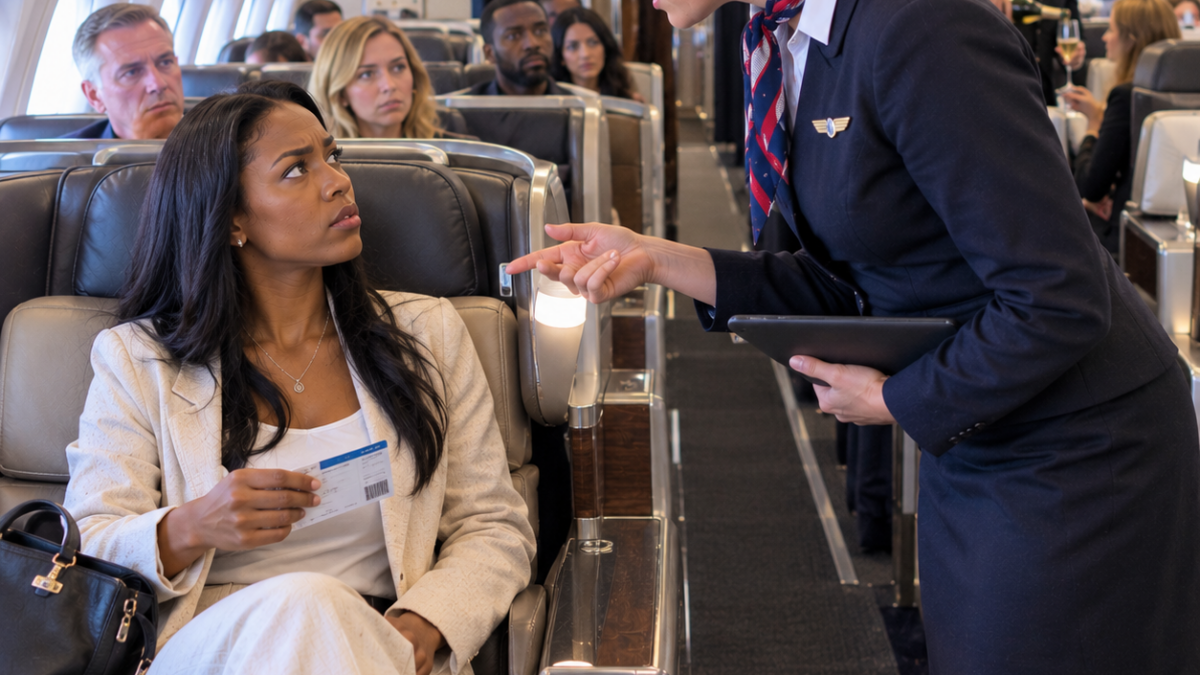
The rain had begun by the time we landed in Seattle.
I remember that because the terminal windows looked gray and streaked when I stepped into the concourse.
My hip hurt badly enough that I had to slow my pace.
But then I saw Simone.
She stood near baggage claim waving both hands above her head like she was trying to guide in an aircraft.
Beside her were my grandchildren.
Zora was ten.
Marcus was fourteen and determined to pretend he had become too old to run toward his grandmother.
Zora had no such concerns.
“Grandma!”
She hit me at full speed.
I laughed despite myself and wrapped both arms around her.
“My baby.”
Marcus came next.
He tried for a dignified hug.
I ruined it by kissing his cheek.
“Grandma.”
“You survived.”
He wiped his face.
Simone laughed.
Then she looked at me more carefully.
“You’re limping.”
“Long flight.”
“I thought you flew first class.”
I hesitated.
“There was a seating problem.”
Her expression changed immediately.
“What kind of seating problem?”
“Not here.”
She knew me well enough not to push.
At her house that evening, Michael made jambalaya from my mother’s recipe.
Zora told me about coding club.
Marcus explained why his chemistry teacher was wrong about a grading rubric.
For almost two hours, I pretended the airplane no longer mattered.
Then the children went upstairs.
Michael disappeared into his office.
Simone poured wine and carried two glasses to the patio.
Lake Washington was dark beyond the railing.
She handed me a glass.
“Now tell me.”
I looked at the water.
“There isn’t much to tell.”
“Mom.”
I took a sip.
Then the words came.
Brenda.
The champagne.
The repeated questions.
Tyler.
Captain Harris.
The boarding pass nobody wanted to believe.
The walk to economy.
The middle seat.
My medication left above 3A.
The people watching.
No one speaking.
By the time I finished, Simone had stopped drinking.
She set her glass down.
“They removed you from a seat you paid for?”
“Yes.”
“With a valid boarding pass?”
“Yes.”
“And the captain saw your receipt?”
“Yes.”
“That is discrimination.”
“I know.”
“We file tomorrow.”
I shook my head.
“Mom.”
“I have spent seventy-two years filing things.”
She stared at me.
“Complaints.”
“Petitions.”
Letters.
Reports.
Statements.
I looked toward the house.
“Sometimes a system is very good at receiving complaints.”
“That does not mean it changes.”
Simone leaned forward.
“So what do you want to do?”
“I don’t know yet.”
She looked at me carefully.
“You are angry.”
“Yes.”
“Good.”
I smiled despite myself.
“You sound like your father.”
“Dad would already have three lawyers on the phone.”
“He would have called four.”
We sat quietly.
Later, after everyone went to bed, I opened my laptop.
I began writing an email to Sky America.
Dear Customer Relations—
I stopped.
Deleted it.
Started again.
To Whom It May Concern—
Deleted that too.
I could already imagine the answer.
Dr. Washington, we regret that your travel experience did not meet our standards.
Please accept a $300 voucher.
We value all customers.
Nothing in that language would explain why three employees had seen evidence and still decided the easiest solution was to move me.
I closed the email.
Then I opened my contacts.
Javier Rodriguez had managed my investments since James died.
It was after midnight in Seattle and after three in the morning where he lived.
I called anyway.
He answered on the third ring.
“Eleanor?”
“I’m sorry.”
“Are you okay?”
“Yes.”
“Then either somebody died or you want to buy something strange.”
I smiled.
“You know me too well.”
“What are you buying?”
“Information.”
“About?”
“Sky America Airlines.”
Silence.
“The airline?”
“Yes.”
“What kind of information?”
“Financial statements.”
“Ownership structure.”
“Stock performance.”
“Board composition.”
“Debt.”
“Executive compensation.”
“Customer complaints if they’re public.”
Another silence.
“Eleanor.”
“Yes?”
“What happened?”
I told him the short version.
When I finished, his tone changed.
“I’ll have a preliminary report tomorrow.”
“Thank you.”
“Are you suing?”
“I haven’t decided.”
“Then why financials?”
I looked toward the dark window.
“Because I want to understand what kind of company decides an elderly Black woman is easier to relocate than a seating error.”
He laughed softly.
“You sound dangerous.”
“No.”
I closed the laptop.
“I sound curious.”
The next morning, I told the family.
Michael was furious.
Simone was already drafting a complaint.
Marcus ate scrambled eggs while listening.
Then he said something nobody expected.
“Buy their stock.”
Simone stared.
“What?”
“Grandma should buy Sky America stock.”
“Why would she reward them?”
Marcus put down his fork.
“Because shareholders get votes.”
I looked at him.
He continued.
“If she owns enough, they have to listen.”
Michael laughed.
“Professor Marcus has spoken.”
Marcus ignored him.
“You don’t need to buy the whole company.”
“Just enough to matter.”
I leaned back.
“How do you know that?”
“Business class.”
“And YouTube.”
Simone groaned.
“Of course.”
But the idea had already entered my mind.
A complaint made me a customer asking for attention.
A meaningful ownership position made me someone management could not dismiss with a voucher.
That afternoon, Javier sent the report.
Sky America was vulnerable.
Its stock had underperformed.
Customer satisfaction had declined for six quarters.
The company was still struggling with post-pandemic debt.
CEO Richard Fleming had built his reputation on aggressive cost cutting.
Employee morale was poor.
Several board members were reportedly questioning his strategy.
I read the report twice.
Then again.
Economics had been my profession for decades.
Markets tell stories.
Sometimes companies hide their real condition behind earnings presentations and polished advertisements.
But the patterns remain.
Customers leaving.
Employees resigning.
Costs climbing.
Reputation weakening.
Sky America had problems long before I entered seat 3A.
I had simply encountered one of them personally.
Over the next week, my visit with my family became an odd combination of grandmotherhood and corporate investigation.
In the morning, Zora and I walked beside the lake.
In the afternoon, I read SEC filings.
We visited Pike Place Market.
Then I took a call with an investment banker.
We rode a ferry.
Then Simone and I reviewed discrimination law.
At dinner, Marcus asked questions about shareholder voting.
The boy became fascinated.
One evening, he said:
“You need to be an activist investor.”
Simone nearly choked on her wine.
“What?”
“We learned about activist investors.”
“They buy enough shares to pressure management.”
I looked at him.
“And what would you pressure them to do?”
“Stop treating people like Grandma.”
That answer was good enough for me.
Michael introduced us to Jordan Chen.
Jordan was forty-three, sharp, skeptical, and very good at making complicated financial structures sound like board games.
We met in his Seattle office overlooking Puget Sound.
He looked over his glasses at me.
“Dr. Washington, let me make sure I understand.”
“Yes.”
“You want to invest tens of millions of dollars in an airline because a flight attendant mistreated you.”
“No.”
He raised an eyebrow.
“I want to invest because one incident exposed what may be a larger operational problem inside an undervalued company.”
Jordan smiled.
“Better answer.”
“It is also the true answer.”
He turned his monitor toward me.
Charts appeared.
Sky America stock.
Revenue.
Debt.
Customer complaints.
Employee turnover.
“Your timing is unusually favorable.”
“How favorable?”
“Management is weak.”
“Board is divided.”
“Stock is depressed.”
“Brand value is deteriorating.”
He tapped one graph.
“If the company were healthy, your money would buy influence very slowly.”
“Right now?”
“Right now, a disciplined campaign could matter.”
Simone sat beside me.
“How much?”
“To matter?”
Jordan thought.
“Five percent gets attention.”
“Ten gets fear.”
“Fifteen can change conversations.”
I looked at the numbers.
I had spent my entire academic career teaching that capital was never merely money.
Capital was power.
Access.
Leverage.
A vote.
James had understood that better than anyone.
He had grown up poor.
Built medical devices.
Patented technologies.
Invested patiently.
When he died, people talked about the wealth he left me.
They rarely talked about the purpose he believed wealth should serve.
“Privilege creates obligation,” he used to tell our children.
I heard his voice again.
I looked at Jordan.
“Begin.”
Simone turned.
“Mom.”
“I know.”
“This is serious.”
“So was what happened.”
Jordan leaned forward.
“One condition.”
“What?”
“If we do this, we do it correctly.”
“Legally.”
“Slowly.”
“No revenge trades.”
“No emotional purchases.”
“No tricks that could become securities violations.”
I smiled.
“You sound like one of my graduate students.”
“Did they pass?”
“Some.”
He laughed.
Then our work began.
Aisha Johnson joined the team next.
Corporate attorney.
Civil-rights specialist.
Brilliant.
She reviewed my flight records.
“This alone supports a strong discrimination case.”
“I know.”
“You could sue.”
“I know.”
“You could probably settle for a large amount.”
“I know.”
She crossed her arms.
“Then why are we discussing corporate governance?”
“Because if Brenda is the problem, firing Brenda solves it.”
“And you don’t believe she is?”
“I believe she is part of it.”
Aisha nodded slowly.
“Then let’s see.”
She established a confidential reporting channel.
Former passengers began contacting us.
Then employees.
At first, three.
Then eleven.
Then dozens.
Older Black passengers asked repeatedly to prove premium seating.
Latino families receiving different baggage treatment.
Disabled travelers ignored.
Employees claiming supervisors instructed them to “protect the premium experience.”
The phrase appeared several times.
Protect the premium experience.
From what?
I knew the answer.
People who did not match an image.
Then Brenda’s name appeared.
Again.
Again.
Again.
“She has previous complaints,” Aisha told me.
“How many?”
“Enough.”
“Discipline?”
Aisha looked at me.
“She was promoted.”
I stared at her.
“To what?”
“Training.”
I actually laughed.
Not because it was funny.
Because sometimes institutional failure becomes so complete it crosses into absurdity.
“The woman who removed me from first class now teaches people how to manage passengers?”
“Yes.”
I leaned back.
“This is no longer about a bad employee.”
“No.”
Aisha closed the folder.
“This is culture.”
That night, I had the first nightmare.
I was walking through an airplane.
But the cabin never ended.
Rows stretched forever.
Every passenger turned toward me.
Brenda walked behind.
“She doesn’t belong.”
Again.
“She doesn’t belong.”
Again.
“She doesn’t belong.”
I woke at three in the morning.
Heart racing.
Sheets wet.
My hip hurt.
My hands shook.
I sat on the edge of the bed and looked at my reflection in the dark window.
Seventy-two years old.
Harvard education.
Professor.
Widow.
Mother.
Grandmother.
Millionaire.
None of it had mattered when someone decided they knew where I belonged.
That realization frightened me.
It also hardened my resolve.
Jordan accumulated shares carefully.
Three percent.
Then four.
Then just over five.
The moment we crossed the reporting threshold, disclosure became unavoidable.
Washington Family Investments appeared in financial filings.
At first, nobody connected the name to me.
Then somebody did.
CEO Richard Fleming called.
“Dr. Washington.”
“Mr. Fleming.”
“I understand you’ve taken an unusual interest in our company.”
“I’m a shareholder.”
“A rather significant one.”
“I hope all shareholders are significant to you.”
He ignored that.
“I also understand you recently had an unfortunate experience with us.”
“Unfortunate?”
“We take customer complaints seriously.”
“Do you?”
Silence.
“I’d be happy to offer compensation.”
“I don’t want compensation.”
“Free first class travel.”
“No.”
“Travel credits.”
“No.”
“What do you want?”
That was the first useful question Sky America had asked me.
“I want to understand why three employees looked at valid documentation and still removed me.”
“We’ve investigated.”
“And?”
“There was a manifest discrepancy.”
“No.”
“Dr. Washington—”
“No.”
I rarely interrupted people.
Age had given me that confidence.
“There was no manifest discrepancy.”
“I have the data.”
“My ticket was valid.”
“My boarding pass was valid.”
“My payment was valid.”
“Your own records confirm it.”
Another silence.
“So I’ll ask again.”
“Why was I moved?”
“I can’t speculate about individual motives.”
“Then I will examine institutional ones.”
His tone cooled.
“What does that mean?”
“It means my team will be contacting your board.”
He paused.
“Our board?”
“Yes.”
“This seems like an extreme response to a service issue.”
“That depends on whether it was one.”
I ended the call.
The battle began publicly soon afterward.
Sky America discovered our other investment entities.
Financial press reported a mystery investor building a position.
Our stake reached eight percent.
Then ten.
Then twelve.
Fleming reacted exactly as Jordan predicted.
Defensive measures.
Board lobbying.
Public relations.
And eventually character assassination.
First, he called me emotional.
He went on television.
“This appears to be a personal reaction to a routine seating confusion.”
Routine.
I watched him say that word from Simone’s living room.
Routine.
If discrimination was routine, then my case was stronger than I had imagined.
Aisha looked at me.
“He just gave us an opening.”
“How?”
“He reduced this to emotion.”
“So?”
“So show everyone your evidence.”
I had avoided public interviews.
I did not want to become a television personality.
I especially did not want my pain turned into entertainment.
But silence was allowing Fleming to define me.
Angry elderly woman.
Rich widow.
Vindictive investor.
So I agreed to one interview.
CNN business correspondent Amara Rodriguez sat across from me.
“Why did you invest in Sky America?”
“Because it is undervalued.”
She looked almost disappointed.
Then I continued.
“And because my experience revealed one reason why.”
“Discrimination?”
“Operational failure.”
She raised an eyebrow.
“Explain.”
“A company that treats customers inconsistently based on race, age, or appearance has an ethics problem.”
“It also has a business problem.”
“Discrimination creates legal exposure.”
“Destroys loyalty.”
“Drives employee turnover.”
“Damages brand value.”
“And teaches employees that personal bias can override procedure.”
Amara leaned forward.
“Sky America says your incident was a seating mistake.”
I looked into the camera.
“I had a boarding pass.”
“I had a receipt.”
“I had seat 3A.”
“There was no seating mistake.”
“The mistake was believing the person holding those documents.”
That clip traveled everywhere.
Passengers began telling their own stories.
Thousands of messages arrived.
Former employees too.
Then three elderly Black women contacted us.
All had flown with Brenda.
All described remarkably similar experiences.
Seat verification.
Extra scrutiny.
Questions about whether they had really purchased premium tickets.
One had been moved.
Another had been threatened with removal from the flight after objecting.
Brenda responded with a television interview.
She said she had followed procedure.
She said I misunderstood.
She said race played no role.
Then Tyler Rhodes called Aisha.
The lead flight attendant from my flight.
“I need to talk.”
We met privately.
He looked exhausted.
“What we did was wrong.”
I waited.
“It wasn’t an official written policy.”
“What wasn’t?”
He looked down.
“Premium cabin verification.”
“Meaning?”
“Certain passengers were checked more aggressively.”
“Which passengers?”
He closed his eyes.
“Older people who looked confused.”
“Passengers dressed casually.”
“People staff thought might have moved forward from economy.”
“And passengers of color?”
Long silence.
“Yes.”
“Who trained you?”
“Nobody said race directly.”
“That’s how it worked.”
“Words like appropriate passenger.”
“Premium profile.”
“Protecting the cabin experience.”
I felt sick.
That phrase again.
“Did Brenda know?”
“Yes.”
“Did Captain Harris?”
“Not everything.”
“But he knew the practice existed.”
Tyler looked ashamed.
“I didn’t stop what happened to you.”
“No.”
“I could have.”
“Yes.”
“I am sorry.”
I believed him.
That did not absolve him.
But truth had to begin somewhere.
Then the threats started.
First a phone call.
“Old women should enjoy retirement.”
Then a brick through the kitchen window.
A note.
BACK OFF.
Simone wanted me to stop.
Michael wanted me hospitalized just for the stress.
Jordan hired security.
My blood pressure climbed.
One morning my hand shook so badly I spilled coffee.
Michael saw.
“This is affecting your health.”
“I know.”
“Do you?”
“I said I know.”
“No.”
His tone became physician rather than son-in-law.
“You understand intellectually.”
“Your body is telling you something else.”
I hated that he was right.
“I’m not quitting.”
“I didn’t ask you to.”
“Then what?”
“Delegate.”
That word was harder for me than fight.
I had taught thousands of students to understand comparative advantage.
Now I was refusing to practice it.
So I stepped back from daily calls.
Jordan handled finance.
Aisha handled legal work.
Simone managed board outreach.
Marcus built spreadsheets.
Yes.
My fourteen-year-old grandson built spreadsheets.
One afternoon, he ran into the room.
“Grandma.”
“What?”
“I found something.”
He turned his laptop around.
He had analyzed public LinkedIn changes among Sky America employees.
Transfers.
Departures.
Department movement.
Crew management.
“Look at these four supervisors.”
“What am I looking at?”
“People leave their teams more.”
“How much more?”
“Sixty-three percent.”
Jordan stared.
“How did you calculate this?”
Marcus shrugged.
“I wrote a script.”
Simone stared at her son.
“You wrote a what?”
He smiled.
“Don’t worry about it.”
I laughed harder than I had in weeks.
But the data mattered.
Employee turnover translated directly into training costs, scheduling instability, and service disruption.
Suddenly our campaign was not simply a civil-rights case.
It was an operational case.
Then Fleming made his next mistake.
Sky America implemented a poison pill.
No shareholder could cross fifteen percent without massive dilution.
It was designed to stop me.
Markets hated it.
Institutional investors began asking why management was spending so much energy protecting itself instead of addressing the allegations.
Fleming called again.
This time, he sounded tired.
“Dr. Washington, let’s end this.”
“How?”
“Sell your stake back to us.”
“Premium?”
“Ten percent above market.”
“No.”
“Lifetime first class.”
I almost laughed.
“Mr. Fleming.”
“Yes?”
“Do you understand how absurd that sounds?”
“I am offering substantial value.”
“You are offering me the seat I already purchased.”
He said nothing.
“What do you want?”
His voice hardened.
“Realistically.”
“Your job.”
Silence.
Long.
Cold.
Then:
“So that’s what this is.”
“No.”
I answered calmly.
“This is about accountability.”
“If keeping your job prevents it, then yes.”
“I want your job.”
He hung up.
The attacks became uglier.
Stories questioned my investment competence.
One article suggested cognitive decline.
Because I was seventy-two.
Another implied James had acquired his patents improperly.
Because attacking a dead Black inventor was apparently easier than answering documents.
Someone tried to access our investment records.
Cybersecurity stopped it.
Then my chest pains began.
At first, I hid them.
That lasted three days.
Simone noticed me rubbing my sternum.
Michael checked my blood pressure.
His face changed.
“Hospital.”
“No.”
“Eleanor.”
“No.”
“Then I call an ambulance.”
I glared at him.
He folded his arms.
I went.
No heart attack.
Yet.
Stress.
Inflammation.
Dangerously elevated blood pressure.
The doctor gave me a choice that did not feel like a choice.
Reduce stress or risk something worse.
Back at the apartment, my family surrounded me.
I hated it.
“I am not dying.”
“That isn’t the standard,” Simone snapped.
“You don’t need to be dying before we worry.”
Jordan spoke gently.
“We can slow down.”
“No.”
“Eleanor.”
“No.”
I looked at all of them.
“My parents spent their lives being told to wait.”
“Wait until things improve.”
“Wait until laws change.”
“Wait until people become ready.”
“I am seventy-two.”
“I have waited enough.”
Simone’s eyes filled.
“And if this kills you?”
That silenced me.
I looked toward Marcus and Zora in the hallway.
What was victory worth if my grandchildren remembered it beside a hospital bed?
So we compromised.
I would remain strategic lead.
No daily operational management.
Limited calls.
Michael monitored me.
If symptoms worsened, I stopped.
I hated every part of the agreement.
I signed it anyway.
Our legal challenge to the poison pill succeeded.
The court questioned whether it served shareholders or merely protected management.
Our stake increased to just under fifteen percent.
More importantly, institutional investors began joining us.
Pension funds.
Asset managers.
Shareholders who had no sentimental attachment to my story but understood the numbers.
Customer satisfaction declining.
Turnover rising.
Brand damaged.
Management distracted.
Discrimination was not only immoral.
It was expensive.
The annual shareholder meeting became the battlefield.
Chicago.
News vans outside.
Security everywhere.
My blood pressure too high.
Michael furious.
Simone beside me.
Jordan carrying three binders.
Aisha carrying enough legal paper to sink a small boat.
Inside, Fleming announced his nuclear option.
A merger.
Sky America and Transcontinental.
“Merger of equals.”
Twenty-two percent premium.
Immediate shareholder value.
The room erupted.
Jordan leaned toward me.
“Desperation.”
“Can he do it?”
“Announce?”
“Yes.”
“Complete?”
“Not without votes and regulators.”
The chairman tried to use the merger announcement to remove our proposals from the agenda.
Aisha stood.
“Point of order.”
The room went quiet.
“The merger was not properly noticed.”
“Our submitted proposals were.”
“Under the bylaws, they must proceed.”
Corporate counsel whispered.
The chairman reluctantly agreed.
Fleming looked at me.
For the first time, he did not look dismissive.
He looked afraid.
When my turn came, I stood.
My vision blurred for half a second.
I waited until it cleared.
Then walked to the microphone.
“Fellow shareholders.”
The room settled.
“Three months ago, I boarded Sky America with a first-class ticket.”
“I did not come here because I wanted champagne.”
A few people smiled.
“I came because the way I was treated revealed something about this company’s decision-making.”
I told them what happened.
Not dramatically.
No raised voice.
No tears.
Boarding pass.
Receipt.
Seat 3A.
Repeated disbelief.
Removal.
Economy.
Then data.
Complaints.
Employee turnover.
Legal risk.
Brand damage.
Settlement patterns.
Training language.
The financial cost of discrimination.
I showed how companies with stronger customer trust outperformed peers.
How employee retention correlated with better operational reliability.
How dignity was not a charitable expense.
It was management competence.
Then I turned toward Fleming.
“Current leadership had months to investigate these problems.”
“It chose instead to investigate me.”
Murmurs spread.
“When evidence emerged, management dismissed it.”
“When shareholders asked questions, management built defenses.”
“When accountability approached, management attempted to merge the company away.”
I paused.
“The issue before you is not whether you like Eleanor Washington.”
“It is whether you trust leaders who would rather surrender corporate independence than admit they were wrong.”
Applause began.
Small at first.
Then larger.
I walked back toward my seat.
Fleming took the podium.
He attacked everything.
My age.
Experience.
Motives.
“Academic theories.”
“Personal grievance.”
“Costly virtue signaling.”
Then movement appeared at the back of the room.
A woman in uniform.
Brenda Mitchell.
My body went cold.
Security tried to stop her.
She pulled away.
“Mr. Fleming.”
His face changed.
“You told me to deny everything.”
The room exploded with whispers.
Brenda walked down the aisle.
“You said if I stuck to the seating-confusion story, the company would protect me.”
Fleming looked toward security.
“Remove her.”
“No.”
Brenda’s voice cracked.
“I’ve been doing this for years.”
The room went silent.
She looked directly at me.
“Dr. Washington.”
My chest tightened.
“What I did to you was wrong.”
I did not move.
“We were taught to protect the first-class experience.”
“To verify people who didn’t look like premium passengers.”
“No one wrote Black passengers.”
“No one wrote elderly passengers.”
“But we knew.”
Tears ran down her face.
“I knew.”
Fleming shouted.
“This is not an authorized statement.”
Then another voice came.
“She is telling the truth.”
Captain Brandon Harris stood near the side wall.
The same captain who had ordered me from seat 3A.
He removed his hat.
“I had authority to stop what happened.”
“I didn’t.”
He looked toward shareholders.
“The culture changed under this management.”
“We were encouraged to scrutinize some passengers differently.”
“We called it protecting the premium cabin.”
He looked at me.
“It was discrimination.”
Fleming went white.
The chairman called a recess.
During those thirty minutes, phones exploded.
Institutional investors changed votes.
Board members called Jordan.
Funds that had remained neutral moved toward us.
When the meeting resumed, voting began.
I watched numbers appear.
Board reforms.
Passed.
Independent investigation.
Passed.
Three Fleming allies replaced.
Passed.
Special customer dignity and culture committee.
Passed.
Fleming sat motionless.
Simone grabbed my hand.
“We did it.”
I stood.
Then pain split my chest.
Sharp.
Deep.
My left arm went numb.
The room tilted.
“Mom?”
I heard Simone.
Far away.
“Mom!”
My knees gave way.
Michael reached me before I hit the floor.
Then everything became dark.
I woke to beeping.
Hospital lights.
Simone beside me.
Michael speaking with a cardiologist.
My first words were:
“The vote.”
Simone laughed and cried simultaneously.
“We won.”
I closed my eyes.
Not a heart attack.
Stress cardiomyopathy.
Broken heart syndrome, they called it.
The irony was almost insulting.
My heart had literally begun failing under the strain of fighting a company that had once decided my body was inconvenient to seat.
Doctors ordered weeks of reduced stress.
I negotiated.
Of course I did.
Thirty-minute secure video calls.
Simone as proxy.
Jordan managing finance.
Aisha handling legal matters.
The new board moved quickly.
Richard Fleming disappeared into his office.
Stopped answering calls.
Three days later, the board placed him on administrative leave.
Soon after, he resigned.
The merger vanished.
Transcontinental publicly described conversations as preliminary.
Smoke.
Nothing more.
The board needed interim leadership.
Jordan presented names.
One stood out.
William Turner.
Former airline executive.
Operationally respected.
Strong labor relations.
Customer experience expert.
One of the few Black executives to reach senior leadership in the industry.
He had retired three years earlier.
I knew his record.
“Call him.”
He accepted.
His first request was a meeting with me.
We spoke by video from my hospital room.
“Dr. Washington.”
“Mr. Turner.”
“I owe you thanks.”
“For what?”
“For creating an opening people inside this industry have wanted for years.”
I shook my head.
“Openings close if people don’t walk through.”
“Then let’s walk.”
I liked him immediately.
One of the first issues he raised was Brenda.
“She violated policy.”
“Yes.”
“She also confessed.”
“Yes.”
“She may face discipline.”
“She should.”
William looked surprised.
“You don’t want leniency?”
“I want proportion.”
“She did harm.”
“She should answer for it.”
“But she also told the truth when lying would have protected her.”
“That matters too.”
“What would you do?”
I thought.
“Make her part of the repair.”
His eyebrows rose.
“How?”
“She knows how bias was taught without being written.”
“She knows the euphemisms.”
“The shortcuts.”
“The excuses.”
“If she is willing to confront what she became, she can teach people to recognize it.”
William smiled.
“Accountability with usefulness.”
“No.”
I corrected him.
“Accountability with redemption.”
Sky America changed slowly.
Not through slogans.
Through systems.
Complaint tracking.
Independent review.
Consistent compensation rules.
Clear premium-cabin verification procedures applied to everyone.
No demographic guessing.
No unwritten “appropriate passenger” language.
Employees could report pressure without retaliation.
Managers were evaluated partly on complaint patterns and employee turnover.
Captain Harris volunteered to help develop intervention training.
He asked to meet me privately.
We sat in a conference room after I left the hospital.
He looked older.
“Dr. Washington.”
“Captain.”
“I am sorry.”
I waited.
“I knew your documents were valid.”
That surprised me.
“How?”
“I saw them.”
“Then why did you move me?”
He stared at his hands.
“Because Brenda and Tyler told me the manifest was wrong.”
“And because we were late.”
“And because moving you was easier than delaying the flight.”
There it was.
Not hatred.
Cowardice.
Sometimes injustice survives because cruelty is convenient.
He continued.
“My father was born in Alabama.”
“He told me stories.”
“Segregation.”
“Giving up seats.”
“Being told where he belonged.”
His eyes filled.
“When I saw the video of you walking to economy, I realized I had helped recreate one of the stories he raised me to hate.”
I breathed slowly.
“Why did you speak at the meeting?”
“Because Brenda did.”
“That was all?”
“No.”
He met my eyes.
“Because I was tired of waking up knowing the truth.”
I nodded.
“That is at least a beginning.”
He later became one of the strongest advocates for crew intervention.
Not because he had always been brave.
Because he understood the price of the time he was not.
I recovered gradually.
Sky America recovered too.
Customer satisfaction rose.
Employee turnover dropped.
Complaints fell.
Service consistency improved.
Investors who had predicted expensive chaos watched profitability climb.
Six months after the shareholder meeting, the board made William Turner permanent CEO.
He called me.
“I want you at the announcement.”
“I’ll be there.”
“And I want you on the board.”
“No.”
Silence.
“No?”
“No.”
“You own nearly fifteen percent of the company.”
“Yes.”
“You replaced three directors.”
“Yes.”
“You led the proxy campaign.”
“Yes.”
“And you don’t want a board seat?”
“I want influence.”
“Not occupation.”
He laughed.
“What do you want instead?”
“Special adviser.”
“Customer experience.”
“Culture.”
“No daily management.”
“My cardiologist will send you flowers.”
“Deal.”
Two months later, I booked another Sky America flight.
Chicago to Seattle.
First class.
Seat 3A.
I did that intentionally.
Simone thought it was dramatic.
She was right.
I walked down the jet bridge slowly.
My hip was better.
My heart was still recovering.
At the aircraft door, a flight attendant named Jennifer smiled.
“Welcome aboard, Dr. Washington.”
I handed her my boarding pass.
She scanned it.
“3A.”
No hesitation.
No double take.
No question about whether I was sure.
Just:
“This way.”
I sat.
A white businessman took 3B.
Jennifer began champagne service.
Row one.
Row two.
Then row three.
“Champagne, Dr. Washington?”
I stared at the glass.
My eyes filled.
Jennifer froze.
“Are you okay?”
“Yes.”
I smiled.
“Perfectly.”
She offered champagne to the man beside me too.
Then row four.
Same voice.
Same courtesy.
No special performance.
That mattered more than being treated like royalty because employees recognized my name.
Equality is not being treated exceptionally.
It is not needing an exception.
Halfway through the flight, the lead attendant brought me a note.
Every crew member had signed it.
Thank you for helping us become better.
I read it twice.
Then looked out at the clouds.
James should have been there.
That thought came unexpectedly.
He would have hated the conflict.
Loved the strategy.
Complained about my blood pressure.
Pretended he had predicted every move.
I could hear him.
“Bought yourself an airline because somebody skipped your champagne?”
I smiled at the window.
“Not exactly.”
A year after the shareholder battle, Sky America no longer existed under that name.
The board approved a rebrand.
Liberty Airlines.
At first, I resisted.
Changing names can be a cheap way for corporations to pretend history disappeared.
So I insisted the rebrand accompany measurable reforms.
Independent monitoring.
Public reporting.
Training outcomes.
Complaint response data.
Employee retention metrics.
Only then did I support it.
At the company celebration, I stood before hundreds of employees.
Seventy-three now.
More silver in my hair.
A little slower on stairs.
Still standing.
“When I boarded a Sky America flight thirteen months ago, I never imagined I would be standing here.”
Employees listened.
“What happened to me was not important because I was wealthy enough to fight it.”
“It was important because most people are not.”
I showed the numbers.
Customer satisfaction up thirty-two percent.
Retention improved.
Discrimination complaints down dramatically.
Profitability higher.
Not because dignity had replaced business.
Because dignity had improved business.
Then I called Brenda to the stage.
A murmur moved through the ballroom.
She walked slowly toward me.
We had not become friends.
I want to be clear about that.
Redemption does not require pretending damage never occurred.
But Brenda had spent the previous months working with trainers and frontline employees.
She explained how euphemisms became bias.
How “protect the cabin” became permission to profile.
How “verify questionable upgrades” became questioning particular faces.
She told new hires exactly what she had done to me.
No excuses.
At the podium, I said:
“Ms. Mitchell and I began as adversaries.”
“She made a decision that humiliated me.”
“She later made another decision that endangered her own career to expose why.”
“Transformation requires both accountability and the possibility that people can become better than their worst act.”
Brenda stepped toward the microphone.
“I don’t deserve Dr. Washington’s grace.”
Her voice shook.
“When I removed her from first class, I knew she had valid documents.”
The room went silent.
“I told myself I was following the cabin culture.”
“That was a lie I used because it was easier than admitting prejudice.”
I watched her.
“That day changed my life.”
“Not because Dr. Washington became powerful.”
“She already was.”
“It changed me because eventually I had to ask what kind of person needed someone’s wealth before recognizing their dignity.”
That was the first time I truly forgave her.
Not when she testified.
Not when she apologized.
That moment.
Because she finally understood.
Later in the reception, William approached with a young Black woman wearing pilot stripes.
“Dr. Washington, meet First Officer Jasmine Wilson.”
Jasmine smiled nervously.
“It’s an honor.”
“The honor is mine.”
“She is the first graduate of the Liberty Aviation Scholarship.”
William said.
Jasmine looked at me.
“I almost quit flight school.”
“Why?”
“Money.”
“Then confidence.”
“Then people kept telling me pilots don’t look like me.”
I smiled sadly.
“I’ve heard versions of that.”
“My mom showed me your interview.”
“And?”
“You were seventy-two and fighting an airline.”
She laughed.
“So I figured I could finish instrument training.”
I laughed with her.
“That is a very low standard for inspiration.”
“No.”
Her expression turned serious.
“It wasn’t.”
That conversation mattered more to me than the proxy vote.
More than Fleming losing his job.
More than our stock gains.
Because power is meaningful only when it creates room for someone else.
That belief led to my final decision.
I called Simone.
Jordan.
William.
The board.
“I am transferring my stake.”
Jordan nearly dropped his pen.
“To whom?”
“Employees.”
Silence.
“What?”
“Employee stock ownership program.”
Simone stared at me.
“Mom.”
“Yes?”
“You spent a year gaining control.”
“No.”
I smiled.
“I spent a year creating change.”
“There is a difference.”
Jordan leaned back.
“You’d give up a controlling influence worth tens of millions.”
“Yes.”
“Why?”
“Because if Liberty’s culture depends on Eleanor Washington owning fifteen percent, then I failed.”
No one spoke.
“I want the people who operate the airline to own its future.”
Pilots.
Flight attendants.
Mechanics.
Gate agents.
Baggage crews.
Dispatchers.
Customer-service workers.
Not immediately.
The transition would take years.
Governance protections had to be written carefully.
No romantic slogans.
Employee ownership can fail too.
But done correctly, it aligned dignity with accountability.
When I announced it publicly, the ballroom erupted.
“This company does not belong to me.”
I told them.
“It belongs to the people whose choices determine what passengers experience every day.”
“My journey began because someone told me I did not belong in one seat.”
“It ends with a company built on a much more important idea.”
“We all belong.”
The next morning, I flew home to Seattle.
First class.
Yes.
3A again.
The crew offered champagne.
I accepted.
Captain Harris was flying.
His voice came through the speakers.
“Good morning.”
“This is Captain Harris welcoming you aboard Liberty Airlines Flight 1457.”
Then he said something that was not in the standard announcement.
“At Liberty, every passenger deserves dignity and respect regardless of age, race, appearance, status, or seat assignment.”
“That is not simply our customer policy.”
“It is our promise.”
I closed my eyes.
The aircraft accelerated.
Lifted.
Chicago fell away.
Clouds opened beneath us.
For the first time since that original flight, I felt finished.
Not victorious.
Finished.
There is a difference.
Victory requires someone else to lose.
Completion means the thing you came to do no longer needs your anger.
A week later, a letter arrived.
Bright rainbow stationery.
Child’s handwriting.
Dear Dr. Washington,
My name is Amara.
I am nine.
My mom showed me your story.
I want to be a pilot.
Some boys at school say girls cannot fly planes and Black girls especially cannot be pilots.
Do you think I can?
I sat at Simone’s kitchen table.
Marcus and Zora were working on homework nearby.
Michael and Simone were gardening outside.
Ordinary family life.
The thing all our struggles are supposedly meant to protect.
I read Amara’s letter again.
Then took out my stationery.
Dear Amara,
Not only do I believe you can become a pilot.
I believe the sky is only the beginning of what you can reach.
You will meet people who mistake their imagination for your limitation.
Do not make the same mistake.
Study hard.
Learn everything.
Respect people.
Ask questions.
Admit when you are wrong.
And never confuse somebody else’s prejudice with evidence about your ability.
I paused.
Then added one more line.
You do not need to buy the airline to prove you belong on the airplane.
You already belong wherever your work, your ticket, your qualifications, and your dreams have earned you the right to stand.
I signed my name.
Dr. Eleanor Washington.
People later reduced my story to a headline.
Elderly Black woman denied first class buys airline.
I understand why.
It is neat.
Funny.
Satisfying.
A perfect piece of instant karma.
But it is not really what happened.
I never wanted an airline because Brenda denied me champagne.
I wanted an answer.
Why did the evidence in my hand matter less than the assumptions in her mind?
Why did a captain move the passenger instead of correcting the employee?
Why did complaints disappear?
Why were staff rewarded for protecting a premium image instead of protecting equal service?
Why did management call discrimination a misunderstanding until shareholders began losing money?
Those questions led me farther than I expected.
To financial statements.
Boardrooms.
Court hearings.
Hospital monitors.
Shareholder votes.
Apologies.
Whistleblowers.
And eventually an entire company’s attempt to become something better.
If there was revenge anywhere in my story, it did not come when Richard Fleming resigned.
It did not come when Brenda stood on stage admitting she was wrong.
It did not come when I returned to seat 3A.
It came, perhaps, in the smallest moment.
Watching a flight attendant greet an elderly Black woman she did not recognize.
“Welcome aboard, ma’am.”
Then greeting the white businessman behind her with the exact same warmth.
No cameras.
No executives.
No special instructions.
Just normal dignity.
That was what I had fought for.
Not special treatment.
Not first class.
Not control.
Normal dignity.
The kind that should never require a fortune to obtain.
The kind nobody should have to purchase twice.








