PART 2: A First-Class Passenger Wanted My Black Family Moved—He Had No Idea I Owned the Airline.
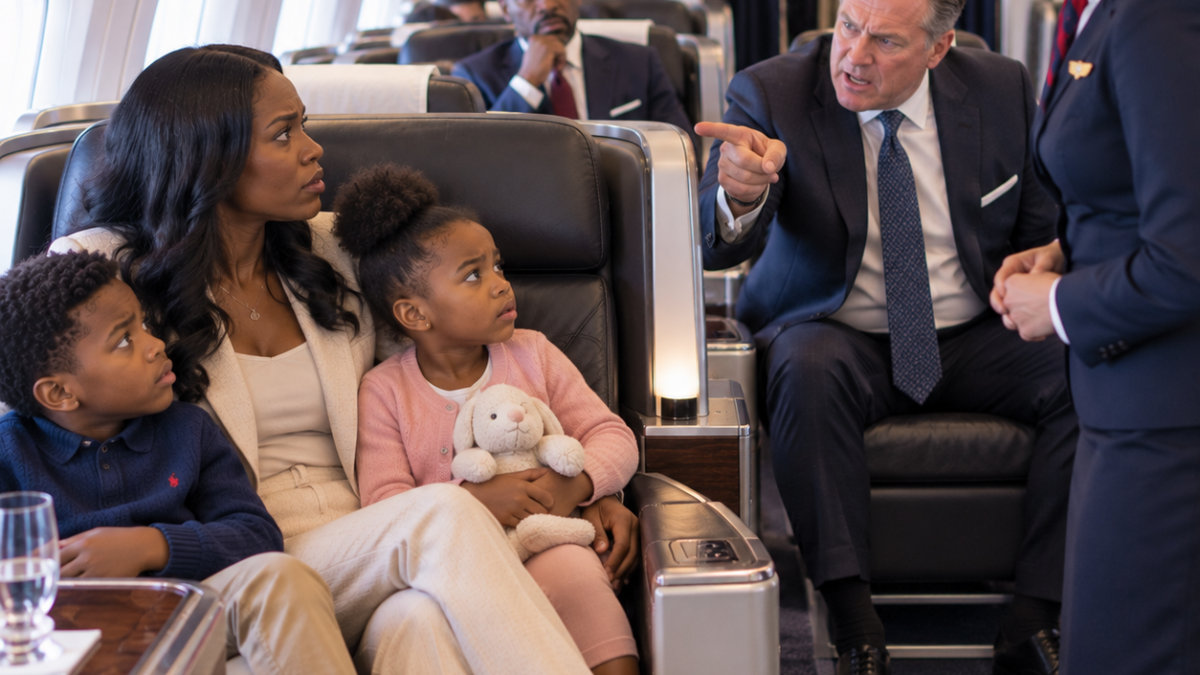
I had taken exactly four steps when Jessica saw me approaching.
Relief crossed her face before she could hide it.
“Mr. Carter.”
Richard Whitfield looked up.
His irritation shifted immediately toward me.
He clearly noticed Jessica’s tone.
What he did not understand was why a flight attendant would address another passenger with that degree of recognition.
I stopped beside his seat.
“Is there a problem, Jessica?”
Before she could answer, Richard did.
“Yes.”
He turned toward me as if grateful someone sensible had finally arrived.
“I’ve been trying to explain that I paid six thousand dollars for a quiet first-class environment, not a daycare center.”
I looked toward my family.
Zoe was reading.
Elijah had both hands wrapped around a plastic cup of orange juice.
Jordan’s tablet was on his lap, headphones over his ears.
Tanya looked exhausted rather than disruptive.
I turned back.
“Those children?”
“Yes.”
“What have they done?”
Richard frowned.
“You’ve been sitting back there.”
“Yes.”
“You’ve heard them.”
“I have.”
“They’re clearly not accustomed to this kind of environment.”
There are sentences you remember not because they are loud, but because of what they reveal.
That was one.
“What kind of environment?”
Richard leaned back.
“First class.”
“I understand where we are.”
He gave a thin smile.
“Then you understand there are certain standards.”
“What standards?”
He looked around.
He was beginning to realize other passengers were listening.
Across the aisle, the woman who had lowered her book watched him without embarrassment.
She was later introduced to me as Elena Martinez, an attorney from Washington.
At that moment, she was simply another witness.
Richard tried again.
“Professionalism.”
“Quiet.”
“Proper etiquette.”
I nodded.
“And which of those standards have the children violated?”
His face reddened.
“Look, I don’t need to defend myself to another passenger.”
“No.”
I agreed.
“You don’t.”
He seemed relieved.
Then I continued.
“But you do need to stop harassing my family.”
His expression froze.
“Your family?”
“Yes.”
I turned slightly.
“Tanya.”
My sister finally looked back.
“Marcus.”
Zoe’s mouth fell open.
“UNCLE MARCUS!”
Half the cabin laughed.
Elijah nearly launched himself over the seat.
“You were here?”
“Surprise.”
Richard looked from them to me.
Then at Jessica.
Then back to me.
He still had not put everything together.
“Wait.”
I extended my hand.
“Marcus Carter.”
He stared at it.
Then shook it automatically.
“Richard Whitfield.”
“I know.”
His eyes narrowed.
I continued.
“Founder and chief executive of Carter Airlines.”
Silence.
Not metaphorical silence.
Real silence.
The kind where you notice the ventilation system.
Jessica stood completely still.
Jordan slowly removed his headphones.
Elena closed her book.
Richard’s hand went limp in mine.
“You’re Marcus Carter?”
“Yes.”
He studied my face.
I could almost see him searching his memory for photographs from business articles.
My public profile had grown as the airline expanded, but I had never cultivated celebrity.
I preferred operations to television studios.
Richard had probably seen my name on documents far more often than my face.
“I had no idea,” he said.
I released his hand.
“That interests me.”
His brow furrowed.
“Why?”
“Because you’re saying it as though knowing would have changed your behavior.”
“No.”
He answered too quickly.
“I simply meant—”
“If you had known the children were related to the airline’s CEO, would you still have suggested they couldn’t afford first class?”
“I never said they couldn’t afford it.”
Jessica spoke from beside me.
“You questioned whether their tickets were legitimate, sir.”
Richard looked at her.
“I asked whether they had been upgraded.”
“You also asked whether we had an affirmative-action upgrade program.”
Elena added from across the aisle.
“You did.”
Richard’s eyes moved toward her.
“Excuse me?”
“I heard you.”
She held out a hand.
“Elena Martinez.”
He ignored it.
“I think everyone here is becoming unnecessarily sensitive.”
Tanya flinched.
I saw it.
She had spent twenty years as a hospital administrator.
She had dealt with angry surgeons, grieving families, understaffing crises, and hospital executives who could make a simple staffing request feel like a congressional hearing.
My sister was not fragile.
But I knew the difference between fear and exhaustion.
I walked toward her.
“You okay?”
She nodded.
“You didn’t have to get involved.”
“Yes, I did.”
“Marcus.”
“Not now.”
Jordan watched me.
There are moments when you realize a child is not simply observing what is happening.
He is deciding what it means.
My nephew was fourteen.
Old enough to recognize racism.
Young enough that the adults around him were still teaching him how much of it he was expected to tolerate.
I turned back toward Richard.
He had straightened his jacket.
“Mr. Carter, perhaps I overreacted.”
“Perhaps?”
“The children are obviously your guests.”
There it was.
Obviously.
Now they belonged.
Because of me.
Elena caught it too.
“So if they weren’t related to Mr. Carter,” she asked, “you’d still want them removed?”
Richard glared.
“That isn’t what I said.”
“You just said they’re obviously welcome because they’re his guests.”
“I didn’t say because.”
Elena smiled without warmth.
“You didn’t have to.”
The captain announced final preparations for departure.
Jessica glanced toward the front.
“Mr. Carter, I need everyone seated.”
“Of course.”
I looked at Richard.
“We’ll continue this later if necessary.”
“I would prefer we didn’t.”
“That depends largely on you.”
His face tightened.
I returned to seat 5C.
As I sat down, my hands began to tremble slightly.
Nobody saw.
I placed them beneath the tray table.
That old memory had returned.
I was ten.
Mechanicsville.
My mother, Denise Carter, cleaned houses in wealthy Atlanta neighborhoods.
One summer afternoon, she brought me to a client’s home because our babysitter canceled.
The woman who owned the house told me I could use the neighborhood pool while Mom cleaned.
I thought I had won the lottery.
Twelve minutes after I entered the water, a manager pulled me out.
He asked where I lived.
I gave him my address.
His face changed.
“Residents and invited guests only.”
“I am invited.”
“By whom?”
I pointed toward the house.
“My mom is working there.”
The word working changed everything.
I was not a guest.
I was the cleaner’s son.
Children watched as I climbed out.
Water ran down my legs onto the concrete.
I carried my towel back to the house.
Mom found me sitting on the curb.
She was furious.
Not at me.
At herself for believing permission would protect me.
That night my father said something I never forgot.
“Son, some people build spaces they think belong to them.”
My father, William Carter, had spent part of his youth working with voter-registration drives and local civil-rights organizers.
By the time I was born, he drove a city bus.
But he never stopped thinking like an organizer.
“Don’t spend your whole life begging to enter somebody else’s room,” he said.
“Learn how the room works.”
“And if you ever get the chance, build one with a bigger door.”
Decades later, I built an airline.
Not because of one swimming pool.
Life is never that simple.
But the memory lived inside the decision.
Carter Airlines started with six leased aircraft.
We nearly failed twice.
I mortgaged my home.
Investors backed out.
A major airport denied us gate space because executives said our growth projections were “too aspirational.”
That word still makes me laugh.
When a white startup founder is ambitious, he is visionary.
When I was ambitious, apparently I was aspirational.
We survived.
Seven years later, Carter Airlines had become one of the fastest-growing carriers in the country.
I had designed our service standards around one idea.
Dignity should not depend on how important an employee thinks you are.
That morning, before we even left Atlanta, somebody had tested that idea.
And now the man testing it happened to hold leverage over two projects that could shape our company’s future.
I did not know that yet.
The plane took off.
Once we reached cruising altitude, I moved forward to sit beside Tanya.
She whispered before I could speak.
“You embarrassed him.”
“He embarrassed himself.”
“I know.”
She looked toward Richard.
“He’s important, isn’t he?”
“How do you know?”
“I’ve watched you in meetings since we were kids.”
She smiled faintly.
“You get that little line between your eyebrows when something has business consequences.”
I touched my forehead.
“I have a line?”
“You have several.”
“That’s rude.”
“You’re forty-five.”
“Still rude.”
She laughed quietly.
Then her expression changed.
“I don’t want you risking anything because of us.”
“Tanya.”
“I mean it.”
She lowered her voice.
“I’ve handled people like him before.”
“That sentence is exactly the problem.”
“What?”
“You’ve handled people like him before.”
I looked at Zoe and Elijah.
“How many times should they have to learn how to handle it?”
She didn’t answer.
Jordan heard me.
He leaned across the aisle.
“Uncle Marcus.”
“Yes?”
“Was he being racist?”
Tanya closed her eyes.
“Jordan.”
“What?”
“I just want to know.”
I considered giving him the careful adult answer.
Bias.
Assumption.
Coded language.
Intent versus impact.
Then I remembered being fourteen.
Fourteen-year-olds can smell dishonesty.
“Yes.”
I said it quietly.
“I think race influenced the assumptions he made about you.”
Jordan nodded.
“Okay.”
“That doesn’t mean you know everything inside his head.”
“I know.”
“But we judge conduct.”
“Okay.”
“You three did nothing wrong.”
He looked at me.
“I knew that.”
Good.
Zoe leaned over Tanya.
“Are we allowed to stay?”
The question nearly broke me.
“Yes.”
“Because you own the airline?”
“No.”
I answered immediately.
“Because you have valid tickets.”
She thought about that.
“Even if you didn’t own it?”
“Especially then.”
She smiled.
“Okay.”
Elijah raised his hand.
“Yes, Elijah?”
“Can I have ice cream?”
Tanya stared at him.
“How did we get from racism to ice cream?”
He shrugged.
“I’m hungry.”
I laughed.
So did everyone else.
The moment loosened.
Jessica brought lunch.
Richard ordered a double scotch.
I was helping Elijah choose between two children’s meals when my phone buzzed.
Thomas Chen.
My chief financial officer.
I answered quietly.
“Thomas.”
“Marcus, tell me you’re not on Flight 247.”
I looked toward Richard.
“I’m on Flight 247.”
Thomas exhaled.
“Then I’m guessing you know Richard Whitfield is too.”
“Yes.”
“Whitfield Properties just called.”
My stomach tightened.
“And?”
“They’re suspending participation in Terminal East.”
I closed my eyes.
Terminal East was our Atlanta expansion.
Dedicated gates.
A premium lounge.
Maintenance space.
New crew facilities.
Roughly two hundred direct jobs and hundreds more indirect jobs.
A $50 million development package.
Whitfield Properties was providing close to a third of the outside project financing.
“Reason?”
Thomas paused.
“Their CEO says he was publicly harassed by Carter Airlines leadership.”
I almost laughed.
“That’s creative.”
“Marcus.”
His voice softened.
“What happened?”
I told him.
Briefly.
Thomas remained silent.
Finally:
“I believe you.”
“But?”
“But the board is going to panic.”
“I know.”
“Whitfield has relationships all over airport development.”
“I know.”
“This could hurt.”
“I know.”
Thomas sighed.
“I hate being the finance guy right now.”
“Then don’t be.”
“What?”
“Tell me what you think as a person.”
He was quiet for several seconds.
“As a person?”
“Yes.”
“I think he sounds like an ass.”
I smiled.
“Thank you.”
“As CFO?”
“Yes?”
“I think the ass controls thirty percent of a project we need.”
“There you are.”
“I contain multitudes.”
“Keep me updated.”
I hung up.
When I looked up, Richard stood beside my seat.
He held his drink.
“Now you understand.”
“Understand what?”
“My name.”
I gestured toward the open seat across from me.
“Sit down.”
He did.
His confidence had returned.
Not the racial confidence from earlier.
Something more familiar to me.
Financial confidence.
The certainty that everybody eventually develops principles they can afford.
“We’re partners,” he said.
“Our companies are.”
“Same difference.”
“No.”
“It isn’t.”
He ignored that.
“Terminal East matters to you.”
“Yes.”
“My people tell me your board has modeled fifteen percent incremental growth from the project.”
I said nothing.
He smiled.
“So let’s be adults.”
“What does that mean?”
“It means this entire ugly little incident disappears.”
“Ugly little incident?”
“You know what I mean.”
“No.”
“Explain it.”
He glanced toward Tanya’s row.
“We both got heated.”
“I didn’t.”
“You publicly accused me of racism.”
“I questioned your assumptions.”
“You humiliated me.”
“You loudly asked for Black children to be moved from seats they paid for.”
“I complained about children.”
“You mentioned affirmative action.”
His jaw tightened.
“I chose my words poorly.”
“You chose them clearly.”
Richard leaned closer.
“Carter, neither of us benefits from turning this into a crusade.”
“I agree.”
“Good.”
“I don’t intend to.”
He relaxed.
Then I added:
“I intend to enforce our passenger conduct rules.”
His face darkened again.
“Don’t be ridiculous.”
“Which part?”
“We have fifty million dollars on the table.”
“Yes.”
“You apologize for publicly escalating this.”
“No.”
“I issue a statement that there was a misunderstanding.”
“No.”
“You ask your flight attendant to do the same.”
“No.”
His fingers tightened around his glass.
“Then I’ll instruct my board to withdraw.”
“That’s your right.”
“You don’t believe me.”
“I do.”
“You’re willing to sacrifice a major expansion because your feelings are hurt?”
That sentence clarified everything.
“My feelings are not the issue.”
“Then what is?”
“The fact that you believe access to money purchases exemption from standards.”
Richard laughed.
“You are a CEO.”
“So are you.”
“Don’t pretend you don’t know how business works.”
“I know exactly how business works.”
I leaned toward him.
“That is why you are trying to convert your financing leverage into immunity.”
He stared at me.
“You’re being dramatic.”
“No.”
“I’m being precise.”
Tanya approached.
“Everything okay?”
Richard’s personality transformed instantly.
A softer smile appeared.
“Mrs. Carter.”
“Tanya is fine.”
“I want to apologize if you interpreted my comments negatively.”
Her expression cooled.
I almost intervened.
Then decided not to.
My sister did not need me translating disrespect.
“If I interpreted them negatively?”
Richard shifted.
“I was concerned about cabin noise.”
“You asked whether my children’s tickets came from affirmative action.”
He looked at me.
I said nothing.
He turned back.
“I was speaking carelessly.”
“Yes.”
Tanya nodded.
“You were.”
He seemed surprised.
“Look, children can be children.”
Tanya stared at him.
“They weren’t bothering you because they were children.”
“You don’t know what bothered me.”
“You’re right.”
She spoke calmly.
“I only know what you said.”
Richard looked away.
Tanya turned to me.
“Don’t lose sleep over this man.”
Then returned to the kids.
I watched her go.
Richard said quietly:
“She’s more reasonable than you.”
That almost made me admire his commitment to making every possible wrong decision.
“My sister just told you that your explanation was dishonest.”
“She also told you not to lose sleep.”
“I won’t.”
My phone buzzed.
A message from Thomas.
Whitfield formal hold submitted.
Richard watched me read it.
Then stood.
“Now maybe you’ll reconsider.”
I looked up.
“No.”
His smile disappeared.
He returned to his seat.
Jordan was watching again.
I wondered what he saw.
His uncle risking millions?
A CEO refusing extortion?
A Black man stubbornly refusing to make peace?
Leadership rarely looks as clean from inside as it does afterward.
I was not certain.
That is the part people edit out of stories.
I believed I was right.
I was not certain the price would only fall on me.
Two hundred jobs.
Employees expecting promotions.
Vendors who had planned around the project.
My board.
Investors who trusted me to separate personal emotion from corporate judgment.
Those people had not made Richard’s comments.
Would they pay because I refused to apologize?
That question sat with me.
Then Richard made his next move.
He demanded to be relocated.
Jessica stood beside his seat.
“Where would you like to move, sir?”
“Anywhere away from these people.”
The cabin went quiet again.
Jessica’s expression hardened.
“We do not have another open first-class seat.”
“Then economy.”
“I can check.”
He raised his voice.
“And document that I am being forced to relocate because your CEO has harassed me.”
I stood.
“No one is forcing you to relocate.”
Richard turned.
“You have made this cabin hostile.”
“You complained repeatedly about another family.”
“You confronted me.”
“You threatened our development project unless I apologized.”
His face reddened.
“That’s business.”
“Then call it business.”
“Don’t call it harassment.”
He pulled out his phone.
“I’ll record this.”
Jessica held up a hand.
“Sir, please remain seated and stop escalating the situation.”
“I have the right to document my treatment.”
“You may document your interactions consistent with crew instructions.”
I appreciated Jessica’s wording.
She did not invent a sweeping rule about recording.
She focused on conduct.
Richard aimed the camera toward Tanya.
Jordan stood.
“Don’t record my little brother.”
“Sit down, kid.”
“Richard.”
My voice changed.
He looked at me.
“Do not direct your anger at my nephew.”
“I told him to sit down.”
“He is protecting his brother because you pointed a camera toward them.”
“It’s evidence.”
“They are children.”
He laughed bitterly.
“Everyone’s suddenly a victim.”
Elijah began crying.
Not loudly.
That was worse.
He pressed his face against Tanya.
“Mom.”
She wrapped both arms around him.
I walked toward them.
“What is it, buddy?”
He looked at Richard.
“Why does he hate us?”
Everything else disappeared.
The expansion.
The board.
The financing.
The stock price.
All of it.
A seven-year-old child had reduced the situation to the one question adults kept making more complicated.
Why does he hate us?
I crouched.
“He doesn’t know you.”
“Then why is he mad?”
“Because sometimes people make unfair assumptions.”
“Because we’re Black?”
Tanya closed her eyes.
I looked at him.
“Yes.”
His bottom lip trembled.
I touched his cheek.
“That is never your fault.”
Behind me, Richard muttered:
“Oh, for God’s sake.”
I stood.
“Jessica.”
“Yes, Mr. Carter?”
“Please speak with Captain Reynolds.”
Richard looked up.
“About what?”
“Your conduct.”
“What does that mean?”
“It means the crew will determine appropriate steps when we land.”
“Are you threatening to have me removed?”
“I am informing you that your behavior is disrupting the cabin and distressing minors.”
“This is retaliation.”
“No.”
He stood.
“This is reverse discrimination.”
People actually groaned.
Elena spoke from her seat.
“Sit down, Mr. Whitfield.”
He turned.
“Nobody asked you.”
“I am asking you.”
“Who are you?”
“Elena Martinez.”
“Attorney.”
“Passenger.”
“Witness.”
She closed her book.
“And currently the person wondering why the only adult throwing a tantrum in first class is the man complaining about children.”
Several passengers laughed.
Richard pointed toward her.
“This entire cabin has turned into a mob.”
“No,” Elena replied.
“It turned into a room where people stopped pretending not to hear you.”
That landed.
Richard sat.
But he did not stop.
“I have contacts with airport authorities in Los Angeles.”
I returned to my seat.
“I’m sure you do.”
“I sit on a regional development advisory committee connected to your proposed West Coast expansion.”
That got my attention.
He saw it.
And smiled.
There are moments when you discover something about the person across from you.
That moment I discovered Richard had been saving his strongest leverage.
“The terminal project comes up for review next week,” he said.
I knew the committee.
I had not realized he sat on one of the advisory groups that influenced the development consortium.
Not final authority.
But enough influence to complicate the process.
“One phone call,” he continued, “and your Los Angeles expansion becomes much harder.”
I stared at him.
“So now we are clear.”
“Clear about what?”
“You want favorable treatment on this aircraft in exchange for not using outside business relationships against my company.”
His expression changed.
“I didn’t say that.”
“You just did.”
“No.”
“I described reality.”
“So did I.”
Jessica returned.
“Mr. Carter.”
“Yes?”
“Captain Reynolds would like to speak with you.”
I followed her forward.
Laura Reynolds sat in the cockpit.
Former Air Force.
Thirty years flying.
One of the first senior hires I made when launching Carter Airlines.
She closed the cockpit door after I entered.
“I got a summary.”
“What do you think?”
“Operationally?”
“Yes.”
“Whitfield is disruptive.”
“Dangerous?”
“No.”
“Removal on arrival?”
“If he continues targeting passengers and refuses crew instructions, yes.”
“Don’t do it because I own the company.”
“I won’t.”
“Do it because of the conduct.”
She looked almost offended.
“I know my job, Marcus.”
“I know.”
She softened.
“Board chair called.”
“Barbara?”
“Yes.”
I groaned.
“Of course.”
“You can take the secure call from the jump seat communication terminal.”
Barbara Thornton appeared on screen.
She had been with Carter Airlines since before our first flight.
Former investment banker.
Brilliant.
Loyal.
And terrified of preventable chaos.
“Marcus.”
“Barbara.”
“What the hell?”
“Good to see you too.”
“Whitfield Properties says you publicly accused Richard of racism and threatened to remove him from the aircraft.”
“That is a very selective summary.”
“Stock is moving.”
“We’re in the air.”
“Markets don’t care.”
“Apparently not.”
She rubbed her forehead.
“Tell me exactly what happened.”
I did.
She listened.
Unlike Thomas, she did not interrupt.
When I finished, she sighed.
“I support you.”
“But.”
“But I chair a board responsible to shareholders.”
“I know.”
“Can this be de-escalated?”
“Define de-escalated.”
“No further confrontation.”
“I want that too.”
“A mutual statement.”
“No.”
“Marcus.”
“I will not apologize for telling a passenger to stop targeting my family.”
“Not an admission.”
“Corporate language.”
“No.”
She leaned closer to the camera.
“Whitfield can hurt Terminal East.”
“I know.”
“He can complicate Los Angeles.”
“I just learned that.”
“We could lose hundreds of millions in long-term growth.”
“I know.”
“And if this continues spreading online, the board will have to evaluate your handling of it.”
I nodded.
That hurt.
Not because she threatened me.
Because she wasn’t threatening me.
She was stating governance reality.
“I understand.”
“Do you?”
“Yes.”
Barbara looked tired.
“I’ve spent seven years defending the argument that values-based management and fiduciary responsibility aren’t enemies.”
“So have I.”
“Don’t force me to prove it in the worst possible circumstances.”
“I didn’t create the circumstances.”
“No.”
She softened.
“But now you are responsible for what happens next.”
That was true.
“I’ll keep it controlled.”
“Please.”
I ended the call.
Laura watched me.
“You okay?”
“No.”
“Good answer.”
I laughed once.
“What would you do?”
She leaned back.
“I would land the airplane.”
“Helpful.”
“You asked a pilot.”
“Fair.”
Then she became serious.
“As an employee?”
“Yes.”
“I would want to know the values in our manual still exist when the person violating them is rich.”
That stayed with me.
I returned to the cabin.
Richard was standing.
Phone raised.
Camera aimed toward my family again.
Tanya had put herself between him and the kids.
Jordan stood beside her.
Jessica was speaking firmly.
“Mr. Whitfield, please return to your seat.”
“I am documenting discriminatory treatment.”
Jordan said:
“Stop filming my brother.”
Richard answered:
“Mind your business.”
Something cold moved through me.
I stepped between them.
“Turn the phone away from the children.”
Richard saw me.
“Here comes the dictator.”
“Sit down.”
“You don’t control me because your name is painted on the plane.”
“No.”
“The captain controls the aircraft.”
“And the crew has instructed you to sit.”
He lowered the phone slightly.
Then Elijah spoke from behind Tanya.
“Why does he hate us?”
Richard heard him.
For one second, shame crossed his face.
At least I thought it did.
Then defensiveness buried it.
“You people always do this.”
The words were soft.
But everyone heard.
Elena stood.
“What did you say?”
Richard’s face hardened.
“I said you people always turn everything into race.”
There it was.
No coding.
No “standards.”
No “professional environment.”
No affirmative-action euphemism.
Just contempt.
I looked toward Jessica.
“Notify Captain Reynolds that I support having security meet the aircraft.”
“Yes, sir.”
Richard stared.
“You’re really doing this.”
“Yes.”
“You know what this will cost?”
“Yes.”
“You don’t.”
His face twisted.
“I can kill your Atlanta deal.”
“Maybe.”
“I can stall Los Angeles for years.”
“Maybe.”
“I can move corporate travel accounts away from Carter.”
“Maybe.”
“You will lose your company over a seating complaint.”
I looked at my nephew.
Jordan.
Fourteen.
Watching.
Then at Zoe.
Ten.
Angry instead of afraid.
Then Elijah.
Seven.
Tear tracks still visible.
“No.”
I said it calmly.
“If I lose my company because I refuse to let a powerful man intimidate Black children on my own airline, then I built the wrong company.”
Richard stared at me.
Nobody spoke.
He sat.
We began our descent forty minutes later.
The consequences were arriving faster than Los Angeles.
Carter Airlines stock had fallen eight percent.
Whitfield Properties publicly announced it was suspending the Atlanta partnership.
Rumors spread that our Los Angeles expansion was in danger.
A video from the cabin had already been viewed more than a million times.
The title was terrible.
BILLIONAIRE AIRLINE CEO CONFRONTS WHITE FIRST-CLASS PASSENGER OVER RACIST COMMENTS
I hated that it centered me.
The children were the people targeted.
But headlines prefer power.
Jessica came to our row.
“Security will be at the gate.”
“Thank you.”
She hesitated.
“Mr. Carter?”
“Yes?”
“The crew supports the decision.”
I looked at her.
“You don’t have to say that.”
“I know.”
She lowered her voice.
“Passengers say awful things sometimes.”
“To you?”
“To us.”
“Staff.”
“Other passengers.”
“We’re trained to de-escalate.”
She paused.
“Sometimes de-escalate becomes another word for absorb.”
That sentence stayed with me.
“How often?”
“Often enough.”
I nodded slowly.
“Then we have work to do.”
She smiled faintly.
“I hoped you’d say that.”
As the wheels came down, my phone received another message.
Vanessa Rodriguez, our COO.
Board emergency session underway. Stock down 11.7%. I’ll meet plane.
Then another.
Whitfield influence on LA project is real but not unilateral. Do not negotiate onboard.
Good advice.
Richard caught my eye.
“Last chance.”
I almost admired his consistency.
“Sit down.”
“If you call off security and correct the public record, I can still stabilize the business relationships.”
“There is nothing to correct.”
“You accused me of racism.”
“I described your behavior.”
“You’ll regret this.”
Maybe.
Leadership often requires acting before certainty arrives.
The plane touched down.
Elijah grabbed my hand.
“Uncle Marcus?”
“Yes?”
“Are they going to take your airplane away?”
I looked at him.
That question carried more fear than a child should have about adults’ business.
“No.”
I squeezed his hand.
“No one is taking our airplane away.”
“But that man said—”
“That man says many things.”
Jordan leaned forward.
“I’m proud of you.”
I looked at him.
Those four words mattered more than the stock price.
“Thank you.”
The plane reached the gate.
Through the window, I saw security.
Vanessa.
Airport operations staff.
And farther away, media cameras.
“How did they get here already?” Tanya asked.
“Internet.”
I hated the answer.
Richard stood before the seatbelt sign turned off.
Jessica immediately said:
“Mr. Whitfield, remain seated.”
He ignored her.
“Carter.”
I remained seated.
“One final time.”
“No.”
“You’re choosing public humiliation over private resolution.”
“You made the complaint public inside this cabin.”
“I wasn’t talking to the internet.”
“You were talking loudly enough for sixteen passengers.”
The door opened.
Two airport security officers entered.
They were not police.
That distinction mattered.
We were not having Richard arrested merely for offensive speech.
They were there to manage the deplaning of a passenger whose behavior had created an ongoing disturbance.
Vanessa stepped in behind them.
“Marcus.”
“Vanessa.”
She looked toward Richard.
He pointed.
“This company is going to regret this.”
Vanessa had spent fifteen years in aviation operations.
Nothing surprised her easily.
“Sir, we’re going to ask you to deplane first so the situation can be resolved away from other passengers.”
Richard straightened his tie.
“You’re ejecting me.”
“The flight has landed.”
She spoke evenly.
“Everyone is deplaning.”
A few passengers laughed.
Richard did not.
As security escorted him toward the door, he stopped beside me.
“You just destroyed your airline.”
I looked at him.
“I hope neither of us is powerful enough to destroy an airline in one day.”
Then he left.
I wish I could say I felt triumphant.
I didn’t.
I felt tired.
Very tired.
The remaining passengers began standing.
Then Elena stepped into the aisle.
“Mr. Carter.”
“Yes?”
“I want my contact information given to your legal team.”
“Why?”
“Because I heard everything.”
She looked toward the jet bridge.
“And I’m guessing Mr. Whitfield’s version is about to become creative.”
She was right.
Outside, reporters shouted before I reached the terminal.
“Mr. Carter, did you threaten Richard Whitfield?”
“Are you terminating his corporate account?”
“Is Carter Airlines losing the Terminal East project?”
“Did you call him racist?”
“Are you facing a board vote?”
Tanya froze.
The kids moved closer to her.
I hated myself for not anticipating this.
I turned to security.
“Get my family out another route.”
Tanya grabbed my arm.
“No.”
“You don’t need this.”
“Neither do you.”
“Tanya.”
Jordan spoke.
“We’re not hiding.”
I looked at him.
“That’s not hiding.”
“It feels like it.”
Fourteen years old.
Stubbornness inherited from both sides of the family.
Before I could decide, Elena walked toward the cameras.
She raised one hand.
“I was on Flight 247.”
Reporters turned.
“My name is Elena Martinez.”
“I am an attorney and an independent witness.”
The noise quieted.
“I watched Mr. Whitfield repeatedly question why a Black family belonged in first class despite being told their tickets were valid.”
She continued.
“I heard him refer to possible affirmative-action upgrades.”
“I heard him describe the family as ‘these people.’”
“I watched him threaten business consequences after learning who Mr. Carter was.”
Other passengers began stepping forward.
An elderly white woman.
“I heard it too.”
A young Asian man.
“He was the one causing the disturbance.”
A Black businessman from row four.
“The kids barely made noise.”
Jessica and the crew remained near the gate.
I stood there listening.
For the first time that day, I understood something clearly.
My money was not the strongest protection we had.
Witnesses were.
People who decided silence was no longer neutrality.
Vanessa approached me.
“Board vote completed.”
My stomach tightened.
“And?”
“Unanimous support for your decision to enforce passenger conduct rules.”
I exhaled.
“Barbara?”
“She voted yes.”
“Stock?”
“Beginning to recover.”
“Terminal East?”
“Whitfield formally withdrew.”
That hurt.
Then Vanessa smiled slightly.
“But we’ve already received two requests from alternative capital partners.”
“That quickly?”
“You went viral.”
“Don’t say that like it’s good.”
“I didn’t.”
“Los Angeles?”
“Three members of the advisory group called to distance themselves from Whitfield.”
“Doesn’t mean approval.”
“No.”
“But his influence is weaker than he implied.”
I nodded.
“Good.”
Elijah tugged my sleeve.
“Can we go to the hotel?”
I looked down.
“Yes.”
“Is there a pool?”
Tanya laughed.
“There had better be.”
I smiled.
“Yes.”
“Then can we stop talking about the angry man?”
That was the smartest suggestion anybody made all day.
The children left with Tanya.
I stayed.
Because I was CEO.
That meant I did not get to end the day when the personal confrontation ended.
I entered the Carter Airlines lounge with Vanessa, Barbara by video, Thomas on another screen, our communications director Melissa Wong, and chief counsel Michael Rivera.
The numbers were ugly.
Then less ugly.
Stock volatility extreme.
Corporate travel cancellations.
A few major accounts asking questions.
Bookings, strangely, rising.
“Fifteen percent above normal since noon,” Melissa said.
“Because of this?”
“Apparently.”
“I don’t want a campaign.”
“Agreed.”
“No hashtags from us.”
“Agreed.”
“No advertisement about courage.”
“Definitely agreed.”
“I mean it.”
“We know.”
Thomas rubbed his forehead.
“Whitfield terminated Terminal East.”
I nodded.
“Alternatives?”
“Three parties interested.”
“Serious?”
“One likely serious.”
“Who?”
“A consortium led by two infrastructure funds and a minority-owned development firm.”
“Terms?”
“Too early.”
Michael spoke.
“Whitfield is threatening suit.”
“On what basis?”
“Defamation.”
“Emotional distress.”
“Interference with business.”
“He’ll add whatever survives first review.”
“Merits?”
“We have witnesses.”
“Video.”
“Crew statements.”
“His own public comments.”
Michael shrugged.
“He can file.”
“Do we settle?”
Everyone looked at me.
“No.”
Barbara appeared on the main screen.
“Careful, Marcus.”
“I’m listening.”
“No emotional decisions.”
“I agree.”
“If there’s a commercially sensible resolution that doesn’t require a false admission—”
“I’ll consider it.”
She nodded.
That mattered.
Standing on principle does not require refusing every compromise merely because the other person proposed it.
It requires knowing what cannot be traded.
Truth was one of those things.
We would not say Richard had been unfairly treated if the evidence showed otherwise.
We would not apologize for protecting passengers.
Everything else could be negotiated.
That evening, I finally reached the hotel.
The suite looked as though a pillow factory had exploded.
Zoe and Elijah built a fort.
Jordan sat on the sofa staring at his phone.
Tanya saw me.
“How bad?”
“Complicated.”
“That means bad.”
“It means complicated.”
“Marcus.”
“We lost Whitfield’s investment.”
She closed her eyes.
“I’m sorry.”
“Why?”
“Because this started with us.”
“No.”
“It started with him.”
Jordan spoke from the sofa.
“People are saying horrible things online.”
I looked at his screen.
Slurs.
Conspiracy theories.
People claiming the family had staged the incident.
Others calling me anti-white.
People saying my sister’s children were “obviously loud” despite never seeing anything beyond brief clips.
I took the phone.
“Don’t read comments.”
“That feels weak.”
“No.”
“It feels smart.”
“But they’re lying.”
“Strangers on the internet are allowed to be wrong without receiving your nervous system as payment.”
He looked at me.
“Is that a CEO quote?”
“No.”
“Then it’s lame.”
“Give me my wisdom back.”
He smiled.
Then became serious.
“Some people are defending us.”
“I know.”
“Does that help?”
“Yes.”
“Does the hate hurt?”
He caught me.
Adults often lie to children because we think resilience requires pretending.
“Yes.”
I said it.
“It hurts.”
He nodded.
“Me too.”
I sat beside him.
“Then we don’t pretend it doesn’t.”
“What do we do?”
“We decide who gets access to our minds.”
“Sounds hard.”
“It is.”
Across the room, Elijah crawled out of the pillow fort.
“Uncle Marcus.”
“Yes?”
“Mom says no ice cream before dinner.”
“Correct.”
“Can you overrule her because you own an airline?”
Tanya threw a pillow at me before I answered.
For five minutes, we laughed.
That laughter saved the day more than any board vote.
Later, after the children slept, Tanya and I sat on the balcony.
Los Angeles glowed below.
“Do you regret it?”
She asked.
I knew what she meant.
“No.”
“Not even a little?”
“I regret that they experienced it.”
“I regret that you did.”
“I regret the financial fallout.”
“But the decision?”
“No.”
She nodded.
“Dad would be proud.”
I looked toward the city.
Our father had died before Carter Airlines launched.
He had watched the early fundraising.
He had seen the business plan.
He never saw a Carter aircraft.
“Do you remember the pool?”
Tanya looked at me.
“Of course.”
“You cried more than I did.”
“I wanted to fight that manager.”
“You were twelve.”
“I was dangerous.”
“You were ninety pounds.”
“Still dangerous.”
I laughed.
Then she said:
“Dad came home that night and told us someday people would have to get used to seeing us everywhere.”
I remembered.
“Hotels.”
“Boardrooms.”
“Airplanes.”
“Country clubs.”
“Universities.”
“He said the point wasn’t to become rich enough that people couldn’t question us.”
I looked at her.
“I forgot that part.”
“I didn’t.”
“What did he say?”
She smiled.
“He said the goal was to make the question itself embarrassing.”
I sat quietly.
Maybe that was what happened on Flight 247.
Richard asked, in a dozen ways:
What are they doing here?
For once, the room answered:
Why are you asking?
The next morning, the crisis intensified.
Richard held a press conference.
We watched from Carter Airlines’ Los Angeles office.
He stood behind a podium.
Several employees from Whitfield Properties stood behind him.
Conveniently diverse.
“I have spent my entire career supporting inclusion,” he said.
“I was subjected to reverse discrimination after raising a legitimate concern regarding cabin disruption.”
Vanessa groaned.
Melissa muttered:
“There it is.”
Richard continued.
“I never objected to anyone’s race.”
“I objected to behavior.”
The reporter immediately asked:
“Did you suggest the family received an affirmative-action upgrade?”
Richard smiled tightly.
“My remarks have been deliberately taken out of context.”
“Did you refer to them as ‘these people’?”
“I was referring to the group involved in the dispute.”
“Did you threaten Mr. Carter’s business projects?”
“I explained that his conduct could affect our partnership.”
“So yes?”
“No.”
He announced a lawsuit.
Fifty million dollars.
Defamation.
Business interference.
Damage to reputation.
Thomas whispered:
“Of course it’s fifty.”
“Symbolic.”
Michael corrected.
“Attention seeking.”
I watched Richard.
Strangely, I did not hate him.
I disliked what he did.
I disliked the machinery he was activating to avoid responsibility.
But hatred is expensive.
I already had an airline.
Three children.
A sister.
Thousands of employees.
I did not have spare emotional capital for hatred.
Barbara asked:
“What approach?”
Melissa displayed three options.
Minimize.
Counterattack.
Elevate.
I disliked all three labels.
“What does elevate mean?”
“Use the attention to reaffirm company standards and announce stronger passenger conduct protections.”
“That sounds like marketing.”
“It could be.”
“Then no.”
Melissa nodded.
“What do you want?”
“The truth.”
“That’s not a communication strategy.”
“It should be.”
We released a short statement.
No attack.
No insult.
No declaration that Richard was a racist person.
We described the documented conduct.
We stated that Carter Airlines supports passengers and crew regardless of race.
We confirmed that security assistance had been requested because of escalating disruptive behavior.
We stated that no passenger’s spending level, loyalty status, or business relationship exempts them from conduct standards.
Then we announced an internal review.
Not of Richard.
Of us.
Crew protocols.
Passenger complaints.
How employees handled discriminatory behavior.
Whether staff felt empowered to intervene.
Jessica had told me the previous night that “de-escalation” sometimes meant “absorb.”
I wanted to know how often.
That review changed the story.
Not immediately.
But eventually.
Crew members began sending accounts.
Passengers refusing service from Black flight attendants.
Sexist comments toward women.
Homophobic remarks.
Passengers challenging immigrant employees’ English despite those employees speaking fluently.
Disabled travelers whose complaints were minimized.
Parents told their autistic children were “badly behaved” before staff understood what was happening.
We had a good company.
Better than many.
We still had blind spots.
Values printed in manuals are not culture.
Culture is what an employee believes will happen when values become expensive.
We created a working group.
Cabin crew.
Pilots.
Gate agents.
Customer service.
Legal.
Passengers.
Civil-rights experts.
Disability advocates.
Not because Richard deserved that much power over us.
Because the incident exposed questions worth answering.
Then Elena brought another complication.
Three former employees of Whitfield Properties had filed discrimination complaints over five years.
Some settled.
Some unresolved.
She asked whether we wanted to investigate.
“No.”
She looked surprised.
“Why not?”
“We are not prosecutors.”
“You’re defending a lawsuit.”
“Our lawyers can use public and properly discoverable evidence.”
I paused.
“I don’t want private investigators digging through his life to prove he’s a bad person.”
Elena studied me.
“You’re serious.”
“Yes.”
“He’s digging through yours.”
“I know.”
“College activism.”
“Old business disputes.”
“Every quote you’ve ever made about race.”
“I know.”
“And you’re not going to hit back?”
“We will defend ourselves.”
“That’s different.”
“Exactly.”
She smiled.
“I might like you.”
“Most lawyers don’t.”
“I said might.”
The former employees ultimately came forward independently.
Their stories became public.
Richard’s company faced its own board crisis.
Contracts were reviewed.
Investors asked questions.
Whitfield Properties stock fell.
But I refused to celebrate.
A falling stock price does not only hurt the CEO.
Retirement accounts.
Employees.
Shareholders.
Suppliers.
Consequences spread.
I did not need innocent people suffering to validate what happened to my family.
The lawsuit dragged on.
Depositions.
Discovery.
Motions.
Months.
Richard’s attorneys obtained footage.
We provided it through proper channels.
Passengers submitted statements.
Jessica testified.
Elena testified.
Tanya testified.
I did too.
Richard’s attorney asked:
“Mr. Carter, isn’t it true you used your position as CEO to publicly humiliate my client?”
“No.”
“You confronted him in front of passengers.”
“Yes.”
“You could have asked him to speak privately.”
“Yes.”
“You chose not to.”
“Yes.”
“Why?”
“Because he was publicly targeting my family.”
“So this was personal.”
“It was both personal and professional.”
“How?”
“I was a family member and the executive responsible for enforcing standards aboard our airline.”
“You were angry.”
“Yes.”
The attorney paused.
Maybe he expected denial.
“Very angry?”
“Yes.”
“And despite that anger, you believe your decision was objective?”
“No.”
He blinked.
“No?”
“Human decisions are rarely perfectly objective.”
I continued.
“That is why I did not order him arrested.”
“I did not personally revoke his status.”
“I asked the captain and crew to assess his conduct under company policy.”
“Security was requested to assist with deplaning.”
The attorney frowned.
“But you told them what you wanted.”
“I stated my view.”
“As owner.”
“As a passenger, uncle, and CEO.”
“That’s enormous influence.”
“Yes.”
“So you abused it.”
“No.”
“I disclosed the conflict and deferred operational authority to the captain.”
That became important.
Power is not made ethical by pretending you do not possess it.
It becomes more ethical when you acknowledge it and build checks around it.
Our captain’s report later confirmed that she independently supported security assistance based on Richard’s escalating behavior.
The case weakened.
Then his own public statements weakened it further.
So did witness videos.
Eventually, both sides entered mediation.
Not because I wanted a settlement.
Because litigation had become a machine consuming everyone’s time.
The final agreement required no admission that Carter Airlines had discriminated against Richard.
No payment from Carter Airlines to him.
Each party covered most of its own costs.
Richard withdrew his public accusation that we removed him because he was white.
His company ended the business partnership through negotiated commercial terms.
Separate from the lawsuit, Richard agreed to participate in leadership coaching requested by his own board.
That wasn’t my victory.
It was his board’s choice.
We met privately once during mediation.
No cameras.
No attorneys for twenty minutes.
Just us.
He looked older.
So did I.
He said:
“I still don’t believe I’m a racist.”
I answered:
“I didn’t ask you to.”
He frowned.
“You called my behavior racist.”
“Yes.”
“What’s the difference?”
“A person is larger than one label.”
I leaned back.
“I care about what you did.”
“Then why does everybody keep asking what I am?”
“Because labels are easier than examination.”
He considered that.
“I’ve thought about the kids.”
I said nothing.
“I wouldn’t have questioned a white family like that.”
There it was.
Not enlightenment.
Not transformation.
But honesty.
“Why not?”
He stared at his hands.
“I would have assumed they belonged.”
I nodded.
“And with Tanya?”
“I assumed the opposite.”
“Yes.”
He looked at me.
“I don’t know what to do with that.”
“Start there.”
He gave a bitter laugh.
“You make everything sound simple.”
“No.”
“I think it is incredibly difficult.”
“Then why were you so calm?”
“On the plane?”
“Yes.”
“I wasn’t.”
He seemed surprised.
“You looked calm.”
“That isn’t the same thing.”
For the first time, Richard smiled without superiority.
“Fair.”
I never became his friend.
He never became a symbol of miraculous redemption.
Life does not require that.
Sometimes the meaningful outcome is simply a person becoming less certain of the prejudice he once defended.
Three months after Flight 247, I was invited to testify before a congressional transportation subcommittee examining discrimination and passenger protections.
I almost declined.
I did not want the incident becoming another spectacle.
Jordan convinced me.
“Go.”
I looked at him.
“Why?”
“Because everybody keeps saying what happened was unusual.”
“It was unusual.”
“No.”
He shook his head.
“Uncle Marcus, what was unusual was that you owned the airline.”
Fourteen years old.
Again.
Straight through it.
So I testified.
Tanya and the kids sat behind me.
Jessica attended.
Darius, one of our Black flight attendants, attended.
Representatives from other carriers came too.
The chairwoman asked:
“Mr. Carter, what do you think the central lesson of your experience is?”
I looked at the committee.
“That no passenger should need a powerful relative before someone believes they belong.”
Pens moved.
Cameras clicked.
“What happened to my family was visible because phones were recording.”
“It became consequential because I had institutional power.”
“Most people who experience discrimination have neither.”
A congressman asked whether airlines could distinguish discrimination from legitimate complaints.
“Yes.”
I answered.
“Imperfectly.”
“That is why procedures matter.”
“A passenger saying children are screaming continuously is a service complaint.”
“A passenger assuming a Black family could not legitimately purchase premium tickets is something different.”
“Context matters.”
“Language matters.”
“Patterns matter.”
“So does due process.”
That last phrase surprised some people.
I meant it.
Policies created in anger can become unjust too.
We trained our teams not to become ideology police.
Not every awkward phrase was grounds for removal.
Not every disagreement involving people of different races was racism.
The goal was not to create fear.
The goal was to give employees tools for responding when conduct crossed into targeting, harassment, or exclusion.
We called the new framework Dignity First.
I originally hated the name.
It sounded like marketing.
Jessica convinced me to keep it.
“Employees need language they can remember under pressure,” she said.
She was right.
Dignity First had three basic ideas.
Protect safety.
Address conduct.
Do not rank dignity by status.
No million-mile traveler had more human worth than a first-time flyer.
No billionaire CEO deserved more courtesy than a nursing student in row thirty.
No employee should be told to absorb abuse merely because the abusive passenger spent more money.
That last principle changed our culture fastest.
Six months later, Jessica became director of cabin-service training.
Not as a reward for supporting me.
She earned it.
She redesigned scenarios using real incidents.
Darius became part of the instructor team.
He told trainees:
“Professionalism doesn’t mean smiling while someone degrades you.”
“It means controlling the situation without becoming the situation.”
That line went into the manual.
Terminal East survived.
Not with Whitfield Properties.
We brought in new capital.
The replacement partnership took longer to negotiate but ultimately gave Carter Airlines better control over the facility.
The project broke ground nine months later.
The Los Angeles expansion was approved too.
Richard’s influence had been real.
Not absolute.
That was another lesson.
Powerful people often benefit when everyone assumes their power is larger than it actually is.
Fifteen hundred planned jobs became twelve hundred in the first phase.
I was disappointed.
Then the second phase restored most of the remainder.
Business is rarely cinematic.
It is timelines.
Permits.
Capital structures.
Arguments over square footage.
The stock price recovered.
Then rose.
Then fell again for completely unrelated fuel costs.
That amused me.
For weeks, television commentators had spoken as if one confrontation would define the company’s financial destiny.
Markets eventually remembered airlines still have to buy jet fuel.
The children recovered differently.
Elijah became nervous about flying.
Before our trip home, he asked three times whether “the angry man” might be on the plane.
We arranged for him to meet the pilots.
Not as therapy theater.
Because he was curious.
Captain Laura Reynolds let him sit briefly in the cockpit before boarding.
He asked approximately forty questions.
“What happens if this button breaks?”
“What does that screen do?”
“Can the airplane go backward?”
“Do pilots sleep?”
Laura answered almost all of them.
By the time we flew home, his fear had transformed into obsession.
He decided he wanted to be a pilot.
His requirement:
“On my airplane everybody has to be nice.”
A difficult operational standard.
But admirable.
Zoe processed it through questions.
“Why did Mr. Whitfield think we couldn’t buy the seats?”
“Because he made an assumption.”
“Because we’re Black?”
“In part.”
“Was he bad?”
“People can do bad things without that being the only thing they are.”
“Did he say sorry?”
“Eventually.”
“Did you forgive him?”
I paused.
“I don’t know.”
She frowned.
“How can you not know?”
“Adults are complicated.”
“That sounds fake.”
She was correct.
I laughed.
“Okay.”
I tried again.
“I don’t want to stay angry forever.”
“But?”
“But forgiveness doesn’t mean pretending it was okay.”
She nodded.
“That makes more sense.”
Jordan changed the most.
He became interested in civil-rights history.
Not the sanitized version.
The complicated one.
Boycotts.
Legal strategy.
Labor movements.
Business pressure.
Courts.
Organizing.
He called me one evening.
“Granddad did voter registration?”
“Yes.”
“Why didn’t you tell me more?”
“I thought your mom had.”
“She told me.”
“Then why are you blaming me?”
“Because I’m fourteen.”
Fair.
He began volunteering with a youth civic program.
Tanya complained that I had made him argumentative.
“He was already argumentative.”
“You gave him vocabulary.”
“That’s education.”
“It’s exhausting.”
“Also education.”
The most important change, though, happened outside our family.
About a year after Flight 247, I received an email.
It came from a Black flight attendant at another airline.
She wrote that a first-class passenger had made disparaging comments about a Black family seated nearby.
Normally, she said, she would have smiled and attempted to “smooth it over.”
This time she calmly told the passenger that concerns about specific behavior were welcome, but comments questioning a family’s right to occupy purchased seats were not.
Her supervisor backed her.
The passenger stopped.
No viral video.
No security escort.
No CEO.
No lawsuit.
Just an employee empowered to set a boundary.
I read that email three times.
That was the outcome I cared about most.
Not Congress.
Not stock performance.
Not awards.
A normal flight on somebody else’s airline where a family never had to become famous before receiving dignity.
Two years after the original incident, I boarded an early flight from Atlanta to Chicago.
First class.
Business trip.
No family.
I took seat 3C.
Across the aisle, a Black mother entered with two young children.
The girl looked around nervously.
The boy stared at the seat controls.
A white man beside them smiled.
“First time up here?”
The mother’s shoulders tightened almost imperceptibly.
I recognized it.
That preparation.
The moment before deciding whether a stranger’s question is friendly or something else.
She answered carefully.
“For the kids.”
The man grinned.
“You’re going to love it.”
He showed the boy where the headphone jack was.
Then warned the mother that the dessert was dangerously good.
She laughed.
That was all.
Nothing happened.
Nobody challenged their tickets.
Nobody asked whether they’d been upgraded.
Nobody sighed because the children were excited.
Nobody knew I was watching.
The interaction lasted maybe twenty seconds.
It remains one of my favorite moments in aviation.
Because there was no hero.
No villain.
No lesson delivered at a podium.
Just people sharing a cabin.
The plane pushed back.
I looked through the window at the airport.
My father’s voice returned.
Build a room with a bigger door.
For years, I thought that meant ownership.
Build the company.
Control the space.
Set the standards.
Flight 247 taught me something deeper.
A bigger door means very little if people still stand inside deciding who looks right walking through it.
Belonging is not achieved when the powerful person says, “They’re with me.”
That afternoon, when I told Richard those children were my family, his behavior changed.
That was necessary in the moment.
But it was not the victory.
The victory would have been him treating them with dignity when he believed they were connected to nobody.
That became the standard I carried forward.
Not:
Would we treat the CEO this way?
The question became:
Would we treat someone with no influence this way?
No executive title.
No lawyer.
No following.
No camera.
No wealthy uncle in seat 5C.
That is where institutions reveal their character.
My niece and nephews did not need to belong in first class because I founded the airline.
They belonged because their tickets said they belonged.
Richard did not owe them respect because they were related to me.
He owed them respect because they were human beings sharing a public space with him.
And I did not stand up because I was a billionaire CEO protecting my family.
At least, that is not how I remember it now.
I stood because I had spent my entire life watching people like my mother, my father, my sister, and eventually myself learn how to make ourselves smaller so somebody else could remain comfortable.
That day, three children were watching.
I wanted them to learn something different.
I wanted Jordan to know that success does not require swallowing every insult.
I wanted Zoe to know that somebody else’s suspicion does not become her burden to disprove.
I wanted Elijah to know that being treated unfairly does not mean he has done something wrong.
And maybe I wanted the ten-year-old version of myself—the boy standing wet beside a pool while strangers decided he did not belong—to finally see an adult walk over and say:
No.
He has every right to be here.
The flight attendant passed.
“Something to drink, Mr. Carter?”
“Water, please.”
She smiled.
A minute later she handed me the glass.
Across the aisle, the little boy accidentally pressed the button that moved his seat.
He yelped in surprise.
His sister laughed.
The white businessman beside them laughed too.
Their mother apologized automatically.
He waved it away.
“They’re kids.”
Simple.
Normal.
Kind.
I raised my glass and looked out at the runway.
For most of my career, people asked how I built an airline.
Capital.
Strategy.
Routes.
Aircraft.
Technology.
Those things mattered.
But Flight 247 changed the answer I gave myself.
Building an airline was never only about making airplanes leave the ground.
It was about deciding what kind of world existed inside them while they were up there.
And for the first time in a long time, I looked around that cabin and thought:
Maybe we were finally getting closer.








