On My Fourth Day at the Gas Station, I Found a Dog Fighting Cancer Alone Behind the Dumpsters.
Dr. Hart did not answer immediately.
She looked at me for a long moment, then looked through the glass at the dog.
“Before we talk about surgery,” she said, “we need to stabilize him.”
“What does that mean?”
“Fluids.”
“Bloodwork.”
“Pain medication.”
“Possibly a transfusion.”
My stomach tightened.
“He’s bleeding?”
“Not actively in a way you would see.”
She pulled a chair toward me.
“His red blood cell count is dangerously low.”
“We found a mass in his abdomen.”
“The imaging suggests it may be localized, but we need additional tests before I can tell you exactly what we’re dealing with.”
“Is he dying?”
Dr. Hart did not use the reassuring voice people use when they want you to stop being afraid.
I appreciated her for that.
“He is very sick.”
“That is different from hopeless.”
I stared through the window.
The dog had not moved.
A technician was adjusting the blanket over him.
“What kind of cancer?”
“We think it may be an intestinal tumor.”
“If it has not spread, surgery could give him a real chance.”
“And if it has spread?”
Her eyes softened.
“Then we talk honestly about quality of life and what is kind.”
I nodded, though my throat had gone tight.
“How much?”
She slid the estimate toward me.
I looked down.
The number might as well have been the price of a house.
Emergency stabilization.
Imaging.
Surgery.
Hospitalization.
Pathology.
Medication.
Potential chemotherapy.
I laughed once.
Not because anything was funny.
Because sometimes the body does something stupid when the truth is too large.
Dr. Hart watched me carefully.
“You don’t have to decide everything tonight.”
“I already did.”
“Lucas.”
She had stopped calling me Mr. Müller.
“You told me you found him today.”
“Yes.”
“He is not legally yours yet.”
“I know.”
“And there are financial assistance options we can explore before you commit yourself to something you cannot sustain.”
“I said do it.”
“I heard you.”
Her voice stayed gentle.
“But helping him means thinking past tonight too.”
That stopped me.
My mother would have liked her.
Mom hated what she called emotional rescue.
She believed in compassionate rescue.
There was a difference.
Emotional rescue was taking home a frightened animal because your heart hurt and then discovering three weeks later that love did not pay veterinary bills, create time, fix behavior, or change a lease.
Compassionate rescue meant looking at the whole life.
Food.
Housing.
Medicine.
Training.
Years.
Not just the moment that made you cry.
I rubbed both hands over my face.
“I have two hundred eighty-four dollars in my bank account.”
Dr. Hart nodded.
“My rent is nine days late.”
Another nod.
“I work at a gas station.”
“I gathered that from the shirt.”
I looked down.
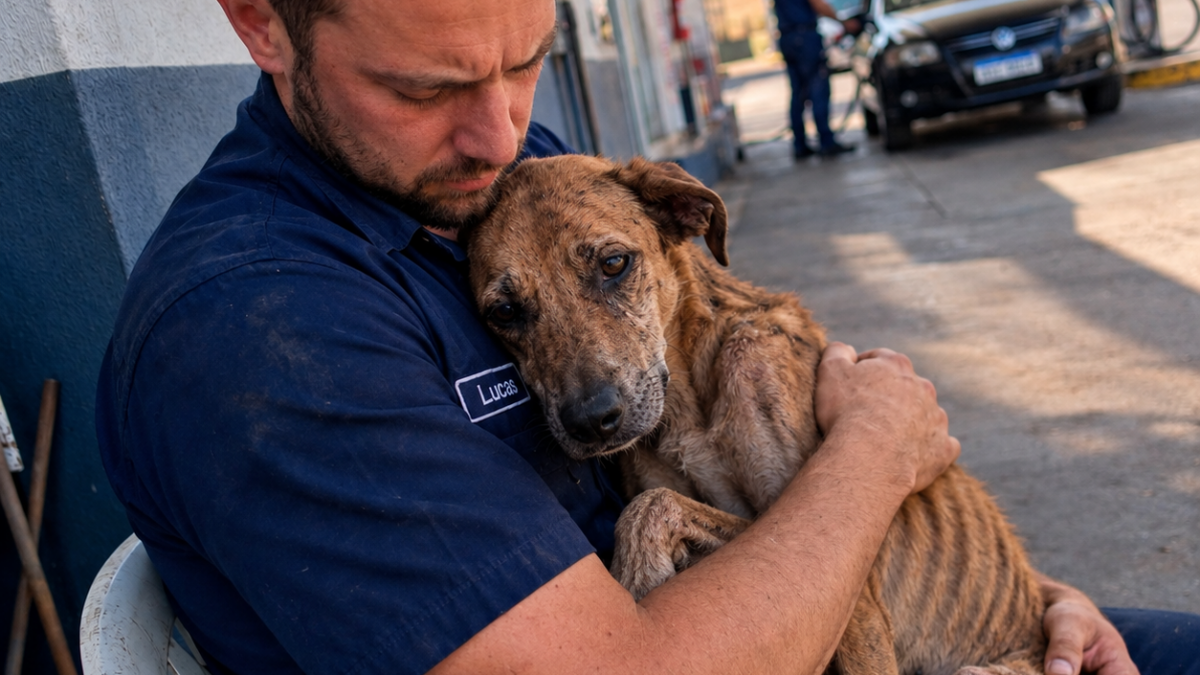
My blue uniform still had my plastic name badge clipped crookedly to the chest.
LUCAS.
DAY SHIFT.
I had forgotten to remove it.
“I’m not exactly the person you want signing financial guarantees.”
Dr. Hart leaned back.
“That is not what I’m deciding.”
“What are you deciding?”
“Whether you are serious.”
I looked through the window again.
The dog’s chest rose.
Fell.
Rose.
Fell.
“I told him I’d come back.”
Dr. Hart followed my gaze.
“He waited?”
“All day.”
“Maybe he was too sick to move.”
“Maybe.”
I swallowed.
“But I came back anyway.”
Something changed in her face.
“All right.”
She picked up the paperwork.
“Let’s find out what help exists before you bankrupt yourself on day four of employment.”
That was how the fight began.
Not with a miracle.
With forms.
So many forms.
A veterinary emergency assistance application.
A local rescue medical fund.
A charity program for stray animals requiring urgent surgery.
A temporary custody agreement while animal control searched for an owner.
Dr. Hart’s clinic had a small hardship fund created by a woman whose golden retriever had died years earlier.
It would cover part of the emergency stabilization.
Not surgery.
Part.
The rescue fund might cover another part if the dog officially entered foster status.
But that required a rescue to accept him.
Which required a foster.
Which required somewhere for him to go after surgery.
I lived in a one-bedroom apartment with a lease that said NO PETS in capital letters.
The situation was becoming more sensible by the minute.
At 7:30 that night, I called my mother.
She answered on the second ring.
“Lucas?”
“Hey, Mom.”
A pause.
My mother has always been able to hear trouble in the way I say one syllable.
“What happened?”
“I found a dog.”
Another pause.
“Of course you did.”
“That sounds judgmental.”
“You never call me at seven-thirty to tell me you found a sandwich.”
“He has cancer.”
Silence.
The kind that changes temperature.
“Where are you?”
“Cedar Grove Veterinary Hospital.”
“Is he stable?”
“Not really.”
“Owner?”
“Unknown.”
“Chip?”
“No.”
“Collar?”
“No.”
“Age?”
“Maybe six or seven.”
“Breed?”
“Mixed.”
“Size?”
“Medium.”
“Temperament?”
“Exhausted.”
“Lucas.”
“I don’t know yet.”
Mom sighed.
“What do you need?”
I looked at the stack of papers in front of me.
“A foster.”
“You cannot bring him to your apartment.”
“I know.”
“Do not say you’ll hide him.”
“I wasn’t going to.”
“You were thinking it.”
“I was exploring possibilities.”
“You were going to hide a cancer patient from a landlord.”
“When you say it like that, it sounds irresponsible.”
“It is irresponsible.”
I smiled despite myself.
Mom had been retired from shelter work for three years, but the intake coordinator in her never died.
“I can call people,” she said.
“You know a rescue?”
“I know everyone.”
“That sounds threatening.”
“It should.”
She paused.
“Lucas?”
“Yeah?”
“Do not promise that dog a cure.”
The words hurt.
“I didn’t.”
“What did you promise?”
I looked through the glass.
“That he wouldn’t be alone.”
Mom was quiet for a long time.
“That one you can keep.”
She made five calls in twenty minutes.
By eight-fifteen, a small nonprofit called Second Road Rescue had agreed to place the dog under their medical program if I agreed to act as his primary support person.
That sounded official enough to frighten me.
The rescue director, a woman named Carla Jiménez, spoke to me by phone.
“You found him?”
“Yes.”
“You paying what you can?”
“Yes.”
“You willing to transport?”
“Yes.”
“Medication schedule?”
“Yes.”
“Post-op supervision?”
“Yes.”
“Home?”
“Problem.”
“Of course.”
She sighed.
“Your mother tells me you are stubborn.”
“She says that about everyone.”
“She specifically used the phrase ‘good heart, poor planning.’”
“That sounds like her.”
“We may have a temporary foster for the first two weeks after surgery.”
My chest loosened slightly.
“Who?”
“Me.”
I blinked.
“You?”
“I run the rescue from my house.”
“I have a quiet spare room.”
“No dogs in that room.”
“Crate if needed.”
“Veterinary experience.”
I nearly cried.
“Thank you.”
“Do not thank me yet.”
“I haven’t met him.”
“He may hate me.”
“He may hate everyone.”
“He may have diarrhea on my carpet.”
“Then I will thank you later.”
“That is acceptable.”
By ten that night, the dog had a rescue backing him, a temporary foster, a partial medical grant, and a pile of paperwork thicker than my monthly bills.
What he still did not have was a name.
One of the technicians came into the waiting room.
“Do you want to see him?”
I stood so fast the chair scraped backward.
“Can I?”
“Five minutes.”
“Quiet.”
“He’s tired.”
The treatment room was warm.
Machines hummed softly.
The dog lay on a padded mat with an IV line taped to one front leg.
Up close, he looked even worse.
His brown fur had patches where the skin showed through.
His nails were overgrown.
There was an old rope mark around his neck, faint but visible.
Someone had owned him once.
Or controlled him.
Those are not always the same thing.
I sat on the floor several feet away.
“Hey.”
His eyes opened.
Dark brown.
Not hopeful.
Not frightened.
Just tired.
“I came back.”
One ear moved.
“That probably sounds impressive only to me.”
I shifted slightly closer.
“You need a name.”
His eyes closed again.
“Something dignified.”
Nothing.
“Thor?”
No reaction.
“Duke?”
Nothing.
“Sir Gas Station Dumpster?”
His eye opened.
“All right.”
“That one is too long.”
I thought about the way he had tried to stand behind the station.
The way every step seemed expensive.
The way he had looked at me when I promised to return.
“Cooper?”
His ear moved again.
It could have been random.
I chose to believe otherwise.
“Cooper.”
He opened both eyes.
“There.”
“That’s you.”
I reached one hand toward him, stopping before contact.
Cooper sniffed faintly.
Then lowered his head until his nose touched my knuckles.
The contact lasted maybe two seconds.
It was enough.
“You do your part,” I whispered.
“I’ll do mine.”
The next morning, I went to work.
I almost called out.
Mom told me not to.
“Your job is how you keep helping him.”
She was right.
Again.
Annoyingly.
At 5:55, I stood behind the gas station staring at the empty patch beside the dumpsters where I had found Cooper.
Frank came out carrying a cardboard box of windshield washer fluid.
He saw me looking.
“That where the dog was?”
I turned.
“You knew?”
“Security camera.”
“Oh.”
“You carried him to your car like a wounded soldier.”
I looked down.
“I was going to tell you.”
“Were you?”
“Eventually.”
Frank was fifty-eight, thick around the middle, permanently suspicious of management software, and capable of fixing almost anything with duct tape while insisting duct tape was not a substitute for proper maintenance.
“What’s wrong with him?” he asked.
“Cancer.”
Frank’s expression changed.
“Damn.”
“They think they can operate.”
“How much?”
“Too much.”
He nodded like a man who had lived long enough to understand that number without hearing it.
“You need time off?”
“Maybe surgery day.”
“You’ve worked here four days.”
“I know.”
“Terrible attendance.”
I stared at him.
He stared back.
Then he tossed me the store keys.
“Let me know when.”
That was Frank’s version of kindness.
Two days later, the pathology needle sample confirmed the mass was malignant.
The scans, however, showed no obvious spread to his lungs or liver.
Dr. Hart called me during my lunch break.
“We think surgery is reasonable.”
I sat on an upside-down milk crate behind the station.
“Reasonable good or reasonable terrible?”
“Reasonable hopeful.”
I closed my eyes.
“When?”
“Tomorrow morning.”
My heart started beating harder.
“Okay.”
“There’s something else.”
Of course there was.
“He is anemic enough that I want blood available.”
“Does that mean—”
“It means we prepare.”
“Not that something will go wrong.”
I stared across the asphalt toward the highway.
Cars moved past, hundreds of people traveling somewhere important.
“Is he scared?”
“He’s actually very quiet.”
“That might be worse.”
“I know.”
“Can I see him tonight?”
“Yes.”
I clocked out at three and drove straight to the clinic.
Cooper was stronger than he had been on the first night.
Not strong.
Stronger.
He could lift his head now.
He had eaten a few bites of chicken.
Dr. Hart said that like it was a medical breakthrough.
I understood why.
I sat beside him for an hour.
No dramatic conversation.
I told him about Frank.
About my rent.
About my mother’s tendency to turn any crisis into logistics.
About how I once thought thirty-two meant I would have a mortgage, a serious career, and a refrigerator containing more than eggs and mustard.
Cooper listened with his eyes half closed.
At some point, he moved one paw until it rested near my shoe.
Not touching.
Near.
It felt like trust on a trial basis.
Surgery began at eight the next morning.
I was not allowed to wait in the treatment area, so I sat in the lobby.
Mom arrived at nine.
I had not asked her to.
She lived forty minutes away and hated highway driving.
Still, she walked through the clinic doors carrying two coffees and a bag of food.
“You came.”
She handed me a cup.
“I raised you.”
“That does not answer the question.”
“It answers every question.”
Mom was sixty-four then, small, silver-haired, and capable of terrifying careless pet owners with a single stare.
She sat beside me.
“Have they called?”
“No.”
“Good.”
“How is no news good?”
“Because if something terrible happens, they do not wait politely.”
I wished she had phrased that differently.
We sat for another hour.
Then two.
At eleven-forty, Dr. Hart came through the double doors.
I stood.
Mom stood too.
Dr. Hart removed her surgical cap.
“He’s awake.”
My legs almost stopped working.
“Okay.”
“The mass was attached to a section of small intestine.”
“We removed it with clean margins as far as we can tell.”
“We’ll know more when pathology comes back.”
“His blood pressure dropped once, but he responded.”
“Transfusion helped.”
“Is he okay?”
“He has a long recovery.”
“That is not what I asked.”
Dr. Hart smiled for the first time.
“Yes, Lucas.”
“He made it through surgery.”
I sat down.
Hard.
Mom placed one hand on the back of my neck like she used to when I was a kid and had done something brave by accident.
I cried.
I did not care who saw.
The next three days taught me that surviving surgery and feeling good are unrelated concepts.
Cooper was miserable.
Nauseated.
Sore.
Confused.
He hated the recovery collar.
He hated medication.
He hated being encouraged to walk.
He hated Carla’s spare room when he was discharged to foster care.
Carla called me the first night.
“He will not eat.”
I sat up in bed.
“What?”
“He sniffed chicken.”
“Refused.”
“Rice?”
“Refused.”
“Canned food?”
“Refused.”
“Cheese?”
“Interested, then insulted.”
“What do we do?”
“Calm down.”
“I am calm.”
“You answered before I finished the sentence.”
“I am efficiently calm.”
Carla sighed.
“Come over tomorrow morning.”
I arrived before seven.
Cooper was curled on a thick bed in her spare room.
He looked smaller than ever.
The incision on his abdomen was covered.
His eyes opened when I entered.
His tail moved.
Barely.
Once.
Carla saw it.
“Well.”
I knelt beside him.
“Hey, buddy.”
He lifted his head.
Not much.
Then lowered it against my knee.
Carla stood in the doorway.
“He hasn’t done that with me.”
“Maybe he knows I owe him money.”
“Try food.”
I held a small piece of chicken near him.
Cooper sniffed.
Turned his head.
“Come on.”
Nothing.
I tore it smaller.
“Your doctor says you need calories.”
He stared at me.
“I know.”
“Doctors are annoying.”
One bite.
That was all.
But he swallowed it.
Carla leaned against the doorframe.
“Again.”
Second bite.
Then third.
By the fifth, Cooper had had enough.
But five bites became breakfast.
That became our routine.
Before work, I drove to Carla’s.
Sat on the floor.
Fed Cooper tiny amounts.
Gave medication hidden in soft food.
Walked him to the yard for three slow minutes.
Then drove to the gas station smelling like dog food and antiseptic.
After work, I returned.
The routine was exhausting.
I loved it.
That surprised me.
My life had felt shapeless before Cooper.
Wake.
Work.
Bills.
Television.
Sleep.
Repeat.
Now the hours had edges.
Medication at six.
Breakfast at six-fifteen.
Work at seven.
Call Dr. Hart on lunch.
Afternoon walk.
Evening food.
Check incision.
Text Carla.
Research cancer treatment.
Sleep.
I was still broke.
Still behind on rent.
Still working at a gas station.
But I was needed somewhere.
That changes the shape of a day.
Pathology came back nine days after surgery.
I was standing at pump six wiping diesel fuel from the concrete when my phone rang.
Dr. Hart.
I nearly dropped it.
“Tell me.”
“It was malignant.”
My stomach fell.
“Okay.”
“But.”
I gripped the phone harder.
“We got clean surgical margins.”
I closed my eyes.
“And the lymph node sample was negative.”
“What does that mean?”
“It means we have a reason to be optimistic.”
Not cured.
Not guaranteed.
Optimistic.
I had never loved a cautious word so much.
“What next?”
“Oncology consultation.”
“Probably oral chemotherapy.”
“Regular blood tests.”
“Scans every few months.”
“How long?”
“We don’t know.”
“Months?”
“Maybe.”
“Years?”
“Possible.”
That word nearly broke me.
Possible.
I looked toward the back of the station.
The bench where I had first seen him.
“Then we do it.”
The money problem did not disappear because the news was good.
Good news is expensive too.
The rescue fund covered part of the surgery.
I paid what I could from each paycheck.
I stopped buying coffee from anywhere that charged more than gas-station employee price.
I canceled streaming services.
Sold an old guitar I had not played in years.
Mom gave me two hundred dollars and refused repayment.
I argued.
She hung up on me.
Frank found out.
I still do not know how.
Probably Mom.
One Saturday, he placed a clear jar beside the register.
On the jar was a handwritten note:
COOPER’S MEDICAL FUND.
I stared at it.
“No.”
Frank did not look up from the inventory screen.
“Yes.”
“You can’t ask customers for money for my dog.”
“He is not your dog.”
“He is the station dog.”
“He has never been here since I found him.”
“Technicality.”
“Frank.”
He looked up.
“Lucas.”
“I don’t want charity.”
Frank stared at me so long I became uncomfortable.
“Do you think accepting help means you did less?”
“No.”
“Yes, you do.”
He pointed at the jar.
“Truckers already heard about him.”
“Mrs. Chen from the flower shop put twenty dollars in.”
“Dave from the tow company put fifty.”
“I put nothing because I pay you and that feels sufficient.”
I almost laughed.
Frank continued.
“People like helping a dog who got found behind their gas station.”
“Do not turn their kindness into your pride.”
That sounded so much like my mother that I suspected conspiracy.
The jar stayed.
Nobody donated a fortune.
That mattered to me.
Five dollars.
Ten.
Loose change.
A truck driver left twenty and wrote GOOD LUCK, BUDDY on the receipt.
A woman traveling with two children put three dollars in because her son insisted.
An old man gave one dollar every Tuesday.
Enough small kindnesses became one chemotherapy appointment.
Then another.
When Cooper was strong enough to leave Carla’s foster room, we faced the housing problem.
My landlord was named Mr. Hendricks.
He lived downstairs and considered every building rule a constitutional principle.
I rehearsed the conversation for two days.
Then knocked on his door.
He opened wearing slippers and an expression suggesting I had interrupted democracy.
“What?”
“I need to ask you something.”
“Rent?”
“I have half Friday and the rest next Wednesday.”
His face tightened.
“I know.”
“Not that.”
“What then?”
“There’s a dog.”
“No.”
“Can I finish?”
“No pets.”
“He has cancer.”
Mr. Hendricks stared.
“That does not make him less dog.”
“He’s in foster care now.”
“No.”
“I need somewhere for him to recover long-term.”
“No.”
“I’ll pay an extra deposit.”
“With what money?”
Fair.
I showed him photos.
I did not mean to use emotion as a weapon.
I did anyway.
The first photo was Cooper behind the station.
The second after surgery.
The third sitting weakly in Carla’s backyard with a blue bandana around his neck.
Mr. Hendricks studied the images.
His expression remained hard.
Then he pointed at the third one.
“That dog chews things?”
“No.”
“How do you know?”
“He barely has enough energy to insult furniture.”
Mr. Hendricks almost smiled.
Almost.
“My wife liked dogs.”
I had never heard him mention a wife.
“She died four years ago.”
“I’m sorry.”
He waved that away.
“She had a terrier.”
“Horrible animal.”
“Bit mailmen.”
“Stole socks.”
“Lived seventeen years out of spite.”
“That sounds impressive.”
“It was exhausting.”
He looked at Cooper’s picture again.
“Thirty days.”
My breath stopped.
“What?”
“Temporary exception.”
“Thirty days.”
“You keep the place clean.”
“No damage.”
“No barking complaints.”
“You pay what rent you can when you said.”
“After thirty days, we talk.”
I wanted to hug him.
That seemed unsafe.
“Thank you.”
He frowned.
“Do not make this emotional.”
“Of course not.”
Cooper came home with me on a Friday.
Home.
The word felt strange.
My apartment had never seemed like much.
One bedroom.
A small kitchen.
A couch I bought used.
A table with one uneven leg.
But before Cooper arrived, I cleaned everything.
Moved cleaning chemicals.
Bought two inexpensive rugs so he would not slip.
Put his bed near my couch.
Installed a cheap baby gate near the kitchen.
Mom inspected the setup and moved three things without asking.
“Why did you move his water?”
“Too close to the food.”
“Dogs eat and drink in the same room.”
“Not this dog.”
“How do you know?”
“I have instincts.”
“You have control issues.”
“Also true.”
Cooper entered slowly.
He stood in the doorway, body thin beneath his new harness, eyes moving around the room.
Carla held his medical bag.
Mom stood behind her.
I sat on the floor.
No pressure.
Cooper sniffed the mat.
The wall.
The corner.
Then walked to me.
He placed his head against my shoulder.
That was it.
Mr. Hendricks, watching from the downstairs hallway, muttered, “Damn dog.”
Mom pretended not to cry.
Carla did not pretend.
The first night, Cooper slept beside my bed instead of on the expensive orthopedic dog bed Carla had donated.
I woke at two in the morning because something warm was touching my hand.
I looked down.
His nose rested against my fingers.
I stayed awake for an hour because I was afraid moving would break something sacred.
Cancer treatment came in cycles.
Good days.
Bad days.
Days Cooper ate everything.
Days he sniffed chicken and walked away.
Days we made it around the block.
Days getting to the mailbox was enough.
Some medications made him nauseous.
Some made him sleepy.
Blood tests became part of our routine.
Dr. Hart celebrated weight gain by ounces.
“Two pounds,” she said one month.
I grinned.
“That’s good?”
“That’s excellent.”
I looked at Cooper.
“You hear that?”
He wagged.
“Fat.”
Dr. Hart pointed at me.
“Do not body-shame my patient.”
Cooper liked her.
That seemed unfair.
She inserted needles.
I offered chicken.
Still, when we entered the clinic, Cooper pulled toward her.
“Medical Stockholm syndrome,” I muttered.
Dr. Hart ignored me.
Three months after I found him, the first follow-up scan showed no visible recurrence.
I sat in my car afterward and cried with both hands on the steering wheel.
Cooper sat in the passenger seat wearing a seat-belt harness and watching traffic.
He had no idea we had just been handed more time.
Maybe dogs are wiser for that.
They do not need to know how much.
Only what the next hour contains.
That winter, Cooper began coming to the gas station occasionally.
Only on short days.
Only with Frank’s approval.
Only after Dr. Hart said his immune system was stable enough.
Frank put an old rubber mat behind the counter and called it Cooper’s office.
“This violates something,” I said.
“Probably.”
Cooper became absurdly popular.
Truckers asked for him.
Children spotted him through the window.
Mrs. Chen brought dog-safe biscuits.
The old man who donated one dollar every Tuesday finally met him and cried.
His name was Walter.
“I had a dog with cancer,” he told me.
“Years ago.”
“What happened?”
“Got fourteen months after diagnosis.”
He smiled.
“Best fourteen months I ever bought.”
I understood exactly what he meant.
Cooper did not work at the station.
Not really.
But he seemed to understand when people were tired.
He would sit near long-haul drivers who drank coffee alone.
He leaned against an older woman whose husband was in hospice.
He slept beside the chair of a teenager waiting for his father’s tow truck.
Maybe sick dogs recognize waiting.
Maybe I was projecting.
It did not matter.
People were gentler when Cooper was around.
I was too.
Six months after surgery, Mr. Hendricks knocked on my door.
My stomach tightened.
I assumed thirty days had finally become eviction.
Cooper barked once, then walked toward the door.
Mr. Hendricks entered when I opened it.
He looked around.
No damage.
No smell.
No destroyed furniture.
Cooper approached him slowly.
Mr. Hendricks held out one hand.
“You still alive?” he asked the dog.
Cooper sniffed him.
Then leaned against his leg.
Mr. Hendricks froze.
I said nothing.
He cleared his throat.
“Dog can stay.”
My chest loosened.
“Really?”
“Do not make it emotional.”
“Of course.”
Mr. Hendricks scratched Cooper behind the ear.
“He needs a better bed.”
“He has a two-hundred-dollar orthopedic bed.”
“Too soft.”
“Since when are you a veterinarian?”
“My wife knew dogs.”
That explained every opinion he would have from then on.
A week later, he brought up an old handmade wooden stand that raised Cooper’s bowls six inches off the floor.
“My wife’s terrier used this.”
“The terrier was twelve pounds.”
“Adapt it.”
So I did.
Spring came.
Cooper gained enough muscle that strangers no longer looked at him with pity first.
His coat turned deep chestnut in the sunlight.
His eyes became brighter.
His bark returned.
The first time he barked at a squirrel outside my apartment, I laughed so loudly Mr. Hendricks hit the ceiling downstairs with a broom.
“You’re celebrating noise now?” he yelled.
“Yes!”
“You’re both idiots.”
Cooper wagged.
Mom came every Sunday.
She said she was checking on him.
She was actually checking on me.
Before Cooper, we had drifted apart.
Not dramatically.
No fight.
No betrayal.
Just adulthood.
My father died when I was twenty-five.
After that, Mom buried herself in shelter work until retirement, and I buried myself in jobs I hated, plans I abandoned, and the quiet embarrassment of not becoming whatever I thought I was supposed to become.
Cooper gave us something to talk about before we remembered we knew how to talk about other things.
One Sunday, Mom sat at my kitchen table while Cooper slept under it.
“You look better,” she said.
“I shower now.”
“I noticed.”
“High standards.”
She smiled.
“I mean your face.”
“What was wrong with my face?”
“You looked absent.”
That hit harder than I expected.
“Before Cooper?”
“Before the gas station.”
“Before all of it.”
I stared at the table.
“I thought you were disappointed in me.”
Mom’s face changed.
“Lucas.”
“You had thirty years at the shelter.”
“Dad built houses.”
“I’m thirty-two and work cash register and pump six.”
She reached across the table.
“You think jobs tell me who my son is?”
I did not answer.
She looked down at Cooper.
“This dog found you on your fourth day there.”
“You were where you needed to be.”
That sentence stayed with me.
Maybe purpose is not always a destination.
Sometimes it is being present at 6:45 behind a gas station when something needs you.
Cooper reached one year after surgery.
Dr. Hart brought a cupcake into the exam room.
For me.
Not Cooper.
He got chicken.
The scan was clear.
Not permanently.
Not proof the cancer would never return.
But clear.
I had learned not to ask life for guarantees it could not give.
“Remission?” I asked.
“That’s a reasonable word.”
“How long?”
Dr. Hart smiled gently.
“There you go again.”
“I know.”
“Lucas, look at him.”
Cooper was sitting beside my leg, healthy weight restored, eyes bright, one ear tilted toward the hallway because a technician had opened a treat jar.
“He does not care how long.”
“I care.”
“I know.”
She leaned against the counter.
“That is the burden of loving animals.”
“They live in today.”
“We count tomorrows.”
I looked at Cooper.
“How do I stop counting?”
“You don’t.”
“You just don’t let counting ruin the day you have.”
Easier said than done.
Worth trying anyway.
At eighteen months, Cooper had a bad scan.
One small suspicious spot near a lymph node.
My stomach dropped so hard I thought I would be sick.
Further testing showed inflammation, not cancer.
I aged approximately nine years that week.
Frank found me sitting behind the station afterward.
“Good news?”
“Yes.”
“Then why do you look terrible?”
“Because I almost lost him.”
Frank sat beside me.
The same bench where I first saw Cooper.
“You know you will eventually.”
I turned on him.
“Helpful.”
“I’m fifty-eight.”
“I have stopped dressing truth nicely.”
He looked toward the dumpsters.
“That dog wasn’t supposed to be here this long, right?”
“No.”
“And yet.”
He shrugged.
“Maybe stop turning extra time into borrowed time.”
“What does that mean?”
“Borrowed things feel like they belong to someone else.”
He stood.
“Cooper’s time is his.”
“Spend it with him.”
Frank occasionally said something wise enough to be irritating.
The second year was our best.
Cooper was not young, but he felt good.
We hiked short trails.
Visited Mom.
Went to the lake.
He learned to swim badly.
Very badly.
He entered the water with confidence and immediately looked betrayed by physics.
I bought him a life jacket.
Frank called him Captain Cooper.
Mr. Hendricks said the life jacket color was ugly.
Carla’s rescue invited us to adoption events.
Cooper wore a vest that read MEDICAL FOSTER GRADUATE, which embarrassed me more than him.
He was good with frightened dogs.
He never rushed them.
Never crowded.
He sat.
Waited.
Let them approach.
At one event, a thin black dog refused to leave the back of her crate.
Cooper lay several feet away for twenty minutes.
Eventually, the dog crept forward.
Carla watched them.
“He remembers.”
“Being sick?”
“Being alone.”
That thought stayed with me.
Second Road Rescue eventually created a small medical assistance program for found animals needing urgent stabilization.
They named it Cooper’s Chance.
I argued against the name.
Carla ignored me.
“You did not found the rescue.”
“I found Cooper.”
“And Cooper founded the fund.”
“That is not legally how organizations work.”
“It is emotionally how they work.”
Mom approved.
Traitor.
The fund did not pay for everything.
No fund can.
But it helped with diagnostics, first-night stabilization, emergency medications, and the gap between finding an animal and figuring out who could take responsibility.
The kind of gap Cooper had nearly fallen through.
I volunteered twice a month.
At first, transportation.
Then intake support.
Then basic animal-care shifts.
Mom watched me clean kennels one Saturday and smiled.
“Do not.”
“What?”
“That face.”
“What face?”
“The I-knew-you’d-end-up-here face.”
“I raised you in a shelter.”
“You had unfair influence.”
“You used to sleep in the laundry basket while I cleaned kennels.”
“I was four.”
“Strong work ethic.”
By the time I was thirty-five, I still worked at the gas station.
But not only there.
I had taken evening courses in veterinary assisting.
Slowly.
One class at a time.
Anatomy.
Animal handling.
Medication basics.
Client communication.
The first semester almost destroyed me because I had forgotten how to study.
Cooper lay beside the table while I worked through flash cards.
Every time I got an answer wrong, he stared at me with profound disappointment.
At least, that is what I chose to believe.
Dr. Hart let me shadow at the clinic occasionally.
“You know you’re doing this because of him,” she said one night.
“Of course.”
“Does that scare you?”
“What?”
“That when he is gone, this will remain.”
I looked through the treatment-room window.
Cooper was asleep in the staff office on his blanket.
“No.”
Then I realized the answer was true.
“No.”
That was Cooper’s second gift.
The first was needing me.
The second was teaching me how to remain useful when he eventually did not.
Two years and seven months after surgery, Cooper stopped eating breakfast.
I knew immediately.
People tell you not to panic over one missed meal.
Usually, they are right.
But after years of cancer, you learn an animal’s ordinary patterns with frightening precision.
Cooper ate breakfast.
Always.
Even after chemotherapy.
Even when nauseated, he eventually ate something.
That morning, he sniffed the bowl and walked away.
My chest tightened.
“Cooper.”
He looked at me.
Tail wag.
Normal.
Mostly.
I called Dr. Hart anyway.
She fit us in that afternoon.
Bloodwork.
Ultrasound.
Waiting.
The old sequence.
I hated how quickly my body remembered.
Dr. Hart entered the exam room and closed the door.
The click sounded too final.
“Lucas.”
I looked at her.
“It’s back.”
There are sentences you prepare for and still cannot hear properly.
I stared at the floor.
“Where?”
“Liver.”
“How much?”
“Multiple lesions.”
“Surgery?”
She shook her head.
“Chemo?”
“Possibly palliative.”
“How long?”
Her eyes filled this time.
Not doctor eyes.
Emily eyes.
“We are not talking about cure now.”
I turned toward Cooper.
He was sniffing the bottom of a treat container.
Of course he was.
My dog had just been given a terminal diagnosis and was committing low-level theft.
I laughed.
Then covered my face.
Dr. Hart sat beside me.
“We can keep him comfortable.”
“Weeks?”
“Maybe months.”
“How many?”
“Lucas.”
“I need to know.”
“No.”
Her voice was gentle.
“You want to know.”
“You do not need to.”
I looked at her.
“You promised him he would not be alone.”
My throat closed.
She remembered.
Years later, she remembered.
“You never promised forever.”
I nodded.
Barely.
“What do I do?”
“Go home.”
“Give his medication.”
“Let him eat things he loves.”
“Walk if he wants.”
“Sleep if he wants.”
“Call me when good days become harder to find.”
I pressed my forehead against Cooper’s head.
He licked my cheek once.
Terrible timing.
At home, I sat on the kitchen floor and cried until my face hurt.
Cooper lay beside me.
Not because he knew he was dying.
Because I was sad.
Dogs do not need the diagnosis to understand the room.
Mom came immediately.
She did not say it would be okay.
That was one of the reasons I loved her.
She sat beside us.
Mr. Hendricks came upstairs with a plate of chicken.
Frank showed up after closing with Cooper’s old donation jar.
“What is that?”
“The jar.”
“I see that.”
“We’re using the money for whatever he wants.”
“There is sixteen dollars in there.”
“Then he has sixteen dollars.”
“What does a dog buy with sixteen dollars?”
Frank looked at Cooper.
“Steak.”
That night, Cooper ate steak.
Badly cooked.
Frank insisted on doing it himself.
We called the next weeks Cooper’s retirement.
No more medical-foster vest.
No more demonstrations.
No schedules except medication.
He went to the gas station only when he wanted.
Most mornings, I left him with Mom or Mr. Hendricks because he tired easily.
When I came home, he still tried to stand at the door.
I told him to stop.
He ignored me.
Some things remained sacred.
We went to the lake one more time.
He wore the ugly life jacket.
He did not swim.
He lay at the water’s edge with his paws in the shallows.
I sat beside him.
“You know, I hated this job when I started.”
He looked at me.
“The gas station.”
“I thought it meant I had failed.”
He sighed.
“You could pretend to care.”
Nothing.
“I found you there.”
His tail moved.
“That was inconvenient.”
Another wag.
“I was broke.”
Wag.
“Still am, actually.”
He rested his head on my knee.
“I thought I was saving you.”
My voice cracked.
“You have been extremely expensive for someone being saved.”
He closed his eyes.
I put one hand over his ribs.
They no longer showed sharply like the first day.
He had lived long enough to become soft.
That felt like victory.
By the third month, the bad days began outnumbering the good ones.
Not dramatically.
Quietly.
A shorter walk.
A meal unfinished.
A night he could not get comfortable.
A morning when he looked at the stairs and decided not to try.
Dr. Hart adjusted medication.
It helped.
Until it did not.
One Tuesday, I woke at four-thirty because Cooper was standing beside my bed.
He never stood there anymore.
His breathing was heavy.
I sat up.
“Hey.”
He looked toward the apartment door.
“You need outside?”
He walked slowly toward it.
We went downstairs.
Mr. Hendricks’ apartment was dark.
The street was empty.
Cooper walked to my car.
Not the grass.
The car.
I stared at him.
“Where are we going?”
He looked at me.
Then at the door.
I knew.
The gas station.
The place where I found him.
I helped him into the back seat.
The drive took nine minutes.
Frank’s truck was already there because he opened early on Tuesdays.
The sky was beginning to lighten.
I parked behind the station.
Cooper tried to stand.
I opened the door and lifted him.
He was heavier than the first time.
Still far too light.
But not the skeleton I had carried years before.
Frank came around the building.
He stopped when he saw us.
“Oh.”
I lowered Cooper onto the grass near the little metal bench.
The dumpsters were still there.
New lids.
Same wall.
Same cracked pavement.
Cooper sniffed.
Then walked slowly toward the spot where I had first seen him.
He circled once.
Lay down.
I sat beside him.
Frank stood several feet away, arms crossed tightly.
The sun edged over the highway.
Cars moved past.
The world began another ordinary day.
Cooper rested his head on my shoe.
“I came back,” I whispered.
His tail moved once.
“I told you I would.”
Frank looked away.
My throat tightened.
“You waited for me.”
Cooper breathed slowly.
“And then you stayed.”
I called Dr. Hart from that bench.
She listened.
Asked questions.
Breathing.
Food.
Pain.
Mobility.
Then she said, “Lucas, I think we’re close.”
I already knew.
That did not make hearing it easier.
“Today?”
“If you are asking me whether it is too early, no.”
“And if I wait?”
“It may become too late.”
Those words made the decision.
I had promised Cooper he would never fight alone again.
I would not turn his last hours into a crisis because I was afraid of my own grief.
Dr. Hart agreed to come to my apartment that afternoon.
I took Cooper home.
Frank closed the station for twenty minutes and drove behind me because he did not trust me to drive alone.
Mom came.
Carla came.
Mr. Hendricks came upstairs wearing the good shirt he usually saved for church.
Emily arrived at four.
Cooper lay on his orthopedic bed near the window.
The same bed Mr. Hendricks once criticized.
Sunlight warmed one side of his face.
Mom sat near his back.
Frank sat on the floor, which I had never seen him do voluntarily.
Carla brought the blue bandana Cooper wore during his first foster week.
She laid it beside him.
Dr. Hart gave us time.
No one rushed.
I brought out the old gas-station name badge I had worn the morning I found him.
LUCAS.
DAY SHIFT.
I placed it beside the bandana.
Mom looked at me.
“What’s that for?”
“I was wearing it when he found me.”
“You found him.”
I shook my head.
“No.”
“He was exactly where he needed to be.”
Mom’s eyes filled.
“Then maybe you found each other.”
Cooper opened his eyes when I sat beside him.
I placed one hand against his chest.
His heartbeat was slow.
Tired.
Still there.
“Hey, buddy.”
His tail moved faintly.
“I need to tell you something.”
Frank muttered, “He knows.”
“Let me do this.”
“Sorry.”
I leaned closer.
“I promised you something behind that gas station.”
Cooper watched me.
“I said I’d come back.”
“I did.”
“I said you wouldn’t be alone.”
My voice broke.
“You aren’t.”
Mom began crying.
I did not look away from Cooper.
“I couldn’t promise you cancer wouldn’t come back.”
“I couldn’t promise forever.”
“I’m sorry.”
His eyes stayed steady.
“But I can keep the one promise I made.”
I pressed my forehead against his.
“You are not doing this alone.”
Dr. Hart waited until I nodded.
The medication relaxed him first.
His body softened.
The tension went out of his legs.
His head became heavy in my lap.
I remembered the first day.
How light he had been.
How his head had rested against my arm because he had no strength to hold it up.
Now he rested because he trusted me to hold it.
That difference was everything.
Frank reached out and touched one paw.
Carla whispered, “Good boy.”
Mom stroked his shoulder.
Mr. Hendricks stood near the door crying openly and making no attempt to hide it.
Dr. Hart administered the final medication.
Cooper’s breathing slowed.
One breath.
Another.
Then a long, soft exhale.
And stillness.
I kept my hand on his chest long after the heartbeat ended.
No one told me to move.
Eventually, I whispered the only thing I could.
“You waited.”
Then I corrected myself.
“We both did.”
Cooper’s ashes came home two weeks later.
I placed them in a simple wooden box.
Not fancy.
On top, I put his collar.
Beside it, the old plastic gas-station badge.
Frank complained that company property had been stolen.
Then he built the shelf the box sat on.
Mr. Hendricks pretended not to notice the memorial in a no-pets apartment.
Mom added a photograph of Cooper by the lake wearing the ugly life jacket.
Carla added a small card from Second Road Rescue.
Cooper’s Chance helped its twenty-seventh animal that year.
A pregnant hound with an infected wound.
Then a senior terrier needing emergency dental surgery.
Then a shepherd hit by a car.
Then a cat found half-frozen behind a grocery store.
Small beginnings.
Not every animal survived.
That mattered too.
We never promised cure.
Only that being poor, stray, sick, or inconvenient would not automatically mean being alone.
I finished my veterinary assistant program six months after Cooper died.
Graduation was held in a small auditorium at the community college.
Mom came.
Frank came in a shirt with buttons and complained about parking.
Carla came.
Dr. Hart came late after an emergency surgery and stood in the back.
Mr. Hendricks did not come because he said graduations were “too much sitting,” but he left an envelope under my door.
Inside was a card.
Your dog would be proud.
Do not make this emotional.
I laughed so hard I cried.
A month later, Cedar Grove Veterinary Hospital offered me a job.
Entry level.
Not glamorous.
Cleaning treatment rooms.
Holding nervous dogs.
Preparing supplies.
Calling clients.
Learning.
My first paycheck was smaller than I hoped.
I accepted immediately.
I still worked two shifts a week at the gas station for almost a year.
Partly for money.
Partly because I could not quite leave the place where everything changed.
Frank eventually hired a kid named Mateo to replace me.
On Mateo’s fourth day, he found a kitten sleeping beneath the ice machine.
He called me.
“What do I do?”
I laughed.
“First, don’t promise anything you can’t keep.”
“What can I promise?”
I looked at Cooper’s photograph on my desk at the clinic.
“That you’ll come back.”
Years have passed now.
I am thirty-eight.
I still work at Cedar Grove.
I am no longer the guy cleaning every treatment room, though I still do it when we are busy because cancer does not care about job titles and neither does bleach.
I coordinate with Second Road Rescue on emergency medical cases.
Mom volunteers there once a week despite claiming retirement should mean something.
Frank retired from the gas station last year and immediately began showing up at the rescue because apparently people do not change as much as they pretend.
Mr. Hendricks sold the apartment building and moved closer to his daughter.
Before he left, he gave me the raised wooden food stand that had belonged to his wife’s terrible terrier and then Cooper.
“It should stay with a dog person,” he said.
I still have it.
At the gas station, behind the building near the little bench, there is now a metal water bowl bolted to a low stand.
Truck drivers refill it.
Staff check it every shift.
Above it is a small plaque.
Frank hated plaques, so he refused to put anything sentimental on it.
It simply says:
WATER FOR ANYONE WAITING.
I think that is perfect.
Sometimes I stop there before work.
Especially on October 12.
I sit on the same bench with coffee.
The highway sounds the same.
Trucks.
Tires.
Brakes.
People going somewhere.
The dumpsters have moved farther back now.
The wall has been repainted.
Almost nothing looks like it did when Cooper stood there shaking on my fourth day.
But I can still see him.
Thin.
Unsteady.
Pale gums.
Eyes without expectation.
I used to think the most important thing I did was telling the veterinarian, “Do whatever it takes.”
It wasn’t.
Money mattered.
Surgery mattered.
Medicine mattered.
Chemotherapy mattered.
But none of those were the promise.
The promise happened earlier.
Behind a gas station.
When I told a sick dog I would come back.
That was the first thing he needed from me.
Not money I did not have.
Not medical knowledge I had not learned yet.
Not a career.
Not a perfect life.
Return.
Presence.
Someone noticing that he was still there at three o’clock.
Someone lifting him carefully.
Someone sitting through surgery.
Someone learning medication schedules.
Someone staying on the bad days.
Someone holding his head at the end.
Cooper did not beat cancer forever.
That is not the ending people usually hope for when they hear a rescue story.
But he beat being alone.
Every day after October 12, he beat it.
He beat it in Carla’s spare room.
In my tiny apartment.
Behind the gas station counter.
At the lake.
At Mom’s house.
In Dr. Hart’s clinic.
On his ugly orthopedic bed.
In the arms of people who learned to love him because he had survived long enough for them to meet him.
And on his final afternoon, when the cancer finally took what medicine could no longer protect, it did not take him behind a dumpster.
It did not take him unseen.
It did not take him waiting for someone who had forgotten him.
It found him at home.
His head in my lap.
His friends around him.
My hand over his heart.
The promise still intact.
I spent years thinking I had found Cooper because I happened to be behind the gas station at the right moment.
Now I think about it differently.
I was thirty-two, broke, ashamed of my job, and convinced my life had gone off course.
Cooper was sick, abandoned, and lying beside a dumpster with no reason to believe anyone would return.
Neither of us looked like much of a success story.
Maybe that was why we recognized each other.
He needed someone to come back.
I needed something worth coming back for.
So when people ask me when my life changed, I do not say when I started working at the veterinary hospital.
I do not say when I finished school.
I do not say when I finally paid off the debt from Cooper’s treatment.
I tell them the truth.
My life changed at 6:45 on the morning of October 12.
On the fourth day of a job I thought proved I had failed.
Behind a gas station.
Beside a sick brown dog who could barely stand.
He looked at me.
I told him I would come back.
And for once in my life, a promise became a direction.








