On a freezing October morning in Detroit, we found a starving mother dog under an abandoned car—but the five puppies curled against her were warm, dry, and completely full
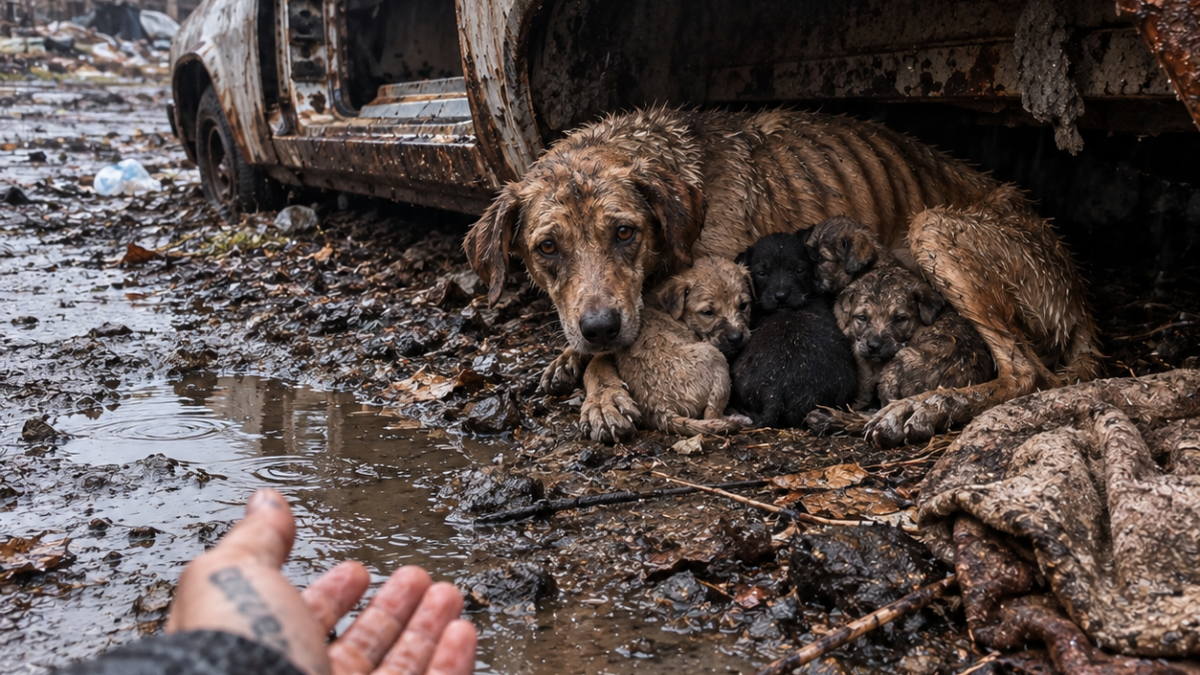
I did not move my hand.
The rain tapped steadily against the rusted metal above us.
Water dripped from the edge of the car and landed inches from my shoulder.
The mother dog’s head rested across my fingers with almost no weight at all.
That frightened me.
A dog her size should have felt solid.
Warm.
Heavy.
Instead, she felt like fur stretched over bone.
Her eyes remained half open.
Still watching me.
Still deciding whether surrendering even an ounce of control was safe.
“You’re okay,” I whispered.
I did not know if she was okay.
She was clearly not.
But sometimes reassurance is less about describing reality and more about telling another living creature what you intend to make true.
James had backed away enough to call for veterinary transport.
I heard him talking to dispatch above the rain.
“Adult female, severe emaciation, lactating, five pups, approximately two to three weeks old.”
He paused.
“Yes, all alive.”
Another pause.
“Mother is responsive but extremely weak.”
I looked at the puppies again.
Five.
One was tan with a dark muzzle.
One almost black except for a white chest.
Two were brown like their mother.
The smallest had a white stripe running from forehead to nose.
They squirmed against one another, warm beneath the shelter she had made of herself.
One found a teat and began nursing.
The mother’s body tightened.
Not from pain.
From instinct.
Even now.
Even barely conscious.
Her body answered the puppy.
My throat closed.
“James.”
He ended the radio call and crouched near me.
“What?”
“We need to move them together.”
He nodded immediately.
“No question.”
We had both seen frightened mothers panic when puppies were removed too quickly.
This dog had protected hers under conditions I did not want to imagine.
Taking them out of sight might destroy the fragile trust she had just given us.
James opened the rescue kit.
Blankets.
Towels.
A shallow plastic crate.
Heat packs.
Gloves.
A slip lead we hoped we would not need.
I reached slowly toward the mother’s neck.
No collar.
But there was a thin line in the fur where one might once have been.
That detail bothered me.
A stray born outside rarely carries the clean impression of an old collar.
At some point, she may have belonged to someone.
I filed the thought away.
Right then, history mattered less than breathing.
“Can you lift her?” James asked.
“Not until we move the pups.”
The mother’s eyes opened wider.
I immediately stopped reaching.
“No one’s taking them.”
Her breathing quickened.
James lowered his voice.
“We can slide the whole blanket under them.”
There was no blanket beneath her.
Only flattened cardboard, dry leaves, and pieces of old upholstery she had somehow dragged under the car.
A nest.
She had built a nest under an abandoned sedan.
James crawled in from the other side.
The mother watched him.
A weak growl returned.
He froze.
“Hi, Mama.”
She stared.
He lowered his face slightly, avoiding direct eye contact.
“You’re right.”
Her ears moved.
“I’m suspicious too.”
I almost laughed.
Even in terrible places, James had a way of talking to animals as if they were coworkers having a difficult shift.
He slowly pushed a clean fleece blanket across the dirt.
The mother sniffed it.
No reaction.
Another inch.
Still nothing.
Eventually, we worked it beneath the puppies without lifting them far.
The smallest squeaked.
The mother’s head snapped toward him.
That movement cost her.
She swayed.
I placed one hand beneath her chest before she fell forward.
“Easy.”
She looked at the puppy.
Only the puppy.
James whispered, “All here.”
She counted them with her nose.
One.
Two.
Three.
Four.
Five.
Then she let her head fall again.
I never forgot that.
She had no idea what animal control was.
No understanding of clinics, IV fluids, foster homes, adoption contracts, or rescue organizations.
But she understood five.
Five smells.
Five tiny voices.
Five bodies.
Her entire world.
The transport van arrived twelve minutes later with our field supervisor, Carla Ruiz.
Carla had worked rescue longer than either James or me and had the kind of calm that made chaos embarrassed to enter the same room.
She took one look under the car and stopped.
“Oh, Mama.”
The dog’s ears twitched.
Carla crouched.
“Vitals?”
“Barely responsive but stable enough to handle,” I said.
“Puppies warm?”
“Surprisingly.”
“Any obvious trauma?”
“Not besides condition and one sore rear paw.”
Carla looked at the puppies.
Then at the mother.
“She gave them everything.”
James nodded.
“All of it.”
We used two rigid rescue boards and the blanket to create a temporary stretcher.
The puppies remained against her belly.
The mother tried to stand when we first moved the board.
Her front legs pushed.
Her back legs failed.
She growled again.
Stronger this time.
Not because she was recovering.
Because fear gave her a brief reserve.
I placed my hand near her face.
“Look at me.”
She did.
“Your babies are right here.”
James kept his palm beside the puppies.
“All five.”
The smallest squeaked.
The mother looked down.
Then stopped struggling.
We slid the board out from beneath the car.
Rain hit her directly for the first time.
She tried to curl around the puppies again.
Even while being carried.
Carla swore softly under her breath.
“Cover her.”
We placed another blanket across them, leaving her head exposed.
The trip from the vacant lot to the truck was maybe forty yards.
It felt like carrying something sacred.
Mrs. Henderson stood beneath an umbrella near the sidewalk.
She was a thin woman in her seventies, wrapped in a purple raincoat.
When she saw the dog, she covered her mouth.
“Oh, Lord.”
“You’re the one who called?” James asked.
She nodded.
“I heard them every night.”
Her eyes filled.
“I thought maybe somebody else would come.”
Then she looked ashamed.
“I should’ve gone sooner.”
Carla stopped beside her.
“You called.”
Mrs. Henderson looked at the puppies.
“I called three times.”
“And today we got them.”
The older woman touched her chest.
“Is she going to live?”
None of us answered immediately.
That was answer enough.
“We’re going to give her every chance,” I said.
Mrs. Henderson nodded.
Then she leaned closer to the mother.
“You did good, baby.”
The dog’s eyes moved toward her.
“You did real good.”
We loaded the family into the heated compartment of the rescue van.
I rode with them.
James followed in our truck.
The mother’s head rested near my knee.
Every few minutes, her eyes opened.
She checked the puppies.
Then me.
Then closed again.
I counted breaths.
Rescue workers do that without thinking after a while.
Breath.
Pause.
Breath.
Pause.
Too long?
No.
There.
Another.
The smallest puppy began nursing again.
I almost moved him away.
Surely she had nothing left to give.
But Carla, driving, glanced through the partition.
“Let him.”
“She’s depleted.”
“We’ll separate carefully at the clinic.”
The mother shifted one front leg around him.
I looked down.
She was still mothering.
Still working.
Even while her body was failing.
“Do you think she knows we’re helping?”
Carla kept her eyes on the road.
“She knows nobody has hurt the puppies yet.”
That was more honest.
Trust was not the absence of fear.
Sometimes trust was simply waiting another minute before deciding you had to fight.
Detroit Animal Emergency Center had been alerted.
The rear doors opened before we fully stopped.
Dr. Priya Shah and two technicians met us with warmed blankets and a gurney.
Dr. Shah looked at the mother.
Then at me.
“How long outside?”
“Unknown.”
“Pups?”
“Five, nursing, appear roughly three weeks.”
“Mother eating?”
“Unknown.”
“Any vomiting or diarrhea observed?”
“No.”
They moved quickly.
But never fast around the mother.
That distinction mattered.
One technician, Leah, took the puppies one at a time.
Each was weighed, examined, warmed, then placed in a clear neonatal enclosure positioned where the mother could see them.
The first puppy left her side.
Her head came up.
“Easy,” I said.
The puppy squeaked.
She tried to rise.
Her body collapsed.
Dr. Shah stopped.
“Bring him back into sight.”
Leah held the puppy closer.
The mother sniffed him.
Settled.
The examination continued.
The pups were underweight for their apparent age, but far healthier than any of us expected.
Slight dehydration.
Fleas.
One with mild upper-respiratory congestion.
No major injuries.
No severe hypothermia.
No obvious congenital problems.
The mother was different.
Dr. Shah’s face became more serious with every minute.
“Temperature low.”
She listened to the heart.
“Pulse weak.”
Checked gums.
“Anemic.”
Pressed carefully along the abdomen.
The dog barely reacted.
“That worries me.”
“What?”
“She should object more.”
Blood was drawn.
An IV catheter placed.
Warm fluids started slowly.
Glucose.
Pain relief.
Antibiotics after samples.
A small amount of high-calorie nutrition, carefully controlled.
Dr. Shah looked at me.
“She’s profoundly malnourished.”
“Can we feed her?”
“Yes, but slowly.”
“Why slowly?”
“Refeeding complications.”
I knew the basics.
When a body starves long enough, suddenly flooding it with nutrition can create dangerous metabolic shifts.
Wanting to give everything quickly can kill the creature you are trying to save.
Rescue was full of cruel lessons like that.
Even kindness sometimes needed restraint.
“Do you think she’ll make it?”
Dr. Shah glanced at the puppies.
Then the mother.
“I think she wants to.”
That was not an answer.
I knew why.
“Medically?”
“Next twenty-four hours matter.”
The mother’s eyes opened.
Dr. Shah crouched beside her.
“You hear us talking about you?”
One ear moved.
“She needs a name,” Leah said.
I looked at the rain streaking the treatment-room window.
“October?”
James had arrived behind me.
“No.”
I turned.
“Why?”
“She deserves something that isn’t the month she almost died.”
Fair.
Leah smiled.
“What about Hope?”
Carla groaned from the doorway.
“We have twelve Hopes in the system.”
“True.”
James looked at the dog.
“June?”
“It’s October.”
“I know.”
“Why June?”
“My grandmother was named June.”
“That explains nothing.”
“She was stubborn.”
The mother opened her eyes again.
James pointed.
“See?”
I laughed despite myself.
Carla shook her head.
“June it is unless she files an objection.”
The dog did not.
So the starving mother under the abandoned car became June.
The puppies received temporary colors instead of names at first.
Blue collar.
Green.
Yellow.
Red.
Purple.
Simple.
Less emotional.
We told ourselves that mattered.
By lunch, James had named Purple “Dot” because of the white stripe on her forehead.
The system collapsed quickly.
Blue became Otis.
Green became Maple.
Yellow became Beans.
Red became Henry.
Purple became Dot.
Professional boundaries had survived nearly three hours.
June’s bloodwork came back worse than we hoped.
Severe anemia.
Low protein.
Electrolyte imbalance.
Signs of chronic malnutrition.
Heavy parasite load.
Early mastitis in one mammary gland.
No organ failure yet.
That last part became our anchor.
Yet.
Her body was damaged.
But not finished.
Dr. Shah reduced nursing while keeping puppies close.
The babies received formula supplements.
June hated that.
The first bottle feeding happened within her view.
Leah picked up Otis.
June lifted her head.
Her eyes followed every movement.
Leah fed him.
Otis drank greedily.
June stared.
When Leah put him back near her face, June licked his entire head with such intensity that he squealed.
“I think she disapproves of our technique,” James said.
June glared at him.
“Definitely.”
By evening, she had swallowed three teaspoons of recovery food.
Three.
We celebrated as if she had eaten Thanksgiving dinner.
The first night, I went home.
Technically.
I showered.
Changed.
Lay in bed.
Then stared at the ceiling.
At 1:12 a.m., I called the clinic.
Leah answered.
“She’s sleeping.”
“Breathing?”
“That’s generally how sleeping works, Rachel.”
“Funny.”
“Vitals stable.”
“Puppies?”
“Currently making sounds inconsistent with peace.”
“Good.”
“Go to sleep.”
I tried.
At 2:40, my phone rang.
I grabbed it so hard it hit my face.
“Hello?”
“Rachel, it’s Leah.”
I sat up.
“What happened?”
“June’s temperature dropped again.”
My stomach turned.
“We’re warming her. Dr. Shah is here.”
“Do you need me?”
“No.”
I was already pulling on pants.
“I’m coming.”
“Of course you are.”
The clinic was quiet when I arrived.
Emergency lights low.
Machines humming.
June lay beneath warming blankets with fluid lines running beside her.
Her puppies slept in the enclosure a few feet away.
I sat on the floor.
“Hey.”
Her eyes opened.
Very slowly.
“You do realize I have work tomorrow.”
One ear twitched.
“This is manipulative.”
She closed her eyes.
I stayed until sunrise.
Around four, her temperature began rising.
At five, she ate one teaspoon of food from my fingers.
At six, two more.
At seven, Dr. Shah entered, saw me on the floor, and sighed.
“You know we employ people overnight.”
“I’m aware.”
“You pay us.”
“Also aware.”
“Then why are you here?”
June rested her chin on my ankle.
Dr. Shah looked down.
“Oh.”
“Exactly.”
Day two was slightly better.
June sat up for almost thirty seconds.
Then collapsed back against the blanket.
But she had chosen to sit.
She watched the puppies take formula.
She drank water on her own.
She ate six small meals totaling less than one normal serving.
We celebrated every one.
On day three, she stood.
Her legs shook.
James had come before his shift.
I was beside him.
June pushed up on her front legs first.
Paused.
Then brought her hind legs underneath.
For one glorious second, she stood perfectly upright.
Then two.
Then three.
“June,” I whispered.
She looked toward the puppy enclosure.
Walked one step.
Then another.
Her back legs buckled.
James caught her chest before she hit the floor.
“Easy.”
June did not care about falling.
She cared about reaching the puppies.
Leah moved their enclosure closer.
June crawled the remaining distance and pressed her nose against the clear panel.
Five puppies immediately woke and began squeaking.
Her tail moved.
Once.
That was the first time we saw it.
James looked at me.
“Did you see that?”
“Yes.”
“Tail.”
“I saw.”
“June.”
Her tail moved again.
I cried.
James pretended not to.
By day five, she could walk across the treatment room.
Slowly.
Her steps stiff.
Head low.
But walking.
The pups were thriving on a combination of supervised nursing and formula.
June’s milk supply gradually decreased as we protected her body from further depletion.
She tolerated bottles now.
Barely.
Whenever a puppy returned, she inspected its face as though checking the work of incompetent babysitters.
The clinic staff adored her.
June did not adore the clinic staff.
She tolerated Dr. Shah.
Accepted Leah.
Liked James.
And attached herself to me in a way I tried not to examine too closely.
Whenever I entered the room, her eyes brightened.
When I left, she watched the door.
“She needs a foster,” Carla said on day seven.
“I know.”
“Maya’s full.”
“I know.”
“Denise has a male dog who won’t tolerate nursing mothers.”
“I know.”
“Patrick has stairs.”
“I know.”
Carla watched me.
I avoided her eyes.
“You have a spare room.”
“There it is.”
“And a fenced yard.”
“I work ten-hour shifts.”
“At animal rescue.”
“That does not make it shorter.”
“You live fifteen minutes from the shelter.”
“I know where I live, Carla.”
June was lying beside my chair.
Her head rested on my boot.
Carla looked down.
Then back at me.
“Temporary.”
I laughed.
“Do not say that word to me.”
“What word?”
“You know what happens when rescue people say temporary.”
“Sometimes it actually means temporary.”
“When?”
She considered.
“Fair.”
I fostered June and the puppies.
Temporarily.
James helped me convert my laundry room and back den into a nursery.
We covered the floor with washable pads.
Set up a low puppy pen.
Added two beds for June.
One inside.
One outside.
Ceramic water bowls.
Blankets.
Heating pad under half the puppy area.
No stairs.
No slippery floors.
No unnecessary visitors.
When we brought them home, June stood at my front door for nearly a full minute.
She sniffed the threshold.
Looked at me.
Then looked back toward the transport van.
The puppies were in a crate.
I carried them inside first.
June immediately followed.
Of course.
She entered not because she trusted the house.
Because the puppies were there.
That was fine.
Trust could begin with logistics.
The first night, June refused both beds.
She slept inside the puppy pen.
Her body curled around them even though the room was warm and dry.
At 3 a.m., I woke to silence and panicked.
I checked the camera.
June was awake.
Sitting.
Watching the window while all five puppies slept against her stomach.
Guarding.
Still.
“You’re inside,” I whispered from the doorway.
June looked at me.
“There is a roof.”
She blinked.
“No rain.”
Nothing.
“You can sleep.”
She did not.
I brought a pillow and lay on the floor outside the pen.
June watched me.
For twenty minutes.
Then thirty.
At some point, I fell asleep.
When I woke around five, June was lying down.
Her eyes closed.
Not deeply asleep.
But resting.
That became our first victory at home.
Rest.
Not eating.
Not walking.
Resting while someone else remained awake.
For dogs who have survived on vigilance, sleep can be trust made visible.
The puppies grew with offensive speed.
Within two weeks, they transformed from soft potatoes into criminals.
Otis learned how to climb the low pen first.
Maple learned by watching.
Beans discovered shoelaces.
Henry believed human toes were prey.
Dot was the smallest and smartest.
She waited for her siblings to create distractions, then escaped in the opposite direction.
June watched them with the expression of a mother who regretted every life choice that had brought her to this moment.
Her body changed too.
Slowly.
Ribs softened beneath muscle.
Her coat lost the brittle, dirty texture.
Her eyes became clearer.
She still looked older than Dr. Shah believed she was.
Maybe four.
Maybe five.
Hard years add false age.
But each week brought something back.
First her appetite.
Then her strength.
Then curiosity.
Then personality.
June, we discovered, was funny.
Quietly funny.
She stole socks.
Only clean socks.
Dirty ones did not interest her.
She disliked the vacuum cleaner and once barked at it from behind me, using my legs as protective infrastructure.
She loved cheese.
She learned the refrigerator drawer where I kept it.
She would sit in front of that drawer and stare at me until I questioned my own morality.
She hated rain.
Not normal dislike.
Fear.
The first heavy storm after she came home began late one afternoon.
Rain struck the windows.
June froze.
Every muscle locked.
The puppies were sleeping in the den.
She ran to them.
Counted.
One.
Two.
Three.
Four.
Five.
Then she began pacing.
Window.
Door.
Puppies.
Window.
Door.
Puppies.
Panting.
I sat beside the pen.
“They’re dry.”
June paced.
“They’re inside.”
Thunder rolled.
She flinched.
Dot woke and squeaked.
June climbed into the pen immediately.
She curled around them.
But she did not settle.
Her eyes stayed on the ceiling.
Waiting for rain to reach them.
I turned off the lights.
Closed the curtains.
Sat beside her.
No touching.
Just there.
The storm continued for almost an hour.
Eventually, June’s breathing slowed.
One puppy crawled onto her neck.
Another slept across her paw.
Her eyes closed.
For five seconds.
Then ten.
Then a minute.
By the next storm, she paced less.
By the fourth, she checked the puppies once and lay beside my chair.
Healing rarely announced itself.
It accumulated.
Tiny evidence that the catastrophe had ended.
We investigated June’s history.
The old collar line suggested she had belonged to someone.
Mrs. Henderson helped.
She remembered seeing a brown dog several months earlier near a duplex two streets away.
A tenant there had moved suddenly during the summer.
Animal control records showed one complaint about an underweight dog in the yard, but when an officer visited, no animal had been present.
We checked microchip databases.
Nothing.
Posted found-dog notices.
Nothing.
The former tenant’s number was disconnected.
Neighbors gave conflicting stories.
One said the dog had belonged to him.
Another said his girlfriend.
Another said she was “always loose.”
No one knew about puppies.
Eventually, the trail ended.
I hated that.
Rescue work trains you to tolerate incomplete stories.
Animals arrive after the important parts.
No narrator.
No explanation.
Only consequences.
What I knew was enough.
June had likely been abandoned or left behind while pregnant.
She found the vacant lot.
Found the broken car.
Built a nest.
Gave birth.
Survived on whatever scraps and water she could find.
Then the rain came.
Three days.
Three nights.
And she stayed.
That was the part that mattered.
At six weeks, the puppies began weaning fully.
June seemed relieved.
Her body certainly was.
She played with them now.
Not often.
She was still a serious mother.
But occasionally she would lower her front half into a play bow.
The puppies exploded.
Five tiny bodies attacked her.
June ran three circles around the yard while they chased her.
The first time it happened, James was visiting.
He stopped mid-sentence.
“Rachel.”
“I see it.”
“Is she running?”
June sprinted past us.
Five puppies behind.
Her tail high.
Mouth open.
Eyes bright.
I laughed so hard I cried.
The skeleton under the car was running.
Not far.
Not for long.
But running because she wanted to.
That was when I realized how dangerous hope can become.
You start by wanting the animal to survive.
Then eat.
Then stand.
Then trust.
Then play.
Eventually, survival is no longer enough.
You want a whole life.
The puppies became adoptable at ten weeks.
Applications flooded in.
Puppies are easy that way.
Everyone wants beginnings.
Older dogs and mothers are harder.
People came to meet the litter.
They admired June.
Called her beautiful.
Told me how wonderful she had been.
Then asked about puppies.
I tried not to resent it.
The puppies deserved homes too.
Otis went first.
A firefighter named Marcus and his husband, Ben, adopted him after he fell asleep in Marcus’s boot during the meet-and-greet.
Maple went to a retired elementary-school teacher with a fenced garden.
Beans went to a family with three teenagers, which seemed appropriate because he had the energy of a small criminal organization.
Henry went to a young veterinary technician who had helped bottle-feed him at the clinic.
Dot received the most applications.
She went to Mrs. Henderson.
That surprised everyone.
Especially Mrs. Henderson.
She came to the shelter “just to visit.”
Dot climbed into her lap.
The older woman stared at me.
“No.”
Dot licked her chin.
“No.”
James smiled.
“You called three times.”
“That does not obligate me to adopt a puppy.”
Dot curled into a ball.
Mrs. Henderson looked horrified.
“Oh, that is unfair.”
She filled out the application that afternoon.
Dot moved into the purple-raincoat lady’s house two days later.
June watched each puppy leave.
We did the departures carefully.
One at a time.
Letting her sniff their new families.
Allowing a calm goodbye.
After Otis left, she searched for ten minutes.
After Maple, five.
By the time Dot left, June watched Mrs. Henderson carry her to the car.
Then came back inside with me.
I wondered if that meant she understood.
Or simply trusted.
Maybe those were the same thing now.
That night, the house was silent.
For the first time in months, no puppy squeaked.
No tiny claws scratched against the pen.
No one tipped over the water bowl.
No one attacked my pajama cuffs.
June stood in the empty den.
The pen had been folded.
The blankets washed.
Only her bed remained.
She sniffed each corner.
Then looked at me.
My chest tightened.
“They’re okay.”
She walked past me.
Through the kitchen.
Into the living room.
Then climbed onto the rug beside my couch and lay down.
I sat.
June placed her head on my foot.
No panic.
No searching.
Just quiet.
Maybe she knew her work was finished.
The rescue posted June’s adoption profile the following week.
I wrote it myself.
JUNE.
Approximately four to five years old.
Medium-sized mixed breed.
Gentle, observant, house-trained.
Good with respectful dogs after introduction.
Prefers quiet homes.
Afraid of heavy rain but improving.
Loves cheese.
Known sock thief.
Experienced mother of five, now ready for someone to take care of her.
That last sentence nearly made me delete the whole thing.
Now ready for someone to take care of her.
I had spent months telling June she did not have to do everything alone.
Now I was preparing to send her somewhere else.
Carla read the profile.
“It’s good.”
“I hate it.”
“I know.”
“She needs a family.”
“Yes.”
“Not a foster.”
Carla nodded.
“A family.”
June was asleep beneath my desk.
I stared at her.
“She deserves stability.”
“She does.”
“Someone home more.”
“Maybe.”
“Someone with fewer emergency callouts.”
“Possibly.”
“Someone—”
“Rachel.”
I stopped.
Carla leaned back.
“You sound like you’re writing an application against yourself.”
“I’m being practical.”
“You have been her practical person for three months.”
“That’s different.”
“How?”
“Because I’m fostering.”
Carla smiled.
There it was.
That word again.
Temporary.
June received three serious applications.
The first family had two young children.
Nice people.
Too loud for her.
During the meeting, June stayed behind my chair.
They understood and adopted another dog later.
The second applicant was a single man who ran every morning and wanted an active companion.
June looked at him as if running recreationally was evidence of mental illness.
Not a match.
The third was perfect.
Her name was Susan Bell.
Fifty-eight.
Widowed.
Worked from home.
Quiet house.
Fenced yard.
No other animals.
Experienced with shy dogs.
She read June’s entire medical history.
Asked about storms.
Asked about food.
Asked how June signaled when she needed outside.
Asked what she did when frightened.
Then she sat on my living room floor and ignored June.
For twenty minutes.
June eventually approached.
Sniffed her hand.
Susan did not move.
June sat beside her.
My heart sank.
Perfect.
Absolutely perfect.
I hated her immediately.
Not really.
That was the problem.
There was nothing to hate.
After Susan left, I stood at the kitchen sink washing a mug that was already clean.
James had stayed.
He leaned against the counter.
“You’re doing that thing.”
“What thing?”
“Washing grief.”
“I’m washing a mug.”
“For six minutes.”
I shut off the water.
“She’s perfect.”
“Susan?”
“Yes.”
“Seems nice.”
“Very.”
“Quiet.”
“Yes.”
“Works from home.”
“I know.”
“Big yard.”
“James.”
He raised both hands.
“Just reviewing evidence.”
June walked in.
She sat between us.
Looked at me.
Then at James.
Then at the refrigerator.
“Cheese,” James said.
“Not relevant.”
“Could be.”
I opened the refrigerator and gave June one tiny piece.
Her tail wagged.
James watched me.
“You know she can love more than one person.”
I looked at him.
“That’s not what this is.”
“Then what is it?”
“She deserves the best home.”
He nodded.
“Yes.”
“And Susan could give her that.”
“Yes.”
June leaned against my leg.
James’s expression softened.
“So could you.”
I slept badly.
At 3:00 a.m., rain began.
Not heavy.
A soft October rain.
I woke automatically.
June was not beside my bed.
My heart jumped.
I found her in the living room.
Standing by the window.
Watching rain.
No pacing.
No panting.
No fear.
Just watching.
I sat beside her.
“You’re getting better.”
She looked at me.
Rain streaked the glass.
A year earlier, that sound would have meant a flooded lot, cold puppies, nowhere to go.
Now it meant water against a window.
A roof.
A couch.
Cheese in the refrigerator.
My ridiculous socks hidden behind her bed.
June walked to me.
Rested her chin on my shoulder.
I laughed quietly.
“This is emotionally manipulative.”
Her tail moved.
I buried my face in her fur.
“What am I doing?”
June did not answer.
Dogs are excellent therapists because they refuse to participate in our nonsense.
The next morning, Carla called.
“Susan wants June.”
I closed my eyes.
“I know.”
“You haven’t accepted yet.”
“I know.”
“Rachel.”
“I need today.”
Carla was silent.
Then she said, “Take today.”
I took June to the vacant lot.
Not under the car.
The sedan had been removed by the city after our rescue.
The lot had been cleared of much of the broken glass and scrap.
Mrs. Henderson had complained until someone listened.
We stood on the sidewalk.
I did not take June inside.
I did not know whether dogs needed symbolic returns to places of trauma.
Humans love that idea.
Maybe because it makes stories neat.
June sniffed the air.
Her body tightened slightly.
Then relaxed.
She looked at the lot.
Then at me.
No dramatic recognition.
No trembling.
No cinematic moment.
She simply sat.
I crouched.
“This is where I found you.”
June sniffed my coat.
“You looked terrible.”
Her tail moved.
“You had five babies.”
She looked toward the street.
“You thought you had to do everything.”
I touched the side of her face.
“You don’t.”
June leaned into my hand.
The answer arrived quietly.
I did not want to keep her because she owed me.
I did not want to keep her because I had rescued her.
I did not want to keep her because letting go hurt.
I wanted her because somewhere between emergency clinic nights, thunderstorms, puppy chaos, stolen socks, and cheese negotiations, June had stopped being a dog staying in my house.
She had become part of how the house felt when I came home.
That mattered.
But loving her did not automatically mean I was the best home.
That mattered too.
So I did something harder than either keeping her or sending her away.
I invited Susan back.
Not for another meet-and-greet.
For a full afternoon.
I wanted to see June choose with more information.
Susan arrived at one.
She brought nothing.
No treats.
No toys.
Smart woman.
We drank coffee.
She sat on the couch.
June moved around the house normally.
At first, she stayed near me.
Then she approached Susan.
Susan scratched her chest.
June liked that.
Later, Susan walked into the yard.
June followed.
My stomach twisted.
They sat together beneath the maple.
June looked peaceful.
I hated how peaceful.
Then a delivery truck slammed a door down the street.
June startled.
She ran.
Not to Susan.
To me.
She pressed against my legs.
I crouched automatically.
“You’re okay.”
Susan watched from the yard.
Her face changed.
Not disappointment.
Understanding.
When June settled, Susan came inside.
She sat across from me.
“She’s yours.”
I opened my mouth.
Susan smiled sadly.
“You were going to say something responsible.”
Probably.
“She likes me,” Susan continued.
“I like her.”
“Yes.”
“I could give her a good home.”
“Yes.”
“But when she’s frightened, she looks for you before she even thinks.”
My eyes filled.
Susan reached across the table.
“That isn’t something I need to compete with.”
“This isn’t fair to you.”
She laughed.
“Rachel, I came here to adopt a dog.”
She nodded toward June.
“I didn’t come here to win one.”
That sentence stayed with me.
Susan adopted another dog from us three weeks later.
A nine-year-old Shepherd mix named Alice whose owner had died.
Alice walked into Susan’s house, saw the couch, and apparently decided the adoption process had concluded.
They were perfect.
And June?
I signed her papers on a Wednesday afternoon.
No ceremony.
No crowd.
Just me, Carla, James, and June.
I insisted on paying the adoption fee.
Carla rolled her eyes.
James bought June a new collar.
Deep green.
No fancy message.
Just her name and my number.
JUNE MORGAN.
I stared at the tag.
James leaned over.
“You crying?”
“No.”
“Your face is wet.”
“Humidity.”
“Inside?”
“Detroit weather is complex.”
June sat on my shoe.
Carla handed me the final paper.
“Congratulations.”
I signed.
“Feels weird.”
“Why?”
“I already take her home every day.”
Carla smiled.
“That’s usually how you know.”
The first thing I did after adopting June was take down the puppy pen from storage.
Not because I needed the space.
Because the chapter was over.
The second thing I did was call Mrs. Henderson.
She cried when I told her.
“I knew it.”
“No, you didn’t.”
“I did.”
“You asked whether she was going to live.”
“And then I saw the way she looked at you.”
“Everyone claims they knew afterward.”
“That’s because you’re slow.”
Dot barked in the background.
June’s ears lifted.
“Is that Dot?”
Mrs. Henderson laughed.
“Your granddaughter is eating my newspaper.”
I drove June over.
Dot was nearly four months old now.
Leggy.
Awkward.
Happy.
When she saw June, she exploded across the living room.
June braced.
Dot crashed into her chest.
June corrected her with one low grumble.
Dot immediately became respectful for approximately six seconds.
Then followed June everywhere.
Mrs. Henderson and I sat drinking tea while mother and daughter wandered around the house.
“She remembers,” Mrs. Henderson said.
“I think so.”
June lay down.
Dot curled against her.
Not nursing.
Not desperate.
Just close.
I looked at them.
Once, June had spent every calorie she had keeping that puppy alive.
Now Dot was plump, vaccinated, spoiled, and apparently the owner of three different beds.
That was rescue.
Not the moment under the car.
This.
The boring after.
Healthy bodies.
Safe houses.
People complaining about chewed newspapers.
A year passed.
Then two.
June became a different dog.
Not unrecognizable.
I never wanted that.
Survival remained part of her.
She still checked doors.
Still hated prolonged rain.
Still stored food sometimes.
For the first six months, she hid pieces of kibble under couch cushions.
I discovered one when sitting down produced a crunch.
“June.”
She looked away.
“You have food.”
Nothing.
“There is an entire bag in the pantry.”
She left the room.
We stopped scolding food hiding.
Eventually it faded.
She learned abundance slowly.
She learned that bowls refill.
That roofs hold.
That people return.
That storms end without puppies freezing.
She learned toys.
At first, she had no idea what to do with them.
James brought a stuffed fox.
June sniffed it.
Walked away.
A week later, I found the fox in my bed.
Then another toy.
Then a sock.
Eventually, my bed became a storage facility for objects June considered important.
One evening, I came home and found three socks, the fox, a tennis ball, and one unopened granola bar arranged on my pillow.
“Are you preparing me for winter?”
Her tail wagged.
We never stopped seeing the puppies.
Not all together often.
But through photos.
Visits.
Updates.
Otis grew enormous.
Maple became a gentle therapy dog at the retired teacher’s reading program.
Beans remained chaos and learned agility.
Henry went to work with his veterinary-tech owner and spent his days sleeping behind reception.
Dot became Mrs. Henderson’s entire personality.
She wore sweaters.
June objected to sweaters on principle.
On the anniversary of the rescue, all five puppies came to a fenced field outside the shelter.
They were full-grown.
No longer puppies.
June stepped through the gate.
Five dogs froze.
Then they ran to her.
Not as babies.
Not desperately.
But with recognition.
June stood in the middle while they sniffed, wagged, circled, and pushed against her.
James whispered, “Five.”
I nodded.
“All five.”
We took a photograph.
June in the center.
Otis.
Maple.
Beans.
Henry.
Dot.
Five dogs who once fit beneath the frame of an abandoned sedan.
Carla framed the picture in the rescue office.
Under it, she wrote:
SHE GAVE THEM EVERYTHING.
THEN SHE LEARNED SHE WAS ALLOWED TO KEEP SOMETHING FOR HERSELF.
I hated the wording because it made me cry every time.
So naturally, it stayed.
June began joining me on certain rescue calls.
Not active emergencies.
Not unsafe scenes.
Only calm follow-ups or educational events.
She had a strange gift with frightened mother dogs.
Maybe I imagined it.
Maybe not.
She never crowded them.
She would lie several feet away.
Quiet.
Facing sideways.
A presence without demand.
One winter, we brought in a young mother from an abandoned warehouse.
She had three puppies and would not let staff near the kennel.
June sat outside.
The mother growled.
June did nothing.
Ten minutes.
Twenty.
Thirty.
The mother stopped growling.
I entered slowly.
She allowed me to replace the water bowl.
James watched through the observation window.
Later he said, “June told her.”
“Told her what?”
“That you’re annoying but mostly harmless.”
“Very funny.”
But I knew what he meant.
Maybe safety is contagious.
Not automatically.
Not magically.
But sometimes one calm body gives another permission to stop fighting for one minute.
One minute can become two.
Then sleep.
Then food.
Then a future.
Mrs. Henderson became part of our rescue family too.
The woman who called three times because she heard puppies eventually became our neighborhood reporting volunteer.
She was relentless.
A loose dog?
Mrs. Henderson called.
No shelter behind a chain-link fence in winter?
Mrs. Henderson called.
Dog left in a parked car?
She called before the owner had finished shopping.
We had to occasionally remind her that seeing a dog through a window did not always constitute an emergency.
“I would rather call once too many,” she said.
We could not argue.
Dot accompanied her everywhere she was allowed.
Purple raincoat woman and the puppy she saved by refusing to stop calling.
That seemed right.
Four years after the rescue, James left animal control.
Not because he burned out.
Because he got married and moved to Grand Rapids.
At his last shift, he came to my house.
June greeted him at the door with full-body wags.
He crouched.
“Hey, stubborn girl.”
She leaned against him.
“You remember me?”
Her tail hit the wall.
“Good.”
James hugged her.
Then looked at me.
“You know she was the call.”
“What call?”
“The one you’ll remember when we’re eighty.”
I looked at June.
“I already knew that.”
He nodded.
“Me too.”
We sat on the porch until dark.
Talked about rescues.
Failures.
Animals we could not save.
The ones we did.
There were too many of both.
People often asked how rescue workers handled the bad cases.
The truth is we did not “handle” them.
We carried them differently over time.
Some got lighter.
Some never did.
June was not a cure for the hard cases.
She was proof that effort could matter.
That helped.
At seven, June developed arthritis.
Nothing severe at first.
Stiffness after long naps.
Slower stairs.
Dr. Shah prescribed supplements and later medication.
June hated the tablets.
Loved the cheese wrapped around them.
This created a complicated ethical relationship with medicine.
At eight, she slowed further.
At nine, her muzzle began turning silver.
By then, very little remained of the dog under the car except one habit.
Rain.
Whenever rain became heavy, June still checked the house.
Bedroom.
Kitchen.
Living room.
Back door.
Then me.
No puppies anymore.
No emergency.
Just accounting.
Everyone here?
Roof intact?
Safe?
Good.
Only after confirming did she sleep.
One October morning, exactly nine years after we found her, I took June back to Fifth Street.
Not to the lot.
The neighborhood had changed.
Two new houses stood near the corner.
The vacant lot had been cleaned, fenced, and turned into a small community garden through a neighborhood nonprofit.
Mrs. Henderson had helped organize it.
Of course she had.
There were raised beds.
Sunflowers.
A bench.
A little gravel path.
The abandoned sedan was long gone.
June walked slowly beside me.
She sniffed the garden.
A child dropped a carrot.
June ate it.
Healing, apparently, included theft.
Mrs. Henderson arrived with Dot, now an elderly dog herself.
Dot and June touched noses.
Two gray faces.
Mother and daughter.
Mrs. Henderson sat beside me on the bench.
“Do you think she knows this is the place?”
“I don’t know.”
June lay in the grass.
Sunlight warmed her back.
The sky was blue.
No rain.
No rust.
No mud.
“She doesn’t need to know,” Mrs. Henderson said.
I looked at her.
She nodded toward June.
“She only needs to know what it is now.”
That may be the wisest thing anyone ever said to me about trauma.
What is it now?
Not what was it?
Not why did it happen?
Not can the past be erased?
What is it now?
Now, the lot was a garden.
Now, June was fed.
Now, Dot was old because she had been given enough years to become old.
Now, I was sitting beside the woman who had heard small cries through rain and refused to let them disappear.
That was enough.
June’s final year came quietly.
No dramatic illness at first.
She simply became old.
Sleep increased.
Walks shortened.
Stairs became optional.
I put rugs everywhere.
Bought ramps.
Lifted her into the car when needed.
She accepted help with dignity and occasional annoyance.
Then one morning, she refused cheese.
That terrified me more than anything.
Dr. Shah found a mass near her spleen.
Tests confirmed cancer.
At her age, aggressive surgery carried significant risk.
We discussed options honestly.
Comfort.
Time.
Quality.
I took June home.
For three months, she did well.
Good appetite.
Slow walks.
Porch naps.
Visits from Dot.
James drove down one weekend just to see her.
He sat on the floor.
June slept with her head on his leg.
“You still remember.”
Her tail moved once.
He cried.
I pretended not to notice.
Her last week began with rain.
Of course.
Three straight days.
Just like the week we found her.
But now June slept on an orthopedic bed in my living room beneath a warm blanket.
The roof did not leak.
Her bowl was full.
I was beside her.
On the second night, thunder rolled.
June lifted her head.
Looked toward the hallway.
Then the kitchen.
Then me.
I sat beside her.
“Everyone is safe.”
Her cloudy eyes held mine.
“All five.”
I had photographs on my phone from that week.
Otis asleep on a couch.
Maple beside a little girl reading.
Beans gray-faced but still stealing toys.
Henry wearing a bandana at the veterinary clinic.
Dot asleep beside Mrs. Henderson.
“All five are safe.”
June’s head lowered.
She slept through the rest of the storm.
The next morning, she could not stand.
I called Dr. Shah.
Then Mrs. Henderson.
Then James.
James could not arrive in time, so he called on video.
Mrs. Henderson came with Dot.
Dot entered slowly.
She approached June.
Sniffed her face.
June’s eyes opened.
Her tail moved once.
Dot lay beside her.
Mother and daughter.
The first and smallest puppy.
Together again, but not in danger this time.
Dr. Shah arrived shortly after noon.
We moved June’s bed near the open back door where she could smell wet grass.
Rain had stopped.
Clouds were breaking.
Sunlight appeared in patches.
I sat on the floor with June’s head in my lap.
Mrs. Henderson sat nearby.
Dot rested against June’s side.
James’s face was on my tablet propped beside us.
“You gave everything,” I whispered.
June breathed slowly.
“You hear me?”
Her ear moved.
“You gave them your food.”
Another breath.
“Your warmth.”
Her eyes opened.
“Your body.”
My voice broke.
“And you didn’t ask anybody for a thing.”
June looked at me.
“But you got something anyway.”
I stroked her silver muzzle.
“You got a house.”
Her breathing softened.
“You got cheese.”
Mrs. Henderson laughed through tears.
“You got stolen socks.”
James wiped his face on the screen.
“You got nine years.”
I bent over her.
“And you got me.”
June’s tail moved.
Once.
Barely.
That was enough.
“You don’t have to guard anyone now.”
I put my hand over her heart.
“The puppies grew up.”
Dot shifted closer.
“They’re safe.”
Another slow breath.
“You can rest.”
Dr. Shah gave her peace.
June died with her head in my lap, Dot beside her, Mrs. Henderson holding one paw, James saying goodbye through a screen, and sunlight reaching across the floor after three days of rain.
I stayed there a long time.
Long after Dr. Shah packed her things.
Long after James ended the call.
Long after Mrs. Henderson stopped crying and began again.
June was warm beneath my hands.
Then less warm.
Grief entered slowly.
Not as shock.
As subtraction.
One breath missing.
Then another.
Then the whole house changed.
That night, rain began again.
For the first time in nine years, no dog walked through the rooms to check the roof.
I sat on the floor and listened.
I thought I would hear her nails.
Nothing.
Then my phone buzzed.
A message from Otis’s family.
A photograph.
Otis asleep with his head on a boy’s lap.
Text beneath it:
Thinking about Mama June tonight.
Then Maple.
Then Beans.
Then Henry.
Then Mrs. Henderson sent a picture of Dot asleep under June’s old blanket.
Five.
One.
Two.
Three.
Four.
Five.
I counted them.
The way June always had.
All safe.
All loved.
All old enough to have gray on their faces.
That was her legacy.
Not sacrifice alone.
Survival multiplied.
We buried June’s ashes in the community garden on Fifth Street.
Not beneath the spot where the car had been.
Near the sunflowers.
Mrs. Henderson insisted.
Neighbors came.
People who had never met June.
People who remembered the abandoned lot.
Children who now played nearby.
The five puppies came too, each with their families.
Five senior dogs gathered around a small patch of earth.
Otis.
Maple.
Beans.
Henry.
Dot.
I stood among them and almost could not breathe.
James drove in for the memorial.
He looked at the five dogs.
Then at me.
“She kept them.”
I nodded.
“She kept every one.”
We placed a small stone in the garden.
Nothing dramatic.
JUNE.
SHE KEPT THEM SAFE.
WE KEPT HER LOVED.
The shelter later used her story to create an emergency fund for nursing mothers and litters found outdoors.
We called it June’s Five.
The fund paid for formula.
Emergency veterinary care.
Foster supplies.
Heated bedding.
Parasite treatment.
Transport.
The unglamorous things that turn rescues into recoveries.
Every October, donations rise.
People remember the photograph James took at the clinic.
June lying beneath a blanket.
Five puppies beside her.
Her eyes half closed.
Still watching them.
I keep another photograph at home.
My favorite.
Taken six years later.
June asleep on my couch.
On her back.
Legs in the air.
One clean sock hanging from her mouth.
No vigilance.
No sacrifice.
No puppies to protect.
Just an old dog sleeping badly in a safe house.
That photograph matters more to me than the rescue photo.
People love the dramatic moment.
The starving mother.
The rain.
The abandoned car.
The miracle of five surviving puppies.
I understand why.
But rescue is not supposed to preserve animals forever as the worst thing that happened to them.
June was not “the starving mother under the car” for nine years.
She was June.
Cheese thief.
Sock collector.
Vacuum critic.
Terrible fetch player.
Storm survivor.
Mother.
Friend.
My dog.
That is the story I try to tell now.
When new rescue volunteers join us, I show them the first photograph.
Then the couch photograph.
I ask which one they think is the rescue.
Most point to the first.
I tell them they are wrong.
The first photograph is the emergency.
The second is the rescue.
The rescue is what happens afterward.
When the animal can sleep.
When food becomes ordinary.
When rain becomes weather instead of danger.
When babies grow old.
When a mother who gave away everything finally learns there will still be something left for her tomorrow.
My name is Rachel Morgan.
I still work animal rescue in Detroit.
I still answer calls in the rain.
I still crawl under things I probably should not crawl under.
James still texts me every October.
Mrs. Henderson still calls more often than technically necessary.
Dot outlived June by almost two years.
When Dot died, Mrs. Henderson buried part of her ashes near June’s stone.
“Back with her mama,” she said.
I cried again.
I have accepted that crying is a significant part of this profession.
The community garden still grows sunflowers.
Children who never saw the abandoned sedan run through the paths.
Neighbors grow tomatoes where broken glass once lay.
Sometimes I sit on the bench with coffee and look at June’s marker.
I remember the first moment beneath that rusted car.
A skeleton of a dog.
Five warm puppies.
A faint growl.
The weight of her head lowering onto my hand.
At the time, I thought she was asking me not to hurt her babies.
Maybe she was.
But over the years, I came to hear something else in that moment.
Not words.
Trust.
The smallest possible surrender.
I have done everything I can.
Can you take it from here?
We did.
All of us.
James.
Carla.
Dr. Shah.
Leah.
Mrs. Henderson.
Five adoptive families.
Me.
June had carried those puppies through the hardest part alone.
After that, she did not have to.
And that is the part of her story I hope people remember.
Not that a mother dog nearly starved herself to death.
But that when her strength finally ran out, somebody heard the crying.
Somebody called again.
Somebody knelt in the mud.
Somebody reached out a hand.
And for the first time since those puppies were born, June was allowed to stop being the only thing standing between them and the world.
She closed her eyes.
We took over.
Five puppies survived.
They grew up.
They grew old.
And the mother who had sacrificed everything for them discovered, in the years that followed, that love was never supposed to mean disappearing so someone else could live.
Sometimes love means staying alive too.
June eventually learned that.
And because she did, I got nine years with a dog who once had almost nothing left to give.
Nine years of watching her keep something for herself.
Food.
Warmth.
Play.
Sleep.
Home.
And finally, peace.








