My ten-year-old daughter disappeared in the Colorado wilderness, and by dawn we found her beside an abandoned dog that had spent the entire night keeping her away from a ravine she could not see.
All of that was reasonable.
None of it had been written for a father who had just heard a sound from the same darkness that held his missing daughter.
The dog barked again.
Closer.
Thomas raised one hand.
“Stop.”
I nearly collided with him.
“What?”
“Listen.”
We stood among the pines.
My breathing sounded enormous.
Somewhere above us, a bird shifted in the branches.
Then came another bark.
Deep.
Hoarse.
Two short bursts.
Thomas pointed through the trees.
“There.”
We moved carefully now.
The ground changed beneath us.
Soft pine needles gave way to exposed rock.
The slope became steeper.
One deputy moved ahead with his flashlight, checking each step.
Then the trees opened.
A small clearing appeared below us.
A wall of rock rose on one side.
Beyond the other edge, the land seemed to disappear.
The ravine.
And beside a large boulder, sitting on the ground with her knees pulled tightly against her chest, was my daughter.
“Emma!”
Her head snapped up.
For one second she just stared at me.
Maybe she thought I was another dream.
Then her face collapsed.
“Dad!”
I reached her before anyone could stop me.
I dropped to my knees so hard that pain shot through both legs.
My arms went around her.
She was cold.
Dirty.
Shaking.
Alive.
That was the only word my mind could hold.
Alive.
I pressed my face into her hair.
“I’ve got you.”
My voice broke.
“I’ve got you, baby.”
Emma wrapped both arms around my neck and began to sob.
“I’m sorry.”
“No.”
“I’m sorry, Dad.”
“No.”
“I didn’t mean—”
I pulled back and held her face between my hands.
“Listen to me.”
Her cheeks were streaked with dirt and dried tears.
There was a small scrape on her temple.
Her lips were pale.
But her eyes were clear.
“You do not apologize for being found.”
She cried harder.
“You’re here.”
“That is all that matters.”
Then something nudged my arm.
I looked down.
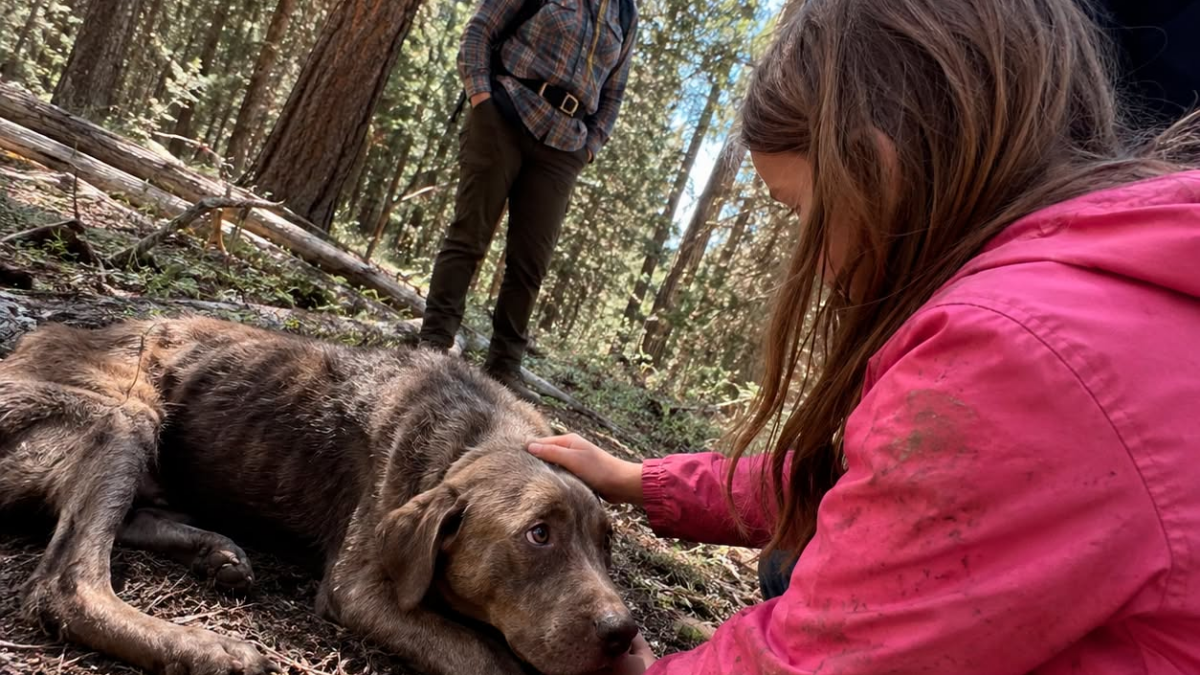
A large brown dog stood pressed against Emma’s side.
He was bigger than I expected from Thomas’s description.
Broad-chested despite how thin he was.
A Labrador–Pit Bull mix, maybe sixty pounds when healthy, but nowhere close to that now.
His ribs showed sharply beneath his dirty gray-brown coat.
His head was wide like a Pit Bull’s, but his muzzle and soft amber eyes reminded me of a Labrador.
One ear carried an old tear near the edge.
The raw groove where the rope had rubbed his neck was visible even in the weak morning light.
His paws were scraped.
His body trembled.
Yet he stood between Emma and the open side of the clearing.
Watching us.
Guarding.
Emma put one hand on his shoulder.
“Dad.”
Her voice was exhausted.
“This is Rocky.”
I stared at her.
“Rocky?”
“He saved me.”
Thomas had reached us.
He crouched several feet away.
“That’s the dog from the cabin.”
Emma nodded.
“He found me.”
I looked from my daughter to the dog.
“How?”
Emma pointed beyond the boulder.
“I was trying to go that way.”
Thomas swept his flashlight toward the edge.
His face changed immediately.
The ravine dropped sharply perhaps fifteen feet from where Emma sat.
In daylight, it was obvious.
At night, with no moon and thick trees around her, the opening between the rocks could easily have looked like another trail.
My stomach turned.
“How close did you get?”
Emma looked at Rocky.
“I don’t know.”
“I couldn’t see.”
“I thought I heard water.”
“I was thirsty.”
“So I thought if I walked toward it…”
Her voice trailed off.
“What happened?”
“Rocky ran in front of me.”
Thomas looked at the dog.
Emma continued.
“He kept barking.”
“I tried to go around him because I didn’t know him.”
“But every time I moved, he moved too.”
She raised both hands.
“I went left.”
“He went left.”
“I went right.”
“He went right.”
“He kept pushing me back.”
The deputy beside me looked toward the ravine.
“Smart boy.”
Emma nodded fiercely.
“I got mad at him.”
Her face crumpled again.
“I’m sorry, Rocky.”
The dog looked up at her.
“What did you do?” I asked.
“I told him to move.”
“I thought he was trying to scare me.”
“Then he grabbed my pants.”
My heart stopped.
“With his teeth?”
“Yes.”
“But he didn’t hurt me.”
“He grabbed the bottom of my pants and pulled backward.”
Thomas moved closer to the ravine.
“Then what?”
Emma swallowed.
“I picked up a rock.”
“I threw it in front of me because I was angry.”
Her eyes widened at the memory.
“And I never heard it hit the ground.”
Nobody spoke.
I felt Sarah’s absence suddenly, violently.
She needed to hear this.
She also absolutely did not need to hear it yet.
Emma buried her face in my jacket.
“I knew then.”
“You knew what?”
“That Rocky was right.”
I pulled her close again.
The thought of my ten-year-old daughter standing in absolute darkness, with nothing between her and a ravine except a starving abandoned dog, made the entire forest seem to tilt.
“What happened after that?”
Emma wiped her face.
“I sat down.”
“He kept standing between me and the edge.”
“For a long time.”
“Then I started crying.”
“He came over.”
“He smelled my backpack.”
“I had some crackers.”
“Did you eat?”
She shook her head.
“I gave him one first.”
That detail nearly destroyed me.
A child lost in the wilderness and a starving dog she had just met.
Both hungry.
Both scared.
And Emma had fed him first.
“I ate the other ones.”
“Then we shared my granola bar.”
“Was that all the food you had?”
She nodded.
“I had water too.”
“Not much.”
“I gave him some in my hand.”
Rocky lowered himself beside her.
His head touched her knee.
The movement looked practiced.
“How long was he with you?”
“I don’t know.”
“It was already really dark.”
“Maybe almost all night.”
She looked at Thomas.
“Did you let him go?”
“I cut his rope.”
Emma’s face changed.
“He was tied?”
Thomas nodded.
“By the cabin.”
“For how long?”
“We don’t know.”
Emma’s hand tightened in Rocky’s fur.
“He came looking for me after somebody left him there?”
Thomas gave a small nod.
“Looks like it.”
She stared at Rocky.
The dog did not seem interested in the question.
He looked tired enough to fall asleep standing.
Emma continued.
“When it got colder, he lay against me.”
“I put my jacket around both of us.”
That was when I noticed the purple jacket beneath them.
Part of it lay across Rocky’s back.
The rest had been under Emma.
Two abandoned creatures in different ways.
One temporarily.
One perhaps permanently.
Trying to keep each other warm.
Thomas removed his hat.
For the first time since I had met him, the experienced tracker looked like he did not know what to say.
A deputy spoke into his radio.
“Subject located.”
His voice shook slightly.
“Repeat, juvenile subject located alive.”
“Alert and responsive.”
“Mild cold exposure likely.”
“Request medical response to coordinates.”
Static exploded with voices.
Questions.
Coordinates.
Commands.
Then I heard Sarah over somebody’s radio.
“Is she okay?”
I closed my eyes.
A deputy answered.
“She’s okay, ma’am.”
The sound my wife made came through the static.
Half sob.
Half scream.
I will never forget it.
Within minutes, the clearing began filling with rescuers.
A medic examined Emma.
Low body temperature, but not severe hypothermia.
Dehydration.
A twisted ankle.
Scratches.
Exhaustion.
Nothing broken.
Nothing life-threatening.
Miraculously okay.
When another rescuer tried to move Rocky away so the medic could wrap Emma in a thermal blanket, Emma panicked.
“No.”
“Emma, sweetheart, we need to examine you.”
“He stays.”
The medic looked at me.
Rocky stood despite his shaking legs.
“He stays,” I said.
The medic sighed.
“All right.”
They wrapped the emergency blanket around both of them.
Rocky’s broad head stuck out beside Emma’s shoulder.
His eyes began closing the moment warmth trapped around him.
But he still woke whenever anyone came too close to her.
A hand reached toward Emma.
One eye opened.
Somebody shifted behind her.
His head lifted.
A branch snapped.
Both ears moved.
He had been freed only hours earlier.
He was hungry.
Injured.
Exhausted.
And somehow he had decided that Emma was his responsibility.
The rescue team prepared a safe route toward the trailhead.
Emma could not walk the whole distance on her ankle.
A rescuer carried her in a transport harness.
Rocky tried to follow.
His legs failed after perhaps twenty yards.
Thomas lifted him carefully.
The dog tensed at first.
Then, when Emma spoke, he relaxed.
“It’s okay, Rocky.”
“I’m right here.”
Thomas carried Rocky against his chest.
The dog’s head stayed turned toward Emma the entire way.
I walked beside them.
When we finally reached the command area, Sarah ran toward us.
She made it several steps before her knees gave out.
I caught her.
Then Emma was in her arms.
They clung to each other.
No coherent words.
Just crying.
Repeated kisses.
Sarah touching Emma’s face, shoulders, hands, as if proving every part was still attached.
Then Emma pulled away.
“Mom.”
Sarah stared.
“What?”
“Rocky.”
She pointed.
Thomas lowered the dog carefully.
Rocky stood beside Emma.
Sarah looked at him.
Then at me.
“What happened?”
I shook my head.
“Later.”
Emma said it anyway.
“He wouldn’t let me walk off the cliff.”
The color disappeared from Sarah’s face.
I caught her arm.
“Not now.”
She looked at Rocky again.
Her mouth trembled.
Then she crouched several feet away.
“Hi, Rocky.”
The dog watched her.
No growl.
No wag.
Just exhausted assessment.
Emma rested a hand on his back.
“He saved me.”
Sarah began crying again.
This time she reached slowly toward Rocky.
He sniffed her fingers.
Then lowered his head beneath her hand.
My wife pressed her forehead against his dirty fur.
“Thank you.”
Rocky closed his eyes.
The ambulance took Emma to a hospital for evaluation.
Animal control transported Rocky to an emergency veterinary clinic.
Emma screamed when she realized they were separating them.
“No.”
“Baby—”
“I’m going with Rocky.”
“You need a doctor.”
“So does he.”
“Yes.”
“He’s scared.”
“So are you.”
Emma looked at me.
“Dad.”
I held her shoulders.
“I will make sure he is safe.”
“You promise?”
I paused.
Promises had become terrifying to me overnight.
But some promises still needed making.
“I promise.”
Thomas stepped beside us.
“I’ll follow the animal-control truck.”
Emma looked at him.
“You will?”
“Yes.”
“I’ll stay until your father calls me.”
Her breathing slowed slightly.
“Tell Rocky I’m coming back.”
Thomas nodded.
“I will.”
Emma finally allowed the ambulance doors to close.
At the hospital, the doctor diagnosed mild hypothermia, dehydration, a sprained ankle, and superficial scratches.
She would recover.
That sentence should have made me feel normal again.
It did not.
I was still standing mentally beside the ravine.
Sarah sat beside Emma’s hospital bed holding her hand while our daughter slept.
I stood near the window with my phone.
At 9:38, Thomas called.
“How’s Emma?”
“She’s okay.”
I closed my eyes.
“She’s really okay.”
“Good.”
His voice softened.
“That’s good.”
“And Rocky?”
A pause.
“Alive.”
I gripped the phone harder.
“What’s wrong with him?”
“Severe malnutrition.”
“Dehydration.”
“Rope injury around the neck.”
“Paw pads are worn and cut.”
“Fleas.”
“Skin infection.”
“Some older scars.”
“Vet thinks maybe five or six years old.”
“Any chip?”
“No.”
“Collar?”
“Nothing except the rope.”
“Is he eating?”
“Tiny meals.”
“Doctor says they have to go slow.”
I leaned against the wall.
“Is he calm?”
Another pause.
“Not really.”
“What do you mean?”
“He keeps looking at the clinic door.”
“Every time somebody walks past, he stands up.”
“He’s exhausted, Michael.”
“But he won’t fully sleep.”
My chest tightened.
“He’s waiting for Emma.”
“Looks that way.”
I turned toward the bed.
Emma was asleep.
But one hand still held the corner of the silver emergency blanket she had insisted on keeping because Rocky had shared it.
“She’s waiting for him too.”
We went to the veterinary clinic immediately after Emma was discharged later that afternoon.
Sarah argued for home first.
I understood.
Our daughter had been missing overnight.
Every primitive part of us wanted her behind our locked front door.
Emma refused.
“I told him I was coming back.”
That ended the argument.
Cedar Ridge Veterinary Hospital had placed Rocky in a quiet recovery room away from the kennel wing.
Dr. Maya Patel met us.
She was in her forties, dark hair tied back, with the calm expression of someone accustomed to frightened animals and frightened people.
She crouched in front of Emma.
“I heard you and Rocky had quite a night.”
Emma looked past her.
“Where is he?”
“Right through there.”
Dr. Patel became serious.
“Before we go in, I need you to understand that he is very weak.”
“I know.”
“He may look worse in bright light.”
“I know.”
“And frightened dogs sometimes behave differently once they’re safe.”
Emma frowned.
“What does that mean?”
“He may not come to you immediately.”
“He may hide.”
“He may growl.”
“That would not mean he stopped caring about you.”
Emma considered that.
Then nodded.
“Okay.”
Dr. Patel opened the door.
Rocky lay on a thick blanket.
His neck had been cleaned.
The fur around the rope injury had been trimmed.
Under proper lighting, his condition looked worse.
Much worse.
Every rib was visible.
His hips protruded.
His coat was brown with darker markings, dulled by dirt and neglect.
His broad head seemed almost too large for his thin body.
One front paw was bandaged.
His eyes were closed.
Emma whispered.
“Rocky.”
The dog’s eyes opened instantly.
His head came up.
He tried to stand.
Dr. Patel moved forward.
“Easy.”
Rocky ignored her.
His legs shook.
Emma lowered herself to the floor.
“I’m here.”
Rocky took one unsteady step.
Then another.
Then another.
He reached Emma and pressed his head into her chest.
Emma wrapped both arms around him.
“Oh, Rocky.”
His tail moved.
Once.
Then again.
He leaned harder into her.
Within minutes, he lay down with his head across her lap.
And for the first time since arriving at the clinic, Rocky slept deeply.
Dr. Patel watched from beside the door.
“He wouldn’t do that before.”
Sarah whispered, “He was waiting.”
Dr. Patel nodded.
“Seems so.”
“How does that happen?” I asked.
“Trauma can create fast bonds.”
“She shared warmth with him.”
“Food.”
“Water.”
“She stayed beside him.”
“And he protected her.”
“They may both associate the other with survival.”
Emma looked down at Rocky.
“He saved me.”
Dr. Patel smiled gently.
“Maybe you helped save him too.”
Animal control began investigating the abandoned cabin.
The property belonged to a man who had died two years earlier.
His son lived in Arizona and claimed he had not been there in months.
Nobody immediately admitted knowing Rocky.
The rope was weathered but not old enough to have been there for years.
There was a cracked bucket near the cabin.
An empty food dish.
A torn blanket.
Someone had placed Rocky there.
Someone had walked away.
That knowledge made me angrier than I knew how to express.
Not around Emma.
Not around Sarah.
But at night, after they slept, I found myself imagining the person who had tied that rope.
I wanted explanations.
I wanted consequences.
I wanted somebody to look at Rocky’s ribs and answer for every day he had spent waiting.
Thomas came to our house two days after the rescue.
He brought Emma a real compass.
Sarah visibly hated the gift.
Thomas noticed.
“This isn’t me telling her to run back into the woods tomorrow.”
Emma looked down.
Thomas sat across from her.
“I want you to understand something.”
“You got lost.”
Emma swallowed.
“I know.”
“You made a mistake.”
“I know.”
“So did experienced hikers I’ve searched for.”
“So have hunters.”
Climbers.”
Adults.”
“People who grew up in these mountains.”
Emma looked at him.
“I left the trail.”
“Yes.”
“I wasn’t supposed to.”
“No.”
“I thought Mom and Dad were behind me.”
“I know.”
“Then everything looked the same.”
Thomas nodded.
“That happens faster than people think.”
Emma stared at the compass.
“I’m stupid.”
“No.”
“I did something stupid.”
Thomas leaned closer.
“That is not the same sentence.”
Emma’s eyes filled.
He continued.
“Fear makes people move when they should stop.”
“You learned something.”
“That matters.”
Sarah spoke from beside me.
“She is not going hiking again.”
Thomas looked at her.
Maybe another person would have argued.
He did not.
“Today, that makes sense.”
Sarah crossed her arms.
“Forever makes sense.”
“Maybe.”
That surprised her.
Thomas looked back at Emma.
“Nothing has to be decided forever right now.”
The next twelve days became a strange new routine.
School.
Veterinary clinic.
Home.
Nightmares.
Repeat.
Emma initially refused to return to school.
She wanted to stay beside Rocky.
Our pediatrician and counselor both recommended routine.
On Wednesday morning, I drove her.
She held a photograph Dr. Patel had printed of Rocky resting in his clinic blanket.
At the school entrance, Emma did not open the door.
“What if something happens to him?”
“The clinic has my number.”
“What if you don’t answer?”
“They have Mom’s.”
“What if he thinks I left?”
That was the real question.
I turned toward her.
“You are going to school.”
“I am picking you up at three.”
“Then we will visit Rocky.”
“You leaving for a few hours does not mean you abandoned him.”
Emma stared at the photograph.
“Promise?”
“Yes.”
At three, I was already waiting.
By 3:40, she sat beside Rocky.
He was stronger.
Still too thin.
But alert.
That afternoon he climbed partly into Emma’s lap.
Sarah stood beside me watching.
“He’s coming home with us, isn’t he?”
“That sounded less like a question.”
“We don’t know his full history.”
“No.”
“We don’t know how he behaves around children when he isn’t exhausted.”
“No.”
“We’ve never had a dog like him.”
“No.”
“Emma is traumatized.”
“Yes.”
“We are traumatized.”
“Yes.”
“This would be an extremely emotional decision.”
“Absolutely.”
Sarah looked through the glass.
Rocky had fallen asleep with Emma’s hand resting on his shoulder.
My wife sighed.
“Damn it.”
I put an arm around her.
“Exactly.”
Rocky had to complete a legal stray hold.
His photo was circulated.
Veterinary clinics checked records.
No microchip.
No credible owner came forward.
Investigators eventually located a man who may have had Rocky previously, but he denied ownership.
A former neighbor later produced photographs of a similar Labrador–Pit Bull mix in his yard.
The case went forward separately.
What mattered to us was that nobody could legally reclaim Rocky.
The shelter received custody.
We applied to foster him immediately.
Emma wanted to adopt him that same minute.
I said foster first.
She told me I lacked commitment.
I reminded her that ten-year-olds who vanished overnight in Colorado forests temporarily lost authority over family risk management.
She glared.
Sarah laughed.
That was one of the first normal sounds in our house since the search.
Rocky came home seventeen days after we found Emma.
We prepared a quiet room downstairs.
Dog bed.
Water.
Open crate.
Blankets.
Food recommended by Dr. Patel.
Rocky entered the house slowly.
He sniffed the entryway.
The couch.
Kitchen.
Hall.
Then Emma started upstairs.
Rocky followed her.
Directly.
He entered her room, walked past the bed we had purchased for him, and lay down beside her desk.
Emma immediately lowered herself onto the floor.
“Give him space,” I said.
“I am.”
She lay several feet away.
Rocky watched her.
Within half an hour, he moved closer.
By dinner, his paw touched her sock.
That first night, Sarah insisted Rocky should sleep downstairs until we understood his behavior better.
At 11:30, I found my wife carrying his bed upstairs.
I leaned against the hallway wall.
“What happened to downstairs?”
“He’s whining.”
“You sounded certain.”
“Michael.”
“I’m saying nothing.”
“Your face is saying plenty.”
Rocky slept outside Emma’s bedroom door.
Not inside.
Not downstairs.
At the threshold.
Guarding.
The first month taught us that rescue stories look much less romantic once everyone is home.
Rocky had stomach problems.
He hated vacuum cleaners.
He barked at men wearing heavy outdoor jackets.
He became nervous if a long rope or cord appeared.
If a door closed between him and Emma, he scratched at it.
He hid food beneath the couch cushions.
He woke from sleep growling softly at things none of us could see.
The worst reaction came when I carried a coil of utility rope through the garage.
Rocky saw it.
His entire body collapsed backward.
He screamed.
Not barked.
Screamed.
Then he ran beneath the kitchen table and shook so violently his teeth clicked.
I dropped the rope.
Emma came running.
“Rocky.”
He would not look at her.
She began crying.
“I scared him.”
“No.”
“I brought him here.”
“Emma, look at me.”
She did.
“The rope scared him.”
“Not you.”
She sat on the floor.
“Does he remember?”
“Yes.”
“Like I remember the cliff?”
I swallowed.
“Yes.”
Emma moved no closer.
She sat quietly.
Twenty minutes later, Rocky crawled from under the table.
He pressed his nose against her sock.
Emma whispered, “Me too.”
They understood each other in ways Sarah and I could only partly reach.
Emma hated darkness now.
Rocky hated closed doors.
Emma checked hallways before bed.
Rocky checked rooms.
Emma woke after dreams about falling.
Rocky woke after dreams about being trapped.
During thunderstorms, Emma sat on the floor with him.
Sometimes I did not know which of them was comforting the other.
Our family counselor, Rebecca Lane, warned us not to turn Rocky into Emma’s entire recovery.
“He is not therapy equipment.”
“I know.”
“He has his own trauma.”
“I know.”
“Emma cannot become responsible for keeping him calm.”
“She’ll try.”
“Yes.”
“And Rocky cannot become the only reason Emma feels safe.”
That part was harder.
Because for a while, he was.
When Emma returned to school full time, Rocky waited at the front window.
Every afternoon when the bus appeared, his tail began hitting the floor.
Emma stepped down.
Rocky raced through the house.
The door opened.
They collided.
Every day.
Months passed.
Rocky gained weight.
His ribs disappeared beneath healthy muscle.
His coat became rich brown with dark markings along his back.
The Labrador softness returned to his eyes.
The Pit Bull strength returned to his chest and shoulders.
But he remained gentle.
Careful.
Especially with Emma.
One afternoon she came home crying.
A boy at school had called her “the girl who got lost.”
She ran upstairs.
Rocky followed.
I found them under her desk.
“I’m stupid,” she said.
“No.”
“I walked off the trail.”
“Yes.”
“That was stupid.”
“You made a dangerous mistake.”
“So I’m stupid.”
“No.”
“Dad.”
I sat beside the desk.
Rocky lay with his head on Emma’s shoe.
I remembered Thomas’s words.
“A mistake is not a person.”
Emma stared at the floor.
“They sent all those people because of me.”
“Yes.”
“That’s embarrassing.”
“No.”
“Dad.”
“They searched because you mattered.”
She looked up.
“Not because you owed them.”
“Not because you deserved to feel guilty.”
“Because a child was missing.”
“That is what rescue teams do.”
Emma rubbed Rocky’s ear.
“Nobody was looking for Rocky.”
That sentence hurt.
“No.”
“Nobody was.”
“That’s not fair.”
“No.”
“It isn’t.”
She looked at him.
“Maybe he found me because nobody found him.”
I did not have an answer.
So I said the only honest thing.
“Maybe.”
We finalized Rocky’s adoption two months later.
At the shelter, Margaret placed the papers in front of us.
Emma insisted on writing his name.
ROCKY.
Breed: Labrador–Pit Bull mix.
Color: Brown.
Age: approximately five.
Adopters: Michael and Sarah Johnson.
I signed.
Sarah signed.
Emma added her name below ours and wrote “assistant owner.”
Margaret laughed and let it stay.
Then she handed Emma his new identification tag.
Emma clipped it onto Rocky’s collar.
The tag jingled.
Rocky shook his head.
Emma wrapped her arms around him.
“You have a family now.”
I watched her face.
I knew she was talking to him.
I also knew part of her was talking to herself.
The first anniversary of the rescue approached.
Emma’s nightmares returned.
Rocky began pacing at night whenever she paced.
Then Thomas called.
“I want to take you somewhere.”
I knew exactly what he meant.
“No.”
He laughed.
“I haven’t said where.”
“I know you.”
“Apparently not well enough.”
He suggested a short, flat, clearly marked trail near a visitor center.
No ravine.
No remote forest.
Good phone signal.
Ranger station nearby.
Half a mile total.
I hated the idea.
Sarah hated it more.
Our counselor liked it.
Traitor.
We let Emma decide.
When we asked her, she was silent for a long time.
“Rocky comes.”
“Obviously.”
“You stay close.”
“Yes.”
“Mom too.”
“Yes.”
“If I want to turn around after ten feet, we turn around.”
“Immediately.”
The morning of the walk, Rocky wore a red harness.
Emma carried Thomas’s compass.
A whistle.
Water.
A warm layer.
A small emergency blanket.
All the things fear had taught her to respect.
At the trail entrance, she froze.
Rocky stopped beside her.
I stood three feet behind.
Sarah beside me.
Thomas waited.
“No rush,” he said.
Emma stared at the trees.
“I hate the smell.”
Pine.
Cold dirt.
Morning air.
Normal things transformed by memory.
Rocky looked at her.
She took one step.
He moved.
Then another.
At the first trail marker, Emma touched it.
“Blue square.”
Thomas nodded.
“Where are we?”
“Cedar Loop.”
“Good.”
She kept walking.
We made it a quarter mile.
At a safe overlook with a strong railing, Emma stopped.
Rocky pressed against her leg.
She crouched and held him.
“Do you remember?”
The dog looked up.
Thomas said quietly, “Maybe not the way we do.”
Emma smiled.
“He remembers me.”
“Yes.”
“That’s enough.”
She stood.
“I want to go back.”
So we went back.
No push to finish.
No speech about courage.
At the parking lot, Emma began crying.
Sarah hugged her.
“I did it.”
“Yes.”
“I hated it.”
“That’s okay.”
Then Emma laughed through tears.
“I might want to do it again someday.”
Sarah closed her eyes.
I smiled.
Thomas pretended not to.
Rocky wagged.
That became our definition of healing.
Not forgetting.
Not pretending fear was gone.
Choosing again.
Emma grew.
Rocky healed.
She gave a school presentation the next year about wilderness safety.
She refused to title it “The Night I Was Rescued.”
Instead, she called it “What to Do When You’re Lost.”
She talked about staying put when safe.
Using a whistle.
Carrying layers.
Telling people your route.
Avoiding cliffs and moving water in darkness.
Conserving energy.
And trusting warning signs.
One slide showed Rocky sitting on our couch.
Under the photo, Emma had written:
LISTEN WHEN SOMETHING IS TRYING TO KEEP YOU SAFE.
Her classmates loved him.
Rocky visited school on presentation day.
Children asked question after question.
“Was he trained?”
“No.”
“Did he know you?”
“No.”
“Why did he help you?”
Emma looked at Rocky.
“I don’t know.”
Then she said something I have never forgotten.
“Maybe he knew what being alone felt like.”
Even the teacher went quiet.
Rocky scratched his ear.
Completely unaware that he had become the moral center of the classroom.
Years passed.
Emma turned twelve.
Then fourteen.
Then sixteen.
She returned to hiking.
Slowly.
Only marked trails.
Never alone.
Eventually, she began volunteering at the base station for Thomas’s search-and-rescue group.
Radios.
Maps.
Water.
Food.
Log sheets.
Rocky came sometimes.
By then, his muzzle had started to gray.
Thomas called him Lieutenant Rocky.
Emma called Thomas ridiculous.
The first missing-person search Emma helped with involved an older hiker who became disoriented near a lake.
Emma stayed at command.
Late that night, she called.
“They found him.”
“Alive?”
“Yes.”
Her voice broke.
I closed my eyes.
Rocky lay beside me.
“Good.”
“Dad?”
“Yes?”
“I understand now.”
“What?”
“The waiting.”
I said nothing.
She continued.
“All these people go out into the dark.”
“You just stand here.”
“You listen to radios.”
“You don’t know what’s happening.”
“The man’s daughter keeps asking whether they’ve found him.”
My throat tightened.
“Yes.”
“I’m sorry.”
“For what?”
“For that night.”
“Emma.”
“I know.”
“You told me not to apologize.”
“Then listen.”
She laughed softly.
The man came back alive.
Emma sat with his daughter until he did.
That was the night I realized the worst night of my daughter’s childhood had not become the center of her life.
It had become a room inside something much larger.
Permanent.
Important.
But not everything.
Rocky aged too.
At ten, he developed arthritis.
At eleven, a mild heart condition.
His muzzle turned silver.
His broad body softened.
He moved more slowly.
He still slept near Emma’s door.
Every night.
Even when she was seventeen.
Even when the nightmares were rare.
One slow patrol through the hallway.
Our room.
Emma’s room.
Stairs.
Back.
Then he lay down.
Guarding.
Habit.
Love.
When Emma began applying to colleges, Sarah and I expected environmental science.
Maybe biology.
Instead, Emma chose emergency management and wilderness medicine.
Sarah read the application and looked at me.
“No.”
I laughed.
“She wants to help people.”
“She wants to run toward missing people.”
“Probably.”
“She could become an accountant.”
“She hates math.”
“That can be fixed.”
“No, it can’t.”
Emma was accepted to Colorado State.
Close enough that Sarah could breathe.
Far enough that I could pretend I was not struggling.
The night the acceptance came, Emma sat beside Rocky.
“I’m leaving.”
Rocky licked her hand.
“Not forever.”
His ears shifted.
“I’ll come back.”
Sarah and I both froze.
Emma heard herself too.
The phrase carried too much history.
She smiled.
“No.”
She corrected it.
“I’ll see you soon.”
Rocky’s tail moved.
That became our phrase.
Not a promise that nothing unexpected would happen.
Simply hope with humility.
Before college, Emma asked for one thing.
“I want to go back.”
Sarah stared.
“To the mountain?”
“Yes.”
“Not the ravine.”
“Just the trailhead.”
“With Thomas.”
“And Rocky.”
Rocky was too old for a real hike.
But we went.
Eight years after the night we lost her, we returned to the Colorado mountains.
The trailhead looked smaller.
That surprised me.
Trauma enlarges places.
The gravel lot that once held ambulances, search vehicles, exhausted volunteers, maps, radios, and our worst fear was simply a parking lot now.
Thomas met us there.
Gray in his beard.
Still calm.
He looked at Emma.
“Ten yesterday.”
“College tomorrow.”
She smiled.
“Something like that.”
Then he looked at Rocky.
The old Labrador–Pit Bull mix stood beside Emma, his broad face almost white around the muzzle.
“And you.”
Rocky wagged.
“Still taking credit.”
Emma bent and kissed his head.
“He earned it.”
We walked only a few hundred yards to a safe meadow.
Rocky moved slowly.
Emma matched his pace.
Nobody carried him.
He still had pride.
In the meadow, Emma sat in the grass.
Rocky lowered himself beside her.
For a moment, the years folded.
I saw the child again.
Dirty face.
Purple jacket.
Rocky’s starving body pressed against hers.
Darkness beyond the rocks.
Then the image faded.
Emma was eighteen.
Strong.
Prepared.
Laughing.
Rocky was old.
Fed.
Loved.
His collar held our phone number.
His harness fit his healthy chest.
No rope.
No fear.
Emma rested one hand on his back.
“Do you remember?”
Rocky looked at her.
Thomas stood beside me.
“Maybe he remembers enough.”
Emma smiled.
“He remembers me.”
Rocky placed his head in her lap.
“That’s enough.”
We took a photograph.
No ravine.
No dramatic pose.
Just a young woman and an old brown dog beneath a Colorado sky.
That photograph is on our mantel.
People see it and say it is beautiful.
They do not know what is inside it.
I see flashlights.
Radios.
Sarah’s silent face.
Thomas returning with news about a dog tied beside a cabin.
A bark before sunrise.
My daughter against a rock.
Rocky between her and the ravine.
I see a child saying, “Dad, he saved me.”
Rocky is thirteen now.
He walks slowly.
He sleeps most afternoons.
Heart medication twice a day.
Arthritis medicine with dinner.
He believes every pill deserves cheese.
Emma is at college.
She video-calls mostly for him.
She does not even pretend otherwise.
“Where’s Rocky?”
Not hello.
Not how are you.
Where’s Rocky?
I turn the phone.
Rocky hears her voice.
His ears lift.
Sometimes his tail moves.
Sometimes he simply listens.
When Emma comes home, the first thing she does is sit on the hallway floor.
Rocky rises slowly.
No running anymore.
No wild reunion.
He walks toward her one careful step at a time.
Then he presses his broad head against her leg.
Exactly as he did in the veterinary clinic years ago.
Last month, Emma told me about a question her wilderness-medicine professor asked.
Why do you want to work in rescue?
Some students said adventure.
Some said medicine.
Some said service.
Emma said:
“Because when I was ten years old, forty-two people were searching for me, but the one who found me first was somebody nobody had been searching for.”
Her professor thought she meant another hiker.
Then Emma showed the class Rocky’s photograph.
I did not cry when she told me this.
That is my official version.
Sarah tells a different story.
There is one question people still ask us.
How did Rocky find Emma?
We do not know.
Thomas believes Rocky may have crossed Emma’s scent trail after he was freed.
Maybe the wind carried it.
Maybe he heard her crying.
Maybe she passed near the cabin earlier without seeing him.
Maybe he simply chose a trail and got lucky.
There is no way to prove it.
I no longer need an explanation.
This much is true.
Someone left a Labrador–Pit Bull mix tied beside an abandoned hunting cabin.
He was starving.
His neck was injured.
He had every reason to run from humans the moment Thomas cut the rope.
Instead, Rocky entered the forest.
Somewhere in that darkness, he found my daughter.
When she tried to walk toward a ravine she could not see, he blocked her.
Left, he moved left.
Right, he moved right.
When she still tried to pass, he grabbed her pant leg and pulled her backward.
Then he stayed.
Through the cold.
Through hunger.
Through Emma’s crying.
Through his own exhaustion.
And when morning came, he barked until somebody answered.
People call Rocky a hero.
Emma usually shakes her head.
She says heroes sound like people who know they are doing something extraordinary.
Rocky probably only knew a child was afraid and danger was nearby.
Maybe that is what makes it extraordinary.
That night, I believed my daughter’s rescue would depend on training.
Searchers.
Sheriff’s deputies.
Tracking teams.
Radios.
Maps.
And every one of those people mattered.
We owe them more than words can carry.
But the final distance between Emma and the ravine was guarded by a dog whose own life had apparently mattered so little to someone that they tied him to a tree and left.
Nobody organized a search for Rocky.
No mother stood beside a radio asking whether he had been found.
No father ran through the trees shouting his name.
No command post had his photograph.
Yet when somebody finally gave him freedom, he used it to keep my daughter alive.
That changed the way I think about worth.
Being forgotten does not make a life worthless.
Being abandoned does not mean you have nothing left to give.
Sometimes the one who has received the least kindness is still the first to offer it.
For years, people have told me that we rescued Rocky after he rescued Emma.
I used to agree.
Now I think that is too simple.
Rocky and Emma found each other at the exact moment both of them needed somebody to stay.
One was a frightened child who could not find her parents.
The other was an abandoned dog who had no reason to believe anyone was coming back for him.
He stopped her from walking toward the ravine.
She shared her food.
He kept her warm.
She wrapped her jacket around him.
He barked for rescuers.
She gave him a name.
By sunrise, they had already become family.
The adoption papers only made it official.
My daughter was the person we were searching for that night.
Rocky was the dog nobody was searching for.
Somehow, in that enormous Colorado wilderness, they found each other first.








