My retired K9 had been off duty for years when I collapsed on my kitchen floor, unable to move or speak, and suddenly he was working again
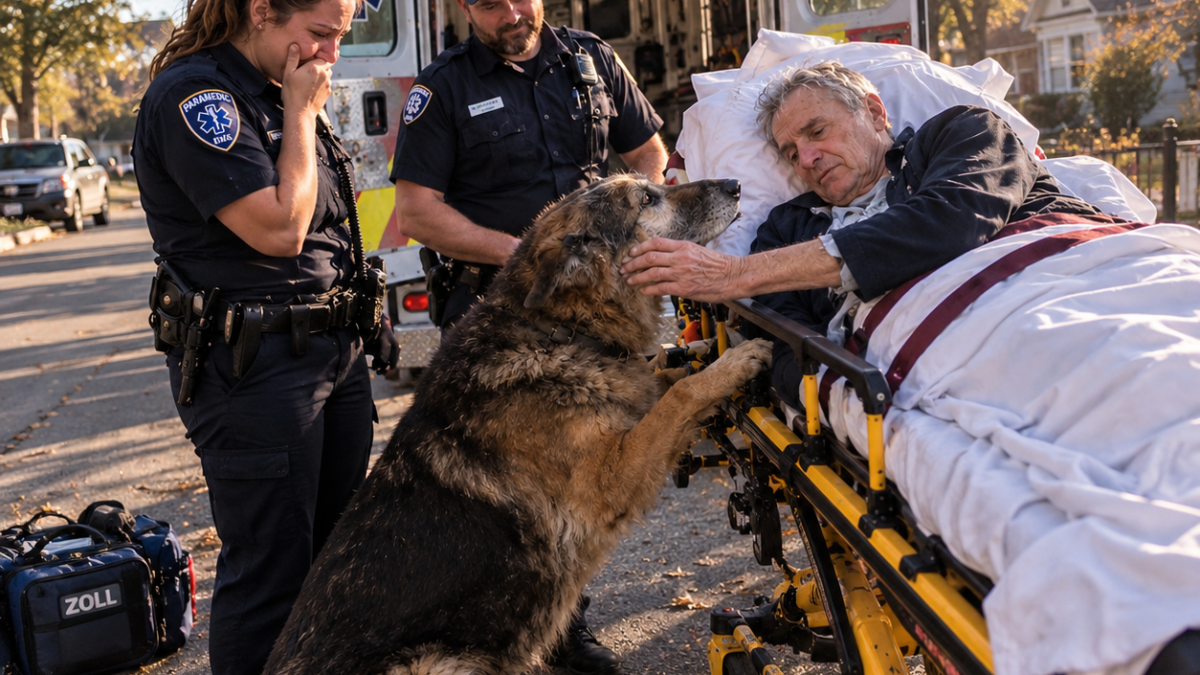
The tip of my left index finger brushed the phone.
That tiny contact felt like reaching shore.
I could not grab it.
I could not turn my wrist properly.
I could barely make my hand move at all.
But I had touched it.
Bruno sat beside my head, breathing through his nose in that slow, deliberate way I remembered from work.
Listening.
Watching.
Waiting.
The sound carried me back seven years to a muddy department training field on a November morning.
Bruno had been thirty-one months old then.
Powerful.
Restless.
Almost insulting in the confidence of his stare.
I would place an object several yards away.
“Take.”
He picked it up.
“Bring.”
He returned.
“Out.”
He released it carefully into my hand.
He had never been the most spectacular dog in the unit.
Other K9s were faster.
Some worked with more explosive energy.
Bruno’s gift was precision.
He retained patterns.
He noticed details.
He did not give up simply because the answer was not obvious.
Now the phone was against my fingers because of that memory.
But a retrieved phone was useless if I could not operate it.
I dragged my finger across the case.
The screen illuminated.
I could see color and light, but my head position made the display difficult to read.
I tried shifting my body.
My right arm remained trapped and useless beneath me.
My right leg did nothing.
I forced sound through my mouth.
“Brr…”
Bruno’s ears snapped upright.
I tried again.
“B…”
That was all I could produce.
Still, he leaned closer.
I could almost hear myself giving the praise inside my head.
Good boy.
Good boy, Bruno.
My phone had an Emergency SOS function set to activate after repeated presses of the side button.
My daughter Sarah had insisted on configuring it at Christmas.
I had mocked her.
“I’m retired, not ninety.”
She had stared at me over folded arms.
“You live alone.”
“I have Bruno.”
“That is not a medical-alert system.”
At the time, Bruno had been lying nearby, looking offended on behalf of both of us.
Now I would have welcomed Sarah standing over me saying, I told you so.
The side button was near my fingertip.
An inch, perhaps less.
I reached.
My hand trembled.
I found the phone’s edge.
Pressed.
Once.
Too softly.
Again.
The phone slipped farther from me.
A frustrated sound broke out of my throat.
Bruno stood immediately.
He looked at the device.
Then at me.
He lowered his head and pushed it back with his nose.
My fingertip found the button again.
Press.
Press.
Again.
I could not tell whether I had pressed enough times.
Then the phone vibrated.
The screen changed.
An alarm sounded.
Bruno barked once, huge and sharp in the small kitchen.
A countdown began.
Please, I thought.
Please.
The call connected.
“911, what is your emergency?”
I tried to answer.
Air came out.
No real word.
“Sir? Ma’am? Can you hear me?”
I concentrated so hard my head hurt.
“St…”
Nothing more.
The dispatcher paused.
Then her voice became more focused.
“Are you having difficulty speaking?”
I tried to say yes.
“Y…”
“Okay.”
“If you can hear me, I need you to respond however you can.”
Bruno barked again.
“Is there a dog with you?”
I made another sound.
The dispatcher adjusted immediately.
“Can you tap the phone?”
I managed one weak tap against the case.
“If you hear me, tap once.”
I tapped.
“If this is a medical emergency, tap twice.”
Two taps.
Weak.
Uneven.
But two.
“All right.”
“You’re doing well.”
“Help is being sent to your address.”
Help.
The word seemed enormous.
My eyes closed.
Bruno licked near my ear.
The dispatcher kept speaking.
“Stay with me.”
“Can you tell me your name?”
I could not.
“That’s okay.”
“Don’t force it.”
“Paramedics are coming.”
Then came a question I had not thought about.
“Is your front door unlocked?”
No.
Of course it wasn’t.
Twenty-three years of police work had made locking doors almost automatic.
Deadbolt.
Always.
I tried moving my left hand again.
“L…”
Nothing useful.
“Sir, don’t strain.”
“The responders will get in.”
Bruno suddenly stood.
His head turned toward the hallway.
The house was still quiet to me.
Not to him.
His ears had caught something.
Maybe the first distant siren.
Maybe a vehicle several streets away.
Maybe he had simply heard tension in the dispatcher’s voice.
Whatever the reason, he left the kitchen.
This time, I did not feel abandoned.
His nails moved through the hall.
Then disappeared.
The dispatcher continued talking.
I remember fragments.
Stay awake.
Keep breathing.
Units are close.
Someone is coming.
I focused on the wall clock.
Tick.
Tick.
Tick.
Every second seemed louder because I knew enough about stroke to understand what delay could mean.
Time is brain.
Every patrol officer learns that phrase sooner or later.
Minutes matter.
Treatment windows matter.
Knowing when symptoms began matters.
I knew all of this.
I could tell the dispatcher none of it.
I wanted to mention blood-pressure medication.
Allergies.
History.
Sarah’s number.
The approximate onset.
Everything useful sat trapped in a functioning mind behind a mouth that would not perform.
Then a siren became audible.
Closer.
Bruno barked from the front room.
Once.
Pause.
Again.
The old alert pattern.
Measured.
Intentional.
The dispatcher heard.
“I hear your dog.”
I tapped once.
“Is he friendly?”
If I had been able to laugh, I might have.
Friendly had always been a situational description with Bruno.
He had spent years learning that unknown people forcing entry into my space deserved assessment.
Paramedics breaking a door could become a serious problem if he misunderstood.
The dispatcher began relaying information over another channel.
I heard only pieces.
“…retired police K9…”
“…owner unable to respond…”
“…use caution…”
Good.
At least they knew.
A vehicle stopped outside.
Then another.
Doors slammed.
Bruno’s bark intensified.
A man shouted from the porch.
“William Hartley!”
Three sharp barks.
“County EMS!”
More barking.
“Mr. Hartley, we’re entering!”
My heart began racing for a completely different reason.
Bruno.
Please.
Please remember good uniforms.
The first impact hit the door.
Bruno’s barking dropped lower.
A warning.
Another strike.
Wood cracked.
I tried calling him.
“B…”
Nothing.
“Brr…”
The dispatcher heard me struggling.
“Are you trying to call your dog?”
I tapped once.
“What’s his name?”
“B…”
“Bruno?”
Maybe the emergency profile on my phone listed him.
Maybe I had managed more of the word than I realized.
Maybe dispatch already had information from the department.
I never asked.
The voice came loudly through the speaker.
“Bruno?”
His barking stopped for a second.
Then the front door gave way.
Men entered.
Footsteps.
One responder called, “K9! Stay back!”
Another answered, “Don’t approach the dog!”
Bruno barked again.
Then a third voice filled my house.
A voice I knew instantly.
“Bruno!”
Silence.
“Bruno, platz.”
Down.
German.
One of the oldest commands in his vocabulary.
His nails moved once over the hardwood.
Stopped.
“Good boy.”
Lieutenant Frank Delaney.
My former shift commander.
More gray in his hair by then, heavier than when I retired, but still one of Bruno’s familiar people.
Frank must have heard the address over police radio or been contacted by dispatch.
However he got there, his voice reached Bruno at exactly the moment it was needed.
“Good boy.”
Then footsteps rushed toward the kitchen.
Frank appeared first.
His eyes found me.
“Bill.”
The paramedics moved around him.
Hands at my neck.
Blood-pressure cuff.
Monitor leads.
Oxygen.
Questions.
A young paramedic named Elena Ruiz dropped beside me.
“Mr. Hartley, I’m Elena.”
“We think you may be having a stroke.”
“Can you smile for me?”
I tried.
She looked toward her partner.
“Right facial droop.”
She placed fingers in my hands.
“Grip.”
Left hand weak.
Right side nothing.
“Lift your right arm.”
Nothing.
“What time did this start?”
I stared toward the wall clock.
Elena followed my eyes.
“Was it recently?”
I tapped one finger.
Frank suddenly spoke.
“He gets up around six.”
“He texted me at 6:04 this morning about coffee with some retired guys next week.”
Elena looked at the kitchen clock.
6:31.
“Last known well at least 6:04.”
That ordinary text became more useful than any answer I could provide.
They rolled me carefully.
My shoulder screamed when they repositioned me.
Then they transferred me to the stretcher.
My right side still felt absent.
My speech was still nearly useless.
But I was leaving the kitchen alive.
Bruno remained down in the doorway.
His body trembled with restraint.
He watched every hand touching me.
Frank crouched beside him.
“He’s doing his job, Bruno.”
When the stretcher passed, Bruno could no longer stay completely silent.
He whined.
I had almost never heard that sound from him.
Not during patrol.
Not even years earlier when he injured a paw during a search.
Now he stared at me while strangers rolled me toward the broken front door.
I forced my left hand upward a few inches.
His ears rose.
“B…”
I tried again.
“Bru…”
His tail moved.
Frank tightened his hand gently around Bruno’s collar.
“I’ve got him, Bill.”
The ambulance doors closed.
That was the last thing I remember clearly for a while.
What followed exists in flashes.
White ceiling panels moving above me.
A mask near my mouth.
Someone repeating stroke alert.
A needle entering my arm.
My left hand being squeezed.
Questions passing too quickly.
Then memory becomes unreliable.
Later, I learned what happened.
Imaging showed an ischemic stroke.
A clot had blocked blood flow to part of my brain.
Because my symptom timeline was fairly clear and I arrived quickly, the stroke team could consider treatments whose usefulness and risk change as time passes.
Dr. Aaron Patel, the neurologist who would later become one of my favorite people to argue with, told Sarah that the speed of the response likely affected my outcome.
Minutes mattered.
Bruno had bought me minutes.
A great many of them.
Sarah reached the hospital shortly after 7:30.
She lived forty minutes away.
She made the drive in twenty-eight.
Months later, once my speech had improved, I lectured her about driving that fast.
She told me I had lost the moral authority to discuss traffic safety by nearly dying before breakfast.
I could not argue with that.
Frank stayed at my house with Bruno.
That decision mattered almost as much as people realize.
Bruno had watched me collapse.
Then watched strangers enter through a broken door.
Then watched those strangers carry me away.
Placing him immediately into a county kennel would have added another loss to a morning already full of them.
Frank understood retired working dogs.
He understood Bruno specifically.
He covered the damaged doorway temporarily with plywood.
Fed him.
Walked him.
Sat in my recliner.
Left the television off.
Bruno refused his evening meal.
He lay facing the hall.
At five that afternoon, Frank called Sarah.
“How’s Bill?”
“Stable.”
“Talking?”
“Not really.”
“Movement?”
“Some.”
Frank looked at Bruno.
Sarah could hear the sigh over the phone.
“How’s Bruno?”
“Emotionally? Worse than your father.”
Sarah laughed for the first time all day.
Frank put her on speaker.
“Talk to him.”
“To Bruno?”
“He knows you.”
She did.
“Bruno.”
His head lifted.
“Dad’s okay.”
That was more hope than medical certainty at that point.
But it was what Bruno needed.
“He’s at the hospital.”
“You did good.”
Bruno walked over to the phone.
Sniffed.
Sarah began crying.
“You saved him, Bruno.”
Later that night, Bruno finally ate.
I became fully aware again the next morning.
A hospital room.
Gray light through blinds.
A mouth that felt like sand.
My right hand seemed distant, but not completely gone.
I focused on my fingers.
One moved.
Barely.
A nurse noticed.
“Do that again.”
I tried.
Another twitch.
She smiled.
“That’s good.”
I wanted only one thing.
Bruno.
My mouth would not produce the question.
“B…”
The nurse leaned closer.
“Pain?”
I shook my head.
“Brr…”
Understanding crossed her face.
“Bruno?”
I nodded so hard the room moved.
“He’s okay.”
My body relaxed.
“Your daughter showed us a picture.”
She pulled out her phone.
There was Bruno in my living room beside Frank.
Serious expression.
Ears up.
Watching the camera.
I touched the screen with my left hand.
The nurse said, “He’s famous downstairs.”
I frowned.
She laughed.
“Not public famous.”
“Hospital famous.”
“The paramedics told everybody.”
Fine.
Let them talk.
Bruno was safe.
That was enough.
Speech returned in fragments.
Far more slowly than I wanted.
On day two, a speech therapist named Olivia Chen arrived with pictures.
Cup.
Chair.
Key.
Dog.
I could identify them by pointing.
Then she asked me to name them.
I knew chair.
Perfectly.
The word existed inside my head.
What came out was closer to “sh…”
I slapped my left palm against the blanket.
Olivia did not flinch.
“Your brain still knows the word.”
“Your mouth is rebuilding the route.”
I glared.
She ignored it.
“Again.”
That became my new command.
Again.
Speak again.
Stand again.
Grip again.
Lift again.
Step again.
A physical therapist named Marcus Lee got me upright for the first time with two people supporting me.
My right leg felt like a sack filled with wet cement.
“Shift your weight,” Marcus said.
I wanted to tell him where he could shift his own weight.
Fortunately for our relationship, my language skills were not yet adequate for the insult.
Sarah watched from a chair and tried not to smile.
On the fourth day, she came in carrying her phone.
“Want to see something?”
I knew.
She turned the screen toward me.
Bruno sat in my backyard beside the porch.
Frank stood nearby.
Sarah’s voice came through the recording.
“Where’s Dad?”
Bruno got up.
Walked to the back door.
Stopped there.
Then Sarah said, “He’s coming home.”
Bruno turned toward the camera.
His tail moved.
I watched the video three times.
On the fourth, I cried.
Sarah looked very intently at the medication chart on the wall.
That is one of the mercies adult children occasionally offer their parents.
After a while, I forced out one word.
“Home.”
Sarah turned.
“Yes.”
The word sounded slurred and weak.
Still, it was a word.
I pointed toward Bruno on the phone.
“Br…”
“Bruno.”
I nodded.
“With Bruno?”
Another nod.
“Yes.”
“You’re going home with Bruno.”
That became the goal.
Not speaking perfectly.
Not walking like I used to.
Not becoming the exact man who had reached for the coffee maker on March 11.
Home.
With Bruno.
I spent eleven days in the hospital.
Then three weeks in inpatient rehabilitation.
I came home thirty-one days after the stroke.
Rehab was humiliating in ways that were also useful.
Every day showed me some ordinary skill I had lost.
Fasten a button.
Control a fork.
Stand from a chair.
Pronounce certain sounds.
Lift my foot instead of dragging it.
Write my name.
My signature looked like a stranger’s.
That affected me more than I expected.
For decades, William Hartley had been one confident line beneath reports, forms, evidence logs, mortgages, and birthday cards.
After the stroke, it looked like scratches.
Olivia made me practice.
I complained.
She ignored me.
Marcus made me walk between parallel bars.
I complained.
He ignored me too.
Apparently rehabilitation specialists are trained to become resistant to retired police officers.
Sarah came nearly every day.
Frank visited twice a week.
Bruno could not enter the rehab unit.
That became unbearable surprisingly quickly.
During the first week, Frank brought him to the parking lot.
A nurse rolled me outside.
I heard Bruno before I saw him.
One bark.
Sharp.
Then silence.
The doors opened and cold March air reached me.
Frank stood perhaps twenty yards away with Bruno sitting at heel.
The moment Bruno saw the wheelchair, his whole body leaned forward.
Frank looked at me.
I tried lifting my right hand.
It moved only slightly.
My left hand gave the release signal instead.
Frank unclipped him.
Bruno ran.
Not like an elderly retired shepherd with occasional hip stiffness.
Like the K9 who used to explode from a patrol vehicle when the world suddenly required all of him.
The nurse beside me inhaled sharply.
Bruno stopped two feet from the chair.
Perfect control remained.
He approached slowly.
Nose to my knees.
Hands.
Stomach.
Then my face.
Once.
Twice.
Exactly as he had done on the kitchen floor.
His ears lowered.
He pushed his head underneath my left arm.
I folded over him.
People like to describe reunions in beautiful language.
I cannot do that one justice.
I cried into his neck.
That is what happened.
Bruno stood there and let me.
Frank looked away.
The nurse did too.
Eventually, I straightened.
Bruno stared up.
I forced my mouth to work.
“G…”
Again.
“Goo…”
My throat tightened.
“Good.”
His tail started moving.
“Boy.”
Clearer.
Good boy.
Words I had said after searches.
After training.
After evidence finds.
After difficult shifts.
After ordinary mornings.
I had never meant them more.
He licked my chin.
Frank said quietly, “He knows.”
I looked at him.
Frank’s eyes were wet.
“He knows, Bill.”
Bruno stayed beside the wheelchair for almost forty minutes.
Anyone in scrubs who came near received his complete attention.
Not threatening.
Assessing.
When a therapist came to return me inside, Bruno stood.
I touched his neck.
“Stay.”
The word sounded wrong to me.
To him, it did not.
He sat.
That moment gave me something I had not felt since the stroke.
Confidence.
If Bruno still recognized my voice as mine, perhaps I could learn to recognize it too.
The story about the phone spread through my old department before I went home.
Frank eventually showed me the messages.
Current handlers.
Retired officers.
Dispatchers.
Paramedics.
People I had not spoken to for years.
Some were sincere.
Others behaved exactly as cops behave when sincerity becomes uncomfortable.
HARTLEY FINALLY ADMITS THE DOG WAS THE SMARTER PARTNER.
BRUNO REQUESTING RETROACTIVE OVERTIME.
K9 SAVES RETIRED HANDLER; HANDLER STILL OWES HIM STEAK.
I laughed during speech therapy until Olivia accused the department of sabotaging rehabilitation.
One message stayed with me.
Detective Lena Morales wrote it.
Her father had suffered a stroke two years earlier.
She said:
The important part isn’t that Bruno knew everything.
It’s that he kept trying things until something worked.
That was more accurate than the heroic version people preferred.
Bruno had not diagnosed a stroke.
He had never been trained to contact 911.
He had no idea what emergency medicine was.
He was not a medical-alert dog.
He knew I was wrong.
He knew I was not moving or speaking normally.
He knew retrieval.
He knew the phone carried my scent and mattered to me.
So he brought it.
Then, when I could not reach it, he changed the placement.
Then he stayed involved.
That was enough.
Sometimes intelligence is not possessing the answer.
Sometimes it is refusing to stop searching.
Rehabilitation taught me the same principle.
My brain had damage.
It had to work around it.
Attempt.
Adjust.
Repeat.
Again.
When Olivia compared the two of us, I was offended.
“You and Bruno are doing the same thing,” she said.
“I’m not a dog.”
“That’s what you heard?”
“Yes.”
She laughed.
“Your brain is developing alternate routes.”
“You try something.”
“You adjust.”
“You repeat.”
“Bruno faced a problem, tried something, adjusted, and repeated.”
I stared at her.
“So he’s my therapist now?”
“He may be easier to work with.”
She was not wrong.
When I returned home, Sarah wanted me to live with her temporarily.
I refused.
Then she used the phrase fall risk.
I refused again.
Then Dr. Patel said it.
Marcus said it.
Olivia said it.
Frank said it.
It appeared that every competent person in my life had formed a committee.
We compromised.
Sarah stayed at my house for two weeks.
The place had changed.
Grab bars.
Shower chair.
Secured rugs.
Additional handrails.
Medication organizer.
Emergency call button.
My phone was no longer allowed to spend its life casually sitting several feet away from me.
The broken front door had been replaced.
And next to the kitchen table, Sarah had attached a small fabric pouch to the wall.
Inside it was a backup phone.
At Bruno’s nose level.
I stared at it.
She spoke before I could.
“Don’t.”
“That is…”
I had to work for the words.
“…ridiculous.”
“It’s smart.”
“Bruno is not an ambulance.”
“I’m aware.”
“He retrieves.”
“I’m aware.”
“So?”
“If you fall, you tell him phone.”
I looked at her.
Then Bruno.
“Try it.”
I rolled my eyes.
“Bruno.”
His ears rose.
“Phone.”
He looked at me.
Then toward the wall pouch.
We had already practiced object retrieval during rehabilitation visits with the help of a trainer.
I pointed.
“Phone.”
Bruno walked to the pouch.
Took the padded sleeve gently.
Returned.
Placed it in my left hand.
Sarah smiled the way prosecutors smile after the witness gives exactly the answer they wanted.
I looked at Bruno.
“Show-off.”
His tail moved.
That first night home, I could not sleep.
The problem was downstairs.
The kitchen.
There was nothing rational about it and everything understandable.
Trauma has no respect for ordinary rooms.
Tile.
Clock.
Refrigerator.
Coffee maker.
My own kitchen had become the place where I had lain helpless waiting to see whether anyone would find me.
Around two in the morning, I went downstairs with the cane.
Bruno followed.
Moonlight lay across the floor.
I stopped at the doorway.
Bruno walked past me.
He went to the exact place where I had fallen.
Sniffed.
Then lay down.
I tightened my hand around the cane.
Bruno looked at me.
I entered.
One step.
Then another.
The tile was not beneath my cheek anymore.
It was beneath my feet.
I reached the coffee maker.
Touched it.
My right grip still did not work properly.
My left did.
I sat.
Bruno came over and put his head on my knee.
“You remember?”
His ears moved.
“So do I.”
We stayed there for twenty minutes.
The kitchen became part of my home again.
That was another rescue Bruno participated in.
Recovery stretched through months.
My speech improved faster than my right hand.
Walking came somewhere in between.
I eventually stopped treating the cane as an insult to my character.
I learned to respect blood-pressure readings even on days I felt fine.
I learned post-stroke fatigue was not laziness.
I learned asking for assistance did not erase adulthood.
That last lesson took the most work.
Bruno also changed.
After March 11, he monitored me constantly.
If I dropped an object, he appeared.
If I deliberately sat on the floor for therapy exercises, he treated the situation like a possible emergency.
The first time I lowered myself onto an exercise mat, he walked straight over and nudged my face.
“I’m okay.”
Another nudge.
“Bruno.”
Harder nudge.
“I put myself on the floor.”
He stared at me until I sat up.
Then he relaxed.
We had to retrain him to understand that not every horizontal William Hartley needed paramedics.
Sarah found that very entertaining.
“He’s supervising.”
“He’s interfering.”
“You supervised him for years.”
“That was work.”
“What’s this?”
I had no acceptable reply.
Leaving the house without him became another problem.
Before the stroke, Bruno was comfortable with ordinary errands.
After seeing me disappear in an ambulance, he became uneasy whenever I put on shoes and picked up keys.
He would position himself near the door.
Not aggressive.
Checking.
At first, I gave in and took him everywhere.
That made things worse.
Denise Walker, a retired K9 trainer who had participated in Bruno’s certifications years earlier, helped us.
“He went through an emergency too,” she said.
“He watched you become incapacitated.”
“Then people entered.”
“Then you vanished.”
“He doesn’t understand cerebral blood flow.”
“What does he understand?”
“That you were there.”
“Then something was wrong.”
“Then you were gone.”
“So rebuild predictability.”
Five-minute departure.
Return.
Ten minutes.
Return.
Twenty.
Return.
Same phrase when leaving.
Same rhythm.
“What phrase?”
“Anything consistent.”
I thought about it.
“I’m coming back.”
The first time I said it, the words hurt.
“I’m coming back, Bruno.”
I walked only to the mailbox.
Returned.
Next time Sarah drove me around the block.
Return.
Pharmacy.
Return.
Rehab.
Return.
Every return loosened something in Bruno.
And in me.
We were both afraid now of how quickly someone could disappear.
We rebuilt the same lesson together.
Leave.
Come back.
Again.
Again.
Again.
Three months after the stroke, I walked across my living room without the cane.
Twelve feet.
That was all.
Marcus had told me not to attempt anything stupid.
I considered this carefully stupid.
Sarah stood close.
Bruno waited on the other side of the room.
“Ready?” Sarah asked.
“No.”
“Excellent.”
First step.
Right foot.
Weak, but responsive.
Second.
Bruno’s ears rose.
Third.
My balance shifted.
Sarah moved forward.
I lifted my left hand.
“Wait.”
Fourth.
Fifth.
My right leg began trembling.
Bruno stood.
“Stay.”
He stayed.
Six.
Seven.
Eight.
By the tenth step, my eyes were wet.
At twelve, I reached him.
He drove his head into my waist with so much enthusiasm I nearly lost everything I had just accomplished.
Sarah caught my elbow.
I laughed.
Bruno wagged.
“Good boy.”
Sarah said, “Which one?”
I looked at her.
“Both.”
That was probably the first time after the stroke I included myself in the praise.
Recovery forces you to reward things that used to be invisible.
Walking across a room.
Buttoning a shirt.
Speaking a full sentence.
Pouring coffee.
Dogs understand incremental reward better than proud human beings do.
Do the behavior.
Mark it.
Reward it.
Move forward.
By summer, I could walk around the block with the cane.
Bruno came with me.
His arthritis was beginning to become more noticeable by then.
The irony was not subtle.
Two retired partners with stiff joints making their way down the sidewalk at a pace that gave neighbors plenty of time to wave.
Children often asked whether Bruno was still a police dog.
“Retired,” I told them.
One boy asked, “Does he remember?”
I looked down at Bruno.
“He remembered when it counted.”
Eventually, local news learned the story.
I wanted no part of it.
Sarah thought the attention could be useful if it encouraged people to recognize strokes and make emergency plans.
She won.
A reporter came to the house.
Bruno considered the tripod suspicious.
The reporter asked whether I believed Bruno consciously understood that he was saving me.
I answered carefully.
“He understood that something was wrong.”
“Did he understand stroke?”
“No.”
“Did he understand 911?”
“No.”
“Then what makes you say he saved you?”
I looked at the dog lying beside my chair.
“Saving somebody doesn’t always require understanding the whole situation.”
“Sometimes you only have to do the next useful thing.”
“He brought the phone.”
“He stayed engaged.”
“That gave me time.”
The reporter asked how important the time had been.
“Ask my neurologist.”
Dr. Patel later explained that prompt stroke recognition and rapid treatment can have a major effect on outcomes.
That was the part I wanted people to remember.
Not that everybody should own a retired police dog.
That ordinary mornings become emergencies without warning.
Recognize the signs.
Call quickly.
Prepare.
If Bruno’s story traveled, it needed to carry something besides sentiment.
That fall, the department invited us to a K9 demonstration.
I nearly declined.
Crowds still exhausted me.
Long periods standing were difficult.
Speech got worse when I was tired.
Frank said, “Come for twenty minutes.”
We stayed two hours.
The unit had changed since my working years.
New handlers.
Younger dogs.
Different vehicles.
But training fields have a smell that seems permanent.
Grass.
Leather.
Coffee.
Dog hair.
Bruno stepped out of Sarah’s SUV and immediately looked taller.
Head up.
Chest forward.
He recognized the place.
Handlers came to greet him.
Some had worked with us years earlier.
Others only knew the story.
Bruno accepted attention with the solemnity of a decorated commander.
A young Belgian Malinois barked from a patrol vehicle.
Bruno stared at him.
The Malinois stared back.
Frank said, “He’s judging him.”
“He’s loud.”
“So were you.”
“Never.”
Frank laughed.
During the obedience demonstration, a handler called commands.
Heel.
Sit.
Down.
Recall.
Bruno watched.
Without thinking, I said softly:
“Fuss.”
Heel.
Bruno moved to my left leg.
Perfect position.
His shoulder aligned with me.
I looked down.
He looked up.
Seven years collapsed into a second.
Uniform.
Duty belt.
Training field.
Old life.
I stepped forward.
He matched.
Another step.
Still there.
My gait was uneven from the stroke.
His was uneven from arthritis.
The position held anyway.
People around us began watching.
We walked perhaps fifteen yards.
Stopped.
“Sit.”
Bruno sat.
I smiled.
“At ease.”
He had never learned that phrase.
I laughed.
“Free.”
That he knew.
The handlers applauded.
I did not like applause.
Bruno clearly did.
Frank leaned toward me.
“Still partners.”
“Yeah.”
The word came easily.
Still partners.
On the first anniversary of the stroke, I returned to the emergency department.
Not in an ambulance.
Sarah drove.
Bruno came too.
The hospital arranged a short meeting with some of the people involved in my care.
The paramedics.
Dispatcher.
Therapists.
Staff.
I had not been especially enthusiastic.
Then I learned Melissa Grant, the 911 dispatcher, wanted to meet Bruno.
That changed the decision.
Melissa was younger than I imagined.
Early thirties.
Curly hair.
Small frame.
She knelt when Bruno entered.
“So you’re the one.”
Bruno sniffed her hand.
She smiled.
“I talked to your dad while you were busy.”
I said, “He has seniority now.”
She laughed.
Then she looked at me.
“You know what I remember?”
“What?”
“His bark.”
I smiled.
“Everybody remembers the bark.”
“No.”
She shook her head.
“I mean when I asked whether there was a dog with you.”
“He barked right beside the phone.”
“It told me you weren’t completely alone.”
The phrase hit hard.
Not alone.
That was becoming the real story.
Melissa stayed with me.
Elena came through the door.
Frank came.
Dr. Patel.
Olivia.
Marcus.
Claire from the stroke unit.
People who had been anonymous voices and hands when I was helpless now had names and faces.
I looked at Bruno.
“You built a team.”
His tail moved.
Elena laughed.
“He also nearly kept us from entering.”
Frank said, “You broke his door.”
“You told us to.”
“I know.”
She shook her head.
“Retired officers.”
The department gave Bruno a framed certificate.
Nothing elaborate.
Not an official medal.
Dogs do not need human decorations to validate doing what they know.
The certificate read:
BRUNO HARTLEY
RETIRED K9
FOR REMAINING CALM, RETRIEVING A PHONE, AND ASSISTING DURING A MEDICAL EMERGENCY.
Sarah hung it in my living room.
I complained about the fuss.
Then I dusted the frame every week.
By the second anniversary, my right hand performed most daily tasks.
My speech was close to normal unless fatigue got involved.
Inside the house, I often walked without the cane.
Longer distances still required it.
The doctors called my recovery excellent.
I called it unfinished.
Dr. Patel told me, “All recovery is unfinished.”
I disliked when physicians became philosophical after they had already won an argument.
Bruno was ten.
His muzzle had gone noticeably gray.
He slept longer.
Stairs became more difficult.
A ramp went beside the porch.
My old rehabilitation ramp remained in the garage.
His stayed outside.
Sarah noticed.
“Interesting.”
“What?”
“You fought your ramp for three months.”
“He’s a dog.”
“And therefore wiser?”
I chose not to answer.
Bruno began arthritis medication.
Then supplements.
Then occasional stronger relief after busier days.
Our walks shortened.
The timing was both beautiful and cruel.
He had remained strong while I was weak enough to need him.
As I recovered, age began taking strength from him.
By year three, I sometimes lifted his rear end into the car.
The reversal was impossible to miss.
One morning in autumn, Bruno slipped on the kitchen tile.
That floor.
His hind legs slid apart.
He fell.
I was across the room.
My body moved before fear caught up.
I went to him.
No cane.
Kneeled beside him.
“Easy.”
Bruno tried standing.
Failed.
His eyes widened.
I recognized the look immediately.
A mind issuing instructions to a body that no longer obeyed.
I placed my forehead near his.
“I know.”
God, I knew.
“Take your time.”
We waited.
He tried again.
With my hands supporting him, he stood.
I stared at the floor.
That afternoon, almost every exposed section of kitchen tile disappeared beneath rubber runners.
Sarah walked in that evening.
“What happened?”
“Bruno slipped.”
She looked down.
Then back at me.
No joke this time.
Later, Bruno lay by the doorway.
I sat beside him.
“You got me off this floor.”
His head rested against my leg.
“My turn.”
One faint tail movement.
That became the language of his aging.
My turn.
Pills.
My turn.
Lift into the vehicle.
My turn.
Slow down.
My turn.
Wait when he needs rest.
My turn.
Help when hearing fades.
My turn.
Stay nearby during storms.
The partnership was never a debt ledger.
I was not repaying him.
I was grateful that his rescue of me had given me more time in which to care for him.
Frank once asked if I thought Bruno knew what he had done that March morning.
“No.”
“You sure?”
“Dogs don’t keep score.”
Frank considered that.
“People could learn something from that.”
Bruno’s decline was gradual.
At twelve, degenerative spinal changes appeared.
Then weakness in the hindquarters.
Veterinary appointments became more frequent.
Dr. Lauren Mitchell had managed Bruno’s care since retirement.
She was practical, kind, and unwilling to let me substitute sentiment for information.
“We’re managing comfort.”
“Mobility.”
“Weight.”
“Quality of life.”
Quality of life.
I knew the concept.
Doctors discuss it with human families.
Veterinarians discuss it with animal families.
Nobody likes hearing it.
I started tracking the questions.
Eating?
Yes.
Enjoying walks?
Short ones.
Seeking affection?
Always.
Standing?
Usually.
Pain controlled?
Mostly.
More good days than bad?
Yes.
Then yes, but closer.
Then eventually:
Maybe.
The first time I wrote maybe, I sat in the truck outside the clinic for twenty minutes.
Bruno waited in the back seat.
Eventually, he barked once.
I looked into the mirror.
“You tired of waiting?”
His tail moved.
I started the engine.
Then came his final winter.
Bruno was thirteen.
Ancient by the standards of a working shepherd who had asked his body to do hard things for years.
A light snow fell in January.
When he was younger, snow turned him ridiculous.
He would drive his face into drifts and come inside soaked and delighted.
That year, he stood on the porch and breathed the cold air.
I stood beside him.
“Want to try?”
He looked toward the yard.
Then toward me.
We used the ramp.
At the bottom, he placed one paw into the snow.
Then another.
He walked perhaps fifteen yards.
Stopped.
I stopped.
No command.
No encouragement.
No need to prove anything.
Bruno lowered his nose.
Breathed.
Then turned toward home.
We went back inside.
That was enough.
His final medical crisis came in March.
Almost four years after mine.
At 3:17 in the morning, a scraping sound woke me.
Downstairs.
Then silence.
Before I reached the kitchen, some part of me already knew.
Bruno lay near his water bowl.
His front legs attempted to pull him.
His hind legs would not rise.
He looked toward me.
There was no panic.
Only confusion.
For a moment, history folded in half.
Me on that floor.
Bruno above me.
Now Bruno on the floor.
Me standing.
I reached him.
Kneeled.
“I’m here.”
His body softened immediately.
Those words.
Same room.
Years apart.
I’m here.
The backup phone pouch Sarah had installed still hung near the kitchen table.
I took out the phone.
Called Dr. Mitchell’s emergency line.
She answered herself.
We went through breathing.
Gum color.
Pain response.
She talked me through repositioning him safely.
Sarah came before dawn.
Frank too.
We moved Bruno to the veterinary hospital on a padded stretcher.
No sirens.
No forced door.
No chaos.
Only people who loved him.
Imaging showed progression of his spinal disease and neurological weakness.
Could treatment restore some function?
Maybe.
Could it buy additional time?
Possibly.
Would it return him to the life he had enjoyed?
That answer was more difficult.
Dr. Mitchell sat across from me.
“I’m not telling you that today must be the day.”
I looked through the glass.
Bruno lay on blankets.
Head raised.
Watching.
“But?”
“You told me years ago that you wanted me to tell you before suffering became the main part of his life.”
I closed my eyes.
“I remember.”
“I think we’re getting close.”
Close.
Not yet.
Close.
I took him home.
I needed time.
Whether that was selfish or reasonable, I still do not know.
Bruno continued eating chicken.
Still looked up when I entered.
Still leaned into my hand.
Still enjoyed the porch.
We used a support sling for his rear legs.
For six days, life became very small.
Sarah came.
Frank came.
A few old K9 handlers visited individually.
Bruno had never enjoyed crowds.
Denise Walker brought one of his old training tugs.
He smelled it.
Took it in his mouth.
Held for three seconds.
Released.
Denise cried.
Frank brought Bruno’s original patrol collar.
Not to place on him.
Just because he had kept it.
The leather was worn.
The brass tag scratched.
K9 BRUNO.
CITY POLICE.
I ran a thumb across the letters.
“He was twenty pounds lighter back then,” Frank said.
“So was I.”
“More.”
“Leave.”
Bruno’s final good afternoon was warm for March.
Sun across the porch.
His bed outside.
Sarah with coffee.
Frank on the steps.
Bruno lying where sunlight reached his gray muzzle.
Birds made his ears move.
A delivery truck went by.
His head lifted.
The old reflex.
I touched his shoulder.
“No need.”
He looked at me.
“Off duty.”
He sighed.
That evening, he refused dinner.
The next morning, water too.
When I helped him stand, he cried.
One small sound.
Bruno almost never cried.
I knew.
I called Dr. Mitchell.
Then Sarah.
Then Frank.
Nobody else.
He did not need a crowd at the end.
Dr. Mitchell came to the house.
Bruno lay in the living room near my chair.
I was grateful it was not the kitchen.
His patrol collar rested on the table.
The emergency certificate hung on the wall.
His retirement leash remained by the door.
Sarah sat near his back.
Frank stood at the window.
Dr. Mitchell examined him gently.
Then looked at me.
I had seen that expression on physicians in human hospitals.
I understood the translation.
“He’s tired, William.”
I nodded.
My voice happened to be perfectly clear that day.
I almost wished it weren’t.
“Yeah.”
I lowered myself onto the floor beside him.
Four years earlier, I could not have done that without help.
Now I did.
Slowly.
My knees protested.
Bruno opened his eyes.
I put my left hand near his muzzle.
He sniffed.
Then my right.
The hand that had once lain useless against the kitchen floor.
It rested against his face now.
That mattered more than I can explain.
“You remember that morning?”
His breathing remained slow.
“You brought me the phone.”
Sarah began crying.
Frank looked at the floor.
“You probably thought I was the worst handler you ever got stuck with.”
Bruno’s tail shifted faintly.
I laughed.
“Yeah.”
“Probably.”
I held his head between my hands.
“I don’t think I ever thanked you enough.”
Of course I had.
Thousands of times.
Still, the sentence felt true.
“You gave me four more years.”
His eyes stayed on me.
“Four years of Sarah calling too much.”
Sarah laughed through tears.
“Coffee.”
“Rehab.”
“Walks.”
“Frank cheating at cards.”
“I do not cheat,” Frank said.
Bruno took another breath.
“You gave me mornings I didn’t know I was going to have.”
My voice broke then.
“And you gave me enough time to look after you.”
That was what I needed to say.
Not repayment.
Not balance.
Time.
He had saved my life.
Then life gave me years in which I could care for him through age.
I moved my right thumb across the gray hair above his eye.
“You did your job.”
One ear shifted.
“You did every job I ever asked you to do.”
Another breath.
“And then you did the one I couldn’t ask for.”
I leaned close.
“You can stand down.”
Frank turned away.
Sarah placed her hand over mine.
Dr. Mitchell administered the sedative.
Gradually, Bruno’s muscles relaxed.
His breathing deepened.
His head became heavier in my lap.
I knew that weight.
Patrol cars.
Living-room floors.
Training fields.
Porches.
Waiting rooms.
One last time.
I whispered an old command.
“Platz.”
Down.
Then the one that meant release.
“Free.”
Bruno exhaled.
Dr. Mitchell waited for me.
I nodded.
The final medication entered.
His heart slowed under my fingers.
Then stopped.
The wall clock continued.
The refrigerator hummed from the kitchen.
Cars moved outside.
Sarah cried.
Frank placed his hand on my shoulder.
The entire world kept going.
Everything was different.
I stayed beside Bruno for a long time.
Nobody hurried.
Eventually, I placed the patrol collar next to him.
Not around his neck.
He was finished wearing equipment.
The police department offered a formal memorial.
I declined.
Then they suggested something smaller at the K9 field.
That felt right.
One Saturday morning, around forty people gathered.
Handlers.
Dispatchers.
Paramedics.
Therapists.
Frank.
Sarah.
Dr. Mitchell.
Melissa.
Elena.
Olivia.
Marcus.
No politicians.
No elaborate program.
Bruno’s ashes sat in a plain wooden box beside the old patrol collar.
Current K9 teams lined up near the edge of the field.
Frank spoke first.
He told the story of a search years earlier for a missing eight-year-old boy.
Heavy rain.
Dark woods.
Bruno tracked almost two miles and found the boy sheltered beneath a fallen tree.
Frightened.
Uninjured.
Frank said, “That was when I learned Bruno didn’t understand quitting.”
Melissa spoke next.
“I never saw him on March 11.”
“I only heard him.”
She smiled.
“That was enough.”
Elena talked about his behavior at the house.
Dr. Patel refused to describe Bruno as medically trained.
Then added:
“Whatever term you use, William got access to that phone sooner because Bruno was there.”
Then Sarah stood.
“My dad tells people Bruno saved his life.”
I looked at her.
“He did.”
“I know.”
She smiled.
“But Dad saved Bruno too.”
I frowned.
“Not during one emergency.”
“Over years.”
“When Bruno retired.”
“When he lost the job that had structured his whole life.”
“When he got old.”
“When he hurt.”
“When the department no longer needed him.”
Her voice began to shake.
“Dad gave Bruno somewhere to belong after the badge stopped mattering.”
“And when Dad’s body stopped working the way it used to, Bruno gave him the same thing.”
I looked down.
That hit harder than the other speeches.
“They were partners when they were strong.”
Sarah paused.
“And they stayed partners when they weren’t.”
Silence held for several seconds.
Then one K9 barked.
Another answered.
Soon half the line was barking while their handlers tried to restore order.
I laughed through tears.
Bruno would have appreciated the disruption.
We scattered some of his ashes at the training field.
Some along the walking path behind my house.
The remainder came home.
The wooden box sits next to my favorite picture.
Not a patrol photograph.
Not an awards photo.
It was taken about six months after the stroke.
Bruno lies in the yard.
I sit behind him.
My cane rests against the railing.
My right hand is on his back.
Neither of us faces the camera.
We are both watching the street.
Two retired partners.
Still on watch.
That is the version of us I prefer.
The department later created a modest emergency-planning program for retired officers who live alone.
Medical alerts.
Emergency profiles.
Lockboxes.
Pet information.
Stroke awareness.
Practical things.
Sarah volunteered at the first seminar.
She held up a pouch just like the backup-phone pouch she had installed in my kitchen.
“This exists because my father believed having a dog counted as an emergency plan.”
I objected from the audience.
She ignored me.
Then she became serious.
“Bruno helped.”
“But nobody should build a safety plan around luck.”
She was right.
The lesson was never that people should train dogs to retrieve telephones.
The lesson was that emergencies happen inside ordinary days.
Half-made coffee.
Locked door.
Phone just out of reach.
No warning.
Preparation matters.
Stroke warning signs matter.
Rapid emergency response matters.
Emergency contacts matter.
And sometimes love contributes in ways no planning document could have predicted.
My right hand remains slower than my left.
If I get tired, words occasionally become difficult.
I walk carefully.
Dr. Patel still watches my blood pressure with almost personal interest.
Sarah still calls more often than necessary.
I answer.
Every time.
The kitchen remains unchanged.
Same floor.
Same tile.
We never replaced it.
I considered it.
Then decided not to.
That room no longer represents only where I nearly died.
It is also where I survived.
Sometimes, while making coffee, I look at the place where my face rested against the floor.
I can almost hear Bruno’s nails.
The soft sound of the phone landing on my chest.
His breathing beside my ear.
I remember the moment when he walked away and I thought:
He doesn’t understand.
He’s only a dog.
I was wrong on both counts.
He understood enough.
And there had never been anything “only” about Bruno.
He was a dog.
That was sufficient.
A dog shaped by breeding, training, repetition, instinct, memory, and thousands of shared hours.
He did not need to understand a stroke.
He needed to understand me.
He did.
Perhaps better than I understood myself.
Every March 11, I wait a little longer before making coffee.
I take Bruno’s collar from the drawer.
Set it on the kitchen table.
Then sit for a while.
No ceremony.
No audience.
Just memory.
The first March 11 after his death was the hardest.
I poured two cups out of habit.
One was supposed to be for Frank, who was coming later.
For a second, the sight of that extra cup made me turn toward Bruno’s old place near the doorway.
Nothing there.
I stood still longer than I care to admit.
My phone buzzed.
Sarah.
You okay?
I wrote back:
Yes.
Then, after a moment:
Missing him.
She answered:
Good.
I frowned.
Another message appeared.
Missing him means he was worth having.
I sat down.
There comes a time when your children become irritatingly wise.
Frank arrived carrying pastries.
We spent the morning talking about Bruno.
Not the heroic stories.
The stupid ones.
The time he stole a sandwich from a prosecutor’s desk.
The day rain convinced him the patrol car was a perfectly acceptable place to remain.
The public demonstration where he chased his tail and made twenty schoolchildren think police work was comedy.
The retirement ceremony he slept through.
Those memories matter.
If we remember someone only for one extraordinary moment, we flatten an entire life into a headline.
Bruno was not merely the dog who retrieved my phone.
He snored.
Stole socks.
Despised baths.
Loved snow.
Inspected grocery bags.
Slept with one paw against my boot.
Pretended scrambled eggs were beneath him until nobody was watching the plate.
He sat near me while I learned to walk again.
He let me lift him when he became too weak to climb.
He grew old beside me.
He saved me spectacularly once.
He helped save me quietly many other times.
Before Bruno settled into retirement, retirement had been harder on me than I admitted.
Police work gives structure.
Purpose.
People who need you.
A radio capable of saying your number at any hour.
Then the radio goes quiet.
No roll call.
No shift.
No uniform.
People say, “Enjoy retirement.”
They mean it kindly.
But no longer being required can feel dangerously close to no longer mattering.
Bruno went through his own version.
One day he had searches.
Training.
Patrol vehicles.
Commands.
Rewards.
The next he had my living room.
Together, we learned a slower kind of purpose.
Walks.
Coffee.
Being present.
Then my stroke took away another version of me.
The man who walked normally.
Spoke without effort.
Used both hands without thought.
Bruno taught me what I should have understood sooner.
He was still Bruno after the badge.
I was still William after the stroke.
Identity can survive lost function.
That may be the most important thing he ever taught me.
You are not only the things your strongest body can accomplish.
Not your job.
Not your speed.
Not your voice.
Not your grip.
Not your uniform.
Not how useful an institution finds you.
Bruno was not worth less when arthritis slowed him.
I was not worth less because my right hand failed.
Dogs seem to understand dignity without needing it explained.
They do not ask whether you are impressive.
They ask whether you are there.
Bruno was there.
I was there.
For years, that was enough.
Last month, the department asked me to speak with a group of new K9 handlers.
I almost declined.
Then I went.
Young officers sat in the training room looking like people who had not yet been humbled enough by experience.
Their dogs waited outside.
I talked about consistency.
Search work.
Trust.
Training.
Veterinary care.
And planning for retirement.
Then an officer asked:
“Was Bruno the best K9 you ever had?”
I smiled.
I served with several excellent dogs.
Different abilities.
Different temperaments.
All of them deserving respect.
“I don’t rank partners.”
The room became quiet.
“But Bruno was the one who came home with me.”
That was the answer that felt true.
Another officer asked whether I believed Bruno remembered his training when I collapsed.
“Yes.”
Then I thought about it.
“Actually, I think he remembered more than training.”
“What do you mean?”
“Relationship.”
I explained.
Training had taught Bruno how to retrieve an object.
Our relationship told him my behavior was abnormal.
Training gave him a tool.
Years together told him when that tool might matter.
That difference is everything.
You can drill commands.
Partnership takes time.
And partnership is what may remain when commands disappear.
On March 11, I could not give Bruno anything.
No verbal cue.
No hand movement.
No whistle.
No direction.
For the first time in our working relationship, I had become incapable of leading.
So Bruno acted without me.
He tried the next useful thing.
Then another.
Then remained with me until other people took over.
That is what I tell handlers now.
Train hard.
Thousands of repetitions.
Precise obedience.
Safe procedures.
But never mistake obedience for the entire bond.
Know the dog beside you.
Let that dog learn you too.
Because equipment breaks.
Radios fail.
Plans change.
Handlers fall.
Sometimes, when everything else disappears, trust is what remains standing.
Bruno’s patrol collar stays in the drawer beside my emergency phone charger.
My hand occasionally touches the leather when I reach inside.
Cold brass.
Worn edge.
Familiar weight.
I rarely need to take it out.
Knowing it is there is enough.
The lessons are like that too.
The kitchen tile.
March 11.
Four additional years I did not know I was about to receive.
If someone asks what saved my life, there is no single answer.
Melissa.
Emergency SOS.
Elena and the EMS crew.
Frank.
The stroke team.
Dr. Patel.
Nurses.
Therapists.
Sarah.
Timing.
Medicine.
Luck.
Bruno belongs among them.
Not above the human team.
Not instead of them.
Beside them.
Exactly where he always belonged.
Beside me.
If I were given one more minute with him, I would not ask whether he knew what he had done.
Dogs do not require our heroic stories.
I would sit on that same kitchen floor.
Put my hand against his gray muzzle.
Wait for him to lean into me.
Then I would use the same words I gave him after searches, after difficult shifts, after ordinary mornings, after painful steps, and after the one rescue neither of us had trained for.
“Good boy, Bruno.”
“Free.”
And then, at last, I would let my partner rest.








