my new dog led me to the same white house and sat on the porch as if someone inside had promised to come back
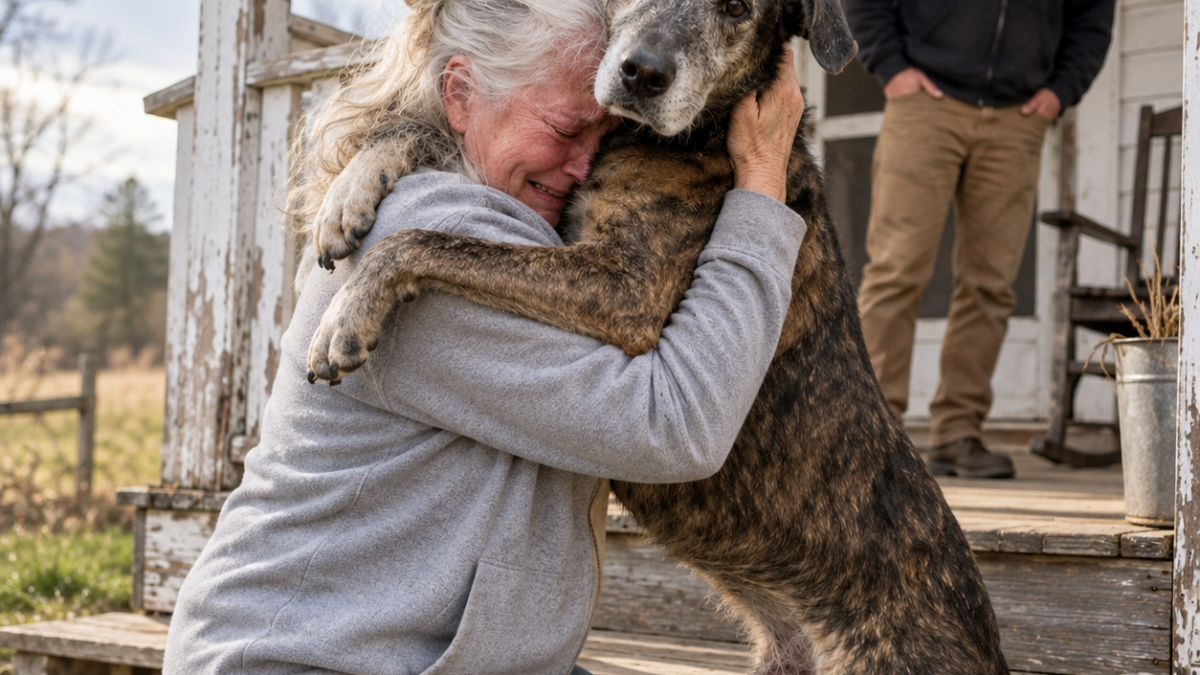
“Toby?”
The name was barely a sound.
But Max heard it.
Or recognized it.
Or felt something in the woman’s voice that belonged to a part of his life no shelter file had managed to record.
His entire body changed.
For thirteen days, I had watched him sit on those steps with almost unnatural patience.
That patience vanished.
He stood so quickly that the leash slipped through my hand.
“Toby!”
The woman’s voice broke.
Max ran.
Not away.
Toward her.
He crossed the porch in three strides and pressed his entire body against her legs.
The woman staggered backward.
I reached instinctively to steady her, but she had already dropped to her knees.
Her arms went around Max’s neck.
He made a sound I had never heard from him.
Not a bark.
Not a whine.
Something between the two.
A raw, breathless cry.
His tail struck the porch floor again and again.
The woman buried her face in his fur.
“Oh, my God.”
She was sobbing now.
“Oh, Toby.”
“You’re alive.”
“You’re alive.”
I stood three feet away holding an empty leash and feeling like I had walked into the middle of a family reunion where I was the only person who did not know the family.
Max—or Toby—licked her face.
She laughed through tears.
He pawed at her arm.
She held his head between both hands and stared into his eyes.
“You got so gray.”
Max pushed forward again.
She wrapped her arms around him.
I finally managed to speak.
“I’m sorry.”
The woman looked up as though she had forgotten I existed.
“No.”
She wiped her face.
“I’m sorry.”
“I…”
She looked at the dog again.
“How do you have him?”
“I adopted him from Greenwood County Shelter two weeks ago.”
Her face drained of color.
“The shelter?”
“Yes.”
“They called him Max.”
The woman stared.
“Max?”
She looked at him.
“No.”
Her fingers moved automatically to the fur behind his ears.
“This is Toby.”
Max closed his eyes.
That small gesture was enough to convince me there was no mistake.
I crouched.
“My name is Daniel.”
“Eleanor.”
“Eleanor Whitmore.”
She looked between Max and me.
“Please.”
“Come inside.”
I hesitated.
I did not know this woman.
I had spent twelve days following an old dog to her porch.
That alone should have been evidence my normal standards for reasonable behavior had already collapsed.
Still, I asked, “Are you sure?”
Eleanor gave a wet laugh.
“Toby has been trying to bring you here for nearly two weeks.”
“I think we’re past formal introductions.”
Fair.
I picked up the leash.
Max refused to let me clip it on.
Not aggressively.
He simply kept circling Eleanor as if she might disappear if he stopped touching her.
Finally, I followed them inside.
The house looked exactly like the kind of place an old dog might remember.
Nothing fashionable.
Nothing new.
A faded floral sofa.
Wooden end tables with rings from years of coffee cups.
Framed family photographs covering one wall.
A crocheted blanket over the back of a chair.
An old clock ticking loudly in the hallway.
Max walked in and stopped.
He sniffed.
Then he walked directly to the living room window.
Not exploring.
Remembering.
His nose touched the lower corner of the glass.
Eleanor covered her mouth again.
“He always sat there.”
I looked at her.
“He lived here?”
“For seven years.”
My chest tightened.
Seven.
Max was around ten.
That meant most of the life he could remember had happened inside this house.
Eleanor lowered herself carefully onto the sofa.
Max immediately came to her and placed his head across her knees.
She stroked his graying face.
“I thought I would never see you again.”
I sat in the chair opposite her.
“I need to understand what happened.”
“So do I.”
She looked at me.
“I thought he was safe.”
That sentence sounded painfully familiar even though I had known Max for only thirteen days.
“What happened?”
Eleanor stared down at him.
Her fingers continued moving through his fur.
“My husband bought him for me.”
“He did not ask me first.”
A faint smile appeared.
“Walter was like that.”
“There was a rescue event outside the grocery store.”
“He went in for milk and came home without milk but with a dog.”
Despite myself, I smiled.
“That sounds expensive for milk.”
“It was.”
She looked down at Max.
“Toby was three.”
“Maybe younger.”
“Nobody knew exactly.”
“He had been found wandering near the interstate.”
“Scared.”
“Thin.”
“Terrible skin.”
“He hated men in hats.”
“Walter wore a hat every day.”
“How did that work?”
“Badly for about two weeks.”
For the first time since opening the door, Eleanor laughed without crying.
“Then Walter started taking off his cap before he came inside.”
“By the end of the month, Toby slept with his head on Walter’s boots.”
Max’s tail tapped against the sofa.
Eleanor stopped.
She looked at him.
“He remembers that name.”
“Toby?”
“No.”
“Walter.”
Something in her face shifted.
Grief.
Old enough to have edges worn smooth but still present.
“When did your husband die?”
“Three years ago.”
“I’m sorry.”
“Thank you.”
Max moved closer to her.
Eleanor rested one hand on his shoulder.
“He was there.”
“When Walter died?”
She nodded.
“Heart attack.”
“Right here.”
She pointed toward the hallway.
“Toby would not leave the bedroom door for two days.”
My throat tightened.
The shelter description came back to me.
HAS LIVED IN MULTIPLE HOMES.
“Is that when you lost him?”
“No.”
Her expression darkened.
“That came later.”
Eleanor had a stroke ten months after her husband died.
Not catastrophic.
She survived.
But she spent nearly six weeks in the hospital and rehabilitation.
Her only child, a daughter named Susan, lived in Arizona.
Susan flew in, handled the medical paperwork, bills, house, mail, and everything else a daughter suddenly becomes responsible for when a parent collapses.
And Toby.
“I told Susan to keep him here if she could.”
Eleanor’s voice became defensive.
“She had a job.”
“Children.”
“A husband who was allergic.”
“I understood.”
“So she found someone?”
“My nephew Michael.”
Eleanor nodded.
“He lived twenty minutes away.”
“He had a fenced yard.”
“He liked dogs.”
“At least I thought he did.”
She stared toward the floor.
“What happened?”
“Michael kept Toby for three months.”
“Then his landlord found out.”
“He wasn’t supposed to have a dog.”
“So Michael gave him to a friend.”
“You didn’t know?”
“Not until later.”
Her jaw tightened.
“I was still in rehabilitation.”
“Susan was flying back and forth.”
“Everybody kept telling me not to worry.”
I winced at those words.
Sometimes “don’t worry” means somebody is protecting you.
Sometimes it means decisions are being made where you cannot see them.
“What happened with the friend?”
“Divorce.”
“Apartment.”
“No dogs.”
“Then another family.”
Eleanor’s eyes filled.
“By the time I came home, Toby had already been moved twice.”
“Why didn’t they bring him back?”
She looked at me as if the question had haunted her.
“Because everyone decided I was too old.”
I did not know what to say.
She was seventy-six now, maybe seventy-three then.
Stroke survivor.
Living alone.
I could understand the concern.
I could also see what it had cost.
“My doctor told Susan I should not be walking a large dog alone.”
“She thought she was protecting me.”
“Maybe she was.”
Eleanor’s voice cracked.
“But nobody asked what losing him would do.”
Max lifted his head.
He touched his nose to her wrist.
She immediately bent over him.
“I know.”
“I know, sweetheart.”
I looked away for a moment.
Some reunions feel too private even when you are part of the reason they happened.
“What happened after the other family?”
Eleanor shrugged.
“I stopped getting clear answers.”
“Michael said the family loved him.”
“Then Susan said they moved.”
“Then she said a rescue had him.”
“I called two rescues.”
“Neither had a Toby matching his description.”
“After that…”
Her voice faded.
“You thought he was gone.”
“I thought somebody had adopted him somewhere else.”
She looked around the room.
“For a year, I kept his bed.”
“Then Susan convinced me to donate it.”
“I kept the bowl.”
She pointed toward the kitchen.
I looked.
Beside a small cabinet was a blue ceramic water bowl.
Empty.
Dust-free.
Still there.
Max saw where I was looking.
He stood.
Walked into the kitchen.
Went directly to the bowl.
Sniffed.
Then looked at Eleanor.
She began crying again.
I sat back slowly.
The puzzle was forming.
The shelter had only partial records because Max had been transferred through multiple homes.
He had eventually been returned to a rescue.
Then fostered.
Then adopted.
Then surrendered.
At some point, the old name Toby disappeared from his paperwork.
Maybe intentionally.
Maybe accidentally.
Maybe somebody thought a new name would help him start over.
The shelter had called him Max by the time I met him.
But whatever humans had written on forms, some part of him had remembered this house.
The roads.
The porch.
The bowl.
Eleanor.
Home.
“Does the shelter know his history?”
“I don’t know.”
I pulled out my phone.
“I have his adoption packet.”
I kept it in my email because I was exactly the kind of first-time dog owner who reread medical paperwork at midnight.
I opened the file.
There were three previous placements listed.
One transfer from a rescue called Harbor Tails.
One private surrender.
One failed adoption lasting six months.
Cause for return:
SEPARATION ANXIETY.
Another:
DIFFICULTY ADJUSTING.
Another:
OWNER RELOCATION.
No mention of Eleanor.
No Toby.
No white house.
“How did he find his way here?” Eleanor whispered.
That question had been bothering me too.
The shelter was four miles from my house.
My house was roughly two miles from hers.
The route Max had chosen was direct enough to suggest memory.
Had one of his temporary homes been nearby?
Had he been walked here before?
Had he escaped once and found the neighborhood?
Dogs can remember routes, smells, landmarks, patterns far longer than we understand.
I did not need a miraculous explanation.
Max had seven years of repetition.
Thousands of walks.
Thousands of smells.
This town was still his map.
“He remembered,” I said.
Eleanor stroked him.
“He always did have a ridiculous memory.”
Max looked offended.
“What?”
“He knew which cupboard Walter kept treats in.”
“That seems normal.”
“Walter moved the treats.”
“Toby still sat in front of the old cupboard for six months.”
I laughed.
“That actually explains a lot.”
Eleanor looked at me.
“What?”
“My pantry.”
“He sits in front of it every evening.”
“Have you put treats there?”
“No.”
“Then I know where you need to put them.”
For the first time, something ordinary entered the room.
Not grief.
Not history.
A dog training his new person badly.
It felt good.
Then Eleanor asked the question I had been avoiding.
“Are you keeping him?”
My body went still.
Max was lying against her now.
His eyes closed.
He looked more peaceful than he had in the thirteen days since I adopted him.
“I…”
I did not know how to answer.
Of course I had planned to keep him.
I had signed papers.
Bought a bed.
Changed my routine.
Spent an unreasonable amount of money on orthopedic dog food because a shelter volunteer mentioned joints and I panicked.
But sitting in that house, watching him with Eleanor, the idea of walking him out the door felt like theft.
Eleanor saw my face.
“Oh, no.”
She sat straighter.
“No.”
“What?”
“You think I want him back.”
I looked down.
“Don’t you?”
She closed her eyes briefly.
“More than I can tell you.”
There it was.
My stomach sank.
Then she continued.
“But wanting and being able are different things.”
I looked at her.
She tapped her left leg.
The movement was slightly stiff.
“I still use a cane outside.”
“My balance is poor.”
“I cannot safely walk him.”
“My daughter comes every six weeks.”
“A home aide comes three mornings.”
“I am alone most nights.”
She looked at Max.
“He deserves more than my wanting.”
The sentence landed hard.
“I can arrange help.”
“No.”
“You barely know me.”
“That doesn’t mean—”
“Daniel.”
She smiled sadly.
“I spent three years being angry because people decided for me that I was too old to keep him.”
“I will not make the same mistake in reverse by deciding you do not matter because I knew him first.”
I said nothing.
She looked at Max again.
“You adopted him.”
“He brought you here.”
“That means something too.”
My throat tightened.
“I’ve had him thirteen days.”
“And he trusts you enough to lead you home.”
Home.
There it was again.
Not his home.
Home.
The word felt less singular than it had that morning.
Eleanor reached for a tissue.
“I want one thing.”
“Anything.”
“Bring him back.”
I nodded too quickly.
“Every day if you want.”
She laughed.
“You have a job, I assume.”
“Unfortunately.”
“Once or twice a week.”
“Whatever is reasonable.”
“Yes.”
“And if someday I am too confused to know him…”
Her voice faltered.
“Bring him anyway if he still wants to come.”
I swallowed.
“I will.”
She studied me.
“Do not promise because you feel guilty.”
“I’m not guilty.”
“You look guilty.”
“I have a expressive face.”
“You have a terrible poker face.”
That made me smile.
“I promise because I think Max—Toby—whatever his name is deserves both of us.”
Eleanor looked down at him.
“He is Max now.”
I blinked.
“What?”
“He came to you as Max.”
“But you called him Toby.”
“And he answered.”
“That doesn’t mean you have to erase the life he had after me.”
Her fingers moved through his fur.
“Toby was mine.”
“Max is yours.”
I did not like the word mine.
Maybe she noticed.
“Or perhaps,” she said, “he belongs to himself and we are both lucky he puts up with us.”
That sounded better.
We stayed for two hours.
Eleanor made coffee.
I found the treat cupboard.
Max remembered it.
Of course he did.
The treats inside were new because Eleanor no longer owned a dog.
I stared at her.
“You still keep dog treats?”
“My neighbor has a spaniel.”
She looked guilty.
“Also, I never stopped buying them for a while.”
Max received three.
I vetoed a fourth.
Eleanor called me cruel.
Max agreed with her.
When I finally stood to leave, my chest tightened.
Max saw the leash.
His body went still.
He looked at Eleanor.
Then at me.
This was the moment I had been afraid of.
I clipped the leash on.
“Come on, buddy.”
Max did not move.
Eleanor’s face crumpled for half a second before she controlled it.
I felt terrible.
Then she did something I will never forget.
She crouched as far as her knees allowed and held Max’s face.
“Toby.”
His ears rose.
“You go with Daniel.”
His eyes stayed on hers.
“You come back.”
His tail moved.
“You hear me?”
“You come back.”
Then she kissed his forehead and stepped away.
Max stood there.
One second.
Two.
Then he turned.
Walked to me.
I nearly cried.
Not because he had chosen me.
He had not.
That was the wrong way to understand it.
He trusted her promise enough to leave.
That was different.
We walked home slowly.
For the first time in thirteen days, Max did not keep looking backward.
That evening, he ate dinner.
Then wandered around the house.
He sniffed the living room.
The hallway.
The kitchen.
Then stopped in front of my pantry.
I opened it.
Moved the dog treats inside.
Max sat.
I laughed.
“Your old mother told me about this.”
Tail wag.
“One.”
I gave him one treat.
He waited.
“No.”
He tilted his head.
“Manipulative.”
Another tilt.
“Absolutely not.”
He sat there for ten minutes.
I gave him another.
My authority as a dog owner was progressing badly.
That night, Max did something new.
Instead of sleeping in the corner of the living room, he walked into my bedroom.
He stood near the door.
Looked at me.
Then lay down beside the bed.
Not touching.
But close.
I reached down.
My fingers rested on his shoulder.
“Good night, Max.”
One tail tap.
After a second, I added, “Toby.”
Two tail taps.
“Greedy.”
He sighed.
We visited Eleanor three days later.
I expected Max to lead.
He did not.
He walked beside me.
At Maple Avenue, I paused deliberately.
“Which way?”
Max looked left.
Then started walking.
He knew.
When the white house appeared, his pace increased.
Eleanor was already on the porch.
She must have been watching through the window.
Max pulled the leash.
I let him.
She opened her arms.
“There you are.”
That became our routine.
Tuesday evenings.
Sunday mornings.
White house.
Blue shutters.
Treat cupboard.
Max lying with his head in Eleanor’s lap while she told me stories.
I learned more about him than I expected.
He hated vacuum cleaners.
Loved cantaloupe.
Was terrified of the sound of balloons popping.
Once stole an entire roast from a kitchen counter when Walter had guests.
Refused to swim despite allegedly being “part water dog,” according to Walter.
Knew how to open the screen door with his nose.
Used to sleep on the left side of Eleanor’s bed until Walter complained there was more dog than wife.
I also learned about Eleanor.
She had been a school librarian for thirty-eight years.
Walter had taught high-school history.
They never had children together, but Susan was Eleanor’s daughter from a short first marriage.
Walter raised her from age six.
He called Toby “the youngest child” and blamed the dog for every mysterious food disappearance in the house, including several that were clearly Walter’s fault.
Eleanor kept photographs.
Thousands.
Old albums.
Boxes.
Framed pictures.
One Sunday, she brought out a photograph of Max as a younger dog sitting beside Walter on the porch.
Walter wore a baseball cap.
Max’s head rested against his knee.
“You said he hated men in hats.”
“He made an exception.”
I held the photograph carefully.
Walter looked kind.
Not movie-star kind.
Ordinary kind.
The kind you see in laugh lines and relaxed shoulders.
“He looks happy.”
“He was.”
Eleanor looked down at Max.
“We were.”
There was no bitterness in her voice.
Only fact.
I began understanding that grief does not erase happiness.
It proves there was enough happiness to leave an outline.
After a month, something changed in Max.
He stopped leading me to Eleanor’s house every morning.
That should have made me sad.
Instead, it relieved me.
The first morning he turned toward the park instead, I almost stopped him.
“You don’t want to see Eleanor?”
Max sniffed a mailbox.
Moved on.
We went to the park.
He investigated a bench.
Ignored two squirrels.
Accepted admiration from a little boy who called him “grandpa dog.”
Then walked home.
Home.
My house.
That evening we still visited Eleanor.
Max had not forgotten.
He simply no longer needed to check the door every day.
He had learned she would still be there Tuesday.
And Sunday.
Predictability had replaced waiting.
I began to realize how much of Max’s behavior the shelter had labeled separation anxiety.
Maybe some of it was.
But imagine being moved from home to home without understanding why.
Imagine doors closing behind people.
Cars taking you somewhere new.
Names changing.
Routines disappearing.
Then humans call you anxious because you do not adapt elegantly.
Max was not broken.
He was experienced.
There is a difference.
I told the shelter about Eleanor.
The adoption coordinator, Hannah, nearly cried on the phone.
“You’re serious?”
“Yes.”
“He remembered the route?”
“Twelve straight days.”
“And she was his original owner?”
“For seven years.”
Hannah became quiet.
“We knew there were earlier placements, but Harbor Tails sent incomplete historical records.”
“I’m not blaming you.”
“I know.”
“But this is exactly why transfer histories matter.”
She asked permission to document Eleanor as part of Max’s background.
I asked Eleanor.
She agreed immediately.
“Maybe another dog will have fewer missing chapters.”
That became important later.
Greenwood changed part of its intake process.
When older animals arrived through transfers, staff began pushing harder for original names, addresses, photographs, previous veterinary records, anything that might preserve continuity.
Not every old owner could be found.
Not every reunion was appropriate.
Some histories were unsafe.
Some doors should remain closed.
But the shelter stopped assuming a new placement meant an old life no longer mattered.
Eleanor liked that.
“Max is improving municipal bureaucracy,” she said.
“Walter would be horrified.”
“Why?”
“He spent forty years complaining about paperwork.”
Max had been with me three months when Eleanor fell.
It happened on a Thursday night.
I did not know until Friday morning.
Susan called.
I had met her only once over video.
Her voice was tense.
“Daniel?”
“Yes?”
“This is Susan Whitmore.”
My stomach tightened immediately.
“What happened?”
“Mom fell in the bathroom.”
“Is she okay?”
“Hip fracture.”
“She’s in the hospital.”
My eyes moved to Max.
He was lying near the window.
“Is she conscious?”
“Yes.”
“Surgery this afternoon.”
“Can we see her?”
Pause.
“You and Max?”
“Yes.”
Susan exhaled.
“She asked for him.”
That afternoon, after getting hospital permission, paperwork, vaccination proof, and what felt like approval from every administrator in the state, I brought Max to see her.
He knew something was wrong before we reached the room.
His nose worked faster.
His body stiffened.
When he saw Eleanor in the hospital bed, he stopped.
She looked small.
Pale.
One arm bruised from IV lines.
“Hey, Toby.”
Max went to her.
Slowly this time.
He put his nose against her hand.
Eleanor cried.
I stood near the foot of the bed.
“Show-off,” she whispered to him.
“You get one dramatic reunion and suddenly hospitals are beneath you?”
His tail moved.
She stroked his head.
Then she looked at me.
“Daniel.”
“Yes?”
“If I don’t get back to the house…”
“Don’t.”
“I’m seventy-six.”
“People survive hip surgery at seventy-six.”
“I know.”
“I intend to.”
“Then stop talking like—”
She raised one hand.
Teacher voice without volume.
I stopped.
“Listen.”
I hated the word.
Still did.
“If I cannot live alone after this, Susan wants me closer to her.”
My chest tightened.
Arizona.
I knew before she said it.
“Okay.”
“You’ll keep bringing him to me until then?”
“Of course.”
“And after?”
I looked at Max.
She did too.
“After,” I said, “we figure it out.”
“No.”
She shook her head.
“You keep him.”
“I was already planning on that.”
“I mean without guilt.”
I said nothing.
She smiled.
“You are extremely easy to read.”
“I’ve been told.”
“You think taking him home while I leave is betrayal.”
“Yes.”
“Why?”
“Because he spent years trying to get back here.”
Eleanor looked at Max.
“No.”
“I think he spent years trying to understand why home kept disappearing.”
That stopped me.
She continued.
“He brought you to me because I was unfinished.”
“Not because you were temporary.”
I sat down.
Max leaned against my leg.
Eleanor reached for my hand.
“He can love where he came from and still belong where he is going.”
I looked at her.
“You’re making this sound very simple.”
“It isn’t.”
“That does not make it untrue.”
Eleanor had surgery.
It went well.
Recovery was slower.
Susan flew in.
I met her properly for the first time in the hospital cafeteria.
She was fifty-two, looked like her mother around the eyes, and carried a permanent layer of guilt under everything she said.
“I was the one who moved Toby.”
The confession came before coffee.
“I know.”
“Mom told you?”
“Yes.”
Susan stared at her cup.
“I thought I was helping.”
“I believe you.”
“She could barely walk.”
“Her blood pressure was unstable.”
“She was on six medications.”
“My cousin said he would keep Toby.”
“Then everything kept changing.”
She rubbed one temple.
“I should have tracked him.”
“You were caring for your mother from two thousand miles away.”
“That doesn’t make it okay.”
“No.”
I surprised myself with the answer.
Susan looked up.
“It doesn’t.”
“I think pretending mistakes become okay because we had good intentions is how we avoid learning anything.”
Her eyes filled.
“But your mother doesn’t hate you.”
“I know.”
“Toby doesn’t either.”
She laughed weakly.
“Max.”
“Both.”
Susan looked toward the hospital elevators.
“Can I see him?”
“Of course.”
Max recognized her.
Not like Eleanor.
But enough.
He sniffed her.
Tail wagged.
Susan knelt in the hospital lobby and cried into his neck.
“I’m sorry, buddy.”
Max licked her ear.
Her face twisted.
“That seems excessive.”
“He has poor boundaries.”
For the first time, Susan laughed.
Maybe forgiveness begins with being allowed to tell the truth without defending it.
Eleanor spent six weeks in rehabilitation.
Max and I visited every Sunday.
The staff adored him.
He became unofficially responsible for morale on the second floor.
He sat beside stroke patients.
Accepted crackers from one gentleman named Harold who was not authorized to distribute crackers.
Slept under Eleanor’s wheelchair during physical therapy.
Once blocked the hallway until a nurse rubbed his chest.
“He’s manipulating you,” I said.
The nurse looked offended.
“He’s supporting healthcare workers.”
Eleanor agreed.
I was outnumbered.
Eventually, the decision came.
Eleanor could not safely return to the white house alone.
She would move to a senior community fifteen minutes from Susan’s home in Arizona.
Pet-friendly, technically.
But Max was ten.
The flight.
The desert.
Eleanor’s mobility.
A new apartment.
No nearby support except Susan.
Could she have taken him?
Maybe.
That word mattered.
But this time, nobody made the decision around her.
We sat together.
Eleanor.
Susan.
Me.
A rehabilitation social worker.
And Max asleep under the table.
Eleanor made the decision herself.
“He stays with Daniel.”
Susan cried first.
I was second.
Eleanor did not cry until later.
Her voice remained calm.
“He has had enough moves.”
“He knows Daniel’s house.”
“He knows the neighborhood.”
“He has his veterinarian.”
“He has his bed.”
“He has Tuesday.”
She stopped.
Tuesday.
Our visiting day.
That was when her composure broke.
Max lifted his head.
He crawled from beneath the table and put his chin on her knee.
Eleanor bent over him.
“I hate this.”
There it was.
Not noble.
Not tidy.
Not easy.
The truth.
“I hate that doing the right thing can still hurt this much.”
Susan put an arm around her.
I stared at the floor.
Max stayed.
That was what he did.
The week before Eleanor moved, we went to the white house every day.
Not because Max demanded it.
Because I did.
Eleanor was packing.
Susan was sorting.
Walter’s books went into boxes.
Photographs into labeled containers.
Furniture marked for donation or moving.
Max wandered through the changing rooms with visible concern.
Boxes had probably preceded too many departures in his life.
So we handled it differently.
Whenever a box filled, I let him sniff.
Whenever furniture disappeared, we stayed.
He watched Susan carry Walter’s old chair out.
His ears dropped.
Eleanor noticed.
She sat on the floor with him despite Susan protesting about her hip.
“It’s okay.”
She stroked his shoulders.
“That chair isn’t Walter.”
Max leaned against her.
“And this house isn’t me.”
I turned away.
She was talking to all of us.
On the final evening, the white house was nearly empty.
No photographs.
No books.
No crocheted blanket.
Only echoes.
Eleanor sat on the porch.
Max beside her.
I stood at the railing.
Sunset turned the street gold.
“You know what Walter used to say?” she asked.
“What?”
“That dogs don’t understand property.”
“They understand people.”
“That sounds like something a history teacher says after losing an argument about furniture.”
She smiled.
“He was very good at losing arguments elegantly.”
Max lowered his head onto her foot.
Eleanor stroked one ear.
“I kept thinking he was trying to come back to the house.”
“So did I.”
“He wasn’t.”
I looked at her.
“He came for you.”
“Yes.”
She glanced toward me.
“But after the first day, he kept bringing you.”
I did not understand.
Then I did.
Max could have pulled harder.
Could have escaped.
Could have refused to leave.
Instead, every day, he brought me.
He had not only been finding home.
He had been connecting two parts of his life.
Eleanor smiled through tears.
“Maybe the old fool was introducing us.”
Max sighed.
“I think he is offended.”
“He should be.”
Eleanor knelt carefully.
She put both hands around Max’s face.
“Toby.”
His eyes lifted.
“I’m going away.”
His tail stopped.
“But you are not being left.”
She pointed toward me.
“You have Daniel.”
Max looked at me.
Then back at her.
“And I have you.”
She touched his chest.
“Here.”
“Yes, that is sentimental.”
She looked at me.
“Do not ruin it.”
“I didn’t say anything.”
“Your face did.”
I laughed.
Then cried.
Eleanor kissed Max between the eyes.
“Go home with him.”
Max leaned into her for a long time.
Then she stood.
Walked inside.
Closed the door.
I expected Max to sit.
Wait.
Scratch.
Cry.
He did none of those things.
He stared at the closed door.
Then looked at me.
I held out my hand.
“Come on.”
He walked down the steps.
Halfway to the sidewalk, he stopped.
Looked back once.
Then continued.
We did not return the next morning.
For the first time since I adopted him, Max walked a completely different route.
He chose the river path.
We went slowly.
He sniffed trees.
Investigated a discarded sandwich wrapper.
Watched ducks from a safe distance because apparently swimming remained unacceptable.
Then we went home.
My home.
Our home.
Eleanor moved to Arizona.
We video-called every Sunday.
At first, Max seemed confused.
Her face appeared on my laptop.
Her voice came from the speakers.
He searched behind the screen.
Eleanor laughed so hard she cried.
“Toby, I am not in the computer.”
Max disagreed.
Within a month, he learned Sunday laptop meant Eleanor.
He would lie beside me.
The moment her voice came on, his ears rose.
Sometimes she talked to me.
Sometimes only to him.
Susan sent packages.
Treats.
Walter’s old blanket.
The blue ceramic bowl.
I placed it in my kitchen.
Max began drinking from it immediately.
I kept his newer bowl too.
Two bowls.
Eleanor called that ridiculous.
I called it hydration options.
A year passed.
Max turned eleven.
We celebrated twice.
One birthday based on the shelter estimate.
One on the date Walter originally brought Toby home.
Eleanor insisted.
“Old dogs deserve extra cake.”
“That is not veterinary advice.”
“I am seventy-seven.”
“I have earned the right to reject nutritional tyranny.”
Max agreed.
My house changed around him.
Not dramatically.
Quietly.
Rugs appeared because his hips slipped on hardwood.
A ramp appeared beside the back steps.
His bed moved from the living room corner to beside my sofa.
Then another bed appeared in my office.
Then one in my bedroom.
At some point, I realized the man who had worried whether he wanted a dog now owned four orthopedic dog beds for one animal.
Eleanor laughed for five straight minutes when she found out.
“You have become Walter.”
“I have never owned a hat.”
“Give it time.”
My life changed too.
I started walking every morning.
Not running.
Max had saved me from that particular mistake.
I learned neighbors’ names because old dogs stop frequently and force conversations.
I met Mrs. Patel from Maple Avenue.
Greg, the mail carrier.
A widower named Sam who carried treats despite not owning a dog.
A teacher named Leah who walked a nervous shepherd every evening.
The town I had lived in for seven years became a place populated by actual people instead of houses I passed.
Max did that.
He moved slowly enough for me to notice.
One evening, Leah and I ended up walking together.
Then again.
Then coffee.
Then dinner.
I told Eleanor.
She looked delighted.
“You’re dating because of Toby.”
“No.”
“You met walking him.”
“That is correlation.”
“You are becoming Walter.”
“Stop saying that.”
Leah became part of Max’s life gradually.
She understood old dogs.
Never crowded him.
She sat on my floor the first night she visited and waited for him to approach.
Max sniffed her shoes.
Then lay against her leg.
Traitor.
Eleanor approved of Leah before meeting her.
“How?”
I asked.
“Toby likes her.”
“You trust his judgment?”
“He picked you.”
I had no counterargument.
Two years after I adopted Max, Eleanor came back.
Just for a visit.
Susan flew with her.
The senior community had organized travel assistance, and Susan said her mother had talked about the trip for months.
I did not tell Max.
Not because I thought surprise was emotionally necessary.
Because explaining future travel to a dog is difficult.
They arrived on a Thursday.
I picked them up from a hotel after they rested.
We drove to my house.
Eleanor stood outside my front door with her cane.
She looked nervous.
“Ready?”
“No.”
“Good.”
I opened the door.
Max was asleep in the living room.
He lifted his head.
Saw me.
Then Eleanor stepped inside.
For a second, he did not move.
Age had softened his eyesight.
Maybe his brain needed time to fit the person before him to the voice from the computer.
Eleanor whispered, “Toby.”
Max stood.
Slowly.
Then faster.
His tail began moving.
He crossed the room.
Eleanor dropped her cane.
I caught it.
Max pressed against her legs.
Eleanor held him.
No frantic crying this time.
Something deeper.
Older.
A reunion without fear that one another had vanished permanently.
“You got even grayer,” she whispered.
Max sneezed.
“You too.”
Susan laughed.
I cried.
Leah cried.
Max eventually became bored with the humans’ emotional instability and went to the kitchen.
Toward the treat cupboard.
Eleanor laughed.
“Still remembers.”
We visited the white house the next day.
New owners lived there now.
A young couple with a toddler and a black cat who watched Max through the window with open hostility.
I had contacted them beforehand.
They knew some of the story because neighbors had told them about the old woman and her dog.
They invited us onto the porch.
Eleanor sat in a chair.
Max stood at the bottom of the steps.
He looked at the door.
Then at Eleanor.
Then at me.
He did not climb the steps.
That surprised all of us.
“You don’t want to go up?” I asked.
Max sniffed the grass.
Turned toward the sidewalk.
Eleanor smiled.
“He doesn’t live here anymore.”
We walked away together.
That moment mattered more than his original return.
The first time, Max had sat on those steps because the story was unfinished.
Now he could leave because it was not.
Three years after adoption, Max’s health began changing.
Kidneys first.
Then arthritis.
Nothing catastrophic.
Aging.
The slow tax of a long life.
His walks shortened.
The river path became too much.
We took one block.
Then half.
Some mornings, he only wanted the yard.
I learned to stop measuring a walk in distance.
If Max spent fifteen minutes smelling one bush, that was his expedition.
Leah moved in around then.
Not because Max needed help.
Though he did.
Not because my house was silent.
It had not been silent for years.
She moved in because the relationships that last sometimes begin quietly enough that nobody notices when they become home.
Eleanor was unbearable about it.
“I knew first.”
“You met Leah on video after six months.”
“Toby knew first.”
That was harder to dispute.
Max turned thirteen.
Eleanor turned seventy-nine.
They both moved slower.
Sunday video calls continued.
Sometimes Eleanor forgot small details.
A word.
A date.
Whether we had talked about something already.
Susan told me there were concerns about early cognitive decline.
Not severe.
Not yet.
The news frightened me.
Not because I believed forgetting meant love disappeared.
Max had taught me otherwise.
But I hated the idea of Eleanor losing one more thing.
During one call, she stared at the screen for several seconds.
“Daniel?”
“Yes.”
“Where is Toby?”
I turned the laptop.
Max was asleep beside the sofa.
“There.”
Her face softened immediately.
“Oh.”
“There you are.”
The same words she had used every reunion.
Max’s tail moved in his sleep when he heard her voice.
I had to look away.
That winter, Eleanor mailed me a letter.
Actual paper.
Her handwriting was shaky.
Daniel,
Susan says I repeat myself now, so I am writing this while I still know exactly what I want to say.
Thank you for knocking.
I spent years thinking Toby had disappeared because I failed him.
You gave me the chance to know that he was safe.
More importantly, you gave him the chance to know I had not chosen to leave him.
Do not underestimate what that means.
If someday I stop remembering the details, you remember them for me.
Tell him I loved him.
Tell yourself I was grateful.
And please stop buying him so many beds.
Love,
Eleanor
P.S. Walter would have liked you, but he would have cheated you at cards.
I framed the letter.
Not the part about the beds.
All of it.
Max’s final year arrived without ceremony.
He was fourteen by our estimate.
Maybe fifteen.
Old enough that nobody could say with certainty.
His kidneys worsened.
His back legs weakened.
Leah and I lifted him using a support harness.
He tolerated it because aging had softened his need for dignity less than his need to reach breakfast.
He still liked food.
That was our measure.
Food.
Comfort.
Curiosity.
Sleep.
Connection.
The things that tell you an old dog is still participating in his own life.
One Sunday in April, Eleanor missed our call.
Susan called later.
Mom had been hospitalized.
Pneumonia.
Again.
This time worse.
I asked whether we should come.
She hesitated.
“That’s a long drive for Max.”
She was right.
He could no longer handle flying.
Even an eight-hour road trip would be hard.
“Can we video?”
“Tomorrow.”
Tomorrow came.
Susan held the phone beside Eleanor’s hospital bed.
Eleanor looked terribly small.
Oxygen under her nose.
Eyes tired.
“Daniel?”
“I’m here.”
“Is he?”
I lowered the camera.
Max was beside me on his bed.
“Toby.”
His head lifted.
Slowly.
Eleanor smiled.
“There you are.”
Max’s ears moved.
He tried to stand.
Could not.
I helped him upright.
He looked toward the laptop.
Eleanor began crying.
“Good boy.”
Max stepped closer.
He sniffed the screen.
Then lay down beside it.
Eleanor watched him.
“I’m tired.”
My throat tightened.
“I know.”
She looked toward me.
“Take care of him.”
“I will.”
“No.”
She frowned, trying to find words.
“I mean when…”
She stopped.
I understood.
“When you can’t anymore?”
She nodded.
I swallowed.
“I’ll do right by him.”
Eleanor relaxed.
“Good.”
She looked at Max again.
“Toby.”
Tail tap.
“You can stay with Daniel.”
Tail tap.
“You don’t need to come find me.”
I pressed my hand over my mouth.
Susan turned away from the camera.
Eleanor continued.
“You already brought him.”
I froze.
“What?”
Her eyes moved toward mine.
“He thought he was taking you home.”
She smiled weakly.
“But maybe he was bringing home to you.”
I did not answer.
Could not.
Max lowered his head beside the laptop.
Eleanor whispered, “Good boy.”
That was our last call.
She died three days later.
Peacefully.
Susan was with her.
I told Max on the living room floor.
Not because I believed he understood death from words.
Because I had promised to remember the details for her.
“Eleanor died.”
His eyes rested on mine.
“She loved you.”
Tail movement.
“She never stopped.”
I brought Walter’s blanket.
Max curled on it.
Leah sat beside me.
We stayed there until dark.
Eleanor’s funeral was in Arizona.
I went alone.
Max could not travel.
Leah stayed with him.
Susan gave me a small wooden box afterward.
Inside was an old brass tag.
TOBY WHITMORE.
A phone number no longer in service.
The tag from his life before me.
I held it for a long time.
“Mom kept it in her jewelry box.”
Susan said.
“She said it was proof he was real.”
I clipped it onto Max’s collar beside his current tag when I returned home.
Two names.
Two chapters.
Max.
Toby.
Neither wrong.
Both loved.
His decline accelerated that summer.
He still ate.
Then only chicken.
Then only if Leah hand-fed him.
He stopped walking beyond the yard.
Then stopped wanting the yard.
Our veterinarian, Dr. Patel, was honest.
“You are getting close.”
“How close?”
“You will know.”
I hated that answer.
Then one morning, I knew.
Max woke before sunrise.
He tried to stand.
I helped.
He walked toward the front door.
That surprised me.
“Outside?”
He looked at me.
I clipped his harness.
Leah came downstairs in pajamas.
“What’s happening?”
“I don’t know.”
We went out.
Max stood at the sidewalk.
He turned left.
My chest tightened.
The old route.
Maple Avenue.
Jefferson.
The pharmacy.
The church.
Impossible.
He could barely walk fifty yards.
I crouched.
“You want the white house?”
His ears lifted.
Leah knelt beside us.
“He can’t walk there.”
“I know.”
We brought the car.
I put Walter’s blanket on the back seat.
Max lay down.
I drove the route exactly as he used to walk it.
Maple.
Jefferson.
Church.
Three blocks.
White house.
The current owners still knew us.
I texted them from the car.
They came outside quietly.
Max could not climb the porch.
I carried him.
For the first time in all the years I knew him, I carried him onto those steps.
He weighed less now.
Too little.
I placed him where he had sat for twelve days when I first adopted him.
Max looked at the door.
Then the window.
Then the street.
No Eleanor.
No Walter.
No old furniture.
No treat cupboard.
Just a house.
He did not wait.
Instead, he turned his head toward me.
I sat beside him.
Leah sat on the other side.
Max placed one paw against my leg.
That was all.
I understood.
We stayed five minutes.
Then I carried him back to the car.
At home, I called Dr. Patel.
She came that afternoon.
Max lay on Walter’s blanket in our living room.
The framed photograph of Eleanor, Walter, and young Toby sat on the table.
Eleanor’s letter beside it.
His old brass tag on his collar.
His Max tag beside it.
Leah sat near his back.
I sat at his head.
Dr. Patel gave us as much time as we needed.
I touched the gray fur between Max’s eyes.
“For twelve days,” I whispered, “I thought you were trying to get away from me.”
His breathing was slow.
“I thought you wanted another home.”
I laughed softly through tears.
“Turns out you were just making introductions.”
Leah cried.
I continued.
“You brought me to Eleanor.”
“You brought Eleanor back to yourself.”
“You brought me into a town I had lived in for years without knowing anyone.”
“You brought Leah into my life.”
Leah put her hand over mine.
“And somehow you turned a quiet house into a home.”
Max’s tail moved once against the blanket.
Dr. Patel waited.
I bent close.
“You don’t have to lead me anywhere else.”
His eyes stayed on mine.
“I know the way now.”
That was the last promise I made him.
When the medication began, Max relaxed.
His head became heavy in my hands.
I remembered the first night he slept across the room with his back turned.
The third day when he pulled me toward streets I did not know mattered.
The thirteenth day.
Eleanor opening the door.
“Toby?”
The sound that changed everything.
I kissed his forehead.
“Good boy, Max.”
Then I added, “Good boy, Toby.”
One small breath.
Another.
Then stillness.
Leah leaned against me.
I kept one hand over Max’s heart long after it stopped.
No rush.
No unanswered door.
No one waiting alone.
We scattered part of Max’s ashes beneath a tree near the river path.
Susan asked for a small portion.
She placed them beside Eleanor and Walter.
I kept his two tags.
They hang together near my front door.
TOBY WHITMORE.
MAX CARTER.
Sometimes people ask why a dog needs two names after death.
I tell them he had more than one life.
The shelter changed after Max too.
Greenwood created a “history preservation” folder for older surrendered dogs.
Previous names.
Old photographs.
Known addresses.
Favorite routines.
Former owners when contact was safe and appropriate.
They do not promise reunions.
Life is more complicated than that.
But they try harder not to erase everything that came before a kennel number.
I volunteer there twice a month now.
Mostly with older dogs.
The quiet ones.
The ones lying in the back while puppies throw themselves against the gates.
I tell adopters what Hannah once told me.
“Do not assume the dog who comes forward fastest will love you most.”
Sometimes the deepest relationships begin with distance.
Last winter, a man named Aaron came looking for a dog.
Forty-two.
Recently divorced.
Small house.
Too quiet.
I recognized that description.
He stopped in front of an eleven-year-old mixed-breed dog named Murphy.
Murphy barely looked up.
Aaron said, “I don’t think he likes me.”
I smiled.
“You’ve known each other thirty seconds.”
“How long did yours take?”
I thought about Max.
“He took three days to show me he had somewhere important to go.”
“What happened?”
“He took me with him.”
Aaron looked confused.
I left it there.
Some stories make more sense after you have lived your own version.
He adopted Murphy.
Two weeks later, Aaron sent the shelter a photograph.
Murphy asleep on his sofa.
His head on Aaron’s leg.
Caption:
He finally moved closer.
I printed it and put it on the staff board.
Leah and I are married now.
Small ceremony.
No dramatic speeches.
Susan came.
Hannah from the shelter came.
On one table were two photographs.
One of Eleanor and Walter with young Toby.
One of me sitting on the white porch steps beside old Max.
The same dog.
Two names.
Three people who thought they were rescuing something and were probably all being rescued in less obvious ways.
I am forty-three now.
The house is not quiet anymore.
Leah talks while cooking.
The refrigerator makes an annoying clicking noise I still need to repair.
Our neighbor’s kid practices trumpet badly.
And there is another dog asleep near my chair.
Her name is Sadie.
Eight years old.
No mysterious white house so far.
She was surrendered when her owner entered hospice.
Her file came with three photographs, a handwritten feeding schedule, an old collar, and a note from the man who loved her before us.
That note says:
She sleeps better if she can see the bedroom door.
Please don’t make her start from nothing.
Greenwood did not make her start from nothing.
Neither did we.
That may be Max’s biggest legacy.
He taught me that adoption is not always a clean beginning.
Sometimes you are entering a story halfway through.
There may already be people.
Places.
Names.
Grief.
Habits.
Promises.
A porch the dog still remembers.
Loving what comes next does not require erasing what came before.
I used to think home was a place you arrived at and stayed.
Max taught me something different.
Home can be a route remembered after years away.
A white house with faded shutters.
A woman saying an old name.
A new man holding the leash.
A kitchen with the treat cupboard in the correct place.
A computer screen on Sunday afternoons.
A blanket carried from one life into another.
Sometimes home is not one place at all.
Sometimes it is every person who made you feel safe enough to stop waiting.
For twelve days, I believed Max was leading me somewhere.
On the thirteenth, I learned he had spent those walks stitching two lives together.
His old one.
And mine.
He was not trying to leave me.
He was making sure I understood who he had been before asking me to become part of who he would be next.
And years later, when I carried him back to those same porch steps for the final time, he did not stare at the door.
He looked at me.
That is how I knew.
He had remembered his way home.
Then, somehow, he had made one with me.








