My mother had been hiding her grief for months, and I showed up at her door with two old Chihuahuas without knowing whether she would let any of us inside
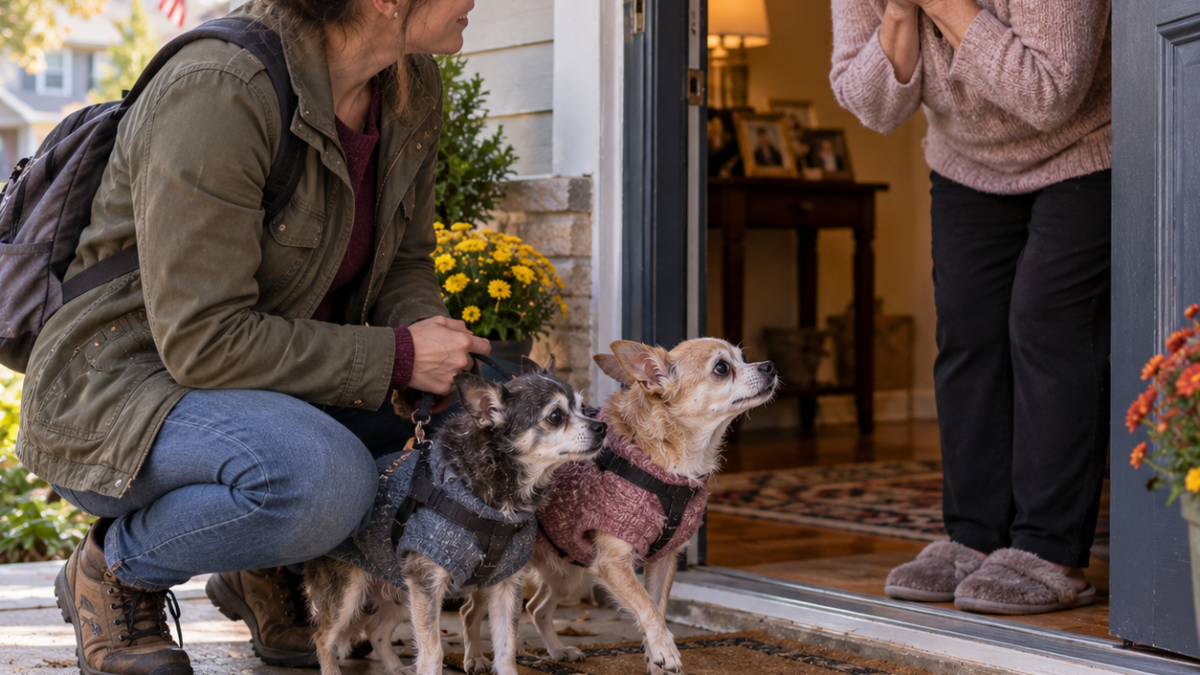
For a few seconds, nobody moved.
Mom stood behind the screen door with one hand covering her mouth.
I stayed beside Bruno because I didn’t trust his back legs on the porch steps without help.
Luna stood at the bottom step, looking up.
The wind moved through the maple tree beside the driveway.
Somewhere down the block, a lawn mower started.
It was an ordinary Saturday afternoon.
But I remember every detail because the three of them seemed to exist inside a silence separate from everything else.
“Mom?” I finally said.
She opened the screen door.
Luna climbed the first step.
Then the second.
She hesitated at the top.
My mother crouched slowly.
“Oh, sweetheart,” she whispered.
Luna walked toward her.
No barking.
No trembling.
No excited tail.
She simply stopped at Mom’s feet and rested her tiny chin on the toe of her slipper.
My mother’s face changed.
I had seen her cry at the hospital.
I had seen her cry at Dad’s funeral.
I had seen her cry when we packed away his winter coat because neither of us could stand seeing it hanging by the door anymore.
This was different.
Her eyes filled, but she didn’t look broken.
She looked surprised.
As if some locked room inside her had opened without warning.
Bruno gave a soft cough behind me.
Mom looked up.
“And him?”
“Bruno.”
“You brought both?”
“I couldn’t separate them.”
I expected a lecture.
Instead Mom nodded.
“No.”
She looked back at Luna.
“No, you couldn’t.”
Bruno had made it to the first step.
His hind legs shook.
I reached beneath his chest.
“I’ve got you, buddy.”
Before I could lift him, Mom stood.
“Wait.”
She disappeared inside.
I heard a drawer open.
Then another.
She came back carrying the old wooden step Dad had built years ago when their terrier, Max, became too arthritic to climb onto the porch.
Max had been gone almost nine years.
I didn’t even know she still had it.
Mom placed the step between the porch and the walkway.
“There.”
Bruno looked at it suspiciously.
Then at Mom.
Then at me.
“Come on,” she said.
He put one paw on the wooden step.
Then another.
It took him nearly a full minute.
Mom never rushed him.
When he finally reached the porch, Luna immediately walked to his side.
Only then did Bruno relax.
My mother watched the two of them.
“They really don’t leave each other, do they?”
“Apparently not.”
She opened the door wider.
“All right.”
I blinked.
“All right what?”
“Well, don’t leave them standing outside.”
That was how Luna and Bruno entered my mother’s house.
No dramatic announcement.
No promises.
No speech about new beginnings.
Just my mother holding the door while two tired old Chihuahuas walked inside.
Luna explored first.
She sniffed the rug.
The table leg.
Dad’s old recliner.
Then she moved into the hallway and immediately looked back for Bruno.
He was still near the door.
Mom noticed.
“His legs?”
“Arthritis, mostly.”
She frowned.
“How bad?”
“Catherine gave me his medication and the veterinary records.”
“You have records?”
“In the car.”
“What does he eat?”
“I brought that too.”
“Does he need a raised bowl?”
“I don’t know.”
“Then we should find out.”
I almost laughed.
Five minutes earlier, she had stared at me like I had lost my mind.
Now she was conducting an intake interview.
Luna wandered into the living room.
Bruno followed.
Near the fireplace sat Dad’s recliner.
Mom had never moved it.
She had stopped sitting in it, but she hadn’t allowed me to move it either.
Luna circled the chair once.
Then she lay down beside it.
Bruno lowered himself next to her.
My mother stopped in the doorway.
I knew what she was seeing.
Dad sitting there every evening.
The newspaper folded across his lap.
One ankle resting over the other.
A cup of tea cooling on the small table.
For a moment, I regretted everything.
Then Mom walked to the closet.
She removed an old knitted blanket.
It was dark green.
Dad’s favorite.
He used it over his legs during his last winter.
She carried it to the floor.
I held my breath.
Mom folded the blanket twice and placed it beside the fireplace.
“For tonight,” she said.
Luna sniffed it.
Bruno stepped onto it first.
Luna immediately followed.
They curled together.
My mother sat in the chair opposite Dad’s empty recliner.
I sat on the couch.
None of us spoke for a while.
Finally Mom said, “You should have asked me.”
“I know.”
“I mean it.”
“I know.”
“You can’t just bring two animals to somebody’s house because you’ve decided they’re lonely.”
“I know.”
She looked at me.
“I could have said no.”
“You still can.”
Her eyes moved toward the blanket.
Luna had fallen asleep with her head over Bruno’s front leg.
Bruno’s eyes were closed too.
Mom was quiet.
“No,” she said.
I waited.
She rubbed her thumb against the edge of her sleeve.
“I don’t think I can.”
That night, I stayed.
I told myself it was because I needed to make sure Luna and Bruno settled in.
Really, I was afraid Mom might change her mind once the house became dark.
I made pasta.
Mom barely ate.
The dogs ate more cautiously.
Luna refused to approach her bowl until Bruno started eating.
Bruno, who had several missing teeth, took his time.
Mom sat on the kitchen floor while he chewed.
“You’re watching him like he’s performing surgery,” I said.
“He’s slow.”
“He’s thirteen.”
“So was Max.”
“Max stole an entire pork chop when he was thirteen.”
“He had a strong constitution.”
Bruno looked up.
A piece of softened kibble was stuck to his lip.
Mom laughed.
It was small.
Barely more than air.
But it was the first time I had heard her laugh since Dad died.
I looked away before she could see my face.
After dinner, I unfolded the second bed I had bought from the rescue’s little store.
Mom stared at it.
“One bed?”
“They sleep together.”
“That doesn’t mean they want to share a mattress.”
“Mom.”
“What?”
“You didn’t want two dogs three hours ago.”
“I didn’t say I didn’t want them.”
“You definitely implied it.”
“I said you should have asked.”
“Same thing.”
“It is not.”
She took her purse from the counter.
“Where are you going?”
“To buy another bed.”
“It’s eight-thirty.”
“The store is open until nine.”
I watched her put on her coat.
“Do you want me to go?”
“No.”
“Mom.”
She stopped at the door.
“I need to see what size they have.”
Twenty minutes later, she returned with two dog beds.
Three fleece blankets.
A package of soft senior treats.
A ceramic water bowl.
And two tiny sweaters.
One blue.
One yellow.
I stared into the bag.
“You bought clothes.”
“They were on sale.”
“You have known them for four hours.”
“It’s supposed to get cold next week.”
Bruno looked at the bag.
“You hear that?” I told him.
“You’ve been here four hours and already have a wardrobe.”
Mom pointed at me.
“Don’t make fun of him.”
I smiled.
There she was.
Not all the way.
But there.
The woman I knew.
We arranged the beds near the fireplace.
Bruno chose Dad’s green blanket instead.
Luna chose Bruno.
Mom turned off the lamps one at a time.
When only the light above the stove remained, I heard her whisper, “Good night, babies.”
I slept in my old bedroom.
At 2:17 in the morning, I woke to footsteps in the hallway.
I sat up.
“Mom?”
No answer.
I walked into the living room.
She was sitting on the floor.
Luna was in her lap.
Bruno was beside her knee.
Mom’s face was wet.
I sat beside her.
For a while, neither of us said anything.
Then she whispered, “I thought I was doing well.”
“You are.”
“No.”
She stroked Luna’s ears.
“I’m pretending very well.”
I didn’t interrupt.
She had spent months telling everyone she was fine.
I wasn’t about to stop her now that the truth had finally found a way out.
“People keep telling me I’m strong,” she said.
“I hate that word.”
I looked at her.
“Strong?”
“Yes.”
She wiped her cheek.
“Strong means everyone thinks you can carry it.”
Luna shifted deeper into her lap.
Mom continued.
“Your father and I were married forty-three years.”
“I know.”
“I know you know.”
Her voice broke.
“But people act as if grief is something you organize.”
She looked toward Dad’s chair.
“As if there is a correct shelf for it.”
I put an arm around her.
Mom leaned against me.
For the first time since the funeral, she allowed herself to say what she had been hiding.
She hated mornings.
She hated cooking for one.
She hated reaching for her phone to tell Dad something and remembering there was nobody to call.
She hated people inviting her to dinner because they felt sorry for her.
She hated people avoiding his name because they worried it would make her sad.
“I’m already sad,” she whispered.
“Saying his name doesn’t create it.”
Bruno stood.
Slowly.
He walked to Dad’s recliner.
Then he lowered himself beside it.
Mom watched him.
“That’s where Robert always sat.”
“I know.”
Luna hopped down from Mom’s lap and joined Bruno.
The two dogs curled together under the edge of the green blanket.
Mom stared at them.
Then she said something so quietly I almost missed it.
“They lost someone too.”
“Yes.”
“What was her name?”
“Their owner?”
Mom nodded.
“I don’t know.”
The next morning, she called Catherine.
Her name had been Eleanor Harlan.
She had been seventy-eight.
She had adopted Luna from a county shelter when Luna was about a year old.
Bruno came two years later after a neighbor could no longer keep him.
Eleanor had lived alone after her husband died.
The dogs had been with her through most of the following decade.
Catherine explained that when Eleanor died unexpectedly, a niece traveled from out of state to settle the estate.
She loved the dogs but lived in an apartment where pets were not allowed.
“She was devastated,” Catherine told Mom over speakerphone.
“She made us promise they would stay together.”
Mom looked toward the living room.
“They will.”
I watched her face.
She said it without hesitation.
After the call, Mom stood at the kitchen counter for a long time.
“What are you thinking?”
“She was alone too.”
“Eleanor?”
“After her husband.”
“Sounds like it.”
Mom looked toward Luna and Bruno.
“And they stayed with her.”
“Yes.”
She nodded slowly.
“Then they know the job.”
“What job?”
She poured hot water into Dad’s blue mug.
“Sitting with someone when there’s nothing to say.”
That became the first thing Luna and Bruno gave her.
Not happiness.
Not immediately.
They gave her company without questions.
Humans often don’t know what to do with grief.
We try to fix it.
We tell people to stay busy.
We tell them the person they lost would want them to be happy.
We say time heals.
We fill silence because silence makes us nervous.
Luna and Bruno didn’t do any of that.
They simply stayed.
If Mom cried, Luna climbed beside her.
If she stared through the kitchen window for twenty minutes, Bruno lay beneath the table.
If she talked about Dad, neither dog tried to change the subject.
If she said nothing, they accepted that too.
Over the next few weeks, routine began returning to the house.
Not the old routine.
A new one.
Luna woke around six-thirty every morning.
She would stand beside Mom’s bed and make a tiny snuffling sound until Mom opened her eyes.
Bruno preferred sleeping late.
Mom joked that he had inherited Dad’s morning habits.
She began getting up before seven.
She opened the back door.
Luna trotted onto the patio.
Bruno followed carefully down the wooden step.
Mom stood outside with a sweater over her pajamas and watched them investigate the yard.
Afterward, she prepared their breakfast.
Bruno’s medication went into a teaspoon of soft food.
Luna received half a senior biscuit.
Then Mom made tea.
Not because she was trying to fill time.
Because she had things to do.
Bruno needed his pills.
Luna needed her little walk.
Beds needed washing.
Water needed changing.
There was hair on the couch again.
Tiny pawprints appeared near the back door when it rained.
The house became imperfect.
That helped.
One Sunday, I arrived and found three rugs covering the hardwood hallway.
“What happened?”
“Bruno slipped.”
“Is he okay?”
“He’s fine.”
Mom pointed at the rugs.
“But the floor is ridiculous.”
“Dad loved that floor.”
“Your father didn’t have arthritis.”
“You made me wear socks in this house for twenty years so I wouldn’t scratch it.”
“That was different.”
“How?”
“You were reckless.”
“I was eight.”
“Exactly.”
Bruno walked across the new rugs with noticeably more confidence.
Mom smiled.
“You see?”
“I see.”
The following week, she called a carpenter.
By Friday, Bruno had a low wooden ramp leading from the back porch into the yard.
I stared at it.
“That looks professionally built.”
“It is.”
“How much did you spend?”
“That is none of your business.”
“Mom.”
“Bruno needs it.”
“Bruno weighs nine pounds.”
“And?”
“You could have bought a portable dog ramp.”
“This one matches the porch.”
I looked at Bruno.
He stood at the top of the ramp like a tiny elderly king surveying an infrastructure project commissioned specifically for him.
“You’ve got her completely under control,” I told him.
His tail moved once.
Luna adapted differently.
She attached herself to Mom quickly but never stopped checking on Bruno.
If he slept too long, she sniffed his face.
If he went outside without her, she paced beside the door.
If Mom picked him up to carry him into the car, Luna tried to follow.
One afternoon, Mom called me sounding worried.
“She won’t eat.”
“Who?”
“Luna.”
“Is she sick?”
“I don’t think so.”
“What happened?”
“Bruno is at the vet.”
I sighed.
“Mom.”
“I know.”
“She’s anxious because he’s gone.”
“I know that now.”
“What did the vet say about Bruno?”
“They’re checking his hips and adjusting the arthritis medication.”
“He’ll be back soon.”
“Try sitting with her.”
“I am.”
Two hours later, Mom sent me a photograph.
Bruno was home.
Luna had wedged herself so tightly against him that half her body was lying across his chest.
The message under the photo said:
She ate.
I saved the picture.
By spring, Mom started walking them around the block.
It was not much of a walk.
Bruno could manage about ten minutes on good days.
On difficult days, Mom brought a small pet stroller she had sworn she would never buy.
“You bought a stroller.”
“He gets tired.”
“You laughed at people who did this.”
“I have matured.”
“Last year you called Mrs. Campbell ridiculous for pushing her Pomeranian in one.”
“Mrs. Campbell’s dog is four.”
“Fair.”
Bruno rode in the stroller while Luna walked beside Mom.
Neighbors began stopping to talk.
People who had barely seen my mother since Dad’s funeral started seeing her every morning.
Mr. Lewis from across the street gave Bruno treats.
A woman two blocks away named Diane walked with Mom twice a week.
A little boy named Noah became convinced Luna was “the smallest wolf in America.”
Luna appeared to agree.
The dogs did not replace my father.
That was important.
Nothing could.
Mom still missed him.
Some days badly.
There were mornings when I called and heard the heaviness in her voice.
There were anniversaries.
Birthdays.
The first spring without him.
The first time the roses he planted bloomed after his death.
The first wedding anniversary Mom spent alone.
But grief changed shape.
It stopped being the only thing in the room.
One afternoon, about three months after Luna and Bruno arrived, Catherine called.
“I found something that belongs to the dogs.”
“What?”
“A bag from their former owner.”
Apparently the rescue had received several boxes when Eleanor’s niece cleaned the house.
Most contained old towels and supplies.
One canvas tote had accidentally been stored in the shelter’s donation room.
Catherine found Luna and Bruno’s names written on a piece of masking tape attached to the handle.
I drove there after work.
The bag was faded navy blue.
Inside were two knitted sweaters.
A soft red leash.
A photograph.
Three old dog tags.
A small fleece blanket.
And an envelope.
The photograph showed Eleanor sitting on a porch between Luna and Bruno.
Luna was younger.
Her muzzle had no gray.
Bruno stood straight on strong back legs.
Eleanor was laughing at something outside the frame.
The envelope contained a sheet of lined paper.
It wasn’t a formal letter.
More like instructions.
Someone had written them over time.
Bruno likes his medicine hidden in cheese.
Luna hates thunder.
They sleep together.
If Bruno doesn’t eat, Luna usually won’t either.
Luna will pretend she doesn’t want to be held, but she does.
Bruno likes warm laundry.
They both know “kitchen” means treats.
Please don’t separate them.
At the bottom, in different ink, was one more line.
They have been my family for a very long time.
Please make sure they still have each other when I’m gone.
I sat in my car with the paper in my lap for almost ten minutes.
Then I drove to Mom’s house.
She was in the garden.
Luna followed her between the flower beds.
Bruno was sleeping on a cushion beneath the patio table.
“I have something.”
Mom saw my face.
“What happened?”
“Nothing bad.”
We sat at the kitchen table.
I gave her the photograph first.
She studied Eleanor.
“She looks kind.”
“She must have been.”
Then I handed her the note.
Mom read slowly.
When she reached the last line, she stopped.
Her thumb rubbed against the edge of the paper.
Finally she whispered, “She knew.”
“Knew what?”
“What it meant to leave someone behind.”
I understood.
Mom read the note again.
Then she walked into the living room.
Luna followed.
Bruno woke and looked up.
Mom sat on the floor between them.
“She loved you,” she said.
Her voice shook.
“Do you know that?”
Luna put a paw on her leg.
Mom smiled through tears.
“She loved you very much.”
That evening, she placed Eleanor’s photograph in a small frame.
Not in the living room.
Not somewhere visitors would immediately notice.
She put it on the shelf above Luna and Bruno’s beds.
“Why there?” I asked.
“Because she belongs to their story.”
A week later, Mom added a photograph of Dad to the same shelf.
I didn’t say anything.
Neither did she.
Two people who had been loved.
Two people who were gone.
And beneath them, three living beings learning that continuing did not mean forgetting.
Summer arrived.
Mom’s garden came back to life.
Luna discovered that she enjoyed lying in warm patches of sunlight.
Bruno preferred shade.
Mom placed a small outdoor bed beneath the maple tree.
She began reading there in the afternoons.
Sometimes I would arrive and find all three asleep.
Mom in the chair.
Luna curled near her feet.
Bruno stretched beside the bed.
Those were the moments that reassured me most.
Not the laughing.
Not the walks.
Sleep.
Grief had destroyed Mom’s sleep after Dad died.
She woke at two.
Three.
Four.
Sometimes she didn’t sleep at all.
Now she napped in the afternoon with two Chihuahuas keeping watch.
One Saturday, I found her baking.
“You’re baking?”
“Banana bread.”
“For who?”
“Diane is coming over.”
I stared.
Mom frowned.
“What?”
“You invited someone?”
“She invited herself.”
“Still counts.”
“We’re going to the garden center afterward.”
I put a hand against my chest.
“I need a minute.”
“Stop being dramatic.”
“I thought you hated the garden center.”
“I hated going alone.”
That sentence stayed with me.
A lot of things she thought she hated had really just become painful alone.
The grocery store.
The garden center.
The park.
Sunday mornings.
Coffee on the porch.
It wasn’t the places.
It was the empty space beside her.
Luna and Bruno couldn’t fill Dad’s place.
But they taught Mom that an empty place did not mean every place had to remain empty forever.
Then came October.
The anniversary.
I had dreaded it for weeks.
Mom pretended not to.
Dad had died on October seventeenth.
As the date approached, she became quieter.
She still walked the dogs.
Still met Diane.
Still cooked.
But I recognized the signs.
The long pauses.
The way she stared at Dad’s photograph.
The way she began using his blue mug every morning again.
I offered to stay with her that weekend.
“No.”
“Mom.”
“I don’t want you sitting here watching me.”
“I wouldn’t watch you.”
“You would absolutely watch me.”
“I’m concerned.”
“I know.”
She looked at Luna sleeping beneath the table.
“I need to get through the day the way I need to get through it.”
So I agreed.
I called the morning of the seventeenth.
No answer.
I called again.
Still nothing.
By nine-thirty, I was in my car.
When I reached the house, Mom’s car was gone.
For half a second, panic hit me.
Then I noticed Luna and Bruno were gone too.
I called Diane.
“Do you know where Mom is?”
There was a pause.
“Cemetery.”
I closed my eyes.
“She went alone?”
“Not exactly.”
“What does that mean?”
Diane laughed softly.
“You’ll see.”
I drove there.
Dad’s grave was near a line of oak trees at the far side of the cemetery.
I saw Mom before she saw me.
She was sitting on a folding chair.
Bruno was beside her in his stroller.
Luna sat in her lap wearing the yellow sweater Mom had bought on their first night.
A thermos rested near Mom’s feet.
She was talking.
Not to the dogs.
To Dad.
I stopped far enough away that she didn’t notice me.
“I brought the two troublemakers,” she was saying.
Luna looked up at her voice.
“You would complain about the dog hair.”
Mom smiled.
“Then you’d sneak them food under the table.”
Bruno sneezed.
“I know.”
Mom touched his head.
“He knows too.”
She poured tea from the thermos into Dad’s blue mug.
Then she began crying.
Not quietly.
Not politely.
She cried the way she had refused to cry in front of people for months.
Luna climbed against her chest.
Bruno struggled to stand in the stroller.
Mom put one hand on each dog.
She cried until there seemed to be nothing left.
Then she wiped her face.
She looked at Dad’s headstone.
“I’m still here,” she whispered.
That was the moment I turned away.
She didn’t need me yet.
Later that afternoon, she called.
“Were you at the cemetery?”
I considered lying.
“Yes.”
“You could have come over.”
“I know.”
“Why didn’t you?”
“Because you seemed like you were doing what you needed to do.”
She was quiet.
Then she said, “Thank you.”
I went to the house that evening.
Mom cooked Dad’s favorite meal.
Beef stew.
She invited Diane.
I brought dessert.
We talked about Dad.
Really talked.
Stories we had avoided because they hurt.
The time he accidentally bought twelve pounds of potatoes because he misunderstood Mom’s handwriting.
The Christmas he assembled my bicycle backward.
The ridiculous hat he wore while gardening.
Mom laughed until she cried.
Then cried until she laughed.
Luna sat under the table waiting for something to fall.
Bruno slept beside Mom’s chair.
That night, while washing dishes, Mom said, “I thought surviving the first year would mean I was finished.”
“Finished grieving?”
“Yes.”
I handed her a plate.
“I don’t think it works like that.”
“No.”
She dried it.
“But I don’t think I’m afraid of it anymore.”
“Grief?”
She nodded.
“It comes.”
She looked toward the living room.
“And then it goes somewhere for a while.”
The following winter, Bruno got sick.
It started with coughing.
Then fatigue.
He stopped finishing meals.
Because Luna refused to eat whenever Bruno didn’t, she also began skipping food.
Mom took them to the veterinarian.
Bruno had developed a heart condition common in older small dogs.
Medication could help.
There was no immediate crisis.
But there was no pretending he was young.
Mom called me from the parking lot.
Her voice was strange.
“Can you come over tonight?”
“Of course.”
When I arrived, Bruno was sleeping.
Luna lay pressed against him.
Mom sat at the kitchen table holding the veterinary papers.
“I can’t do this again.”
I sat across from her.
“Do what?”
“Lose someone.”
There it was.
The fear beneath everything.
“I can’t.”
Her hands shook.
“I knew they were old.”
“I know.”
“I knew.”
She wiped her eyes angrily.
“So why does it feel like someone tricked me?”
“No one tricked you.”
“I finally love them.”
“I know.”
“That’s the problem.”
I waited.
Mom stared down at the table.
“I didn’t realize how much I had started depending on them.”
“You’re allowed to.”
“What happens when they’re gone?”
The question hung between us.
I wanted to give her something comforting.
A promise.
Years.
A miracle.
But older dogs do not come with those guarantees.
Neither do people.
So I told her the only true thing I had.
“It will hurt.”
Mom looked at me.
“It will hurt because you love them.”
“That’s not helpful.”
“I know.”
She looked away.
“But loving Dad was worth losing him.”
Her face tightened.
“Don’t.”
“I’m not saying it was fair.”
I leaned forward.
“I’m saying if someone had told you on your wedding day that you would have forty-three years and then it would hurt more than anything you could imagine, would you have walked away?”
Mom’s eyes filled.
“No.”
“Then don’t walk away from this part because you know someday it ends.”
We sat quietly.
Bruno coughed from the living room.
Mom stood immediately.
Luna lifted her head.
Mom knelt beside them.
“All right,” she whispered.
“I’m here.”
Bruno responded well to medication.
Within two weeks, he was eating normally again.
Within a month, he was back to riding in his stroller like royalty.
The scare changed Mom.
But not in the way I expected.
She became less afraid of loving them.
Not more.
She stopped treating every happy day like something fragile she might break by acknowledging it.
She celebrated Bruno’s good mornings.
She laughed when Luna stole socks.
She took photographs constantly.
She began making small albums.
Not because she expected loss.
Because she had learned memory was worth making while you still had the chance.
That spring, Mom volunteered at the rescue.
It was Catherine’s idea.
“Only two hours a week,” Mom told me.
“What do you do?”
“Laundry.”
I laughed.
“You volunteer to do laundry?”
“Clean blankets matter.”
She said it so seriously that I stopped laughing.
Sometimes she sat with older dogs.
The ones visitors passed because they wanted puppies.
The frightened ones.
The quiet ones.
The dogs who had lost owners.
Mom understood them.
She didn’t stand at the kennel door saying, “Come here.”
She sat.
Waited.
Talked softly.
One afternoon, Catherine sent me a picture.
Mom was sitting on the floor with a sixteen-year-old Chihuahua named Penny asleep against her leg.
The caption said:
Your mother has become our senior dog whisperer.
I sent it to Mom.
Her reply came five minutes later.
Penny just needs people to stop shouting baby talk at her.
That sounded exactly like my mother.
A year after Luna and Bruno arrived, we celebrated what Mom called their “home day.”
She refused to call it an adoption anniversary.
“They don’t know what an anniversary is.”
“They don’t know what a home day is either.”
“That’s different.”
“How?”
“It sounds nicer.”
Mom invited Catherine.
Diane came.
I brought a small cake for the humans.
Mom made frozen pumpkin treats for the dogs.
Catherine carried a gift bag.
Inside were two new collars.
Luna’s was pale yellow.
Bruno’s was dark blue.
Mom removed their old worn collars carefully.
The ones that had belonged to Eleanor.
She didn’t throw them away.
She placed them inside the navy canvas bag along with Eleanor’s note.
Then she fastened the new collars.
Each had a small silver tag.
LUNA.
BRUNO.
On the back was Mom’s phone number.
Catherine watched.
“You know Eleanor would have loved this.”
Mom touched the tags.
“I hope so.”
“She wanted them together.”
“They are.”
Mom looked at the two dogs.
“And they will be.”
Bruno wandered toward the kitchen.
Luna immediately followed.
Catherine laughed.
“Apparently they have somewhere more important to be.”
“Kitchen means treats,” Mom said.
We all looked at her.
She shrugged.
“It was in Eleanor’s note.”
That afternoon, I realized something I had missed before.
When I first brought Luna and Bruno home, I had thought their bond was the reason they needed to remain together.
I was right.
But I had underestimated what that bond would teach Mom.
They had lost Eleanor.
They could not bring her back.
They did not forget her because they entered another house.
Some part of their history would always belong to that porch in the old photograph.
To the hands that once fed them.
To the voice they once followed from room to room.
And yet they had loved Mom.
Not instead of Eleanor.
After Eleanor.
That distinction mattered.
Love did not require erasing what came before.
My mother could miss Dad and still laugh.
She could keep his mug and buy new dog bowls.
She could leave his photograph on the shelf and make room beside it for another.
She could grieve one life and still participate in her own.
That was what Luna and Bruno had shown her simply by doing it themselves.
One evening, Mom and I sat on the porch after dinner.
Bruno slept on the outdoor bed.
Luna was beneath Mom’s chair.
The neighborhood was quiet.
“You know what I thought when you brought them here?” Mom asked.
“That I had lost my mind?”
“That too.”
“Thanks.”
She smiled.
“I thought you were trying to fix me.”
“I might have been.”
“I know.”
I looked down.
“Sorry.”
“Don’t be.”
She rested both hands around her tea.
“You couldn’t fix it.”
“I know that now.”
“I didn’t need fixing.”
“I know.”
She nudged my shoe.
“Stop agreeing with everything.”
I laughed.
“What did you need?”
Mom looked toward Bruno.
“Something that needed me tomorrow.”
I understood immediately.
Grief had made time meaningless.
Every day after Dad died had felt like something she endured because the calendar insisted on continuing.
Luna and Bruno changed that.
Bruno needed medicine tomorrow.
Luna needed breakfast tomorrow.
The water bowl needed filling tomorrow.
The little walk had to happen tomorrow.
Tomorrow stopped being an empty continuation of loss.
It became a responsibility.
Then a routine.
Then, eventually, a possibility.
Mom continued.
“And I needed something that didn’t mind if I was sad.”
“People mind?”
“People worry.”
She smiled faintly.
“Dogs don’t seem offended by it.”
Luna shifted beneath the chair.
Mom reached down and touched her back.
“She can sleep through almost anything.”
A few months later, Catherine called Mom about another bonded pair.
Two senior dogs whose owner had entered assisted living.
The rescue needed a temporary foster for one weekend while a permanent foster family finished moving.
Mom said no.
Then Catherine sent photographs.
Mom called me.
“Don’t say anything.”
“I haven’t.”
“You’re about to.”
“I’m listening.”
“It’s only three nights.”
“Okay.”
“I am not keeping them.”
“I didn’t say you were.”
“You thought it.”
“I did.”
She fostered them for three nights.
Luna was suspicious.
Bruno mostly slept.
Mom survived.
When the dogs left for their permanent foster home, Mom cried.
Then she said, “Well, that was terrible.”
“Because you miss them?”
“Yes.”
“Would you do it again?”
“No.”
Catherine called two months later.
Mom fostered again.
That became part of her life too.
Not constantly.
She knew her limits.
But every few months, an old dog who needed somewhere quiet spent a weekend or a week in Dad’s old house.
Mom never tried to replace Luna and Bruno.
She simply had room now.
The house that once felt unbearably empty became a place where tired animals rested.
One winter, I arrived to find four Chihuahuas asleep in the living room.
“Mom.”
She looked up from her book.
“What?”
“There are four dogs.”
“Two are temporary.”
“You said one foster.”
“They’re bonded.”
I stared at her.
She stared back.
Then she smiled.
“I couldn’t separate them.”
I started laughing.
She pointed at me.
“This is your fault.”
“Absolutely not.”
“You started this.”
“I brought two dogs one time.”
“And look what happened.”
I looked.
Luna was sleeping beneath the green blanket.
Bruno was beside her.
The two foster Chihuahuas occupied Dad’s recliner as if they had inherited it.
Mom sat between them with tea in her hand.
Dad’s photograph stood on the shelf.
Eleanor’s photograph beside it.
The house did not look like it had forgotten anyone.
It looked like love had accumulated there.
Layer by layer.
Memory by memory.
One afternoon, nearly two years after that first Saturday, Mom called and asked me to come help move a cabinet.
When I arrived, she had already moved it.
“You said you needed help.”
“I changed my mind.”
“Why am I here?”
“Tea.”
“You tricked me into visiting?”
“Yes.”
We sat in the living room.
Bruno was slower now.
His heart medication had increased.
Luna had more gray around her eyes.
Mom had more gray too.
Nobody mentioned that.
She handed me an old photograph album.
“What’s this?”
“I started organizing things.”
The first pages held pictures of Dad.
Young.
Ridiculous haircut.
Wedding day.
Holding me as a baby.
Standing beside a terrible used car.
Sleeping in a lawn chair.
Later pages showed Mom and Dad older.
Trips.
Birthdays.
Christmas mornings.
Then came photographs after Dad died.
The first was Luna and Bruno in the back seat of my car.
I had forgotten taking it.
They were pressed together.
Luna’s head on Bruno’s paw.
The next photo showed Mom sitting on the floor with both dogs the first night.
Then Bruno on his new ramp.
Luna wearing the yellow sweater.
The cemetery.
The garden.
Home day.
Foster dogs.
Mom volunteering at the rescue.
There was no dividing page between Dad’s life and what came after.
It was one album.
One continuous story.
“You mixed them together,” I said.
Mom looked confused.
“What?”
“The pictures.”
“Where else would they go?”
I closed the album.
“Nowhere.”
She studied me.
“You used to worry that I was forgetting him.”
“I did.”
“I knew.”
“I’m sorry.”
She shook her head.
“People think moving forward means the dead get pushed backward.”
She touched the album cover.
“That’s not how it works.”
“How does it work?”
“I carry him.”
She looked at Luna and Bruno.
“And I keep walking.”
That summer, we took the dogs to a small lake where Dad used to fish.
Bruno rode in the stroller along the path.
Luna walked until she got tired, then demanded to be carried.
Mom sat beneath a tree.
I spread a blanket on the grass.
We ate sandwiches.
Luna stole a piece of turkey.
Bruno slept through the crime.
Mom stared across the water.
“Your father would have liked this.”
“The dogs?”
“The quiet.”
“He was never quiet.”
“That’s why he liked places that were.”
We stayed until evening.
On the drive home, Mom fell asleep in the passenger seat.
Luna slept in her lap.
Bruno slept behind us.
I looked at them at a red light.
I remembered driving that same road years earlier with two newly adopted Chihuahuas in the back seat and fear in my stomach.
I had wondered whether I had made a terrible mistake.
Now I understood I had been asking the wrong question.
The question had never been whether Luna and Bruno could make Mom happy.
They couldn’t.
No one could simply hand happiness back to someone after a loss like hers.
The real question was whether they could accompany her while she found her own way toward living again.
They did.
And she did the same for them.
Bruno’s health continued to require attention.
There were medications.
Checkups.
Good weeks.
Slower weeks.
Mom handled each one.
She no longer treated love as a bargain in which pain meant something had gone wrong.
Pain was part of loving old creatures.
So was joy.
So was inconvenience.
So were vet bills.
So was waking at two in the morning because Bruno needed water.
So was laughing when Luna disappeared under a pile of laundry.
So was the weight of a tiny sleeping dog against your leg.
So was knowing time mattered because it was limited.
One morning, Catherine asked Mom to speak to a woman at the rescue.
The woman’s husband had died four months earlier.
Her adult children believed she should adopt a dog.
She wasn’t sure.
Mom agreed to talk.
I happened to be there.
The woman sat across from Mom in the rescue’s small visitation room.
Her name was Carol.
She looked exhausted in the way grief exhausts people even when they have slept.
“My daughter thinks a dog will make me less lonely,” Carol said.
Mom nodded.
“It might.”
Carol looked surprised.
“I thought you were going to tell me it definitely would.”
“No.”
Mom smiled gently.
“A dog is not medicine.”
Catherine, standing near the door, glanced at me.
Mom continued.
“You still wake up missing him.”
Carol’s eyes filled.
“You still reach for things that aren’t there.”
Carol nodded.
“A dog doesn’t change that.”
“Then why did it help you?”
Mom looked through the glass.
Luna and Bruno were lying together in the office.
“Because they gave my love somewhere to go while it was learning how to exist differently.”
The room went quiet.
Carol wiped her eyes.
Mom leaned forward.
“But don’t take a dog because your children think you should.”
“What should I do?”
“Sit with some.”
“For how long?”
“As long as it takes.”
Mom smiled.
“They’ll tell you.”
Months later, Carol adopted a ten-year-old Chihuahua mix named Teddy.
Mom and Carol began walking together once a week.
I sometimes wondered how many lives had shifted because I walked into the rescue that first Saturday.
Not in some grand heroic way.
Just small changes.
Catherine had kept two bonded dogs together.
I had brought them home.
Mom began volunteering.
Foster dogs found a temporary bed.
Carol found Teddy.
Neighbors started walking together.
The rescue gained another person willing to sit with frightened senior animals.
There was no single rescue anymore.
It had become a chain of people and animals carrying one another forward.
On the third anniversary of Dad’s death, Mom went to the cemetery again.
This time she asked me to come.
We brought Luna and Bruno.
Bruno’s stroller had been upgraded.
It had a cup holder.
I made fun of Mom.
She told me the cup holder was for her.
Then she put Bruno’s water bottle in it.
We sat near Dad’s grave.
Mom poured tea.
Luna explored the grass.
Bruno slept.
Mom talked to Dad.
So did I.
There were tears.
But there was laughter too.
Before we left, Mom touched the headstone.
“You’d like them,” she said.
She looked at Bruno.
“Especially this lazy one.”
Bruno opened one eye.
I laughed.
On the way home, Mom said, “I used to think coming here would keep me stuck.”
“And now?”
“It reminds me I’m not.”
When we got home, Luna ran to the kitchen.
Bruno waited for help out of the stroller.
Mom carried him inside.
The house smelled like cinnamon because she had left bread cooling before we left.
Music played quietly from the radio.
Sunlight crossed the living room.
Dad’s recliner still stood in the same place.
But it was no longer a monument.
Sometimes Mom sat there.
Sometimes Luna slept there.
Sometimes foster dogs claimed it.
Life had returned not by erasing what had happened, but by using the room again.
Years from now, I know I will remember many things about Luna and Bruno.
I will remember Luna’s enormous eyes.
The way she checked on Bruno whenever he coughed.
The yellow sweater.
Her habit of spinning once before settling into Mom’s lap.
I will remember Bruno’s slow dignity.
His stroller.
His wooden ramp.
The way he somehow occupied the center of every blanket despite being nine pounds.
I will remember Eleanor’s note.
They have been my family for a very long time.
Please make sure they still have each other when I’m gone.
We did.
But she had given us something too.
She had loved those dogs well enough that they still understood what love felt like after she was gone.
That allowed them to recognize it again.
Maybe that was why Luna walked toward my mother on the first day.
Not because she understood grief.
Not because she knew Mom needed saving.
But because somewhere inside that tiny old dog was a memory of safety.
A hand.
A voice.
A home.
And something in my mother felt familiar.
Today, Luna and Bruno are still with her.
Older.
Slower.
Completely spoiled.
Bruno has more medication bottles than my mother does.
Luna believes every blanket belongs to her.
Mom keeps their schedule written on the refrigerator even though she knows it by heart.
She still misses Dad.
She always will.
There are mornings when grief returns unexpectedly.
A song.
A smell.
A jacket in the back of a closet.
A familiar joke someone else tells.
When that happens, Mom no longer hides it from me.
Sometimes she calls.
Sometimes she cries.
Sometimes she simply sits on the porch.
Luna sits beside her.
Bruno sleeps near her feet.
Then the moment passes.
Not because grief has disappeared.
Because Mom has learned she can survive its arrival.
Last Sunday, I visited for dinner.
Mom was in the kitchen.
Luna followed her.
Bruno was asleep beside the fireplace on Dad’s green blanket, the same blanket Mom put on the floor the first night they came home.
It is faded now.
One corner is frayed.
I once offered to replace it.
Mom looked horrified.
“That is their blanket.”
“It was Dad’s.”
“I know.”
“So which is it?”
She looked at me like the answer was obvious.
“Both.”
After dinner, we sat outside.
The sun dropped behind the houses.
Luna curled in Mom’s lap.
Bruno lay on a cushion beside her chair.
Mom stroked Luna’s gray muzzle.
“Do you remember the day you brought them?”
“Of course.”
“I thought you were insane.”
“You still think I’m insane.”
“Frequently.”
I smiled.
She looked across the yard.
“But I’ve thought about something.”
“What?”
“You said you went to find me one dog.”
“Yeah.”
“And you came home with two.”
“They were a package deal.”
Mom nodded.
“I think that was the important part.”
“What do you mean?”
She looked at Luna.
Then Bruno.
“They had already learned the thing I needed to learn.”
I waited.
“That losing someone doesn’t mean you stop loving.”
The yard was quiet.
Mom continued.
“They lost Eleanor.”
She touched Luna’s ear.
“They still had each other.”
She looked at me.
“Then they came here.”
Her voice softened.
“And somehow they made room for me too.”
I felt my throat tighten.
Mom smiled.
“Love made room.”
That was it.
Not replacement.
Not rescue in the simple way people use that word.
Room.
Eleanor remained part of Luna and Bruno.
Dad remained part of Mom.
Nothing had to be erased for something new to enter.
A heart could carry grief and still make room.
A house could contain an empty chair and still become warm again.
Two old Chihuahuas could lose one home and somehow help another home remember how to breathe.
When I finally stood to leave, Mom walked me to the door.
Luna followed.
Bruno lifted his head but decided goodbye was not worth getting up for.
I kissed Mom’s cheek.
“Call me tomorrow.”
“I always do.”
I stepped onto the porch.
Then Mom said my name.
I turned.
She stood in the doorway with Luna beside her ankle.
Behind them was the living room.
Dad’s chair.
The photographs.
The green blanket.
Bruno.
The life that had once seemed finished.
“I know why you did it,” Mom said.
“Did what?”
“Brought them.”
I smiled.
“You needed somebody.”
“No.”
I paused.
Mom looked down at Luna.
Then back at me.
“You thought I needed somebody.”
She smiled.
“But I think all three of us needed a place to put the love we still had.”
I didn’t answer.
I couldn’t.
Mom closed the door gently.
Through the window, I saw Luna follow her toward the kitchen.
Bruno slowly got up and went after them.
Three figures moving through a house that had once gone silent.
I stood on the porch for another moment.
Then I understood something I had missed on that first day at the rescue.
I had thought I was choosing a dog for my mother.
Then I thought I was choosing two because I couldn’t bear to separate them.
But love had already made the choice long before I arrived.
Eleanor had loved Luna and Bruno.
Luna and Bruno had loved each other.
My father had loved my mother.
My mother had loved him.
None of those bonds disappeared simply because death had entered the story.
They changed shape.
They traveled.
They found somewhere else to rest.
And sometimes, when we are very lucky, the love left behind by one life becomes the thing that helps another life keep going.
I still have the photograph from the first day.
Luna and Bruno are sitting together in the back seat of my car.
Luna’s head is resting against Bruno’s paw.
Both of them look uncertain.
They don’t know where they are going.
They don’t know my mother.
They don’t know the green blanket waiting beside the fireplace.
They don’t know about the porch ramp, the stroller, the garden, the yellow sweater, the walks, the frozen pumpkin treats, or the silver tags with their names.
They don’t know that my mother is standing behind a door twenty-five miles away trying to figure out how to live inside a life she no longer recognizes.
They don’t know that within a few hours, three grieving hearts are going to meet.
They only know they are together.
Maybe that was enough.
Maybe sometimes that is all any of us need at the beginning.
Someone beside us.
A door opening.
And a place where we are allowed to arrive carrying everything we have lost.








