Leo followed the ambulance all the way to our hospital and sat outside the glass doors, waiting for a man who would never walk through them again
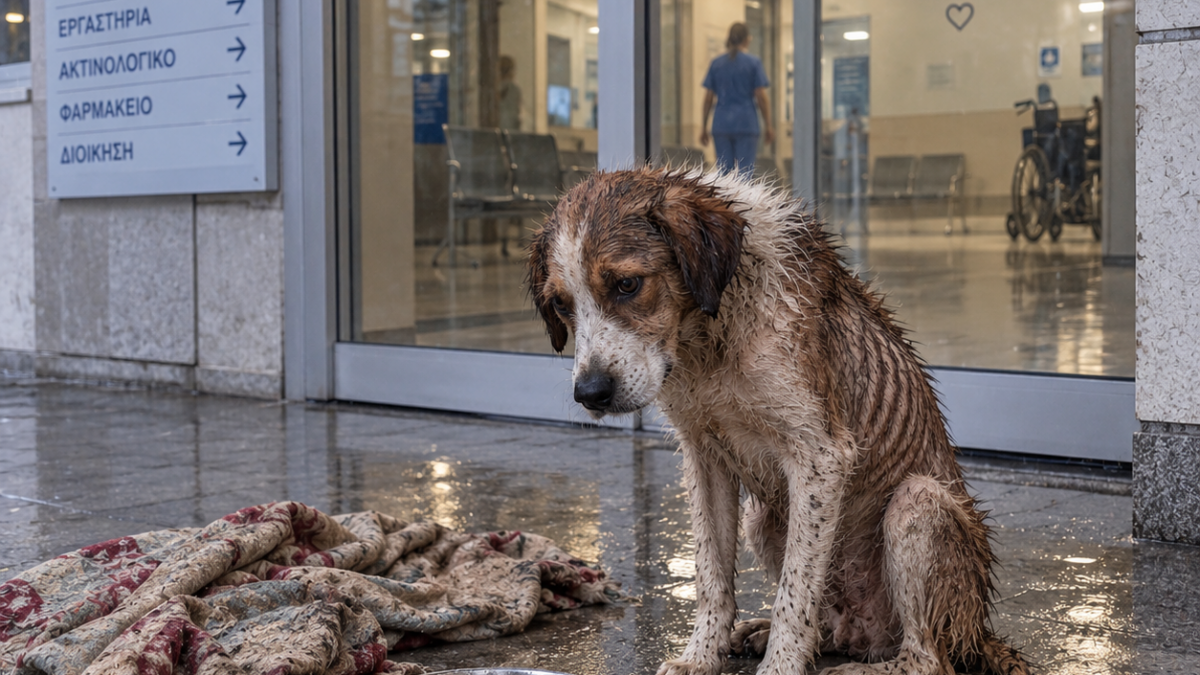
Leo stayed with his head on my knees until the rain became heavy enough to run from the edge of the awning in steady streams.
I should have gone home.
My shift had ended nearly forty minutes earlier.
I was tired, hungry, and still wearing shoes that had been uncomfortable since six that morning.
But every time I thought about standing, I looked down at Leo.
His eyes were closed.
His breathing had finally slowed.
For the first time since the ambulance arrived, he seemed to have stopped watching the doors.
I could not make myself wake him.
A security guard named Paolo came outside with an umbrella.
“Elena.”
I looked up.
“You’re going to catch pneumonia sitting there.”
“I’m wearing a coat.”
“You’re sitting on wet stone.”
“That part is less ideal.”
Paolo looked at Leo.
“So that’s the dog.”
“That’s the dog.”
“He has been here all day.”
“I know.”
“We can’t keep him outside the entrance.”
“I know that too.”
Paolo crouched.
Leo opened his eyes immediately.
His body tensed.
Paolo stopped moving.
“Easy, friend.”
Leo looked toward the hospital doors.
Then back at Paolo.
“He’s waiting for the man from this morning,” I said.
“The homeless gentleman?”
“Marco.”
Paolo nodded.
“He was transferred.”
I looked at him.
“What?”
“Before six.”
“Transferred where?”
“San Vittore Cardiac Center.”
The name hit me harder than it should have.
San Vittore was the largest cardiac hospital in the province.
When patients were transferred there directly from our emergency department, it usually meant one thing.
We could not give them what they needed.
“How bad?”
Paolo gave me the look hospital staff give one another when there is no useful answer.
“Bad enough.”
I looked down at Leo.
He had been lying outside our doors for hours after Marco was no longer inside.
Waiting in the wrong place.
The thought hurt in a way I was not prepared for.
“Does anyone know he has a dog?”
Paolo shrugged.
“The paramedics mentioned a dog following the ambulance.”
“Following?”
“They said he ran behind them for part of the route.”
I stared at him.
“The whole way?”
“Not the whole way.”
Paolo looked toward the road.
“They slowed down near the station because traffic was heavy.”
“He apparently kept appearing behind them.”
I looked at Leo differently then.
The station was nearly three kilometers away.
Maybe he had cut through side streets.
Maybe he knew the route.
Maybe he simply followed the sound and scent of the ambulance until instinct brought him here.
However he had done it, this dog had not wandered accidentally into our hospital entrance.
He had followed Marco.
I touched the wet fur between his ears.
“You really did come after him.”
Leo’s ears moved.
Paolo straightened.
“What are you going to do?”
That was the question.
I had no dog.
My apartment did not officially prohibit pets, but I had never needed to ask.
The municipal shelter was closed for ordinary intake at that hour.
We could call the emergency animal service.
That would be responsible.
They would take Leo somewhere dry.
Feed him.
Scan for a microchip.
Maybe find records.
Everything about that plan made sense.
Then the hospital doors opened.
A man in a dark jacket stepped outside.
Leo sprang to his feet.
His tail rose.
He took three quick steps toward the man.
Then stopped.
Wrong face.
His tail lowered.
He returned to the step.
Paolo watched.
“Oh.”
“Yes.”
Neither of us said anything for a moment.
Finally, I stood.
My legs were stiff.
“Give me five minutes.”
“Where are you going?”
“Inside.”
I went to the emergency desk and found Lucia, the charge nurse.
“Marco Bellini.”
She looked at the computer.
“What about him?”
“Transferred to San Vittore?”
“Yes.”
“Any emergency contact?”
Lucia scrolled.
“No.”
“Family?”
“Nothing listed.”
“Identification?”
“An old health card.”
“Address?”
“Expired registration from years ago.”
I leaned on the desk.
“Does San Vittore know about the dog?”
Lucia looked up slowly.
“The dog outside?”
“Yes.”
“Elena.”
“I’m asking.”
“I highly doubt the cardiac unit has a field labeled dog waiting outside previous hospital.”
“You know what I mean.”
Lucia sighed.
“You’re going to take him home, aren’t you?”
“I did not say that.”
“You are wearing the face.”
“What face?”
“The face you wore when you brought a pigeon into the staff lounge.”
“The pigeon had an injured wing.”
“It also defecated on the espresso machine.”
“That was unrelated.”
Lucia smiled despite herself.
Then she became serious.
“Call San Vittore tomorrow morning.”
“Tonight?”
“Elena, if Marco is unstable, nobody there is going to arrange a canine reunion at midnight.”
I knew she was right.
I hated it.
“What about the dog?”
“Take him somewhere warm.”
That was how Leo came home with me.
Not because I made a grand decision.
Because it was raining.
Because the shelter was closed.
Because Marco was gone from our building.
Because Leo was soaked.
Because sometimes life changes while everyone involved believes the arrangement is temporary.
Paolo found an old lead in the hospital’s maintenance office that had once been used for a stray dog in the parking lot.
Leo allowed me to loop it through a makeshift collar.
He did not like walking away from the entrance.
At first, he refused.
Four paws planted.
Head turned toward the glass doors.
“Leo.”
Nothing.
I had started using the name only because one paramedic remembered hearing Marco say it before losing consciousness.
“Leo.”
His ears lifted.
There.
Recognition.
I crouched.
“Marco isn’t here.”
His eyes fixed on mine.
“I’m sorry.”
Of course, he could not understand the sentence.
But he understood Marco.
The moment I said the name, his tail moved once.
Then he looked at the doors again.
I pulled gently.
He resisted.
I stopped.
No dragging.
Not after everything he had already lost that day.
So I sat back down.
Paolo stood under the awning, watching us with the patience of a man who had known me too long.
“What now?”
“We wait.”
“We have established that the dog is excellent at that.”
I almost laughed.
Fifteen minutes later, Leo stood on his own.
He walked to me.
Then toward the parking lot.
Not happily.
But willingly.
I took that as permission.
My apartment was on the second floor of a narrow building overlooking a small courtyard.
Leo climbed the stairs slowly.
Once inside, he stood in the hallway and stared at me.
No exploration.
No sniffing corners.
No excitement.
He simply waited.
I removed the wet improvised lead.
He immediately went to the front door.
Sat.
Facing it.
I put down a bowl of water.
He drank.
I offered chicken.
He ate two pieces.
Then returned to the door.
“Marco isn’t going to knock tonight.”
Leo’s ear moved.
Again.
That name.
I sat on the floor beside him.
He leaned away at first.
Then, after several minutes, shifted closer.
I found an old duvet in the closet.
Folded it.
Placed it near the wall.
Leo ignored it.
At midnight, he was still beside the front door.
At one, still there.
I went to bed.
At one-thirty, I got up and checked.
Still there.
At two, I gave up trying to sleep.
I brought a pillow and blanket into the hallway and lay on the floor.
Leo looked at me as if I were the one behaving strangely.
“Your fault.”
He sighed.
For several minutes, nothing happened.
Then he lay down beside my hip.
Not touching.
Close.
Sometime before morning, I woke with his back pressed against mine.
The next day was my scheduled day off.
At seven, I called San Vittore.
I was transferred three times before reaching someone on Marco’s unit.
A nurse named Giulia answered.
I introduced myself.
Explained Marco had arrived through our hospital.
Then I said, “This is going to sound strange, but his dog followed the ambulance to us.”
Silence.
“His dog?”
“Yes.”
“He’s with you?”
“For the moment.”
Giulia’s voice softened.
“Oh.”
“How is Marco?”
Another pause.
Professional.
Careful.
“He is very ill.”
“Conscious?”
“Not right now.”
“Was he conscious after transfer?”
“Briefly.”
“Did he say anything?”
“I can’t share clinical details beyond what’s appropriate.”
“I understand.”
I did.
I was a nurse.
That did not make me less desperate.
“There’s no family listed.”
“Social services are working on it.”
I looked toward the hallway.
Leo was sitting near the door again.
“Could you add a note that his dog is safe?”
Giulia went quiet.
Then said, “Yes.”
“Please.”
“I will.”
“And if he wakes up…”
“I’ll tell him.”
That nearly undid me.
“Thank you.”
After the call, I sat beside Leo.
“Marco is alive.”
The dog turned his head instantly.
“Alive.”
He did not understand alive.
But Marco was enough.
His tail moved.
I stroked his shoulder.
“He’s somewhere else.”
No reaction.
“San Vittore.”
Nothing.
“Marco.”
Tail.
I laughed weakly.
“You know exactly one useful word.”
Leo leaned his head against my knee.
That morning, I took him to a veterinarian.
The clinic belonged to Dr. Ricci, who had treated half the animals in our neighborhood for thirty years.
He scanned Leo.
No microchip.
Checked his teeth.
Maybe seven or eight years old.
Possibly older.
Underweight.
Fleas.
Mild skin irritation.
Old scar on one hind leg.
Otherwise surprisingly healthy.
“He has been outdoors a long time,” Dr. Ricci said.
“I think so.”
“You know the owner?”
“Patient at my hospital.”
“Homeless?”
“Yes.”
Dr. Ricci looked at Leo.
“Then this dog has probably lived a harder life than his bloodwork suggests.”
Leo stared at the door of the exam room.
“Does he always do that?”
“Since yesterday.”
“Waiting?”
“Yes.”
Dr. Ricci nodded as if this confirmed something.
“What?”
“Dogs build their world around predictable return.”
“Food.”
“Smell.”
“Footsteps.”
“Doors.”
“People.”
He touched Leo gently along the back.
“When return stops, some dogs keep performing the routine because the routine is the only map they have.”
“That sounds awful.”
“It is grief.”
“Do dogs understand death?”
Dr. Ricci paused.
“Not like we do.”
He removed the stethoscope.
“But they understand absence.”
That sentence stayed with me.
Absence.
Not death.
Not forever.
Just the repeated failure of someone to return.
I brought Leo back to the hospital entrance that afternoon.
I had no good reason.
Maybe I wanted to see what he would do.
Maybe I hoped the familiar place would reassure him.
The moment we turned the corner, Leo pulled toward the glass doors.
He remembered exactly where to sit.
Same step.
Same direction.
I stayed beside him.
Hospital staff began recognizing him.
An orderly brought water.
A receptionist brought a piece of bread.
Paolo came outside during his break.
“He’s back.”
“Apparently he has office hours.”
Leo ignored him.
Every time the doors opened, his head lifted.
Patient.
Doctor.
Cleaner.
Visitor.
Nurse.
Not Marco.
By evening, I understood that bringing him there had been a mistake.
Not cruel exactly.
But useless.
I had returned him to a question nobody could answer.
We went home.
That night, Leo ate an entire bowl of food.
Small victory.
He still slept beside the front door.
On the second day, San Vittore called me.
Giulia.
“Marco woke up for a little while.”
My heart jumped.
“Did you tell him?”
“I did.”
“And?”
“He became very agitated until he understood the dog was safe.”
I sat down at my kitchen table.
Leo was beneath it.
“Did he say his name?”
“Yes.”
“Leo?”
“Yes.”
My eyes filled.
Giulia continued.
“He kept repeating it.”
“Could I bring Leo there?”
“I asked.”
“And?”
“Not inside the cardiac unit.”
“Outside?”
“If Marco improves enough to be moved in a wheelchair later, perhaps.”
Perhaps.
A tiny word with enormous power.
I built an entire future around it before the call ended.
Marco improving.
Wheelchair.
Hospital courtyard.
Leo seeing him.
The dog running.
Marco crying.
Maybe a relative found.
Maybe temporary housing.
Maybe rehabilitation.
Maybe somehow a way forward.
I should have known better.
Nurses are trained to live inside uncertainty.
We are not trained to stop hoping.
For the next two days, Leo changed slightly.
He followed me into the kitchen.
Then the living room.
He slept on the duvet instead of beside the door for twenty minutes.
He began noticing pigeons from the window.
When I returned from the grocery store, he met me at the door.
Not Marco.
Me.
The realization gave me both joy and guilt.
I did not want him to transfer his loyalty because Marco was sick.
I did not want to become a replacement.
I simply wanted the dog to feel safe for one afternoon.
On the fourth morning, my phone rang before six.
I had worked enough hospital years to fear early calls.
It was Giulia.
“Elena?”
I sat up.
“Yes.”
Her voice told me before the words did.
“I’m sorry.”
I closed my eyes.
Leo lifted his head from the duvet.
“Marco had another cardiac event during the night.”
I could not speak.
“They tried everything.”
“When?”
“A little before five.”
I looked at the dog.
Leo stood.
Walked toward me.
“Was he alone?”
“No.”
“Good.”
My voice broke.
“Did he know Leo was safe?”
“Yes.”
That mattered.
I hated that it mattered because it was so little compared with what had been lost.
But it mattered.
Giulia continued.
“Social services located his older brother yesterday.”
“Brother?”
“Antonio Bellini.”
“Where?”
“Bergamo.”
“He came?”
“He arrived during the night.”
I let out a breath.
“Did Marco know?”
“For a short time.”
“Did they speak?”
“Some.”
She hesitated.
“Elena, Antonio would like to meet you.”
“Why?”
“Because of Leo.”
I looked down.
Leo was standing with his front paws against the side of the bed.
I lifted him.
His body settled against me.
“He knows about him?”
“Yes.”
“He didn’t know Marco still had the dog.”
That sentence carried a history.
Family separation.
Lost years.
Things unsaid.
I told Giulia I would come later that morning.
After hanging up, I sat with Leo in my arms.
For several minutes, I said nothing.
Then, because silence became unbearable, I said the only name that mattered.
“Marco.”
Leo’s ears lifted.
His eyes searched my face.
I began crying.
He licked my chin.
“No.”
I laughed through tears.
“You’re supposed to be the one I comfort.”
He licked me again.
How do you tell a dog that waiting is finished?
I had no answer.
I dressed.
Fed him.
Then took him outside.
Instead of driving directly to San Vittore, I went first to our hospital.
Leo recognized the entrance.
Same pull on the leash.
Same step.
Same glass doors.
He sat.
I sat beside him.
Morning staff came and went.
No rain this time.
Cold sunshine.
A woman pushed a wheelchair through the doors.
Leo stood.
Wrong person.
He sat again.
I placed one hand on his back.
“Marco isn’t coming.”
Nothing.
“Marco.”
His head turned.
“I’m sorry.”
He stared at me.
“I told you he would.”
My throat closed.
“That first night.”
A tear fell onto his coat.
“I told you he would come back.”
Leo leaned against my side.
Dogs do not blame us for false promises made in ignorance.
Maybe humans could learn something from that.
I stayed for ten minutes.
Then stood.
“Come on.”
Leo looked at the doors.
I waited.
No pulling.
Eventually, he stood too.
We walked away.
He turned back twice.
Then followed me to the car.
Antonio was waiting in a private consultation room at San Vittore.
He was around sixty.
Tall.
Broad shoulders.
Gray beard.
The family resemblance to Marco was obvious once I knew to look for it.
Same eyes.
Same nose.
Different life written across the face.
When I walked in with Leo, Antonio stood.
Then stopped breathing.
Or seemed to.
“That’s him?”
“Yes.”
Leo stared at him.
Antonio crouched slowly.
“Leo.”
The dog’s ears went forward.
Antonio began crying before Leo moved.
“I’ve seen pictures.”
Leo stepped closer.
Sniffed his hand.
Then his trousers.
Then Antonio’s coat.
Suddenly, Leo became frantic.
He pushed his nose into Antonio’s sleeve.
Again.
Again.
He whined.
Antonio looked at me.
“He smells Marco.”
I swallowed.
“Were you with him?”
“At the end.”
There it was.
The last scent.
Leo pressed himself against Antonio’s arm.
The man sank onto the floor.
Leo climbed partly into his lap.
Antonio wrapped both hands around the dog.
“Oh, Marco.”
Not Leo.
Marco.
For several minutes, grief blurred everyone in the room.
Brother.
Dog.
Nurse.
All joined by a man who was no longer there.
Antonio eventually sat in a chair.
Leo remained pressed to his leg.
“He got Leo six years ago,” Antonio said.
“You knew?”
“At first.”
He wiped his face.
“A friend’s dog had puppies.”
“Marco took the runt.”
I smiled faintly.
“That seems like him.”
“You didn’t know him.”
“No.”
“Not awake.”
Antonio looked at Leo.
“But yes.”
He took a breath.
“Marco always chose whatever nobody else wanted.”
There was affection in the sentence.
And frustration.
Maybe both had always existed together.
“What happened between you?”
Antonio stared at the floor.
“Our father died.”
“Marco started drinking more.”
“Then he lost work.”
“I helped.”
“Then helped again.”
“Then we fought.”
“He disappeared.”
“Sometimes he called.”
“Then less.”
Antonio’s mouth tightened.
“Eventually I stopped answering.”
I said nothing.
People often tell nurses the worst sentence of their lives because we are strangers safe enough to confess to.
Antonio continued.
“I told myself he had chosen that life.”
“Maybe some of it.”
“Not all.”
“No.”
“He never asked me for money at the end.”
“Only once.”
“What did he ask for?”
Antonio looked at Leo.
“Dog food.”
My eyes filled again.
“Two winters ago.”
“He called and said he needed twenty euros for food.”
“I told him I was done.”
Antonio rubbed both hands over his face.
“I wonder if Leo ate that night.”
Leo rested his chin on Antonio’s shoe.
I leaned forward.
“Do not turn one phone call into the whole relationship.”
Antonio looked at me.
“I’m a nurse.”
“I’ve watched families do that for fourteen years.”
“One argument becomes the last conversation.”
“One decision becomes every decision.”
“Grief does that.”
“It takes a complicated life and tries to reduce it to a single point where you think you could have changed everything.”
“Could I have?”
“Maybe.”
He winced.
I continued.
“Maybe not.”
“Both answers can be true enough to hurt.”
Antonio stared at Leo.
“What happens to him?”
“I don’t know yet.”
“You have him?”
“For now.”
“I live in Bergamo.”
“Apartment?”
“Yes.”
“Pets allowed?”
“I think so.”
He sounded uncertain.
Then he added, “My wife has two cats.”
That complicated things.
Leo had survived streets.
Maybe cats would be nothing.
Maybe they would be disaster.
We did not know.
Antonio looked at me.
“Do you want him?”
The question startled me.
“I barely know him.”
Leo leaned against my ankle.
Antonio glanced down.
“He appears to disagree.”
I laughed despite myself.
“I’m not trying to take Marco’s dog.”
“He needs someone.”
“I know.”
“And you already took him.”
“Temporarily.”
“That word is doing a lot of work.”
I liked Antonio immediately.
That annoyed me.
Marco’s few belongings were released to Antonio.
An old wallet.
A scarf.
Two shirts.
A small notebook.
A plastic bag containing dog food.
And a faded green leash.
Leo saw the leash before anyone else did.
His whole body froze.
Antonio held it up.
“This?”
Leo began whining.
I crouched.
Antonio lowered the leash.
Leo took the handle gently in his mouth.
No chewing.
No playing.
He carried it to the corner.
Lay down.
Placed his chin on top of it.
The room went quiet.
Antonio looked away.
“He knows.”
“Yes.”
“God.”
We stayed another hour.
When it was time to leave, Antonio asked if I would keep Leo for several days while he arranged Marco’s funeral and spoke with his wife.
“Of course.”
“I want to make the right decision.”
“For Leo.”
“Yes.”
“Not because I feel guilty.”
I nodded.
“That is the right way to think about it.”
Antonio gave me the green leash.
“Keep this with him.”
I did.
For the first week after Marco died, Leo carried that leash everywhere.
From the hallway to the kitchen.
From the kitchen to the duvet.
Sometimes he dragged it beside his water bowl.
At night, he slept with his nose resting across the handle.
I bought a proper harness and lead for walks.
The old leash was too worn.
But it remained his.
A memory object.
A scent.
Something his body understood even when his mind could not understand death.
The waiting changed slowly.
At first, every sound in the hallway sent Leo running to the door.
Neighbor coming home.
Lift opening.
Footsteps.
Keys.
He stood.
Listened.
Waited.
Then returned.
The first day he did not run to the door, I almost missed it.
Someone climbed the stairs outside.
Leo lifted his head from the rug.
Listened.
Then put his head back down.
I sat very still.
That tiny act felt enormous.
Another person’s footsteps had stopped meaning Marco.
I was happy for him.
Then guilty for being happy.
Grief is ridiculous that way.
Antonio visited twice before the funeral.
Leo greeted him warmly.
Especially his coat.
Marco’s scent was fading, but enough remained.
On the second visit, Antonio brought his wife, Sofia.
She was kind.
Quiet.
Leo accepted chicken from her.
Then met a blanket carrying the scent of their cats.
He sniffed.
Sneezed.
Walked away.
Not definitive.
But promising.
Antonio began imagining Leo in Bergamo.
I could see it.
So could I.
And unexpectedly, the thought made my stomach hurt.
I had told myself every day that Leo was temporary.
Temporary bowl.
Temporary bed.
Temporary fur on my coat.
Temporary warm body curled near my feet while I read.
Temporary face waiting when I came home.
Then Antonio asked, “What do you think?”
I knew what he meant.
Should we take him?
I looked at Leo.
The morally easy answer would have been yes.
Brother.
Family.
Connection to Marco.
But dogs do not inherit people like furniture.
Leo’s needs had to matter more than our symbolism.
“What is your schedule?”
“I work from home three days.”
“Sofia?”
“Schoolteacher.”
“Cats?”
“Indoor.”
“Older?”
“Five and seven.”
“Dog experience?”
“We had one years ago.”
“Fenced garden?”
“No.”
“Nearby park?”
“Across the street.”
Antonio smiled.
“Interviewing me?”
“Yes.”
“Should I provide references?”
“Possibly.”
He laughed.
Leo climbed onto my foot.
Antonio looked at him.
Then at me.
“You love him.”
I did not answer.
That was answer enough.
“You keep him.”
I shook my head.
“Antonio.”
“No.”
“You keep him.”
“He was Marco’s.”
“And Marco is gone.”
The bluntness hurt.
Antonio’s eyes filled.
“He needs someone he already trusts.”
“He trusts you.”
“Because I smell like my brother.”
“That will fade.”
Antonio nodded.
“Exactly.”
He crouched in front of Leo.
The dog sniffed his hand.
Antonio scratched under his chin.
“I want him because part of me thinks keeping Leo would give me Marco back.”
My throat tightened.
“That’s not fair to the dog.”
“No.”
Antonio looked at me.
“You want him because you started loving Leo.”
I said nothing.
“That might be fair.”
That night, after Antonio left, Leo and I sat on my living room floor.
The green leash lay between us.
“You have complicated my life.”
Leo yawned.
“I had plans.”
He lay down.
“Not particularly interesting plans.”
He closed his eyes.
“But still.”
I touched his shoulder.
“What would Marco want?”
The name opened his eyes.
Tail.
Always.
I smiled through tears.
“He would probably want you somewhere warm.”
Leo sighed.
“With food.”
Another sigh.
“Someone who talks too much.”
He rested his head on my leg.
“All right.”
The adoption paperwork took several weeks because technically Leo had to pass through municipal animal services after his owner’s death.
Antonio signed a statement declining ownership and identifying me as the preferred adopter.
The shelter performed a home check.
I passed.
Leo officially became my dog in January.
I hated the phrase my dog for months.
It felt like theft.
Then Antonio corrected me.
“He can be your dog and still have been Marco’s dog.”
I knew that intellectually.
It took my heart longer.
The first winter was difficult.
Leo hated heavy rain.
He hated cold wind.
He hated being left alone for more than a few hours.
If I put on my work shoes, he followed me.
If I touched my coat, he stood.
If I picked up my bag, he moved between me and the door.
Not aggressive.
Pleading.
Separation had become dangerous in his world.
So we trained slowly.
Five minutes.
Return.
Ten minutes.
Return.
Twenty.
Return.
My neighbor, Marta, checked on him during long shifts.
Hospital colleagues helped.
Paolo sometimes picked him up and walked him near the river.
We built proof through repetition.
I leave.
I return.
I leave.
I return.
The first time I came home and found Leo asleep instead of waiting at the door, I stood in the hallway with tears in my eyes.
Safety can look remarkably ordinary.
A sleeping dog.
That was all.
Antonio called every Sunday.
Sometimes we used video.
Leo responded to his voice, though not as intensely as Marco’s name.
Antonio never stopped talking about his brother.
Not in a reverent way.
He told me embarrassing stories.
Marco getting thrown out of a cinema at seventeen for sneaking in a stray cat.
Marco trying to repair a washing machine and flooding their mother’s kitchen.
Marco playing guitar on the balcony despite knowing only four chords.
Marco buying Leo a red sweater from a market and then pretending the dog had chosen it.
I learned Marco backward.
Through stories after death.
That happens often in nursing.
A patient arrives as a body in crisis.
Later, family fills in the life.
Marco became more than the thin man on the stretcher.
He had worked as an electrician.
Loved AC Milan.
Hated olives.
Could fix radios.
Was terrible with money.
Generous when he had it.
Stubborn when he did not.
He struggled with alcohol for years.
Then depression.
Then jobs became irregular.
Housing unstable.
Family relationships broke.
Eventually the station became familiar.
Leo stayed.
Always.
One night Antonio said, “He refused a shelter bed once because they wouldn’t take dogs.”
I looked at Leo asleep beside me.
“How do you know?”
“A social worker called me.”
“When?”
“Three years ago.”
“What did you do?”
“Nothing.”
Antonio did not defend himself.
“He said Marco could have a bed if he surrendered Leo to a kennel overnight.”
“And Marco refused?”
“Yes.”
Antonio laughed sadly.
“He told the social worker, ‘He doesn’t leave me, I don’t leave him.’”
I pressed my hand over my mouth.
Leo slept on.
Suddenly the hospital doors made perfect sense.
Marco had built their life around not separating.
Even when life became hard.
Even when a warm bed required compromise.
Leo had no reason to understand why an ambulance changed the rule.
Why this time Marco went through a door and Leo did not.
I stopped thinking of his waiting as simple loyalty.
It was expectation based on years of evidence.
Marco always returned.
Until he could not.
Spring came.
Leo gained weight.
His coat became glossy.
His ribs disappeared.
He discovered my balcony.
Every morning, he sat in the sun.
At first, always facing the street.
Then sideways.
Eventually curled with his back toward the railing.
That change meant more to me than any obedience command.
A dog who slept facing away from escape routes had started believing the world behind him was safe.
We visited Antonio in Bergamo that summer.
Leo met the cats.
Disaster did not occur.
The older cat, Mina, hissed once.
Leo sat down.
Looked offended.
Then ignored her.
The younger cat, Piero, followed Leo for two hours like a private investigator.
By dinner, all three occupied different corners of the same room.
Antonio declared it a diplomatic success.
We walked through a park near his apartment.
People sometimes asked what breed Leo was.
I always said, “Everything.”
Medium-sized mixed breed.
Brown and white.
Longer legs than a beagle.
Narrower face than a Labrador.
One ear that stood more upright than the other.
A white stripe down his nose.
No elegant pedigree.
No dramatic breed label.
Just Leo.
That mattered.
His story did not need a special breed to be extraordinary.
Antonio took us to Marco’s grave.
I had not expected to bring Leo close.
I did not know whether it would mean anything.
We stood several yards away.
Leo sniffed the grass.
Trees.
Path.
Nothing dramatic.
Then Antonio placed Marco’s old scarf beside the stone.
Leo smelled it.
Stopped.
His body went very still.
He sniffed again.
Then lay down.
Antonio began crying.
I sat beside Leo.
We stayed twenty minutes.
No bark.
No whine.
No cinematic understanding.
Only a dog lying near something that still carried a trace of his person.
Eventually, Leo stood on his own.
Walked to me.
We left.
I was grateful for the simplicity.
Real grief does not always perform.
Years passed.
Leo became part of the hospital in an unofficial way.
Not because he lived there.
He did not.
But everyone knew him.
When my schedule allowed, I brought him to outdoor charity events.
Hospital staff greeted him like an old colleague.
Paolo always said, “Late for your shift again.”
Jenna smuggled him chicken.
Lucia claimed not to like dogs and was repeatedly photographed kissing his forehead.
One winter, our social work department began discussing a recurring problem.
Patients experiencing homelessness sometimes refused medical transport because they had animals.
Dogs especially.
They feared surrender.
Theft.
Shelters.
Separation.
I thought of Marco immediately.
I told his story carefully.
No exploitation.
No dramatic speeches.
Only the practical problem.
A person should not have to choose between emergency medical care and knowing whether their animal will still be there afterward.
Our hospital partnered with two animal welfare groups.
Then a veterinary clinic.
Then the municipality.
We created a small emergency foster network.
If an unhoused patient arrived with a pet, social services could call one number.
Temporary foster.
Food.
Veterinary check if necessary.
Reunion when the patient was discharged.
It was not perfect.
Capacity was limited.
But it existed.
The first time it worked, the patient was an older man named Pietro with pneumonia.
His dog, a terrier named Berto, had been living with him in a van.
Pietro refused admission.
“Berto stays with me.”
Hospital policy said no.
Social services made one call.
A foster volunteer arrived.
Pietro watched her scan identification, sign the intake form, and photograph Berto.
“You bring him back?”
“Yes.”
“When?”
“When you leave.”
He looked at me.
“Promise?”
The word hit me.
Promises again.
This time, I knew we could keep it.
“Yes.”
Pietro stayed.
Recovered.
Eight days later, Berto returned.
The dog nearly knocked him over.
I went into the supply room afterward and cried.
Jenna found me.
“You realize hiding in here never works.”
“I know.”
“Marco?”
“Yes.”
She handed me tissues.
“That program exists because somebody noticed Leo.”
“No.”
“What?”
“It exists because Leo waited where we could see him.”
There is a difference.
Thousands of people and animals suffer invisibly.
Leo sat at a hospital entrance and made the problem impossible to ignore.
Antonio loved the program.
He donated each Christmas.
Not large amounts.
Whatever he could.
The transfer notes always listed the donor only as A.B.
He did not want Marco’s name on a plaque.
“He hated being made into a sad story,” Antonio said.
I understood.
Marco deserved to remain complicated.
Not saint.
Not cautionary tale.
Not symbol.
A man who loved his dog.
A man who struggled.
A brother.
A patient.
A person.
Leo aged slowly.
At first, only gray around the muzzle.
Then stiffness after long walks.
Dr. Ricci estimated he was probably older than we had guessed.
Maybe nine when we met.
Maybe ten.
No one knew.
It did not matter.
At eleven or twelve, Leo developed a heart murmur.
The irony frightened me.
I sat in Dr. Ricci’s clinic with Leo beside me.
“Is this what Marco had?”
Dr. Ricci looked at me gently.
“No.”
“Dogs and humans do not inherit cardiac disease from emotional proximity.”
“I know that.”
“You are a nurse.”
“I’m also irrational.”
“That is allowed here.”
Medication began later.
Then regular scans.
For years, the murmur changed slowly.
Leo remained Leo.
Walk.
Food.
Balcony.
Nap.
Marco’s old green leash remained in a wooden box beside my bookshelf.
On difficult nights, Leo still sometimes slept near it.
Less often.
But never completely stopped.
Antonio visited for Leo’s estimated fifteenth birthday.
We made no serious attempt to determine the actual date.
We used the day of adoption.
Antonio brought chicken.
I bought a ridiculous biscuit shaped like a bone.
Leo wore no hat because I respected him.
We sat on the balcony.
Antonio looked at his white muzzle.
“Marco would not believe this.”
“What?”
“That he became old.”
The sentence hurt.
“No.”
Antonio scratched Leo’s chest.
“He used to say this dog would outlive civilization.”
“Possibly.”
Leo sneezed.
“See?”
Antonio smiled.
Then his eyes filled.
“I wish Marco had seen this.”
I knew exactly what he meant.
Old age is painful.
But it is also a privilege.
Marco had protected Leo through years when neither of them had much.
Because of that love, Leo eventually got to become an old dog in sunlight.
I was only the person lucky enough to witness that part.
The next winter was harder.
Leo began coughing at night.
Medication increased.
Walks shortened.
Stairs became impossible.
I carried him.
He hated being carried unless it was his idea.
His appetite became selective.
Chicken remained acceptable.
Dog food became an insult.
I negotiated like a hostage specialist.
He won frequently.
One morning, I found him sitting by the apartment door with Marco’s green leash beside him.
He had somehow pulled it from the open box.
I stared.
“Where do you want to go?”
Leo looked at me.
I had a shift that afternoon.
But some instincts become clearer after years of watching patients reach endings.
I called work.
Jenna answered.
“I need the day.”
She heard my voice.
“Leo?”
“I don’t know.”
“Take it.”
I drove to the station.
The old square had changed.
New café.
Different benches.
Fresh pavement.
More tourists.
Same tracks.
Same winter air.
Leo walked slowly.
I let him choose direction.
He moved toward the far end of the square.
Stopped near an old stone wall.
Sniffed.
Then found a bench.
Not necessarily Marco’s bench.
Probably replaced years ago.
Leo stood beneath it.
Then lay down.
I sat.
For almost an hour, we watched trains arrive and leave.
Leo did not search frantically.
No whining.
No pulling.
He slept beside my foot.
I thought about Marco.
Maybe Leo did too.
Maybe dogs do not revisit memory in the narrative way humans do.
Maybe the smell of trains was simply familiar.
I did not need an answer.
The peace was enough.
A month later, Leo collapsed in my kitchen.
Only for seconds.
But I knew immediately.
Dr. Ricci confirmed the heart disease had progressed.
“We can adjust medication.”
“How long?”
He shook his head.
“I don’t know.”
“Months?”
“Maybe.”
“Weeks?”
“Possible.”
“Days?”
“Not today.”
That was all I needed.
Not today.
We went home.
Leo ate chicken.
Slept on the duvet.
Barked at a delivery scooter.
Not today.
Three weeks later, the answer changed.
It was just after four in the morning.
I woke because Leo was not beside the bed.
I found him in the hallway.
Near the front door.
The same place he had slept his first night with me.
He was lying on his chest.
Breathing too hard.
“Leo.”
His head lifted.
I knelt.
He tried to stand.
Could not.
I wrapped him in a blanket.
Called the emergency veterinary clinic.
Then Antonio.
He answered on the second ring.
“Elena?”
“It’s Leo.”
Silence.
Then, “I’m coming.”
“Antonio, you’re two hours away.”
“I’m coming.”
At the emergency clinic, oxygen helped.
Medication helped some.
But the ultrasound showed the truth.
Heart failure.
Fluid accumulation.
His body could be pushed a little further.
Hospitalized.
More drugs.
More procedures.
Maybe a few days.
Maybe more.
I knew what those words meant.
I had said versions of them to human families.
Now every medical phrase felt cruel.
Dr. Ricci arrived after I called him.
He had known Leo for years.
He looked at the scan.
Then at me.
“Elena.”
I shook my head.
“Don’t use my name like that.”
He sat beside me.
Leo was in my lap with oxygen near his face.
“I can give you options.”
“I know the options.”
“Yes.”
“I hate the options.”
“I know.”
I pressed my face into Leo’s fur.
He smelled like home.
Not rain anymore.
Not train station.
Not hospital steps.
My apartment.
Blankets.
Sunlight.
Years.
I whispered Marco’s name.
Leo’s ear moved.
Even then.
Even after all that time.
Marco remained somewhere inside him.
I began crying.
“You remember.”
His breathing remained hard.
I stroked the white stripe down his nose.
“He never stopped being yours.”
My voice broke.
“And you never stopped being his.”
The clinic door opened.
Antonio.
He had driven faster than I wanted to know.
His coat half-buttoned.
Hair disordered.
Face terrified.
Leo smelled him.
His tail moved once.
Antonio dropped to his knees.
“There he is.”
Leo lifted his head slightly.
Antonio pressed his forehead against Leo’s.
“Hello, old friend.”
For several minutes, nobody discussed medicine.
We simply existed together.
Then Antonio took something from his coat pocket.
Marco’s scarf.
He had kept it sealed for years.
The scent could not truly be Marco anymore.
Time takes too much for that.
Still, Leo sniffed it.
His eyes softened.
Maybe cloth itself had become enough.
Maybe all of us were inventing meaning.
I no longer cared.
Antonio placed the scarf near Leo’s paws.
“You took care of him,” Antonio whispered.
I looked up.
He was crying openly.
“You stayed with my brother when I didn’t.”
“Antonio.”
“No.”
He shook his head.
“I know we talked about this.”
“I know guilt isn’t the whole story.”
“But this dog stayed.”
Leo breathed.
Antonio touched his ear.
“Thank you.”
My throat tightened.
Then he looked at me.
“And you stayed with Leo.”
That nearly broke me.
Dr. Ricci gave us time.
Eventually, he asked whether we were ready.
No one is ready.
Readiness is not always part of mercy.
I held Leo.
Antonio kept one hand on his side.
Marco’s scarf lay beside him.
The green leash rested near my chair.
I had brought it without consciously deciding to.
Dr. Ricci gave the first injection.
Leo relaxed.
His breathing eased.
The strain disappeared from his face.
For the first time that morning, he looked comfortable.
Antonio whispered Marco’s name.
Leo’s ear moved.
I smiled through tears.
“There.”
I lowered my mouth near his ear.
“You waited long enough.”
My voice shook.
“You don’t have to wait anymore.”
His head became heavier against my arm.
“You can rest.”
Antonio cried silently.
I stroked Leo’s face.
“Marco knew you were safe.”
That mattered most.
“He knew.”
Leo released a slow breath.
I continued.
“He asked for you.”
Another breath.
“He remembered you.”
His eyes were almost closed.
“And we remembered him.”
Dr. Ricci gave the final medication.
Leo died in my arms.
Warm.
Wrapped in a blanket.
Not in rain.
Not outside a locked door.
Not wondering whether anyone would return.
For several minutes, I stayed completely still.
Antonio rested one hand on my shoulder.
Nobody hurried us.
Eventually, I placed the green leash beside Leo.
Not around him.
Nothing tied.
Nothing restraining.
Only beside.
A road already traveled.
We cremated Leo.
Antonio and I divided his ashes.
He kept a small portion.
I kept the rest.
Months later, we returned together to the square near the station.
There was an old plane tree near the edge.
With permission from the municipality, Antonio paid for a small metal tag to be attached to the memorial rail nearby.
Nothing dramatic.
No long story.
Just:
LEO
HE WAITED FOR LOVE, AND LOVE FOUND HIM AGAIN.
I argued with the wording.
Antonio said mine sounded like a hospital discharge summary.
He was probably right.
Our hospital’s animal foster program continued growing.
Other hospitals joined.
Veterinary practices donated care.
Local families volunteered.
A small boarding facility reserved two emergency spaces for pets belonging to hospitalized homeless patients.
Nobody named the program after Marco or Leo.
I am glad.
Neither of them should have to become a slogan.
But I know where the idea began.
A glass hospital door.
A wet November evening.
A thin brown-and-white dog lying in rain because leaving felt more frightening than cold.
Years later, I still work at the same hospital.
Twenty years now.
Sometimes I stand near the entrance during a night shift and remember exactly where Leo sat.
The paving stones have been replaced.
The automatic doors are newer.
Paolo retired.
Lucia moved south.
Jenna is now our head nurse and therefore even more dangerous than before.
Most staff members never met Leo.
That is how time works.
Stories become older than the people who remember them firsthand.
But occasionally, a patient arrives with a dog.
Social services makes the call.
A foster comes.
Paperwork is signed.
The patient sees exactly where the animal is going.
And I watch fear leave their face.
Every time, I think of Marco.
One winter evening, a man came in with severe pneumonia.
He lived in his car.
His dog was an elderly shepherd mix named Otto.
The man refused admission.
“No dog, no hospital.”
The doctor tried reasoning.
Nothing.
I sat beside the bed.
“I understand.”
He looked suspicious.
“No, you don’t.”
“I knew a man once who would not leave his dog either.”
His expression changed.
“What happened?”
“He got very sick.”
“And the dog?”
“Someone kept him safe.”
I called the foster network.
A volunteer arrived within forty minutes.
The man watched her photograph Otto.
Scan his chip.
Write down food instructions.
Sign every line.
“You bring him back?”
“Yes.”
“Promise?”
I looked at him.
“Yes.”
This time, unlike that rainy night with Leo, I knew the promise could be kept.
Nine days later, the man left the hospital.
Otto was waiting outside.
The reunion lasted maybe thirty seconds.
Tail.
Hands.
Tears.
Ordinary miracle.
I went into the staff room afterward.
Jenna was there.
She handed me coffee without asking.
“Leo?”
I nodded.
She sat beside me.
We did not need to say more.
That is what Leo’s story became for me.
Not only grief.
Not only loyalty.
A correction.
A small change in how we treat people whose animals are their last stable relationship.
Because when you have lost housing, work, family, health, and dignity, a dog is not an accessory.
Sometimes that animal is the one living creature that still knows you as the person you were before everything fell apart.
Leo knew Marco that way.
He knew the man who fed him.
Walked with him.
Shared blankets.
Said his name.
Refused to leave him.
Leo did not know diagnoses.
Addiction.
Homelessness.
Estrangement.
Failure.
He knew Marco.
That was enough.
I am older now.
When people hear the story, they often ask whether I think Leo spent the rest of his life missing Marco.
Yes.
I think part of him did.
But people ask that question as though missing someone means life afterward must be incomplete.
I no longer believe that.
Leo missed Marco.
Leo also loved Antonio.
He loved Paolo.
He loved chicken.
He loved the balcony.
He loved sleeping in ridiculous positions.
He loved me.
One love did not betray another.
Grief and happiness occupied the same animal.
Maybe they do that in us too.
For years, I thought the saddest image was Leo lying outside the hospital in November rain.
Now I think differently.
That image is sad.
But it is not the whole story.
The whole story includes a warm apartment.
A full bowl.
A veterinary record thick with ordinary appointments.
Summer afternoons.
A brother reconnecting with the last living piece of someone he lost.
A dog becoming old.
And one final morning when Leo no longer had to watch any door.
That is the ending I choose.
Because Marco did not come back.
Nothing I did could change that.
Leo waited for something impossible.
What we could change was what happened while he waited.
We could sit beside him.
Keep him warm.
Feed him.
Respect what Marco meant to him.
Give him another home without asking him to forget the first one.
And eventually, little by little, waiting became living.
That is what I learned from Leo.
Sometimes grief does not need to be dragged away from the door.
Sometimes you sit beside it.
You bring a blanket.
You bring water.
You stay through the rain.
And you wait until the one who is grieving decides, on his own, that he is ready to stand up and walk somewhere new.








