I went to the shelter to make a small donation—then a gray-muzzled Labrador tilted his head exactly like the dog I gave away four years ago
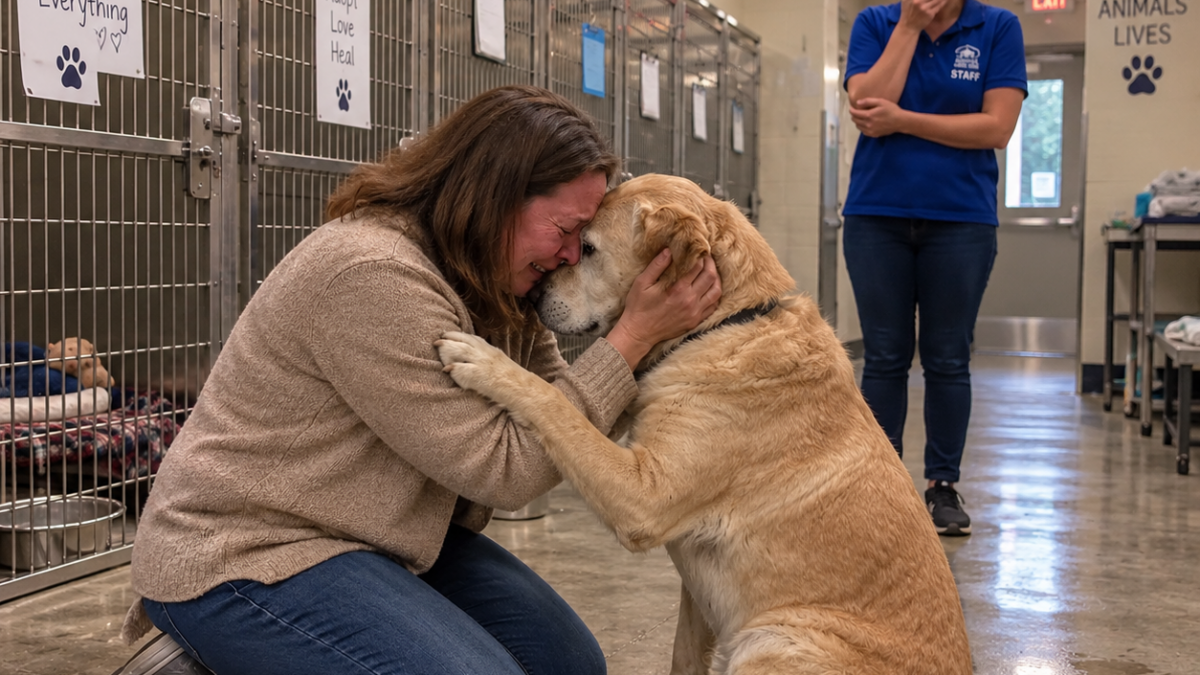
Charlie pushed his nose harder through the wire.
I put both hands against the kennel gate.
For one second, neither of us knew what to do with the distance between us.
Then his tail began hitting the metal wall behind him.
Thump.
Thump.
Thump.
Not frantic.
Not puppy excitement.
Something deeper.
Recognition fighting through four years of absence.
“Charlie.”
My voice cracked on his name.
He whined again.
The sound was so small that it hurt more than barking would have.
I had forgotten that sound.
Or maybe I had not forgotten anything.
Maybe I had simply packed those memories somewhere inside myself because opening them would have meant admitting what I had lost when I left.
A shelter employee appeared at the end of the aisle.
She was about my age, wearing navy scrubs and carrying a clipboard.
“Ma’am?”
I turned toward her, still on my knees.
“I know this dog.”
She stopped.
“You know Charles?”
“His name is Charlie.”
The employee glanced at the kennel card.
“Charles is what came in with him.”
“No.”
I shook my head.
“Charlie.”
I looked back at him.
His front paws were planted against the gate now.
“He was mine.”
The employee’s expression changed immediately.
Not suspicion exactly.
Professional caution.
Shelter workers have heard every version of that sentence.
That dog is mine.
He looks like mine.
I lost one just like him.
My ex took him.
My cousin gave him away.
People become strangely certain when there is a lonely animal on the other side of wire.
She crouched beside me.
“My name is Hannah.”
“I’m Rebecca.”
“Okay, Rebecca.”
Her voice was gentle.
“When did you last have Charlie?”
“Four years ago.”
That answer made her eyebrows lift.
“I know how that sounds.”
I wiped my face.
“I moved for work.”
“I couldn’t take him.”
“My neighbor, Margaret Williams, adopted him from me.”
“She promised to keep him.”
“What city?”
“Here.”
“Three blocks from Oak Street.”
Hannah studied Charlie.
Charlie never looked away from me.
“Do you have photos?”
Hundreds.
I had not opened them in years.
My phone shook so badly in my hands that I mistyped the password twice.
Then I found the old album.
Charlie at two years old sleeping upside down on my couch.
Charlie wearing a red bandana on Christmas.
Charlie standing beside Margaret’s rose bushes.
Charlie on the passenger seat of my old car.
Charlie with his head tilted left while I held a slice of pizza outside the frame.
I handed the phone to Hannah.
She compared the photographs with the dog behind the gate.
Same white patch beneath the chin.
Same tiny notch in the left ear.
Same darker stripe down the center of his nose.
“Do you have veterinary records?”
“I can get them.”
“Microchip?”
“Yes.”
My heart suddenly pounded harder.
“He was chipped.”
Hannah stood.
“Wait here.”
She disappeared through a door at the end of the hallway.
Charlie lowered himself onto the floor directly against the kennel gate.
I sat down too.
The concrete was cold through my jeans.
“I’m sorry,” I whispered.
His eyes stayed on mine.
“You probably don’t know what I’m apologizing for.”
His tail tapped the floor.
“I thought you were safe.”
Another tap.
“I thought about you every day at first.”
My throat tightened.
“Then every week.”
“Then I stopped letting myself think too much because it hurt.”
Charlie rested his chin against the bottom bar.
I slid my fingers through carefully.
He sniffed them.
Then licked one.
That nearly destroyed me.
Four years.
I had changed apartments three times.
Changed jobs twice.
Cut my hair short.
Grown it long again.
Gone through therapy.
Paid off debt.
Started sleeping through the night.
Learned how to live without the marriage I once thought would last forever.
Charlie had aged from five to nine.
And somehow his tongue still knew my hand.
Hannah returned with another woman.
Older.
Silver hair in a loose braid.
A name badge read CARLA – SHELTER DIRECTOR.
Carla carried a scanner.
“Rebecca?”
“Yes.”
“I’m Carla Brooks.”
She crouched beside Charlie.
“We’re going to check his microchip again.”
“Again?”
“We scanned him when he arrived.”
My heart dropped.
“And?”
“The registered information was outdated.”
Of course.
My old number.
My old address.
The house I sold.
The email account I stopped using after my divorce because too much of my old life lived there.
Carla opened Charlie’s kennel.
“Can you step back for one second?”
I moved reluctantly.
Charlie immediately tried to follow me.
Carla smiled faintly.
“That is fairly persuasive identification.”
She passed the scanner between his shoulders.
It beeped.
She read the number.
I already knew the last four digits before she finished.
“Seven-three-one-eight,” I whispered.
Carla looked up.
“You remember it?”
“I filled it out on every vet form for five years.”
She nodded slowly.
“Then we have a match.”
My knees went weak again.
Charlie tried to push past her toward me.
Carla stepped aside.
“Go ahead.”
I entered the kennel.
Charlie did not jump.
He could not have, not with his old hips.
Instead, he walked directly into my body.
He pressed his forehead against my stomach.
Then leaned.
All of him.
Seventy pounds of old Labrador trusting me to hold him up.
I wrapped my arms around his neck.
The fur around his shoulders smelled like disinfectant and shelter blankets.
Not like home.
Not like the old oatmeal shampoo I used to buy.
But underneath it, impossibly, he smelled familiar.
I buried my face against him.
“I came back.”
The words escaped before I could stop them.
Charlie’s body trembled.
“I know.”
“I know it took too long.”
His tail thumped.
Carla quietly closed the kennel door behind us and gave us several minutes.
I cried harder than I had cried when my divorce papers arrived.
Harder than when I sold the house.
Harder than the night I drove away from Margaret’s porch while Charlie watched through the rear window until the street disappeared.
Because those griefs had been about losing something.
This was about finding something I had believed I had no right to find again.
Eventually, Charlie lowered himself onto my feet.
I sat beside him.
His head immediately went into my lap.
Exactly where it used to go during thunderstorms.
Hannah returned with a box of tissues.
“Thank you.”
She handed me the entire box.
“Take it.”
“I think you’re going to need the industrial supply.”
I laughed through tears.
Charlie lifted his head at the sound.
Tilted left.
Hannah stared.
“Oh.”
“You see it?”
“I see it.”
She smiled.
“That is very specific.”
I wiped my eyes.
“What happened to Margaret?”
The question changed the room.
Carla glanced at Hannah.
Then she sat on the low bench outside the kennel.
“We don’t know everything yet.”
My stomach tightened.
“What do you know?”
“Emergency services responded to Margaret Williams’s house six days ago.”
“She had fallen.”
I covered my mouth.
“Is she alive?”
“Yes.”
Relief came first.
Then fear immediately replaced it.
“She was hospitalized.”
“She had apparently been on the floor for quite some time before a neighbor heard Charlie barking.”
I looked down at him.
He had closed his eyes in my lap.
“Charlie got help?”
“Essentially.”
Carla nodded.
“The responding paramedics found him loose inside the house.”
“No food in his bowl.”
“Water nearly empty.”
“They couldn’t leave him there.”
“Animal control brought him here.”
“Why didn’t anyone call family?”
“We tried.”
“Margaret listed no local relatives on the emergency paperwork we received.”
“Her nephew lives out of state.”
“He called yesterday.”
“What did he say?”
Carla hesitated.
“That Margaret is likely going into rehabilitation after the hospital.”
“Possibly assisted living after that.”
My hand stopped moving on Charlie’s back.
“Can she take him?”
“We don’t know.”
The answer sounded like no.
I looked at the gray fur around Charlie’s eyes.
He had already lost one home when I left.
Now maybe another.
“Does Margaret know he’s here?”
“We believe so.”
“Believe?”
“She was confused initially.”
“Her nephew said she kept asking whether someone had fed Charlie.”
I closed my eyes.
Of course she did.
Even from a hospital bed.
Even after lying helpless on a floor.
Margaret was still worried about the dog.
Guilt moved through me in a fresh wave.
I had trusted her.
She had kept the promise.
For four years.
Maybe she had loved Charlie better than I had.
“What happens now?” I asked.
Carla folded her hands.
“Legally, Charlie is still considered Margaret’s dog unless ownership is voluntarily transferred or another legal determination is made.”
I nodded.
“That makes sense.”
“You being the prior registered owner matters.”
“His recognition of you certainly matters to us emotionally.”
“But we cannot simply hand him to you today.”
I looked at Charlie.
The thought of leaving without him felt physically impossible.
“I understand.”
The words came out anyway.
That surprised me.
Four years earlier, I might have argued.
Begged.
Made everything about my pain.
But Charlie had already had enough adults making decisions around him.
I was not going to become another one.
“Can I see Margaret?”
Carla looked surprised.
“I don’t know.”
“I mean, can you give me the hospital?”
“We can’t release private information.”
“Right.”
“Of course.”
I rubbed Charlie’s ear.
“I still know her address.”
“I can try her nephew.”
Hannah spoke up.
“Her nephew left permission for the shelter to give him messages related to Charlie.”
My heart jumped.
“Could you call him?”
Carla nodded.
“I can ask whether he’s willing to speak with you.”
She stood.
“In the meantime, stay with Charlie.”
“I’m not going anywhere.”
Charlie slept against me for almost forty minutes.
At some point, I noticed his nails.
Trimmed.
His ears.
Clean.
His teeth.
Older, but cared for.
His weight was healthy.
He did not look neglected.
That mattered.
Whatever had happened to Margaret, she had not failed him.
The gray muzzle was time.
The stiffness was age.
The sadness was uncertainty.
I looked at the turquoise blanket folded in one corner of his kennel.
“Did that come with him?”
Hannah looked.
“Yes.”
“Emergency services brought it from the house.”
I pulled it closer.
Charlie lifted his nose.
Then immediately pushed his face into the fabric.
It smelled like Margaret’s home.
Like laundry detergent, maybe.
Like four years of naps.
His second life.
That was when something painful became clear to me.
Charlie had not been waiting for me all this time.
He had loved Margaret.
He had belonged to her.
He had built another life after I left.
That should have hurt.
Instead, it made me grateful.
I had not condemned him to four years of waiting.
Margaret had kept her word.
She had given him mornings, meals, walks, probably too many pieces of chicken, and a place beside her chair.
I whispered into his fur, “She loved you, didn’t she?”
His eyes opened.
Tail tap.
“Yes.”
“I thought so.”
Carla returned about ten minutes later.
“Margaret’s nephew agreed to speak with you.”
She held out the shelter phone.
“His name is Daniel.”
I stood carefully so Charlie would not slide from my lap.
“Hello?”
A man answered.
“Rebecca?”
“Yes.”
“I’m Daniel Williams.”
“Margaret’s nephew.”
“Thank you for talking to me.”
There was a pause.
“They told me Charlie recognized you.”
“He was mine before Margaret.”
“I know.”
That stopped me.
“She told you?”
“Aunt Margaret talked about you.”
My throat tightened.
“What did she say?”
Daniel sighed.
“That you loved him.”
I had expected accusation.
Instead, I got mercy.
“She said you had to move.”
“That you cried harder about Charlie than about the house.”
I laughed once through tears.
“That sounds right.”
Daniel’s voice softened.
“She never thought you abandoned him.”
Those words broke something open.
I sat back down on the kennel floor.
Charlie immediately placed his head across my thigh.
“How is she?”
“Better than she was.”
“Fractured hip.”
“Dehydrated.”
“She’s seventy-two now.”
“I know.”
“She probably shouldn’t have been living alone.”
“I should have checked on her.”
The sentence escaped me.
Daniel was quiet.
“Rebecca.”
“I left four years ago.”
“I called at first.”
“Then work got crazy.”
“Then I changed numbers.”
“And somehow I just…”
I closed my eyes.
“I stopped.”
“You weren’t family.”
“She was my friend.”
“That doesn’t make you responsible for every year.”
Tell guilt that.
“What happens with Charlie?”
Daniel exhaled slowly.
“That is why I agreed to talk.”
My hand tightened in Charlie’s fur.
“Aunt Margaret won’t be returning to the house.”
The words landed heavily.
“She knows?”
“Not completely.”
“She has moments when she’s clear.”
“Then moments when she thinks she is going home tomorrow.”
My eyes burned.
“What does she say about Charlie?”
“That he needs dinner.”
A pause.
“That he hates peas.”
I laughed and cried at the same time.
“He does hate peas.”
Daniel gave a small laugh too.
“She says he sleeps on the left side of her bed even though he’s not supposed to.”
“That sounds like Charlie.”
Then Daniel became quiet.
“She told me something this morning.”
“What?”
“She said, ‘Find the girl who gave him to me.’”
My heart stopped.
“She remembered me?”
“She called you Rebecca.”
I pressed one hand to my mouth.
“What else?”
Daniel’s voice broke slightly.
“She said, ‘Tell her I kept him safe as long as I could.’”
I bent over Charlie.
Tears fell into the fur between his ears.
“She did.”
I whispered it before remembering Daniel was still there.
“She did keep him safe.”
“She did.”
Daniel cleared his throat.
“I can’t take Charlie.”
“I have two dogs already.”
“One is reactive.”
“And I live eight hours away.”
“I’ve been sick about it.”
“You don’t have to explain.”
“I do.”
“No.”
I looked at Charlie.
“You don’t.”
Daniel went quiet.
Then he asked, “Would you take him?”
The question should have been easy.
Every part of me wanted to say yes before he finished.
But four years ago, I had made a promise based on love and circumstances.
Then circumstances changed.
Charlie had paid for that change with a goodbye.
I was not going to make another emotional decision without looking at my actual life.
So I forced myself to breathe.
“I need to check something first.”
Daniel sounded surprised.
“You don’t want him?”
“I want him so much I can barely think.”
I looked around the shelter kennel.
“That’s why I need to think.”
My apartment.
My schedule.
My landlord.
Charlie’s age.
His medical needs.
His stiffness.
Whether he had anxiety.
Whether Margaret might want him to visit.
Whether I was trying to undo my guilt rather than give him what he needed now.
“I need to make sure I can do this right.”
Daniel was silent.
Then he said, “Aunt Margaret would like that answer.”
I smiled through tears.
“Can I see her?”
“I think she’d want to see you.”
The hospital allowed me in the next morning.
Daniel arranged it.
I barely slept.
Charlie stayed at the shelter because ownership paperwork had not been completed.
I hated leaving him, but Hannah promised to give him Margaret’s blanket and put a note on his kennel asking staff to spend extra time with him.
When I arrived at St. Joseph’s Medical Center, Daniel met me outside Margaret’s room.
He was around forty-five, tall, tired, with Margaret’s pale blue eyes.
“Rebecca?”
“Yes.”
He hugged me.
That surprised both of us.
“She’s having a good morning.”
“What does that mean?”
“She knows where she is.”
“She knows she fell.”
“She knows I’m Daniel.”
He hesitated.
“She knows Charlie is not at home.”
I nodded.
“Okay.”
“She’s ashamed.”
“Why?”
“Because she thinks she broke her promise to you.”
I felt something hot and angry rise inside me.
Not at her.
At the absurd cruelty of guilt.
“No.”
I shook my head.
“She did not.”
“Tell her that.”
“I will.”
Margaret looked smaller than I remembered.
Four years had silvered all of her hair.
Her face was thinner.
One hip was immobilized, and an IV line ran into her arm.
But when I stepped into the room, her eyes widened.
For one second, I saw the woman from the porch again.
The woman holding Charlie’s leash while I loaded my last suitcase.
“Rebecca?”
I nearly collapsed.
“Hi, Margaret.”
She lifted one hand.
I went to her immediately.
She held my fingers.
“You came.”
“Daniel called.”
Her eyes searched behind me.
“Where’s Charlie?”
“At Greenwood.”
Her mouth trembled.
“They took him.”
“They’re taking care of him.”
“He hates cages.”
“I know.”
“He never liked the groomer either.”
“I remember.”
Margaret closed her eyes.
A tear moved down one cheek.
“I fell.”
“I know.”
“I tried to get up.”
“I know.”
“He barked.”
My throat tightened.
“He got help.”
“He kept licking my face.”
She opened her eyes.
“He wouldn’t leave me.”
Of course he would not.
That was Charlie.
He had never understood the concept of giving people privacy during emergencies, sadness, meals, showers, or tax preparation.
Margaret looked at me.
“I’m sorry.”
“No.”
“I promised.”
“You kept your promise.”
“No.”
Her fingers tightened around mine.
“He’s in a shelter.”
“Because you got hurt.”
“I should have made plans.”
“Margaret.”
My voice cracked.
“You gave him four years.”
Her eyes filled.
“You fed him.”
“You walked him.”
“You gave him a bed.”
“Probably half your dinner.”
“Only chicken.”
“Exactly.”
“You kept him safe.”
She shook her head faintly.
“I can’t take him where I’m going.”
The grief in her voice was unbearable.
“Daniel told me.”
“They say assisted living.”
“Maybe.”
“I don’t want maybe.”
I sat beside her.
“No one does.”
She stared toward the window.
Then she whispered, “He waited for you after you left.”
My heart tightened.
“For how long?”
“First few weeks.”
“He slept by the front window.”
“I thought I’d made a mistake taking him.”
My eyes filled.
“But then he started sleeping by my chair.”
She smiled faintly.
“He stole my socks.”
“He always did.”
“He hated peas.”
“Still does, apparently.”
Margaret laughed softly.
For a moment, we were simply two women who had loved the same dog in different chapters.
Then she looked at me again.
“He never forgot you.”
I shook my head.
“You don’t know that.”
“Yes.”
“I do.”
“How?”
“Every time a car like yours passed.”
Her voice softened.
“He looked.”
My eyes closed.
“Margaret.”
“But he was happy.”
She said it quickly.
Like she knew where my guilt was going.
“Rebecca, listen to me.”
I looked at her.
“He was happy.”
“With me.”
“I think.”
“He loved the garden.”
“He chased squirrels.”
“He slept on my feet.”
“When I got pneumonia two winters ago, he stayed beside the sofa for three days.”
“He had a life.”
“Do not turn those years into sadness because you weren’t in them.”
I cried then.
Quietly.
Margaret held my hand.
The sick woman comforting the healthy one.
Some things never make sense.
“I want to take him,” I said.
Her eyes changed.
Hope and fear together.
“Do you?”
“Yes.”
“But I’m checking my apartment first.”
“Good.”
“I’m checking my work schedule.”
“Good.”
“I’m asking the vet about his hips.”
“Very good.”
“I’m not taking him because I feel guilty.”
Margaret studied me.
“Are you sure?”
“No.”
That made her smile.
“Better answer.”
I laughed.
“I’m taking him because I loved him before.”
“And I think I still do.”
“And if I can give him a safe home now, I want to.”
Margaret looked toward the door.
“Bring him to see me.”
My chest tightened.
“I will.”
“Before he goes home.”
Home.
The word hung between us.
Which home?
Mine?
Hers?
The old one?
Maybe dogs understand something people do not.
Maybe home can be plural.
I went straight from the hospital to my apartment office.
My lease technically allowed dogs under seventy-five pounds with management approval and an additional deposit.
Charlie weighed seventy-two.
I laughed when the manager told me.
“Three pounds of destiny,” I said.
She stared at me.
“Excuse me?”
“Nothing.”
The deposit was painful.
I paid it.
My work schedule was harder.
I worked nine-hour days, four days a week, plus one remote day.
Charlie was nine.
He would not need puppy-level activity, but senior dogs should not be alone endlessly either.
My coworker Jasmine lived two blocks away and already walked her own dog at lunch.
When I explained the situation, she said, “Rebecca, you have listened to me complain about my ex for three years.”
“I can walk a Labrador.”
I nearly hugged her.
Then I called the shelter.
“Hannah?”
“It’s me.”
“I’m applying.”
There was a pause.
“For Charlie?”
“No, for the beagle in kennel twelve.”
Silence.
Then Hannah said, “That is not funny.”
“It was a little funny.”
“Charlie has been staring at the lobby all morning.”
My chest tightened.
“I’m coming.”
“Bring identification, lease approval, and any old veterinary records you can find.”
“Already printed.”
“You’re terrifying.”
“I learned from guilt.”
“That is not healthy.”
“I know.”
The shelter veterinarian examined Charlie that afternoon.
Mild arthritis.
Dental disease needing treatment.
A benign fatty mass near one shoulder.
Early clouding in one eye.
Nothing unusual for a nine-year-old Labrador.
His bloodwork was surprisingly good.
“He was well cared for,” the vet said.
I closed my eyes.
There it was again.
Proof.
Margaret had kept him safe.
I completed the application.
Carla conducted the interview personally.
Not because she distrusted me.
Because she said history made emotions dangerous.
“What happens if your job moves you again?”
“I don’t move unless Charlie can go.”
“What if your apartment changes policy?”
“I move apartments.”
“What if he develops expensive medical needs?”
“I have savings now.”
“Enough?”
“No one has enough.”
She nodded.
“Better answer.”
“What if Margaret recovers enough to want him back?”
That one hurt.
I took my time.
“Then we talk about what is best for Charlie.”
Carla watched me.
“Not what you want?”
“No.”
“Not what Margaret wants?”
“No.”
“What Charlie needs.”
“Yes.”
Carla closed the file.
“Good.”
Daniel signed Margaret’s voluntary transfer paperwork the next day with her approval.
I did not become Charlie’s owner that afternoon.
Not exactly.
We arranged foster-to-adopt first.
Thirty days.
Carla’s suggestion.
Mine too.
Because recognition is powerful.
But recognition is not the same as compatibility after four years.
Charlie knew the woman I had been.
He needed to meet the woman I was now.
Before he came to my apartment, I brought him to the hospital.
Getting permission took Daniel, a social worker, hospital administration, proof of vaccinations, a bath at the shelter, and enough paperwork to make Charlie legally more documented than most humans.
But we did it.
Hannah helped me lift him into my car.
He hesitated at the door.
Then looked at me.
“Remember this?”
I had replaced the old car years ago.
Wrong question.
“This is different.”
He tilted his head.
“I know.”
I spread Margaret’s turquoise blanket across the back seat.
Charlie sniffed it.
Then climbed in.
The entire drive, he kept one paw on the blanket and watched me through the gap between the seats.
At the hospital entrance, he became alert.
New smells.
Automatic doors.
Wheelchairs.
Strangers.
I moved slowly.
Daniel met us downstairs.
When Charlie saw him, nothing happened.
They barely knew each other.
But when the elevator opened on Margaret’s floor, Charlie’s nose lifted.
He knew.
He pulled for the first time.
Not hard.
Just urgent.
“Easy.”
His tail began moving.
We entered Margaret’s room.
She was sitting upright in bed.
For one second, Charlie froze.
Margaret covered her mouth.
“Charlie.”
The dog made a sound I had never heard before.
Half whine.
Half cry.
Then he went to her.
Hospital rules said four paws on the floor.
Charlie respected approximately none of that emotionally, though physically he could not climb onto the bed.
He pressed his head against the mattress and stretched his neck until Margaret could wrap both arms around him.
She sobbed into his gray fur.
“My boy.”
Charlie’s tail hit the cabinet.
Thump.
Thump.
Thump.
“I’m sorry.”
Charlie licked her wrist.
“I’m so sorry.”
I stood near the door crying.
Daniel cried too.
A nurse outside the room cried and pretended she was looking for gauze.
Margaret held Charlie’s face.
“Rebecca is taking you.”
Charlie looked toward me when he heard my name.
Margaret laughed through tears.
“See?”
“He remembers.”
She stroked his ears.
“You go with her.”
Charlie leaned into her.
“She’ll give you chicken.”
I laughed.
“I was hoping to maintain nutritional standards.”
Margaret ignored me.
“You sleep on the left side.”
“Even when she says no.”
“Margaret.”
“He hates peas.”
“I know.”
“He needs his medicine with cheese.”
“I wrote everything down.”
Of course she had.
Daniel handed me a notebook.
A blue spiral notebook with CHARLIE written across the front.
Inside were years of ordinary love.
Vaccination dates.
Food brand.
Medication schedule.
Favorite treats.
Words he knew.
Dates of nail trims.
A note that said:
Thunderstorms – bedroom closet, door open. Do not force him out.
Another:
When sad, give him my blue blanket.
Another:
He still looks for Rebecca when he sees dark hair from behind.
I had to close the notebook.
Margaret saw.
“I thought you should know.”
“I don’t know whether that makes me feel better or worse.”
“Both is allowed.”
We stayed almost an hour.
Eventually Charlie grew tired and lay beside Margaret’s bed.
His head rested on my shoe.
One paw touched the metal leg of her bed.
Connected to both of us.
That image stays with me.
Charlie between his two homes.
Not choosing.
Not needing to.
When it was time to leave, Margaret bent as far as she safely could.
“Charlie.”
He stood.
She pressed her forehead to his.
“You were never too much trouble.”
His tail moved.
“You were never left because I stopped loving you.”
My throat closed.
Margaret looked at me.
She was not only speaking to him.
“Sometimes people leave because life gets bigger than what they can carry.”
Charlie licked her face.
Margaret laughed.
“Terrible breath.”
“Dental appointment next week,” I said.
“Good.”
Then her expression changed.
“Bring him back.”
“I will.”
“No.”
She looked directly at me.
“Do not say things just because goodbye hurts.”
I understood.
“I’ll bring him back every week the hospital allows it.”
She held my gaze.
“Good.”
That promise became our first new routine.
Charlie came home with me that afternoon.
My apartment was on the second floor, which suddenly seemed like an architectural crime.
He made the stairs slowly.
One step.
Pause.
Another.
I stood beside him with the harness handle ready.
By the time we reached the landing, he was panting.
I immediately began looking for ground-floor apartments online.
The door to my place opened.
Charlie stopped at the threshold.
That hurt.
Four years earlier, I had watched him enter Margaret’s house while I stood outside with boxes in my car.
Now he stood outside mine.
Waiting.
Maybe dogs remember thresholds better than people do.
I went inside first.
Set Margaret’s blanket on the living room floor.
Placed the blue notebook beside it.
Then sat down.
“Take your time.”
Charlie sniffed the doorway.
Hall.
Kitchen.
Sofa.
Me.
Then he stepped inside.
He inspected everything.
Trash can.
Coffee table.
Bedroom.
Bathroom.
Closet.
He spent a suspicious amount of time smelling my shoes.
Then he returned to the living room and stood beside the sofa.
I patted the cushion automatically.
“You’re not supposed to—”
He looked at me.
Head tilt left.
I laughed.
“Margaret ruined you.”
He put one paw on the couch.
“Fine.”
Five minutes later, Charlie was asleep with his head in my lap.
I did not move for two hours.
My phone died beside me.
Dinner went uncooked.
My left leg fell asleep.
None of it mattered.
That first night was harder.
Charlie woke at eleven and stood by the front door.
I assumed he needed outside.
We walked.
He came back.
At midnight, he stood at the door again.
Then two.
Then four-thirty.
It took me until dawn to understand.
He was waiting for Margaret.
My heart broke quietly.
I sat on the floor beside him.
“She’s not coming through that door.”
Charlie watched the hallway outside my apartment.
“I know.”
“You don’t understand.”
Or maybe he did.
I brought Margaret’s blue blanket from the sofa.
Set it beside him.
Charlie sniffed deeply.
Then lay down.
His head rested on the blanket.
I slept beside him on the floor until morning.
Foster-to-adopt is not a romantic phrase.
It is logistics.
Charlie had diarrhea from stress on day two.
He refused breakfast on day three.
He barked when I went into the shower and closed the door.
He paced if I picked up my keys.
The first time I left for twenty minutes to buy groceries, Jasmine said she could hear him whining from the hallway.
Four years earlier, Charlie had tolerated me going to work without concern.
But four years had changed his understanding of leaving.
People left.
Sometimes for eight hours.
Sometimes forever.
We started again.
Keys in hand.
Sit down.
Keys on table.
Treat.
Shoes on.
No departure.
Treat.
Open door.
Close door.
Stay inside.
Treat.
Step into hall for ten seconds.
Return.
No dramatic greeting.
One minute.
Three.
Five.
Ten.
Charlie learned.
So did I.
The difference between reassurance and making anxiety bigger.
The importance of routine.
The value of returning before panic won.
I hired a trainer who specialized in senior dogs and separation distress.
Her name was Naomi.
She watched Charlie follow me from room to room and said, “He has lost two primary people.”
“I came back.”
“Yes.”
“But his nervous system does not understand biography.”
I looked at her.
“That sounded expensive.”
“It is.”
Despite the joke, she was right.
Charlie did not need my explanation of 2019.
He needed consistency in the present.
So we built it.
Morning walk.
Breakfast.
Medication.
Quiet time.
Jasmine at lunch on office days.
Remote work Friday.
Hospital visit Sunday.
Dinner at six.
Short evening walk.
Blue blanket near the sofa.
Bedroom door open.
Closet accessible during storms.
Within two weeks, Charlie stopped standing at the front door every night.
Within three, he slept through until morning.
On day twenty-one, I came home from work and found him asleep.
Not waiting at the door.
Asleep.
Jasmine had left two hours earlier.
Charlie had trusted that I would return enough to sleep.
I sat in my parked car and cried before going upstairs.
There are victories no one outside rescue or grief understands.
A dog sleeping can be one.
Margaret’s recovery was uneven.
Some Sundays she was sharp.
She asked about my job.
Corrected my grammar.
Accused me of giving Charlie too many treats while slipping him crackers behind Daniel’s back.
Other Sundays she was confused.
Once, she looked at me and asked when Rebecca was coming to pick Charlie up.
I stood frozen.
Daniel began to explain.
Margaret looked down at Charlie.
He was lying beside her wheelchair.
Then she smiled.
“She always loved this dog.”
I swallowed.
“Yes.”
“She did.”
“Tell her I kept him.”
My eyes filled.
“I will.”
On the drive home, Charlie slept in the back seat.
I cried the entire way.
By the end of the thirty-day foster period, there was no real decision left.
Not because Charlie had become easy.
Because we had become a team again.
A different team.
Older.
More cautious.
Less innocent.
But real.
Carla came to my apartment for the final home visit.
Charlie greeted her, then returned to his bed.
“Looks settled.”
“He is.”
“Still pacing?”
“Only during storms or if I change routine too quickly.”
“Eating?”
“Too enthusiastically.”
“Arthritis?”
“Better with medication and rugs.”
Carla looked toward my bedroom.
“You bought rugs everywhere.”
“He slipped twice.”
“You bought a ramp for your car.”
“Yes.”
“You’re moving?”
“Next month.”
“Ground floor?”
“Yes.”
She smiled.
“You planned.”
“I’m terrified of failing him twice.”
Carla’s expression softened.
“That is not the same thing as planning.”
I looked at her.
“What?”
“Fear can make you prepare.”
“It can also make you believe every normal mistake is a catastrophe.”
She sat across from me.
“You will miss a medication dose someday.”
“You will work late.”
“He may get sick.”
“You may get sick.”
“Life will change.”
“Adoption is not promising that nothing changes.”
I looked at Charlie.
He was snoring now.
“What am I promising?”
“That he remains part of the plan when it does.”
That became the sentence I signed under.
Charlie officially became mine again six weeks after I walked into Greenwood with a donation envelope.
Except that wording never felt quite right.
Mine again.
Charlie had never been an object returned.
He had belonged to himself all along.
Margaret had been one chapter.
I had been another.
Now we were writing a new one.
I signed the adoption papers.
Rebecca Lawson.
Carla signed.
Hannah took a photo.
Charlie slept through most of it.
When I clipped his new identification tag onto his collar, I kept the old one too.
Margaret Williams’s number was still engraved on it.
I could have removed it.
I did not.
Two tags.
Two homes.
Two women who loved him.
Our new apartment had a patio instead of stairs.
Charlie approved immediately.
He spent the first afternoon lying in a patch of sunlight near the sliding door.
Jasmine came over with a housewarming gift.
A dog bed.
Charlie ignored it and slept on the cardboard box.
“Excellent use of sixty dollars,” she said.
“Welcome to Labrador ownership.”
Winter arrived.
Charlie’s arthritis worsened slightly.
We added a second medication.
Dr. Patel recommended shorter walks and more sniffing.
Charlie had no objection to a medical plan involving slower movement and more smelling.
He became known in the neighborhood.
The old Labrador with two tags.
Children asked why.
I began saying, “He had two families who loved him.”
That sounded better than the whole story.
And it was true.
Margaret moved into assisted living in January.
A place called Rosewood Gardens.
No pets could live there permanently, but they allowed scheduled visits.
So every Sunday, Charlie and I went.
At first, Margaret recognized him instantly.
Then some weeks she needed time.
Charlie never did.
He always knew her.
He would enter the community room, scan the chairs, find her, and walk directly over.
Even when Margaret looked puzzled, Charlie rested his head in her lap.
Something in her body remembered before her mind did.
Her hands found his ears.
Her fingers moved to the same place behind his collar.
Her shoulders softened.
Once, she looked down at him and said, “I had a dog like you.”
Daniel turned away.
I knelt beside her.
“You had Charlie.”
Margaret’s eyes lifted to mine.
“Charlie?”
He licked her hand.
She laughed.
“There you are.”
Those four words destroyed every person in the room.
There you are.
Not where have you been.
Not why did you leave.
Recognition without accusation.
Charlie’s greatest gift.
Spring brought better days.
Margaret became more stable after medication changes.
She began remembering recent things more consistently.
She knew Charlie lived with me.
She approved of the new apartment.
She complained that I fed him cheap biscuits.
I upgraded them mostly to stop hearing about it.
Charlie turned ten.
We celebrated at Rosewood.
Daniel came.
Hannah and Carla came from the shelter.
Jasmine brought a ridiculous dog-safe cake.
Margaret wore a blue dress and insisted Charlie needed a bow tie.
He wore one for eleven minutes.
Then ate part of it.
“Still himself,” Margaret said.
We laughed.
I watched Charlie move between us.
Daniel scratching his shoulders.
Margaret feeding him chicken under the table.
Hannah photographing his gray face.
Me holding the leash loosely.
For years, I had imagined love as something exclusive.
If Charlie loved Margaret, maybe that meant I had lost my place.
If he still remembered me, maybe that meant part of him had never fully belonged to her.
That was human insecurity.
Charlie understood better.
Love had expanded.
Nothing was replaced.
The shelter invited me to speak at their donor dinner that summer.
I said no.
Then Carla reminded me that my original two-hundred-dollar donation was still sitting in their accounting system under my name, and she was professionally capable of guilt.
So I agreed.
I stood in a small event room with Charlie beside me.
Maybe seventy people.
Volunteers.
Donors.
Adopters.
Staff.
I told them why I had walked into Greenwood.
Not to adopt.
Not to recover my past.
Just to give a little money.
“I thought a donation was something you handed over,” I said.
Charlie sat beside my leg.
“I did not know sometimes you walk into a shelter planning to give something away and discover something has been waiting to give part of your life back.”
People cried.
I hated public speaking.
Charlie slept.
Typical.
Then I told them about Margaret.
Not as the woman who lost Charlie.
As the woman who kept him.
That mattered.
Too often, rescue stories need villains because villains make clean narratives.
Margaret was not one.
Neither was I.
Sometimes good people face impossible circumstances.
Sometimes a dog is loved by multiple people who cannot all keep him forever.
Sometimes the tragedy is not cruelty.
It is age.
Illness.
Housing.
Money.
Distance.
Rules.
Life.
I told the audience that shelters do more than save abandoned animals.
Sometimes they become bridges between chapters.
Greenwood had been Charlie’s bridge.
From Margaret back to me.
From one home to another without erasing either.
The shelter raised enough money that night to create a small emergency boarding fund for pets whose elderly owners were suddenly hospitalized.
Carla named it Margaret’s Promise.
I called Margaret afterward.
She laughed.
“That sounds too important.”
“You are important.”
“I mostly fed him chicken.”
“You did it consistently.”
“That is the secret to most good relationships.”
She was not wrong.
Margaret’s Promise began modestly.
Emergency kennel fees.
Temporary foster supplies.
Transport.
Medication pickup.
Phone calls to distant relatives.
The boring infrastructure that prevents a beloved pet from becoming permanently homeless because someone fell in a bathroom or had a stroke.
The first animal helped was a thirteen-year-old tabby whose owner needed heart surgery.
Then a small terrier belonging to a man hospitalized with pneumonia.
Then two bonded spaniels whose owner broke her hip.
Each time, I thought of Margaret lying on her floor while Charlie barked.
One small safety net can change the whole ending.
Charlie aged.
That is the part of every reunion story people would rather skip.
He turned eleven.
Then twelve.
The gray spread from his muzzle across his face.
His hearing softened.
His walks shortened.
His hips needed injections.
He stopped jumping into the car, even with enthusiasm.
So I bought a better ramp.
He stopped climbing onto the couch.
I lowered his bed beside it and slept on the floor with him during storms.
Not because he needed me every time.
Sometimes because I needed him.
Margaret declined too.
Dementia does not move in a straight line.
Some days she knew the year.
Other days she believed her husband was still alive and coming home from work.
Some days she called Daniel by his father’s name.
But Charlie remained somewhere deep.
Even when she could not say his name, she knew his body.
His smell.
The weight of his head.
During one visit, she did not recognize me at all.
I introduced myself.
“Rebecca.”
She smiled politely.
“That’s a nice name.”
Charlie walked toward her.
Margaret’s face changed before he reached the chair.
Her hands opened.
“Oh.”
He placed his head in her lap.
She stroked him.
“You came back.”
Daniel began crying.
I sat beside them.
Margaret looked at me.
“Is he yours?”
The question hurt in a strange way.
I answered carefully.
“He lives with me.”
She nodded.
“Good.”
Then she looked down at Charlie.
“He shouldn’t be alone.”
“No.”
“He isn’t.”
Margaret smiled.
“That’s good.”
It became enough.
Charlie’s health changed rapidly when he was thirteen.
A cough first.
Then fatigue.
Dr. Patel found heart disease.
Manageable.
Until it was not.
Medication bought us time.
Months.
Good months.
Slow months.
Charlie still ate.
Still enjoyed Rosewood.
Still wagged at Jasmine.
Still hated peas.
Still tilted his head left when I said something stupid.
But his body was asking for gentleness now.
Our last visit with Margaret happened on a rainy Sunday in March.
Charlie had trouble getting out of the car.
I almost canceled.
Then he saw Rosewood’s entrance.
His tail moved.
So we went in.
Margaret was having a clear afternoon.
A gift.
She saw us from across the room.
“Charlie!”
He walked toward her.
Slow.
Stiff.
Proud.
She bent forward and opened her arms.
Charlie rested his head in her lap.
Margaret looked at me.
“He’s old.”
“So are we.”
She smiled.
“You were always smart.”
“I was thirty-four and thought I knew everything.”
“That is different.”
For a while, we sat without speaking.
Rain moved down the windows.
Charlie slept between us.
Margaret stroked the gray fur around his eyes.
Then she said, “Rebecca?”
“Yes?”
“Thank you.”
I stared at her.
“For what?”
“Coming back for him.”
My throat tightened.
“You kept him until I could.”
She shook her head.
“No.”
“I kept him because I loved him.”
“You came back because you loved him.”
She looked down at Charlie.
“He was lucky.”
I took her hand.
“So were we.”
Margaret’s eyes filled.
“He forgave us both, didn’t he?”
I thought about that.
“Maybe he never blamed us.”
She smiled.
“Dogs are smarter.”
“Yes.”
“Except about peas.”
“Absolutely.”
That was the last fully coherent conversation I had with Margaret.
Three weeks later, Daniel called.
She had pneumonia.
Then complications.
She died peacefully on an April morning with Daniel beside her.
I was sitting on my apartment floor when he told me.
Charlie was asleep nearby.
I put down the phone.
Then I opened Margaret’s blue notebook.
I read every page.
The ordinary pages.
Vet appointments.
Chicken portions.
Medication notes.
Storm instructions.
One entry near the back had no date.
It said:
If something happens to me, Charlie should go to Rebecca if she can take him. If she cannot, find someone gentle. Do not let him think he was left again.
I pressed the notebook to my chest and sobbed.
Charlie woke.
He came to me.
Slowly.
He put his head in my lap.
I whispered, “She planned for you.”
His eyes stayed on mine.
“She didn’t leave you.”
His tail moved once.
I brought Charlie to Margaret’s memorial.
Rosewood allowed him into the garden courtyard.
Daniel placed a framed photograph near the flowers.
Margaret on her porch.
Charlie beside her.
The same porch where I had said goodbye four years earlier.
I had never seen the photograph.
Daniel handed me a copy.
“Look at the back.”
Margaret had written:
Rebecca trusted me with her boy. I hope someday she knows he saved me from being lonely too.
That sentence changed the entire memory of my departure.
I had spent years believing Margaret saved Charlie for me.
She had never seen it that way.
Charlie had saved her too.
Love had moved in both directions while I was gone.
After Margaret’s death, Charlie declined.
Maybe coincidence.
Maybe age.
Maybe dogs understand absence in ways we underestimate.
He still ate.
Still walked.
But he slept more.
He sometimes carried Margaret’s blue blanket from room to room.
One evening, he stood by the front door and stared into the hallway.
I sat beside him.
“She’s not coming.”
He looked at me.
“I know.”
“We both know.”
I brought the blanket.
He lay down.
I lay beside him.
We stayed there until midnight.
Two months later, Dr. Patel found fluid around Charlie’s heart.
We adjusted treatment.
He had a few more good weeks.
I made a list.
Not a bucket list.
Charlie did not care about dramatic experiences.
A good-day list.
Chicken.
Sun.
Slow walks.
Car rides.
Jasmine.
The park bench.
Margaret’s blanket.
Sleeping near me.
No pain.
Food still enjoyable.
Eyes still interested.
Tail still willing.
When the bad days began outnumbering those things, I called Dr. Patel.
She came to the apartment.
I had promised Charlie, without ever saying it aloud, that his last goodbye would not happen behind kennel bars.
He lay on Margaret’s blue blanket near the open patio door.
Rain had stopped.
The air smelled clean.
Daniel came.
Jasmine came.
Hannah came from the shelter, though she said she would stay only if Charlie was comfortable.
He wagged when he saw her.
Carla sent flowers and a note that said:
Thank you for choosing him twice.
I almost could not read it.
Charlie’s two ID tags rested against his chest.
Margaret’s old tag.
Mine.
I had left both there all those years.
I sat beside him.
He put his head in my lap.
Exactly as he had the day I found him at Greenwood.
“Hey, Charlie.”
His eyes opened.
Head tilt.
Barely.
Still there.
I laughed through tears.
“You’re ridiculous.”
Tail tap.
Dr. Patel gave him a sedative first.
His body relaxed.
The stiffness left his face.
Daniel knelt on one side.
I stayed on the other.
I opened Margaret’s notebook to the final page.
There was something I had added after her death.
Charlie was loved in every home he had.
I read it aloud.
Then I looked down at him.
“I need you to know something.”
Charlie breathed slowly.
“I thought I left you.”
My voice broke.
“But Margaret taught me that isn’t the whole story.”
“She loved you.”
“You loved her.”
“You loved me.”
“And none of those things canceled the others.”
His eyes stayed on mine.
“I’m sorry it took me four years to see you again.”
Tail tap.
“But I’m grateful I did.”
I bent down and kissed the white fur between his eyes.
“The first time I left, I told you to be good.”
I laughed softly.
“That was stupid.”
“You were always good.”
My tears fell onto his fur.
“So this time, I’ll say something better.”
I placed my hand over his heart.
“You don’t have to wait for anyone anymore.”
His breathing slowed.
“Margaret isn’t behind a door.”
“I’m right here.”
“You’re not being left.”
“You’re going loved.”
Dr. Patel waited until I nodded.
Charlie’s final breath was so quiet I almost missed it.
His head became heavier in my lap.
His heart slowed beneath my fingers.
Then stopped.
The room did not change.
That surprised me.
The refrigerator kept humming.
A car passed outside.
Somebody laughed in another apartment.
The world continued even though Charlie did not.
I stayed on the floor holding him.
Daniel placed one hand on his back.
Jasmine cried quietly.
Hannah sat near the door.
No one rushed me.
Eventually, I removed the two tags from his collar.
I held one in each hand.
Margaret.
Rebecca.
Two addresses.
Two lives.
One dog.
Charlie’s ashes were divided between us.
Most came home with me.
A smaller portion was placed beneath Margaret’s rose garden at her old house, with the new owner’s permission.
Daniel and I planted a small stone there.
It read:
Charlie
He was never between homes.
He carried both with him.
Greenwood Animal Shelter still has Margaret’s Promise.
I increased my monthly donation.
Not because I am wealthy.
I am not.
But because I understand now how close Charlie came to becoming one more older dog whose story no one knew.
The fund has helped dozens of pets whose owners were suddenly hospitalized.
Some return home.
Some go to family.
Some, when return is impossible, move carefully into new homes without losing every familiar blanket, medication note, photograph, or piece of their old life.
That last part matters to me.
We used to talk about rescue as starting over.
I do not anymore.
Sometimes starting over is the wrong goal.
Sometimes animals need continuity.
A blanket.
A name.
A routine.
A person from before.
A person from now.
A bridge.
I volunteer at Greenwood twice a month now.
Mostly with senior dogs.
The ones visitors overlook because their muzzles are gray.
The ones who do not jump at the gate.
The ones whose histories come in plastic bags with medication bottles and handwritten notes.
When someone asks me why an old dog is lying quietly in the back of a kennel, I tell them not to assume he has nothing left to give.
Charlie was nine when I found him again.
People might have looked at him and seen a tired Labrador with stiff hips.
I saw four missing years.
Margaret saw companionship.
Greenwood saw a dog who needed a bridge.
Charlie saw me.
That was enough to change everything.
Last month, a woman came into the shelter with her teenage son.
They stopped in front of an eleven-year-old golden retriever named Sam.
Sam did not come forward.
The woman looked disappointed.
“He doesn’t seem interested.”
I thought of Charlie lying in the back of his kennel.
I said, “Sit down.”
She looked at me.
“For how long?”
“As long as you can spare.”
The boy sat first.
Five minutes passed.
Then ten.
Sam lifted his head.
At twelve minutes, he stood.
At fifteen, he came to the gate.
The boy put his hand against the wire.
Sam pressed his nose to it.
The woman began to cry.
I smiled.
There are moments that repeat.
Not exactly.
But enough to make you understand that some stories keep teaching long after the dog at the center of them is gone.
Sometimes I still take out Charlie’s tags.
I keep them beside Margaret’s notebook.
One old tag with her number.
One with mine.
I used to think they represented two separate chapters.
Now I think they say something simpler.
Charlie was wanted.
Then loved.
Then loved again.
And when circumstances broke one home apart, another one formed around him.
That is not abandonment.
Not every time.
Sometimes it is the painful shape love takes when people understand they cannot be everything forever.
Four years ago, I left Charlie on Margaret’s porch believing I had failed him.
Four years later, I found him in a shelter and thought the universe was giving me a chance to undo that failure.
I was wrong both times.
Margaret had not been a temporary solution.
She had been family.
I was not reclaiming something that belonged to me.
I was accepting responsibility for the next part of a life she had protected beautifully.
And Charlie?
Charlie did what dogs do when humans finally stop making love complicated.
He remembered.
He forgave whatever needed forgiving.
He accepted the hand in front of him.
Then he came home.
Again.








